

|
Getting your Trinity Audio player ready...
|
Introduction
A Christmas letter story, if it is to be worthy of both sentiment and season, must concern itself not merely with envelopes and ink, but with the fragile hopes tucked inside them. So it is with The Midnight Delivery, wherein a weary postman—Sam Delaney by name and gruffness by habit—finds his solitary path transformed on Christmas Eve by a mailbag whose contents no mortal clerk could have sorted. Within those yellowed envelopes lie the unsent last words of souls departed: apologies never voiced, gratitude never spoken, love never confessed.
As Sam walks the snow-muffled streets of Hollyridge, delivering messages written by hands long stilled, each door he knocks upon opens not only to astonished recipients, but to grief itself—grief that softens, dissolves, and finally heals beneath the warmth of long-awaited closure. And in these humble exchanges, the postman who had long sealed his heart against all comfort finds the first cracks in his own cold defenses.
Indeed, the miracle of Christmas often arrives not in grand displays but in quiet mercies whispered between the living and the lost. Sam’s journey through the starlit streets, guided by a presence more celestial than earthly, teaches him that the letters we most fear to read often contain the very words that can set us free. Thus the night, which began in loneliness, becomes rich with revelation, guiding him back toward the family he believed himself unworthy of reclaiming.
In this tale, readers will find not ghosts of terror, but spirits of tenderness; not sorrow for its own sake, but sorrow uplifted into forgiveness. Such messages are the true postage of Christmas—paid not with coin, but with courage of the heart.
THE MIDNIGHT DELIVERY
A Christmas Tale of Letters From Beyond
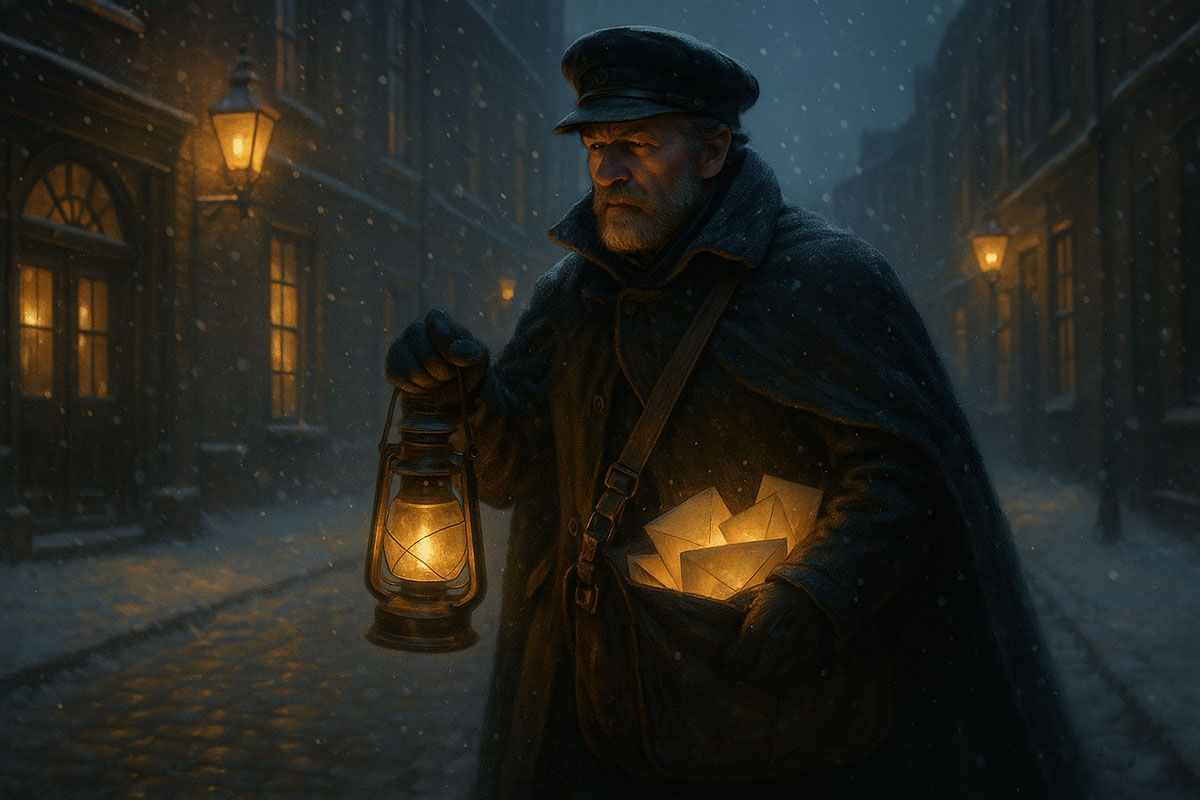
If you should ever wander through the narrow streets of Hollyridge on Christmas Eve, you might hear the soft crunch of boots upon snow, the jangling of a mailbag, and a muttered complaint or two from a man who would much rather be home with a warm fire than out delivering envelopes to households decorated with far more joy than he could tolerate.
This man was Sam Delaney—postman, widower, curmudgeon of the first order.
Sam had walked the same route for thirty years. He had delivered invitations, overdue notices, Valentine cards, and even, once, a letter addressed to a cat (which he had, with great dignity, placed neatly upon the creature’s cushion). But though he served the village faithfully in wind or sleet, Sam did so with a spirit as cold as the winter pavement.
His heart had not always been so. He had once loved Christmas—the smell of pine, the thrill of parcels, the promise of togetherness. But loss has a way of dimming bright holidays. When Sam’s wife, Margaret, passed unexpectedly one December, the season soured in his memory like spoiled milk. Since then, he delivered mail without looking at wreath or candle, for fear they might beckon emotions he preferred to keep locked away.
On this Christmas Eve, his supervisor—a cheerful youth Sam found intolerably optimistic—announced, “Delaney! I need you to take the midnight shift. Special bag. Important deliveries.”
“Midnight?” Sam scowled. “Who sends letters at midnight?”
“Not my question to ask,” the youth chirped, thrusting a heavy leather bag into his arms. “Merry Christmas!”
Sam muttered something decidedly un-Christmassy and set out.
Snow fell in soft, quiet flakes. The lamp posts cast long golden pools of light across the streets. Hollyridge looked like a painting titled Peaceful Winter Evening, but Sam saw only slippery sidewalks and decorative nonsense.
He opened the mailbag to sort the envelopes—and froze.
The letters were old. Their paper was yellowed, their ink faded. The handwriting belonged to another era. And the return addresses—Sam squinted. He knew these names. All of them.
Because all of them were dead.
“This is some fool joke,” he muttered. But duty, habit, or perhaps something deeper compelled him to deliver them anyway.

The first address belonged to Mrs. Abernathy, a widow of ten years. Sam knocked; she opened the door with weary kindness.
“Evenin’, Sam. You’re working late.”
“Special delivery,” he grunted, handing her the letter.
The moment she saw the handwriting, she gasped. Her hand flew to her mouth. Tears welled in her eyes.
“It’s his,” she whispered. “My George… his handwriting.”
She opened it with trembling fingers. As she read, her knees nearly buckled.
“Oh, George,” she wept. “You never got to say goodbye.”
Sam stood awkwardly, unsure what to do as she leaned against him, sobbing. Finally, she hugged him fiercely—a gesture he was not prepared for.
“Bless you for bringing this,” she said.
Sam shuffled away, shaken.
At the next house, a letter from a long-deceased father apologized for an argument. At another, a child received a message from his mother, gone five years, telling him how proud she still was.
With each delivery, Sam witnessed the impossible: sorrow easing, hearts mending, old wounds softening like frost under sunlight.
By the fifth house, he found himself wiping his own eyes, though he would have denied it vehemently.
At midnight, only one envelope remained.
It bore no return address. Only his name.
His breath caught. With trembling hands, Sam opened it.
The letter was written in the delicate cursive he had not seen in twelve years. Margaret’s writing.
“My dearest Sam,” it began. “If this letter has reached you, then you are still walking alone when you should be walking with others…”
He clutched the paper as though it might vanish. Tears spilled freely down his weathered cheeks.
“…You were always a good man, Sam, but grief taught you to hide your heart. It is time—oh, my love, it is long past time—to open the door again.”
He felt a gentle presence behind him.
Sam turned.
Standing beneath a streetlamp was a tall figure in a red coat—not bright like Santa’s, but deep as old wine. The man’s face was obscured by shadow, but his voice was calm and eternal.
“Some letters are too important to trust to ordinary couriers,” the stranger said. “Tonight, you were chosen to deliver what had been left unsaid.”
Sam could not speak.
“You have delivered hope to others,” the stranger continued. “Now deliver it to yourself.”
Then the figure stepped back into the shadows and vanished, leaving only the faintest warmth in the air.
Sam stood in the silent snow, holding Margaret’s letter to his heart.
By dawn, his footsteps led not to the postal office but to the house of his estranged daughter, whom he had avoided for years, believing his grief made him a burden.
When she opened the door, her eyes widened. “Dad?”
Sam held out the letter with shaking hands. “Your mother said… I’ve been alone too long.”
She pulled him inside without a word and held him tightly.
And in a small corner of Hollyridge, a heart that had frozen many winters ago began—at last—to thaw.
Final Thoughts
It is a curious trait of the human soul that the letters we postpone—whether written with pen or with feeling—are often those most needed by the very hearts we fear to burden. Sam Delaney, trudging through the frost with his magical cargo, stands as a symbol of the countless messengers we might become if only we found the courage to deliver the words our loved ones long to hear. In watching the transformation of this solitary postman, we are reminded that reconciliation is rarely a matter of grand speeches; rather, it is a humble acknowledgment of love delayed but not extinguished.
The miraculous mail he carries serves as a gentle parable: that no farewell is truly final if the memory of affection endures, and that even the quietest message—sent or unsent—can set a life aright when opened with sincerity. As dawn breaks over Hollyridge and Sam steps toward the home he once avoided, we witness a truth as old as Christmas itself: that the heart, even when chilled by grief, remains a deliverable parcel waiting for the right moment to be claimed.
May this story encourage all who read it to write their own letters of forgiveness, gratitude, and love—before time, that great postmaster, declares the window closed. And may your Christmas bring with it the courage to deliver what truly matters.
Short Bios:
Sam Delaney
An aging postman known for his gruff exterior and solitary habits. Once warm-hearted and devoted to his family, Sam withdrew from the world after losing his wife, Margaret. Years of unexpressed grief hardened him, but beneath the roughness lies a man who still yearns for connection, even if he no longer believes he deserves it.
Margaret Delaney
Sam’s late wife, remembered for her gentle spirit and unwavering love. Though no longer living, her presence is felt through the unexpected letter Sam receives—words she was never able to speak in life. Her message becomes the turning point that allows Sam to confront his grief and open his heart once more.
Mrs. Abernathy
A widow of ten years who lives alone at the edge of Hollyridge. Kindhearted but weary, she has carried the unresolved sorrow of her husband’s sudden passing. The mysterious letter she receives—written in her husband’s own hand—becomes an unexpected source of healing and the first warmth she has felt on Christmas Eve in years.
Gregory Finch
A young boy who lost his mother at a tender age. Quiet and observant, with a heart far older than his years, he receives a letter filled with love and encouragement from the mother he barely remembers. The message becomes a guiding light for his uncertain future.
The Stranger in the Red Coat
A mysterious, otherworldly figure who appears at the quietest hours of Christmas Eve. Neither ghost nor man, he delivers the enchanted mailbag to the post office and guides the night’s events with a calm, knowing presence. His role is subtle yet pivotal, offering Sam the final push toward redemption.
Eliza Delaney
Sam's estranged daughter, carrying the hurt of years spent believing her father had chosen isolation over family. When Sam arrives at her door at dawn, letter in hand and emotion raw, she rediscovers the father she thought she had lost forever.
The Town of Hollyridge
Though not a person, Hollyridge acts as a silent character—its snow-covered cottages, warm lamplight, and quiet streets shaping the emotional landscape of the story. The town becomes the stage upon which grief melts into forgiveness.
Leave a Reply