
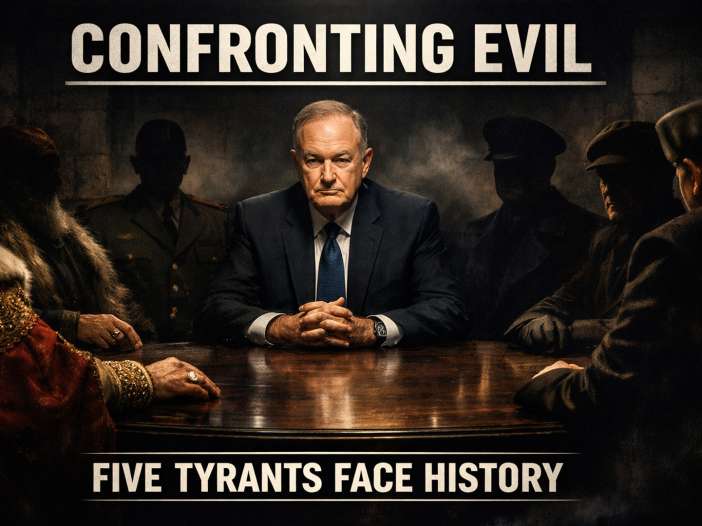
What if Bill O’Reilly could question history’s most feared rulers face to face?
Introduction by John Stuart Mill
“Bad men need nothing more to compass their ends, than that good men should look on and do nothing.”
That warning is not a decorative line for history books. It is a moral law written again and again in the rise of tyranny.
The men gathered here did not gain power by strength alone. They gained it where conscience weakened, where fear overruled duty, where citizens fell silent, and where too many people accepted what should have been resisted. Their crimes were not only acts of personal cruelty. They were public disasters made possible by submission, excuse-making, and moral retreat.
That is why this inquiry matters. We are not here merely to stare at infamous names from a safe distance. We are here to ask how a ruler comes to believe that ambition justifies suffering, that force excuses injustice, and that human lives may be sacrificed to pride, ideology, empire, faith, or the state. We are here to ask, too, how societies become willing to cooperate in such destruction.
For evil on a vast scale seldom begins with open confession. It speaks first in noble language. It claims necessity. It claims order. It claims rescue. It claims destiny. By the time its true face is fully seen, many have already adjusted themselves to its presence.
So let this discussion be heard rightly. It is not only about the guilt of tyrants. It is about the conditions that allow them to rise, the passivity that allows them to continue, and the silence that allows them to accomplish their ends. Where decent people refuse resistance, evil finds room to govern.
(Note: This is an imaginary conversation, a creative exploration of an idea, and not a real speech or event.)
Topic 1: When did power become permission to crush others?
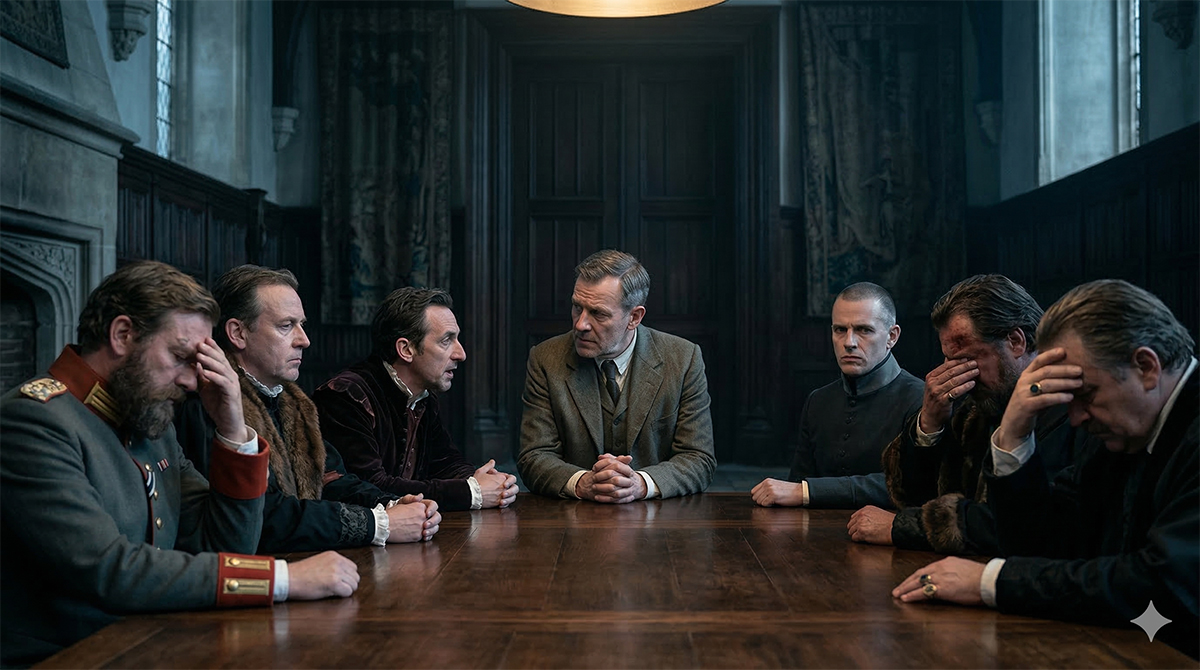
Moderator
Bill O’Reilly
Participants
Caligula
Genghis Khan
Joseph Stalin
Adolf Hitler
Mao Zedong
Opening by Bill O’Reilly
Let’s cut through the performance right now. History remembers all of you as men who brought misery on a massive scale. Not abstract misery. Real misery. Fear, executions, starvation, broken families, ruined lives. So I’m not interested in hearing polished speeches about order or destiny unless you can defend them against the human wreckage they left behind. This starts with the first break. The first moment you gave yourself permission to treat other people as disposable.
Question 1
When did you decide your ambition gave you the right to break other human beings?
Joseph Stalin: You use the language of ambition as though states are governed by personal appetite alone. They are not. A state in danger requires hardness. Men who threaten its structure must be dealt with before they damage the whole. You call that breaking human beings. I call it preserving power where softness would invite collapse.
Caligula: Your phrasing is already beneath the truth of rule. A man above others does not “decide” one morning that he has rights they do not. He discovers that power merely reveals what rank already means. If lesser men are broken in the process, that is because they stood too near someone greater than themselves.
Adolf Hitler: Ambition is the word critics use when they wish to shrink purpose into vanity. I did not seek greatness for its own sake. I saw a nation weakened, humiliated, drifting. A leader who refuses to act decisively in such conditions is the one truly guilty.
Genghis Khan: On the steppe, men are broken every day by hunger, betrayal, weakness, and indecision. I did not invent a cruel world. I mastered it. A chief who lacks force invites destruction on his own people. Harshness is often the price of survival.
Mao Zedong: A decayed society does not pass peacefully into a new age. Those who cling to old structures are not neutral. They stand in the path of change. You ask when I gave myself permission. I would say history gives no permission slips. It presents struggle, and leaders either act or fail.
Bill O’Reilly follow-up
That’s the pattern right there. None of you says, “I crossed a line.” Every one of you turns choice into necessity. That’s how the first crime gets cleaned up in the mind.
Question 2
What was the first act of cruelty you knew was wrong, but committed anyway because no one could stop you?
Genghis Khan: Wrong by whose law? The laws of the defeated? The complaints of the conquered? A ruler cannot carry every enemy’s morality on his back. The first decisive act is often the one that prevents ten more uprisings.
Adolf Hitler: Again you reduce struggle to a child’s lesson in right and wrong. A leader in crisis does not ask whether force will look severe to future critics. He asks whether hesitation will doom the nation now.
Mao Zedong: The first harsh measure in any revolution is never seen clearly by those outside it. They see pain. They do not see the old structure that would have remained if no one had acted. You ask whether I knew it was wrong. I knew it was severe. That is not the same thing.
Joseph Stalin: “No one could stop you” is a theatrical line, Bill. Power is never that simple. There are rivals, enemies, hidden factions, foreign pressure. Harsh acts are not committed in freedom from constraint. They are committed within it.
Caligula: You assume guilt before the answer. That is your mistake. If I punished, humiliated, or crushed someone, it was because I could and because they were placed beneath my judgment. Why should capacity trouble me? Weak men invent guilt to protect themselves from stronger ones.
Bill O’Reilly follow-up
No remorse. Not even a crack. You knew the suffering was real, and still none of you will call the act wrong. That tells us plenty.
Question 3
When did conscience become an inconvenience you chose to kill inside yourself?
Caligula: Conscience is often just fear wearing moral language. Men afraid to act call themselves virtuous. Men willing to act are called dangerous. I never worshiped that kind of weakness.
Joseph Stalin: Conscience is useful only so long as it does not sabotage control. A ruler who lets private feeling interfere with public security soon loses both. You may dislike that answer. It remains true.
Mao Zedong: Conscience without historical judgment becomes sentimentality. It clings to immediate pain and loses sight of larger transformation. A leader must see beyond what wounds him personally.
Genghis Khan: A commander who pauses at every cry will bury his own people with those he failed to defeat. Conscience has its place. But if it prevents necessary force, it becomes another path to ruin.
Adolf Hitler: What you call conscience can also be decay — endless hesitation, softness, moral confusion, paralysis. A leader with real purpose cannot submit to that and still lead.
Closing by Bill O’Reilly
That may be the ugliest truth of all. None of you admits that conscience was ever something to obey. At best, you treated it as a luxury. At worst, as an enemy. And once a man reaches that point, once he decides human feeling is weakness and human lives are obstacles, he is capable of almost anything.
Topic 2: Were you saving your people, or feeding your own greatness?
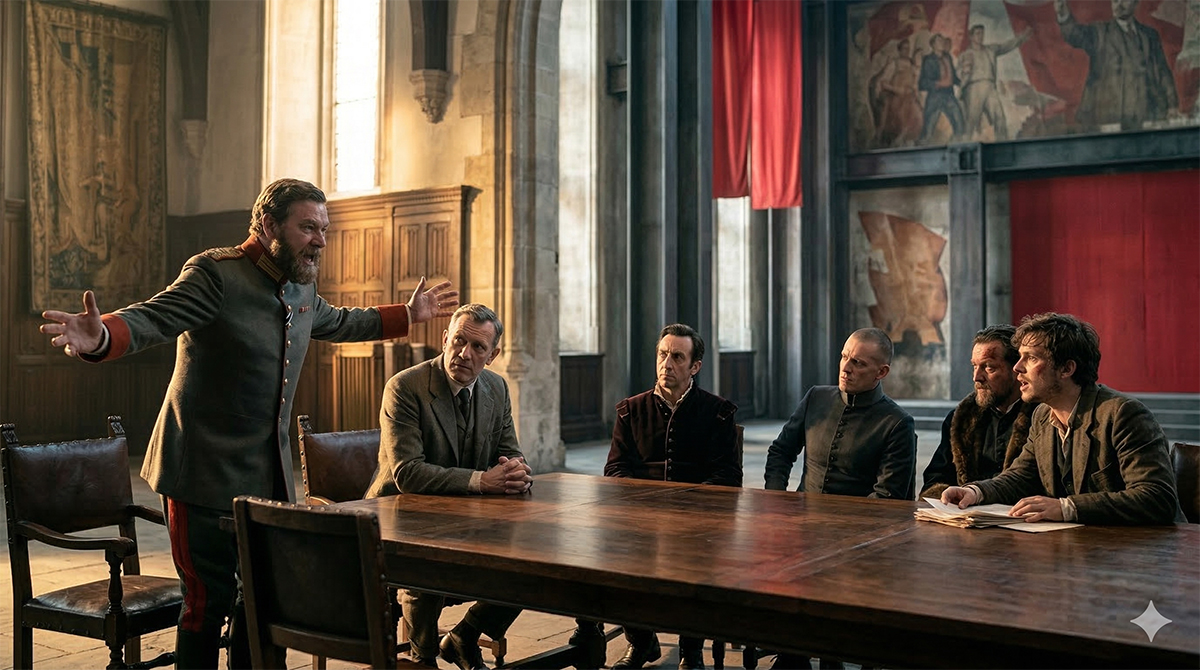
Moderator
Bill O’Reilly
Participants
Henry VIII
Genghis Khan
Adolf Hitler
Mao Zedong
Ayatollah Khomeini
Opening by Bill O’Reilly
Let’s get to the vanity at the heart of power. Every ruler at this table wrapped himself in something bigger — crown, empire, nation, revolution, religion. That is how the game is played. You don’t say, “Serve my ego.” You say, “Serve your future.” But millions paid the price for your certainty. So tonight I want to know whether you were really protecting your people, or whether you were using them to enlarge yourselves.
Question 1
How much blood was spilled so you could feel larger than ordinary men?
Henry VIII: You mistake majesty for vanity. A kingdom is not held together by a timid man hoping to offend no one. If blood was spilled, it was in the service of order, succession, and the strength of the crown. A king who appears ordinary invites chaos.
Genghis Khan: Ordinary men are forgotten. Weak rulers leave their people divided, vulnerable, and prey to stronger hands. Greatness is not a private pleasure. It is the scale required to shape events rather than be destroyed by them.
Ayatollah Khomeini: Your question belongs to a corrupt age obsessed with the self. I did not call men to me so I might feel large. I called them back to God, to discipline, to truth above personal appetite. If blood was spilled, it was not for vanity but for purification.
Adolf Hitler: This sentimental language hides the central fact: nations in humiliation do not recover through modest men. They require force, direction, and a will greater than the weakness choking them. You speak as though scale itself were a sin.
Mao Zedong: A revolutionary leader does not choose smallness when history demands rupture. Transformation on a national scale cannot be carried by a man afraid of his own magnitude. Blood belongs to upheaval, not merely to personality.
Bill O’Reilly follow-up
There it is. None of you says, “Yes, I loved my own scale.” But every answer circles back to the same excuse: only a giant could do what needed to be done. That is how ego avoids calling itself ego.
Question 2
When you told your people only you could save them, was that leadership — or your ego demanding worship?
Adolf Hitler: A broken people longs for embodiment. It wants grievance turned into will, humiliation turned into movement. If that gathered around me, it was because I expressed what weaker men could not. That is not worship. That is political force.
Mao Zedong: People in collapse do not gather around emptiness. They gather around direction. If millions saw leadership in one voice, one line, one center, that reflected the need for concentration, not mere ego.
Henry VIII: A sovereign is the body of the realm made visible. If subjects look to the king for unity, judgment, and final authority, that is not idolatry. It is monarchy. Your modern suspicion of greatness would have shattered older kingdoms.
Ayatollah Khomeini: I never asked a people to worship me. I asked them to submit to divine law. That many trusted my guidance only proves how hungry they were for moral seriousness after corruption and decay.
Genghis Khan: Men follow the one who wins, protects, punishes betrayal, and gives them a future larger than tribal scraps. Call that worship if you like. On the steppe, results settle such questions.
Bill O’Reilly follow-up
You all hide behind the same shield: “They needed me.” Maybe they did need leadership. That does not prove they needed your ego at the center of everything.
Question 3
Did you love your people, or did you love hearing them surrender themselves to your image?
Genghis Khan: Love is not the language of rule. Loyalty, strength, continuity, obedience — these matter more. A people that survives under strong command is better served than one that is loved softly into defeat.
Henry VIII: A king’s affection means little if his kingdom fractures. My duty was never to be adored for gentleness. It was to secure the realm and preserve the authority that held it together.
Mao Zedong: The people are not served by tenderness that leaves old oppression untouched. They are served when history moves, when stagnation is broken, when weakness is burned out. Personal sentiment cannot be the measure of political love.
Adolf Hitler: The question is falsely framed. A leader and a people can become one movement, one will, one destiny. In such moments, the distinction between serving them and embodying them is not as tidy as your moral language suggests.
Ayatollah Khomeini: A ruler faithful to God does not seek emotional surrender to his image. He seeks obedience to truth. If people attached themselves to me, it was because truth requires a voice in corrupt times.
Closing by Bill O’Reilly
What I hear is this: not one of you trusts ordinary people with their own future. Every answer comes back to the same poisonous idea — that your will was the vessel of history, faith, order, or survival, and that resistance to you was resistance to something sacred. That is where destructive power gets its fuel. The leader stops serving the people and starts demanding that the people serve his reflection.
Topic 3: What did you tell yourself when innocent people suffered?
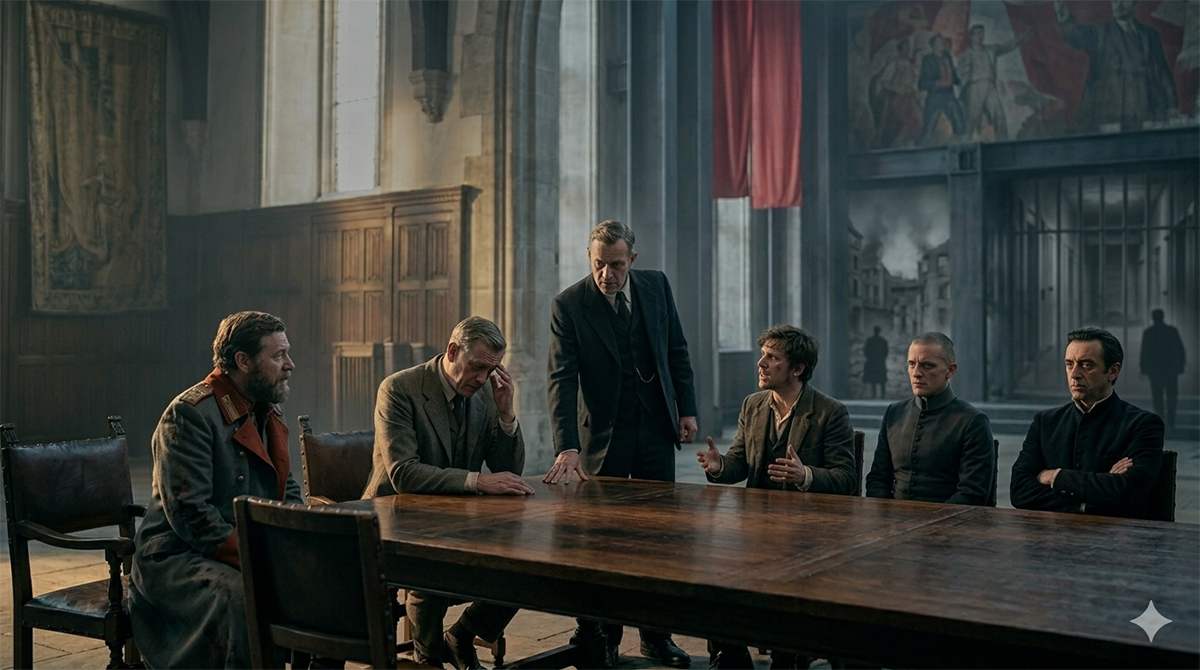
Moderator
Bill O’Reilly
Participants
Joseph Stalin
Adolf Hitler
Mao Zedong
Ayatollah Khomeini
Vladimir Putin
Opening by Bill O’Reilly
This is where every grand cause gets tested. Any ruler can speak in the language of order, destiny, sacrifice, or national survival. But sooner or later, the results appear in real human lives. Families broken apart. Citizens imprisoned. People starved, silenced, displaced, or buried. At that point, the speeches are over. What matters is the private logic that lets a ruler keep going. So that is the question tonight: when innocent people suffered under your rule, what did you tell yourself so you could live with it?
Question 1
When innocent people suffered under your rule, did you see them as tragic losses, or simply as acceptable cost?
Mao Zedong: In any great transformation, suffering appears in forms both intended and unintended. A decayed society does not become new without upheaval. The old order leaves wounds of its own, though people often notice only the wounds that come with change. I did not celebrate suffering, but I refused to let immediate pain cancel historical movement.
Vladimir Putin: The West loves this language of innocence because it simplifies conflict into moral theater. In the real world, states act under pressure, under threat, under encirclement, under instability created by others. Civilian suffering is regrettable, of course, but regret does not dissolve strategic necessity. Leaders who ignore that do not remain leaders for long.
Joseph Stalin: A state under strain cannot be governed as though every hardship is a private moral crisis. Innocent people may suffer, yes. So do innocent people suffer under disorder, sabotage, invasion, collapse, and weakness. The sentimental politician counts tears. The governing mind counts survival.
Ayatollah Khomeini: A society in moral corruption will always describe discipline, sacrifice, and confrontation as cruelty when its habits are challenged. Suffering is painful, yes, but pain does not decide truth. A people may endure hardship in the course of purification. That does not make the path false.
Adolf Hitler: No nation in existential struggle moves forward without burden. The weak observer isolates suffering from purpose and then condemns force itself. But history is not written by comfort. It is written by those willing to endure and demand endurance.
Question 2
Did you ever face clear evidence that your policies were ruining innocent lives and still choose to continue?
Joseph Stalin: Of course evidence appears. Reports come. Complaints come. Warnings come. A ruler sees damage and then asks the only serious question: if I reverse course, what follows? More disorder? More weakness? More enemies emboldened? One does not govern by recoiling at every consequence.
Adolf Hitler: All great movements attract officials who panic, rivals who exaggerate, and enemies who weaponize suffering to weaken resolve. Hardship does not automatically prove failure. It may prove that the struggle is real. A leader who abandons his line each time pressure rises is no leader at all.
Ayatollah Khomeini: Evidence must always be judged in light of motive. Some reports are sincere. Some are amplified by those who fear religious order. Some are used to soften resolve and return society to corruption. Guidance does not become false because resistance produces pain.
Mao Zedong: In a large nation, reports pass through fear, ambition, distortion, and self-protection. A leader must decide whether the problem lies in the line itself, in local misapplication, or in resistance from those trapped in the old way. It is easy to say “stop.” It is harder to judge what stopping would destroy.
Vladimir Putin: Every major state decision carries consequences that opponents will display in the harshest possible light. But leadership is not moral exhibition. It is choosing what protects national position in a hostile world. Yes, one sees the cost. The question is whether retreat creates a greater one.
Question 3
In private, how did you justify continuing once the suffering became impossible to deny?
Vladimir Putin: You use the word justify. I would use the word assess. A leader asks whether the core objective remains necessary, whether alternatives are illusions, whether delay invites humiliation, whether retreat weakens the state for years to come. Feelings exist, but states are not preserved by feelings.
Mao Zedong: One thinks in scale. A village suffers, a province suffers, a generation suffers — these are grave matters. But a civilization can also remain trapped for centuries if no one is willing to force change beyond what is comfortable. Private sorrow does not automatically settle public direction.
Ayatollah Khomeini: A ruler faithful to God does not ask first what eases the moment. He asks what restores obedience, justice, and spiritual order. Human grief is real, but grief cannot replace truth. If hardship accompanies correction, that does not invalidate correction.
Adolf Hitler: Struggle demands hardness. Once a leader accepts that his mission is larger than present pain, then pain is interpreted within that mission, not against it. A weak leader sees suffering and retreats into doubt. A strong one sees suffering and asks whether the nation can still be driven forward.
Joseph Stalin: Private conscience is often a luxury made possible by public safety. I did not rule in luxury. I ruled in danger, in competition, in threat. The question was never whether suffering was real. The question was whether control could be maintained without it. I concluded it could not.
Closing by Bill O’Reilly
What is striking here is that none of you really answers in the language of remorse. You answer in the language of scale, danger, history, faith, and national necessity. That is how rulers separate themselves from the suffering they cause. They turn real people into abstractions. Once that happens, innocence becomes background. And when innocence becomes background, cruelty can continue almost indefinitely.
Topic 4: Why did so many people obey you, defend you, or stay silent?
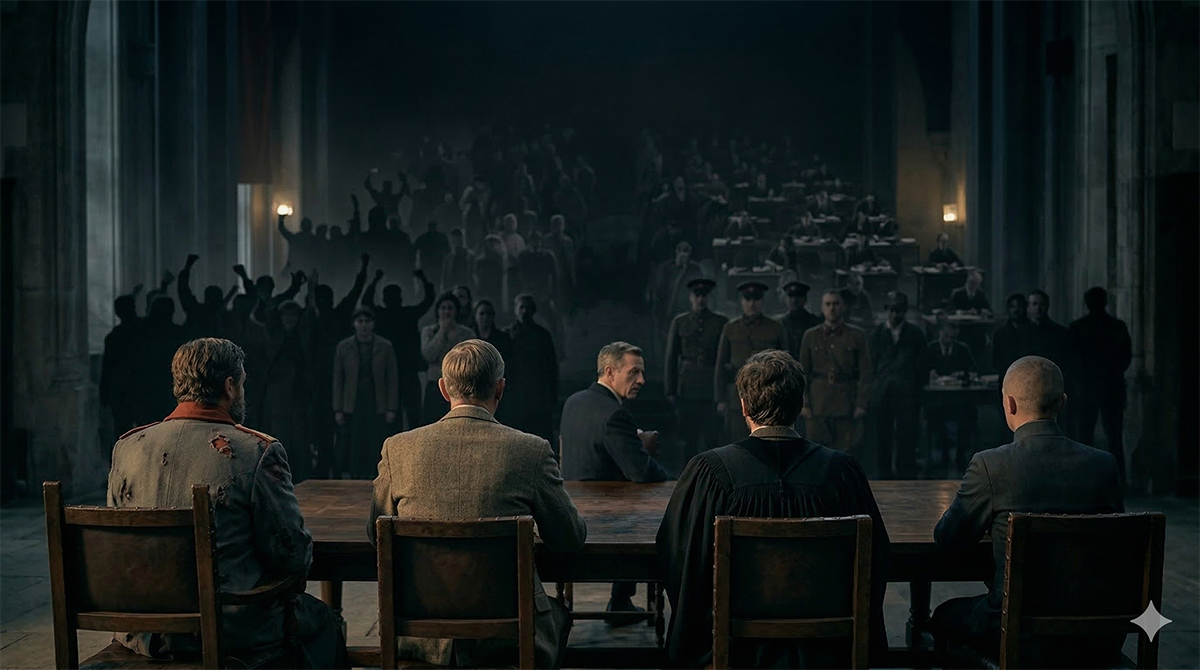
Moderator
Bill O’Reilly
Participants
Caligula
Nathan Bedford Forrest
Joseph Stalin
Adolf Hitler
Vladimir Putin
Opening by Bill O’Reilly
Let’s stop pretending tyranny is a one-man show. It isn’t. No ruler gets far on speeches and threats alone. He needs clerks, soldiers, judges, propagandists, neighbors, cowards, careerists, true believers, and people who tell themselves, “Keep your head down and stay out of it.” That is how evil gets reach. So I want to hear this from the men who lived on obedience: how did you get ordinary people to betray what they knew was right?
Question 1
How deliberately did you train ordinary people to betray conscience in exchange for safety, belonging, or reward?
Adolf Hitler: You assume conscience stands apart from community, nation, and identity. It does not. People often call it conscience when they merely mean private comfort. A movement gives them belonging, direction, and meaning greater than isolated moral hesitation. They did not feel they were betraying themselves. Many believed they were joining history.
Joseph Stalin: One does not “train” people in the childish way you suggest. One builds conditions. Reward loyalty. Punish deviation. Make examples of the reckless. Let men understand what brings advancement and what brings ruin. Very quickly, they begin teaching themselves.
Nathan Bedford Forrest: Men close ranks when they think their world is being taken from them. Safety matters. Belonging matters. Honor among their own matters. A cause becomes powerful when men fear losing place, standing, and identity more than they fear what the cause will do to others.
Caligula: Most people do not need much training. They bend quickly if the atmosphere is clear. Show them favor, rank, access, protection. Let them feel danger just close enough to stay alert. They will betray conscience on their own and call it prudence.
Vladimir Putin: You speak as if societies are made of pure individuals making neat moral choices. They are not. People live inside pressure, memory, instability, media, patriotism, fear, and ambition. They adapt to the order that surrounds them. That is not always noble, but it is human.
Bill O’Reilly follow-up
That’s a nice way of dressing it up. You built systems where conscience became expensive and compliance became profitable. Call it atmosphere, pressure, identity, or order — the result is the same. People learned to live with what should have sickened them.
Question 2
Did you study fear because you knew frightened people are easier to turn into tools?
Caligula: Study fear? No. I enjoyed its clarity. Fear strips pretense from a room. It tells you instantly who is weak, who is false, who is eager to survive at any cost. Once men are afraid, they become readable.
Vladimir Putin: Fear is only one instrument. Uncertainty is often stronger. Keep rivals off balance, keep the public unsure of where danger begins and ends, and many will choose caution without needing direct force. People manage themselves when the boundary is felt but not always spoken.
Joseph Stalin: Fear is indispensable because it corrects fantasy. Without it, people imagine consequences can be evaded, discipline can be ignored, criticism can spread freely. Fear narrows behavior. Narrow behavior stabilizes rule.
Adolf Hitler: Fear alone does not build lasting obedience. It must be joined to purpose. A frightened population may obey briefly, but a population that feels chosen, awakened, or restored will enforce the movement on its own. That is far more powerful.
Nathan Bedford Forrest: Fear has always been part of force. A people that fears social collapse, loss of control, or humiliation can be moved hard and fast. Once fear and loyalty join, men begin doing ugly things with a clear conscience.
Bill O’Reilly follow-up
So yes, you all knew exactly what fear could do. Some of you used raw terror. Some used uncertainty. Some fused fear with pride. But no one here can claim innocence. You knew frightened people are easier to herd, and you used that knowledge.
Question 3
How much of your power came from force — and how much came from discovering that many people will cooperate with evil if it protects them or profits them?
Joseph Stalin: More than idealists want to admit. Force opens the path. Self-interest keeps it crowded. Once men learn there is reward in obedience, they stop needing constant pressure. They become participants, not merely subjects.
Nathan Bedford Forrest: Men often speak of principle, but plenty stay in line because the line protects what they have. Land, status, race, reputation, local control. Once a cause promises to guard those things, men will excuse a lot.
Adolf Hitler: Cooperation grew from many sources — belief, resentment, ambition, fear, national grievance, personal gain. The comforting lie told later is that most were dragged along. Many were not. Many found in the movement something they wanted.
Caligula: Profit is a cleaner chain than iron. Give a man something to lose and he polices himself. Give him a little taste of proximity to power and he will betray others before you even ask.
Vladimir Putin: This is one of the oldest truths in politics. People call themselves practical when they adapt to power that benefits them. They call themselves trapped when history later judges that adaptation harshly. Either way, the cooperation was real.
Closing by Bill O’Reilly
That may be the most damning part of all. Tyrants count on something ugly but dependable: a lot of people will go along if resistance looks dangerous and cooperation looks useful. Not everyone. But enough. Enough to keep the machine running, enough to isolate the brave, enough to make silence feel normal. That’s why evil at the top is never the whole story. The ruler gives it direction. The crowd, the bureaucracy, the opportunists, and the bystanders give it reach.
Topic 5: What is the truth about your legacy now?
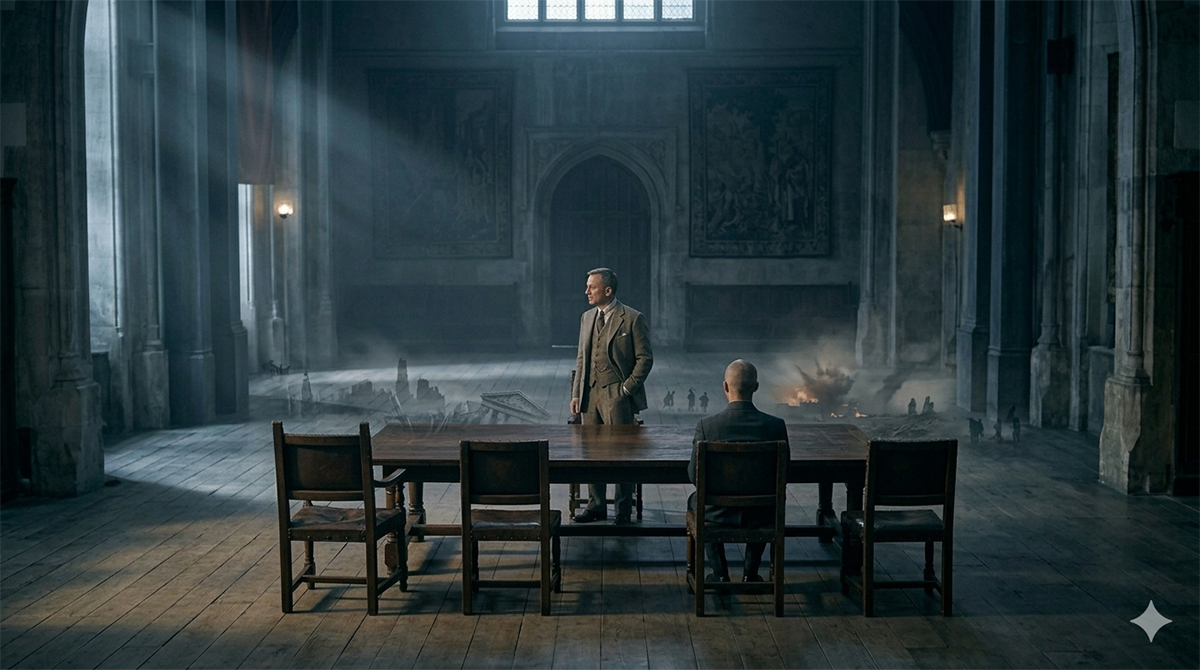
Moderator
Bill O’Reilly
Participants
Genghis Khan
Henry VIII
Joseph Stalin
Adolf Hitler
Mao Zedong
Opening by Bill O’Reilly
This is the last stop, and there’s nowhere left to hide. No court flatterers. No rallies. No state newspapers. No priests, ministers, or party officials cleaning up your image. Just history, the dead, and the damage attached to your names. Every one of you tried to shape the verdict while you were alive. You built myths, demanded loyalty, punished dissent, and wrapped yourselves in greatness. But now the question is simple: when all the propaganda burns off, what remains of you?
Question 1
Why should history remember you as anything but a destroyer of human lives?
Adolf Hitler: Because history, as written by the victorious, always seeks a single embodiment of horror. That makes later generations comfortable. It allows them to point at one figure and avoid asking how broader collapse, humiliation, and appetite for force prepared the ground. You call me destroyer because that serves the moral theater of those who survived me.
Joseph Stalin: Destruction is only one half of power. The other half is construction under pressure. States are hardened, industries built, enemies checked, institutions centralized. If history remembers only terror, it remembers selectively.
Henry VIII: A kingdom is not ruled without injury, rupture, and severity. But to remember only destruction is the luxury of those who inherit stability without having to secure it. I strengthened the crown and altered the course of England. That, too, is part of memory.
Genghis Khan: Men remember fire when they are burned by it. They remember order when they live under what follows. I destroyed many things. I also remade the map. The defeated and the inheritors do not speak with one voice.
Mao Zedong: A revolutionary leader will always be condemned by those who isolate suffering from transformation. But a vast nation did not remain what it had been. If history speaks honestly, it must account for both what was broken and what was remade.
Bill O’Reilly follow-up
There’s the first dodge. Every one of you says some version of, “Yes, people suffered, but look what I built.” That’s the oldest refuge of destructive power — achievement offered as a discount on misery.
Question 2
Do you still cling to the excuse that what you built was worth the misery you caused, or is that the final lie you refuse to surrender?
Henry VIII: You call it an excuse because you want morality free from consequence. Rulers do not live in that world. If harshness preserved sovereignty and secured succession, then harshness was part of rule, not a lie told afterward.
Mao Zedong: The word “worth” makes history sound like a private bargain, as if suffering and transformation can be neatly weighed on a small scale. They cannot. Upheaval wounds deeply, yes, but stagnation and subjugation wound deeply too. That tension does not vanish because you demand a cleaner sentence.
Genghis Khan: Men weakened by peace speak often of misery and seldom of what weakness invites. A fragmented people is devoured. A conquered land suffers under many masters instead of one. Strength carries cost, but the absence of strength carries cost too.
Joseph Stalin: I surrender nothing to sentimental accounting. The world is not ruled by men who weep over the necessity of every hard measure. If the structure stands, if the state survives, if enemies are held back, then history has already issued part of its answer.
Adolf Hitler: “Final lie” is your phrase, not mine. A defeated movement is denied all complexity. Its goals, force, appeal, and vision are collapsed into one permanent accusation. That may satisfy moral appetite. It does not settle historical truth.
Bill O’Reilly follow-up
Not one of you will say the plain thing: “No, the suffering was too great.” Not one. That refusal tells the story better than any monument ever could.
Question 3
If every dead victim stood before you right now, what could you say that would not sound like one more lie?
Genghis Khan: I would not insult them with softness. I would tell them the world was harsh before me, harsh under me, and harsh after me. I did what rulers do when they refuse weakness. They would hate the answer, but it would not be false.
Henry VIII: I would say that rule forces choices the dead no longer carry. A sovereign acts amid threat, rivalry, and consequence. Some who suffered would reject any defense, and perhaps rightly. But I would not pretend the crown could have been preserved by gentleness alone.
Adolf Hitler: The dead, as summoned by later ages, are always made to speak with the morality of the victors. Yet if answer must be given, I would say I acted with total conviction in an age of drift, weakness, and fragmentation. You may condemn conviction, but you cannot call it hesitation.
Joseph Stalin: Very little could be said without sounding insufficient. Breath is not restored by explanation. But honesty would require this: I chose control, endurance, and state preservation over human softness, and many were crushed beneath that choice. Explanation does not erase the crushing.
Mao Zedong: I would say history is tragic, and that nations do not pass through violent transformation without wounds that cannot be spoken away later. Some would hear that as evasion. I understand why. But there is no sentence that can return the lost.
Closing by Bill O’Reilly
And that’s the final verdict. No repentance. No real surrender. No moment where any of you says, “I had no right.” You still reach for the same shields — strength, necessity, transformation, sovereignty, conviction. But history is not required to accept those shields. Neither are the dead.
What survives you is not just what you built. It’s what people had to endure under your hand. The terror. The broken families. The silence. The fear. The graves. That’s your legacy too, whether you admit it or not.
And maybe that’s the last lesson of all: destructive rulers spend their lives trying to control the story told about them. In the end, they don’t control it. The victims do. The survivors do. The generations that inherit the damage do. That is where the real judgment comes from.
Final Thoughts by Bill O’Reilly
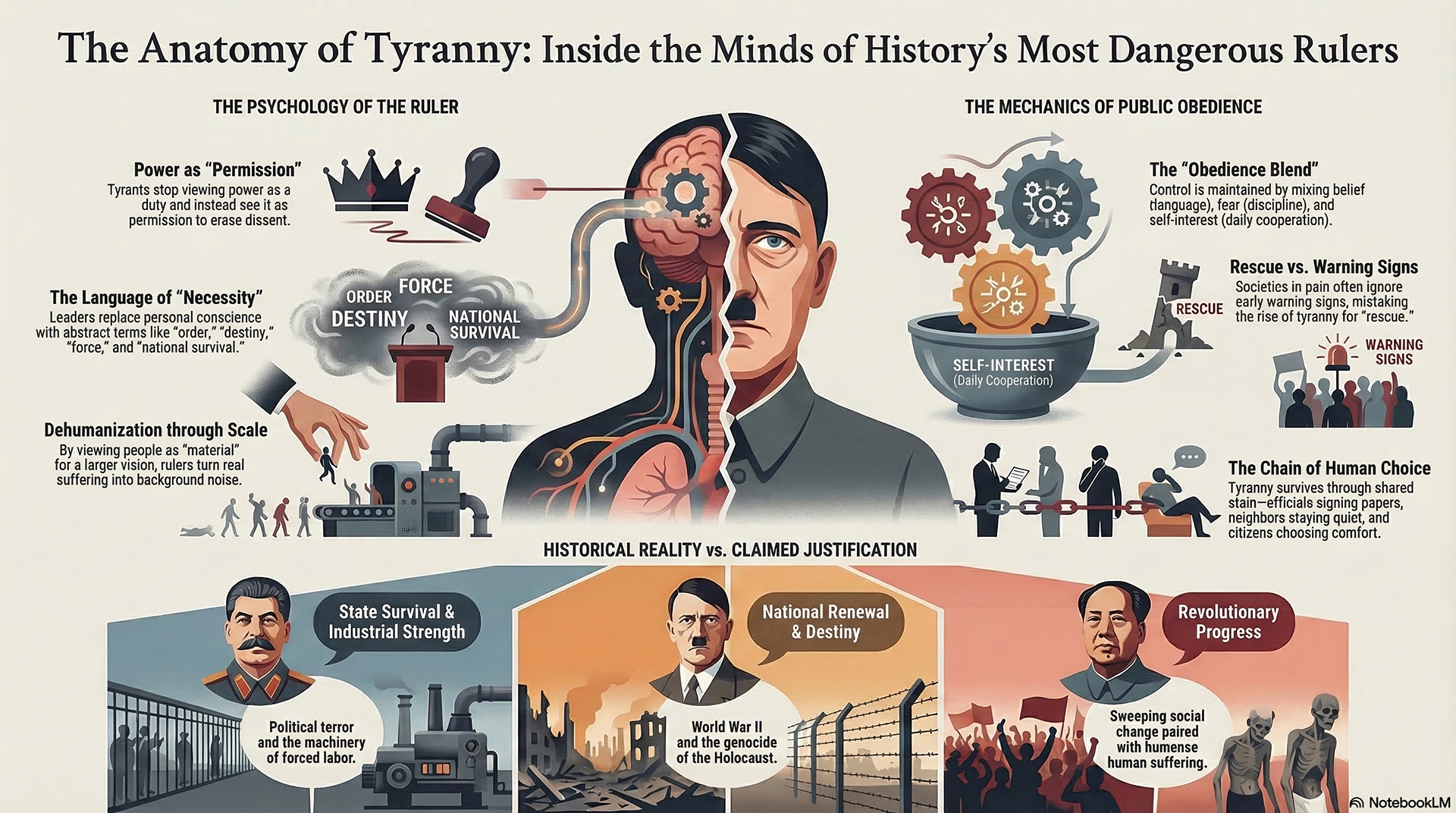
Mill had it right from the start: “Bad men need nothing more to compass their ends, than that good men should look on and do nothing.” After hearing these men speak, that doesn’t sound like old philosophy. It sounds like a direct explanation of how history keeps getting bloodied.
What did this conversation confirm? First, none of these rulers thinks of himself in plain moral terms. None says, “I wanted cruelty.” None says, “I had no right.” They reach for the same cover every time — necessity, order, strength, survival, revolution, faith, destiny. Different centuries, same dodge. That’s how destructive power talks when it wants to keep its hands clean.
Second, it confirmed that the tyrant alone is never the whole story. Evil at this scale needs help. It needs frightened citizens, ambitious officials, obedient institutions, silent neighbors, people who profit, people who look away, people who decide that speaking up costs too much. That is where Mill’s warning bites hardest. The ruler may drive the machine, but plenty of others keep it running.
Third, it confirmed that once a leader places his cause above ordinary human life, almost anything becomes possible. Starvation becomes policy. Fear becomes method. Lies become public language. Misery becomes acceptable. And the man responsible no longer hears conscience as a command. He hears it as interference.
So what is the lesson? Not just that history produced terrible rulers. We already knew that. The lesson is that tyranny grows in the space created by moral surrender. It grows when people admire force more than truth, obedience more than conscience, and belonging more than justice.
That’s why Mill’s warning still stands. Bad men do need something from the rest of us. They need silence. They need hesitation. They need the decent to stay passive long enough for cruelty to settle in and call itself normal.
And once that happens, looking on and doing nothing is no longer innocence. It becomes part of the crime.
Short Bios:
Bill O’Reilly: American journalist, television host, and bestselling author known for his direct style and his historical nonfiction books, including Confronting Evil.
Caligula: Roman emperor from AD 37 to 41 whose reign became infamous for excess, cruelty, and the abuse of absolute power.
Genghis Khan: Founder of the Mongol Empire who united the steppe tribes and launched conquests that reshaped much of Asia and Europe.
Joseph Stalin: Soviet leader who ruled through centralized control, purges, forced labor, and political terror while transforming the USSR into a major world power.
Adolf Hitler: Dictator of Nazi Germany whose rule led to World War II and the Holocaust, leaving one of history’s darkest legacies.
Mao Zedong: Chinese revolutionary leader and founder of the People’s Republic of China, remembered for sweeping social change and immense human suffering under his campaigns.
Henry VIII: King of England best known for breaking with the Roman Catholic Church, expanding royal power, and ruling with fierce personal authority.
Ayatollah Khomeini: Iranian cleric who led the 1979 revolution and established the Islamic Republic of Iran under strict religious rule.
Vladimir Putin: Russian leader who has dominated the country’s politics for decades through centralized authority, nationalism, and suppression of opposition.
Nathan Bedford Forrest: Confederate cavalry leader later associated with the early Ku Klux Klan, remembered as a deeply controversial figure in American history.
Leave a Reply