
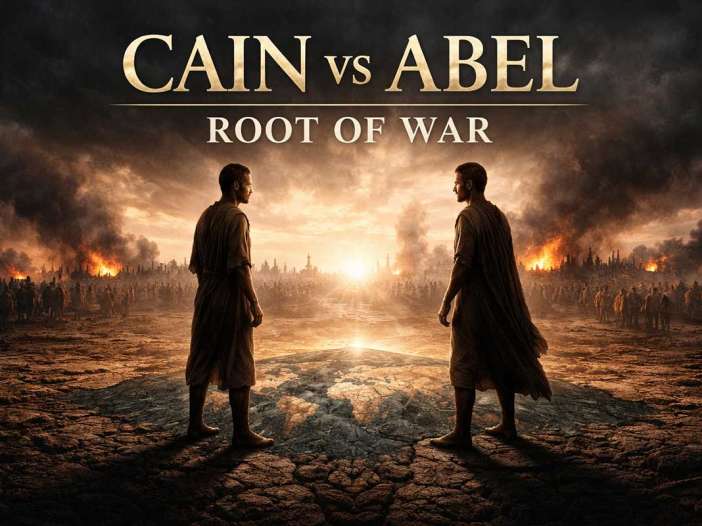
What if the deepest cause of global conflict is not politics but a spiritual pattern that began in the first family?
Introduction by Jordan Peterson
You know, it’s strange—people keep asking why history never learns.
We have better technology. More education. More “progress.” And yet… we keep returning to the same pattern: two sides, two camps, two tribes—each convinced it’s righteous, each convinced the other is the threat. And the frightening thing is this: the Bible doesn’t treat that as an accident. It treats it as the human story.
Because after the Fall, the very first serious human conflict isn’t between strangers. It’s between brothers.
Cain and Abel.
And that’s already telling you something profound: the most dangerous enemy is not the distant foreigner—it’s the one close enough to mirror you. Close enough to compete with you for recognition, for status, for love. Cain doesn’t just want Abel to fail. Cain wants Abel’s standing with God. He wants the place Abel occupies in the moral order. And when he can’t have it, he’d rather destroy the order itself.
Now scale that up.
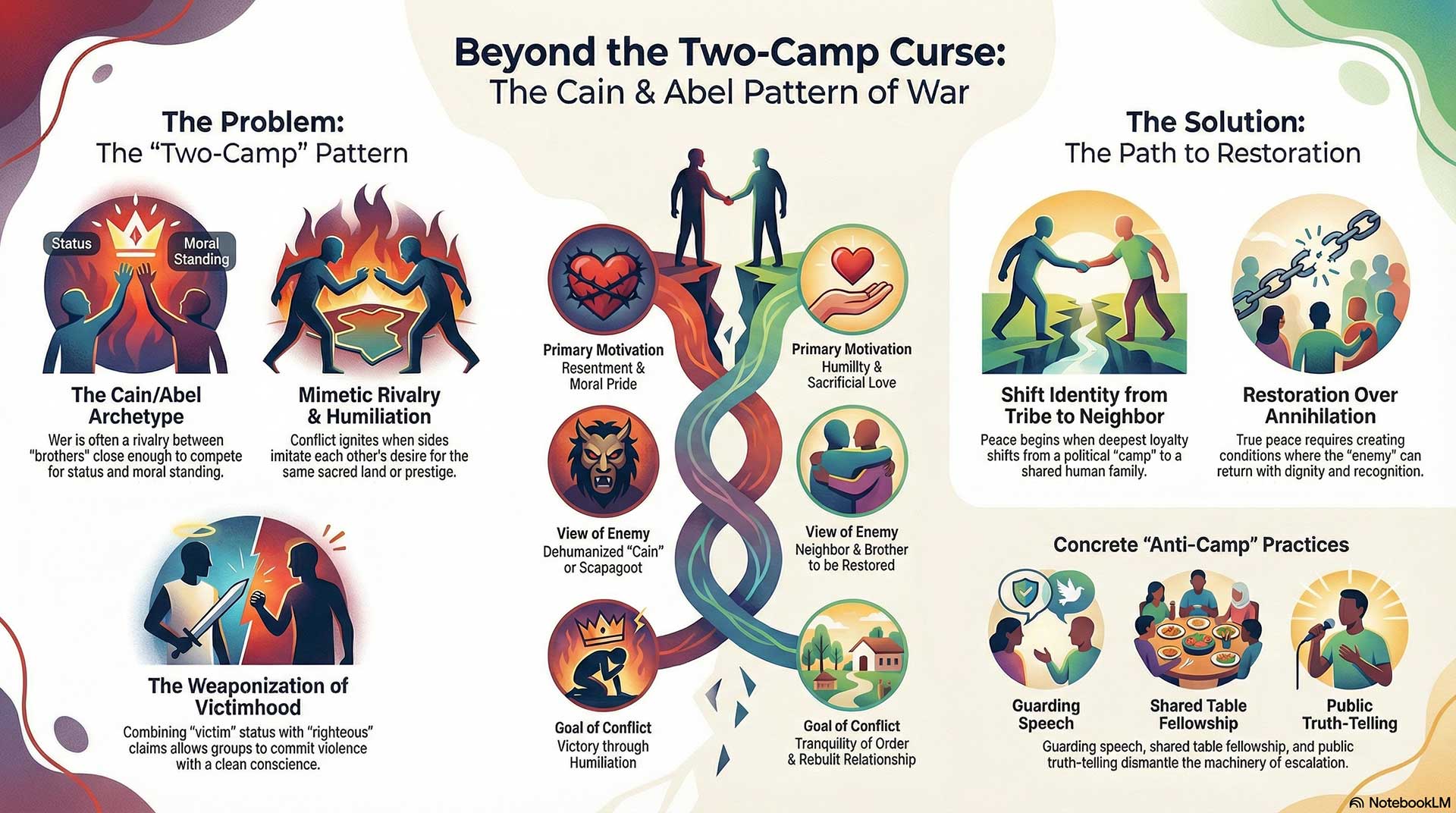
Take that psychological structure—resentment, humiliation, moral grandstanding, envy, the hunger to be “the chosen,” the terror of being the rejected—and apply it to nations, religions, and ideologies. That’s when you stop seeing war as a purely strategic event and start seeing it as a replay of an ancient spiritual drama.
So the question we’re dealing with isn’t just “Who’s right?” or “Who started it?” Those are important, but they’re not deep enough.
The deeper question is: Are we reenacting Cain and Abel on the world stage—again—and if we are, what would it take to stop it?
Tonight we’ll move through five stages:
- Cain & Abel as geopolitics
- how Abel becomes proud and Cain becomes desperate
- how the Fall spreads into systems—propaganda, escalation, humiliation
- whether “just war” can exist without becoming vengeance
- and finally: what breaks the two-camp curse
Because if we can’t answer that last question, we’ll keep sacrificing the future to the same ancient pattern—forever.
(Note: This is an imaginary conversation, a creative exploration of an idea, and not a real speech or event.)
Topic 1: Cain & Abel on the World Stage
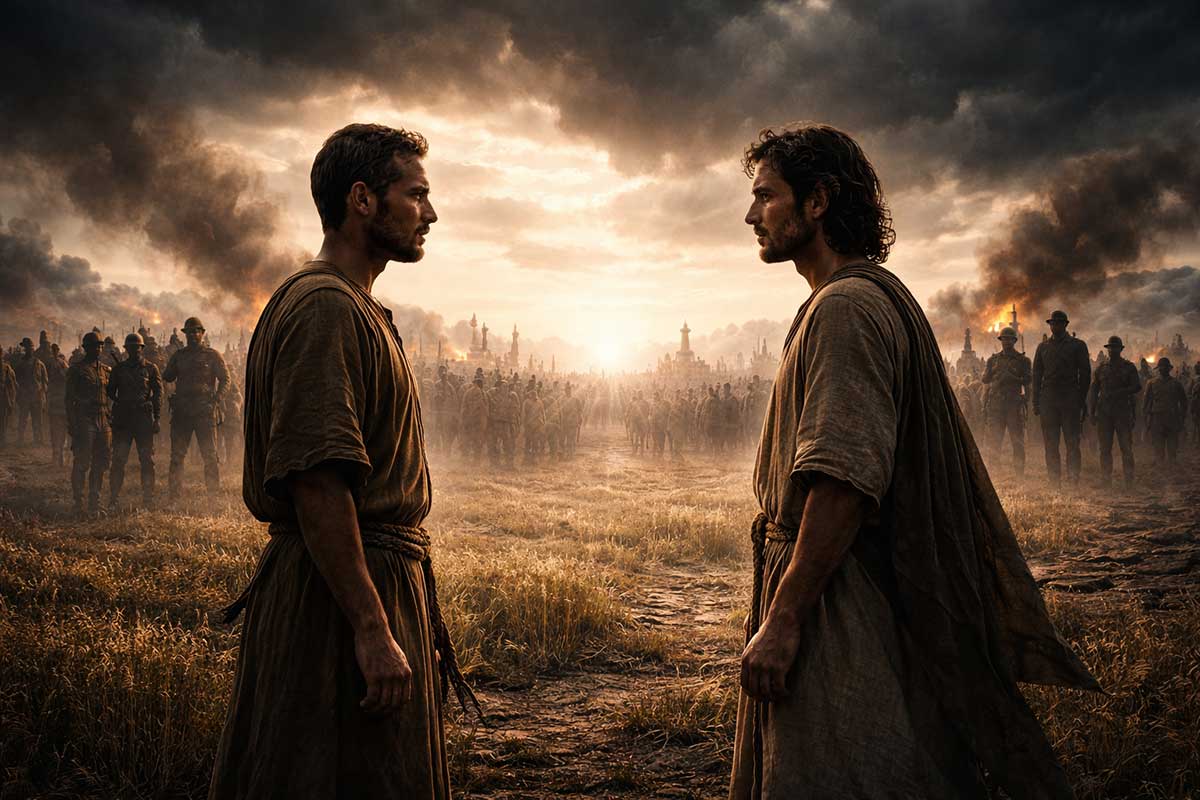
Moderator (radio style): Krista Tippett
Speakers (same as before): Rev. Sun Myung Moon, René Girard, St. Augustine, Reinhold Niebuhr, Hannah Arendt
Opening (Moderator)
Krista Tippett:
Welcome to Imaginary Talks. Tonight we ask a haunting question: Is the world re-enacting Cain and Abel—again and again—through nations, ideologies, and wars?
Five voices join us to explore the pattern beneath the headlines.
Q1) In a modern war, how do we avoid turning “Cain vs Abel” into a moral label that dehumanizes the other side?
Hannah Arendt:
The danger is that “Cain” becomes a category, not a person. Once a society decides an entire group is “Cain,” it has already given itself permission to do anything to them. Labels can replace thinking. And when thinking disappears, bureaucracy and ideology can make violence feel normal—almost administrative.
Rev. Sun Myung Moon:
Cain and Abel are positions, not permanent identities. If we use the label to condemn, we repeat the original failure. The purpose is to heal the relationship. A nation that calls itself Abel must act like Abel—by loving, serving, and guiding Cain back, not humiliating him.
Reinhold Niebuhr:
Collectives are addicted to innocence. Each side assumes it is Abel, therefore pure. That is why moral language can become the most dangerous language. It hides self-interest and pride behind virtue. The first discipline is humility: we may be right about some facts and still be wrong in spirit.
St. Augustine:
The deeper division is not nation against nation but love against love: love of God versus love of self. If “Cain vs Abel” helps, it helps only by forcing confession: Where are we ruled by pride? Where do we desire domination? Otherwise the story becomes a weapon, not a mirror.
René Girard:
The label becomes dangerous when it turns into scapegoating. Each side believes it is the innocent victim, and the other is the monstrous aggressor. That story provides a clean conscience for violence. Cain and Abel is not a permission slip—it is a revelation of how quickly rivalry turns sacred.
Q2) What actually ignites the Cain/Abel spiral today—status, humiliation, sacred identity, fear, security—what’s the trigger?
René Girard:
The trigger is imitation. We want what the other seems to possess: legitimacy, recognition, sacred status. Then we compete for the same prize. Each move is a mirror of the other’s move, and soon escalation feels inevitable. Rivalry feeds on proximity—on sameness—not difference.
St. Augustine:
Pride is the spark that turns fear into sin. A nation says “security,” but often it means, “We will not be humbled.” The desire to dominate—the libido dominandi—is a spiritual illness. It makes peace feel like weakness and restraint feel like humiliation.
Hannah Arendt:
Modern triggers are also structural. Media systems amplify outrage; political systems reward polarization; bureaucracies convert fear into policy momentum. People begin to live inside narratives that demand enemies. The “two camps” are produced and maintained like a machine.
Reinhold Niebuhr:
Humiliation is especially combustible because it becomes morally useful. Leaders can mobilize populations by turning pain into righteousness. Once that happens, compromise looks like betrayal. The tragedy is that moral energy is real—but it gets captured by pride.
Rev. Sun Myung Moon:
At the root is the longing for love and value. Cain feels unseen and unloved; Abel feels chosen and becomes careless. Multiply that by nations and history: one side feels dismissed, the other feels superior. The trigger is not merely strategy—it is wounded heart.
Q3) If reconciliation is the “missed miracle” of Cain and Abel, what would a real-world restoration look like that doesn’t require annihilation?
Rev. Sun Myung Moon:
Restoration means creating a path for Cain to return without humiliation. Abel must lead with service—living for the sake of the other—while still protecting the innocent. If the outcome of victory is resentment, then the war is not finished; it is only delayed.
René Girard:
Restoration requires breaking the scapegoat reflex: the belief that peace comes by destroying “the guilty one.” The Gospel exposes that mechanism. Practically, it means refusing dehumanization, protecting civilians, and building off-ramps that allow both sides to stop without shame.
Reinhold Niebuhr:
We must be honest: restoration is not possible without justice and restraint. Idealism without power becomes a sermon to the wind. Power without humility becomes tyranny. A mature peace requires limits, accountability, and the refusal to pretend we are morally spotless.
Hannah Arendt:
Restoration is rebuilding the shared world: institutions, stories, and daily practices that make coexistence normal again. Hatred grows when people have no common world—only competing fantasies. If you want peace, you must repair the world where people can appear to one another as human.
St. Augustine:
Peace is not merely the cessation of conflict; it is the tranquility of order. That order begins with rightly ordered loves—God above all, neighbor as neighbor, not as instrument. Without inner transformation, treaties become pauses. With transformation, politics can become a servant of peace.
Topic 2: When “Abel” Becomes Proud and “Cain” Becomes Desperate
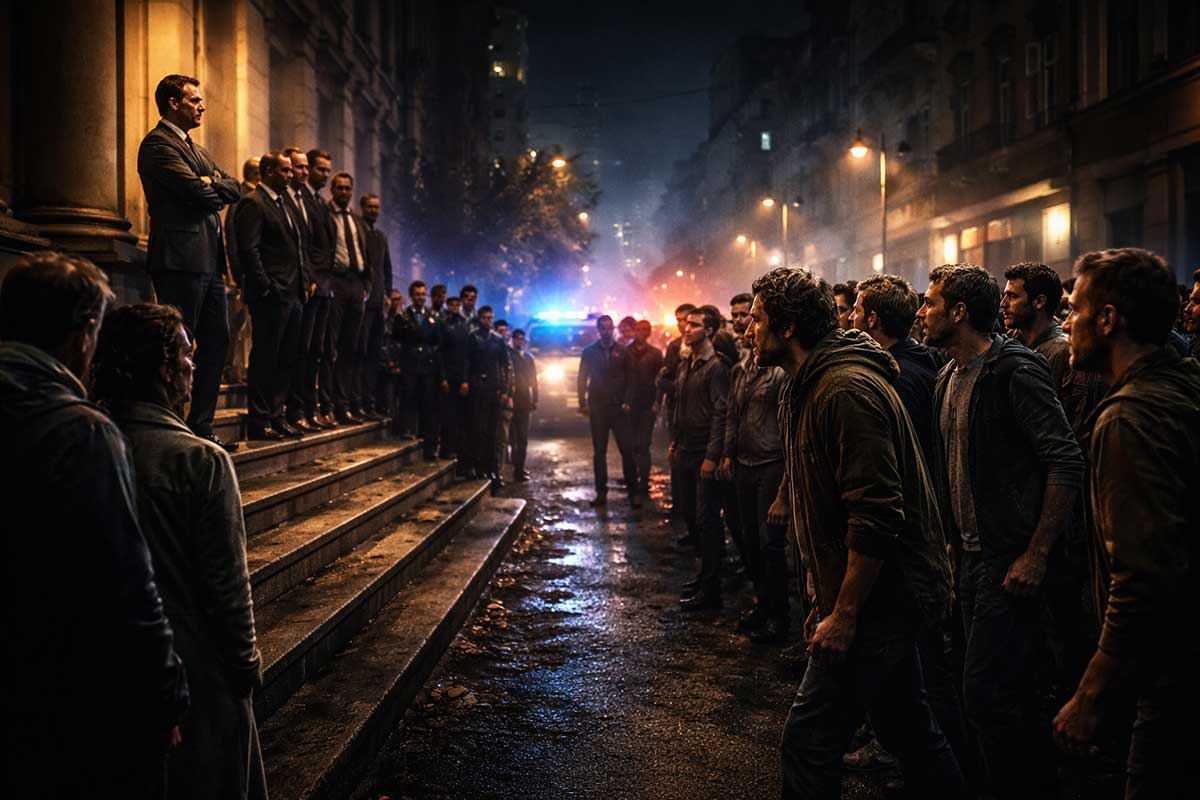
Moderator (radio style): Krista Tippett
Speakers: Fyodor Dostoevsky, Carl Jung, Martin Luther King Jr., James Baldwin, Simone Weil
Opening (Moderator)
Krista Tippett:
In the Cain-and-Abel story, we often imagine a simple moral: one brother is good, the other is bad. But history is rarely that clean. Sometimes the “righteous” become cruel. Sometimes the wounded become violent. Tonight we ask: what twists the soul until pride and desperation create a collision?
Q1) What turns “Abel” into a bully—and when does “Cain” cross the line into violence?
Carl Jung:
Abel becomes a bully when he identifies with his goodness and refuses to see his shadow. Then the shadow acts out unconsciously—through contempt, cruelty, and moral superiority. Cain crosses into violence when shame becomes unbearable and he projects his own hated self onto Abel. He tries to destroy the person carrying his inner torment.
James Baldwin:
Abel becomes a bully when he needs Cain to feel clean. A lot of “innocence” is just fear that refuses to confess itself. Cain crosses the line when he’s told—again and again—that he’s nothing. Rage becomes the only language left that proves he exists. But rage without truth becomes its own prison.
Martin Luther King Jr.:
Abel becomes a bully the moment he stops seeing Cain as a brother made in God’s image. Cain crosses into violence when he believes suffering grants permission to hate. In both cases, the person becomes a symbol. And once people become symbols, cruelty becomes easy.
Fyodor Dostoevsky:
Pride is a narcotic. Abel begins to enjoy the feeling of being “chosen.” Cain feels rejected not only by society, but by heaven. Then resentment turns spiritual: “If I cannot be loved, I will destroy love itself.” Murder is not only anger—it is despair that has decided to rule.
Simone Weil:
Force corrupts both the one who uses it and the one who suffers it. Abel becomes a bully when he believes power proves virtue. Cain crosses into violence when affliction has reduced him to a thing—when he no longer feels seen by God or man. Violence is often the last attempt to feel real.
Q2) Why do groups weaponize both victimhood and righteousness at the same time—and why is that combination so addictive?
Fyodor Dostoevsky:
Because it gives you moral license. Victimhood removes responsibility: “I had no choice.” Righteousness grants permission: “I am justified.” Combine them and you can commit horrors with a clean conscience, even feeling holy while doing it.
Simone Weil:
Suffering becomes a currency: “My pain purchases my right to hurt you.” That is the logic of force. But attention to the other’s suffering breaks the spell. When attention dies, victimhood becomes a weapon and righteousness becomes a mask.
Carl Jung:
It is the ego’s dream: innocence and grandeur at once. “We are pure” and “we are heroic.” That story hides the shadow and projects it outward. Then aggression feels like virtue, because the enemy is carrying what we refuse to acknowledge in ourselves.
Martin Luther King Jr.:
This is why we must unite truth with love. Truth without love becomes brutality. Love without truth becomes sentimentality. A movement must discipline itself: refuse dehumanizing language, refuse vengeance, refuse the intoxicating pleasure of contempt.
James Baldwin:
Because myths hold nations together. And the most powerful myth is: “Our suffering proves our goodness.” But suffering doesn’t automatically make you wise; it can make you blind. If you can’t face what you do to others, you become trapped inside your own story and call that “morality.”
Q3) What breaks the cycle when both sides feel morally superior and existentially threatened?
James Baldwin:
Truth that people can survive. If truth is only a weapon, people cling to lies for shelter. But if truth includes a doorway to dignity—“you can change without being annihilated”—then people can step out of the script.
Martin Luther King Jr.:
A justice that does not require humiliation. If peace is built on shaming the other side, it plants the next war. We must protect the vulnerable, confront wrongdoing, and still insist the enemy is a human being. That is not weakness. It is moral strength.
Carl Jung:
Integration of the shadow—personally and collectively. A group must be able to say, “We are capable of evil.” That sentence is medicine. Without it, the enemy becomes a container for everything we deny, and the conflict becomes religious in the worst sense.
Simone Weil:
Begin with attention and the protection of the innocent. Change the language that turns people into things. Where speech becomes dehumanizing, violence soon follows. If you guard the vulnerable and refuse contempt, you slow the machinery of force.
Fyodor Dostoevsky:
Confession—real confession. Not performance. Abel must admit the pleasure of superiority. Cain must admit the love of revenge. Without humility, the heart demands blood again and again. With humility, a new future becomes possible.
Topic 3: The Fall as the Root of Modern Escalation

Moderator (radio style): Krista Tippett
Speakers: St. Irenaeus, St. Maximus the Confessor, Jonathan Haidt, Jacques Ellul, Viktor Frankl
Opening (Moderator)
Krista Tippett:
We’ve traced conflict from Cain and Abel into pride, resentment, and the machinery of polarization. Now we go deeper: what if escalation begins as a spiritual distortion—love and desire out of order—and then becomes social, technological, and political? Tonight, we explore “the Fall” not as ancient history, but as a living pattern.
Q1) If the Fall is “disordered love,” what are the modern symptoms—what does it look like in a world on the edge?
Jacques Ellul:
One symptom is that propaganda becomes the atmosphere. People don’t merely receive messages; they inhabit them. Technique—systems optimized for efficiency—turns human fear into predictable reactions. Escalation then feels automatic, as though history is running on rails.
St. Irenaeus:
The Fall appears as immaturity with enormous power. Humanity was meant to grow into God’s likeness—patient love, wisdom, self-giving. Instead, we grasp, we panic, we demand quick victory. In war, this immaturity is visible as impatience: “End it now, no matter the cost.”
Jonathan Haidt:
Morally, it looks like tribal certainty. Under threat, people become less curious and more convinced. Our brains are built for teams. We interpret events through “us versus them,” and social platforms reward outrage and punishment—so the loudest voices steer the group.
Viktor Frankl:
It looks like meaning collapse. When people lose meaning, hatred offers a substitute purpose. War becomes a story that tells you who you are. But hatred cannot heal suffering; it only spreads it. The opposite symptom of the Fall is dignity—choosing who you become even under fear.
St. Maximus the Confessor:
Disordered love becomes passions that enslave the will: anger, fear, vainglory, the craving to control. These passions distort perception, so we cannot see the other clearly. A society ruled by passions calls its impulses “necessity” and mistakes fever for clarity.
Q2) Why does humiliation ignite escalation so fast—faster than logic, treaties, or “rational interests”?
Jonathan Haidt:
Humiliation hits honor and status—ancient circuits. Once those are activated, reasoning becomes a lawyer for emotion. People ask, “What restores our standing?” not “What is wise?” That’s why humiliation is gasoline.
St. Maximus the Confessor:
Humiliation wounds the egoic will—the false self that demands glory. If a people’s identity is bound to pride, humiliation becomes unbearable, and revenge feels like salvation. Humility is the cure, but it is rare in crowds and almost absent in nations.
Viktor Frankl:
Humiliation tempts people to believe: “If I make the other suffer, my suffering will shrink.” It does not. It enlarges the inner prison. Meaning breaks the chain—because meaning lets you endure pain without turning it into hatred.
St. Irenaeus:
Because humanity was made to receive value from God. When that bond is weak, people seek value through dominance and comparison. Humiliation threatens existence itself—so the impulse is to prove worth through power. That is immaturity again: proving instead of becoming.
Jacques Ellul:
And propaganda weaponizes humiliation because it is efficient. It creates unity instantly: shared wound, shared enemy, shared permission for violence. Once humiliation becomes narrative, every new event is interpreted as proof—and escalation becomes self-renewing.
Q3) What is “restoration” at the level of mind and society—how do you de-escalate when systems profit from escalation?
St. Irenaeus:
Restoration is maturation—learning the patience of God. It means forming people who can repent, restrain, and endure ambiguity without violence. A society that cannot repent must repeat its sins, because it has no way to transform them.
Jacques Ellul:
Restoration requires limits on technique and propaganda. We must admit the machine will not save us; it accelerates what we already are. Build friction into systems that profit from outrage. Refuse efficiency when it crushes the human person.
St. Maximus the Confessor:
Restoration begins with healing desire: disciplining speech, fasting from contempt, refusing the pleasure of hatred. When passions calm, discernment returns. Without inner restoration, political agreements are only masks over fever.
Jonathan Haidt:
We also need redesigned incentives: reward curiosity, cross-group contact, and moral humility. Platforms and politics currently reward outrage. If you want a less escalatory society, you must make restraint socially prestigious again.
Viktor Frankl:
And restore meaning that does not require an enemy. The deepest peace comes when people can say: “My life has purpose even if I do not destroy you.” When that freedom exists, fear cannot drive policy so easily.
Topic 4: Just War vs Restoration
Moderator (radio style): Krista Tippett
Speakers: St. Thomas Aquinas, John Howard Yoder, Dietrich Bonhoeffer, Desmond Tutu, Rev. Sun Myung Moon
Opening (Moderator)
Krista Tippett:
When people feel threatened, “peace” can sound naïve—and “war” can sound necessary. But Christianity carries two tensions at once: the call to protect the vulnerable, and the command to love the enemy. Tonight we ask: Can war ever be just? And even if it can, can it ever be restorative?
Q1) Can a Christian affirm “just war” without betraying Jesus’ teaching on enemy-love?
John Howard Yoder:
No. Jesus did not give us a private ethic. The Sermon on the Mount is not poetry; it is the politics of the kingdom. When Christians make killing normal, they stop being the church and become a chaplaincy for the state.
St. Thomas Aquinas:
The tradition does not bless violence easily. It limits it. Force may be permissible only under legitimate authority, for a just cause, with right intention—aiming at peace, not revenge. Even then, the moral burden is heavy, and the protection of innocents is central.
Rev. Sun Myung Moon:
Enemy-love is not optional if you want restoration. Even if force is used to stop immediate harm, it must never become hatred. Cain and Abel cannot be healed by repeating Cain’s act again. The goal must be to return the enemy to brotherhood.
Dietrich Bonhoeffer:
There is a tragic complexity here. Doing nothing can also be guilt. Yet violence is spiritually poisonous; it tempts us toward self-righteousness. If one chooses force to resist evil, it must be done with trembling, confession, and accountability—not with moral triumph.
Desmond Tutu:
Enemy-love is not weakness; it’s the refusal to let hatred govern your soul. But love does not mean passivity. It means pursuing justice in a way that leaves a future. A “just war” that destroys dignity will plant the next war.
Q2) What most often corrupts war morally—fear, pride, revenge, propaganda, or the intoxication of power?
Desmond Tutu:
Dehumanization. Once the enemy becomes a thing, anything is possible. Then even prayer becomes a weapon. The first duty is to protect the humanity of everyone involved—especially civilians—because once you lose that, you lose the moral world.
Dietrich Bonhoeffer:
Moral certainty. The belief that God is obviously on our side. That is when cruelty becomes easy. In crisis, people want purity; purity becomes ideology; ideology permits violence without repentance.
St. Thomas Aquinas:
Revenge and excessive intention. War is corrupted when the aim shifts from restoring peace to punishing, humiliating, or dominating. Intention matters because intention governs limits. A vengeful heart cannot maintain proportion.
John Howard Yoder:
The deepest corruption is the belief that “necessary violence” can be kept clean. The state offers effectiveness; the church trades its witness for influence. Christians then confuse success with faithfulness and call it wisdom.
Rev. Sun Myung Moon:
Hatred rooted in wounded pride. Cain’s resentment and Abel’s arrogance feed each other. Even if the cause begins defensively, pride turns it into domination. If the stronger side enjoys superiority, it is already losing spiritually.
Q3) If restoration—not just victory—is the goal, what concrete principles should guide action during and after war?
St. Thomas Aquinas:
First, safeguard the innocent—strict discrimination. Second, proportionality—never exceed what is necessary. Third, last resort and a real plan for peace. If leaders cannot articulate the peace they seek, war becomes a substitute for thought.
Rev. Sun Myung Moon:
Create a path for Cain to return without humiliation. Even while stopping aggression, you must prepare reconciliation: aid, rebuilding, education, interfaith cooperation. Otherwise you win territory and lose the future. Restoration is a long project of healing brotherhood.
Desmond Tutu:
Truth-telling and repair. Peace that hides suffering is fragile. Peace that humiliates is poisonous. Restoration requires acknowledging harm, protecting the vulnerable, and building institutions where former enemies can meet as human beings again.
John Howard Yoder:
The church must refuse demonization—especially when it’s popular. Offer sanctuary to victims on all sides. Practice reconciliation visibly: meals, service, aid, honest speech. If Christians mirror the world’s hatred, they cannot later preach peace without hypocrisy.
Dietrich Bonhoeffer:
Accountability—legal, moral, spiritual. If force is used, it must be bounded and judged, not romanticized. Afterward, confession and rebuilding are necessary, or violence becomes habit. Restoration requires cost, not slogans.
Topic 5: Breaking the Two-Camp Curse
Moderator (radio style): Krista Tippett
Speakers: Jesus, St. Paul, Miroslav Volf, Dietrich Bonhoeffer, Rev. Sun Myung Moon
Opening (Moderator)
Krista Tippett:
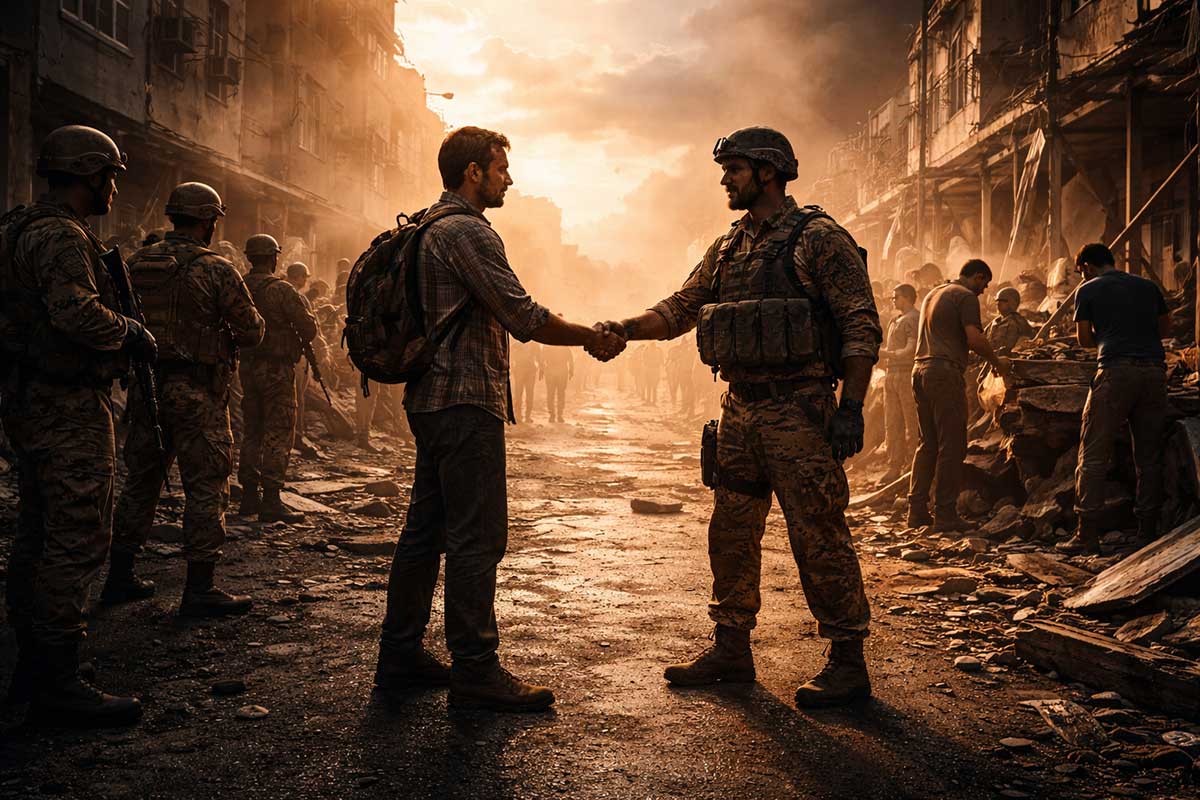
Across history, humanity seems to split into two camps—two moral tribes—locked in cycles of fear, pride, and retaliation. If Cain and Abel is the first fracture, then our question is: what actually breaks the pattern? Not just temporarily—but deeply.
Q1) What is the first inner shift that breaks the “two-camp” spell—before any policy, before any treaty?
Dietrich Bonhoeffer:
The first shift is repentance from false righteousness. The camps thrive on self-justification. A Christian must ask: “Where have I enjoyed contempt? Where have I lied for my tribe? Where have I worshiped safety and called it God?” Without that, the camp becomes an idol.
Jesus:
The first shift is to see the other as neighbor, not as a category. Love your enemies. Pray for those who persecute you. If your heart is ruled by retaliation, you are not free. The one who breaks the cycle is the one who refuses to return evil for evil.
Rev. Sun Myung Moon:
The first shift is living for the sake of others—especially the one you resent. Cain and Abel cannot unite by argument. Someone must initiate love first. That love creates a bridge where the other can return without humiliation.
Miroslav Volf:
The first shift is refusing to be possessed by the enemy. Hatred is captivity. “Embrace” begins as an inner opening: I will not let fear shrink my humanity. This is not sentimental; it’s a choice to stay human while naming injustice truthfully.
St. Paul:
The first shift is identity. When your deepest loyalty is to Christ, tribe becomes secondary. The wall that divides “us” and “them” loses ultimate authority. Reconciliation becomes possible because you are no longer saved by your camp.
Q2) How do you pursue reconciliation without rewarding evil or erasing justice?
Miroslav Volf:
Reconciliation requires boundaries. Embrace has a “wait” in it—you don’t embrace someone who is actively striking you. Protect the vulnerable, tell the truth, and insist on accountability. But do not turn accountability into humiliation, or the cycle will restart.
Jesus:
Forgiveness is not permission for harm. It is refusing vengeance as your master. Confront sin, but do not become sin in your confrontation. If you hate, you become shaped by what you fight. Seek justice, but keep your heart clean.
St. Paul:
Grace is not cheap. Reconciliation is not denial; it is transformation. Wrong must be named; truth must be spoken. But the goal is new life—repair—so that the future is not imprisoned by the past.
Dietrich Bonhoeffer:
Sometimes resistance is required, but resistance must not become worship of power. The church must not confuse national survival with God’s will. If you fight evil with hatred, you lose your soul even if you win.
Rev. Sun Myung Moon:
True justice includes a path of return. If justice is designed to humiliate Cain, Cain will never come home; he will only sharpen resentment. Restoration separates the evil act from the human being who must be recovered.
Q3) What concrete “anti-two-camp” practices can societies adopt to prevent future escalation?
St. Paul:
Create communities where former enemies share life—eat together, work together, serve together. Table fellowship is not symbolic; it forms a new “we.” When people worship and eat across lines, tribal identity weakens.
Rev. Sun Myung Moon:
Make living for the sake of others a public ethic: interfaith service projects, leadership that models humility, family-level relationships across divisions. Peace cannot be sustained by treaties alone. It must be rebuilt at the level where Cain and Abel began—human relationships.
Jesus:
Guard speech. Bless instead of curse. Protect the least. Seek peace actively. If contempt becomes normal, violence becomes easier. The peacemakers are called children of God because they act like the Father—bringing enemies back into family.
Miroslav Volf:
Build institutions for truth-telling and repair: public acknowledgment of suffering, lament that is allowed, and practical rebuilding that restores dignity. Reconciliation fails when it is only emotional and not material.
Dietrich Bonhoeffer:
Teach costly discipleship: the courage to tell the truth to your own side, to refuse propaganda, and to accept personal cost for peace. The two camps weaken when enough people refuse to lie for their tribe.
Final Thoughts by N. T. Wright
If we read Cain and Abel as a mere morality tale, we miss the point. Genesis is not simply telling us, “Don’t be jealous.” It’s giving us a lens to understand how the world goes wrong—and how God intends to put it right.
The Bible’s story is not that violence is natural and therefore inevitable. The Bible’s story is that violence is a symptom of a deeper disorder: humanity turned inward, curved in on itself—what the Christian tradition has often called sin. And sin doesn’t remain private. It becomes social, political, and eventually imperial. It builds structures. It creates slogans. It teaches people to call hatred “justice” and revenge “security.”
And yet—here is the Christian claim, and it is outrageous if you take it seriously—God answers this not by escalating violence, but by absorbing it. The cross is not an endorsement of passivity; it is God’s unveiling of the world’s tragic mechanism: we solve our fear by finding someone to blame, someone to punish, someone to sacrifice. The gospel calls that out as the lie beneath the lie.
So what then is peace?
Peace in Scripture is not simply the absence of conflict. It is the presence of right relationship: with God, with one another, and with the created world. That means that any “victory” purchased by humiliation, dehumanization, or permanent exclusion is not truly peace. It is merely a pause between episodes.
That is why Christian thinking about war, at its best, is always about restraint, protection of the vulnerable, truth-telling, and the pursuit of a future in which enemies might become neighbors. And yes, that is difficult—especially when you are afraid, especially when there has been real evil. But the question the church must ask is not, “How do we win?” The question is: What kind of people are we becoming while we pursue what we call justice?
Because Cain’s tragedy is not merely that he killed Abel. It’s that he refused the moment God offered him another path: “Sin is crouching at the door… but you must rule over it.” In other words, the human being is not fated to repeat this pattern. There is a choice—painful, costly, and real.
And so the Christian hope is not naïve optimism. It is the conviction that God’s new creation has already begun in Jesus, and therefore the church is called to live now as a sign of that future: refusing demonization, practicing enemy-love, telling the truth, repairing what is broken, and building communities where the “two camps” do not get the final word.
That is how the Cain and Abel story ends—not with a brother’s blood crying from the ground forever, but with a people learning, at last, to become family.
Short Bios:
Intro + Final
Jordan Peterson — Canadian psychologist and public intellectual known for mapping biblical stories onto modern psychology, meaning, and moral formation.
N. T. Wright — New Testament scholar and theologian who emphasizes the Bible’s “new creation” story, kingdom ethics, and historically grounded Christian hope.
Topic 1 Panel
Rev. Sun Myung Moon — Founder of the Unification Movement; taught a providential view of history shaped by restoration and the reconciliation of “Cain and Abel” divisions.
René Girard — French thinker who argued human conflict is driven by mimetic rivalry and often resolved through scapegoating, exposed by the biblical narrative.
St. Augustine — Early Christian theologian who framed history as two “cities” formed by two loves: love of God versus love of self.
Reinhold Niebuhr — Influential “Christian realist” who warned that nations easily sanctify their own pride and call it righteousness.
Hannah Arendt — Political philosopher who analyzed how ideology and systems can normalize violence and turn people into instruments.
Topic 2 Panel
Fyodor Dostoevsky — Novelist who explored resentment, pride, guilt, and the spiritual psychology that can turn suffering into cruelty.
Carl Jung — Psychiatrist who developed the concept of the “shadow,” showing how people and groups project denied darkness onto enemies.
Martin Luther King Jr. — Christian leader who fused justice with disciplined nonviolence, insisting enemy-love is strength, not sentimentality.
James Baldwin — Essayist and truth-teller on identity, fear, and moral honesty—especially how innocence narratives can mask harm.
Simone Weil — Mystic-philosopher who wrote about “force” and affliction, urging radical attention to the vulnerable.
Topic 3 Panel
St. Irenaeus — Early church father who saw humanity as meant to mature into God’s likeness; sin as a derailment of growth in love.
St. Maximus the Confessor — Theologian of the “healing of the will,” describing how disordered passions distort perception and action.
Jonathan Haidt — Social psychologist known for moral foundations theory and how tribes, outrage, and status shape politics.
Jacques Ellul — Christian sociologist who warned that propaganda and “technique” can become an invisible system shaping society.
Viktor Frankl — Psychiatrist and Holocaust survivor who argued meaning and dignity can resist hatred even under extreme suffering.
Topic 4 Panel
St. Thomas Aquinas — Medieval theologian who articulated moral reasoning behind Just War limits: authority, cause, intention, and restraint.
John Howard Yoder — Mennonite theologian who argued Jesus’ nonviolence is not optional; the church must embody another politics.
Dietrich Bonhoeffer — Pastor-theologian who resisted Nazism and wrestled with “costly discipleship” and tragic moral responsibility.
Desmond Tutu — Archbishop who advanced truth-and-reconciliation as justice that aims to heal rather than humiliate.
Rev. Sun Myung Moon — (see above) emphasizes restoration through reconciliation rather than endless retaliation.
Topic 5 Panel
Jesus — Central figure of Christianity; taught enemy-love, peacemaking, and a kingdom ethic that breaks cycles of retaliation.
St. Paul — Early Christian apostle who framed reconciliation and unity beyond tribe as the practical fruit of the gospel.
Miroslav Volf — Theologian of reconciliation who argues for “embrace” with boundaries: truth, justice, and restored relationship.
Dietrich Bonhoeffer — (see above) warns against idolizing nation or power; calls for costly truth and courage.
Rev. Sun Myung Moon — (see above) anchors the “two-camp” problem in family-level restoration and living for others.
Leave a Reply