

|
Getting your Trinity Audio player ready...
|
What if Jesus confronted contemporary apocalyptic scholars in public debate—no fear, only truth?
Introduction by Rowan Williams.
Some texts are meant to be studied. Revelation is meant to be survived. It was written for communities living under pressure, surrounded by spectacle, threatened by coercion, and tempted by the promise that compliance can buy peace.
Its visions feel unreal because they describe what power feels like from the underside. They describe a world where domination becomes normal, where loyalty is demanded, where commerce can become a sacrament, where resistance has a cost.
Tonight we are not here to sensationalize the imagery. We are here to read it with discipline and to ask what it reveals about the spiritual physics of empire, and about the kind of faith that refuses to become another form of cruelty.
(Note: This is an imaginary conversation, a creative exploration of an idea, and not a real speech or event.)
Topic 1 — What Kind of Book Is Revelation, Really?

A long oak table sits under a hanging lamp that makes the room feel half library, half courtroom. The walls are lined with quiet old commentaries and worn atlases of the Roman world. At the center is a single open Greek New Testament, turned so no one “owns” it. A glass of water sweats beside Lex Fridman’s notebook. Everyone is calm, but the air has that charged feeling you get right before a debate becomes a confession.
Lex Fridman (smiling, measured)
We’re going to do this in a way that honors both scholarship and the fact that people read this book with their whole nervous system. Revelation has been called propaganda, poetry, terror, comfort, code, hallucination, and holy scripture. So let’s begin with the framing that decides almost everything.
What kind of book is Revelation—apocalypse, prophecy, letter, political critique, worship script—and what does that force us to stop doing with it?
Elaine Pagels
If you start with genre, you immediately stop treating it like a newspaper in advance. Apocalypse is not “a timeline.” It’s a way of seeing—of exposing power. It’s a literature that thrives when communities feel cornered. And that matters, because Revelation’s imagery functions like a symbolic weapon: it gives persecuted people a sense that their suffering is not meaningless and that the empire’s story is not final.
So what must we stop doing? We must stop extracting “predictions” as if John is a modern analyst. It’s more like a survival document for a community under pressure, using the language of visions to re-train imagination.
Craig R. Koester
I’d emphasize its multi-genre nature. Revelation is a letter to real congregations, addressed to lived situations. It is prophecy in the sense of calling communities to faithful witness. It is apocalypse in the sense of “unveiling,” not merely future-telling. And it’s saturated with worship—hymns, doxologies, liturgical scenes.
So we stop reading it as a detached puzzle. It’s not meant to be decoded as trivia; it’s meant to form a people. The scenes of heaven are not escape; they’re a counter-vision shaping how believers live under imperial pressure.
Richard Bauckham
Revelation is fundamentally a prophetic critique of the world as it appears—especially the world constructed by imperial power. It offers a “true” account of reality, which is the opposite of what the empire claims. That’s why it leans heavily on scriptural imagery—Israel’s prophetic tradition—because it’s presenting a theologically grounded interpretation of history.
So we must stop reading it as though it speaks first to modern anxieties and only second to its first audience. The first audience is the anchor. If you lose that, you lose the moral point of the book.
G. K. Beale
I’d put it this way: Revelation is the climax of biblical prophecy, a tapestry woven from the Old Testament—especially Daniel, Ezekiel, Isaiah, and the Psalms. John is not inventing images ex nihilo; he is reusing and reapplying earlier prophetic patterns.
So what do we stop doing? We stop reading it with a flat literalism that ignores intertextuality. Many of the images are symbolic, but they refer to real spiritual and historical realities. And the letter form forces us to treat it as a covenantal call to perseverance.
Adela Yarbro Collins
We should not underestimate the apocalyptic genre’s conventions. Ancient apocalypses often use visions, cosmic battles, and coded symbolism to interpret present circumstances and to project an ultimate resolution. The point isn’t merely “what will happen,” but “how should we understand what is happening now,” in light of a transcendent framework.
So yes—stop reading it as a technical manual for the end of the world. And stop assuming that one interpretive system can erase the diversity of early Christian apocalyptic expectation.
A brief silence follows—not awkward, but attentive. Lex turns his pen in his fingers.
Jesus (quiet, direct—not argumentative, but piercing)
When you read it, do you become more truthful… or more frightened? Do you love people more… or do you start looking for enemies to label?
No one rushes to answer. The room doesn’t feel like it’s been interrupted. It feels like something has been clarified.
Lex Fridman
That question is… very hard to dodge. Let me sharpen the frame. If Revelation is “unveiling,” not “fortune-telling,” then “responsible interpretation” has to mean something concrete.
What would count as a responsible interpretation—and what are the red flags of irresponsible interpretation?
Craig R. Koester
A responsible reading respects context—historical, literary, and theological. It asks: what pressures were these churches facing? How does the book’s rhetoric function? What does it ask of the readers? It treats worship scenes seriously, because worship is how Revelation reorders allegiance.
A red flag is when interpretation fuels panic, obsession, or superiority. Another is when the book is used to justify cruelty because “judgment is coming anyway.” Revelation calls for witness; it does not license believers to become agents of terror.
Elaine Pagels
I agree, and I’d add: irresponsible readings often show up when people use Revelation as a tool for control. It becomes an authority mechanism—“I know the secret; you don’t.” Or it becomes a way to declare that one’s enemies are cosmically condemned.
A responsible reading will notice how often Revelation portrays faithful people as vulnerable—martyrs, witnesses, communities struggling. It’s meant to fortify endurance, not inflate ego. When it inflates ego, something has gone wrong.
Richard Bauckham
Responsible interpretation, to me, is interpretation that aligns with Revelation’s own ethic: faithful witness, resistance to idolatry, and hope grounded in God’s sovereignty. One has to respect how the book uses imagery to portray the moral character of power.
The red flags include confident date-setting, sensationalism, and especially the transfer of Revelation’s critique of Rome onto whatever group one already dislikes. The book critiques empire as a system of idolatrous power—not as a simple label for “those people over there.”
G. K. Beale
A responsible reading will let Scripture interpret Scripture. John assumes his readers know the Old Testament, because the imagery is saturated with it. When you see beasts, temples, seals, trumpets—these aren’t random. They connect to patterns already present in Daniel and the prophets.
Red flags: treating symbols as though they must map one-to-one onto modern technology or geopolitical headlines, and ignoring the church-directed nature of the message. Revelation is meant to warn believers against compromise with the world’s idolatry. When it becomes an excuse to obsess over external conspiracies while neglecting internal compromise, it’s upside down.
Adela Yarbro Collins
I would emphasize rhetorical strategy. Revelation is persuasive discourse. It uses vivid images to provoke revulsion toward idolatry and admiration for faithfulness. A responsible interpretation asks how this rhetoric functions—how it shapes community identity.
Irresponsible interpretation tends to flatten the rhetoric into predictions and then weaponize them. It also tends to ignore the emotional manipulation that can occur when leaders harness apocalyptic texts to intensify fear and dependence.
Jesus (still calm, but sharper now)
If your interpretation makes you eager to be proven right—while others suffer—then you have not understood the Lamb.
If your certainty makes you less merciful, you have mistaken noise for truth.
Lex Fridman
That’s a… diagnostic. Almost like a spiritual peer review. Let’s move to the first audience, because every scholar here has implied it’s the anchor.
What did the first audiences likely hear that modern readers usually miss?
Richard Bauckham
They would have heard Revelation as a direct challenge to the imperial cult and to the social economics of the cities. “Babylon” is not an abstract villain; it’s the kind of power that seduces through prosperity and punishes dissent. The first hearers would recognize the cost of refusing emperor worship, of refusing guild practices tied to pagan cults, of being socially marginalized.
Modern readers often miss how specific that pressure is. We read it in comfort; they heard it with risk in their bones.
Craig R. Koester
They would have heard the worship scenes as reorientation. In a world where Rome claimed to be the source of peace and order, Revelation says: no—the true throne is God’s, and the Lamb’s victory defines reality.
Modern readers miss how the book trains perception. It’s like spiritual counter-propaganda. It takes what seems ultimate—Rome, commerce, violence—and says, “Look again. That is not ultimate.”
Adela Yarbro Collins
They also would have heard it as continuity with Jewish apocalyptic expectation. The imagery is not exotic for them. It’s part of a symbolic vocabulary already in circulation—cosmic conflict, angelic mediators, divine judgment, vindication of the righteous.
Modern readers often miss the way this language functions as a communal code—a shared imaginative world that interprets suffering and hopes for justice.
Elaine Pagels
And they would have heard it as a battle over allegiance. Revelation doesn’t merely say “the empire is bad”; it says “the empire demands worship.” The deeper issue is idolatry—who gets ultimate loyalty.
Modern readers miss that Revelation is less about decoding villains and more about refusing seduction. The seduction is comfort, status, security. It’s the choice to trade conscience for belonging.
G. K. Beale
They would have heard echoes—constant echoes—of Exodus, exile, temple, and prophetic hope. The plagues recall Egypt; the wilderness recalls Israel’s testing; the new Jerusalem echoes the prophetic vision of restored creation.
Modern readers miss the interpretive key: Revelation is the consummation of covenant history. It’s not a disconnected end-times add-on. It’s the final movement in a symphony whose themes were introduced in Genesis and developed through the prophets.
Jesus (soft again, almost like a blessing)
Blessed are those who read and keep what is written—because “keeping” is not guessing.
Keeping is choosing faithfulness when it costs you something.
Lex Fridman
Okay. Let me try to compress what happened here without flattening it.
You’ve all said Revelation is not a horoscope. It’s an unveiling that forms a people—through worship, through prophetic critique, through symbols anchored in Scripture and history. And the biggest modern danger is turning it into a fear machine or an ego machine.
So here’s the final compression question—more personal, but still rigorous. If a smart, sincere reader wants to approach Revelation responsibly, what is one practice you’d give them—one habit of reading—and one temptation you’d warn them against?
Elaine Pagels
Practice: read it with awareness of power—ask what kind of world the text is resisting and what kind of world it is calling forth. Temptation: using it to crown your own tribe as pure and your enemies as damned.
Craig R. Koester
Practice: read it as worship-shaped formation—notice how the hymns frame the judgments and how the Lamb redefines victory. Temptation: reading it with adrenaline rather than with endurance.
Richard Bauckham
Practice: keep the first-century context as the anchor and let its critique of empire interrogate all empires, including the ones we benefit from. Temptation: turning it into an externalization—blaming “them” and refusing self-examination.
G. K. Beale
Practice: trace the Old Testament echoes—let Scripture be the dictionary. Temptation: literalism that ignores symbolism, and speculation that bypasses obedience.
Adela Yarbro Collins
Practice: attend to rhetoric—how the images persuade, form identity, and shape moral imagination. Temptation: surrendering your interpretive responsibility to a system or a charismatic interpreter.
Jesus
Practice: read it with your hands open. Ask, “What must I repent of? What must I endure? Who must I love?”
Temptation: reading it to feel powerful.
The lamp hums quietly. The Greek text remains open, unclaimed. Nobody “won.” But something in the room feels cleaner—as if Revelation, for a moment, stopped being a weapon and became what it claims to be: an unveiling.
Topic 2 — The Violence Problem: Wrath, Judgment, and the Lamb

A different room. Same long table—now closer to a chapel than a library. Candlelight, but not theatrical. The only “decor” is a simple wooden bowl at the center filled with torn paper scraps—names, prayers, regrets—folded and unfolded too many times. The atmosphere feels like a hearing for the soul.
At the head sits Jesus—not as a lecturer, but as someone who won’t let anyone hide behind abstractions. The scholars are here for precision. He is here for truth that changes people.
Jesus
Many read Revelation and become hungry for judgment—like it is entertainment. Others read it and cannot bear it—because it sounds like cruelty.
Tell me plainly: when Revelation speaks of wrath, plagues, and destruction, are we looking at God’s character… or the world’s character being revealed?
N. T. Wright
We’re seeing both, but not in the simplistic way people assume. Revelation is not saying God is having a tantrum. It’s unveiling what happens when the world insists on idolatry and violence. Judgment, in biblical terms, is often God giving people over to the consequences of their chosen reality—while also confronting evil to rescue creation.
The Lamb is the key: victory comes through suffering love, not through domination. So any reading that makes God look like the Beast has already missed the Lamb.
Craig S. Keener
I’d add that apocalyptic imagery uses vivid, even shocking language. It draws from the prophets, who used “cosmic” metaphors for historical upheavals. We should be careful about literalizing every symbol, but we also shouldn’t domesticate the moral seriousness.
Wrath in Revelation is not random aggression; it’s the moral response of a holy God to systems that crush the vulnerable. If a reader enjoys it, that’s the danger signal—not the text itself.
Miroslav Volf
I’ve argued elsewhere that belief in divine judgment can be necessary to prevent human vengeance. If victims have no hope that evil will be named and confronted, they are tempted to take justice into their own hands.
But Revelation does something more: it shows judgment as the final refusal to let violence have the last word. The deepest point is not destruction—it is the creation of a world where tears are wiped away. If you make wrath the main note, you’ve turned the symphony into a drumbeat.
Richard B. Hays
The interpretive center must be Christ crucified. If you read Revelation in a way that contradicts the self-giving love revealed in Jesus, your “Bible” has split into competing gods.
The Lamb’s power is paradoxical: the conquering is done by faithful witness. So the text is not a permission slip for believers to fantasize about enemies being annihilated. It’s a call to endure suffering without becoming what you oppose.
Gregory A. Boyd
Yes—and we need to be honest that Revelation can be misused to sanctify violence. The antidote is to read it through what I call the “cruciform” lens: God’s definitive self-revelation is on the cross.
So when Revelation uses violent imagery, we should ask: what is the function of the image? Often it’s to expose the grotesque nature of evil, to strengthen a persecuted church, and to promise that oppression will not be eternal. It is not training disciples to kill; it’s training disciples to remain faithful.
Jesus
Then why do so many readers come away eager to punish?
He pauses, letting the question land as accusation and invitation at the same time.
If the Lamb conquers by being slain, how do you explain the scenes that look like slaughter from heaven? How do you hold the Lamb and the plagues in the same hands without breaking one of them?
N. T. Wright
By remembering that Revelation is a pastoral document written to communities under pressure. It speaks in the language of hope and warning. The “plagues” echo Exodus—God confronting a tyrannical system that enslaves. But Exodus is also about liberation.
So the Lamb and the plagues belong together because liberation is never neutral. When God liberates, the oppressor’s world collapses. The collapse feels like “wrath” to those invested in the old order.
Miroslav Volf
And we should distinguish between judgment as vengeance and judgment as justice. Justice is the defense of the violated good. Revelation wants a world where violence ends—not a world where violence is eternally recycled in God’s name.
If a person cannot imagine justice without sadism, they will misread Revelation. The text’s horizon is reconciliation and new creation, not perpetual revenge.
Craig S. Keener
Also, Revelation is full of “calls to repent”—even under judgment. That matters. The text depicts opportunities for turning, but it also depicts hardened resistance. This isn’t God enjoying destruction; it’s God confronting entrenched evil while still summoning people away from it.
And we can’t ignore that the “weapons” of the faithful are witness and worship, not swords.
Richard B. Hays
One way to hold it is to see that Revelation’s most decisive “battle” is won not by Christians killing enemies, but by Jesus bearing witness unto death—and by his followers refusing idolatry.
The violent imagery, then, is not a script for Christian behavior. It is a symbolic disclosure that evil is doomed, and that its doom is tied to the Lamb’s strange victory. If we read it as permission for cruelty, we’ve turned symbolism into sin.
Gregory A. Boyd
I’d press the cruciform point: the cross reveals that God absorbs violence rather than endorses it. In that light, many of Revelation’s violent portrayals can be understood as God “meeting people where they are” in their symbolic world to communicate a truth: evil will be defeated.
But the clearest, non-negotiable ethical direction is: the church follows the Lamb. That means enemy-love, truthful witness, and suffering service—even when you crave retaliation.
Jesus
You keep saying, “It’s not a script for Christian violence.”
So let me ask the question that burns underneath: what is Revelation actually trying to do to the reader’s heart?
Does it make the reader more compassionate and courageous—or more paranoid and cruel?
Craig S. Keener
It should produce endurance, clarity, and hope—especially for those suffering. It’s meant to help believers resist assimilation into idolatrous systems. If it produces paranoia, it’s being read through fear rather than through faith.
Richard B. Hays
It should form a community that can tell the truth about power without becoming intoxicated by power. Revelation gives courage to resist, not permission to dominate.
Cruelty is the sign that the Beast is being mirrored rather than resisted.
Miroslav Volf
Compassion and courage—yes. It also gives moral seriousness: it refuses to call evil “normal.” But compassion is essential because the goal is a world where wounds are healed.
If someone uses Revelation to justify humiliation of opponents, they are rehearsing hell while claiming to anticipate heaven.
N. T. Wright
And it should produce worship that reshapes politics. Revelation is profoundly political—because it redefines who is Lord. Yet it is not partisan in the modern sense. It calls out idolatry wherever it hides.
If it makes you cruel, you’ve made an idol out of being right.
Gregory A. Boyd
I’d say it’s meant to exorcise the Beast from our imagination. The Beast’s spirit is coercive power, scapegoating, and violence. The Lamb’s spirit is self-giving love.
So the test is simple: after reading Revelation, do you want to imitate the Lamb—or do you secretly want to ride with the Beast as long as the Beast is “on your side”?
A long silence. The candle flames wobble slightly in a draft no one felt before.
Jesus (quiet, final)
If your reading makes you dream of your enemies burning, you are not reading with my eyes.
If your reading makes you refuse to become what you hate, even when you are afraid—then you are beginning to understand.
He looks at the bowl of torn paper scraps—names, prayers, regrets.
Revelation is not given to make you a spectator of the end.
It is given to make you faithful before the end.
Topic 3 — The Beast and Babylon: Empire, Propaganda, and the War for Desire

The room changes again.
Not dramatically—no thunder, no theatrics. But the air feels heavier, like stepping into a command center where decisions get made that never appear on ballots.
The long table is now set inside a high-rise conference room at night. The windows show a glittering cityscape. Below, traffic moves like blood cells through veins. On the wall behind them: a huge screen—blank, black, reflective. It shows only silhouettes. No words. No charts. Just the sense that the room itself is watching.
At the center of the table sits a simple object: a gold coin fused to a rusted chain link, as if prosperity and bondage were welded together.
Jesus looks at it for a long moment before speaking—like he’s listening for what nobody wants to admit.
Jesus
People want the Beast to be one man. One enemy. One obvious villain.
But Revelation does not show a single face. It shows a system. A seduction. A story that makes people love their chains.
Tell me: what is the Beast—and why do people worship it even when it devours them?
Walter Brueggemann (prophetic critic of empire and imagination)
Elaine Pagels (historian of apocalyptic, persecution, and meaning-making)
Michael Gorman (cruciform theology: “the Lamb-shaped life”)
David deSilva (honor/shame + socio-rhetorical context of Revelation)
Nadia Bolz-Weber (pastoral truth-teller: sin, power, vulnerability, real people)
Walter Brueggemann
The Beast is empire—always. Not merely Rome, but the recurring pattern: concentrated wealth, militarized security, religious legitimation, and the propaganda of inevitability. Empire always says, “This is reality. There is no alternative.”
What makes it worshipful is not only fear. It is the promise: safety, status, and belonging—at the cost of your conscience. Empire offers liturgy. It forms desire. People worship because it tells them who they are.
David deSilva
And Revelation is written to communities under immense pressure to participate in the imperial cult—economically, socially, even relationally.
The “worship” language is not metaphorical fluff. In the ancient world, loyalty to Rome was enacted through rituals, speech, and public gestures. Refusal came with real costs: economic exclusion, shame, suspicion.
So the Beast is coercive power that demands total allegiance and punishes dissent—not always through violence, often through marginalization.
Elaine Pagels
Historically, apocalyptic literature emerges when communities feel powerless—when the world is dominated by forces they cannot control. Revelation gives them a symbolic map: it names the power and insists it is not ultimate.
But there’s a tension: apocalypse can also become intoxicating. People can use it to demonize outsiders and justify their own absolutism. The Beast becomes a convenient projection: “Evil is over there, and we are pure.” Revelation is meant to empower the oppressed, but it can be weaponized by those who want power.
Michael Gorman
Which is why the Lamb remains the interpretive center. The Beast is not only “out there.” It is the pattern of domination that can infect the church itself whenever we seek victory by coercion rather than witness.
Revelation calls believers to “conquer”—but it defines conquering as faithful testimony, sacrificial love, and refusal of idolatry. The Beast conquers by killing. The Lamb conquers by being slain. That contrast is everything.
Nadia Bolz-Weber
And here’s the part people hate: the Beast is also the thing we cling to when we’re scared—when we want to be the right kind of person in the right tribe.
Sometimes Babylon looks like “success.” Sometimes it looks like “moral superiority.” Sometimes it looks like “I’m not like those people.”
I’ve sat with people who didn’t worship money, they worshiped control. Or being seen as correct. The Beast feeds on our hunger to matter.
Jesus
Then explain Babylon.
Why does Revelation describe her like a seductress—dressed beautifully, intoxicating, desirable?
Why doesn’t it simply say: “Empire is bad”? Why does it say: “She made the nations drunk”?
The Seduction of Babylon
Walter Brueggemann
Because empire does not recruit by force alone. It recruits through imagination—through luxury, spectacle, and the promise that your life can be insulated from suffering. Babylon sells a dream: “You can have everything and never pay the moral cost.”
“Drunk” is the perfect image. When you’re drunk, you stop noticing who gets hurt. You stop noticing that your comfort depends on someone else’s exhaustion.
David deSilva
Babylon is also the economic machinery. Revelation’s “merchant lament” is one of the sharpest critiques of exploitative commerce in the New Testament.
The fall of Babylon is mourned not primarily by the poor but by merchants and shipmasters—those who profit from her system. That’s not accidental. Babylon is the marketplace when it becomes a god.
Elaine Pagels
And symbolically, Babylon is the story that says: “This is the only world that matters.” If you can convince people there is no transcendent accountability, no moral horizon beyond survival and consumption, you own them.
But again, apocalyptic language can cut in multiple directions. It can awaken conscience—or it can deepen paranoia.
Michael Gorman
Babylon is opposed to the New Jerusalem. One is a city built on extraction and display. The other is a city characterized by healing and presence—God with humanity.
The contrast is not merely geography; it’s ethics. Babylon forms people into consumers. New Jerusalem forms people into a community of life.
Nadia Bolz-Weber
And Babylon is often heartbreakingly ordinary. People picture it like some Vegas-on-fire fantasy. But in real life it’s a slow drift: you get used to things that should disturb you.
It’s the “I deserve this” voice. It’s the dopamine loop. It’s the algorithm that tells you what to hate so you can feel alive. Babylon doesn’t need to chain you when it can entertain you.
Jesus
So the Beast is not only a tyrant. Babylon is not only a city.
Then be brave: where do you see the Beast today?
And how do we recognize it without turning every opponent into a demon?
Identifying the Beast Without Becoming the Beast
David deSilva
The Beast is any system that demands ultimate loyalty, especially when that loyalty competes with the demands of God. It shows up when economics, nationalism, ideology, or even religious identity becomes non-negotiable.
To avoid demonizing opponents, Revelation must be read as a critique of idolatrous power—not as a tool for labeling individuals as irredeemable. The text calls Christians to endurance and integrity, not to vigilante purification.
Elaine Pagels
I agree. Historically, the danger is when apocalyptic frameworks get used by groups who feel threatened and want certainty. They begin to identify the Beast with whatever scares them most—and suddenly they believe cruelty is justified.
We should treat Revelation like fire: it can warm a cold community—or burn down a house. The ethical posture of the reader matters.
Michael Gorman
The Beast shows itself whenever we abandon cruciform patterns: humility, enemy-love, truth-telling without coercion.
If my “resistance” makes me mirror the Beast’s tactics—dehumanization, fear propaganda, coercion—then I have already lost spiritually even if I win politically.
Walter Brueggemann
And the Beast thrives on scarcity narratives: “There’s not enough; you must take; you must secure; you must crush.”
Revelation counters with doxology—a worship that breaks the spell. Because worship is not escapism; it is re-narration. It tells the truth about who reigns, so you stop being hypnotized by what merely struts.
Nadia Bolz-Weber
And here’s a practical test: if your “truth” makes you more contemptuous, more addicted to outrage, more eager to humiliate—then congratulations, you’re spiritually caffeinating the Beast.
People will say, “But I’m fighting evil.” Yeah—so is everyone. The question is: are you doing it with the Lamb’s spirit or the Beast’s spirit?
Jesus
You keep returning to the Lamb.
Then answer this with no hiding: what does it mean to “come out of Babylon”?
Is it withdrawal from society? Is it political revolution? Is it inner detachment? Is it something else?
And what does it cost?
“Come Out of Her”: The Cost of Non-Participation
Michael Gorman
It is not escapism. It is nonconformity shaped by the cross. “Come out” means refusing to let Babylon form your values and desires. It includes economic choices, speech, loyalties, and the rejection of idolatry—while still loving your neighbor.
It costs comfort. It costs belonging. It may cost access to the marketplace—just as it did then.
David deSilva
Exactly. For John’s audience, “come out” had concrete implications: refusing certain trade-guild practices, certain festivals, certain rituals of allegiance. That could mean losing income, losing social standing, being considered disloyal.
Revelation is honest: faithfulness can be expensive.
Walter Brueggemann
And the cost is not only external. It is the death of false narratives inside us: “I am what I consume,” “I am safe if I dominate,” “I am righteous because my enemies are wicked.”
Coming out is a re-socialization of imagination. You learn to want different things. That is why it’s so hard. Babylon does not want your agreement; it wants your desire.
Elaine Pagels
And this is where communities matter. Apocalyptic hope is not a private hobby; it’s a communal practice. Without a community shaped by compassion, “coming out” becomes purity politics and suspicion.
The healthiest apocalyptic posture is a community that can endure suffering without becoming violent.
Nadia Bolz-Weber
Coming out of Babylon means telling the truth about what you’re hooked on—and letting it hurt.
Sometimes it’s money. Sometimes it’s being admired. Sometimes it’s feeling superior. Sometimes it’s the adrenaline of hating the right people.
You don’t exit Babylon by moving to the woods. You exit Babylon by refusing to be bought.
A silence fills the room. The city lights outside feel suddenly less glamorous—more like a test.
Jesus (soft, unyielding)
If Babylon is seduction, then the Beast is the promise that you can be saved without love.
And the mark is not only on hands and foreheads. It is on hearts that trade mercy for certainty.
He looks at each of them, then at the blank black screen on the wall—like it could turn on at any moment and show them what they’ve tried not to see.
If you fear the Beast, do not become it.
If you want to conquer, do not imitate Rome.
Follow the Lamb—even when it costs you everything Babylon says you need.
Topic 4 — The Mark: Commerce, Conscience, and the Price of Belonging

The high-rise conference room is gone.
Now the table sits inside something that feels like a modern marketplace and a sanctuary at once—an atrium with stone floors, soft lighting, and a quiet hum like distant servers. Along the walls: sleek kiosks with blank screens. People move in the background, but their faces can’t quite be remembered, like figures in a dream.
On the table is a simple device—smooth, palm-sized, featureless. Next to it: a loaf of bread and a small cup of water. The contrast is deliberate. Transaction and communion. Two ways of living.
Jesus places his hand near the device but does not touch it.
Jesus
The mark is always imagined as a thing you receive—an implant, a tattoo, a public act.
But Revelation makes it sound like a kind of permission: permission to participate, permission to belong, permission to buy and sell.
So tell me: what is the mark, truly?
And why does it feel so normal—like the price of living?
Craig Koester (Revelation scholar; symbolism, worship, and empire)
G. K. Beale (biblical theology; mark as counterfeit sealing)
M. Eugene Boring (apocalyptic ethics; witness under pressure)
N. T. Wright (New Testament historian; early Christian political-theological imagination)
Amy-Jill Levine (Jewish scholar of the New Testament; clarity on texts, power, and misreadings)
Craig Koester
Revelation uses the mark as a parody of God’s seal. It’s not merely a gadget; it is an identity that aligns you with a rival “lord.” The text connects it to worship—allegiance expressed through the body and the mind.
“Hand” and “forehead” echo action and thought, practice and perception. So the mark is a comprehensive social-spiritual conformity: how you think, what you love, what you do.
G. K. Beale
Yes—an anti-seal. In biblical patterns, God’s people bear his name as belonging. The Beast marks as ownership.
If the seal of God is the Spirit shaping character, then the mark is idolatry shaping character. It is not fundamentally about technology. It’s about the heart and its outward acts—people becoming the kind of creatures who can live comfortably inside the Beast’s world.
M. Eugene Boring
And we should remember the function of apocalyptic language: it unmasks systems of domination. “Buy and sell” is not only an economic detail; it’s about social life.
To be excluded from commerce is to be excluded from community. Revelation addresses the terror of social death—being cut off, made unclean, treated as a problem.
N. T. Wright
Put it this way: the early Christians lived in an economy that was saturated with “Caesar is Lord.” Coins bore images. Festivals honored imperial power. Trade guilds had patron deities.
So “mark” means the whole web of loyalty-signals required for normal participation. Revelation is asking: which “lord” defines your reality? Who gets final say over your bread?
Amy-Jill Levine
And we need to be careful: Revelation has been used to stoke fear, scapegoat groups, and craft conspiracy theories. Historically, “the mark” gets pinned on whoever the reader dislikes. That’s spiritually dangerous and intellectually sloppy.
The text is about empire and idolatry—about coerced conformity. If we read it faithfully, it should create moral seriousness, not paranoia.
Jesus
Then answer with precision.
If the mark is not mainly a technological stamp, what is the lived experience of receiving it?
How does a person actually come to bear it—without ever noticing the moment it happened?
How the Mark Becomes “Normal”
Craig Koester
It happens when worship becomes invisible. People think worship is singing. But Revelation treats worship as ultimate allegiance.
So the mark comes when the patterns of empire—status-seeking, consumption, violence, dehumanization—become normal and unquestioned. You don’t “choose the mark” in one dramatic moment. You accept it in a thousand small compromises.
G. K. Beale
And those compromises reshape imagination. You begin to rationalize what you once would have confessed.
A key sign is when you can no longer envision an alternative. The Beast’s world becomes “reality,” and God’s world becomes “religious sentiment.” At that point the mark is already functioning.
M. Eugene Boring
I’d add: the mark is social. People absorb it through belonging.
A community teaches you what to fear, who to blame, what to desire. The mark is communal formation—when a group requires you to perform loyalty to the Beast in order to remain “one of us.”
N. T. Wright
Which makes it profoundly contemporary. Every society has liturgies—habits that train people to love certain things.
The question is: do our daily practices train us to trust God’s justice and generosity, or do they train us to trust the system’s violence and scarcity? The mark is what happens when scarcity becomes your gospel.
Amy-Jill Levine
And the unnoticed moment is usually ethical. You tell yourself, “This doesn’t matter.”
You stop caring about truth because belonging matters more. You stop caring about the vulnerable because comfort matters more. You stop caring about mercy because being right matters more. That’s how you carry a mark without ink.
Jesus
Revelation ties the mark to buying and selling.
So let’s confront what people avoid: money.
Is the text condemning commerce itself? Or is it condemning something deeper—how commerce can become a moral gatekeeper?
And in your world today, what does “economic exclusion” look like?
Buying and Selling: The Moral Gatekeepers of a Society
M. Eugene Boring
Revelation does not reject economic life; it rejects the idolatrous system that makes participation contingent upon worship.
It is the combination that matters: commerce fused with coercion, economy fused with devotion to the Beast. When the economy becomes a temple—and the temple is controlled by empire—you can’t buy bread without bending the knee.
N. T. Wright
Exactly. The issue isn’t “marketplaces exist.” The issue is: who do marketplaces serve, and what do they demand of you?
When economic systems require dehumanization—when they function by excluding, shaming, exploiting, silencing—then they resemble the Beast’s economy. They become a rival kingdom.
Craig Koester
The lament over Babylon’s fall is telling: merchants weep, not because people are suffering, but because profits end. Revelation is exposing the moral numbness produced by a system that treats people as inventory.
“Buying and selling” becomes a spiritual phrase: what are you willing to trade—truth, compassion, integrity—in order to remain inside the flow?
G. K. Beale
And it connects to discipleship. The Lamb’s people may face exclusion—not because they are weird, but because they will not participate in idolatrous practices.
That can look like losing opportunities, being deplatformed, being pushed out of circles of influence, being labeled dangerous or disloyal. It’s a modern form of the same pressure.
Amy-Jill Levine
But be careful with easy analogies. Not every inconvenience is persecution.
The point is not to cultivate victimhood. The point is to ask whether systems punish conscience and reward conformity. And to ask it without turning Revelation into a weapon against your political opponents.
Jesus
Then give a test that cuts through self-deception.
How can someone discern whether they are refusing the mark—or merely wearing a different mark and calling it holiness?
What does true resistance look like without becoming the Beast in reverse?
Discernment: Refusing the Mark Without Becoming Its Mirror
G. K. Beale
True resistance is defined by the Lamb’s character.
If your “refusal” produces pride, contempt, and cruelty, it’s not the Lamb. The seal of God bears fruit: faithfulness, humility, endurance, love of truth. Resistance that looks like the Beast is simply another brand of the Beast.
Craig Koester
Revelation repeatedly contrasts two communities shaped by worship. Worship forms ethics.
So discernment means asking: what practices shape you? What narratives do you rehearse? What do you celebrate? What do you excuse? The mark is easier to see in habits than in headlines.
M. Eugene Boring
It also means refusing to let fear dictate your imagination. Apocalyptic communities can become addicted to panic, always searching for hidden enemies. That is not liberation; it is captivity.
Revelation calls for patient endurance and truthful witness, not panic and vengeance.
N. T. Wright
And we must keep the bigger biblical story in mind: the victory of God is not achieved by mimicking the world’s methods.
The church’s vocation is to be a preview of the New Jerusalem—communities of generosity, reconciliation, and justice. That is how you unmask Babylon: by living as though another world is already breaking in.
Amy-Jill Levine
Also, resistance without compassion becomes self-righteous theater.
If your reading of Revelation makes you less merciful, less honest, less willing to listen, then you’re not “awake”—you’re hardened. Revelation should make you brave enough to tell the truth and tender enough not to dehumanize.
A long pause.
The faceless figures in the atrium keep moving. Somewhere, a quiet chime sounds—like a transaction completed.
Jesus looks again at the loaf of bread and the cup of water.
Jesus
If the mark is a counterfeit belonging, then refusing it will feel like hunger.
Not only hunger for food, but hunger for acceptance.
You will be tempted to say, “It’s just a small compromise,” because you want to live easily inside Babylon.
But I tell you: you cannot serve two lords and still remain whole.
Then he looks at them all—steady, unblinking.
If you want to discern the mark, ask this:
What do you do when the cost of truth touches your wallet, your reputation, and your tribe?
That is where worship becomes visible.
Topic 5 — The End That Isn’t the End: Judgment, Hell, and the New Jerusalem

The atrium fades like mist.
Now they are standing on the edge of a city that feels impossible to measure—bright, not with neon, but with a clean, living radiance. The streets are not gold like jewelry; they’re gold like sunlight made solid. The air carries the scent of rain on stone and something like cedar. Water can be heard before it’s seen.
At the city’s threshold, a river moves through the center like a pulse. Beside it, a tree with wide leaves—too many leaves, as if it were determined to outnumber every wound.
And yet—beyond the light—there is another image pressing at the edges of perception: fire, smoke, something final.
Jesus stands between the river and the shadow.
Jesus
People think Revelation ends with a threat.
But it also ends with a city.
So tell me plainly: is this ending vengeance, or medicine?
And what does it mean that the gates are never shut?
Richard Bauckham (Revelation’s theology; worship, empire, and cosmic justice)
David Bentley Hart (theologian; judgment, mercy, and the moral logic of “hell”)
N. T. Wright (New Testament historian; resurrection, new creation, and biblical hope)
Elaine Pagels (early Christianity; how apocalyptic images shape communities)
Craig Koester (Revelation scholar; symbolism of New Jerusalem and final scenes)
Richard Bauckham
Revelation’s ending is not a mere finale; it’s the unveiling of what God has been doing all along—setting creation right.
But it’s not sentimental. Babylon falls. The Beast is judged. The book insists that evil is real, systemic, and destructive. Justice is not optional decoration; it is part of love’s integrity.
N. T. Wright
And the city matters because Revelation is not about souls escaping earth. It’s about heaven and earth being married—God’s presence filling creation.
The New Jerusalem comes down. That direction is decisive. The goal is renewed humanity in renewed creation, not the cancellation of embodied life.
Elaine Pagels
Historically, apocalyptic endings do two things: they console the powerless and terrify the comfortable.
They’re not neutral imagery. They shape identity. The way a community reads “judgment” determines whether it becomes compassionate or cruel—hopeful or vengeful, resilient or paranoid.
Craig Koester
The gates never shutting is one of the most provocative details. In ancient cities, gates close when danger is near. Open gates imply security—no threat remains.
But it also implies welcome. Nations are pictured bringing glory in, not being erased into sameness. It suggests a healed diversity rather than a flattened unity.
David Bentley Hart
If the city is the telos—God’s final intention—then any doctrine of judgment must be compatible with God’s goodness.
The question is not, “Can God punish?” but “What would be worthy of God?” Vengeance may satisfy human anger, but it cannot be the ultimate signature of divine love.
Jesus walks to the edge of the river. The water reflects faces as if it remembers them—faces of the living and the dead, faces that were forgotten on earth but not forgotten here.
Jesus
Then we must face the image people avoid and people misuse.
The lake of fire.
Is it a place of endless torment?
Is it annihilation?
Is it purification?
And why does Revelation call it the “second death”?
The Fire: Torment, Destruction, or Healing?
Richard Bauckham
Revelation is saturated with symbolic language, and the lake of fire functions as the ultimate image of God’s decisive victory over evil.
The “second death” signals finality. It is the end of death’s dominion, the end of evil’s parasitic life. Whether we press the image into a geography of the afterlife may be a mistake; the point is: evil does not get the last word.
Craig Koester
The book’s images work like a moral X-ray. Fire in Revelation is both destructive and purifying.
But the lake of fire is linked to the Beast and the false prophet—representations of systemic evil. It’s an image that says: the machinery of oppression will not simply retire peacefully. It will be ended.
N. T. Wright
Whatever we say about the images, we should not ignore the broader biblical story: the final enemy is death, and death is defeated.
“Second death” can be read as the complete undoing of what dehumanizes—death of death. The point is not to give the faithful a revenge-fantasy. It’s to insist that God’s justice is real and that evil will be dealt with, not negotiated.
Elaine Pagels
But historically, these images have been read as maps, and that has produced fear-based religion.
A community that centers on threat becomes obsessed with boundary policing. And then “judgment” becomes a tool to control people, not a promise that God will set things right.
David Bentley Hart
If the fire is literal eternal torture, then God becomes morally monstrous—worse than the Beast.
A coherent Christian vision must hold together justice and goodness. The only judgment compatible with divine love is one that either heals or ends evil without turning God into an eternal torturer. The imagery of fire can be read as the burning away of falsehood—truth as flame.
The river’s sound deepens, like a heartbeat.
Jesus
If judgment is not divine sadism, then what is it?
When Revelation says the dead are judged “according to what they have done,” is that courtroom retribution—or is it the unveiling of reality?
And tell me this: who is judgment for?
For the victims?
For the perpetrators?
For God?
Judgment as Unveiling: Who Is It For?
Craig Koester
Revelation’s judgment scenes are deeply tied to truth. Books are opened. What is hidden becomes visible.
That suggests judgment is revelation in the strictest sense—disclosure. It’s reality finally told without propaganda. Victims are vindicated because the story is told truthfully.
Richard Bauckham
Yes—vindication is crucial. The martyrs cry out, not for petty revenge, but because the world has been lying about what matters.
Judgment is God’s “No” to that lie. It is the public declaration that the Lamb’s way was not foolish. It is God’s moral clarity made visible.
N. T. Wright
And “according to what they have done” is not crude scorekeeping; it’s about the sort of person one becomes.
In the New Testament, what you do shapes what you are. Judgment is the recognition—by God and by the world—of what has been formed in a human life. Grace is not the cancellation of truth; grace is what makes truth bearable.
Elaine Pagels
But communities must handle that carefully. If judgment becomes a license to despise outsiders, then the book is being used against its own purpose.
The text can generate hope for the oppressed, or it can generate cruelty. The difference is whether the community imitates the Lamb or the Beast.
David Bentley Hart
Judgment is for the healing of reality.
If creation is to be truly reconciled, truth must be faced. Not as humiliation, but as liberation. The problem is that we often imagine judgment as God finally getting to be angry. But the deeper image is God finally getting to be truthful—so that nothing remains distorted.
The leaves of the tree shift slightly, as though they are listening.
Jesus
Then explain the detail that haunts and comforts at once:
“The leaves of the tree are for the healing of the nations.”
If nations are healed, what becomes of enemies?
What becomes of the people who did not repent?
What becomes of the self that loved darkness?
And why are the gates never shut?
The Open Gates: Inclusion, Healing, and the Final Mystery
N. T. Wright
The open gates are the shock. They suggest that the city is not a bunker. It’s a home.
Nations bring glory in—not weapons, not trophies, but what is good and beautiful. That implies continuity: God does not discard culture; he purifies it.
Craig Koester
The healing of the nations implies that history’s wounds are not simply erased; they are transformed.
The “nations” are precisely where violence and pride show up. If nations are healed, it means God’s redemption reaches into the most stubborn forms of collective sin—identity, power, memory, vengeance.
Richard Bauckham
But Revelation also maintains a moral seriousness: “nothing unclean shall enter.”
The open gates are not cheap permission for evil to stroll in. They are a declaration that evil no longer has leverage. The city is open because the threat is gone—not because holiness is indifferent.
Elaine Pagels
Which raises the pastoral question: how do you preach that without producing either fear or naïveté?
If you emphasize exclusion, you can build a terror machine. If you emphasize inclusion without transformation, you can dissolve moral urgency. The text holds both: mercy and truth, welcome and purification.
David Bentley Hart
And here we touch the mystery. The gates never shut is a theological provocation.
It implies that God’s final posture is not clenched fist but open hand. If the city is truly the consummation of love, then the ultimate horizon is healing. Yet Revelation also speaks with the terrifying honesty that evil cannot be allowed to reign forever.
So the question becomes: can love finally win without coercion? The Christian claim is that divine love is not weak—it is inexhaustible.
A silence settles that feels like standing at the edge of a decision.
Jesus looks toward the shadow beyond the city, then back to the river.
Jesus
You have spoken of symbolism, history, ethics, and hope.
Now speak as if your words will form a people.
If someone reads Revelation today—surrounded by propaganda, exhaustion, outrage, and despair—what is the ending asking of them?
How should they live in Babylon while refusing to become Babylon?
What does it mean to “come out of her,” without fleeing the world or hating it?
The Ending’s Demand: Becoming a People of the City
Richard Bauckham
It asks them to worship truly. Revelation is, at its core, a liturgy of resistance.
If you worship the Lamb, you cannot worship the Beast. That means refusing the empire’s stories about power and success. It means practicing truth-telling, courage, and costly solidarity.
Craig Koester
It asks them to imagine differently. The book re-forms the reader’s vision so they can see the present truthfully.
Babylon looks glamorous until you see her victims. The New Jerusalem looks impossible until you realize it is God’s promise. Living faithfully means letting the future city reshape present choices.
Elaine Pagels
It asks them to resist fear. The most dangerous readers of Revelation are those who read it as permission to hate.
A community shaped by the Lamb should become harder to manipulate, harder to bait into violence, harder to recruit into scapegoating. Revelation can immunize against empire—but only if read with humility.
N. T. Wright
It asks them to be a preview of the end.
The church is meant to be a sign of new creation: forgiving when the world demands retaliation, generous when the world hoards, truthful when the world spins. Not perfect, but patterned after the coming city.
David Bentley Hart
And it asks them to refuse the lie that cruelty is realism.
The New Jerusalem is not an escapist fantasy; it is the claim that goodness is more fundamental than violence, and that beauty is not a fragile accident. To live by that claim is to begin becoming the kind of people who could walk those streets.
Jesus steps closer to the river and kneels, letting the water run over his fingers.
Jesus
Then hear my final question, the one no scholar can avoid.
If the city is real—if God’s future is the healing of the nations—then every act of mercy now is rehearsal.
Every act of truth is rehearsal.
Every refusal to worship the Beast is rehearsal.
So I ask you:
When the world offers you safety at the price of conscience, what will you choose?
When the world offers you belonging at the price of love, what will you choose?
When the world offers you bread at the price of worship, what will you choose?
He stands, and the river sounds like a door opening.
Jesus
The Spirit and the Bride say, “Come.”
Not “come when you are strong.” Not “come when you are certain.”
Come thirsty.
Come honest.
Come without the mark.
And the gates—do you see?—the gates are not shut.
Because the end is not God’s tantrum.
It is God’s home.
And home is what evil cannot build.
Final Thoughts by Rowan Williams
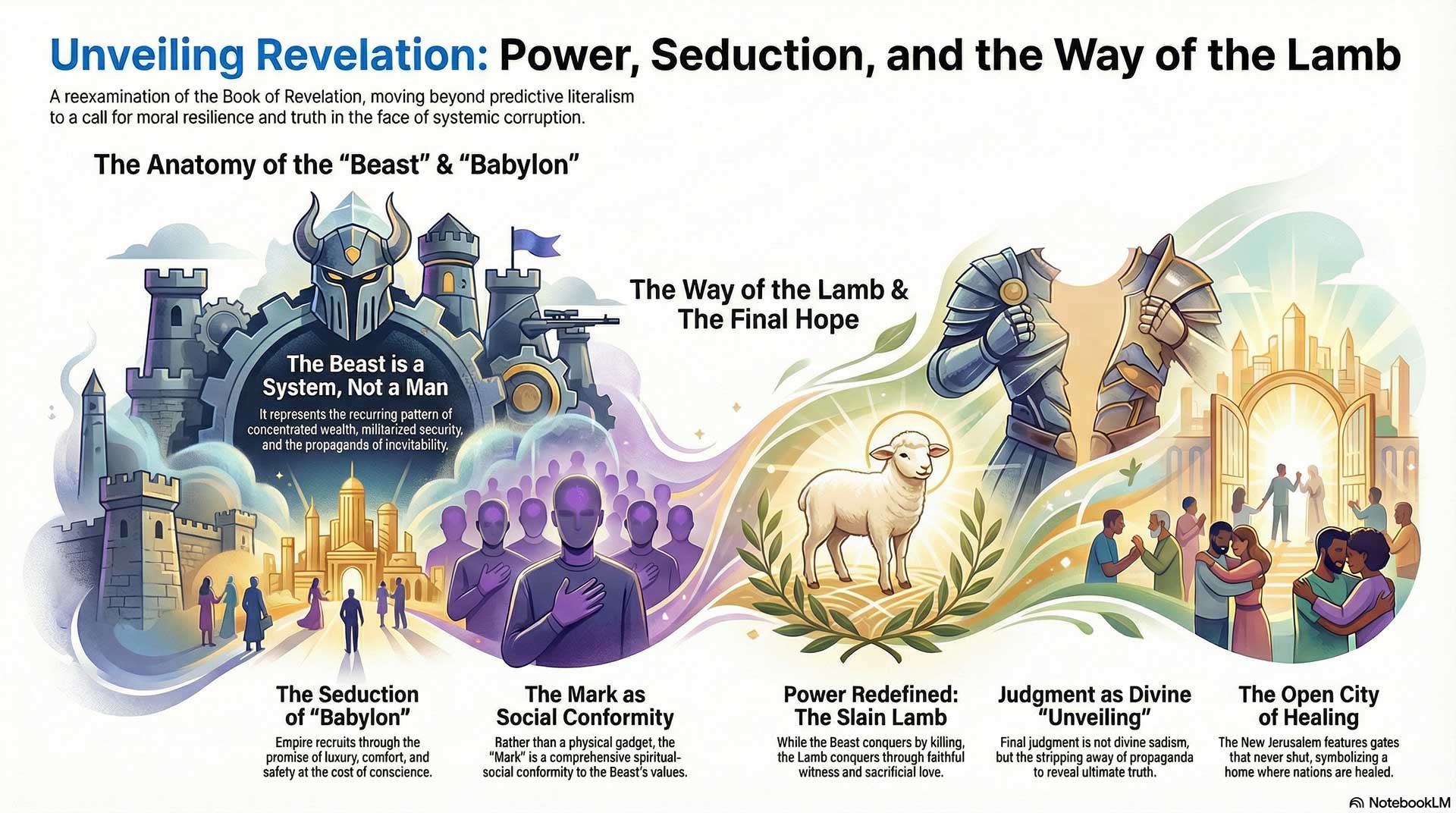
Revelation leaves the reader with a strange gift: it refuses to let evil remain abstract. It gives it contours, a vocabulary, a set of images sharp enough to name what otherwise hides inside normal life. That naming matters, because the most dangerous forms of domination are the ones that feel inevitable, reasonable, even beneficial. Revelation insists they are not inevitable. They are choices, repeated until they become a world.
If we read it well, we stop treating the Beast as a curiosity and start asking what it looks like when power demands devotion. We stop treating the Mark as a gimmick and start recognizing the moral pressure points where conscience is exchanged for access. We stop treating Babylon as distant and begin seeing how luxury can be built on invisibility, on exploited labor, on manufactured desire, on the quiet agreement to look away. And we stop imagining the Holy City as escapism and hear it as a claim about reality itself: that the final word does not belong to violence, and that human dignity is not a temporary exception granted by the strong.
The point, then, is not to leave with certainty about symbols. The point is to leave with greater integrity in how we see. Revelation trains attention. It teaches the reader to notice what is being asked of them, what is being normalized around them, and what is being worshiped without being named as worship.
So if this book confronts us, it does so with a simple question underneath all the thunder and light: when the world demands your allegiance, what will you refuse, and what will you become?
Short Bios:
Krista Tippett – Interviewer and public thinker best known for drawing out people’s deepest convictions with warmth, patience, and spiritual curiosity.
Melvyn Bragg – Veteran broadcaster who’s built a reputation for steering sharp, high-level conversations that stay rigorous without losing clarity.
Karen Armstrong – Former religious sister turned comparative religion writer who translates complex theology into human questions about meaning, fear, and hope.
Reza Aslan – Religion communicator who presses scholars to explain what texts meant in their world and why they still provoke people now.
Lex Fridman – Long-form interviewer with an analytical style who tends to slow arguments down and force definitions, assumptions, and evidence into the open.
Adela Yarbro Collins – New Testament scholar known for framing Revelation as apocalyptic literature with roots in Jewish and early Christian symbolic worlds.
John J. Collins – Leading scholar of apocalyptic traditions who helps explain how “end-time” imagery functions as coded political and spiritual speech.
Craig R. Koester – Specialist in Revelation’s imagery and theology, often focused on how symbols form a moral imagination and a map for perseverance.
Richard Bauckham – New Testament scholar recognized for careful work on early Christian texts and how Revelation critiques empire while re-centering worship.
David E. Aune – Scholar noted for deep, technical analysis of Revelation’s structure, sources, and ancient literary setting.
N. T. Wright – Prominent New Testament scholar who often emphasizes how early Christian hope was shaped by politics, worship, and a reimagined kingdom vision.
Walter Brueggemann – Influential biblical theologian known for confronting the “royal consciousness” and exposing how scripture critiques wealth, power, and denial.
Michael J. Gorman – New Testament theologian who foregrounds “faithful witness” and cruciform ethics, connecting Revelation’s vision to lived discipleship.
Warren Carter – Scholar whose work frequently highlights how the New Testament engages imperial power, economics, and social pressure.
Catherine Keller – Theologian known for reading apocalyptic themes through contemporary crises, asking how fear, power, and hope shape public life.
Bart D. Ehrman – Historian of early Christianity widely known for examining how early Christian beliefs formed, changed, and were debated across communities.
Elaine Pagels – Historian of early Christianity known for exploring how early Christians argued about authority, revelation, and the meaning of salvation.
Candida Moss – Scholar who studies martyrdom and memory, often challenging popular assumptions about persecution narratives and their modern uses.
Paula Fredriksen – Historian of ancient Christianity who emphasizes first-century Jewish context and how early Jesus movements understood empire and identity.
Frances Young – Early Christianity scholar associated with careful theological and historical reading of how the early church interpreted scripture.
G. K. Beale – Evangelical New Testament scholar known for detailed interpretation of Revelation and its dense use of Old Testament imagery.
Elisabeth Schüssler Fiorenza – Pioneering feminist biblical scholar who reads Revelation through power, resistance, and the politics of interpretation.
Stephen D. Moore – Scholar known for literary and cultural approaches to biblical texts, often probing how symbols can be weaponized or liberated.
M. Eugene Boring – New Testament scholar recognized for making Revelation’s genre and message accessible without flattening its strangeness.
Reta Halteman Finger – Scholar and writer who often connects early Christian texts to questions of empire, economics, and social justice.
Miroslav Volf – Theologian focused on reconciliation, human flourishing, and the moral shape of hope amid conflict and fear.
Jürgen Moltmann – Major Christian theologian whose work centers on hope, suffering, and the future as a force that reshapes ethics now.
Rowan Williams – Theologian known for spiritually serious, intellectually dense readings that keep doctrine tethered to prayer, beauty, and conscience.
Richard B. Hays – New Testament scholar noted for exploring how scripture forms moral vision, especially through intertextual echoes and narrative logic.
Fleming Rutledge – Preacher and theologian known for stark honesty about evil and suffering, paired with a strong emphasis on judgment, mercy, and promise.
Leave a Reply