
|
Getting your Trinity Audio player ready...
|
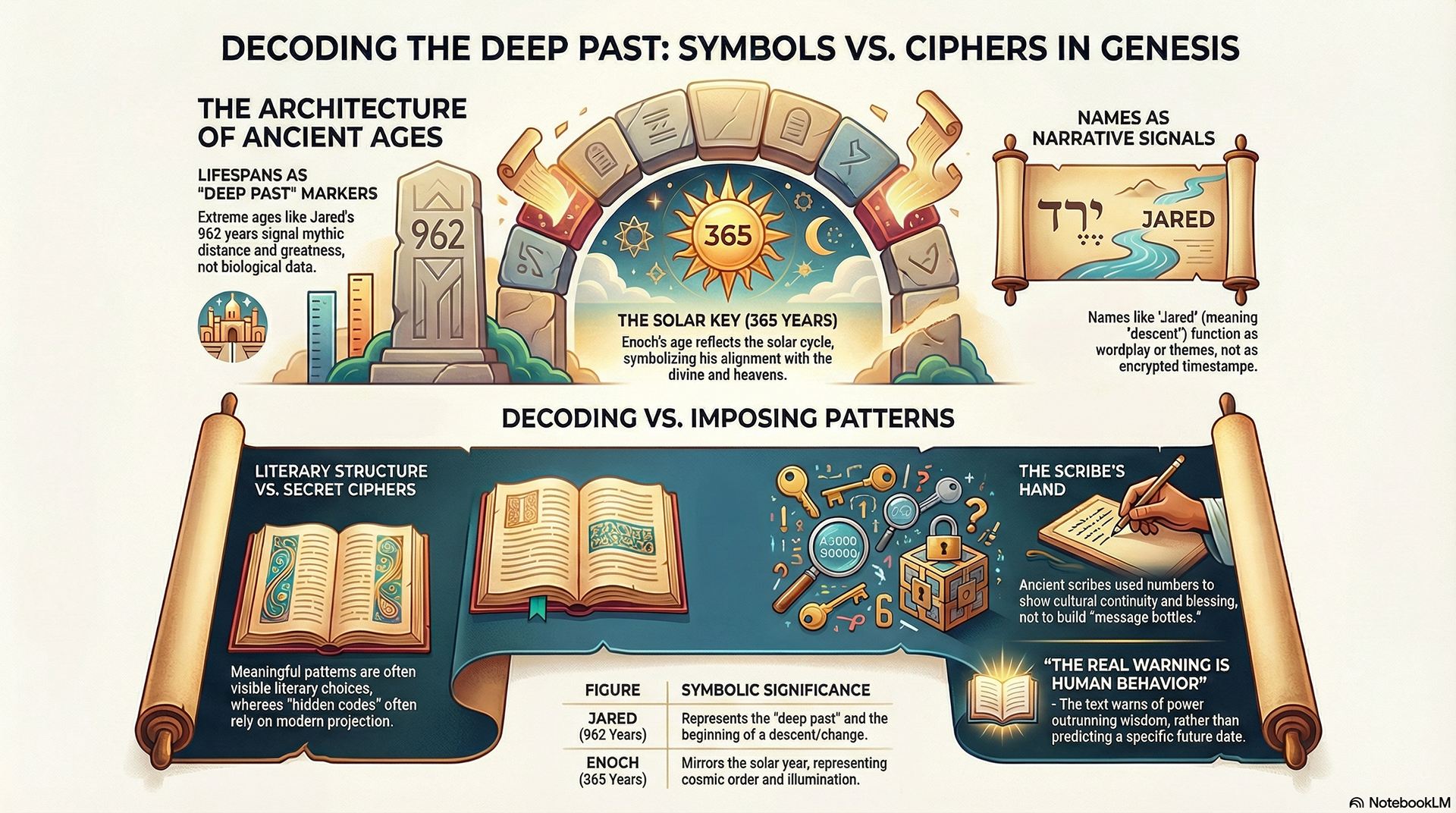
What if Jared’s famous 962 is not a prophecy, but a literary signal of “deep past” memory?
Introduction by Carl Sagan voice
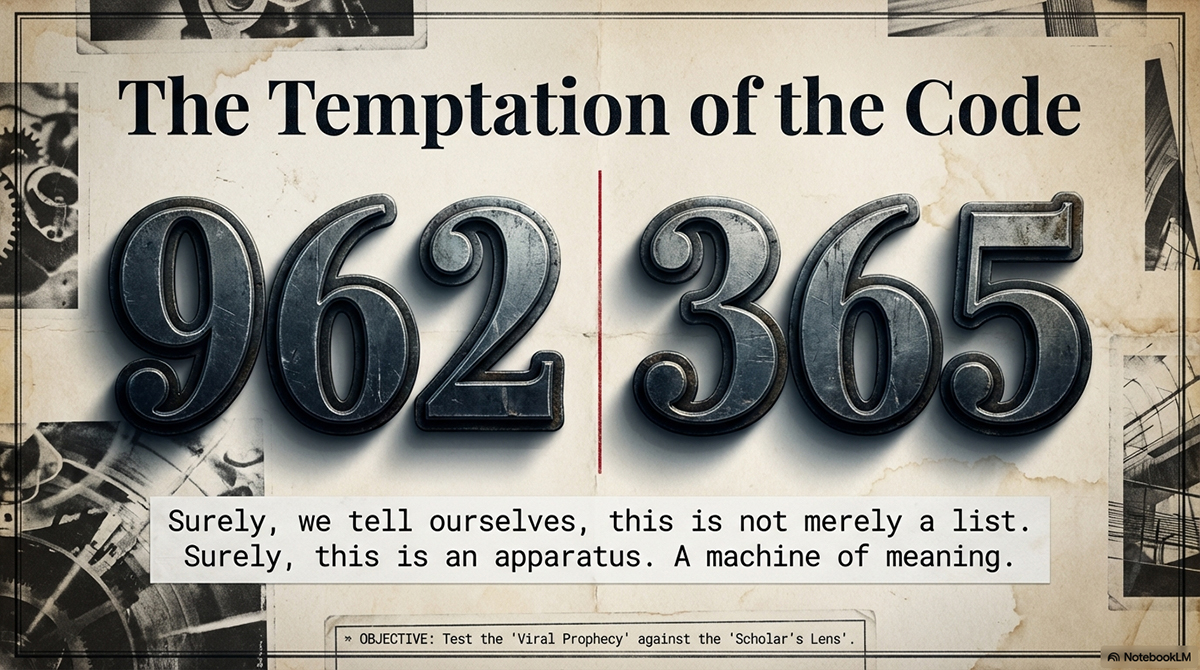
In every age, we have looked into the darkness and tried to count what looks back. We do it with stars, with calendars, with family trees, with the patient arithmetic of generations. And sometimes, when an ancient text hands us a string of lifespans that stretch far beyond any human biology, we feel a thrill that is almost physical. Surely, we tell ourselves, this is not merely a list. Surely, this is an apparatus. A machine of meaning.
Tonight’s investigation begins with a temptation: to treat the ages in Genesis as a locked vault and to imagine that Jared’s 962 years, and Enoch’s remarkable 365, are not symbols but signals. The claim is alluring because it sounds like science. It wears the costume of precision. But precision is not proof, and numbers can persuade even when they do not predict.
So we will do something both simple and rare. We will test the idea with discipline. We will ask what genealogies were meant to do in the ancient world, what later traditions like the Enoch literature added, and how easily the human mind can mistake pattern for intention. We will keep wonder intact, because wonder is the beginning of knowledge. But we will also keep our standards intact, because standards are how knowledge remains honest.
If there is a warning embedded in these lineages, it may not be a date. It may be something older and more human: what happens when curiosity outruns humility, when power outruns wisdom, and when we begin to prefer the comfort of a countdown to the hard work of understanding.
(Note: This is an imaginary conversation, a creative exploration of an idea, and not a real speech or event.)
Topic 1: “Jared” as a Signal Word
The studio lights were low, warm, and calm, like a late-night investigation show that refused to rush its own curiosity. Behind the roundtable, a clean backdrop held only one visual motif: a family-tree silhouette with branches fading into shadow. No words. No labels. Just the suggestion that something old was about to be examined with modern eyes.
Nick Sasaki looked around the table, not with showman energy, but with that careful tone you use when you know the audience has been primed for a conspiracy and you want to give them something better than a cheap thrill.
Nick Sasaki: Tonight we are testing a specific claim that keeps showing up in “hidden code” content. The name “Jared” is often said to mean “shall come down,” and some say that is not just a name but a marker, a pivot point, a signal that something came down into the world. In other words, not genealogy as record, but genealogy as message. So I want to start with something simple, and then we will sharpen it.
If “Jared” means “shall come down,” how likely is it that Genesis intended that as a narrative marker rather than just a name?
Michael S. Heiser leaned forward, familiar with the terrain where ancient texts, modern imagination, and supernatural readings collide.
Michael S. Heiser: The first thing is to separate two layers. One layer is the Hebrew name and its possible sense. Another is what Genesis is doing as a literary unit. Names can carry meaning without being a coded timestamp or a secret switch. Genesis uses names in meaningful ways sometimes, but it is inconsistent. The temptation is to treat meaning as mechanism. “This name means X, therefore X happened exactly here.” That leap is where things go off the rails.
Now, could an ancient audience hear a name and think of a theme like descent, falling, coming down, divine movement? Sure. Ancient people were not allergic to wordplay. But that is different from saying the author planted a cipher. If you want to argue “signal marker,” you need narrative support in the surrounding text. Genesis does not pause at Jared and say, “and now the descent begins.” It just keeps going.
Francesca Stavrakopoulou gave a half-smile, not mocking, more like someone who has watched viewers fall in love with patterns that are emotionally satisfying.
Francesca Stavrakopoulou: We also have to remember that Genesis is not a single author writing a single clean document. It is a compilation of traditions and texts that have histories, and genealogies are among the most formulaic parts of the Hebrew Bible. That matters because formula resists the kind of precision-code reading people want to impose on it.
Names can be meaningful, yes. But meaning is not the same as authorial intention. People often read the meaning of a name as though it is a divine caption placed beneath a photograph. Ancient naming practices were messy. A name might reflect hope, memory, family pride, local dialect, or later editorial shaping. And even if the name has a “descent” nuance, it can function as theology or symbolism rather than a literal “here is the moment fallen beings arrived.”
James Kugel spoke with that quiet, old-school clarity that turns the room from sensational to serious without taking away wonder.
James Kugel: Genealogies are not just lists. They are claims. They tell you who belongs, who matters, where legitimacy flows. Their purpose is often identity, not encryption. When later readers treat them like a locked safe, they forget that the original function was more like a family banner.
Do biblical writers sometimes use wordplay? Of course. But most of the cleverness in the Hebrew Bible is visible, not hidden behind math. It is designed to be heard. When people say “the name itself signals a cosmic descent,” I ask, “Where is the textual cue that the author wants you to stop, notice, and interpret?” If you have to bring in a separate library of later ideas to make the cue work, you are no longer reading Genesis. You are remixing it.
Bart D. Ehrman leaned back slightly, the way he does when he is about to deliver a blunt but useful boundary.
Bart D. Ehrman: There is also a basic historical point. The Watchers narrative people often cite is not in Genesis. It is in later literature like 1 Enoch, and even there it is part of a mythic explanation for evil. That does not mean it is worthless, but it means you cannot pretend Genesis is secretly talking about Enoch the way a modern author drops an Easter egg for a sequel.
When people insist that “Jared is the code word,” they are usually doing something backwards. They start with a conclusion they like, then rummage through the text for a word that can be made to point to it. That is not decoding. That is confirmation bias. If someone wants to argue that Genesis itself is signaling something cosmic, they should be able to do it from Genesis, not from a later myth being projected back into it.
Irving Finkel had the air of someone who has actually touched ancient tablets, held them, read the scratches, watched “mystery math” content slide past the reality of scribes.
Irving Finkel: I always want to bring us back to how texts survive. Lists, numbers, names, these pass through hands. Hands make errors. Hands harmonize. Hands copy from exemplars. A genealogy is exactly the kind of text that scribes preserve because it is culturally important, but it is also exactly the kind of text that can be standardized and smoothed. That is not sinister. It is normal.
So when someone says “this name is a marker,” I ask, “Marker for whom?” You are assuming a community that shares the same interpretive key. If the key is not demonstrable within the culture and the text, it becomes a modern key, not an ancient one.
Nick Sasaki nodded, letting the first pass land. Then he moved the conversation to the pressure point where the YouTube outline tries to fuse Genesis genealogy to Watchers descent as though the texts are one seamless blueprint.
Nick Sasaki: That brings us to the next step, because the claim rarely stops at “the name has meaning.” It often becomes “the name is announcing a specific event,” and that event is tied to Watchers traditions. So let me ask this in the most responsible way I can.
What is the most responsible way to connect Genesis genealogy language to Watchers traditions without forcing it?
Michael S. Heiser: If you want to connect them responsibly, you start by admitting the relationship is intertextual and later. In other words, Watchers traditions are a commentary on Genesis, not a hidden layer inside Genesis. Second Temple Jewish writers read Genesis, especially the “sons of God” passage, and developed an explanation for evil and corruption. That is a real phenomenon: interpretation creates tradition.
So the responsible approach is: “Here is Genesis. Here is how later Jews read it. Here is how they developed the Watchers story. Here is what that story is trying to explain.” You can even say that the meaning of “Jared” feels thematically resonant to readers who already hold that Watchers lens. But you should not claim Genesis is hiding a Watchers calendar in a genealogy.
Francesca Stavrakopoulou: I would add that “responsible” also means acknowledging that we have multiple ancient Near Eastern contexts. Many cultures tell stories about divine beings, transgressions, boundary-crossing, heavenly knowledge, and the consequences of divine-human mixing. The Watchers story is one expression of that, shaped by its time and its concerns.
If someone wants to draw a line from Jared to Watchers, let it be a line of reception history, not a line of secret engineering. Show how later texts read earlier ones. Show why the interpretation was attractive. And then show the limits. That is honest and still fascinating.
James Kugel: Exactly. The Hebrew Bible invites interpretation, and later interpreters took the invitation seriously. That is not scandalous. It is how scriptural traditions work. But it is a category error to treat the later interpretation as the original meaning. The Watchers tradition is evidence of what people thought, feared, hoped, and tried to explain centuries later.
So, connect them by saying, “This is how a later community made sense of that ambiguous line.” Do not connect them by saying, “The original author planted a cipher for us.” That is modern thriller logic.
Bart D. Ehrman: And if you want to keep it rigorous, you can also highlight that different Jewish and Christian groups treated these traditions differently. Some embraced them, some rejected them, some allegorized them, some used them to warn against certain behaviors. That diversity is evidence against the idea of one hidden code everyone knew.
The second you say “hidden numerical code,” you are asking me to believe there was a secret school that preserved the key, and yet the mainstream textual tradition never clearly says, “Here is the key.” That is a tall claim, and extraordinary claims need extraordinary evidence.
Irving Finkel: I like that phrase “reception history.” That is the proper channel for these connections. Because scribes and scholars have always made connections. They annotate. They interpret. They preserve. They sometimes even adjust numbers or names to harmonize traditions. But this is not the same thing as a cosmic countdown intentionally embedded for modern viewers.
If you want to connect Genesis to Watchers, connect them as a long conversation across centuries. That is already dramatic. You do not need to invent a lock-and-key conspiracy.
Nick Sasaki glanced toward the camera as if to remind the viewer that the show was not trying to kill wonder. It was trying to keep wonder honest.
Nick Sasaki: So far I am hearing a consistent theme. Meaning, yes. Resonance, yes. Later interpretive development, absolutely. But “secret engineered marker” is a different category and it needs more than a name meaning. That leads to the most useful question for our format, because our audience loves the mystery style, and we can honor that by asking what would actually qualify as proof.
What would count as a “smoking gun” that this is deliberate encoding and not meaning-making after the fact?
Michael S. Heiser: A smoking gun would be a pattern that is both intentional and accessible to the original audience, and that is acknowledged in some way by the text or by very early interpreters close to the time of composition. For example, if Genesis itself drew attention to the names or numbers and said, “therefore understand,” or if an early commentary from the same cultural world said, “we know this genealogy is structured as a countdown,” that would matter.
Without that, you are left with pattern detection that may be psychologically compelling but textually ungrounded. I am not saying that patterns cannot exist. I am saying the burden of proof is on the person claiming a cipher.
Francesca Stavrakopoulou: I would want to see controls. That is, if you can “decode” Jared, can you decode anything? If the method produces a prophecy no matter what name you start with, it is not a discovery tool. It is a story generator.
A smoking gun would include methodological restraint: a decoding method that produces specific results, fails predictably when it should fail, and is anchored in demonstrable ancient practices, not modern numerology habits. And even then, we would still have to ask, “What did the author intend the code to do?”
James Kugel: I would add something very plain. A smoking gun would be clear literary signaling. Ancient authors did not always hide their cleverness. If a text wants you to notice something, it often nudges you. The Bible contains acrostics, poetic structures, repeated phrases, thematic patterns. Those are visible. A truly hidden code, by definition, is invisible unless you already know what you want to find. That is the danger.
If I were convinced, it would be because the text itself presents a structure that cannot be explained by ordinary list-making. Not because a modern reader found a clever alignment with an external myth.
Bart D. Ehrman: For me, the smoking gun would be independent attestation. If two or three early sources, not dependent on one another, say something like “these ages form a designed sequence” and they explain what it means, then we have evidence of intention.
But here is what we usually get instead: a modern content creator claims a hidden structure and then proves it by asserting it. That is not how historians work. If there is no early trace of the key, we should not pretend we found the author’s secret diary.
Irving Finkel: I will make it earthy. Show me the workshop. Show me the scribal practice. If you claim Babylonian base-60 encoding, I want to see it demonstrated in a context where we know scribes used such systems for comparable literary purposes. We have lots of Mesopotamian material. We know what their numerical habits look like. We can compare.
A smoking gun would be a match between method and culture. Not a match between method and a modern appetite for apocalypse.
Nick Sasaki let a quiet pause settle, the kind that signals the end of a segment without making it feel like the conversation is closing down. The energy in the room had shifted from hype to clarity, and that clarity itself had its own thrill.
Nick Sasaki: So if we are going to do ImaginaryTalks with this premise, we can keep the mystery style, but our real hook becomes this: we are not just “revealing a code.” We are testing whether there is enough textual and cultural evidence to justify the claim. And if there is not, we can still tell a powerful story about how later traditions read Genesis and why the Watchers theme keeps returning in modern imagination.
He looked around the table again.
Nick Sasaki: Next topic, we will move from the name to the numbers. If there is “architecture,” it will show itself there, or it will collapse. Either way, we will learn something real.
The lights held steady, the family-tree silhouette behind them still branching into shadow, as if to say the oldest stories never stop inviting questions, but they do demand that we ask them carefully.
Topic 2: The 962-Year Lifespan and “Mathematical Architecture”
The backdrop shifted from the family-tree silhouette to something that looked like a museum display case. A single, oversized parchment panel showed only columns of numbers and blank lines, like a ledger waiting to be interpreted. The mood was still late-night investigative, but now it felt more clinical. The table had cups of water, not props. The message was clear. If there is a code, it has to survive real scrutiny.
Nick Sasaki rested a finger lightly on the table, as if tapping the surface could summon a pattern without forcing one.
Nick Sasaki: Topic one established something important. Names can resonate without being engineered signals. Now we have to deal with the thing people find irresistible. The ages. Especially Jared’s 962. Some call it an anomaly. Some call it architecture. Some call it a cipher.
When we see extreme ages like 962, what are the best scholarly explanations before we jump to “code”?
John H. Walton: The most basic move is to ask what genre we are in. Many modern readers approach Genesis 5 like it is a modern birth registry. But genealogies in the ancient world do more than preserve data. They establish identity, legitimacy, continuity, and a sense of ordered origins. The ages, then, can serve literary and theological purposes even if they do not map onto biological lifespan.
One strong scholarly approach is to treat these numbers as part of an ancient worldview that expresses greatness, antiquity, blessing, and distance from the present. Early ancestors are portrayed as closer to origins, closer to the divine ideal, and the numbers communicate that in a way ancient audiences understand. That does not require a cipher. It requires a symbolic register.
Christine Hayes: I would add that “best explanation” also includes the simple reality of textual transmission. Numbers are notoriously unstable in manuscript traditions. Copying names is hard enough. Copying numbers can be harder because a single error can produce a startling result. Even if we assume an original pattern, we should not assume perfect preservation. This is why we need humility before declaring precision-engineered structure.
There is also the possibility that these ages function as a schematic, not as literal history. A schematic can be meaningful without being encoded. It can be structured, memorable, and didactic without hiding a countdown.
Irving Finkel: From my side, the Mesopotamian comparison is unavoidable. Long lifespans appear in ancient king lists as a way of expressing distance from the present and a mythic sense of time. You can find reign lengths that are astonishing. Some are plainly symbolic. Some reflect a way of thinking about early eras as qualitatively different. So, when you see 962, you should hear it as “the deep past,” not “a secret alarm clock.”
It is also worth remembering that numbers often get systematized. Scribes like tidy arrangements. If there is a pattern, it may be a pattern of scribal taste and tradition, not an interdimensional warning.
Stephen J. Gould: From a scientific standpoint, we should start with the biological impossibility. Humans do not live nine hundred years. So the question becomes, what cultural function is the claim serving. That is where it becomes interesting. Cultures encode values in stories, and numbers can carry values too. If we accept that, then we stop treating the numbers as data to be cracked and start treating them as signals of meaning within a narrative tradition.
And I would offer a warning. Humans are exceptionally good at finding patterns. That skill helped us survive. But it also makes us vulnerable to seeing design where none exists. So “best explanation” must include psychological explanation.
Hannah Fry: Mathematically, the first responsible move is: define your hypothesis in advance. If you say, “These numbers are a countdown,” you need to specify what kind of countdown and how you would recognize it without looking at the answer first. If you do not, then any pattern you find can be retrofitted.
A strong explanation might be: these are symbolic numbers that create a sense of ordered descent from an idealized past toward a broken present. That can still be structured. It can still be “architected” in a literary sense. But that is different from “encoded in base-60 to predict something.”
Nick Sasaki: That leads directly into the biggest claim in the inspiration text. It says, “base-60 Babylonian influence,” and then it moves from there to astronomy, calendars, divine geometry. People love that because it sounds technical. So I want to pin it down.
If someone claims “base-60 Babylonian influence,” what evidence would we need to demonstrate it and not just assert it?
Irving Finkel: You would need cultural proximity and a plausible transmission mechanism. You would also need clear mathematical fingerprints. Base-60 is not just a vibe. It produces recognizable structures. If a set of numbers was designed around sexagesimal thinking, we might expect consistent divisibility patterns, consistent modular relationships, or recurring factors that map to known Mesopotamian calendrical schemes.
Then you would need a comparative corpus. Show me similar numerical encoding in texts we can confidently locate in a Mesopotamian scribal environment. If the method is authentic, it should not appear only in Genesis when a modern person goes hunting for it. It should appear in the scribal ecosystem.
John H. Walton: I would also want to see that the proposed influence actually fits the Israelite context of the text’s formation. Yes, Israel existed in a world with cultural exchange. Yes, Babylon looms large at various points. But “influence” cannot be a shortcut word that lets any theory pass through. We need to show why an Israelite text would embed a Babylonian astronomical calendar inside a genealogy, and why the audience would be expected to decode it.
If the claim is that later editors reworked the numbers under Babylonian influence, then show the historical moment and the editorial motive. Otherwise, “Babylonian base-60” becomes a magic phrase.
Christine Hayes: Evidence would also include consistency across witnesses. If we had multiple textual traditions and the numbers align in a way that preserves the supposed encoding, that would be notable. But if the numbers vary, then a fragile code becomes even less plausible.
And importantly, we need to distinguish between shared ancient numeracy and intentional cryptography. People could use numbers, symbolic quantities, and calendrical ideas without embedding a hidden cipher. The evidence has to show intent, not merely possibility.
Hannah Fry: In math terms, you would want to reduce degrees of freedom. Most “hidden code” claims have too many adjustable knobs. You can add, subtract, switch bases, take differences, pair ages with birth years, pair lifespans with something else, and eventually you will hit something that looks meaningful.
So evidence would include a method that is constrained. The rule is simple. The rule is specified up front. The rule produces a unique output. The output matches something historically plausible. And you can test it on other datasets where you should not see the effect. If it still “works” everywhere, then it is not real evidence.
Stephen J. Gould: And we should add a cultural sanity check. Even if you could demonstrate sexagesimal structure, you still need to show that it is being used to communicate the sensational conclusion. Otherwise, all you have proven is that ancient people liked numbers. Which we already knew.
A scientific mindset says: separate detection of structure from interpretation of purpose. Many claims skip that step.
Nick Sasaki: I like that. Structure and purpose are different. People often leap from “look, a pattern” to “therefore prophecy.” So let’s talk about that leap, because it is where audiences either get informed or get manipulated.
How do we separate “pattern recognition that teaches something” from “pattern obsession that proves nothing”?
Hannah Fry: A helpful filter is predictive power. If your pattern is real, it should help you anticipate something you did not already bake into the method. Another filter is parsimony. A good explanation does not require ten hidden steps. It requires a few clear steps and then it holds.
Also, ask whether the same method finds equally compelling patterns in random data. If it does, you have learned something about human perception, not about Genesis.
Christine Hayes: I would add that teaching value matters. Patterns can be pedagogically useful even when they are not “proof.” For example, seeing the genealogy as a structured descent toward the flood can teach something about the narrative’s movement and theological arc. That is legitimate.
Pattern obsession, by contrast, often produces fear. It produces certainty without accountability. It collapses the distance between ancient text and modern headlines. It is not only an academic problem. It is an ethical one.
John H. Walton: A good separation is to ask: does the pattern emerge from the text’s own categories, or are we imposing modern categories onto it? If the text is doing theology and identity, then we should read it in that frame first.
And we should not treat “non-randomness” as proof of hidden code. A genealogy can be intentionally structured as literature. That is not the same as being an encrypted message.
Stephen J. Gould: I would put it bluntly. Pattern recognition teaches when it increases understanding with minimal fantasy. Pattern obsession proves nothing when it requires maximal fantasy and offers minimal constraint. The obsession often relies on the feeling of discovery. But feelings are not methods.
There is also a survival lesson here. Humans are drawn to apocalyptic countdowns because they turn anxiety into a schedule. That is psychologically soothing, even when it is false.
Irving Finkel: My test is practical. If you propose a decoding method, can you explain why a scribe would do it, how they would preserve it, and who it is for. If you cannot answer those questions, it is likely a modern entertainment overlay. Ancient scribes had motivations, institutions, and audiences. They were not writing for YouTube in the year 2026.
But if you treat the numbers as mythic time, symbolic memory, and a way of giving the earliest world a different texture, then you are reading in a way that honors the ancient mind.
Nick Sasaki nodded, and the table felt steadier now. Not less mysterious, just less gullible.
Nick Sasaki: So if we do Topic 2 in ImaginaryTalks style, the payoff is not “we proved a cosmic invasion timetable.” The payoff is something more solid.
We learn what genealogical numbers do in ancient storytelling. We learn what would be required to prove real encoding. We learn why base-60 claims need fingerprints, not vibes. And we also learn that patterns can be meaningful without becoming panic.
He glanced at the ledger-like parchment behind them.
Nick Sasaki: Next topic, we step into the most tempting bridge of all. Jared’s relationship to Enoch. Because once 365 enters the room, everyone wants to turn the genealogy into a calendar. We will see what holds.
The camera pulled back slightly, not to end the conversation, but to widen it. The numbers stayed on the wall, silent and patient, as if they had waited thousands of years to be read carefully for the first time.
Topic 3: Jared, Enoch, and the Solar Key (365)
The set changed again, quietly. The ledger backdrop was gone. In its place was a simple circular diagram that looked like a sun dial drawn by hand. No labels. Just a ring of small marks, like days. The lighting felt warmer now, almost intimate, as if the room itself understood that “365” is the number that makes people lean forward even before anyone explains why.
Nick Sasaki looked around the table and spoke in a tone that was careful, but not cold. This was the part where viewers usually expect fireworks, because the moment you say “Enoch lived 365 years,” everyone wants the text to become a calendar.
Nick Sasaki: We have arrived at the magnet. Enoch’s 365. People hear that and instantly think solar year, secret astronomy, a key to unlock Jared, a countdown, a code. Some even treat it like the writer is winking at us across millennia.
Why does Enoch’s 365 create such a strong gravitational pull toward “astronomical encoding” interpretations?
Elaine Pagels: Because it is a number that already lives in the human body of time. It is familiar. It is orderly. It feels designed. When a text gives you a number that matches the rhythm of the sun, the imagination says, this cannot be accidental. It must be a signal.
But religious texts often use familiar cosmic rhythms to suggest meaning. “This life is aligned with the heavens.” That can be symbolic theology, not hidden math. Enoch becomes a figure of closeness to the divine, and the solar cycle becomes a natural metaphor for ordered knowledge, illumination, and completion.
James Kugel: I agree. The appeal is that 365 feels like a rare moment of clarity in a list that otherwise feels opaque. Most readers do not know what to do with 895 or 962. But they know 365. So they treat that recognition as proof.
Ancient writers, however, used recognition on purpose. They wanted you to feel something. They wanted you to hear an echo between the human story and the cosmos. That does not require a cipher. It requires a poetic instinct.
Michael S. Heiser: And once you bring Enoch into the picture, you are also dealing with a huge interpretive tradition. Enoch is not just a line in Genesis for many readers. He becomes a doorway into a whole world of stories about heavenly journeys, forbidden knowledge, Watchers, and cosmic conflict.
So 365 becomes more than a number. It becomes a hook. People want it to be the lock that fits the key they already love. If they already believe Enoch is tied to celestial knowledge, then a solar number feels like confirmation.
Francesca Stavrakopoulou: There is also the psychology of meaning. Readers want the genealogy to be more than a list. They want it to be a message. When they see 365, they feel permission to treat the list as intentional architecture.
But I would urge caution. What feels like permission can be a trap. Because the desire for a hidden calendar can become stronger than the evidence. Then the text is no longer allowed to be what it is. It is forced to become what the reader wants.
Yuval Noah Harari: From a broader cultural view, a number like 365 is a perfect bridge between myth and system. Myths become more compelling when they look like science. A solar cycle gives the story a sense of precision. It feels modern.
And in our era, precision feels like truth. So a person hears “365” and feels they are leaving the realm of faith and entering the realm of data. But that feeling can be manufactured. The number may function as an aesthetic of truth, not as proof.
Nick Sasaki let that settle. Then he nudged the discussion into the next claim. The inspiration outline keeps insisting that Watchers themes involve “forbidden knowledge” and that Jared, as Enoch’s father, becomes a transmission point.
Nick Sasaki: That brings us to the connective tissue people love to build. Jared is father of Enoch. Enoch becomes the great transmitter figure in later tradition. So the claim becomes: Jared is the gateway, Enoch is the carrier.
What is the cleanest way to link Enoch traditions to “forbidden knowledge” without sensationalizing?
Michael S. Heiser: First, you keep your categories straight. Genesis says very little. Later Enochic literature says a lot. So you present it as development. You say, “Later interpreters expanded this figure into a major symbol.”
Second, you explain what “forbidden knowledge” means in that literature. It is not always sci-fi. It is often moral and social. Knowledge that blurs boundaries. Knowledge that leads to violence, exploitation, domination. The Watchers narrative is a way of explaining why the world feels corrupted.
If you want to be responsible, you treat it as an ancient moral myth about transgression and consequence. That is already powerful.
Elaine Pagels: Yes. Many traditions use “forbidden knowledge” to talk about spiritual danger. Knowledge that inflates pride. Knowledge that becomes control. Knowledge that separates elites from ordinary people.
When you frame it that way, it becomes human and ethical. It is less about secret technology and more about the way power distorts. That keeps the story meaningful without turning it into a claim about literal ancient portals.
James Kugel: And you show the range. Not every ancient reader treated Enoch the same way. Some embraced Enochic stories. Some did not. Some used them as warnings. Some used them as explanations for suffering.
That diversity matters. It tells us we are looking at interpretive traditions, not at a single encoded master plan.
Francesca Stavrakopoulou: Also, do not flatten “forbidden knowledge” into a single trope. In many ancient contexts, knowledge is never neutral. It is bound to social order, priestly authority, and community boundaries.
So when Enoch becomes a knowledge figure, it can reflect tensions about who controls access to wisdom. Who has the right to interpret the divine. That is historically interesting. And it does not require sensational claims.
Yuval Noah Harari: If you want to avoid sensationalizing, you also avoid using modern technological language as if it were present in the ancient text. The moment you say “technology,” many viewers stop listening and start imagining machines. You can say “skills,” “arts,” “craft,” “power,” “methods.” These are ancient categories.
And you can bring the viewer back to why this story persists. People are afraid that the world is being shaped by knowledge that is out of moral control. That fear is timeless. The myth is a mirror.
Nick Sasaki nodded. The conversation was moving toward the question that would either save the episode or turn it into a hype machine. The YouTube outline claims “countdown,” “planetary alignment,” “precise synchronization.” If the show was going to be honest, it had to put that claim on the table and demand real standards.
Nick Sasaki: Now the hard part. Some creators say Jared initiates a countdown. That the genealogy is synchronized with cosmic cycles. That the text is a timed warning system.
If Jared begins a “countdown,” what exact mechanism would the text need to show for that claim to be credible?
James Kugel: It would need explicit signaling. The text would have to invite calculation. It would have to indicate that the ages are meant to be added, compared, or read as a sequence that points beyond itself.
Genealogies in the Bible do sometimes do arithmetic for narrative purposes. But if this were a deliberate countdown, we would expect an internal cue, not just an external desire. Without that cue, the “countdown” is something the reader brings, not something the text gives.
Francesca Stavrakopoulou: Credibility would also require coherence across textual traditions. If the mechanism depends on precision, then the numbers would need to be stable in transmission in a way that supports the mechanism. But numerical stability is not guaranteed.
A credible claim would have to acknowledge textual history rather than pretending the text arrived as a perfect machine.
Michael S. Heiser: I would want to see early evidence that ancient readers saw it that way. Not modern viewers. Ancient interpreters closer to the world of the text. If the mechanism is real, it would likely leave footprints in early commentary or parallel literature, not just in a twenty-first century decoding video.
Also, the mechanism would need to be consistent with the theology of the text. Genesis is not written like an encrypted prophecy manual. It is written like theological narrative. That matters.
Elaine Pagels: The text would need to show intent to communicate a timetable, not just an opportunity for one. A timetable implies an audience who can act on it, or at least understand it.
If the mechanism is so hidden that only modern decoding can recover it, then it ceases to function as scripture in its own time. It becomes a message in a bottle sent to strangers. That is possible as a fantasy, but it is weak as historical interpretation.
Yuval Noah Harari: In my language, the mechanism would need to be socially plausible. A countdown is not just numbers. It is a social technology. It is a way of shaping behavior, expectations, cohesion, fear, hope. If it was embedded, why was it embedded, and for whom?
If you cannot answer who it was for and what it was meant to do in its original community, then the “countdown” is likely a modern projection of our obsession with deadlines and apocalypses.
Nick Sasaki let the room breathe. The circular sun-dial image behind them looked almost tender now, like a reminder that cosmic rhythms can carry meaning without becoming alarm bells.
Nick Sasaki: So Topic 3 gives us something important for ImaginaryTalks. We can absolutely lean into the 365 fascination. We just do it honestly.
We can say: Enoch’s 365 is a symbolic bridge between human life and cosmic order. It becomes a hook for later traditions that imagine heavenly knowledge and moral transgression. But the leap from symbolic alignment to precision countdown needs a mechanism that the text itself signals, and evidence that ancient readers recognized it.
He turned slightly toward the camera, as if inviting the viewer to keep their curiosity but tighten their standards.
Nick Sasaki: Next topic, we move into the modern parallels. Watchers then, non-human intelligence now, and why every era finds a way to retell the same fear in the language of its time.
The lights stayed steady. The circle behind them stayed quiet. The conversation did not end. It simply shifted, the way old stories always do when they find a new century to live in.
Topic 4: Watchers Then vs “Non-Human Intelligence” Now
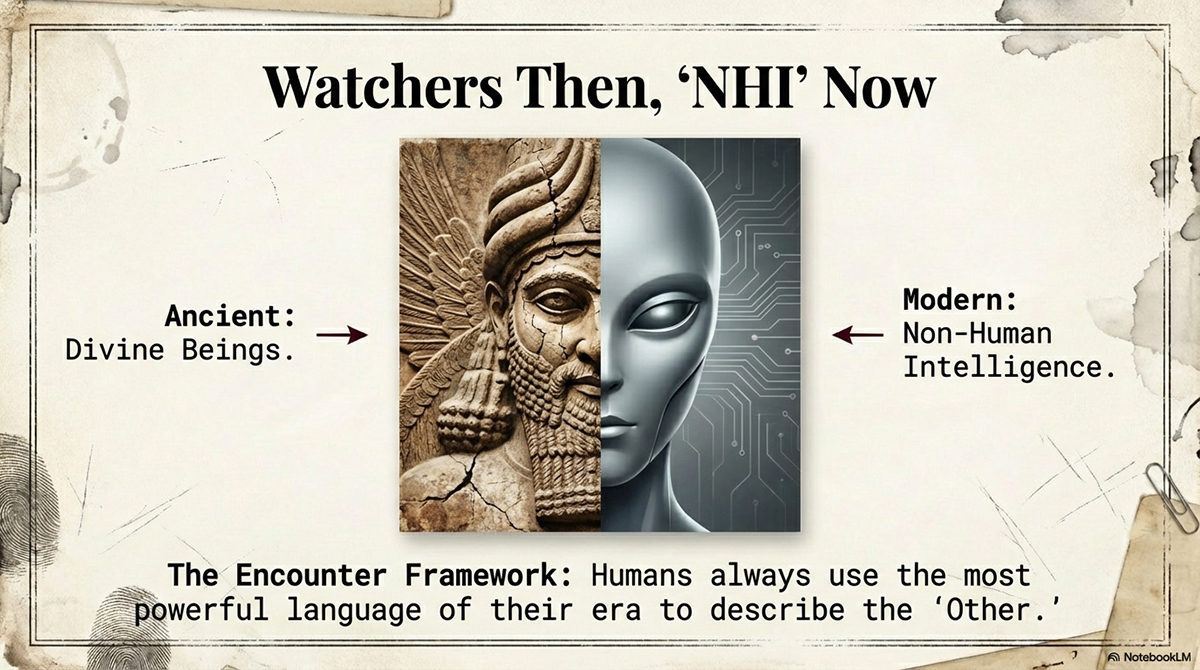
The set took on a different texture, more contemporary but still restrained. The backdrop was a dark wall with a grid of softly glowing squares, like screens viewed from a distance. No headlines. No logos. No dates. Just the feeling that modern life is flooded with signals and that people are trying to decide which ones mean something.
On the table were ordinary objects that hinted at the present without turning it into a gimmick: a small circuit board, a stone fragment, a simple star chart, and a notebook filled with blank pages.
Nick Sasaki looked from face to face.
Nick Sasaki: This is where the story usually tries to snap from ancient text to modern alarm. Watchers. Non-human intelligence. Sightings. Technology. People want a clean bridge that says, “It is happening again.”
So I want to ask this carefully, not to drain mystery from the room, but to stop us from calling a feeling “evidence.”
Why do Watchers stories map so easily onto modern NHI language, and what does that reveal about us?
Diana Walsh Pasulka: They map easily because they occupy the same psychological and cultural space. In many eras, people describe encounters with “others” using the most powerful language available to them. Ancient people used divine beings, angels, rebellious heavenly figures. Modern people use extraterrestrials, non-human intelligence, advanced civilizations.
What it reveals is that human experience includes events people interpret as contact with something beyond normal categories. Whether those events are external realities, internal experiences, or social contagions, the phenomenon has a recurring structure. The language changes, the core tensions remain. Awe, fear, fascination, and the sense that knowledge is being offered or taken.
Jeffrey Kripal: I would push that further. These stories are about the limits of the human. They are not only about literal beings. They are about the encounter with the impossible, the taboo, the forbidden. That is why they recur.
NHI language gives a modern person permission to speak about experiences that otherwise sound religious. In a secular age, UFO or NHI frameworks can function like a socially acceptable spiritual vocabulary. It reveals that the sacred does not disappear. It migrates into new forms.
Michael S. Heiser: From my side, the mapping happens because the Watchers story is a ready-made explanatory myth for why the world feels compromised. It speaks to disorder, corruption, boundary breaking, and the consequences of illicit knowledge.
Modern NHI talk often carries the same emotional logic. Something came from outside. It changed things. It gave knowledge. It confused moral boundaries. Even when people claim they are being purely scientific, they sometimes adopt mythic structures.
That does not mean NHI claims are true or false by definition. It means the interpretive frame people reach for is ancient and powerful.
Carl Sagan: I think it reveals our hunger for narrative. When we face uncertainty, we want a story that turns chaos into meaning. Watchers myths and modern NHI narratives can both supply that.
But we must be careful. The ease of mapping can be a warning. If a story fits too perfectly, it may be because it is a human template being laid over ambiguous data. The universe does not owe us narratives that match our expectations.
Neil deGrasse Tyson: It also reveals our relationship with ignorance. When we do not know, we fill gaps. Sometimes that produces poetry. Sometimes that produces delusion.
The mapping is easy because both frameworks describe “intelligence beyond us.” But modern NHI claims should rise or fall on evidence, not on how smoothly they rhyme with mythology. If we let rhyme stand in for proof, we become extremely easy to manipulate.
Nick Sasaki nodded, letting the first question open the main tension. Then he leaned into the most combustible claim in the original outline, the one that can quickly turn a thoughtful episode into pseudo-history. “Ancient metallurgical secrets,” “silicon-based tech mirroring Watchers teaching,” “forbidden technology.” It can be compelling, but it can also become sloppy fast.
Nick Sasaki: So here is the next bridge people try to build. They say, “Watchers taught ancient technology. Today we have silicon-based technology. Therefore it is the same story repeating.”
Can “ancient tech teachings” be handled as mythic motif without turning into fake history?
Michael S. Heiser: Yes, if you state what the sources are and what they are not. In 1 Enoch and related traditions, the Watchers teach various arts, often framed as harmful or corrupting. But that is not a lab report. It is moral storytelling.
Handled responsibly, you say: this is a mythic way to talk about the dangers of power and knowledge. It explains violence, exploitation, weaponization. You do not say: therefore we can trace modern microchips to Mount Hermon.
Diana Walsh Pasulka: I agree, and I would add that modern audiences often hunger for sacred meaning in technology. People experience tech as almost supernatural. It shapes attention, identity, memory, and social life. That makes it tempting to mythologize tech origins.
The responsible way is to treat the “teaching” motif as a symbolic lens. It highlights anxiety about knowledge that arrives faster than moral wisdom. That is a real theme. We can explore it without pretending to possess an archaeological paper trail that does not exist.
Jeffrey Kripal: Myth is not fake. Myth is a truth-language, but it is not the same truth-language as history. The danger comes when someone uses mythic motifs as if they are literal timelines. The motif of forbidden teaching expresses transgression, desire, and the cost of crossing boundaries.
We can say: modern technology feels like forbidden fruit. It grants power, but it can deform the soul and the community. That is a mythic reading, and it can be intellectually honest if you do not disguise it as excavation.
Carl Sagan: Precisely. We can learn from myths without confusing them with evidence. When we interpret a myth as a literal blueprint, we stop asking the questions myths are best at provoking.
Myths tell us about ourselves, our fears, our moral dilemmas. History and science tell us what happened and what is happening. Mixing them can create a very persuasive story that is nevertheless false.
Neil deGrasse Tyson: And the minute you claim direct continuity, you own the burden of proof. Show the artifacts. Show the chain of transmission. Show the documentation. Otherwise it is fiction wearing a lab coat.
But if you keep it as metaphor, it becomes useful. Technology as a modern version of forbidden knowledge. That is a conversation worth having. It just is not evidence for ancient beings.
Nick Sasaki let that land, then moved to the third question. This is where the “countdown to 2026” and “final window” rhetoric usually enters. Even if you want to keep the suspense, you need a standard that forces accountability.
Nick Sasaki: Last question for this topic, and I want it to be the kind of question that protects the audience.
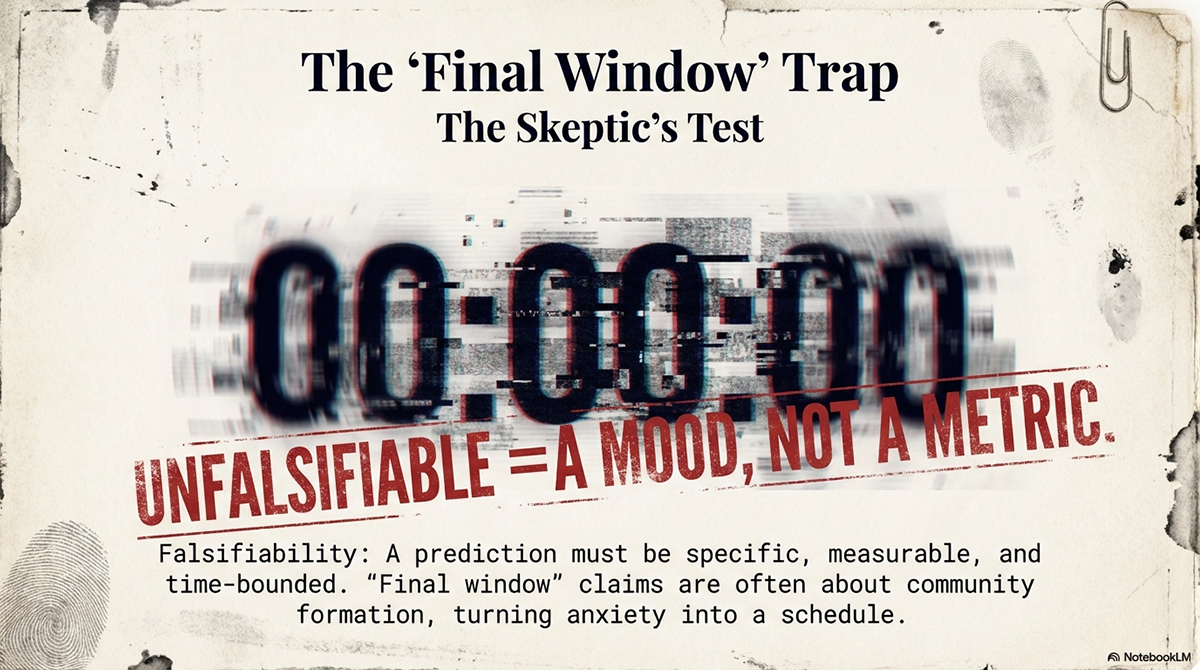
If someone says, “We have entered the final window,” what falsifiable prediction would they be willing to make?
Neil deGrasse Tyson: A falsifiable prediction must be specific, measurable, and time-bounded. It cannot be vague like “things will intensify” because things always intensify somewhere.
If someone claims a final window tied to 2026, they should state exactly what will be observed, by whom, and what outcome would prove them wrong. If they refuse, they are not predicting. They are marketing a mood.
Carl Sagan: I would add that extraordinary claims demand robust standards. If you propose a cosmic event, you should point to instruments and data streams that could detect it. If the claim cannot be tested by any method outside the claimant’s interpretation, it is not a scientific claim. It is a belief claim.
Beliefs can be meaningful, but they should not masquerade as evidence.
Diana Walsh Pasulka: Many “final window” claims are less about prediction and more about community formation. They create urgency and belonging. They turn viewers into insiders.
So a good practice is to ask for falsifiability as a moral test, not only an epistemic one. If the creator is unwilling to risk being wrong, then the claim is not meant to be evaluated. It is meant to be absorbed.
Jeffrey Kripal: Even within a mythic or symbolic frame, you can still ask for integrity. If someone uses apocalyptic language, they are shaping human emotion. Fear and expectation are powerful forces. The ethical responsibility is to be clear about the register you are speaking in.
If it is mythic truth, say it is mythic. If it is literal prediction, accept the discipline of being wrong.
Michael S. Heiser: From a text perspective, “final window” claims often rely on selective reading and flexible interpretation. That is why falsifiability matters. It forces the interpreter to stop sliding the goalposts.
If the claim is tied to biblical markers, define the markers clearly, and define what would count as not meeting them. Otherwise it becomes perpetual suspense.
Nick Sasaki sat back slightly. The room felt calmer after that. Not because mystery had been eliminated, but because it had been given boundaries.
Nick Sasaki: So Topic 4 works in 53r1 because it lets us do two things at once.
We acknowledge why Watchers and NHI language feel like a natural match. We explore the motif of forbidden knowledge and the modern sense that technology has become spiritually destabilizing. But we refuse to turn metaphor into fake history. And we insist that countdown claims either become testable or they stay in the realm of story.
He glanced at the glowing grid behind them, the silent suggestion of a world drowning in signals.
Nick Sasaki: Next topic, we bring it all together. If there is a “final warning” in the lineage, what would responsible synthesis look like, and what would it look like if it were just pattern obsession dressed up as proof?
The camera widened a touch, not to close the discussion, but to make room for what was coming. The grid of light squares stayed steady, like a reminder that modern mysteries multiply easily, but standards still matter.
Topic 5: “Final Warning Embedded in the Lineage”
The studio felt quieter than before, like the moment a good investigation stops chasing sparks and starts weighing what it can honestly carry. The backdrop was almost empty now. A single branching silhouette again, but this time the branches faded into a horizon line, suggesting that the “lineage” was not just a family tree but a map of human imagination across time.
On the table, the props from earlier topics were gone. No circuit board. No stone fragment. No star chart. Only five small blank cards, like conclusions waiting to be written carefully.
Nick Sasaki looked down at the cards, then up at the panel.
Nick Sasaki: This topic is where the sensational version of this story usually declares victory. It says, “We proved a countdown. We entered the final window. We can identify markers in current events.”
But ImaginaryTalks works best when we do something harder. We synthesize without pretending. We respect the texts and respect the audience. And we give people something real to take home.
So I want to begin here.
What is the most meaningful takeaway from genealogies if we treat them as theology and memory, not code?
Christine Hayes: Genealogies are an architecture of belonging. They tell you who you are in relation to a story of origins. They compress time into identity. They are memory systems. They are not neutral.
When read as theology, Genesis genealogies also express a movement. They carry the sense of a world that changes, a distance that grows between origins and the present, and a human condition that becomes more complicated. The numbers and names can contribute to that feeling without being a cipher. They give weight. They give scale. They make the deep past feel like deep past.
John H. Walton: I would add that genealogies are part of the Bible’s way of telling you that history is purposeful, even when it is not narrated as a sequence of dramatic events. The very regularity of “and he lived, and he died” can be theological. It teaches mortality. It teaches continuity. It teaches that divine purposes unfold through generations, not only through heroes.
If you treat it as memory and theology, the genealogy becomes a spiritual mirror. It asks: what do you pass on, and what do you inherit. That is more enduring than any prophecy claim.
Hannah Fry: Even from a mathematical perspective, the meaningful takeaway can be structure as storytelling. People think math is only about prediction. But math is also about form, rhythm, and pattern that helps humans remember and make sense of complexity.
So a genealogy can use numbers to create a sense of ordered descent. It can be mnemonic. It can be symbolic. It can be aesthetically coherent. None of that requires that it is forecasting a year on a modern calendar.
Bart D. Ehrman: The genealogies also show us something about scripture as a living tradition. People have always read these lists and tried to find meaning. That itself is historically important. You can trace how communities interpret, expand, and repurpose earlier material.
So the takeaway is not “secret code.” The takeaway is “how humans create meaning, authority, and identity through texts.” And that is not cynical. It is simply honest.
Diana Walsh Pasulka: I would frame it as an archive of sacred imagination. These texts preserve a way of seeing reality where the human story is not isolated from the cosmic story. Even if you do not accept it literally, you can see why it moves people.
Genealogies create a bridge between the ordinary and the vast. They suggest that your life is part of something long and layered. That feeling is one of the deepest human needs. And it does not require fear to be powerful.
Nick Sasaki nodded. Then he moved to the heart of what would make this a strong ImaginaryTalks episode rather than a fear-driven decoding video.
Nick Sasaki: That brings us to responsibility. If we wanted to do a numerology-flavored episode, but one that informs rather than alarms, what would it look like?
What would a responsible “numerology episode” look like that informs rather than alarms people?
Hannah Fry: It would start with clear rules. You would say what you are testing, what would count as evidence, and what would count as failure. You would show your work and your limitations.
And you would include a reality check. You would show how easy it is to find patterns in any dataset, and you would demonstrate at least one control example. That does not kill wonder. It increases trust.
Christine Hayes: It would also show multiple interpretive frames. Scripture scholarship, ancient Near Eastern context, reception history, and the psychology of pattern-making. The viewer learns that meaning can exist without certainty. That is a mature form of engagement.
And it would avoid using crisis language to drive engagement. Not because crisis language is always wrong, but because it is often used as a tool to override critical thinking.
Bart D. Ehrman: A responsible episode would be transparent about sources. Genesis is not 1 Enoch. Later traditions are not original intentions. You can bring them into conversation, but you cannot collapse them.
It would also resist certainty. It would say, “Here is what we can know, here is what we cannot, and here is why people are tempted to go further.” That gives viewers the tools to think, not just the feeling of being initiated.
John H. Walton: It would keep the text in its own world before dragging it into ours. If you start with modern fear and then read backward, you will force the text to become a mirror of your anxiety. But if you start with ancient context, you can still ask modern questions, just without distorting the original.
A responsible episode would invite wonder and humility at the same time.
Diana Walsh Pasulka: And it would acknowledge that many viewers are not only looking for information. They are looking for a framework that helps them handle a world that feels unstable. So the episode should not shame them for their interest. It should guide them toward a better relationship with mystery.
That means offering practices of discernment, not only arguments. Ways to hold uncertainty without panic. Ways to explore without becoming obsessed.
Nick Sasaki glanced down at one of the blank cards, then asked the final question, the one that would let viewers keep the “hidden code” thrill without turning it into a claim that could spiral into paranoia.
Nick Sasaki: Last question. Suppose the audience still loves the hidden code idea. They want to feel that the lineage contains a warning. We can either say no, or we can offer a safer framework.
If viewers still love the “hidden code” idea, what is the best safe framework, metaphor, mythic pattern, or speculative hypothesis?
Bart D. Ehrman: Metaphor or mythic pattern. Speculative hypothesis is fine if it is labeled as such and not presented as established. But the most honest framework is mythic pattern. These texts are powerful because they speak in symbols and archetypes. Treating them that way preserves their meaning without pretending you have uncovered secret data.
Christine Hayes: I agree. Mythic pattern is the most responsible. You can say: the genealogy expresses a world moving toward crisis and reset, and that pattern is something humans recognize in their own lives. That is “warning” in a moral and existential sense, not in the sense of a date.
Metaphor allows the viewer to ask, what is corrupting us now, what knowledge is outpacing wisdom now, what boundaries are we crossing now. Those are profound questions.
John H. Walton: Metaphor and theological pattern. A genealogy can teach that human violence and disorder grow when boundaries are violated and when knowledge is separated from obedience or moral formation. That is a real warning. It does not need a calendar.
If someone wants speculation, it must remain speculation. It cannot hijack the text’s primary function.
Hannah Fry: From my side, if you choose speculative hypothesis, you must include guardrails. You label it. You state what would disconfirm it. You do not let it become unfalsifiable. And you do not use it to stoke fear. Otherwise it is not hypothesis. It is entertainment.
But mythic pattern is safer and often more insightful. It is a way of saying: the story is not predicting your year, it is describing your condition.
Diana Walsh Pasulka: Mythic pattern also honors the spiritual appetite without feeding paranoia. It says: these texts preserve a symbolic memory of transgression and consequence, of the allure of power, of the dream of contact with the beyond. And they warn that fascination without discernment leads to captivity.
That is a warning that fits every era, which is why people keep retelling it in the language of their time.
Nick Sasaki looked at the five blank cards again. Then he picked one up and placed it down as if he were writing the conclusion without writing words.
Nick Sasaki: So here is our synthesis in plain terms.
Jared’s name can resonate without being a planted switch. The extreme ages can be symbolic architecture without being encrypted prophecy. Enoch’s 365 can be a cosmic metaphor without becoming a calendar lock. Watchers language maps onto modern NHI talk because humans keep reaching for a story that explains boundary-breaking knowledge and a world that feels compromised.
If we do this as ImaginaryTalks, our most honest hook is not “we decoded the apocalypse.” Our hook is, “We tested the claim, and we learned why the claim is so tempting.” And then we offer the real warning that does not expire.
The real warning is not a date. It is a pattern of human behavior. Power without wisdom. Knowledge without ethics. Fear without discernment. And the way a society can lose itself chasing signals instead of cultivating truth.
He set the card down.
Nick Sasaki: That is a warning embedded in every lineage, not because it was hidden in numbers, but because it is written into the human story.
The lights stayed soft. The branches on the backdrop faded into the horizon. The conversation did not close with a door slam. It simply left the viewer with a choice: chase the thrill of certainty, or learn the discipline of mystery.
Final Thoughts by Sagan voice
When we sift the ancient genealogies for hidden codes, we are not only studying Genesis. We are studying ourselves. We are studying the human impulse to turn uncertainty into schedule, anxiety into arithmetic, awe into a timetable. We want the universe to speak in numbers because numbers feel impartial, clean, undeniable. But the mere presence of numbers does not guarantee a message, and the discovery of a pattern does not guarantee a prophecy.
And yet, it would be a mistake to dismiss these texts as nothing but superstition. They have endured because they address permanent human questions. Who are we. What do we inherit. What do we pass on. Why does knowledge so often arrive with moral risk attached. Why does the promise of forbidden understanding exert such gravitational pull.
If you are drawn to the Watchers tradition, or to modern stories of non-human intelligence, notice what is happening beneath the surface. These narratives, ancient and modern, often carry the same warning in different costumes: the boundary between wisdom and power is fragile. Knowledge without ethics can become cruelty. Certainty without evidence can become captivity. And fear, when dressed as revelation, can override the very discernment we most need.
So let the genealogies be what they have always been at their best: not a calendar for panic, but a mirror for conscience. Let them invite you to ask harder questions, not to accept easier answers. We do not diminish mystery by treating it carefully. We dignify it.
In the end, the most important “countdown” is not hidden in the ages of the patriarchs. It is the one unfolding quietly inside every civilization: the time we have to choose wisdom before our powers outgrow our humanity.
Short Bios:
Nick Sasaki: Creator of ImaginaryTalks and host of the series, guiding big ideas into clear, story-driven conversations.
Michael S. Heiser: Scholar known for making the Bible’s “divine council,” Watchers, and supernatural worldview readable to modern audiences.
Francesca Stavrakopoulou: Hebrew Bible scholar focused on how biblical texts were formed, edited, and shaped by ancient culture and politics.
James Kugel: Literary-minded biblical scholar famous for explaining how ancient readers understood Scripture versus how modern readers assume it works.
Bart D. Ehrman: New Testament historian and textual critic known for clarifying what early Christian texts say, how they changed, and why that matters.
Irving Finkel: Assyriologist and curator who studies Mesopotamian tablets, scribal culture, and how ancient stories and numbers traveled through time.
John H. Walton: Old Testament scholar emphasizing Genesis in its ancient Near Eastern context, focusing on function, worldview, and meaning.
Christine Hayes: Scholar of the Hebrew Bible and early Jewish interpretation, known for clear teaching on law, tradition, and textual reading.
Stephen J. Gould: Influential scientist and essayist who challenged easy “just-so” explanations and promoted careful thinking about evidence and bias.
Hannah Fry: Mathematician and public communicator who explains how patterns, probability, and statistics can illuminate or mislead.
Elaine Pagels: Historian of early Christianity who explores how alternative traditions and hidden texts shaped Christian imagination.
Yuval Noah Harari: Historian of big human narratives, examining how myths and shared stories organize societies and belief.
Diana Walsh Pasulka: Scholar of religion who studies how technology, belief, and “encounter” experiences shape modern spiritual culture.
Jeffrey Kripal: Author and professor exploring the overlap of religion, mysticism, and anomalous experiences with intellectual rigor.
Carl Sagan: Astronomer and beloved science communicator who championed wonder, skepticism, and the ethics of evidence.
Neil deGrasse Tyson: Astrophysicist and media educator known for blunt, accessible reality-checks on extraordinary claims.
Leave a Reply