
|
Getting your Trinity Audio player ready...
|
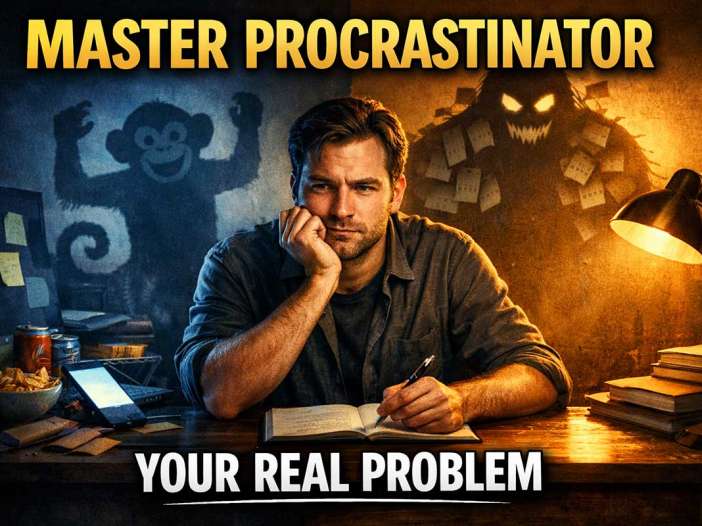
What if Tim Urban debated psychologists and productivity experts about procrastination?
Introduction — by Tim Urban
When I first tried to understand why I procrastinate, I assumed the answer would be simple: poor discipline, bad habits, maybe a personality flaw politely labeled “quirky.” Instead, what I found was a whole cast of characters living inside my brain.
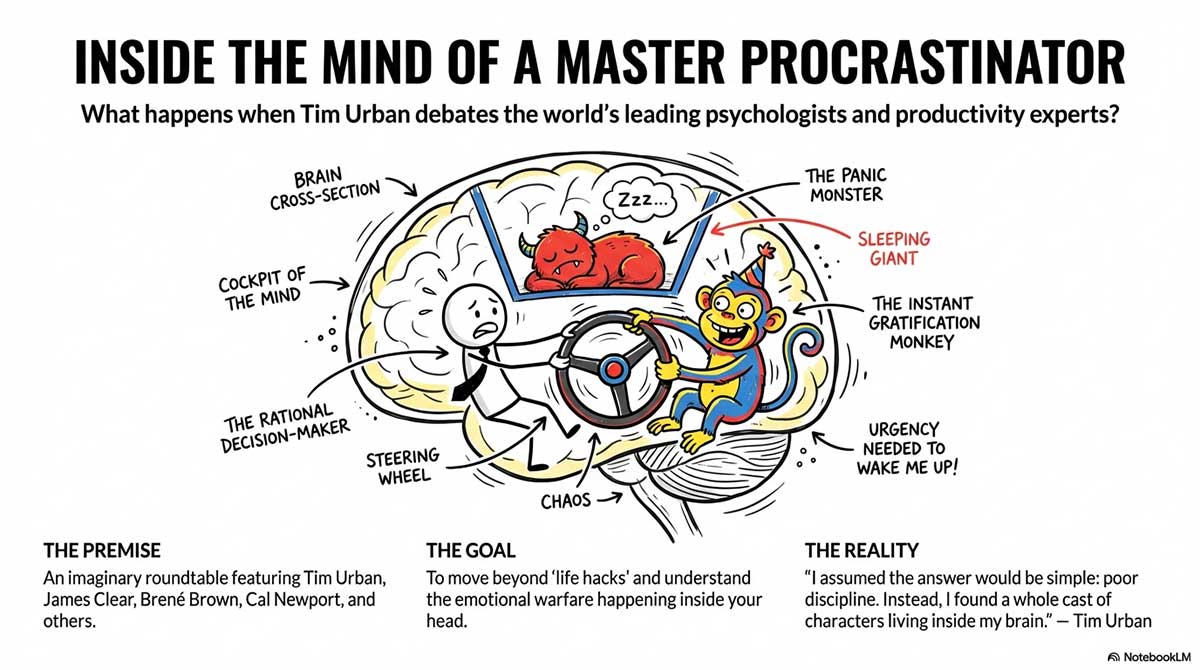
There’s the Rational Decision-Maker, who makes ambitious plans at 11:30 PM.
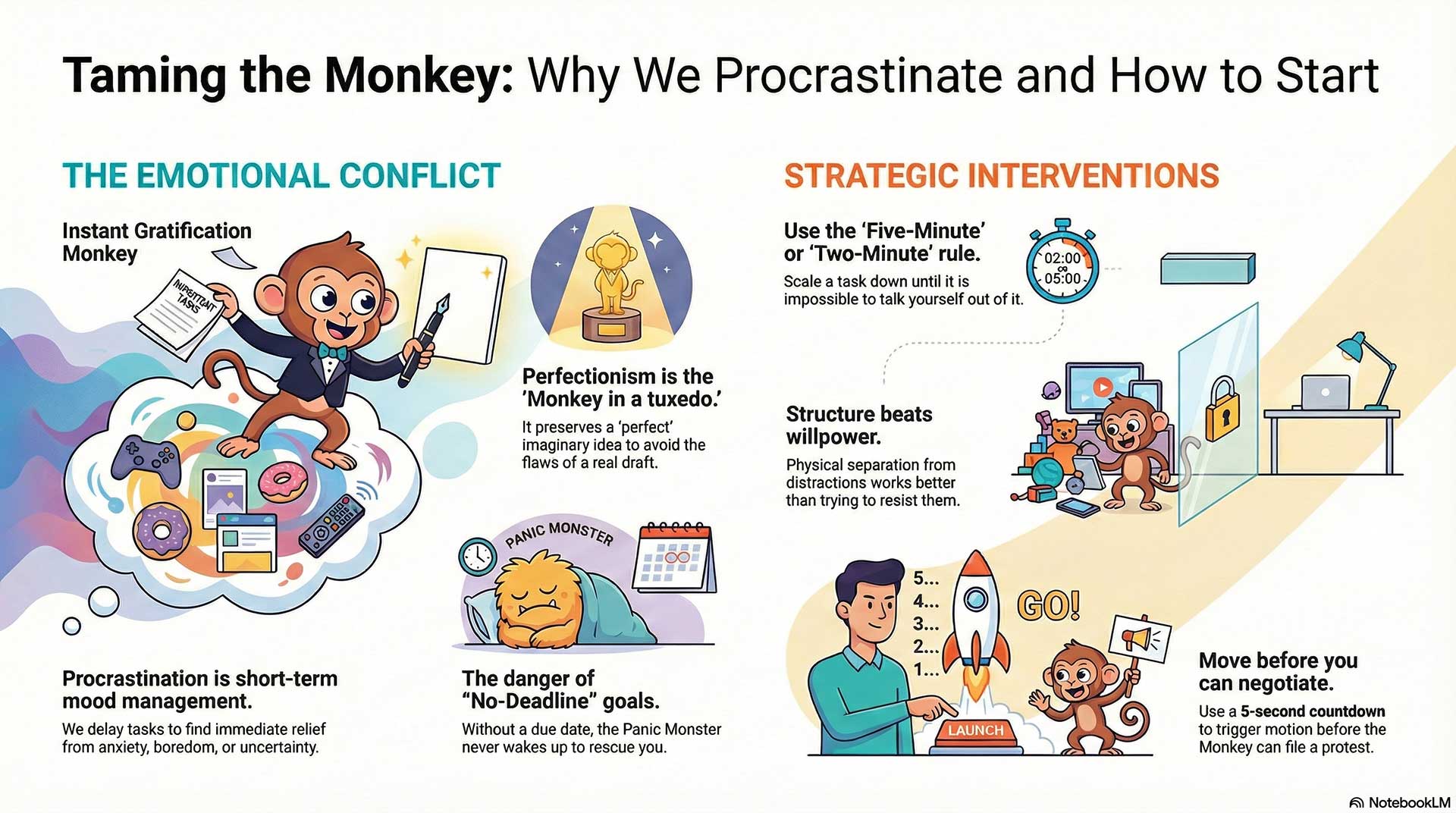
There’s the Instant Gratification Monkey, who takes over at 11:31 PM.
And there’s the Panic Monster, who wakes up only when the deadline becomes a horror movie.
This conversation explores those characters seriously, even if they sound ridiculous. Because procrastination is rarely about not caring. It’s usually about caring so much that the present moment feels emotionally uncomfortable. The Monkey isn’t trying to ruin your life. He’s trying to protect you from effort, uncertainty, and the possibility of discovering you’re not instantly great at something important.
The real problem is not that we delay laundry or emails.
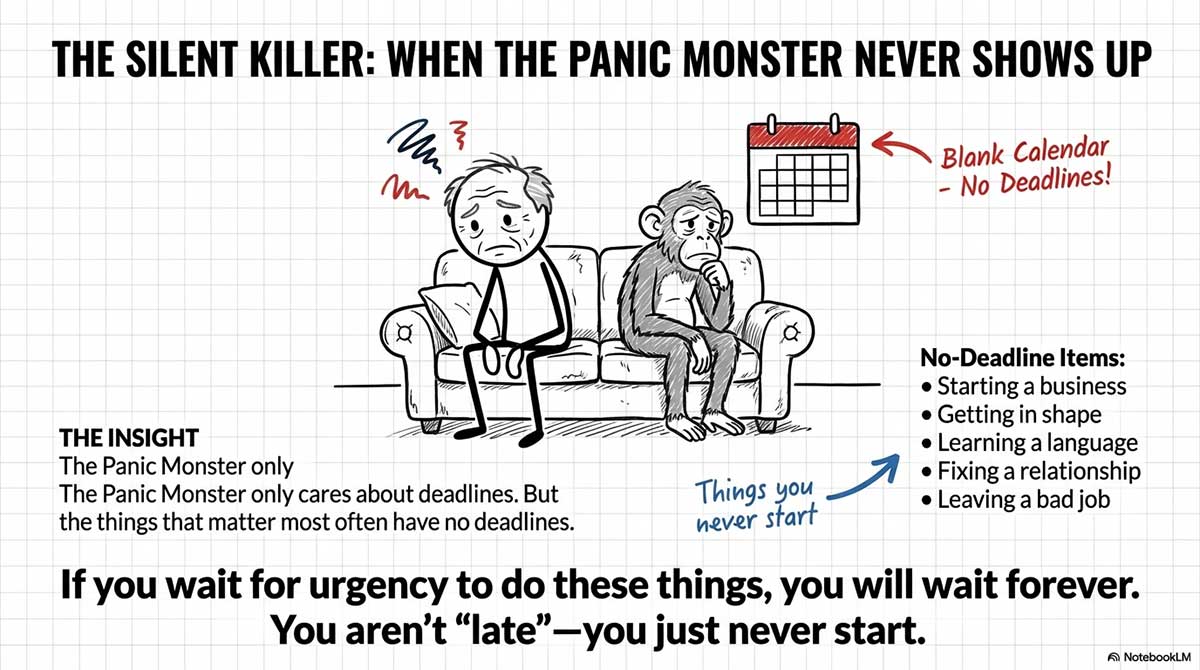
The real problem is what happens when there’s no deadline.
No one gives you a due date for learning the piano, fixing your relationships, writing the book, starting the business, improving your health, or becoming the person you meant to be. And in those spaces, the Panic Monster never arrives to save you.
So this discussion isn’t about productivity hacks.
It’s about awareness.
Because once you see the Monkey clearly, you can finally stop negotiating with him.
(Note: This is an imaginary conversation, a creative exploration of an idea, and not a real speech or event.)
Topic 1: The Monkey, the Rational Self, and What Procrastination Really Is

Tim Urban:
Welcome, everyone. I’m thrilled you’re here, and also slightly suspicious, because this topic usually attracts people who meant to attend and then showed up three days later with an apology and a donut. My TED talk framed procrastination as a battle inside the mind. The Rational Decision-Maker has plans. The Instant Gratification Monkey wants easy fun right now. And the Panic Monster only shows up when things get terrifyingly close to a deadline.
But underneath the jokes is a serious question about what procrastination actually is.
What is procrastination protecting us from emotionally, moment to moment?
Timothy Pychyl:
Most procrastination is the short-term management of mood. People delay tasks because the task triggers uncomfortable emotions such as anxiety, boredom, resentment, uncertainty, or fear of failure. Procrastination is not primarily a time management problem. It’s an emotion management problem.
In the moment, you feel relief when you avoid. The brain learns quickly that avoidance works, at least briefly. So the behavior repeats.
BJ Fogg:
I see procrastination as a design issue in behavior change. If a task feels too big, unclear, or unpleasant, and the prompt is vague, the person will drift to the easiest behavior available. That usually means something rewarding and low effort.
Emotion is part of it, but the actionable piece is that you can redesign the behavior so it feels easier to start. When starting becomes easy, avoidance has less power.
James Clear:
Procrastination protects you from friction and identity discomfort. When a task forces you to become a beginner again, you feel the sting of not being who you want to be yet. The Monkey offers a fast escape into something that makes you feel competent or entertained immediately.
So you’re not just avoiding work. You’re avoiding the feeling of being incomplete.
Mel Robbins:
Procrastination protects you from the moment of starting, because starting is where the fear lives. Once you start, reality begins. You can fail. You can be judged. You can discover you don’t know what you’re doing.
So people sit in delay because delay preserves the fantasy that everything will be fine later. Procrastination is a stall tactic for fear.
David Allen:
Procrastination often protects you from the stress of unclear commitments. When you haven’t defined the next physical action, your mind sees a foggy project rather than a doable step. That fog produces mental friction. So you avoid it to reduce that friction.
But the problem remains in your head as an open loop, which creates more stress later.
Tim Urban:
Okay, so the Monkey is basically an emotional bouncer who says, “We’re not going in there. The vibes are bad.”
Now the next question.
Why does “knowing what to do” collapse in the moment when the Instant Gratification Monkey shows up?
Timothy Pychyl:
Because intention is future-oriented but emotions are present-oriented. In the future, you imagine yourself calm, capable, and disciplined. In the moment, you feel the discomfort right now. And right-now feelings usually win.
That’s why advice alone doesn’t work. If you don’t have a plan for the discomfort, you’ll default to avoidance.
BJ Fogg:
Knowing doesn’t automatically translate into doing because behavior requires three things: motivation, ability, and a prompt. In the moment, ability can drop if the task feels difficult or ambiguous. The prompt can be weak if it’s not specific.
So the Monkey wins when the task is too big and the prompt is vague. You don’t need more knowing. You need better prompts and smaller actions.
James Clear:
Because your systems beat your goals. In the moment, you’re not choosing from a blank slate. You’re operating inside habits, environment cues, and reward loops. If your phone is the default relief valve, you’ll reach for it without thinking.
Knowing fails because you’re trying to use willpower against a trained system. Change the system and the knowing can finally matter.
Mel Robbins:
Because you’re negotiating. And negotiation is where you lose. The second you start debating, the Monkey takes the microphone. “Not now. Later. After one more thing.”
Knowing collapses because you’re waiting to feel ready. Readiness is a lie the Monkey uses to keep you sitting. You need a move that bypasses thinking.
David Allen:
Because “knowing” is often still unclear. People say they know what to do, but what they actually know is the project title. The brain can’t execute a project title. It can only do the next physical action.
When the next action isn’t defined, the mind resists. When it is defined, action becomes much more likely.
Tim Urban:
So basically, the Monkey wins because your plan is a PowerPoint, and your emotions are the actual operating system.
Now the third question.
What is the smallest intervention that breaks the loop today?
Timothy Pychyl:
Name the emotion and start for five minutes. The naming shifts you from unconscious avoidance into awareness. The five-minute start lowers the emotional barrier. Once you begin, your feelings often change because the task becomes real and manageable.
The goal is not finishing. The goal is beginning.
BJ Fogg:
Make it tiny and attach it to a specific prompt. After I sit down with my coffee, I open the document and write one sentence. That is a behavior you can do even when motivation is low.
Tiny success creates momentum. Momentum changes identity. Identity changes behavior.
James Clear:
Use the two-minute rule. Scale the habit down to the first two minutes so it’s impossible to talk yourself out of it. Open the laptop. Write one paragraph. Put on the running shoes.
You are not trying to complete the task. You are trying to become the person who shows up. Showing up is the real victory.
Mel Robbins:
Act before you think. When you feel the hesitation, count down 5, 4, 3, 2, 1, and move. Stand up, open the tab, send the email. Motion interrupts the Monkey’s speech.
The rule is simple. You don’t wait. You move.
David Allen:
Get it out of your head and onto paper. Clarify the project and write the next action. Then put it where you’ll see it at the right time.
Procrastination thrives in mental clutter. Clarity is a form of relief. Relief creates movement.
Tim Urban:
So the smallest intervention is basically: reduce the emotional threat, make the next step tiny, and move before the Monkey can file a motion to postpone your life.
Let me close this topic with the bridge to what comes next. In my talk, the Panic Monster saves you when deadlines exist. But it does nothing for the no-deadline goals. The dreams. The relationships. The health. The writing you keep meaning to do.
Next time, we’ll go deeper into fear, identity, and perfectionism, the emotional engine that makes the Monkey feel so persuasive.
Topic 2: Fear, Identity, and the Perfectionism Trap
Brené Brown:
We’re going to talk about the emotional engine underneath procrastination. When people say, “I’m just lazy,” I usually hear something else hiding in that sentence. Fear. Shame. Perfectionism. The sense that being seen could be dangerous.
So let’s start here.
How does perfectionism become procrastination disguised as “high standards”?
Tim Urban:
Perfectionism is the Instant Gratification Monkey in a tuxedo. It sounds noble. It says, “I care so much that I refuse to do it badly.” But what it really means is, “If I do this, I might discover I’m not as good as I hope.”
So instead of finishing something imperfect, you keep it in your head where it’s still perfect. Your imaginary book is always brilliant. The real draft has flaws. The Monkey votes for imagination.
Carol Dweck:
Perfectionism often appears when people hold a fixed mindset. If you believe ability is a trait you either have or you don’t, then any mistake feels like evidence of deficiency. That makes starting emotionally risky.
In a growth mindset, mistakes are information. In a fixed mindset, mistakes are identity. When mistakes are identity, procrastination becomes self-protection.
Steven Pressfield:
Perfectionism is Resistance wearing makeup. It tells you you’re being refined, but you’re actually avoiding the work. The pro understands that the first draft is supposed to be bad. The amateur thinks the first draft should prove something.
Resistance wants you to keep polishing the idea instead of producing the reality. Real work threatens the ego. Perfectionism is the excuse the ego uses to stay safe.
Susan David:
Perfectionism becomes procrastination when standards become a shield against discomfort. The person isn’t serving excellence. The person is serving avoidance.
You can tell the difference by the emotional tone. Healthy standards feel energizing and directional. Perfectionism feels brittle, anxious, and self-punishing. When it’s brittle, the brain chooses avoidance because avoidance reduces immediate emotional pain.
Adam Grant:
Perfectionism becomes procrastination when people treat “getting it right” as the entry requirement for starting. But starting is how you learn what right even looks like.
There’s also a social dimension. In workplaces, people sometimes perform perfectionism to signal competence. It becomes a status strategy. But the cost is output and creativity. Perfectionism kills shipping.
Brené Brown:
That’s a powerful distinction. Healthy standards help you serve the work. Perfectionism helps you hide from it.
Now the second question.
What role do shame and identity-threat play in avoidance and hiding?
Tim Urban:
Shame turns the task into a referendum on your worth. If the thing you’re doing is connected to who you are, writing, creating, building, being a good parent, being competent, then the stakes feel enormous.
So procrastination is not avoiding the task. It’s avoiding the possibility of concluding, “Maybe I’m not who I think I am.” The Monkey would rather watch videos than face existential evaluation.
Carol Dweck:
Identity-threat grows when people define themselves as “smart,” “talented,” or “naturally good.” Those labels can become fragile. If you fear losing the label, you avoid situations where you might struggle.
In contrast, if you define yourself as a learner, struggle is part of the identity. Shame decreases when you normalize effort and imperfection as data, not verdict.
Steven Pressfield:
Shame is Resistance’s favorite weapon because it makes the battle personal. It whispers, “If you fail, you are a fraud.” So you don’t ship. You don’t submit. You don’t publish. You hide.
The cure is to depersonalize the work. Treat it like a job. Show up like a pro. Pros don’t ask their feelings for permission.
Susan David:
Shame collapses the space between “I did something imperfect” and “I am imperfect.” Emotional agility is the skill of creating space. You can say, “I’m having the thought that I’m not good enough,” instead of fusing with it.
When you create space, identity-threat weakens. Then you can choose actions aligned with values rather than actions aligned with avoidance.
Adam Grant:
Identity-threat also thrives in environments that punish mistakes. If a culture equates errors with incompetence, people will avoid exposing unfinished work. They’ll procrastinate until they can present something polished, or they’ll never present it.
So we can’t treat this only as an individual issue. Systems that reward learning and iteration reduce shame-driven avoidance.
Brené Brown:
Exactly. Shame grows in secrecy and silence. It shrinks when we name it and stay connected.
Now the third question.
How do you ship work when you feel your worth is being judged?
Tim Urban:
I use what I call the “dumb first version” rule. The goal is to create something intentionally mediocre just to break the seal. When the Monkey hears “make it amazing,” he panics. When he hears “make it dumb,” he relaxes.
Then once something exists, my Rational Decision-Maker can edit. The biggest win is getting out of zero.
Carol Dweck:
Reframe shipping as part of learning. Your output is not a verdict. It is feedback.
One practical approach is to set process goals instead of outcome goals. For example, “I will write for 30 minutes,” not “I will write something brilliant.” Process goals protect identity because they reward behavior, not perfection.
Steven Pressfield:
You ship like a pro by having a schedule and honoring it. Talent is irrelevant if you don’t sit down. The muse shows up when you do.
And you ship by accepting that fear never leaves. The goal isn’t to be fearless. The goal is to act in spite of fear, every day, like a craftsman.
Susan David:
You ship by connecting to values. Ask, “What does this work serve?” When values lead, the shame voice becomes smaller.
Also, practice self-compassion. Self-compassion is not softness. It’s resilience fuel. People who can recover from imperfection ship more, because they’re not destroyed by their own inner critic.
Adam Grant:
Build a system of small stakes and fast feedback. Don’t wait until the work is finished to share it. Share early drafts with a trusted person. Create a culture of iteration around yourself.
And set “definition of done” rules. Perfection is infinite. Done is a decision.
Brené Brown:
Let me close this topic with a simple truth. Perfectionism is not the pursuit of excellence. It’s the avoidance of vulnerability. And procrastination often lives where vulnerability feels dangerous.
In the next topic, we’ll move outward. We’ll talk about the attention economy, dopamine, and how the modern world has basically built luxury condos for the Instant Gratification Monkey.
Topic 3: Distraction, Dopamine, and the Attention Economy

Cal Newport:
So far we’ve talked about emotions and identity inside the individual. Now we move outside the individual. The modern world is not neutral. It is engineered. Many tools we use every day are designed to capture attention, not support intention.
Let’s start here.
How has the modern environment trained the Monkey to win more often?
Tim Urban:
The Monkey used to live in a small village with maybe three distractions: food, gossip, and staring at a tree. Now the Monkey lives inside a casino designed by neuroscientists. Infinite scroll is basically a slot machine that fits in your pocket.
So procrastination used to require effort. Now it’s ambient. You don’t choose distraction anymore. Distraction chooses you.
Tristan Harris:
That’s exactly right. Many digital platforms optimize for engagement, which means they optimize for habit formation. They learn what keeps you checking, refreshing, and staying.
This shifts the default. Instead of effort being required to avoid work, effort is required to maintain focus. The human brain evolved for scarcity of stimulation, not abundance.
Nir Eyal:
I want to add nuance. Technology is not only a distraction. It’s also a tool. The problem is not that products hook you, but that internal triggers like boredom or uncertainty make you seek relief.
If you don’t learn to manage discomfort, you will always be distractible, whether the tool is social media, email, or the refrigerator. The environment amplifies a vulnerability that already exists.
Anna Lembke:
From an addiction science perspective, we are living in a dopamine-rich environment. Constant novelty trains the brain to expect quick rewards. Tasks that provide slow rewards, writing, studying, exercising, feel comparatively painful.
The brain adapts downward. Pleasure thresholds drop. So ordinary effort feels harder, not because people are weaker, but because stimulation is stronger and constant.
Johann Hari:
And there is also a cultural layer. We built systems that fragment attention and then blame individuals for failing to maintain it. The problem is partly personal habits but also societal expectations of constant responsiveness.
We normalized interruption. Deep focus now feels unusual, even though it’s necessary for meaningful work.
Cal Newport:
Good. So we agree the Monkey is not only stronger. The jungle has changed.
Now the second question.
What rules reduce distraction without relying on willpower?
Tim Urban:
My Monkey loves willpower because willpower is a suggestion. Rules are walls. If my phone is in my hand, I will check it. If it’s in another room, suddenly I’m a philosopher.
So the rule is physical separation. Don’t trust your future self to resist. Design your present self to not need resistance.
Tristan Harris:
I recommend default redesign. Turn off non-human notifications. Remove visual triggers that call for attention. Make your devices calm instead of persuasive.
You don’t fight addiction by trying harder. You remove cues that trigger the behavior loop.
Nir Eyal:
Create pre-commitments. Decide in advance when and how you’ll use a tool. For example, social media only on desktop, or only after work blocks.
The goal isn’t abstinence. The goal is intentionality. You choose when to engage instead of reacting automatically.
Anna Lembke:
Introduce friction to high-dopamine behaviors and reduce friction to meaningful ones. Put distracting apps behind passwords or time locks. Keep books, notebooks, and work tools immediately accessible.
The brain follows the path of least resistance. Change the path.
Johann Hari:
And protect uninterrupted time socially. Tell others when you are unreachable. Normalize deep work blocks in teams and families.
If your environment expects constant availability, personal rules collapse under social pressure.
Cal Newport:
Exactly. Structure beats intention.
Now the third question.
What does a realistic digital diet look like for ordinary people?
Tim Urban:
Not throwing your phone into the ocean. I tried that mentally and still checked for messages in my pocket.
A realistic diet is scheduled indulgence. The Monkey gets bananas at certain times, not all times. You plan distraction so it doesn’t plan you.
Tristan Harris:
I’d say: start with awareness. Track how often you check and why. Then group usage into deliberate sessions instead of constant grazing.
It’s similar to meals versus snacking. Continuous snacking keeps the mind restless.
Nir Eyal:
I recommend timeboxing. Decide what you will do and when, including leisure. When distraction is planned, it stops being a distraction.
A digital diet works when it respects human need for rest instead of pretending you’ll be productive nonstop.
Anna Lembke:
Balance high-dopamine with low-dopamine activities. After intense stimulation, do something slow, walk, stretch, read, or sit quietly. This resets reward sensitivity.
Without contrast, everything meaningful feels dull.
Johann Hari:
And reconnect with meaningful engagement offline. Focus improves when life contains absorbing activities beyond screens, conversation, making things, being outdoors.
Attention is strengthened by meaning, not just discipline.
Cal Newport:
So the takeaway is simple but demanding. Don’t rely on heroic willpower in an engineered environment. Change the environment so focus becomes the default.
In the next topic, we’ll talk about the Panic Monster itself, deadlines, last-minute surges, and whether panic is a useful motivator or a dangerous addiction.
Topic 4: The Panic Monster, Deadlines, and Burnout Culture
Adam Grant:
We’ve talked about the Monkey and distraction. Now we meet the creature that saves many people at the last second, the Panic Monster. Deadlines create urgency, urgency creates action. But action driven by panic is complicated.
So let’s start here.
When is deadline panic useful, and when is it destructive?
Tim Urban:
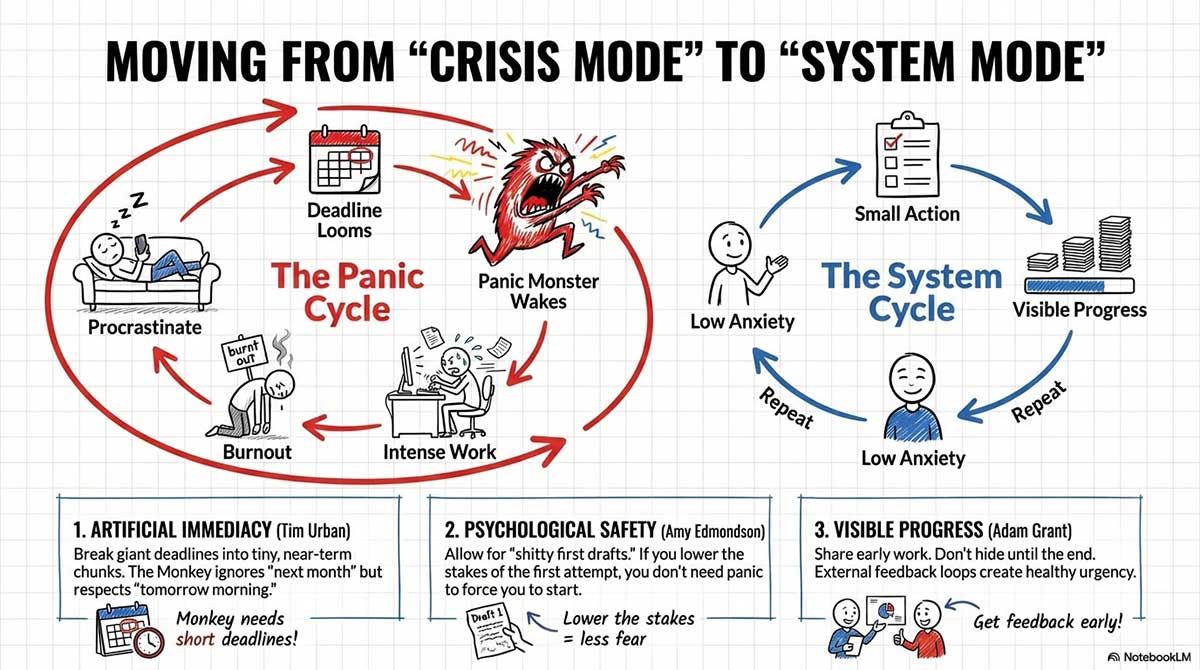
Deadline panic is like a fire alarm that also makes coffee. It wakes you up and suddenly you can do twelve hours of work in three. For school papers and taxes, it works. The Panic Monster rescues you.
But it’s destructive when your life depends on sustained quality, health, or relationships. You can’t build a meaningful project on adrenaline forever. Eventually the Monster burns the house down.
Daniel Kahneman:
Urgency narrows attention. In some situations that improves performance because it reduces irrelevant thoughts. But it also increases errors and reduces careful reasoning.
Short tasks benefit from urgency. Complex tasks suffer from it. Panic trades accuracy and reflection for speed.
Angela Duckworth:
Panic can trigger effort, but it does not build perseverance. Grit is consistent engagement toward long-term goals. Panic is intermittent intensity.
If a person relies on panic repeatedly, they train themselves to wait for crisis instead of building steady habits.
Amy Edmondson:
In teams, panic can create short bursts of coordination, but it damages learning. People focus on avoiding blame rather than improving systems.
When organizations normalize last-minute heroics, they often hide structural problems instead of fixing them.
David Allen:
Panic is often a symptom of unclarified commitments. When people don’t define next actions early, the work accumulates invisibly. The deadline simply reveals what was always there.
Useful urgency is planned. Destructive panic is accumulated ambiguity.
Adam Grant:
So panic is a temporary stimulant, not a sustainable strategy.
Now the second question.
How do individuals and teams reduce last-minute chaos without lowering standards?
Tim Urban:
You replace one giant terrifying deadline with many small boring ones. The Monkey ignores distant deadlines but respects near ones.
So the trick is artificial immediacy. Make the future feel closer in manageable pieces.
Daniel Kahneman:
Break large decisions into smaller evaluations. Frequent checkpoints reduce cognitive overload. When evaluation is continuous, the mind stays calibrated instead of shocked at the end.
Angela Duckworth:
Build routines that remove choice. If work time is fixed daily, you don’t negotiate with yourself repeatedly. Consistency protects standards better than bursts of effort.
Amy Edmondson:
Create psychological safety for early drafts. If people can share incomplete work without punishment, they surface problems earlier.
High standards and early sharing go together. Silence creates last-minute chaos.
David Allen:
Clarify projects into visible next actions and review them regularly. Weekly reviews prevent surprises. Standards rise because attention is continuous instead of compressed.
Adam Grant:
So quality improves when progress is visible early rather than dramatic late.
Now the third question.
What replaces panic as a sustainable engine for progress?
Tim Urban:
Curiosity helps. When I’m curious, I don’t need terror. The Monkey will actually cooperate if the task feels interesting enough.
So I try to design work to be engaging in small pieces instead of overwhelming in one giant piece.
Daniel Kahneman:
Predictability reduces cognitive strain. A stable work rhythm allows System 2 thinking to operate without emergency mode.
Regular engagement supports better judgment than crisis-driven bursts.
Angela Duckworth:
Purpose plus habit replaces panic. Purpose gives direction. Habit provides execution. Together they remove the need for emotional extremes.
Amy Edmondson:
Learning orientation replaces fear orientation. When progress is framed as learning rather than evaluation, people continue moving without waiting for urgency.
David Allen:
Trust in your system replaces anxiety. When you trust that everything is captured and reviewed, your mind stops relying on stress to remember obligations.
Adam Grant:
So the alternative to panic is structure, purpose, and steady engagement.
In the final topic, we’ll leave deadlines behind entirely and talk about the most dangerous form of procrastination, the one without alarms, the quiet postponement of the life you meant to live.
Topic 5: No-Deadline Procrastination and the Life You Meant to Live
Oliver Burkeman:
We’ve talked about deadlines and panic. Now we come to the most unsettling part. The tasks with no deadlines. The ones that matter most and shout the least. Health. Relationships. Creativity. The work you feel called to do. The life you intend to live.
So let’s begin with this.
Why do the most important goals have the weakest urgency signals?
Tim Urban:
Because the Panic Monster is basically a deadline creature. If there’s no due date, it stays asleep. So the Monkey runs the show forever.
And the scariest part is that no-deadline procrastination feels harmless. You’re not late. You’re just “not doing it yet.” You can drift for years and only notice when something hurts.
Viktor Frankl:
Meaning is not urgent in the way survival is urgent. Yet meaning is what makes survival worth enduring. People postpone meaning because it demands responsibility.
To choose a meaningful path is to accept that you are accountable for your life. Many avoid that responsibility through distraction, not because they are evil, but because freedom can feel heavy.
James Clear:
No-deadline goals lack immediate feedback. Habits form around immediate rewards. If you don’t create a system that gives small wins now, the brain won’t stay with it.
So important goals feel vague and unrewarding in the short term. That’s why systems are essential. They create urgency by creating consistency.
Gretchen Rubin:
Also, people expect motivation to appear first. But motivation often follows action. With no deadlines, people wait for the feeling of readiness.
And personality matters. Some people need outer accountability. Some need inner identity commitments. With no deadline, you must know what kind of person you are and build accordingly.
Naval Ravikant:
The most important goals are weakly signaled because society trains you to respond to other people’s demands. Emails, meetings, obligations. Those are urgent because someone else will be upset.
But your own dreams have no external enforcement. So the mind pushes them into the indefinite future. The answer is to treat your own priorities with the same seriousness as external demands.
Oliver Burkeman:
So the problem is not motivation. The problem is that meaning has no alarm clock.
Now the second question.
How do you design a life system where meaning is scheduled, not postponed?
Tim Urban:
You build your own Panic Monster, but in a friendly way. Like a calm accountant instead of a screaming bear.
I love the idea of deadlines that are chosen, not imposed. Put things on the calendar. Commit publicly. Create a structure that wakes you up before years disappear.
Viktor Frankl:
A life system must begin with values. Meaning arises from what you commit yourself to. Then action follows.
Schedule what aligns with your values. Otherwise your schedule will be filled by whatever is loudest. Meaning must be chosen, and choice must be enacted.
James Clear:
Make it a habit, not a project. Define the smallest repeatable action tied to the identity you want.
If meaning matters, you make the habit obvious, attractive, easy, and satisfying. That is how meaning becomes real. Not through grand plans, but through consistent tiny actions.
Gretchen Rubin:
You also design the right kind of accountability. For some people, a scheduler works. For others, an accountability partner. For others, a group.
And you remove barriers. If the meaningful action is hard to start, you won’t do it. Make it convenient. Make it automatic. Meaning needs infrastructure.
Naval Ravikant:
Protect time like an asset. If you don’t schedule meaning, you’ll spend your life reacting.
Create “maker time” blocks. Put them first. And stop treating your own priorities as optional. You are teaching people how to value you by how you value your time.
Oliver Burkeman:
So meaning is not found. Meaning is built into the calendar.
Now the third question.
What single decision rule prevents “someday” from stealing years?
Tim Urban:
If I’m being honest, my rule would be: if it matters, it goes on the calendar this week in a tiny form. Not next month. Not when life calms down. This week.
Because “someday” is a mythical land where all plans are perfect and nobody is tired. It doesn’t exist.
Viktor Frankl:
My rule would be: choose your responsibility. Ask, “What is life asking of me now?” Then answer with action.
The antidote to someday is the present moment taken seriously.
James Clear:
I would say: never leave an important goal without a daily or weekly system. If there is no system, you are relying on mood. Mood is unreliable.
System equals traction. Without traction, someday wins.
Gretchen Rubin:
Know your tendency and plan accordingly. Some people need external expectations. Some need internal identity rules.
So my rule is: build your rule around who you actually are, not who you wish you were. That honesty prevents someday from becoming an excuse.
Naval Ravikant:
Value time like life. Because it is.
My rule is: if you wouldn’t trade a year of your life for it, don’t do it. And if you would, schedule it. Meaning must be funded with time.
Oliver Burkeman:
Let’s end where Tim ends in his talk, with the quiet seriousness beneath the humor. You do not need to become a different person overnight. But you do need to notice what you are trading your life for.
Deadlines will come for work. They will not come for meaning.
So if you’ve been waiting for panic to wake you up, you may be waiting forever.
Choose a small action. Put it on the calendar. And let the life you meant to live begin while there is still time.
Final Thoughts by Tim Urban
If procrastination were only about deadlines, most of us would be fine. We’d keep submitting assignments at the last minute, complain about stress, and life would go on.
But the most important parts of life are silent. They don’t scream at you from a calendar notification. They wait patiently while years pass comfortably. And that’s the dangerous kind of procrastination, the kind you don’t notice until the gap between the life you live and the life you imagined becomes impossible to ignore.
The Panic Monster cannot help you there.
So the solution isn’t to eliminate the Monkey. You can’t. He’s part of being human. The solution is to stop giving him total authority over long-term decisions. You do that not by heroic bursts of motivation, but by small actions taken before you feel ready.
One paragraph written.
One conversation started.
One walk taken.
One honest step toward something meaningful.
Because the opposite of procrastination isn’t discipline.
It’s courage in tiny doses.
And the moment you begin, even imperfectly, you take time back from “someday” and return it to today.
Short Bios:
Tim Urban — Writer and speaker known for Wait But Why and his TED talk on procrastination, using humor and simple mental models to explain serious behavior patterns.
Timothy Pychyl — Psychology professor and leading procrastination researcher who frames procrastination as emotion regulation rather than poor time management.
BJ Fogg — Behavior scientist known for the Tiny Habits method, focusing on how small actions and smart prompts reliably change behavior.
James Clear — Author of Atomic Habits, specializing in habit systems, identity-based change, and making progress through small consistent actions.
Mel Robbins — Speaker and author known for practical motivation tools like the 5-second rule, helping people act before hesitation takes over.
David Allen — Productivity expert and creator of Getting Things Done (GTD), emphasizing capturing commitments and defining next actions to reduce mental clutter.
Brené Brown — Researcher and author focused on shame, vulnerability, and courage, explaining how perfectionism and fear of judgment fuel avoidance.
Carol Dweck — Psychologist known for mindset research, showing how fixed vs growth mindset shapes resilience, effort, and willingness to start.
Steven Pressfield — Author of The War of Art, known for naming “Resistance” as the inner force that blocks creative work and shipping.
Susan David — Psychologist known for “emotional agility,” teaching how to hold emotions lightly and act from values instead of avoidance.
Adam Grant — Organizational psychologist who studies motivation, creativity, and work culture, including how systems can reduce fear-driven delay.
Cal Newport — Author known for deep work and attention, emphasizing focus systems and environment design in a distraction economy.
Tristan Harris — Tech ethicist and former design ethicist at Google, focused on how attention-hijacking product design shapes behavior.
Nir Eyal — Author and behavioral design writer known for work on habits, triggers, and becoming “indistractable” through planning and commitment.
Anna Lembke — Psychiatrist and addiction researcher who explains dopamine-driven behavior and how overstimulation increases avoidance of effort.
Johann Hari — Writer and journalist known for work on attention and modern disconnection, emphasizing societal causes of distraction.
Daniel Kahneman — Nobel Prize-winning psychologist known for decision science, cognitive biases, and how stress affects judgment and performance.
Angela Duckworth — Psychologist known for grit research, focusing on perseverance, habits, and sustained effort over time.
Amy Edmondson — Harvard professor known for psychological safety, showing how learning cultures reduce fear, silence, and last-minute chaos.
Oliver Burkeman — Writer focused on time, mortality, and meaning, urging realistic choices instead of infinite postponement.
Viktor Frankl — Psychiatrist and author of Man’s Search for Meaning, emphasizing responsibility, values, and meaning as central to human life.
Gretchen Rubin — Author who studies habit formation and personality tendencies, helping people build systems that fit how they actually behave.
Naval Ravikant — Entrepreneur and thinker known for ideas on leverage, priorities, and treating time as the most valuable asset.
Leave a Reply