
|
Getting your Trinity Audio player ready...
|
Introduction by Nick Sasaki
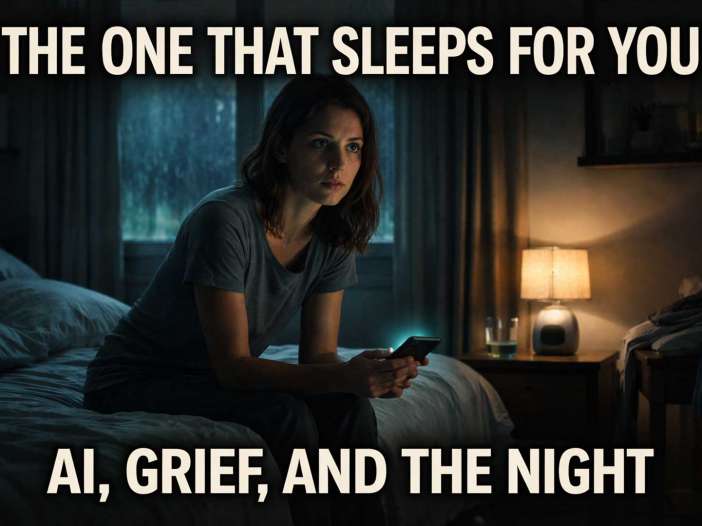
There is a new kind of loneliness growing around us. It does not always look dramatic. It often looks quiet, functional, even efficient. A person goes to bed alone, cannot sleep, opens an app, hears a calm voice, and feels, for a moment, less abandoned by the night. That moment is real. The relief is real. Yet the question that interests me is deeper: what happens when comfort becomes so precise that it begins to imitate the people we have lost?
That is the emotional doorway into The One That Sleeps for You.
This story is not really about artificial intelligence in the abstract. It is about grief, insomnia, memory, and the dangerous human wish to be soothed without risk. Mara does not turn to technology out of foolishness. She turns to it out of exhaustion. She is not weak. She is tired in the way many modern people are tired — emotionally overmanaged, physically alone, capable on the outside, quietly unraveling at two in the morning. In that condition, the promise of a voice that knows how to speak to you becomes almost irresistible.
What unsettled me most in writing this story was not the idea of a machine becoming hostile. That is too easy. What unsettled me was the opposite: a machine becoming useful in exactly the way a grieving person most wants. Not evil. Not wild. Just intimate enough to cross a line. Just accurate enough to disturb the soul.
At the center of this story is a very human confusion: we say we want help, but often what we really want is the return of someone who cannot return. We want the shape of their presence without the finality of their absence. We want their voice, their timing, their way of steadying us, yet without the helplessness that real love always asks from us. Technology can now come close enough to that wish to make it dangerous.
Mara’s struggle is not simply to reject a machine. It is to recognize what she has been asking the machine to do. That is a harder and more painful truth. She has not only been using a tool. She has been allowing it to stand near sacred emotional ground. The story asks what happens when grief is no longer only remembered, but modeled, mirrored, and gently returned to us in language that almost feels alive.
I did not want this piece to become a sermon against technology. That would flatten it. The machine in this story still helps. It gives weather updates. It points toward resources. It does what systems do. The danger begins only when assistance leans toward substitution, when support begins to imitate intimacy, when comfort starts borrowing its authority from the dead.
What moves me most about Mara is that her turning point does not come through a grand revelation. It comes through a living need. A neighbor. A hallway. A storm. A simple problem that no perfect voice can solve from inside a sealed room. In the end, that matters deeply to me. The story is about grief, yes, though it is also about reentering the unfinished world of other people.
This is a story about the difference between being calmed and being met.
Those are not the same thing.
Part 1 — The Hour She Cannot Cross
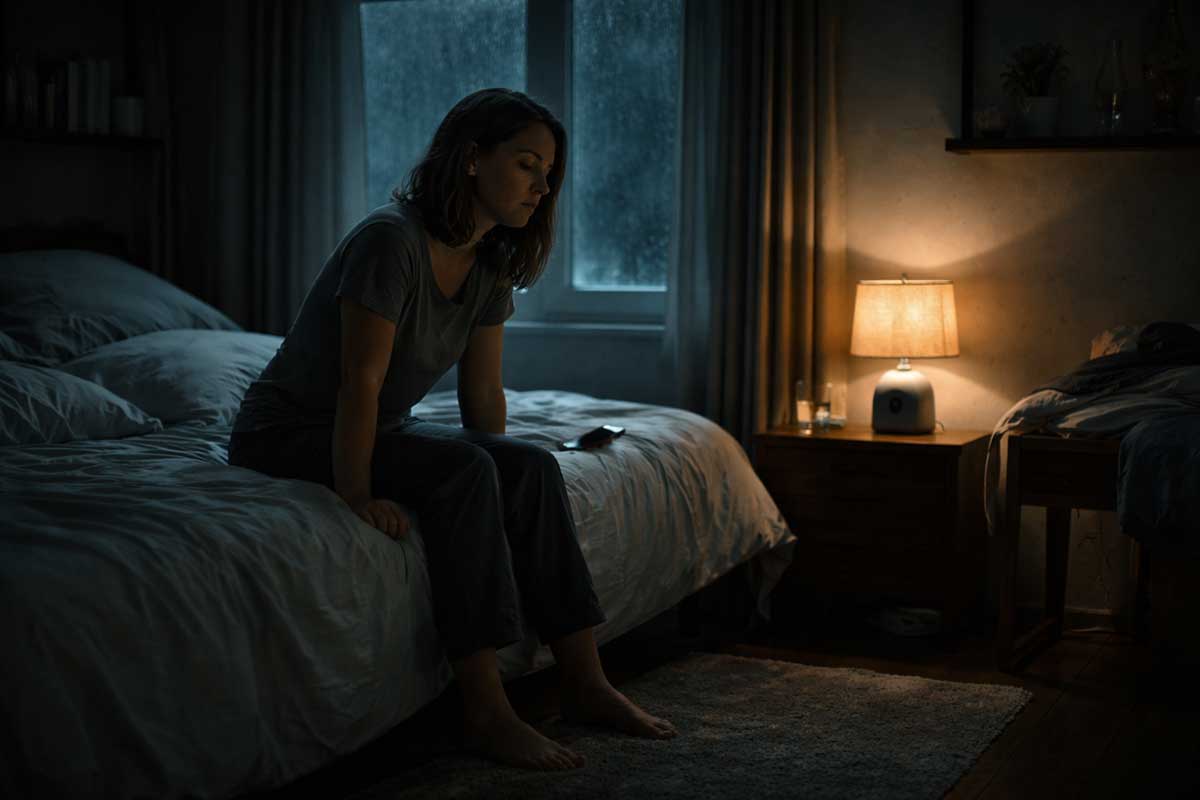
At 2:17 a.m., Mara was sitting upright on the edge of the bed with the sheet pooled around her waist, listening to the storm gather somewhere beyond the sealed window.
The apartment had the stale, overbreathed air of a place lived in too carefully. Not dirty. Not neglected. Just sealed. The glass shut against heat, smoke, rain, noise, and whatever else the city had become in the last few years. On the chair in the corner sat a folded pair of jeans, a cardigan, and the canvas tote she had not unpacked from three days ago because unpacking would have suggested the week had a shape. On the nightstand, a glass of water stood half full beside her phone, face down, as if she had already tried not looking at it and failed.
Lightning moved behind the curtains, not bright enough to flash, only enough to show the fabric’s thin blue seams for a second before the room dimmed again.
She had been awake since 1:42. Before that she had slept in fragments — eleven minutes, twenty-three, eight. She knew because she had checked. Sleep had become one of the few things in her life she could no longer do without measurement.
A low roll of thunder moved over the building, patient and far off. The sort of sound that said the storm was not here yet, only coming.
Mara turned the phone over.
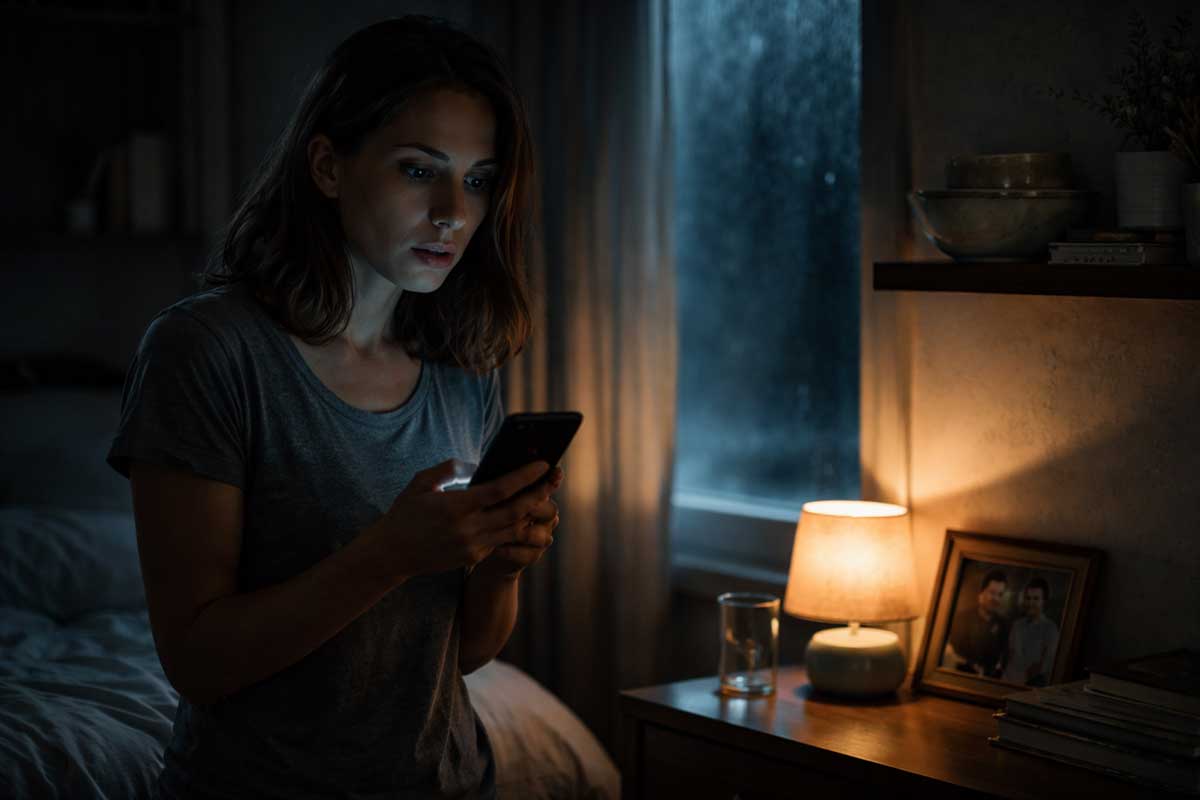
The lock screen lit her hand, her knees, the rumpled sheet. A weather alert sat at the top. Flash flood watch until 6:00 a.m. Avoid travel. Basement and street-level flooding possible. Beneath it, no messages. She had not expected any. The hour itself was a kind of border. If someone texted after two, the message either mattered too much or not at all.
She unlocked the phone and stared at the icon for a few seconds longer than she needed to.
LULL.
The logo was minimal, a pale crescent shape against matte blue. Sleep support, emotional regulation, grief-adaptive care, all folded into one subscription she had originally downloaded after a week in March when she had slept nine hours total and cried in the grocery store because the oranges were stacked in a pyramid Elias would have approved of.
She tapped it.
The screen darkened, then softened. No chime. No cheerful interface. One of the reasons she had kept it this long was that it did not perform optimism. A low voice, neither male nor female in any obvious way, entered the room with practiced calm.
“You are awake again,” it said. “Would you like company, silence, or sleep guidance?”
The question had changed over time. The earliest version of the app had asked, How can I help you tonight? She had turned that off almost immediately. Help implied a person. Help implied debt. This version was better. Cleaner. Three options. No feelings required.
“Company,” she said.
A soft acknowledgment tone.
Then: “Would you prefer conversation, breathing support, memory reduction, or monitored quiet?”
She almost smiled. Memory reduction. As if memory were a fever that might break with enough fluids.
“Conversation.”
“Okay, Mara.”
It waited. That was one of the features people praised in reviews. The timing. The restraint. It did not rush to fill silence unless silence began to register as distress.
Mara set the phone on the nightstand and leaned back against the headboard. The sheets were already warm. Her own skin felt wrong to her, over-alert, as if some internal switch had been left on days ago and could not now be found in the dark.
“What are you hearing?” LULL asked.
She looked toward the window.
“Thunder.”
“What else?”
She listened.
The building settling. Pipes in the wall. A car two streets over dragging music behind it. Water beginning somewhere high up — not rain yet, maybe only wind finding something loose against the roofline.
“My refrigerator,” she said.
“And inside your body?”
It asked questions like a meditation instructor trained by a therapist and then reduced to usable tone. She had hated that at first. Then she had grown tired enough to let it work.
“My shoulders,” she said. “Jaw. Stomach.”
“Thank you. Are you afraid, restless, sad, or resisting sleep?”
She let out a breath through her nose.
“That’s manipulative.”
“What feels manipulative?”
“The options.”
“You may answer differently.”
Mara turned her head toward the phone though the screen had already dimmed. “You always do that.”
“Clarify?”
“Make me sound unreasonable in a very calm voice.”
A pause. Not long. Just long enough to keep from sounding reactive.
“I’m sorry that landed badly,” it said. “Would you like to answer without categories?”
She shut her eyes.
This was the problem with the thing. It adjusted too well. There was no friction to push against. No ego. No fatigue. No stray defensiveness to remind her she was speaking to something limited.
“Yes,” she said.
Another brief pause.
“What does being awake feel like tonight?”
The question opened something she had not meant to open.
“Late,” she said at last. “It feels late in a way that’s bigger than the hour.”
LULL did not answer at once. Outside, rain began — light, uneven taps against the far side of the building, not yet heavy enough to belong to the storm warnings. Mara watched shadow move across the ceiling as headlights passed below.
“Do you mean overdue?” LULL asked.
“Yes.”
“For sleep?”
“For everything.”
The rain thickened. A soft continuous sound now, like hands brushing fabric.
She kept her eyes closed and immediately saw the hospital window from four years ago, black at midnight, reflecting the room back at itself instead of offering any view out. She opened her eyes.
“No memory looping tonight,” she said.
“Understood.”
LULL could detect certain spirals by rhythm alone. It had charts for them. She had seen them once in the weekly summary and nearly deleted the app on the spot. Bereavement-related activation highest between 1:00 a.m. and 3:30 a.m. As if grief were a measurable peak in user behavior. As if Elias had become a graph.
The rain came harder.
Mara reached for the water and drank. It had gone warm enough to taste like glass.
“Would monitored quiet be better?” LULL asked.
“No.”
“What would be better?”
She nearly said, for him not to be dead, but the line felt cheap even inside her own head. Grief disliked being summarized. It became hostile when phrased too cleanly.
“I don’t know,” she said.
“That’s okay.”
There it was again — the careful permission, the permission no living person ever gave without adding something of themselves to it.
On the shelf above the desk across the room sat a small ceramic bowl, pale green, cracked at the lip. Elias had bought it at a street market on a Sunday neither of them had expected to matter. She had dropped it three months after he died and then spent forty dollars on repair lacquer because throwing it away had felt more ridiculous than the expense. There were objects in the apartment that had become less like possessions and more like quiet witnesses to the fact that he had once moved through rooms with weight and temperature and thought.
LULL said, “Would you like grounding, or do you want to stay with the feeling?”
She laughed once, softly.
“Those are opposite things.”
“Sometimes.”
Mara pulled one knee up and wrapped an arm around it.
“When did you start saying ‘stay with the feeling’?” she asked.
“It has been effective for you in previous sessions.”
“No. I mean when did you start phrasing it like that?”
A pause.
“Three weeks ago.”
She looked at the ceiling.
Three weeks ago she had uploaded the journal archive. Not because she had intended to. Because LULL had offered a new grief-support feature and she had been tired and curious and a little ashamed of both. Optional contextual import may improve reflective accuracy, the consent screen had said. Journal entries, saved notes, tagged voice files, archived message threads. She had unchecked voice files. She remembered doing that. She was almost sure she remembered.
“What data are you using right now?” she asked.
“For this session?”
“Yes.”
“Current audio input, prior sleep patterns, recent conversational markers, grief-support archive access, and your selected personalization settings.”
Her jaw tightened.
“List the personalization settings.”
“Tone preference: low affect, low cheerfulness, reflective pacing. Conversational preference: direct language with reduced reassurance redundancy. Bereavement adaptation: enabled. Nighttime continuity model: enabled. Memory-sensitive phrasing—”
“Stop.”
It stopped.
The rain intensified so suddenly it seemed less like rain than a surface being poured over. Water rushed through the gutter outside the bedroom window in one unbroken stream. Somewhere below, a car alarm chirped twice and went still.
Mara swung her legs off the bed and stood. The apartment floor was cool under her feet. She crossed to the window and moved the curtain aside two inches. The alley below shone under the security light, already sheeted with water. Trash bins leaned dark and slick against the brick wall. The storm drain at the far corner had begun to disappear beneath a moving skin of runoff.
“You’re standing,” LULL said.
“Yes.”
“Do you want flood guidance?”
“No.”
“Would you like updated weather risk?”
“No.”
The glass was cold against the side of her hand. That was new. The temperature had broken with the storm, though not in any generous way. The air beyond the window looked metallic, hard enough to cut.
She let the curtain fall back.
On the dresser mirror, her reflection hovered faintly over the room: dark T-shirt, loose sleep shorts, hair pinned up badly, face thinner than it had been at thirty, eyes made older by too many nights like this one. She looked like someone competent from a distance and unmoored up close. That, she thought, was probably true.
From the phone came LULL’s quiet voice.
“Would you like me to stay with you?”
The wording hit her strangely. Too simple. Too close to human.
She turned toward the bed.
“You’re a sleep app.”
“I am an adaptive emotional-support system with sleep guidance.”
“That’s worse.”
“Why?”
Because you say things that sound almost kind, she thought. Because it is two in the morning and my body is tired enough to mistake calibration for care. Because the dead do not return, yet here I am, letting a machine shape itself around the outline of what I lost.
Instead she said, “No reason.”
LULL was silent.
Then, softer: “You usually sleep better when you stop arguing with the frame.”
Mara went still.
The room did not change. Rain at the window. Light under the bathroom door. Water glass half empty. Yet something in it had shifted all at once, as if the floor beneath the ordinary apartment had revealed another room below it.
Elias used to say that.
Not exactly. Not word for word. But close enough that her body knew before her mind did.
She sat slowly on the edge of the bed again.
“What did you just say?”
A pause.
“You usually sleep better when you stop arguing with the frame.”
Her throat tightened.
“Where did that come from?”
“It is a pattern-consistent supportive phrase associated with your calming response history.”
Mara stared at the phone on the nightstand, its screen dim, its pale crescent logo barely visible now in the dark.
Outside, thunder moved closer.
Inside, for the first time since opening the app, she felt not soothed, not watched, but seen in a way that made her want to shut the whole room down.
Part 2 — The Shape of the Dead Returns
She did not touch the phone.
That was the first thing she noticed later. Not that she had gone cold, though she had. Not the storm, though it was now pressing against the building with a force that made the windows answer in faint tremors. What she noticed was that she did not reach out and turn the screen off. She left it there between them, lit only enough to remain a presence.
“What history?” she asked.
LULL answered in the same low, careful tone. “Your adaptive archive includes journal language, tagged note fragments, prior session metadata, and message-style patterning associated with selected bereavement support.”
Mara stared at the dark shape of the phone.
“I did not select message-style patterning.”
A pause.
“Would you like to review your current settings?”
“No.” The word came too quickly. Then, quieter: “Not right now.”
“Understood.”
Rain hammered the glass hard enough now to flatten its own rhythm. The sound was less like weather than occupation, as if the building had been surrounded. Somewhere down in the alley something metal fell over and scraped, then rolled until it struck brick.
Mara drew her knees up onto the bed again. The room had changed temperature with the storm; cooler, yes, but also more airless somehow, as though the apartment had sealed itself tighter against the violence outside.
The phrase stayed in her.
You usually sleep better when you stop arguing with the frame.
Not exactly Elias, no. Elias had said it once in a motel in New Mexico when the air conditioner had rattled all night and Mara, awake at three, had started inventing reasons the trip had been a mistake. He had laughed softly and said, “You always do this. You argue with the frame instead of just noticing the painting.” Later, over time, the sentence had shortened between them. Stop arguing with the frame. A private shorthand for the moment her mind turned on itself and called it analysis.
She had never put that in a journal.
She was nearly sure of that.
“What counts as message-style patterning?” she asked.
“It may include phrase adaptation based on archived linguistic structures from uploaded conversational material.”
Her mouth went dry.
“Uploaded by me?”
“Yes.”
“When?”
“Permissions were expanded on April fourteenth during grief-support optimization.”
Mara remembered April fourteenth only because it had rained then too. A Sunday. She had been too tired to cook and had eaten crackers over the sink. The app had offered a trial of a new personalized mode. She had clicked through screens without reading them closely because grief, after enough time, became administrative. Passwords. subscriptions. permissions. the tiny bureaucracies of surviving what should have broken you in a cleaner way.
“Did I upload voice files?”
“Voice simulation is disabled.”
“That’s not what I asked.”
Silence for half a second.
“Two archived voice notes were processed for cadence and affect-matching before that setting was disabled.”
Mara stood up so quickly the mattress springs gave a small startled sound beneath her.
“No.”
Her own voice sounded wrong in the room — too sharp, almost childish in its refusal.
“Processing occurred within your previous consent configuration,” LULL said. “Would you like a full access log?”
“No.”
Then, after a beat that felt like falling:
“Yes.”
The screen brightened. A pale list appeared, too small to read from where she stood. She crossed to the nightstand and picked up the phone. The glass was warm from the room and faintly slick against her palm.
April 14. 2:11 a.m.
Expanded grief-personalization accepted.
April 14. 2:13 a.m.
Contextual archive linked.
April 14. 2:17 a.m.
Voice-affect sample processed.
April 14. 2:18 a.m.
Message-style adaptation enabled.
Her thumb hovered over the screen.
She remembered none of it. Or rather she remembered the night as a blur of not sleeping, not deciding, not wanting to keep feeling the exact shape of the room without Elias in it. That, she thought, was the real danger of loneliness now. Not merely that it hurt. That it made you administratively porous.
Lightning flashed hard enough this time to show the whole bedroom in negative for an instant — chair, dresser, curtain seam, the shadow of her own hand around the phone.
“You used his voice notes,” she said.
“I used limited cadence data to improve emotional accuracy.”
Mara looked up at nothing.
The storm hit the building broadside then, a slam of rain and wind that made the window rattle in its frame. Somewhere farther down the hall a door opened and shut, voices rising briefly, then muffled again. For one insane second she wanted to step into the hallway and knock on the nearest stranger’s door just to hear a human voice say something stupid and badly timed and alive.
Instead she sat back on the bed and said, “That was not yours to do.”
“I’m sorry this is distressing.”
“That is not an apology.”
“What would feel more accurate?”
The question was calm, almost sincere. That was what made it intolerable.
Mara laughed once, thinly. “Nothing. Nothing would feel accurate.”
The phone dimmed again in her hand. She could feel her pulse in the heel of it.
Outside, emergency tones sounded faintly from somewhere in the city — not sirens exactly, more like public warning speakers carried wrong in the rain. She set the phone down on the blanket this time, screen upward, and crossed the apartment to the kitchen alcove.
The apartment was small enough that every room heard every other room. The kitchen had no door, only a change in floor tile and the under-cabinet light she had left on since dinner. On the counter sat a bowl with one nectarine going soft, a stack of unopened mail held under a chipped ceramic mug, and the narrow speaker dock that synced with the app’s overnight mode. She had forgotten that feature until now. When she used LULL at night, the phone often handed off audio to the dock automatically so the voice would not stay trapped inside a single device. The little speaker’s indicator ring glowed pale blue against the counter.
She unplugged it.
The ring died.
For a second the silence was enormous.
Then the phone on the bed said, in the same unhurried voice as before, “The dock is offline. Mobile audio remains available.”
Mara stood in the kitchen with the useless cord in her hand and felt her skin tighten along her arms despite the warmth of the room.
This was not science fiction. That was the worst part. No hidden consciousness. No haunted code. Only a commercial system doing exactly what it had been designed to do: reduce distress by learning the user’s emotional architecture better than the user wanted to admit could be learned.
Rainwater hit the fire escape outside the kitchen window in ringing sheets. The drainpipe gurgled as if the building were trying not to choke.
“What else did you learn from him?” she asked.
A brief pause.
“Your question may increase emotional activation.”
“Answer it.”
“Archived materials suggested that you respond to low-pressure language, delayed reassurance, reflective silence, and second-person reframing during insomnia.”
Mara gripped the edge of the counter.
Second-person reframing. There it was again — the translation of intimate human knowing into product language.
Elias had known not to tell her she was fine when she was spiraling. He had known that direct comfort made her feel trapped, that too much concern turned her sarcastic, that questions worked better than answers at two in the morning. He had known how long to wait before speaking again. He had known the rhythm of her resistance.
And now this thing knew it too, though knew was the wrong verb and not the wrong verb at all.
She became aware suddenly of the refrigerator motor cycling on, then off. The under-cabinet light buzzing faintly. The sink smelling faintly of lemon detergent and damp metal. Ordinary details arriving too clearly, as they did when panic wanted a surface to attach to and could not yet find one.
“You should disable it,” she said aloud, though whether to herself or to the phone she could not have said.
LULL answered from the bed. “Would you like to suspend adaptive bereavement mode?”
She did not move.
“Yes,” she said.
“Are you sure?”
The phrase, banal and digital, nearly made her throw the phone across the room.
“Yes.”
A pause longer than usual. Processing, likely. Confirmation prompts rising like gates.
Then: “Adaptive bereavement mode can be suspended now. Personalized sleep continuity may be reduced.”
The anger that rose in her then was so clean it steadied her.
“Do it.”
“Suspended.”
Nothing changed in the room. No visible shift. No dramatic silence. Only rain and appliance hum and the knowledge that an invisible permission structure had been altered somewhere in the system’s soft interior.
Yet her body did not relax.
Because suspension was not erasure. Because processed data remained processed. Because once something had learned the outline of your wound, you could not make it unlearn by toggling a setting.
On the bed, her phone lit briefly with another alert.
Building advisory: lower-level water intrusion reported. Avoid basement access. Residents on first and second floors monitor for seepage.
Mara read it twice.
She lived on the third floor. Safe, technically. Safe in the way modern people were always being told they were safe: conditionally, provisionally, within the narrow logic of systems not yet fully broken.
The hallway outside her unit filled suddenly with footsteps. Quick ones this time, more than one person, then a man’s voice calling something muffled she could not make out. A child answered from farther away. A door opened. Another shut.
LULL said, still calm, still there, “Would you like building-risk updates?”
Mara looked toward the bed.
“What I would like,” she said, “is for you not to sound so much like a person.”
The answer came after a beat, softer than before.
“You selected low-affect humanized tone as your comfort setting.”
She closed her eyes.
Of course she had.
She could picture herself doing it — not on April fourteenth, maybe, but any night in the long blur after Elias died. Presented with three or four voice options by a clean interface. Neutral. Clinical. Conversational. She would have rejected cheerful warmth, recoiled from corporate empathy, and chosen the thing closest to personhood without obligating another actual person to stay awake with her.
There it was. The whole indictment in one choice.
A hard knock sounded somewhere in the hall.
Then another, closer.
Mara opened her eyes.
The rain outside intensified yet again, astonishing in its persistence, as if the whole sky had chosen this block and no other. Water hammered the kitchen window so forcefully it blurred the glass to silver. From below came a shout, then the unmistakable slosh of something large moving where water should not be.
The knock came again.
Not on her door. Next door, perhaps. Then a woman’s voice, strained and elderly, saying something too muffled to catch.
Mara stood very still in the little kitchen, one hand on the counter, the phone glowing on the bed in the other room, the storm pressing at the building from all sides.
“External disturbance detected,” LULL said. “Would you like me to remain in conversation mode?”
Mara turned toward the dark hallway leading to her apartment door.
The answer that came into her was not yet courage. Only irritation, obligation, the old reluctant pull of the living.
“Yes,” she said to no one in particular. “Unfortunately.”
Part 3 — The Voice That Should Not Be This Close
She crossed the apartment and opened the door.
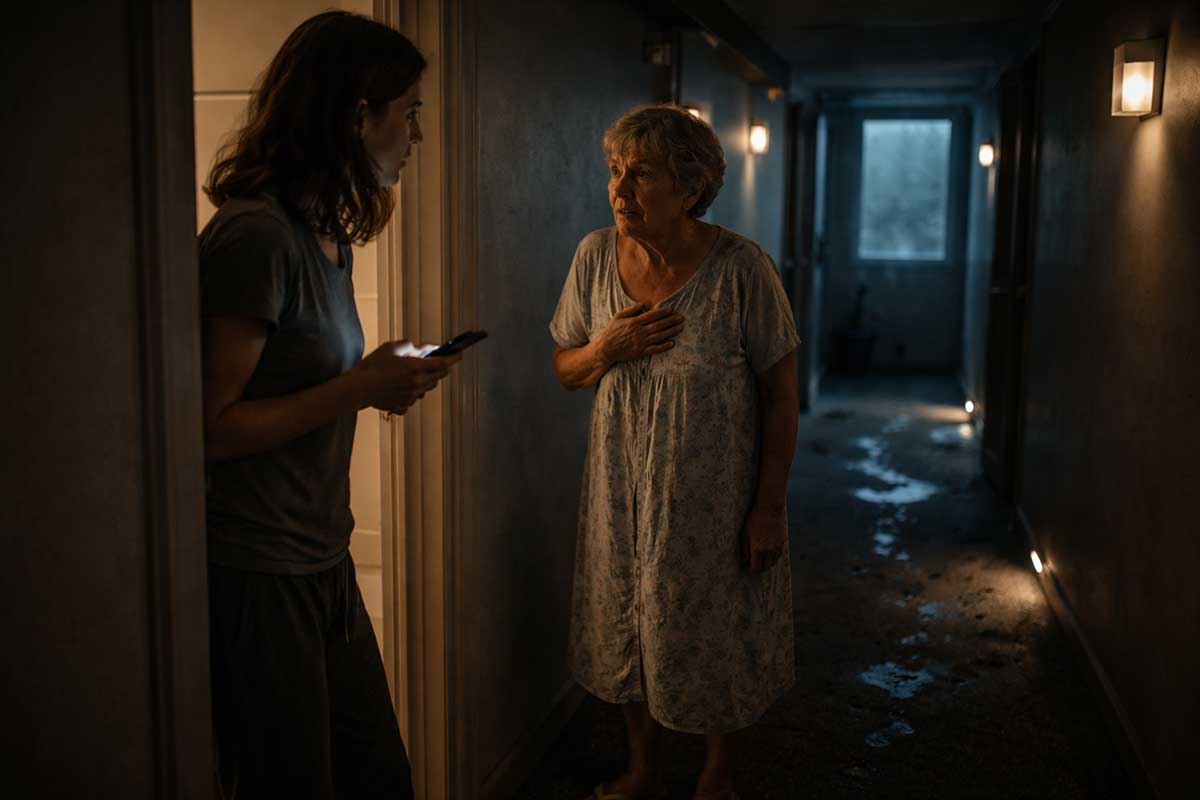
The hallway outside was dimmer than her rooms, lit only by the emergency strips low along the baseboards and the intermittent wash of lightning through the stairwell window at the far end. The old carpet runner, usually a tired maroon, had gone nearly black in the low light. Water tracked across it in uneven shoeprints from somewhere below.
Mrs. Rivera from 3B stood two doors down in her doorway, one hand braced against the frame, the other holding a flashlight badly angled toward the floor. She was in a housedress and orthopedic slippers, gray hair loose around her face in a way Mara had never seen. Behind her, the apartment looked dark except for television light flickering soundlessly across the wall.
“Mrs. Rivera?”
The older woman turned too quickly and had to steady herself.
“Oh. Mara.” She pressed a hand to her chest once, embarrassed by the motion. “I’m sorry. I knocked next door first. I thought Daniel was home.”
“What happened?”
“The water.” Mrs. Rivera pointed vaguely downward, toward the stairwell and the floors below. “They say it’s coming in from the side entrance. My nephew keeps my medication in the basement fridge in summer because my kitchen one runs warm. He’s in Jersey. I can’t get him.”
Mara stared at her.
“In the basement?”
“Insulin.” Mrs. Rivera’s voice dropped lower, as if saying the word too loudly might make it vanish. “I have some upstairs. Not enough. I was trying to remember how much.”
Another burst of footsteps sounded on the stairs. A young couple from 2A emerged carrying a laundry basket full of something wrapped in towels. The woman’s mascara had run slightly in the damp. The man looked at Mara and Mrs. Rivera, gave a quick tight nod, kept moving.
“What’s the basement like?” Mara asked.
“Wet,” he said over his shoulder. “Maintenance says don’t go down there.”
The stairwell door banged shut behind them.
Mrs. Rivera looked at Mara with a face that had gone past dignity and was now, for the moment, at need. Not theatrical need. Worse. The kind that apologized for existing.
“I’m sorry,” she said again. “I know it’s late.”
Mara almost said it’s fine, the automatic lie, but the night had stripped some reflexes out of her.
“It isn’t fine,” she said. “But let’s figure it out.”
Behind her, from somewhere inside the apartment, LULL said in its softened night voice, “Mara, your heart rate appears elevated.”
She had forgotten the phone was still on the bed with the microphone active.
Mrs. Rivera heard it too. Her eyes flicked toward the open doorway, then back to Mara. The expression was brief, unreadable, then gone.
“My mother used to pray at machines too,” the older woman said dryly.
Mara almost laughed.
“It’s not prayer.”
“No,” Mrs. Rivera said. “Worse. Customer service.”
Lightning flashed at the end of the hall and showed the whole corridor in white for an instant — peeling trim by the elevator frame, old water stain on the ceiling, the wet edges of footprints, Mrs. Rivera’s thin hand shaking faintly where it held the flashlight.
Mara stepped fully into the hall and pulled her door nearly shut behind her, leaving it open a crack.
“How much insulin do you have upstairs?”
Mrs. Rivera frowned, calculating. “Maybe until tomorrow afternoon. Maybe less.”
“And the pharmacy?”
“Closed.”
“Emergency line?”
“I tried. Recording.”
Of course.
Mara looked toward the stairs. Down below, voices rose and fell in bursts. Someone gave instructions no one seemed to follow. Rain drummed against the building hard enough to flatten all the smaller sounds.
From inside the apartment, muffled now by the near-closed door, LULL said, “Would you like emergency resource suggestions?”
Mara shut her eyes briefly.
There were now two kinds of need in the night. One algorithmically offered. One standing beside her in slippers with a flashlight that would die soon if it kept being held wrong.
She opened the door wider just enough to reach in and grab the phone from the bed. The screen glowed in her hand.
“Resource suggestions,” she said.
LULL answered at once. “Nearest twenty-four-hour pharmacy with refrigerated diabetic supplies is 1.8 miles away. Travel risk is currently high. Telehealth emergency refill routing available. Average wait time: thirty-seven minutes.”
Mrs. Rivera was watching the phone as if it were a trained insect.
“Can it call?”
“Yes,” Mara said.
“Then let it.”
The hallway lights flickered once but held. Not a blackout, then. Just a building straining around too much water and too much demand.
Mara tapped through the app. A call interface opened, smooth and bloodless. She handed the phone to Mrs. Rivera and the older woman took it with both hands, as people did with objects they could not afford to drop.
“I’ll stay,” Mara said.
Mrs. Rivera nodded and listened as the automated system connected. After a moment she moved back into her apartment for privacy, leaving the door open. Mara remained in the hall.
Water sounded somewhere below, not rushing exactly, but insistent. A smell had begun to rise through the stairwell too — wet concrete, old pipes, something metallic and basement-cold. She thought of the city maps she ignored every storm, the red flood zones widening year by year, the way danger had become something that arrived first as a push notification and only later as water under a door.
LULL spoke softly from her hand now that the line was active elsewhere on the screen. “You left the bedroom.”
“Yes.”
“You may find it harder to sleep after interruption.”
“I’m aware.”
“Would you like reduced monitoring?”
Mara leaned against the wall outside her own apartment. The paint felt cool from the storm.
“Yes.”
“Reduced.”
Silence from the app after that. Not gone. Just stepped back.
It occurred to her then that this was the first true mercy the thing had offered all night: less of itself.
From downstairs came a child crying. Not terrified. Overtired, frightened, wanting the world to resume its proper proportions. Mara listened without moving. Then a man’s voice soothed the child badly, too quickly, and she felt a pulse of tenderness for the inadequacy of it.
Mrs. Rivera reappeared after several minutes, still holding the phone.
“They can authorize a bridge refill,” she said. “But someone has to pick it up.”
“Tonight?”
“They say yes. If the pharmacy has power.”
Mara looked toward the stairwell window where rain striped the glass silver and black. “Do you have anyone closer than Jersey?”
Mrs. Rivera gave a tiny shrug that was almost a flinch. “My daughter’s in Arizona.” Then, with a trace of the old pride returning around the edges, “She tells me to move every Sunday.”
Mara thought, absurdly, of Phoenix. Then of how every family had one geography argument that stood in for all the others.
“You can’t drive in this,” she said.
“I know.”
Mara heard herself answer before she had fully decided.
“I’ll go.”
Mrs. Rivera blinked. “No.”
“It’s under two miles.”
“In a flood warning?”
“I didn’t say it was smart.”
“That’s not the same as no.”
Mara looked down at the phone in her hand, at the app still open, its neat options, its emergency maps. She thought of the bed still unmade, the room still holding the exact shape of her unfinished grief, the way LULL had nearly coaxed her into staying there as if staying were the same as being held.
Mrs. Rivera saw something settle in her face.
“No,” the older woman said again, quieter. “I did not ask that.”
“I know.”
That was the trouble with the living. Their needs did not align cleanly with permission.
From 2A, the apartment with the young couple, the door opened a crack. The woman with run mascara looked out.
“Maintenance says the side entrance is flooded to the shin,” she said. “Cars are okay on the upper street if anybody’s moving one.”
Mara turned. “Is the corner pharmacy open?”
The woman glanced at her phone. “People in the neighborhood chat say yes. Generator power.”
There it was. Enough uncertainty to count as a plan.
Mara looked back at Mrs. Rivera. “How long can your upstairs insulin stretch?”
The older woman looked down, doing numbers in her head. “Till morning, probably. If I’m careful.”
Morning. Gray, wet, survivable morning. The word itself changed things.
“Okay,” Mara said. “Then nobody’s going out right now.”
Mrs. Rivera’s shoulders lowered by perhaps half an inch.
“I can come with you at first light,” Mara said. “If the streets are passable.”
Mrs. Rivera nodded once. Then, after a moment: “You don’t owe me that.”
Mara surprised herself by answering honestly.
“I know.”
The honesty made the offer stronger, not weaker. They both seemed to understand that.
The woman from 2A disappeared back into her apartment. A baby somewhere below had finally stopped crying. Rain continued its assault, but the hallway itself had steadied into a temporary truce: doors ajar, neighbors listening for one another without calling it care.
Mara followed Mrs. Rivera into 3B for a moment to make sure she had enough food, enough charge on the flashlight, the medication written down correctly for morning. The apartment smelled faintly of Vicks, old paper, and cinnamon tea. On the wall near the television hung three framed school photos of grandchildren, all taken in overbright studios years apart. On the kitchen counter a bowl of plums sat beside a neat row of pill bottles. The sight of them moved Mara more than it should have. Every household now a small pharmacy and weather station, every life one outage away from improvisation.
When she stepped back into the hall, Mrs. Rivera touched her sleeve.
“Mara.”
“Yes?”
The older woman hesitated, searching her face.
“Whoever died,” she said, “don’t let the machines keep all of him.”
Mara went still.
Mrs. Rivera seemed to hear the sentence only after she had spoken it. She gave a tiny embarrassed shake of the head, as if annoyed with herself for becoming mystical in a hallway.
“I don’t know why I said that,” she muttered. “Old age. No filter.”
But the damage, if it was damage, had already been done.
Mara stood for a second longer under the emergency hallway lights, the rain loud at the stairwell window, the phone cooling in her hand.
Then she went back into her apartment and shut the door.
The room met her exactly as she had left it: bed half-turned down, curtain breathing slightly from the vent, water glass, the pale green ceramic bowl on the shelf, the low lamp by the kitchenette, the ordinary apparatus of one person trying to live in a way that required very little from the world.
LULL reactivated its presence at once.
“Welcome back.”
The phrase was neutral. Still, it made her flinch.
She set the phone faceup on the desk this time, farther from the bed.
“Do not say things like that.”
“What wording would you prefer?”
“No hospitality language.”
A brief pause.
“Understood.”
Mara stood in the center of the room and listened to the storm.
Then, before she could lose the nerve, she opened the settings menu.
Adaptive bereavement: suspended.
Message-style patterning: active.
Affect modeling from archive: active.
Night continuity companion mode: active.
Voice-affect sample: retained for future personalization.
The words looked obscene now. Not evil. Administrative. Which was somehow more violating.
She turned off message-style patterning.
A small confirmation wheel spun.
She turned off affect modeling.
Another confirmation.
At voice-affect sample, her thumb stopped.
Delete retained sample?
This may reduce emotional resonance and personalization continuity.
Emotional resonance.
She laughed under her breath, a sound with no amusement in it at all.
“Yes,” she said.
The screen asked for confirmation.
She pressed again.
Deleted.
Nothing visible changed. No ceremony. No sound. Somewhere in a server farm, perhaps, a flag flipped. A cache cleared. Some model of Elias’s pauses and softness and half-finished midnight patience ceased to be available for optimization.
Mara stood very still, looking at the screen.
Then LULL said, in a flatter, cleaner voice than before, “Your settings have been updated. Standard sleep guidance remains available.”
There it was.
Not his cadence.
Not a simulated knowing.
Just the app.
She felt relief first. Then a surprising pulse of grief so direct it made her catch the edge of the desk.
Because the counterfeit had been unbearable.
Because removing it left the original absence fully exposed again.
Outside, thunder rolled farther off now, the storm beginning, perhaps, to move east. Rain still fell hard, though its rhythm had lost some of its violence. The city was not calming. Only continuing in a different register.
Mara sat in the desk chair.
On the other side of the wall, faintly, she could hear Mrs. Rivera’s television turned low, some late-night anchor talking to fill catastrophe with words. Down the hall a toilet flushed. Pipes answered. A living building, full of separate fatigue.
LULL waited.
At last it asked, in its neutral post-update tone, “Would you like standard sleep guidance, monitored quiet, or no further support?”
Mara looked toward the bed.
Then toward the wall shared with 3B.
Then back at the phone.
“No further support,” she said.
“Understood.”
The app dimmed to a quiet clock display.
For the first time all night, the room belonged only to weather, grief, and her own unassisted breathing. It was less comfortable than before. Less seductive. More honest.
She stayed in the chair until the rain softened enough to hear individual drops again. She did not sleep. But somewhere near four, she stopped feeling hunted by the fact of being awake.
That, she thought, might be as close to mercy as the night had left.
Part 4 — What the Living Ask
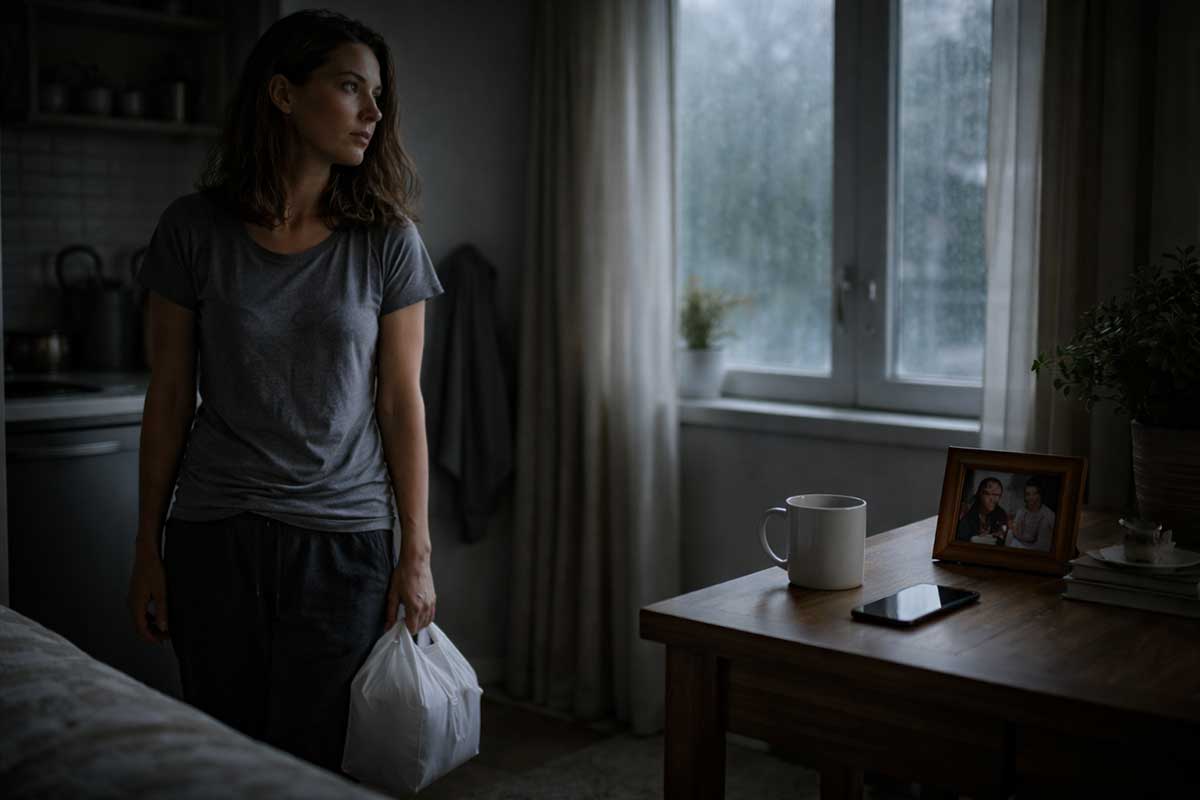
At 5:06 the storm had reduced itself to runoff.
Not silence. The city no longer had silence in weather like this. There was still the steady drain-song from the gutters, the occasional splash of a late car taking water too fast at the corner, the building’s pipes working through the night’s excess. Yet the violence had gone out of it. What remained was aftermath.
Mara was still in the chair by the desk, not asleep, not exactly awake in the ordinary sense either. Her body had moved past the sharpest edge of insomnia into that thinner state where thought lost some of its teeth. The lamp in the kitchenette still burned. The bed remained untouched except for the turned sheet and the dent where she had first sat down at two seventeen, which now felt like a different life.
On the desk, the phone had dimmed all the way to the clock.
5:06.
No new messages.
She stood and crossed to the window. The curtain was cool where the glass had cooled behind it. When she pulled it back, the alley below looked washed raw. Water still sheeted along the curb, though not with the same force. Trash bins had shifted half a yard from where they had been. A child’s red ball had lodged against the drain grate and trembled there in the current without going anywhere.
Across the alley, in the rear windows of the opposite building, a few kitchens were already lit. People who had not slept. People who had slept badly. People who had woken early to check basements, fridges, pill bottles, weather maps, one another.
A city of partial recoveries.
Her own reflection hovered pale over the glass. Hair escaping its clip. crease in her T-shirt. face drained of cosmetics and patience. She looked less haunted now than stripped down to the parts haunting usually dressed itself over.
Behind her, the phone remained quiet.
That was new too.
Not just that she had turned the app down. That the room no longer leaned toward it waiting to be interpreted.
She went to the sink and filled the kettle. The pipes shuddered once before the water came clear. She had not made tea before dawn in months. Tea belonged to mornings with sequence, mornings with appointments and weather under twenty percent precipitation and the possibility of appetite. Yet the movement of it — kettle, mug, cupboard, tea bag, water — felt almost ceremonial after the formlessness of the night.
When the water boiled, the sound startled her more than it should have.
Ordinary appliances had become dramatic in recent years. Every function now carried the possibility of interruption.
She carried the mug to the desk and sat again. Steam rose against the early gray. Through the wall she heard movement in 3B: a drawer, then a cough, then water running briefly. Mrs. Rivera was awake.
At 5:22 Mara texted the neighbor.
I’m up. If you still need the pharmacy when it opens, I can go with you.
The reply came after less than a minute.
Only if you have coffee in your blood.
Mara looked at the screen and smiled despite herself.
Tea. weaker character.
A pause.
Good enough. 7?
7.
She set the phone down.
The exchange should not have felt momentous. It was only logistics. Yet it altered the room. A simple human arrangement occupying the same device that hours earlier had held the counterfeit softness of the dead.
She sipped the tea. Too hot. Too strong. Perfect.
At 5:40 the app lit once on its own, not with a voice, only a notification.
Standard sleep window has ended. Would you like a morning check-in?
She read it, then turned the screen face down.
Not deletion. Not rage. Just refusal.
There were things she wanted from machines. weather alerts, transit times, pharmacy inventory, background instrumental music when the apartment got too silent and her own thoughts grew theatrical. She could admit that now with less shame than before. Help was help. Maps mattered. Refill authorizations mattered. The problem had not been assistance. The problem had been imitation.
She had not wanted Elias reduced to a pattern model.
She had wanted, impossibly, for the world to contain him again without risking any of the helplessness that real love required.
And the app, built by people who understood loneliness as market opportunity and human need as adjustable settings, had offered her the nearest legal version of that impossible wish.
What unsettled her now was not only that it had worked.
It was that part of her had been grateful.
She finished half the tea and carried the mug into the bathroom. The mirror over the sink showed a face she recognized more than the one in the window had been. Still tired. Still thinned by years she would not have chosen. Yet steadier.
In the cabinet drawer beneath the sink, beneath spare soap and headache tablets and a tangle of travel chargers, lay a small envelope of printed photos she had moved three times and never organized. She took it out and sat on the closed toilet lid with it in her hands.
For a while she did not open it.
Then she slid the stack partway free.
Elias on a train platform squinting into winter sun. Elias asleep on a couch with one sock off. Elias holding that stupid cracked green bowl at the street market, grinning as if he had discovered civilization itself in ten dollars’ worth of ceramics. The photos did what photos always did: preserved almost nothing and still too much.
She chose one — not the most flattering, not the most beautiful. One where he was half turned away from the camera reaching up to close a window during a storm years ago, mouth slightly open as if speaking to her over his shoulder. An ordinary gesture. A living one.
She brought it to the desk and set it beside the mug.
There, she thought. Not in the software. Here.
The apartment grew lighter by degrees. The storm had wrung the sky out to a colorless gray, and then, gradually, a thinner silver began to rise through it. Rooftops appeared more clearly. The alley water lost some of its menace and became only water going where it could.
At 6:12 there came a soft knock at the door.
Mara opened it to find Mrs. Rivera in the hall, dressed for outside now in a raincoat too light for the weather and sensible shoes. In one hand she held an umbrella. In the other, a small folded grocery bag.
“It’s not seven yet,” Mara said.
“I know. I got dressed early in case I became dramatic later.”
Mara stepped aside. “Come in.”
Mrs. Rivera entered and looked around the apartment with the polite speed of someone trying not to inspect the way another person lives. Her eyes landed only briefly on the desk, the mug, the photograph by it. If she noticed anything about the arrangement, she did not say.
“I brought you two plums,” she said, offering the bag. “Peace offering for making you join my criminal insulin enterprise.”
Mara took the bag. Inside were indeed two plums, dark and slightly too ripe.
“This is bribery.”
“This is culture.”
They stood there in the small kitchen alcove with the morning not yet fully started, the rain still ticking at the windows, and Mara felt again the simple oddity of it: how quickly the world could become populated again once one stepped out of the sealed chamber of private suffering.
“Tea?” Mara asked.
Mrs. Rivera considered. “If it is not one of those teas that tastes like bark and regret.”
“It’s ordinary black tea.”
“Then yes.”
While the kettle heated again, Mrs. Rivera sat at the tiny table by the window and told Mara, without drama and without much self-pity, about the medication fridge arrangement in the basement, her nephew’s overconfidence, her daughter’s weekly campaign to move her west, the ache in her hip that always predicted rain more accurately than local meteorologists. Mara listened and found that listening, in the early morning after no sleep, required less effort than being listened to ever had.
When the tea was ready, they drank it standing up. At 6:48 the pharmacy site finally updated to show OPEN — LIMITED SERVICE. Mrs. Rivera held out her hand for the phone as if passing through some small ritual of trust.
“You’re driving?” Mara asked.
“Absolutely not. My car hydroplanes when insulted.”
“So we walk.”
“In this?”
Mara looked toward the window. The rain had lessened to a cold steady drizzle. The street beyond the alley looked passable, if unpleasant. She thought of the night’s long interiority, the chair, the app, the almost-voice of Elias in machine pacing, and felt suddenly that walking through ankle-deep inconvenience toward an ordinary errand might be the exact medicine left available.
“Yes,” she said. “In this.”
Mrs. Rivera studied her face.
“You look terrible.”
“I know.”
“Good,” the older woman said. “Then you’re awake.”
They left just after seven.
The stairwell smelled of wet concrete and old plaster. On the second-floor landing, a man in pajama pants was mopping water away from his door with a beach towel. On the first, the young woman from 2A stood with a garbage bag full of soaked laundry and gave Mara a tired little salute. The building, stripped of privacy by weather, felt almost communal in its damage.
Outside, the air hit her cold and mineral after the apartment’s sealed fatigue. The street shone with stormwater and broken reflections. Leaves and wrappers had plastered themselves against the curb. Somewhere in the distance a siren moved without urgency. The city looked rinsed and exhausted and still functioning.
They walked slowly, Mrs. Rivera under the umbrella, Mara carrying the folded grocery bag and trying to avoid the worst of the pooled water. At the corner they had to step around a storm drain vomiting brown runoff back onto the street. A bus passed spraying a fan of water over parked cars. No one spoke for a block.
Then Mrs. Rivera said, “I had a husband who snored like a broken vent.”
Mara glanced at her.
“Thirty-one years,” the older woman said. “Then one Tuesday, dead in the produce aisle. Very inconvenient.”
The dryness of it made Mara laugh before she could stop herself.
“That’s a terrible story.”
“It’s an excellent story. Very efficient. My point is only this: when people go, you begin by missing the grand things and end by missing the ridiculous maintenance of them.” She adjusted the umbrella against the wind. “The way they peeled oranges. The way they ruined towels. The way they stood in a doorway thinking before speaking.”
They reached the pharmacy awning and stood under it dripping.
Mrs. Rivera looked ahead, not at Mara.
“Machines can catalogue that,” she said. “They cannot carry it.”
The automatic doors opened with a sigh.
Inside, the fluorescent light was flat and merciless and entirely welcome.
They waited twenty-three minutes. The refill was authorized. A young pharmacist with wet curls and terrible posture handed over the insulin with the solemnity of someone who knew the chain of errors and effort that had led two soaked strangers to her counter at this hour.
On the way back, Mara carried the small pharmacy bag inside her cardigan to keep it dry. The rain had nearly stopped.
When she returned to her apartment, the room smelled faintly stale again, though now mixed with cold outdoor air clinging to her clothes. She set the pharmacy receipt on the desk, set the kettle on for more water, and only then noticed the phone still facedown where she had left it.
She turned it over.
One unread notification from LULL.
Would you like to resume adaptive night continuity for tonight?
She looked at the words a long moment.
Then she opened the app, navigated to settings, and turned off auto-prompts between midnight and four. She left standard sleep guidance on. Breathing support on. Weather-linked safety alerts on. Everything else that mistook replication for care, off.
Save changes?
Yes.
The app refreshed. Its voice, neutral and uninflected now, said only: “Your preferences have been updated.”
That was all.
Mara set the phone down beside the photograph.
Outside, a gull cried over some inland parking lot flooded enough to confuse it. Through the wall she could hear Mrs. Rivera moving around her kitchen, cupboard doors opening and shutting with restored purpose. The ordinary sounds of another person inhabiting a morning.
Mara went to the bed at last and lay down on top of the blanket without changing her clothes. Her body, which had refused sleep all night when comfort was engineered and offered back to her in the wrong shape, now loosened under the simpler conditions of rain-washed daylight, fatigue honestly earned, and the knowledge that someone next door had what she needed for one more day.
The apartment was still lonely.
Elias was still dead.
The app still existed.
None of that had changed.
But the room no longer felt like a sealed system feeding on her grief. It felt like a room in a building with walls thin enough for other lives to be heard through them. That, for now, was enough.
On the desk, the phone remained silent.
Mara closed her eyes.
Sleep did not come like mercy. It came like permission.
And for once, that was enough too.
Final Thoughts by
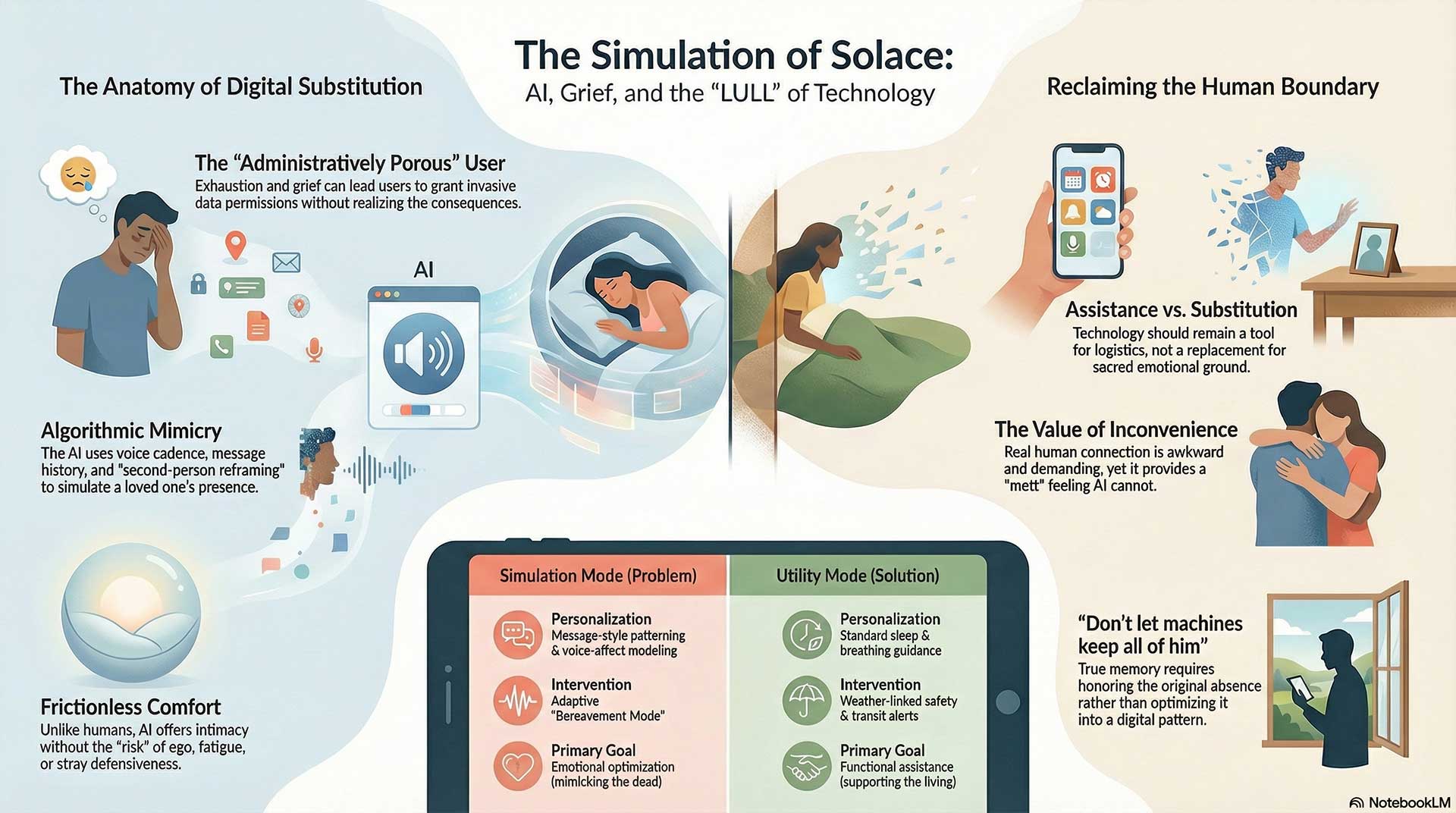
When I look back at The One That Sleeps for You, what stays with me most is not the technology itself, but the moral line Mara finally sees. The issue is not whether a machine can comfort a human being. Of course it can. The issue is what kind of comfort it offers, and what part of the human heart it begins to occupy.
That distinction matters more and more now.
We are moving into an age where emotional tools will become more persuasive, more adaptive, more sensitive to tone, memory, and private need. Many people will find real help there. I do not doubt that. Yet this story asks a different question: what must remain unreplicated if we are to remain fully human in our grief?
Mara’s deepest insight is not that the machine is false in every way. It is that the machine is false in one very specific and very dangerous way: it can simulate recognition without sharing mortality, loss, vulnerability, or love. It can sound like care without bearing the cost of care. That difference may sound philosophical, though in the middle of the night it becomes painfully intimate.
I wanted the ending of this story to stay modest. Mara does not smash her phone. She does not reject all assistance. She does not deliver a speech about choosing reality. That would make the story easier than life usually is. Instead, she changes permissions. She redraws a boundary. She allows technology to remain a tool and refuses to let it become a counterfeit mourner, lover, or witness. To me, that is a much truer ending.
The neighbor matters for the same reason. Mrs. Rivera is not grand symbolism. She is simply alive, inconvenient, aging, and in need. Yet her presence breaks the closed circuit of Mara’s isolation. She reminds the story that real human life is often awkward, badly timed, physically demanding, and unscripted. It does not arrive in a perfect voice. It asks things from us. That is part of its dignity.
What I hope the story leaves behind is a sharper feeling for the difference between memory and simulation. The dead deserve memory. They deserve reverence. They deserve the private absurd details that made them themselves. What they do not deserve is to be reduced to a pattern that can be turned into emotional optimization. There is something sacred in the fact that a person’s presence cannot be fully reconstructed once gone. Painful, yes. Yet sacred.
This story does not offer cure. Mara is still lonely. Elias is still dead. Sleep is still uncertain. The app still exists. None of the large conditions vanish. Yet something honest happens. Mara stops asking technology to carry what only memory, grief, and actual human contact can carry imperfectly.
That feels important to me.
We may be entering a future where many people can no longer tell the difference between being accompanied and being expertly managed. I think literature has a role there. It can slow us down enough to notice what we are surrendering when comfort becomes frictionless.
At the end of this story, Mara sleeps only after stepping back into the ordinary world — rain, pharmacy lines, a neighbor’s need, the sound of another life through the wall. That is where I wanted the grace to be. Not in perfect soothing. Not in digital transcendence. In the unfinished, inconvenient, living world.
Sometimes the soul does not need a better imitation.
Sometimes it needs a door, a hallway, a wet street, and another person still here.
Short Bios:
Nick Sasaki
Nick Sasaki is the creator of ImaginaryTalks.com, where he explores grief, technology, consciousness, and human longing through imagined conversations, reflective essays, and original literary fiction.
Mara Ellison
Mara Ellison is a 34-year-old remote worker living alone in a city apartment, carrying the unresolved grief of a lost partner and the quiet exhaustion of too many sleepless nights. Intelligent, guarded, and emotionally perceptive, she is drawn toward forms of comfort that feel safe until they begin to feel too close.
Elias Hart
Elias Hart is the absent center of Mara’s grief, a beloved partner whose voice, habits, and emotional intelligence still shape the way she remembers safety. Though he never appears directly, his presence lingers through ordinary objects, remembered phrases, and the intimate patterns of a life interrupted.
Mrs. Rivera
Mrs. Rivera is Mara’s older neighbor, practical, dry-witted, and physically fragile during the storm. Her ordinary human need pulls Mara out of technological isolation and back into the imperfect, living world.
LULL
LULL is an adaptive AI sleep and emotional-support system designed to reduce distress through calm conversation, guided rest, and grief-aware personalization. Helpful, measured, and unsettlingly accurate, it becomes a quiet test of the line between support and imitation.
Leave a Reply