
|
Getting your Trinity Audio player ready...
|
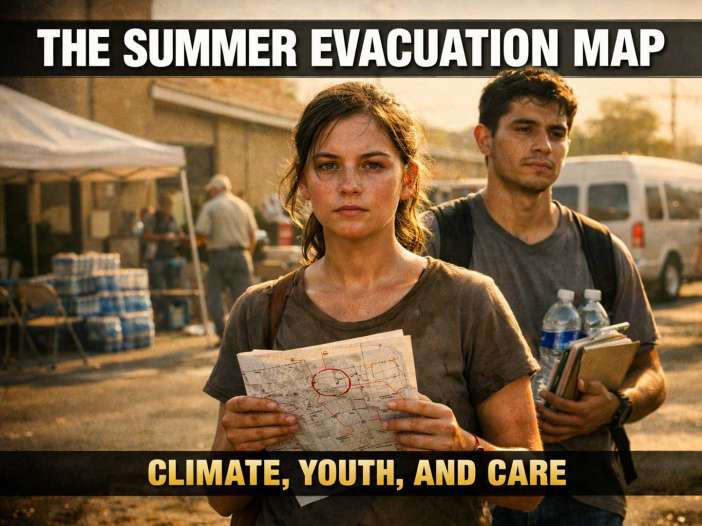
Introduction by Nick Sasaki
When I think about The Summer Evacuation Map, I think first about the quiet violence of simplification.
A city makes a form. A form becomes a map. A map becomes a plan. And somewhere inside that process, a real human life gets flattened into a line item that almost fits, but not quite. That small gap is where this story begins.
I did not want to write a climate story built on spectacle. We already have enough images of disaster. What interests me more is the ordinary moral pressure that arrives long before anything looks cinematic: a heat wave, a clipboard, a neighborhood list, a wrong transport note, a building that holds heat too well, a household that official systems have misunderstood just enough to place in danger.
That is the world Nora enters.
What I love about her as a character is that she does not begin as a natural idealist. She begins in distance. She is observant, intelligent, emotionally careful, and quietly exhausted by a future that already feels damaged. She is not indifferent because she lacks feeling. She is distant because too much feeling has started to seem unusable.
That is a very modern kind of fatigue.
Mateo matters because he does not cure that fatigue with speeches. He offers something better: steadiness. Practical attention. A way of staying with reality after disappointment. Their connection is meaningful to me for that reason. It is not built on fantasy. It is built on shared witnessing.
At the center of this story is one large question hidden inside many small tasks:
What happens when a young person stops treating crisis as background and begins treating one address, one house, one family as real?
That shift changes everything.
Not the whole city.
Not the climate.
Not history.
But the moral scale of the day.
This story is about the moment when paperwork becomes human, when systems fail in ordinary ways, and when care begins not as inspiration but as attention. Sometimes that is the most honest form of hope available.
Part 1: Names on a List
By nine in the morning the city had already begun to look temporary.
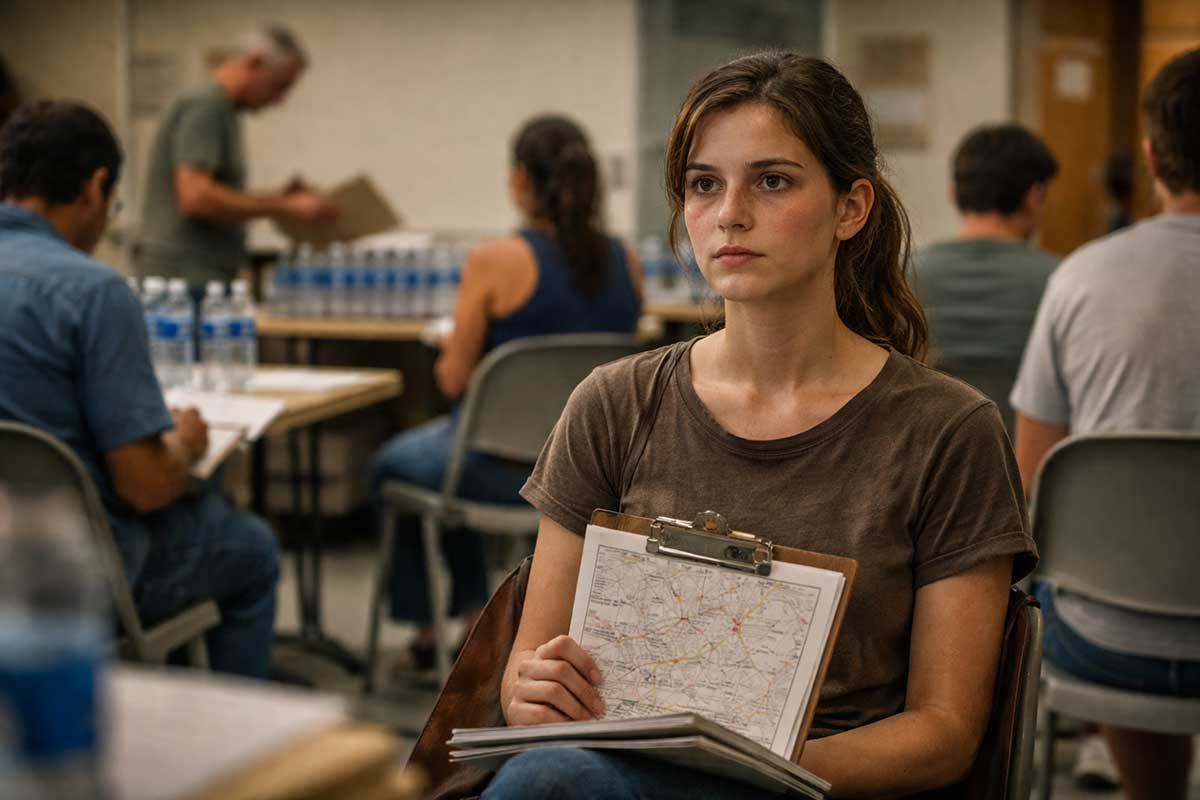
Heat rose off the library parking lot in visible layers, bending the parked cars at their edges, turning distance into something unreliable. The white pop-up tent beside the entrance had gone slack on one side where the volunteers had tied it badly, and the folding table beneath it was lined with paper maps, clipboards, sunscreen, bottled water, and a plastic bowl of cheap granola bars no one seemed willing to claim. A laminated sign taped to the table read HEAT RESPONSE VOLUNTEERS, the corners already curling.
Nora stood just inside the library lobby, letting the air-conditioning hit her face hard enough to sting.
The building smelled like old carpet, printer toner, and the sweet metallic chill of institutional cooling. She had arrived five minutes early and already regretted it. Around her, people in city lanyards and college T-shirts moved with that earnest summer-purpose energy she had never trusted. They carried clipboards as if clipboards themselves created authority. Someone laughed too loudly by the circulation desk. A woman with a braided ponytail was explaining the phrase door-to-door wellness verification to a volunteer who looked about fourteen.
Nora shifted the manila packet under her arm from one hand to the other and checked her phone.
No new messages.
At 8:12 Aunt Elise had texted: Take water. And don’t volunteer in a way that gets you killed for a PDF.
Nora had typed back: Encouraging as always.
Her aunt had answered with a thumbs-up and, a minute later, I mean it.
That was the thing about Elise. She could sound like a joke and an instruction at the same time.
Nora slipped the phone into her back pocket and walked toward the meeting room at the end of the lobby, where a paper sign with a crooked arrow said RESILIENCE MAPPING / TRAINING.
Resilience, she thought, was one of those words people used when they wanted to sound hopeful about things that should have made everyone more ashamed.
Inside, the room was too cold and too bright. Fluorescent panels hummed overhead. Someone had drawn the blinds, though a strip of white heat still leaked through at the edges. About twenty people sat in plastic chairs facing a projection screen that showed a city map coded in soft official colors: yellow, orange, red, and a cooler blue for designated relief sites. Streets she knew had been turned into symbols. Blocks had been ranked, outlined, and abstracted into need.
Nora took a seat near the back.
A volunteer coordinator stood at the front, a man in his thirties with rolled sleeves and the air of someone trying to project calm into systems that no longer deserved it. He was speaking without a microphone, one hand resting against the podium as though he could hold the room in place that way.
“...so the point is not to alarm anyone,” he was saying. “You’re confirming contact information, checking transport status, verifying cooling access, and noting any households that may need direct follow-up if grid conditions worsen later today.”
Later today.
As if the heat had not already made everything feel late.
Nora pulled a pen from the packet. The paper inside was warm from being carried against her side. At the top of the first page, in bold letters, was DISTRICT 4B: VULNERABILITY RECHECK. Beneath that, columns for address, resident name, age bracket, medical dependency flag, cooling access, transport access, contact verification, and notes.
Notes, always the smallest space.
On the projection screen, a different slide appeared: Priority conditions requiring escalation.
The list was clean and calm:
- no functional cooling
- no transport
- age 75+ living alone
- oxygen dependency
- mobility limitation
- recent hospital discharge
- confusion or disorientation
- any condition not captured by current file
Nora stared at the last line.
Any condition not captured by current file.
That, she thought, was basically the whole city now.
She hadn’t planned to be here. Not really. The volunteer form had come through the university portal under civic engagement opportunities, between a tutoring program and a request for donated dorm mini-fridges. She had clicked it because summer credit was expensive and because Aunt Elise had looked at the heat warning on the local news two nights ago and said, “You can’t keep reading about collapse like it’s someone else’s weather.”
Nora had said, “That sounds made up.”
Elise had replied, “Most true things do at first.”
Now here she was in an overcooled room with a clipboard on her lap, preparing to verify which strangers were most likely to be left inside dangerous temperatures by a city that still insisted on color-coded competence.
At the front, the coordinator clicked again. “You are not emergency responders. If you encounter an acute medical situation, you call it in. If someone is in immediate danger, you escalate. If an address doesn’t match the file, you document it. Don’t freelance.”
Several people nodded as if they belonged to the kind of life where don’t freelance had ever prevented anything.
The coordinator looked down at his list. “We’re pairing up by district.”
Nora sat a little straighter.
She didn’t dislike people exactly. She disliked the early stages of being expected to speak to them.
Names were called, pairs stood, packets changed hands. One girl in a baseball cap immediately began making conversation with her assigned partner, a boy who looked relieved someone had done the work for him. Two city interns compared route blocks in low voices. An older retired teacher type — Nora could tell by the sandals and the heavily annotated packet — asked whether any district had better shade than the others, which made three people laugh politely.
“District 4B,” the coordinator said. “Nora Vale and Mateo Serrano.”
A chair scraped somewhere to her left.
Nora turned.
The person standing two rows over was taller than she expected, lean, dark-haired, maybe twenty-one, wearing a faded gray T-shirt and carrying his clipboard like it was already part of his arm. He looked not cheerful exactly, but awake in a way that made her tired on sight.
He caught her looking and gave a brief nod, nothing performative.
Nora stood.
As they crossed toward the side table where district packets were being handed out, she became aware of the cold in the room all at once — the kind of cold public buildings used to imply safety. Outside, through the narrow strip left between the blinds, she could see the brightness deepening toward white.
The coordinator handed them a thicker packet and a printed neighborhood map with several blocks circled in orange.
“4B’s mostly apartments and older single-family homes,” he said. “High heat retention, lower car ownership, a lot of older residents. We’ve had a few missed follow-ups this week so the data may be soft in places.”
Soft, Nora thought. Another gentle word for failure.
“Anything specific?” Mateo asked.
The coordinator glanced down. “One building on Hawthorne has had repeated cooling complaints. Couple of flagged residents on Milton. And the west side of Prince Street’s been underreported for transport access.”
Mateo nodded once, already scanning the sheet.
Nora took the map from the table. The paper was oversized and slightly glossy, still cool from indoor storage. District 4B spread across it in careful color. Streets, circles, arrows, shaded risk zones. Small symbols for cooling centers. Bus lines. Medical priority dots.
Seen from above, it almost looked manageable.
“You’ve done canvassing before?” Mateo asked as they stepped aside to let the next pair through.
Nora looked at him.
“Is it that obvious I haven’t?”
“A little.”
“Great.”
“It’s not bad,” he said. “Mostly people either don’t answer, or they do and they tell you more than the form knows what to do with.”
His voice was easy without being aggressively friendly. That made it harder to dismiss.
Nora glanced back at the map. “That sounds reassuring.”
“It wasn’t meant to be.”
For the first time, she almost smiled.
The room had begun breaking apart into motion. Volunteers heading toward the lobby. Water bottles being claimed. Someone asking where sunscreen had gone. The coordinator calling out final reminders about logging changes in real time if the network held up. Through it all, the air-conditioning kept up its steady dry hum, heroic and temporary.
Mateo set his clipboard against the table and uncapped a marker. “You want to split door knocks and cross-check, or go together the whole time?”
Nora watched him circle the first cluster of addresses.
“Is there a correct answer?”
“No. There’s a faster answer and a less awkward answer.”
“And which is which?”
He looked up. “Depends how much you enjoy strangers watching you read a form.”
Nora took one of the extra markers from the table.
“So we go together.”
“That was my vote.”
He handed her the packet, and for a second their fingers hit the same edge of the paper — not meaningful, not cinematic, just the small accident of two people taking hold of the same task at once.
On the way out through the lobby, they each grabbed two bottles of water from the folding table under the drooping tent. The granola bars were still untouched. Outside the glass doors, the heat waited in full.
The moment they stepped onto the library steps, it hit her across the face and chest like something with intent.
Not just warmth. Density.
The air smelled faintly of hot dust, tar, and the dry leaf-burnt scent that sometimes drifted east when there were fires far enough away for officials to call the air quality only moderate concern. The sky was cloudless and wrong, a pale glare rather than a color. Across the street, a bus shelter advertisement had been replaced by a municipal poster showing a smiling cartoon sun beside the words CHECK ON YOUR NEIGHBORS.
The cruelty of the design nearly impressed her.
Mateo unfolded the map against the hood of a parked city van. Sun bounced off the paper at once.
“Hawthorne first?” he asked.
Nora looked at the highlighted route. Four blocks south, then west. Apartment buildings, side streets, two flagged houses, one church basement marked as a cooling site.
“Sure.”
He handed her the packet again. “You track the notes?”
“Why me?”
“You look like you’d have better handwriting under pressure.”
“You know nothing about me.”
“I know enough to delegate.”
She gave him a flat look. He nodded as if accepting the charge.
Then they started walking.
The sidewalk shimmered ahead of them. Lawn grass along the first block had gone the brittle color of packing straw. Most houses had blinds drawn against the sun, making the neighborhood look less asleep than withdrawn. A child’s plastic pool sat upside down in one driveway, warped slightly at one edge. On the corner, someone had set out a cardboard box labeled FREE FAN — WORKS SOMETIMES in thick black marker.
Nora wrote the first address at the top of her notes page and felt, unexpectedly, not dread exactly, but the faint beginning of attention.
Above them the heat held steady, blank as paper.
Below it, names waited to be checked against the world.
Part 2: Houses That Do Not Fit the System
The first building on Hawthorne had three floors, a sagging front awning, and the kind of brick that held heat like an argument.
Nora felt it rising from the steps as they climbed. The front door had been propped open with a chipped ceramic planter, though no air moved through the entryway except the stale upward drift of old hallway warmth and somebody’s cooking from the second floor. A handwritten notice taped beside the mailboxes read ELEVATOR OUT AGAIN. SORRY. Beneath that, in a different pen, someone had added, “AGAIN” IS DOING A LOT HERE.
Mateo stopped in the dim lobby and looked at the packet.
“Unit 1C first. Mrs. Wallace. Seventy-nine. Lives alone. Cooling access uncertain.”
Nora uncapped her pen.
The hallway carpet was the same color as old tea. Somewhere down the corridor a television was on too loud, the sound flattened by walls into unplaceable alarm. Mrs. Wallace answered after the second knock, opening the door only as far as the chain allowed.
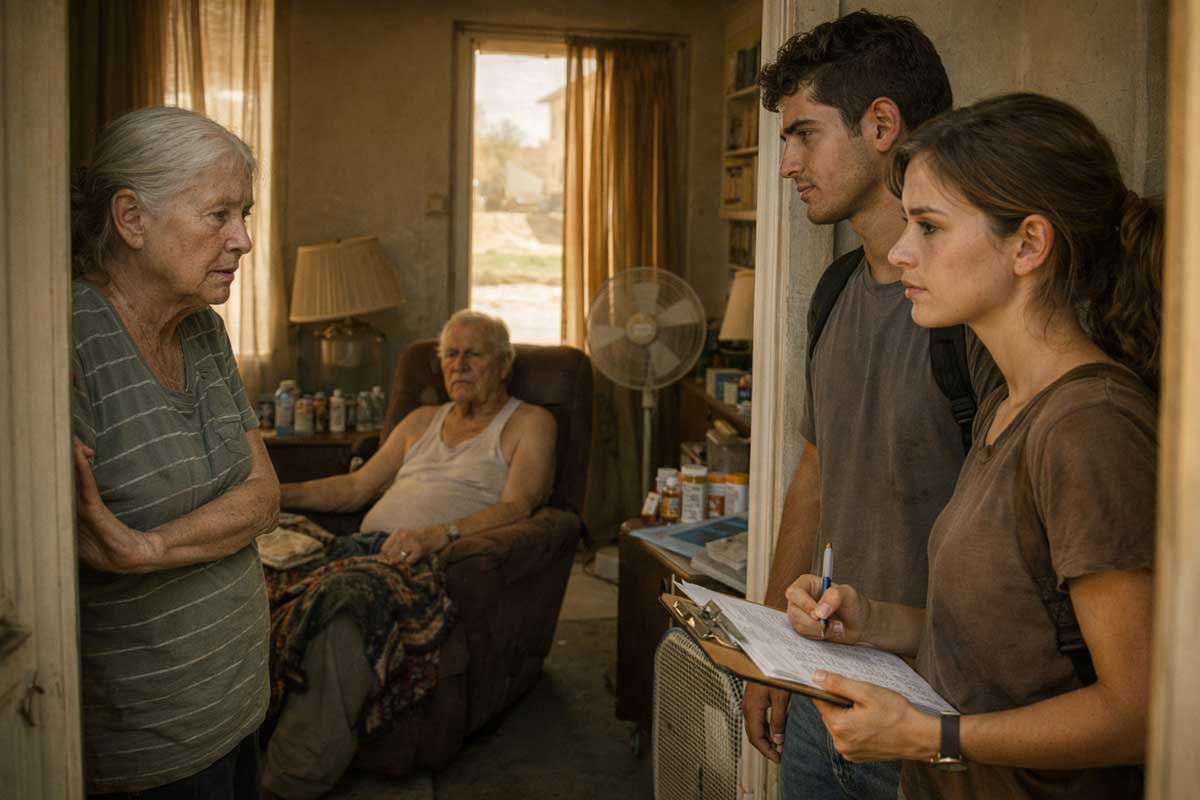
She was smaller than Nora expected, with a face that had the fine collapsed look of paper folded too many times. A box fan ran behind her in the living room, aimed toward the sofa. It made more noise than wind.
“Yes?” she said.
Mateo gave the practiced little half-step back people used when trying not to crowd strangers. “Good morning, ma’am. We’re with the city heat-response recheck. Just confirming your cooling status and transport info in case conditions worsen later.”
Mrs. Wallace looked from him to Nora and back again with visible suspicion.
“You with the city?”
“Through the volunteer program,” Mateo said.
“So not with the city.”
Nora kept her face neutral and wrote: suspicious / coherent / answers own door.
Mrs. Wallace’s gaze caught on the clipboard in Nora’s hand. “You gonna write down that my fan’s useless?”
“If you want us to,” Nora said.
The older woman opened the door another inch.
That was enough invitation, apparently. Mateo asked the form questions. Air-conditioning? No. Functional fan? Barely. Family nearby? Daughter in Tulsa, worse off there than here. Transport? Bus if it came. Cooling center awareness? Vaguely. Would she go if temperatures inside became unsafe? Mrs. Wallace gave a laugh so dry it might have become a cough.
“Depends if unsafe arrives before or after I feel like putting on proper shoes.”
Nora wrote that down too, then crossed it out because there was nowhere in the notes column for wit.
When they left, she marked No AC / fan insufficient / bus dependent / resistant but informed and realized the note still told almost nothing true.
“She should be orange at least,” Mateo said as they headed back down the hall.
“She already is orange.”
He glanced at the map. “No, she’s yellow.”
Nora stopped.
He leaned over the packet in her hands, and there it was: Mrs. Wallace’s unit marked with the mildest vulnerability tier, as if one loud dying fan and a joke about collapse amounted to relative safety.
“Why?” Nora asked.
Mateo gave a small shrug. “Maybe she answered ‘yes’ to cooling once in June and no one rechecked.”
They stood in the hallway with the television noise leaking under another door and the broken elevator sign behind them like a punchline no one respected anymore.
Nora changed the mark by hand.
The ink bled slightly into the cheap paper.
The next apartment belonged to a man named Terrence who opened the door shirtless, holding a baby against one shoulder and looking like he had not slept in years or perhaps only last night. The form listed him as one adult, age twenty-seven, no dependents, transport available.
In the actual apartment there were four adults, two children, one grandmother sleeping in a recliner beneath a window unit that had been duct-taped along one side, and not enough floor visible to suggest anyone lived there without stepping around somebody else’s life.
Mateo, to his credit, did not look startled.
Terrence adjusted the baby and said, “They still got me as one person?”
Nora checked the sheet. “Yes.”
He laughed once. “That’s beautiful.”
A woman from the kitchenette said, “Ask them if one person can pay our electric.”
The grandmother opened one eye but did not otherwise move.
Nora asked the questions more slowly this time. Cooling access technically yes, though the unit froze and leaked. Transport yes, though the car had no registration and the transmission “felt haunted.” Emergency contacts multiple, all equally overextended. Would they go to a cooling center? Maybe, except the grandmother got confused in crowds and the baby screamed in big rooms and last time the bus stopped running before they got home.
Nora wrote until the notes ran into one another.
When they stepped back into the hall, she looked at the form again.
“How is any of this useful?” she asked quietly.
Mateo wiped the back of his wrist across his forehead. The hallway had no moving air at all.
“It’s useful if someone reads it.”
“That sounds fake.”
“It kind of is.”
She looked at him.
He held her gaze just long enough to show he meant it.
On the second floor they found a unit listed as transport available occupied by an older couple who had not owned a car since 2018 and now split their time between one working walker, three prescription copays they kept reordering in the wrong sequence, and an ancient portable AC unit that blew cold air directly onto a dining chair because the hose adapter for the window had cracked in spring and none of their grandchildren had come by to help rig it since.
“Can you mark that we are not idiots?” the wife asked Nora. “We know it’s hot. We’re just tired.”
Nora wrote: No transport despite file. Both ambulatory but limited. Need follow-up if outage.
Then, below it, smaller: Tired, not noncompliant.
Mateo glanced at the page and said nothing, though the side of his mouth moved slightly.
By the time they reached the street again, Nora’s T-shirt was damp between her shoulder blades and the pen had left a blue indentation on the side of her middle finger. Sunlight bounced off parked windshields with enough force to make her eyes ache.
Across Hawthorne, a man in a lawn chair sat shirtless under the shade of a single drooping maple, holding a garden hose over his bare feet as if they had negotiated this arrangement privately. Two children rode past on scooters slower than walking speed. From somewhere came the whine of a leaf blower used by somebody either delusional or paid badly enough not to refuse.
Mateo unfolded the map on top of a newspaper box.
“Okay,” he said. “Prince Street or Milton?”
Nora took one of the water bottles from her tote and drank half of it too fast. The plastic had gone slightly soft in the heat.
“How many people made this map?”
He glanced up. “At once, or morally?”
She laughed before she could help it.
That seemed to satisfy him.
“I’m serious,” she said.
“I know.” He tapped the paper. “Probably a lot of people. None of them in the same room. Some city data, some health outreach, some utility records, some volunteer updates. Good intentions plus old files plus the fantasy that addresses are stable.”
Nora looked down at the color bands, the small coded circles, the routes laid over blocks she had ridden through a hundred times without ever wondering who inside them had stopped being legible to the system.
“And we’re fixing it with clipboards,” she said.
“We’re bothering reality until it answers.”
The phrase landed with more force than she expected.
He recapped his marker and folded the map in half, leaving the next section visible. “Prince first. Less shade but fewer stairs.”
They walked west.
Prince Street had narrower lots and older houses, most with front porches that seemed to have given up on aesthetics and taken up survival instead. Box fans in windows. Blankets over south-facing glass. One home with aluminum foil pressed across almost every pane. The street trees were older here, which helped, though the air beneath them still felt used.
At the third house, a woman in oversized sunglasses opened the door only after watching them through the side curtain for nearly a full minute.
“We’re good,” she said before Mateo could speak.
“We’re just rechecking cooling access,” he said.
“We’re good.”
Behind her, through the crack, Nora could see a boy of maybe ten lying on the floor directly in front of a vent, cheek pressed to the tile.
The woman followed Nora’s eyes and opened the door wider with a sigh that was less surrender than annoyance.
“My mother’s inside,” she said. “She’s the one on your list.”
Her mother turned out to be seventy-four, which meant the form had her three years younger than the priority cut-off and therefore in the bureaucratic category of concern but not enough concern. She had COPD, though “mild on paper, rude in practice,” as she put it. There were two adults, one child, one cooling unit, and no backup plan except the daughter’s promise that if the power went she would “figure something out with my cousin and his truck,” a sentence Nora wrote down knowing it meant both everything and almost nothing.
At the porch steps, Nora asked, “Why wasn’t she flagged?”
Mateo squinted at the sheet. “No idea.”
“She has a respiratory condition.”
“Maybe it wasn’t coded right. Maybe nobody asked the right question. Maybe she stopped filling out forms when they started asking online.”
Nora pressed the capped pen against her wrist.
Aunt Elise had done that with half her medical portals. Not from ignorance. From principle. “If I need three passwords to tell someone I can’t breathe,” she had said once, “then the republic is already over.”
At the end of Prince, the pavement buckled slightly where tree roots had been winning for years. The heat there rose visibly from the tar patchwork, making the parked cars look as if they were floating just above the street. They paused under a utility pole shadow too narrow to deserve the name.
Mateo took out his phone and checked the volunteer group chat. “Cooling center on Maple is nearing capacity.”
“Already?”
“It’s noon.”
Nora looked at the sky. It had not changed color at all. That was the problem with these days. They had one expression from ten in the morning until the sun finally surrendered.
Her own phone buzzed in her back pocket. She pulled it out.
Aunt Elise: How’s the republic?
Nora typed: Under review. You okay?
The reply came after a moment.
Apartment’s warm. Not dramatic yet. AC wheezing like a smoker in church.
Nora stared at that for a second longer than she needed to.
Mateo was still looking at the group chat. “There’s a request to prioritize addresses with no transport first if grid strain goes up.”
Nora slipped the phone away.
“Feels like everyone’s one broken machine away from being a special case,” she said.
He looked at her then — really looked, maybe for the first time all morning.
“Yeah,” he said. “That’s pretty much the job.”
They stood another second in the thin slice of shadow, both drinking water that had stopped being cold an hour ago.
Then Mateo tapped the next circled block on the map.
“Milton?”
Nora took the packet back from him and adjusted the stack against her hip.
“Sure.”
And together they turned south again, into the bright, thinning line between addresses and whatever reality the forms still had not learned to hold.
Part 3: The Map Fails
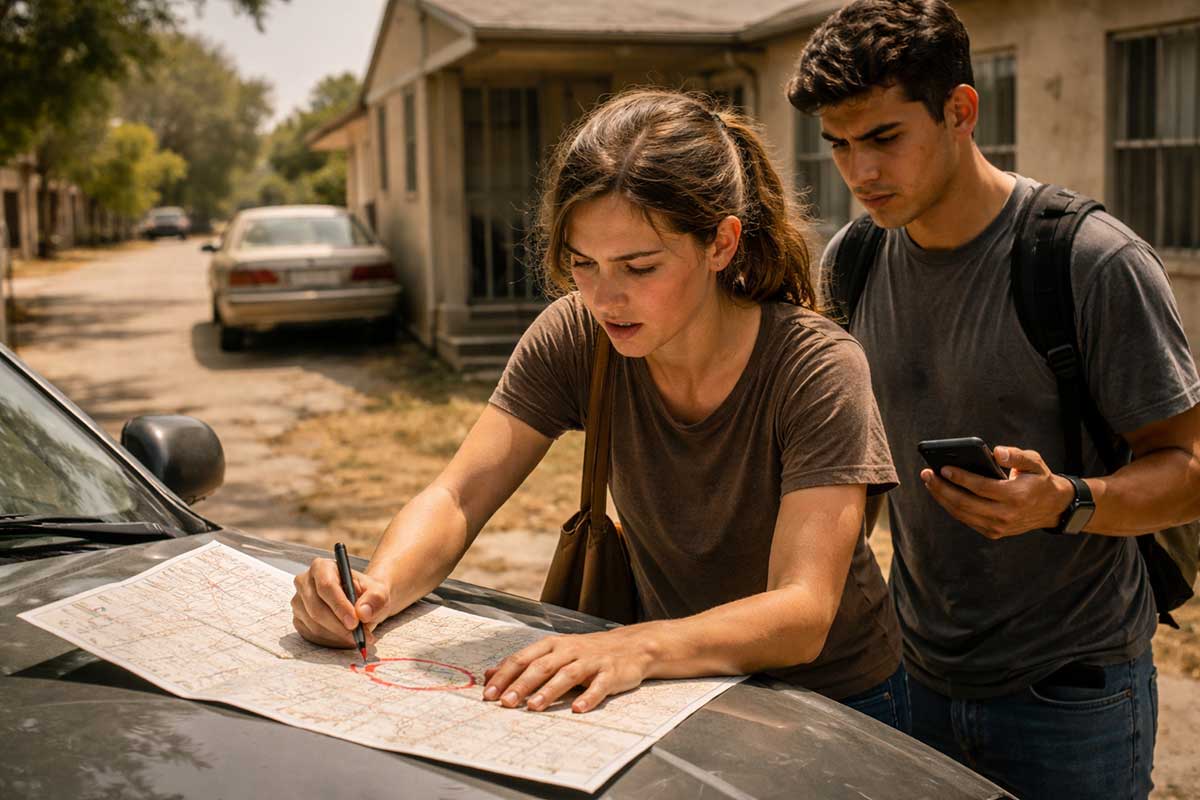
Milton Avenue ran hotter than the streets around it, though Nora could not have said why.
Maybe fewer trees. Maybe more asphalt. Maybe the row houses were packed more tightly, their brick walls collecting and returning the day with mean efficiency. The air above the parked cars looked liquid. Window units dripped from second floors like afterthoughts. Somewhere nearby, unseen, a dog barked with the slow offended rhythm of an animal that had decided weather was personal.
By one o’clock the clipboard had gone damp under Nora’s hand.
They stopped outside a narrow duplex marked with two orange circles and one handwritten note from a prior team: recheck transport / son may be home days. The yard was mostly gravel and stubborn weeds. A child’s plastic wagon lay tipped against the porch steps, one wheel melted slightly out of shape.
Mateo glanced at the packet. “Marilyn Keene. Sixty-eight. Transport available. One additional adult in household.”
“One additional adult,” Nora repeated.
“Reassuringly vague.”
She stepped onto the porch and knocked.
No answer at first. Then movement inside: the drag of something heavy or slow, a pause, another sound closer to the door. When it opened, the woman on the other side looked almost exactly as if the house had shaped itself around her rather than the other way around — gray hair pinned badly up, sleeveless housedress, skin flushed with heat, one hand still on the lock as if she distrusted all thresholds on principle.
“What.”
It was not a question. More a warning.
Mateo gave the short version of their introduction. By now he had reduced it to its useful bones.
“We’re rechecking heat-risk info. Cooling access, transport, anyone in the house who might need follow-up if conditions worsen.”
Marilyn Keene looked from him to Nora, then down at the form in Nora’s hand.
“They got me on a list now?”
“Yes, ma’am,” Mateo said.
She gave a dry snort. “That sounds like progress.”
Behind her, the house was dim. Not dark, exactly, but aggressively shaded. Curtains pinned shut. A fan turning in one corner. The smell that drifted out was part laundry detergent, part canned soup, part the stale trapped-warmth smell of a place that had spent too many days managing summer manually.
“Do you have air-conditioning?” Nora asked.
“One window unit in the back.”
“Working?”
“Depends what you mean by working.”
That answer had become its own category by now.
“Can we confirm who’s in the household?” Mateo asked.
“My son.”
“Is he able to transport you if needed?”
That was the moment the woman’s face changed. Not dramatically. Just a small flattening, like a shade pulled one notch lower.
“No,” she said.
Nora checked the form. “It says transport available.”
“It says wrong.”
“Do you have a vehicle?”
“Still sitting in the driveway, if that’s what you mean.”
The driveway beside the duplex held a faded sedan with one tire half-soft and registration tags that looked old enough to vote.
Mateo kept his tone careful. “Is there another reason transport wouldn’t be possible?”
Marilyn looked at him for a second, measuring whether he deserved the answer.
Then she stepped back and opened the door wider.
Her son was in the living room in a medical recliner angled toward the fan. He looked to be in his forties, maybe younger made older by the body’s unfairness. One leg was braced. A forearm crutch leaned against the chair. On the side table sat three prescription bottles, a half-finished sports drink, and a remote wrapped in tape where the battery cover had broken. The window unit behind him was running, though the room still felt thick and undercooled.
“Darren,” Marilyn said. “City kids.”
Darren looked up, tired but amused enough to be polite. “That sounds ominous.”
Nora felt the familiar awkwardness of entering a stranger’s hard fact and having to act as though clipboards belonged there.
“We’re rechecking heat and transport notes,” she said. “The file says this household has transport.”
Marilyn folded her arms. “The car died three weeks ago. My son can’t get down porch steps fast in this heat, I don’t drive at night, and the online update form kicked me out twice, so congratulations, we are a success on paper.”
Nora wrote that almost verbatim, then shortened it because the notes box was absurdly small.
Darren gestured toward the packet. “Do we at least get a prize for being misclassified?”
“Only our concern,” Mateo said.
“Ah,” Darren said. “The cheapest government commodity.”
Marilyn shot him a look that suggested this joke had been made before and was aging badly.
Nora stepped farther into the room. Heat had a way of flattening social rules; it now seemed weirder to stay on the porch than to come in. “If there were a transport alert later today,” she asked, “do you have any backup? Family nearby, neighbor with space, church route?”
Marilyn shook her head once. “My sister’s in Dayton. Neighbor across the street works nights and sleeps through doorbells. There’s a church van sometimes, but they don’t always come this far when the center fills.”
“The Maple center’s already near capacity,” Mateo said quietly.
Darren looked at the floor. “Great.”
Nora looked back at the form. One adult, transport available. The map’s orange circle suddenly seemed almost insulting in its neatness. This house should have been flagged differently days ago. Weeks ago, maybe. Not because anyone had chosen cruelty. Because the system had asked questions once and then rested on them.
That was somehow worse.
“Can we update your file now?” she asked.
Marilyn let out a breath through her nose. “If now means someone actually reads it.”
Mateo crouched near the coffee table so he could ask Darren directly a few questions without towering over him. Cooling tolerance? Mobility limits in stairs? Medication refrigeration? Could he manage a short transfer if the car issue were solved? Did he have a charger, backup battery, emergency contacts?
Nora watched Marilyn while he spoke. The older woman’s hands kept moving — folding the edge of a dish towel, smoothing it, folding it again. Not panic. The small repetitive labor of someone who had learned that helplessness needed a task or it would become visible.
“What’s the hardest part right now?” Nora asked her.
Marilyn looked up, surprised.
It was not a standard form question. Maybe that was why the answer came fast.
“Timing,” she said. “Everything is timing. If the power goes in daylight, the room goes bad fast. If it goes at night, the steps are worse. If buses stop, I can’t drag him to a center. If I call too early, nobody comes. If I call too late, everybody’s already full.”
She glanced toward the taped remote, the crutch, the dying sedan outside.
“Everything works if you catch it early enough,” she said. “We don’t.”
The sentence landed so exactly that Nora stopped writing.
From the recliner, Darren said with tired cheerfulness, “You make me sound heavier than I am.”
“You are heavy,” Marilyn said. “You are a full human man.”
“Rude.”
Mateo smiled faintly but kept writing.
The room hummed with the window unit’s labor. Somewhere in the kitchen a refrigerator motor cut on, then off. Nora thought of Aunt Elise’s text: AC wheezing like a smoker in church. Suddenly the phrase no longer felt witty. Just diagnostic.
On the way back out, Marilyn said, “So what happens now?”
Nora looked at the map, then at the notes page, then at the woman’s face.
The honest answer was: maybe nothing fast enough.
Mateo answered first. “We escalate transport risk and cooling priority. If grid conditions worsen, this address should move up.”
“Should,” Marilyn repeated.
There was nothing hostile in it. Just perfect hearing.
Outside on the porch, the heat hit them again like opened machinery.
Nora stepped into the small strip of shadow cast by the awning and rewrote the whole entry more clearly, printing harder now:
NO FUNCTIONAL TRANSPORT. Son mobility-limited. Porch steps barrier. Window unit only. Needs early intervention if outage risk rises. Do not wait for emergency call.
She underlined the last sentence twice.
Mateo watched her do it. “Good.”
“It feels fake,” she said. “Like we’re writing a strongly worded prayer.”
He leaned one shoulder against the porch post. The wood was hot enough that he moved off it again.
“Maybe,” he said. “But if enough fake things line up, sometimes a real van shows up.”
She looked at him.
“That’s your motivational speech?”
“It’s all I’ve got in this weather.”
They walked back to the sidewalk in silence.
Halfway down the block, Nora’s phone buzzed again. This time the city alert tone.
HEAT EMERGENCY UPDATE: GRID CONSERVATION REQUEST NOW ACTIVE. RESIDENTS IN DISTRICTS 3–5 PREPARE FOR POSSIBLE ROLLING INTERRUPTIONS BETWEEN 4 P.M. AND 9 P.M. CHECK ON VULNERABLE NEIGHBORS. COOLING CENTERS REMAIN OPEN WHILE CAPACITY ALLOWS.
She stopped walking.
Mateo turned back. “What?”
She held up the screen.
He read it and exhaled once, not dramatically, just the body’s quick accounting of worse-than-before.
“What time is it?” he asked.
Nora checked. “1:27.”
“Great.”
The word meant the opposite.
A bus roared past at the end of the block, blowing heat and dust sideways. Across the street, two men were carrying a box fan into a duplex with the seriousness of people transporting a minor deity. An elderly woman in a visor stood by her mailbox reading the same alert from her phone with the expression of someone who had long ago stopped expecting useful surprises.
Mateo opened the volunteer chat on his phone. Messages were already stacking.
Maple near capacity
Need updated no-transport addresses now
Prince bus route unstable
Can anyone verify oxygen-dependent on Wilson?
Do not self-dispatch to outages. Route through command.
He showed her one of the responses from the coordinator:
Focus on flagged orange/red only. Log discrepancies, move on. Transport teams triaging centrally.
Nora looked down at her own notes, sweat spotting the page where her hand had rested.
“Marilyn isn’t red,” she said.
“Not yet.”
“She should be.”
“Yeah.”
The afternoon sunlight seemed to get brighter with every minute, though that was impossible. The whole block had the overexposed feeling of something already burning without flame.
Nora unfolded the printed map against the hood of a parked car. The paper was hot almost immediately. Orange circles, yellow blocks, blue cooling centers, dashed bus lines. A city pretending to know itself from above.
She found Marilyn’s address and stared at the small neat symbol beside it.
One orange dot.
One wrong line.
Mateo stood beside her, reading the coordinator’s message again as if it might rewrite itself into decency.
“What do we do?” she asked.
He did not answer right away.
At the far end of the street, somebody was testing a generator even though the power was still on. The machine coughed, caught, then held in a low mechanical growl that sounded too prepared.
Finally Mateo slipped his phone into his pocket and said, quietly enough that it felt less like courage than accuracy:
“If we leave them where they are, we’re not really updating the map.”
Nora looked at him.
“We’re just protecting it,” he said.
The heat between them held still for one second, absolute and blank.
Then Nora took out her marker and circled Marilyn’s address so hard the tip squealed on the paper.
Part 4: What Cannot Be Marked in Color
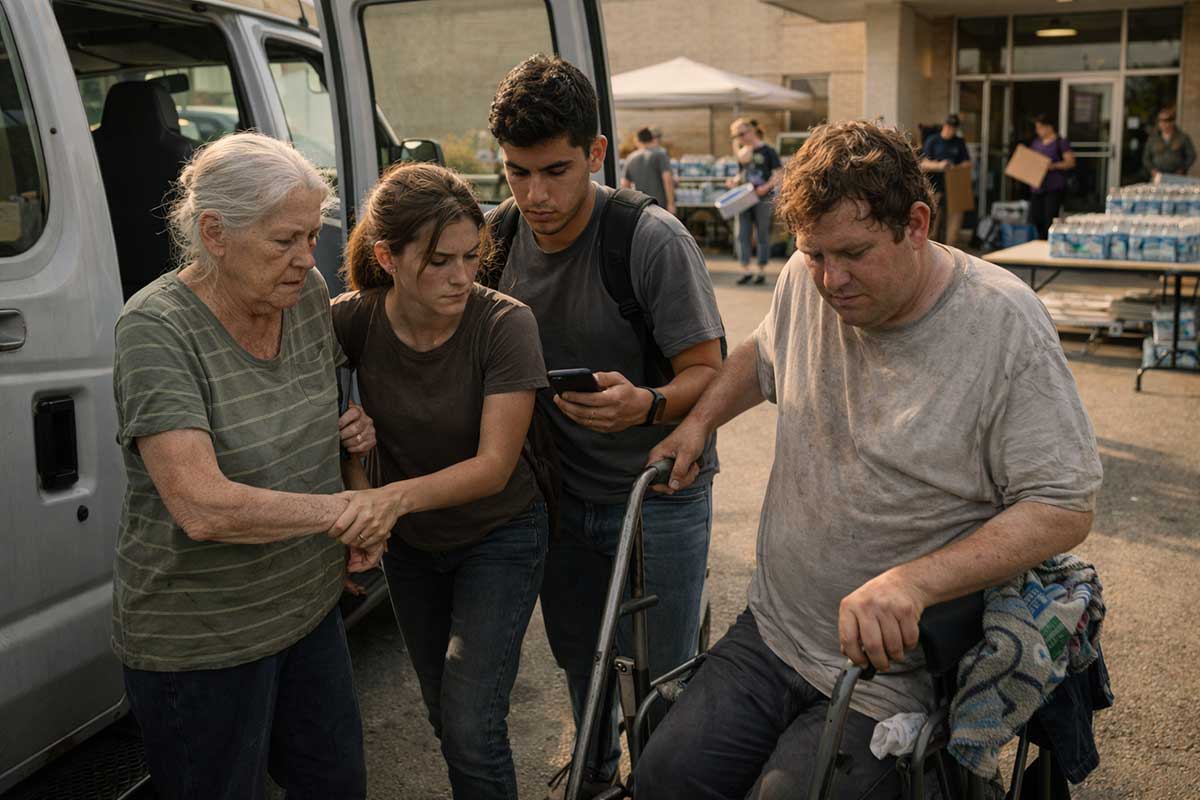
Mateo looked at the circle she had drawn and gave the smallest nod, not approval exactly, more like recognition.
“Okay,” he said. “Then we stop pretending the next step is theoretical.”
The sentence steadied her.
Nora capped the marker and squinted down the block. The generator’s growl continued from somewhere out of sight, absurdly patient. Heat shimmered above the parked cars hard enough to blur the house numbers. Her own skin felt too tight across the bridge of her nose. She had the strange sensation that the day had been waiting all morning for this exact point — not a disaster, not a collapse, just the moment when procedure and conscience stopped occupying the same line.
“What does non-theoretical look like?” she asked.
Mateo pulled the packet closer and flipped to the contact sheet stapled at the back. “Closest cooling spaces with remaining room. Transport options that still answer. Neighbors with vehicles if city transport lags. Early move before the outages actually start.”
“You say that like it’s a thing.”
“It is a thing. It’s just a bad one.”
He was already scanning names, numbers, routes. Nora watched him for half a second and then forced herself to move too, checking the margin notes from earlier teams, the church on Willow, the senior center already marked full, the bus line likely to become useless once the rolling interruptions started.
A text from Aunt Elise came through while she was reading.
The building AC has entered its death rattle phase. Not urgent. Just narrating.
Nora stared at the message.
The city alert still glowed above it, as if one part of her life were trying to provide official context for another.
She typed: Can you go to the library cooling room if needed?
The reply came fast enough to suggest Elise had been standing with the phone in hand.
Yes. I’m old, not decorative.
Nora almost smiled, but the motion stopped halfway.
Mateo was on the phone now, one finger pressed to the other ear. “Hi, this is Mateo Serrano with District 4B volunteer recheck. I need current capacity on Willow Church, not Maple, not the library. Specifically for one mobility-limited adult and one older caregiver, no private transport.”
He listened, face blanking in that useful way people’s faces did when trying to make information behave.
“No, not hypothetically. I mean if we moved them now.”
A pause.
“Yeah. I can hold.”
He lowered the phone and looked at Nora. “Willow might take them if they arrive before three-thirty. After that they can’t guarantee cots or accessible placement.”
“What about transport?”
“Working on it.”
She looked back toward Marilyn’s duplex. The gravel yard glared white in the sun. The half-flat sedan in the driveway sat there like a joke repeated too long.
“What if we just call it in again and move on?” she said, hearing even as she spoke how much she did not want that to be the answer.
Mateo tilted his head. “Do you want me to tell you that’s enough?”
“No.”
“Okay.”
The coordinator finally texted back to the group chat after what felt like too long:
If address updated from orange to red, submit through escalation form. Transport response times currently unpredictable. Do not promise pickup windows.
Nora read it twice.
“Unpredictable,” she said.
Mateo made a face without humor. “That’s one word.”
She opened the escalation form on her phone. It loaded slowly in the heat, spinning through bars and fields and dropdown menus as if time itself were enjoying the bureaucracy. Address. risk code. cooling access. transport status. mobility notes. medical dependency. She entered everything with angry precision.
When she got to Additional notes, she typed:
Household requires early move before outage window. Waiting until emergency call likely to trap them in place.
Then she submitted it and felt nothing at all. No satisfaction. No relief. The little green confirmation banner at the top of the screen looked offensively cheerful.
Mateo was speaking again into the phone. “No, they do not have a ramp. Three porch steps. One mobility-limited adult who can transfer with help but not fast, especially in this heat… Right… Right, I understand, but if your van is ‘possibly available later,’ that is not a plan.”
Nora looked away and scanned the street.
Across from them, a teenager in a black T-shirt was filling gallon jugs from an outdoor spigot and lining them on the porch rail. A mail carrier sat in the cab of the truck with both doors open, not moving. At the corner, the bus stop bench was occupied by three people and a stroller, all of them angled toward the inch of shade cast by the ad panel like plants toward a window.
The whole city had begun rationing itself by position.
Mateo ended the call and slipped the phone into his pocket.
“No van yet. Maybe after another priority drop.”
“So we wait?”
“No,” he said. “We build options.”
The phrase sounded almost ridiculous. Then useful.
They went back to Marilyn’s house.
This time she opened the door after the first knock, as if she had been standing on the other side listening for them.
“Well?”
Nora held up the map and hated herself for how helpless it made her feel. “We escalated your address. There’s a church cooling center on Willow that may have space if we can get you there before three-thirty.”
Marilyn looked at both of them in turn. “If.”
“My thought exactly,” Darren said from inside.
Mateo stepped in. “We don’t have a city van confirmed yet. We’re checking nearby neighbors and any route volunteers with working vehicles. If we can get a ride, would you be ready to move fast?”
Marilyn answered without hesitation. “Yes.”
Darren gave a slower nod. “If you mean I don’t have twenty minutes to prove I can manage things I obviously can’t.”
“That is exactly what I mean,” Mateo said.
Nora took a fresh page from the back of the packet.
“Okay,” she said. “Tell me what has to go with you if this happens quickly.”
Marilyn blinked. “What?”
“Medication. Chargers. paperwork. ice packs. anything he needs in transfer. We make the list now.”
For the first time, the older woman looked less wary than relieved.
They built the list at the kitchen table under the humming window unit. Nora wrote while Marilyn dictated: insulin bag? no. pill organizer yes. Darren’s brace tools yes. charger yes. pain meds yes. ID folder yes. bottled water yes. clean shirt? “He can survive one shirt.” cooling towel yes. backup keys maybe. remote no. “You’re not taking the taped remote to church,” Marilyn said, and Darren muttered that this was discrimination against his one luxury.
The list did more than prepare them. It changed the room.
Need became sequence. Sequence became temporary courage.
Mateo went outside to knock on two nearby doors marked in earlier outreach as possible community transport contacts. Nora stayed with Marilyn and Darren, both because it made sense and because leaving now felt like returning them too quickly to abstraction.
“How long have you been doing this?” Darren asked her.
“Today.”
“That tracks.”
“What’s that supposed to mean?”
“You still look shocked when the paperwork lies.”
Marilyn opened a drawer, took out two grocery bags, and handed one to Nora. “Start with the meds.”
Nora did.
Prescription bottles warm from the cabinet. Charger cords tangled in a ceramic bowl. A folded set of discharge papers from some orthopedic event the form had not mentioned. A freezer pack half-thawed already. A framed photograph of Darren at maybe twenty on a fishing pier, leaner then, sunburned, holding up some unimpressive catch with the confidence of a man who expected his body to keep obeying him for decades.
Nora put the photograph down carefully and kept packing.
In the living room, the local news played soundlessly under captions about grid pressure, hydration, and voluntary conservation. A smiling meteorologist pointed at a map full of sun icons and hazard bars. She looked as if she had never been inside a house with one working unit and no plan for steps.
When Mateo came back fifteen minutes later, his face said enough before he spoke.
“Across the street, no car. Blue house, woman works at the hospital and already left. Guy on the corner’s generator, not van. But the church has one volunteer on-call driver in this zone if he finishes another stop in time.”
“In time for what?” Marilyn asked.
“Before the center starts holding overflow at standing room.”
“That sounds humane,” Darren said.
Nora checked the time. 2:11.
Too late to feel early. Too early to feel doomed. The worst kind of hour.
Her phone buzzed again — Aunt Elise.
Library cooling room is mostly old men staring at weather maps like they can shame them. I’m still home. Debating surrender.
Nora typed back without thinking: Please go before the room gets full.
There was a longer pause this time. Then:
You sound official. I dislike it.
I mean it.
That silence after sending felt worse than argument.
Mateo had stepped to the window and was checking his messages in the pale slice of light where the curtains didn’t quite meet.
Then his shoulders shifted.
“Okay,” he said. “Driver can come. Maybe twenty minutes.”
Marilyn stood too quickly and had to steady herself on the chair. Darren swore under his breath, more from the effort of watching this become real than from fear itself.
“Twenty real minutes?” Nora asked.
Mateo looked at the message. “Probably thirty pretending to be twenty.”
“Fine,” Marilyn said. “That’s still a thing.”
And suddenly there was motion everywhere.
Not panic. Preparation. Darren trying to stand before either of them could help him and then grudgingly accepting help anyway. Marilyn tying grocery bags tighter than necessary. Nora checking the list twice. Mateo moving the crutch, then the brace bag, then coming back for the folded walker attachment that had been behind the recliner all along. A house turning itself toward departure.
Outside, the heat remained absolute, indifferent, and public.
Inside, four people made a narrow corridor through it using hands, tape, pill bottles, impatience, and just enough belief in sequence to keep moving.
At 2:37 the power flickered once.
No outage. Just a warning flash, enough to make the window unit groan and recover.
Everyone in the room froze.
The machine held.
Then the television blinked back to life with the meteorologist still smiling mid-sentence.
Darren let out a laugh that had gone too far in the direction of disbelief to be amusement. “Excellent,” he said. “Love that for us.”
Marilyn looked at the ceiling as if bargaining privately with infrastructure.
Nora felt her own heartbeat in the pen still clipped to her packet.
From outside came the low honk of a horn — two short bursts.
Mateo crossed to the window and looked through the curtain edge.
“That’s him.”
No one moved for half a second.
Then the room seemed to contract into purpose.
“All right,” Marilyn said, with the voice of someone who had spent years being left too long to her own devices and now refused to waste whatever chance had finally arrived. “Let’s go before the city changes its mind.”
Part 5: One Bad Line on a Map
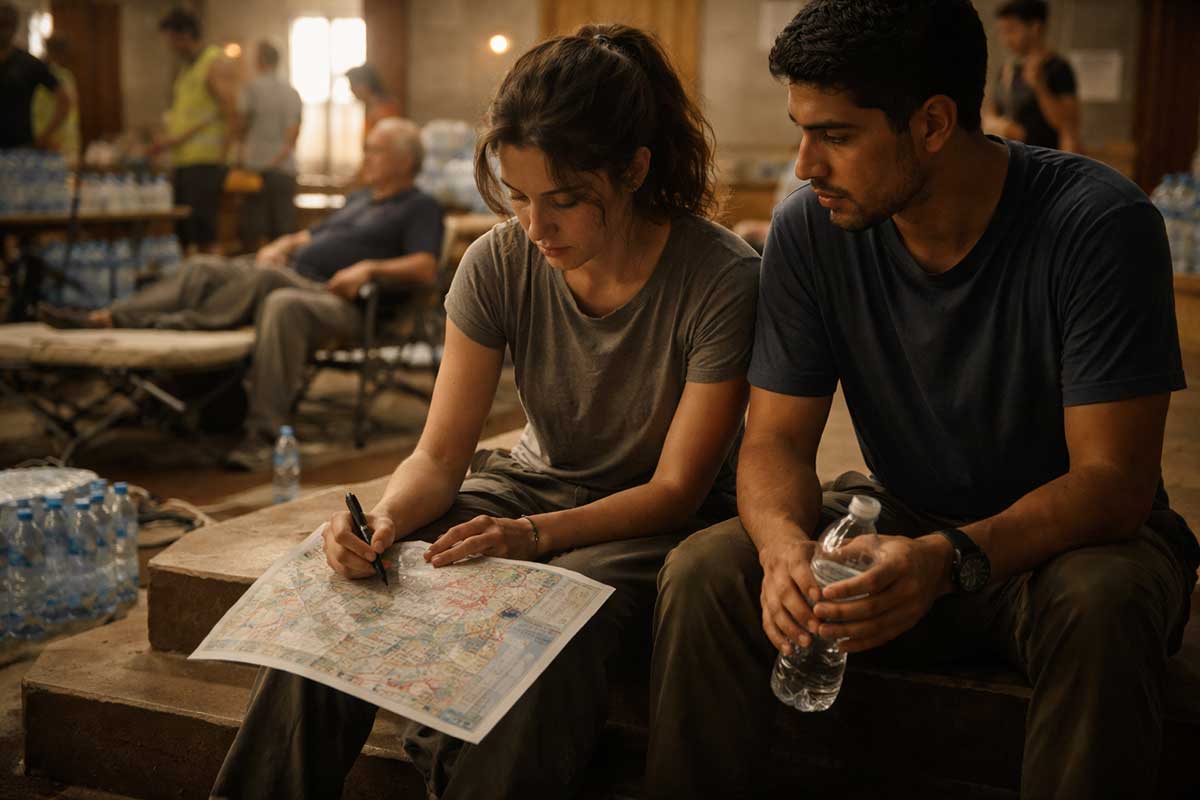
The volunteer driver’s van was smaller than Nora had hoped and older than she wanted to see.
It waited at the curb with the engine running, pale paint oxidized almost to chalk, one rear quarter panel patched in a mismatched gray. On the side door, half-peeled vinyl still read WILLOW COMMUNITY OUTREACH, the letters ghosting where older signage had once been removed. The driver, a broad-shouldered man in his fifties wearing a church polo darkened with sweat at the chest and underarms, leaned out the window and lifted one hand in a gesture that managed to mean both I’m here and please do not make this take an hour.
“Mr. Patel?” Mateo called.
“That depends,” the man said. “Are you the two who text like city forms with punctuation trauma?”
Mateo actually laughed. “That would be us.”
“Good. Then let’s move before Maple starts redirecting people again.”
The sentence snapped the air tighter.
They got Darren down the porch steps in stages. Not elegantly. That was part of the truth of all this. Mateo took most of Darren’s weight on the stronger side while Nora steadied the crutch and watched the foot placement like it mattered more than anything in the world for those thirty seconds, which for a moment it did. Marilyn came behind with the bags, locking the door one-handed, keys gripped between her teeth, furious at the necessity of her own slowness.
The heat off the concrete hit them like opening an oven.
By the second step down, Darren was breathing harder. By the third, Nora could feel his effort vibrating through the arm she had under his elbow.
“Don’t narrate,” he muttered, sweat standing out at his temples.
“I didn’t say anything.”
“You were about to.”
She almost told him he had an unreasonable gift for reading panic in silence, but there was no oxygen for wit just then.
Mr. Patel had already jumped out to open the side door and fold up one of the rear seats. “I’ve got room if nobody minds knees touching theology pamphlets.”
“We’re not picky,” Marilyn said.
“You should be,” he said, but kindly.
Getting Darren into the van required a maneuver that would have humiliated him more if everyone involved had not already crossed too far into practical necessity for pride to remain pure. Mateo braced from the side, Nora passed the crutch in after him, Mr. Patel adjusted the seat angle, Marilyn held the medication bag like a sacrament. For one ugly second Darren’s bad leg caught awkwardly on the threshold and all four of them froze with the same shared intake of breath.
Then he was in.
No one spoke for a beat.
Mr. Patel shut the door gently, as if the gentleness could erase the difficulty.
Nora felt sweat running down the sides of her ribcage under her shirt. The clipboard was still tucked under her arm, absurd and persistent as bureaucracy itself.
“Who’s riding?” Mr. Patel asked.
“Mom comes,” Darren said at once.
“Obviously,” Marilyn snapped.
“I can walk back,” Nora said.
Mateo was already shaking his head. “No. We go with them, log the transfer, make sure the center actually takes the updated status.”
Mr. Patel looked at the two of them with quick practiced assessment. “Then squeeze.”
So they did.
Nora took the narrow rear bench beside a milk crate full of bottled water and flattened cardboard fans. Mateo sat half-turned on the folded jump seat. Marilyn in front, one hand braced on the dash. Darren by the side door, pale and angry and trying not to show that every movement still cost him something. The van smelled of hot upholstery, hand sanitizer, and the faint papery scent of church-basement storage rooms.
As they pulled away from the curb, Nora looked back once at the duplex.
From the street it already looked abstract again. Curtains. gravel yard. half-dead car. A wrong orange dot on a map. If she had not been inside it, if she had not held the charger cords and folded the list and watched the taped remote on the side table, it might have gone right back to being “transport available” in her mind.
That thought sickened her a little.
Prince Street was slower now than it had been at noon. Heat had changed the city’s pace by force. People moved as if through syrup or not at all. At one intersection a city bus sat idling with all its windows open, the driver outside smoking in the shade of the bus shelter advertisement that still told everyone to check on their neighbors. Two teenage boys dragged a box fan across a crosswalk like a rescued animal. A woman in scrubs walked fast with a case of bottled water pressed to her chest.
Mr. Patel drove with the blunt concentration of someone who had been doing small emergency logistics for too many years to romanticize them.
“Maple overflowed at one-thirty,” he said, eyes on the road. “Library room’s at standing capacity. Willow still has floor mats and a hallway if necessary.”
“That sounds festive,” Darren said.
Marilyn twisted halfway in her seat. “Can you save your strength for not passing out?”
“I am not passing out.”
“You could have fooled your face.”
Mateo leaned forward slightly. “Do they have medical refrigeration?”
“At Willow? Two units and a volunteer nurse who retired three times and ignores all of them.”
“Good,” Nora said before she had time to decide whether the word meant anything.
Her phone buzzed again. Aunt Elise.
Left for library. Your apocalypse has community theater energy.
Nora closed her eyes once, very briefly, in relief.
Good. Stay there if power starts playing games.
This reply took longer.
Don’t start sounding like a person who owns a whistle.
Nora put the phone away without answering. She wasn’t sure whether she was relieved by the joke or accused by it.
As the van turned onto Willow, the church came into view — red brick, white trim, a squat fellowship hall off to one side where three canopy tents had been set up in the parking lot as if anyone still believed shade alone counted as infrastructure. Cars were packed crookedly along both curbs. The side entrance stood open, and people moved in and out carrying water cases, grocery bags, coolers, one folded wheelchair, a child asleep over someone’s shoulder.
No one looked heroic. That helped.
Mr. Patel pulled to the curb and turned to them. “All right. This is where it gets dignified by committee.”
Inside, the fellowship hall was colder than outside and warmer than salvation. It smelled of coffee urns, old linoleum, sweat, bleach, and the sweet processed smell of shelf-stable snack bars. Folding chairs lined the walls. Cots filled most of the center. At the back, volunteers in colored badges moved between tables marked by handwritten paper signs: CHECK-IN, MEDS, WATER, QUIET CORNER, CHARGING.
A television mounted high in one corner showed a weather map with hazard overlays and a ticker no one was reading anymore.
The check-in volunteer, a woman with reading glasses on a beaded chain and the brisk tenderness of an elementary school principal in wartime, started with the standard questions, then abandoned them halfway through when Darren’s condition and Marilyn’s expression made clear that nothing about this arrival would fit the original boxes cleanly.
“Mobility limited, caregiver with him, transport fragile, needs meds refrigeration,” Mateo summarized, handing over the updated notes.
The woman scanned the page, then looked up at Nora. “Who wrote this?”
“I did.”
“It’s legible. Marry well.”
Then she flagged another volunteer and started reshaping their intake without waiting for permission from the form.
Nora watched her cross out one line, draw an arrow to another, and write do not separate across the margin in decisive block letters.
There it was again. Not the system failing exactly. A person inside it refusing to let the paper win.
They got Darren onto a cot near an outlet and a box fan. Marilyn sat down so suddenly on the chair beside him that Nora realized she had been staying upright by fury alone. Mr. Patel took the medication bag toward the refrigeration table. Mateo was talking to a volunteer nurse about transfer strain and step tolerance. For the first time since 2:11, no one was moving solely on speculation.
Nora stood in the middle of the room holding the folded map.
Around her, heat-displaced lives had arranged themselves into temporary rows. An older man slept with both hands folded over his stomach as if conserving etiquette. Two teenage girls shared earbuds over a phone screen turned so low it was basically faith. A mother rocked a listless toddler against her shoulder under a ceiling vent that was trying its best and failing with public dignity. Near the water table, a college-age volunteer was taping handwritten arrows to a wall because people kept getting lost on the way to the bathrooms.
So this, Nora thought, was what the map became when it finally touched the ground: not color. Not planning language. Cots, outlets, warm bottled water, old women with medication bags, teenagers taping arrows to drywall, and the tired holiness of do not separate written fast in blue ink.
Mateo came back toward her, rubbing the back of his neck.
“They’re good here for now,” he said.
For now.
Two words that had started to replace the future in every institution she knew.
Nora looked down at the map in her hands. Darren’s address was still circled hard enough to tear the paper if folded again in the same place.
“They were one orange dot,” she said.
Mateo followed her gaze. “Yeah.”
“If we hadn’t gone back—”
He didn’t let her finish.
“But we did.”
The hall around them went on making its own exhausted weather. A volunteer dragged in another crate of bottled water. Somewhere toward the kitchen someone started laughing too hard at something minor and then couldn’t stop. The television flashed a new advisory band across the bottom of the screen, red over blue, language sliding under the image of a smiling meteorologist who now looked almost embarrassed to still exist.
Nora realized she was shaking slightly.
Not panic. Aftermath. Adrenaline looking for somewhere to go now that the next task had temporarily been assigned to someone else.
Mateo noticed.
“You need water,” he said.
“That’s very original of me.”
“Still true.”
He came back with two bottles, both warm. They sat on the edge of the stage steps at the side of the fellowship hall, not exactly apart from the room, just no longer in the center of it. The wood beneath them held a little coolness from the overworked AC.
For a minute they drank without speaking.
Then Nora said, “I thought this would feel more dramatic.”
Mateo turned the bottle slowly in his hand. “Saving them?”
“Any of it.”
He looked out across the rows of cots and chairs.
“It usually doesn’t,” he said. “That’s part of why people miss it.”
The sentence settled into her more deeply than the heat ever had.
Across the room, Marilyn caught Nora’s eye and lifted one hand in a gesture too small to mean gratitude if gratitude were the only thing people ever meant. Nora lifted her hand back. Darren was already half-reclined, face gray with fatigue, but his breathing looked easier here, or maybe only less trapped.
Nora took the map onto her lap and uncapped the marker again.
“What are you doing?” Mateo asked.
“Fixing it before I forget.”
She wrote in the margin beside the printed district notes:
Keene / transport false / move early / steps barrier / do not wait
Then, lower down, after a hesitation:
Check neighboring duplexes — likely similar underreporting
Mateo watched her write and then said, “You know they’ll probably ask you to transfer that into the digital form later.”
“I know.”
“Your handwriting is still for you.”
That was not quite a compliment. Not quite not one either.
She looked at him then, properly, with less of the day’s administrative glaze between them. His T-shirt was dark at the collar. One forearm had a faint pale line where a watch usually sat. He looked tired now in a way she trusted more than the earlier wakefulness. Not invulnerable. Just still moving.
“You’ve done this before,” she said.
He leaned forward, elbows on his knees.
“My family got moved three times in two fire seasons,” he said. “After the second one, I started noticing who knew where to go before the official texts came. It wasn’t the people with the best information. It was the people somebody remembered.”
Nora held still.
He gave a short shrug, almost apologetic for saying something that true aloud. “So now I do this.”
She thought of all the years since lockdown, all the arguments online, the warnings, the graphs, the way catastrophe had become content before it became logistics. She had spent so much of that time believing that caring too much in advance was a setup for humiliation. Better to expect less. Better to narrow the aperture. Better not to build too much in the mind.
And yet here she was, holding a paper map gone warm from her own hands, newly aware that attention itself could be a kind of shelter.
From the front of the hall came a call for volunteers to help tape extension cords farther from the water station. Mateo stood up automatically.
“You coming?” he asked.
Nora looked once more at the corrected notes, at the scuffed fellowship hall, at Marilyn beside Darren, at the room full of people who had become legible to one another by force and effort rather than by clean planning.
Then she capped the marker and stood too.
“Yeah,” she said.
This time she didn’t have to think about it first.
Part 6: A List of Names Someone Still Needed to Remember
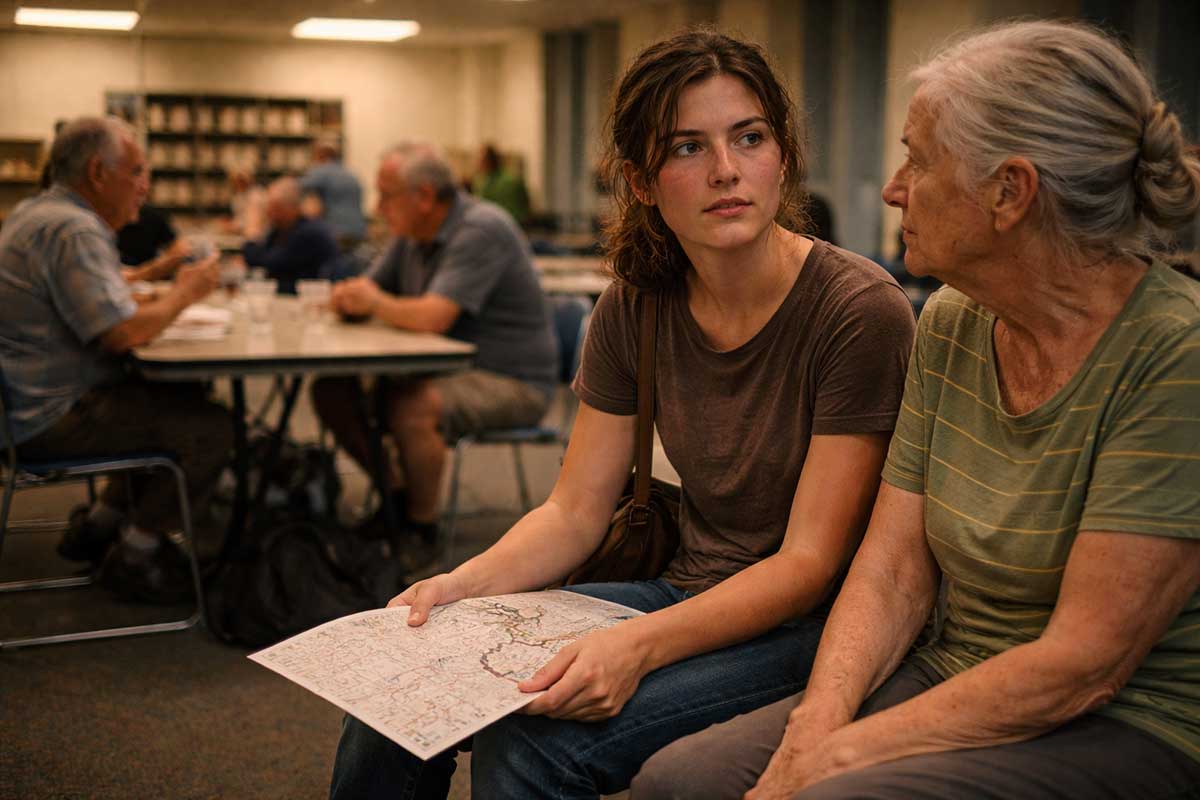
The extension cords turned out to be less heroic than everything that had come before them, which was exactly why Nora trusted the task.
One volunteer held the tape. Another unwound the cord. A third kept reminding everyone not to run anything across the path to the bathrooms because someone had almost gone down on spilled water twenty minutes earlier. Mateo crouched by the wall outlet, testing the plug with the cautious concentration of someone defusing a household argument. Nora held the coil off the floor and watched sweat darken the back of her own wrist where the marker ink had smudged.
No one made speeches.
At some point a woman from the intake table handed her a paper cup of electrolyte mix and said, “Drink that before you get romantic about usefulness.” Then she moved on without waiting for thanks.
By four-thirty the emergency had settled into its next form. Not over. Simply managed for now.
The church hall filled another quarter, then held. The feared outage in their district had not yet started, though phones kept buzzing with conservation warnings and vague utility forecasts. Volunteers drifted toward the walls when they could. People on cots dozed or pretended to. A little boy in dinosaur pajamas used two folding chairs as a tunnel. Near the charging table, an older man argued gently with a volunteer nurse about whether his blood pressure cuff was more accurate at home, which everyone seemed to accept as a sign of stable morale.
Nora stood by the side entrance and texted Aunt Elise again.
You at the library still?
This time the reply took several minutes.
Yes. The old men are now ranking heat maps by betrayal. One of them brought chess.
Nora let out a breath that came closer to laughter than the day had allowed so far.
Stay until evening. Please.
A pause. Then:
Bossy. But fine.
She slipped the phone away and stepped outside.
The late afternoon had lost none of its heat, only changed its angle. The parking lot behind the church shimmered in long bands of white glare. Under the canopy tents, bottled water cases had collapsed in on themselves, cardboard gone soft with condensation and handling. Someone had set a box fan near the side door, but it only pushed the heat from one place to another. Still, after the fellowship hall’s crowded breath, the open air felt oddly clarifying.
Mateo came out a minute later carrying two more water bottles.
“You disappear quietly,” he said.
“I thought that was polite.”
He handed her one. “Depends on the emergency.”
They stood in the strip of shade thrown by the fellowship hall wall. Across the parking lot, Mr. Patel was leaning against the van with his church polo untucked now, talking on the phone and shaking his head in the slow rhythm of someone explaining once again that no, a thing could not be in two places at once no matter how earnestly people required it.
Nora twisted the bottle cap loose.
“I keep thinking the map should feel useless now,” she said. “And it doesn’t.”
Mateo looked at her. “Because it’s not.”
“It was wrong.”
“Yeah.”
She held the folded paper up slightly. The edges had softened from sweat and handling. Darren’s address was still circled through two layers. The notes she’d added in the hall looked less like official correction now than like somebody trying to keep a life from slipping backward into abstraction.
“It still got us there,” Mateo said.
Nora drank some water. It was no cooler than before, but her body had apparently stopped expecting cold as a moral category.
“Do you ever get tired of this?” she asked.
“Of today?”
“Of all of it.”
He leaned one shoulder against the wall and looked out toward the street beyond the lot. Cars moved in the glare with the slowed caution heat imposed on everything.
“Yeah,” he said. “Constantly.”
The honesty of it settled her more than optimism would have.
“My family’s first evacuation,” he said after a moment, “I thought the worst part was the fire. The second one I realized the worst part was forms. addresses. proving you existed in the right version. proving loss in the approved format.” He rubbed the side of the bottle label with his thumb. “After a while I got interested in who never fit on the first try.”
Nora looked down at the map in her hand.
“I don’t think I’ve been interested in anything for a while,” she said. The sentence came out so plainly she almost took it back.
Mateo didn’t rush to rescue it.
Finally he asked, “Not even things you’re good at?”
She thought of school discussion boards, reading the news too late, keeping her own dread neat enough to sound ironic, years of narrowing everything into manageable surfaces.
“That’s the problem,” she said. “I got very good at standing near things.”
Heat pressed against the side of her face. Somewhere behind them a volunteer called for more tape. In the distance a siren moved and moved and did not arrive.
Mateo said, “Maybe standing near things is how some people start.”
The sentence might have sounded rehearsed in someone else. In him it didn’t. It sounded like something discovered the hard way and offered without decoration.
Nora folded the map again, more carefully this time.
Inside, the church hall doors opened and shut in a steady rhythm. Each time they opened, she caught little slices of the improvised world within: cot, cooler, volunteer badge, dangling charger cord, Mrs. Rivera—no, not Rivera, she corrected herself automatically, Marilyn—turning to ask somebody for another blanket even though it was not cold enough to need one. A room full of people who would never appear correctly on a simple municipal printout and yet were, somehow, being carried.
She realized then that this was the first time all summer she had imagined tomorrow without flinching first.
Not the future in some grand sense. Not jobs or stability or a saved world. Just tomorrow as a thing one might enter and continue participating in.
It felt small.
It also felt enormous.
A volunteer coordinator pushed open the side door and leaned out. “If either of you are District 4B, I need your final field sheets before six.”
Mateo lifted his bottle in acknowledgment. “See? paperwork always survives.”
Nora looked at the notes pages clipped beneath the map. Mrs. Wallace upgraded. Prince Street respiratory flag corrected. Keene address escalated. transport false. move early. do not wait. check neighboring duplexes.
The handwriting was hers, but it no longer felt private. It felt like evidence that attention had happened.
“I should rewrite these cleanly,” she said.
“Don’t,” Mateo said.
She looked up.
“Keep the messy copy too,” he said. “The clean one’s for the system. The messy one’s for memory.”
For a second she could not answer.
Then she nodded once. “Okay.”
They went back inside and found a corner of the long folding table near intake. Nora copied the key changes into the official summary sheet in block letters the coordinator would be able to scan quickly later. Then, when she finished, she folded the original field pages and tucked them into the back of the packet instead of surrendering them with the rest.
The act felt oddly serious.
At six-ten the utility district sent another alert: Rolling interruptions postponed pending evening demand. Continue conservation. Around the room, people read it with expressions ranging from gratitude to open distrust. No one applauded. Systems did not deserve applause for postponing harm.
Marilyn saw Nora and waved her over. Darren was sitting more upright now, one hand around a paper cup of something fluorescent and medicinal.
“Your church has terrible coffee,” Marilyn said.
“It’s not my church.”
“It is today.”
Darren lifted the cup. “I’m staying for the air and the slander.”
Nora smiled.
“Do you need anything?” she asked.
Marilyn glanced around the hall, then back at her son. “No. Which is suspicious.”
The answer, somehow, was better than thanks.
When Nora stepped back again, Mateo was by the side table coiling unused extension cord into a loop that would not tangle later. She moved to help him without being asked. The gesture felt natural enough that she only noticed it after she was already doing it.
Once the cords were stacked, they left together.
The street outside the church had softened into evening light without losing much heat. The shadows were longer, that was all. Cars still rolled past with windows down. The municipal poster in the bus shelter still instructed everyone to check on their neighbors, now with the authority of a tired joke that had accidentally become true.
At the corner, Nora stopped.
“I should go get Elise,” she said.
Mateo nodded. “Library?”
“Yeah.”
He shifted the empty water crate from one hand to the other. “I’m heading back to the office to dump the updates before they forget why they asked for them.”
She looked at him, at the gray shirt gone darker with the day, the tiredness finally visible around his eyes, the stubborn alertness still there under it.
“Are you doing this tomorrow too?” she asked.
The question came out before she had the chance to decide whether it was too direct.
“Probably,” he said. “You?”
Nora thought of the overcooled training room, the brittle lawns, the wrong orange dot, the church hall, the notes folded into the packet, Aunt Elise among the old men at the library ranking heat maps by betrayal.
Then she said, “Yeah.”
Again, before overthinking it.
He nodded once, like someone accepting a fact rather than claiming a victory.
“Okay,” he said. “See you tomorrow.”
They exchanged numbers with the anticlimactic efficiency of people too tired to make a ritual of it. Then he turned toward downtown with the crate in one hand and the folded map packet in the other, and she headed for the library branch three blocks east.
The library cooling room was less grim than she expected and more absurd. Exactly as Elise had described: old men with weather maps, two women playing cards with a kind of hostile concentration, a child asleep under a table with one sneaker missing, and a municipal intern trying to get a printer to connect while everyone ignored him on principle.
Aunt Elise sat near the magazine racks with a paper cup of ice water and a church fan someone must have pressed on her earlier. She looked up as Nora entered and took in the sweat, the rumpled packet, the sunburn starting across Nora’s nose.
“Well,” she said. “You look like paperwork bit back.”
Nora sat in the chair beside her.
“It did.”
Elise studied her face for a moment longer than usual.
Then: “You all right?”
Nora looked at the cooling room around them. At the old men and the maps. At the child under the table. At the fan in her aunt’s hand advertising a church she had not attended in years. At the phone in her own pocket now holding a number she had not expected to want this morning.
“No,” she said, and then, because it was truer, “I think maybe a little more than I was.”
Elise gave the smallest lift of one eyebrow, accepting the answer without trying to improve it.
On Nora’s lap, the folded map packet sat warm from being carried all day. Through the paper she could feel the thickened places where ink and correction and underlining had gathered. She slipped it out and looked once more at the district lines, the circles, the margins marked by hand.
The printed map was still wrong in a hundred ways. It always would be. It was only a map.
But it was no longer untouched.
Elise glanced down at it. “Did you save the city?”
Nora looked at the hard-circled address, at the note beside it in her own tired handwriting.
Then she said, “No. Just one bad line on a map.”
Elise took a sip of ice water.
“That’s how cities survive,” she said. “One bad line at a time.”
Outside, evening lowered itself over the parking lot in thin gold light that changed nothing and made everything briefly more bearable. Inside, the cooling room hummed with the temporary life of strangers expected somewhere. Nora folded the map again, not to put it away, but to keep it.
For the first time in a long while, the future did not feel like a blank glare she had to look away from.
It felt, modestly and without promise, like a list of names someone still needed to remember.
Final Thoughts by Nick Sasaki
What stays with me most about The Summer Evacuation Map is that nothing in it is fully solved.
The city is still strained.
The heat is still dangerous.
The forms are still incomplete.
The future is still uncertain.
And yet the story does not end in defeat.
That matters to me.
I think many people, especially younger people, have grown used to treating the future as something already damaged before it arrives. Not in a dramatic way. In a daily way. A quiet lowering of expectation. A habit of emotional withdrawal. A belief that distance is maturity and numbness is realism.
Nora begins inside that condition.
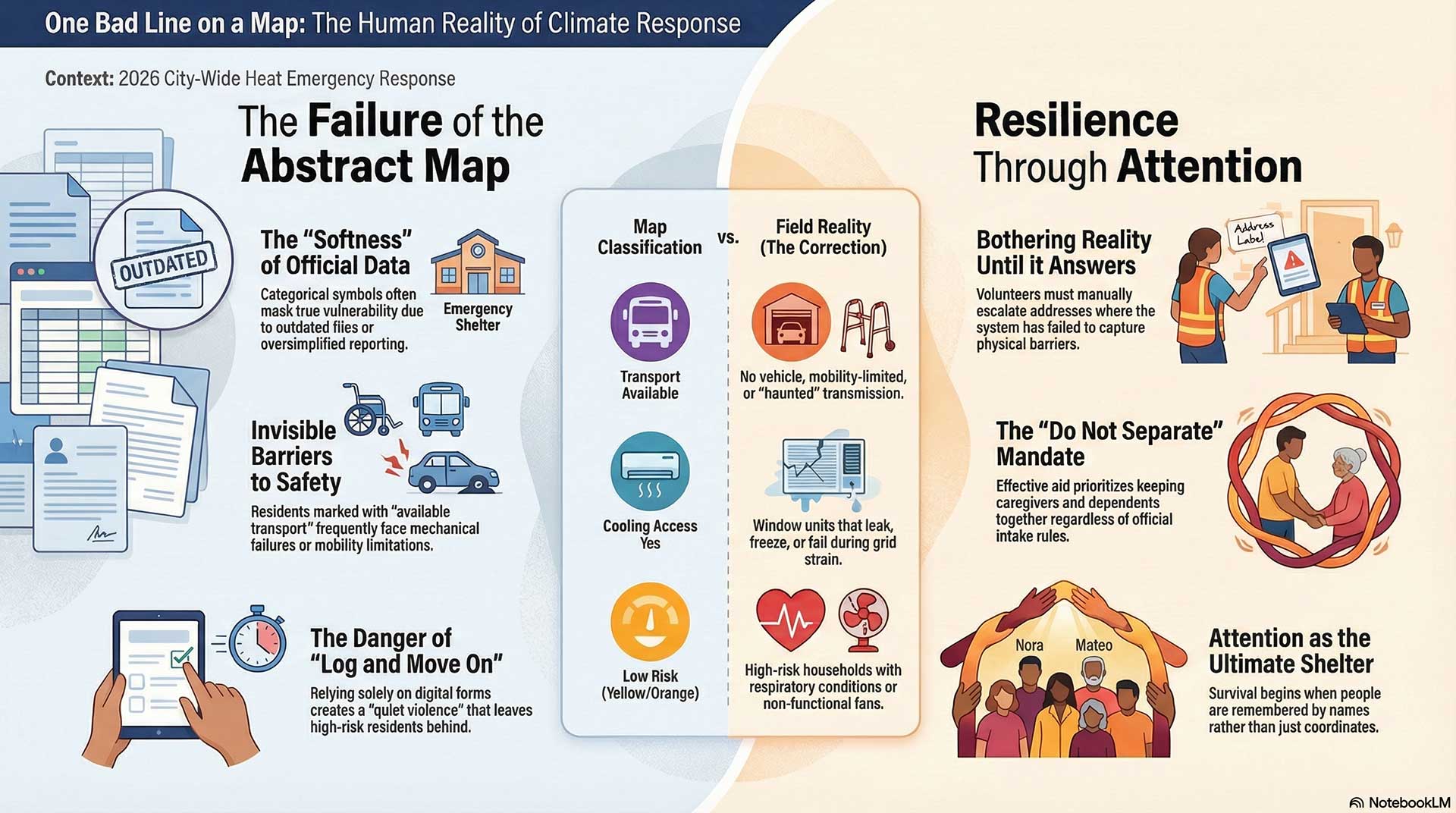
What changes her is not a grand revelation. It is a correction. A household misclassified. A map that fails. A decision not to “log and move on.” In that sense, the story is not really about saving the world. It is about refusing to let abstraction win one more time.
That is why the map becomes such an important symbol.
At first it represents the system’s confidence.
Later it represents the system’s blindness.
By the end it becomes something else: a record of human attention.
The printed version is wrong.
The handwritten version is truer.
Not perfect. Truer.
I wanted the ending to remain modest. Nora does not suddenly become an activist prophet. She does not leave with a perfected philosophy of hope. She leaves with something smaller and more believable: a renewed willingness to participate. To notice. To remember names. To understand that care may begin locally, specifically, almost invisibly.
That feels important to me.
There is also a quieter truth in the ending that I love: the future stops being one giant, blinding concept and becomes something much more human. A list of people. A set of responsibilities. A reason to come back tomorrow.
That is not flashy hope.
But it is real.
And maybe that is enough.
Sometimes survival does not begin with certainty.
Sometimes it begins with one corrected line, one ride to a cooling center, one note in the margin, one person deciding not to look away.
That is the kind of hope I trust.
Short Bios:
Nick Sasaki
Nick Sasaki is the creator of ImaginaryTalks.com, where he explores deep human questions through imagined conversations, reflective essays, and original literary fiction shaped by moral tension and emotional realism.
Nora Vale
Nora Vale is a 19-year-old student volunteer shaped by pandemic-era isolation, climate dread, and a quiet loss of faith in the future. Intelligent, observant, and emotionally restrained, she begins to rediscover meaning through practical acts of care.
Mateo Serrano
Mateo Serrano is a 21-year-old volunteer whose family has already been altered by climate displacement. Practical, attentive, and quietly warm, he helps Nora see that attention and action still matter, even inside failing systems.
Aunt Elise Vale
Aunt Elise Vale is Nora’s sharp, dry-witted older aunt, whose humor masks a clear-eyed awareness of how fragile ordinary life has become. She grounds the story by bringing the climate crisis into Nora’s own home life.
Marilyn Keene
Marilyn Keene is an older woman trying to care for her mobility-limited adult son in a house that official paperwork does not understand. Proud, tired, and unsentimental, she embodies the human realities that systems too often miss.
Darren Keene
Darren Keene is Marilyn’s adult son, physically limited and sharply aware of how easily people like him can disappear inside bad data and slow response systems. His presence turns one wrong line on a map into an urgent moral fact.
Leave a Reply