
|
Getting your Trinity Audio player ready...
|
What if procrastination is not laziness, but self-protection?
We usually talk about procrastination in a light way. We joke about it, make memes about it, laugh at how strangely talented human beings can be at avoiding the one thing they most need to do. That laughter is honest. There is something funny about the mind’s ability to know exactly what matters and then wander off toward snacks, scrolling, errands, or pointless little detours that suddenly feel urgent.
But procrastination is only funny up to a point.
Beneath the comedy lies a serious human struggle. A person can know what matters and still resist it. A person can have goals, talent, intelligence, love, conviction, even a real sense of calling, and still delay the work that would bring those things into the world. That is why procrastination feels so painful. It is not just wasted time. It is conflict within the self.
This conversation has tried to follow that conflict all the way down. First, into the divided mind, where intention and impulse pull against each other. Then into the emotional core, where fear, shame, uncertainty, and self-protection often hide beneath the delay. Then into the modern environment, where distraction is no longer occasional but engineered, constant, and profitable. From there, into the deeper cost: lost self-trust, weakened character, hidden regret, and the quiet erosion of a life. And finally, into the question that matters most: how real change begins.
Procrastination is never only about getting things done. It is about who governs a life. It is about what we do when effort feels hard, when meaning feels heavy, when fear whispers, when comfort is close, and when time still seems abundant.
That is why this matters. Not since every delayed email or unfinished project is tragic, but since repeated delay can become a way of not fully entering one’s own life. And few losses are greater than that.
(Note: This is an imaginary conversation, a creative exploration of an idea, and not a real speech or event.)
Topic 1 — The Divided Mind: Why do we act against our own intentions?

Participants: Tim Urban, Cal Newport, Andrew Huberman, Adam Grant, Carol Dweck
Question 1 — Why does a person often do what feels good now instead of what they know matters most?
Tim Urban:
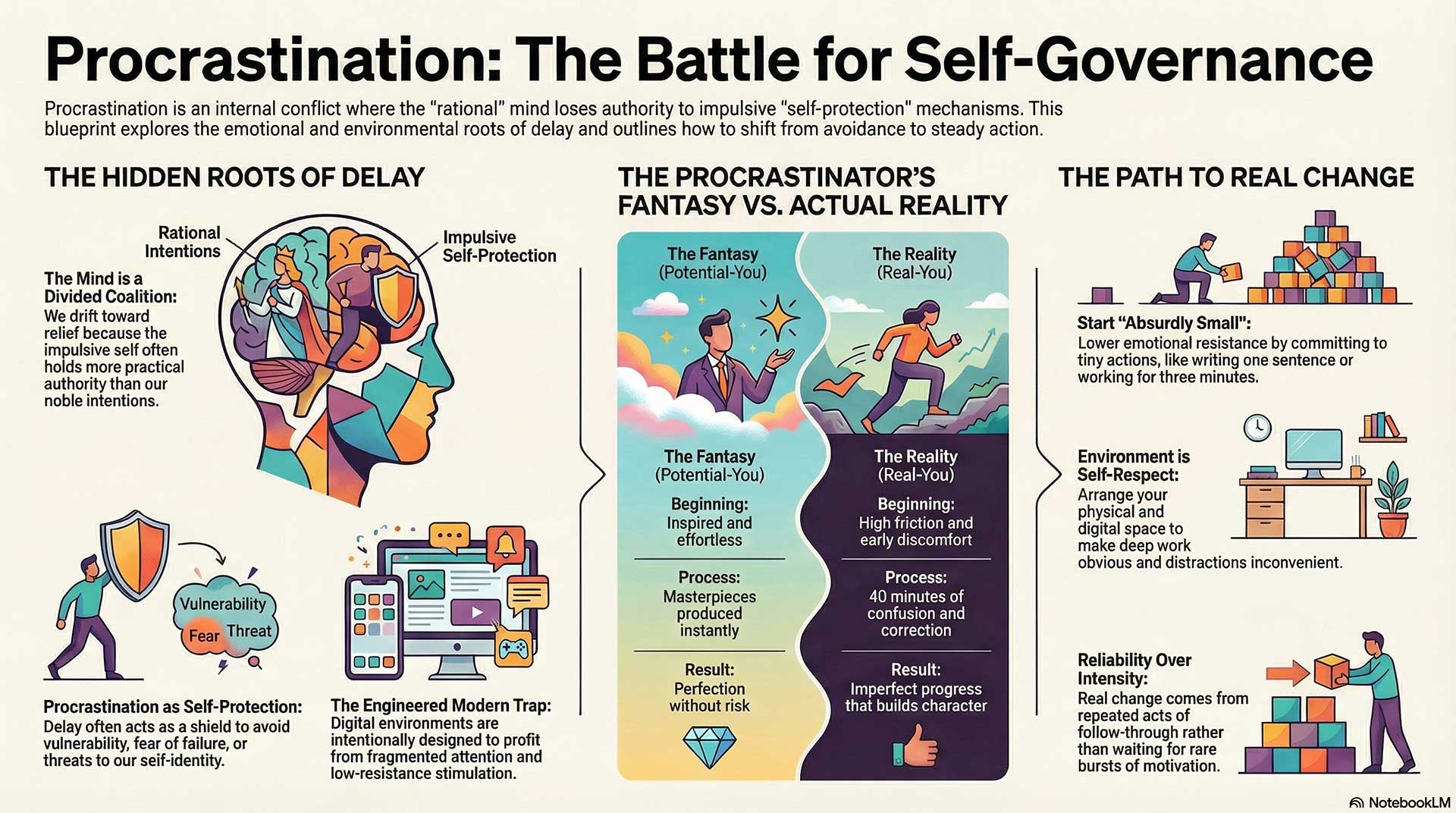
I think the first thing to admit is that the mind is not one clean, unified government. It is more like a badly run coalition. One part of you can see the future, make plans, and speak in noble language about long-term goals. Another part of you wants snacks, novelty, comfort, and freedom from difficulty right now. The strange thing is that the second part often has more practical authority. So people do not drift toward what matters most by accident. They drift there by being ruled, moment by moment, by the side of the self that wants relief more than meaning.
Carol Dweck:
A lot depends on what the task means to the person. When meaningful work becomes tied to self-worth, it stops feeling like simple effort and starts feeling like a test of identity. Then the mind does something protective. It hesitates. It delays. It looks for safer experiences. The issue is not pleasure alone. It is often the wish to avoid a moment that might say, “Perhaps I am not as capable as I hoped.” That is one reason people can be committed in theory and avoidant in practice.
Andrew Huberman:
There is a biological side to this. The nervous system is drawn toward what gives immediate reward and away from what brings friction, uncertainty, or cognitive strain. If the important task has a long reward horizon and the distraction has an instant payoff, many brains will choose the latter unless the person has trained their attention and reward systems with intention. The problem is multiplied when someone is tired, stressed, overstimulated, or conditioned by constant novelty. In that state, the brain starts treating effort as a threat or a tax.
Adam Grant:
I would add that people are often not choosing between work and laziness. They are choosing between one kind of discomfort and another. Doing the meaningful thing may bring confusion, self-doubt, or the chance of being judged. Doing the easier thing may bring guilt later, but it feels emotionally cheaper in the moment. Human beings are excellent at making small bargains with themselves: “I’ll do it later, when I’m sharper, freer, more inspired.” That story gives present relief, and present relief is persuasive.
Cal Newport:
The modern person has made this harder by building a life that trains shallowness. Deep effort is no longer the default state for many people. Attention is fragmented, the day is broken into small pieces, and the mind becomes accustomed to low-resistance stimulation. Then, when the person faces something meaningful that requires sustained concentration, it feels unusually heavy. What matters most often loses, not just since it is difficult, but since the mind has lost familiarity with depth.
Question 2 — What does procrastination reveal about the conflict between reason and impulse inside the mind?
Andrew Huberman:
It reveals that insight alone is weak unless it is linked to behavior, state control, and repeated training. A person may fully understand what they should do and still fail to do it. That gap tells us that cognition is not command. You can know and not act. You can intend and still move in the opposite direction. That is why routines, environmental design, sleep, movement, and reward timing matter. They help the reflective part of the mind gain leverage over the reactive part.
Adam Grant:
It also reveals that people often overestimate how democratic their own minds are. We like to think the best argument wins. It does not. The loudest feeling often wins. The nearest temptation often wins. The easiest narrative often wins. So procrastination is humbling. It shows that a clear value system is not enough. A person can believe in excellence, purpose, service, or mastery and still spend the afternoon doing nonsense. That contradiction is painful, though it can also become the beginning of self-knowledge.
Cal Newport:
I see procrastination as evidence that the mind must be governed by structure if it is going to serve serious aims. Reason rarely defeats impulse in a vacuum. It needs support. Time blocks, rituals, clearly defined sessions, reduced distractions, and a sense of what counts as progress — these are not small technical aids. They are forms of self-rule. Without them, the person is left standing in an open field, asking abstract conviction to defeat immediate temptation. That is a poor contest.
Tim Urban:
Yes, and one of the humiliating features of this conflict is that the impulsive side does not need a noble philosophy. It just needs a button. It needs one shiny thing, one open tab, one strange curiosity, one tiny doorway out of effort. The rational side is trying to build a cathedral. The impulsive side is saying, “What if we just watched one video about octopuses wearing hats?” And absurdly often, that side wins. Procrastination shows how vulnerable intelligence is when it is left alone with temptation.
Carol Dweck:
This conflict is shaped by beliefs about growth and failure. When challenge is interpreted as a path of development, reason has more strength. When challenge is interpreted as exposure, impulse grows stronger. Then avoidance begins to look almost rational. If the task threatens the self-image, the mind starts defending the image instead of doing the work. So procrastination can reveal a hidden allegiance: the person may say they want accomplishment, yet inwardly they may be more committed to protecting the idea of being talented than to enduring the process of becoming better.
Question 3 — Is procrastination really a time problem, or is it a self-governance problem?
Cal Newport:
At its core, it is a self-governance problem. Time matters, of course, though the deeper issue is whether a person can direct attention toward what matters without waiting for mood or panic to do the job. People often think they need better calendars, better apps, better reminders. Sometimes what they need is a more serious relationship with their own attention. The central question is not, “Where did the hours go?” It is, “Who or what was in charge of them?”
Tim Urban:
I agree. The time problem is real, but it is downstream. The calendar is the crime scene, not the criminal. You can buy a beautiful planner and still hand the day over to the inner fool who fears boredom and worships convenience. The person who procrastinates is often not confused about the hour. They are confused about authority. Which self is making decisions? The one that cares about the future, or the one that wants escape right now? That is why procrastination can feel so personal. It is not just lost time. It is self-betrayal.
Carol Dweck:
And self-governance is shaped by identity. People who grow stronger over time learn to value the process of effort, correction, and persistence. Then governing the self becomes less about punishment and more about alignment. They are not forcing themselves as harshly since they are building a self that expects growth through difficulty. If, on the other hand, effort feels like proof of inadequacy, self-governance becomes brittle. The person delays, then blames themselves, then feels weaker, then delays again.
Andrew Huberman:
I would phrase it this way: self-governance depends on training the body and brain to tolerate the early phase of effort. A lot of important work feels bad in the first few minutes. The reward is delayed. Friction is high. Uncertainty is present. If the person has no tools for staying with that phase, impulse will rule. So yes, it is a self-governance issue, but that does not mean moral scolding is useful. Training is useful. Systems are useful. Learning how to enter effort before motivation arrives is useful.
Adam Grant:
There is a humane side to this too. When people hear “self-governance,” they can turn it into self-condemnation. I do not think that helps much. A better question might be: how do we become the kind of person who can be both honest and effective? You need enough honesty to admit that the problem is deeper than scheduling, and enough self-respect to believe that change is possible. The goal is not becoming a machine. It is becoming someone whose actions stop drifting so far away from their values.
The room grows quieter here. They have not solved procrastination yet, though they have stripped away one comforting illusion: this is not just about being busy, forgetful, or disorganized. It is about the divided self, the meaning of effort, and the struggle for authority within a human life.
Topic 2 — The Emotional Core: What are we really avoiding?

Participants: Brené Brown, Gabor Maté, Lori Gottlieb, Esther Perel, Tim Urban
Question 1 — What emotions are people most often trying to escape when they procrastinate?
Brené Brown:
A lot of procrastination is an attempt to get away from vulnerability. People think they are postponing a task, but very often they are postponing exposure. The work may ask them to be seen, measured, judged, or disappointed. That is a deeply human fear. So they step back, stall, distract themselves, and call it laziness when in fact they are trying to avoid the raw feeling of uncertainty. The delay is often less about the task itself and more about the emotional risk of showing up fully.
Tim Urban:
Yes, and one of the maddening parts is that the emotion being avoided can be very small and still somehow overpowering. It might be ten seconds of discomfort. Opening the blank document. Looking at the tax form. Sending the awkward email. Beginning the thing that reminds you you’re human and not a productivity robot from a commercial. The mind says, “No, thank you, let’s reorganize the desk.” So procrastination can be absurdly dramatic in response to tiny emotional threats.
Gabor Maté:
I would put it in terms of pain avoidance. Human beings do not merely avoid work. They avoid states of feeling that awaken old wounds: inadequacy, helplessness, humiliation, anxiety, grief. The task in front of them may be current, yet the feeling it stirs can be much older. Then the behavior makes more sense. Delay becomes self-soothing. Distraction becomes anesthesia. The problem is that what soothes in the short term often deepens suffering later.
Lori Gottlieb:
People also avoid disappointment in a very sneaky form: “If I don’t really try, then I never have to find out.” That can protect the ego for a while. If the novel stays unwritten, it can remain brilliant in fantasy. If the application is never submitted, rejection never becomes official. So postponement preserves illusion. It lets people keep a flattering future version of themselves intact, instead of meeting the imperfect truth of where they are right now.
Esther Perel:
And sometimes what they are escaping is not only fear, but confinement. Meaningful work asks something of us. It asks loyalty, patience, repetition, surrender to process. There is a part of the self that rebels and says, “Why should I submit to this?” So avoidance can carry traces of resistance, not just weakness. The person seeks pleasure, novelty, seduction, movement — anything that restores a sense of aliveness against the demands of duty.
Question 2 — How much of procrastination is tied to fear of failure, shame, uncertainty, or self-doubt?
Lori Gottlieb:
A great deal of it. People often treat procrastination as a scheduling issue since that sounds manageable. But when you listen to them closely, what you hear is fear. “What if I do this badly?” “What if it’s too late?” “What if I’m not who I hoped I was?” Delay gives temporary shelter from those questions. The price is that the shelter slowly turns into a prison.
Gabor Maté:
Shame is especially powerful. When a person carries shame, effort itself can become dangerous. The task is no longer just a task. It becomes a possible confirmation of worthlessness. In that state, self-doubt is not a passing thought. It is a wound organizing perception. Then procrastination is not irrational at all from the organism’s point of view. It is protective. It is trying to spare the person from what feels intolerable.
Brené Brown:
That is exactly why shame is so corrosive here. Shame says, “If this goes badly, it means something terrible about who you are.” Once that voice takes over, perfectionism and procrastination become close companions. The person waits for certainty, the perfect mood, the perfect draft, the perfect version of themselves. None of that comes. Shame loves delay since delay keeps the person from entering the arena where they might discover they are still worthy, imperfect and all.
Esther Perel:
Uncertainty plays its own role too. Human beings want guarantees before they commit their energy. But meaningful life gives very few guarantees. Love, art, work, calling, reinvention — all of them demand risk. Procrastination can become an attempt to postpone the moment of existential exposure. Once I act, I am implicated. Once I begin, I can no longer remain only potential. And some people find potential more seductive than reality.
Tim Urban:
Yes, potential is an excellent place to live if your main hobby is protecting your ego. Potential-you is incredible. Potential-you exercises daily, writes masterpieces, answers emails instantly, and probably flosses. Real-you has to sit down and be confused for forty minutes. So procrastination keeps the fantasy version alive. It is a strange arrangement: your current self suffers so your imaginary self can remain impressive.
Question 3 — When someone says, “I work best under pressure,” are they describing a strength, or a way of hiding from deeper emotional discomfort?
Tim Urban:
In many cases, it is a very flattering description of a bad system. What people usually mean is, “Terror is the only thing strong enough to overpower my avoidance.” That does produce results sometimes, which makes it tempting to turn it into an identity. But it is like saying, “I drive best when I’m almost out of gas and late for the airport.” Maybe you do drive very sharply in that moment. It is still a terrible method.
Brené Brown:
I hear that phrase as armor. It lets people rename distress as style. Instead of saying, “I struggle to face vulnerability until panic forces me,” they say, “I thrive under pressure.” It sounds competent. It sounds admirable. But often it hides a deep distrust of steady, openhearted effort. Pressure becomes preferable since it narrows the emotional field. Once panic arrives, there is no room left for shame, perfectionism, or second-guessing. There is only survival.
Gabor Maté:
Yes. Pressure can function like a drug. It floods the system with urgency, and urgency can temporarily silence inner conflict. The person feels focused at last. They mistake that relief for proof that pressure is beneficial, when in reality it may simply be masking unresolved emotional pain. The deeper question is why calm effort feels so difficult in the first place. Why must crisis be invited in before permission to act is granted?
Esther Perel:
There is also an erotic element to pressure in the broad sense of the word. The deadline creates intensity, and intensity can feel more alive than ordinary devotion. Some people become attached to the drama of last-minute existence since drama gives heat to what otherwise feels flat. Yet a meaningful life cannot be built only on episodes of emergency. Mature freedom includes learning to stay present in repetition, not only in crisis.
Lori Gottlieb:
The healthiest answer is probably this: some people may indeed perform sharply under pressure, but that does not mean pressure is the best environment for their lives. Many produce good work at the last minute and still pay for it with dread, exhaustion, strained relationships, and self-contempt. So I would ask, “What is this system costing you?” A pattern can be effective in one narrow sense and still be quietly destructive.
Topic 3 — The Modern Trap: Why is procrastination easier than ever now?

Participants: Tristan Harris, Cal Newport, Jonathan Haidt, Johann Hari, Aza Raskin
Question 1 — How has modern technology made it far easier to escape effort and far harder to stay with meaningful work?
Tristan Harris:
Technology has turned distraction into an always-open doorway. The phone is no longer just a tool sitting nearby. It has become a highly trained system that studies what pulls your attention and keeps presenting it back to you. So the person trying to work is not just resisting boredom or inner weakness. They are resisting an environment built to interrupt intention.
Cal Newport:
Meaningful work usually requires sustained concentration. The trouble is that modern life keeps training the opposite habit: checking, switching, glancing, refreshing. Once the mind gets used to that rhythm, deep work starts to feel unusually hard. It is not just that people want distraction more. It is that they lose familiarity with depth itself.
Johann Hari:
And the person often blames themselves too quickly. They say, “What’s wrong with me?” when in fact they are living inside systems that profit from fractured attention. The problem is personal, yes, but it is social too. We have built a culture where attention is constantly being pulled apart and sold back to us in pieces.
Jonathan Haidt:
This does not stay at the level of productivity. It changes how people relate to quiet, boredom, effort, and solitude. When a person is constantly stimulated, they become less able to sit with slowness or uncertainty. Yet that is exactly where meaningful thought often begins.
Aza Raskin:
A lot of this comes from design choices. Infinite scroll, autoplay, intermittent rewards, notifications — these are behavioral hooks. They are made to keep people engaged. So procrastination today is not only a moral failure. It is often the predictable result of living inside persuasive systems optimized to capture time.
Question 2 — What happens to a person’s mind when distraction becomes the default condition of daily life?
Jonathan Haidt:
The person becomes more reactive and less inwardly steady. Their attention is governed more by external signals than internal purpose. Quiet begins to feel uncomfortable. Unstructured time feels restless instead of rich. That weakens the ability to regulate oneself without stimulation.
Johann Hari:
The saddest part may be that people end the day mentally exhausted but spiritually undernourished. They have spent hours attending to things, but very little of that attention has been deeply inhabited. So there is activity without presence, stimulation without meaning.
Cal Newport:
There is a cognitive erosion too. Complex thinking needs continuity. Original work needs uninterrupted time. Reflection needs space. When interruption becomes normal, people remain near the surface of their own minds. They may stay busy and responsive, but they produce less depth.
Tristan Harris:
A society can normalize this so thoroughly that people stop seeing how strange it is. They begin to think constant interruption is just life. But a life broken into endless fragments is a distorted human condition. It affects work, memory, relationships, and even the ability to care about difficult truths.
Aza Raskin:
It also changes desire. The mind starts expecting every moment to deliver a little novelty, a little hit, a little stimulation. Once that happens, slower forms of value — reading, writing, thinking, building, waiting — begin to feel almost offensive. Distraction does not just consume time. It reshapes appetite.
Question 3 — At what point does procrastination stop being a personal weakness and become a cultural crisis of attention?
Aza Raskin:
It becomes a cultural crisis when the same systems are shaping millions of people in the same direction and then telling each person the result is their private fault. That is when we need to stop asking only, “Why am I weak?” and start asking, “What kind of environment have we accepted?”
Tristan Harris:
Attention is life. What you pay attention to becomes your days, your relationships, your politics, your memory, your future. So when major systems are built to seize and redirect attention at scale, this is not a side issue. It is a human issue at the level of civilization.
Cal Newport:
Personal responsibility still matters, but it works best when joined to cultural clarity. People need language for what is being lost. Families, schools, and workplaces need norms that protect depth instead of assuming constant connectivity is harmless. Otherwise the individual is always fighting upstream.
Johann Hari:
The word crisis fits when people begin losing the ability to read deeply, think patiently, stay present, finish meaningful work, or remain with their own lives without reaching for stimulation. At that point, procrastination is only one symptom of something much larger.
Jonathan Haidt:
And the stakes are even higher when the young are formed inside this from the beginning. A culture that weakens patience, attention, emotional regulation, and real-world presence is shaping the kind of adults it will produce. This is about more than tasks. It is about what kind of people we are becoming.
The conversation widens here. Procrastination is no longer just an inner struggle between intention and impulse. It is a struggle inside a culture built to fracture attention. The person who cannot stay with meaningful work may still need discipline, but they are also living inside systems that make distraction feel normal and depth feel unnatural.
Topic 4 — The Silent Cost: What does procrastination steal from a life?

Participants: Oliver Burkeman, Arthur Brooks, Susan Cain, David Brooks, Tim Urban
Question 1 — What is the deepest cost of delaying important action again and again over time?
Oliver Burkeman:
The deepest cost is not inefficiency. It is forfeiture. A human life is finite, and procrastination is one of the quiet ways we refuse to meet that fact. We postpone what matters as though time were a generous background condition instead of the substance of life itself. So the real loss is not simply that tasks remain unfinished. It is that whole portions of one’s one and only existence remain unlived, not through tragedy, but through deferral.
Tim Urban:
Yes, and the frightening thing is how harmless it can look from day to day. Nothing explodes. There is no dramatic movie soundtrack. You just keep putting off the important thing and doing smaller, easier, weirder things instead. Then one day you realize the cost was never just a late project or a messy week. The cost was years. It is like being slowly pickpocketed by your own avoidance.
Arthur Brooks:
I would say procrastination steals joy in a very specific way: it weakens earned satisfaction. Human beings are meant to know the pleasure of effort aligned with meaning. When that pattern is broken again and again, life becomes thinner. There may still be comfort, entertainment, and temporary relief, but the deeper happiness that comes from doing difficult things for worthy reasons begins to fade.
Susan Cain:
It can steal hidden life too. Many people carry inward callings that are easily postponed since they are quiet. Writing, creating, serving, saying what is true, following a vocation that does not announce itself loudly — these things can be delayed for years without public alarm. So procrastination often harms the parts of a life that are most inward, tender, and difficult to defend in a noisy world.
David Brooks:
And there is a moral cost. By moral I do not mean moralistic. I mean the slow formation of the self. Repeated delay teaches a person something about who they are. It shapes character. It says, “When the important moment comes, I step back.” Over time, that becomes more than a habit. It becomes a way of being. So procrastination is dangerous partly since it is a form of self-education.
Question 2 — How does chronic procrastination slowly reshape a person’s identity and trust in themselves?
Susan Cain:
It often creates a painful split between the inner self and the enacted self. The person knows what they care about. They may even feel deeply called. But their days do not reflect that knowledge. That gap becomes sorrowful. It can make someone feel estranged from their own gifts, as though the truest parts of them are always waiting in another room.
David Brooks:
Trust in oneself is built through repeated acts of kept promise. “I will do this,” followed by doing it. When that bond is broken often enough, the person begins to live under a subtle cloud of self-distrust. They stop fully believing their own intentions. This is one of the saddest developments in adult life: not that one fails, but that one begins to doubt the integrity of one’s own will.
Tim Urban:
And once you stop trusting yourself, weird things happen. You become your own unreliable coworker. Future-you keeps getting assigned responsibilities by present-you, and everyone knows future-you is going to be furious and ineffective. So the whole internal company starts running badly. Jokes aside, that loss of self-trust is brutal. It makes even good plans feel fake.
Oliver Burkeman:
Yes, the self begins to experience time as a place where meaningful intentions go to die. That is spiritually corrosive. The future becomes less a horizon of possibility and more a dumping ground for avoided commitments. When that happens, procrastination is no longer a scheduling problem. It is a damaged relationship with time and with one’s own capacity to inhabit it truthfully.
Arthur Brooks:
This also touches self-respect. People often think self-respect comes from success or recognition, but much of it comes from private congruence. Am I living in a way that fits what I say matters? Chronic procrastination injures that congruence. The person may appear functional from the outside and still feel inwardly diminished, since they know how often they have abandoned what they themselves judged worthy.
Question 3 — When people reach later stages of life with regret, do they suffer more from failure, or from the things they never truly began?
Arthur Brooks:
In many cases, they suffer more from what they never began. Failure at least has a shape. It gives you a story, a lesson, a reality to work with. But unlived possibility lingers in a different way. It becomes haunting. The thought is not, “I lost.” It is, “I never showed up.” That kind of regret can be especially sharp since there was never even a meeting between the self and the task.
Oliver Burkeman:
I agree. Failure can be metabolized. It belongs to life. One acts, one discovers limits, one learns, one grieves, one continues. But avoidance can leave life in a ghostly condition. The unattempted remains pure enough to torment. It offers no closure. That is one reason procrastination is so dangerous: it preserves fantasy at the price of reality, and fantasy often becomes crueler than failure.
Susan Cain:
This is especially true for inward vocations. A person may mourn the book not written, the apology not spoken, the change not made, the path not chosen. These are not always public failures. Sometimes no one else even knows they existed. But inwardly they can define a life’s regret with extraordinary force.
Tim Urban:
Yes, and the scary thing is that failure feels dramatic enough to respect. Avoidance can feel almost invisible. That is why it is such a sneaky thief. People imagine regret as some huge bold disaster, but often it is much quieter. It is the accumulation of all the times you kept saying, “Later, later, later,” until later became a personality.
David Brooks:
What people long for near the end is often not perfection, but fidelity. Did I answer what was asked of me? Did I bring my gifts into relationship with the world? Did I become trustworthy in love, work, service, and truth? Failure does not automatically ruin that. Avoidance often does. Since avoidance keeps the self from offering itself at all.
The room feels heavier now. The talk is no longer about clever metaphors or funny delay. It is about time, self-trust, hidden callings, character, and regret. Procrastination is revealed as something far more serious than poor productivity. It can become a quiet theft of life itself.
Topic 5 — The Turning Point: How does real change begin?

Participants: James Clear, BJ Fogg, Cal Newport, Angela Duckworth, Andrew Huberman
Question 1 — Why do people often gain insight into their procrastination but still fail to change?
James Clear:
Insight is helpful, but behavior changes when life changes. A person can understand themselves deeply and still keep living in an environment that pulls them toward the same old pattern. If the cues stay the same, the routines stay the same, and the rewards stay the same, insight alone rarely wins. People often think change begins with a big realization. More often it begins when daily systems stop feeding the behavior they say they want to leave behind.
Andrew Huberman:
There is also a gap between knowing and training. The nervous system does not automatically obey intellectual clarity. A person may genuinely understand that procrastination is harming them and still have no reliable practice for entering effort when discomfort begins. Meaningful work often starts in friction. If the brain has been conditioned to escape friction, then self-knowledge without training will not carry the person very far.
Angela Duckworth:
People also underestimate how much change asks of identity. They want a better pattern without yet becoming a steadier person. But consistency is rarely built on insight alone. It is built through repeated acts of follow-through, especially on ordinary days when inspiration is absent. The person must stop asking, “Do I feel ready?” and begin asking, “What kind of person do I want my repeated actions to reveal?”
BJ Fogg:
A lot of people fail since they make change emotionally too heavy. They decide, “Tomorrow I become a new human being.” That is usually too large and too dramatic. When the new behavior feels difficult, vague, or dependent on motivation, the old behavior returns. Tiny actions matter since they create success experiences. Success changes identity more reliably than self-criticism does.
Cal Newport:
And many people still leave attention unprotected. They say they want to change, but they continue to live inside constant interruption. Then they are surprised when serious effort never stabilizes. Real change needs structure. It needs boundaries around time, focus, and the conditions in which meaningful work can actually happen.
Question 2 — What small shifts in daily life actually help a person move from avoidance into steady forward motion?
BJ Fogg:
Start absurdly small. Make the beginning easy enough that resistance has very little to fight. Open the document and write one sentence. Sit down and work for three minutes. Put the guitar in your hands. Tiny starts matter since they lower emotional resistance and build momentum. The goal at first is not heroic output. It is creating a reliable bridge between intention and action.
James Clear:
I would add that environment is one of the most underrated forms of self-respect. Put the desired behavior in the path of daily life and put distraction farther away. Make the good habit obvious and the bad one inconvenient. A lot of people think discipline means forcing yourself harder. Often it means arranging life so the better choice requires less friction.
Cal Newport:
Time must become concrete. People often say they will work on something important “later,” which usually means never in particular. A scheduled block, even a small one, has moral force. It turns vague hope into a commitment in time. Once meaningful work has a place in the day, the person can begin rebuilding trust in themselves.
Andrew Huberman:
Learning to tolerate the first minutes of effort is huge. Many tasks feel unpleasant at the start, and people misread that as a sign to stop. It is often just the brain crossing from low-effort stimulation into focused engagement. If someone learns to remain present through that transition, the work can become much easier after the initial resistance.
Angela Duckworth:
And consistency should be valued more than intensity. A person who keeps showing up in modest ways is often building something far more durable than a person who waits for rare bursts of motivation. Steady contact with a meaningful task changes character. It teaches the self, “This is what we do now.”
Question 3 — What is the first real sign that someone is no longer living as a procrastinator, but becoming someone new?
Angela Duckworth:
The first sign is not perfection. It is reliability. The person starts doing what they said they would do with greater regularity, especially when the work is inconvenient or unglamorous. Change becomes visible when action is no longer hostage to mood. That is when character begins to form in a new direction.
James Clear:
I would say the first real sign is identity shift. The person stops seeing action as a special event and starts seeing it as normal. They no longer think, “I hope I can be productive today.” They begin to think, “I am someone who returns to the work.” That shift may sound subtle, but it changes what repeated behavior feels like from the inside.
BJ Fogg:
There is often more ease too. Not since the work becomes easy in itself, but since the battle at the starting line becomes smaller. The person wastes less energy negotiating with themselves. Beginning grows simpler. That matters a great deal. A huge amount of suffering in procrastination comes from the drama before the work, not only from the work itself.
Andrew Huberman:
Biologically, you could say the system begins associating effort with reward rather than only with strain. The person still feels resistance at times, but they have enough repetitions of meaningful engagement that the brain starts recognizing work as a path to clarity and satisfaction. That is a major shift. It means discipline is being reinforced rather than merely demanded.
Cal Newport:
I would put it this way: the person’s calendar and their values begin to resemble each other. What they claim matters starts appearing in the architecture of their days. That is one of the clearest signs of real change. Their life becomes less aspirational and more actual. They are no longer merely admiring meaningful work from a distance. They are making room for it, regularly, in lived time.
The final turn is quiet but hopeful. Real change does not begin with becoming flawless. It begins when intention starts finding a place in action, when resistance stops ruling every decision, and when a person becomes a little more trustworthy to themselves each day. The procrastinator does not disappear in one dramatic victory. A different self is formed through many small acts of return.
Final Thoughts
In the end, procrastination is not best understood as stupidity, laziness, or poor scheduling. It is a much more human problem than that. It is the struggle between comfort and calling, fear and action, fantasy and reality, distraction and depth, intention and lived time.
A person delays for many reasons. Sometimes they are protecting themselves from shame. Sometimes they are avoiding uncertainty. Sometimes they have been trained by modern life to seek stimulation at every moment. Sometimes they have simply lost the habit of beginning. But whatever form it takes, the danger is the same: delay can slowly teach a person to stand outside their own values, watching the life they mean to live remain always one step ahead.
Yet the conversation does not end in despair.
Change does not require becoming a flawless person. It begins much smaller than that. It begins when someone becomes a little more honest about what they are avoiding. When they stop romanticizing pressure and start respecting steady effort. When they rebuild trust in themselves through kept promises, however small. When they protect attention. When they act before they feel fully ready. When they decide that imperfect reality is better than untouched potential.
That is the real turning point. Not a giant burst of motivation, but a quieter shift in loyalty. A person stops serving the part of themselves that wants escape at any cost, and starts serving the part that wants truth, growth, and a life that is actually lived.
Procrastination will probably never vanish completely. The pull of ease is ancient, and the world is full of distractions eager to help it win. But a human being can still choose differently. Again and again, in small faithful acts, they can return to what matters.
And that may be the deepest answer of all: a meaningful life is not built by never feeling resistance. It is built by not letting resistance decide.
Short Bios:
Tim Urban — Writer, speaker, and creator of Wait But Why, known for turning procrastination, ambition, and human behavior into funny, memorable ideas.
Cal Newport — Author and professor known for writing about deep work, focus, and building a life with less distraction.
Andrew Huberman — Neuroscientist and educator known for explaining attention, habits, stress, sleep, and behavior in practical ways.
Adam Grant — Organizational psychologist and author known for work on motivation, potential, generosity, and how people grow.
Carol Dweck — Psychologist known for her work on mindset, learning, effort, and the difference between fixed and growth-oriented thinking.
Brené Brown — Researcher and author known for work on vulnerability, shame, courage, and emotional honesty.
Gabor Maté — Physician and writer known for exploring trauma, emotional pain, addiction, and the hidden roots of behavior.
Lori Gottlieb — Psychotherapist and writer known for making inner struggle, self-deception, and emotional growth feel clear and human.
Esther Perel — Psychotherapist and speaker known for insights on desire, relationships, freedom, and emotional tension.
Tristan Harris — Technology critic known for warning about attention capture, persuasive design, and the human cost of digital systems.
Jonathan Haidt — Social psychologist and author known for work on morality, culture, technology, and the shaping of modern life.
Johann Hari — Writer known for exploring attention, distraction, mental struggle, and the wider social forces behind them.
Aza Raskin — Designer and thinker known for humane technology, digital ethics, and how interfaces shape human behavior.
Oliver Burkeman — Writer known for reflections on time, finitude, productivity, and the challenge of living meaningfully.
Arthur Brooks — Author and teacher known for writing about happiness, purpose, character, and a well-lived life.
Susan Cain — Writer known for exploring introversion, quiet strength, hidden gifts, and the inner life.
David Brooks — Writer and commentator known for work on character, moral formation, culture, and the deeper shape of a human life.
James Clear — Writer known for practical ideas on habits, identity change, and small repeated actions.
BJ Fogg — Behavior scientist known for tiny habits and making change easier to begin and sustain.
Angela Duckworth — Psychologist and author known for work on grit, effort, persistence, and long-term achievement.
Leave a Reply