

|
Getting your Trinity Audio player ready...
|

Robert Fagles:
Homer’s voice comes to us across nearly three millennia — not as a whisper, but as a steady tide. His Iliad and Odyssey are not only the foundation stones of Western literature; they are enduring meditations on wrath, endurance, longing, and the fragile triumphs of the human spirit.
We imagine him here not as the marble figure of classical memory, but as a man — a poet walking the coasts of the Aegean, sightless yet seeing farther than most of us dare. In these pages, we follow him not from the distance of history, but from the nearness of friendship. We walk the rocky shores with him, sail the wine-dark sea, hear the first lines of Achilles’ anger before they found their shape, and sit beside him at sunset as the last notes leave his lyre.
Homer’s gift was never simply in telling a tale. It was in shaping the truths of war, love, and return into rhythms that could survive the turning of centuries. The stories in this series are drawn in the spirit of those rhythms — grounded in the landscape of ancient Greece, yet alive with the intimacy of a shared bench, a shared silence.
(Note: This is an imaginary conversation, a creative exploration of an idea, and not a real speech or event.)

Chapter 1: The Blind Singer by the Shore
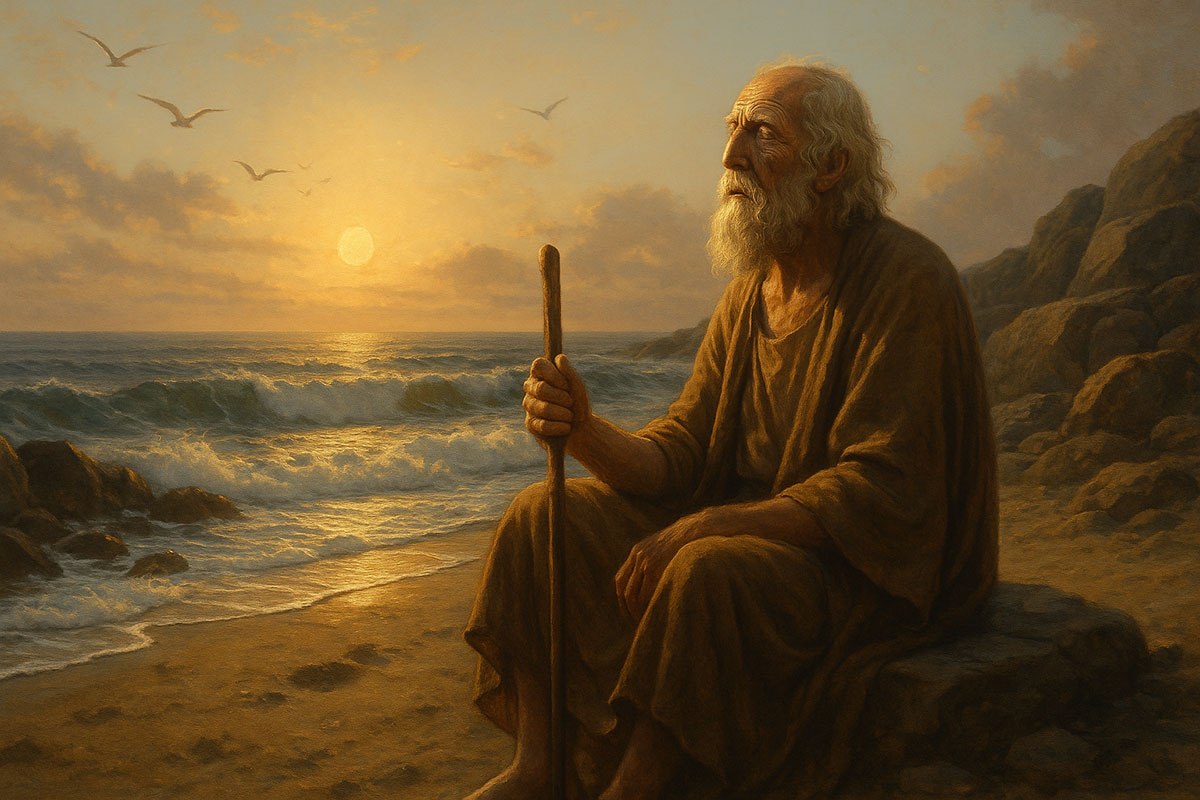
The gulls wheeled low over the water, their cries sharp against the steady hush of the Aegean. The morning was pale and salt-bright, the kind of day when the horizon seemed to drift farther away the longer you looked.
I found him sitting where the rocks met the sand, his staff resting across his knees. His head tilted slightly, as if he were listening to a voice just beyond the sound of the waves. His hair was white, wind-tangled; his eyes clouded with the milky film of blindness.
“Homer,” I said, though it felt strange to speak his name into such a quiet.
He smiled. “You walk too heavily,” he replied. “I could hear your steps long before you reached me.”
I sat beside him, letting the tide wash over my ankles. “What are you listening for?”
“The sea,” he said. “It is always telling stories. You only have to learn its tongue.”
He turned his face toward the wind, and for a moment, it seemed the very air held still for him. “Long before men learned to write, they remembered the world through song. I carry those songs. Not because I chose to, but because they would not let me go.”
He reached down, fingers tracing the sand until they closed around a smooth shell. He placed it in my palm. “Hold it to your ear.”
I did, and the hollow roar inside seemed to echo the breakers before us.
“That,” Homer said softly, “is the sound of return. Every man who sails must hear it, somewhere in his heart. Odysseus most of all.”
“You’ve been speaking of him lately,” I said. “As if he were more than a story.”
“Some are,” he answered. “Some begin as men and end as truths. Odysseus is one of those.”
A breeze lifted, bringing with it the scent of olive groves from the hills. Homer’s hand moved in the air as though sketching the shape of a distant sail. “But it is not just Odysseus. It is the rage of Achilles, the sorrow of Priam, the patience of Penelope. These are not merely names — they are the marrow of what it means to be human.”
We sat until the tide began to pull back, revealing wet sand patterned with shells and kelp. Homer lifted his staff and rose with practiced ease.
“Come,” he said. “There will be a gathering at the village tonight. They will want to hear the beginning again.”
“And what beginning is that?” I asked.
He smiled, and in that smile was the certainty of a man who had walked the length of memory itself. “Sing, O Muse,” he said, “of the man of many ways…”
The wind carried the words out over the water, where they seemed to join something older, vaster — the endless song of the sea itself.
Chapter 2: The Wine-Dark Sea

The ship rocked gently beneath our feet, the deck still damp from the morning spray. The sail above us filled with the steady breath of the wind, its white cloth snapping like a heartbeat against the blue. Homer sat on a coil of rope near the prow, his face tilted toward the breeze, his sightless eyes half-closed as though feeling the horizon through the skin alone.
He did not speak for a long while. The only sounds were the creak of the mast, the cry of gulls tracing our wake, and the rhythmic slap of water against the hull. Then, softly, he began to hum — low, almost imperceptible, the way a man might test the key before beginning a song.
“You hear it too,” he said after a moment, “the sea’s voice. Not the waves, but the pulse underneath. It carries the stories from one island to the next.”
I asked what story he heard today.
He smiled faintly. “A man, long absent, carried over these waters by longing. His ship broken, his men gone, his heart pulled by two shores — the one he stands on and the one that waits.”
He turned his face toward me, the sun bright on his weathered brow. “It is not just his journey. It is every journey home that costs more than the leaving.”
I watched as he reached for the wooden lyre beside him, fingers tracing its familiar frame. The notes that followed were slow at first, then gathering into a rhythm that matched the swell of the sea. His voice rose with the wind, unspooling lines I had never heard before:
Sing, O Muse, of the man of many turns,
driven far and wide after sacking the sacred citadel of Troy…
The words were not written anywhere, not yet. They lived in the air between us, in the salt sting of the wind and the shadow of gulls on the sail.
He paused, letting the line hang, as if listening for the next part from some far-off shore. “It comes in fragments,” he murmured. “The sea delivers it in pieces, like driftwood. My work is only to fit them together.”
By midday, the coastline had begun to blur into the haze. Homer rested his lyre and leaned against the mast. “When I am gone,” he said quietly, “the words will remain. But I would like someone to remember how they first came — not in the halls of kings, but here, where the air tastes of brine and the only applause is the turning of the waves.”
The sun slipped lower, gilding the water until it looked as though we were sailing across molten bronze. Behind us, the wake stretched like a path back to where we had begun, though I knew we would not return that way.
Homer lifted his face once more to the wind. “Now,” he said softly, “let’s see where the Muse takes us next.”
Chapter 3: The Anger of Achilles
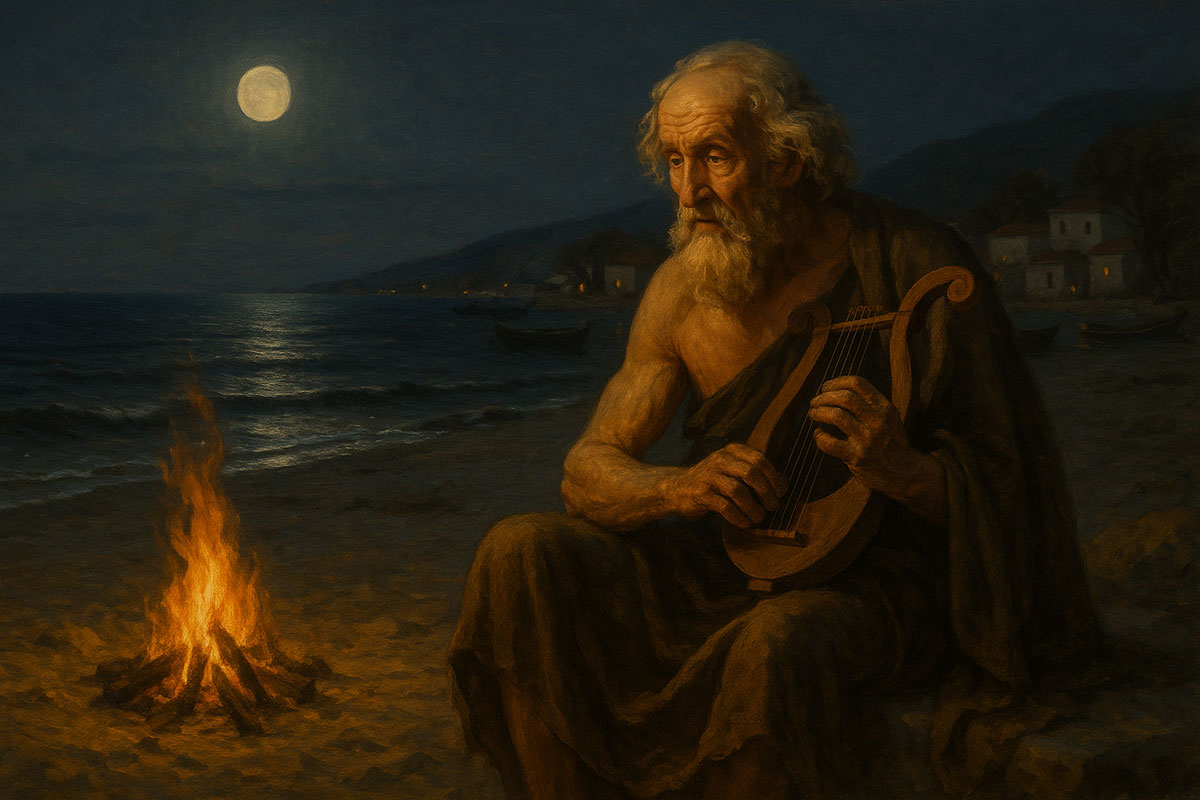
The evening fires crackled low in the encampment, their smoke curling into the violet dusk. We had stopped near a fishing village, and the air smelled of salt and roasting mackerel. Homer sat apart from the others, his lyre across his knees, silent for once.
He traced the wood of the instrument with his fingertips, almost as though feeling for something beneath the grain. “Everyone expects the Iliad to begin with glory,” he said finally. “But it begins with a wound.”
I waited. When Homer spoke like this, it was best to let the current carry him.
“Achilles,” he went on, “was not made great by his victories. He was made eternal by his rage — and the cost of it. Rage is the most human thing, and the most ruinous. That is why the Muse must sing of it first.”
He lifted his face to the night. “Rage, goddess,” he murmured, “sing the rage of Peleus’ son Achilles… the accursed rage that brought countless griefs upon the Achaeans.” The words hung there, raw and heavy, before vanishing into the sea air.
Homer leaned back, the lamplight catching the clouded surface of his eyes. “Do you know why I begin there? Because a war is not remembered for the first sword drawn, but for the moment mercy is forgotten.”
He told me then of a vision that had come to him in dreams: two men locked in argument before the gates of Troy, their words sharper than any spear. Agamemnon’s pride against Achilles’ fury — a spark that would burn for ten years and leave ashes where cities once stood.
“The Iliad is not about who won,” Homer said. “It is about what was lost. Hector’s life. Priam’s joy. Patroclus’ smile. Even Achilles himself, for all his strength.”
As he spoke, he plucked a slow, mournful tune on the lyre, each note spaced wide as if it needed room to breathe. “People will tell you I sing of heroes,” he said. “But I sing of men. And men are more than their victories.”
The fire beside us hissed as a log split, sending up a burst of sparks. Homer leaned toward me. “Remember this when you hear the tale in full: every line carries a weight it cannot set down. And that weight is the grief behind the rage.”
The moon rose higher, silvering the sea until it looked like a plain of hammered bronze. Homer’s voice grew softer. “I will tell of battles and armor, of walls and ships — but I will always be telling of that first injury, the wound that opens and never closes.”
And then, almost to himself, he repeated the words: “Rage, goddess… sing the rage.”
Chapter 4: The Feast of the Kings

The hall was lit with fire and gold. Torches lined the walls, their flames bending in the draft from the high arched doors. Long tables groaned beneath the weight of roasted lamb, figs, olives, and amphorae of deep red wine. The smell of rosemary and char hung thick in the air.
Homer and I entered quietly, though all eyes soon turned to us. Messengers had spread word ahead — the poet had come to sing. The king sat at the head of the feast, his cloak clasped with a brooch of hammered bronze, a crown of olive leaves resting lightly on his brow.
Homer moved toward the hearth, where the flickering light caught the curves of his lyre. He did not bow deeply, nor flatter with praise. Instead, he simply inclined his head, as though greeting an equal.
When the king welcomed him, offering the finest seat near the dais, Homer only smiled. “My place is where all can hear,” he said, and chose a bench near the center of the hall.
The feast continued for a time — the clatter of cups, the murmur of voices, the low laughter of men already softened by wine. Then, when the last platter had been set down, Homer rose.
He began not with triumph, but with loss. He told of Hector’s final night, of Andromache’s hand lingering on the threshold, of the quiet in Troy before the storm. The hall stilled. Warriors who had once roared in battle now sat unmoving, their eyes fixed on the blind man’s face.
His voice carried the rhythm of the oar, the beat of hooves, the hush of ships waiting for the wind. Yet he gave them no simple glory. He reminded them of the price — the fathers who would not see their sons return, the mothers who lit lamps for men already gone.
I watched the king’s face. At first, pride flickered there — the pride of hearing war’s grandeur retold. But as the verses deepened, that pride shifted into something heavier, as though each word weighed more than the gold on his shoulders.
When Homer finished, the silence was deep enough to hear the spit crackle in the hearth. Then, slowly, the king rose. He poured a cup of wine and carried it himself to the poet.
“You speak of kings,” he said, “yet you kneel to none. And that is why your song will outlive us all.”
Homer accepted the cup but did not drink. “A song is not made to outlive men,” he replied. “It is made to remind the living what it costs to be one.”
Later, as the hall erupted once more in music and laughter, I saw the king watching him from the high table — not as a ruler regarding a servant, but as a man listening to the only voice in the room that could not be bought.
Chapter 5: The Last Song at Sunset

The sun was already low when I reached the small house by the shore. The air smelled of pine and brine, the cicadas calling in long, slow waves from the trees. Homer sat outside, facing the horizon, the light turning his hair the color of old ivory. His lyre rested on his lap, though his fingers lay still upon it.
“I think,” he said without turning, “this may be the last time I sing to the sea.”
I sat beside him, the wooden bench warm from the day’s heat. “Then let the sea hear something it will carry forever.”
He smiled faintly. “You speak as though the sea could ever forget.”
The tide rolled in, patient and unhurried. Homer lifted the lyre and let his fingers fall gently on the strings. The notes were slow, deliberate, like the first steps of a man beginning a journey he knows will take him beyond the reach of roads.
His voice followed, softer than I had ever heard it:
I have walked the long shores of memory,
and heard the footsteps of the dead
beside my own in the sand.
The wind took their names,
but the sea kept their stories.
He paused, letting the sound drift out over the water. The gulls wheeled silently overhead, as if unwilling to break the moment.
“I could fill another lifetime with the battles left untold,” he said, “but the Muse is quiet now. She asks not for another war, but for the telling of peace.”
We sat together as the sun touched the edge of the sea, spilling its gold across the waves. His hand trembled slightly, but his playing never faltered.
“When I am gone,” Homer said, “they will argue over where I was born, or if I ever truly lived. But you will know. You will remember the smell of this shore, the taste of this wind, the sound of the first lines before they were ever sung for a crowd.”
He closed his eyes, and the final verse came:
The journey is not to the gates of Troy,
nor to the halls of kings.
It is here,
where the sea meets the sky,
and the singer meets the silence.
The last note lingered, then faded into the soft hush of the tide. Homer laid the lyre across his knees, his hands folding over it as though cradling a child.
The sun slipped beneath the horizon, and for a moment, the whole world seemed to hold its breath. Then the first star appeared, trembling faintly in the deepening blue.
He did not speak again. But in the quiet, I felt the weight of the song settle into the air, as if the sea itself had taken it and would carry it across every shore, forever.
Final Thoughts By Robert Fagles
In Homer’s lifetime — if we can measure such a thing — the world was already changing. Empires would rise and fall. The songs would pass from his own lips into the voices of others, carried to places and centuries he could not have named.
The Best Friend Series closes, as all journeys must, at the shore. There, Homer’s songs meet the horizon — the point where sea and sky embrace, and the poet meets the silence. It is tempting to think of this as an ending, but Homer himself would not call it that. His lines remind us that endings are only the places where one path vanishes and another begins.
The task of a friend, then, is not to keep the poet from that horizon, but to bear witness as he steps into it — to remember the scent of the salt air, the feel of the sun at his back, the sound of the last string touched by his hand. In doing so, we carry the song forward, not as a relic, but as something still alive, still salt-wet from the sea.
Three thousand years have not diminished that song. It still calls to us, urging us to remember what it means to be human: to fight, to long, to endure — and above all, to return.
Short Bios:
Homer – Legendary ancient Greek poet traditionally credited with composing The Iliad and The Odyssey. Believed to have lived between the 8th and 7th centuries BCE, Homer is often portrayed as a blind bard whose oral recitations shaped the foundational epics of Western literature. His works explore war, heroism, longing, and the human condition with enduring poetic force.
Achilles – Central figure of The Iliad, the unmatched warrior of the Greeks during the Trojan War. His legendary rage, sparked by personal insult, becomes the catalyst for much of the epic’s tragedy, making him a lasting symbol of both glory and the cost of pride.
Odysseus – Hero of The Odyssey, king of Ithaca known for his cunning, endurance, and longing for home. His ten-year journey after the fall of Troy weaves themes of resilience, temptation, and the search for belonging.
The Muse – In Greek tradition, one of the divine inspirers of art and poetry. Homer’s invocation to the Muse at the start of each epic is both a literary device and an acknowledgment of storytelling as a sacred, communal act.
Leave a Reply