

What if the world’s greatest thinkers gathered to redesign school for human potential instead of obedience?
Introduction — by Sir Ken Robinson
There is a question that follows nearly every parent, teacher, and student through the years of schooling, whether they say it aloud or not:
Do schools kill creativity?
It is not asked angrily.
It is asked quietly, often after watching a child change.
Very young children are fearless creators. They sing without permission, draw without hesitation, and speak before certainty. They do not wait to be correct before they begin. They begin, and correctness follows later.
Then something shifts.
Gradually, students learn to pause before answering. They erase more than they write. They ask fewer questions each year, not because they know more, but because they have learned which questions feel safe.
This is not the fault of teachers. Teachers work with extraordinary care inside a structure older than any of us in the room today. A structure designed for efficiency, predictability, and fairness at scale. Those were noble aims, and in their time they transformed society.
But every system carries assumptions about human ability.
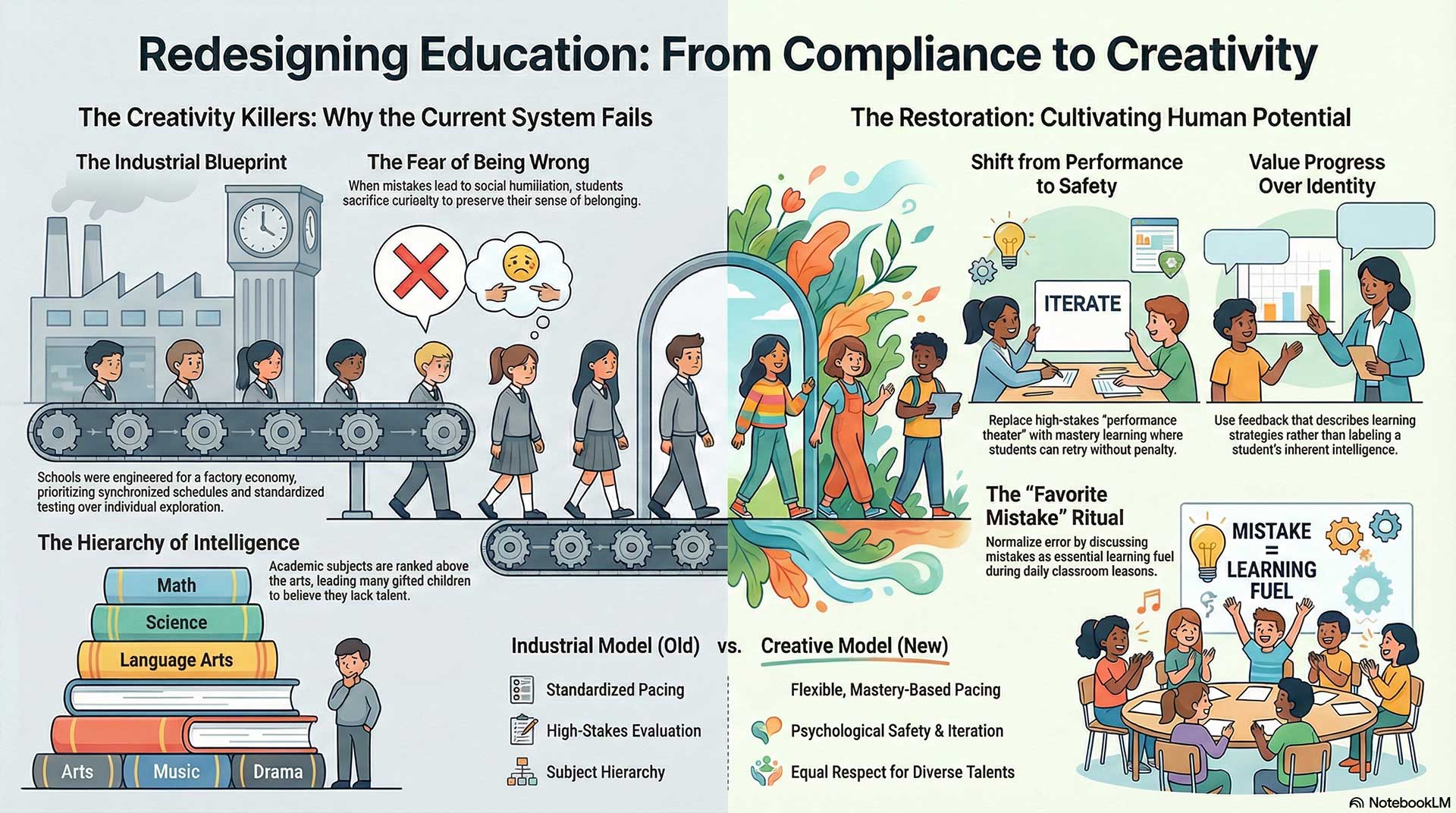
The modern education system inherited a hierarchy of intelligence. Certain ways of thinking are called academic. Others are called artistic, practical, emotional, or expressive. Children quickly learn which ones count more.
Soon, learning becomes performance.
Curiosity becomes risk.
And mistake becomes identity.
The tragedy is not that creativity disappears. It rarely does. The tragedy is that many people conclude they never had it.
This conversation is not about blaming schools.
It is about understanding what they were built to do, and what human beings now need them to become.
Because the question is not whether education matters.
It is whether education cultivates the whole person.
(Note: This is an imaginary conversation, a creative exploration of an idea, and not a real speech or event.)
Topic 1 — Fear of Being Wrong

The room felt less like a debate stage and more like a thoughtful seminar after hours. No podiums. Just chairs in a circle. Warm lighting. A place where people could admit uncomfortable truths without needing to win.
Sir Ken Robinson leaned forward slightly.
We are here because of a deceptively simple question: Do schools kill creativity?
Not intentionally. Not maliciously. But systematically. And if they do, the mechanism is not lack of talent. It is fear. Specifically, the fear of being wrong.
Children are born experimenters. They guess boldly, draw freely, speak before they know the words properly. Then gradually they stop. So let me begin here.
What happens inside a child when being wrong becomes socially dangerous at school?
Carol Dweck
The child shifts from learning to protecting identity.
When mistakes are treated as evidence of ability, students stop trying to improve and start trying to appear capable. They choose easier tasks. They avoid challenge. They stop asking questions.
A growth mindset says, I am developing.
A fixed mindset says, I must prove myself.
And creativity cannot survive in a proof-based psychology. Because creative thinking requires repeatedly entering situations where you are temporarily incompetent.
Brené Brown
I want to underline the phrase socially dangerous.
Kids can handle difficulty. What they cannot handle is humiliation.
The moment a classroom teaches that mistakes lead to embarrassment, belonging becomes conditional. And belonging is a stronger human need than curiosity. So children sacrifice curiosity to preserve connection.
Shame does not just silence answers.
It silences imagination.
You cannot be creative while managing self-protection.
Daniel Kahneman
We can also describe this as an incentive problem.
Human beings respond to predictable rewards and punishments. If correctness is rewarded immediately and visibly, students optimize for correctness. Not for exploration.
But exploration has a statistical property: it increases error rate in the short term while increasing understanding in the long term.
School evaluates short term accuracy.
Creativity depends on long term discovery.
So the rational student avoids risk.
John Cleese
In comedy we rely on exactly the opposite environment.
If a writer feels judged while brainstorming, nothing funny happens. The mind closes. It edits too early. It produces polite ideas instead of surprising ones.
Children begin life in what I would call open mode. School gradually trains closed mode. Efficient, but unimaginative.
You cannot have creativity in permanent closed mode.
Salman Khan
I see this very clearly in online learning data.
When students can practice privately, they attempt harder problems. When they are watched or graded immediately, they choose safer ones.
So it is not that students lack motivation.
They lack psychological safety.
Once they feel safe to fail, their curiosity returns almost instantly.
Sir Ken Robinson
So the issue is not discipline versus freedom. It is safety versus performance theater.
Let me ask the second question.
How do we keep high standards while removing shame from mistakes?
Carol Dweck
By grading progress instead of identity.
Feedback should describe strategies, not intelligence.
“You worked hard on this approach” instead of “You are smart.”
Standards remain high. But the meaning of failure changes. It becomes information.
Brené Brown
Public ranking systems create shame automatically.
We could keep evaluation but reduce exposure.
Private feedback preserves dignity. Dignity preserves effort.
People try harder when they are not defending themselves.
Daniel Kahneman
We should also delay judgment.
Immediate evaluation interrupts reasoning. Reflection requires cognitive space. If every answer is judged instantly, the brain optimizes speed, not depth.
Remove instant judgment and thinking quality improves.
John Cleese
Yes, separate creation from evaluation.
During creation: no criticism.
During revision: rigorous criticism.
If you mix them, you kill both quality and originality.
Salman Khan
Mastery learning works here.
Students retry until they understand. The standard does not lower, but the path becomes iterative instead of terminal.
A mistake becomes a step, not a verdict.
Sir Ken Robinson
So rigor is preserved. What changes is the emotional meaning of error.
Then let us move to the practical.
What is one daily classroom ritual that rebuilds creative risk-taking quickly?
Carol Dweck
Start each lesson with a “favorite mistake” discussion. Normalize it as learning fuel.
Brené Brown
Teachers share their own mistakes first. Vulnerability grants permission.
Daniel Kahneman
Require explanation before grading. Thinking precedes evaluation.
John Cleese
Ten minutes of idea generation where nothing can be marked wrong.
Salman Khan
Unlimited attempts before scoring. Practice without penalty.
Sir Ken Robinson
Then perhaps the conclusion is gentle but serious.
Schools do not kill creativity through cruelty.
They do it through the well-intended elevation of correctness over curiosity.
If we make it safe to be wrong again, creativity does not need to be taught back into children.
It simply returns.
Topic 2 — The Industrial Blueprint Behind Modern School
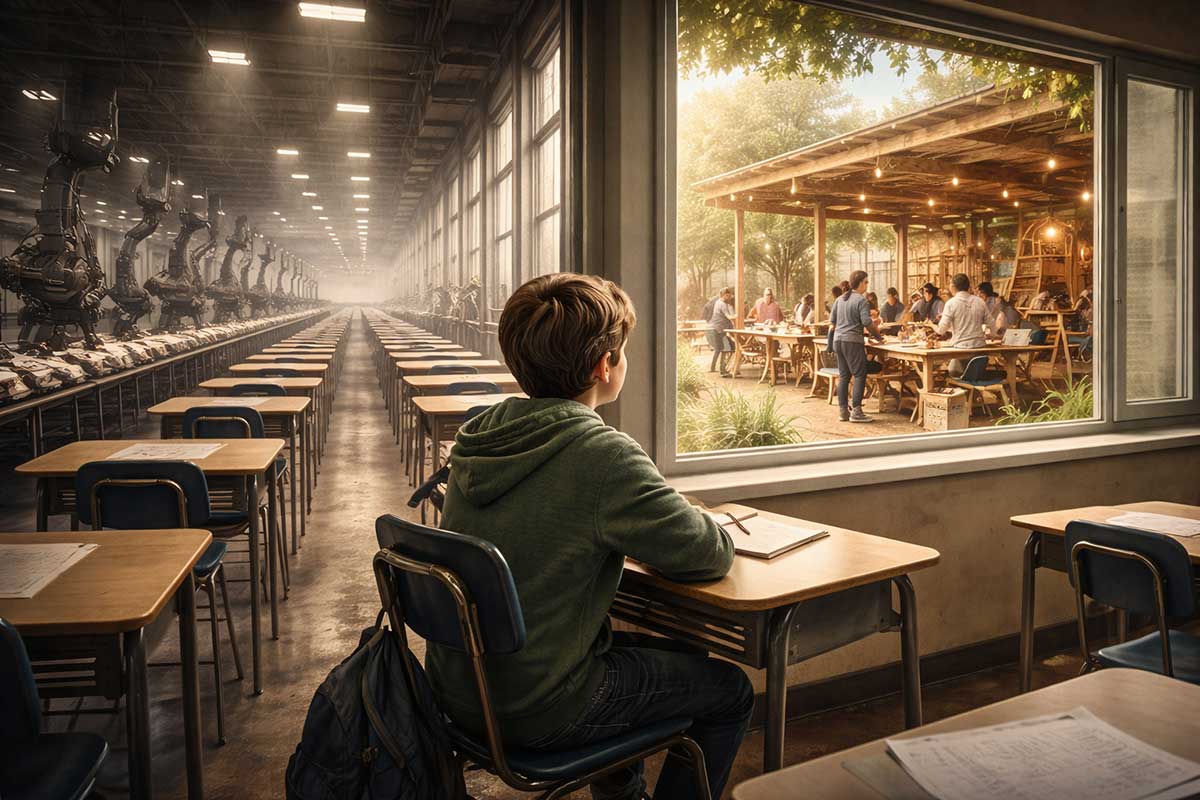
The circle remained, but the tone shifted. Less personal psychology, more history. The question was no longer about children individually, but about the architecture surrounding them.
Yuval Noah Harari folded his hands.
If we want to answer Do Schools Kill Creativity, we must first ask a prior question.
What problem were schools originally designed to solve?
Because systems rarely malfunction randomly. They succeed at the purpose they were built for, even when society changes.
Which parts of schooling were designed for the industrial economy rather than human learning?
John Dewey
The modern classroom mirrors the factory more than the laboratory.
Age grouping, synchronized schedules, standardized subjects, uniform pacing. These were logical solutions for managing large populations efficiently. The aim was social coordination, not individual exploration.
Education became preparation for a predictable role in society, not discovery of personal capacity.
So the structure is not cruel. It is simply inherited.
Paulo Freire
Yes, and it produces what I called the banking model of education.
Knowledge is deposited into students. They are containers, not creators. This model fits hierarchical economies where obedience and repetition matter more than invention.
Creativity becomes disruptive to the structure. Therefore it is quietly discouraged, not by teachers’ intentions but by institutional logic.
Diane Ravitch
Mass schooling expanded alongside industrial growth because governments needed literate workers and citizens who could follow shared rules. Standardization allowed fairness at scale.
The challenge now is that fairness through sameness conflicts with learning through difference. When accountability relies on identical measurement, instruction narrows.
We start teaching what is easy to measure instead of what is important to develop.
Andreas Schleicher
International comparisons show this clearly.
Systems optimized for reliability outperform in routine tasks. But when economies shift toward innovation, those same systems struggle. The model trains compliance effectively but adaptability poorly.
The issue is not that standardization never works. It works very well for the world it was built for.
The world simply changed faster than the structure.
Ivan Illich
And once institutions exist, they perpetuate themselves.
Schooling becomes confused with learning. Credentials replace competence. People seek certification rather than understanding because society rewards the certificate.
Creativity suffers not because it is forbidden, but because it is unnecessary for institutional success.
Yuval Noah Harari
So the factory model succeeded historically. The question becomes practical.
If the factory model is the root issue, what replaces it that can still scale to millions?
John Dewey
We shift from uniform instruction to guided inquiry. Teachers become designers of experiences rather than deliverers of content. The curriculum adapts to questions, not the reverse.
Scale comes from method, not sameness.
Paulo Freire
Dialogue must replace narration.
Students participate in constructing knowledge. When they help create understanding, they also learn responsibility. Creativity grows alongside agency.
Large systems can still function, but authority changes shape.
Diane Ravitch
We should keep shared goals but diversify pathways.
Common expectations do not require identical instruction. Standards define destination, not route. Multiple routes increase engagement without sacrificing equity.
Andreas Schleicher
Technology can support this transition.
Adaptive systems personalize practice while teachers focus on mentorship and problem solving. The teacher’s role becomes more human, not less.
Scale becomes possible through flexibility rather than rigidity.
Ivan Illich
We must also reduce the monopoly of school over learning.
Communities, apprenticeships, and real world participation should count as education. When learning exists everywhere, schools no longer carry the impossible burden of containing all growth inside one building.
Yuval Noah Harari
Then perhaps the final question.
If curiosity led the design instead of compliance, what would the school day actually look like?
John Dewey
Projects organized around real problems. Subjects integrated rather than separated.
Paulo Freire
Discussion before memorization. Questions before answers.
Diane Ravitch
Assessment after exploration, not before it.
Andreas Schleicher
Flexible pacing, allowing mastery rather than time limits.
Ivan Illich
Learning extending beyond the classroom walls into society.
Yuval Noah Harari
Then we see the answer emerging.
Schools do not kill creativity because teachers oppose it.
They limit creativity because they were engineered for a different civilization.
The challenge is not reforming attitudes.
It is redesigning purpose.
Topic 3 — The Hidden Hierarchy of Intelligence
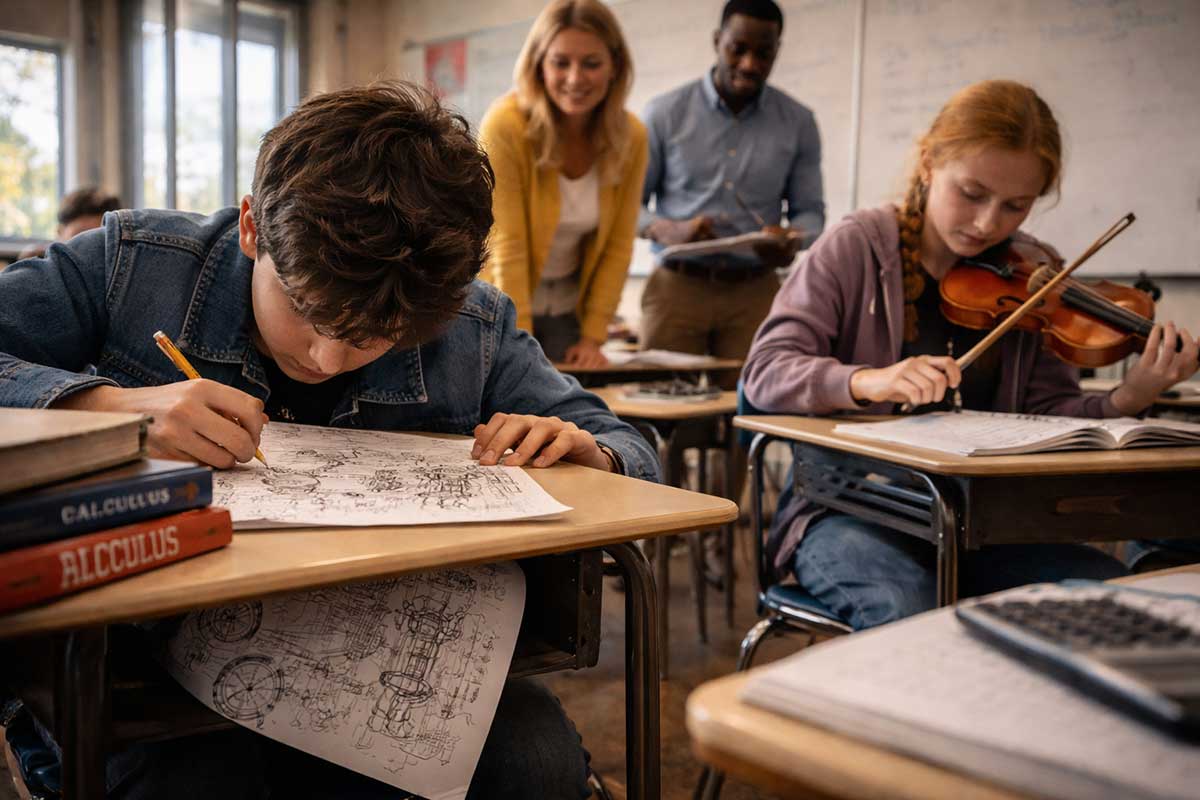
The chairs had not moved, but the conversation had shifted again.
Now the focus was not history, nor fear, but something quieter and more personal. Identity.
Why do some children grow up believing they are smart, while others quietly conclude they are not?
Howard Gardner looked around the circle.
When we ask Do Schools Kill Creativity, we are also asking another question.
Who gets told they are intelligent, and who gets told they are not?
Schools rarely say it directly. Yet every day, children receive the message.
Why did education elevate certain subjects as real intelligence and demote others?
Maria Montessori
Because order is easier to manage than diversity.
Abstract symbols such as numbers and language fit neatly into lessons and examinations. Movement, art, music, and building belong to the body and senses. They are harder to standardize.
So schools valued what could be easily measured, not what was most human.
Temple Grandin
And that decision shaped lives.
Many visual thinkers or pattern thinkers struggle early in school. Not because they cannot think, but because they think differently. I learned through images, not words.
When schools rank intelligence narrowly, students like me believe they are broken before discovering their strengths.
We do not lose ability. We lose confidence first.
Yo-Yo Ma
Music education shows this clearly.
In an orchestra, intelligence is listening, timing, sensitivity, coordination, memory, interpretation, and emotion working together. Yet a child who excels at this may still be considered average academically.
Society praises creativity publicly but ranks it privately. Children notice the contradiction.
Sir Ken Robinson
Yes, the hierarchy is cultural.
Mathematics and language sit at the top. Humanities follow. The arts remain at the bottom. Even within the arts, music and visual arts outrank dance because the body is treated as less intellectual than the head.
Yet creativity often lives in the body as much as the mind.
Schools do not intend to silence talent.
They simply do not recognize all forms of it.
Rita Pierson
And children internalize that ranking very quickly.
A student may say, “I am bad at school,” when what they mean is, “The way I think is not valued here.”
Once they believe that, effort drops. Not from laziness, but from self protection. Why invest energy where you are already labeled limited?
Howard Gardner
So let us press deeper.
How does this hierarchy shape identity, confidence, and life choices?
Maria Montessori
Children build their sense of self from repeated experience. If success appears only in narrow tasks, they conclude ability is narrow. When the environment widens, the child widens.
Identity follows opportunity.
Temple Grandin
Many innovators were poor traditional students.
They persisted because they found environments where their strengths mattered. Without that, they would have assumed they had none.
A system that recognizes only one intelligence discards problem solvers it desperately needs.
Yo-Yo Ma
Respect is formative.
When a child sees their gift treated seriously, discipline follows naturally. Passion becomes responsibility. But if their strength is treated as extracurricular, they treat themselves as secondary.
The hierarchy becomes self-fulfilling.
Sir Ken Robinson
Exactly.
We have confused academic ability with intelligence itself. That mistake shapes entire lives. Children leave education not knowing their talents because they were never given the status required to notice them.
Rita Pierson
And relationships reinforce it.
Teachers unintentionally encourage students who succeed in the valued categories. Others receive less feedback, less expectation, less attention. Expectations shape performance more than instruction alone.
Howard Gardner
Then the final question.
What would an equal respect curriculum look like in practice?
Maria Montessori
Longer uninterrupted work periods and choice within structure.
Temple Grandin
Hands-on design and visual problem solving as core subjects.
Yo-Yo Ma
Collaborative artistic practice integrated with academic study.
Sir Ken Robinson
Assessment across multiple forms of expression, not only written recall.
Rita Pierson
Adults trained to recognize potential before performance.
Howard Gardner
Then perhaps the answer emerges gently.
Schools do not usually destroy creativity by removing it.
They do it by ranking it.
When only certain minds are called intelligent, many minds stop trying to be.
Topic 4 — Academic Inflation and the University Pipeline
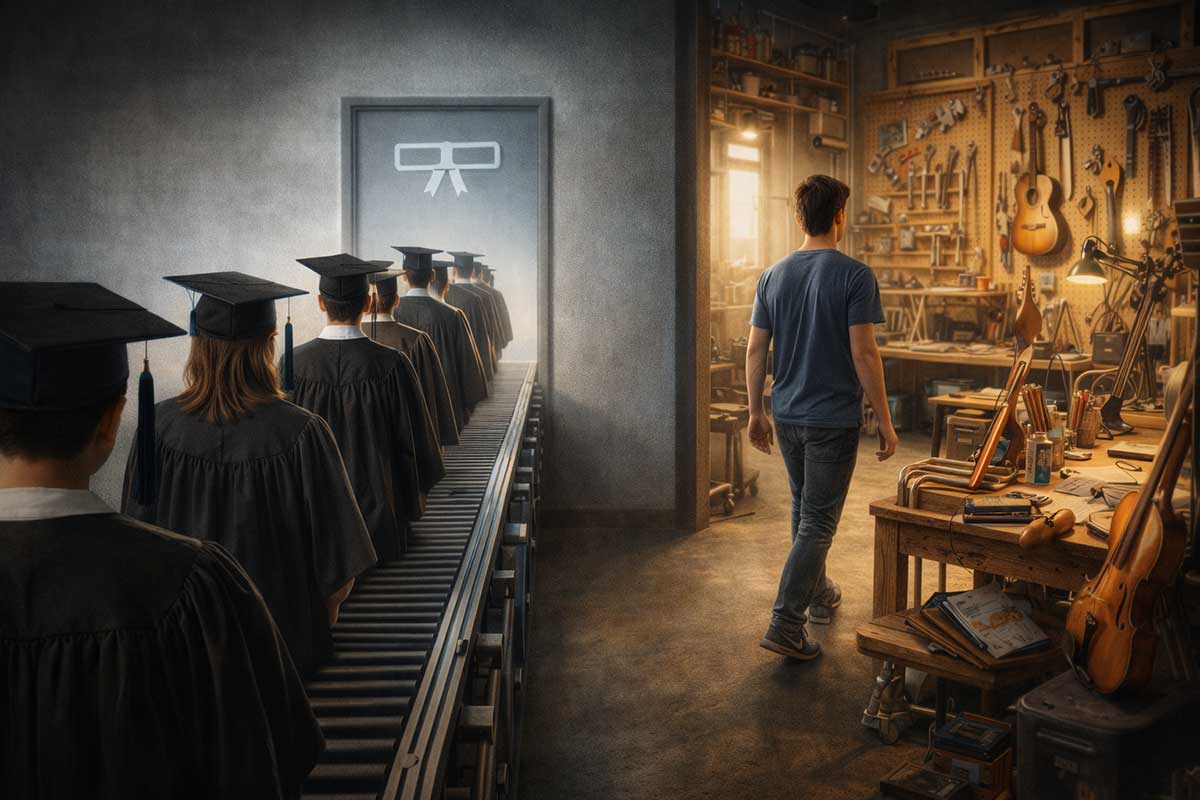
The circle had grown thoughtful. The previous discussion left a quiet realization hanging in the air: it wasn’t only what happened inside classrooms. It was what classrooms were aiming toward.
A single destination.
Malcolm Gladwell rested his elbows lightly on his knees.
We have talked about fear and hierarchy. But there is a powerful force pushing both. A promise repeated to every child for generations.
Study hard so you can go to college.
Go to college so you can succeed.
If we are asking Do Schools Kill Creativity, we must ask whether the destination itself reshapes the journey.
How did academic credentials become the main definition of intelligence and success?
Bryan Caplan
Because degrees became signals.
Originally they represented knowledge. Over time they represented traits employers wanted, persistence, conformity, reliability. School became less about learning and more about proving you can complete the process.
Once society rewards the signal, schools optimize for the signal.
Creativity is inefficient signaling. Compliance is efficient signaling.
Scott Galloway
And economically, scarcity created prestige.
When fewer people attended university, the degree separated you. As more people attended, the pressure increased to attend simply to avoid falling behind. The credential stopped indicating excellence and started preventing exclusion.
So students pursue safety. Not curiosity.
Angela Duckworth
There is also a psychological dimension.
Goals shape effort. If the goal becomes admission rather than mastery, students train for evaluation. They develop perseverance, but toward checkpoints rather than understanding.
Grit can serve learning or serve performance theater, depending on incentives.
David Epstein
Specialization arrives too early.
Many systems push students to narrow their path to optimize admission outcomes. But innovation often comes from breadth. People discover their strengths through sampling, not early narrowing.
When exploration threatens admissions efficiency, exploration disappears.
Claudia Goldin
And labor markets reinforced the pattern.
Employers needed simple filters for large applicant pools. Degrees became convenient. Schools aligned to employer filters. Families aligned to schools. The loop stabilized itself.
The system rewards predictability more than originality because predictability is easier to evaluate at scale.
Malcolm Gladwell
So the pipeline persists because every participant behaves rationally within it.
Then let us ask the uncomfortable part.
When does the college pipeline create opportunity, and when does it become a creativity bottleneck?
Bryan Caplan
It creates opportunity when it teaches useful skills.
It becomes a bottleneck when completion matters more than competence. At that point, learning becomes secondary to endurance.
Scott Galloway
For some professions it remains essential. For many others it is defensive. Students accumulate debt to avoid social penalty, not to gain specific capability.
Fear drives the decision, and fear rarely produces bold thinkers.
Angela Duckworth
Motivation matters here.
When students pursue external validation only, persistence drops once validation ends. Creativity requires intrinsic motivation, which the pipeline can unintentionally weaken.
David Epstein
Late specialization correlates with adaptability. Early funneling narrows identity. A system designed to select quickly loses people who develop slowly but profoundly.
Claudia Goldin
The economic cost is misallocation of talent.
Societies grow when people use their comparative advantage. A single prestige path discourages diverse contributions.
Malcolm Gladwell
Then perhaps the constructive question.
What alternative pathways could schools offer that still carry status and dignity?
Bryan Caplan
Skill certification independent of seat time.
Scott Galloway
Prestige apprenticeships connected to industry.
Angela Duckworth
Recognition for mastery portfolios, not only transcripts.
David Epstein
Structured exploration years before specialization.
Claudia Goldin
Labor markets valuing demonstrated capability over pedigree.
Malcolm Gladwell
Then the conclusion feels less radical than expected.
Schools do not suppress creativity simply through teaching methods.
They suppress it by aiming every student toward one narrow finish line.
When success has only one form, thinking soon follows one form.
Topic 5 — Making Creativity as Important as Literacy

The atmosphere in the room softened. The earlier topics had diagnosed the problem.
Now the circle leaned toward possibility.
If schools unintentionally limit creativity, what would it actually mean to restore it without abandoning education itself?
Maria Montessori spoke gently.
We have discussed fear, structure, hierarchy, and pathways. Yet the heart of the question remains simple.
If creativity is truly equal to literacy, how do we teach it without turning it into another subject to memorize?
Ken Robinson
First, we must stop treating creativity as a talent possessed by a few.
Creativity is a process. It is the act of generating ideas that have value. Like reading, it improves with use. Like writing, it requires expression.
The mistake is not that schools teach subjects.
It is that they rarely teach thinking within them.
Every subject contains creativity when approached as inquiry rather than instruction.
Sugata Mitra
Children already learn creatively when given agency.
When groups of students explore a question together without immediate correction, they build explanations, challenge each other, and refine understanding. The teacher becomes a guide, not a source.
Creativity appears naturally when curiosity leads structure instead of following it.
Satya Nadella
From an innovation perspective, the most valuable ability is learning continuously.
Technology changes too quickly for fixed knowledge to remain sufficient. What matters is adaptability, collaboration, and imagination applied to problems that do not yet exist.
Teaching creativity means teaching students how to approach the unknown without paralysis.
Rita Pierson
And relationships make that possible.
Students create when they feel safe with the adults guiding them. Encouragement does not lower standards. It raises participation. Participation builds competence.
Before students believe in their ideas, they must believe someone is listening.
Mitchel Resnick
We see this in creative learning environments.
Projects, passion, peers, and play. When learners build something meaningful to them, they iterate naturally. Reflection replaces memorization as the driver of understanding.
Creativity grows through cycles, imagine, create, test, share, refine.
Maria Montessori
Then let us ask the structural question.
Which change matters most first: assessment, schedule, teacher training, or environment?
Ken Robinson
Assessment.
As long as tests reward only recall, teaching will follow recall. Change assessment and practice changes with it.
Sugata Mitra
Environment.
Flexible spaces invite exploration. Rigid spaces invite obedience.
Satya Nadella
Teacher preparation.
Educators must be trained as mentors of thinking, not distributors of answers.
Rita Pierson
Time.
Students need uninterrupted periods to think deeply. Creativity does not occur in five minute fragments.
Mitchel Resnick
Culture.
Schools must celebrate iteration, not just completion.
Maria Montessori
Then the practical question.
What is the smallest reform a real school could implement this year that measurably increases creativity?
Ken Robinson
Replace one weekly test with a weekly project.
Sugata Mitra
Allow collaborative problem solving before explanation.
Satya Nadella
Add reflection journals across all subjects.
Rita Pierson
Guarantee every student adult mentorship.
Mitchel Resnick
Public exhibitions of student creations instead of private grading only.
Maria Montessori
Then perhaps the answer to Do Schools Kill Creativity is neither accusation nor defense.
Schools diminish creativity when they treat education as delivery.
They nurture creativity when they treat education as cultivation.
The difference is not in children.
It is in what adults choose to value.
Final Thoughts by Sir Ken Robinson
After all our discussion, the answer to the question is gentler and more hopeful than it first appears.
Schools do not set out to destroy creativity. They simply reward behaviors that make creativity less likely to appear. When correctness is valued more than exploration, students protect themselves. When intelligence is narrowly defined, many abilities go unnoticed. When success follows a single path, curiosity narrows to fit it.
None of this requires ill intention.
Only habit.
And habits can change.
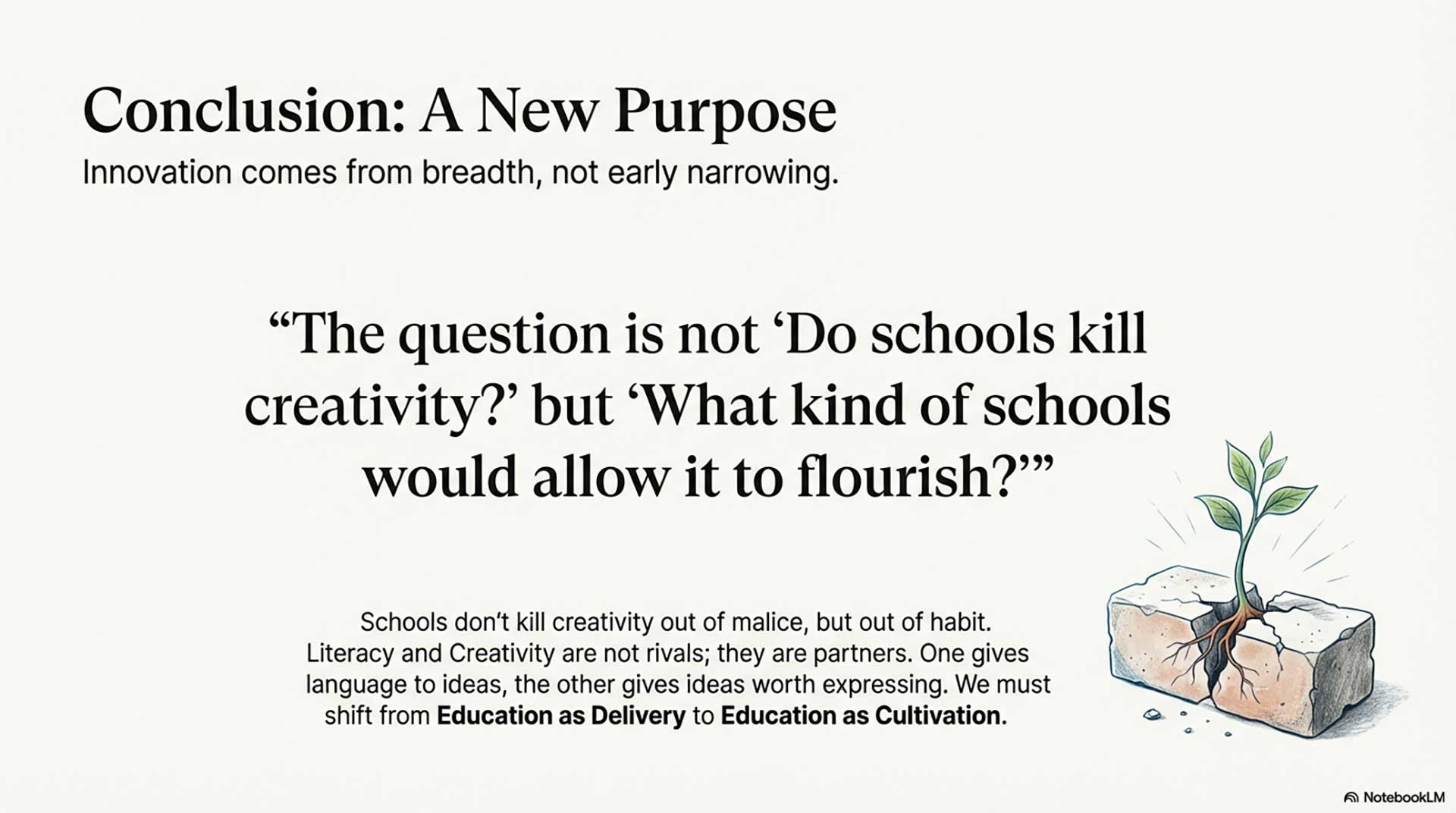
We need not choose between knowledge and imagination, nor between discipline and freedom. The real task is balance. Literacy and creativity are not rivals. They are partners. One gives language to ideas, the other gives ideas worth expressing.
When classrooms become places where mistakes are treated as information, where talents are recognized in many forms, and where learning prepares students for possibility rather than only prediction, creativity returns naturally.
Children are not short of imagination.
Adults are sometimes short of systems that allow it.
So the question, Do schools kill creativity?
Perhaps the better question is:
What kind of schools would allow it to flourish every day?
Because education, at its best, is not the filling of minds but the awakening of them.
Short Bios:
Sir Ken Robinson — British education thinker and speaker known for challenging traditional schooling and advocating creativity as a core human capacity.
Carol Dweck — Stanford psychologist who developed the growth vs fixed mindset theory explaining how beliefs about ability shape learning behavior.
Brené Brown — Research professor studying vulnerability, shame, and courage, showing how psychological safety enables creativity and participation.
Daniel Kahneman — Nobel Prize–winning psychologist whose work on decision-making explains how fear and incentives shape thinking and risk-taking.
John Cleese — Writer and comedian whose reflections on creativity emphasize play, openness, and the freedom to be wrong.
Salman Khan — Founder of Khan Academy, pioneering mastery learning and self-paced education that allows students to learn without penalty for mistakes.
Yuval Noah Harari — Historian analyzing how institutions evolve and how education must adapt to changing civilizations.
John Dewey — Philosopher of progressive education who promoted learning through experience and inquiry instead of memorization.
Paulo Freire — Brazilian educator who criticized passive learning and argued students should actively construct knowledge.
Diane Ravitch — Education historian examining policy and the impact of standardized accountability systems.
Andreas Schleicher — Director of OECD education assessments, studying how school systems influence real-world skills.
Ivan Illich — Social critic who questioned institutional schooling and promoted community-based learning.
Howard Gardner — Psychologist who proposed multiple intelligences, expanding the definition of human ability beyond academics.
Maria Montessori — Physician and educator who created child-centered learning environments encouraging independence and exploration.
Temple Grandin — Autism advocate and designer showing the importance of visual thinking and diverse cognitive strengths.
Yo-Yo Ma — Cellist emphasizing collaboration, creativity, and human expression as forms of intelligence.
Rita Pierson — Educator known for highlighting relationships and belief in students as foundations of learning.
Malcolm Gladwell — Writer exploring hidden social systems and how institutions shape opportunity and behavior.
Bryan Caplan — Economist analyzing education signaling and the labor market value of credentials.
Scott Galloway — Business professor discussing higher education economics and societal incentives around degrees.
Angela Duckworth — Psychologist researching grit and motivation in achievement and learning persistence.
David Epstein — Author studying the benefits of breadth and late specialization in expertise development.
Claudia Goldin — Nobel Prize–winning economist examining education, labor markets, and opportunity pathways.
Sugata Mitra — Educational researcher known for self-organized learning environments and curiosity-driven exploration.
Satya Nadella — Technology leader advocating lifelong learning, adaptability, and collaborative problem solving.
Mitchel Resnick — MIT researcher promoting creative learning through projects, play, and sharing.
Leave a Reply