

|
Getting your Trinity Audio player ready...
|
Introduction by Santa in Disguise
People often imagine me living only at the North Pole, stepping into the world once a year, leaving gifts, then vanishing again like a dream.
But that has never been the full truth.
The truth is simpler, quieter, and perhaps more surprising:
I walk among you.
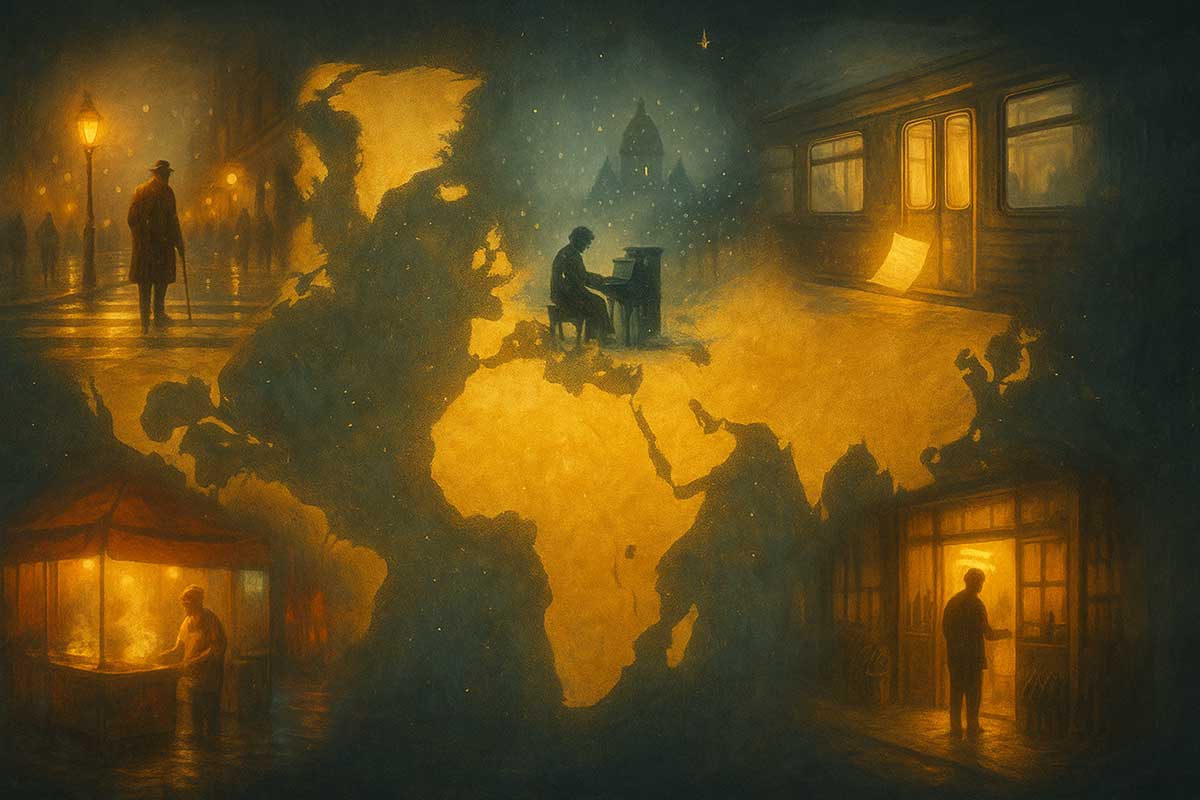
Not as the figure on postcards or the jolly giant in red, but as someone you would pass on the street without a second glance. A gentleman standing at a foggy London crosswalk. A street pianist playing beneath Paris snow. A tired cleaner on a Berlin train. A tteokbokki vendor stirring comfort into a Seoul alley. A station clerk returning more than lost items in Tokyo.
These disguises are not meant to deceive.
They are meant to bring me closer to the places where miracles are needed most.
You see, gifts are not always wrapped in ribbon.
Sometimes they are wrapped in timing, in listening, in a few words offered at the right moment. Gifts can look like safety, or courage, or someone finally being seen after a long time of feeling invisible.
As the world grows busier, as people move faster and ache more quietly, I find myself drawn to cities—vast, brilliant, lonely in their own ways. Cities where millions cross paths but rarely meet. Cities full of people carrying things no one else can see.
Here, kindness hides more easily.
Here, so does pain.
And here is where small, unnoticed acts can bloom into something extraordinary.
So I chose five cities this year.
Five disguises.
Five stories woven into the nights of London, Paris, Berlin, Seoul, and Tokyo.
Not because these cities are special, but because the people in them are—every one of them living a chapter no one else can write.
If these stories reach you, let them remind you of this:
You are surrounded by more magic than you realize.
And you are capable of giving far more than you think.
After all, I am not the only one in disguise.
Many of you are, too—hiding your tenderness behind busy schedules, your generosity behind self-doubt, your hopes behind fear of disappointment.
These stories are here to lift the disguise just a little.
So come.
Walk with me through these five cities.
Let us see together how kindness moves through the world—not loudly, not perfectly, but faithfully, even in the quietest places.
1: LONDON — The Gentleman at the Foggy Crosswalk
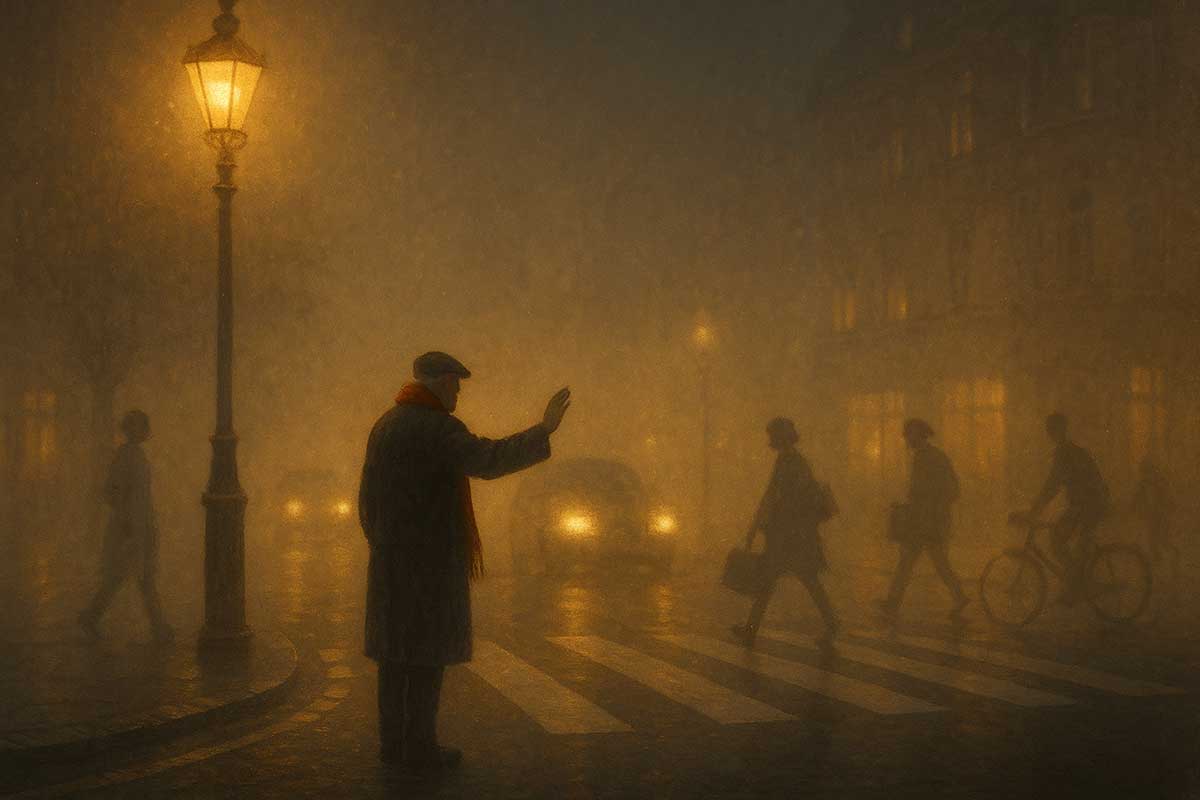
London wore its winter like an old overcoat—heavy, familiar, and full of pockets no one ever checked.
On this particular December evening, the fog rolled in low and soft, wrapping itself around lampposts and blurring car headlights into halos. At a small zebra crossing not far from St. Paul’s Cathedral, the world felt quieter than usual, as if the city were holding its breath.
That was where he stood.
Just an older gentleman, coat buttoned to his throat, red scarf tucked neatly under his chin, one hand resting on a folded umbrella. He looked like someone who had always been there—waiting politely at the curb, as if he had infinite time.
In truth, he did.
He watched the traffic lights blink from green to amber to red. He watched the people hurry—shoulders forward, eyes down, lives so heavy that their feet barely seemed to leave the ground.
Most of them did not see him.
But he saw all of them.
He was, of course, Santa.
Not the jolly figure painted on shop windows or printed on wrapping paper. Tonight he wasn’t surrounded by elves, sleighs, or reindeer. He was simply a man at a crosswalk, where the smallest nudge in timing could decide whether someone went home or didn’t.
And tonight, timing mattered.
The first person he noticed was a young woman in scrubs, coat unzipped, hair hastily pinned back. Dr. Maya Patel. She had just finished a twelve-hour shift, the last three hours consumed by one patient she hadn’t been able to save.
She walked as if the pavement might break beneath her.
When she reached the curb, the light for pedestrians was red, but Maya didn’t register it. Her eyes were glassy, fixed on some invisible point inside her mind.
She stepped forward.
A hand gently caught her sleeve.
“Not yet, dear,” said the gentleman.
A car rushed through the crossing a heartbeat later, horn blaring as it vanished into the fog.
Maya blinked. “I—I didn’t see it.”
“I know,” he said softly. “You’ve been looking everywhere but here.”
She let out a shaky breath. “Rough night,” she admitted.
“Did you lose someone?” he asked.
The question was so precise, so gentle, that she didn’t bother pretending. “Yes.”
“Did you stay until the very end?”
“Yes.”
“Did you do everything you could?”
Her throat tightened. “Yes.”
“Then you didn’t lose them,” he said. “You walked them to the door.”
The light turned green.
They crossed together, his umbrella angled just slightly so that it shielded her more than him.
At the other side, he placed something small in her hand—a folded card, smooth and warm like it had been in a pocket for a long time.
“What’s this?” she asked.
“A reminder you’ll need later,” he said.
By the time she looked up, he had already stepped back toward the fog, as if he belonged to it.
Maya walked a few more meters before curiosity won. She opened the card.
In simple handwriting, it read:
“You are not meant to save everyone.
You are meant to love the ones you can.
That is enough.”
Her eyes filled. For the first time in months, the tightness in her chest loosened just a little.
She slipped the card into her pocket like a talisman and kept walking.
The next person to reach the crossing was Danny Byrne, a bike courier with a neon bag on his back and fear in his stomach.
He was late.
He was always late this month.
Traffic was chaotic, orders never stopped, and every minute he lost meant money he desperately needed. He weaved between cars, ignoring the ache in his legs and the pounding in his head.
At the crossroads, he saw the pedestrian light was red, but there were no cars in his immediate lane.
“I can make it,” he muttered, standing on his pedals.
As he surged forward, the gentleman stepped out—not in front of him, but just enough that their eyes met.
It was the calm in those eyes that arrested him. Not anger. Not panic. Just steady concern.
Danny squeezed his brakes on instinct.
A lorry shot across the intersection a second later, so close the wind from it nearly knocked him sideways.
“Bloody hell!” Danny gasped, heart racing.
“That one wasn’t yours,” the gentleman said mildly.
“You— you just saved my life,” Danny stammered.
The man tilted his head. “Possibly. Or possibly I saved the life of the little sister you haven’t taught to ride a bike yet.”
Danny’s mouth fell open. “How do you know about Abi?”
The gentleman smiled. “You say her name in your sleep on buses.”
Danny swallowed hard.
“What if I hadn’t stopped?” he whispered.
“Then someone else would be standing at this crossing tomorrow,” the man replied. “But it wouldn’t be you.”
The light clicked green. They crossed together, Danny pushing his bike this time.
At the far side, the gentleman handed him a small, laminated card.
On it was the name of a courier company he’d heard about but never dared apply to—one known for safer routes, better hours, fairer pay.
“Maybe it’s time to ride for people who think your life is worth more than a delivery window,” the man said.
“I—I can’t just switch,” Danny protested. “What if they say no?”
The gentleman’s eyes twinkled. “What if they don’t?”
With that, he turned back toward the fog.
The card burned in Danny’s palm all the way home.
He called the number the next afternoon.
They hired him the following week.
Later that night, as the city grew quieter, a woman in a grey coat reached the crossing and stopped as though the ground itself had caught her.
Helen Marsh had worked at the same company for thirty years. That afternoon, HR had called her in and, with carefully rehearsed sympathy, ended her job.
Words like restructuring and redundancy floated through her head like bits of torn paper.
She stared at the red crossing light as if it were personally mocking her.
“Lights can be cruel, can’t they?” the gentleman said.
She sighed heavily. “Depends which side of them you’re on, I suppose.”
“Indeed,” he replied. “And which part of your life you’re in.”
She glanced at him, noticing his kind eyes, the wiry white brows, the way he seemed rooted, as if the wind couldn’t move him.
“I’m sorry,” she said. “I’m… having a day.”
“I imagine you’re having the end of many days,” he said. “Sometimes they like to disguise themselves as one.”
Her eyes narrowed. “Who are you, exactly?”
“Someone who enjoys a good story,” he said. “And yours isn’t finished.”
She laughed, but there was no humor in it. “Feels like it is.”
“Tell me,” he said, as the light turned green and they began to cross together, “when you were twenty, what did you want to do?”
She almost answered automatically, then caught herself.
“I wanted to open a bookshop,” she said quietly. “A small one. With tea. And chairs that didn’t look like they wanted you to leave.”
“And what happened?”
“Life,” she replied. “Rent. Responsibility. Sensible choices.”
“Ah,” he said. “Sensible. The dull cousin of possible.”
They stepped onto the far pavement. The fog curled around them, turning the streetlights into halos.
He reached into his pocket and drew out a small, folded flyer. It looked slightly worn, as though passed through many hands.
He gave it to her.
She unfolded it slowly.
It was a letting notice for a tiny retail space on a side street not far from her flat. She knew the place; she’d walked past it a hundred times, always imagining shelves in the windows.
Across the printed words, in a different hand, someone had written:
“Quiet Corner Books & Tea — waiting for you.”
Her throat tightened. “This is… cruel. I can’t— I don’t have—”
“You have time,” he said gently. “You have experience. You have thirty years of knowing how people behave when they’re tired and stressed and needing somewhere to rest their minds.”
Tears pricked her eyes.
“I’m too old,” she whispered.
He smiled, a slow, warm smile that seemed to lift the fog around them.
“You’re exactly the age needed,” he replied. “Who better to run a sanctuary than someone who has survived the storm?”
She laughed weakly, wiping her eyes.
“When did you get so good at talking people into madness?” she asked.
“Oh, I’ve had a bit of practice,” he said.
She looked at the flyer again. For the first time, the weight in her chest shifted—not gone, but moved aside enough to let something else in.
Something like… possibility.
When she looked up to thank him, he was already crossing back to the other side, red scarf bright in the fog.
By midnight, the streets were nearly empty. A light snow had begun to fall, soft and quiet, dusting the zebra stripes like sugar.
The gentleman stood alone at the curb.
He watched a final pedestrian hurry by, phone pressed to his ear, laughter echoing as he told someone he’d be home soon. The light turned green, then red again.
Santa breathed in the cold air, which tasted like chimney smoke and hope.
He had been many things in many cities.
Tonight, he had simply been a man at a crosswalk.
It was enough.
He touched the brim of an invisible hat to the sleeping city.
“Merry Christmas, London,” he murmured.
The fog thickened, then thinned.
When it cleared, the crosswalk was empty.
But for reasons no one could explain, people who used that crossing in the years to come often said the same thing:
“I always feel safer there. Like someone’s watching out for me.”
They were right.
He had been.
In some quiet, timeless way, he always would be.
2: PARIS — The Midnight Pianist of Montmartre
Paris liked to pretend she slept, but she never really did.
Even in winter, when the wind slipped down the narrow streets and the cobblestones shivered under the weight of cold, there were always a few windows lit, a few cafés open, a few souls too restless to surrender to dreams.
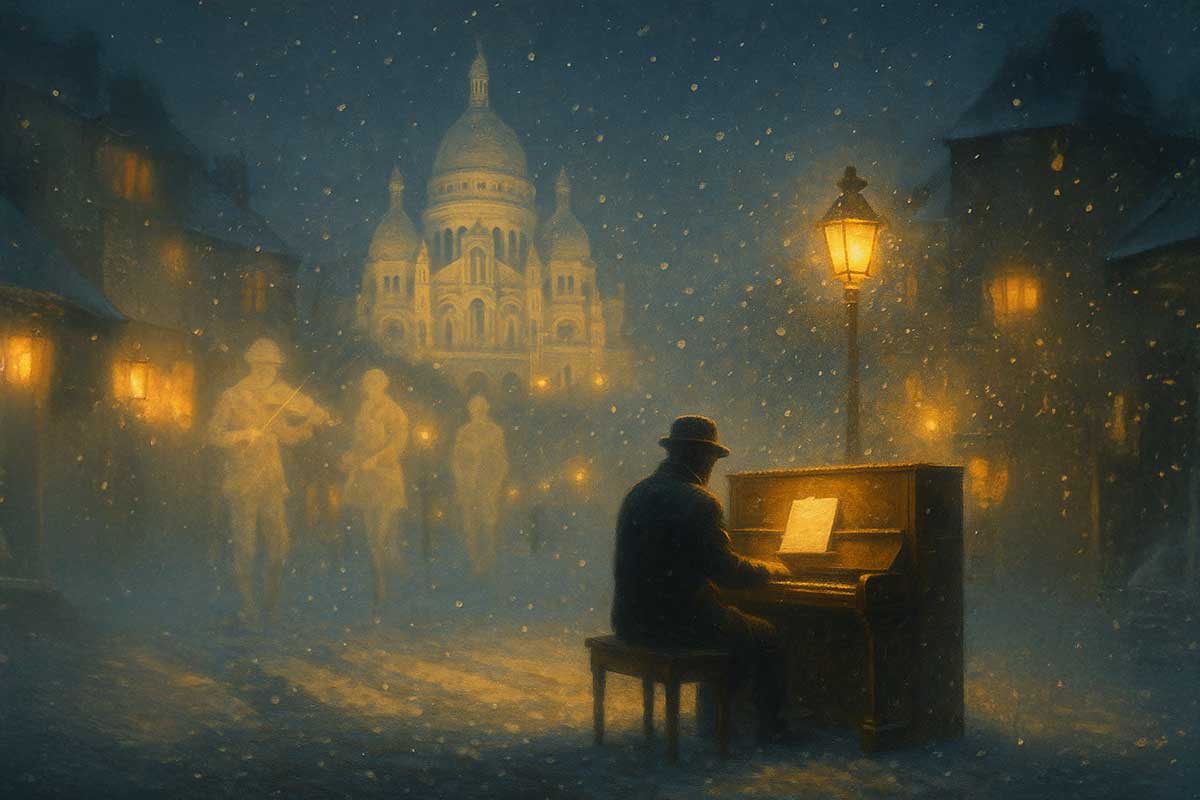
At the top of the city, beneath the white domes of Sacré-Cœur, Montmartre watched over it all. Painters and tourists filled the square by day; by night, the hill grew quieter, more reflective, as if the buildings themselves were remembering old songs.
On one such December night, when snow began to drift in lazy spirals, a piano stood alone in a small square just off the main plaza. It hadn’t been there all afternoon. No one saw it arrive. It simply… was.
It was an old upright piano, its wood scratched and polished by time, a few keys slightly yellowed. A small wooden stool sat in front of it. On top, a glass jar labeled in looping script:
“Pour les rêves oubliés” — For forgotten dreams.
No euros sat inside. Only folded bits of paper.
A man in a long wool coat and soft cap took his place at the stool. His beard was white, his eyes bright, his hands surprisingly youthful as they hovered above the keys.
He did not look like Santa Claus.
He looked like any elderly Parisian who might have once played in smoky clubs along the Seine, who now played for himself and the sky.
But when he played, something in the air shifted.
The snowflakes seemed to slow. The distant hum of traffic softened. The night itself seemed to lean closer, listening.
He waited.
He had, after all, all the time in the world.
The first person drawn in by the music was Lucien Delacroix, a painter in his early thirties with red paint on his cuffs and self-doubt under his skin.
He had just left a gallery that, after two months of “consideration,” had told him his work was “not commercially viable at this time.” They’d smiled politely as they said it, as if that made the words less sharp.
Lucien’s portfolio felt heavier than its weight. His breath fogged in front of him as he trudged up the hill, wondering if he should finally admit defeat and take the office job his brother kept suggesting.
Then he heard it.
A melody drifting through the cold — not loud, not showy, but honest. Simple chords that felt like walking into a warm kitchen after being out in the snow too long.
He followed the sound.
The pianist looked up as he approached and nodded, as if greeting an old friend.
“Bonsoir,” the man said.
Lucien stopped a few steps away. “…Bonsoir.”
“Cold night for despair,” the pianist remarked, fingers never leaving the keys.
“I’m not despairing,” Lucien lied.
“Ah,” the man smiled. “Then you must simply be walking with heavy thoughts for exercise.”
Lucien snorted despite himself.
The pianist’s hands moved into a different melody — one that reminded Lucien of his mother humming while stirring soup, of afternoons spent sketching at the kitchen table, of the thrill he’d felt the first time he saw his own painting hanging somewhere that wasn’t his room.
His chest tightened.
“How do you know that song?” he asked.
“I don’t,” the man answered. “You do.”
Lucien frowned. “I’ve never heard it before.”
“Oh, you have,” the pianist said. “You just haven’t played it on a piano.”
He nodded toward the glass jar.
“Go on,” he said. “Leave a forgotten dream.”
Lucien hesitated, then took one of the blank slips of paper from the jar’s side. His fingers were numb from the cold, but he managed to write:
“To paint something that makes one person feel less alone.”
He folded the paper, dropped it into the jar, and turned to leave.
“Lucien,” the pianist said softly.
He froze. “How do you know my name?”
The pianist’s eyes twinkled. “You signed your first painting with it, remember? In blue, too large, on the back of the canvas. You were afraid someone would see.”
The hairs on Lucien’s arms stood up under his coat.
“Go home,” the man said. “There is something waiting for you on your easel.”
Lucien didn’t ask how he knew where he lived. He was too unsettled, too tired. He walked back down the steps, the piano’s melody following him like a second shadow.
When he reached his tiny apartment in the 18th arrondissement, he almost didn’t turn on the light. But when he did, he saw it: one of his own unfinished canvases on the easel, a brush laid across it, a single line of paint more than he remembered leaving.
Someone — or something — had added a small figure to the corner of the painting: a person standing alone in a rainy street, looking up at a window of light.
The figure’s posture, its loneliness, its hint of hope… it changed everything.
Lucien stared at it, heart racing.
He picked up the brush.
And for the first time in months, he painted with joy instead of fear.
Back up in Montmartre, the pianist kept playing.
The next soul the music pulled toward the square was Amélie, a sixteen-year-old violin student from the suburbs who had run away from home that evening after a vicious argument with her parents.
They wanted stability. She wanted music.
They had called it unrealistic.
Selfish.
Impossible.
The word impossible had landed on her heart like a stone.
She sat now on a cold bench, violin case at her feet, cheeks streaked with tears, not sure where she’d sleep that night.
The piano found her before the night could.
The melody shifted into something minor, bittersweet. Notes rose and fell like someone asking questions they weren’t ready to answer.
Amélie approached, drawn like a moth to a flame.
“Do you take requests?” she asked, voice hoarse.
“Only very important ones,” the pianist said.
She swallowed. “Can you play something that tells me if I’m wasting my life?”
He chuckled softly. “That’s not a request, that’s a confession.”
She blushed, angry at herself. “Forget it.”
“Stay,” he said, without looking up. “Play with me.”
He pointed at her violin case.
Her grip tightened. “I’m not good enough.”
“You came all the way up here with your violin in that cold,” he said. “That tells me you’re serious, not perfect. Serious is all music needs.”
After a long moment, she opened the case.
Her fingers shook as she placed the instrument on her shoulder, bow hovering above the strings.
The pianist shifted to a simple chord progression. “Follow,” he said.
She did.
At first her sound was shaky. The bow squeaked, the notes wobbled. But his playing wrapped around hers like a warm coat, guiding rather than correcting.
Gradually, she relaxed. Her tone deepened. The melody unfolded, something raw and beautiful spilling from her that she didn’t know she had.
When they finished, she was breathing hard, as if she’d run a great distance.
The pianist smiled. “There. Now you have proof.”
“Proof of what?” she whispered.
“That your life is not being wasted when you do that,” he said. “Whatever else you do to pay rent, do not abandon the part of you that sounds like this.”
Tears slipped down her cheeks.
“What if my parents never approve?” she asked.
“Then they will live with that disappointment,” he said gently. “Not you.”
He nodded toward the jar.
She took a slip of paper and wrote, hand trembling:
“To play music that makes people feel seen.”
When she dropped it in, she noticed for the first time that some of the folded notes inside seemed to glow faintly, as if lit from within.
“Go home, Amélie,” the pianist said. “Tell them the truth. The world already has plenty of people doing what they hate.”
“How do you know my—?”
“The violin told me,” he replied, as if it were the most ordinary thing in the world.
She laughed despite herself.
When she looked back a minute later, he was playing again, and the snow had begun to fall more thickly, each flake catching the light from the nearby café like tiny stars.
Near midnight, an elderly man in a worn coat and carefully polished shoes approached the square.
Henri Dubois had once danced professionally in little Paris theatres, then in slightly larger ones. Now his knees ached, and the city felt faster than he did.
He had come to Montmartre that night out of habit more than hope.
When he heard the piano, he stopped.
The tune was something from long ago, a waltz he had danced to with his wife on the night they’d decided to get married. She’d been gone five years now, and he had never heard that particular arrangement since.
He followed the sound like someone following a scent.
The pianist looked up and smiled. “Bonsoir, Henri.”
Henri’s heart stuttered. “Do I know you?”
“Not yet,” the man said. “Care to dance?”
Henri let out a brittle laugh. “My dancing days are finished, I’m afraid.”
“Your knees are tired,” the pianist said. “Your heart is not.”
A single couple, younger, moved into the square, drawn by the music. Without speaking, they began to dance, clumsy at first, then slowly finding the rhythm.
Henri watched, throat tight.
“Close your eyes,” the pianist said softly.
Henri hesitated, then did.
The music swelled.
For a moment — just a moment — the years peeled away. His body felt lighter. He could smell his wife’s perfume, feel the warmth of her hand in his, hear her laughter against his chest.
His feet shifted in tiny movements, muscle memory waking up from a long sleep.
He swayed, barely moving, but inside he was waltzing across a polished floor, her dress brushing his trousers, her cheek against his own.
When the song ended, he opened his eyes again.
The square was just a square. His knees still ached.
But the crushing loneliness had eased, replaced by a tender ache that felt like love instead of absence.
“Thank you,” he whispered.
The pianist nodded once. “She misses you, too. But she’s very proud that you still polish your shoes.”
Henri laughed, wiping his eyes.
He didn’t ask how the man knew. Some questions didn’t need answers.
He approached the jar, took a strip of paper, and wrote:
“To keep dancing in my heart until I see her again.”
He placed it inside, then turned to go.
Snow fell thicker now, blanketing the hill.
When Henri looked back from the top of the steps, the piano was still there, the man still playing, but for a moment Henri could have sworn he saw something else:
A sleigh silhouette, faint as breath on a window, gliding just behind the piano.
He blinked.
It was gone.
As the bells of Sacré-Cœur chimed midnight, the pianist finished one last song.
He stood, stretched his back, and placed both hands gently on the closed lid of the piano.
“Merci, Paris,” Santa murmured. “You never forget how to dream.”
He took the jar of forgotten dreams, now glowing faintly from within, and tucked it under his arm.
By the time the first early-rising baker came through the square at dawn, there was no sign a piano had ever been there.
But in the days and months that followed, something subtle shifted.
Lucien’s painting with the lone figure in the rain found its way into a small gallery, where a stranger stood in front of it for a long time and whispered, “I thought I was the only one who felt that way.”
Amélie played her violin in the metro one weekend and watched as a tired businessman stopped, then cried quietly for reasons he couldn’t explain.
Henri took to waltzing very slowly in his kitchen every Sunday, smiling.
And whenever someone in Paris looked out over the city at night and felt suddenly less alone, they might have heard it—
A melody on the wind.
An old piano, playing just for them.
3: BERLIN — The S-Bahn Storyteller
Berlin in winter wore its history close to the surface.
The air had a certain sharpness, as if it still remembered all the words shouted and whispered through it. Concrete and glass stood beside old brick and bullet marks. Street art bloomed in unexpected corners, color against grey. The city pulsed with trains—S-Bahn and U-Bahn lines cutting through the cold, carrying lives that rarely looked up from their phones.
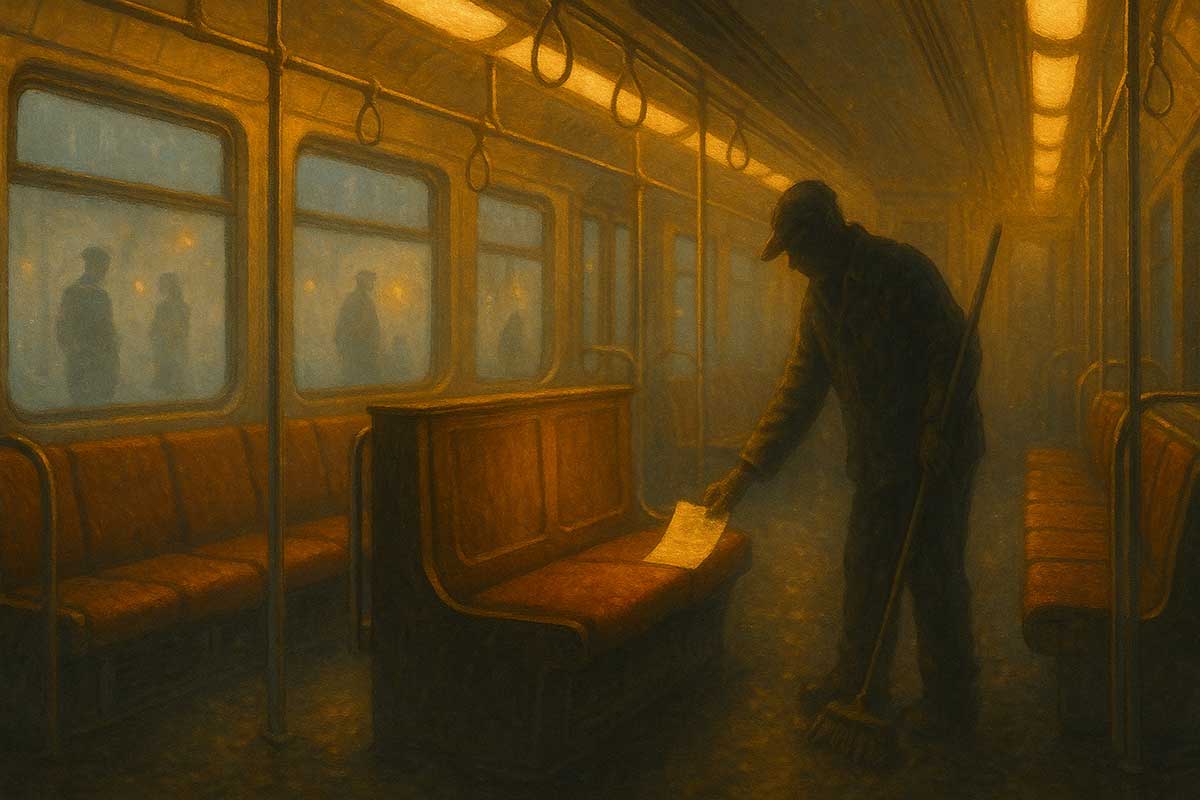
Every morning before dawn, when the platforms were still half-asleep and coffee machines just warming, a man in a bright orange cleaning vest boarded the S-Bahn at Ostkreuz.
He carried a bag of rags, a small brush, and a thermos of something that steamed in the frozen air. His beard was white. His eyes were kind. His name tag read: “Niklas.”
No one suspected it was Santa.
He worked the early shift, moving through nearly empty carriages with a slow, steady rhythm—wiping windows, collecting discarded tickets, straightening abandoned newspapers.
But he left something behind, too.
On some seats, folded neatly where a passenger’s hand would naturally fall, he left stories.
Not long ones. Not printed books.
Just single pages, handwritten, each beginning the same way:
“A person once thought their life was over when…”
On a Tuesday so cold it made the metal handrails sting, Mara Vogel stumbled onto the S-Bahn at Warschauer Straße, eyes swollen from lack of sleep.
She was a startup founder—one of many in Berlin—with a product she believed in and investors who had stopped believing. The email she’d read at 3:00 a.m. still burned in her mind: they were pulling out. Funding gone. Team uncertain. Future shredded.
She dropped heavily into a seat, hugging her laptop bag as if it were a life jacket. Her reflection in the dark window hardly looked like her—older, sharper, stranger.
Something crinkled beneath her hand.
She looked down.
A single folded page lay on the seat.
She glanced around. Only one other person in the carriage: an older cleaner in an orange vest a few rows down, humming under his breath as he polished a metal pole.
“Excuse me,” she called. “Did you drop this?”
He looked up, smiled. “If it’s on your seat, perhaps it’s for you.”
She frowned, suspicious, but curiosity won. She unfolded the page.
The heading read:
“A person once thought their life was over when…”
Underneath, in flowing handwriting:
“…the company they had built from nothing was torn apart in a single email.
They believed this meant they were a failure.
Later, they would describe this day as the moment they were returned to themselves.”
Her heart thumped faster.
“…What is this?” she asked.
“A story,” the man said. “We forget to read our own, so sometimes it helps to borrow someone else’s chapter.”
“There’s no name,” she said.
He shrugged. “Not yet.”
She stared at the page. The words continued:
“Freed from the weight of pretending everything was fine, they created something smaller, truer, and kinder—to themselves and others.
It did not make headlines.
It made a life.”
Her throat tightened.
“How did you know?” she whispered.
“About what?” the cleaner asked, gently wiping the window beside the door.
“My startup,” she said. “My investors. The email.”
He smiled faintly. “The whole city buzzes with your kind of story. You’re not the first to think an ending means you’ve failed. Usually, it just means the editor has taken your pen away long enough for you to breathe.”
Mara snorted despite herself. “That’s not how business works.”
“It is how living works,” he replied.
The train slowed for Ostbahnhof.
As the doors slid open, he stepped off, turning back just long enough to say:
“Get some rest. The next chapter won’t write itself.”
She watched him disappear among commuters, then looked down at the page again.
It should have been ridiculous. It should have felt like a joke.
Instead, for the first time in days, the panic inside her eased enough for a different thought to surface:
If this isn’t the end… what else could it be?
She folded the story carefully and put it in her wallet, next to her ID.
Two days later, the S-Bahn storyteller met Fatma Yilmaz, a grandmother in her late sixties who rode the Ringbahn every Thursday to visit her grandchildren in Neukölln.
She always sat by the window, scarf tucked neatly around her hair, tote bag full of simit and sweets on her lap. She had lived in Berlin for forty years and still sometimes felt like she was waiting to be fully accepted.
That morning, news from home weighed heavily on her—another cousin’s shop destroyed, another message about “maybe we will all have to leave.” Her hands trembled as she read the text on her old phone.
She didn’t notice the cleaner at first.
He noticed her.
When she finally looked up from the screen, she saw him wiping the glass near her seat.
“Entschuldigung,” she said automatically, shifting her bag, always worried about being in the way.
“Please, stay,” he replied in accented German that sounded like it had travelled through many countries. “You are exactly where you should be.”
She smiled politely, unsure.
“And this is exactly where this should be,” he added, placing a folded paper on her seat.
She frowned. “What is it?”
“A story for the journey,” he said.
Her curiosity, sharpened by years of raising children who always asked “Why?”, nudged her to open it.
The familiar heading:
“A person once thought their life was over when…”
She read:
“…they left the country of their birth and arrived in a foreign city where their name, their accent, and their cooking made them strange.
They believed they no longer belonged anywhere.
Years later, their grandchildren would say, ‘You are the root of our family tree. Without you, we have no place at all.’”
Fatma’s eyes blurred.
Further down:
“They did not realize, in those first lonely winters, that they were building a home that did not exist before they came.
Their presence was the miracle.
The city became more itself because they stayed.”
A tear slid down her cheek.
“How do you know…?” she began.
“Know what?” the cleaner asked gently.
“That I left Konya with two suitcases. That I thought I would go back. That I…” She swallowed. “Sometimes I still feel like a guest.”
“You brought bread,” he said quietly, nodding at her tote bag. “No one who brings bread is a guest.”
She laughed wetly. “You sound like my grandmother.”
“I am older than your grandmother,” he replied with a wink. “At least in spirit.”
The train slowed.
“Neukölln,” the announcement called.
Fatma stood, clutching the paper.
“You keep writing these?” she asked.
“I just clean,” he said. “Sometimes stories do the rest.”
He lifted his hand in a small wave as she stepped off, her heart strangely lighter. When her grandchildren later ran into her arms, she held them a little tighter, thinking:
I am not a guest. I am a beginning.
The third person to encounter the S-Bahn storyteller was Jonas, a young programmer who had become very skilled at pretending he was okay.
He wore noise-cancelling headphones, coded long hours at a co-working space near Alexanderplatz, and told everyone he “loved the grind.” At night, when he couldn’t sleep, he stared at the ceiling and thought about stepping in front of a train.
He didn’t want to die.
He just didn’t know how to keep living like this.
One icy evening, he boarded the S-Bahn at Friedrichstraße, shoulders slumped under an invisible weight. He sat automatically, headphones still on, though no music played.
Something brushed his wrist.
He looked down.
A folded page lay on his knee, as if dropped from nowhere.
He pulled off his headphones.
Across the aisle, the cleaner in the orange vest was carefully scrubbing a graffiti tag off the window. He hummed a tune that sounded suspiciously like an old lullaby.
Jonas opened the page.
“A person once thought their life was over when…”
His eyes raced ahead.
“…the grey inside them became louder than any sound outside.
They believed they were a burden.
They believed everyone else would be relieved if they disappeared.
This was not the truth.”
Jonas swallowed hard.
He kept reading.
“They did not know, in that moment, how many mornings would be brightened by their laugh.
How many friends would one day say, ‘You were the one who understood.’
How many quiet revolutions in other people’s hearts they would start, simply by surviving.”
The words blurred as tears filled his eyes.
He looked up sharply.
The cleaner met his gaze.
“You’re not a problem to be solved,” the man said. “You’re a story to be continued.”
Jonas’s voice was raw. “What if I can’t?”
“Then let others hold the pen for a while,” the man said. “Therapists, friends, strangers. That’s what we’re here for. Stories are meant to be written together.”
A pause.
“Will you promise me one thing?” the cleaner asked.
“What?” Jonas whispered.
“Promise you’ll tell someone how loud it’s become inside your head. Not someday. Soon.”
Jonas stared at the page again.
At the bottom, in different ink, a hotline number glowed like a small lighthouse.
He nodded, barely.
“I promise,” he said.
The cleaner’s shoulders relaxed.
“Gut,” he replied. “You’re late for your future, you know. Don’t miss it.”
When Jonas got off at his stop, he didn’t go straight home.
He sat on a bench outside the station, phone in trembling hand, and called the number.
He didn’t say everything. But he said enough.
It was a start.
By Christmas Eve, the stories had spread in ways no algorithm could measure.
A barista taped one to the coffee machine.
A tired teacher slid one into a stack of graded papers.
A stranger found one on a bench and copied it, changing just a few details, leaving both behind for others.
The man in the orange vest moved through the trains as always, quiet, thorough, present.
At dawn on Christmas morning, as the city lay under a thin blanket of snow, he sat alone in an empty S-Bahn carriage, stack of leftover pages in his lap.
He didn’t need them anymore.
The people of Berlin were writing their own.
He smiled, eyes crinkling.
“Danke, Berlin,” Santa whispered. “You tell very good stories.”
The train pulled into a depot. He stood, placed his cleaning cloth neatly on the seat, and stepped off.
By the time the first driver climbed aboard, yawning and ready for another day of shuttling lives around the Ring, the carriage was just a carriage.
But some mornings, when the light slanted just right through the windows, it almost looked like words were written on the glass.
And every now and then, someone still found a folded page on a seat.
Always beginning the same way:
“A person once thought their life was over when…”
And always, somehow, ending with the same quiet miracle:
They discovered it wasn’t.
4: SEOUL — The Midnight Tteokbokki Vendor
Seoul at night was a river of light.
Neon signs blinked and buzzed, taxis threaded through narrow streets, and music spilled out of basement cafés and rooftop bars. In districts like Hongdae, the air hummed with youth—buskers singing, dancers rehearsing, couples sharing street food under umbrellas.
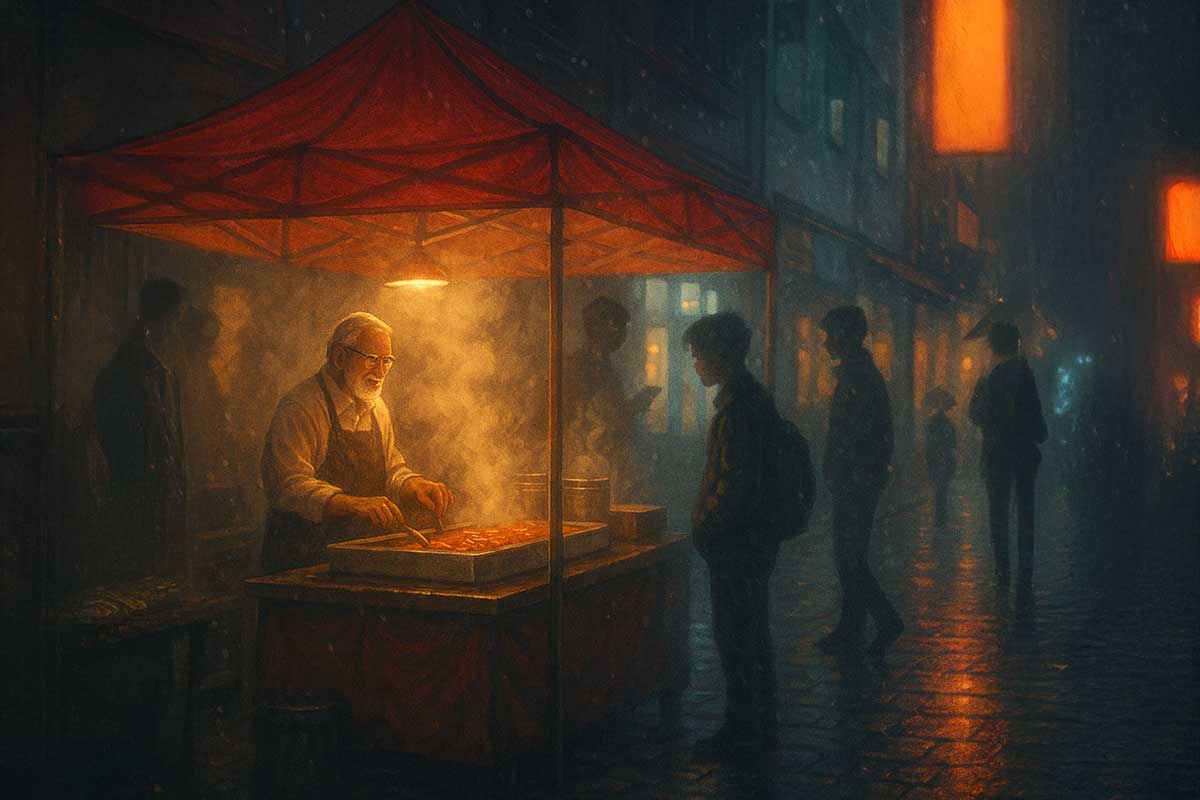
But if you walked just a little farther from the main road, down a side alley where the noise softened into a distant pulse, you could find a small red tent that looked like it had been there forever.
Steam rose from large metal pans, thick with spicy tteokbokki, fish cake broth, and skewers of odeng. Plastic stools clustered around the tent, their red seats shiny from use. A single yellow lantern swung gently overhead, painting the steam gold.
Behind the counter stood an elderly man in a red apron and cap, ladle in hand, eyes crinkled with permanent smile lines.
His nametag read: “Halabeoji.”
Grandpa.
Most people assumed it was just a friendly nickname.
No one suspected he was Santa.
He didn’t wear fur-trimmed clothes or jingle bells. Instead, he wore a stained apron and smelled of chili paste and soup. But people who sat at his tent often left with something more than a full stomach.
They left feeling… lighter.
The first visitor that December night was Jiyeon, a K-pop trainee in her early twenties. She walked like someone carrying a backpack full of invisible bricks.
Her hair was pulled into a tight ponytail, her makeup smudged from hours of practice. Her feet ached. Her throat felt raw from singing. Her mind replayed the same words from her instructor:
“Not good enough. Not special enough. Maybe this isn’t for you.”
She had skipped dinner. Again.
As she turned into the side street, the smell of broth and rice cakes hit her like a memory of childhood—nights when her mother would buy her tteokbokki after school, saying, “You worked hard. Eat.”
She stopped.
The old man behind the counter looked up.
“Come in, come in,” he said. “You look colder on the inside than the outside.”
She managed a small smile and sat on a stool.
“What can I get you?” he asked.
“Just tteokbokki,” she said. “Not too spicy, please.”
“Ah,” he replied, eyes twinkling. “For tired hearts, medium spice is best.”
He ladled soft rice cakes into a bowl, sauce glistening, and set it in front of her with a pair of chopsticks. The steam warmed her face.
She took a bite.
The taste was perfect—chewy, comforting, spicy enough to wake her without hurting.
“How did your audition go?” he asked casually.
She froze. “I… never said I had an audition.”
He shrugged. “You have trainee shoes, trainee shoulders, and trainee dark circles,” he said. “I’ve been here a long time. I know the look.”
A bitter laugh escaped her. “The audition was fine. I’m the problem.”
“Mm.” He wiped the counter slowly. “That’s what they told you?”
“They didn’t have to,” she muttered. “I can see it. There are a hundred girls better than me. Maybe staying in this is just selfish.”
He leaned on the counter, studying her gently.
“Do you like singing?” he asked.
“Yes.”
“Do you like dancing?”
“Yes.”
“Do you feel more alive when you do those things?”
Her eyes dropped to the bowl. “…Yes.”
He nodded. “Then what if the problem isn’t you? What if the problem is believing that your dream only counts if a company chooses it, instead of you?”
She looked up, frowning. “That’s not how this industry works.”
“That’s how being alive works,” he replied. “The world can reject a thousand times. But if you reject yourself, that’s the loudest ‘no’ of all.”
Something in her chest tightened.
“What if I’m not good enough?” she whispered.
He smiled. “Then you’ll become better. Or you’ll find the version of this dream that fits you. Teacher, choreographer, indie artist, vocal coach. There are many stages.”
He poured her a small paper cup of odeng broth and slid it toward her.
“Here,” he said. “For courage.”
She took a sip. The warmth sank into her like a promise.
On the inside of the cup, she noticed something printed in tiny letters—so small she almost missed it:
“You are allowed to keep going.
You are also allowed to change the path.”
She blinked. “Did you… print this?”
He shrugged. “Sometimes cups know what to say.”
She laughed despite herself.
When she finished, she realized her shoulders had dropped, the tension in her jaw eased.
“How much?” she asked, reaching for her wallet.
He shook his head. “Tonight, it’s already paid for.”
“By who?”
“By the future version of you,” he said. “She insisted.”
She rolled her eyes affectionately, but her heart caught on the image.
The future version of her. The one who didn’t give up tonight.
She bowed slightly. “Thank you, halabeoji.”
“Come back when the world feels too loud,” he said. “My tent has good ears.”
She stepped back into the neon glow, the alley feeling a little less dark.
Later that night, a bleary-eyed university student named Minho stumbled into the tent, backpack sagging with textbooks.
He dropped onto a stool like a tree being felled.
“Exams?” the old man asked.
“Yes,” Minho groaned. “And projects. And group work with people who don’t do anything. And… life.”
“Ah,” the vendor said. “You’re taking all the required courses at once.”
Minho snorted.
“What will you have?” the man asked.
“Anything,” Minho said. “As long as it’s cheap.”
“Tonight, everything is the same price,” the man replied. “One honest answer.”
Minho blinked. “What?”
“You answer one question honestly, you eat,” the vendor said. “Fair?”
It was absurd. But Minho was tired of thinking logically.
“Okay,” he said. “Ask.”
The man ladled tteokbokki into a bowl, added a boiled egg, and said:
“What are you truly afraid will happen if you fail one exam?”
Minho frowned. “My GPA will drop.”
“And then?”
“I’ll lose my scholarship.”
“And then?”
“I won’t get a good job.”
“And then?”
“I’ll disappoint my parents.”
“And then?”
He hesitated.
“…They’ll stop being proud of me,” he whispered.
The vendor nodded slowly.
“Ah. So the real exam is not on paper,” he said. “It’s the one where you believe your worth is only as strong as your grades.”
Minho stared at him, chopsticks halfway to his mouth.
“Write this down,” the old man said, pushing a napkin and pen toward him.
Minho sighed, but did as he was told.
“Write: ‘I am more than my scores.’”
He scribbled it.
“Now add: ‘But I will still study, because my dreams deserve effort, not fear.’”
Minho wrote, reading it back. Something in the words felt… different. Heavy and light at once.
“That will be 5000 won,” the vendor said cheerfully. “Payable by going home, sleeping six hours, and studying tomorrow like a human being, not a machine.”
Minho laughed, bowed, and left the napkin in his pocket. Weeks later, during a panic attack before another exam, he would find it and breathe through the words.
Just after midnight, when the main street had quieted and only a few stragglers wandered by, a man in a business suit approached the tent.
His name was Daeho, though his nametag at work said “David,” because his company thought it easier for international clients.
His tie was loose, his hair slightly mussed, his shoulders sagging in a way that had nothing to do with physical tiredness.
“Still open?” he asked.
“For you, always,” the vendor said.
Daeho sat.
“Tteokbokki?” the man asked.
“No, thank you,” Daeho said. “Just broth.”
“Ah,” the vendor said, already pouring. “Soul soup.”
They sat in silence for a moment.
“You look like someone who spends his days talking and nights not saying anything,” the old man observed.
Daeho smiled weakly. “I… talk for a living. Sales. Negotiations.”
“And when do you tell the truth?” the vendor asked.
The question hit him like a stone dropped into deep water.
He hesitated. “I… don’t know.”
The vendor slid the steaming cup toward him.
“Drink,” he said. “Then answer again.”
Daeho drank. The broth tasted like the ones his mother used to make—anchovy, kelp, something gentle and real beneath the salt.
He closed his eyes.
“When I tuck my daughter in,” he admitted. “When I tell her stories.”
The vendor nodded. “There is the real job.”
“I feel like I’m disappearing,” Daeho said quietly. “Every year I become more of a title and less of a person. Sometimes I look in the mirror and feel like I’m watching a stranger.”
“That’s not disappearing,” the old man said. “That’s wearing shoes that don’t fit.”
He reached under the counter and pulled out a laminated menu—not of food, but of… roles.
Each line had something written in Korean and English:
Father. Son. Husband. Friend. Worker. Dreamer. Child you once were.
“Which one have you stopped feeding?” the vendor asked.
Daeho stared at the “Dreamer” line.
“That one,” he whispered.
“Then start with tteokbokki,” the vendor said. “Dreams need carbs.”
Despite everything, Daeho laughed.
Under the menu, he noticed a handwritten note taped to the counter:
“You are allowed to choose a life your child will be proud to watch you live.”
His chest ached.
“If I change careers now, it will be hard,” he said.
“If you don’t, it will be harder,” the vendor replied. “One kind of hard empties you. The other kind fills you.”
A long silence.
“What if I fail?” Daeho murmured.
The old man smiled softly.
“Then your daughter will see a father who tried to live honestly,” he said. “That is not failure. That is a gift.”
Daeho’s eyes shone.
He finished his broth, bowed, and walked back into the night with a different weight on his shoulders—not lighter, exactly. But truer.
Sometime before dawn, when the neon lights dimmed and the last buses groaned past, the red tent grew quiet.
The old man cleaned the pans, stacked the stools, wiped the counter. The lantern above him flickered like a tired star.
He stepped out into the middle of the alley and looked up. Seoul towered above him—endless apartments, blinking windows, signs in every color.
“So many hungry hearts,” Santa murmured. “Good thing I have a big pot.”
He laughed softly at his own joke.
When the first pale light of morning touched the edges of the sky, the tent was gone.
In its place was an ordinary stretch of asphalt, a faint round mark where the lantern hook had been, and the faint smell of chili and comfort hanging in the air, quickly claimed by the city.
But people who had eaten there never quite forgot it.
Jiyeon would one day become a vocal coach who told her students, “Your dream isn’t invalid just because someone else can’t see it.”
Minho would become a teacher known for telling his struggling students, “You are not your grades.”
Daeho would, slowly, carefully, change paths—less money at first, more evenings at home. His daughter would tell classmates, “My dad loves what he does,” with shining eyes.
None of them would quite be able to explain why, on cold winter nights, they sometimes craved tteokbokki from a tent they couldn’t find again.
But if they listened very carefully, when the city grew quiet and the neon reflections danced on the wet pavement, they might hear it:
The clink of metal pans.
A ladle stirring.
An old man’s voice saying,
“Come in, come in. You look colder on the inside than the outside.”
5: TOKYO — The Shinjuku Lost-and-Found Guardian
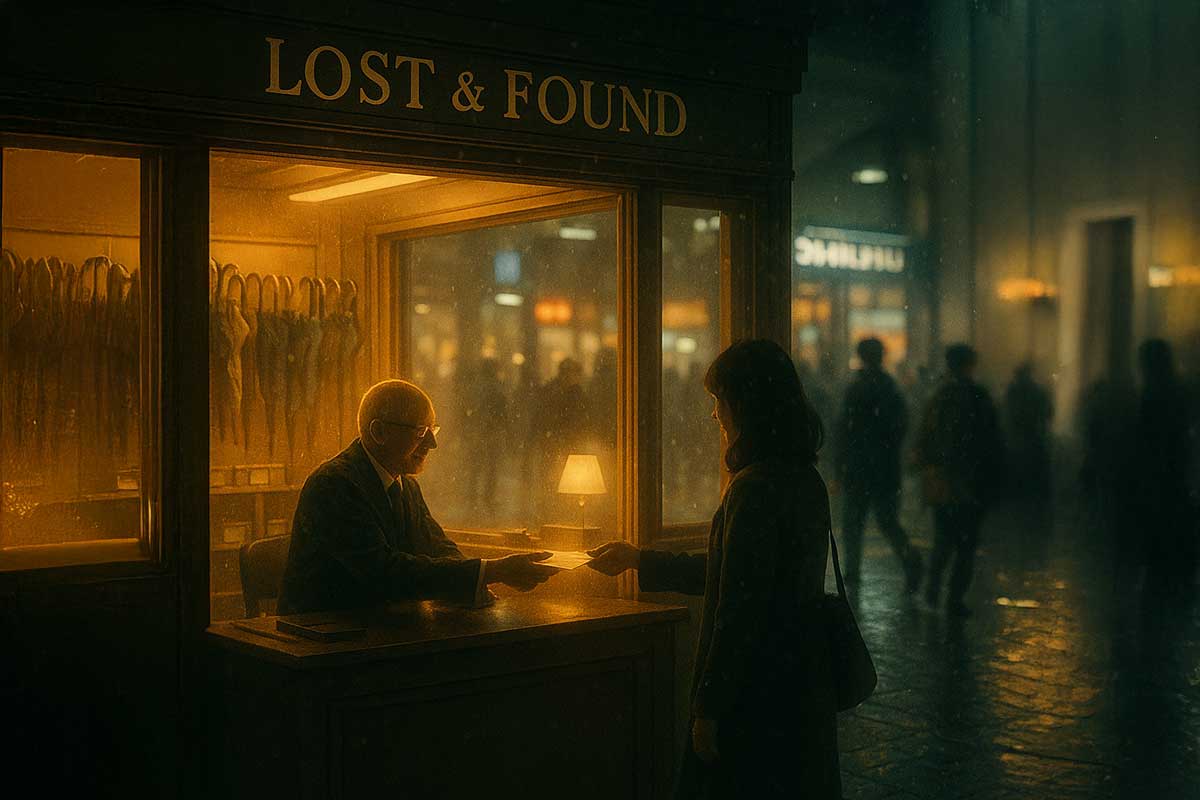
Shinjuku Station breathed like a living creature.
More than three million people moved through it every day—streams of bodies in coats and briefcases, school uniforms and shopping bags, each with somewhere to be and not enough time to get there. Signs flashed overhead, trains arrived and departed with precise regularity, and announcements flowed in calm, practiced tones.
Beneath the fluorescent lights and polished floors, a tiny room sat tucked near one of the lesser-used exits.
Lost & Found.
Most people saw it only as they rushed past, a blur of shelves and boxes and neatly labeled drawers. Inside, umbrellas leaned like a small forest. Scarves hung in quiet patience. Wallets and keychains rested in numbered plastic trays, waiting.
Behind the counter sat a man in a simple station uniform, wearing a name tag that read:
“森山 (Moriyama)”
He was older than most of the staff, with a gentle face, silver hair neatly combed back, and eyes that seemed to notice things without staring.
No one suspected he was Santa.
Not here, not in the busiest station in the world. There were no reindeer on the platforms, no sleigh parked on the tracks. There was only the endless river of commuters—and one man who made sure that what they lost had a chance of finding its way home.
But not everything he returned could be placed in a tray.
Some things people had lost long before stepping into Shinjuku Station.
Those, he returned in other ways.
The first person that December he truly watched was Kenji, a salaryman in his mid-thirties whose life had become a series of identical days.
He worked late. He ate convenience store dinners. He listened to podcasts about productivity while feeling less productive than ever. The job he had wanted at twenty-five now felt like a tunnel with no visible exit.
One night, hurrying to make a transfer, he dropped his Suica card and didn’t notice until he reached the turnstile.
He froze, patting his pockets, panic rising. Without the card, he couldn’t get home easily. Without home, he couldn’t recharge for the next grinding day. The thought felt bigger than it should have.
He retraced his steps, scanning the floor.
Nothing.
After ten minutes of searching, he gave up and trudged to the Lost & Found counter, feeling foolish. It had only been half an hour. Surely no one had turned it in yet.
“Sumimasen,” he said, bowing slightly at the window. “I lost my—”
“Suica card?” the man behind the counter finished, holding one up between two fingers.
Kenji blinked. “How did you—? I mean—yes. That’s mine, I think.”
“Name?” the man asked.
“Takeda Kenji.”
The clerk flipped the card, checked the back, and nodded. “You walk very fast, Takeda-san.”
Kenji flushed. “I was trying to catch the train.”
“Sometimes the train is not what you’re trying to catch,” Moriyama said mildly.
Kenji hesitated, unsure how to respond.
The older man slid a small form across the counter. “Please write your name here. And—if you don’t mind—one thing you’re afraid you’ve lost that isn’t on this card.”
Kenji stared at him. “Is this… a survey?”
“You could say that,” the clerk replied.
He should have refused. He was tired. It was strange.
Instead, he found his pen moving.
On the second line, without really thinking, he wrote:
“The part of me that used to be excited to wake up.”
He almost scratched it out.
But the man behind the counter simply read it, eyes kind.
“Ah,” Moriyama said softly. “That’s a common item. Many people misplace it around their late twenties. We tend to find it in the same place.”
“Where?” Kenji asked quietly.
The clerk smiled. “Where you stopped doing things just because they were fun, not useful.”
Kenji let out a short, self-conscious laugh. “I don’t have time for fun.”
“Then you don’t have time for yourself,” the man replied. “And you’re the one doing all the working.”
He reached under the counter and placed something small in Kenji’s hand.
It was a ticket—one of those old-fashioned paper types, stamped with a date and a destination: “Enoshima.”
“This isn’t valid,” Kenji said. “We use IC cards now.”
“Then think of it as a suggestion,” the clerk said. “You used to love the ocean, didn’t you?”
Kenji’s heart skipped.
He had gone to Enoshima as a child, searching for seashells and building lopsided sandcastles. He hadn’t been since university.
“How do you—?”
“Stations remember more than timetables,” Moriyama said. “Take a day off. Go. Leave your suit at home.”
“There’s too much work,” Kenji murmured.
“The work will always be there,” the older man said. “You may not.”
The words landed with gentle weight.
Kenji slipped the old ticket into his wallet, next to the recovered Suica card. He bowed and stepped back into the river of Shinjuku.
Two weeks later, on a rare day off carried by a feeling he couldn’t quite explain, he stood on a beach in Enoshima, shoes off, waves cold against his feet.
The sunrise that morning cracked something open in him.
It didn’t solve everything.
But for the first time in years, he felt it again: a small, quiet excitement about being alive.
Another evening, the Lost & Found received a different kind of visitor.
Aiko, in her late twenties, approached the counter with hesitant steps. She wore a long beige coat and clutched a small clutch bag like a worry stone.
“Excuse me,” she said softly. “I lost something. On the Chūō Line. Maybe.”
“What kind of item?” Moriyama asked.
She hesitated. “It’s… a letter.”
He nodded. “Color? Size?”
She opened her mouth, closed it, then laughed nervously. “This is silly. It was never written. I… I didn’t lose it here. I lost my chance to give it.”
He regarded her calmly, as if she had said something as ordinary as “a blue umbrella.”
“Tell me,” he said. “Who was it for?”
“My grandmother,” she replied, voice shaking. “She raised me. I always meant to write her a proper thank you letter. Something beautiful. I kept waiting for the right time, the right words. And then she…”
Her throat closed.
“…she died,” Aiko finished. “Three months ago. And now there’s nothing to send.”
The noise of the station flowed around them—train doors closing, announcements calling out lines and destinations—but inside the small room, it felt as though the sound had dimmed.
Moriyama folded his hands on the counter.
“We get many such items,” he said after a moment. “Things that were meant to be said, not left in the drawer of someday.”
She blinked, tears gathering. “Can you… return them?”
He smiled gently. “Sometimes.”
He reached below the counter and brought out a narrow wooden box.
Inside were many envelopes, all unaddressed, their paper slightly yellowed, some with delicate patterns, others plain.
He selected one, set it in front of her, and slid over a pen.
“Write the letter now,” he said. “I will see that it reaches her.”
Aiko let out a small, broken laugh. “That’s not how post works.”
“That’s not how this post works,” he agreed. “But this,” he tapped the counter lightly, “is a different kind of delivery.”
She stood there for a long moment, then sat on a chair by the wall, envelope on her lap.
At first the words came slowly, dripping like reluctant rain.
“Dear Grandma,” she began.
Bit by bit, the dam broke. She wrote about small things—egg rolls packed in school lunches, the way her grandmother’s hands always smelled of soap and mandarin peel, the nights she’d sat by Aiko’s bed when she was sick.
She wrote about bigger things too—her guilt at being too busy to visit as often, the way she’d looked away from the hospital bed because it was too painful to see the strong woman she knew becoming fragile.
Finally, she wrote the words that had weighed on her chest since the funeral:
“I’m sorry I didn’t say ‘thank you’ properly while you were here.
I hope you can feel it now.
I love you.”
Her tears smudged the ink.
When she was done, she brought the sealed envelope to the counter, eyes red but clearer.
“Where shall I address it?” she asked, half expecting him to say “nowhere” or “this is just for you.”
“Here,” he said.
He took a small stamp from his pocket, one she had never seen in any post office. It bore a simple symbol: a tiny house with light in the window.
He stamped the envelope gently.
“Destination: Home,” he said. “No further address needed.”
She smiled through fresh tears. “Will she get it?”
Moriyama met her gaze.
“She already has,” he said.
She bowed deeply.
As she turned to leave, she noticed a sign taped on the back wall behind him, hand-lettered in quiet script:
“Some things must be lost
before we realize we are still connected.”
The words settled in her like warmth.
That night, she slept without the familiar weight of unsent words pressing on her chest.
On a particularly cold night, near the end of the year, a young manga artist named Ren showed up at the counter. His shoulders were hunched, his backpack heavy with sketchbooks.
He didn’t say he was an artist. He simply stated, “I’m looking for something I dropped here a long time ago.”
“What kind of item?” Moriyama asked.
Ren thought for a moment.
“…Confidence,” he said.
The older man chuckled softly. “Ah. We have whole drawers of that.”
He motioned for Ren to sit.
“You stopped drawing for yourself,” he said. “Only for deadlines. Only for likes and comments.”
Ren flinched. “How do you—?”
“You look like someone who used to draw in the margins of his textbooks,” Moriyama said. “Who used to lose track of time with a pencil in his hand. Now you look at the clock more than the page.”
Ren opened his backpack and pulled out a crumpled sketch.
“I’m not good enough,” he muttered. “There are so many better artists. Every time I open social media, I feel like I should quit.”
Moriyama studied the sketch—a small scene of a boy feeding stray cats in an alley, snow gently falling, the boy’s face tender and a little lonely.
He smiled.
“This is exactly good enough,” he said. “Because it is exactly you.”
“That’s not how editors talk,” Ren said bitterly.
“Editors talk about magazines,” Moriyama replied. “I am talking about hearts.”
He reached under the counter and produced a small, battered notebook.
“Here,” he said. “This was left here many years ago. No name. No claim. It’s yours now.”
Ren opened it.
Every page was filled with rough sketches—clumsy, unpolished, but bursting with joy. A dog with too-long legs. A crooked house. A girl with wings too big for her body.
On the inside cover, someone had written:
“I draw because it feels like breathing.
If someone likes it, that’s extra.”
Ren’s eyes stung.
“I want you to fill the rest of that notebook,” Moriyama said. “Not for followers. Not for editors. For the boy who used to draw in the margins.”
Ren nodded slowly, clutching it to his chest.
“For payment,” the older man added, “you must draw one thing that makes you feel calm and pin it above your desk.”
Ren laughed softly. “That’s all?”
“That’s everything,” the clerk said.
On New Year’s Eve, Tokyo pulsed with countdowns and screens and cheers. Shinjuku Station continued its endless rhythm—trains arriving, trains departing, people moving.
Inside the Lost & Found, the fluorescent lights hummed softly.
Moriyama sat alone, hands folded on the counter. Shelves of umbrellas and forgotten scarves stood in orderly rows behind him, quietly guarding other people’s carelessness.
He closed the ledger, its pages filled with item numbers and dates and brief descriptions.
Then, with a small smile, he whispered:
“Arigatou, Tokyo. You lose many things. But you find so much more.”
He stood, smoothed his uniform, and hung his name tag on a hook by the door.
For a moment, if anyone had been watching, they might have seen something odd—the faint outline of a heavier coat around his shoulders, the suggestion of a fur-trimmed hat where his hair should be.
But no one was watching.
When the first shift worker arrived just after dawn, the Lost & Found looked the same as ever—shelves, drawers, neat labels.
Only one difference:
On the counter lay a small sign in clear, simple Japanese:
“Not all that is lost is gone.
Some of it is simply waiting
for you to come back to yourself.”
No one could remember putting it there.
Yet no one removed it.
And in the years that followed, people who visited the Shinjuku Lost & Found sometimes left with more than a wallet or an umbrella.
They left with something they hadn’t even known was missing—
A bit of courage.
A breath of hope.
A tiny, persistent sense that the world was, somehow, rooting for them.
Santa, for his part, had already moved on to another city, another disguise.
But a part of him stayed there too, in that quiet room beneath the busiest station in the world.
Watching.
Waiting.
Guarding all that we lose
until we are ready
to find ourselves again.
Final Thoughts by Santa in Disguise
Now you know.
Not the legend.
Not the myth.
But the truth behind the many faces I wear.
People often ask, “Why don’t you reveal yourself? Why stay hidden?”
But I am not hidden.
I am simply ordinary.
That is the real magic.
For if kindness required a costume, or a flying sleigh, or a name whispered through centuries, it would be too easy to dismiss as something belonging only to me. But when it arrives from a stranger, a neighbor, a passerby at a crosswalk, you begin to understand:
Kindness is not mine alone to give.
It belongs to everyone.
In London, someone will pause at a crosswalk because they remember the feeling of being protected.
In Paris, a musician will play not for applause, but for the one heart listening in the dark.
In Berlin, someone will leave a story on a train, hoping it finds the person who needs it.
In Seoul, an elder will serve warm food to someone colder on the inside than the outside.
In Tokyo, a clerk will treat a stranger’s sorrow as something deserving of careful return.
That is how my work continues long after I leave.
Not because I stay,
but because you carry it forward.
So let these stories remind you:
You never truly know what someone is carrying.
You never truly know what someone is losing.
And you never truly know what quiet miracle your smallest action might begin.
I will keep traveling, of course.
New cities, new faces, new disguises.
But I am always closest not when you look for me—
but when you become the reason someone else believes in goodness again.
Wherever you are, whoever you are, whatever you are facing…
I see you.
I believe in you.
And I am cheering for you in more ways than you will ever realize.
Until we meet again—
in a station, on a street, through a word, through a kindness—
Merry Christmas,
from the one who has always been beside you,
in more disguises than you can imagine.
– Santa in Disguise
Short Bios:
Leave a Reply