

Introduction by SID (Santa In Disguise)
New York City is a place that believes it has seen everything.
It has watched hopes rise in glass towers, and hearts break on cold subway benches. It has witnessed miracles dressed as coincidences, kindness tucked into strangers’ pockets, and love disguised as everyday routine. If you stand quietly enough in a city like this, you begin to notice something: people are carrying far more than they ever say out loud.
I have walked these streets for longer than memory, wearing a thousand faces and a hundred uniforms, always blending into the lives around me. You’ve passed me before—maybe holding a door, sweeping a floor, handing you coffee, or giving you a moment you didn’t know you needed. I have never been one for grand entrances. Magic is gentler when it arrives unnoticed.
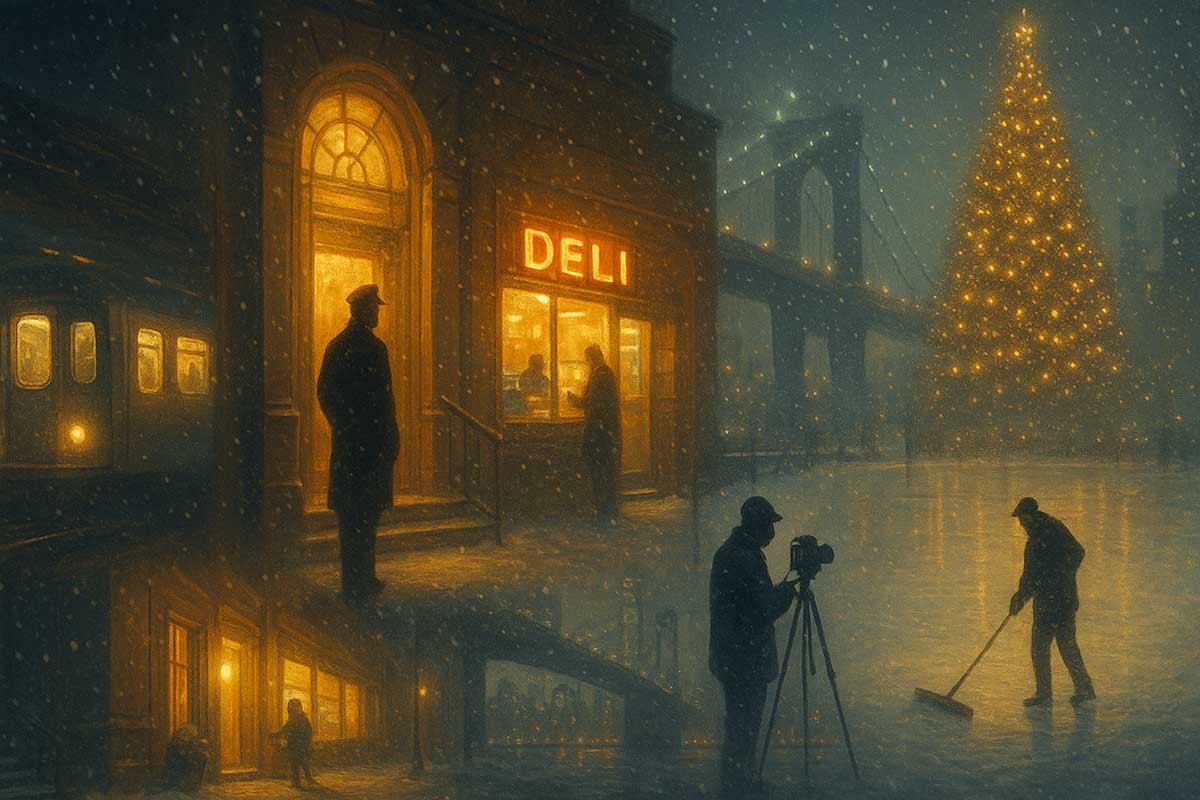
Each December, I come to New York not with a sleigh or reindeer, but with something far more ordinary: a broom, a camera, a deli apron, a subway seat… and the quiet certainty that every person deserves to be seen.
Miracles, after all, are rarely spectacular.
Most of the time, they look like kindness.
These five stories are not tales of gifts wrapped in silver paper. They are stories of hearts rediscovered, burdens lifted, futures glimpsed, and memories returned at the moment they were needed most. Stories of the small nudges I leave behind—just enough to point a weary soul back toward hope.
You may not recognize me in these pages.
That’s quite all right.
I work best when you don’t know I’m there.
But if, someday, on a snowy night, you feel someone holding a door for you… earlier than expected… longer than needed… with a warmth that feels strangely familiar—
Well.
Just say hello.
I might be closer than you think.
Story #1: The Subway Santa
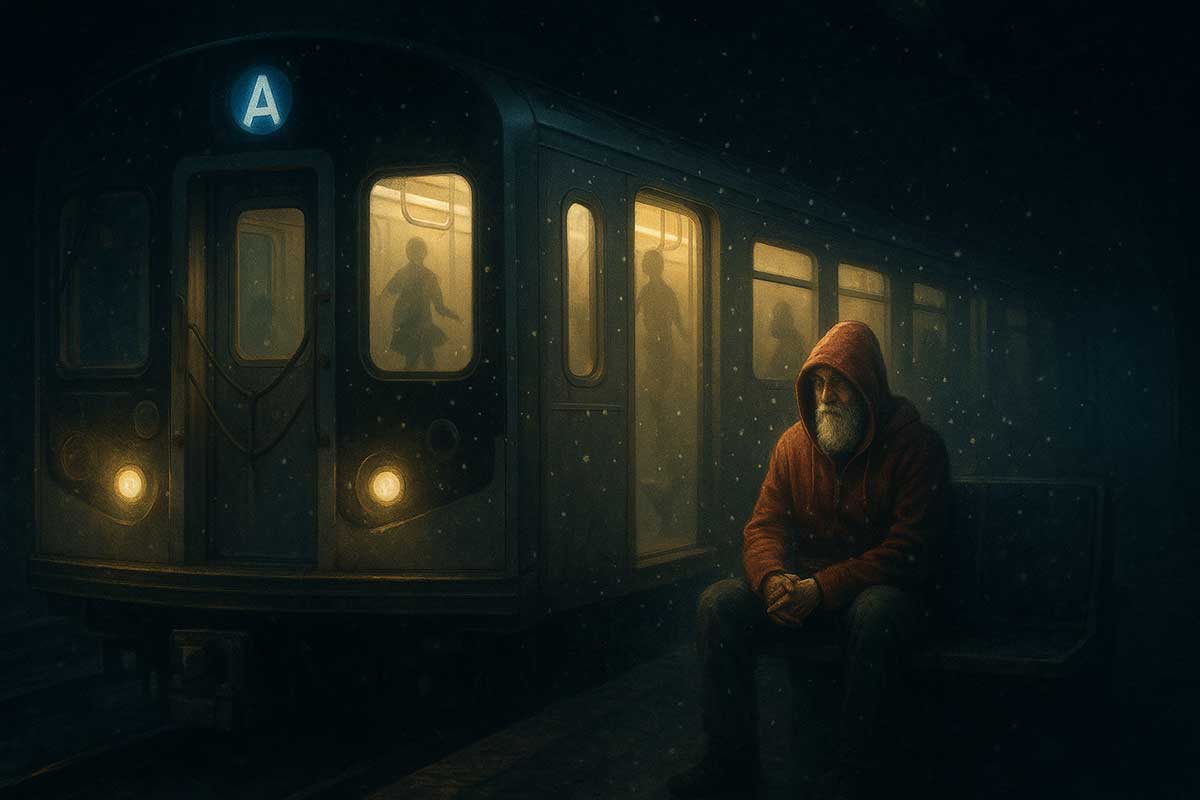
New York in December had a way of swallowing people whole. The cold wind between buildings felt like it had a personality, the kind that whispered, Keep moving or get swallowed. And people listened. They rushed, they pushed, they rarely looked up.
But late at night—long after office lights dimmed and stores locked up—the city changed. The noise softened. The streets exhaled. And beneath it all, in the tunnels of the A Train line, something extraordinary rode quietly from one end of Manhattan to the other.
No one knew him. No one looked twice. Why would they? He wore a faded red hoodie, jeans patched at the knees, and boots that looked older than half the commuters in the city. His beard spilled from beneath the hood in soft white waves, though most people assumed it was dyed for a seasonal job. His eyes shone the way streetlights do before a snowstorm—glassy, reflective, full of something ancient.
To most, he was just a man riding the subway.
To a very select few, he became the miracle they didn’t know they needed.
It began at 11:42 PM on a Tuesday.
The A Train rumbled into 145th Street, doors screeching open. A woman rushed aboard, clutching a stroller without a child—just a pile of folded blankets and a worn-out stuffed rabbit. Her eyes were red, her hair pulled back in a messy knot, her shoulders tight with exhaustion.
She sat across from the man in the red hoodie.
He didn’t stare. He didn’t intrude. But he noticed the tremble in her fingers as she smoothed the rabbit’s ear.
The train lurched forward.
She sighed, barely above a whisper.
“I’m so tired.”
The man nodded gently. “Long day?”
She laughed, but it cracked. “Long month. I’m a cleaner at Mount Sinai. They cut my hours. The babysitter raised her price. And now…” She lifted the empty stroller slightly. “The wheel split. Can’t afford a new one till after Christmas. My son’s going to think Santa forgot us.”
The man’s eyes warmed.
“Santa forgets no one,” he said.
She smiled at him the way you smile at strangers who mean well but don’t understand.
The train screeched through 110th, 103rd, 96th.
When she stood at 59th Street to get off, she found a new MetroCard resting beside her—gold-edged, decorated with tiny snowflakes. She frowned, looked around the nearly empty car. The man with the red hoodie waved and gave a quiet wink.
She picked it up, confused.
When she tapped it at the turnstile, it read:
UNLIMITED RIDES UNTIL NEXT CHRISTMAS
She froze.
She looked back.
The man was gone.
Yet down the tunnel, faint and echoing, she heard a soft jingle—like sleigh bells swallowed by subway noise.
Two nights later, the man in the hoodie boarded again—this time at Columbus Circle. A young woman in a puffy jacket stepped into the car just behind him. She carried a small duffel bag and limped slightly, pain etched across her face. A pair of worn ballet shoes hung from her backpack.
She didn’t sit. She held the pole as if trying to hold herself together.
The man’s voice drifted over like warm steam.
“You dance.”
She blinked. “How did you know?”
He pointed to the shoes. “Those weren’t bought. They were earned.”
She let out a hollow laugh. “Not anymore. I had my last audition today. Bombed it. Sprained my ankle. My teacher says maybe I should choose a different dream.”
His eyes softened.
“Dreams don’t retire,” he said.
She stared through the window into the dark tunnel. “Well, mine might.”
When the train reached West 4th, she stepped out—though she didn’t want to. Some part of her wished she could stay in that warm, quiet presence a little longer.
She walked toward the exit, her ankle throbbing.
Then she noticed something in her duffel bag.
A pair of ballet shoes.
Gleaming. Satin. Perfect.
The soles shimmered faintly, as though dusted with starlight.
A small handwritten note was tucked inside:
“For the next stage you step onto.”
When she spun around, wind rushed up the stairwell, but the man in the red hoodie was nowhere to be seen.
Her ankle stopped hurting.
She walked home on air.
Five days before Christmas, a man boarded at Canal Street—a veteran with a backpack full of everything he owned. His coat was threadbare. His hands shook. He sat heavily beside the man in the hoodie and closed his eyes.
“Rough night?” the hooded man asked.
“Rough decade,” the veteran replied.
Silence.
Then the man in the hoodie reached into his pocket and pulled out a folded piece of paper.
He placed it on the veteran’s knee.
“What’s this?”
“A key,” the hooded man said.
The veteran scoffed. “Yeah? To what?”
“To your new room.”
The veteran looked up sharply. “What?”
The paper wasn’t a letter. It was a voucher—official—and attached to it was a metal key stamped with a number. Affordable housing he had applied for seventeen times. Always rejected.
His hands shook worse now.
“This… this can’t be real.”
“Real is what you’ve earned,” the man said softly. “Merry Christmas.”
But when the veteran looked back again, the seat beside him was empty—except for a faint dusting of snow on a nearly empty subway bench.
The veteran began to cry.
Word began to spread around the city.
Not loudly, not publicly. Just whispers along train platforms and murmurs in late-night bodegas.
“Did you hear about the man on the subway…?”
“Some guy in a red hoodie…”
“My cousin got a miracle MetroCard…”
“My friend swears she saw him vanish like smoke…”
Some said he was a ghost.
Some said he was a con artist.
Some said he was a Christmas hallucination.
But then there were the gifts.
Real gifts.
Life-changing gifts.
Someone donated dozens of brand-new strollers to a Harlem shelter—each tagged “For the mothers Santa didn’t forget.”
A downtown dance company announced a full scholarship for a “mysterious rising star.”
A housing lottery recipient swore he received his key from an angel.
And throughout it all, the A Train kept rolling, carrying a man in a red hoodie who smiled at strangers as if he’d known them forever.
On Christmas Eve, the train was nearly empty. Snow drifted down the dark stairs of the 168th Street station as the man stepped inside, brushing frost from his sleeves.
He sat. Closed his eyes. Breathed in deeply, as though tasting the air.
He whispered to the empty car:
“Almost done.”
At the next stop, a little girl got on with her father. She stared at him, wide-eyed.
“You look like Santa,” she said.
He smiled. “Do I?”
She nodded. “But Santa wears a red coat. You’re wearing a red hoodie.”
He tugged the edge of it playfully. “Maybe Santa dresses differently in New York.”
She giggled.
He reached into his pocket and pulled out a tiny wrapped present, no bigger than a snowball.
“For you.”
Her father hesitated. “Oh—you don’t have to—”
“I know,” the man said kindly. “But she’s been very brave this year.”
The father froze.
“How… how did you know that?”
The man just winked.
The girl unwrapped the gift. Inside was a small music box carved with stars. When she opened it, a soft melody played—the lullaby her mother used to sing before she passed away.
The father’s breath caught.
The man in the red hoodie stood up as the train slowed.
“Where are you going?” the little girl asked.
He tipped his head, eyes twinkling.
“There’s someone else who needs me.”
The doors opened.
He stepped into the swirling snow and disappeared down the platform.
But as the train pulled away, her father could swear—just for a moment—that he saw a sleigh-shaped shadow ripple across the tunnel wall.
And every year after that, people riding the A Train swore they felt something on late December nights:
A warm presence.
A sudden gift.
A whisper of encouragement drifting through the cold.
Some say Santa flies over rooftops.
But in New York?
He rides the subway.
And he never misses a stop.
Story 2: The Fifth Avenue Doorman
On Fifth Avenue, Christmas looked like a movie set.
The streetlights wore wreaths. Store windows glowed with impossible worlds made of glitter and glass. Tourists tilted their heads back, dizzy with skyscrapers and snowflakes. Yellow cabs honked like impatient reindeer.
And right in the middle of it all stood a building that seemed to be made of marble, glass, and whispered secrets.
Residents liked to say their lobby was “tastefully understated,” which meant it probably cost more than a small castle. The people who lived there had everything—at least on paper. Corner offices. Holiday homes. Children in schools so exclusive the uniforms looked like private flags.
But on a windy December afternoon, something new arrived on the front steps.
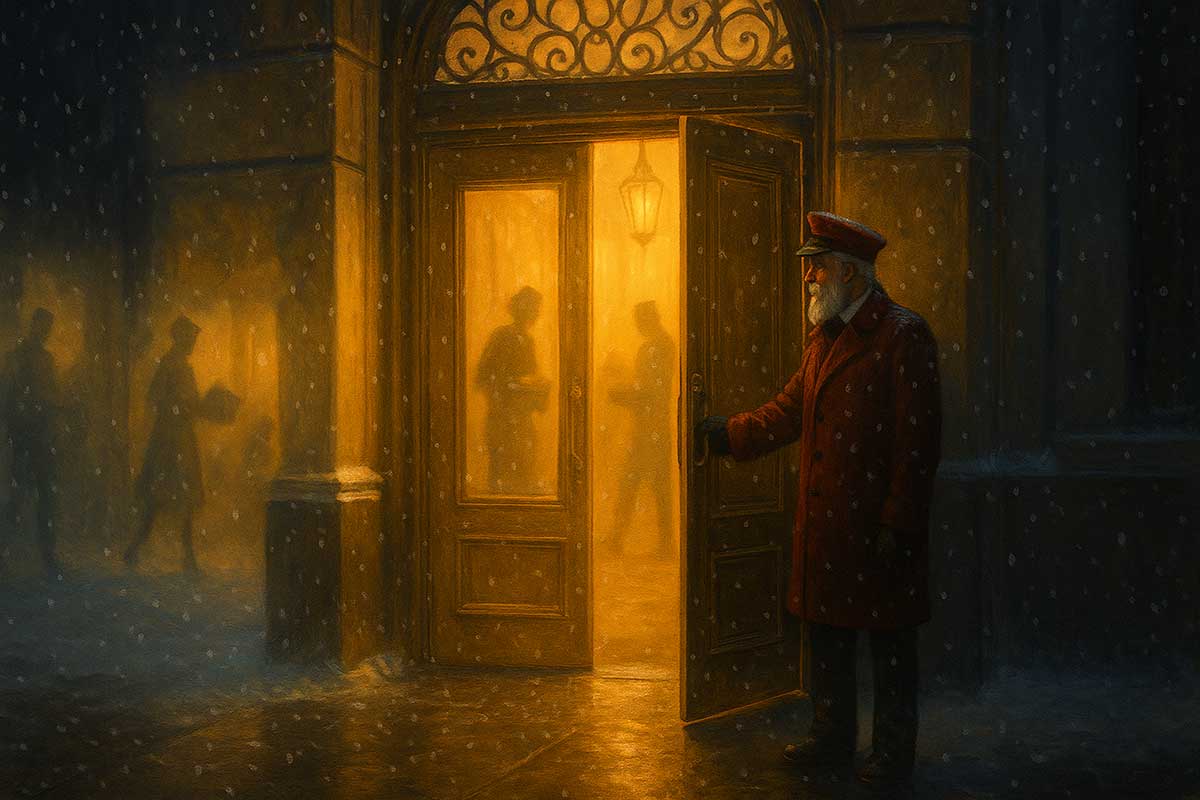
He showed up with no fanfare, no paperwork in the elevator bank, no HR memo in anyone’s email. Just… appeared. An older man with a silver beard, kind eyes, and a posture that somehow managed to be both relaxed and perfectly straight. His overcoat was simple but immaculate. His gloved hands were steady as he held the brass door open for an elderly woman wrestling with her dog’s leash.
“Thank you, dear,” she said, a little flustered.
He tipped his cap. “My pleasure, Mrs. Hayes.”
She blinked. “Have we met?”
“We have now,” he replied, eyes twinkling.
The building manager rushed over a minute later, out of breath. “Oh good, you made it. Temporary holiday staff, right? We’ve been expecting you.”
The old man just smiled. “I’ve been expecting you too.”
No one questioned it much after that.
In New York, you get used to gaps in the story.
The new doorman stood post with a warmth nobody could quite explain. He held doors for nannies, dog walkers, CEOs, and frazzled assistants. He greeted delivery drivers like old friends. He somehow remembered every name after hearing it once—human or animal.
“Morning, Mr. Klein. Good luck on the earnings call.”
“Afternoon, Sofia. Your painting looked beautiful in that north window.”
“Evening, Max. Peanut butter cookie for Daisy?” He’d slip a treat to the golden retriever, who worshipped him within 24 hours.
He never checked his phone. He never seemed cold. Snowflakes melted on his shoulders like they recognized him.
And strange things started to happen.
Not the kind you could submit in a maintenance ticket.
The other doormen noticed first. One of them, Luis, whispered about it to the night concierge.
“I swear,” he said, “the new guy, Nick? Chris? Whatever his name is? He knows stuff.”
“What kind of stuff?”
“Residents’ business. Before they tell him. Like he knows what they need before they ask.”
The concierge rolled his eyes. “So what, he’s psychic?”
“Or,” Luis said slowly, “it’s a Christmas thing.”
They laughed it off.
But they were both watching now.
One cold evening, just as the sky bruised purple and the city lights blinked awake, a widower named Mr. Gordon stood outside the building, staring at the doormen’s wreath.
He had lived in 12D for forty-two years. His wife had filled their apartment with music and soup and too many plants. She had died in the spring. He had not played a single record since.
The new doorman opened the door for him.
“Good evening, Mr. Gordon.”
“Yes, yes,” the old man muttered. “Evening.”
He didn’t step inside.
The doorman tilted his head. “Cold out tonight.”
“Doesn’t bother me,” Mr. Gordon lied.
The doorman studied his face for a moment, then reached beneath the podium and pulled out a small, neatly wrapped package.
“This was left for you,” he said.
Mr. Gordon frowned. “By who?”
“Didn’t catch the name,” the doorman said lightly. “But they insisted you receive it today.”
Gordon grumbled but took the box upstairs.
He intended to open it with a gruff, dismissive snort, then complain about marketing gimmicks and wrong addresses.
Instead, his hands shook as the lid lifted.
Inside was a record.
Not just any record.
It was their record.
The one he and his wife had danced to on the night they decided to stop being scared and start growing old together. The original pressing that had cracked in half during their last move. The one he’d searched for online and never found again.
The label, the year, the slight misprint on the back cover—it was identical.
Except this one was whole.
His breath caught.
A small note tucked inside read:
“She’d like a dance tonight.”
Mr. Gordon set the record on the turntable with trembling fingers.
As the first familiar crackle turned into brass and strings, the apartment filled with her again. Not fully. Not physically. But enough.
Enough to make his eyes close, his shoulders soften, his hand reach out into the empty room.
Down on the sidewalk, the new doorman smiled, head tilted as if listening to distant music.
Two floors below Gordon lived two sisters who spoke to each other only through emails copied to lawyers.
Emma and Grace had inherited their mother’s apartment—together. One wanted to sell, the other wanted to stay. Their last conversation in person had ended with a slammed door and an overturned lamp.
On December 20th, both women received separate notices from building management:
MANDATORY ROOF ACCESS INSPECTION – 7 PM, DECEMBER 22ND – TENANTS MUST BE PRESENT
Emma scowled and forwarded it to Grace.
Grace rolled her eyes and forwarded it back.
Neither called.
On the 22nd, both sisters took the elevator to the roof, each assuming the other wouldn’t show up anyway.
The elevator doors opened.
No inspector.
No clipboard.
Just a rooftop strung with soft white lights, a small heater humming in the corner, and a low table with two mugs of steaming hot chocolate.
The city stretched around them—spires, windows, the pulse of Fifth Avenue like Christmas veins glowing below.
Emma stepped out first. “…Is this a joke?”
Grace followed, eyebrows arched. “Clearly one of your weird ideas.”
“Mine? Please. I would have catered.”
The rooftop door swung shut behind them and clicked—a deliberate, gentle sound.
A faded sign hung on the handle:
“Meeting in Progress – Please Do Not Disturb”
They both laughed at the same time, which startled them.
It had been months since they’d done that.
The new doorman’s handwriting was tidy and looping.
They recognized it without knowing why.
They argued at first. Years of resentment don’t dissolve just because someone provides pretty lighting and hot chocolate. But the city around them seemed determined to soften their edges. Snow began falling in lazy spirals. Somewhere, music drifted up from a street performer’s saxophone.
After an hour, the arguments loosened. Stiff phrases like “You always” and “You never” melted into “I missed you.”
By the time they made it back downstairs, cheeks pink from the cold and something else, both of them were clutching keys—physical and metaphorical—that felt newly shared.
“Who the heck signs off on mandatory roof inspections?” Emma asked the night front desk.
The concierge blinked. “We didn’t schedule one.”
Behind him, through the glass, the new doorman held the door for an elderly couple and pretended to be fascinated by a snowflake on his glove.
On December 23rd, a little boy named Leo sat in the lobby with his knees pulled up to his chest.
His parents were at work.
The nanny had the day off.
The building’s sitter was running late.
Leo felt small and invisible, lost in a world of tall adults and taller trees. The Christmas decorations made the lobby look like a magazine page, but his stomach felt like a knot.
The new doorman sat down beside him on the bench, not too close.
“Not a bad fort,” he said, nodding at Leo’s knees and backpack.
Leo sniffed. “It’s not a fort.”
“Could be.” The man leaned in slightly. “Do you have a password?”
Leo hesitated. “Penguins.”
“Excellent choice.” The doorman lowered his voice. “I have something for you. Someone dropped it off.”
From behind the front desk, he produced a small snow globe. Inside was not a typical winter scene. It was a tiny, perfect replica of the lobby, complete with sparkling tree and revolving doors.
But there, in the center, was a small boy sitting on a bench.
When Leo shook it, snow began to fall around his miniature self.
“Is that… me?”
“You tell me,” the doorman replied.
Suddenly, the lobby wasn’t so big. The world outside wasn’t so overwhelming. Somewhere in the swirling snow, Leo felt like he mattered.
His parents arrived a few minutes later, breathless and apologetic. They found their son chatting happily with the doorman, planning which “penguins” would be allowed into the fort lobby.
“Thank you,” Leo’s mother said. “You’re very good with kids.”
The doorman smiled. “I’ve had… a lot of practice.”
On Christmas Eve, the residents of the building woke to find small envelopes slipped neatly under their doors.
Inside each was something deeply specific:
A long-forgotten recipe card in a mother’s handwriting.
A printed photo of a family together before the divorce.
A ticket to a concert that rekindled a teenage dream.
A handwritten note that read exactly what they needed that year:
“You are not alone.”
“You are allowed to start again.”
“They are proud of you.”
Downstairs, the building manager looked around in confusion.
“Did you sign off on some kind of… gift drop?” he asked the night concierge.
The concierge shook his head slowly. “No. But I think I know who did.”
They both turned toward the front doors.
The new doorman was gone.
In his place hung a simple red coat on the stand, still dusted with snow. Leaning against it was an old wooden sign that nobody had seen before:
“MERRY CHRISTMAS. THANK YOU FOR LETTING ME HOLD THE DOOR.”
For a moment, as the revolving doors spun with residents hurrying out to brunches and flights, a few swore they saw him reflected in the glass—just a blur of red and white and twinkling eyes.
Every Christmas after that, the building hired temporary staff, but none stayed long. None had that same patient warmth, that feeling that someone truly saw you.
Still, on certain December nights, when the wind howled down Fifth Avenue and snow fell in silver sheets, residents stepping inside could swear the door felt lighter.
As if someone, somewhere, was still holding it open for them.
And sometimes, just as it closed behind them, they heard a faint sound on the street—
Not a honk.
Not a shout.
Something softer.
Like sleigh bells.
Far away.
But coming closer.
Story 3: Christmas Eve at the 24-Hour Deli
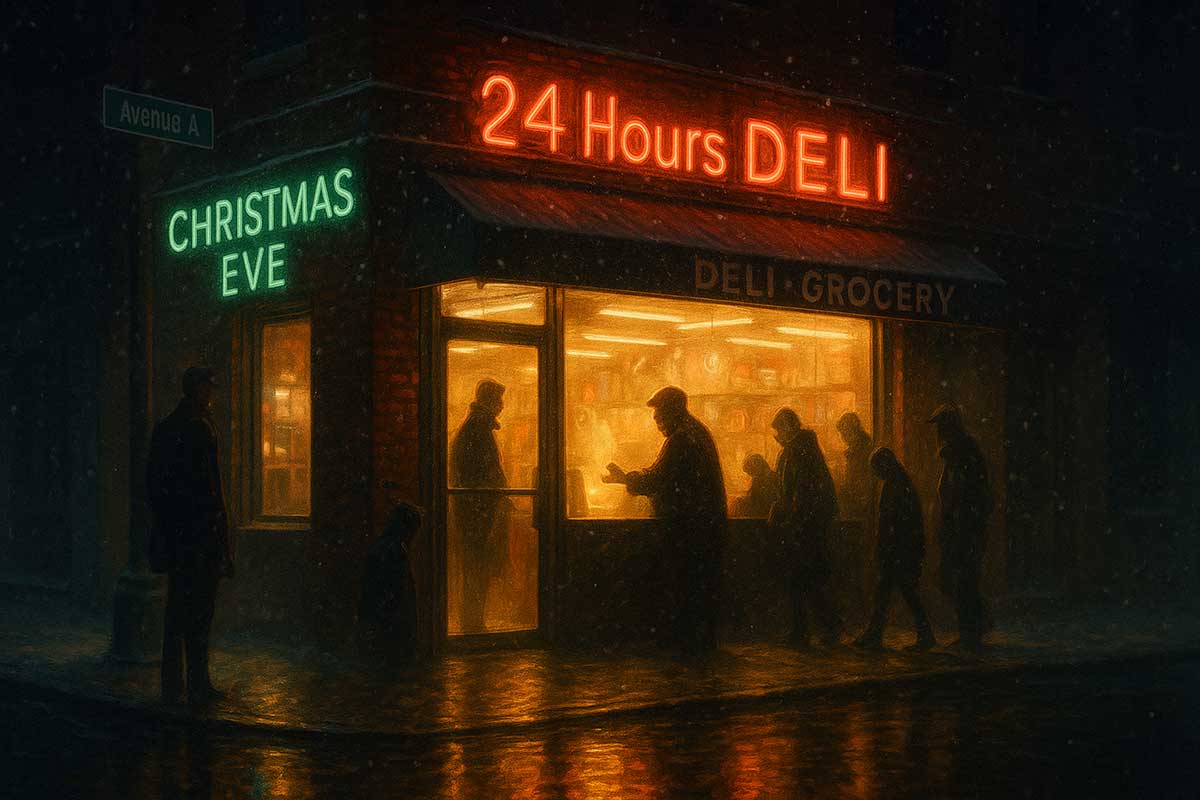
On the corner of Houston and Avenue A stood a deli that never closed.
Not for blizzards.
Not for blackouts.
Not even for Christmas Eve.
Its neon sign buzzed like an exhausted angel. Inside, the shelves were always a little too full, the coffee a little too strong, and the floor mats never quite stayed in place. But the regulars loved it. It was the kind of place where night-shift workers, street musicians, and lonely souls all passed through like it was a midnight church.
On December 24th, the bell over the door jingled more softly than usual.
A new cashier stood behind the counter.
He wasn’t young, but he wasn’t old in the usual way. Round-bellied, rosy-cheeked, with a beard that looked suspiciously natural, not costume-shop white. His eyes shone beneath the fluorescent lights, as if lit from some gentler source.
His name tag read: “Nick.”
But anyone looking closely might’ve noticed the small, nearly faded letters beneath it—old engraving marks from another name entirely.
Customers who entered felt something strange, though none could articulate it.
Like walking into warmth after years of cold.
Around 8:30 PM, the first miracle happened.
Nurse Lila Rodriguez trudged in, still wearing her navy scrubs from the ER. Her shift had been brutal—holiday accidents, winter fevers, and families torn apart by sudden emergencies. She had stopped checking the time hours ago.
“Coffee,” she muttered to the cashier. “The biggest one you’ve got.”
Nick nodded with a smile that felt like a soft blanket. “Long day?”
She laughed without humor. “All days are long in December.”
He handed her the steaming cup. “It’s on the house.”
She shook her head. “I can’t accept that. I know how hard these places work to stay open.”
His eyes twinkled. “It’s Christmas Eve. Let me give you something warm.”
She hesitated, then relented. “Thanks.”
As she lifted the cup, she noticed something taped to the bottom. A small slip of paper.
A lottery ticket.
She groaned. “Oh no. My patients give me these all the time. They’re always losers.”
“Maybe this one isn’t,” Nick said softly.
She snorted, shoved it into her pocket, and left, trudging into the cold.
Two days later, she would find out that the ticket paid off—enough to clear her medical school debt entirely.
But in that moment, she only felt the hot coffee warming her hands as the snow came down.
At 9:47 PM, the bell jingled again.
A teenage boy entered—face pale, shoulders tight, movements wary. He hovered by the refrigerated section, pretending to debate between citrus drinks and iced tea.
Nick watched him from the counter.
Eventually the kid approached, setting a bottle down carefully, like it might break.
“That all tonight?” Nick asked gently.
The boy nodded.
Nick scanned the bottle, then quietly scanned a second item: a thick winter coat someone had left on the lost-and-found rack.
“You forgot this,” Nick said.
The boy blinked. “That’s not mine.”
“It is if you want it.”
The boy stared at him, eyes filling. “I… I don’t have enough money.”
“It’s free.”
His throat tightened. “Why?”
Nick leaned forward. “Because you look cold, son.”
The boy swallowed hard.
As he left, he reached into the coat pocket and discovered a MetroCard and a note:
“Go home. They’re waiting for you.”
He stopped dead on the sidewalk.
He hadn’t told anyone he’d run away.
He hadn’t told anyone where he’d been sleeping.
He hadn’t told anyone anything.
He turned toward the subway.
And for the first time in months, he didn’t feel alone.
Around 11 PM, the deli door opened to a gust of icy wind—and a delivery driver stumbling in, numb fingers wrapped around an empty cup.
“Hey Nick,” he said—though he didn’t know how he knew the man’s name.
“Rough night?” Nick asked.
“Brutal. Third shift in a row. I’m freezing. And my thermos broke.”
Nick slid a new stainless-steel thermos across the counter. “Take this.”
The driver shook his head. “No way. Those things cost too much.”
“It was a return,” Nick said casually. “Couldn’t resell it.”
The driver hesitated. “I appreciate the gesture, man. Really.”
“Open it,” Nick insisted.
Inside, steam rose from a warm drink—something richer than coffee, sweeter than cocoa, with a scent like childhood Christmas mornings.
“What is this?” the driver whispered.
“Something to remind you you’re more than your job,” Nick said.
“But how… how is it still hot?”
Nick winked. “Magic, maybe.”
The driver laughed through exhaustion. “Yeah. Maybe.”
But when he stepped back outside and walked six blocks through bitter wind, the thermos was still hot.
Exactly as hot as when Nick handed it to him.
At 11:32 PM, a subway performer entered—his guitar slung over his back, fingers red from cold. He shook the snow from his hair and sighed heavily.
Nick tapped the counter. “How’d the night go?”
“Bad,” the musician muttered. “Everyone’s either drunk, cranky, or broke. I made twelve bucks in four hours.”
He opened his guitar case to buy a sandwich.
And froze.
The case was full.
Not with bills.
With twenties. Fifties. Hundreds.
“WHAT—” His voice cracked loud enough that two customers turned.
Nick only smiled. “Looks like someone appreciated your music.”
The musician stared. “This can’t be for me. This is… this is too much.”
“No gift is too much for a good heart,” Nick replied.
The musician blinked rapidly. “I can finally record my album.”
Nick nodded. “I know.”
The musician stepped forward as if to hug him—but Nick simply touched his shoulder, gentle as snowfall.
“Merry Christmas,” he said.
As midnight approached, the deli grew quiet.
Most of the city’s celebrations were happening in bars or apartments decorated with artificial pine. But a few stragglers still wandered in, drawn by warmth, light, or loneliness.
An elderly woman bought cat food and a single cookie.
A taxi driver napped against the coffee machine.
A young couple argued over which ice cream flavor counted as “festive.”
Each time someone approached the counter, Nick offered a gift.
Not always physical. Sometimes just a sentence warm enough to thaw an entire winter’s worth of sorrow.
“You’ve done enough.”
“They miss you too.”
“You’re not failing.”
“You’re stronger than you believe.”
By 12:10 AM, the city had hushed into snowfall.
Nick stepped outside the deli for a moment, breathing in the cold air.
He lifted his face toward the sky.
It was time.
Inside, the bell jingled again—but when the deli owner emerged from the back room, rubbing his eyes, the counter was empty.
Nick was gone.
No coat. No hat. No coffee cup.
Just a small wooden sign leaning against the register:
“CLOSED FOR ONE HOUR — DELIVERY IN PROGRESS.”
The deli never closed.
But for one quiet hour each year, it did.
Some said they saw a shadow lift into the sky that night—something sleigh-shaped gliding above Houston Street.
Others heard bells, faint but unmistakable.
And a few swore that the next morning, every person who entered the deli found something waiting for them—something they had needed, though they never would’ve asked for it.
A note.
A memory.
A kindness.
A reminder.
Because Santa works with chimneys, yes…
…but in New York City on Christmas Eve?
He works the night shift at a deli.
And he never forgets a soul.
Story 4: The Brooklyn Bridge Photographer

The Brooklyn Bridge was always beautiful, but at Christmastime it felt enchanted.
The cables shimmered with frost. The wooden planks glowed under the streetlamps. Tourists shuffled across the span snapping selfies, while locals hurried by, pretending not to be moved by the glittering skyline.
But there was one person who never hurried.
Every evening in December, just as the sun sank behind Manhattan, an old man appeared at the pedestrian ramp carrying a battered vintage camera. He wore an old-fashioned wool coat, a knitted red scarf, and a small leather satchel slung over his shoulder.
He seemed familiar in a strange, comforting way. Something about the rosy cheeks, the gentle smile, the way he spoke to people as if he knew them already.
Most people assumed he was a retired hobbyist or an artist selling candid shots for a few dollars.
They didn’t know that his photographs were magic.
They didn’t know that Santa had traded his sleigh for a camera that could see straight into a person’s heart.
The first to encounter him that winter was a couple on the brink of breaking up.
Julia and Mateo walked the bridge at dusk because neither of them could bear to have the conversation inside their apartment. Their hands stayed stuffed in their own pockets. Their shoulders were tense. Their eyes never met.
“I just don’t know if we’re the same people anymore,” Julia murmured.
“We’re trying,” Mateo said. “But maybe trying isn’t enough.”
They stopped halfway across the span. Cars roared beneath them. The wind carried ice.
That’s when the old photographer approached.
“Would you like a picture?” he asked.
Julia shook her head. “No, thank you. We’re kind of—”
“Busy ending things,” Mateo finished bitterly.
The old man smiled gently. “All the more reason to remember who you were… before today.”
Something in his tone—soft, knowing—made them pause.
They agreed without understanding why.
He lifted the camera.
Click.
The couple felt a strange warmth sweep through them, like sunlight cutting through fog.
The old man handed them a small envelope.
“Open it tomorrow,” he said. “Merry Christmas.”
They walked away, still angry, still uncertain, but… quieter.
The next morning, while packing their things separately, Julia finally opened the envelope.
Her gasp brought Mateo running.
Inside was a photograph—not of yesterday’s cold, distant walk—but of them ten years in the future.
Older. Softer. Laughing on the same bridge, holding hands, wedding rings glinting in the sunlight.
They both stared.
And something broke open.
Not the relationship—
but the wall they had both built.
They sat down, really talked, and realized there was still love underneath the hurt.
The photo stayed on their fridge for years.
Two days later, a struggling actor crossed the bridge after failing yet another audition.
He walked slowly, guitar case slung over his back, face half-hidden in a scarf. His agent had stopped answering his calls. His parents wanted him to come home. The holidays made failure feel sharper, like a personal verdict on his dreams.
He stopped to watch the skyline.
“May I take your picture?” came a voice.
The old photographer.
The actor sighed. “I don’t really have the face for photos today.”
“Your face is perfect,” the man said. “It’s honest.”
Something inside the actor softened.
He nodded.
The camera clicked.
The photographer handed him a print within seconds. Impossible—no portable printer, no developing equipment—but the actor was too tired to question it.
On the photo, he looked… luminous. Not handsome, exactly, but alive. Focused. Like someone who had something important to say and the courage to say it.
He tucked it in his pocket.
The next morning, a Broadway casting director—who rarely checked social media—stumbled across the actor’s newly posted photo. It stopped her cold. It was the exact face she had imagined for her new play’s lead role.
She emailed him immediately.
Three months later, he stood onstage for his first curtain call, tears shining under the lights, knowing that one stranger’s photograph had somehow captured the future before it happened.
A week before Christmas, the old photographer noticed a woman lingering at the bridge’s midpoint. She wore a long coat and carried a paper bag of pastries she hadn’t touched. Her eyes were red, her face tense.
“Beautiful night,” he said gently.
She nodded without looking at him.
“Would you like a picture?” he asked.
“No,” she whispered. “Not tonight.”
“Especially tonight,” he replied.
She blinked, confused, but something in his tone urged her forward.
He lifted the camera.
Clicked once.
When he handed her the photo, her knees nearly buckled.
It wasn’t the bridge.
It wasn’t the skyline.
It was her—
at six years old—
in her father’s arms, laughing as they decorated the Christmas tree.
A memory she’d forgotten.
Her father had passed away that morning. She had come to the bridge because she didn’t know where else to put her grief.
“How… how did you get this picture?” she whispered, clutching it like something holy.
“Memories are the world’s most precious gifts,” the old man said softly. “Sometimes we lose them. Sometimes we need help finding them again.”
Tears streamed down her face.
“Thank you,” she whispered.
He nodded. “Merry Christmas.”
On Christmas Eve, a blizzard rolled in unexpectedly.
Still, the old man appeared, camera in hand, scarf fluttering like a banner of red joy against the storm.
Few people were brave enough to cross the bridge that night.
But one was a little girl named Lacey, bundled in a puffy coat, her mittened hand tucked firmly inside her mother’s.
She spotted the photographer and tugged her mother’s sleeve.
“Mommy! That man looks like Santa!”
Her mother laughed. “Everyone looks like Santa in a snowstorm.”
“No,” Lacey insisted. “That’s him.”
The old man knelt down to her height.
“Would you like a Christmas picture, Lacey?” he asked.
Her mother blinked. “How do you know her name?”
He winked. “Santa knows many things.”
Lacey giggled.
The man snapped her photo, and when he handed it to her, she gasped.
It wasn’t the bridge.
It wasn’t the storm.
It was her standing in front of a Christmas tree… holding a baby brother. Smiling so wide her eyes sparkled.
“But I don’t have a baby brother!” she said.
“Not yet,” he replied.
Her mother froze.
And then her hand flew to her mouth.
The photographer smiled.
A knowing, gentle smile.
“Merry Christmas,” he whispered.
The next morning, the bridge was piled with snow, the cables glittering like crystal strings. But the old man was nowhere to be found. Only a single red mitten lay on the railing, dusted with frost.
People picked it up, puzzled.
But those who had met him didn’t need an explanation.
And every Christmas after that, locals would walk the Brooklyn Bridge at sunset, hoping to catch sight of a wool-coated figure with a vintage camera.
Sometimes people claimed they did.
Usually on nights when they felt lost, or lonely, or in need of a reminder that magic is real.
And occasionally, a New Yorker would find an envelope tucked under their wiper blade or slipped into their mailbox—containing a single photograph:
A memory they’d forgotten.
A future they hadn’t dared imagine.
A moment they needed more than anything.
Signed with two small words:
“Keep believing.”
Story 5: The Rockefeller Rink Janitor
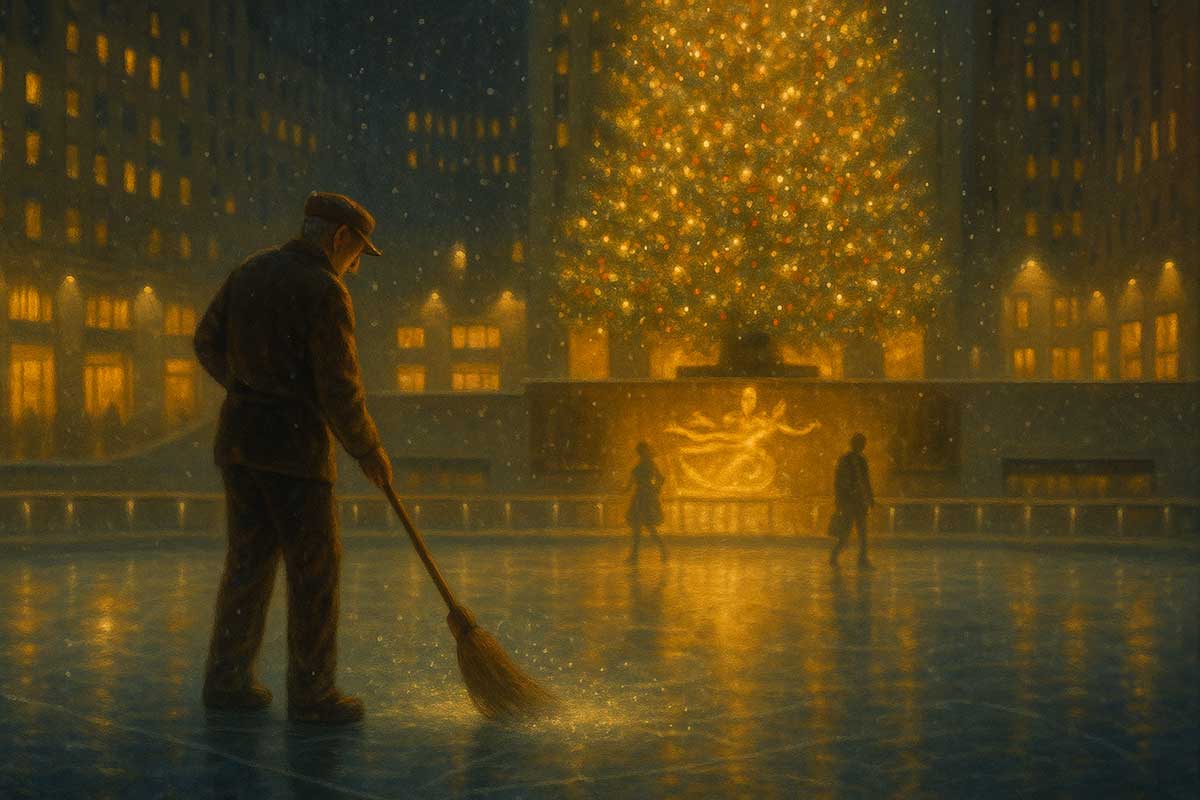
Every December, people came from all over the world to stand under the Rockefeller Christmas tree and feel small in the best possible way.
They craned their necks, took a thousand photos, and shuffled past each other on the crowded plaza. Below, the skating rink gleamed like a tiny stage set into the stone—bright, polished, ringed by golden flags.
Down there, magic was expected.
But hardly anyone noticed the man who made the ice shine.
He arrived before dawn, long before the first skaters laced their boots. An older man, stooped but somehow light on his feet, pushing a wide broom across the surface with slow, careful strokes. His jacket was the standard maintenance navy, but someone had stitched a strip of red fabric along the collar. His beard was white and soft, tucked neatly into his scarf.
The staff called him “Mr. Kris.” No one knew if that was his first or last name. He’d just appeared one November a few years ago with perfect references and a smile that warmed the cold stone corridors.
He cleaned. He hummed. He listened.
And at night, when the tree lights glowed and the city felt like a snow globe someone kept shaking, strange things began to happen.
The first happened to a girl named Mia.
She was nine, with a determination that made her little body seem twice as tall. Her skates were secondhand, the leather scratched, the blades nicked. She skated anyway, circling the rink with her jaw set, trying to copy the spins she’d seen on TV.
Her mother watched from the sidelines, clutching a thermos, the worry lines on her forehead deepening with every near-fall. Lessons were too expensive. Ice time was a once-a-year treat.
On her third lap, Mia stumbled and went down hard. She bit her lip to stop from crying.
A hand appeared in front of her.
“You okay?” a gentle voice asked.
She looked up.
The janitor smiled down at her, broom in his other hand.
“I’m fine,” she said, forcing bravery into her voice. “I just need better skates.”
“Maybe,” he said. “Or maybe the skates just need to meet the right dream.”
She frowned. “What does that mean?”
He winked. “You’ll see.”
He helped her up, and she pushed off again, more careful this time.
When the session ended and the staff called everyone off the ice, Mia shuffled toward the exit, cheeks flushed, hair sticking out of her hat.
Her mother gasped.
“Sweetheart… your skates.”
Mia looked down.
The scuffed leather was gone.
In its place were sleek, white skates that fit her feet perfectly. The laces were new. The blades gleamed, catching the lights from the tree above. Inside one boot, she felt something crinkled.
A note.
“For the next place you’ll fly. —K”
Mia’s eyes went wide. “Mom…?”
Her mother stared between the skates and the janitor sweeping the far end of the rink, moving as if he weighed nothing at all.
“Did you see…?”
Her mother just smiled through sudden tears. “Maybe it’s a Christmas miracle.”
Years later, when Mia skated onto national television for her first big competition, she would look back at those first Rockefeller skates and whisper, “Thank you,” to whoever had believed in her before she believed in herself.
The second strange thing happened to a man named Daniel Green.
He was a stockbroker who had once loved numbers and puzzles and the thrill of solving difficult problems. Lately, all he felt was a gnawing emptiness—like his life was a spreadsheet no one had bothered to save.
On Christmas Eve afternoon, he stood by the rink railing in an expensive coat that didn’t feel like it belonged to him. He watched the skaters circle—kids laughing, couples wobbling, tourists gripping each other’s arms and shrieking when they slipped.
He envied them.
They were present. He hadn’t been present anywhere in a long time.
He didn’t notice the janitor step up beside him until he heard the soft sound of a broom resting against the rail.
“Beautiful, isn’t it?” the older man said.
“The tree?” Daniel replied.
“The people,” the man corrected.
Daniel snorted. “I see chaos. Lines. Noise.”
“Look closer.”
Reluctantly, he did.
A father teaching his child to stand after a fall.
A teenager skating backward so his grandmother could feel safe moving forward.
A woman skating alone with headphones in, quietly mouthing the words to some song only she could hear.
“Oh,” Daniel said quietly.
The janitor nodded.
“You used to love something, too,” he said.
Daniel frowned. “What?”
“Solving things,” the janitor replied. “Problems. Puzzles. Making messy numbers become clear.”
Daniel’s heart stuttered. “How did you—”
The janitor pulled a paper snowflake from his pocket, folded with surprising precision.
“Someone dropped this,” he said, placing it in Daniel’s hand. “Maybe it’s yours.”
Daniel unfolded it.
Inside, in careful handwriting, were five words:
“What you’ve lost can be rebuilt.”
The wind stung his eyes—or maybe that wasn’t the wind.
He looked up to ask the man what he meant.
But the janitor was already gliding back onto the ice, broom in hand, moving with the smooth grace of someone born on frozen ponds.
That night, Daniel went home and opened an old box from the back of his closet. Inside were designs he’d once sketched for a community financial literacy program—one he’d shelved when the promotions started.
Three weeks into the new year, he would quit his firm and start something that scared him more than any market crash: helping regular people understand their money, rebuild their futures, and stop feeling like life was happening to them instead of with them.
He kept the snowflake in his wallet.
The third miracle came for someone who didn’t even want to be there.
Her name was Priya, and she was dragged to the rink by friends who insisted she needed “holiday spirit.” She was between jobs, between relationships, between ideas of who she wanted to be. Christmas lights only made her feel behind.
She stayed at the edge of the rink while her friends skated, pretending to text, hiding a tightness in her throat.
“Not a skater?” a voice asked.
She glanced over. The janitor stood nearby, leaning on his broom.
“Not a anything,” she muttered, then winced at how pathetic that sounded.
He didn’t laugh.
“You work in pictures,” he said calmly. “But not the kind you frame.”
She narrowed her eyes. “Do I know you?”
“Maybe someday,” he answered.
He reached into his jacket and handed her a small laminated card.
On the front was a photograph of the rink from above—tiny figures carved light paths into the ice, the tree glowing like a star.
On the back, in simple print:
“Your eye will help others see themselves. Don’t stop looking.”
She turned the card over and over.
Images had always meant more to her than words. She’d studied design, dabbled in illustration, dreamed of creating stories for children who didn’t see themselves in the books they read.
Then life happened. Rent. Rejections. Doubt.
Now a janitor was handing her… a calling card?
She almost rolled her eyes.
But when she got home, she couldn’t stop thinking about it.
One month later, she sketched a little girl learning to skate under a giant tree. That drawing led to a small online comic. That comic led to an email from a publisher.
A year later, a children’s book about a nervous skater at Rockefeller Center found its way into school libraries.
On the dedication page, in tiny letters, she wrote:
For the janitor who saw me.
On Christmas Eve night, just before closing, the rink finally emptied.
The last of the families left, the music shut off, and the plaza quieted to a soft hum. Snow began to fall in slow, fat flakes that glowed in the floodlights.
Mr. Kris stepped onto the ice one last time, broom resting on his shoulder.
He looked up at the tree.
“Another year,” he said to no one in particular.
From where he stood, the lights looked like stars caught in branches. The god of the city was not made of money or steel or ambition tonight, but of small, flickering bulbs trying their best to glow.
He began to sweep, long strokes that left the ice looking like glass.
As he moved, he hummed a tune older than the building itself, older than the city, older than the bridge and the trains and the towers combined.
If anyone had been watching, they might have noticed he didn’t slip, didn’t shiver, didn’t seem to touch the ice so much as hover above it.
He finished at the center, directly beneath the tree.
There, he leaned his broom against the railing and reached into his coat.
He pulled out a list.
Not the long scroll of names people imagined, but a small, worn notebook with scribbles next to each entry.
Mia — skates.
Daniel — snowflake.
Priya — card.
Nurse from the deli.
Boy from the A train.
Doorman on Fifth.
The list connected like a web.
Santa did not travel only by sleigh anymore. He moved through the city in disguises, in borrowed uniforms, in quiet corners where people didn’t expect to be seen.
He smiled, closed the notebook, and slipped it back into his pocket.
Above him, a gust of wind made the tree lights flicker—but not go out.
“Good,” he said softly. “They’re learning.”
He stepped off the ice.
By the time the security guard came to lock up, the broom was propped neatly against the wall, the navy jacket hung on a hook, and the red strip of fabric had come loose, draped over the railing like a forgotten scarf.
The guard picked it up, frowning.
“Where’d the old guy go?” he muttered.
No one knew.
But some people on the street below would later swear they heard something overhead that night—
Not the rumble of a truck.
Not the chop of a helicopter.
Something lighter.
Like bells.
Faint at first.
Then, for just a heartbeat, loud enough to make you look up at the sky and feel, deep down where grown-ups rarely go anymore, that someone kind was still watching.
Still sweeping.
Still making a way for you to glide.
Final Thoughts by SID (Santa In Disguise)
Thank you for walking with me through this city I love. Not the sparkling version in postcards, but the real one—the one lit by a thousand small acts of courage, exhaustion, longing, and unexpected grace. New Yorkers may look hurried, but their hearts are wide open. You can tell in the way they pause for a moment of music in the subway, or lift a stranger’s heavy bag, or share a knowing smile with someone they’ll never see again.
I have always believed that the true purpose of Christmas is not celebration, but recognition. Recognition that every person carries a story… and every story carries a spark. My task has never been to deliver toys. It is simply to help people remember themselves when life has made them forget.
Mia remembered her dream.
Daniel remembered his purpose.
Priya remembered her voice.
A lonely rider remembered he was not invisible.
A city, too busy for miracles, remembered it still believed in them.
And you—
perhaps you remembered something too.
If these stories have brought you warmth, hold onto it.
Share it.
Pass it forward with the same quiet subtlety with which it was given. The world does not need more spectacle; it needs more gentleness disguised as ordinary life.
Tonight, if the snow begins to fall and the city lights blur into soft gold, listen closely. You may hear the faint sound of a camera shutter, or the swish of a broom gliding across ice, or bells lost in the wind between subway tunnels.
It is only me.
Still here.
Still watching.
Still believing in you.
Merry Christmas, my friend.
Wherever you go, may you find a miracle waiting at the next corner.
Short Bios:
Santa (in Disguise)
Santa appears throughout these stories not as the mythic figure of folklore but as a quiet presence moving through New York City’s everyday corners. Whether sweeping the ice at Rockefeller Center, photographing strangers on the Brooklyn Bridge, or working a late shift in a downtown deli, he reveals himself through small acts of compassion. His character in this collection reflects a timeless truth: the greatest miracles are often delivered anonymously.
Mia Thompson
Mia is the aspiring young skater from The Rockefeller Rink Janitor. Raised in Queens, she dreams of performing professionally but has limited means for training. Her encounter with Santa’s disguised generosity becomes the catalytic moment that launches her future athletic career.
Daniel Green
A disillusioned stockbroker in The Rockefeller Rink Janitor, Daniel represents the many New Yorkers who achieve outward success yet lose touch with their inner purpose. Santa’s intervention helps him rediscover the meaningful work he set aside long ago.
Priya Nandan
A struggling creative from The Rockefeller Rink Janitor, Priya channels her lifelong love of visual storytelling into a new artistic path after receiving Santa’s quiet encouragement. Her later children’s book becomes an unexpected gift to others who feel unseen.
Julia & Mateo Rivera
The couple in The Brooklyn Bridge Photographer stand on the edge of separation until Santa’s magical photograph reveals a possible future worth fighting for. Their story reflects love’s resilience amid the pressures of modern city life.
The Subway Mother (Unnamed)
The young mother in The Subway Santa symbolizes everyday New Yorkers carrying heavy burdens without complaint. Her brief encounter with the mysterious man in the red hoodie restores hope at a moment when she feels forgotten by the world.
Leo Benjamin
A sensitive, soft-spoken boy from Christmas Eve at the 24-Hour Deli, Leo represents the innocence often overlooked in the bustling city. Through Santa’s subtle guidance, he discovers belonging during one of the loneliest nights of the year.
Mr. Gordon
A widower from The Fifth Avenue Doorman, Mr. Gordon’s arc highlights grief’s quieter forms. Santa’s disguised presence helps reconnect him to a cherished memory, renewing his capacity to move forward with warmth instead of sorrow.
Emma & Grace Whittaker
The estranged sisters from The Fifth Avenue Doorman showcase the fragile complexity of family relationships. A rooftop “inspection” orchestrated by Santa sets the stage for reconciliation neither believed possible.
The Subway Dancer (Unnamed)
An aspiring performer glimpsed in The Subway Santa, she embodies youthful ambition. Santa’s small intervention outside the spotlight helps her continue pursuing her dream in a city known for breaking spirits as often as it elevates them.
The Homeless Veteran (Unnamed)
A fleeting yet powerful presence in The Subway Santa, the veteran reflects New York’s forgotten heroes. Santa’s quiet acknowledgment honors his dignity without pity, reminding readers that compassion does not require recognition.
Leave a Reply