

|
Getting your Trinity Audio player ready...
|
What if a group of world-class thinkers mapped where the money is heading in 2026—without hype or ideology?
Introduction by Vaclav Smil
Economic change is rarely driven by novelty. It is driven by constraint.
Across history, the most consequential shifts in business and technology have occurred not when new ideas appeared, but when existing systems reached their physical, energetic, or organizational limits. Capital does not chase imagination for long; it follows necessity. It flows toward bottlenecks, scarcity, and infrastructures that cannot be ignored.
As we approach the latter half of the 2020s, the global economy is entering such a phase. Productivity gains from digitalization and automation are accelerating faster than labor markets, regulatory frameworks, and social institutions can absorb them. Energy systems are strained by computation. Supply chains are reorganizing around resilience rather than cost alone. Real estate, finance, and labor are being repriced—not by ideology, but by physics, demographics, and scale.
Entrepreneurs and investors often misinterpret these moments. They look for the “next big thing,” when in fact the decisive opportunities arise in less visible places: where capital is forced rather than invited, where inefficiencies persist because they are difficult to remove, and where secondary systems quietly support dominant ones.
This series does not attempt to predict fashions or speculate on short-term market movements. Instead, it examines the deeper structures shaping where money flows, where it withdraws, and why timing—more than brilliance—determines outcomes. The future rewards those who understand not only innovation, but inevitability.
(Note: This is an imaginary conversation, a creative exploration of an idea, and not a real speech or event.)
Topic 1 — Forced Capital Flows

Where Money Has No Choice But to Go in 2026
PBJ
Let’s start with first principles. Every time I’ve made real money—twenty, thirty million in a year—it wasn’t because I was smarter. It was because I stood where the river was already bending. So before we talk tactics, I want to ask something fundamental. In 2026, where is capital forced to go—not because it’s trendy, but because it has no alternative?
Vaclav Smil
Capital is forced when physical systems reach their limits. Energy, computation, food production, transportation—these are not ideological domains. They are governed by thermodynamics, scale, and time. In 2026, computation has crossed from being an efficiency enhancer to a structural requirement. That forces investment regardless of interest rates or political cycles. Entrepreneurs misunderstand this when they chase applications instead of foundations. The money flows first to what must exist, not what is elegant.
Jensen Huang
From where I sit, demand is no longer hypothetical. Entire industries are redesigning themselves around accelerated computing. That forces spending even when executives hesitate. What matters for entrepreneurs is recognizing that forced capital does not wait for perfect execution. It rewards speed, reliability, and proximity to the bottleneck. Builders should ask: what prevents deployment today? Investors should ask: who benefits even if margins compress?
Ray Dalio
This pattern is not new. Whenever societies confront productivity ceilings, capital shifts toward whatever restores momentum. In previous cycles it was railroads, electricity, the internet. Now it is intelligence infrastructure. Forced flows occur when decision-makers fear not investing more than investing poorly. That’s the tell. Entrepreneurs succeed when they serve fear-driven urgency, not optimism.
Mary Barra
In large organizations, forced capital is visible internally long before it appears publicly. Budgets get reallocated quietly. Projects that were “experimental” become mandatory. What I see in 2026 is less debate about whether to invest and more debate about how fast and with whom. That creates opportunity for operators who can execute without friction.
Cathie Wood
Disruptive innovation creates forced flows because it compresses timelines. When productivity gains compound, standing still becomes loss. Investors who wait for certainty miss the asymmetry. Builders who wait for perfect clarity miss the window. The key is understanding whether the innovation removes cost permanently. If it does, capital follows whether markets like it or not.
PBJ
That leads to the second layer, which matters more to entrepreneurs than to commentators. When money is forced, it doesn’t flow smoothly. It hits walls—permits, power, labor, regulation. Where does friction show up in 2026, and how do builders versus allocators exploit it differently?
Peter Thiel
Friction is where monopoly hides. Progress that is universally desired but locally blocked creates asymmetric opportunity. Entrepreneurs should not ask how to compete in open markets; they should ask where progress is politically or structurally constrained. Allocators benefit by owning the choke points. Builders benefit by relieving them. Both profit from friction—but in opposite ways.
Chamath Palihapitiya
Most people try to innovate around constraints. The money is in innovating through them. When timelines are delayed by regulation or infrastructure, capital accumulates pressure. That pressure explodes into value once released. Investors want exposure to that release. Operators want to be the release valve.
Sam Zell
Real assets make friction visible. Land, power access, logistics—these aren’t theoretical. When demand outruns supply, scarcity becomes pricing power. Entrepreneurs who understand this stop chasing scale for its own sake and start chasing positioning. You don’t need to own everything. You need to own what can’t be easily replaced.
Elon Musk
Constraints are invitations. If something is hard, slow, or politically complicated, that usually means it matters. Most people avoid those problems because they don’t scale nicely. But if you solve one real constraint, you inherit all downstream demand. That’s where forced capital becomes obedient capital.
Mariana Mazzucato
Public and private capital collide most intensely at constraint points. Regulation doesn’t eliminate opportunity—it shapes it. Entrepreneurs who understand policy trajectories gain years of advantage. Investors who ignore them misprice risk. The money follows coordination failures because solving them creates disproportionate value.
PBJ
Here’s the last thing I want to pressure-test. Forced capital flows don’t last forever. They overshoot, they attract copycats, and then they break. How should entrepreneurs think about timing—when to build, when to invest, and when to step aside before gravity shifts?
Howard Marks
The biggest mistake is assuming inevitability equals permanence. Forced flows create excess. Excess creates mispricing. The disciplined entrepreneur distinguishes between participating early and staying too long. Builders should focus on cash flow durability. Allocators should focus on exit liquidity before narratives peak.
Cathie Wood
Timing isn’t about prediction—it’s about understanding adoption curves. Early stages reward builders. Middle stages reward investors. Late stages punish both. The signal isn’t headlines; it’s margin compression and talent saturation. When everyone can do it, it’s time to rethink exposure.
Ray Dalio
Cycles end when leverage replaces innovation. Entrepreneurs should watch whether returns depend on real productivity gains or financial engineering. When debt and speculation dominate, the flow reverses. That’s when builders pivot and allocators hedge.
Vaclav Smil
Physical systems change slower than financial ones. Entrepreneurs who align with physical reality endure longer. When investment runs ahead of infrastructure or energy constraints, corrections follow. Timing improves when expectations match material limits.
Jensen Huang
The safest position is proximity to fundamentals. Technologies change, cycles turn, but demand for efficiency, security, and intelligence persists. Builders who stay close to those needs adapt. Investors who do the same suffer less volatility.
PBJ
So if I had to summarize this for the entrepreneurs listening: forced capital flows don’t reward brilliance—they reward positioning. Whether you’re building or allocating, the goal in 2026 isn’t to predict the future. It’s to stand where money has no choice but to pass through.
Topic 2 — Constraint Arbitrage

How Friction Creates the Biggest Entrepreneurial Upside
PBJ
If forced capital is the river, constraints are the bends that make fortunes. In every cycle I’ve ridden successfully, the money didn’t show up where things were easy—it showed up where progress was blocked. Permits, power, labor, regulation, legacy systems. So let’s talk plainly: in 2026, where is friction creating the biggest upside, and how do builders and allocators approach it differently?
Peter Thiel
Friction is misunderstood because people confuse it with inefficiency. Inefficiency repels capital; friction concentrates it. When something important is slow, constrained, or politically complicated, it becomes defensible. Entrepreneurs should look for constraints that won’t be solved by incumbents because solving them requires stepping outside existing incentives. That’s where monopoly profits form—not through better products, but through access.
Sam Zell
Every real opportunity I’ve seen lived inside a mess. Zoning issues. Power access. Timing mismatches. People want clean spreadsheets and smooth narratives. Money prefers reality. In 2026, friction shows up in places where demand is obvious but execution is painful. If you can tolerate pain longer than others, you get paid for it. Investors should own the scarce assets. Operators should control the messy processes around them.
Mariana Mazzucato
Constraints often originate at the intersection of public and private action. Regulation isn’t just a barrier; it’s a signal of where coordination is failing. Entrepreneurs who understand regulatory intent—not just rules—can design businesses that move faster than policy without breaking it. Capital flows toward those who align with long-term public goals while solving immediate private bottlenecks.
Elon Musk
If something matters and it’s hard, that’s a clue. The biggest mistakes come from trying to avoid constraints instead of attacking them directly. Permits, supply chains, power—these aren’t side issues; they’re the work. Builders win by compressing timelines others accept as fixed. Investors win by backing the people who can compress them repeatedly.
Chamath Palihapitiya
Constraint arbitrage exists because markets price convenience, not difficulty. Capital avoids friction until it can’t. When timelines stretch and demand stacks up, value accrues quietly. Entrepreneurs should stop asking what’s scalable and start asking what’s blocked. Allocators should look for businesses whose margins improve as complexity increases.
PBJ
Let’s go one level deeper. Friction attracts everyone eventually. Once a constraint becomes visible, competition piles in. How do entrepreneurs tell the difference between a temporary bottleneck and a durable moat—and how should that change how they build or invest?
Howard Marks
Durable constraints persist because they are structural, not cyclical. A temporary bottleneck resolves when capital floods in. A durable one resists capital because it involves politics, culture, or physical limits. Builders should commit only where resolution requires relationships, expertise, or trust—not just money. Investors should favor constraints that take time to understand, not just capital to overcome.
Peter Thiel
Competition is a sign the constraint is shallow. If many players can attack it simultaneously, it’s not a moat. True constraint arbitrage requires a non-obvious solution path—often one that looks unattractive or risky at first. Entrepreneurs should seek constraints that repel consensus. That’s where defensibility forms.
Sam Zell
I look for friction that doesn’t go away when prices rise. If higher prices don’t solve the problem, you’ve got something. Builders who own that terrain gain leverage over time. Investors benefit by holding exposure to scarcity that cannot be manufactured quickly.
Mariana Mazzucato
Some constraints are policy-shaped, not market-shaped. They persist because incentives are misaligned. Entrepreneurs who help realign incentives—between governments, communities, and capital—create lasting value. That kind of moat is social as much as economic.
Elon Musk
If a constraint requires coordination across multiple systems—engineering, policy, labor—it’s probably durable. Most people won’t touch those problems. Builders who do earn outsized returns. Investors should back teams that have demonstrated they can move across domains, not just optimize within one.
PBJ
Last angle. Constraint arbitrage sounds attractive, but it’s uncomfortable. It’s slower, messier, and harder to scale cleanly. For entrepreneurs listening who want to win in 2026, how do they decide where to apply this strategy—and when to avoid it altogether?
Chamath Palihapitiya
The mistake is confusing difficulty with importance. Entrepreneurs should only attack constraints tied to unavoidable demand. If demand isn’t forced, friction just becomes pain. Investors should avoid romanticizing complexity; the payoff comes from inevitability, not heroics.
Howard Marks
Risk increases when entrepreneurs mistake persistence for inevitability. Some constraints persist because demand is weak, not because solutions are hard. The discipline is knowing which pain is worth enduring. Builders should demand visibility into long-term cash flows. Allocators should demand margin resilience.
Peter Thiel
Constraint arbitrage works best when the founder’s advantage is non-transferable. If anyone can hire the same consultants and solve the same problem, the edge disappears. Entrepreneurs should ask: why am I the one who can solve this? If the answer is vague, walk away.
Sam Zell
Timing matters. Enter too early and you burn cash educating the market. Enter too late and margins vanish. Builders win when they arrive just before urgency peaks. Investors win when they recognize urgency before headlines do.
Mariana Mazzucato
Finally, constraint arbitrage should create shared value. When solutions benefit only capital and not society, backlash follows. Entrepreneurs who integrate public purpose reduce political risk and extend their opportunity window.
PBJ
So here’s the takeaway for 2026. The biggest opportunities won’t feel elegant. They’ll feel slow, political, and inconvenient. But if demand is real and constraints are durable, friction isn’t a problem—it’s the profit center. Builders unlock it. Allocators own it. Everyone else watches it from the sidelines.
Topic 3 — Secondary Money Rivers

The Boring Businesses Riding the Biggest Waves
PBJ
Most people chase the headline. They want to be in the spotlight industry—the AI company, the platform, the breakthrough product. But when I look back at the easiest money I’ve ever made, it was almost never in the headline. It was in the second and third layer—the boring businesses that suddenly had demand shoved down their throat. So let’s talk about that. In 2026, where are the quiet money rivers flowing beneath the obvious trends?
Howard Marks
Secondary effects are where risk is mispriced. The primary winners attract attention quickly, which compresses returns. But their suppliers, service providers, and enablers often lag in valuation despite benefiting from the same demand—sometimes more predictably. Entrepreneurs win here by ignoring excitement and focusing on cash flow durability. Investors win by recognizing that second-order exposure often carries less volatility and better downside protection.
Michael Porter
Every industry transformation creates a reconfiguration of the value chain. When one link strengthens dramatically, pressure shifts downstream and upstream. The mistake entrepreneurs make is assuming value concentrates only at the top. In reality, competitive advantage often emerges in activities that become mission-critical but remain operationally fragmented. That’s where secondary rivers form.
Brad Jacobs
I’ve built businesses by aggregating boring services into serious platforms. When demand spikes, fragmentation becomes expensive. Customers want reliability, scale, and accountability. Secondary money flows toward companies that can professionalize chaos. Entrepreneurs should look for messy industries with sudden demand growth. Investors should look for consolidation opportunities that follow inevitability, not hype.
Emily Chang
Labor tells the story early. When industries transform, talent moves before narratives do. In 2026, we’re seeing explosive demand for workers in implementation, maintenance, training, and integration roles. These aren’t glamorous jobs, but they’re indispensable. Entrepreneurs who build around workforce bottlenecks capture recurring revenue. Investors who ignore labor signals miss where money actually flows.
Ben Thompson
Platforms rarely operate alone. Ecosystems form around them, often faster than strategy decks predict. The most resilient businesses aren’t the platform itself but those embedded so deeply that replacement becomes painful. Entrepreneurs should aim to become invisible infrastructure. Investors should favor businesses whose relevance increases as the ecosystem grows—even if the platform changes.
PBJ
Let’s sharpen this. Entrepreneurs hear “boring business” and think small money. But that’s not what we’re talking about. How do builders identify which secondary layers actually scale—and which ones just stay busy?
Brad Jacobs
Scale comes from standardization under pressure. If demand grows faster than coordination, fragmentation becomes a liability. Entrepreneurs should look for services that customers hate managing themselves. If complexity grows with demand, there’s room to build scale through process, not invention.
Michael Porter
True scale requires defensibility. Secondary businesses scale when they integrate into customers’ core operations. If switching costs rise over time, you’re building something durable. If customers can easily substitute providers, you’re running a commodity—no matter how busy you are.
Howard Marks
Busy is not profitable. Entrepreneurs often mistake utilization for value creation. The key is pricing power. Secondary businesses that gain leverage over time—through specialization, trust, or embedded workflows—outperform those that rely purely on volume.
Emily Chang
Talent intensity matters. If a business depends on scarce skills that can’t be automated quickly, it gains leverage. Secondary money flows toward companies that organize human expertise efficiently when demand outpaces supply.
Ben Thompson
Distribution is underestimated here. Secondary businesses that integrate into dominant platforms benefit from demand they don’t control. The risk is dependency; the reward is scale without customer acquisition costs. Entrepreneurs must design for resilience, not just access.
PBJ
Last question, and this one matters for people actually deciding what to build next year. Why do so many entrepreneurs still ignore secondary money rivers—and how do you avoid missing them in 2026?
Howard Marks
Ego. People want to feel early and visionary. Secondary businesses feel derivative, even when they’re more profitable. The discipline is accepting that great returns don’t require great stories. They require great positioning.
Michael Porter
Another reason is misaligned metrics. Venture culture rewards growth narratives, not operational excellence. Entrepreneurs who step outside that framework see opportunities others overlook. Competitive advantage often comes from doing unglamorous things exceptionally well.
Brad Jacobs
Entrepreneurs miss these rivers because they look like work. Rolling up service businesses, improving operations, dealing with labor—it’s not sexy. But when demand is forced, boring becomes beautiful. That’s where fortunes get built quietly.
Emily Chang
There’s also a cultural bias against labor-centric businesses. Yet when automation accelerates, human coordination becomes more valuable, not less. Entrepreneurs who respect that reality win. Investors who do, too.
Ben Thompson
Finally, people mistake visibility for importance. The most critical systems are often invisible until they fail. Secondary businesses thrive because they prevent failure. In 2026, reliability beats novelty.
PBJ
So here’s the takeaway. The biggest money rivers in 2026 won’t announce themselves. They’ll flow beneath the surface, feeding off inevitability. Builders who serve pressure points get paid repeatedly. Allocators who own those quiet channels enjoy steadier returns. Everyone else keeps chasing the headline—and wonders why the money feels harder.
Topic 4 — Structural Losers & Capital Exit Zones

Where Smart Money Quietly Leaves Before Collapse
PBJ
Up to now, we’ve talked about where money is being forced and where friction creates upside. But every wave has a downside. For every sector that benefits, another one bleeds quietly—until it doesn’t. In my experience, the easiest way to lose money isn’t being early. It’s staying too long. So let’s talk about the other side of the map. In 2026, where is capital already exiting—even if the headlines still look fine?
Scott Galloway
Structural decline is almost always disguised as a temporary problem. Leaders blame cycles, regulation, or bad luck. But underneath, the business model is broken. In 2026, you see this clearly in sectors that relied on bundling, opacity, or inertia. Once customers gain alternatives—cheaper, simpler, more transparent—capital leaks out slowly at first, then all at once.
Howard Marks
The danger zone is where investors confuse stability with safety. Structural losers often generate cash right up until they don’t. That lulls people into complacency. Smart capital exits before narratives collapse—not after earnings miss. Entrepreneurs should watch where reinvestment stops. That’s usually the first honest signal.
Michael Burry
Markets hate admitting when assumptions are wrong. Structural decline becomes obvious only when leverage exposes it. In 2026, sectors built on long-duration assumptions—steady occupancy, predictable demand, endless refinancing—are vulnerable. When cash flows can’t support debt, reality intervenes quickly.
Nouriel Roubini
These periods are defined by cascading failure. One sector’s decline stresses another. Office real estate weakens banks. Banks pull credit from small businesses. Small businesses cut spending. Structural losers rarely fall alone. Entrepreneurs who understand second-order effects can profit from unwinds—not just avoid them.
Annie Duke
People stay too long because leaving feels like admitting a mistake. Behavioral bias keeps capital trapped. Entrepreneurs and investors alike anchor to sunk costs and past success. The discipline isn’t prediction—it’s recognizing when the odds have shifted against you, even if outcomes haven’t yet.
PBJ
That brings me to the next layer. A lot of people listening are operators, not just investors. They’re inside these industries. How do builders tell the difference between a business that’s temporarily struggling and one that’s structurally done?
Howard Marks
Look at reinvestment incentives. If the smartest people in the room stop funding growth and start extracting cash, the story is over. Temporary problems invite reinvestment. Structural ones invite liquidation.
Scott Galloway
Another signal is customer behavior. If customers are staying but complaining, that’s fixable. If they’re quietly leaving or downgrading, that’s terminal. In 2026, switching costs are falling everywhere. Loyalty is no longer protection.
Michael Burry
Debt exposes truth. Businesses that only work in low-rate environments are fragile. When rates normalize or refinancing tightens, structural flaws surface. Operators should stress-test their models without cheap capital. If it breaks, it’s not cyclical.
Nouriel Roubini
Watch policy response. Governments prop up cyclical downturns. They abandon structurally obsolete sectors. When support shifts elsewhere, decline accelerates. Builders should follow subsidies and incentives—they reveal political priorities.
Annie Duke
Emotion is the final indicator. When decision-making becomes defensive—focused on justification rather than strategy—you’re already late. Healthy businesses debate growth. Dying ones debate blame.
PBJ
Last angle. Structural decline sounds like something to avoid, but I’ve made good money on the way down too. For entrepreneurs in 2026, how do you profit from decline without becoming the last one holding the bag?
Michael Burry
You profit by understanding timing and liquidity. Shorts, restructurings, and asset acquisition only work if exits exist. The danger is being right too early. Decline is inevitable—but markets can stay irrational longer than expected.
Howard Marks
The best opportunities in decline are usually indirect. You don’t bet on collapse—you provide services around it. Advisory, migration, replacement, compliance. Entrepreneurs who help others exit painlessly get paid regardless of market direction.
Scott Galloway
There’s also opportunity in consolidation. When sectors shrink, weaker players die first. Strong operators acquire assets cheaply and reposition them. The mistake is assuming yesterday’s business model still applies. You’re buying assets, not nostalgia.
Nouriel Roubini
Crisis creates political and social opportunity too. Regulation changes, capital reallocates, and new winners emerge. Entrepreneurs who remain flexible—not ideological—capture upside while others freeze.
Annie Duke
Finally, manage exposure psychologically. Make decisions probabilistically, not emotionally. Structural decline isn’t about villains—it’s about math. When the math changes, so should your position.
PBJ
So here’s the blunt truth for 2026. The biggest risk isn’t missing the next big thing. It’s overstaying the last one. Smart entrepreneurs don’t just know where money is flowing in—they know where it’s leaking out. Avoiding structural losers isn’t pessimism. It’s capital preservation. And sometimes, that’s the most profitable move of all.
Topic 5 — Timing, Labor, and the Post-Efficiency World

What Breaks After 2026 — and How to Position Before It Does
PBJ
I want to end this series where most conversations avoid going. Efficiency always looks like progress—until it works too well. Every wave I’ve seen eventually creates backlash, displacement, or distortion. So let’s talk about the part entrepreneurs don’t like to plan for. If everything we’ve discussed actually succeeds by 2026, what breaks next—and how do builders and allocators position before the break shows up on the news?
Yuval Noah Harari
When efficiency accelerates faster than meaning, societies destabilize. Work has never been only about income—it has been about identity and dignity. If intelligent systems replace large segments of cognitive labor, the challenge is not technological but psychological and political. Entrepreneurs who ignore this assume markets exist in a vacuum. They do not.
Naval Ravikant
Leverage always changes labor. What’s different now is speed. Software and AI compress decades into years. The opportunity for builders is not competing with machines but designing systems where human judgment, trust, and persuasion remain essential. Investors should focus on leverage that scales wisdom, not just output.
Andrew Yang
Displacement doesn’t arrive evenly. It hits regions, industries, and demographics asymmetrically. That creates political response whether entrepreneurs like it or not. Policy, UBI, and labor reform aren’t ideological—they’re reactive. Builders who anticipate social pressure design businesses that survive it. Allocators who ignore it misprice risk.
Daniel Pink
Motivation changes when productivity is abundant. When efficiency increases, autonomy, mastery, and purpose matter more—not less. Businesses that rely on compliance struggle. Those that cultivate meaning outperform. Entrepreneurs who understand this create loyalty that algorithms can’t replicate.
Kevin Kelly
Technology never finishes. It only opens doors to the next set of problems. The post-efficiency world isn’t about less work—it’s about different work. Long-term winners are those who adapt to continual reinvention, not static advantage.
PBJ
Let’s ground this. Entrepreneurs are practical people. They hear “labor disruption” and think cost savings. But when does efficiency stop being a tailwind and start becoming a headwind—for business and for society?
Naval Ravikant
Efficiency becomes a headwind when it eliminates optionality. When systems optimize too tightly, they lose resilience. Entrepreneurs should build slack into their models—human judgment, redundancy, adaptability. Investors should favor businesses that can absorb shocks, not just maximize margins.
Andrew Yang
The tipping point arrives when people feel replaced, not augmented. At that moment, political intervention becomes inevitable. Regulation, redistribution, or restriction follows. Builders who plan for that moment gain durability. Those who dismiss it face sudden rule changes.
Yuval Noah Harari
Historically, revolutions follow when large groups feel useless. Not poor—useless. Entrepreneurs who reduce humans to cost centers accelerate instability. Those who integrate human value into systems reduce risk and extend their operating environment.
Daniel Pink
When efficiency strips autonomy, motivation collapses. Productivity gains reverse. Entrepreneurs who understand human psychology outperform those who chase optimization blindly. The future belongs to systems that empower, not just automate.
Kevin Kelly
Efficiency is not destiny. It’s a phase. What follows is exploration. Builders who anticipate exploration phases—education, creativity, care—position themselves ahead of social demand.
PBJ
Final question, and this one’s about timing. Entrepreneurs don’t get paid for being right too early. As we approach 2026, how should builders and allocators position themselves so they benefit from efficiency without being exposed when the backlash arrives?
Howard Marks
Balance exposure. Don’t bet everything on uninterrupted momentum. Builders should diversify revenue streams. Investors should avoid excessive leverage. Timing is about survival as much as upside.
Naval Ravikant
Own equity in your own leverage. Builders should create businesses where human insight compounds over time. Allocators should prefer assets that appreciate without requiring constant intervention.
Andrew Yang
Engage early with policy, not react late. Entrepreneurs who help shape solutions earn trust. Those who fight society lose legitimacy.
Yuval Noah Harari
Narratives matter. Societies accept disruption when they understand its purpose. Entrepreneurs who articulate meaning reduce resistance. Silence breeds fear.
Kevin Kelly
Think in decades, not quarters. The winners aren’t those who predict exact outcomes, but those who remain adaptable. The future rewards flexibility more than certainty.
PBJ
So here’s the final takeaway. The goal in 2026 isn’t maximum efficiency—it’s sustainable advantage. Builders who design for human value endure longer. Allocators who hedge social risk sleep better. Efficiency creates wealth, but wisdom determines who keeps it. If you plan for what breaks next, you’re not pessimistic—you’re prepared.
Final Thoughts by Vaclav Smil
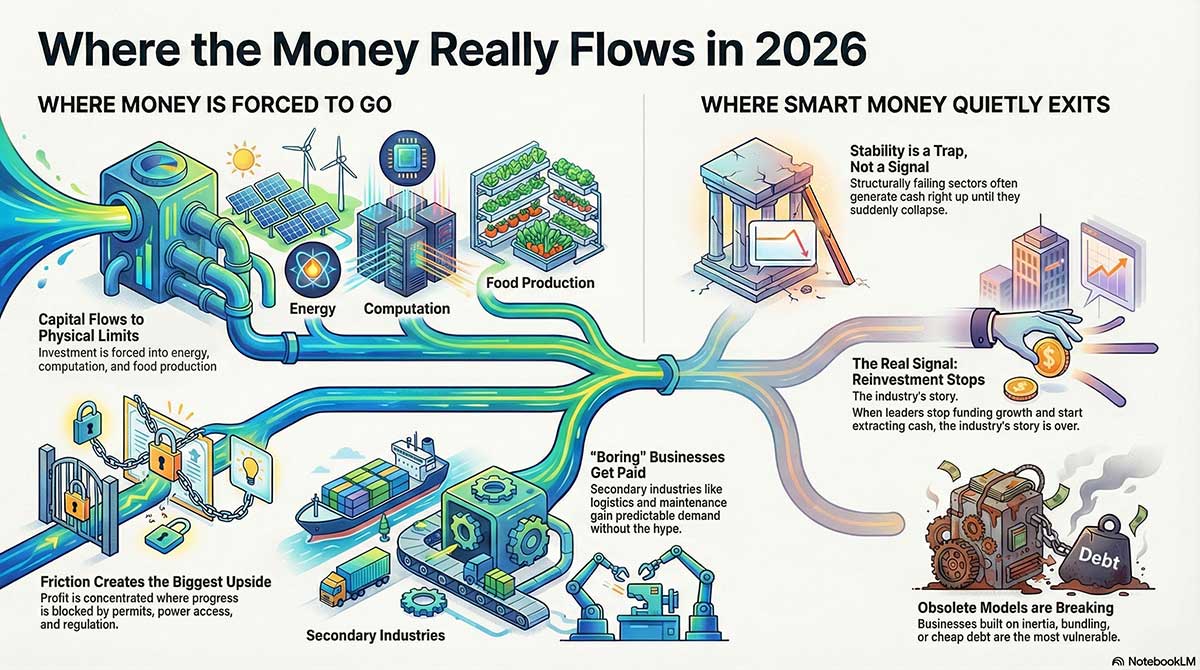
History offers a consistent lesson: periods of rapid technological efficiency create both extraordinary wealth and profound imbalance. When systems become more productive than societies can adapt to, the result is not immediate collapse—but tension, delay, and eventual reconfiguration.
In such moments, the most durable fortunes are not built at the center of attention. They emerge in supporting systems, transitional roles, and sectors that convert pressure into service. Conversely, industries that once thrived on complexity, friction, or institutional inertia eventually become liabilities rather than assets.
The coming years will likely reward those who recognize where decline has already begun, even if it remains profitable for a time. They will also reward those who understand that labor displacement is not merely a social concern, but an economic signal—one that reshapes consumption, risk, and political response.
There is nothing unprecedented about this transition. Similar patterns accompanied the electrification of industry, the rise of fossil fuels, and the automation of manufacturing. What differs today is velocity. Change is occurring faster than cultural narratives can explain it.
Those who succeed will not be those who react most quickly, but those who position themselves correctly—early enough to benefit, and early enough to exit. In the end, economic advantage belongs not to those who predict the future, but to those who understand the forces that make certain futures unavoidable.
Short Bios:
Vaclav Smil
Interdisciplinary scholar known for his rigorous analysis of energy, technology, economics, and long-term civilizational trends. His work emphasizes physical limits, scale, and historical patterns over speculation.
Peter Zeihan
Geopolitical strategist focused on demographics, supply chains, energy security, and the structural forces reshaping global power and trade.
Ray Dalio
Investor and economic historian recognized for his frameworks on debt cycles, capital flows, and systemic risk across macroeconomic regimes.
Catherine Wood
Technology-focused investor known for identifying long-term innovation platforms and capital allocation shifts driven by exponential technologies.
Sam Altman
Technology executive focused on artificial intelligence infrastructure, deployment, and the economic implications of large-scale computation.
Ben Thompson
Technology analyst and writer specializing in business strategy, platform economics, and how technology reshapes industry power structures.
Brad Smith
Technology executive with expertise in enterprise infrastructure, regulation, cybersecurity, and the intersection of government and technology.
Andy Jassy
Business leader experienced in large-scale cloud infrastructure, logistics, and the economics of hyperscale operations.
Mary Meeker
Internet analyst known for long-term trend analysis of technology adoption, capital deployment, and digital transformation cycles.
Howard Marks
Investor and writer focused on risk, cycles, market psychology, and disciplined capital allocation during periods of structural change.
Scott Galloway
Business professor and commentator analyzing the convergence of technology, capital concentration, labor disruption, and power asymmetry.
Tim O’Reilly
Technology thinker focused on platforms, regulation, and the societal impact of technological revolutions.
Jason Calacanis
Early-stage investor and entrepreneur with experience identifying second-order business opportunities emerging from major technology shifts.
Naval Ravikant
Entrepreneur and investor known for insights on leverage, capital efficiency, and long-term value creation in technology-driven economies.
Esther Duflo
Economist specializing in development economics, labor markets, and the real-world effects of economic policy on populations.
Leave a Reply