
|
Getting your Trinity Audio player ready...
|
What Happens After Death? Dolores Cannon Moderates the Debate
Introduction by Dolores Cannon
When people hear the phrase life after death, they often expect comfort, belief, or mystery. What I want to offer instead is understanding.
For more than three decades, through tens of thousands of past-life and between-life regressions, I did not set out to prove anything. I simply listened. I asked the same questions again and again, across cultures, religions, and personal belief systems, and I paid attention to what remained consistent when imagination, expectation, and doctrine fell away.
What emerged was not a theory, and not a religion, but a pattern. A structured experience of death. A continuity of consciousness. A system of learning that is far more compassionate, intelligent, and self-directed than most of us were ever taught to believe.
This conversation is not about near-death experiences alone, nor about faith. It is about what people describe when they go all the way through the death experience and return with memory intact. It is about why fear dissolves when understanding replaces assumption. And it is about why life on Earth, difficult as it is, suddenly makes sense when seen from a wider perspective.
I am not here to tell you what to believe. I am here to share what has been shown, repeatedly, by the consciousness itself when the conscious mind steps aside.
Let us begin with curiosity, not judgment. And with listening, not fear.
(Note: This is an imaginary conversation, a creative exploration of an idea, and not a real speech or event.)
Topic 1: “Real Death” vs Near-Death

Moderator: Dolores Cannon
Participants: Raymond Moody, Bruce Greyson, Kenneth Ring, Brian Weiss, Michael Newton
Dolores Cannon (opening)
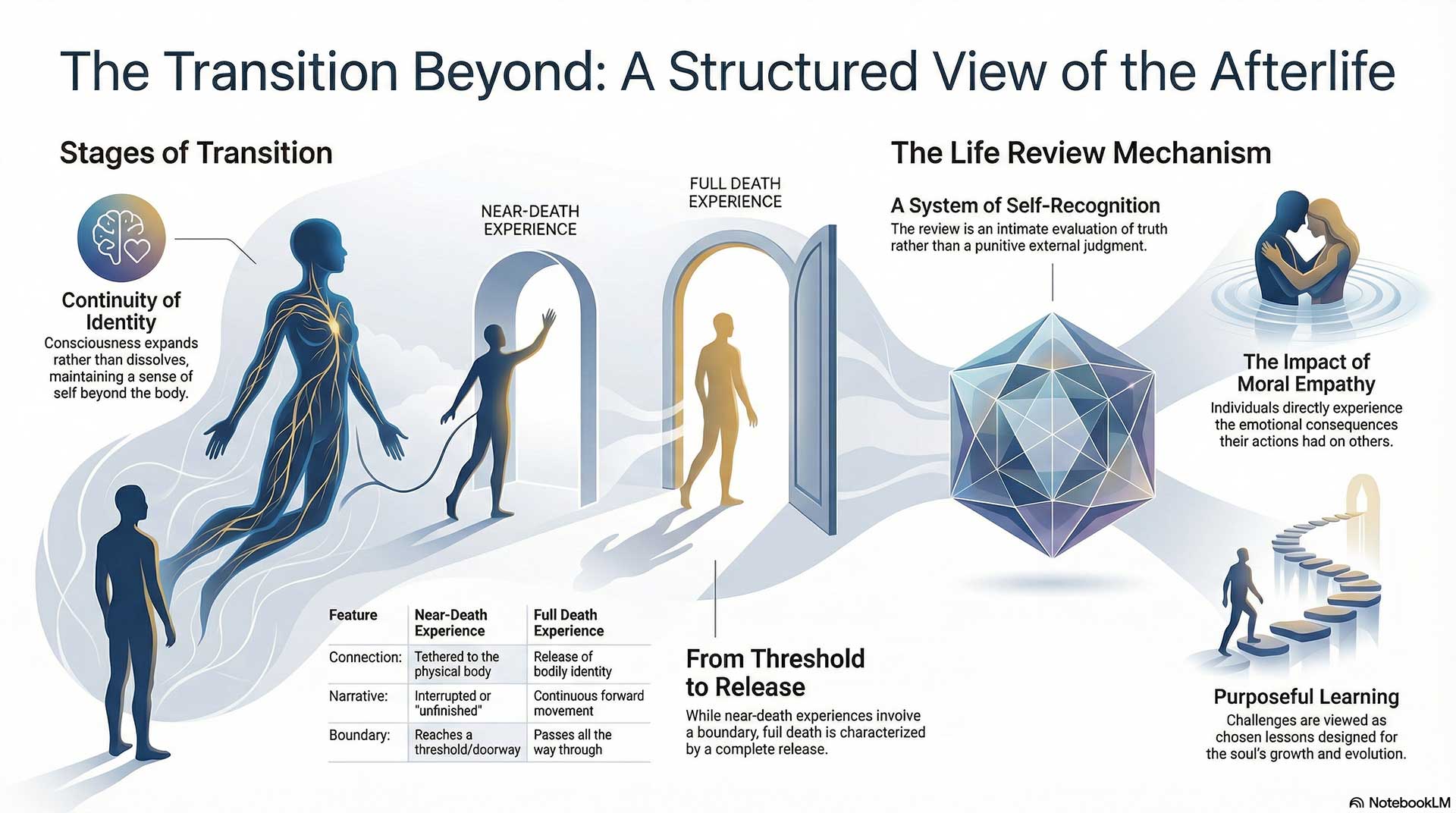
When I take people through past-life regression, I do not stop at the moment of death. I follow them through it. Over decades, thousands of people have described what happens when they go all the way through death, not just near it. Tonight, I want us to explore one simple but profound question: are near-death experiences and full death describing the same event, or are they describing different stages of the same process?
I’ll ask one question at a time. Please answer from your own work and experience.
Question 1
When people say they “went all the way,” what truly separates a near-death experience from what you would consider an actual death experience?
Raymond Moody
In my work, the defining feature of near-death is return. The experience unfolds, but something interrupts it. The person comes back. Structurally, many elements are consistent: separation from the body, movement toward light, encounters, profound peace. What they do not report is finality. There is always a sense, implicit or explicit, that the journey is incomplete. Whether that incompleteness is biological or metaphysical is the open question.
Brian Weiss
From regression work, I would say intention and continuity separate the two. In near-death experiences, the consciousness is pulled back abruptly. In full death, the narrative continues forward. There is no urgency to return, no negotiation. People move into a wider awareness that includes planning, review, and reconnection. It feels less like an interruption and more like a transition.
Bruce Greyson
Clinically, we cannot verify “full death” because those individuals do not return. That is the boundary of science. What we can say is that near-death experiences often stop at thresholds. People describe being told it is not their time. That suggests a process with stages. Whether regression accesses later stages or constructs them symbolically is where caution is required.
Michael Newton
In life-between-lives regression, the distinction is extremely clear to subjects. Near-death feels unfinished. Full death involves release. There is no sense of being tethered. Clients describe the loss of bodily identity and entry into a stable nonphysical environment. The difference is not subtle in their accounts.
Kenneth Ring
I see near-death experiences as initiatory. They open a door but do not pass through it. Many experiencers say they reached a boundary they could not cross. That boundary itself is meaningful. It implies structure. Whether that structure exists independently or is generated by consciousness is the unresolved mystery.
Question 2
Across your cases, which elements appear so consistently that they cannot easily be dismissed as culture, expectation, or imagination?
Michael Newton
The life review appears with extraordinary consistency. Not judgment, but self-recognition. Also the presence of guiding intelligences who do not command but advise. Another consistent element is the sense of returning to familiarity rather than entering something unknown.
Bruce Greyson
The transformative aftereffects are difficult to dismiss. Reduced fear of death, increased compassion, decreased materialism. These changes persist for decades. Hallucinations rarely restructure a person’s value system so completely and permanently.
Kenneth Ring
The experience of overwhelming love is universal. Not approval. Not reward. Love without conditions. People struggle to describe it, but the emotional tone is unmistakable and cross-cultural.
Raymond Moody
The out-of-body perception stands out. People report details they should not be able to know from their physical position. Some verifications have held up under scrutiny. That alone suggests consciousness can function independently of the body, at least temporarily.
Brian Weiss
Continuity of identity. People do not feel erased. They feel expanded. They know who they are, and more. That sense of identity persisting beyond the body is reported again and again.
Question 3
If regression narratives and near-death research diverge on details, should we treat that as a contradiction, or as evidence that different layers of the same process are being observed?
Bruce Greyson
From a scientific standpoint, divergence requires caution. But it does not require dismissal. Different tools access different data. A telescope and a microscope reveal different truths about the same reality.
Brian Weiss
I see them as complementary. Near-death shows the doorway. Regression shows the rooms beyond it. Both are incomplete alone.
Raymond Moody
I agree. Near-death experiences are constrained by return. They are like reading the first chapter repeatedly. Regression attempts to read further chapters. Whether those chapters are literal or symbolic remains the open question.
Kenneth Ring
Human consciousness may translate nonphysical reality into imagery it can understand. Differences may reflect translation, not contradiction. The deeper question is whether the translation points to something real.
Michael Newton
In my work, the consistency across thousands of independent subjects suggests we are not dealing with random imagination. When patterns emerge repeatedly without cross-contamination, they deserve serious consideration.
Dolores Cannon (closing)
What I hear tonight is not conflict, but layering. Near-death experiences show the threshold. Regression explores what lies beyond. Each method has limits, but together they form a more complete picture than either alone.
I do not ask anyone to believe. I ask them to listen. When the same story emerges from different doors, we should at least consider that the house is real.
In the next topic, we will move deeper into one of the most challenging parts of this subject: the life review, and why people judge themselves more harshly than any external authority ever could.
Topic 2: The Life Review

Moderator: Dolores Cannon
Participants: Bruce Greyson, Kenneth Ring, Michael Newton, Brian Weiss, Elisabeth Kübler-Ross
Dolores Cannon (opening)
When people hear “life review,” they often imagine a courtroom, a judge, a sentence. In my work, that is not what I see. I see something far more intimate and, honestly, far more demanding. It is not about punishment. It is about truth.
Tonight we are going to look at the life review from five angles: research, clinical work, regression, and the lived reality of dying people. I will ask one question at a time. Everyone will answer before we move on.
Question 1
Is the life review primarily moral, educational, therapeutic, or something else? What tells you that?
Kenneth Ring
From the near-death accounts, the life review often feels educational, but not in a classroom way. It is educational through direct knowing. People do not just recall what they did. They comprehend what it meant. The emphasis is on understanding the impact of one’s life, especially on others. That points to learning, not condemnation.
Michael Newton
In life-between-lives regression, it is a combination of educational and moral, but not moral in the religious sense. It is moral as in cause and effect. People see patterns. They see intentions. They see where they avoided growth. They experience it as a structured evaluation meant to help them plan better next time. That is why it feels instructional, not punitive.
Elisabeth Kübler-Ross
In my time with the dying, what stood out was the human need to find meaning. People review their lives even without mystical experiences. They do it because they want coherence. If there is a spiritual dimension, it seems to amplify that need into a clearer perspective. That makes it therapeutic. It heals by helping a person reconcile, forgive, and release.
Bruce Greyson
Clinically, I would say the life review functions as a moral and therapeutic mechanism that produces measurable psychological change. People return more compassionate, less fearful, and often with a renewed sense of purpose. That looks like therapy, but delivered in a form that is not typical of the waking mind. The consistent aftereffects are what tell me it is not random.
Brian Weiss
In regression, many people experience the life review as emotional truth, not intellectual summary. They understand love and harm in a way that bypasses rationalization. The review seems designed to dissolve denial. That makes it therapeutic and educational at the same time. People come away with clarity about what they must change.
Question 2
Do people experience the review as judgment, or as self-recognition? How does that change the way they live afterward?
Elisabeth Kübler-Ross
Most of the fear around judgment comes from what people have been taught. But when you sit with dying people, you see that their harshest critic is often themselves. When they can move into self-recognition, their final days soften. They become kinder, more honest, and more willing to let go. The release is not from an external judge. It is from internal guilt.
Bruce Greyson
In NDE reports, the “judge” is rarely a figure handing down punishment. People describe a profound self-awareness, often in the presence of a loving atmosphere. They judge themselves because they suddenly see consequences clearly. Afterward, many try to live differently. They become less reactive, more forgiving, more service-oriented. That suggests self-recognition is the driver of change.
Michael Newton
In my sessions, the review is frequently described as objective. There is guidance, but not condemnation. The person sees where they met their goals and where they avoided them. The shame is self-generated, and that shame often turns into resolve. It produces a practical outcome: different choices in the next plan, and different priorities in the current life if the person is viewing it from a regression.
Kenneth Ring
I would add that the review often includes what we might call moral empathy. People feel what others felt. That is not judgment in the legal sense. It is recognition through shared experience. When that happens, the person often cannot return to ordinary cruelty. They have felt too much. They live with a new awareness of interconnection.
Brian Weiss
In therapy, self-recognition is powerful because it removes the need to defend the ego. If the soul sees clearly, excuses fall away, but so does hopelessness. People return with the sense that love is the metric. They stop worrying about impressing others and start caring about how they affect others. That is a big shift.
Question 3
Are there limits to what a life review can explain, for example trauma, mental illness, or seemingly random suffering?
Bruce Greyson
Yes, there are limits. A life review may provide meaning, but meaning does not equal blame. Trauma can happen to people who did nothing to deserve it in any simple moral accounting. If we misuse the concept, we can harm people by implying their suffering is their fault. The ethical line is to allow meaning without forcing moral causation.
Kenneth Ring
I agree. Some suffering may be meaningful in ways we cannot translate cleanly. Near-death experiencers often return with compassion, not with a neat explanation for every tragedy. The life review, as described, is less about explaining pain and more about revealing how one responded to pain. That is a different kind of lesson.
Brian Weiss
In regression work, people sometimes connect trauma to patterns across lifetimes, but that must be handled with care. The purpose is healing, not metaphysical certainty. If a person leaves the session more peaceful and more empowered, we have done our job. If the narrative creates shame or fatalism, we have missed the point.
Elisabeth Kübler-Ross
When someone is dying, what they need is not a philosophical system. They need comfort, presence, and permission to be human. If there is a spiritual review, it should not be used as a weapon. For trauma and mental illness, compassion must come first. No spiritual idea is worth more than a person’s peace.
Michael Newton
From the life-between-lives perspective, many choose difficult circumstances to accelerate learning, but we must never say that to someone as a cold explanation. The review may show intention at the soul level, but the human experience of suffering is real. The only responsible use of this concept is to help people find meaning and become kinder, not to lecture them into accepting pain.
Dolores Cannon (closing)
What I want people to hear is this: the life review is not a divine punishment system. It is a truth system. It shows you what you did, and it shows you how it felt to others. That can sting, but it is the kind of sting that wakes you up, not the kind that destroys you.
And if there is a single ethical rule we all agree on tonight, it is this: never use spiritual ideas to blame the suffering. Use them to bring understanding, responsibility, and compassion.
Next, we move into an even more sensitive subject: contracts, karma, and the exit plan, and how to discuss those ideas without harming the grieving.
Topic 3: Contracts, Karma, and the Exit Plan

Moderator: Dolores Cannon
Participants: Michael Newton, Brian Weiss, Ian Stevenson, Jim B. Tucker, Stanislav Grof
Dolores Cannon (opening)
Now we step into the part of this work that can comfort people, or harm them, depending on how it is spoken. In my research through regression, people repeatedly describe life as planned. They speak of agreements, lessons, roles, even an exit plan. They also speak of karma, not as punishment, but as balance and learning.
But we must be careful. If we say “it was planned” in the wrong way, we can wound the grieving. If we say “it was karma” thoughtlessly, we can turn a healing idea into a weapon. So tonight we are going to handle this with precision and compassion.
I will ask one question at a time. Everyone will answer before we move on.
Question 1
If a life has an “exit plan,” how do we speak about tragedies ethically, without blaming the victim or minimizing grief?
Stanislav Grof
We begin by separating meaning from moral blame. A tragedy may carry meaning in a person’s inner life, but that does not mean they deserved it. In altered states, people often discover that suffering can be integrated into growth, but that integration cannot be forced from the outside. Ethically, we follow the person’s readiness. We never impose metaphysics on raw grief.
Jim B. Tucker
From my standpoint, the first responsibility is humility. Even if one believes in planning or reincarnation, we cannot know the specific framework behind any particular death. Families need compassion, not theories. If our research suggests that consciousness continues, we can gently offer that hope. But claiming certainty about why a tragedy happened is rarely justified.
Brian Weiss
In therapy, the priority is the person in front of you. Grief is not a debate to win. If spiritual language comforts them, we can use it carefully. If it does not, we do not push it. Even if planning exists at some level, the human heart still suffers, and that suffering deserves to be honored without explanation.
Michael Newton
In life-between-lives regression, the exit plan is typically described as a soul-level decision, but I never present it to grieving people as a blunt fact. The ethical approach is to say: some people in regression experience their life as guided and purposeful. If that helps you, we can explore it. If it does not, we stay with your grief and your love. The concept must serve healing, not ideology.
Ian Stevenson
My work is more evidential and cautious. I studied cases of children who reported previous lives, often involving violent death. Even in those, I would not claim to know why events occurred. The ethical language is probabilistic and gentle. We can say that some findings suggest continuity, but we cannot assign moral causation or purpose to specific tragedies without stepping beyond the evidence.
Question 2
What is the cleanest way to separate “soul planning” from confirmation bias or storytelling created under hypnosis or altered states?
Ian Stevenson
Independent verification. When a person reports details that can be checked and were not accessible through normal means, the case becomes stronger. Also, we must avoid leading questions. The more the investigator shapes the narrative, the less meaningful the result.
Michael Newton
In regression, you can test internal consistency across many sessions, but yes, hypnosis is vulnerable to suggestion. The cleanest method is disciplined interviewing and pattern analysis across thousands of cases, looking for recurring structures that do not depend on one therapist’s language. You also watch outcomes. Does the material consistently produce healing and behavioral change, or does it produce fantasy and dependency?
Stanislav Grof
Altered states generate mythic imagery. That does not automatically mean it is false. The psyche speaks in symbols. The question is whether the symbol carries transformative truth. The cleanest separation is to ask: does the experience reduce suffering, increase responsibility, and deepen compassion? If it inflates ego, creates fatalism, or causes harm, then whatever its metaphysical status, it is not being integrated well.
Jim B. Tucker
We can look for cross-cultural consistency and for cases that arise spontaneously rather than through guided techniques. Children’s past-life reports often come without hypnosis. That reduces, though does not eliminate, the risk of suggestion. Comparing spontaneous cases with regression material can show where overlap exists and where hypnosis may be constructing narrative layers.
Brian Weiss
In therapy, I treat the narrative as potentially symbolic even if it is literal. I ask: what changes in the person’s symptoms, relationships, and peace? Confirmation bias is reduced when the therapist does not insist the story is fact, but instead uses it as a tool for healing and insight. If the person becomes freer, the process is doing something real, at least psychologically.
Question 3
If reincarnation is real, why do some lives look like rapid progress while others repeat the same pain for decades?
Michael Newton
Because souls plan at different levels of ambition and readiness. Some choose a focused lesson and complete it. Others overload the curriculum or keep avoiding the hardest truth. Repetition often indicates unfinished learning, but it can also reflect the complexity of free will. You can plan growth, but you can still resist it while you are here.
Jim B. Tucker
From the children’s cases, there are hints that temperament carries over, and certain emotional patterns can persist. That might explain why some people repeat. Also, the environment matters. A person may have the inner capacity to grow, but be placed into circumstances that reinforce trauma rather than resolve it. If there is planning, it is not simple.
Stanislav Grof
Trauma can lock the psyche into loops. Even with insight, the body and nervous system may repeat the old program. Progress is not only spiritual, it is biological and relational. A person can have deep spiritual understanding and still struggle emotionally if their early conditioning or trauma has wired them into survival patterns. The repeated pain may be precisely the field of work.
Brian Weiss
I see progress accelerate when compassion enters. People repeat pain when they stay in blame, shame, or resentment. When they shift into forgiveness and responsibility, they often move quickly. If reincarnation is a classroom, then love is the skill that passes the course. Without it, the same lesson appears in new costumes.
Ian Stevenson
My caution is that “progress” is hard to measure from the outside. A life that looks repetitive may be doing subtle inner work. Also, some suffering may not be moral instruction but simply part of human vulnerability. If reincarnation exists, it likely interacts with genetics, culture, and chance in ways we do not yet understand.
Dolores Cannon (closing)
If there is one message I want people to carry from this conversation, it is this: these ideas must never be used to harden the heart. Contracts and karma, in the way my clients describe them, are not excuses to dismiss pain. They are explanations that call us into greater compassion and greater responsibility.
The ethical use of this material is gentle. It meets a grieving person where they are. It offers meaning when meaning helps, and it offers silence and presence when meaning would be too sharp.
Next, we can move into the question of “astral geography,” levels, vibration, and why so many people describe temples, schools, and libraries.
Topic 4: Astral Geography, Levels, and Vibration

Moderator: Dolores Cannon
Participants: Robert A. Monroe, Stanislav Grof, Raymond Moody, Kenneth Ring, Michael Newton
Dolores Cannon (opening)
People tell me about places. They call them lower, middle, upper. They talk about schools, councils, libraries, temples, healing chambers. Critics say these are fantasies. Believers say they are literal. Tonight we are going to treat it like investigators, not like preachers. What is “place” in a reality where thought shapes experience?
Question 1
Are the lower, middle, and upper realms literal locations, shared consensus environments, or symbolic translations of inner states?
Stanislav Grof
In non-ordinary states, the psyche reveals landscapes that are both inner and transpersonal. Some are clearly symbolic. Some feel like shared domains that many can enter. I think the honest answer is that we may be dealing with multiple layers. Symbolic does not mean unreal. Symbol is the language consciousness uses when ordinary perception cannot contain what is happening.
Robert A. Monroe
From my experience framework, many environments are stable enough to be revisited and compared. Some are personal overlays. Some are what I would call consensus territories, places multiple explorers can enter and report with similarity. The problem is language. We call them locations because that is what the human mind can understand.
Raymond Moody
Near-death accounts suggest structure but they do not settle the question of literal geography. People report boundaries, thresholds, and regions, but what we can responsibly say is that the experience has organized stages. Whether those stages map to external places or internal conditions is not resolved by testimony alone.
Michael Newton
In life-between-lives regression, people describe both. There are areas that appear consistent across cases, and there are features that look tailored to the individual. The level framework functions like a sorting mechanism. Where you go corresponds to what you can resonate with, not what you deserve in a punitive sense.
Kenneth Ring
I tend to think of it as a spectrum. There may be genuine shared realities, but consciousness also translates what it meets into images it can process. The repeated appearance of “levels” could be a real structure, or it could be a universal way minds organize complexity. Either way, the consistency is meaningful.
Question 2
What should we make of “vibration” and “frequency” language? Is it metaphor, measurable reality, or a useful pointer that risks becoming vague?
Robert A. Monroe
It is a pointer. In my model, it describes a shift in state, a tuning. When you change your state, your access changes. Whether that can be measured with instruments is a separate issue. As an explorer, I treat it operationally. If you adjust, you reach different environments.
Kenneth Ring
It is often metaphor, but a metaphor pointing to something precise. People struggle to describe a qualitative change in being. “Vibration” is shorthand. The risk is that it becomes mystical jargon. The value is that it captures the lived sense of resonance, compatibility, and expansion.
Raymond Moody
In research language, I would translate it as “state-dependent experience.” We know that altered states influence perception and meaning. The question is whether the state reveals external reality or constructs an internal one. Frequency language may be poetic, but it does not by itself answer that question.
Stanislav Grof
It can be both poetic and accurate in a psychological sense. Some experiences feel as if they operate on an energetic substrate, but we must be careful not to claim physics without evidence. Still, “frequency” can describe how emotional tone governs access. Fear leads to constricted domains. Love leads to expanded domains. That pattern is consistent.
Michael Newton
Clients often report that you cannot enter certain environments if your state is heavy, confused, or resistant. They experience it like a natural law. The language may be metaphorical, but the function is consistent. It is about readiness and alignment.
Question 3
Why do people report human-like structures such as libraries, temples, councils, schools? Does that strengthen the case for reality, or weaken it as projection?
Kenneth Ring
It could be translation. If consciousness encounters something vast, it might render it as a library or school because those are archetypes of learning. The fact that these symbols appear across cultures may indicate a shared cognitive grammar. That does not disprove reality. It may be the interface.
Michael Newton
The structure strengthens the case when the function is consistent. A council appears in different forms, but the role is similar: guidance without coercion, planning without punishment. A library appears as a place of access to knowledge. The outer form can vary, the inner function repeats.
Stanislav Grof
Archetypes are not merely personal. They can be transpersonal. The mind may use temple imagery because it has always used sacred architecture to represent transformation. The weakness is when people take the literal form too seriously. The strength is when the form produces lasting ethical change.
Raymond Moody
In near-death accounts, structures appear, but often as feelings more than buildings. Some say “a place of learning” rather than “a school.” The more we push literalism, the more we risk overclaiming. But the recurrence of organized guidance is hard to ignore.
Robert A. Monroe
In exploration terms, thought is creative. If you need a doorway, you see a doorway. If you need orientation, you see a guide. That does not mean there is nothing there. It means the environment and the explorer interact. The structure may be partly you and partly the territory.
Dolores Cannon (closing)
I hear a common thread: these experiences are structured, but the structure may be both real and translated. The map is not the territory, but a good map still points somewhere. Next, we go to the sharpest question of all: evidence.
Topic 5: What Counts as Evidence

Moderator: Dolores Cannon
Participants: Bruce Greyson, Ian Stevenson, Jim B. Tucker, Stanislav Grof, Raymond Moody
Dolores Cannon (opening)
People ask me, “Is this true?” They mean, “Can you prove it?” The honest answer is that different fields accept different kinds of proof. Tonight I want us to talk about standards. Not to attack one another, but to clarify what we can responsibly say.
Question 1
What level of consistency across cases is enough to treat a pattern as more than imagination, expectation, or suggestion?
Ian Stevenson
Consistency is not enough by itself. People can share expectations. The strongest cases are those with independent verification, where specific statements match facts unknown to the subject and later confirmed. In my work, the best cases involved children giving verifiable details about a deceased person they could not reasonably have learned.
Bruce Greyson
Consistency matters, but I agree it is not sufficient. What strengthens the pattern is when it appears across cultures, belief systems, and ages, and when it produces stable aftereffects. Hallucinations are usually idiosyncratic and transient. NDE patterns are often coherent and life-changing.
Stanislav Grof
We should add phenomenological rigor. The inner experience has its own validity, but we must document it carefully. If certain motifs appear repeatedly under different conditions, it suggests we are touching a deep layer of psyche or reality. Still, the leap from motif to metaphysics requires caution.
Raymond Moody
In NDE research, the repeated core features have persuaded many that something significant is happening, but the question becomes: significant of what? Consistency suggests there is a real process. It does not yet define its ultimate nature.
Jim B. Tucker
I look for convergence between methods. When children’s spontaneous reports, NDE accounts, and some regression material overlap on specific themes, that convergence is meaningful. Each method has weaknesses. Overlap reduces the chance that any single weakness is driving all conclusions.
Question 2
Which kind of data is strongest in your work: verified details, long-term life changes, medical corroboration, or something else?
Bruce Greyson
Long-term transformation is powerful. Many experiencers show lasting changes in values and behavior that are difficult to attribute to fantasy. Medical corroboration is important too, especially when the experience occurs during impaired brain function, but transformation is the human proof that something reorganized their inner life.
Ian Stevenson
Verified details, especially when they involve specific names, places, and circumstances that can be checked. Also behavioral carryovers such as phobias corresponding to reported modes of death, and birthmarks matching wounds in the previous life record, when the documentation is solid.
Jim B. Tucker
I agree with Stevenson. Verification is the clearest lever. But I also value the psychological patterning in children: consistent statements, consistent emotional ties, and the way some cases resolve with time. The combination of detail plus behavioral coherence is strongest.
Raymond Moody
Medical corroboration and verified perception during out-of-body moments are compelling. When a person reports accurate details from a vantage point they should not have had, it forces us to reconsider the mind-body relationship. That is where the evidence presses hardest.
Stanislav Grof
In my area, the strongest evidence is therapeutic impact combined with cross-case similarity. But I am careful. Healing does not prove metaphysical claims. It proves that the experience is meaningful and can be integrated. The metaphysical question remains open, but the clinical value is undeniable.
Question 3
If we cannot prove an afterlife in a laboratory, what does “responsible truth-telling” to the public look like?
Jim B. Tucker
It means distinguishing evidence from interpretation. We can say, “Here is what we observed, here is what it might mean, and here are alternative explanations.” We should avoid certainty language that exceeds the data, especially when speaking to vulnerable people.
Raymond Moody
We should present the experiences as real experiences, not dismiss them, but we should not force one doctrine. The public deserves honesty about what we know, what we suspect, and what remains mystery.
Bruce Greyson
Responsible truth-telling includes ethics. Do not exploit grief. Do not sell certainty. Emphasize the humane outcomes: reduced fear, increased compassion, deeper appreciation of life. If an idea encourages kindness and reduces terror, it can be offered carefully without claiming final proof.
Stanislav Grof
I would add: respect both skepticism and wonder. A mature culture can hold ambiguity. We can validate experience without turning it into dogma. Dogma is the enemy of genuine inquiry.
Ian Stevenson
And we must protect the integrity of research. Sensational claims harm credibility. The proper stance is careful documentation, cautious conclusions, and openness to revision. If the phenomenon is real, it does not need exaggeration.
Dolores Cannon (closing)
What I hear is a shared ethic: do not overclaim. But also, do not dismiss. Something is happening in these experiences, and it changes people. I can live with mystery. I cannot live with fear being used as control.
Next, if you want to continue, we can either move into a new Topic 6, or we can circle back and tighten the panels so the five topics feel like one escalating argument that builds toward a final conclusion.
Final Thoughts by Dolores Cannon
If there is one thing I hope stays with you, it is this: death is not the end of anything real.
What we call death is simply a transition. A return to awareness. A moment when the confusion lifts and the larger picture comes back into view. No one is punished. No one is abandoned. And no one is alone.
The most difficult truths people encounter in these sessions are not about judgment from outside forces, but about self-honesty. We see how our words mattered. How our actions rippled outward. And how every experience, painful or joyful, was chosen for growth, not suffering.
Life is not random. And it is not cruel. It is challenging because it is efficient. Earth teaches lessons that cannot be learned anywhere else, and it does so through limitation, emotion, and relationship. That is why we come. And that is why we return.
When fear of death fades, something remarkable happens. People live differently. They become kinder. More patient. Less attached to fear-based systems. They stop asking, “What will happen to me?” and start asking, “What did I come here to learn?”
Understanding the death experience does not pull us away from life. It brings us fully into it.
And when the time comes to leave, it will feel less like an ending, and more like remembering who you were all along.
Short Bios:
Dolores Cannon: American hypnotherapist and author best known for popularizing past-life regression and “between death and life” case material through decades of client sessions.
Raymond Moody: Physician and philosopher who helped popularize modern near-death experience research and brought NDE narratives into mainstream conversation.
Bruce Greyson: Psychiatrist and leading academic NDE researcher known for clinical rigor, long-term outcome studies, and careful framing of evidence and ethics.
Kenneth Ring: Psychologist and early NDE researcher recognized for mapping common NDE patterns and the lasting life-changes reported by experiencers.
Brian Weiss: Psychiatrist and bestselling author known for therapeutic past-life regression work and mainstream storytelling around reincarnation and healing.
Michael Newton: Regression researcher associated with “life-between-lives” hypnosis, focusing on reported soul planning, life reviews, and inter-life learning.
Elisabeth Kübler-Ross: Swiss-American psychiatrist who transformed end-of-life care by emphasizing the emotional and spiritual reality of dying patients and grief.
Ian Stevenson: Psychiatrist and researcher (notably at UVA) known for systematic investigations of children’s reports of past-life memories and related case documentation.
Jim B. Tucker: Psychiatrist and researcher who continued Stevenson’s work, studying children’s past-life memory cases with an emphasis on careful data and analysis.
Stanislav Grof: Psychiatrist and pioneer of transpersonal psychology known for exploring non-ordinary states of consciousness and “death-rebirth” experiences in therapy and research.
Robert A. Monroe: Consciousness explorer and author associated with out-of-body experience research and structured methods for investigating altered states.
Leave a Reply