
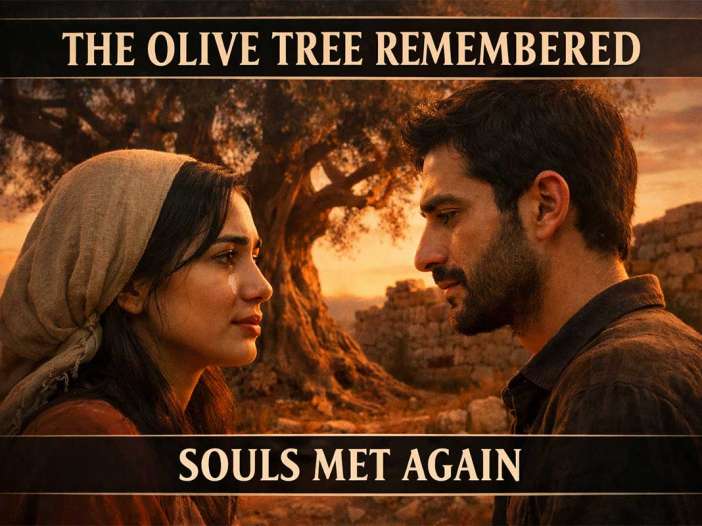
Some stories begin with a question. Others begin with a feeling that has no name.
The Olive Tree Remembered belongs to the second kind.
This story was inspired by the spiritual ideas often linked to Dolores Cannon — soul memory, pre-birth connection, unfinished pain, forgiveness, and the possibility that life carries a deeper pattern than we usually see from inside it. In this new second-edition version, I wanted to shape the story more clearly around those themes, yet still keep it human, intimate, and emotionally grounded.
At its heart, this is not just a story about two people meeting. It is a story about what happens when a meeting feels older than the present moment. It is a story about dreams that seem more like memory, grief that arrives before explanation, and the unsettling possibility that some souls may return to one another so what once ended in pain can finally be faced in truth.
I chose this setting near Jerusalem because it carries a weight that fits the story deeply: stone, prayer, history, loss, longing, and the sense that the land itself remembers what human beings try to bury. In such a place, the themes of soul recognition and unfinished sorrow do not feel abstract. They feel lived.
This is not a literal Dolores Cannon case, session, or transcript. It is a fictional spiritual story shaped by questions her work has stirred in many people:
Do souls choose certain bonds before birth?
Can old pain return for healing?
Can forgiveness free us without erasing what happened?
Can one life hold traces of a much longer journey?
My hope is that this story does not only move you emotionally, but opens something quieter too — the sense that some of the deepest mysteries in our lives may not be meaningless, only unfinished.
A Grief Without a Name
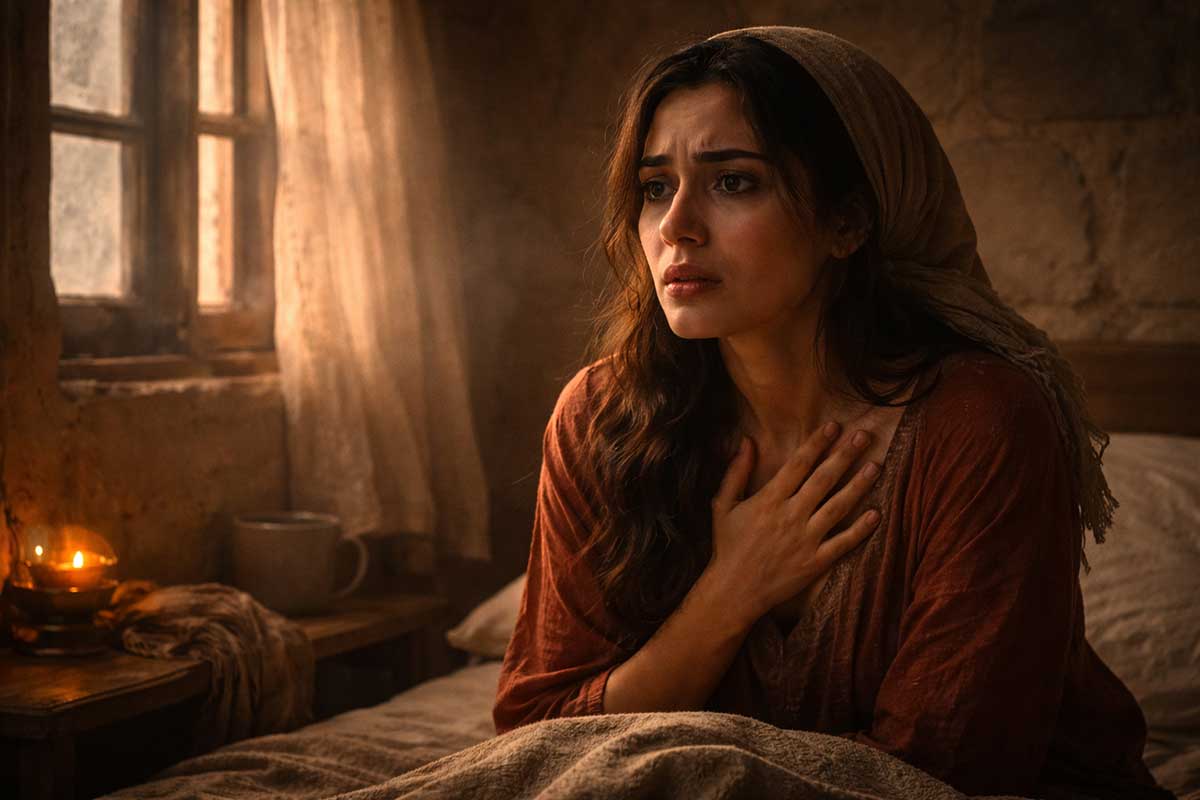
In a stone village not far from Jerusalem, Lina woke each morning to the sound of prayer moving across the hills.
It came before the full light.
It came before the market noise.
It came before the ovens had fully warmed and before the dust began to rise from the road.
The sound drifted over old walls, through narrow lanes, past worn wooden doors and cracked windows, past sleeping roofs and olive jars and laundry left to dry in the pale air. It entered the house softly, as if it already knew the way.
Lina opened her eyes and lay still.
There it was again.
That same weight in her chest.
Not a sharp pain. Not sickness. Not fear exactly. Something older. Something that sat inside her life like a guest that had never gone home.
From the next room came the quiet sounds of morning. Her mother’s hands working dough. Clay touching wood. A kettle beginning to stir. The small ordinary music of a house that had survived by staying busy.
Everything around her was familiar.
The woven blanket at her waist.
The pale crack in the wall above the window.
The folded shawl over the chair.
The chipped clay cup beside the bed.
Nothing in the room had changed.
Yet Lina woke almost every day with the feeling that she had lost something during the night.
Or someone.
She sat up slowly and pressed her palm to her chest.
The dream was already fading, but not fast enough.
A stone wall.
Red evening light.
A tree.
Always the tree.
Its branches moved in a wind she could almost hear even after waking. Gray-green leaves. Twisted trunk. Roots holding into dry earth as if they had been there longer than memory.
And someone leaving.
Always someone leaving.
Sometimes she heard herself crying before she saw anything at all. Sometimes she saw a hand slipping from her grasp. Sometimes she ran toward the fading shape and could not reach it. The details changed around the edges, but never in the center. The grief was always the same.
It felt less like a dream than like a wound remembering itself.
Lina lowered her head and waited for the room to settle around her.
She had lived with this for years. Since childhood, as far back as she could remember. At first she had told her mother. Then an aunt. Once, when she was very young, she had even tried to draw the tree with a piece of charcoal on the back wall of the courtyard. But no one could do much with a sorrow that had no event behind it. Sooner or later people began answering her with silence, or with kindness so careful it felt like distance.
It was easier not to mention it.
Her mother called from the other room.
“Lina.”
“I’m awake.”
“Then come before the bread cools.”
Lina rose, wrapped her shawl around her shoulders, and stepped into the morning.
The house was modest and narrow, built of old stone that held night air longer than the newer places did. Her mother stood at the low table, dark hair pinned back, sleeves rolled, face already carrying the day’s responsibilities. Her father sat near the radio, listening with the blank endurance of a man who had learned not to argue with the news. The smell of bread and oil filled the room.
Her mother glanced at her once and paused.
“You look tired.”
“I didn’t sleep well.”
“The dream again?”
Lina hesitated.
Her mother did not press. She only turned back to the bread and said, with a gentleness that made it harder to answer, “Eat before you go.”
Lina sat.
Outside the small window, early light spread itself slowly over the stones of the village. Somewhere farther down the lane, a child laughed. A metal bucket scraped against a well edge. A donkey let out one rough cry and then another.
Life beginning. Life repeating.
Her father lifted the tea to his mouth without looking up. “Your mother needs the oil taken to the market.”
“I’ll go.”
Her mother nodded toward the basket already wrapped in cloth. “And stop by your aunt’s stall after. She says she never sees you anymore.”
Lina almost smiled. “She sees me every week.”
“That has never stopped her from complaining.”
For a moment, the room felt lighter.
Lina held on to that moment.
She finished the tea, gathered the basket, and stepped into the road.
The village opened around her in terraces of pale stone, narrow alleys, shaded doors, and small worn courtyards where rosemary and mint grew in cracked pots. The morning had turned gold at the edges. Dust already lifted from footsteps. Neighbors called across walls. A woman shook a rug from an upper window. Two boys ran past Lina chasing a half-flat ball and nearly collided with her before veering away at the last second with laughter and shouted apology.
The world was ordinary.
That almost hurt more.
Because Lina had learned that grief was easier to carry when the world looked ruined. Harder when bread still baked, and birds still landed on walls, and sunlight still warmed stone.
She adjusted the basket at her hip and kept walking.
By the time she reached the market, the place was alive.
Fruit piled in wooden crates. Figs split at the skin. Pomegranates glowing like coals. Strands of garlic hanging beside copper pots. Voices rising over each other. Prices argued. Children weaving through legs. The smell of dust, citrus, bread, sweat, spice, sun-warmed cloth, and olive oil settling over everything like one shared breath.
Lina moved through it with practiced ease.
She greeted the old man by the herbs. Nodded to the twins at the bread stall. Passed a woman arranging folded fabrics dyed in indigo and rust. The market did what it always did. It made everyone part of one moving body.
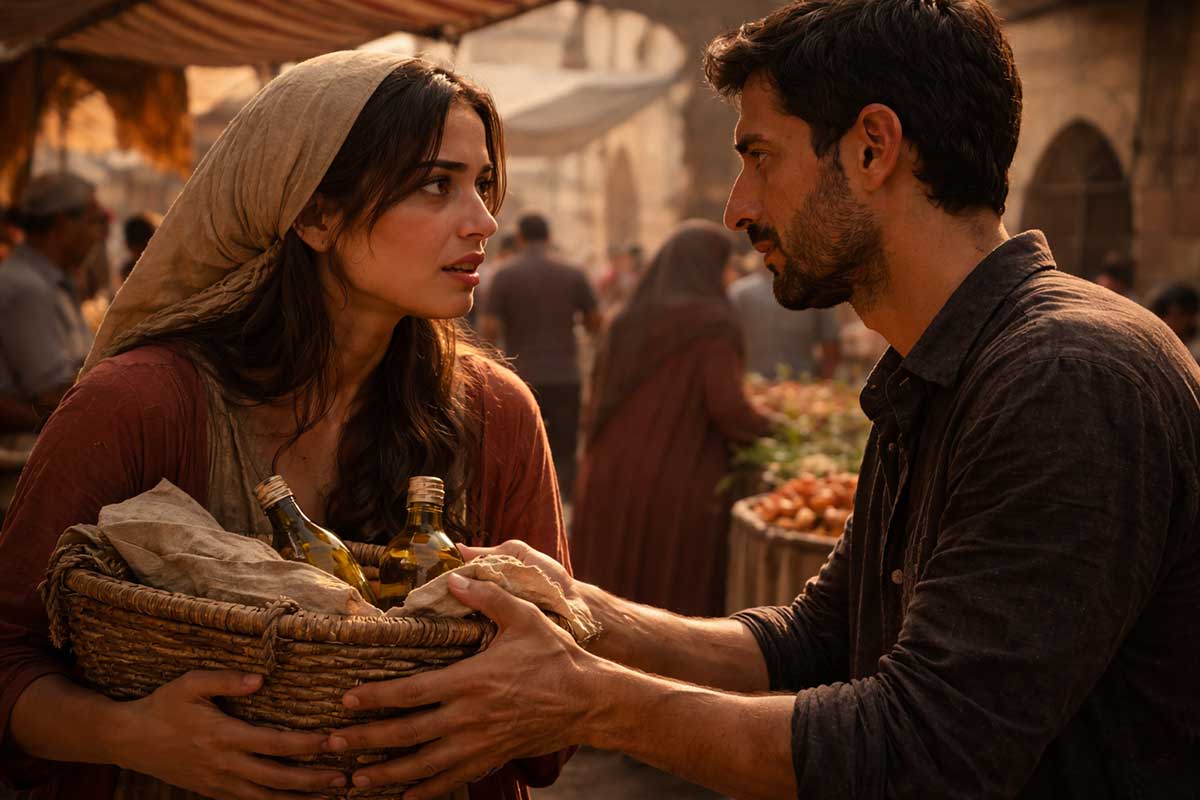
She was nearly past the center when someone struck her shoulder.
The basket tipped hard.
A glass bottle slid against another with a sharp sound.
Lina caught her breath.
Before the basket could fall, a hand closed around its handle and steadied it.
“I’m sorry.”
The voice was low. Close.
The Stranger Her Soul Recognized
Lina looked up.
For a single second the whole market seemed to pull away from her.
A man stood before her, perhaps near her own age, perhaps a little older. Dark hair. A face leaner than comfort. Eyes that looked as if they had already endured more than they had ever explained. One hand still held the basket. The other had half-lifted, as if he did not know whether to reach closer or step back.
He was a stranger.
Lina knew that.
And yet something inside her had already broken the word apart.
Not a stranger.
Not quite.
The shock did not arrive like attraction. It arrived like recognition sharpened by sorrow. Like seeing a house from childhood in a place it could not possibly stand. Like hearing the first note of a song she had once loved and realizing she had spent years trying to forget it.
The man was looking at her the same way.
Not boldly. Not warmly. Almost with alarm.
“Are you hurt?” he asked.
Lina swallowed. “No.”
But her voice came out thin.
His fingers loosened from the basket slowly, as if letting go of something heavier than wood and glass.
“I didn’t see you.”
“That makes two of us,” Lina said before she meant to.
Something changed in his face then. Not quite a smile. More like pain passing under control.
Around them, the market surged on. A child cried for sweets. A merchant shouted the day’s figs were the best in three villages. Somewhere metal struck metal. Someone laughed too loudly. The whole world continued with rude confidence.
Yet in the small space between Lina and the man, time seemed unsure of itself.
She lowered her eyes first.
“Thank you,” she said.
Then she took the basket and walked away too quickly.
Her heart was beating high in her throat.
She crossed two stalls before realizing she had no idea whether she had already passed her aunt’s table.
She stopped, turned, and saw the man still standing where she had left him.
Not watching her exactly.
Standing as though he had forgotten what he had meant to do next.
Lina turned away at once.
All morning she felt him like an unanswered question.
When her aunt complained that she never visited enough, Lina barely heard. When she measured oil for an old customer, she poured too much and had to laugh awkwardly as the woman clucked at her clumsiness. When she went to buy flatbread on the way home, she found herself staring at a stone wall on the far side of the lane where late sun had begun to gather.
A wall.
Warm with light.
Her breath caught.
For one flashing instant she saw not the market road but a different wall, rougher, lonelier, burning red under evening.
She stood frozen.
The baker’s daughter touched her arm. “Lina?”
Lina blinked. “I’m sorry. I was somewhere else.”
The girl smiled. “Then come back. Your bread is cooling.”
Lina forced herself to laugh and took the wrapped loaf.
But the whole walk home felt wrong.
It was not only the man.
It was the way her body had known him before she had allowed herself any thought at all.
That night, sleep took her quickly.
And the dream returned.
Not slowly this time.
Not in fragments.
She was already inside it.
The red sky hung low. The air smelled of dust and crushed leaves. The tree stood beside a broken wall, its trunk bent like an old witness. Her own hands were shaking. Someone was in front of her. She could not fully see his face because tears had blurred everything. She was trying to hold him, or stop him, or save him. She did not know which. Perhaps all three.
There were voices somewhere far away.
Urgent. Male. Nearing.
The man gripped her shoulders.
He was saying something.
She could not hear it.
No — she could hear it, but not enough.
Then the grief came, tearing through her so violently she felt it in her sleeping body. She reached for him and heard her own voice break open around a name.
Not a whisper now.
A cry.
“Yusef!”
Lina woke sitting upright in darkness, gasping.
Her hand flew to her mouth.
The room was still. The blanket half-fallen. The window black except for one blade of moonlight. No one else stirred.
But her face was wet.
Yusef.
She whispered it once more, more softly, as if the room itself might answer.
No answer came.
She pressed her hand hard against her chest.
That was new.
The dream had never given her the name before.
She lay back, but sleep would not return.
At dawn she went through her work like someone moving underwater.
Her mother noticed, then chose not to ask. Her father noticed and hid it behind silence. Lina was grateful to them both.
By midmorning she found herself back near the market, though she had not meant to go that way. She told herself she needed mint. Then that her aunt might need help. Then that perhaps she had forgotten something yesterday.
All lies. All transparent.
The market unfolded around her once more, loud and sunlit and certain of itself.
She saw him before he saw her.
He stood near a stall of figs, speaking with an old man Lina knew only by face. The man turned away. The stranger looked up. Their eyes met.
This time neither moved first.
Then he stepped toward her with an uncertainty so open it steadied her.
“I helped save your basket,” he said. “Surely that earns me one less frightened look.”
Lina almost answered too sharply. But there was something in his voice — not teasing exactly, not careless — that softened the edge before it reached her tongue.
“I was not frightened.”
“No?” He glanced aside once, almost smiling. “Then I have imagined very badly.”
That pulled a small involuntary breath of laughter from her.
He placed his hand lightly against his chest. “My name is Samir.”
Lina felt her own name suddenly strange inside her, as though it belonged more to this life than the one trembling below it.
“Lina.”
He repeated it quietly. “Lina.”
The way he said it unsettled her all over again.
Not because it was intimate. Because it sounded as if he were measuring the distance between her name and another one he almost remembered.
He did not try to hold her there. He only nodded toward the bread stall.
“You come here often.”
“My mother would say not often enough.”
“Then your mother and my aunt should form an alliance. It would be dangerous for everyone.”
This time Lina smiled fully.
The strangeness between them remained, but it no longer stood alone. Something human had joined it.
Over the next days, then weeks, they crossed paths again and again.
Never arranged. Never admitted. Yet always somehow happening.
At the herb stall.
Near the well.
By the road leading out toward the hills.
At the edge of the market when the heat thinned the crowd and the merchants leaned back with tired shoulders.
Their conversations stayed ordinary at first.
His uncle’s bad knee.
Her aunt’s endless complaints.
The dry season.
The poor olives from the southern grove.
A family with a sick child.
The way old men always predicted weather with more confidence than accuracy.
But under every exchange, something deeper watched.
Lina began noticing things she could not explain.
The way Samir paused when she touched a stone wall as they stood talking.
The way his face changed at the sound of evening prayer.
The way a certain kind of wind — dry, carrying dust and leaf scent together — made both of them fall silent at once.
One evening, after a long pause neither knew how to fill, Samir said, “Can I ask you something strange?”
Lina gave him a tired half-look. “It would suit the conversation.”
He lowered his eyes briefly. “Have you ever dreamed of a tree?”
All warmth left her hands.
He went on before she answered.
“An olive tree. Beside a broken wall. Near evening.”
The world narrowed.
Lina could hear the market, but from very far away.
“How do you know that?”
His face changed with relief and fear together. “So it’s not only me.”
She stared.
Samir drew one careful breath. “I see it sometimes in sleep. Sometimes when I’m awake. Not clearly. Pieces. Light on stone. Wind. Someone crying. I never knew whether it meant anything or whether I was just…” He gave a small helpless motion with one hand. “Inventing sorrow.”
Lina’s throat tightened so sharply it hurt.
“In the dream,” she said, “do you hear a name?”
He looked at her for a long time.
Then nodded once.
“Not always. But once.”
“What name?”
His answer came slowly, as though he feared it might split the air if spoken too quickly.
“Yusef.”
Lina turned away at once and pressed her hand to the nearest wall.
The stone was warm.
Her skin was not.
Samir did not touch her.
After a moment he said, very quietly, “I nearly never told you.”
She kept her eyes on the wall. “You should not have.”
He absorbed that without defense. “Maybe not.”
But even as she said it, Lina knew the opposite was true.
The Elder Who Named the Mystery
That night she went to her grandmother.
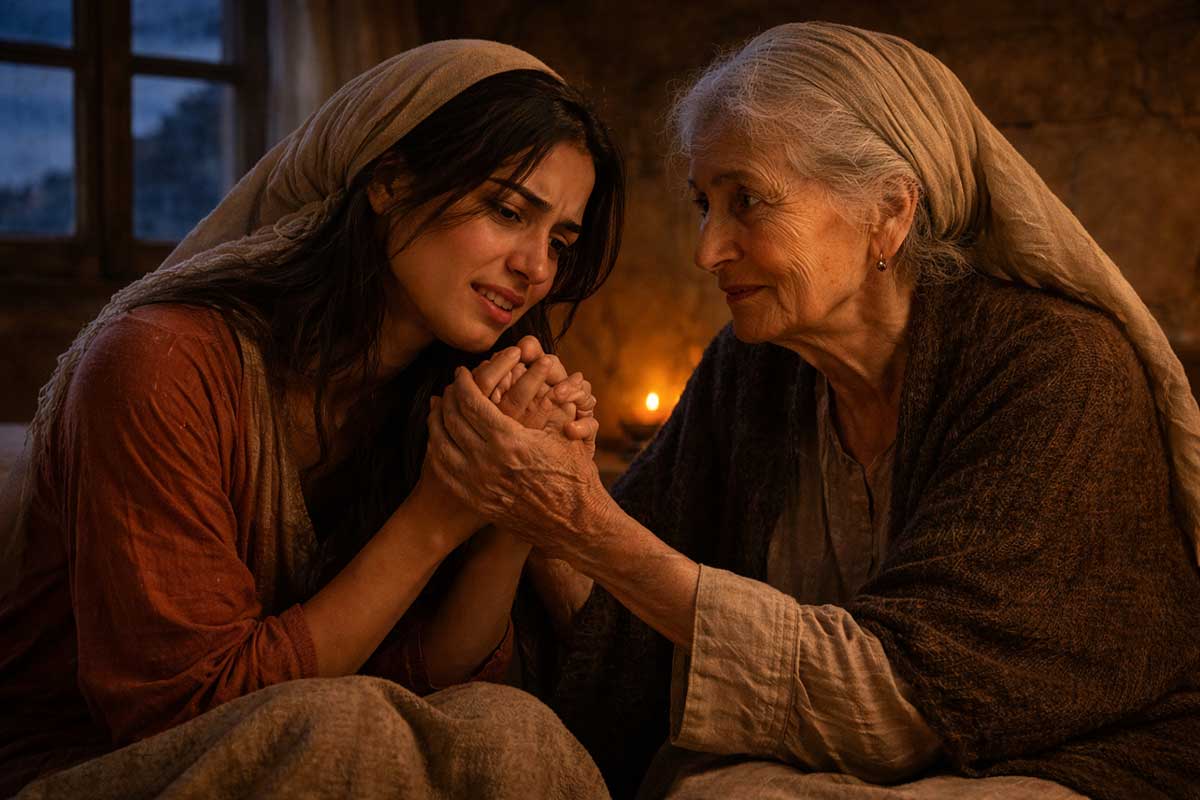
The old woman lived at the far end of the village in a low house that smelled of cumin, clean cloth, olive soap, and old paper. She had grown smaller with age, but not weaker. Her face had thinned. Her hands had roughened. Yet her eyes remained clear in the way of those who have suffered enough to stop pretending life owes them simplicity.
She opened the door before Lina could knock twice.
“You look like someone followed you from a dream,” she said.
Lina nearly broke then.
Her grandmother led her inside without another word. The room was dim and warm. One lamp burned low near the wall. Evening blue rested against the windowpanes. The old woman poured tea, waited, and let silence make a place wide enough for truth.
Then Lina told her everything.
The tree.
The wall.
The dream.
The name.
The market.
The stranger.
The way recognition had struck before thought.
The way fear and longing had arrived together, impossible to separate.
When she finished, her grandmother did not look surprised.
That frightened Lina more than surprise would have.
“You knew?” Lina asked.
“I knew only that one day you would come with this face.”
“What face?”
“The one people wear when the soul has started remembering before the mind is ready.”
Lina felt tears rise too quickly. “Grandmother, please.”
The old woman reached out and took her hand.
“The mind forgets much. The soul forgets less.”
“That sounds comforting when you say it,” Lina whispered. “It does not feel comforting.”
“No.” Her grandmother’s thumb moved once across Lina’s knuckles. “Remembering rarely feels comforting at first.”
Lina lowered her head. “Who is he?”
Her grandmother was quiet for a long time.
Then she said, “That may not be the first question.”
“What is the first question?”
The old woman’s voice softened. “Why did your soul need to meet him again?”
The words struck so deeply Lina could not answer.
Her grandmother looked toward the darkening window.
“Some meetings begin before birth,” she said. “Some are chosen. Some are accepted. Some are necessary. Not for romance, the way young people like to imagine. Not always for happiness either. Sometimes souls meet again because something between them was never brought to peace.”
Lina shook her head. “No.”
“No, you don’t believe it? Or no, you don’t want it to be true?”
Lina gave a wet, broken laugh. “Both.”
Her grandmother squeezed her hand.
“There are pains that do not end simply because one life ends. There are griefs that remain unfinished. There are promises, losses, betrayals, separations — all of it can leave a mark. And sometimes souls come back into each other’s path so the wound can be seen clearly this time.”
“Seen clearly?” Lina’s voice sharpened. “Why? So it can hurt again?”
“Maybe so it can stop hurting the same way.”
The room fell silent.
Outside, a breeze moved lightly against the shutters.
Lina stared at the lamp flame until her eyes blurred. “What if I do not want to know?”
“That is allowed.”
“And if I already know too much?”
“That happens also.”
Lina began to cry then, suddenly and without grace. Not polite tears. Not quiet ones. The kind that bend the body. The kind that seem to come from somewhere below language.
Her grandmother moved beside her and let her cry against her shoulder.
No false comfort.
No quick answers.
Only the mercy of being held while something old tore itself open.
When Lina’s breathing finally settled, the old woman said into her hair, “Listen carefully. Recognition is not the same as duty. A soul may return to someone, but that does not mean you must lose yourself to them. Sometimes the meeting exists so a lesson can rise. Sometimes the healing lies in staying. Sometimes it lies in choosing differently.”
Lina drew back enough to look at her.
Her grandmother’s face was lined with lamp light and years.
Then she spoke the sentence Lina would carry for the rest of the story of her life.
“Some souls do not meet again to begin love. They meet again to finish pain.”
Three days later, Lina found Samir waiting near the well at the far edge of the market.
He straightened when he saw her, but did not come closer.
“I know I should leave this alone,” he said.
Lina looked at him for a long moment.
Then she said, “I want to find the place.”
He did not ask what place.
“I do too,” he answered.
They left early the next morning before the sun had fully hardened the land.
The road out of the village gave way to a narrower path. Then to no path at all, only dry earth broken by grass, stone, thorn, and patches of stubborn wild growth. The hills unfolded around them pale and ancient. Here and there the remains of old walls stood like forgotten sentences.
At first they spoke little.
The air felt too full for easy words.
Lina noticed the sound of their footsteps. The scrape of dust. The shift of small rocks beneath sandals. Once, in the distance, a shepherd called out to someone she could not see. A hawk moved overhead without sound.
By late afternoon the light had begun its slow change. Gold deepened. Shadows lengthened.
Lina’s chest tightened.
Not from exertion.
From knowing.
She slowed.
Samir saw it at once. “What is it?”
She did not answer.
A few steps later she stopped completely.
There.
The Place That Remembered
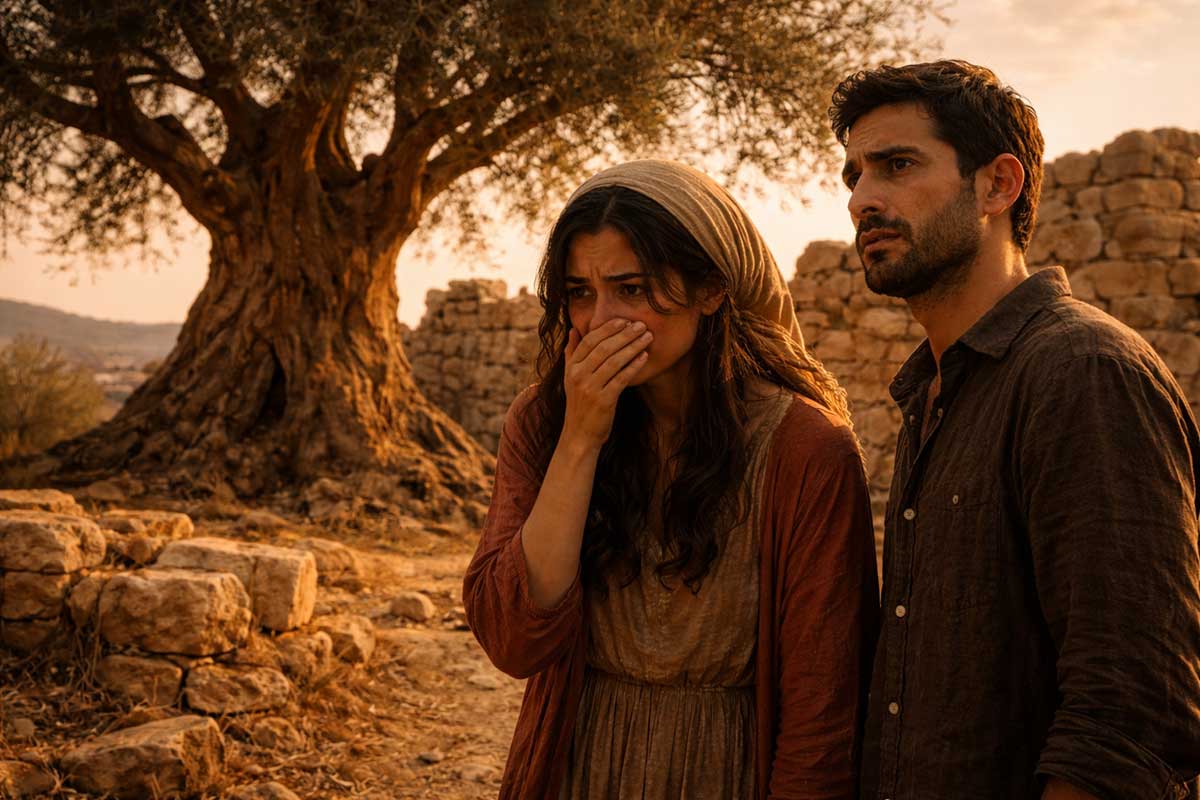
Ahead of them, half-swallowed by earth and time, stood the remains of a broken stone wall.
And beside it —
the tree.
Older than in the dream. Larger. More scarred. Yet unmistakable.
An olive tree with branches twisted toward the sky as if grief itself had once tried to bend it and failed.
The late sun struck the wall.
Red-gold.
Exactly as before.
Lina could not breathe.
The world seemed to tilt inward.
Every sound fell back. Every thought thinned. She walked forward without feeling the ground under her feet until her knees gave way and she dropped beside the roots.
The bark was rough under her hands.
Rough and real.
A sob broke from her before she could stop it.
Not the sob of this week, or this year. Something older. A grief with no patience left.
Samir stood a few feet away, his face already wet.
“I know this place,” he whispered.
Lina pressed her palm into the dust.
And memory came — not in a clear line, not in names and dates, but in blows of feeling and image.
A younger sky.
The same wall less broken.
Voices approaching with danger in them.
A promise spoken too quickly.
A man turning away because he must.
Her own hands reaching.
Terror.
Love.
Failure.
Loss arriving before death.
Then the one truth in the center of all of it.
She had lost him here.
Not merely in dream. Not in imagination.
Here.
“This is where I lost you,” she said.
Samir closed his eyes as if struck.
When he spoke, his voice was shattered. “I told you I would come back.”
Something in Lina answered that before her mind could.
“You never did.”
He dropped to the ground across from her, shoulders bent, one hand over his mouth.
For a long time they stayed like that, two figures in the dust beneath the old tree, held by evening, by broken stone, by the unbearable recognition of a wound older than the bodies now carrying it.
At last Samir said, “When I first saw you, I felt sorrow before I felt anything else. I thought there was something wrong with me.”
Lina laughed once through tears. “There may be.”
He almost laughed too. Almost.
Then his face broke again.
“I think I have been ashamed of something I could not name.”
Lina looked at him.
“And I think I have been angry for years without knowing who I was angry at.”
The wind moved through the leaves above them.
The sound was small. Endless.
Samir wiped at his face. “What do we do with this?”
Lina stared at the roots, at the dust in the lines of her fingers, at the red light fading across stone.
The answer that came was not comforting.
“We tell the truth.”
He waited.
She forced herself to go on.
“I think I have lived as if grief were the last proof that what was lost mattered. I held on to pain because I was afraid that if I let it go, then what happened would disappear. Or I would disappear.”
Samir said nothing.
That was good. The words needed room.
Lina breathed unevenly. “I think part of me made a home inside the wound.”
When she finally looked up, his face had changed. Not softened. Opened.
“I know that place,” he said.
The honesty between them altered everything.
This was no longer a mystery story. No longer a question of who they had once been to each other, though that grief still trembled around them. This was now the harder question.
What would they do with the pain, now that it had found them again?
Samir lowered his gaze.
“What if this is all it is?” he asked. “What if we came back only to hurt the same way?”
Lina thought of her grandmother.
Recognition is not the same as duty.
Some souls meet again to finish pain.
She wiped her face with the back of her hand.
“No,” she said. “I don’t think we came back to repeat it.”
He looked at her.
“Then why?”
She answered more quietly than she expected.
“To answer it differently.”
The words settled between them.
Hard words. True words.
Not the language of romance. The language of souls standing at the place where something once broke and deciding whether to remain broken by it.
Samir leaned back against the wall and closed his eyes.
“I don’t know how.”
“Neither do I.”
“Then what now?”
Lina looked up into the branches.
The sky above them had begun its turn toward violet.
She thought of all the years of unnamed sorrow. Of waking with loss and no face attached to it. Of building a self around grief because grief was the only inheritance she trusted. Of fearing memory because memory might ask more of her than tears ever had.
Then she heard herself say, with a steadiness that surprised her, “I am tired.”
Samir opened his eyes.
“Tired of what?”
“Tired of letting an old wound tell me who I am.”
The wind lifted a few strands of her hair across her face. She pushed them back slowly.
“I am tired of carrying pain as if it were loyalty. Tired of thinking anger is the same thing as love for what was lost. Tired of waking inside something I could not name and letting it shape my whole life.”
Samir’s face tightened, then gave way.
“So am I.”
That nearly undid her more than the memory had.
Because it was simple.
Because it was human.
Because after all the mystery, the soul still had to pass through plain truth.
Lina placed her palm against the tree trunk again.
Its bark was cool now. Evening had begun to take the heat from it.
And then, with no vision, no voice from the sky, no miracle grand enough for stories told badly, something shifted.
Not outside.
Inside.
A loosening.
As if a knot tied long before her birth had at last begun to yield under the weight of being seen fully.
Her tears came again, but changed.
No longer the tears of being trapped in something nameless.
The tears of someone standing at the edge of release and afraid to take it because freedom asks so much.
Samir watched her.
“What is it?”
Lina did not turn.
“I think forgiveness is here.”
He did not speak for several seconds.
Then, carefully: “For me?”
She let out one trembling breath.
“For you. For myself. For the whole thing.”
His face twisted in grief. “I don’t deserve that.”
“That may be true.”
The honesty of it shocked them both.
But Lina went on.
“This is not about deserving. It is about whether I want to remain bound to this forever.”
Samir’s shoulders bowed.
Lina looked at him then, fully.
“I do not forgive because nothing happened. I forgive because something did happen, and I do not want it to own me anymore.”
He began to cry openly.
No restraint left. No dignity saved for later. Only the breaking of someone who had carried shame without a name and now finally knew its shape.
Lina moved closer and sat beside him in the dust.
For a long moment they did not touch.
Freedom After Grief
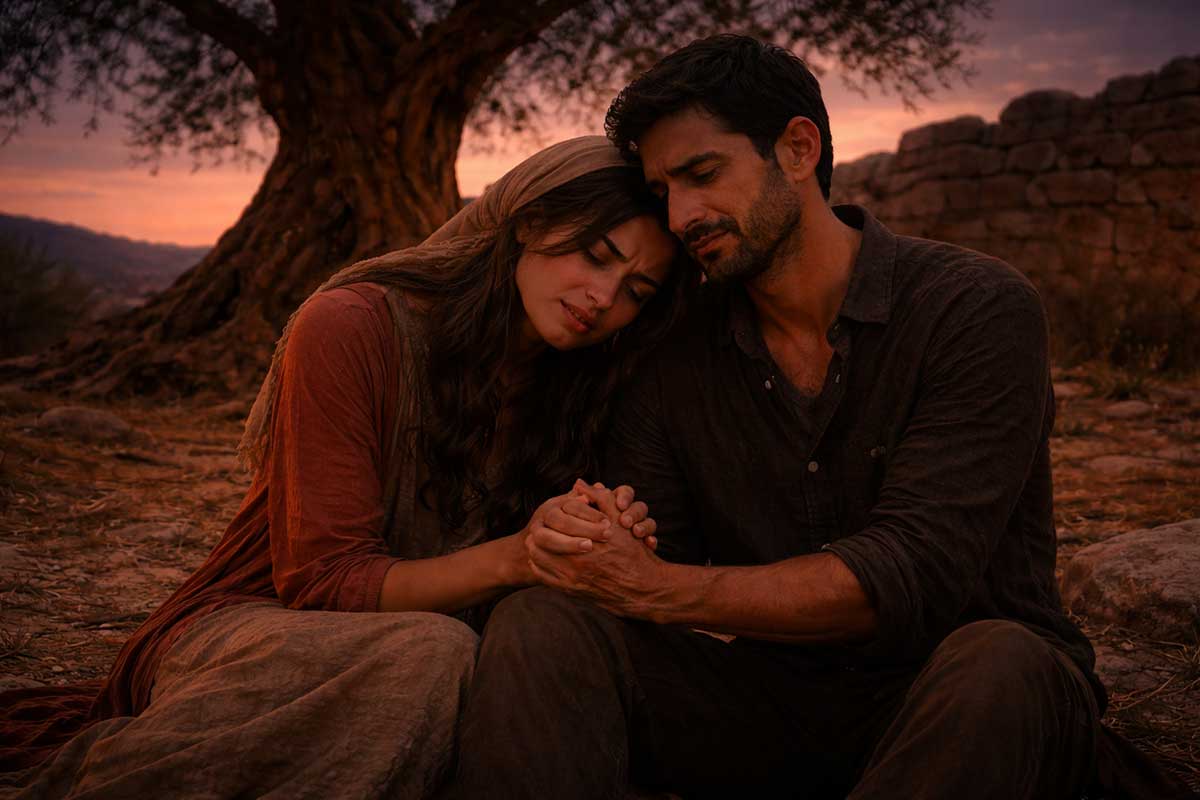
Then Samir reached for her hand in the hesitant way of someone asking permission not only to be comforted, but to exist in truth.
She let him take it.
Beneath the olive tree, beside the broken wall, under a sky darkening toward night, they sat hand in hand and allowed an ancient grief to stop ruling them.
Nothing outside changed.
The dead did not return.
History did not reverse.
The land did not heal around them in a single gracious sweep.
No voice declared peace.
Yet something sacred still happened.
The chain weakened.
The old pattern lost its throne.
Pain was no longer the only truth left standing.
By the time they rose, stars had begun to appear above the hills.
Lina placed her hand once more against the trunk.
Then she whispered, not to the tree, not to Samir, not only to the past, but to that part of herself which had been wandering for years under the weight of unnamed sorrow:
“I remember now.”
The leaves moved softly.
That was enough.
When Lina walked home in the dark, the road was the same road she had always known. The houses the same. The village the same. Her mother would still wake early. Her father would still listen to the radio. The market would still crowd and shout and bargain. Bread would still cool on tables. Children would still run where they should not.
The world had not become easier.
But her life no longer felt random.
That changed everything.
She understood now that the grief had not been meaningless. It had been a memory seeking its place. A wound seeking language. A soul seeking the courage to look directly at what had shaped it.
She understood that some meetings begin before first sight. Some tears belong to stories older than the body. Some pain returns, not to destroy, but to ask whether we are finally ready to answer it differently.
And she understood one thing more.
This life was not only the place where she had suffered.
It was also the place where she had learned.
Learned how memory rises.
Learned how fear hides behind silence.
Learned how sorrow can become identity if left untouched.
Learned how forgiveness does not erase truth, yet still frees the heart.
Learned that the soul is larger than the worst thing that happened to it.
When she reached her house, she did not go inside at once.
She stood in the small courtyard beneath the night sky and placed her hand over her heart.
The ache was still there.
Perhaps some ache always would be.
But beside it now was something new.
Mercy.
Not soft. Not forgetful. Not false.
Earned mercy.
The kind born when grief and truth have both been faced, and neither one is allowed to rule alone.
For the first time in years, Lina did not feel only absence within herself.
She felt space.
She felt sorrow and release living side by side.
She felt, in the strangest and most tender way, that her life had just begun again inside the same life she had been living all along.
Far off, the night wind moved over the hills.
Somewhere beyond sight, the olive tree stood in darkness, roots deep in wounded ground, branches lifted into silence.
Scarred.
Weathered.
Still alive.
Lina closed her eyes.
The tears came one last time, quietly.
Not the tears of someone lost.
The tears of someone found.
Final Thoughts by Nick Sasaki
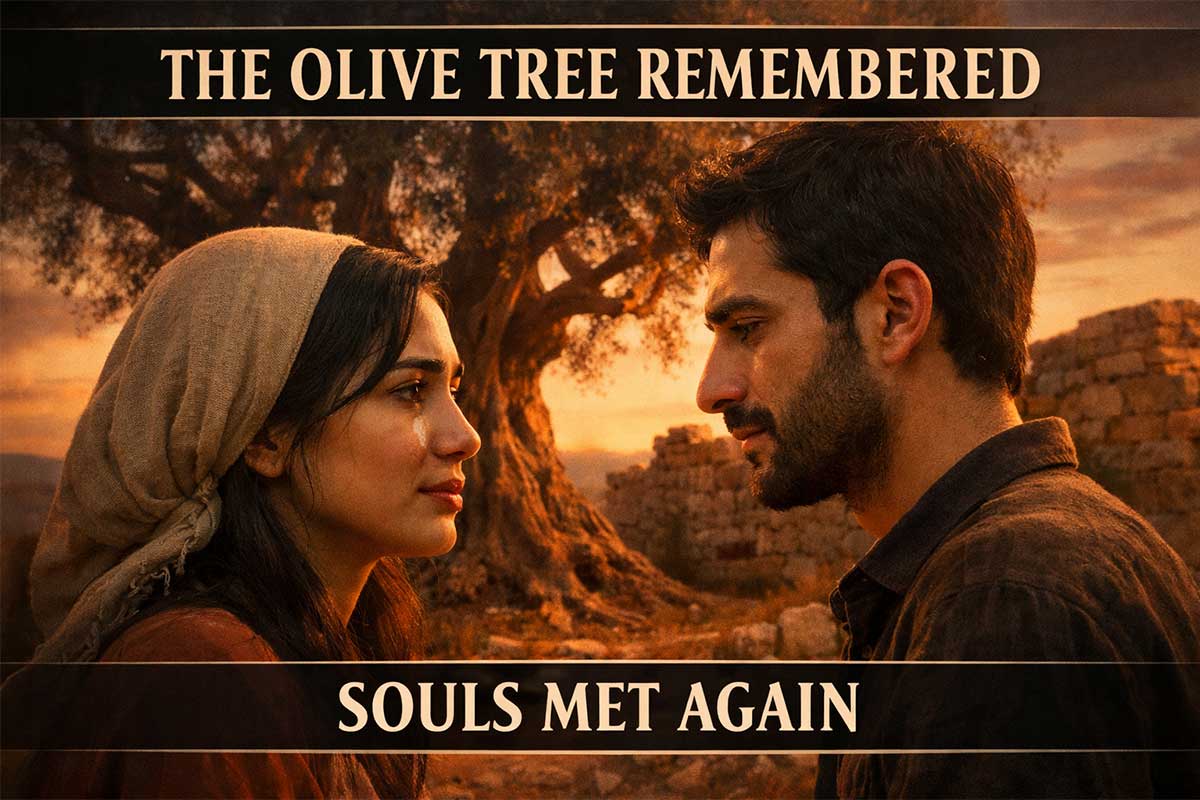
What moves me most about this story now is not only the reunion, but the meaning of the reunion.
Lina and Samir do not simply remember. They are asked to do something with what they remember. That is the harder part. Recognition by itself is not healing. Memory by itself is not freedom. Even truth by itself is not enough unless it opens the door to a different response.
That is where this second version became deeper for me.
The real question of the story is no longer only, Who were they to each other before?
It becomes, Why were they brought back to this wound, and what will they choose now?
That question reaches far past one imagined story. Many people carry sorrow they cannot fully explain. Many know what it is to feel drawn to someone instantly, or burdened by grief that seems older than the present hour. Many discover that pain can become identity if it is left untouched too long.
What Lina begins to see is something I find deeply moving: forgiveness does not deny the wound, excuse the loss, or erase the past. It ends the wound’s rule. It makes room for truth and mercy to live in the same heart.
That may be the deepest spiritual turning point in the whole piece.
If Dolores Cannon’s work points in any lasting direction, I think it is here: life may be far more patterned, purposeful, and soul-shaped than it first appears. Some meetings may not be random. Some tears may not belong only to this life. Some pain may return so it can be answered in a new way. And some freedom comes only when we stop asking why the wound came to us and begin asking what the soul is now ready to become through it.
For me, The Olive Tree Remembered is no longer only a story about loss. It is a story about release. A story about the soul refusing to remain trapped inside its oldest sorrow. A story about what becomes possible when grief is finally met with truth, courage, and mercy.
If the story stays with you, I hope it stays in that way.
Short Bios:
Leave a Reply