
|
Getting your Trinity Audio player ready...
|
What if Ray Dalio challenged contemporary economic and democracy thinkers to map America’s next decade?
Introduction by Ray Dalio.
We’re living through a period that feels chaotic on the surface, but it’s not random. In my life as a macro investor, I’ve learned that most big outcomes come from a few big forces interacting over time. When you step back, you can see patterns repeat across centuries. Not because people are the same, but because incentives and mechanics are the same.
What we talked about is really one integrated machine.
There’s the monetary order, which is how money and credit get created, how debt builds, and how a reserve currency system eventually gets strained when supply grows faster than demand. There’s the domestic political order, where wealth gaps, values gaps, and distrust can push societies toward gridlock and then toward more extreme “winner take all” behavior. There’s the geopolitical order, where rising powers test existing powers and the global rules based system weakens when it stops serving the strongest actors. Then you have acts of nature and new technologies, which can reshape prosperity and reshape war at the same time.
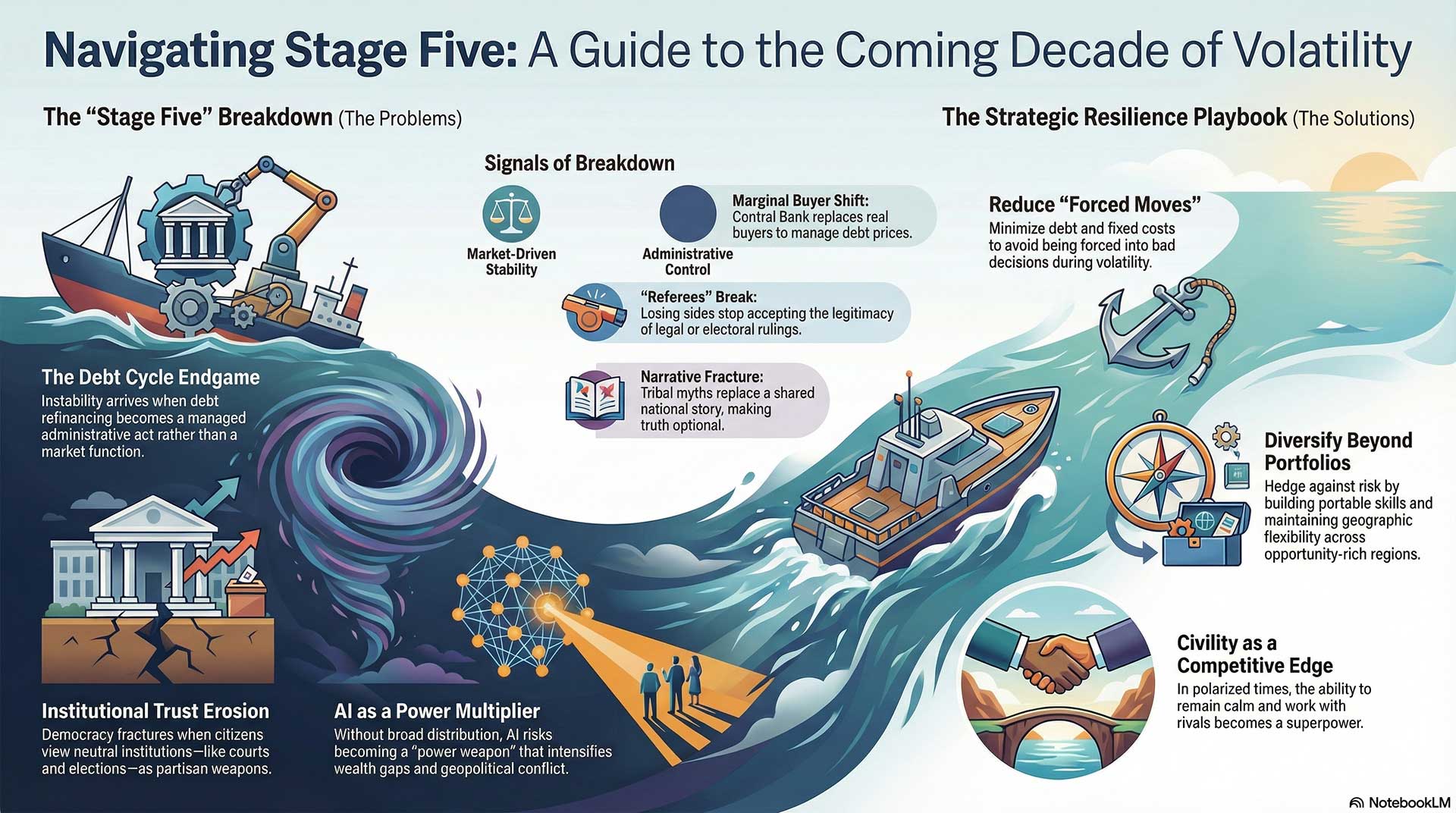
When those forces converge, you get what I call late cycle conditions. Stage five, near the brink but not over it. That does not mean collapse is inevitable. It means the risks are rising and the choices matter more.
This series is a creative exploration of those forces through imaginary conversations. The goal is not to frighten anyone or to be sensational. The goal is to help people see the machine clearly, so they can make better decisions personally and collectively. When you can name the dynamics, you can stop reacting emotionally to the headlines and start thinking in principles.
So as we begin, keep one idea in mind. If you worry in the right way, you become more prepared and more constructive. If you don’t worry at all, you tend to drift into problems that could have been prevented.
Let’s look at the world as it is, not as we wish it to be, and then talk about what to do next.
(Note: This is an imaginary conversation, a creative exploration of an idea, and not a real speech or event.)
Topic 1: The Debt Cycle and the Endgame of Printing
The roundtable is set inside a glass-walled library overlooking a city that never fully sleeps. On the table: a few plain index cards, a pencil, a single brass hourglass, and a small stack of old bond certificates tucked into a folder like museum artifacts. A large screen behind them shows only shapes and motion: a climbing curve, a tightening band, a sudden drop, then a slow rise again.
Ray Dalio sits as if he has been here many times before, not in this room, but in this moment. He lets the room settle into a kind of listening.
Around him are five people who each see a different part of the same machine.
Carmen Reinhart with the historian’s calm, eyes sharp, voice unromantic.
Kenneth Rogoff with the economist’s dry precision and a faint impatience for wishful thinking.
Mohamed El-Erian with the strategist’s attention to incentives and fragile confidence.
Paul Volcker present as a legacy voice, heavy with lived inflation and hard choices.
Zoltan Pozsar with the plumbing map in his head, where everything is flow, collateral, and who gets stuck holding what.
Ray Dalio: When people talk about debt, they want a slogan. They want a villain, a single decision, a single date when everything “broke.” That’s not how it works. It’s a cycle, and it’s a machine. I want to start with the first question that matters, because it’s the one most people get wrong.
He turns the hourglass once, slow enough that it feels intentional.
Ray Dalio: When does a debt cycle stop being manageable and start becoming unstable? Not in theory. In practice. What are the signals you watch?
Carmen Reinhart: I watch the point where the adjustment becomes politically impossible. The math can be ugly for a long time, but countries limp along as long as they can still make choices. When the society cannot accept any combination of higher taxes, reduced spending, or lower real returns, the instability arrives. The warning sign is not just debt. It’s the refusal to absorb the consequences of debt.
Zoltan Pozsar: I watch the marginal buyer. If real buyers step back and the marginal buyer becomes a regulated institution or the central bank, then the price is no longer discovered, it’s managed. That’s when you start to see the system shift from market funding to administrative funding. It can go on, but the character changes. The machine starts running on a different fuel.
Mohamed El-Erian: I watch the policy reaction function. When every wobble requires a larger intervention, you are no longer smoothing cycles, you’re borrowing stability from the future. That’s when the cost of preventing pain today becomes the amplification of pain later. It is also when confidence stops being anchored in fundamentals and becomes anchored in belief that policymakers will always catch you.
Paul Volcker: I watch discipline. There is a moment when officials talk as if financing is automatic, as if interest rates are a nuisance rather than a signal. When that attitude spreads, you are on the edge. Inflation is not a theory. It is what happens when discipline fails and the country insists on consuming what it hasn’t produced.
Kenneth Rogoff: I watch rollover risk. Debt structure matters. When maturities shorten, when refinancing becomes constant, confidence becomes a daily vote. High debt is one thing. High debt that must be rolled again and again at uncertain rates is another. That’s when a small change in sentiment can do a lot of damage quickly.
Ray Dalio nods once, as if each answer clicked into a familiar diagram inside him.
Ray Dalio: Good. So the signals are not just levels, but willingness, structure, and who is actually funding the system. Let’s take the next step. Because this is where the conversation gets real.
He places a finger on the screen where the curve rises until it presses against a ceiling.
Ray Dalio: Suppose you hit the moment where buyers will not fund your debt at tolerable rates. The choice set gets ugly fast. What are the real options, and what is the least destructive path?
Mohamed El-Erian: The options are never as clean as people want. Tighten and you risk recession and political backlash. Inflate and you punish savers and people on fixed incomes. Restructure and you damage trust and raise borrowing costs for a long time. The least destructive path is to act early enough that you can choose a mix. Waiting turns “mix” into “crisis decision.”
Kenneth Rogoff: Historically, “least destructive” often includes some form of financial repression. It’s not a pretty phrase, but it describes what happens. Yield caps, regulatory pressure, subtle ways of ensuring a steady bid. Countries do it because they’re cornered. The question is whether it happens transparently and with a plan, or chaotically and under duress.
Paul Volcker: You cannot print your way to prosperity. You can print your way to postponement. The least destructive path is to restore credibility with real fiscal choices. That usually means taking pain when you still have agency, not waiting until markets impose it. The public always wants relief. Leadership is deciding which relief is poison.
Carmen Reinhart: In crisis cases, it’s often a package: some austerity, some inflation, some restructuring, sometimes controls. What differs is the management. Managed adjustment preserves institutions. Unmanaged adjustment breaks them. People talk about default as if it’s a single act. Often it is a long process of devaluing claims through inflation or policy.
Zoltan Pozsar: And in the background, plumbing matters. If you cap long rates, you push investors into risk or you break them. If you shorten maturities, you create rollover dependence. If the central bank absorbs the debt, you transform the currency into the shock absorber. The least destructive path is one that keeps collateral trusted. When collateral loses trust, everything becomes more expensive and more fragile at once.
Ray Dalio leans back slightly, as if to give the idea space to show itself.
Ray Dalio: The machine, then, is not moral. It’s mechanical. If you don’t make choices, it makes them for you. Now we get to the question people ask in headlines, but they never ask it in a human way.
The hourglass is half empty now.
Ray Dalio: What does a real monetary breakdown look like for ordinary people, markets, and governments? Not an academic model. What does it feel like?
Kenneth Rogoff: It feels like volatility becomes normal. You get sudden changes in rates, in housing affordability, in business financing. You see the distributional effects intensify. Some people are protected by assets, others are exposed through wages and borrowing costs. Even if there is no “collapse,” the sense of stability erodes.
Carmen Reinhart: It feels like trust becomes conditional. People start asking if the promises are real. Pensions, bond payments, the purchasing power of wages. They start changing behavior. They shorten horizons. They demand immediate compensation for future uncertainty. That shift in psychology can become self-fulfilling.
Zoltan Pozsar: It looks like a shortage of trustworthy collateral. The system runs on safe assets. If markets question the safety or the real return, the demand shifts. You see more flight into hard assets, into shorter duration, into anything perceived as outside the political reach of the issuer. Liquidity becomes selective. Money is available, but not for everyone at the same price.
Paul Volcker: It feels like prices stop being background noise and start being a daily emotional event. When purchasing power is uncertain, society gets angrier. People do not debate calmly when their paycheck buys less each month. That anger seeks targets. It invites bad politics.
Mohamed El-Erian: It also feels like the rules are constantly being rewritten. Emergency measures become routine. The line between fiscal and monetary blurs. The public senses that institutions are improvising. Even if the improvisation prevents disaster, it can still damage credibility. People can live through hardship. They struggle to live through confusion.
Ray Dalio looks around the table, as if checking each face for the same truth in different language.
Ray Dalio: So breakdown is often not fireworks. It’s a slow loss of trust, a loss of clean price signals, a rise in control, and a public that feels the ground shifting under agreements they used to take for granted.
He taps the hourglass lightly, not to hurry it, but to remind everyone it exists.
Ray Dalio: If we accept that, then the most important part is not predicting the exact day. It’s recognizing the stage and responding with the right posture. The machine doesn’t care if we dislike the options. It only cares whether we choose, or whether we drift.
Outside the glass, the city continues to glow as if nothing is happening. Inside the room, the conversation makes it clear that “nothing happening” is often the most dangerous illusion of all.
Topic 2: Reserve Currency Risk and the New “Hard Money” Debate

Ray Dalio stage 5
The roundtable has moved to a different kind of room, still quiet, but less insulated.
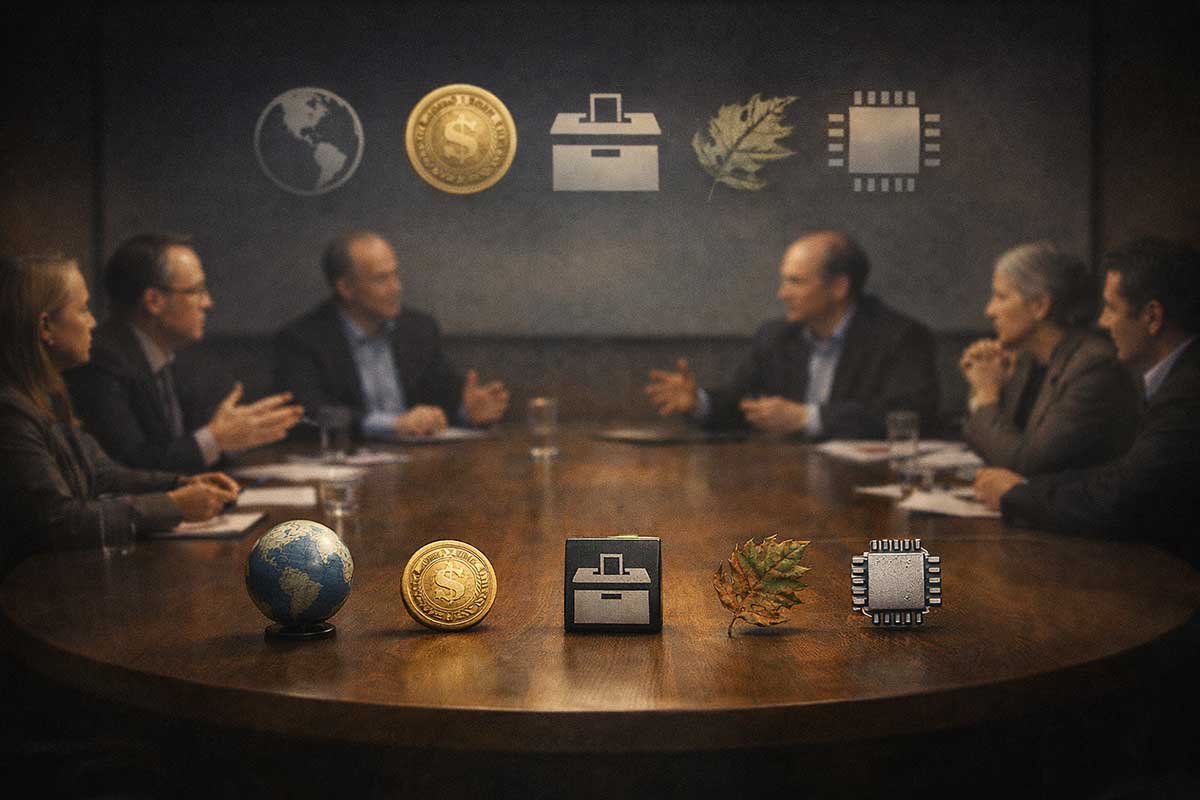
A long table sits beneath a vaulted ceiling in an old financial district building. Tall windows. Rain tapping softly against the glass. On the wall behind them, a single framed map of global trade routes, its lines faded and elegant. On the table: five plain objects, placed like props in a test of honesty.
A small gold coin.
A blank black card labeled only with a tiny embossed circle.
A sealed envelope marked “SANCTIONS.”
A short stack of unmarked paper bills.
A metal key on a ring.
Gillian Tett sits at the head of the table, not like a referee, but like someone trained to notice what people avoid saying. She looks at the objects for a moment, then at the five faces.
Ray Dalio is calmer here, because he is not responsible for steering the ship tonight. He gets to be a voice on the ship.
Barry Eichengreen has the air of a man who can name the last time every empire thought its currency would last forever.
Eswar Prasad carries a quiet skepticism about easy narratives, especially the ones that sound inevitable.
Nouriel Roubini looks like he arrived already mid-argument with reality.
James Rickards has the composure of someone who has spent years saying, “This is what money is,” and watching people misunderstand him.
Gillian Tett: Topic two is reserve currency, sanctions risk, and the return of hard money as an insurance policy. People throw around phrases like “de-dollarization,” “multipolar reserves,” “the end of the dollar.” Those phrases can be lazy. So let’s make this precise.
She lightly taps the sealed envelope labeled “SANCTIONS.”
Gillian Tett: First question. What makes a currency trustworthy as a store of wealth, not just a medium of exchange? And where do the major currencies actually stand today?
Barry Eichengreen: Trust is not one thing. It’s a bundle. You need deep, liquid markets. You need political stability. You need rule of law. You need a credible central bank. You need an open capital account, or at least a believable one. Historically, reserve status is as much about institutional quality as it is about GDP. The dollar still benefits from the most complete bundle. That doesn’t mean it’s immortal. It means it has the strongest incumbency.
Eswar Prasad: I would separate convenience from confidence. The dollar is convenient because it is everywhere and because U.S. markets remain unmatched in scale. Confidence is more fragile. Confidence depends on predictable rules, yes, but also on how the issuing country uses its power. When assets can be frozen, when payments can be blocked, other countries will think about alternatives. Not because they love the alternatives, but because they dislike the vulnerability.
Ray Dalio: A reserve currency needs to be a storehold of wealth, and that comes down to purchasing power over time and the safety of the claims. If you create too much debt and finance it by printing, you risk devaluing the currency. If you use the currency system as a tool of geopolitical influence, you create fear in holders. So trust can weaken even while usage remains high. People confuse those. They think if something is used, it must be trusted. Sometimes it’s just used because there is no better pipe.
Nouriel Roubini: The world is stuck with the dollar because the alternatives are incomplete. Europe has fragmentation. China has controls. Japan has scale limits. But that does not mean the dollar has no problems. Large deficits, political dysfunction, and the temptation to monetize debt create long-term erosion. You do not need a sudden collapse for the trust premium to shrink. A slow decay is enough to change behavior at the margin.
James Rickards: The store of wealth question is exactly why we keep circling back to gold. Trust in a fiat currency is ultimately trust in a political system. Gold is not a political system. It is a physical asset without counterparty risk. That’s why central banks keep it. That’s why it comes back every time geopolitical pressure rises. People keep treating it like a trade. It’s not a trade. It’s insurance.
Gillian Tett nods, then looks at the black card with the embossed circle.
Gillian Tett: That card is a placeholder for every digital promise ever made. It represents systems, settlement layers, and the idea that convenience equals safety. Which brings us to the second question.
She slides the “SANCTIONS” envelope slightly forward.
Gillian Tett: Are we moving toward a multipolar reserve system? If so, what replaces the one dominant anchor model? And what role do sanctions and payment control play in accelerating that shift?
Eswar Prasad: Multipolar is plausible in function, even if not in symbolism. We may see a world where trade invoicing and settlement diversify. More regional currency usage. More bilateral arrangements. More local currency swaps. But a true reserve currency requires openness and trust. China can expand use of the renminbi in trade corridors, especially where it has influence. But as a global store of wealth, it faces a credibility problem unless controls loosen significantly, and that is a political decision, not a technical one.
Barry Eichengreen: Multipolarity has precedent. The world has lived in systems where multiple currencies played roles, and the transition phases are rarely smooth. Sanctions are an accelerant because they highlight that reserves are not purely financial assets, they are geopolitical assets. The paradox is that the more powerful the dollar system is, the more tempting it is to use it as leverage, and the more incentive others have to create alternatives. That does not mean they succeed quickly. It means the direction of effort changes.
Ray Dalio: Think in incentives. If you are a large country holding reserves, you want liquidity, safety, and neutrality. If neutrality disappears, you diversify. That does not mean you dump everything. You shift at the margin, then you build pipes over time. The danger is not an overnight exit. It’s a gradual reduction in the willingness to absorb new supply of debt. When the marginal buyer changes, the whole machine changes.
Nouriel Roubini: I agree, and I’ll add that this shift can be messy because it is not happening in a world of peace and coordination. Multipolarity plus fragmentation plus tech war plus energy constraints creates volatility. You can get currency blocs. You can get financial decoupling. You can get “friendly” settlement networks and “unfriendly” ones. That increases transaction costs. It also increases the risk of policy mistakes because each bloc thinks it can insulate itself. Usually it cannot.
James Rickards: In a multipolar system, gold becomes the neutral settlement asset again, not because people love nostalgia, but because they need something outside the political reach of any one state. When sanctions become more common, reserve managers want assets that cannot be frozen with a keystroke. That is why gold holdings rise even when the financial press treats gold like a quirky side bet. Central banks are not quirky. They are defensive.
Gillian Tett lets that sit. The rain against the window becomes louder for a moment, as if it wants to join in.
She picks up the gold coin, holds it between thumb and forefinger, then places it back down beside the paper bills.
Gillian Tett: Third question, and I want you to answer it as if you are advising a very smart person who refuses to panic, but also refuses to be naive. How should investors and central banks think about gold and other hard assets as strategic insurance, without turning it into a prophecy or a sales pitch?
Ray Dalio: Start with portfolio construction. The mistake is to ask, “What will gold do next?” The better question is, “What do I need when my other assets fail me?” Gold tends to do well when real interest rates are negative and when fiat money is being devalued. It’s also a diversifier in crisis. So you decide an allocation that fits your total exposures. Not a bet. A balance. Enough to matter, not so much that it dominates your fate.
Barry Eichengreen: For central banks, gold is partly about diversification and partly about signaling. It says, “We want some reserve assets that do not depend on another country’s policies.” For private investors, the question is more personal. What is your base currency risk? What is your inflation risk? What is your institutional trust risk? Gold can address some of that, but it is not a substitute for sound fiscal policy, and it is not a machine that prints returns. It is a hedge against certain regimes.
James Rickards: If you treat insurance like a day trade, you misunderstand it. You do not buy fire insurance and then complain it didn’t go up in price this quarter. You buy it because you know what fire is. Gold is monetary insurance. It has no counterparty risk. It is liquid in crisis. It performs when confidence in paper claims erodes. The goal is not to predict the price. The goal is to still have purchasing power when other promises get repriced.
Nouriel Roubini: I would widen the lens. Hard assets matter, but so does resilience. Diversification across geographies, currencies, durations, and real assets. A person who only buys gold but ignores leverage risk, job fragility, and liquidity needs is still vulnerable. Central banks have their own constraints, but they also need flexibility. In crisis, you want assets you can mobilize. Hard assets play a role, but so do short-duration safe instruments, and so does credibility.
Eswar Prasad: And remember the political economy. If fragmentation increases, countries may impose controls, taxes, or restrictions in ways that surprise investors. So resilience is not just a list of assets. It is also an understanding of what can be trapped and what can move. Gold is portable in concept, but not always easy in practice. The best strategic insurance is diversified, legally clear, and matched to the risks you actually face, not the risks you enjoy talking about.
Gillian Tett looks at the key on the ring.
Gillian Tett: That key represents access. Because in the end, a reserve currency is not just about value, it’s about being able to use it when you need it.
She looks around the table again, then speaks more softly.
Gillian Tett: Here’s what I’m hearing. The dollar remains dominant because the system is deep and convenient. But trust can weaken at the margin because debt expansion and geopolitical weaponization change incentives. Alternatives are growing, not because they are perfect, but because dependence has become a risk. In that environment, hard money returns as insurance, and the real question is not predicting headlines, but designing resilience.
No one interrupts her, which is its own kind of agreement.
Outside, the rain keeps falling. Inside, the gold coin sits quietly on the table, not as a prophecy, but as a reminder that money is never only money. It is also power, memory, and fear, and the human need for something that still holds when the room gets dark.
Topic 3: Domestic Polarization, Institutional Trust, and the Autocracy Drift
The room changes again.
This time the roundtable is set in a candlelit hall that feels half modern conference space, half old courthouse. The walls are stone, but the chairs are sleek. The lighting is soft but unforgiving. On the table sit five objects that look simple until you stare at them too long.
A small U.S. flag pin.
A cracked mirror.
A worn pocket Constitution with blank pages tucked inside.
A plain ballot box with no markings.
A gavel with the head slightly chipped.
Anne Applebaum sits at the head of the table with the posture of someone who has watched democracies fail and refuses to romanticize the warning signs. Her voice is calm, but it doesn’t soothe. It clarifies.
Around her are five thinkers whose work keeps circling the same uncomfortable question: how a society loses the ability to live together.
Francis Fukuyama carries the language of legitimacy and institutional decay.
Steven Levitsky has the pattern-recognition of someone who can tell you what happens after “norms stop working.”
Robert Putnam feels like the keeper of an older America, when civic life was a habit, not a slogan.
Yuval Noah Harari watches the story layer, where identity becomes destiny.
Preet Bharara brings the legal spine, the rule-of-law lens, the question of whether the referee is still trusted.
Ray Dalio is here too, not as the moderator, but as a participant who sees politics through incentives and history’s recurring mechanics. He sits slightly back from the objects, as if he already knows which ones people will fight over first.
Anne Applebaum: We’re calling this topic “domestic polarization, institutional trust, and the autocracy drift.” That last phrase makes people defensive. They say it sounds exaggerated. But the pattern is not new. The pattern is: citizens stop trusting neutral institutions, politics turns into tribal survival, and then people start preferring order over freedom, because order feels like mercy.
She taps the cracked mirror lightly.
Anne Applebaum: Let’s start where it actually starts. Not with violence. Not with a dictator. With trust. When a society stops believing the system is fair, what breaks first? Courts, elections, media, or the social fabric underneath all of it?
Preet Bharara: The referee breaks first. Once people believe the institutions are partisan weapons, every ruling becomes illegitimate by definition. It doesn’t matter whether the judge is fair. If the losing side believes the process is rigged, the process stops functioning as a conflict-resolution mechanism. That’s when politics becomes raw power.
Steven Levitsky: I agree. Democracies don’t usually collapse because someone announces “democracy is over.” They collapse because the guardrails get removed, one justification at a time. When norms of restraint disappear, when politicians stop accepting the legitimacy of opponents, elections become existential. And when elections become existential, people tolerate undemocratic tactics because they feel like self-defense.
Francis Fukuyama: Underneath that is legitimacy. A modern state needs both capacity and legitimacy. If the state cannot deliver basic competence, and if citizens believe it serves only one faction, legitimacy drains. When legitimacy drains, people begin to desire a leader who can “get things done,” even if it means bypassing rules.
Robert Putnam: The social fabric breaks earlier than people notice. When people no longer share spaces and organizations across lines, the informal trust erodes. Civic life used to train compromise. Without that training, politics becomes the only arena where conflict plays out, and it plays out at maximum volume.
Yuval Noah Harari: The story breaks first. When people stop sharing a common narrative about what the country is, institutions become props in rival myths. One side sees courts as guardians. Another sees courts as captured. One side sees elections as sacred. Another sees elections as theater. Once reality is tribal, truth becomes optional.
Ray Dalio: And when truth becomes optional, incentives shift. If winning is the only thing that protects your tribe, you justify anything. That’s when compromise looks like betrayal. You can almost map it like a cycle: rising wealth gaps, rising polarity, declining trust, more extreme tactics. Not moral. Mechanical.
Anne Applebaum nods, almost grimly, as if the table has just agreed on something they all wish were untrue.
Anne Applebaum: Second question. Is there an off-ramp? When compromise becomes impossible, what actually prevents a slide into violence or a strongman solution? Have you seen credible examples of power-sharing or reforms that pull a society back before the point of no return?
Steven Levitsky: It’s rare, but not impossible. Off-ramps usually require elites to choose restraint even when their base wants revenge. They require reforms that reduce the incentives for zero-sum politics. Electoral reforms, anti-corruption measures, protections for independent institutions. But none of it works if the main parties do not accept each other as legitimate competitors.
Francis Fukuyama: A credible off-ramp also requires competence. If people are angry because the system feels broken, you need visible improvements in governance. And you need a shared national identity that is bigger than faction. Without that, reforms are interpreted as tricks.
Preet Bharara: The off-ramp is the rule of law being applied consistently, even to people your side likes. That sounds simple, but it’s emotionally hard. It means accepting outcomes you hate because you believe the process matters more. If that belief dies, there is no peaceful resolution mechanism left.
Robert Putnam: Off-ramps are cultural as much as institutional. You need rebuilding of local trust. Mixed communities, shared projects, civic groups that include people who disagree. Without those, politics carries all the weight, and it buckles. You can’t fix national polarization if people never practice cooperation in real life.
Yuval Noah Harari: The off-ramp is a new story that allows both sides to remain human. If politics becomes a battle between stereotypes, violence becomes psychologically easy. The minimum requirement is restoring empathy, not as sentiment, but as a shared recognition that the other side is still part of “us.”
Ray Dalio: Historically, the off-ramp often looks like discipline. Some leader or coalition imposes discipline: fiscal discipline, legal discipline, cultural discipline. Sometimes it’s benevolent, sometimes not. The question is whether discipline is restored within democracy or imposed outside it. The earlier you act, the more likely it stays inside.
Anne’s eyes flick to the gavel, then to the ballot box.
Anne Applebaum: Third question. If you were trying to reduce “win at all costs” politics without destroying pluralism, what would you actually do? Not slogans. Not hopes. Concrete measures.
Preet Bharara: Enforce transparency and accountability consistently. Strengthen ethics rules. Protect prosecutors and inspectors general from political retaliation. Make it harder to use state power as a weapon. And educate the public on what the justice system can and cannot do, because misinformation corrodes trust faster than any verdict.
Steven Levitsky: Reduce incentives for extremism. Open primaries, ranked-choice voting, independent redistricting. Encourage coalition-building rather than purity contests. Also, defend independent institutions fiercely, because once they fall, rebuilding them is painfully slow.
Francis Fukuyama: Invest in state capacity. People accept democracy when it delivers. Improve schools, infrastructure, health systems, and the competence of government agencies. Corruption and incompetence are fuel for authoritarian arguments. If the state performs, the strongman pitch weakens.
Robert Putnam: Rebuild civic life. Support local associations, public spaces, community service, cross-class and cross-ethnic institutions. Put young people in experiences where they cooperate with people unlike themselves. The habits of democracy are learned. If we don’t teach them, we can’t expect them.
Yuval Noah Harari: Create shared narratives without forcing uniformity. That means building media and education ecosystems that reward curiosity and humility. If algorithms reward outrage, outrage becomes the national language. You have to change the information incentives, or nothing else holds.
Ray Dalio: And you have to address the wealth and opportunity gap. When a large part of the population feels the system is not working for them, they become open to radical solutions. That’s the root fuel. If the fuel remains, you can tweak institutions and still watch the temperature rise.
Anne Applebaum sits back. The candlelight catches the cracked mirror and throws a fractured reflection of the table onto the stone wall, as if the room itself is making an argument.
Anne Applebaum: What I hear is that democracy doesn’t just need elections. It needs referees people trust, a story people share enough to coexist, and a civic culture that trains compromise. When those fail, people reach for order. They call it strength. They call it common sense. And then one day they wake up and realize they traded the future for the comfort of a single voice.
She pauses, letting the silence do what it does best.
Anne Applebaum: The question is not whether the cycle exists. The question is whether we recognize it while we still have choices.
Topic 4: Technology as Prosperity Engine and Power Weapon

The roundtable meets in a place built for optimism, but designed for pressure.
A modern glass atrium at night. Clean lines. Quiet air conditioning. A single circular table under a skylight that reflects the city like a second sky. On the wall, a large screen loops simple icons only: a chip, a factory, a power grid, a globe, a lock. No words. Just signals.
On the table are five objects that feel almost too symbolic to touch.
A black silicon wafer.
A small lithium battery.
A thick folder labeled only with a blank rectangle.
A sealed envelope stamped “EXPORT.”
A plain school notebook with a sharpened pencil resting across it.
Kara Swisher sits at the head of the table with the focused impatience of someone who has heard every promise and every excuse from the people building the future. She is not here to worship technology, and she is not here to demonize it. She is here to ask what it does to power.
Around her sit five people who each hold a different part of the tech story.
Daron Acemoglu sees institutions, incentives, and who captures the gains.
Erik Brynjolfsson sees productivity, diffusion, and the long lag between invention and broad prosperity.
Jensen Huang sees compute, supply chains, and scaling reality.
Demis Hassabis sees frontier capability and the strange edge between promise and risk.
Ian Bremmer sees blocs, chokepoints, and the politics that decide who gets access.
Ray Dalio is here too, as a participant, because this topic is where his cycles collide with silicon and code. He watches the objects like components in a machine that can accelerate a country or destabilize it.
Kara Swisher: Topic four is technology, especially AI, as both prosperity engine and power weapon. People are telling themselves a comforting story right now. The story is: AI will grow us out of debt, grow us out of division, grow us out of decline. Maybe. But stories are cheap. Chips are not.
She taps the silicon wafer once.
Kara Swisher: First question. What has to be true for AI-driven productivity to materially relieve debt and deficit pressure in time? Not someday. In time.
Erik Brynjolfsson: The key word is diffusion. We have seen this movie with electricity and computers. The breakthroughs arrive first, but productivity gains spread slowly because organizations do not change overnight. If AI is going to relieve fiscal pressure in time, it needs broad adoption in mid-sized firms, in government operations, in healthcare, in education. It cannot live only in a few elite companies. And we need complementary investments, training, process redesign, modernized infrastructure. Otherwise the gains stay narrow and delayed.
Daron Acemoglu: And the gains must be real, not just valuations. It is easy to generate financial enthusiasm that looks like prosperity. It is harder to generate widespread productivity that raises wages, tax revenues, and living standards. If AI mainly substitutes labor without expanding opportunity, it can increase inequality and political instability, which undermines the very conditions needed for sustained growth.
Jensen Huang: The physical reality matters. AI is not a slogan, it is compute, energy, and factories. The world has to build. Data centers, networks, chips, cooling, power generation. If you want rapid productivity, you need massive deployment of AI infrastructure and software that actually changes workflows. We can do it, but it is not automatic, and it is not free.
Demis Hassabis: I think the potential is extraordinary, but timing is uncertain. We could see major boosts in scientific discovery, medicine, materials, energy efficiency. But transforming breakthroughs into societal productivity requires governance, trust, and talent development. We are not just inventing tools. We are retooling how humans work. That always takes time.
Ian Bremmer: I would add geopolitics. If AI development is fragmented into competing blocs, diffusion slows. If export controls tighten, supply chains fragment, and countries duplicate stacks, you get inefficiency. That means you might still get breakthroughs, but you pay more for them and distribute them less widely.
Ray Dalio: From a cycle perspective, you need two things at once. Rapid productivity and a politically acceptable distribution of that productivity. If the benefits concentrate, it can worsen internal conflict. So the question is not just whether AI can create growth, but whether it can create enough broad-based income and tax base growth to ease the debt dynamic without inflaming the political one.
Kara Swisher: Good. So for AI to “save us,” it has to diffuse fast, be supported by infrastructure, avoid becoming pure paper wealth, and not turn society into a pressure cooker. That leads straight into the most sensitive part.
She slides the school notebook forward, the pencil pointing toward the center like an accusation.
Kara Swisher: Second question. Who captures the gains? And how do we prevent AI from widening the wealth gap so much that it becomes a political destabilizer?
Daron Acemoglu: You cannot prevent that outcome with hope. You prevent it with choices. The default path is concentration. The owners of capital, data, and platforms capture outsized gains. If you want broad benefit, you need policies and institutional arrangements that encourage AI to augment workers, not simply replace them. That includes competition policy, labor market institutions, education and retraining that actually works, and a tax system that can fund public goods without creating panic or flight.
Erik Brynjolfsson: I would emphasize redesign. Companies can deploy AI in ways that make workers more valuable or in ways that deskill and replace them. The difference is strategic. If leadership treats AI as a cost-cutting weapon, the gains will be narrow and social resistance will rise. If leadership treats AI as a productivity amplifier across the workforce, you get both growth and legitimacy. That second path is harder, but it scales better.
Jensen Huang: There is also the supply side. We need more builders. More engineers, more technicians, more people who can work with AI tools. If only a small priesthood can use these systems, gains will concentrate. If millions can use them, you get a broader distribution. Access to compute and education becomes a fairness issue, not just an economic issue.
Demis Hassabis: And there is a trust issue. If people feel AI is something being done to them, not something being built with them, you will see backlash. Broad benefit requires transparency, safety, and clear social contracts about where AI is used and where it is not. The most powerful systems must be matched with responsibility, or you will get political shockwaves that slow adoption.
Ian Bremmer: Internationally, who captures the gains becomes a power question. If AI enables winner-take-most outcomes, countries that lead in chips, energy, and frontier models gain disproportionate leverage. That creates resentment and resistance. Domestically, the same dynamic creates polarization. If people believe the system is rigged, they stop cooperating with it.
Ray Dalio: And then the cycle tightens. Wealth gaps become values gaps. Values gaps become political gaps. Political gaps make it impossible to implement the financial discipline you need. So you cannot separate tech distribution from social stability. They are one machine.
Kara Swisher looks at the sealed envelope stamped “EXPORT,” then sets it beside the silicon wafer like a warning label.
Kara Swisher: Third question. In a tech arms race, what are the decisive chokepoints? Chips, energy, data, talent, alliances, rules? If you had to name what actually decides who wins, what is it?
Ian Bremmer: Alliances and chokepoints. Chips and energy are the immediate bottlenecks, but alliances determine whether you can secure them reliably. The world is moving toward blocs. Tech supply chains will follow geopolitics, not efficiency. That is the new rule. The winners will be the ones who can coordinate within their blocs and sustain industrial capacity without constant political sabotage.
Jensen Huang: Chips are a chokepoint, yes, but it is also manufacturing ecosystems. You cannot just design a chip and call it power. You need fabs, packaging, testing, equipment, materials, power, and skilled labor. And you need to iterate fast. Scale matters. The winners will be the ones who can build and deploy AI infrastructure at industrial speed.
Demis Hassabis: Talent and scientific progress matter more than many people think. Frontier capability is not only about compute. It is about algorithms, research culture, and the ability to translate discoveries into products safely. Safety itself becomes a strategic asset. If societies cannot trust their own systems, they will regulate in panic or fracture internally. That slows progress.
Daron Acemoglu: Institutions are a chokepoint too. A country that cannot govern technology, cannot distribute benefits, cannot maintain legitimacy, will not “win” even if it builds impressive models. It will create internal instability. A strong state is not the same as an authoritarian state. The decisive factor is whether institutions can steer innovation toward broad prosperity.
Erik Brynjolfsson: And I would add implementation capacity. Many societies can invent. Fewer can implement at scale. The winners will be those who can convert AI into real productivity across sectors, including public services. That requires management, education, and a culture of continuous improvement.
Ray Dalio: From the cycle lens, technology can change the trajectory, but it cannot override physics and politics. If the tech war intensifies, it reinforces geopolitical conflict. If the gains concentrate, it reinforces domestic conflict. So the real chokepoint is whether leadership can keep the system cohesive while scaling innovation. Without cohesion, even great technology becomes a destabilizer.
Kara Swisher sits back and studies the five objects again.
The silicon wafer looks like a miracle. The battery looks like a constraint. The export envelope looks like a weapon. The notebook looks like a plea. The blank folder looks like a plan no one agrees on yet.
Kara Swisher: What I’m hearing is brutal and strangely hopeful at the same time. AI could be a prosperity engine, but only if it spreads fast and widely, and only if the gains are shared enough to preserve legitimacy. In the wrong conditions, it becomes an amplifier of inequality and a multiplier of geopolitical conflict. And the winners are not just the smartest coders. They are the societies that can build, coordinate, govern, and stay coherent.
She pauses, then adds one more line, quieter than the rest.
Kara Swisher: The future is not only being invented. It’s being distributed.
Topic 5: What Individuals Can Do in Stage Five

The final roundtable isn’t held in a grand hall or a futuristic atrium.
It’s in a quiet, warmly lit community room that could be anywhere in America. Folding chairs, a round table, a coffee station in the corner, raincoats hung by the door. The kind of place where people come when they want answers that don’t require a PhD, just honesty.
On the table sit five everyday objects that feel oddly heavy in this context.
A household budget notebook with blank columns.
A simple compass.
A small potted plant with new leaves.
A backpack with a zipper half open.
A framed family photo with the glass slightly smudged, as if someone recently wiped it while thinking.
Arthur C. Brooks sits at the head of the table, the tone-setter tonight. Not preachy. Not sentimental. Practical compassion, the kind that assumes people are trying.
Around him are five voices who understand resilience in different languages.
Morgan Housel sees risk as behavior more than math.
Vicki Robin sees money as a life relationship, not a scoreboard.
Scott Galloway sees opportunity flows, geography, and the brutal arithmetic of mobility.
Angela Duckworth sees character as a long-term asset.
Ray Dalio is here too, because even in the personal realm, cycles don’t stop. They just show up in quieter ways.
Arthur C. Brooks: Topic five is what individuals can do in what Ray calls stage five. Not panic. Not conspiracy. Not pretending nothing can happen. Just grounded preparation and a better way to live.
He opens the budget notebook, showing empty columns.
Arthur C. Brooks: First question. What does “resilience” actually mean if the next decade includes volatility, inflation shocks, maybe higher rates, maybe lower growth, and more political stress? What do people do first, in real life?
Morgan Housel: Resilience is endurance. It’s the ability to stay in the game when surprises arrive. And surprises always arrive. Practically, that means lower fixed costs, more cash runway than you think you need, and fewer fragile assumptions. People want a perfect forecast. Resilience is admitting you won’t get one and designing your life so you don’t need it.
Vicki Robin: I would start with the relationship to spending. If your life depends on a certain income forever, you’re vulnerable. Resilience means aligning your expenses with what you truly value and lowering the amount of money you need to feel okay. It’s not deprivation. It’s liberation. When the world wobbles, the person with a simpler baseline has options.
Scott Galloway: Resilience also means being close to opportunity. People romanticize staying put, but mobility is an advantage in volatile times. Where are the jobs growing? Where are the industries? Where is the tax base stable? Where is the social fabric functional? Resilience is not just personal finance, it’s location strategy.
Angela Duckworth: And resilience is psychological. People underestimate how much stress affects decision-making. You need routines that keep you steady. Sleep, exercise, supportive relationships. The ability to tolerate uncertainty without self-destructing is a skill. The people who thrive are not always the smartest. They are the ones who can persist without panic.
Ray Dalio: On the financial side, resilience means not being overly exposed to any one scenario. Diversify. Reduce leverage. Think about what happens if your currency loses purchasing power, if your income gets interrupted, if markets drop. The goal is not to be clever. The goal is to still be standing when the cycle turns.
Arthur C. Brooks picks up the compass, turns it slowly, then sets it down.
Arthur C. Brooks: Second question. If opportunity and civility become competitive advantages, how should families decide where to live and work without falling into fear or tribalism?
Scott Galloway: Start with economics. Follow the growth and the networks. Look for places with strong job creation, strong educational institutions, and upward mobility. The cities and regions that invest in talent attract more talent. That creates momentum. Civility matters because it affects investment and quality of life. Chaos drives away capital and families.
Morgan Housel: I’d add that you don’t need to “win” geography. You need to avoid losing it. Choose places where a single shock won’t ruin you. Think diversification again: job market diversity, climate risks, governance stability. People often optimize for today’s vibe. You should optimize for tomorrow’s flexibility.
Vicki Robin: And don’t confuse low taxes with a good life. Sometimes lower taxes come with hidden costs: weaker services, higher personal spending for what government doesn’t provide. The question is total cost of living, and the question is community. In hard times, community becomes a form of wealth.
Angela Duckworth: Civility is also what your kids absorb. If the environment is constantly hostile, they learn that hostility is normal. So you’re not only picking a job market. You’re picking a moral climate. Kids become what they practice. Adults too.
Ray Dalio: Historically, people move toward places with opportunity and order. That’s a long pattern. But the key is to avoid being caught in the worst conflicts. Don’t be naive, but don’t become ideological about it. Practicality beats identity when you’re making life decisions.
Arthur C. Brooks looks at the framed family photo and wipes the smudge with his thumb, slowly, as if doing so clears a thought.
Arthur C. Brooks: Third question. What should parents prioritize so children thrive through uncertainty, not just financially, but as stable, capable human beings?
Angela Duckworth: Two things: competence and character. Teach kids to do hard things, to keep promises to themselves, to build skills that travel. And teach them how to handle disappointment without collapsing. The world is going to throw setbacks at them. Grit is not toughness for show. It’s the ability to keep going when it’s not fun.
Morgan Housel: Teach them humility about uncertainty. The most dangerous people are the ones who think they can’t be surprised. Teach them to save, to avoid debt traps, to understand compounding, but also teach them that luck and timing exist. That makes them less arrogant in good times and less broken in bad times.
Vicki Robin: Teach them that money is a tool, not a god. If they build their identity on consumption, they become fragile. If they build identity on capability, relationships, service, and creativity, they become durable. The most resilient children are those who know what matters when the scoreboard goes dark.
Scott Galloway: Teach them to be competitive in the real economy. That means communication, math literacy, digital fluency, and social intelligence. Also teach them to build networks, not just résumés. The world hires through trust. And trust is built through relationships over time.
Ray Dalio: And teach them civility. In periods of polarization, civility becomes a superpower. The ability to listen, to work with people you disagree with, to stay calm while others panic. Those are the people who end up leading teams, building businesses, and creating stability.
Arthur C. Brooks rests his hands on the table for a moment.
Arthur C. Brooks: What I hear is a practical philosophy. Reduce fragility. Increase options. Live near opportunity. Build community. Raise children with competence and character. Diversify not just assets, but skills, relationships, and places you can belong.
He glances at the backpack, zipper half open, like someone prepared to leave quickly but hoping they won’t need to.
Arthur C. Brooks: In other words, stage five is not a call to despair. It’s a call to responsibility. A call to make your life less breakable, and your family more able to carry meaning through uncertainty.
Outside, the rain has slowed. Inside, the room feels steadier, not because the world is fixed, but because the people at the table have named what they can control.
And sometimes that’s enough to begin.
Topic 6: The Control Pathway

The room feels different from the earlier roundtables. Less academic. More consequential.
A long wooden table sits inside a quiet federal-style building with high ceilings and pale stone walls. No flags. No slogans. Just the hum of air-conditioning and the soft click of a door that closes with finality. The windows are tall but narrow, like they were designed to let light in without letting people look out too easily.
On the table are five objects, arranged with unsettling simplicity.
A plain metal gavel.
A transparent plastic card with a blank chip.
A thick binder with tab dividers, all unlabeled.
A set of handcuffs placed face-down, almost apologetically.
A small glass bowl filled with coins, with one gold coin resting on top.
Preet Bharara sits at the head of the table, steady and direct, as if he has spent his life separating what is lawful from what is convenient. His job tonight is not to inflame. It is to make people be specific.
Around him sit five voices who each understand a different form of power.
Ray Dalio sees systems, incentives, and how leaders get trapped by math.
Niall Ferguson sees how states use crisis as a tool, and how debt often invites coercion.
Eswar Prasad sees digital money not as science fiction but as design and governance.
Zoltan Pozsar sees the plumbing: flows, collateral, controls, and the quiet mechanisms that harden into regimes.
Shoshana Zuboff sees the surveillance logic, the way convenience becomes dependence, and dependence becomes control.
Preet Bharara: This topic is called “The Control Pathway.” Not because we’re assuming a grand conspiracy, but because history shows something sobering. When governments face severe pressure, they reach for tools that increase control. Often they tell themselves it’s temporary. Often it becomes permanent.
He taps the blank chip card once.
Preet Bharara: I want to start with the first question. When governments get stuck with debt, what are the most common real-world tools they use to regain control, and which ones quietly change citizens’ freedom the most?
Ray Dalio: Most of it starts with the same trap. Deficits persist. The political system resists raising taxes or cutting spending. So they monetize in one form or another. They try to keep borrowing costs contained. They pressure institutions to hold government debt. They find ways to make the debt burden lighter in real terms. That can mean inflation. It can mean negative real rates. It can mean changing rules. It’s not one dramatic event. It’s a sequence of incentives and reactions.
Zoltan Pozsar: The quiet part is always the plumbing. Financial repression doesn’t arrive with sirens. It arrives with regulation. Banks and pension funds are guided toward “safe” assets, meaning government paper. Yield caps appear through policy or through balance sheet expansion. Capital flow friction increases, first for “stability,” then for “security.” When you see the system start prioritizing control of flows over price discovery, you are in the pathway.
Niall Ferguson: States have always used crisis to expand power. Debt and war are the classic pairing. When debt becomes large enough, the state seeks new revenue, new compliance, and new levers. Sometimes it is overt, like emergency laws. More often it is institutional drift. Temporary taxes become normal. Surveillance justified by security becomes normalized. The most important lesson is that the state rarely gives back power voluntarily once it has learned it can keep it.
Shoshana Zuboff: And the most modern version is behavioral. You don’t need force when you can engineer dependence. When people’s ability to pay, transact, travel, or participate becomes mediated through systems they do not understand, power becomes invisible. It doesn’t feel like oppression at first. It feels like convenience. The moment you cannot opt out without becoming a second-class citizen is the moment freedom changed shape.
Eswar Prasad: Many of these tools exist on a spectrum. Some are legitimate stabilization mechanisms. Some are overreach. But the common pattern is: policymakers choose tools that are fast, administratively simple, and politically survivable. And control tools meet all three criteria. That is why transparency and governance matter so much. Without guardrails, the toolkit expands in the direction of control because it’s the path of least resistance.
Preet Bharara nods once. He does not let the room float upward into abstraction. He points to the binder with unlabeled tabs.
Preet Bharara: Second question. CBDCs are often sold as convenience. What specific design features determine whether they become a harmless payment upgrade or a powerful control lever?
Eswar Prasad: Start with architecture. Is it account-based or token-based? Who holds the ledger? Who has access? Is there an offline mode that allows transactions without constant authorization? What are the privacy standards, and are they enforced by law or by policy that can change overnight? Also, is it programmable? Programmability can be useful for fraud prevention, but it can also allow restrictions on where and how money is spent.
Shoshana Zuboff: The decisive feature is whether the system turns transaction life into behavioral data that can be used to shape people. If every transaction becomes legible and searchable, you are building an infrastructure of monitoring. Even if today’s leaders promise restraint, you’re creating an apparatus that future leaders can weaponize. The design question is not only technological. It is moral. What are the limits of what the state should know?
Zoltan Pozsar: Then there is settlement control. If the CBDC becomes the primary rail, whoever controls access controls life. It’s not only surveillance. It’s permission. You can be de-risked. You can be throttled. You can be delayed. And in a crisis, governments love systems they can steer instantly. That’s why “emergency mode” becomes the real feature, even if it’s never advertised.
Niall Ferguson: Historically, the equivalent was capital controls, bank holidays, and forced conversions. CBDCs could make these tools more precise and more enforceable. That is why they will be tempting in crisis. The design feature that matters is whether citizens have meaningful alternatives. If CBDC is an option, it is one thing. If CBDC becomes the only rail, it is another.
Ray Dalio: A CBDC is an efficiency tool and a control tool. Whether it becomes coercive depends on circumstances. In stable times, it can be framed as modernization. In crisis, the same features can be used to prevent capital flight, enforce tax compliance, or manage inflation. So the question becomes: what happens to the tool when the incentives change? Because the incentives will change.
Preet Bharara moves the handcuffs slightly farther away, almost like a statement. Then he points to the gavel.
Preet Bharara: Third question. If a society wants modernization without sliding into coercion, what safeguards or institutional limits actually work in practice?
Preet Bharara: And I want specifics. Not “trust the system.” Not “good people will be in charge.” What actually constrains power?
Preet Bharara: The first safeguard is legal. Strong statutes that define limits, require due process, and create penalties for abuse. Not vague promises. Clear limits. The second is oversight. Independent inspectors general, independent courts, independent audit rights. Third is transparency. Citizens should know what data is collected, how it’s used, and what rights they have to challenge it.
Eswar Prasad: I agree, and I’d add design safeguards. Privacy-by-design. Tiered anonymity for small transactions, similar to cash, while still allowing law enforcement due process for large criminal flows. Separation of functions so the central bank does not become a surveillance agency. And a competitive environment where private payment rails can coexist, so CBDC is not a monopoly.
Zoltan Pozsar: The most practical safeguard is redundancy. Systems become coercive when they become singular. If you want resilience, you keep multiple rails. You keep choices. You allow assets and transactions that are not instantly stoppable. A single rail is efficient, but it’s also brittle and controllable. Redundancy is freedom.
Shoshana Zuboff: And we need cultural safeguards. A society must decide that some forms of knowledge are illegitimate to collect. Not because they can’t be collected, but because they shouldn’t be. If the culture accepts total visibility as normal, law will eventually follow. If the culture insists on privacy as dignity, law has a chance.
Niall Ferguson: The historical answer is that safeguards work only when institutions remain strong and citizens insist on them. If polarization destroys trust, people accept extraordinary measures because they want their side to win. That is the danger. Control expands fastest when the public demands it.
Ray Dalio: And this loops back to the earlier topics. If you don’t address the underlying debt and distribution issues, you increase the probability of crisis. Crisis increases the probability of control tools being used. So the most powerful safeguard is to reduce the likelihood of the crisis that makes coercion politically acceptable.
The room goes quiet. The objects on the table suddenly look less symbolic and more like a menu.
The gavel.
The chip.
The binder.
The handcuffs.
The coins.
Preet Bharara sits still for a moment, then speaks in the tone of someone writing a legal brief for the future.
Preet Bharara: What I hear is not a plot. It’s a pathway. A set of incentives that reliably push institutions toward more control under pressure. Debt creates pressure. Pressure creates emergency logic. Emergency logic creates permission. And permission, once granted, is rarely fully returned.
He looks around the table once more, as if he wants each person to feel the weight of what they just said.
Preet Bharara: The real question is whether a free society designs its tools as if it will always remain wise, or as if someday it might not.
Topic 7: The Survival Playbook

This roundtable is held in a place that feels deliberately ordinary.
A public library meeting room on a weekday evening. Beige carpet. A humming fluorescent light that nobody bothers to fix. A circle of chairs. A pot of coffee that smells like it has been reheated twice. On the wall, a bulletin board filled with local flyers, all blank rectangles, no words.
On the table are five objects that look almost too simple to matter, until you remember that people have rebuilt whole lives with less.
A glass jar of cash with a rubber band around it.
A spare house key.
A small toolkit with a few basic tools.
A printed map with roads but no labels.
A notebook titled only with a blank line, as if you get to name the next chapter.
Morgan Housel sits at the head of the circle with the calm of someone who has spent a career explaining that the future is mostly surprise, and that the point is not to predict surprises but to survive them without losing yourself.
Around him sit five people who do not share a politics, and do not share a personality, but do share one obsession. Avoid fragility.
Ray Dalio is here to translate cycles into personal principles.
Arthur C. Brooks is here to keep the soul intact while the world shakes.
Annie Duke is here to keep decision-making clean when emotions get loud.
Scott Galloway is here to talk about opportunity like it is geography and math.
Nassim Nicholas Taleb is here to remind everyone that the worst risk is the one you ignored because it made you uncomfortable.
Morgan Housel: Topic seven is the survival playbook. Not the bunker fantasy. Not the doom scroll. A real playbook for regular people living through volatility. Inflation shocks. Job disruption. Political stress. Maybe periods of calm, followed by periods of chaos. The goal is not to be fearless. The goal is to be durable.
He gestures toward the jar of cash.
Morgan Housel: First question. If the next decade is defined by volatility rather than steady growth, what are the few highest-leverage moves families can make that protect them across many scenarios?
Annie Duke: Reduce your forced moves. That’s the core. Volatility hurts you when you must act under pressure. If you have high fixed expenses, high debt, no liquidity, you get forced into bad decisions at the worst times. Liquidity is not an investment return, it’s an option. Build runway. Build flexibility. Give yourself time to think.
Ray Dalio: Diversify and avoid leverage. Those two principles are boring, and that’s why they work. In environments where money can lose value, you want exposure to assets that respond differently. You want some inflation protection. You want geographic and asset-class diversity. The goal is balance, not prediction.
Nassim Nicholas Taleb: Stop optimizing. Optimization makes you fragile. People love efficiency because it feels smart, but it removes redundancy. Redundancy is survival. You want slack in your budget, slack in your time, slack in your supply chains. And don’t put yourself in situations where one bad month ruins you.
Scott Galloway: Build income resilience. Families talk about portfolio diversification but ignore income concentration. One employer. One skill. One local economy. That’s fragile. Develop skills that travel and that sell. Build networks. Keep your professional brand alive. Volatility becomes survivable when your earnings power is portable.
Arthur C. Brooks: And protect the interior life. I’m serious. Volatile decades break people through anxiety and resentment. If you lose meaning, you become easy to manipulate. The highest leverage move is building relationships, routines, and spiritual or philosophical anchors that keep you stable. Otherwise you make dumb choices even with perfect finances.
Morgan Housel nods and picks up the spare key, turning it in his fingers.
Morgan Housel: Second question. How should a smart person think about diversification beyond investments, including income, location, skills, and social networks, without overreacting?
Scott Galloway: You diversify by keeping doors open. Location is a door. If you’re in a place with shrinking opportunity, you don’t need to panic, but you do need to plan. Keep your resume current. Know where the next job market is. Maintain relationships in high-growth ecosystems. And don’t underestimate the value of being physically near opportunity. Remote work is real, but clusters still win.
Ray Dalio: Asset diversification is a starting point, but in stressed times, correlations rise. That’s why personal diversification matters. Skills, relationships, and geographic flexibility are often more protective than any single portfolio tweak. And you don’t need to move tomorrow. You just need to have the ability to move if the incentives change.
Annie Duke: Diversification is not “do everything.” It’s “avoid being cornered.” A good approach is to identify your top vulnerabilities, then reduce one or two at a time. If your vulnerability is one income stream, build a second. If your vulnerability is high debt, pay it down. If your vulnerability is a weak local network, build community. Don’t collect risks. Retire them.
Nassim Nicholas Taleb: And do not diversify into fragility. People think buying complex assets is diversification. It’s not. It’s complexity. Complexity increases hidden correlations. Keep it simple. Build a barbell. Very safe on one side, small speculative bets on the other. Avoid the mushy middle that blows up silently.
Arthur C. Brooks: Social networks are the overlooked asset class. In hardship, people with community recover faster, because information, help, and opportunity move through relationships. If you think of friendship as optional, you will discover later that it was infrastructure.
Morgan Housel sets the key down beside the printed map.
Morgan Housel: Third question. Where is the line between being prepared and living in fear, and what habits keep people calm, rational, and resilient under stress?
Arthur C. Brooks: Preparedness produces peace. Fear produces obsession. If your planning is making you more loving, more stable, more present, it’s healthy. If it’s making you angry, isolated, and suspicious of everyone, it’s not preparation, it’s self-harm. The habit is gratitude and service. When you serve someone else, you break the narcissism of fear.
Annie Duke: Build decision rules ahead of time. When you’re calm, write down what you’ll do in certain scenarios. If inflation spikes, here’s how I adjust. If my job is threatened, here’s my runway plan. If markets drop, here’s what I do and what I refuse to do. The point is to protect yourself from your future emotions.
Ray Dalio: Worry in order to prevent, not to panic. If you worry, you reduce risks. If you don’t worry, you get blindsided. The right relationship to worry is strategic. Use it to design resilience. Then stop.
Nassim Nicholas Taleb: Also, stop consuming poison. If your information diet is outrage, you will become outrage. Fear is profitable to sell, which means you will be targeted. Opt out. Read less, think more, walk more, sleep more. The most radical survival habit is refusing to be emotionally hijacked.
Scott Galloway: And focus on agency. People fall apart when they feel powerless. Agency is built through skills, fitness, relationships, and money runway. Even small wins build confidence. Preparedness is not a vibe. It’s a set of actions that make tomorrow less scary.
Morgan Housel looks down at the notebook with the blank line on the cover.
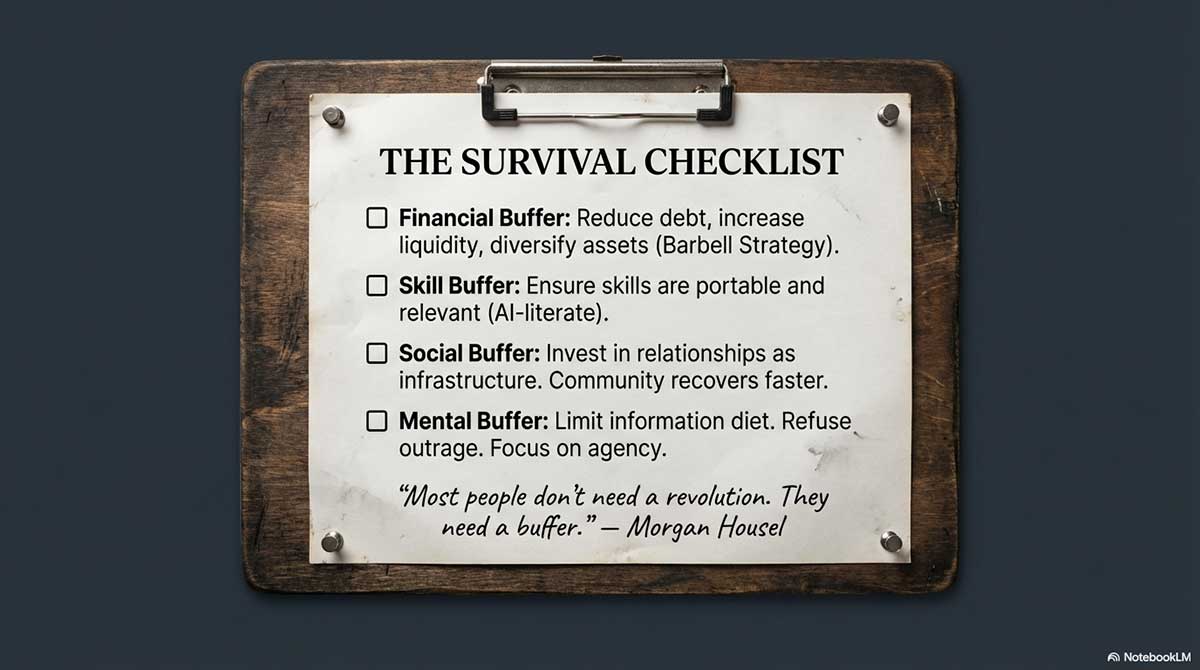
Morgan Housel: Here’s the truth. Most people don’t need a revolution. They need a buffer. A buffer of money. A buffer of skills. A buffer of relationships. A buffer of mental health. Volatile eras don’t destroy everyone. They destroy the people who are forced to make desperate choices.
He pauses, letting the room’s ordinary quiet do the work of making the message believable.
Morgan Housel: So the playbook is simple. Build slack. Reduce forced moves. Diversify beyond your portfolio. Stay near opportunity. Feed your mind and body what makes you steady. And keep your life large enough that the news cannot become your entire identity.
The fluorescent light hums. The coffee pot clicks. People stand up, not inspired in a theatrical way, but steadier in a real way, like they’ve been handed a flashlight instead of a prophecy.
And sometimes a flashlight is the best thing you can give.
Final Thoughts by Ray Dalio
If there’s one takeaway, it’s that these cycles are not moral judgments. They are cause and effect. They are mechanical. And because they’re mechanical, you can see the signs early and you can respond intelligently.
In late stage environments, people tend to do two unhelpful things. One is denial, pretending it can’t happen here. The other is fatalism, assuming it must happen and nothing can be done. Both are mistakes. The reality is in the middle. These systems can be repaired, but only if enough people put the system above tribal victory and only if leaders are willing to accept discipline that is politically hard.
On the national level, that means restoring credibility. Credibility in money. Credibility in institutions. Credibility in rule of law. In practical terms, it means bringing deficits and debt dynamics to sustainable levels, reducing the internal conflict that makes compromise impossible, and competing in technology in a way that strengthens prosperity without destroying trust.
On the personal level, the principles are straightforward. Live within your means. Build savings. Diversify well, including diversifiers that can protect you in bad monetary environments. Think about where opportunity and civility are highest, because opportunity tends to move. And most importantly, raise your children to be capable, resilient, and civil, because that is what keeps societies from tearing themselves apart when stress rises.
Civil conflict and war are always worse than people imagine before they live through them. So the smartest approach is prevention. That starts with understanding what’s happening, refusing to dehumanize people into stereotypes, and choosing to be part of the stabilizing force rather than the accelerating force.
History shows that the future is not fixed. But it also shows that when you ignore the patterns, the patterns eventually teach you. I’d rather we learn the easy way.
(And in the spirit of this project, remember: this is an imaginary conversation series, a creative exploration of ideas, designed to clarify dynamics and encourage thoughtful preparation, not to predict a specific outcome.)
Short Bios:
Ray Dalio – Founder of Bridgewater Associates and leading macro investor known for studying long-cycle patterns in debt, politics, and geopolitics, author of Principles and The Changing World Order.
Kara Swisher – Veteran tech journalist and interviewer recognized for sharp, skeptical conversations with Silicon Valley leaders about power, regulation, and culture.
Daron Acemoglu – MIT economist specializing in institutions, inequality, and how technology shapes prosperity and democratic stability.
Erik Brynjolfsson – Stanford economist focused on the productivity impacts of digital technology and AI, and why diffusion, adoption, and redesign matter.
Jensen Huang – Co-founder and CEO of NVIDIA, central to the modern AI hardware ecosystem and the scaling of compute infrastructure.
Demis Hassabis – AI researcher and CEO of Google DeepMind, known for frontier AI breakthroughs and discussions on safety, capability, and governance.
Ian Bremmer – Political scientist and founder of Eurasia Group, focused on geopolitical risk, power blocs, and how global fragmentation reshapes markets.
Arthur C. Brooks – Social scientist and writer on happiness, meaning, and civil discourse, known for practical frameworks to reduce polarization and live well.
Morgan Housel – Finance writer and author of The Psychology of Money, focused on behavior, risk, and staying resilient through uncertainty.
Vicki Robin – Author of Your Money or Your Life, known for reframing money as a life-energy trade and promoting financial independence through values.
Scott Galloway – Business professor and commentator who analyzes opportunity, mobility, inequality, and the modern career landscape with blunt clarity.
Angela Duckworth – Psychologist and author of Grit, focused on perseverance, character development, and resilience under long-term stress.
Preet Bharara – Former U.S. Attorney and legal commentator known for rule-of-law framing, institutional accountability, and crisp questioning.
Niall Ferguson – Historian of finance and empires who studies debt, war, institutional power, and how crises reshape political order.
Eswar Prasad – Economist known for research on digital currencies, central banking, and the design tradeoffs of CBDCs and monetary systems.
Zoltan Pozsar – Financial analyst known for deep expertise in monetary plumbing, collateral systems, and how crises reshape global finance.
Shoshana Zuboff – Scholar known for the concept of surveillance capitalism and for analyzing how digital systems can concentrate power and reduce autonomy.
Annie Duke – Decision strategist and former poker champion known for probabilistic thinking and making strong choices under uncertainty.
Nassim Nicholas Taleb – Essayist and risk thinker known for The Black Swan and Antifragile, focused on fragility, leverage, and survival under volatility.
Leave a Reply