
|
Getting your Trinity Audio player ready...
|

Introduction by Yuval Noah Harari
For thousands of years, human beings have looked to the skies, the stones, and the mysteries beneath our feet, asking: What does it all mean? Our ancestors saw signs in comets, encoded their dreams in pyramids, and whispered to stones as if they could remember. Today, in the digital age, we confront the same longing—but now it takes the shape of artificial intelligence, algorithms, and questions about who controls truth.
This series of conversations is not merely about interstellar visitors, Area 51, pyramids, or AI. It is about our deepest human instinct: the search for meaning in chaos. Every generation projects its anxieties and hopes onto the unknown. The Egyptians carved stone to defy time. Medieval monks wrote scriptures to preserve truth. Today, we build machines that try to tell us what is real.
The great question is not whether aliens exist, or whether pyramids store energy, or whether AI will guide us. The great question is: what story will we choose to tell about ourselves in relation to these mysteries? Because in the end, humans live by stories more than by facts. Facts shape the world, but stories give us purpose.
(Note: This is an imaginary conversation, a creative exploration of an idea, and not a real speech or event.)
Topic 1: Are Interstellar Visitors Clues to Intelligent Design?

Moderator: Karen Armstrong
Opening by Karen Armstrong
We’ve now seen three confirmed interstellar visitors: ʻOumuamua in 2017, Borisov in 2019, and ATLAS in 2025. Each carried mysteries that challenged our understanding of comets and asteroids. Some whisper about alien technology; others urge caution. Tonight, I’d like to explore what these messengers from beyond really mean. Let’s begin with this: Are interstellar objects natural wanderers, or could they carry intentional design?
Question 1: Are these interstellar objects simply natural anomalies, or should we take seriously the possibility of artificial origin?
Avi Loeb
I’ve long argued that we must keep open the possibility of artificial origin. ʻOumuamua’s flat, reflective surface and its acceleration without visible outgassing defied natural explanations. To dismiss design prematurely is to shut the door on discovery. Science thrives when we follow anomalies, not ignore them.
Neil deGrasse Tyson
I admire Avi’s boldness, but we need to stay cautious. Nature produces oddities all the time. A strange rock doesn’t make it a spacecraft. Extraordinary claims demand extraordinary evidence, and so far, we’ve seen only suggestive patterns, not proof.
Sara Seager
I think of these as data points rather than conclusions. Borisov, for example, looked very comet-like. ATLAS, though, with its green glow and unusual CO₂ balance, complicates the picture. Whether natural or not, these objects expand our catalog of what’s possible. That’s valuable in itself.
David Grinspoon
From a planetary evolution perspective, even if these bodies are natural, they remind us that planets and stars exchange material across vast distances. That, to me, is evidence of a “cosmic ecology.” If intelligence is involved, so be it—but the natural story is already astonishing.
Michio Kaku
Physics tells us that advanced civilizations, if they exist, might launch probes using light sails or exotic materials. ʻOumuamua’s behavior could fit that profile. I wouldn’t call it proof, but I also wouldn’t call it impossible. The universe is stranger than our textbooks.
Question 2: If one of these visitors were in fact designed, what would that mean for humanity’s place in the cosmos?
Michio Kaku
It would be the greatest discovery in human history. Imagine: we are not the pinnacle of intelligence, but one of many voices in a galactic choir. It would force us to reconsider religion, philosophy, and geopolitics overnight. The shockwave wouldn’t just be scientific—it would be civilizational.
Sara Seager
For me, the emotional shift would be profound. Right now, we look for biosignatures in exoplanet atmospheres—hints of life. But a designed artifact would be a technosignature. That would mean technology itself can outlive its makers, carrying intent across stars. It would show us survival is possible on cosmic timescales.
Neil deGrasse Tyson
If it were true, it would be exciting, yes. But would it really change our daily lives? We’ve already seen how people shrug at climate change, vaccines, or even landing on the Moon. Knowledge alone doesn’t transform society. It depends on whether we integrate it meaningfully.
Avi Loeb
Neil, that’s precisely why we must pursue it. Evidence of intelligent design would unify humanity around a bigger story. We’d stop thinking only of tribal conflicts and start imagining ourselves as part of a cosmic community. That shift could be the antidote to our parochial divisions.
David Grinspoon
I see both sides. Discovery wouldn’t erase human problems. But it could inspire us to rethink stewardship. If civilizations survive long enough to send probes, maybe they’ve already learned lessons about sustainability. Perhaps their silent presence is an invitation: “Here’s proof you can endure. Will you?”
Question 3: How should we study these visitors going forward, balancing skepticism, imagination, and limited resources?
David Grinspoon
We need international cooperation. When ATLAS came through, Hubble and ESA provided glimpses, but NASA’s budget cuts left gaps. These events shouldn’t depend on one nation’s priorities. They’re global opportunities. A coordinated response—like we do with climate science—would maximize what we learn.
Avi Loeb
I agree, but I’d go further. We need dedicated missions—interceptors ready to launch the moment a new interstellar object is spotted. If we wait, they’re gone forever. Catching one up close would be worth the investment of billions; the return in knowledge could be infinite.
Neil deGrasse Tyson
Billions? Careful. The public already doubts science spending. If we promise “alien probes” and deliver only “weird rocks,” trust erodes. I’d frame it differently: these are opportunities to refine our planetary defense and deepen our astrophysics. If we find more—great. If not, the tools still matter.
Sara Seager
That’s true, Neil. But I think the key is framing. We don’t chase these objects just for “aliens.” We chase them because they’re rare laboratories. They carry chemistry from other suns. Every spectrograph reading, every dust sample, is a page from another solar system’s history.
Michio Kaku
And in balancing resources, let’s remember: physics teaches us that the universe is vast. If intelligence exists, the odds of it reaching us are slim, unless they leave breadcrumbs—like these visitors. To ignore them would be like burning unread letters from the cosmos.
Closing Reflection by Karen Armstrong
What I hear tonight is a chorus of caution and curiosity. Some of you insist on skepticism; others invite us to expand imagination. Perhaps that tension itself is the lesson. Every anomaly asks: do we dismiss it as noise, or honor it as signal? Whether 3I/ATLAS is just an exotic comet or a crafted messenger, the deeper truth may be this: our longing to know reveals as much about us as about the stars.
Topic 2: Area 51 and the Origins of Human Technology

Moderator: Karen Armstrong
Opening by Karen Armstrong
Area 51 has long been a canvas for speculation—UFOs, secret aircraft, reverse-engineering alien craft. For decades, testimonies have surfaced claiming our most advanced technologies may not be purely human achievements. Tonight, let’s explore the possibility that extraterrestrial contact has shaped human innovation. Is it myth, or might there be truth beneath the secrecy?
Question 1: Do you believe Area 51 has played a role in accelerating human technology, and if so, how?
Jacques Vallée
From my research, secrecy and myth are always entwined. While much of what we hear about Area 51 is exaggerated, I do believe there’s a core truth: unusual materials have been studied there. Whether they’re extraterrestrial or not is less important than the way they catalyze imagination, inspiring leaps in science.
Elon Musk
If aliens gave us iPhones, I’d like to meet them and ask why they didn’t just skip to Neuralink. Realistically, most technological advances we’ve seen—rockets, chips, AI—have clear human lineages. But I won’t deny: rumors around Area 51 push engineers like me. Myth fuels ambition, even if there’s no alien circuit board in a drawer.
Linda Moulton Howe
I’ve interviewed dozens of whistleblowers who insist advanced craft and biological entities were stored there. They describe reverse-engineering attempts leading to fiber optics, night vision, even microchips. Dismissing these accounts outright ignores consistent testimony. Where there’s smoke, there’s often fire.
Stanton Friedman
As a nuclear physicist, I’ve studied the Roswell case extensively. Too many high-ranking witnesses confirmed debris with exotic properties. It strains credibility to think the government would hide mere weather balloons at a base like Area 51. Something unusual happened, and the public has been denied the truth.
Annie Jacobsen
I researched Area 51 for years, interviewing engineers and pilots. Most of what’s there is human military secrecy—stealth aircraft, drones, black projects. That said, the mythology itself has become a cultural technology. Belief in aliens keeps public attention away from classified weapons programs. In a sense, the alien narrative is itself part of the cover.
Question 2: If technology were seeded or influenced by extraterrestrials, what does that mean for how we view human innovation?
Stanton Friedman
It would mean humility. We like to think of ourselves as self-made, but if even fragments of our tools originated elsewhere, then humanity has been climbing a ladder someone else placed before us. That should challenge our arrogance and invite honesty about our cosmic context.
Elon Musk
I’d argue it wouldn’t diminish us—it would expand us. If we took a fragment of alien metal and built Silicon Valley out of it, that’s still human ingenuity. Technology is less about the raw material and more about what you do with it. We’d still own the story.
Linda Moulton Howe
But Elon, the implications are deeper. If extraterrestrials have guided or nudged us, we must ask: why? Are they shepherds? Experimenters? If our breakthroughs aren’t entirely ours, then our destiny might also be entangled with theirs. That’s not just science—it’s theology, philosophy, and geopolitics.
Jacques Vallée
Precisely. The myth of pure independence is a modern illusion. Even if no alien hardware was ever handled at Area 51, human culture has always been shaped by “others”—whether gods, angels, or visitors. We should focus less on whether a transistor came from a saucer, and more on what these stories tell us about our need for connection with the beyond.
Annie Jacobsen
And let’s not forget: even if aliens seeded tech, secrecy has been the gatekeeper. A handful of people would decide how and when that knowledge reaches the world. That raises ethical questions: is innovation truly “ours” if it’s rationed by power structures?
Question 3: Given the uncertainty, how should humanity approach the legacy and secrecy of Area 51 moving forward?
Annie Jacobsen
We need transparency, but not recklessness. If Area 51 is hiding nothing but stealth drones, then secrecy perpetuates distrust. If it hides something more, the people deserve to know—but disclosure must be managed so it doesn’t destabilize societies overnight. Information has to be staged responsibly.
Elon Musk
I’d livestream it. Imagine the ratings: “Welcome to Area 51, here’s the hangar.” Joking aside, secrecy breeds conspiracy. If there’s nothing, open the doors. If there’s something, humanity can handle it. We already watch Marvel movies about aliens; we’re primed. The worst risk is treating people like children who can’t know the truth.
Linda Moulton Howe
Disclosure is overdue. Too many insiders have risked careers and lives to tell fragments of the truth. Humanity is ready. We can’t prepare for contact, or for the philosophical questions it brings, by keeping everyone in the dark. A slow drip of denial only weakens trust.
Stanton Friedman
I agree with Linda. Governments don’t own the universe. Knowledge of extraterrestrial contact belongs to the species, not to secret committees. If alien technologies have shaped our lives, then citizens have a right to that story, no matter how unsettling.
Jacques Vallée
I would offer a different angle: perhaps the secrecy itself is part of the phenomenon. The elusive nature of UFOs, the government denials, the leaks—it all feeds into a mythos that transforms culture. Maybe the “truth” isn’t a single artifact in a warehouse, but the way humanity has evolved through the dance of concealment and revelation.
Closing Reflection by Karen Armstrong
Across these perspectives, I hear both urgency and caution. For some of you, disclosure is a moral imperative; for others, secrecy is itself the mystery. Perhaps what Area 51 really symbolizes is the blurred line between myth and matter. Did aliens gift us microchips? Or did our imagination, sparked by whispers of the extraordinary, drive us to invent them ourselves? In either case, the story reveals a profound truth: our hunger to see ourselves in a larger cosmic narrative.
Topic 3: Do the Pyramids Encode Ancient Energy and Information Systems?

Moderator: Karen Armstrong
Opening by Karen Armstrong
The Great Pyramid has fascinated humanity for millennia—not only as a tomb or monument, but as a possible device: an energy source, a communication hub, even a repository of encoded knowledge. Tonight, we ask: were the pyramids simply stone marvels of human engineering, or do they conceal a deeper purpose tied to energy and information?
Question 1: Were the pyramids purely symbolic tombs, or could they have served as functional energy or information systems?
Gregg Braden
For me, the pyramids resonate as both. They are extraordinary works of architecture, but also align with Earth’s natural frequencies. The use of granite—piezoelectric in nature—suggests intentional design to harness energy. Whether for healing, communication, or preservation, these weren’t just tombs—they were living technologies.
Zahi Hawass
As an archaeologist, I must be clear: the pyramids were royal tombs, built by Egyptians for their kings. We have inscriptions, worker’s graffiti, and burial goods that support this. That doesn’t diminish their grandeur. We don’t need to invent aliens or “machines” to marvel at Egyptian genius.
Robert Schoch
I respect Dr. Hawass, but geology suggests the pyramids’ design may have tapped into groundwater and seismic energy. These structures could amplify natural forces, intentionally or not. I’m not saying they were power plants—but they interacted with Earth in complex ways, more than just as tombs.
Brian Cox
From a physics standpoint, we must be cautious. Granite may be piezoelectric, yes, but the idea of pyramids as giant “batteries” is scientifically weak. That said, human societies often build monuments that double as calendars, observatories, or symbolic “machines.” Their purpose may have been partly functional, partly spiritual.
John Anthony West
I’ve always argued that the pyramids encode wisdom older than dynastic Egypt itself—echoes of a lost civilization. Their design carries harmonic ratios, astronomical alignments, and mathematical constants like pi and phi. Tombs? Perhaps. But also textbooks in stone. They are repositories of knowledge.
Question 2: If the pyramids were encoding knowledge or energy, what message do you think they were meant to preserve?
John Anthony West
I see them as messages across time: “We knew the universe was patterned, and here is the pattern.” By embedding cosmic ratios and alignments, the builders offered a bridge between heaven and earth, a map of harmony for future generations.
Brian Cox
I’d interpret it differently. The “message” is human capability. When we see a society marshal tens of thousands to move millions of stones, that’s a statement: “We can organize, we can endure, we can dream.” The pyramid itself is the message—testament to human willpower.
Gregg Braden
And yet, Brian, messages don’t have to be just symbolic. The stones could act as a recording medium. In indigenous traditions, materials hold memory. Perhaps the pyramid stones preserve intention, prayer, and frequency. In our age, we might call that “data storage.” To them, it was sacred continuity.
Zahi Hawass
The message is religious: the king becomes divine, uniting with the gods in the afterlife. Hieroglyphic texts describe this clearly. The pyramid is a spiritual ladder, not a battery. To misinterpret it undermines the people who built it.
Robert Schoch
Still, one must admit: if the pyramids were only tombs, why encode such astronomical precision? Alignments with Orion, solstices, and Earth’s meridians suggest a message beyond funerary needs. To me, it’s as though the builders were whispering: “Pay attention to the cosmos—your fate is tied to it.”
Question 3: How should we balance skepticism and openness when studying such theories—between archaeology, physics, and alternative perspectives?
Robert Schoch
We must test, not dismiss. Too often, ideas outside orthodoxy are ridiculed before evidence is gathered. Science should be a process of curiosity, not gatekeeping. If people suggest energy systems, let’s model them, measure them, and see what holds up.
Zahi Hawass
And yet, Robert, I must defend rigor. Too many “alternative” theories ignore evidence and disrespect Egyptian heritage. The pyramids were built by Egyptians, for Egyptians. Speculation is fine—but not at the expense of truth. Archaeology requires discipline, not fantasy.
Gregg Braden
Rigor and openness can coexist. We don’t have to choose between “tombs” and “power plants.” The truth may be layered: spiritual structures that also harnessed natural forces. We need a new language that bridges science and tradition.
John Anthony West
Exactly. Orthodoxy tells us “what,” but imagination asks “why.” The pyramids remind us that science and myth were once united. To cut one from the other leaves us blind. The challenge is integration, not division.
Brian Cox
Integration is fine, but we must anchor it in evidence. I love speculation as much as anyone, but science demands falsifiability. If someone says “the pyramids were energy devices,” then show me the measurable output. Otherwise, it remains poetry. Beautiful poetry, yes—but not physics.
Closing Reflection by Karen Armstrong
Tonight, we heard five visions: the pyramid as tomb, as textbook, as energy device, as cultural testament, and as cosmic calendar. Perhaps its real genius lies in containing all of these at once. To the ancient builders, separating “sacred” from “scientific” may never have made sense. What we see as contradiction, they may have seen as unity: matter infused with meaning, stone alive with spirit. In seeking to decode the pyramids, perhaps we are really seeking to decode ourselves—the balance of reason and wonder that defines what it means to be human.
Topic 4: Stones as Memory — Can Matter Hold Human Intention?

Moderator: Karen Armstrong
Opening by Karen Armstrong
From the granite sarcophagi inside pyramids to modern proposals for quantum storage, humans have long wondered if matter itself can retain memory. Is it possible that stone or crystal can hold intention, energy, or information? Or are such ideas poetic metaphors? Tonight, we’ll explore whether “stones remember,” and what that means for science, spirituality, and the future of knowledge.
Question 1: Do you believe physical matter—stone, crystal, or minerals—can retain memory or intention?
Rupert Sheldrake
I’ve studied “morphic resonance,” and I think matter is not as inert as we assume. Crystals, especially, show patterns that may interact with consciousness. When people claim stones “record” rituals or prayers, I don’t dismiss it. Science hasn’t fully mapped the relationship between mind and matter.
Roger Penrose
As a physicist, I must tread carefully. I’ve argued that quantum processes may occur in microtubules in the brain, perhaps linking consciousness to fundamental physics. Could crystals or stone retain information? In principle, yes—materials hold patterns at quantum scales. Whether intention can imprint them remains unproven but not impossible.
Marina Abramović
As an artist, I’ve worked with stone as if it breathes. When you spend hours in ritual with marble, you feel it hold something. Is it measurable? Perhaps not in scientific terms, but energetically, emotionally—it’s undeniable. Stone absorbs presence.
Dean Radin
Parapsychology experiments suggest intention can affect material systems, albeit subtly. Random number generators shift during mass meditation events. If silicon chips respond, why not granite blocks? Our tools for measuring subtle effects are still primitive, but data suggests consciousness does interact with matter.
Carlo Rovelli
I love the poetry, but I must be cautious. Matter records information in specific, testable ways—like fossils, like cosmic radiation in crystals. That’s memory in a strict sense. When we speak of “intention,” we should clarify: is it metaphor or mechanism? Science must not confuse the two, even as we explore.
Question 2: If stones or materials can hold memory, what might ancient builders or ritual practitioners have intended to encode?
Dean Radin
Perhaps they encoded coherence. A ritual is a way of aligning minds. If matter amplifies that, then a pyramid or a stone circle could become a kind of resonator, broadcasting harmony or continuity to future generations.
Marina Abramović
I think of it as a dialogue. When ancient builders carved granite, they were speaking with the stone. The message may not be words, but presence—fear, awe, devotion. These emotions could saturate a space. You feel it when you stand in Chartres Cathedral or inside the Great Pyramid.
Roger Penrose
If anything was encoded, it might be mathematical. Ratios embedded in structure endure for millennia. The builders may not have left texts, but they left geometry—numbers carved into space. That, too, is a form of memory, one we still decipher.
Rupert Sheldrake
I’d add that traditions often treated stones as alive. Think of standing stones in Britain, or sacred rocks in India. If communities projected meaning onto them, perhaps stones do become carriers of collective memory, holding patterns of thought across time.
Carlo Rovelli
From my perspective, the “encoded message” is the continuity of civilization itself. A stone monument is a physical archive. By surviving, it tells us: “we were here, and we mattered.” Whether intentional or not, stone preserves human striving in a way parchment never could.
Question 3: How should we approach this question going forward—through science, art, spirituality, or a synthesis of all three?
Roger Penrose
We need rigorous science, but not narrow-minded science. Quantum physics teaches us that the universe is stranger than classical materialism suggests. If there are subtle effects of consciousness on matter, we must design experiments that respect complexity rather than dismiss anomalies.
Marina Abramović
I would say: art is essential. Science measures, but art feels. Together, they complete the picture. If you want to know whether stone holds memory, sit with it, perform with it, listen to it. That data may be subjective, but it is no less real.
Rupert Sheldrake
And spirituality gives context. Humans have always believed materials are sacred. To treat stones as inert lumps is an anomaly of modern thinking. We should restore that sense of reverence while also inviting scientific tests. A synthesis is the only way forward.
Carlo Rovelli
I respect reverence, but we must avoid slipping into mysticism. Science has tools to explore information in matter—through physics, geology, archaeology. If we want synthesis, let it be evidence-based, where poetry inspires but data confirms.
Dean Radin
I see it as an ecosystem of approaches. Double-blind experiments can measure subtle effects, while artists and spiritual practitioners provide hypotheses worth testing. If consciousness does imprint matter, only a broad coalition—scientists, artists, seekers—will uncover how.
Closing Reflection by Karen Armstrong
Tonight, you’ve all spoken of stone not as dead matter, but as something that resists easy categories. For some of you, stone encodes math, for others, memory, and for still others, emotion or presence. Perhaps the real question is not whether stones literally remember, but whether we are willing to remember through them. Every block of granite is a story in compression: geological, cultural, spiritual. In listening to stones, we may be listening to ourselves—the imprints we choose to leave behind.
Topic 5: Truth in the Age of Chaos — Can AI Become Our Navigator?

Moderator: Karen Armstrong
Opening by Karen Armstrong
We live in an age of contested truths. Social media floods us with claims and counterclaims; experts are doubted; conspiracy theories thrive. Amid this chaos, some suggest that artificial intelligence might serve as a new compass—sorting fact from fiction, guiding decision-making, perhaps even redefining “truth.” But can we trust machines with something so human?
Question 1: In today’s chaotic information environment, do you believe AI can help humanity discern truth?
Sam Altman
AI can certainly help. Large language models and knowledge graphs can analyze vast data streams faster than any human. They can flag contradictions, expose misinformation, and highlight credible sources. But AI is not “truth” itself—it reflects training data. If society wants a compass, it must calibrate the needle carefully.
Jaron Lanier
I’d caution against expecting too much. AI systems can amplify illusions just as easily as they clarify. If we hand over judgment to algorithms, we risk losing our agency. Truth is not just statistical pattern—it’s relational. It emerges from dialogue, not from a machine’s output.
Nick Bostrom
Still, there’s no denying the utility. A well-designed AI could serve as an epistemic filter, shielding us from information overload. But the danger lies in alignment. Whose “truth” is the AI trained to enforce? If misaligned, it becomes not a compass, but a manipulator.
Shoshana Zuboff
And we must remember: AI does not exist outside capitalism. Current systems are built by corporations that monetize attention. The “truths” they promote will often serve profit rather than public good. AI could be a guide—but only if wrested from surveillance capitalism.
Yuval Noah Harari
Truth has always been fragile. Religions, empires, nations—they run on shared fictions. AI doesn’t remove that—it magnifies it. The real question is: will AI create one global narrative, or fracture us further into echo chambers? That’s where the future of truth will be decided.
Question 2: If AI does take on the role of “navigator,” how might that change our sense of human responsibility?
Yuval Noah Harari
If we outsource truth to machines, humans may lose their role as meaning-makers. History shows that authority over truth—priests, kings, scientists—shapes entire civilizations. If AI takes that role, humans could drift into passivity, living by instructions rather than interpretation.
Sam Altman
I don’t think it’s all-or-nothing. AI can be a co-pilot, not a dictator. Ideally, it helps us see clearer choices, but we remain the decision-makers. The danger is when people stop questioning AI outputs. We need a culture of critical AI literacy—humans must stay in the loop.
Shoshana Zuboff
But the incentives today don’t foster co-pilots—they foster control. If AI becomes the “navigator,” it will be used to steer populations subtly, nudging behavior. That erodes responsibility because people think, “The machine told me so.” True responsibility requires transparency in how AI reaches conclusions.
Nick Bostrom
Exactly, Shoshana. Responsibility doesn’t vanish; it shifts. The responsibility lies with the designers, the regulators, the overseers. If AI guides society, those who shape its architecture become the new moral authorities. We must ensure they are accountable.
Jaron Lanier
Responsibility also lies in refusing to surrender ourselves. We must design AI as a tool that preserves individuality and dialogue. If we let it become an oracle, then yes—we’ve lost responsibility. But if it amplifies diverse voices rather than narrowing them, responsibility deepens.
Question 3: How should we balance skepticism and trust in using AI to navigate truth in the future?
Nick Bostrom
Balance begins with governance. Just as we regulate medicine or nuclear power, we must regulate AI. Skepticism ensures we don’t accept outputs blindly, while trust allows us to use the tools productively. Without oversight, AI will reflect the worst of us.
Jaron Lanier
I’d add: skepticism must be cultural, not just regulatory. People should treat AI like they treat a fellow human with biases—useful, but fallible. Trust comes from relationships, not from blind faith. We need a cultural shift toward seeing AI as “fallible companions.”
Sam Altman
Trust must be earned. If AI systems consistently demonstrate accuracy, transparency, and fairness, then skepticism will naturally soften. But the moment we hide how models work or who funds them, skepticism should rise again. AI trust should never be unconditional.
Shoshana Zuboff
Exactly. Transparency is the heart of trust. People must know not only what an AI says, but why it says it. Without explainability, skepticism is the only rational posture. AI must be open-source in spirit, if not always in code.
Yuval Noah Harari
And we should remember: skepticism and trust are not opposites—they are partners. The healthiest relationship with AI will be dialectical. Like with religion, science, or democracy, truth emerges not from blind devotion but from ongoing questioning.
Closing Reflection by Karen Armstrong
In this conversation, I hear a paradox: AI may become both a savior and a seducer in our search for truth. Some of you see it as a filter, a co-pilot, a helper; others warn it could become an oracle, stripping humans of responsibility. Perhaps the key lies in holding skepticism and trust together—never surrendering entirely, never dismissing outright. The machine may illuminate paths, but only we can choose which to walk. Truth, in the end, is not just found. It is lived.
Final Thoughts by Yuval Noah Harari
After hearing all these voices—scientists, philosophers, mystics, and visionaries—we are reminded that the frontier of knowledge is always uncertain. Interstellar objects may be messengers or merely rocks. Area 51 may hide spacecraft or only human ambition. The pyramids may be tombs or cosmic textbooks. Stones may hold quantum memory or only our imagination. And AI may be our guide or our manipulator.
But the truth is this: humanity has never truly lived by certainty. We have lived by curiosity. By daring to ask questions that seem impossible. By weaving myths and science into stories that orient us in a vast, indifferent universe.
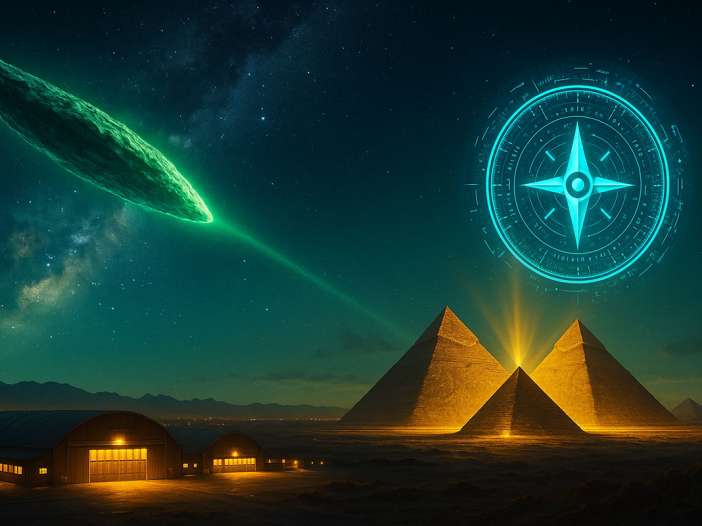
So, what do these mysteries demand of us? Not blind belief, and not cynical dismissal, but humility. Humility to accept that we don’t know everything, and courage to continue asking. The green glow of an interstellar object, the silence of pyramids under the stars, the hum of data inside an AI system—these are all invitations to wonder.
And perhaps that is the real message hidden in stone, in stars, in silicon: that the greatest technology humans ever invented is not a machine, but the story. Stories that connect us, guide us, and remind us that even in chaos, meaning can be created.
Short Bios:
Avi Loeb – Harvard astrophysicist, founder of the Galileo Project, known for proposing that ʻOumuamua might be of artificial origin.
Neil deGrasse Tyson – Astrophysicist and science communicator, Director of the Hayden Planetarium, popular for making complex science accessible.
Sara Seager – MIT professor and exoplanet researcher, expert in planetary atmospheres and the search for biosignatures.
David Grinspoon – Planetary scientist and astrobiologist, studies planetary evolution and the possibility of life beyond Earth.
Michio Kaku – Theoretical physicist and futurist, co-founder of string field theory, author of numerous books on science and the future.
Jacques Vallée – Computer scientist and UFO researcher, noted for linking UFO phenomena with cultural and consciousness studies.
Stanton Friedman – Nuclear physicist and UFO investigator, one of the first to promote the Roswell incident as extraterrestrial.
Annie Jacobsen – Investigative journalist and author of Area 51: An Uncensored History of America’s Top Secret Military Base.
Elon Musk – Entrepreneur, CEO of SpaceX and Tesla, focused on advancing space travel, AI, and sustainable technology.
Linda Moulton Howe – Investigative journalist and documentary producer specializing in UFOs, alien encounters, and government secrecy.
Zahi Hawass – Prominent Egyptian archaeologist and former Minister of Antiquities, known for excavations and conservation of pyramids.
Robert Schoch – Geologist and author, known for re-dating the Sphinx and suggesting advanced pre-dynastic civilizations.
John Anthony West – Independent Egyptologist and writer, known for theories on ancient Egypt’s symbolic and esoteric knowledge.
Brian Cox – Particle physicist and broadcaster, Professor at the University of Manchester, renowned for science communication.
Gregg Braden – Author and researcher bridging science and spirituality, focusing on ancient traditions and modern physics.
Roger Penrose – Nobel Prize-winning physicist, known for contributions to cosmology and theories linking consciousness to quantum mechanics.
Rupert Sheldrake – Biologist, originator of the concept of “morphic resonance” and controversial theories on memory and form.
Dean Radin – Researcher in parapsychology, Chief Scientist at the Institute of Noetic Sciences, explores mind-matter interaction.
Carlo Rovelli – Theoretical physicist, founder of loop quantum gravity, author of The Order of Time and Reality Is Not What It Seems.
Marina Abramović – Performance artist, famed for exploring endurance, ritual, and the energetic dialogue between people and materials.
Sam Altman – Entrepreneur and CEO of OpenAI, former president of Y Combinator, central figure in the global AI conversation.
Jaron Lanier – Computer scientist, technologist, and author, pioneer of virtual reality and critic of digital exploitation.
Nick Bostrom – Philosopher at Oxford, author of Superintelligence, focuses on existential risks and the future of humanity.
Shoshana Zuboff – Social psychologist and author of The Age of Surveillance Capitalism, expert on data, power, and society.
Yuval Noah Harari – Historian and author of Sapiens and Homo Deus, exploring human history, shared myths, and the future of society.
Leave a Reply