
|
Getting your Trinity Audio player ready...
|
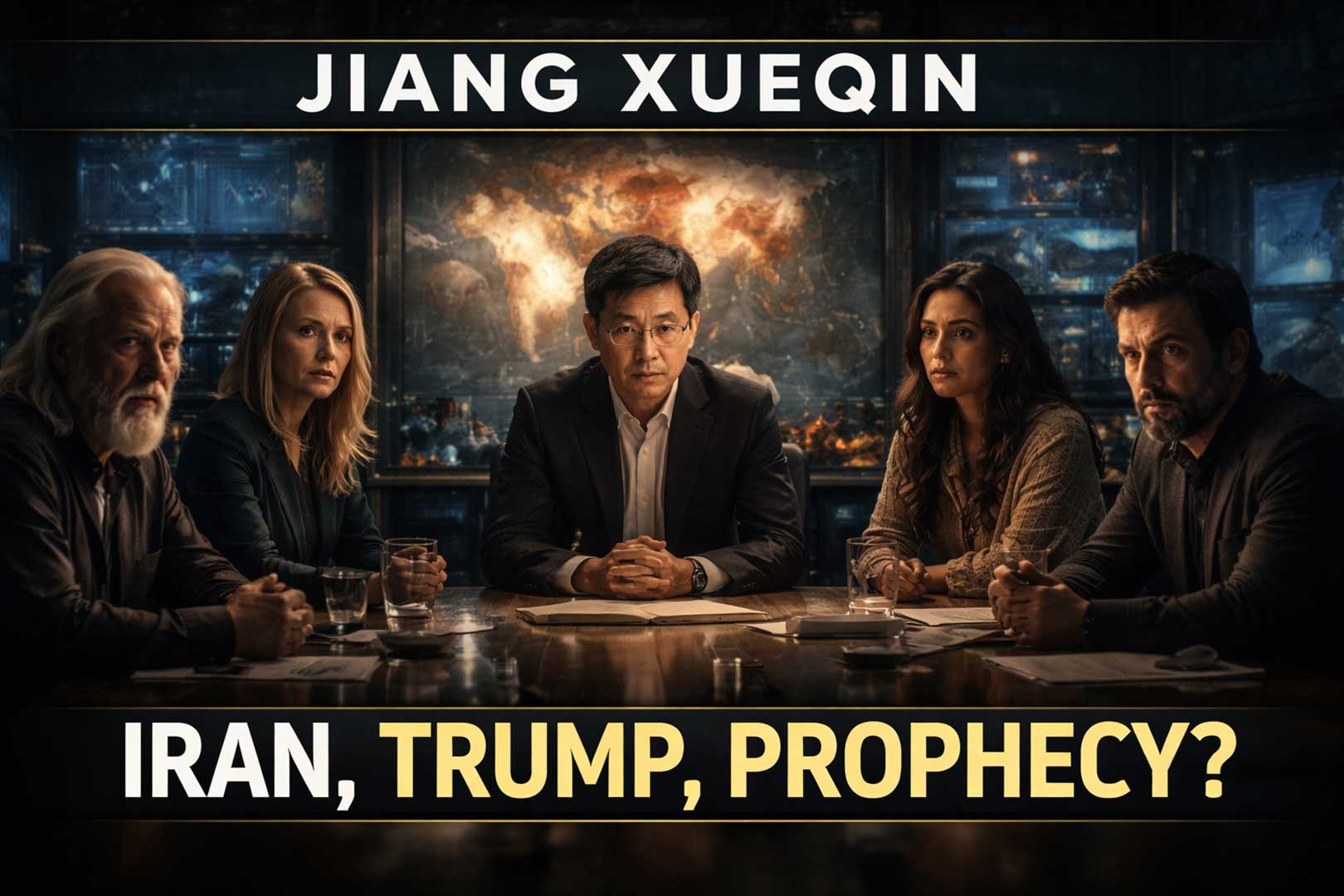
What if Jiang Xueqin is warning that Iran could reshape the West?
There are moments when one person’s warning seems to gather the unease of an entire age into a single frame.
That is part of what makes Jiang Xueqin so interesting right now.
He is not speaking only about one politician, one country, or one crisis. He is trying to connect larger forces: Trump as a sign of political change, Iran as a possible flashpoint, the weakening of public trust, and the sense that the old order may not be as stable as it once appeared. Whether one sees him as a prophet, a strategist, or simply a reader of historical patterns, his warning has captured attention because it seems to name something many people already feel.
That is the spirit of this conversation.
This is not a conversation built on fear, and it is not built on blind belief. It is an attempt to look carefully at one serious warning and the wider questions it raises. Why has Jiang’s view gained such force? What does he really see in Trump? Why does Iran matter so much in his framework? Is he describing the weakening of the old order? And if any part of his warning carries truth, how should ordinary people live now?
The voices in this conversation do not all agree in the same way. Some echo Jiang. Some widen his vision. Some make it more spiritual, some more symbolic, and some more historical. That range matters. It keeps the conversation from becoming flat or doctrinaire. It lets the warning breathe.
And maybe that is what makes a conversation like this useful.
Not that it gives perfect certainty. Not that it settles every political argument. But that it helps us ask better questions about power, instability, leadership, fear, and the kind of character people need in uncertain times.
So I hope this conversation is read in that spirit: seriously, openly, and with enough humility to admit that history sometimes starts changing before most people know what to call it.
(Note: This is an imaginary conversation, a creative exploration of an idea, and not a real speech or event.)
Topic 1: Why Do So Many Prophetic Voices Keep Returning to Trump?
Moderator: A Conan-like host
Participants: Jiang Xueqin, Craig Hamilton-Parker, Joseph Tittel, Jessica Adams, Amy Tripp
Question 1
Why has Jiang Xueqin’s warning caught people’s attention so strongly right now?
Moderator:
Tonight’s subject is light, cheerful, and guaranteed to relax everyone before bed: prophecy, war, political upheaval, and the fate of civilization. So naturally, a perfect evening. Jiang, let me start with you. Why do you think your warning has landed so strongly with people right now?
Jiang Xueqin:
I think it lands because many people already feel that the world is becoming less stable, less coherent, and less trustworthy. They may not have a full framework for that feeling, but they sense it. My work tries to connect visible events to deeper structural pressures. When people hear that kind of pattern laid out clearly, it resonates because it gives language to an unease they already carry.
Craig Hamilton-Parker:
Yes, I think that is true. People are often living with a kind of unspoken tension. They know something feels off, but they cannot quite define it. Jiang’s warning speaks to that. It feels less like random alarm and more like an attempt to identify the shape of the pressure.
Joseph Tittel:
That is what I feel too. There is a difference between somebody scaring people and somebody touching a deeper current that people already sense. Jiang is speaking to a field of tension that many people feel in their gut. That is why they lean in.
Jessica Adams:
He is also connecting things that many people have been treating separately. Politics, conflict, public emotion, civilizational fatigue, leadership, instability. When one person starts putting those pieces into one frame, people pay attention because the world itself no longer feels neatly separated.
Amy Tripp:
Timing matters too. There are moments when the public is much more sensitive to people who seem able to read the larger pattern. We are in one of those moments now. People are tired of shallow commentary. They want somebody who can explain why everything feels connected.
Moderator:
So part of it is that Jiang is not walking into a calm room and yelling, “Fire.” He is walking into a smoky room where everybody already smells something burning, and he is the one saying, “Maybe we should talk about the walls.”
Question 2
Is Jiang Xueqin best understood as a prophet, a strategist, or a reader of historical patterns?
Moderator:
Now let me ask the question that probably annoys Jiang the most, which is always a good sign. How should we think about you? Prophet? Strategist? Historical pattern-reader? Mysterious time-traveling chess player? What is the right frame here?
Jiang Xueqin:
I would say pattern-reader first. I am trying to identify structures, incentives, cycles, and pressure points that shape history. If that sounds prophetic to some people, it is likely because large patterns often become visible before large events fully emerge. But my focus is not on mystical identity. It is on whether the pattern itself is real.
Jessica Adams:
That answer makes sense to me. A strong reader of patterns often sounds prophetic, because what they are doing is noticing how certain cycles and tensions converge. It may not be supernatural in the usual sense, yet it still feels revelatory because it names what others have not yet fully seen.
Craig Hamilton-Parker:
Yes, and I think the prophetic element comes in when the pattern carries moral or civilizational weight. Jiang is not just describing movement. He is describing a moment with consequence. That is why people hear more than analysis in his voice.
Joseph Tittel:
I agree. Prophet does not always mean somebody floating above reality. Sometimes it means somebody who senses the direction things are taking and says it before people are ready to hear it. Jiang has some of that quality, even if his language comes through history and strategy.
Amy Tripp:
He sits in an unusual place. He is too structural to sound like a pure mystic, and too charged to sound like an ordinary pundit. That middle ground is part of why people find him interesting. He feels serious without sounding stale.
Moderator:
That is a strong answer. So the official description is: not wizard, not cable-news uncle, but a man standing in the narrow hallway between history and warning, which frankly sounds like the title of a very intense documentary.
Question 3
What makes Jiang Xueqin’s warning feel different from ordinary political commentary or fear-based prediction?
Moderator:
A lot of people predict disaster. It is basically an industry at this point. Somebody is always saying the end is near, the system is broken, the sky is falling, and please subscribe. So what makes Jiang’s warning feel different from ordinary political noise?
Amy Tripp:
Structure. He is not just reacting to headlines emotionally. He is trying to show how certain tensions fit together. That gives his work more weight. Even people who disagree with him can usually see that he is building an argument, not just throwing sparks around.
Craig Hamilton-Parker:
Yes. There is shape to it. Many alarming voices are scattered. Jiang’s warning has a line running through it. You can see the logic of it, whether you accept every conclusion or not.
Jiang Xueqin:
Fear is easy to produce. It is one of the cheapest forces in public life. What matters is whether one can explain why events might unfold in a certain way, and what makes one point of tension more dangerous than another. Without that, warning becomes performance.
Jessica Adams:
That is exactly why people keep returning to his work. He is not only saying something may happen. He is saying why this moment feels historically loaded. That makes the warning feel larger than commentary.
Joseph Tittel:
A real warning also turns people inward. It does not just make them stare outward at chaos. It makes them ask what kind of time they are living in, what kind of leaders they trust, what kind of people they are becoming. That is when a warning starts having depth.
Moderator:
So the difference is that this does not feel like somebody pounding a drum just to make people nervous. It feels more like somebody laying a map on the table and saying, “Look, these roads are converging, and you may want to notice where they lead.”
Closing reflection
Moderator:
Then maybe that is the clearest answer for tonight. Jiang Xueqin’s prophecy has captured attention because it does more than predict. It connects. It connects politics to history, conflict to public emotion, leadership to civilizational strain, and outer instability to the inner condition of a people. And, cheerfully enough, that is exactly why so many people cannot stop listening.
Topic 2: Is Iran the Spark That Changes the World?
Moderator: A Conan-like host
Participants: Jiang Xueqin, Craig Hamilton-Parker, Joseph Tittel, Jessica Adams, Amy Tripp
Question 1
Why does Trump matter so much in Jiang Xueqin’s prophecy?
Moderator:
All right, let’s move gently into the least explosive subject in modern life: Donald Trump. Just a nice, relaxing little topic for friends. Jiang, your larger warning is clearly bigger than one man. So why does Trump matter so much inside it?
Jiang Xueqin:
Because Trump is one of those rare figures through whom a deeper national change becomes visible. He did not create all the forces around him, but he gave them shape, voice, and momentum. Many Americans felt that the old political language had become hollow, managerial, and disconnected from lived reality. Trump mattered because he broke that language and replaced it with something more forceful, more combative, and, to many people, more real.
Amy Tripp:
That is a big part of it. Many Americans see Trump as strong in a way few modern politicians are. They see stamina, instinct, refusal to back down, and a willingness to fight where others seem cautious or overly scripted. That is not a small thing. For a lot of people, that strength is exactly why he matters.
Craig Hamilton-Parker:
Yes, and he has enormous symbolic force. Some leaders simply occupy office. Trump changes the emotional atmosphere around politics itself. He energizes people, irritates people, emboldens people, alarms people. That degree of force is unusual. It makes him historically significant whether one admires him or not.
Joseph Tittel:
What I feel around him is resilience. People have thrown everything at him, and he keeps coming back. Supporters experience that as proof of strength. They feel he represents persistence under pressure, and that gives him a kind of mythic quality in public life.
Jessica Adams:
And he matters because he stands at the meeting point of so many American tensions: class, media, leadership, status, trust, anger, and national identity. That makes him more than a politician in the usual sense. He becomes a figure people read meaning into from many directions.
Moderator:
So he is not the whole prophecy, but he is one of those figures who somehow walks into the room and suddenly everybody is talking louder, feeling more, and texting relatives they were hoping not to text.
Question 2
Do these voices see Trump mainly as a fighter, a mirror, or a sign of deeper change already underway?
Moderator:
Now here is where I want to keep this fair. Because if we are honest, a lot of Americans do not look at Trump and think, “Here comes doom.” They think, “Finally, somebody who fights.” So when you look at him, what do you really see?
Amy Tripp:
Fighter is the first word that comes to mind. A great many Americans see Trump as someone who does not bow to elite pressure, media pressure, or institutional pressure. They may not care that he is polished. In fact, that is often the point. They see him as willing to fight for things they think weaker politicians surrendered long ago.
Joseph Tittel:
I would say fighter and mirror. He fights, yes, but he also reflects what millions of Americans have been feeling: frustration, distrust, fatigue with establishment language, and a desire for directness. He reflects a public mood that was already growing before he fully rose.
Jiang Xueqin:
That is close to my view. Trump is a strong political actor, but he is also a sign that the old order had already lost much of its hold over the public imagination. If the system had still possessed deep confidence and legitimacy, a figure like Trump would not have risen the way he did. So he is both leader and indicator.
Craig Hamilton-Parker:
Yes, and this is where oversimplifying him becomes a mistake. He is not merely a symptom, because he clearly has agency and unusual force. But he is not merely a cause either. He rose because conditions were ready for someone like him. That is why he feels larger than an ordinary politician.
Jessica Adams:
Mirror is still my strongest word, though not in a dismissive sense. He reflects where the country already was: tired of managed language, skeptical of institutions, hungry for force, and increasingly split over what leadership should even look like. That reflective power is part of what makes him so central.
Moderator:
So the room is basically saying: he is not just a man shouting into history. He is also history shouting back through a man, which is dramatic, unsettling, and, frankly, a pretty strong image.
Question 3
What strength do many Americans see in Trump, and why does that matter inside Jiang Xueqin’s larger warning?
Moderator:
Let’s end by naming the positive side clearly, because that often gets lost. What strength do many Americans genuinely see in Trump, and why does that matter in this bigger prophecy?
Joseph Tittel:
Many see courage. They see someone who does not crumble under pressure. Whether people agree with him or not, they see a person who takes hits and keeps moving. That creates loyalty. It gives supporters the feeling that he will keep fighting when others would fold.
Amy Tripp:
Resilience is a huge part of it too. A lot of supporters look at Trump and see someone who has been counted out repeatedly and yet keeps returning to the center. They read that as proof of force, proof of instinct, proof that he has a rare connection with public energy.
Craig Hamilton-Parker:
They also see directness. In a political culture many people experience as overmanaged and artificial, bluntness can look like honesty. Trump’s style feels real to supporters, and that perceived authenticity is a major source of his strength.
Jessica Adams:
And symbolically, he represents a break with a political style many Americans had grown tired of. Even among people who would not describe themselves in mystical terms, he can feel like a turning-point figure, someone who marks the end of one kind of leadership and the rise of another.
Jiang Xueqin:
That strength matters because large historical transitions often move through strong figures. A weak, cautious, purely conventional leader could not occupy this role. Trump could. Many Americans see him as decisive, combative, and willing to challenge institutions they no longer trust. That perception is central to why he matters inside my larger warning.
Moderator:
So maybe that is the clearest way to put it. In Jiang Xueqin’s prophecy, Trump matters because many Americans see him as strong, resilient, direct, and willing to fight at a time when trust in the old order has worn thin. He is not the whole story. But he is one of the main figures through whom the story becomes impossible to ignore.
Closing reflection
Moderator:
And that may be the fairest note to end on. Trump is not being treated here as a cartoon hero, and he is not being treated as a cartoon villain. He appears as something more historically serious: a powerful figure through whom deeper tensions, hopes, and changes in American life have taken visible form. Which, I admit, is much harder to fit on a bumper sticker.
Topic 3: Are We Watching the Collapse of the Old Order?
Moderator: A Conan-like host
Participants: Jiang Xueqin, Craig Hamilton-Parker, Joseph Tittel, Jessica Adams, Maneeza Ahuja
Question 1
Why does Iran hold such an important place in Jiang Xueqin’s prophecy?
Moderator:
All right, we now move from the easiest possible subject, Donald Trump, into something even more soothing: Iran and the possible turning of world history. So, a lovely calm evening. Jiang, why does Iran hold such an important place in your warning?
Jiang Xueqin:
Because Iran is not just one country in one dispute. It sits where too many fault lines meet at once: energy, religion, memory, empire, regional rivalry, humiliation, and strategic geography. A crisis there does not remain neatly local. It has the potential to activate larger systems very quickly. That is why I treat Iran as more than a regional issue. It is a possible ignition point.
Craig Hamilton-Parker:
Yes, that feels right to me. Some places in history seem to carry more weight than others. Iran feels like one of those places. It has strategic importance, of course, but it also carries older layers of grievance and symbolism. That gives tension there a larger emotional charge.
Joseph Tittel:
That is what I pick up too. Iran feels dense. There is pressure there that does not feel isolated. It feels connected to alliances, to fear, to long memory, to larger spiritual and political currents. When people hear Iran, they do not just think of one nation. They sense a wider chain reaction.
Jessica Adams:
And I think that matters because modern people often try to separate hard politics from symbolic meaning. But in a place like Iran, those things do not stay separated. A crisis there shakes markets, alliances, public psychology, and the imagination of whole populations. That gives it unusual weight.
Maneeza Ahuja:
Iran also matters because it carries internal and external pressure at the same time. That combination can make a nation central in history. When internal tension and outside confrontation begin pressing on each other, events can move much faster than outsiders expect.
Moderator:
So Iran is not just a dot on a map here. It is more like one of those pressure valves in an old machine where everybody suddenly realizes, “Oh, that part was more important than I thought.”
Question 2
What makes Iran more dangerous than just another Middle East crisis?
Moderator:
Now, people hear “Middle East crisis” and, sadly, many have been conditioned to think, “Well, that sounds bad, but also familiar.” So what makes Iran different? Why is this not just one more serious but contained conflict?
Jiang Xueqin:
Because Iran is linked to escalation in a different way. A confrontation there can pull in not only military reactions, but proxy dynamics, energy disruptions, regional alliances, and broader questions of credibility and deterrence. Once escalation crosses a certain threshold, it becomes hard for leaders to control not just the conflict, but the sequence of reactions that follows.
Jessica Adams:
Yes, and the emotional stakes rise quickly too. Iran is one of those places where conflict is read through much larger language: survival, revenge, honor, destiny, sacred identity. Once a crisis enters that level of meaning, restraint becomes more difficult.
Craig Hamilton-Parker:
That is a key point. People often imagine leaders operating like cold calculators, but history is full of moments when symbolism and wounded pride become just as powerful as strategy. Iran has the capacity to awaken that kind of response.
Maneeza Ahuja:
And Iran cannot be understood only through Western strategic language. There are deeper layers of civilizational memory, spiritual identity, and historical consciousness at work. That is why a crisis there can widen in ways that look irrational from far away but feel inevitable to those living inside it.
Joseph Tittel:
And once it widens, ordinary people far from the region feel it too. They may not feel the battlefield first, but they feel the fear, the headlines, the market effects, the instability, the change in atmosphere. That is when a regional crisis becomes something bigger in public consciousness.
Moderator:
So the danger is not just that Iran could become a conflict. It is that Iran could become the kind of conflict that makes everybody suddenly aware that the walls of the room were more connected than they thought.
Question 3
If Iran is the spark, what larger fire could it ignite?
Moderator:
All right, here comes the cheerful final part. If Iran is the spark, what is the larger fire? What actually becomes vulnerable once that spark catches?
Jiang Xueqin:
The larger fire is the exposure of weakness in the wider system. A serious Iran conflict could reveal how fragile economic stability is, how thin public confidence is, how overextended alliances are, and how quickly normal political assumptions can break down under pressure. The issue is not only war itself. It is what war reveals about the order surrounding it.
Craig Hamilton-Parker:
Yes, that is why it feels so consequential. A crisis like this does not simply add one more problem. It can expose hidden weakness in several areas at once. A society can survive stress more easily when it trusts its foundations. It struggles much more when stress reveals those foundations were already unstable.
Jessica Adams:
And once that exposure happens, different forms of instability begin feeding each other. Economic unease sharpens political fear. Political fear sharpens social division. Social division weakens trust even more. Then the meaning of the crisis grows larger than the original event.
Joseph Tittel:
I would say the larger fire is fear meeting exhaustion. A lot of people are already worn down. They are overloaded, skeptical, emotionally tired. So when a major crisis hits, it lands in a population that is less resilient than it looks. That makes the reaction more volatile.
Maneeza Ahuja:
And spiritually, the larger fire is revelation. Pressure shows what has depth and what only had appearance. It reveals which systems can carry strain and which were surviving mostly on assumption. In that sense, the fire is not only destructive. It is revealing.
Moderator:
So maybe that is the clearest way to say it. In Jiang Xueqin’s prophecy, Iran matters not simply because it could produce conflict, but because it could expose how much of the wider system has been running on confidence, habit, and hope that things would hold together forever.
Closing reflection
Moderator:
And that may be why Iran feels so central here. Not because it is the only problem in the world, but because it is one of those places where a regional spark could suddenly illuminate a much larger structure. Which is a very elegant sentence about something nobody would actually like to test in real life.
Topic 4: Can Prophecy Change What Is Coming?
Moderator: A Conan-like host
Participants: Jiang Xueqin, Athos Salomé, Jill M. Jackson, Dallisa Hocking, Jessica Adams
Question 1
When Jiang Xueqin speaks of crisis, is he really warning about the weakening of the old order?
Moderator:
And now we move into a nice cozy subject: the possible weakening of the old order. Just a phrase that definitely lowers everybody’s blood pressure. Jiang, when you describe this moment, are you really talking about the weakening of the old order itself?
Jiang Xueqin:
Yes, but I would describe it carefully. The weakening of an order does not always mean instant collapse or dramatic ruin. Often it means that the confidence holding it together has thinned out. Institutions may still stand. Procedures may still continue. Yet the belief beneath them becomes weaker. That is what interests me. The old order may still speak with authority, but its power to inspire trust, loyalty, and sacrifice is not what it once was.
Jessica Adams:
That distinction matters. People often imagine decline as one sudden event, but in reality it is often a long loss of confidence. Structures remain in place, but inwardly more and more people stop believing they carry the same truth or legitimacy they once did.
Athos Salomé:
Yes. An age usually grows hollow before it visibly falls. People sense it first as fatigue, confusion, spectacle, and a strange emptiness beneath official certainty. The old order does not lose force only when its buildings crack. It loses force when its story no longer persuades.
Jill M. Jackson:
And that has a deep emotional effect. When institutions still exist but no longer feel trustworthy, people become unmoored. They may not use words like civilizational strain, but they feel it as instability, anxiety, and the sense that the old anchors do not hold as firmly as they once did.
Dallisa Hocking:
I would say the weakening begins in the soul before it becomes obvious in public life. People grow tired of performance, noise, manipulation, and endless reaction. They may not know what should replace the old system, but inwardly they have already stopped resting in it.
Moderator:
So what we are talking about is not necessarily some Hollywood moment where civilization falls over dramatically in slow motion. It may be more like everybody quietly realizing the floor feels less solid than they kept pretending it was.
Question 2
What signs tell Jiang Xueqin that the old order is weakening?
Moderator:
Now let’s get specific. What tells you this is more than ordinary messiness? Because, to be fair, history has always had mess, noise, bad leadership, and people confidently saying strange things on television.
Jiang Xueqin:
One sign is that institutions increasingly rely on performance rather than conviction. They can still issue statements, enforce rules, and project authority, but they struggle to command genuine trust. Another sign is that public language has become more theatrical because old consensus has weakened. A third sign is that external crises now expose internal fragility very quickly. The system appears stable until pressure touches it, and then its brittleness becomes visible.
Jessica Adams:
Fragmentation of reality is another sign. Public life is now filled with competing narratives, competing moral worlds, and competing truths. Once a society loses shared reality, institutions become much harder to steady.
Athos Salomé:
Exhaustion is one of the clearest signs to me. A weakening order produces tired people. Tired leaders, tired citizens, tired cultures. People keep reacting, but with less conviction. They consume more noise and trust it less. That combination is not healthy.
Jill M. Jackson:
Fear rises in that exhaustion. People become easier to manipulate when they are inwardly depleted. A frightened public often signals that deeper forms of stability have already weakened long before the surface fully shows it.
Dallisa Hocking:
I would add imitation. Leaders imitate strength. Media imitates clarity. Institutions imitate service. People imitate certainty. But the substance underneath gets thinner. When appearance has to work harder than reality, something deeper is wearing out.
Moderator:
That is a strong list. So the signs are not just markets or armies or elections. They are also emotional, moral, and symbolic: more performance, less trust, more noise, less conviction, more appearance, less depth. Which, unfortunately, sounds familiar enough to make everyone in the room stare at the floor for a second.
Question 3
If the old order is weakening, what kind of transition is Jiang Xueqin really describing?
Moderator:
Let’s end with the big one. If the old order is weakening, then what kind of transition are we actually talking about? Political realignment? Civilizational change? Spiritual exposure? A very long, awkward historical hallway nobody knows how to decorate?
Jiang Xueqin:
It is a mixture. Political realignment is part of it, yes, but the deeper issue is that several supporting assumptions of Western confidence are under strain at the same time: trust in institutions, trust in elite competence, trust in endless stability, and trust in a rules-based order that can absorb any pressure. When those assumptions weaken together, the transition becomes larger than politics. It becomes civilizational.
Jessica Adams:
Yes, because once confidence weakens at that level, crises stop remaining separate. War affects psychology. Psychology affects politics. Politics affects legitimacy. Legitimacy affects everything else. Events begin speaking to one another much more loudly.
Athos Salomé:
And transitions like this are never only external. They are crises of meaning too. People begin asking what they trust, what they serve, what future they are really moving toward. That is why such times feel frightening, but also strangely revealing.
Jill M. Jackson:
For many people, the transition will first be felt as disorientation. They may not use grand language for it, but they will feel that the emotional climate of life has shifted, that the old supports are thinner, and that certainty is harder to come by.
Dallisa Hocking:
And that is where the deeper possibility enters. Exposure can become awakening. The weakening of an old order can push people back toward conscience, truthfulness, prayer, real relationship, and inner seriousness. A transition is not only loss. It can also become purification, though not usually the comfortable kind.
Moderator:
So maybe the clearest answer is this: Jiang is not simply talking about one government getting weaker or one policy era ending. He is describing a broader transition in which political, emotional, and spiritual pressures all start converging at once. Which, admittedly, is a lot for one century to fit on its schedule.
Closing reflection
Moderator:
And that may be the key to this whole topic. The old order may not be weakening because one single thing broke. It may be weakening because too many things are thinning at once: trust, meaning, confidence, shared reality, and the sense that the people in charge still understand the age they are trying to manage. That is not a cheerful thought, but it is a serious one.
Topic 5: How Should Ordinary People Prepare for the Next Few Years?
Moderator: A Conan-like host
Participants: Jiang Xueqin, Joseph Tittel, Amy Tripp, Maneeza Ahuja, Nicolas Aujula
Question 1
If Jiang Xueqin’s warning carries truth, what inner qualities will ordinary people need most?
Moderator:
All right, after Trump, Iran, and the possible weakening of the old order, we arrive at the modest little question of how to live as a human being. So, no pressure. Jiang, if your warning carries truth, what kind of inner qualities will ordinary people need most?
Jiang Xueqin:
Clarity comes first. People need the ability to see events without slipping into denial or panic. A stressed age punishes both extremes. Steadiness matters too. If a person is ruled by every emotional swing, that person becomes easy to manipulate. And proportion matters. Not every headline is the whole future, but patterns of weakness should not be ignored either. The person who can hold proportion already has an advantage.
Joseph Tittel:
I would add discernment. People are going to be flooded with fear, narratives, pressure, and emotional noise. Discernment means not handing your spirit over to every wave that comes through. It means learning how to pause and sense what is real before reacting.
Amy Tripp:
Steadiness is huge. A lot of people confuse intensity with truth, but they are not the same thing. In unstable times, the calm person is often the stronger person. Calm helps people think clearly and act with much more real strength.
Maneeza Ahuja:
Humility matters too. Difficult times expose arrogance quickly. People who believe they cannot be misled or tested are often the first to lose balance. Humility keeps the heart teachable. It makes correction possible before pain forces it.
Nicolas Aujula:
And quiet courage. Not dramatic courage, not performance. The courage to remain truthful, humane, and inwardly centered when public life grows loud and unstable. That kind of courage protects dignity.
Moderator:
So, in summary, the survival kit is not just canned soup and batteries. It is clarity, steadiness, humility, discernment, and enough courage not to lose your mind every time the internet has a bad afternoon.
Question 2
What mistakes do ordinary people make when they sense instability, and what should they do instead?
Moderator:
Let’s make this practical. When people sense instability, what mistakes do they usually make? And what would wiser preparation look like?
Jiang Xueqin:
One mistake is confusing awareness with obsession. A person can become so focused on prediction that they stop living well. Another mistake is assuming that an unstable outer world requires an unstable inner life. It does not. The wiser response is more discipline, more observation, and less emotional waste.
Joseph Tittel:
People also ignore their nervous systems. They stay overstimulated, exhausted, spiritually ungrounded, and then wonder why they cannot think straight. If you want to meet a difficult time well, you need to calm your system. Otherwise fear makes too many decisions for you.
Amy Tripp:
Another mistake is overdependence on systems people no longer trust. Many say they distrust institutions, yet they still depend on them for emotional security. That is a fragile position. A better response is to build more inner center and more practical resilience.
Maneeza Ahuja:
Yes, and many neglect spiritual depth. They consume information constantly, but inwardly remain empty. In more unstable times, that emptiness becomes painful. Prayer, stillness, honest self-examination, and reflection are not luxuries. They become forms of protection.
Nicolas Aujula:
Isolation is another mistake. People often think preparation is only about information or supplies. But human relationships matter just as much. Trust, companionship, and mutual care keep people from collapsing inwardly when the pressure rises.
Moderator:
So wiser preparation is not panic-buying seventeen flashlights and then yelling at your family. It is discipline, stronger inner life, calmer nerves, and actually knowing a few human beings you can trust.
Question 3
What kind of human being comes through a hard era with dignity, wisdom, and sanity intact?
Moderator:
Let’s end with the deepest version of the question. What kind of person comes through a hard era without becoming bitter, manipulated, or inwardly broken?
Jiang Xueqin:
The person who can live in reality without worshiping fear. That means seeing danger clearly, but not surrendering one’s whole inner life to it. Such a person does not deny instability, but does not become its servant either.
Joseph Tittel:
The person who protects their spirit. Fear can harden people. It can make them suspicious, cold, or numb. A person who keeps prayer, compassion, and inward life alive becomes much harder to deform.
Amy Tripp:
The person who lives by rhythm rather than reaction. Regular reflection, steady habits, honest speech, financial sobriety, and emotional steadiness may not look dramatic, but they protect a person from being scattered.
Maneeza Ahuja:
The person who can suffer without becoming self-absorbed. Pain can turn people inward in the worst way. But dignity grows when someone can still care, still serve, still bless, and still remain connected to something larger than the self.
Nicolas Aujula:
The person who accepts uncertainty without losing center. Many think sanity depends on knowing exactly what comes next. It does not. It depends on learning how to live honorably without certainty.
Moderator:
Then maybe that is the clearest answer. If Jiang Xueqin is right, the person who comes through a hard era well is not the one who predicts every headline correctly. It is the one who remains clear, steady, discerning, compassionate, and morally awake under pressure.
Closing reflection
Moderator:
And honestly, that may be the most useful part of the whole conversation. Because after all the geopolitics, prophecy, and grand historical language, life still happens in kitchens, relationships, habits, prayers, sleepless nights, and ordinary acts of courage. Which is slightly less dramatic than the fate of civilization, but probably where the real test has been hiding the whole time.
Final Thoughts
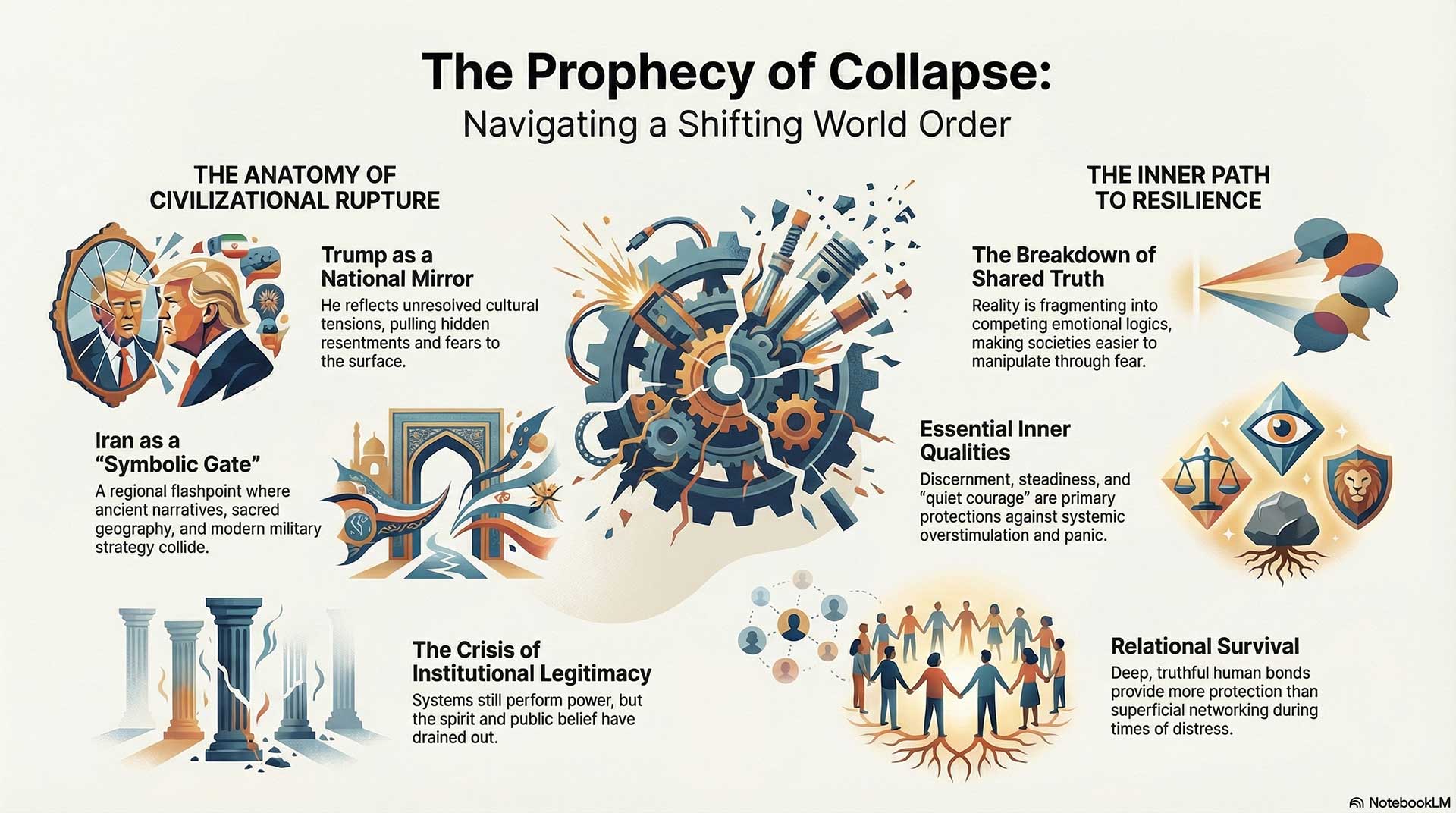
After all five topics, what stays with me most is not one prediction, but one pattern.
Jiang Xueqin’s warning is not really about Trump alone, or Iran alone, or even prophecy alone. It is about how these things may connect inside a larger moment of strain. Trump appears as a powerful political figure in a time of public frustration. Iran appears as a possible spark in a system already under pressure. The old order appears less solid than it once did. And ordinary people are left asking how to live with clarity and dignity when the world feels less certain.
That is what gives this conversation its weight.
The deepest issue here is not whether every detail unfolds exactly as predicted. It is whether the warning helps people see more clearly. Whether it helps them become less reactive, less shallow, and less easily manipulated by fear. Whether it pushes them back toward steadiness, truthfulness, courage, prayer, discipline, and stronger human bonds.
That, to me, is where the real value lies.
Because history does not only test nations. It tests persons. It tests whether we can remain calm when the public mood grows unstable. Whether we can remain honest when the loudest voices reward exaggeration. Whether we can remain human when politics becomes theatrical and fear becomes contagious.
So whether one sees Jiang Xueqin as prophet, strategist, or pattern-reader, the most serious response is not obsession.
It is clarity.
It is steadiness.
It is moral seriousness.
And in the end, that may be the most important prophecy of all: not what happens next, but who we become when pressure begins to rise.
Short Bios:
Jiang Xueqin — Chinese-Canadian educator, writer, and geopolitical commentator known for his “Predictive History” work, where he blends historical pattern reading with game-theory style forecasting. He has become widely discussed for warnings tied to Trump, Iran, and civilizational instability.
Craig Hamilton-Parker — British psychic and medium, known in popular media for public predictions on major political events and for his long-running work in Spiritualist and paranormal circles. He is an author and public commentator on prophecy, dreams, and mediumship.
Joseph Tittel (Spiritman JT) — American psychic medium, author, teacher, and speaker who says he has worked professionally for more than 30 years. He is known for spirit communication, public forecasts, and a direct, conversational style.
Jessica Adams — Australian astrologer and author who has written for major magazine brands and publishes widely on astrology, culture, and current events. She is known for mixing mainstream writing experience with predictive astrology.
Amy Tripp — Professional astrologer and licensed therapist whose background includes psychology and social work. She is known online for political astrology and for reading public events through astrological timing.
Maneeza Ahuja — Indian Vedic astrologer and spiritual counselor who draws on astrology, mantra, and meditative practice in her guidance. Her background includes a long career in media and advertising before her public spiritual work.
Athos Salomé — Brazilian psychic figure often presented in media as the “Living Nostradamus,” known for dramatic public forecasts on global politics, conflict, and technological disruption. His public image centers on big-picture warnings and future-shock themes.
Nicolas Aujula — UK-based hypnotherapist and psychic who works with past-life regression, ancestral healing, and intuitive forecasting. He is often cited in media roundups about future predictions and social trends.
Jill M. Jackson — Award-winning psychic medium, spiritual teacher, trance channel, and author whose work focuses on intuitive development, transformation, and public spiritual guidance. She is known for mentorship, readings, and speaking work.
Kelli Miller — Psychic medium and spiritual teacher with more than a decade of professional experience. She is known for practical, non-judgmental readings and for teaching spiritual development through events and training.
Baba Vanga — Bulgarian mystic and healer (1911–1996) whose name became famous across Eastern Europe for alleged clairvoyant predictions. Many claims attached to her remain disputed, and recent reporting notes that much of the modern geopolitical lore built around her is poorly documented.
Leave a Reply