
|
Getting your Trinity Audio player ready...
|
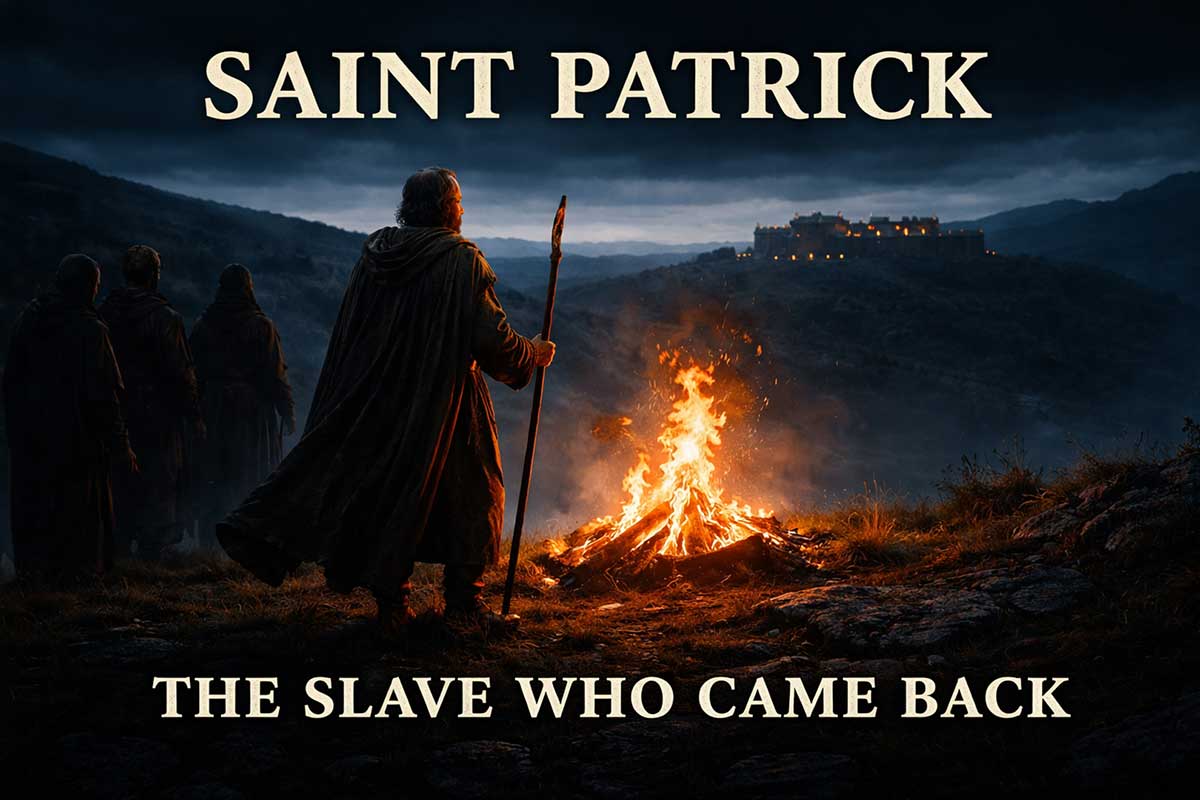
What if the man taken as a slave returned to the land of his suffering with forgiveness instead of revenge?
Introduction by Patrick
I was not born in Ireland. I did not go there by choice.
I was taken.
What began in terror became the road by which my soul was stripped bare. I lost home, comfort, youth, and every false confidence I had carried without knowing it. On those cold hills, among sheep and silence, I first learned that God was not a word spoken safely inside familiar walls. He was the One who remained when all else was gone.
Many remember the saint. I remember the slave.
I remember the wind, the hunger, the long nights, the ache of being forgotten. I remember the dream that sent me running. I remember the shore, the ship, the return to my own people. And I remember the harder call that came after safety: to go back.
This is not the story of a fearless man. It is the story of a wounded one who was led, step by step, into obedience. If there is any fire in this story, it was lit first in darkness. If there is any courage in it, it was born where I was weakest.
So let the story begin where my old life ended: at the moment I was torn away, and the mercy I did not yet recognize began its hidden work.
(Note: This is an imaginary conversation, a creative exploration of an idea, and not a real speech or event.)
Scene 1 — The Raid
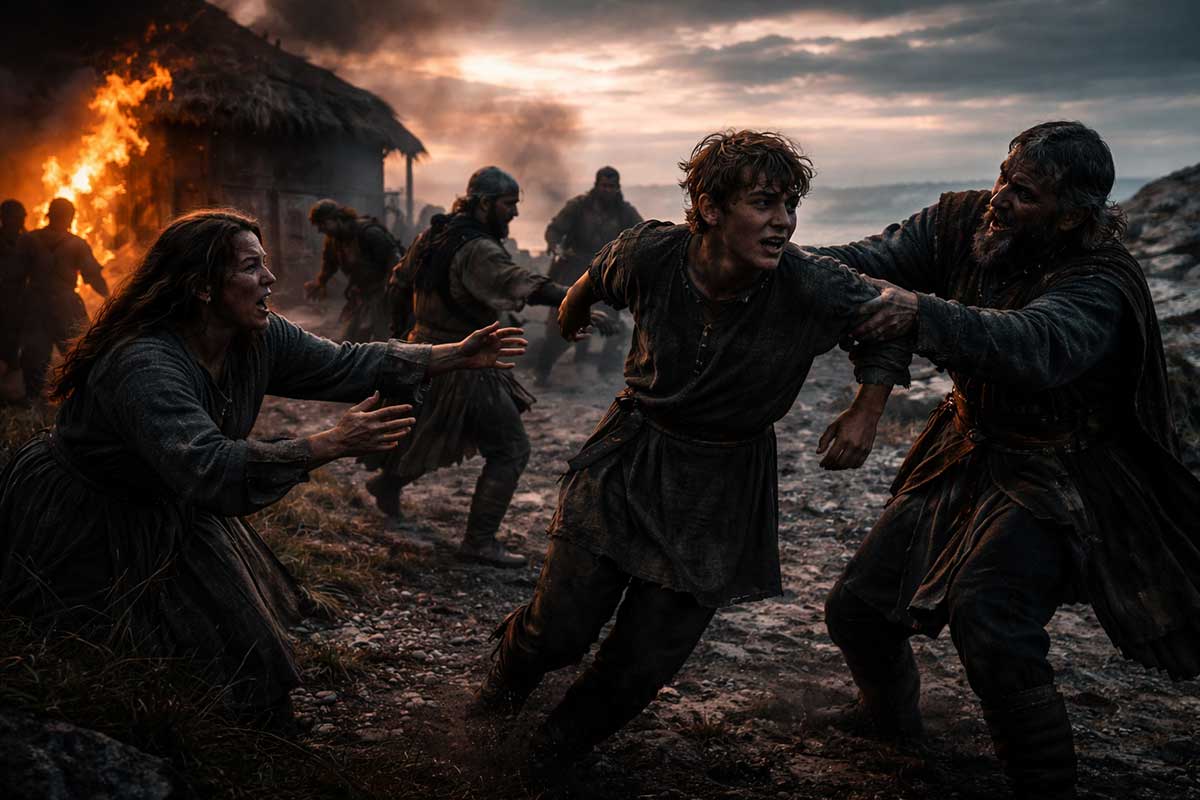
Setting:
The western coast of Roman Britain, late afternoon. A cold wind. A modest Christian household near the edge of open land. Beyond it, the sea. The light is gold at first, but fading.
At rise:
A simple home. A bench. A cloak hanging near the door. A wooden table with bread and a cup. Far off, gulls and waves. The stage should hold peace, but only for a moment.
Characters in Scene 1:
- Young Patrick — around sixteen, intelligent, restless, not yet deeply devout
- Calpurnius — Patrick’s father, a deacon and local official
- Concessa — Patrick’s mother
- Older Patrick — appears at the edge of the stage as memory and witness
- Raider Captain
- Raiders
(Soft sea wind. Concessa folds cloth at the table. Calpurnius sits, reading quietly from a worn scroll. Young Patrick stands outside the doorway, looking toward the sea.)
CONCESSA
Patrick, come in before the cold turns sharp.
YOUNG PATRICK
Just a little longer.
CALPURNIUS
You said that a little while ago.
YOUNG PATRICK
The sea changes every minute. I want to catch it before it turns gray again.
CONCESSA
The sea has been there longer than your attention span.
YOUNG PATRICK
That is exactly why I watch it.
(Concessa smiles despite herself.)
CALPURNIUS
You watch many things. You attend to few.
YOUNG PATRICK
I attend when it matters.
CALPURNIUS
And who decides that?
YOUNG PATRICK
Usually the thing itself.
CONCESSA
That sounds clever enough to get you into trouble.
(Young Patrick steps inside. He takes bread from the table.)
CALPURNIUS
Did you finish what I asked?
YOUNG PATRICK
Most of it.
CALPURNIUS
Most is a word boys use when they mean no.
YOUNG PATRICK
I meant to finish.
CALPURNIUS
You meant. Yes.
(A pause. Calpurnius studies him.)
CALPURNIUS
You have been given peace, food, learning, and a home where the name of Christ is spoken without fear. Do not live as though such things are ordinary.
YOUNG PATRICK
To me they are ordinary. They are all I have known.
CONCESSA
That is why gratitude must be learned before loss teaches it.
(Young Patrick looks away. He is not rebellious, only untouched.)
YOUNG PATRICK
You both speak as if sorrow is waiting just outside the door.
CALPURNIUS
It often is.
YOUNG PATRICK
Then let it knock first.
(A faint horn in the distance. No one moves at first.)
CONCESSA
Did you hear that?
CALPURNIUS
Wind.
(Another horn. Fainter than alarm, but wrong.)
YOUNG PATRICK
No. That was no wind.
(They listen. The sea sound shifts. There is shouting far off.)
CONCESSA
Calpurnius.
CALPURNIUS
Patrick, bar the door.
(Young Patrick hesitates only a second, then moves fast. Calpurnius goes to the doorway and looks out. His face changes.)
CONCESSA
What is it?
CALPURNIUS
Riders. No—
(he sees more)
Boats at the shore.
CONCESSA
How many?
CALPURNIUS
Too many.
(A louder cry outside. Then running feet. Smoke begins to drift past the open side of the stage.)
CONCESSA
Patrick.
YOUNG PATRICK
I barred it.
CALPURNIUS
Get behind me.
(Young Patrick does, but keeps looking toward the sound.)
YOUNG PATRICK
Who are they?
CALPURNIUS
Raiders from across the water.
CONCESSA
No—no, not here—
CALPURNIUS
Take the back path. Take him and run inland.
CONCESSA
Come with us.
CALPURNIUS
I will hold them as long as I can.
CONCESSA
You cannot hold men like that.
CALPURNIUS
Then I will stand before them.
(A crash outside. A scream from another house. Young Patrick freezes.)
CONCESSA
Patrick! Move!
(She seizes his arm. He does not move.)
YOUNG PATRICK
My cloak—
CONCESSA
Leave it!
YOUNG PATRICK
The scrolls—
CALPURNIUS
Leave all of it!
(The door shudders with a blow.)
CONCESSA
Saints preserve us—
(Another blow. Wood splinters.)
CALPURNIUS
Go!
(Concessa pulls Patrick toward the rear. They get only a few steps. The door bursts open. Raiders enter with speed and force. The Raider Captain follows. The room that held quiet now holds iron, breath, mud, violence.)
RAIDER CAPTAIN
There!
(One raider seizes Calpurnius. Another blocks Concessa. Young Patrick struggles free and tries to lunge toward his father, but is caught hard.)
CONCESSA
No! He is a boy!
CALPURNIUS
Patrick!
YOUNG PATRICK
Let go of me!
(He fights wildly, without skill. A raider strikes him across the face. He falls to one knee.)
CONCESSA
Stop! Stop!
RAIDER CAPTAIN
This one is strong enough. Take him.
CALPURNIUS
Take me instead.
RAIDER CAPTAIN
You are slower.
CALPURNIUS
He is sixteen!
RAIDER CAPTAIN
Then he will live.
(Young Patrick is dragged upright.)
YOUNG PATRICK
Mother!
CONCESSA
Patrick!
(She tries to reach him; a raider shoves her back. Calpurnius strains against the men holding him.)
CALPURNIUS
Listen to me! Listen—
(to Patrick)
Do not lose yourself!
YOUNG PATRICK
Father!
CONCESSA
Patrick, look at me!
(He does. This freezes the moment.)
CONCESSA
Whatever they take, do not let them take the face of God from you.
YOUNG PATRICK
I do not know how.
CONCESSA
Then remember this house until you do.
(The raiders pull him away. He kicks, twists, nearly breaks free, then is pinned again.)
RAIDER CAPTAIN
Move.
(They drag him toward the broken doorway.)
YOUNG PATRICK
No! No!
(Older Patrick steps into a narrow light at the edge of the stage. The action slows but does not stop.)
OLDER PATRICK
I did not know, when they took my arm, that they had taken my life in two.
Before that hand. After that hand.
Before the sea. After the sea.
(Young Patrick is pulled across the threshold.)
OLDER PATRICK
I had heard prayers all my life as a boy hears winter through a wall.
Present. Real. Distant.
That day the wall broke.
(Concessa’s cry echoes. Calpurnius shouts, but we no longer hear the words clearly. Only force, motion, fragments.)
OLDER PATRICK
I thought I was being carried away from home.
I did not know I was being carried toward the first terrible mercy of my life.
(The raiders drag Young Patrick offstage. Concessa collapses near the doorway. Calpurnius falls beside her, held down by grief more than force. Smoke and sea wind fill the space.)
(A long silence.)
CONCESSA
Patrick...
(Blackout.)
Scene 2 — The Hills of Slavery
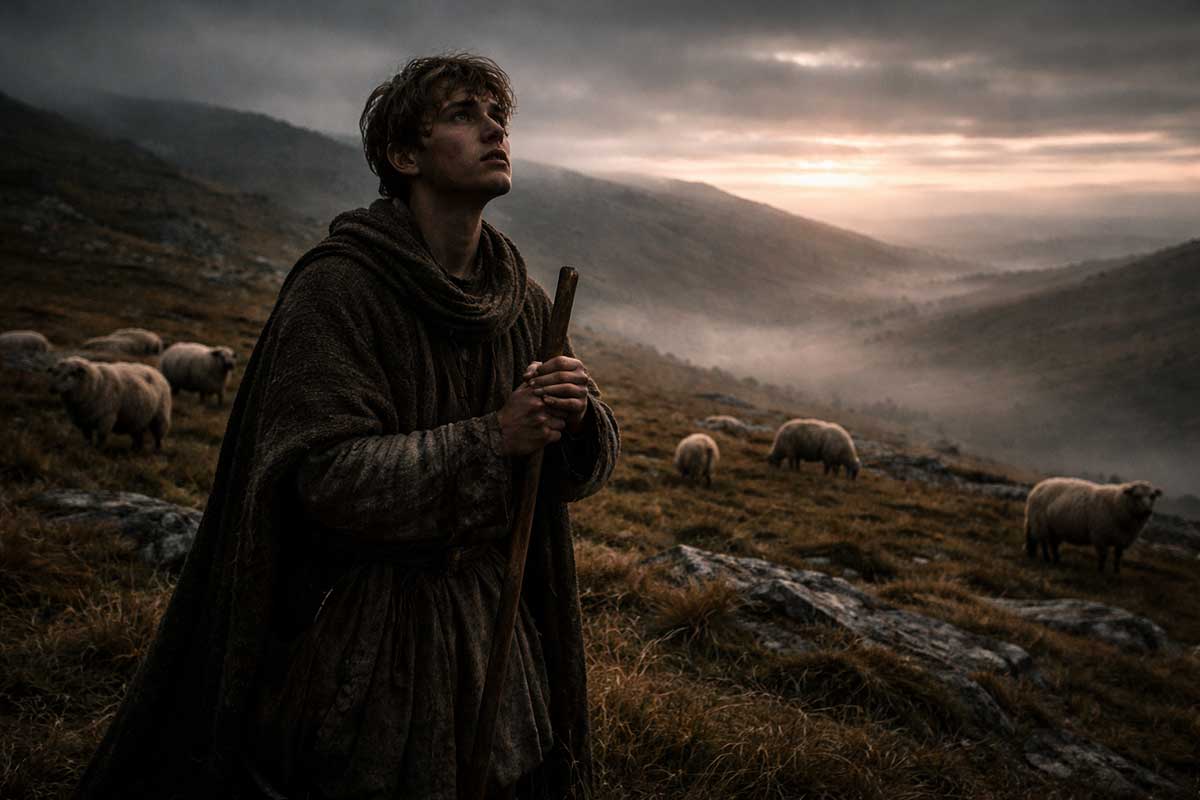
Setting:
A lonely hillside in Ireland. Early dawn at first, then shifting light across the scene as weeks and seasons pass. A rough shelter of stones. Wind almost always present. The land is wide, exposed, and beautiful in a hard way.
At rise:
A bleak slope. A few sheep scattered far apart. Young Patrick stands alone with a staff, thinner now, clothes worn, face sharpened by cold and labor. Silence sits on the land like a weight.
Characters in Scene 2:
- Young Patrick
- Older Patrick
- Miliuc — Patrick’s master
- Servant Boy — another enslaved youth, used sparingly
- Voices in Prayer — optional, faint, not seen
(Cold morning light. Wind. Sheep bells, distant and irregular. Young Patrick stands still, staring over the empty land. His hands are raw. He is no longer the boy from the shore.)
YOUNG PATRICK
Come back.
Come back, you witless creatures.
If one of you goes over the ridge, I go after you, and if I go after you, he counts the time, and if he counts the time, I pay for it with my back.
(A sheep wanders. He trudges after it.)
YOUNG PATRICK
No. No, no, no. Stay where I can see you.
(He stops, breathing hard, though the task is small. He is hungry.)
OLDER PATRICK
At first I counted the days. Then I counted the weeks. Then weather took the place of numbers. Rain. Frost. Wind. Hunger. Dark. Dawn again.
(Young Patrick gathers the sheep inward with clumsy patience. Miliuc enters from higher ground, wrapped in a heavier cloak.)
MILIUC
You let them spread too wide.
YOUNG PATRICK
The ground spreads wider.
MILIUC
Then walk faster.
YOUNG PATRICK
I have walked since before dawn.
MILIUC
You will walk after dusk as well.
(Miliuc studies him.)
MILIUC
You still answer like a freeborn boy.
YOUNG PATRICK
I still remember being one.
MILIUC
Memory does not warm you.
YOUNG PATRICK
Neither does kindness here.
MILIUC
Kindness?
(a short, humorless laugh)
Did the sea carry you here for kindness?
YOUNG PATRICK
Why keep asking work from an empty stomach?
MILIUC
An empty stomach listens better than a full one.
(Miliuc steps close, not wild with anger, just hard from habit.)
MILIUC
You watch the sheep. You sleep when I say. You eat what is given. That is the shape of your life now.
YOUNG PATRICK
For how long?
MILIUC
Until the hills forget your name.
(Miliuc exits. Young Patrick stares after him, then turns away as if ashamed of hoping for an answer.)
OLDER PATRICK
He did not need to strike every day. The land struck for him. Wind stripped speech from the mouth. Rain worked into bone. Night pressed down for hours without witness.
(Young Patrick kneels near the rough shelter and tries to eat a scrap of coarse bread. He chews slowly, then stops.)
YOUNG PATRICK
Mother would not have called this bread.
(He takes one more bite, then folds in on himself against the cold.)
YOUNG PATRICK
Father said sorrow waits outside the door.
He did not say it follows you into the fields.
(Silence. A Servant Boy appears briefly with a small bucket or bundle.)
SERVANT BOY
You were called.
YOUNG PATRICK
For what?
SERVANT BOY
Nothing good.
YOUNG PATRICK
That narrows nothing.
SERVANT BOY
One ewe was lame.
YOUNG PATRICK
I saw it.
SERVANT BOY
He said you did not see it soon enough.
YOUNG PATRICK
Did he send you to say that?
SERVANT BOY
He sent me to see if you had gone deaf.
(A pause.)
YOUNG PATRICK
What is your name?
SERVANT BOY
What for?
YOUNG PATRICK
So I can speak to someone as a person.
SERVANT BOY
Best not. Names make things harder.
(The Servant Boy leaves. Young Patrick watches him go.)
YOUNG PATRICK
Names make things real.
OLDER PATRICK
That was the wound of it. A man can be driven like an animal if enough days pass without hearing himself called with love.
(Light shifts. Time passes. Patrick moves through repeated tasks: gathering sheep, kneeling in rain, sleeping on stone, rising stiffly, scanning the horizon. The motions may repeat like ritual.)
OLDER PATRICK
Yet in that emptiness, another voice began.
Not in thunder.
Not in vision.
Not at first.
Only this: pray.
Then pray again.
Then keep praying when you feel nothing.
(Young Patrick, exhausted, drops to his knees on the hillside.)
YOUNG PATRICK
I do not know how.
(Wind.)
YOUNG PATRICK
I do not know where to begin.
(He waits, half-angry, half-broken.)
YOUNG PATRICK
If You are there, You have chosen a poor place to remain silent.
(A long pause. He lowers his head.)
YOUNG PATRICK
Our Father...
(He stops. Tries again.)
YOUNG PATRICK
Our Father...
(He cannot finish. He presses his fist to his eyes. Then slowly the words come, fragment by fragment.)
YOUNG PATRICK
...who art in heaven...
hallowed be Thy name...
OLDER PATRICK
I had heard holy words before. I had repeated them before. On those hills I began, at last, to mean them.
(Light changes again. Night now. Patrick wakes shivering in darkness. He sits upright as if from a dream, though none is yet clear.)
YOUNG PATRICK
No fire.
No roof worth naming.
No friend.
No road home.
(He stands and looks upward.)
YOUNG PATRICK
Then hear me.
If I am forgotten by every other mouth, do not forget me.
(Faintly, perhaps only in feeling, the sound of many whispered prayers begins beneath the wind. Not loud. Not certain. Young Patrick hears nothing clear, yet something in him steadies.)
OLDER PATRICK
Soon I prayed through frost. Through rain. Before dawn. After dark. Many times in a day. Many times in the night. What had once felt like duty became breath itself.
(Miliuc reenters at dawn and sees Patrick already awake, already watching the flock.)
MILIUC
You are up early.
YOUNG PATRICK
I did not sleep much.
MILIUC
Good. Sleep wastes labor.
YOUNG PATRICK
No.
(quietly)
It was not waste.
MILIUC
What was it then?
(Young Patrick looks over the hills. His face is still worn, still young, yet something has changed.)
YOUNG PATRICK
I do not know the word for it yet.
(Miliuc eyes him with suspicion.)
MILIUC
Keep your words for the sheep.
(He exits.)
OLDER PATRICK
He thought the hills were empty.
So did I, once.
Yet there, where no friend stood beside me, I began to find the Friend I had ignored all my life.
(Young Patrick steps farther up the hill. Dawn grows stronger. He lifts his face into the cold light.)
YOUNG PATRICK
I am still hungry.
Still cold.
Still far from home.
But I am not only that.
(The sheep move around him. The land remains severe, yet less dead than before.)
OLDER PATRICK
The chains on my body were real.
So was the opening in my soul.
(Young Patrick takes up his staff and walks the ridge with a new steadiness, still enslaved, still burdened, yet inwardly altered.)
(Lights fade slowly.)
Scene 3 — The Dream and the Sea
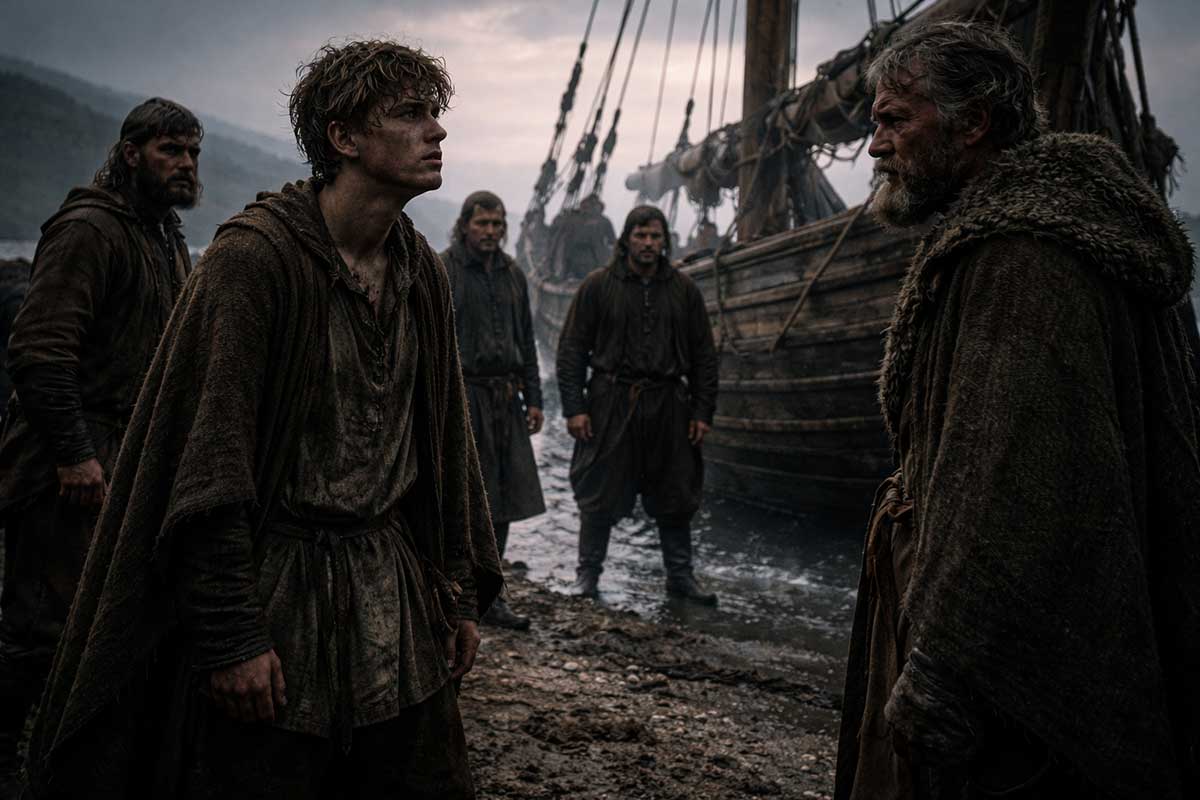
Setting:
The Irish hillside at night, then a long road across rough country, then the shore. The scene should move with urgency. Space may shift through light, sound, and spare stage elements: stone, wind, dark, then distant surf.
At rise:
Night on the hillside. A thin moon. Sheep at rest. Young Patrick lies near his rough shelter, wrapped in a worn cloak. The air is bitter. Silence, then a strange stillness within it.
Characters in Scene 3:
- Young Patrick
- Older Patrick
- Miliuc
- Servant Boy
- Shipmaster
- Sailor
- Voice — heard in dream or inwardly
(Night. Wind moving low across the hill. Young Patrick sleeps uneasily. Then, in the dark, stillness gathers. A voice comes, not loud, yet impossible to ignore.)
VOICE
You have fasted well.
Soon you will go to your own country.
(Young Patrick stirs but does not wake fully.)
VOICE
Look. Your ship is ready.
(He wakes all at once, breathing hard. He sits upright, listening into the dark.)
YOUNG PATRICK
Who is there?
(Only wind.)
YOUNG PATRICK
Who spoke?
(He rises, looking over the black hillside.)
YOUNG PATRICK
No one.
(A pause. He presses both hands to his chest, as if to steady his heart.)
OLDER PATRICK
I had prayed through many nights, but this was unlike prayer. It came with the weight of command. Not comfort. Not wish. Command.
YOUNG PATRICK
My ship is ready.
(He says it again, half in awe, half in fear.)
YOUNG PATRICK
My ship is ready.
(Dawn begins slowly. Miliuc enters. Young Patrick is already awake, watching the horizon with a new intensity.)
MILIUC
You stare as though the hills have spoken.
YOUNG PATRICK
Perhaps they have.
MILIUC
Then the hills have gone foolish.
YOUNG PATRICK
How far is the sea from here?
(Miliuc studies him.)
MILIUC
Why?
YOUNG PATRICK
I asked how far.
MILIUC
Far enough that a hungry slave would die before he reached it.
YOUNG PATRICK
That is not a number.
MILIUC
It is the only one that matters.
(A pause.)
MILIUC
You have a fever?
YOUNG PATRICK
No.
MILIUC
Then get to the flock.
(Miliuc turns to go.)
YOUNG PATRICK
And if I did reach it?
(Miliuc stops.)
MILIUC
The sea?
YOUNG PATRICK
Yes.
MILIUC
Then another man would own you.
(He exits. Young Patrick stands motionless.)
OLDER PATRICK
He spoke with the wisdom of this world. One master, then another. One chain, then another. He did not know that freedom had already entered me as a word before it entered my feet as a road.
(The Servant Boy appears, carrying a small bundle of feed.)
SERVANT BOY
You look strange.
YOUNG PATRICK
I dreamed.
SERVANT BOY
That explains nothing.
YOUNG PATRICK
I was told to leave.
SERVANT BOY
By whom?
YOUNG PATRICK
I do not know how to answer that without sounding mad.
SERVANT BOY
Try me.
YOUNG PATRICK
A voice. In sleep, but more real than waking. It said my ship is ready.
(The Servant Boy looks at him for a long moment.)
SERVANT BOY
There are ships.
YOUNG PATRICK
Where?
SERVANT BOY
South, I think. Or east. I hear things. Men talk.
YOUNG PATRICK
How far?
SERVANT BOY
Too far.
YOUNG PATRICK
Everyone says that.
SERVANT BOY
That is because it is true.
(A beat.)
SERVANT BOY
Are you going?
YOUNG PATRICK
I am afraid not to.
SERVANT BOY
That is a strange sort of courage.
YOUNG PATRICK
It does not feel like courage.
SERVANT BOY
What does it feel like?
YOUNG PATRICK
Like a hand at my back.
(The Servant Boy glances around instinctively.)
SERVANT BOY
There is no hand.
YOUNG PATRICK
I know.
(A silence.)
SERVANT BOY
Then go before sunrise another day. Do not tell me when.
YOUNG PATRICK
Why not?
SERVANT BOY
So I can say I never knew.
(He starts to leave, then turns.)
SERVANT BOY
If you reach your country, remember there was someone here who still had none.
(He exits.)
OLDER PATRICK
Some kindnesses arrive quietly, without daring to call themselves by name.
(Lights shift. Passage of time. Young Patrick watches, waits, gathers a crust of bread, a scrap of cloth, a little water. Then one gray dawn he stands alone, ready.)
YOUNG PATRICK
If this is madness, let it fail quickly.
If it is You, carry me farther than I can carry myself.
(He runs.)
The Road
(Sound and light create distance. Young Patrick crosses rough country. He stumbles, rises, keeps going. Time blurs. The road is long, lonely, and uncertain.)
OLDER PATRICK
I went without permission, without escort, without map worth trusting. Forest. Mud. Stone. Fields. Strange paths. Hunger at my side. Fear behind me. Hope ahead of me, though I could not yet see its face.
(Young Patrick slows, exhausted. He drinks the last of his water.)
YOUNG PATRICK
One more hill.
Then one more after that.
(He nearly falls, catches himself on a rock, laughs once from weariness.)
YOUNG PATRICK
So this is how freedom begins.
With blistered feet.
(Night. He crouches beneath a tree or rock outcrop.)
YOUNG PATRICK
Do not let them find me.
Do not let me turn back.
Do not let the sea be a lie.
(Darkness. Then dawn again. Sound of gulls, very faint at first.)
YOUNG PATRICK
...Gulls?
(He lifts his head.)
YOUNG PATRICK
Sea.
(He starts forward with what strength remains.)
The Shore
(The stage opens into the coast: wind, surf, ropes, a rough ship at anchor or implied nearby. Sailors move about their work. Young Patrick enters, spent, dirty, almost unable to stand.)
YOUNG PATRICK
A ship.
OLDER PATRICK
There it was. Real wood. Real sail. Real salt in the air. What had come first as promise now stood before me as judgment. For reaching the shore is not the same as being welcomed aboard.
(Young Patrick approaches the men.)
YOUNG PATRICK
Please—
Please, take me with you.
SAILOR
Look what the tide dragged in.
SHIPMASTER
Who are you?
YOUNG PATRICK
A Briton. Escaped. I need passage home.
SHIPMASTER
Need is cheap on a shore.
YOUNG PATRICK
I can work.
SHIPMASTER
Can you pay?
YOUNG PATRICK
No.
SHIPMASTER
Then you can pray to the gulls.
(A few sailors laugh.)
YOUNG PATRICK
Please.
SHIPMASTER
Please does not move a hull.
YOUNG PATRICK
I have come far.
SHIPMASTER
Then you can go farther on your own feet.
(The Shipmaster turns away. Young Patrick stands frozen, as if struck by more than refusal.)
OLDER PATRICK
That was the edge of it. After all those miles, after all that hunger, the door stood shut again.
(Young Patrick steps back. He cannot speak for a moment.)
YOUNG PATRICK
You told me the ship was ready.
(He looks upward, wounded, angry.)
YOUNG PATRICK
You brought me here for this?
(He turns from the ship and walks a little distance away, shaking.)
YOUNG PATRICK
Was I a fool?
Was it only my own starving mind?
(A long pause. Then, very quietly:)
YOUNG PATRICK
Christ with me.
Christ before me.
Christ behind me.
(He closes his eyes. The surf pounds. A gull cries. Then a shout behind him.)
SAILOR
Boy!
(Young Patrick turns.)
SAILOR
The master has changed his mind. If you can keep up and keep out of trouble, come.
(Young Patrick does not move at first.)
SAILOR
Did you lose your hearing on the road?
YOUNG PATRICK
No.
SAILOR
Then move.
(Young Patrick steps toward the ship, still half-stunned.)
SHIPMASTER
Do not thank me. I dislike gratitude almost as much as begging.
YOUNG PATRICK
I will work.
SHIPMASTER
You will do exactly what you are told.
YOUNG PATRICK
Yes.
(He stops at the edge before boarding and looks out over the sea.)
OLDER PATRICK
I had crossed the water once in chains. Now I crossed it in trembling hope. I was not yet healed. I was not yet called to return. I was only a fugitive with salt on his face and mercy beneath his feet.
(Young Patrick boards. The sailors haul rope. The ship begins to pull away.)
YOUNG PATRICK
Home.
(He says it softly, as if afraid the word may still vanish.)
OLDER PATRICK
I thought I was sailing toward the end of my trial. I did not know I was sailing toward the question that would one day define my life.
(Sea wind rises. Lights dim slowly as the ship moves into darkness.)
Scene 4 — The Call to Return
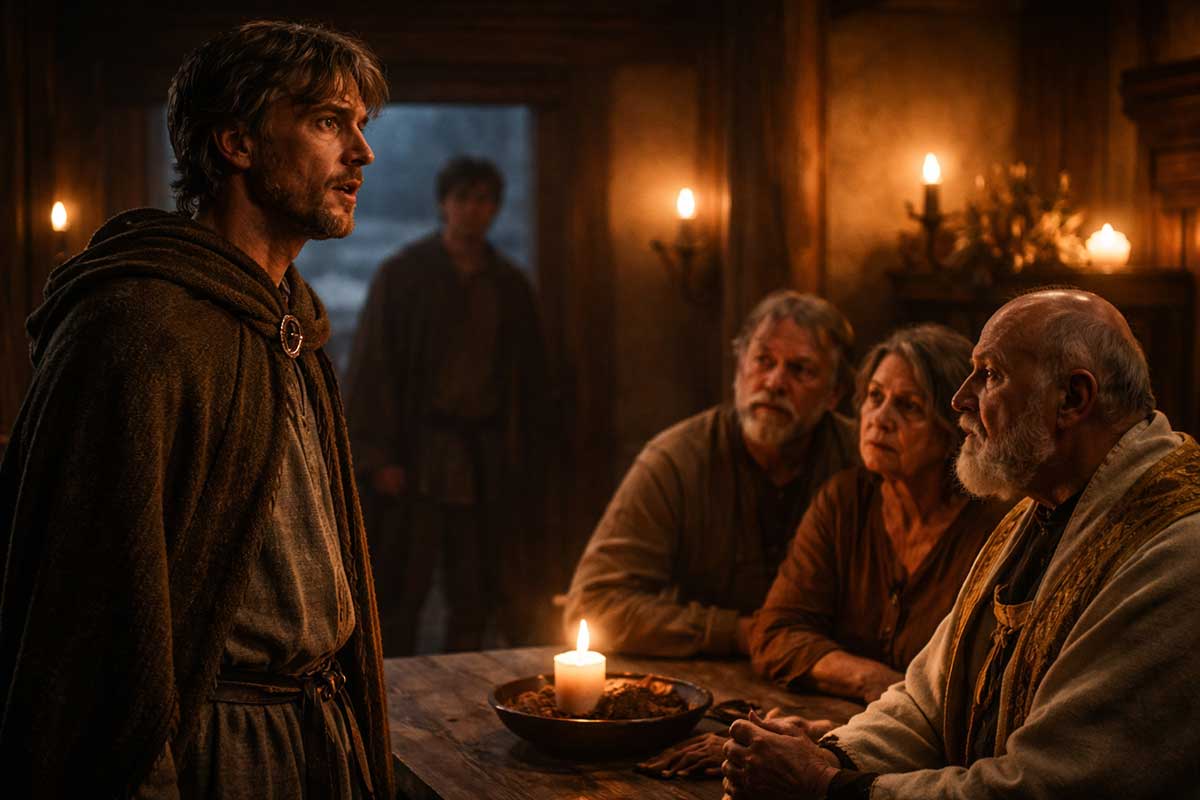
Setting:
Britain, some years later. A modest church residence or study room near evening. It is warmer than Ireland, more settled, with shelves, a table, lamplight, and signs of order. Yet Patrick does not fully belong to peace anymore.
At rise:
A room of safety. A cloak neatly hung. A lamp lit. A scroll open on the table. Older Patrick stands near the window, looking out into gathering dusk. Young Patrick is present at the edge of the stage as memory, dressed in the rough cloak of slavery. He is unseen by the others.
Characters in Scene 4:
- Older Patrick
- Young Patrick
- Calpurnius
- Concessa
- Bishop Germanus — or a senior cleric figure
- Voice of the Irish — heard inwardly, not seen
(Warm lamplight. A quiet room. Concessa mends a garment by the table. Calpurnius reads, older now. Patrick stands by the window, still, almost too still.)
CONCESSA
You have worn a path into that floor.
OLDER PATRICK
Have I?
CALPURNIUS
Since coming home, yes.
CONCESSA
A man can stand in his own house and still look like a guest.
(Patrick turns from the window with a faint smile that fades quickly.)
OLDER PATRICK
I am grateful to be here.
CONCESSA
Gratitude is not the same as rest.
CALPURNIUS
Nor is silence the same as peace.
(A pause.)
OLDER PATRICK
The room is quiet.
CONCESSA
That should comfort you.
OLDER PATRICK
Sometimes it does. Sometimes it feels too quiet.
CALPURNIUS
You lived too long with wind.
OLDER PATRICK
Yes.
(Young Patrick steps into a narrow light at stage edge, watching the room like one who remembers wanting it.)
YOUNG PATRICK
This was the place I wanted back.
The chair. The bread. The lamp.
The sound of my mother moving from one end of the room to the other.
I thought if I reached this place again, I would be whole.
(He looks at Older Patrick.)
YOUNG PATRICK
Why are you not whole?
(The line hangs in silence.)
CONCESSA
You have been home a long while now, Patrick. Yet some part of you is still on those hills.
OLDER PATRICK
Perhaps.
CALPURNIUS
No. Not perhaps.
(He sets down the scroll.)
CALPURNIUS
When you first returned, I thought time would do its work. Food, sleep, safety, prayer. A son restored to his house. Yet you have the look of a man waiting for a second summons.
OLDER PATRICK
What if I am?
CONCESSA
To what?
(Patrick does not answer.)
CALPURNIUS
Patrick.
OLDER PATRICK
I do not fully know.
(Knock at the door. Calpurnius opens it. Bishop Germanus enters, grave but kind.)
CALPURNIUS
Bishop.
BISHOP GERMANUS
Peace to this house.
CONCESSA
And to you.
(They greet him. Patrick inclines his head.)
BISHOP GERMANUS
Patrick.
OLDER PATRICK
Bishop.
BISHOP GERMANUS
Your father asked me to come.
CONCESSA
He says little to us, but much to the window.
BISHOP GERMANUS
Then perhaps he may say something to me.
(Calpurnius and Concessa step back, not far, but enough. Germanus studies Patrick.)
BISHOP GERMANUS
You have learned well. You pray with seriousness. You listen with hunger. Yet there is resistance in you.
OLDER PATRICK
Not resistance.
BISHOP GERMANUS
What then?
OLDER PATRICK
An ache.
BISHOP GERMANUS
For what?
(Patrick hesitates.)
OLDER PATRICK
For a people who once held me in bondage.
(Silence.)
CONCESSA
Patrick—
CALPURNIUS
No.
BISHOP GERMANUS
Go on.
OLDER PATRICK
I have tried to set it aside. I have told myself it is memory, nothing more. A scar that still pulls in bad weather. But it does not fade. It grows clearer.
CALPURNIUS
You speak of Ireland?
OLDER PATRICK
Yes.
CONCESSA
The place that took you from us.
OLDER PATRICK
Yes.
CALPURNIUS
The place where you froze, starved, labored, and nearly vanished.
OLDER PATRICK
Yes.
CONCESSA
Then why speak of it with longing?
(Patrick struggles for words.)
OLDER PATRICK
It is not longing for what was done to me. It is sorrow for those still there. Their faces do not leave me. Their voices return in prayer.
CALPURNIUS
The faces of masters? Raiders? Men who traded in lives?
OLDER PATRICK
And children. Servants. Women at the edges of the villages. Old men who watched me as though I were already dead. Souls, Father. Souls.
CONCESSA
Must your mercy go that far?
OLDER PATRICK
I did not choose how far it goes.
(A low stillness enters the room.)
YOUNG PATRICK
I chose escape.
He speaks of return.
What has happened to us?
BISHOP GERMANUS
Tell me plainly.
OLDER PATRICK
I hear them.
BISHOP GERMANUS
Who?
OLDER PATRICK
The Irish.
(Lights dim slightly at the edges. The room remains, but another layer opens beneath it.)
VOICE OF THE IRISH
(faint, inward, many voices as one)
We ask you, holy servant boy, to come and walk among us once more.
(Concessa shivers, though she does not hear the words clearly. Patrick closes his eyes.)
OLDER PATRICK
In sleep. In prayer. In the middle of ordinary things. They come as a cry, as a plea. Not from one mouth. From many.
CALPURNIUS
Memory can do strange things to a wounded man.
OLDER PATRICK
This is more than memory.
BISHOP GERMANUS
And you believe you are being sent back?
OLDER PATRICK
I fear that I am.
CONCESSA
Fear?
OLDER PATRICK
Yes. Because no part of me would invent this.
CALPURNIUS
Then reject it.
OLDER PATRICK
I cannot.
CALPURNIUS
Cannot, or will not?
OLDER PATRICK
Both.
(Calpurnius rises, shaken.)
CALPURNIUS
A father is asked to give his son once. I have done that already. Must I do it twice?
CONCESSA
We prayed for your return for years. Years. Every knock on the road. Every sail on the horizon. Every rumor from the coast. We thought heaven had heard us when you crossed that threshold again.
OLDER PATRICK
Perhaps heaven had heard you.
CONCESSA
Then do not ask me to bless your leaving.
OLDER PATRICK
I do not ask lightly.
CONCESSA
Yet you ask it.
(A long silence. Patrick lowers his head.)
OLDER PATRICK
When I was taken, I hated the sea.
When I was enslaved, I hated the hills.
When I escaped, I hated the men who bought and sold the breath of others.
I thought hatred would keep me alive.
Instead, prayer kept breaking it open.
(He looks up at them.)
OLDER PATRICK
If Christ sought me in that place, how can I refuse to go where He first found me?
(Concessa turns away, fighting tears.)
YOUNG PATRICK
I wanted home.
He wants obedience.
I do not know which is harder.
BISHOP GERMANUS
And if you return, what do you expect to find?
OLDER PATRICK
Suspicion. Danger. Old fear. Perhaps death.
CALPURNIUS
Then why go?
OLDER PATRICK
Because I was not spared merely to be comforted.
(That line settles over the room.)
BISHOP GERMANUS
There are men better born for this. Better trained. More learned. Less marked by the past.
OLDER PATRICK
Yes.
BISHOP GERMANUS
So why you?
OLDER PATRICK
Because I know their roads. Their weather. Their hunger. Their pride. Their speech as it falls in the ear. I know the look of that land at dawn. I know what it is to be alone there. I know what sort of man I was when I arrived, and what sort of mercy met me there.
BISHOP GERMANUS
And you would preach to the people who enslaved you?
OLDER PATRICK
I would preach to the people among whom I was enslaved.
BISHOP GERMANUS
There is a difference.
OLDER PATRICK
A necessary one.
(Germanus studies him for a long moment.)
BISHOP GERMANUS
Then this is no fever of grief.
OLDER PATRICK
No.
BISHOP GERMANUS
No passing fervor.
OLDER PATRICK
No.
BISHOP GERMANUS
Then you know what this will cost.
OLDER PATRICK
Not fully. But enough.
(Germanus turns to Calpurnius and Concessa.)
BISHOP GERMANUS
There are calls no parent wishes confirmed.
(Concessa covers her face. Calpurnius stands rigid, holding himself together by will.)
CALPURNIUS
If you go, do not go as a dreamer chasing voices. Go as a man who has counted the wound.
OLDER PATRICK
I have counted it.
CONCESSA
And if they harm you again?
OLDER PATRICK
Then I will be in the hands I was always in.
(She looks at him, broken by love and pride all at once.)
CONCESSA
You speak like someone older than the child I lost.
OLDER PATRICK
That child was lost.
(Young Patrick steps forward into clearer light. He stands beside Older Patrick now, almost mirror to him.)
YOUNG PATRICK
Yes.
He was.
(Older Patrick does not see him, yet seems to feel him near.)
YOUNG PATRICK
But I see it now.
We were not brought back here only to recover what was taken.
We were brought back here to learn what to give.
(The Voice returns, faint but steady.)
VOICE OF THE IRISH
Come and walk among us once more.
(Patrick lifts his head.)
OLDER PATRICK
I will go.
(Silence. No triumph. Only weight.)
CALPURNIUS
Then go with truth.
CONCESSA
Go with God.
BISHOP GERMANUS
Go without hatred.
OLDER PATRICK
That is the only way I can go.
(Young Patrick slowly steps back into shadow, as though the frightened captive is yielding his place to the man who must now return freely.)
YOUNG PATRICK
I crossed the sea once in fear.
He will cross it now in love.
That is a stranger miracle than escape.
(Lamplight holds for a moment on the family, the bishop, and Patrick standing between loss and mission.)
(Blackout.)
Scene 5 — The Fire on the Hill
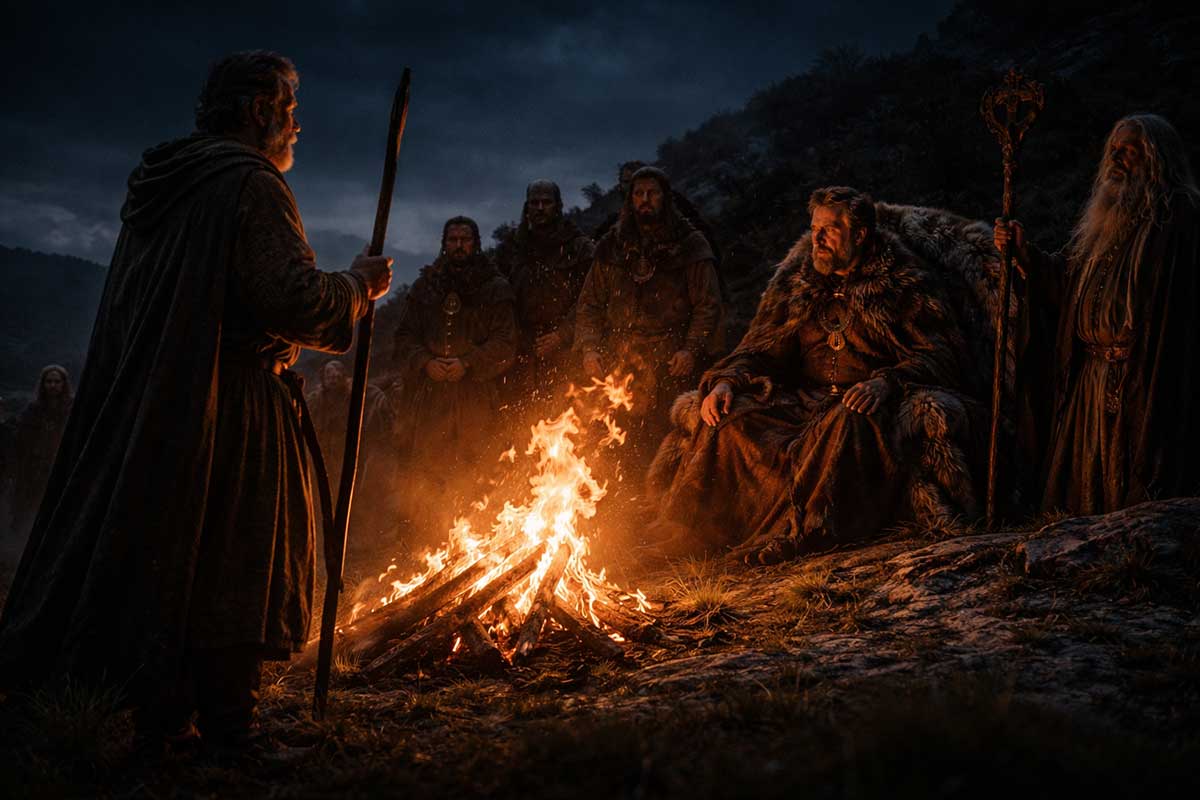
Setting:
Ireland. Night. A hillside near the seat of royal power at Tara. It is the eve of a sacred feast, and no fire is meant to be lit before the king’s fire. The air is cold and expectant. The hill is broad, dark, ancient. In the distance stand the halls of power. Nearer at hand, Patrick and a few companions have kindled a flame.
At rise:
Darkness over the hill. Then one sudden living fire. Its light throws long shadows. Patrick stands beside it. A small group of companions kneel or stand close. From farther off come horns, alarm, and the stir of armed men.
Characters in Scene 5:
- Older Patrick
- Young Patrick
- High King Laegaire
- Dubhán the Druid
- Royal Messenger
- Guard Captain
- Companions
- Older Patrick’s Voice may merge with live speech at key moments
(Dark stage. A single spark. Then tinder catches. Flame rises. Patrick stands beside it, calm, grave, fully present.)
OLDER PATRICK
There are hours when a man does not argue with fear. He simply steps through it.
(The fire grows. Companions watch with reverence and dread.)
FIRST COMPANION
Father Patrick, once they see this, they will come.
OLDER PATRICK
Yes.
SECOND COMPANION
The king’s law forbids any flame before his own.
OLDER PATRICK
Yes.
FIRST COMPANION
Then this fire is a challenge.
OLDER PATRICK
No.
It is a witness.
(A horn sounds in the distance.)
SECOND COMPANION
They have seen it.
OLDER PATRICK
Then let them come to the light.
(Young Patrick appears at the edge of the firelight, clothed as in bondage, yet no longer frantic. He watches the flame, astonished.)
YOUNG PATRICK
The hills are the same.
The wind is the same.
But the man standing here is not the one they dragged across the shore.
(A Royal Messenger rushes in with guards behind him.)
ROYAL MESSENGER
Who lit this fire?
OLDER PATRICK
I did.
ROYAL MESSENGER
Do you know where you stand?
OLDER PATRICK
I do.
ROYAL MESSENGER
Do you know whose law you defy?
OLDER PATRICK
I know whose law I obey.
(The Messenger is taken aback by Patrick’s steadiness.)
ROYAL MESSENGER
Put it out.
OLDER PATRICK
No.
GUARD CAPTAIN
Then you will answer to the High King.
OLDER PATRICK
Gladly.
(Enter Dubhán the Druid, stern, controlled, old with authority. He studies Patrick first, then the flame.)
DUBHÁN
So. The Briton returns.
Once a slave under Irish sky. Now a fire-bringer.
OLDER PATRICK
I return as a servant of Christ.
DUBHÁN
Servant. That word has followed you faithfully.
OLDER PATRICK
Better to serve truth than fear.
DUBHÁN
You stand on ground older than your preaching. This hill has heard holy words long before your tongue found courage.
OLDER PATRICK
I do not deny the age of this place.
DUBHÁN
Then honor it. Bow to its order. Put out your flame.
OLDER PATRICK
No flame lit for God is dishonored by standing before kings.
DUBHÁN
Your God asks much boldness from a man once bought like cattle.
(Young Patrick flinches faintly at the word. Older Patrick does not.)
OLDER PATRICK
Yes. He does.
(Trumpets or horns. Enter High King Laegaire with attendants. He is not a caricature. He carries real authority, real pride, real intelligence.)
LAEGAIRE
Who stands blazing on my hill before my fire is lit?
ROYAL MESSENGER
This man, my lord. Patrick.
LAEGAIRE
Patrick.
The name has reached my hall already.
(He steps closer, measuring him.)
LAEGAIRE
Are you careless, or are you brave?
OLDER PATRICK
Neither word is safe in a king’s mouth.
LAEGAIRE
Then choose one in your own.
OLDER PATRICK
Obedient.
(A small murmur among the court.)
LAEGAIRE
To whom?
OLDER PATRICK
To the Lord who made both kings and slaves.
(A dangerous silence.)
DUBHÁN
My lord, this is how foreign faith enters a land: not with armies first, but with fire and strange certainties.
LAEGAIRE
I can see that.
(To Patrick)
LAEGAIRE
You were once a captive here.
OLDER PATRICK
Yes.
LAEGAIRE
And you came back.
OLDER PATRICK
Yes.
LAEGAIRE
Most men leave pain behind if they can.
OLDER PATRICK
Most men do.
LAEGAIRE
Then why are you here?
(Patrick looks into the king’s face, then over the gathered people, the hill, the darkness beyond.)
OLDER PATRICK
Because I was found by God in this land.
Because the place of my humiliation became the place of my awakening.
Because I do not come to take Ireland. I come to love it.
(The line lands hard. Dubhán steps in at once.)
DUBHÁN
Love? Love arrives with law, judgment, and a cross? Love tells old gods to kneel and ancient fathers to forget their names?
OLDER PATRICK
No. Love calls every people to what is deeper than fear, blood, or pride.
DUBHÁN
Easy for a foreigner to say.
OLDER PATRICK
I was not foreign when I froze on your hills.
I was not foreign when I learned your roads.
I was not foreign when your rain entered my bones.
Pain is a hard teacher, but it teaches a man the land under his feet.
(Young Patrick steps nearer the fire, almost as if hearing his own life spoken back to him with new meaning.)
YOUNG PATRICK
This is the answer.
Not escape.
Not revenge.
Return, with nothing in the hands but truth.
LAEGAIRE
And what truth is worth setting my kingdom on edge for one night?
OLDER PATRICK
That there is a King above kings, and He does not despise the poor, the bound, the forgotten, or the proud. He calls them all.
DUBHÁN
He calls them away from us.
OLDER PATRICK
No. He calls them into fuller life.
DUBHÁN
And who made you judge of fullness?
OLDER PATRICK
I judge nothing in my own name. I bear witness to the mercy shown to me.
LAEGAIRE
Mercy? By whom? The raiders who took you? The master who worked you? The sea that cut you off from your blood?
OLDER PATRICK
By Christ.
LAEGAIRE
You name mercy in the middle of suffering.
OLDER PATRICK
That is where I first recognized it.
(A pause. The king circles the fire slowly.)
LAEGAIRE
You speak with more steel than many warriors.
OLDER PATRICK
Steel cuts what stands before it. I seek another victory.
DUBHÁN
A softer conquest can still be conquest.
OLDER PATRICK
Then hear me plainly: I have not come to shame Ireland, nor to strip it bare, nor to pay old wounds back with righteous words. I have come because God did not leave me to hate you.
(Silence. That reaches farther than argument.)
YOUNG PATRICK
There it is.
The chain is gone.
FIRST COMPANION
Father Patrick—
(Companions are tense; guards shift, ready for an order.)
LAEGAIRE
And if I order this fire stamped out?
If I send you from this hill in disgrace?
If I remind you that kings still have hands?
OLDER PATRICK
Then stamp it out. Send me away. Use every hand you possess. Yet another fire will still remain.
LAEGAIRE
Where?
OLDER PATRICK
In every soul that has learned it belongs first to God.
(Dubhán looks from Patrick to the king, seeing the danger of such speech.)
DUBHÁN
My lord, do not mistake calm for weakness. Men like this change countries.
LAEGAIRE
I have eyes.
(He studies Patrick a long time. Then:)
LAEGAIRE
You do not tremble.
OLDER PATRICK
I have trembled enough in this land already.
(That line passes through the whole scene like a blade and a healing at once.)
LAEGAIRE
No one speaks to me this way.
OLDER PATRICK
Then perhaps no one has loved you enough to speak without flattery.
(The guards half-move. The king raises a hand and they stop.)
LAEGAIRE
You are near death, priest.
OLDER PATRICK
Every man is near death, my lord. That is why truth matters.
(A beat. Then the king gives a low, almost unwilling laugh, born more from recognition than amusement.)
LAEGAIRE
He answers like a man who has already lost what can be taken.
DUBHÁN
Or like a man too intoxicated by his mission to count the cost.
OLDER PATRICK
I have counted it.
(Young Patrick steps fully into the firelight now, directly across from Older Patrick. The two face one another at last.)
YOUNG PATRICK
Have we truly?
The boy dragged from home.
The shepherd under frost.
The fugitive on the shore.
Did all of that lead here?
OLDER PATRICK
Yes.
YOUNG PATRICK
And was it worth it?
(Older Patrick looks at the king, the druid, the companions, the dark land around them, the fire.)
OLDER PATRICK
If even one soul knows it is loved by God, yes.
(Young Patrick holds his gaze, then slowly bows his head, no longer in defeat but in consent. He begins to fade back into shadow.)
YOUNG PATRICK
Then I release the wound.
Carry the fire.
(He disappears.)
(The king sees only Patrick, yet senses a strange completion in him.)
LAEGAIRE
You ask much of a kingdom.
OLDER PATRICK
No. I ask only that truth be heard before it is condemned.
LAEGAIRE
And if I allow you to speak?
OLDER PATRICK
Then I will speak.
LAEGAIRE
And if I do not believe you?
OLDER PATRICK
Truth does not wait on belief to remain true.
(Dubhán steps nearer the king.)
DUBHÁN
My lord, one flame allowed tonight becomes many tomorrow.
LAEGAIRE
That may be so.
(He turns back to Patrick.)
LAEGAIRE
Keep your fire, then. Speak your faith. Let Ireland hear you. Yet know this: old roots do not yield in a single season.
OLDER PATRICK
Nor do I ask them to. I ask only for the chance to plant.
(The king gives a curt gesture. The guards lower their posture. The immediate danger passes, though the struggle is far from over.)
DUBHÁN
This is not the end.
OLDER PATRICK
No.
It is a beginning.
(Laegaire and his company begin to withdraw. Dubhán lingers a moment.)
DUBHÁN
Tell me one thing, Patrick.
Do you truly forgive this land?
OLDER PATRICK
I forgive what was done in it.
I bless what may yet be born from it.
(Dubhán looks at him, unsettled more by mercy than by defiance. He exits.)
(Now Patrick stands with his companions by the living fire. Dawn is still far off, yet the night has changed.)
FIRST COMPANION
You stood before them as if no chain had ever touched you.
OLDER PATRICK
A chain touched me.
That is why I know what freedom is.
SECOND COMPANION
Will they listen?
OLDER PATRICK
Some will. Some will not. Some will resist, some will mock, some will weep, some will kneel. That has never belonged to me.
FIRST COMPANION
Then what belongs to you?
OLDER PATRICK
To keep the fire.
(He looks out over Ireland.)
OLDER PATRICK
I was carried here once against my will.
I have returned now with open hands.
Let this land know I do not come with sword, but with news: no wound is so deep that grace cannot enter it.
(The companions bow their heads. The fire burns steadily.)
OLDER PATRICK’S VOICE
Ireland first knew me as a captive.
May it know Christ as freedom.
(The eastern horizon begins to pale with the first hint of dawn. The flame remains bright against it.)
(Blackout.)
Final Thoughts by Patrick
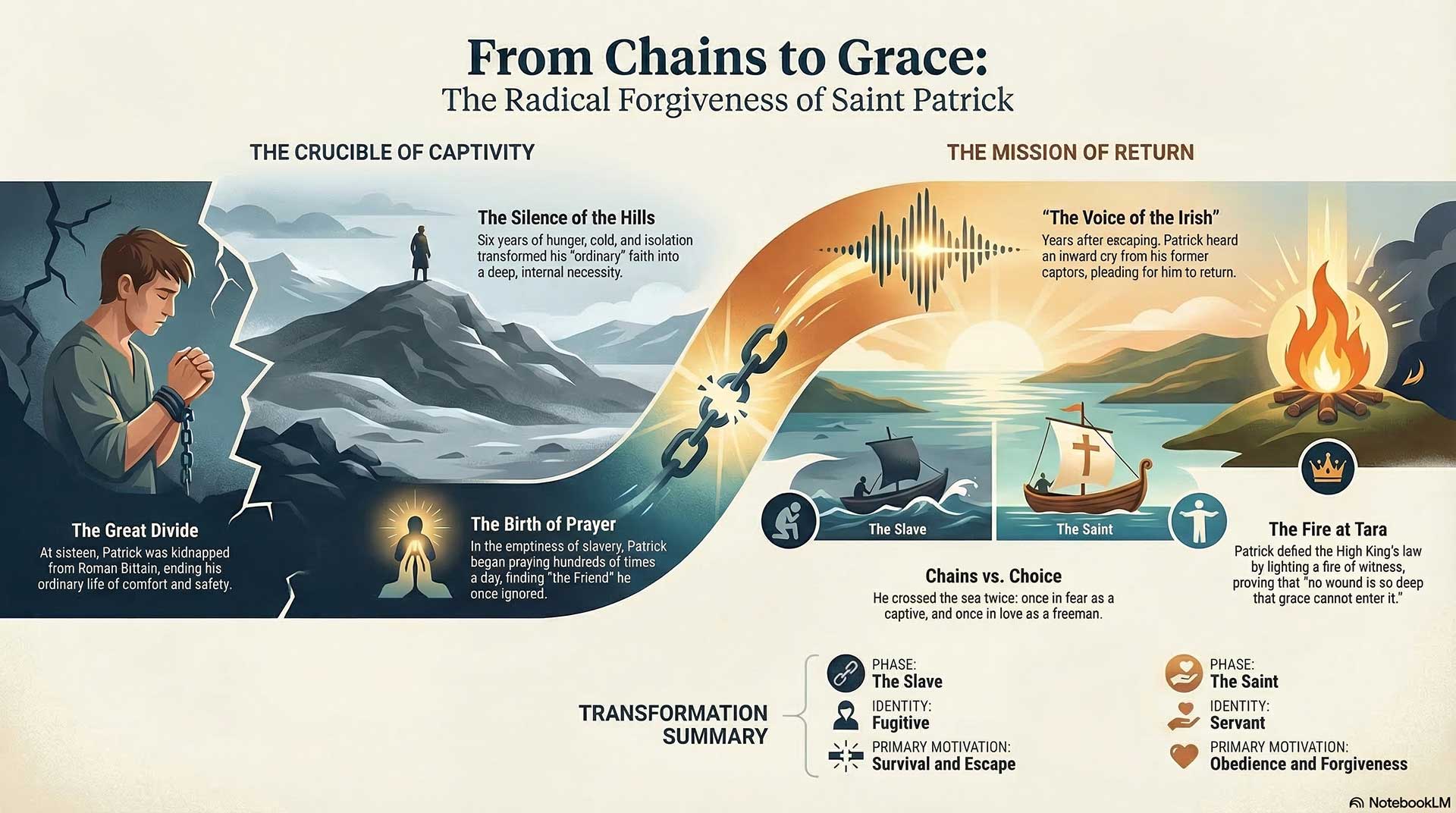
When I was young, I thought freedom meant getting back what had been taken from me.
I know better now.
Freedom was not only escape. Freedom was the healing of hatred. Freedom was the day I could stand again on Irish soil and come with open hands. Freedom was the grace to speak truth without revenge, to remember pain without living under its rule, to love the people among whom I had once suffered.
God did not waste my captivity. He did not bless the evil done to me, yet He refused to let evil have the last word. He met me in the place of loss, and from that place He made a calling.
That is the mystery at the center of my life.
The land of my humiliation became the land of my mission. The wound became the doorway. The fire I once feared became the fire I carried.
If you remember me, do not remember only a symbol, a feast day, or an old tale repeated in spring. Remember this: Christ can enter the darkest part of a life and bring from it mercy, courage, and love stronger than injury.
I was taken to Ireland in chains.
I returned by grace.
Short Bios:
Leave a Reply