

|
Getting your Trinity Audio player ready...
|
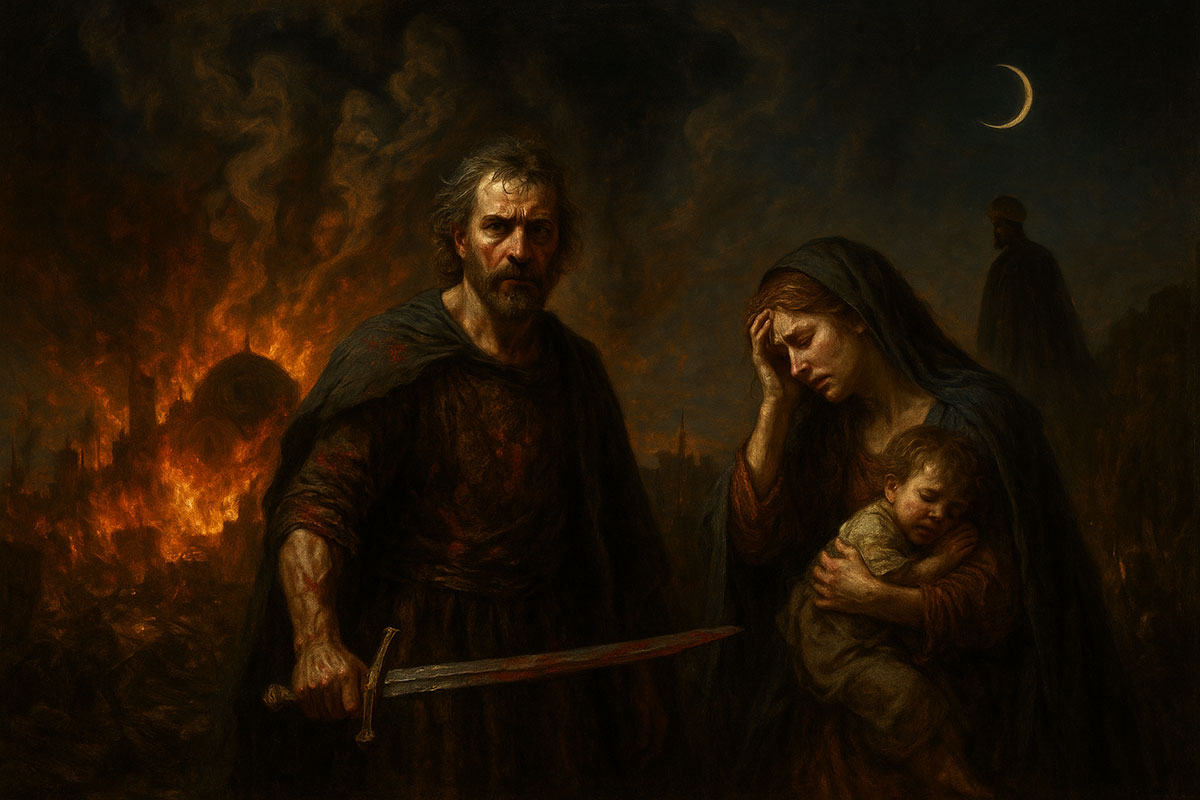
Prologue
Chorus enters.
From East to West the world’s great empires gaze,
Where Bosporus divides both night and day;
Byzantium, crown’d in ancient, golden rays,
Now starves within her walls, her strength decay’d.
A Sultan young, with thunder at his back,
Would clasp this bride, or break her stone to dust;
An Emperor old, though weary, shall not slack,
Yet honor feeds not hunger, bread, nor trust.
A widow’s tear, a scholar’s burning scroll,
A traitor’s purse, a fool’s last bitter jest—
All meet beneath the crescent’s dark’ning toll,
Where prophecy shall weigh both East and West.
Attend, good friends: behold both crown and fall,
A city lost, yet mourn’d beyond us all.
Exit Chorus. Curtain rises on Act I.

Act I — The Crumbling Gate
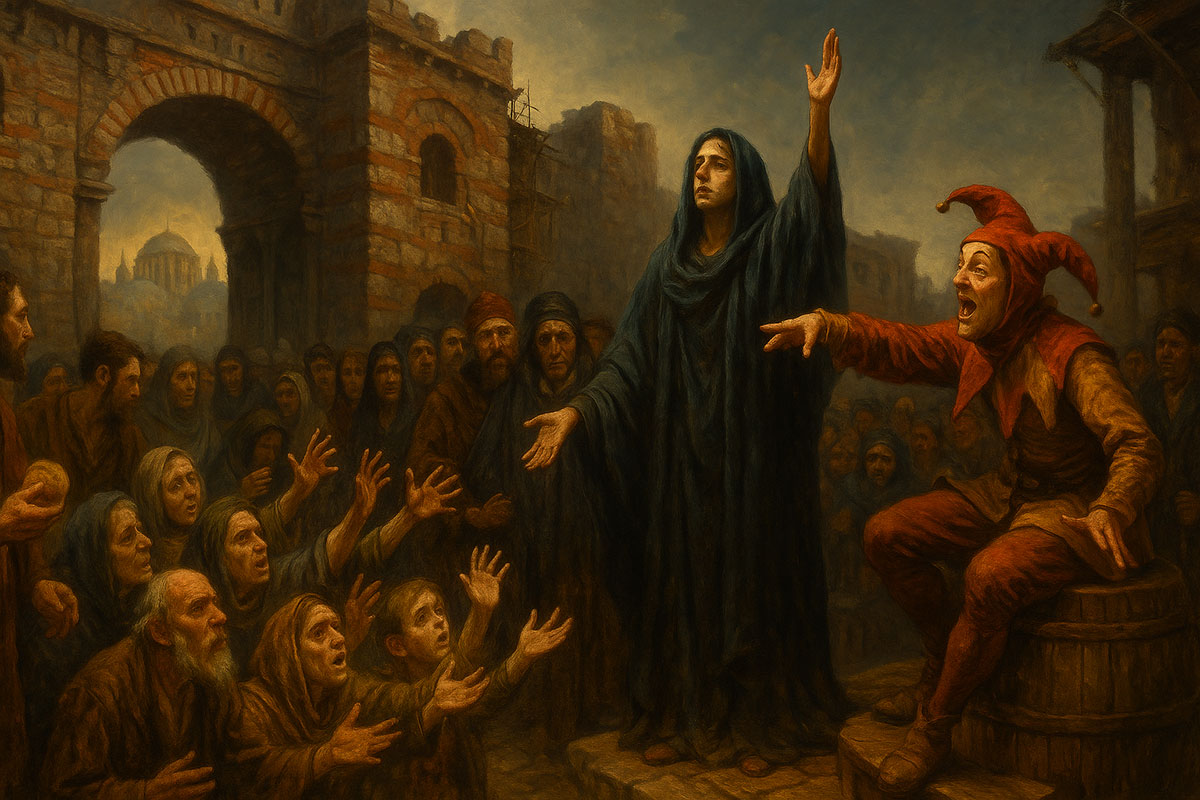
Scene I — The Marketplace
The city square. Stalls stand empty, citizens quarrel over crumbs. Soldiers keep them back with rusty spears. Helena enters with her child. Andreas the Fool wanders, patched cloak dragging. The Gypsy Oracle drifts in, veiled and strange.
First Citizen
Bread! Bread! We pay with bone and belly.
Baker (within)
No grain, no loaf. Go gnaw thy shadow.
Second Citizen
We’ll eat the Emperor’s oath for supper, then!
Soldier
Back, curs! The city stands while ranks stand sober.
Andreas
Then we are fallen, for I am drunk with famine.
Good my lord Spear, I’ll drink thy steel for ale.
(licks the spear point)
Tastes of rust and holy patience.
Helena (to her child)
Hush, little star. The day is loud with empty.
Oracle
Hear, walls of Constantine; hear, hunger’s horn!
A wall shall fall, not batter’d down by stone,
but eaten with the worm within—by want.
A crown shall crack, the crescent climb the night,
a widow’s tear outlive emperors.
First Citizen
Another holy mouth that feeds on fear.
Soldier
Back to thy camp of clouds, witch.
Andreas (bowing)
Lady of Rag and Riddle, will you sell me a prophecy cheap?
I’ll pay tomorrow, when tomorrow’s full.
Oracle (to Helena)
Keep close thy heart: a book shall burn for thee,
a child lie still, yet love will breathe and bleed.
Helena
Mad tongue!—Yet something freezes in my breast.
Andreas (to the crowd)
Mark, friends: the city hath three bellies—
the priest’s, the noble’s, and the people’s.
Two are full. Guess which is lean?
Laughter, bitter. A soldier strikes Andreas. He reels but grins.
Andreas
A gentle knock—my wit rings hollow.
If bread be gone, I’ll feast on sermons;
if walls must fall, I’ll sell the stones for soup.
The Oracle drifts away. The crowd disperses. Curtain.
Scene II — The Palace Council
Within the palace. Constantine sits at a long table; nobles, generals, and priests argue. Demetrios clutches a scroll; Gregorios whispers aside.
Constantine
My lords, the hour grows leaner than our store.
The Turk hath ring’d our walls with fire and iron.
What counsel brings salvation? Speak plain.
Gregorios
Majesty, yield. Cast down the keys of empire,
and gain from Mehmed mercy for our lives.
Better gold in his coffer than graves in our street.
Demetrios
Majesty, stand firm. Yield once, and all is chains.
Better graves with honor than breath with shame.
General
We have neither graves nor honor left, my liege,
but swords rusting for want of men to wield them.
Priest
Call Rome, call Venice, call the Pope in Rome!
Surely Christendom will answer.
Constantine
Aye, and while they answer, our children starve.
Gregorios (aside)
The crown weighs heavy; hunger will unmake him.
I’ll sell him to the crescent for a purse of coin.
Demetrios
My liege, the city’s soul yet stands.
If books burn, memory may rise again.
Let me guard our wisdom, though walls fall round it.
Constantine
A noble wish, but ashes keep no words.
Still, thy fire shames the coward’s counsel.
The nobles argue. Constantine dismisses them in weariness. Trumpets sound faintly beyond the walls.
Scene III — The Fool’s Mockery
Marketplace at dusk. Andreas mounts a barrel, lute in hand. Citizens gather, soldiers hover.
Andreas
Look how our generals march: (mimics stiff soldier)
“Left, right, left—into the grave we go!”
And our priests: (clasps hands piously)
“Starve sweetly, children, heaven loves a thin saint.”
Laughter rises. Soldiers grow uneasy.
First Citizen
Speak on, fool! Thy tongue feeds better than loaves.
Andreas
Aye, and our nobles: (struts, belly out)
“Wine for me, sermons for thee!
If the Turk comes, I’ll sell my mother for mercy.”
Second Citizen
Ha! He names them rightly!
Andreas
And I name myself too: fool, knave, beggar, clown.
Yet still I starve less honest than a lord.
Soldiers seize him, strike him. He laughs through blood.
Andreas (low)
Laugh, laugh—
for laughter feeds no bellies.
When walls fall, fools fall last,
yet fall we must.
He is dragged off. The crowd disperses in silence.
Scene IV — The Soliloquies
Night. Within the palace. Constantine alone with crown in hand.
Constantine
This circlet weighs more lead than gold.
I am no king, but warder of a tomb.
My fathers built a city strong as faith;
now famine gnaws the stones, and treason eats the heart.
Shall I barter crown for crust,
name for bread?
Yet honor cries: stand, and let the city fall with thee.
Between the bread and the crown
I am crucified.
He sinks to a chair. Darkness. Shift of stage: the Turkish camp, lit by fire. Mehmed enters, gazing toward the walls.
Mehmed
There she lies, bride of the Bosporus,
a city older than my blood.
Am I her lover, or her murderer?
They call me Conqueror, yet conquest chains me;
iron crown, no rest, no peace.
What is conquest but a crown of bones?
Still… empire calls,
and I must answer.
He turns sharply. Drums thunder. Curtain.
Act II — Love and Treachery

Scene I — The Ruined Chapel
Moonlight through broken stained glass. A silver shaft falls upon a cracked altar. Demetrios Scholarios kneels among scattered scrolls; some are bound with twine, others singed at the edges. Footsteps. Helena enters with her sleeping child; she draws her cloak close against the night air.
Helena
Good Demetrios, thou keep’st a vigil cold,
where saints are dust and windows bleed with moon.
The city groans; the walls are hollow drums;
why kneel’st thou here among these tinder’d leaves?
Demetrios
Because these leaves remember. Swords forget;
the iron boasts to-day and rusts to-morrow.
But in these skins the breath of ages moves—
the fathers’ counsel, hymns, and histories.
If we must die, let wisdom live to speak
our names aloud when we are only ash.
Helena
Wisdom can warm no child, nor still his cry.
Sweet scholar, love outclimbs thy ladders all.
Look on his face: his sleep is but a truce.
Hunger will shake him waking like a storm.
Demetrios (rising, gentle)
I look—and tremble. Yet if I forsake
the lamp that keeps the night from eating men,
what shall he wake to? Darkness without dawn.
I keep these words as sailors keep their stars.
Helena
And I— I keep a smaller star than thine,
this little soul, whose light is all my sky.
Demetrios, be more man than book to-night:
take us and fly before the city cracks.
Demetrios
By what sea-road? The Bosporus is a blade;
its edges flash with Turkish galleys’ teeth.
We are enclosed, my heart; the map is iron.
Helena (drawing nearer)
Then choose another way: the way of love.
If gates are lock’d, still hearts have secret doors.
O take us to some cellar, vault, or crypt;
hide us like relics till the storm is spent.
Demetrios (hands to her face)
If I could build a fortress of my breast
to house thee from the wind, I would—
but even love must answer conscience’ bell.
To flee these books were treason to our dead.
Helena (hurt, but soft)
And is not flight from me a treason too?
We are not parchment, ink, or syllables;
we bleed. If fate demands a sacrifice,
let scrolls burn bright and we slip through the smoke.
Demetrios (after a struggle)
O argument that shakes me like an angel!
Yet hear me, Helena: were I to run,
my feet were iron-shod with shame forever.
Still—if flame draws near, I swear by God
I’ll be thy shield, thy porter, and thy guide.
Helena (kissing his hands)
I take thy oath, though oaths are brittle glass.
Look—he stirs. (to the child) Hush, little star; be kind.
(aside)
If he must choose ’twixt wisdom and my arms,
may Heaven bend his scale toward love—this once.
The chapel bell far off gives one hollow note. They part slowly; Helena exits with the child. Demetrios gathers his scrolls with renewed tenderness.
Scene II — The False Courtship
The palace gallery: a long colonnade open to the night. Wind worries the banners; a brazier guttering. Helena walks alone, cloaked; she glances often toward the city’s dark horizon. Enter Gregorios Palaiologos, velveted, courteous, with a smile bright as a knife.
Gregorios
Madonna Helena, jewel of a ruin’d crown,
forgive a lord whose eyes are late in worship.
Thy step rebukes the moon for arrogance.
Helena
My lord, the moon keeps colder company.
What seeks thy courtesy at such an hour?
Gregorios
A future—not for me alone, but thee.
The tide hath turn’d; thou know’st it as I do.
Between a starving city and a sea
of steel, what bridge remains? One word: accord.
The Sultan—merciful in victory—
will spare whome’er I name. Thy name was first.
Helena
Spare? That word is winter-milk—thin, gray, and sour.
I do not drink of it. I’ll not be bought.
Gregorios (smiling still)
Not bought, but cherish’d. Wed me, and be safe.
I hold in secret keys to mercy’s gate.
Think on thy child—on bread, and rest, and years.
What honor feeds an orphan?
Helena
Honor feeds his ghost when bread cannot be found.
My child shall learn that slavery wears silk
and calls its gaoler “husband.” Keep thy keys.
Gregorios (tone hardening)
Proud widow, take good heed how pride tastes cold.
The Sultan loves what yields and hates what breaks;
and I am set to judge between the two.
Join hands with me, or with the night—choose quick.
Helena
I choose a hand that’s clean. Thine sweats with coin.
Go sell thyself; I am not merchandise.
Gregorios (aside, venom under honey)
So holy scorn shall teach thee how to kneel.
Aloud—
If stubborn hearts provoke a city’s grief,
remember this: I offer’d thee a bridge.
Spurn bridges, swim—and drown. Good night, proud saint.
He bows with perfect grace and glides away. Helena watches him vanish, then clutches her cloak.
Helena (to the night)
O God, keep watch; the serpent hath our gate.
Scene III — The Fool’s Song
The marketplace by torchlight. A ring of ragged citizens; some hold empty bowls, some icons. Soldiers at the edge, uneasy. Andreas the Fool climbs upon a wine-cask, lute slung, a crown of straw cock’d on his head.
Andreas
Room for a king of nothing! Place for a prince of rags!
Who’ll buy my kingdom? ’Tis cheap as laughter—
and dear as bread.
First Citizen
Sing, Andreas! Make the belly forget itself.
Andreas (strumming)
Walls feast on sermons,
priests feast on bread,
nobles drink red wine—
and fools drink red blood instead.
Who’ll dine with me to-night? I serve two meats:
the Turk’s old steel and our new promises.
Second Citizen
A plague on promises. Give us bread!
Old Woman
Sing soft, good fool; the soldiers’ ears are pricks.
Andreas
Then I will sing them blunter. Hark, my lords—
(mimics a general) “Left, right, left—keep step with honor’s drum!”
But honor’s drum is hollow, and the skin
was flay’d from starving backs.
(mimics a priest) “Fast, children, fast;
your faith is lighter when your bodies are!”
(mimics a noble) “Peace, peace; if Turks should enter, I
shall purchase peace—my purse is Christian gold.”
Crowd (uneasy laughter, claps, hisses)
Soldier
Down from that tun! Thy music breeds disease.
Andreas
Why then, I am a healer; laughter sweats it out.
Come, buy a jest—one coin for truth half-told;
two coins for truth made whole (’twill choke thee).
First Citizen
I’ve but a copper prayer.
Andreas (tossing him a grin)
Keep that; prayers are legal tender when God sits judge.
To-night, alas, the court is otherwise.
Two soldiers push through.
Soldier
Down, I say.
Andreas (bows, dismounts, then aside to crowd)
Weep later, laugh while breath is cheap.
(To the soldiers)
Gentle lords of iron, will you have a tune to march to?
(bangs the lute like a drum and chants)
“Pay! Pay! Pay!”—the taxman’s song;
“Pray! Pray! Pray!”—the churchman’s song;
“Slay! Slay! Slay!”—the hungry soldier’s song.
And what sings the people? “Nay! Nay! Nay!”—
for we have naught to pay, to pray, or slay withal.
The crowd bursts into rough applause. A soldier cuffs Andreas across the mouth; he staggers, then flourishes a bloody smile.
Andreas
Behold—communion! I taste iron.
Citizens, mark me: when walls fall, fools fall last—
not for want of enemies, but for lack of importance.
Yet fall we do. Laugh now; it costs less than tears.
He limps away, still plucking a defiant chord. The ring dissolves; people scatter under the soldiers’ stares.
Scene IV — The Oracle Returns
Night deepens. Back in the ruined chapel: wind moans through stone ribs. Demetrios stacks scrolls carefully in a wooden chest. A small lamp shivers. From the darkness steps the Gypsy Oracle, her bells deadened by cloth; her eyes like coals.
Demetrios (startled, then steady)
Lady of riddles—thou again?
Oracle
Not twice, but once unending. Time circles me.
Scholar, guard thy heart.
Demetrios
My heart I guard with prayer; these books with care.
What news thy spirit brings?
Oracle
A widow’s tear shall outlive emperors.
A book shall burn; a child shall lie like snow;
the fool shall sing until his music breaks.
The crescent climbs; the crown cries out for bread;
the traitor’s key will fit the city’s throat.
Demetrios (reeling)
Widow—child— O merciful God, not hers!
Speak plainer; warn me how to break this doom.
Oracle
Wouldst thou unwrite the sky?
He that would heal the wound must first be wound.
Yet mark this hope: though ash devours the leaf,
the breath of leaf survives in living mouths.
Plant what thou canst in hearts; the rest is fire.
Demetrios (after a beat, resolved)
Then let me be a sower in a storm.
I’ll hide what volumes I may hide, and teach
what lips may carry when the shelves are smoke.
Oracle (softening)
Love hast thou too. Forget it not, nor choose
’gainst love in zeal for letters. Wisdom’s fruit
is charity, not pride. When fire is near,
be book and shield—be scholar, lover, both.
Demetrios (with sudden fervor)
I will. If I must perish, let me die
a bridge for those I love to cross the flame.
Oracle (lifting a hand in blessing/doom)
So speak the brave, and so the brave are spilt.
Remember me when silence floods the streets.
A widow’s tear shall outlive emperors.
She turns to go; Demetrios reaches out.
Demetrios
Stay—tell me of Helena—of the child!
Oracle (without turning)
Ask not the moon to hold her silver still.
She sets to rise elsewhere. Keep thy vow.
She melts into the dark. The lamp gutters; wind sighs. Demetrios kneels, head bowed over the chest of scrolls.
Demetrios (prayer)
Lord of all light, receive these leaves and lives.
If I must choose, let love be first—then words.
But if I may, O knit them both in me,
that when I break, some harvest still be won.
He rises, takes two small manuscripts, and folds them beneath his robe. He blows out the lamp; the moon remains, cold and watchful. From far away: a single war drum, slow and inevitable.
Curtain.
Act III — The Breach Within
Scene I — Mehmed’s Soliloquy
The Turkish war camp outside Constantinople. Fires blaze in a ring; drums beat low, like thunder in the earth. Mehmed II enters, armored but with helm off, gazing across the water at the city’s silhouette. He holds a dagger and map. He speaks slowly, as if confessing to the night.
Mehmed
Behold her walls, the ribs of empire’s corpse.
Behold her domes, the breast of ancient faith.
The city waits, half-proud, half-beggar’d ghost.
What bride is this, that I must force to bed?
They call me Conqueror—child of destiny,
but what is conquest? Chain and sleepless crown.
One hand clasps triumph, the other drips with ghosts.
If I should fall, my name becomes a jest.
If I should win, my name becomes a dirge.
O fathers, watchers, prophets in their graves,
what empire kept you safe? The grave, the grave.
Yet still I hunger, for I am not ash.
History doth whisper: “Strike, and be eternal.”
And so I must.
But here— (he holds his dagger aloft)
Here lies the thorn: I take a city,
but lose myself.
Am I storm, or storm’s mere servant?
Do I command the tide,
or does the tide command me?
He drops the dagger upon the map, stabbing it through Constantinople. He lifts his helm, and with a final glance, exits. The drums swell.
Scene II — The Treachery of Gregorios
Dark corridor within the palace. Torchlight flickers. Enter Gregorios, richly dressed, with a purse of silver hidden at his side. He meets a Turkish envoy, cloaked and shadowed.
Gregorios
The Emperor wastes his strength in prayers and oaths.
He trusts me not; suspicion blinds his eyes.
Good. Distrust is shield, but shields have cracks.
At midnight, mark: the postern by the cistern
shall gape as wide as any grave.
There Mehmed’s soldiers enter.
Let him reward me,
and let him drown the rest.
Envoy (dryly)
The Sultan rewards treachery—
and buries it when done.
Gregorios (smiling coldly)
Then let him bury me in silks and coin.
A grave with gold is warmer than a throne with hunger.
Envoy
So be it. The Sultan knows thy price.
Guard thy tongue, lest silver turn to steel.
They clasp hands. The Envoy vanishes into shadow. Gregorios lingers, sneering.
Gregorios (alone)
What is loyalty but chain?
What is treason but survival writ in coin?
The Emperor clings to honor,
but honor feeds no belly.
I will live, though he and his fools perish.
He exits swiftly.
Scene III — The Lovers’ Plea
The ruined chapel. Moonlight. Helena clutches Demetrios’s hands in desperation. The child sleeps nearby upon a cloak.
Helena
Beloved, I beg thee—take me, take us, flee!
The sea may bristle, yet some boat may steal
a passage in the dark. Better the risk
of water’s teeth than certain jaws of fire.
Demetrios
How shall I flee when wisdom burns behind me?
If I abandon scroll and word, I die
before the body dies. These books are breath;
without them man is less than dust.
Helena
And what of me? Am I not breath to thee?
What of this child? Shall parchment be thy son,
while he lies slain for want of father’s choice?
Demetrios (tormented)
Do not so strike me, Helena—thy voice
cuts sharper than the sword. I love thee more
than ink, than parchment, more than my own name.
Yet God did give me this one trust: to guard
the lamp of wisdom. To betray that trust
is sin, though love itself cry out against me.
Helena
Then love is naught to thee but scholar’s phrase!
O blind devotion, colder than the Turk.
Choose! Will thy hand hold scroll, or me, or both?
Demetrios (falling to his knees before her)
If God would let me, I would hold all three.
But if fate tears my arms in twain, then hear:
I hold thee in my heart though hands embrace
mere paper. Think me traitor to thy eyes,
but not to love. My soul is thine alone.
Helena (weeping, touching his face)
My soul is bruis’d with loving such a man.
Yet bruis’d or whole, it cannot help but cling.
If thou must die among thy books,
then let me weep among their ashes.
They embrace. Distant bells toll doom. They part slowly, Helena carrying her child.
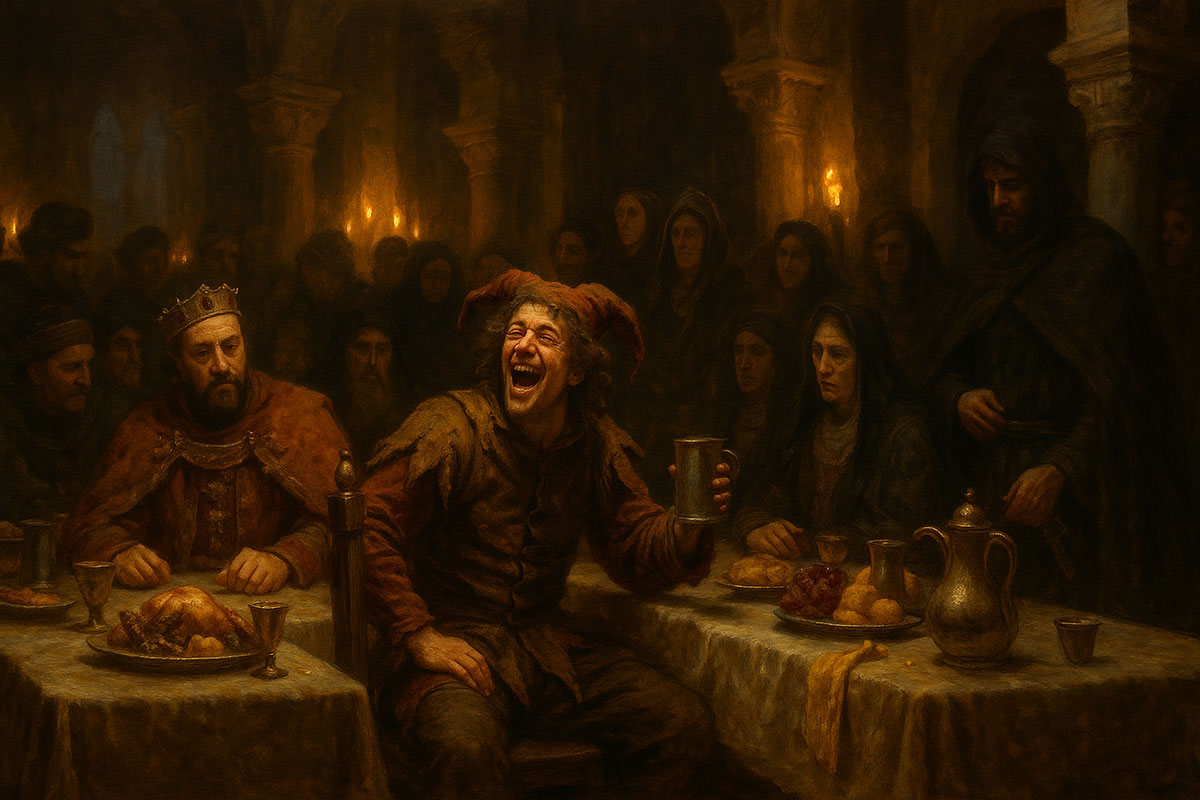
Scene IV — The Banquet of Mockery
The great hall of the palace. Torches burn. A long table groans with meager fare. Nobles drink nervously; soldiers lean in corners, half-drunk. Constantine sits grim, crown upon his brow. Gregorios smiles slyly at his place. Enter Andreas the Fool, staggering with a cracked lute. He climbs upon the table to the scandal of all.
Andreas (singing drunkenly)
Eat, drink, be merry,
the Turk shall pick thy teeth!
Better feast to-night, my lords,
for to-morrow thou feast’st on grief.
Noble
Down with him! Shame, shame!
Andreas (mocking)
Shame sits already here, lords;
I see him wearing velvet,
I see him sipping wine.
Laughter, uneasy. Constantine frowns but does not rise.
Andreas (pointing at a noble)
Behold our generals: (mimics stiff march)
“Left, right, left—into the grave we go!”
(He shifts to clasping hands like a priest)
“Fast, children, fast;
the emptier thy belly, the lighter thy soul!”
(Struts with belly out)
“Wine for me, sermons for thee;
and if the Turk should knock,
I’ll sell my mother for his mercy.”
Crowd (mixed laughter and horror)
Gregorios (furious, leaping up)
Silence, clown! Thy tongue shall be thy noose.
Andreas (reeling, but pointing straight at him)
Aye, lord—thy tongue is sharper than all swords,
yet cuts thine own house first.
What need of gates when traitors hold the keys?
Constantine (rising, thunderous)
Peace! Enough! This feast is bitter as wormwood.
Fool, thy wit is dagger, yet it cuts too deep.
And thou, my lords, sit gorg’d while walls do bleed.
This city is no banquet, but a tomb.
Think ye on death, for death thinks now on us.
Silence. A distant roar of drums outside the walls. All turn toward the sound. Soldiers rush in, breathless.
Soldier
The Turks advance! Their torches ring the moat.
Constantine (grimly)
Then let them come. We dine no more, but fight.
To arms! To arms!
Andreas (aside, as soldiers rush past)
Ah, at last, the bill is call’d.
The feast is ended, the jest begun.
He coughs blood into his hand, grins at it, then staggers off. The nobles scatter. Constantine strides toward the armory. Gregorios slips into the shadows, fingering a key at his belt.
Curtain falls. End of Act III.
Act IV — The Walls Fall
Scene I — The Gate Betrayed
Midnight. The postern by the cistern: a low arch of stone where water sweats through the mortar. Torches sputter in damp air. Distant drums. Enter Gregorios, cloaked; he carries a ring of keys. A Sentry drowses on a stool, spear across his knees.
Gregorios (softly)
Sleep, city, sleep. Thy dreams are cheaper than thy bread.
(He steps toward the lock.)
Sentry (startled awake)
Who goes? Stand and speak thy name.
Gregorios (turning, bland)
A faithful servant, bearing the Emperor’s word.
He bids me test the locks, for fear of treachery.
Sentry
At midnight?
Gregorios (producing a small seal)
His signet. Will thy suspicion outrank thy duty?
Sentry (peering, wavering)
The seal… ’tis dim. Yet— forgive me, lord, the hour is sharp.
Gregorios (close, friendly)
So art thou. Thy watchfulness shall be remember’d.
Here—warm thy bones. (He offers a small flask.) Drink, friend.
Sentry (drinks, coughs)
Bitter stuff.
Gregorios (aside, smiling)
As is truth. (Aloud) Now, see me try the bar.
(He slips the proper key into the lock. A deep bolt slides with a groan.)
Sentry (suddenly alarm’d)
Hold! That sound—what order had thee lift the bar?
Gregorios
The Emperor’s—
(A shadow passes beyond the arch; faint torch-glow from outside.)
Sentry (leveling spear)
Back from the postern, lord!
Gregorios (snatching a dagger)
Out of my path, honest fool.
They grapple. The Sentry’s spear clatters. Gregorios stabs him. The Sentry falls with a gasp, clutching Gregorios’s cloak.
Sentry (fading)
For… Constantin— (He dies.)
Gregorios (breathing hard, shakes off the hand)
A trifle. One flea less upon the city’s hide.
(He drags the body aside. He hauls the small door inward. Cold night air rushes in. Turkish shadows move.)
Come in, dark tide.
Turkish soldiers slip through, one by one, swift and silent. An Officer nods to Gregorios as they pass.
Turkish Officer (low)
At the stroke. Where lies the palace way?
Gregorios
Follow the old aqueduct—three turns, then left.
Spare the quarter north; there live my friends.
Turkish Officer (dry)
The night is no cartographer. We spare what we spare.
Trumpets sound elsewhere—alarm raised. Shouts. The Officer gestures; more soldiers pour in. Suddenly, the glare of torches from within: Constantine enters with guards, sword drawn.
Constantine
Treason! Hold the gate!
Gregorios (startled, then smooth)
Majesty! I— I came to bar the postern, finding it ajar—
Constantine (seeing the dead Sentry, the open door, the flood of foes)
O perfidy writ plain!
Seize him!
Guards grapple Gregorios. Turkish soldiers rush; steel clashes. Constantine drives two back with furious blows.
Constantine (to Gregorios, cold)
Thy key unlocks thy verdict.
Gregorios (defiant, struggling)
I chose life. Thou chose starvation wrapped in pride.
Constantine
And so thou livest now—one breath. No more.
(He takes Gregorios’s own dagger and strikes him. Gregorios falls.)
Gregorios (dying, spitting blood)
May Mehmed… weigh thy bones for bridges.
(He dies.)
Constantine (to his guards)
Bar up the postern! Raise the city! To arms!
(He looks a moment at the Sentry, then at Gregorios.)
Honor and shame—one grave receives you both.
Turks press hard. The guards heave at the door; the bolt scrapes, half-seats. A Turkish ram hammers. The timbers shudder.
Constantine
Leave it—fall back to the inner way!
This breach is lost—save what remains.
They retreat fighting. The door splinters as the Turks flood in. Blackout to the thunder of boots.
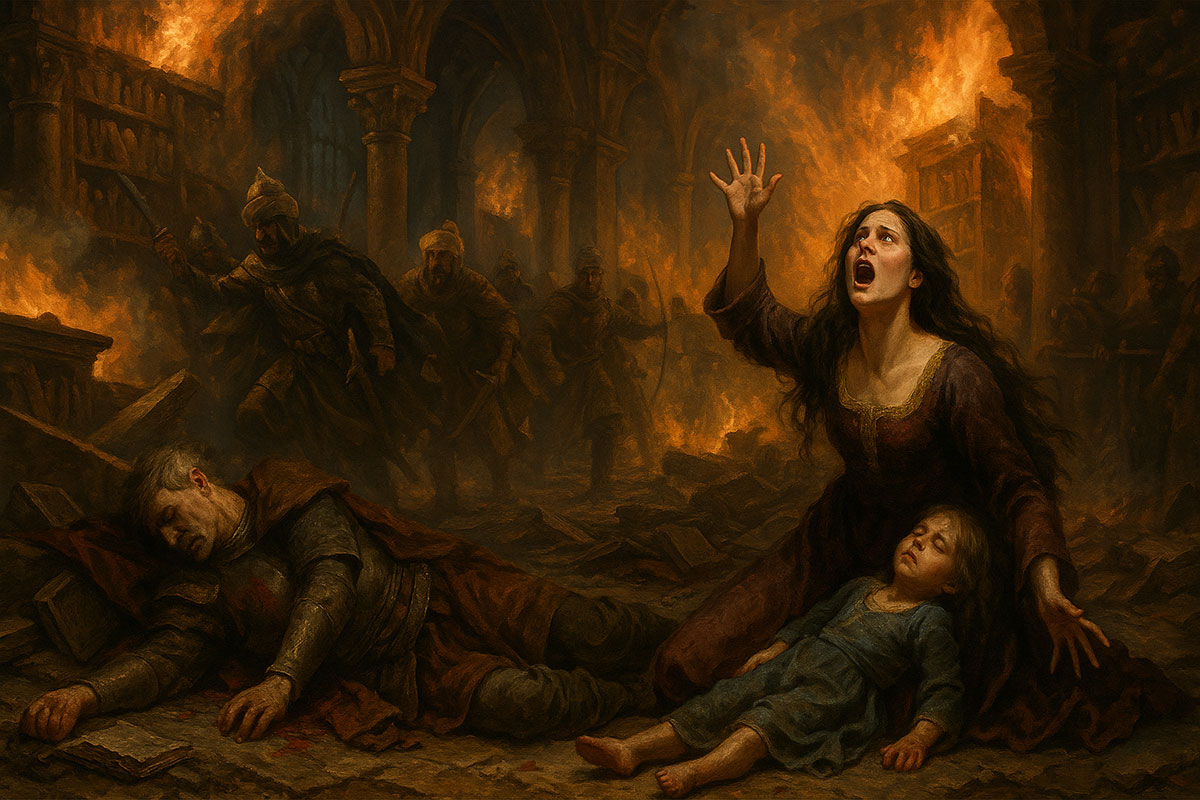
Scene II — Fire and Ruin
The imperial library: long aisles, high windows. Fire blooms along shelves; smoke billows. Demetrios drags a wooden chest toward a hidden trap near an apse. He coughs, eyes streaming. He clutches a slim gospel and a bundle of manuscripts.
Demetrios (to himself)
Not all—O God, not all—
But these few seeds—let some be sown.
Enter Helena with her child, hair wild, cloak scorched.
Helena
Demetrios!
Demetrios (whirls, relief and terror)
Helena! Why—why here? The streets are knives!
Helena
I fled where thy feet would run—the books.
Take us, beloved—no more debates.
The city screams. The sky is made of iron.
A crash above. Sparks rain down. Demetrios hustles Helena and the child toward the apse.
Demetrios
Down this way—there’s a door to the old crypt.
We’ll find a seam of safety in the stone.
(He thrusts the gospel into her hands.)
Hold this—if I should drop, it must not.
Helena (grips it)
I’ll hold thy heart as well.
He strains at the chest, shoves it toward the trap. A flaming beam groans overhead. Two Turkish soldiers burst in, blades drawn, faces smeared with ash. They halt at the heat.
First Soldier (in awe)
Books burn like cities.
Second Soldier (hard)
And cities read us death. Take what’s living.
Helena shields the child. Demetrios flings a brazier; coals scatter. The First Soldier stumbles back. The Second charges Demetrios; they struggle among the falling sparks.
Helena (crying)
Mercy! The child! Mercy!
The First Soldier wavers, glancing at the small boy clinging to Helena’s skirt. A shower of blazing shingles cascades. The Second Soldier slashes Demetrios across the ribs; Demetrios staggers. The beam above, half-burnt, gives way with a terrible crack and crashes down, pinning Demetrios from the waist.
Demetrios (a cry choked to breath)
Ah—God!
Helena (rushing to him)
No!
The First Soldier moves toward Helena, then freezes, blade half-lifted.
First Soldier (low, shaken)
Go—hide—(He gestures toward the apse.)—Quickly!
(To his comrade) Leave them. Take the chest.
Second Soldier (snarling)
Orders said no mercy. (He kicks the chest; it bursts; manuscripts spill like birds.)
Look, brother—this is their treasure.
First Soldier (seeing the child clutching Helena)
We are not wolves. (He shoves the Second’s blade aside.) Enough.
The Second Soldier shoves him back, grabs for the child. In the turmoil, the child slips; the Second Soldier’s sword flashes—then stillness. The child falls. Time stops.
Helena (a cry from the marrow)
No—O world unmade!
The First Soldier stares, horrified. He drops his sword as if it burns him.
First Soldier (whisper)
What have we done?
Second Soldier (hard, but shaken)
We obey’d. Move! The fire eats us next.
They bolt as rafters crash. Helena gathers the child’s body, rocking. She crawls to Demetrios, the child in her lap, both faces soot-streaked with ash and tears.
Helena (to Demetrios, broken)
Beloved—he’s— (Her voice fails.)
O God, why breath for me?
Demetrios (pain-shaken, reaching to touch the child’s hair)
Little star… my son by love if not by blood…
(He looks at Helena.)
Forgive me—for choosing parchment over flight.
I meant to build thee shelter with these leaves—
but leaves are tinder when the wind is war.
Helena
Speak no more of books. Hold me if thou canst.
Demetrios (fighting the pressure of the beam, his breath shallow)
I cannot lift— (He grimaces.)—but I can speak.
Hear me: within that gospel’s golden thread
are words that walked through fires worse than this.
If thou canst live, live with it.
Teach it to any child who yet may breathe.
Let wisdom be thy vengeance—mercy too.
(He tries to smile.)
Love outlives cities. We named it once—
and love remembers its own name.
Helena (kissing his bloodied brow)
I remember. O my heart.
Flames lick along the beam. Demetrios stares at the roll of smoke above as if reading.
Demetrios (half-prayer, half-chant)
“In principio erat Verbum…”
(He coughs.)
“The light shineth in darkness… and the darkness…”
(His eyes shine once; his head settles.)
“…comprehended it not.”
He is still. Helena lays her forehead to his. The roof roars. She gathers the gospel, cradles the child, kisses Demetrios’s hand once, and rises with terrible gentleness.
Helena (to the world, quiet and flint)
I live—if only to remember.
She moves toward the apse door through smoke and sparks. The library roof caves in behind her with a blast of fire. Blackout.
Scene III — The Fool’s Last Rhyme
A street near the forum: buildings toppled, smoke-ghosts wandering. Distant screams, nearer sobbing. Moon red through soot. Andreas staggers in, cloak scorched, cheek split, his lute a char of wood with two strings. A few Citizens huddle against a wall; a Little Girl cries softly, alone.
Andreas (seeing her, soft)
Hush, small sorrow. Doth the world grow too loud?
(He crouches, winces.)
Here—borrow my ear. ’Tis good for tears.
Little Girl
Where is my mother?
Andreas (looks at the ruins, then back with a fool’s brave smile)
At market, buying bread from angels.
They sell it fresh and never count the coin.
She’ll find thee. Sit. I’ll sing till she arrives.
He settles, props the broken lute, plucks a fragile interval. His voice is hoarse but tender.
Andreas (singing low)
Walls fall, kings fall,
priests fall, fools fall last—
yet all fall fast.
Eat when thou canst,
drink when thou must,
love while thou mayst—
all else is dust.
He breaks off, coughs blood, dabs it away with a joke of a bow.
First Citizen (hollow)
Fool, why laugh when all is ruin?
Andreas
Because to weep alone is to drown;
to laugh together is to swim a little.
Besides, my trade is jest; if I be poor to-night,
I’d be no tradesman at all.
(He strums again; the string snaps. He chuckles.)
My instrument grows honest: it refuses to sweeten lies.
Footsteps. A knot of Turkish soldiers rush past, chasing two Byzantine lads who flee down an alley. The First Citizen flinches; the Girl buries her face in Andreas’s cloak.
Andreas (to the soldiers, lightly, deflecting)
Ho, brave sirs! Care you for music to mend your march?
’Twill pace thy steps and soften thy boot-heels.
The soldiers glance, puzzled, then hurry on. The lads vanish in smoke.
Second Citizen (awed whisper)
He turn’d their eyes. A jest hath spared two lives.
Andreas (winks, then sways, catching himself)
Mark it in thy book: for once, folly was the cleverest prayer.
(He stands, raises the broken lute like a banner.)
Citizens of ash and iron—hear me!
Let not your hearts be sacked though roofs be torn.
Keep some small room within, four-corner’d, strong,
where no invader plants his flag. Fill it with names—
thy dead, thy dear, thy daily bread of love.
So long as memory stands, a city stands.
The Little Girl slips her hand into his. He smiles at her, then blinks, dizzy.
Andreas (aside, to himself)
Ah—my audience dwindles behind a veil.
(He shakes his head clear.)
One song more, then curtain.
He climbs a fallen stone and sings, voice fraying but fierce.
Andreas (singing)
O city mine, thou comb of golden bees,
now hollow, humming only ghosts and fire;
thy honey—love—still clings to broken combs.
We lick it from the ash and call it life.
Laugh, laugh—
that tyrants hear thy bellies ring
and wonder at a music not their own.
We are not only hunger; we are song.
He bows extravagantly—and nearly falls. The Citizens murmur. He waves them off with a grin.
First Citizen
Fool, sit. Thy blood runs as red as torches.
Andreas
A match for theirs, then. Equality at last.
(He staggers down, kneels beside the Little Girl.)
Hush now. Thy mother is—
(He sees Helena in the distance, moving like a ghost with her bundle. He cannot know the bundle’s weight.)
There—perhaps—come, child, rise gently.
The Girl peeks, then runs toward Helena, who pauses, kneels to embrace her, then moves on, veiled in sorrow. Andreas watches, understanding nothing and everything.
Andreas (soft, to himself)
A widow before the blow is told.
Prophets wear no crowns.
He tries to stand; his legs fail. He slides to the stone, rests his head against the broken lute.
Andreas (very low)
Walls fall, kings fall…
fools fall last—
yet all fall… fast.
His breath thins. He musters one last grin toward the huddled Citizens.
Andreas
Laugh… friends—
for laughter feeds… no bellies—
but keeps… a little…
warmth.
He exhales. Stillness takes him. A torch guttering nearby fizzles out. The Citizens bow their heads. Off, a great iron bell begins to toll—slow, implacable. The red moon dims behind smoke.
Curtain.
Act V — Ashes and Mercy
Scene I — The Last Battle
Before the palace gates. Torches flare, smoke rolls, the clang of steel echoes. Byzantine soldiers rally in tatters. Constantine enters, helm cracked, cloak torn, sword in hand, bloodied but resolute. He climbs a fragment of wall, rallying those left.
Constantine
Stand, sons of Rome! Though Rome be far,
her heart beats here within these stones.
This city is no wall of brick alone,
but spirit forged in martyr’s flame.
One stroke, one breath, one stand—
and though we fall, our fall shall thunder
louder than a Sultan’s trumpet.
Soldiers (weak cheer)
For Constantinople! For the Emperor!
The Turks surge; battle rages. Constantine leaps down, striking with furious strength. He cuts down two, drives back three. A Guard staggers to his side, blood streaming.
Guard
Majesty, the breach widens! We are spent!
Constantine (with grim fire)
Then let us spend ourselves entire.
Gold and crowns are ashes; honor alone
endures the fire.
He plunges into the fray, disappears in smoke. A terrible clash. Silence. The Guard crawls forward, face ashen.
Guard (with last strength)
The Emperor… slain!
He fell as a lion, yet the pride is broken.
He collapses. A Turkish banner rises behind him. Drums thunder. Curtain falls briefly.
Scene II — The Widow Before the Sultan
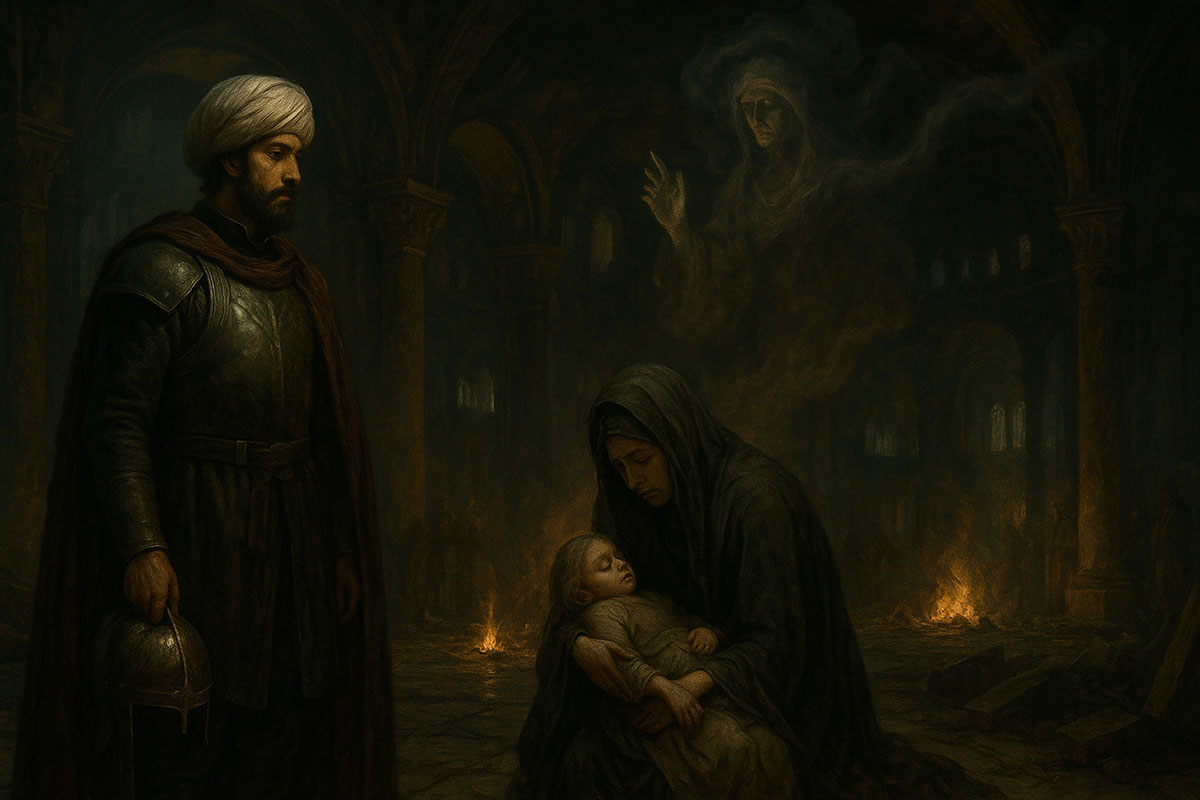
The ruined Hagia Sophia. Smoke curls from shattered domes; shattered mosaics glint faintly. Soldiers line the nave. Mehmed II enters solemn, helm under arm. His face is streaked with ash and sweat, grave with triumph. Helena is dragged before him, ragged, clutching the body of her child wrapped in cloth. She kneels.
Helena
Great Sultan, I beg no throne, no gold.
Grant me only this—
a grave for my son, a stone to name his breath.
She lays the bundle at her knees, veiling her face. The hall grows hushed. Mehmed gazes at her long, then turns aside, speaking to himself.
Mehmed (aside)
I have taken a city, yet this woman’s grief
outweighs my triumph.
Crowns are lighter than the weight of tears.
He approaches Helena, voice grave.
Mehmed
Rise. Thy child shall have his stone.
Go, and live.
Helena (lifting her face, bitter and hollow)
Live? I am but tomb made walking.
My loves are ashes; I breathe only dust.
Yet mercy is rare coin,
and I thank thee, conqueror.
Mehmed (softly, almost to himself)
Conqueror? A name that tastes of iron.
Helena gathers her child’s body and moves slowly toward the doors. Soldiers part in silence as she passes. Her figure fades into shadow.
Scene III — The Sultan’s Soliloquy
Mehmed stands alone in the nave. The vast dome, cracked and wounded, towers above. A single shaft of moonlight falls upon him. He removes his gauntlets, drops them on the altar steps. His sword clatters down beside them.
Mehmed
This city is mine—yet what is mine?
Stones bow, but silence answers.
Trumpets sound, but widows drown them weeping.
What empire is this,
where victory smells of smoke and milk of graves?
They will write: “Mehmed, the Conqueror.”
But the pen shall not record the taste:
iron on the tongue, ashes in the throat.
The scroll shall praise the crown,
but not the burden pressing bone to dust.
O History, thou cruel bride!
I woo thee, win thee,
and find thy chamber cold.
Art thou worth the blood of children?
Art thou worth the fool’s last song,
the widow’s cry, the scholar’s flame?
Yet still I am her servant.
Glory is a tyrant that unmans the victor.
And I, who thought myself a storm,
find I am but storm’s prisoner.
He sinks to the altar steps, burying his face in his hands. The hall echoes with distant wails and bells. The moonlight dims behind drifting smoke.
Scene IV — Epilogue of the Oracle
Smoke swirls. From it emerges the Gypsy Oracle, veiled, her eyes blazing faint. She moves slowly, raising her arms. Soldiers recoil; Mehmed lifts his head, startled. She speaks with voice both prophecy and lament.
Oracle
The wall is fallen, the crown is crack’d,
the crescent climbs, the widow weeps.
Stone may burn, scroll may fall,
but one tear outlives empires.
Remember, O world, the fool’s last jest;
remember the scholar’s vow;
remember the widow’s song.
For cities fall, but sorrow walks eternal.
She turns to Mehmed.
Oracle
Thou call’st thyself Conqueror—
but what hast thou conquer’d?
The earth? Nay. The dead.
And death is no throne to sit upon.
Mehmed stares, speechless. The Oracle fades into smoke. Darkness closes. A single bell tolls, slow and hollow. The stage empties. Curtain.
Epilogue

Enter the Ghost of Andreas, with broken lute in hand.
Good friends, the jest is done, the wine is spent,
The city fallen, crown and honor bent.
Kings bled like beggars, beggars died as kings,
And widows wept o’er ashes, not o’er rings.
Think not this tale of Constantinople lone—
For every age builds walls of dust and stone.
Each empire feasts until its belly’s bare,
Each fool cries truth, and none will lend an ear.
Yet mark me well: when walls and crowns are past,
It is the widow’s tear that lingers last.
So grant us pardon, if our stage was sore,
And hold this ruin in your hearts once more.
He bows low, lute string snapping. Exits. Curtain falls.
Dramatis Personae:
Constantine XI Palaiologos — Last Emperor of Byzantium, proud yet weary, torn between honor and survival.
Mehmed II — Sultan of the Ottomans, ambitious conqueror, haunted by the weight of glory.
Helena — A Byzantine widow, mother, and secret beloved of Demetrios, embodying sorrow and resilience.
Demetrios Scholarios — Scholar-priest, guardian of books, lover of Helena, defender of wisdom against ruin.
Gregorios Palaiologos — Noble of Byzantium, traitor, false suitor to Helena, betrays the city for silver.
Andreas the Fool — Jester and beggar, mocking priest, noble, and soldier alike; truth-teller who dies laughing.
Gypsy Oracle — Ragged seeress, her prophecy frames the play, warning of hunger, treachery, and widowed grief.
Citizens of Constantinople — Hungry, quarrelsome, despairing, caught between faith and famine.
Soldiers of Byzantium — Undermanned, embittered, weary defenders of the walls.
Envoy of Mehmed — Shadowed figure, takes Gregorios’s bargain at the gate.
Priests and Generals of the Court — Voices of faith and strategy, divided and impotent.
A Guard — Brings word of Constantine’s last stand.
Leave a Reply