

|
Getting your Trinity Audio player ready...
|
What if leading QHHT and hypnosis experts openly compared how to reach the somnambulistic state—fast, safely, and without mysticism?
Introduction by Dolores Cannon
When people hear the word somnambulistic, they often imagine something dramatic—someone asleep, unresponsive, or somehow “gone.” That idea has caused more confusion than clarity.
In my work, the somnambulistic state is not about sleep at all. It is about who is speaking.
When a person reaches true depth, the conscious mind steps aside, and the Subconscious—the part that knows the body, the life lessons, and the larger picture—can communicate clearly and directly. There is no guessing, no performance, and no effort. The answers come simply because that level of mind already knows.
Over the years, I learned that depth is not achieved by force or theatrics. It comes from preparation, calm authority, and a clear structure that allows the analytical mind to relax and stop interfering. When that happens, the process becomes surprisingly efficient.
This conversation is not about belief. It is about recognition—how to recognize true depth, how to enter it more reliably, and how to work within it responsibly. When done correctly, the somnambulistic state is not rare or mysterious. It is natural. It is accessible. And it is precise.
(Note: This is an imaginary conversation, a creative exploration of an idea, and not a real speech or event.)
Topic 1: What Exactly Counts as Somnambulistic?
Moderator: Cal Banyan
Participants:
Dolores Cannon
Julia Cannon
Candace Craw-Goldman
Dave Elman
Gerald Kein
Opening Scene
A quiet roundtable room. No stage, no audience. Just professionals who’ve all seen “deep trance” from different angles. Cal Banyan leans forward slightly, not ceremonious, more like a workshop about to begin.
Cal Banyan
Before we talk about how to get there fast, we need to agree on something basic. When someone says “somnambulistic,” what are we actually talking about? Not vibes. Not beliefs. Observable reality. Dolores, let’s start with you.
Dolores Cannon
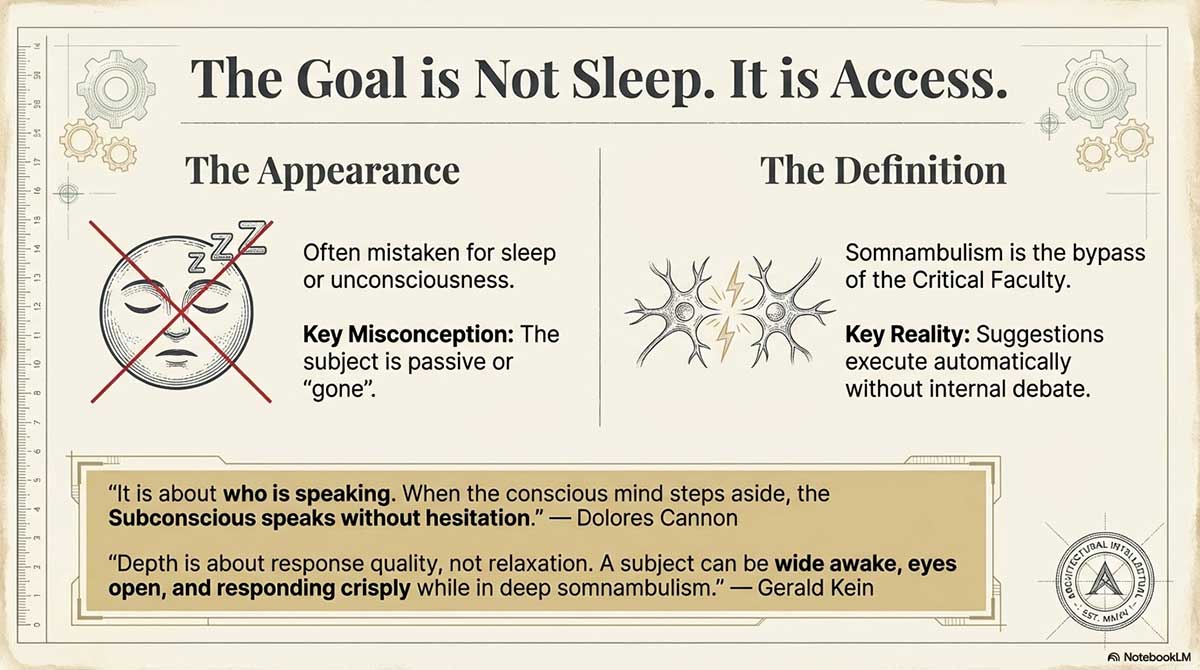
For me, somnambulistic is not about how relaxed someone looks. It’s about who is answering.
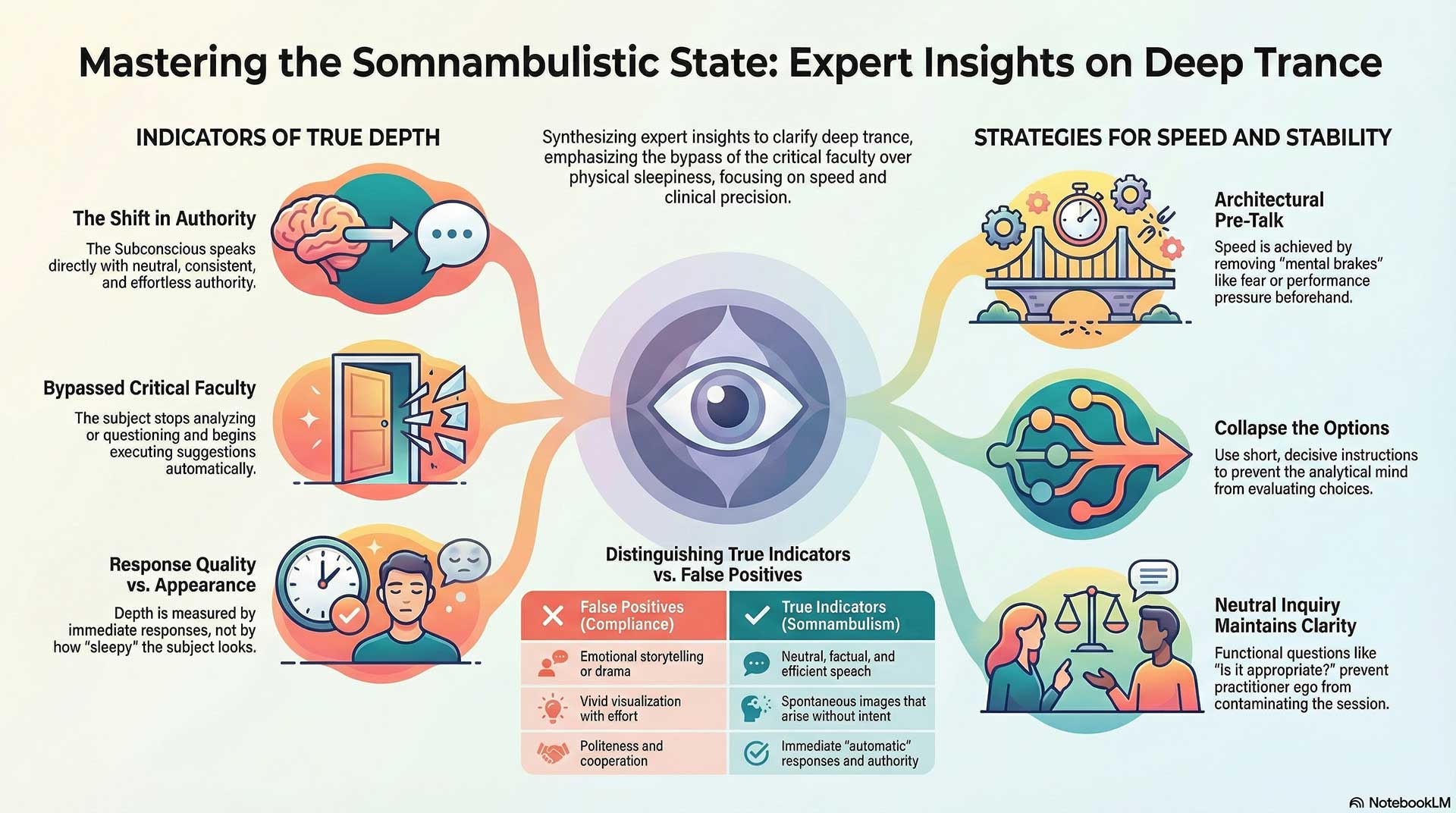
When the conscious mind steps aside completely, the Subconscious speaks without hesitation, without emotion, without storytelling. The voice often changes. The sentence structure changes. There’s no guessing. If I have to coax, they’re not there yet.
Dave Elman
I agree, but I’ll make it more mechanical.
Somnambulism means the critical faculty is bypassed. Period. If a subject can analyze, question, or wonder whether they’re doing it right, they’re not there. In true somnambulism, suggestions execute automatically, without internal debate.
Gerald Kein
And that’s where people get confused. They think depth is sleepiness. It’s not.
I’ve seen people wide awake, eyes open, responding crisply, and they’re in deep somnambulism. Then I’ve seen people drooling in a chair who aren’t even close. Depth is about response quality, not appearance.
Julia Cannon
In QHHT, we don’t test depth the traditional stage-hypnosis way. We listen.
When the answers come instantly, consistently, and with a perspective the client does not normally have, that’s our confirmation. Especially when healing instructions are given clearly and confidently. That doesn’t happen at medium depth.
Candace Craw-Goldman
I’d add something subtle.
In somnambulistic depth, the emotional charge disappears. Trauma can be described without reliving it. Past events are narrated without personal attachment. That neutrality is one of the clearest indicators for me.
Cal nods, then gently pivots.
Cal Banyan
So here’s the next problem. Many practitioners think they’ve reached somnambulism because the client is cooperative. What are the most common false positives you’ve all seen?
Dave Elman
Compliance.
A willing subject will follow instructions beautifully while still thinking. That’s not depth. That’s politeness.
Gerald Kein
Exactly. Another is visualization.
People assume that if someone can “see” a scene vividly, they’re deep. Visualization can happen at very light levels. It tells you nothing by itself.
Dolores Cannon
And imagination is often misunderstood.
People hear “you’re imagining it” and think that disqualifies the experience. In reality, imagination is the doorway. But when imagination stops being effortful, when images arise without intent, you’re crossing the line.
Julia Cannon
In QHHT, a big false positive is emotional storytelling.
If the client is embellishing, dramatizing, or trying to be interesting, the conscious mind is still driving. The Subconscious is extremely efficient. It doesn’t perform.
Candace Craw-Goldman
Another sign is inconsistency.
If answers change when you ask the same question twice in a slightly different way, you’re not deep enough yet.
Cal lets that sit for a moment, then asks the question that tightens the frame.
Cal Banyan
Let’s say you’re mid-session. You don’t want to break state. You don’t want to lead. What is the cleanest way to confirm somnambulistic depth without contaminating it?
Dolores Cannon
You ask neutral, functional questions.
Not “Are you the Subconscious?” but “Is it appropriate to answer this now?” The quality of the response tells you everything.
Julia Cannon
I look for authority.
When the Subconscious is present, it speaks as if it has jurisdiction. There’s no uncertainty. No checking in with the client’s personality.
Dave Elman
From my side, ideomotor response.
Automatic signals bypass conscious interference. If those responses are immediate and consistent, you’re there.
Gerald Kein
I agree, and I’ll add this.
The moment you feel the need to convince yourself, you’re probably not deep yet. Experienced practitioners recognize somnambulism because the work suddenly becomes easy.
Candace Craw-Goldman
Yes. Flow replaces effort.
When the questions feel like they’re being answered before you finish asking them, depth has stabilized.
The table goes quiet for a moment. Not an ending silence, more like alignment.
Cal leans back slightly, already moving the conversation forward in his mind.
Topic 2 :Fast Inductions That Still Hold Depth
Moderator: Cal Banyan
Participants:
Dolores Cannon
Dave Elman
Mike Mandel
Gerald Kein
Julia Cannon
Opening Scene
Same room. Same table. The tone shifts slightly. Less definitional now. More tactical.
Cal doesn’t recap. He assumes everyone followed.
Cal Banyan
Now that we agree on what counts as somnambulistic, let’s get practical. Everyone wants speed. But speed without stability is useless. So let me ask this directly.
What is the fastest path you trust to reach deep trance without sacrificing depth?
Dave Elman
I’ll answer bluntly.
Speed comes from decisiveness, not shortcuts. The Elman induction works fast because it removes ambiguity immediately. The subject is not eased in. They are directed. The mind responds to certainty.
Mike Mandel
Yes, and timing matters.
People think fast inductions are about clever techniques. They’re not. They’re about stacking compliance early. If I get three automatic responses in the first minute, depth follows naturally. Speed is cumulative.
Gerald Kein
I’d add this.
Fast does not mean rushed. It means no wasted language. Every word must do a job. If your induction contains anything decorative, you’re slowing yourself down.
Dolores Cannon
I come from a different angle.
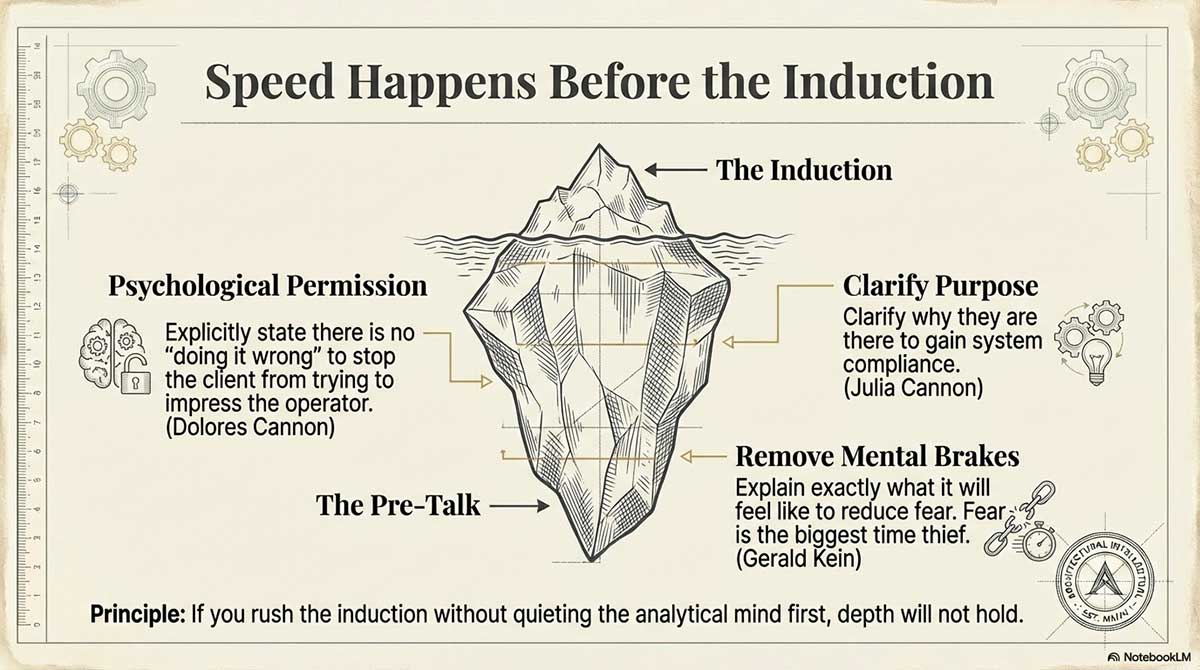
In QHHT, the speed doesn’t come from the induction itself. It comes from what happens before the induction. By the time the client lies down, they are already half there. That’s why I never felt pressure to rush the trance.
Julia Cannon
Exactly.
Many people try to “go fast” during induction, but they’ve done nothing to quiet the analytical mind beforehand. Then they wonder why depth doesn’t hold. Preparation creates speed.
Cal nods, then tightens the focus.
Cal Banyan
So let’s talk failure points. When a fast induction doesn’t hold depth, what usually went wrong? Technique, pacing, wording, or the client?
Mike Mandel
Wording. Almost always wording.
A single ambiguous phrase gives the conscious mind an escape hatch. Once it starts evaluating, speed is gone.
Dave Elman
I’ll say pacing.
Many hypnotists hesitate at the critical moment. They soften their voice, slow down, or check for approval. That hesitation invites resistance.
Gerald Kein
For me, it’s the practitioner’s doubt.
If you don’t expect depth quickly, you won’t get it. Subjects sense uncertainty immediately. Authority is not arrogance. It’s clarity.
Dolores Cannon
In my sessions, the problem was usually trying too hard.
If the practitioner is chasing depth, the client feels it. The Subconscious responds best when there is calm expectation, not urgency.
Julia Cannon
I see another issue.
Some practitioners confuse emotional release with depth. A client crying is not the same as a client being deep. Emotion can actually pull them out of somnambulism.
Cal pauses. Then asks the question that separates theory from mastery.
Cal Banyan
Imagine this scenario. You have two minutes. The client is cooperative but hovering at medium depth. What do you do in those first two minutes that determines whether the session becomes “deep and usable” or “deep but fragile”?
Dave Elman
I eliminate choice.
I give instructions that do not invite internal dialogue. When the mind stops choosing, depth stabilizes.
Mike Mandel
I anchor automaticity.
A physical signal, a response that happens before thought. Once that loop is established, depth maintains itself.
Gerald Kein
I simplify.
If something isn’t working, I don’t add more. I strip the process down until the subject has nothing left to manage.
Dolores Cannon
I listen.
The moment the answers shift from personal language to neutral authority, I stop pushing entirely. At that point, less intervention creates more depth.
Julia Cannon
And I trust the structure.
QHHT works because the flow is predictable. When the client feels held by a process, the mind lets go faster.
The room settles again. Not finished. Aligned.
Cal doesn’t close. He transitions.
Topic 3: The Client Setup That Makes Fast Possible

Moderator: Cal Banyan
Participants:
Dolores Cannon
Julia Cannon
Candace Craw-Goldman
Brian Weiss
Gerald Kein
Opening Scene
The conversation feels more like a craft meeting now. The table is the same, but the energy is different—less “induction talk,” more “architecture.” Cal Banyan taps a pen gently against a notebook, as if he’s about to diagram the invisible.
Cal Banyan
Most people obsess over the induction. But the fastest sessions I’ve ever seen were decided before the client even closed their eyes.
So let’s go straight to it: What should happen before the session so the client’s mind stops trying to perform and drops in faster?
Dolores Cannon
I always started with permission.
Not mystical permission—psychological permission. I explained that there’s no “doing it right.” The conscious mind relaxes when it realizes it won’t be judged. When clients stop trying to impress me, they go deep quickly.
Julia Cannon
In QHHT, the pre-talk isn’t small talk. It’s the foundation.
We spend time clarifying why the client is there, what they want answers to, and what will make the session meaningful. When the client feels the process has a purpose, their system cooperates. Speed comes from trust.
Candace Craw-Goldman
And I normalize the experience.
I tell them: “Some people see images, some feel, some just know.” The second you remove the pressure to visualize perfectly, they stop checking themselves every ten seconds.
Gerald Kein
I’d call it “removing the mental brakes.”
A lot of clients think hypnosis is something that happens to them. I correct that. I tell them exactly what to expect and what it will feel like. Clarity reduces fear. Fear is the biggest time thief.
Brian Weiss
I approach it through safety and curiosity.
When clients feel emotionally safe, their mind becomes exploratory instead of defensive. Curiosity is a quiet door into depth—especially for people who are skeptical but willing.
Cal nods, then turns the dial toward the analytical mind.
Cal Banyan
What is the best way to frame expectations so the analytical mind cooperates instead of resisting?
Gerald Kein
You don’t fight analysis. You recruit it.
I tell the analytical mind it can relax because it will get proof afterward. It doesn’t need to supervise every second. Give it a job later, and it stops interrupting now.
Dolores Cannon
Yes. And I’d say: you remove the “test.”
If they’re secretly testing whether hypnosis is real, they won’t go deep. I would explain that the Subconscious speaks differently—short, direct, neutral. That gives them a concrete sign to look for instead of analyzing every sensation.
Julia Cannon
I also emphasize that QHHT isn’t about talent.
People think, “I’m not imaginative.” But the session isn’t a performance. It’s a receptivity exercise. The analytical mind softens when you stop framing it as “visualization ability” and start framing it as “allowing.”
Candace Craw-Goldman
I use a simple reframe:
“If you’re wondering whether you’re making it up, that’s normal. Don’t wrestle the question. Just keep describing what comes.”
That removes the power struggle.
Brian Weiss
And I gently set the expectation that meaningful material can appear softly.
Not every memory is a movie. Sometimes it’s a feeling, a phrase, an impulse. When clients accept subtlety, they stop demanding spectacle. Spectacle-seeking blocks depth.
Cal leans in slightly. Now the common obstacle.
Cal Banyan
Alright. The classic line: “I can’t visualize.” Or “I’m not hypnotizable.”
What preparation changes that the quickest?
Candace Craw-Goldman
First, I stop treating it like a problem.
Then I say: “Great. We won’t use visualization as the main channel.”
Some people are kinesthetic. Some are auditory. Some are purely intuitive. Once they feel allowed to use their strongest channel, depth speeds up.
Julia Cannon
In QHHT, we often find that “I can’t visualize” really means “I’m afraid I’ll do it wrong.”
So we give them a safer target: describe sensations, emotions, impressions—anything. The moment they start describing, the doorway opens.
Gerald Kein
And we can be practical: not everyone is equally hypnotizable.
But most people can go deep enough for meaningful work with the right approach. You improve the odds by removing novelty: explain the process clearly, reduce uncertainty, and guide with confidence.
Brian Weiss
I sometimes ask them to remember something ordinary in detail—their kitchen, a drive they take often.
That “memory vividness” exercise shows them they can produce internal detail. Then the fear dissolves.
Dolores Cannon
And I remind them of something that sounds almost too simple:
The Subconscious is always there. The question is whether the conscious mind will stop interrupting. If you stop demanding proof and start allowing information, it begins.
The group falls into a quiet rhythm—like they’ve all seen the same moment a thousand times: the instant a client stops trying, and the session suddenly moves twice as fast.
Cal glances around the table, ready to shift into troubleshooting.
Topic 4: Why People Fail to Go Deep — and the Fix in 60 Seconds
Moderator: Cal Banyan
Participants:
Dolores Cannon
Mike Mandel
Cal Banyan
Dave Elman
Gerald Kein
Opening Scene
Same room. But now it feels like a troubleshooting clinic.
Cal Banyan puts the pen down, looks around the table, and speaks like someone who’s handled a thousand stalled sessions.
Cal Banyan
Alright. Most sessions don’t fail because the person “can’t be hypnotized.” They fail because something blocks depth and no one names it fast enough.
So let’s do this cleanly:
What are the top three reasons people stall at medium depth—and how do you spot each one early?
Mike Mandel
Number one: the evaluator.
You spot it because they keep checking: “Am I doing this right?” “Is this working?” Their breathing is calm, but their mind is narrating. The giveaway is micro-pauses before answers—as if they’re editing.
Dave Elman
Number two: lack of authority in the operator.
People like to blame the subject. But hesitation from the hypnotist is contagious. You spot it when the subject’s responses start waiting for permission—like they’re asking silently, “Was that okay?”
Gerald Kein
Number three: fear disguised as politeness.
They’ll agree with everything, but they won’t surrender control. You spot it because their compliance is perfect, but depth doesn’t increase. The body is cooperating; the mind is holding the wheel.
Dolores Cannon
I’ll add one that looks spiritual but is purely practical: performance pressure.
They want it to be meaningful. They want to please you. They want a cinematic experience. And that desire creates tension. You spot it when they give dramatic, story-like answers instead of neutral, simple ones.
Cal nods once, then tightens to the “fix.”
Cal Banyan
Now give me your fastest reset. The client is stuck thinking, evaluating, controlling. You have sixty seconds. What do you do?
Dave Elman
I remove decision-making immediately.
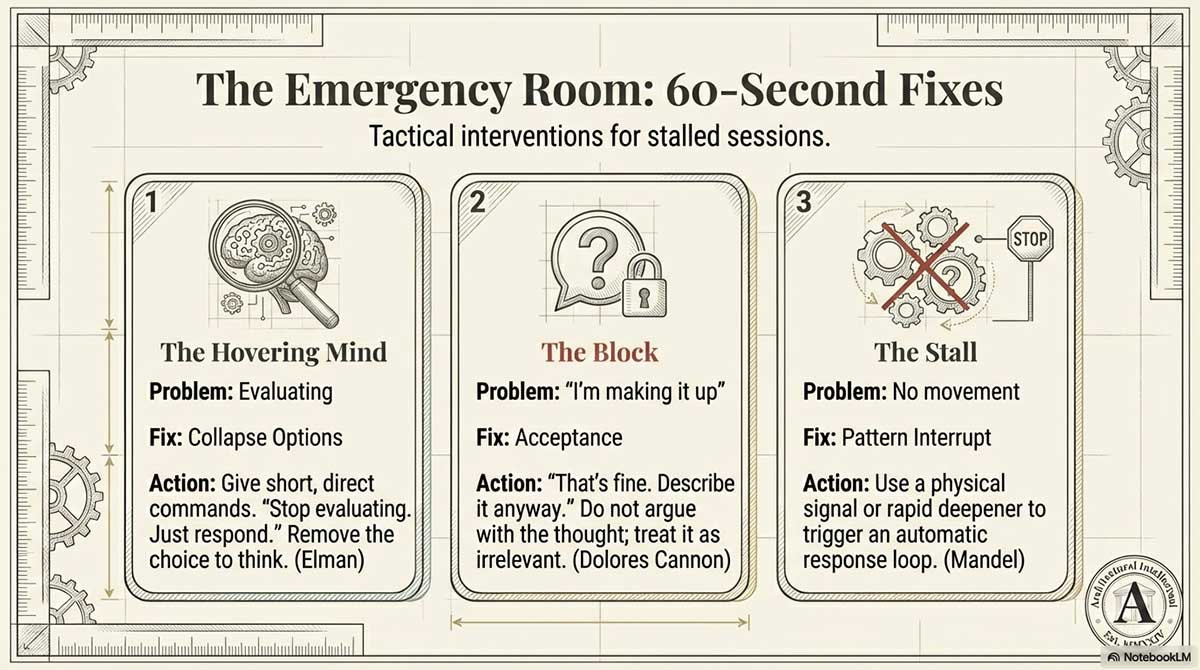
Short, direct instructions. No choices. No questions. The conscious mind stalls when it has options. So I collapse options. That’s the fastest way to bypass it.
Mike Mandel
I use a pattern interrupt plus automatic response.
Something physical and simple: a signal, a reflex-like action, a rapid deepener. When the body responds automatically, the mind follows. If you can create one clean automatic loop, depth jumps.
Gerald Kein
I simplify the entire task.
Often the client is trying to do too many things: relax, visualize, feel, answer, impress. I strip it to one instruction: “Just listen.” One lane. The mind relaxes when it stops multitasking.
Dolores Cannon
I stop chasing depth and I change the question style.
Instead of “What do you see?” I ask: “Tell me the first impression.”
If you ask for “impression,” the conscious mind can’t overbuild a story. It has to report. Reporting is closer to the Subconscious.
Cal lets that land, then addresses the most common poison phrase.
Cal Banyan
Now the killer thought: “I’m making it up.”
How do you fix that quickly—without suggesting answers or contaminating content?
Dolores Cannon
I tell them: “That’s fine. Describe it anyway.”
The moment you argue with the thought, you strengthen it. If you treat it as irrelevant and keep moving, it loses power. The Subconscious doesn’t need the conscious mind’s approval.
Mike Mandel
I reframe it: “Good. Let your imagination run—because imagination is how your unconscious communicates.”
Not “This is real.” Not “This is past life.” Just: “This is a channel.” That removes the courtroom.
Dave Elman
I’m even more direct.
I say: “Stop evaluating.”
Evaluation is the conscious mind’s job. You can evaluate later. Right now you respond. Fast, simple, immediate. The rule is: respond before thought.
Gerald Kein
I give them a clean contract:
“You can doubt all you want afterward. During the process, you follow instructions.”
This separates experience from interpretation. People relax when they’re not forced to believe anything.
Cal looks around the table like a coach about to end practice—but he doesn’t end it. He transitions again.
Topic 5: QHHT Session Flow — From Depth to Subconscious Communication

Moderator: Cal Banyan
Participants:
Dolores Cannon
Julia Cannon
Candace Craw-Goldman
Brian Weiss
Gerald Kein
Opening Scene
The same roundtable, but now it feels like the “real work” portion of a workshop—when everyone stops talking about getting deep and starts talking about staying clean. Cal’s tone softens, but the precision increases.
Cal Banyan
Alright. Let’s assume we’ve achieved true depth. The question becomes: what keeps the channel clear so the answers come from the Subconscious—not from guesswork, pleasing the practitioner, or storytelling? Dolores, start us off.
Dolores Cannon
In QHHT, the biggest shift is this: you stop interviewing the personality and you begin speaking to the Subconscious directly.
You don’t ask leading questions. You don’t praise or react dramatically. You become very neutral—almost boring. That neutrality is what protects the channel.
When the practitioner gets excited, the client’s conscious mind wakes up to manage you. That’s contamination.
Julia Cannon
Yes. I tell practitioners: your tone is part of the method.
If you sound impressed, skeptical, worried—anything—clients start adjusting. The cleanest sessions happen when the practitioner’s energy says, “This is normal. Keep going.”
And the structure helps. The client can relax because the process is predictable: regress, gather context, then move into Subconscious communication with clear intent.
Candace Craw-Goldman
I’d add: clean channel requires clean consent.
The Subconscious communicates best when the client’s system feels safe. If there’s pressure to “perform,” or fear of what might come up, you’ll get surface answers—nice answers—answers that keep everyone comfortable.
So you protect the session by protecting the client’s sense of safety. That’s not just kindness. It’s technique.
Gerald Kein
From my side, “clean channel” is really “clean responses.”
If the subject is pausing, editing, or decorating, they’re thinking. So the operator’s job is to keep responses automatic—short, direct, immediate. You can always ask for detail later. Depth loves simplicity.
Brian Weiss
And I’ve found that clients do best when you remove the philosophical burden.
If they feel they must prove reincarnation, prove history, prove something cosmic, they tense up. When they’re allowed to treat what arises as meaningful information—without forcing a belief—depth stays stable and the material becomes more coherent.
Cal nods, then leans in with the next pivot, the one every serious practitioner cares about.
Cal Banyan
Let’s talk question style. What phrasing produces the cleanest, most specific responses in QHHT—and what wording contaminates the session?
Dolores Cannon
The cleanest questions are functional and neutral.
Not “Are you Jesus?”—that invites theater.
Instead: “Is it appropriate to answer?” “What does this person need to know?” “Can you scan the body?” “Can you explain the lesson?”
Contamination happens when the practitioner wants a particular kind of answer—especially when they ask questions that contain the conclusion.
Julia Cannon
Exactly. Even subtle enthusiasm can turn into leading.
A simple rule: ask for information, not confirmation.
You don’t ask, “Is this a karmic contract?” You ask, “What is the origin of this pattern?” Let the Subconscious name it.
Candace Craw-Goldman
Another contaminator is over-explaining mid-stream.
When practitioners talk too much, the client’s conscious mind has more to respond to. Short prompts keep the channel clean. And when the client says “I don’t know,” you don’t panic. You ask: “What is your best impression?” That keeps it reporting, not inventing.
Gerald Kein
I’ll be blunt: the operator’s ego contaminates sessions.
If you want to be seen as profound, you’ll ask dramatic questions. Dramatic questions invite dramatic answers—often produced by the subject’s imagination trying to satisfy you.
Clean hypnosis is unglamorous. It’s accurate.
Brian Weiss
And sometimes the cleanest move is silence.
Clients need space for material to arise. When you fill the gap, you pull them upward. When you allow the gap, you let the deeper process complete itself.
Cal lets the silence do its work—then asks the question that protects the client and the practitioner equally.
Cal Banyan
How do you close the session so the client feels grounded, safe, and integrated—especially if intense material emerged—without leaving them open, raw, or confused afterward?
Dolores Cannon
Closure is part of the healing.
You don’t just “wake them up.” You return them to the body gently, and you make sure the Subconscious has completed what it intended—especially if healing was requested. Then you bring them back with calm certainty: they are safe, they are here, and they remember what is appropriate.
Julia Cannon
In QHHT, we emphasize integration.
Not “Here’s what it all means”—but “How does this help your life now?” You give them simple anchors: water, breath, time, a grounded conversation. And you keep it human.
Candace Craw-Goldman
I also watch for spiritual dizziness—people who feel too expanded after a powerful session.
So I guide them back to ordinary reality: their feet, their hands, the room, the present day. Then I encourage gentle self-care, not immediate life decisions.
Gerald Kein
Technically, I want them alert, oriented, stable—no fog.
And emotionally: I want them to feel ownership. If they think the power was in the practitioner, they’ll become dependent. If they understand the experience came from within them, integration becomes strength.
Brian Weiss
I’d add compassion.
Sometimes what heals most is the feeling that they were witnessed safely. When they leave with that, the session continues to work quietly over time.
Closing Beat
Cal looks around the table, not to end it, but to make sure the logic of the whole series has landed:
Depth is the entry.
Clean questioning is the craft.
Safe closure is the responsibility.
He smiles slightly—like someone about to move from theory into a real demonstration next.
Final Thoughts by Dolores Cannon
The most important thing to understand is this: the power was never in the technique.
Techniques help guide the mind, but the information, the healing, and the clarity all come from within the person themselves. My role—and the role of any responsible practitioner—was simply to create the conditions where that inner intelligence could speak without interference.
When the somnambulistic state is reached, there is no need to impress anyone. There is no need to dramatize the experience. The Subconscious communicates in a calm, factual way, because it is not trying to convince—it is explaining.
If there is one lesson I hope comes through in this discussion, it is that depth does not require struggle. When the conscious mind feels safe, respected, and unchallenged, it steps aside on its own. And when it does, the answers that emerge are often clearer than anything we could reason out consciously.
The work is simple, but it requires discipline. Neutrality. Patience. And respect for the process.
When those are present, the door opens—quietly, naturally, and exactly when it should.
Short Bios:
Dolores Cannon — A pioneering hypnotherapist and author best known for developing QHHT-style deep-trance sessions and popularizing the idea of direct “Subconscious” communication for insight and healing.
Julia Cannon — A leading teacher and organizer of QHHT training who helped systematize and carry forward the method, emphasizing consistent depth, clean questioning, and safe session structure.
Candace Craw-Goldman — A prominent QHHT practitioner and creator of BQH (Beyond Quantum Healing), known for modernizing training approaches while focusing on client safety, clarity, and practical results.
Cal Banyan — A professional hypnosis educator recognized for pragmatic, ethics-forward teaching and clear frameworks that help practitioners achieve reliable depth without mysticism or unnecessary complexity.
Dave Elman — A foundational figure in modern hypnosis training whose induction methods strongly influenced fast, repeatable paths to deep trance and the somnambulistic level used in clinical-style practice.
Mike Mandel — A well-known modern hypnosis trainer who teaches efficient, skill-based methods for achieving stable deep trance, with an emphasis on language precision and rapid troubleshooting.
Gerald Kein — A longtime hypnosis trainer associated with OMNI approaches, respected for depth testing, clean technique, and training practitioners to keep responses automatic rather than “performed.”
Brian Weiss — A psychiatrist and bestselling author who brought past-life regression into mainstream awareness and teaches gentle, safety-first regression approaches rooted in therapeutic framing.
Leave a Reply