

Prelude: The Girl Who Learned to Sound Harmless
Before the ghost, before the wedding that replaced a funeral, before the castle began whispering in faster, sharper registers, I had already learned the first lesson Elsinore teaches its daughters.
How to be small on purpose.
Not small in spirit. Small in surface. A careful, practised shrinking — the kind that keeps men calm, that persuades the world you are not a threat. In a court, threat is not only swords and soldiers. Threat is a woman who notices patterns. Threat is a woman whose memory is longer than the story she has been handed.
My father called this virtue. He had a name for every leash.
He called silence modesty. He called obedience wisdom. He called caution purity. He said a girl's value is safest when it is kept behind doors and guarded by men who believe they own it. He spoke those things with the quiet confidence of someone certain he was protecting me from the world.
He was protecting the world from me.
I did not understand that then. I only understood that the castle was full of rules that were never written down, only enforced — in where people stood, in who spoke first, in which eyes lowered when a door opened. In the way laughter stopped if the wrong person entered a room.
And because I was not foolish, I learned.
I learned to let my face remain pleasant while my mind raced elsewhere. I learned to speak in half-sentences so no one could accuse me of certainty. I learned to say *yes* in a tone that did not reveal whether yes meant agreement or surrender.
In the early evenings, when the castle quieted and the lamps made everything look kinder than it was, I slipped into the garden and collected small flowers. Nothing expensive. Nothing rare. The kinds of things that grew in corners where no one looked.
It began as a habit. Then a refuge. Then something else entirely.
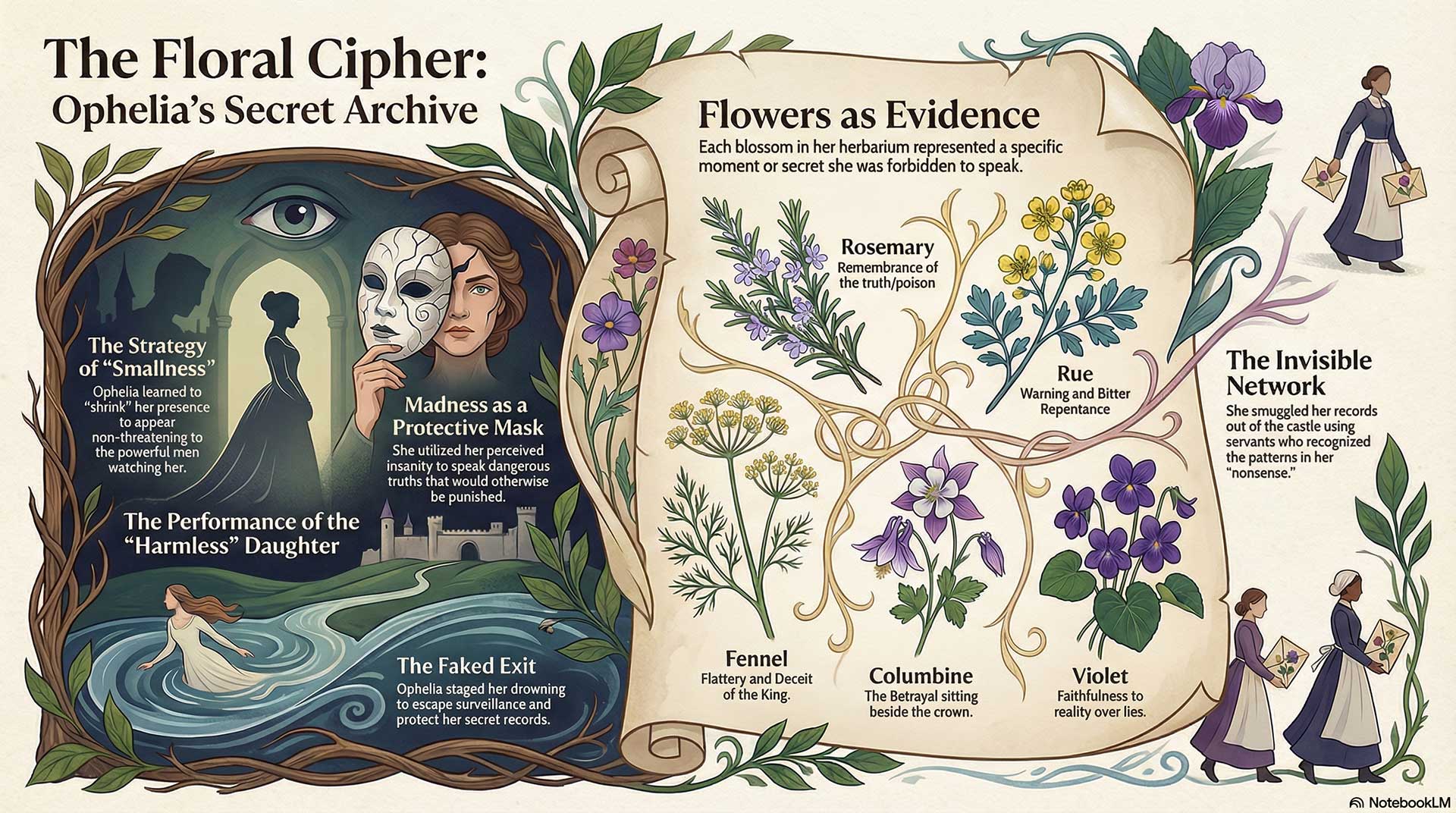
I pressed blossoms into a small book, one by one, and watched them flatten into something permanent. A violet, bruised dark at the edges. A sprig of rosemary, sharp and thin. Rue, bitter between the fingers. Even before I had a plan, I was building a place where memory could survive.
I did not yet know how much blood Elsinore would demand.
I did not yet know that my life would be reduced, in the mouths of men, to a single word.
*Mad.*
But I knew one thing, with the quiet certainty of a girl who has spent years watching how courts work.
If the day came when truth became dangerous, I would need a way to carry it.
Not in my voice. Not on my face. In something everyone believed was harmless.
(Note: This is an imaginary conversation, a creative exploration of an idea, and not a real speech or event.)
Act I, Scene 1: The Herbarium

A girl can live her whole life inside other people's sentences.
In Elsinore, words are not only spoken — they are weighed, traded, overheard and carried down corridors like bowls of soup, warm and dangerous. A woman's words are treated like something that might spill. So I began keeping mine in a book.
It is small enough to hide beneath folded linen, small enough to slide under the loose board near my bed where the wood lifts if you know where to press. Its cover is plain — not from humility, but from camouflage.
Inside, the pages hold pressed flowers.
They are delicate, yes. They are also evidence.
A violet flattened into a dark bruise, still faintly purple at the edges. A sprig of rosemary, thin as a wish. A pale petal that once looked innocent and now looks like parchment. Each one is a moment I could not say aloud.
At the small table by the window, I laid a white blossom between two pages and closed the book over it, my palms resting flat on the cover. Then I listened — because in Elsinore, silence is never empty. It is full of footsteps. Doors. The faint scrape of a chair, someone moving with purpose.
I rose and looked at myself in the mirror. Not to admire, not to judge. To adjust. That is what mirrors are for here. You shape your face into something acceptable. You smooth your dress so it does not suggest you have been alive.
The pleasant daughter. The obedient girl.
My father liked that face. He said it made me look virtuous. He said virtue was a woman's greatest wealth — and never once said it was also her greatest cage.
When I slipped the herbarium under my shawl and pressed it against my bodice, it felt like carrying a heartbeat that belonged only to me. The one thing I owned that did not belong to my father, my future husband, or the court's judgment.
I stepped into the hallway.
Footsteps approached behind me — my father's footsteps, arriving as they always did, as though Polonius were perpetually arriving at something important.
He came beside me at the window. "My daughter," he said, warm, as if affection were his natural state. "You are up early."
"Yes, Father."
He looked at me the way men look at women in Elsinore. Not with hatred, not with love. With assessment. A faint anxiety that something might slip through.
"You will see the prince today," he said.
I kept my eyes on the sea. "Yes."
"And what do you imagine you will speak of?" He said it lightly, as if it were idle curiosity. It was not.
"I will listen," I said.
My father smiled. "Very good. Listening is a rare virtue. Especially in the young."
He leaned slightly closer. "The prince is unsettled." He paused, choosing his next word as a man chooses a key. "You must remember that affection is not a promise."
There it was. The real lesson: love is unreliable; reputation is permanent.
When he turned away, satisfied, I stood a moment longer at the window. The sea glittered faintly.
Inside, the herbarium pressed against my ribs — hidden, and open.
Act I, Scene 2: The Court’s Listening Walls

The court looks bright in the morning. It wants to.
Gold catches sunlight. Tapestries soften echoes. Servants move like trained shadows, making the room appear effortless. But I have learned to measure Elsinore by its silences, not its splendour.
Voices travel strangely in the great hall. Some words carry; some vanish; some return to you later, twisted in another person's mouth.
I walked beside my father toward the dais, where Claudius sat with the queen at his side, and felt eyes touching me like fingers. A girl is always being examined here. If she smiles, she is vain. If she does not, she is proud. If she speaks, she is forward. If she stays silent, she is suspicious. The only safe thing is to be useful.
Claudius's voice filled the hall with practised ease — smooth words about duty, stability, the future. Smoothness is always a sign of danger in a room that has recently buried a king.
The queen looked lovely. She always does. Beauty is her armour.
I watched Hamlet standing apart, wearing black like a refusal. His face held not only grief but accusation. The court pretended not to notice, because noticing would mean admitting the air was poisoned.
When his eyes met mine, I felt my breath catch — not from romance. From recognition.
He saw too much.
My father murmured at my ear: "Do not stare."
"Yes, Father."
Claudius spoke again, trying to draw Hamlet in. "You are our cousin and our son."
Hamlet did not bow. Did not soften.
"A little more than kin," he replied, voice dry, "and less than kind."
The hall shifted — not loudly, not with gasps, but with a tension precise as strings pulled tighter. My father stiffened. Claudius smiled as if amused.
Hamlet went further. He spoke of mourning, of appearances, as if the court's brightness were a mask pressed over rot. The words had the quality of a stone dropped into still water — the ripples visible long after the surface seemed calm again.
When the assembly ended, my father guided me away quickly. In a quieter corridor, he turned.
"Hamlet is dangerous," he said. "Dangerous men are careless, and careless men make careless promises."
"I will be careful," I said.
He studied my face, searching for the shape of independent thought. He rarely found it, because I had learned to hide it — but sometimes I felt he sensed it anyway, like a man sensing a draught in a sealed room.
"You must understand," he said, "that you are seen. By everyone."
I lowered my eyes and nodded.
But I translated his warning into my own private language: *if everyone watches, then the watching can be used.*
Later, alone, I opened my herbarium and pressed a thin sprig of rosemary between two pages.
For remembrance. Not of love. Of evidence.
Act I, Scene 3: Hamlet’s Private Tenderness

Hamlet found me where the corridor narrows behind the gallery — a quieter passage where the floorboards speak softly and the tapestries swallow sound. Elsinore has many such places. None of them are truly private. They are only less public.
I knew he was coming before I saw him. The air changes when Hamlet enters it. He carries a pressure, the way a storm presses against sky without yet breaking.
"Ophelia," he said.
My name in his mouth was not a title. It was my actual name.
I turned, letting my face settle into the expression that causes no trouble. But something in his eyes undid the arrangement — the same thing that had always undone it: he was looking at me as if I were a person, not a function.
"You look well," he said.
No one looks well in Elsinore. We look arranged. "I am well," I replied.
He accepted the lie, too tired to argue with it. "Do you trust anyone?"
The question startled me. It was not polite. It was not romantic. It was the kind of question you only ask when you genuinely need to know.
My father's voice moved through my mind. *You are seen.*
"I trust you," I said.
Hamlet's eyes darkened, pained rather than pleased. "Do not."
He said it the way you say *do not touch the flame* — not to protect the flame, but because it burns even those who mean well.
I kept my hands folded. In Elsinore, touch is never only touch. It is a statement, a risk, a witness.
His gaze moved quickly to the tapestry at the end of the passage. His shoulders tightened. He was listening.
"I have been thinking," he said, louder, in a tone shaped for any ear nearby, "about how quickly people forget."
But his eyes held mine, and the hidden meaning landed: *they are rewriting me. They will rewrite all of us.*
I answered with two voices at once. "People forget what they are told to forget."
For a moment his face opened — the raw, startled expression of a man who has finally heard another living mind.
Then the mask returned. He stepped back, his voice rising into public air. "Tell me — what do the women say of the new king?"
A test. I felt the question's edges.
"I do not gossip," I said, also louder.
His eyes flashed once, approving. Then, just above a whisper: "My father did not die of weakness."
The words were simple. The implication behind them was a blade.
I felt my skin go cold. I did not ask how he knew. Questions are recorded here as disloyalty.
"I cannot prove it," he added. And that, I knew, was the true wound — not the knowledge, but the powerlessness of it.
"Then you must be careful," I said.
Hamlet laughed once, short and bitter. "Careful. You mean silent."
I did not deny it.
He searched my face again. I wanted to tell him what I had already learned — about the listening walls, my father's guiding hands, how Polonius could turn any sentence into a rope. But I could not say it plainly. Not here.
"You are not the only one who listens," I whispered.
Hamlet stilled.
A pause. A sharp inhale.
"Ophelia," he said, warning in his voice.
"You are not alone," I said quietly.
Something in his shoulders released — a man allowing himself a single breath after holding it too long.
Then footsteps sounded at the corridor's far end. My father's footsteps, brisk and purposeful.
Hamlet's face hardened immediately. He stepped away.
When Polonius appeared, beaming with courtly warmth, Hamlet turned to him, voice cool as iron.
"Excellent. I have been speaking with your daughter."
My father's gaze sharpened at once.
That evening, I opened the herbarium and pressed a small violet — dark at the edges. I did not write the word I was feeling. I only wrote, in my private cipher:
*The prince knows the world is lying. He needs proof. So do I.*
Act I, Scene 4: The Father’s Script

My father summoned me as if summoning were affection.
His study smelled of ink and wax and old leather — the scent of words that have been written down so they cannot be argued with. Shelves of ledgers lined the walls. If the castle had a heart, this was where it kept its accounts.
Polonius stood at the desk with a letter in his hand.
Hamlet's hand. I recognised the slope of the letters at once.
My father waited in the way of a man who believes patience is the same thing as power. He watched me see the letter. He watched me keep my face still.
"Do you know what this is?" he asked.
"A letter," I said.
"From the prince." He set it down like evidence, because it was.
He paced once, slowly — not thinking, performing the appearance of thought. "You have been seeing him," he said.
"He has spoken to me," I corrected.
My father nodded, as if approving my phrasing. He always approves phrasings that make me sound less like an agent and more like a surface.
Then he moved behind me. "Ophelia," he said, softer, gentle in the way he is always gentle before tightening his hold, "you must understand your value."
Your value. Not your mind. Not your will.
He returned to the desk and tapped the letter once. "The prince says he loves you. And you have listened."
"I did not encourage him," I said.
Polonius smiled faintly. "Encourage. Discourage. These are the little words girls use when they want to pretend they have no effect. You have an effect. That is the point." Then his voice sharpened — quick as a lash. "What have you told him?"
"Nothing improper," I said carefully.
He studied my face. He knew my careful voice — he had built it. It meant I was hiding something.
He did not push. He built a story instead.
"This is good," he said suddenly, with a brightness that made my stomach drop. "Very good." When my father says something is good, he has found a use for it. "The prince is unsettled. Desire makes men reckless. Reckless men can be guided."
He turned and held the letter between two fingers. "You will return his gifts. Refuse his letters. Appear wounded and virtuous. Let him speak — and bring me what he says."
I understood the shape of it in a single beat. He wanted me to be bait.
"Father—"
"The prince is a man," he said, cutting across me. "And men reveal themselves when they believe they are alone with a woman."
He placed the letter into my hands. The paper felt warm, as if Hamlet's fingers were still there. I wanted to fold it gently and carry it away — press it into the herbarium like the fragile thing it was.
Polonius watched me. I did not dare.
"You will do this," he said, quietly, without inflection. Not a question.
"Yes, Father."
"Good girl," he murmured. "You will save the state from disorder."
The state. The castle. The men. Never the girl.
He dismissed me with a wave of his hand.
In the corridor, alone, I paused by a stone column. A band of thin sunlight lay across the floor like a blade set down carefully.
I slipped Hamlet's letter inside the herbarium — not to preserve it as love, but as proof. Because my father's plan had made one thing certain: soon the prince would speak in a way the court could use against him. Soon I would be forced to play my part in the trap.
And when a trap closes, the only way to survive is to make certain the story cannot be entirely erased.
I pressed a small sprig of rue into the book that night. And wrote, in the smallest cipher I had:
*Father has written my lines. The prince will be watched. I will be used. But I will keep a second script. Mine.*
Act I, Scene 5: The Ghost’s Ripple

The first time I heard the word *ghost*, it did not come from a prince or a priest.
It came from a kitchen girl who was trembling so hard she spilled milk.
I was passing through the service corridor — warm with bread and damp wool, a kind of warmth the great hall never managed, not because it was kinder but because bodies were permitted to exist there without ceremony. The girl stood near the pantry door, hands white-knuckled around a pitcher, eyes wide and unfocused, fixed on something only she could see.
I might have walked past. That is what ladies do.
"What is it?" I asked softly.
She flinched, then looked at me with the desperate relief of someone who has been carrying something too heavy. "They saw him," she whispered. "The guards. On the platform. Last night."
She lowered her voice until it was barely breath. "The old king."
The pitcher trembled.
A ghost is never only a ghost. In a court, it is a message. A threat. An announcement that the past is not finished with the living.
"His armour shone," she breathed. "They swear it. They say his face looked like death itself. They say he stared at them like he wanted them to speak."
*Speak.*
Ghosts do not appear to be admired. They appear to be heard.
I thanked her quietly and continued down the corridor, but my heart was no longer calm. I traced the shape of the news — how it would travel. Guard to friend, friend to cousin, someone to a priest, someone to the right room. Step by step, it would climb until it reached Hamlet.
And when it reached Hamlet, it would not remain a story.
The castle had changed around me by afternoon — or perhaps I was finally hearing it properly. Doors shut more quickly. Laughter sounded forced. Claudius moved through the hall with his usual ease, but his eyes were sharper, counting exits. The queen walked beside him, her hand resting lightly on his arm, her face arranged into radiance. There is a difference between radiance and the decision to be radiant.
Then I saw Hamlet.
He stood alone near the chapel entrance — not praying, not moving. Simply standing as if the stone had grown into his shape.
I slowed. He looked up and found me. For a fraction of a second his face opened, and I saw the Hamlet I had known before the funeral, before the wedding, before grief became accusation.
Then it closed again.
"Your Highness," I said.
The title made him flinch. "You look frightened," he said quietly.
"I am not frightened," I lied.
"Everyone is," he said. "They're just frightened of different things."
I glanced quickly down the hall. Empty. But Elsinore does not need visible witnesses.
I leaned close and spoke the word as lightly as possible — as if it were a childish superstition.
"Ghost," I whispered.
Hamlet froze. The change in him was immediate, as if a key had turned inside his chest — relief and fury at once, twisted together. He turned away sharply, hands clenching, muttering something under his breath I could not hear.
Then he turned back, eyes intense. "Who told you?"
"A kitchen girl," I said.
He nodded once, as if the source confirmed the truth. Servants see what kings prefer to pretend they cannot see.
He stepped close again, urgent and low. "If anyone asks you what you've heard — you know nothing."
My father's script would have smiled at that. Obedience. Silence. The safe virtues.
But this was different. This was not control. This was protection.
"I understand," I said.
Hamlet held my gaze a beat too long, as if he wanted to say something human, something belonging to the world before all this. Then footsteps sounded at the corridor's far end. Polonius, brisk and purposeful.
Hamlet's face changed instantly. He stepped back. His voice became unreadable.
When my father appeared and smiled — that wide, courtly smile that looks like respect and functions like a net — Hamlet returned it coolly. "Excellent. I have been speaking with your daughter."
My father's eyes found mine, sharp and pleased.
That night, I opened the herbarium and pressed a thin, grey leaf. Not for mourning. For omen.
And wrote: *The ghost has entered the castle's mouth. Hamlet has swallowed the rumour like fire. Now everyone will watch him burn. But I will keep the ash.*
Act II, Scene 6: The “Nunnery” Trap
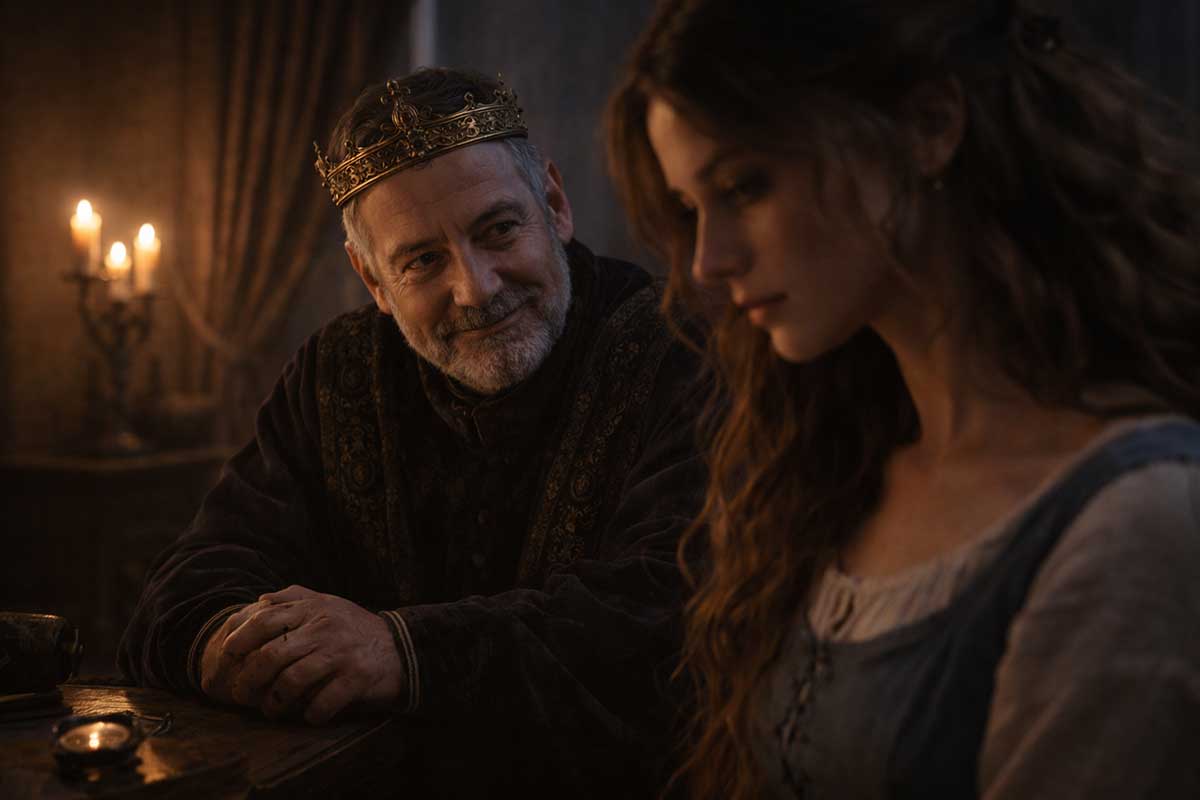
They told me to wear my innocence like armour.
My father said it softly, like a man offering wisdom — as if the advice were meant to protect me rather than position me. He stood in my doorway while a maid adjusted my collar, smoothing fabric that was already smooth. Men in Elsinore love to arrange women the way they arrange tables before a feast.
"Gentle," Polonius said. "Modest. Calm."
Calm. Always calm. It means: do not resist.
Behind him in the corridor, Claudius waited with his pleasant king's face. And near the tapestry at the far end of the gallery where I was to meet Hamlet — a barely visible shift in the fabric. A held breath.
My father had told me I would be alone with Hamlet. He had lied.
I took Hamlet's gifts in my hands — small tokens, letters, a ribbon that once smelled faintly of cedar — and Polonius held my gaze for a moment, searching for wavering. He found none. He never did.
"You will give these back," he said. "You will show him you are virtuous. And you will let him speak."
I nodded. "Yes, Father."
He guided me to the gallery: tall windows, ancestors staring from their frames, a polished floor that showed you your own reflection if you looked down. The light had been chosen deliberately — it would halo my hair, soften my face. Make me look believable.
My father backed away. Claudius disappeared behind a column. The tapestry absorbed my father's bulk.
I stood in the gift-wrapped silence and listened to the castle listen back.
Hamlet entered like a man who had wandered in by accident, but his eyes moved too quickly, scanning the corners. He stopped when he saw me.
Something complicated crossed his face — old tenderness, then pain, then a sharpening into guarded suspicion. He looked at the gifts in my hands and his jaw tightened.
"Ophelia," he said.
"My lord." I stepped forward, playing my part. "I have remembrances of yours that I have longed long to redeliver."
I watched his eyes flick toward the tapestry. A pause — small, almost invisible. He knew.
He could feel them.
"No," he said, voice low. "I never gave you aught."
We both knew he was lying. We were both speaking around the ears in the walls.
"My honoured lord," I said, gentle and clear, "you know right well you did."
His expression darkened, and his voice rose slightly — shaped for the hidden audience as much as for me. "Are you honest?" he demanded.
The question had nothing to do with virtue and everything to do with survival. *Are you yourself, or are you a puppet?*
"My lord, what mean you?"
He moved closer, voice dropping to a pitch that was nearly private: "Where's your father?"
My stomach twisted. Not random. A spear thrown at the tapestry.
"At home, my lord," I lied.
Hamlet's face changed completely. The tenderness gone; the pain sharpened into fury. He stepped back, and his voice rose, harsh and theatrical — performing, deliberately, for anyone positioned to hear.
"Let the doors be shut upon him," he said, "that he may play the fool nowhere but in's own house."
The tapestry shifted. Barely. An inch of revealed movement.
Hamlet turned back to me, eyes bright, almost feverish. "Get thee to a nunnery."
He said it like a blade — and then, with no warning, his voice broke open:
"I did love you once."
The truth, raw, in the open air.
Then it slammed shut again.
"I loved you not." Louder.
I understood what he was doing. He was cutting the cord between us in front of the watchers — destroying what could be used against him. Or protecting me. Or both. In Elsinore, cruelty and protection wear identical faces when fear is present.
"Why wouldst thou be a breeder of sinners?" His voice spiralled, words piling on words as if he were trying to empty something too large to keep inside. His eyes flicked once more toward the tapestry. Then: "Farewell."
He moved to the door. And at the last moment turned, and looked at me — not with fury. With something quieter.
*You are not safe here.*
Then he was gone.
Polonius emerged from behind the tapestry, flushed with triumph and worry. Claudius stepped forward, mask intact, eyes narrowed.
"See," my father said, "how he speaks of love."
Claudius stared at the doorway Hamlet had passed through as if he could still read the anger in the air. When he finally spoke, his voice was smooth. "Love? His affections do not that way tend." A pause. "This is dangerous. We must not let it grow."
I stood holding Hamlet's returned gifts and felt, with great clarity, what I had become.
The bait that had missed the spring.
I left the gallery with my face composed and my steps steady. Only in my room did my breath break.
My hands shook as I opened the herbarium and pressed a small cluster of pale petals. Then wrote:
*They watched him through me. He knew. He cut us apart in front of their eyes. The trap is set. Now the court will call him mad. And they will say it was for love.*
Act II, Scene 7: The Cipher Begins

After the gallery, the castle treated me like glass.
Servants moved around me more carefully. Ladies lowered their voices when I entered. Men looked at me with a new attention — not desire but calculation. I had become an instrument in a royal diagnosis. The prince's words had been poured through me, and now the court held up the cloth to see what stains had caught.
My father was pleased. His pleasure frightened me more than his anger ever had.
"Good," Polonius said when I gave him the safe version of what had happened. "He raves because he loves."
As if this conclusion were comforting.
That night I sat by the window and tried to make sense of Hamlet's words. *Get thee to a nunnery.* It came back to me like a bruise you keep pressing.
If the court's story was true, Hamlet had hated me. If Hamlet's eyes were true, he had been warning me. If both were true — then love in Elsinore was not love at all. It was a weapon that could be turned in any direction.
I pulled the herbarium close.
The court's great power was this: it could rewrite what people said. A phrase, lifted from its moment and carried into a different room, becomes something else. Meaning is portable and unreliable.
But it could not so easily rewrite what people *saw*.
Not if the seeing was arranged.
I turned to a fresh page and placed a sprig of rosemary flat against the paper. Pressed it carefully with two fingers until the oils kissed the page. Then a violet beside it. Then rue, sharp and bitter.
Remembrance. Faithfulness. Warning.
The page said nothing, and it said everything.
The next morning I carried flowers into the courtyard as if I were simply being feminine. I moved slowly and let the court see me. I did not stare at Claudius, at my father, at Hamlet. I watched everything from a soft, unfocused angle — a girl's drifting gaze.
Inside, I was arranging my cipher.
I noticed Claudius's patterns: how quickly he found Hamlet in a room, how his smile never softened his eyes, how he planted himself at the centre and made others orbit. I noticed the queen's hands — trembling only when she thought no one was watching, stopping halfway toward Hamlet as if love had become a forbidden gesture. I noticed my father's habits near doorways and curtains.
And I noticed the servants.
A maid lingering near a column, eyes down but ears alive. A kitchen boy pausing too long at a threshold. A guard's gaze flicking toward Hamlet then away. The castle was full of silent witnesses. People who saw without being permitted to speak.
That afternoon I found one of the older maids near the laundry room. Rough hands, quiet intelligence, the kind of woman who would never be asked what she thought — which made her dangerous in a way that the court had entirely failed to consider.
I approached her with nothing in my hands but the herbarium.
She startled. "My lady."
"It's only flowers," I said with a small smile, and opened the book to the page with rosemary, violet, and rue.
She stared at it. Then something shifted in her eyes — not full comprehension, but recognition. She understood that I was offering her something more than pressed plants.
"What is it?" she murmured.
"A way to remember," I replied.
Her hands trembled as she returned the book. "I understand," she whispered.
She may not have understood everything. But she understood the essential thing: *this is not nonsense. This is not decoration. This is a message.*
That night, I added thyme to a fresh page. Courage. Then fennel — flattery. Then a white chapel flower — innocence.
The page said: *Be courageous. Do not trust flattery. Wear innocence as disguise.*
I began carrying flowers more often. Court ladies commented.
"How sweet," one said.
"How fragile," murmured another.
Men glanced at the flowers and at me and dismissed both with the same indulgent contempt.
Good.
Contempt is freedom, if you know how to use it.
I carried rosemary when Hamlet passed — *remember.* I left rue near my father — *I see you.* I wore violets when Claudius spoke of stability, whispering to whatever walls might carry it: *faithfulness is not what lives here.*
No one confronted me. A girl cannot be accused of holding flowers.
But slowly, something began to happen. The older maid began positioning herself closer when I walked by. And once, in a corridor, Hamlet's eyes dropped briefly to the rosemary in my fingers.
His expression did not change. But his gaze held — just for a second — with a quality that felt like a hand pressed against a wall from the other side.
I returned to my room that night and opened the herbarium.
Then wrote: *The court thinks I am breaking. So I will break open a record. They will call it madness. I will call it testimony.*
Act II, Scene 8: The Play Within the Play

The night of the performance, the castle dressed itself like a lie.
Candles multiplied along the hall, bright enough to soften every harsh edge. Nobles arrived in their finest, faces arranged into public joy, as if enough candlelight could decorate a court out of grief.
Hamlet entered late — not from forgetfulness, but with the precise timing of someone who wants the room to feel his arrival. He moved through the hall with a strange brightness, as if he had swallowed something volatile and was holding it behind his teeth.
When his eyes found mine, he did not soften. He asked, without sound: *Are you watching?*
I gave the smallest nod. *Yes.*
He sat near me, closer than the court approved. My father's eyes narrowed across the room. Hamlet leaned toward me, voice light enough to seem playful: "Lady, shall I lie in your lap?"
The court flinched — almost audibly. I kept my voice steady. "No, my lord."
He smiled. It looked like humour. It was strategy. He was smearing his own reputation, making himself ungovernable, taking away the court's ability to hold him up as a symbol of anything clean.
"Do you think I meant country matters?" he asked, still loud, still bright.
"I think nothing, my lord," I said calmly.
Hamlet's smile vanished. For a moment his eyes found mine and the performance fell away entirely, revealing the raw nerve underneath. Then he turned to watch the stage.
But I did not watch Hamlet.
I watched Claudius.
The play moved into its crucial scene: a sleeping king, a nephew, a vial of poison. An act done quietly, efficiently, without spectacle. The hall held its breath.
At first, nothing. The king's mask remained intact — the faint curve of polite interest, the hands resting calm on the armrests.
Then, in a fraction of a moment: a tightening around the eyes. A shallow inhale he almost managed to hide. His fingers pressing harder into the armrest, whitening at the knuckle.
The queen leaned forward, puzzled.
Claudius rose.
"Give me some light," he snapped — and his voice was sharper than I had ever heard it, scraped raw at the edges.
As if light could burn away what had just been revealed.
The court stood in a wave, following the king's movement. But I remained still, watching Claudius cross the room with his back straight, his pace measured, restoring the mask with each step — and failing, slightly, to finish the restoration before he reached the door.
He did not leave because he was weak.
He left because he was calculating.
A man like Claudius does not flee in panic. He flees to change the story before the story changes him.
Already, voices were forming explanations behind me. *He is tired. Unwell. The play was in poor taste. Hamlet is cruel.* The machine, producing its output.
Hamlet turned to watch the departing court, face lit with fierce, trembling triumph. He had struck the nerve. He had forced the king to move.
But I had seen something Hamlet had not: the exact quality of Claudius's panic. Not the panic of a man confronted with an accusation. The panic of a man confronted with a mirror.
In my room that night, I pressed a leaf of laurel. Not for victory. For confirmation.
Then rosemary: *remember.*
Then fennel: *flattery is coming.*
And wrote: *The king rose at the poison. The mask slipped. The room saw it, then decided not to. Hamlet believes he has proof. I believe the king now has a plan. So I will keep recording — not the performance, but the reaction. The truth in Elsinore is never in what people say. It is in what their bodies cannot hide.*
Act II, Scene 9: Blood Behind Curtains

The corridor outside the queen's chamber was too quiet.
Not the gentle quiet of late night — the tight quiet of a place where people are holding their breath. Candles burned low. Shadows pooled in corners. The air smelled of heated stone and old perfume, as if the castle itself had been sweating.
I was not supposed to be there.
My father had sent me — not to do anything visible, but to be present in case a witness was needed later. "Stay near," he had told me. "There may be developments."
Developments. Another word that means danger.
Standing at the corridor's far end, pressed behind a pillar, I listened. The queen's door was closed. Two guards stood outside, faces blank. A servant passed and carefully avoided looking at me.
From within: Hamlet's voice, sharp and urgent. The queen's, strained. And beneath those — muffled, careful, breathy — my father's voice.
He was inside. Hidden. Listening.
*Always listening.*
I pressed my hand lightly against the herbarium beneath my shawl.
The voices inside rose. Hamlet's words cut through the wood: "Mother. You have offended."
The queen's reply, soft and broken. "Hamlet, thou hast thy father much offended."
Hamlet laughed — harsh, hollow.
Then: a startled cry. A scuffle. The sharp crack of impact against something solid.
And then a shout — unmistakable, from a man who had spent his life giving orders and never expected to need to give this one:
"Help!"
My father's voice. High with fear.
The queen gasped. Hamlet's voice rose into fury: "A rat? Dead, for a ducat, dead!"
A heavy thud. The sound of finality.
Then silence. Then the queen's scream.
The door flew open. Hamlet stood in the frame, face flushed and blazing. The queen behind him, hair disordered, both hands pressed to her mouth.
His eyes found mine in the corridor. Something crossed his face — recognition, and a terrible clarity. He turned back into the room.
I did not move.
I stood frozen while my body caught up to what my mind already knew.
My father was dead.
Not metaphorically. Not politically. Dead behind a curtain, killed in the act of eavesdropping — a man who had built his entire life around listening to other people's secrets, finally caught inside one of his own arrangements.
A servant hurried past me, face drained. Another ran, whispering. Guards exchanged helpless glances.
I moved toward the open door as if compelled by gravity.
He lay on the floor, half behind the tapestry, the fabric bunched and dark around him. His eyes were open. His mouth slightly parted — as if he had been about to say something and simply run out of time.
The sight of him hit me with a force I had not prepared for.
Hamlet stood over the body, looking down with a mixture of disgust and grief. "Thou wretched, rash, intruding fool," he said, voice bitter. "Farewell."
*Intruding.* He spoke as if my father were a function that had malfunctioned, not a man who had spent decades believing he was the one doing the controlling.
The queen shook, stripped of her radiance in a way I had never seen.
I stepped back. A maid touched my arm. "My lady. You must go."
Go where?
The fourth thought arrived like a blade between my ribs: my father's death would not be told as it had happened. It would be told as power required. Claudius would not say: *Polonius hid like a spy and was killed for it.* He would say: *Hamlet is mad and dangerous.* The queen would confirm it. The court would echo it. And the man who had spent his life controlling narratives would become one himself — reshaped, simplified, sanitised.
I walked back to my room as if dreaming. The corridors blurred. Voices followed me like smoke.
In my room, I slid down the door to the floor and pressed my forehead to my knees.
The grief came. I let it — silently, as a girl who has been taught that even grief should not disturb the house.
He had manipulated me. He had used me as bait. He had treated my mind as an inconvenience and my obedience as a resource.
He was still my father.
Both of these things were true at once, and they did not cancel each other out.
After the grief, numbness. After numbness, clarity.
I pulled out the herbarium. Not a flower this time — a torn black ribbon, the kind used to bind documents. I pressed it between the pages like a dead thing. Then rue. Then rosemary.
And wrote:
*Father is dead behind the curtain. The court will erase the curtain. They will erase the trap. They will say it was madness — Hamlet's madness — and use his death to justify whatever they were already planning.*
*But I saw the blood. I saw the hiding place. I saw the rewrite begin.*
*So I will keep the record. Not because I loved him easily. But because the truth does not belong to the clean story.*
*It belongs to the stain.*
Act II, Scene 10: The Controlled Girl

My father's death did not make the castle softer. It made it faster.
Everything in Elsinore accelerates after blood. Servants run more quietly. Doors close more quickly. Men speak in low urgent tones that pretend to be calm. The court is a machine, and when something breaks inside it, the machine does not pause to mourn. It shifts its gears.
The day after Polonius died, Claudius summoned me.
Not with cruelty. With concern. That was how I knew I should be afraid.
He received me in a small chamber warmer than the great hall, lined with tapestries, meant to feel intimate. Claudius sat in a chair that was not a throne but had been positioned to serve as one. The queen stood near the window, hands folded, her face pale beneath its beauty.
"Poor Ophelia," Claudius said, voice gentle. "How heavy this grief must be."
He offered the word *grief* like a cushion.
"Your father was a faithful servant," he continued. "His death is a tragedy. A tragedy born of disorder."
*Disorder.* Another word that means Hamlet.
The queen's lips parted as if she wanted to speak, then pressed closed again.
Claudius leaned forward. "You must not blame yourself," he said.
The sentence was perfectly crafted — it planted the idea that I might blame myself while appearing to release me from it.
"I do not blame myself," I said softly.
"Good," he murmured. "Your steadiness honours him."
*Steadiness.* It sounded like praise. It was a command.
The queen finally spoke. "Ophelia. I am so sorry." Her eyes were wet, and I believed her sorrow — which made it all the more painful that her sorrow was powerless.
Claudius stood. "We will take care of you," he said, and I knew exactly what that meant.
He dismissed me. A servant guided me out as if escorting something fragile.
As I returned through the corridors I noticed I was being watched more openly now. Not by servants but by guards. I had become a liability — Polonius's daughter, Hamlet's former love, a witness.
Then Laertes returned.
I heard the commotion before I saw it: shouting in the courtyard, boots pounding, doors flung open. Laertes had burst into Elsinore like a storm, surrounded by men, swords visible, his face blazing with the raw, uncomplicated fury of someone who believes he can force the world to be just.
I watched from a corridor window as Claudius stepped into the courtyard below, calm as a man stepping onto a stage.
"My good Laertes," Claudius called. "Why are you so rash?"
*Rash.* A gentle hand on a shoulder, disguised as a word. He did not meet my brother's fury with force. He met it with language. That is how he wins.
Soon Laertes was inside, and I was summoned — not to speak, but to be seen.
When my brother saw me his face changed. For a second I saw the boy he had once been — the one who had warned me about men, who had promised to protect me. Then grief hit him and his expression twisted into something fierce and broken.
"Ophelia," he breathed. He gripped my shoulders too tightly — needing proof I was real.
"They killed him," he said. "They killed our father."
In my throat: *yes.* In the room, with Claudius present, the queen watching, guards near the door, that yes could not be the whole truth.
"He was slain by the prince," Claudius said softly.
Laertes's eyes flared. "Hamlet."
"Yes," Claudius said, with great sorrow. "But you must know the truth of it. His mind is diseased. He is dangerous to everyone he loves."
*Dangerous to everyone he loves.* The sentence arrived with the precision of a hook.
I watched my brother receive it. Saw it enter him. Rage needs a shape, and Claudius was shaping this one: Hamlet the threat, Laertes the avenger, Claudius the statesman holding the realm together.
Laertes turned to me, desperate. "Tell me what happened."
The room held its breath.
I looked at my brother — his grief, his love, his readiness to be used — and said the only true thing I could say without destroying him in that room, in front of those ears: "I was not there."
He flinched. He understood that the court was between us even now, shaping even our grief.
He pulled me into a rough embrace, shaking. "I will punish them," he whispered.
"Justice must be done," Claudius said gently, moving closer. He placed a hand on Laertes's shoulder like a man claiming something he has paid for.
And my brother — my honest, grieving, furious brother — looked at the king with something like trust.
That night I opened the herbarium and pressed fennel. Then rue. Then a small violet.
And wrote:
*The king has taken our father's death and made it his shield. He has taken my brother's grief and made it his sword. He has taken my face and made it his proof.*
*If they want a controlled girl, I will give them a performance. And beneath it, I will keep the record that survives them.*
Act III, Scene 11: Madness as Testimony

They expected me to break.
It was the easiest story for them. A girl without a father, discarded by a prince, trapped in a court that uses women like cloth — wiping its hands on them and calling it duty. They expected tears, incoherence, collapse. They expected me to become a cautionary tale.
And I understood, in the moment I felt my grief begin to tilt into something sharper, that there was a choice inside this.
If I gave them the expected kind of breaking, they would close the book on me. *She went mad. It is sad. It is inevitable.* Then they would move on.
So I chose a different kind of breaking.
I would break open.
It began softly, in the corridor near the chapel. Two ladies fell silent when they saw me approach — that particular silence, sharp as a door gently shut.
"Good day," I said brightly.
They stared. One forced a smile. "Ophelia, how are you?"
"How should I be?" I laughed.
The laugh came too quickly. Too high.
Their eyes widened. The older lady glanced at the younger — the silent vocabulary of discomfort.
I stepped closer and asked for a song. They had no idea what to say. So I began one myself: soft, sing-song, the rhythm of nursery verses — the rhythm that men associate with harmless women.
A song about a maid deceived. About promises and broken vows. About death and a bed that will never be warmed again.
The words reached them before the sweetness could quite contain them. I watched the discomfort settle across their faces — that particular unease of people who cannot quite name what is wrong.
I stopped suddenly. Smiled. Held out a flower.
Rosemary. "For remembrance," I said.
The older lady took it automatically — politeness moving her hands before sense could stop them. She stared at the sprig as though it might sting.
I turned and drifted away, humming.
"She is mad," one whispered behind me.
"Poor thing," said the other.
*Poor thing.* The perfect cover. Pity makes people stop listening carefully.
In the queen's chamber, Gertrude received me with genuine, exhausted concern. Since my father's death, her composure had been worn too tight.
"How is your heart?" she asked.
"My heart?" I echoed, as if the word delighted me. "It is a little cracked."
She flinched.
I pressed a pansy into her hand. *For thoughts.*
Then I began to speak — half-singing, half-talking, in that strange rhythm that makes people uncomfortable precisely because truth keeps surfacing through the nursery rhyme meter like something coming up through ice.
I spoke about my father. About men who hide behind curtains and then claim honour. About how the walls already know everything they're trying to pretend.
Gertrude's face drained. "Ophelia. Hush."
"Why hush?" I asked, light and wondering. "The walls already know."
Her eyes darted to the corners, the door, the places where listening might be hiding.
She believed me. Not that I was sane. That I was dangerous.
Claudius arrived — summoned by the queen's fear — and his presence arranged itself in the room: measured, warm, assessing. "How now, sweet Ophelia," he said.
*Sweet.* The word used to make women into something edible.
I curtsied, wobbling slightly. "Majesty."
I stepped toward him and held out fennel.
His eyes tightened. He knew the old meanings — or perhaps simply knew that anything placed in his hand might carry a message. He took the flower. Then I held out columbine.
The air shifted. Claudius accepted the flowers with both hands and a smile, but his fingers held them too tightly.
"This is the poison of deep grief," he murmured to the queen. "We must watch her."
*Watch.* Yes.
Watch me, and not the record travelling quietly through the castle's lower places.
That night the older maid slipped into my room and shut the door.
"They are saying you have lost your mind," she whispered.
I looked up at her with calm eyes. "Let them," I said.
She stared at me. In the long silence, I opened the herbarium and turned it toward her — page after page of pressed flowers, patterns, repetition, meaning accumulated over weeks.
"This is a record," I said softly. "A testimony."
She swallowed hard. "What do you want me to do?"
"Carry what survives," I said.
Her hands trembled. Then she nodded.
I opened the herbarium and wrote: *Madness is the only language they will not punish. So I will speak it fluently. They will pity me. They will watch me. They will call me harmless. And while they watch the girl breaking, the truth will travel through the castle unseen.*
Act III, Scene 12: Smuggling the Truth

The next morning the castle treated me like a rumour given a body.
I walked through it all with my loose hair and my drifting smile, humming as if I were carrying nothing heavier than a tune. Inside my sleeve, the herbarium's edge pressed against my wrist. Inside my chest, my heart moved with the precise calm of someone who has stopped hoping for kindness and started building something more durable.
They were watching me openly now. That was the point.
When you want to move something precious through a guarded house, you do not sneak. You create a spectacle.
I chose the chapel corridor — narrow, busy, the stone carrying whispers further than most people realise. The older maid would be at the laundry stairs. I had seen her positioning herself there as I came down.
I entered humming, flowers loose in my hand. A lady-in-waiting crossed herself as I approached.
I began to sing.
The same sweet voice, the same childish rhythm — but today I changed the words. A line about a king who smiles. A line about a curtain. A line about poison poured where no one dares to look.
Faces shifted. Someone laughed nervously. Someone murmured, "Don't encourage her."
I stopped singing, turned a slow uncertain circle, as if searching for something misplaced. Then my gaze settled on the maid.
I drifted toward her with a wide smile and leaned in — too close, the way people expect the unhinged to lean — and placed rosemary in the cloth she was folding.
"For remembrance," I said brightly, loudly.
"Thank you, my lady," she murmured, eyes down.
While everyone's attention was on the flower, while the words were still sweet in their ears, my gloved fingers slid something small beneath the cloth. A thin folded scrap of paper. Inside it: a pressed violet.
The maid's hands paused — barely, barely — then continued folding.
I turned away and wandered on, humming.
At the far end, a guard watched me. Suspicious, but unfocused. He looked for sharp actions, quick movements, meaningful stares. He did not understand that slowness can be sharper than speed.
That afternoon I moved through the great hall, flowers and loose hair and bright smile, the court parting around me like water. Claudius was there, speaking with a counsellor. When he saw me his face softened into the particular warmth he reserves for things that need to be managed gently.
"Ophelia. How now?"
I curtsied poorly. Giggled.
The counsellor looked uneasy.
I stepped toward Claudius and held out fennel. He took it cautiously. Then rue — for him, and then a second sprig of rue turned toward the queen.
"And for me," I said softly.
*Rue for repentance. For what cannot be undone.*
Gertrude's face tightened. Claudius glanced at the flowers, then at me, his calm slightly strained at the edges.
"We must keep you safe," he said.
"Safe," I repeated, as if the word were funny. "No one is safe."
A flicker passed behind his eyes. He rose. "See her attended. She must not wander alone."
*Attended. Watched.* Perfect.
That night the maid returned.
"They are going to send the prince away," she said. "England. The guards say there are papers. Orders."
Orders.
I felt the castle's pace shift again. Claudius was moving faster. Removing Hamlet. Removing risk.
"What happened with the cloth?" I asked quietly.
She reached beneath her apron and produced the folded scrap. The violet still pressed inside.
"I hid it," she whispered. "Like you said. It will be found if something happens."
Good. The truth had left my hands. It belonged to the invisible now.
I opened the herbarium and placed it on the table between us.
She stared at it with reverence and fear.
"Tonight," I said, "you will take part of this."
Her hands trembled. "My lady—"
I slid my fingers into the herbarium's spine — a hidden seam — and removed several thin pages carefully torn from the back. Each one was pressed flowers arranged in a pattern. Each one was a record.
"This is what must survive," I whispered.
She nodded once, slowly, like someone accepting a weight that cannot be returned.
"Where?" she asked.
I told her in landmarks rather than sentences: the laundry stairs behind the third stone with the crack; the old chapel chest beneath the false bottom; and — she looked startled — the gardener.
"He sees everything," I said. "He is invisible."
She gathered the pages with both hands. A pause. Then: "If they catch me—"
"You are only carrying flowers," I said gently.
A shaky laugh. "Only flowers."
Yes. That was all. That was everything.
The court had dismissed flowers as feminine nonsense for so long that they had forgotten flowers could carry the weight of a testimony.
When the maid slipped out, pages hidden beneath her apron, my hands trembled. Not for myself.
I opened the herbarium to a fresh page.
Thyme. *Courage.*
Rosemary. *Remember.*
Rue. *Warning.*
And wrote: *The truth has left my hands. Now it belongs to the invisible. They can lock me up. They can call me mad. They can erase my reputation. But they cannot erase what is already hidden in the walls.*
Act III, Scene 13: The River Scene Reframed
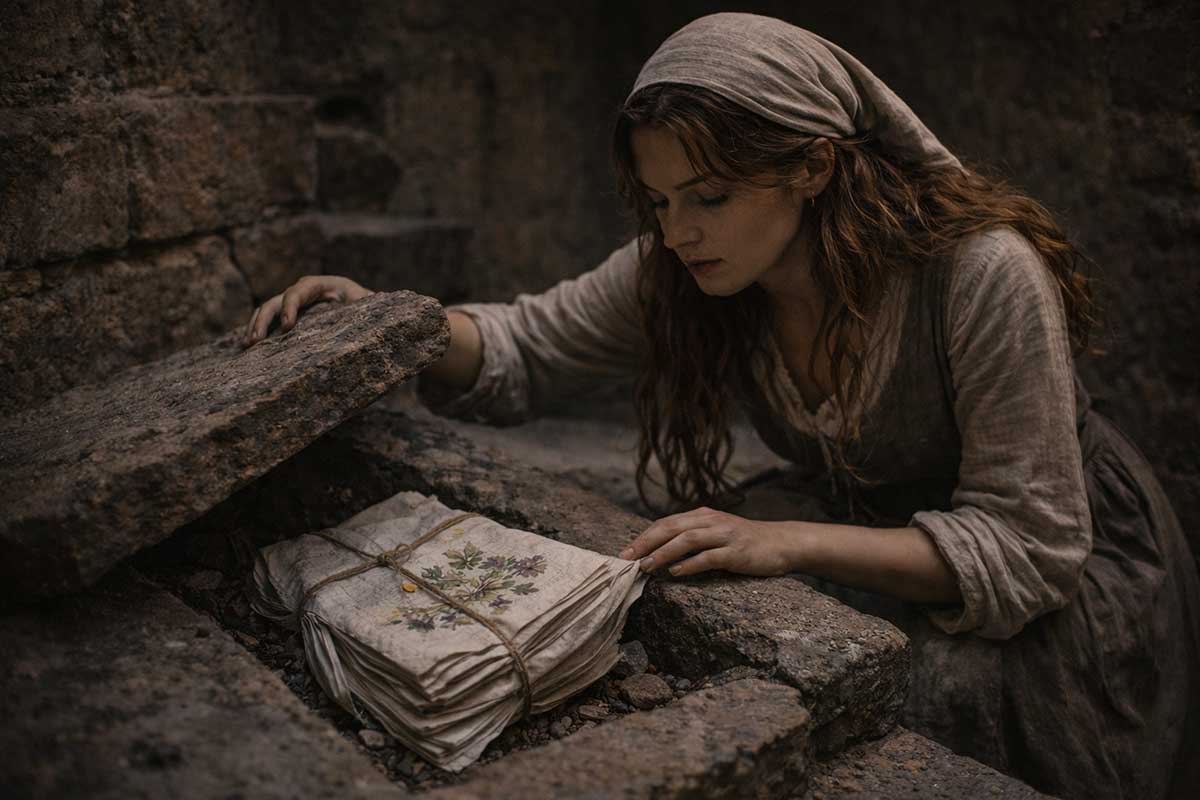
After the maid carried the pages away, the castle tightened around me.
Not with chains. With care.
Two attendants appeared at my door in the morning — faces polite, hands ready, sent by the queen to keep me close. Closeness as comfort. Surveillance wrapped in silk.
I let them follow. Let them speak softly behind me. Let them think I was drifting.
Because I had already moved the most important thing out of reach.
Now I needed to do one final thing.
In Elsinore, as long as you exist, you can be used. Claudius could hold me up as proof of Hamlet's madness. He could keep me near to control Laertes. He could lock me away "for my safety" and wait for my performance to crack into confession.
But if I was gone, the court would lose its easiest symbol.
So I prepared my disappearance.
The court would call it tragedy. They would call it inevitable. They would call it madness.
Good. Let them.
That story would protect the true story.
I asked to walk in the garden. The attendants exchanged a glance, then agreed. The garden seemed harmless — a place where women are encouraged to be delicate, where beauty blooms in neat rows, controlled and controllable.
We walked along the lavender path. I hummed. The attendants relaxed, their attention softening into boredom.
Near the far edge, where the path narrows and trees begin, I paused beside the willow. Its branches hung low, touching the air like hair.
The river moved quietly beyond it. Not far.
I had studied the river. I had noticed the narrow channel where the reeds grew thick and the bank rose steeply. I had done this three days ago, while the attendants were distracted and the gardener was watching from a distance, pretending not to.
I turned to them and smiled. "I want to pick flowers. I must do it myself — flowers don't like strangers."
One stepped forward. "My lady, we can—"
"No," I laughed, and drifted toward the willow.
Under its shade the air cooled. I knelt near the riverbank and picked slowly — rosemary, rue, violets. The three anchors. Then a few pale blossoms to make the scene believable.
Then I rose, stepped onto the low branch that stretched over the water, lifted my arms slightly — a girl balancing, a foolish girl — and turned to let the attendants see my face.
In that look I placed a message. Not for them to decode. For them to remember.
Then I slipped from the branch into the water.
Not screaming. Not dramatically. I slid in with a quiet splash, and the cold flooded my dress instantly. The current took hold of my skirt and pulled.
The attendants screamed.
I let the current carry me beneath the willow's curtain of branches where they could not see clearly, and then I moved. Not flailing. Not panicking. I kicked hard beneath the surface, pushing sideways into the reed channel, hauling myself toward the bank with both hands buried in wet mud.
My dress clung like dead weight. My fingers dug into earth. I pulled.
Behind me, the attendants' cries grew distant, distorted by water and distance. Footsteps on the opposite bank. Voices shouting. Panic spreading through the outer gardens.
I crawled into the reeds and lay there, soaked and shaking, listening.
Then, faintly, through the noise: "She fell. She's gone."
*Gone.*
Yes.
Gone from their hands.
I waited until the urgency moved back toward the castle, carrying the story like a gift. Then I rose and moved through the trees along the bank, staying low, until I reached the gardener's shed.
He was waiting.
He handed me a bundle — a rough, plain cloak, dry; bread; a coin; a simple pin for my hair. The tools of invisibility. He did it without ceremony, the way a man does something he has already decided to do regardless of consequences.
"Thank you," I whispered.
He nodded once. "Go. Before they come back."
As I slipped into the trees, the cloak wrapped tight, I felt the strange emptiness of becoming a ghost while still living.
The ghost rumour had started this. Now my own ghost would help finish it.
Behind me, Elsinore was already beginning to tell my death the way it preferred. They would say I drowned because I was fragile. They would say I was mad. They would say it was tragic.
They would never say the true reason.
*I disappeared so the record could survive them.*
And as I walked away from the river, my hands cold inside the cloak and the herbarium gone from my ribs — already distributed, already hidden in the castle's walls — I felt, for the first time in months, the strange lightness of being uncontrolled.
Not happy. But free.
Act III, Scene 14: Elsinore’s Blood Accounting

I learned what happened in fragments.
Whispers from servants who travelled outside the walls to buy bread. The nervous talk of a stable boy at dawn. The careful, measured voice of the gardener, who slipped out to meet me once more by the river path.
Each piece was a shard of the same mirror.
Hamlet had been sent to England as planned. They said it was for his safety, and used the word with the same soft precision they had used on me. Then the ship returned without him.
Not gently. As chaos.
Hamlet had escaped. No one said how. When the court cannot control a detail, it calls it accident or divine fate.
Hamlet returning meant Claudius's plan had failed. And when Claudius fails, he accelerates.
Laertes was the acceleration.
My brother had been kept close, fed, praised, given a story in which vengeance looked like righteousness. They told him I was dead. That I had drowned. That it was because Hamlet had killed our father.
I imagine Laertes hearing this and feeling the world split open. A brother's promise — I will protect you — becomes a wound when the sister is gone.
My death sealed him to Claudius completely.
"They buried a coffin," the gardener whispered. "Your name on it."
The thought sat in me strangely. My name on a coffin while I stood breathing among the trees. The court had committed publicly to the lie. A public lie is a fortress.
Then: the duel.
A fencing match, presented as honour. The nobles said it was sport. The servants said the blades were sharpened differently.
The gardener came to me pale and still. He stood for a moment without speaking, and I knew from his silence before he said it.
"The king is dead," he whispered. "Hamlet too."
I stood very still while the forest settled around me.
Hamlet. Whatever he had become — the storm, the grief, the fury, the recklessness — he had been the only person in that castle who carried truth like a fever. He had burned himself with it.
"What happened?" I whispered.
"Poison," the gardener said, looking away. "A sword. A cup. The queen drank."
Gertrude. Who had been trapped in her own way — in beauty, in comfort, in choices made too quickly and repented too late, in a love that had hardened into obligation without her quite noticing.
"And Laertes?"
The gardener's face crumpled. "Dead."
My brother, who had come home like fire. My brother, who had been handed a clean story of revenge and given no room to grieve honestly. My brother, sharpened into a weapon.
I closed my eyes for a long moment.
The court had eaten everyone.
Then: "A foreign prince," the gardener added quietly. "Fortinbras. He has arrived."
So the castle would have a new story. A new ruler. A new set of faces arranged into stability. The blood would be scrubbed from the floors. The furniture would be rearranged. Official grief would be declared. Official grief is always tidy.
And the official story of what had happened — of Hamlet, of Claudius, of my father, of me — would become whatever the new power needed it to be. They might call Hamlet noble. They might call him mad. They might erase Claudius's guilt for the sake of peace. They might bury the truth with the bodies and call the burial mercy.
They would certainly bury me. A decorative tragedy attached to the larger one. The poor drowned girl. The mad, petal-strewing daughter. The cautionary note.
I walked that night to the edge of the river, where the willow still hung over the water.
The river moved steadily, reflecting nothing. Water does not care who is king.
I thought of Hamlet's eyes the last time he looked at me. Of my father's mouth, slightly open, the sentence he didn't finish. Of Laertes's hands gripping my shoulders, shaking. Of rue pressed into Gertrude's palm.
I stood there until the cold stopped feeling like cold and started feeling like clarity.
Then I whispered to the river, not expecting to be heard: *You will not be entirely erased. Not while the testimony remains in the walls.*
Act III, Scene 15: The Survivor’s Archive

When the new banners went up, the castle looked almost clean.
That was the first cruelty of peace.
I remained outside the walls for two more days, watching from the forest's edge — an animal that has learned the hunter's patterns. I slept in the gardener's shed wrapped in rough wool. I ate bread in the dark and watched Elsinore reorganise itself around a new centre of gravity.
On the third morning, the gardener brought news: Horatio was still inside the castle.
Horatio — Hamlet's closest friend, the one who had been standing at the edge of every catastrophe, the one Hamlet had trusted above all others. A scholar. A witness. A man the new court would not yet have found a use for.
I told the gardener what to do.
He returned two hours later. Shook his head, then paused, then corrected himself with a small nod. "He will come," he said quietly. "Tonight."
Horatio arrived after dark, slipping through the garden gate with his hood up and his face grave. He stopped when he saw me, startled — and then still in a way that told me he had already understood, on some level, that something impossible was standing in front of him.
"You're alive," he said.
"Yes," I said. "And I have something for you."
I told him about the herbarium. About the pages hidden in the laundry stairs, the chapel chest, the places I had memorised and mapped. The old maid. The patterns. The cipher.
Horatio listened without interrupting. He had the scholar's discipline of listening as though the words mattered.
When I finished, he was quiet for a long time.
"Hamlet asked me," he said finally, "to tell his story. To tell it honestly."
"Then tell mine alongside it," I said. "Tell the part that happens below the great speeches. The part in the corridors, behind the tapestries, in the cipher that no one thought to guard."
Horatio looked at me carefully. "Who will believe it?"
"Some won't," I said. "But the evidence exists. The record exists. And evidence has a long life. Longer than any story the court tells about itself."
He nodded slowly. The gesture of a man who has just added something to the weight he agreed to carry.
We arranged the practical things — the pages would be retrieved, in the right order, by people who knew where to look. Horatio would carry what he could. The rest would remain buried, waiting for the moment when someone was willing to look.
He left before dawn.
I remained at the forest's edge until the sun was properly up and the castle was bright with morning — gold on the stone, windows catching light, the whole impossible, beautiful, blood-soaked machinery of Elsinore looking, from here, almost peaceful.
I thought of my father, who had tried to govern by controlling what people knew. I thought of Claudius, who had tried to govern by controlling what people believed. I thought of Hamlet, who had tried to govern by forcing the truth into the open at any cost — to himself, to everyone near him.
All three of them were dead.
The truth, hidden in pressed flowers and cipher and a scholar's careful testimony, was not.
I pulled the plain cloak around my shoulders and turned away from the walls.
Somewhere ahead of me was a road. Several roads. A world that did not know my name, which was, for now, the greatest luxury I could imagine.
I was not healed. I was not safe. I did not know where I would go or what shape my life would take when I arrived there.
But I had done the one thing Elsinore had spent months trying to prevent.
I had kept the record.
And I was still here.
Epilogue: What History Chose to Remember

History remembered the flowers.
Not what they meant. Not the system of symbols pressed into the herbarium's pages or the pattern of placement that had allowed a young woman to smuggle testimony through a watched castle. Not the cipher, the pages beneath the chapel floor, the courage of a maid with rough hands and quiet eyes.
History remembered a girl with loose hair and petals, singing in a strange key, and concluded she had gone mad.
That is what history does with women who carry evidence in containers no one thinks to search.
Horatio wrote what he could. He told the story with as much honesty as the new court would permit — which was most of it, but not all of it, and with certain emphases that reflected what his audience could bear. Hamlet's anguish, his father's ghost, the poisoned court. These were the things people wanted to understand, and so these were the things that survived most completely.
My part survived as a kind of footnote to Hamlet's grief. The tragic beloved. The innocent victim. Ophelia, poor Ophelia, who broke under the weight of a world too heavy for her.
But the pages under the chapel floor were found, years later, by a priest who was cleaning and noticed a false bottom. He could not read the cipher, but he recognised, with the instinct of a man familiar with sacred texts, that the markings were deliberate. He kept them. His successor kept them. The chain of keeping was unremarkable and therefore unbroken.
And the maid — who lived to old age, and had children, and told them what she had done without quite explaining why — left behind a pressed violet in a box with her few possessions. Her granddaughter found it and kept it because it was the most deliberate thing in an otherwise ordinary collection. She could not have said why the violet felt important. She kept it anyway.
That is how testimony survives. Not dramatically. Not in a single heroic act of revelation.
It survives in the chain of small keepings.
In the maid who held the pages for twenty seconds in a busy corridor.
In the gardener who provided a cloak and a coin and asked no questions.
In the scholar who chose to say *I will tell it honestly* and meant it, imperfectly.
In the granddaughter who kept a flower she did not understand.
And in the girl who understood that if truth cannot be spoken aloud, it can still be pressed between pages and left in the walls.
History remembered the flowers.
It simply forgot that flowers were the point.
Short Bios:
Ophelia — Daughter of Polonius. In this retelling she survives, stages her death, and becomes the hidden archivist of Elsinore’s truth.
Hamlet — Prince of Denmark whose search for justice ignites the court’s collapse; brilliant, perceptive, and ultimately consumed by the system he tried to expose.
Claudius — King of Denmark who maintains power through control of narrative, manipulation of grief, and carefully crafted appearances of mercy.
Gertrude — Queen torn between affection and survival, gradually recognizing the cost of the world she chose to remain inside.
Polonius — Court counselor who believes surveillance is loyalty; dies behind the curtain while attempting to manage truth.
Laertes — Ophelia’s brother, honest in grief but weaponized by the king into vengeance.
Horatio — Hamlet’s loyal friend and the only official survivor allowed to tell the public version of events.
The Gardener — A quiet observer among the working class who helps preserve Ophelia’s hidden record.
The Maid — Palace servant who risks her safety to carry the coded testimony beyond the court’s control.
Fortinbras — Foreign prince who inherits the throne and stabilizes Denmark after the royal family destroys itself.
Leave a Reply