

|
Getting your Trinity Audio player ready...
|
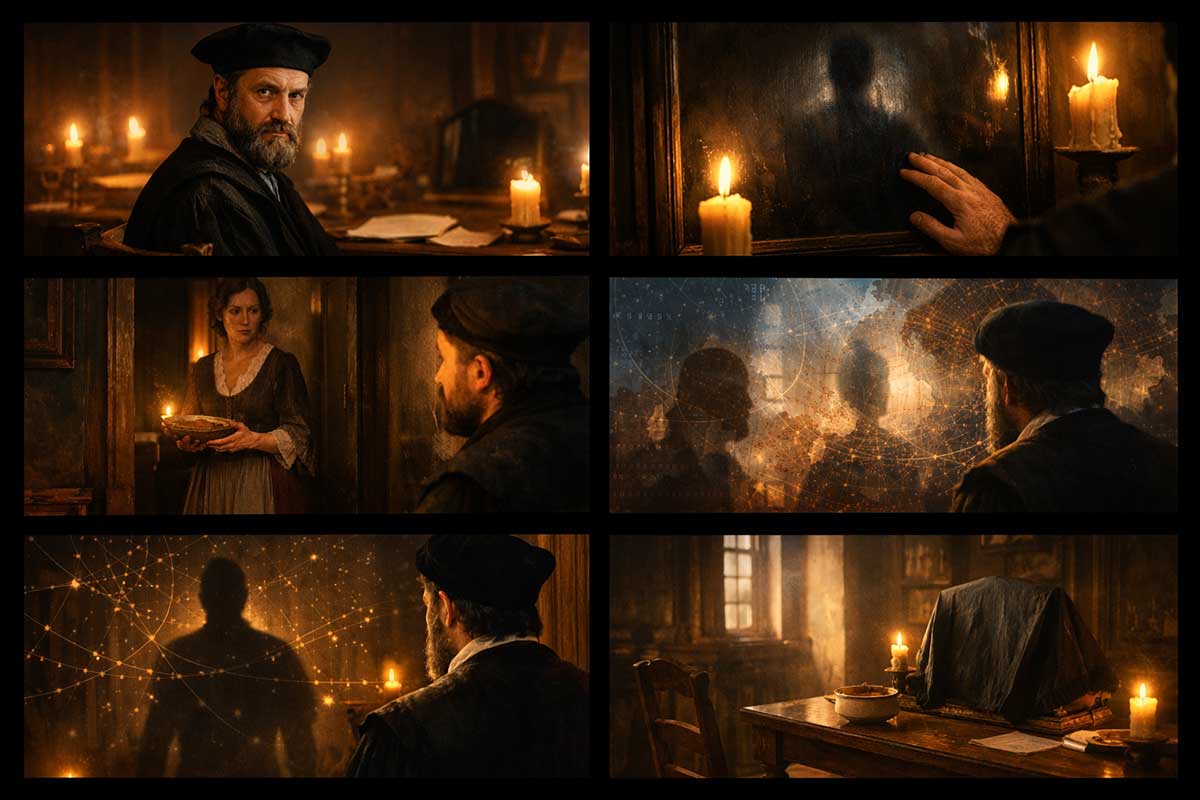
What if Nostradamus spoke directly with Dolores Cannon across time to warn us that the future could still be changed?
Introduction by Nostradamus
I write these words not as prophecy, but as confession.
I was trained to measure the stars, to grind herbs, to set broken bodies back into order. I believed that knowledge, when disciplined, could be made harmless. Yet there came a night when knowledge crossed a threshold I had not marked, and I found myself speaking not to the dead, nor to angels, but to a voice that stood beyond the narrow corridor men call time.
Understand this first: I do not see the future as men imagine it, laid out like a road. What came to me came sideways, through glass and shadow, through interruption and fear. It arrived while my wife called from the doorway, while a maid hesitated with a bowl of stew, while candles bent their flames toward a mirror that should have reflected only my own face.
The woman who spoke to me did not belong to my century. Of this I am certain. Her presence carried no weight of flesh, yet it pressed upon my thoughts as firmly as any living witness. I sensed that she stood in a later age, one that had learned to speak across distance without crossing it, to question without kneeling.
She asked me not what would happen, but whether it must.
This is the origin of my quatrains, and also their limitation. They are not commands from heaven. They are warnings etched under duress, written while one ear listened for footsteps in the hall and the other strained toward a future that did not yet know its own name.
If these pages unsettle you, it is because they were never meant to comfort.
(Note: This is an imaginary conversation, a creative exploration of an idea, and not a real speech or event.)
Topic 1: The Mirror That Found a Voice
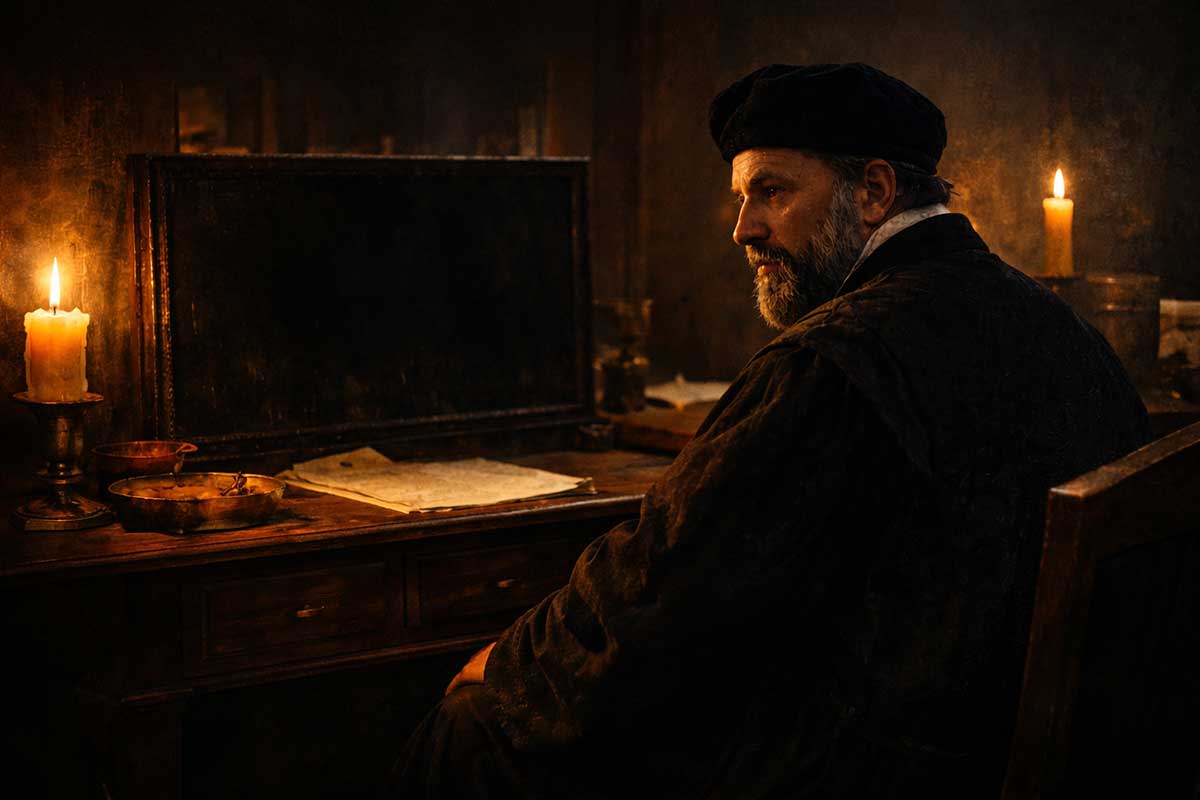
I have learned to distrust silence.
Silence, in my house, is never empty. It is only waiting to be filled—by a footstep on the stair, by the click of a latch, by the hush of a priest’s curiosity that arrives wearing courtesy.
Tonight the candles burn low, not from neglect, but from caution. I prefer the flame small when I work. A large light invites the world to look back.
The mirror sits where it always sits: a disk of black stone, polished until it becomes less an object and more a depth. In daylight it is nothing—an ornament, a curiosity. At night, when the shutters are tight and the air itself seems to listen, it becomes a mouth that does not move.
I lay my hand near it, not upon it. One does not touch the threshold. One does not knock on the door and expect the door to remain a door.
I breathe. I let the breath lengthen. I allow my mind to loosen the knot of hours.
The old method—herbs, prayers, the slow removal of the world—still works. Even when the world mocks. Even when my own doubts sharpen their knives.
And then it happens: the sense of another presence, not behind me, not beside me, but through—as if the room has acquired a second interior.
I do not look directly into the mirror at first. That, too, is a rule. One approaches as one approaches a wild animal: sideways, without triumph.
A voice arrives.
Not in the way the living speak. No breath, no throat, no warmth. It is thought that has learned to mimic speech. It is meaning shaped into sound within my skull.
It is a woman.
Not my wife. Not any woman I have ever known.
The sensation is like cold water in the chest.
I have seen strangers before—faces in the dark water of visions, bodies in the fever of plague, armies that had not yet been born. But this is different. This is not a picture. This is attention turned upon me.
I feel myself stiffen. My first instinct is anger—because fear will always dress itself as anger when it wishes to save face.
“Who are you?” I whisper, and my whisper seems too loud.
The answer comes softly, carefully, as if she fears to break something delicate between us.
“I am… listening.”
That is the first impossible thing: the humility of it. Spirits do not speak with such restraint in the stories people tell. Demons do not announce themselves as listeners. And yet the room receives her words as if they belong here.
I shift my chair an inch away from the mirror, and the mirror reflects only candlelight. I do not want my eyes to betray me. I do not want my body to confess that I am speaking to air.
“This is not permitted,” I say. “If you are a temptation, you have chosen the wrong house.”
The voice holds steady. “I don’t want to harm you.”
I almost laugh, but the laughter dies before it is born. The times have cured me of easy mockery. People are burned for less than a sentence.
I draw in a slow breath. I ask the question that matters.
“From where do you speak?”
A pause. The smallest hesitation. Then: “From… far.”
Far. Not a place, but a distance that has nothing to do with roads.
The mirror’s darkness thickens. It becomes not a surface but a corridor. And for one fleeting moment I feel the shape of her presence—as if she stands on the other side of a pane, not glass, not stone, but something like the skin of a dream.
I swallow. My tongue tastes of iron.
“This—this is beyond the limbo,” I say before I can stop myself.
It is an old phrase, one I used once as a boy to frighten myself. Limbo: that imagined borderland, neither mercy nor fire. Beyond it is not theology. Beyond it is… unnameable.
The moment the words leave me, a chill travels down my arms. Because the phrase does not feel like my own invention tonight. It feels like recognition.
The voice answers quietly, as if she has heard the phrase before, as if it belongs to the architecture of what is happening.
“I don’t understand all of it,” she says. “But I can hear you.”
I glance toward the door. I listen for footsteps. Nothing. The house breathes.
I should end it. I should stand, douse the candles, and cross myself into the ordinary. I should return to medicine, to poultices and fevers and the clean obedience of flesh.
Instead I speak again.
“If you can hear me,” I say, “then you must know what I risk.”
“I do,” she replies. “I’ll wait if someone comes.”
That is the second impossible thing: she speaks as if my life is real to her. As if my wife has a voice. As if the maid is not an abstraction.
My wife, as if summoned by the very thought of her, calls from beyond the hall—sharp, practical, alive.
“Michel! The stew is ready!”
I close my eyes.
There it is—the crude pin that pops the balloon of the extraordinary. Stew. Salt. The small tyranny of supper. The world insisting on itself.
My throat tightens. I answer my wife with a voice that tries to sound ordinary.
“In a moment.”
Then, to the presence: “You see?”
“I see,” she says.
And I do not like the way she says it—gently, as if she sees more than she should.
I lean toward the mirror, not with devotion, but with warning.
“You must not linger,” I tell her. “Not here. Not now. If the maid comes in and thinks there is a ghost, she will scream. If she screams, neighbors will come. If neighbors come, questions follow them. Questions bring priests.”
“I’ll be quiet,” the voice says.
“It is not quietness I fear,” I answer. “It is witness.”
My hand trembles, and I tuck it under the table so I will not see it. Even alone, I refuse to look weak.
The voice lowers, as if she understands the weight of my word.
“Then tell me what you want,” she says. “Why did you reach?”
I stare into the mirror at last.
And there—only darkness, only candle, only my own pale face refusing to become a confession.
I speak as if to myself, because perhaps that is what I am doing.
“I have written,” I say, “and what I have written is breaking in other people’s mouths. They chew it like hard bread and swallow the wrong meaning. They will not be ready.”
“Ready for what?” she asks.
“For the turning,” I whisper.
A third impossible thing occurs: the sense that she is not merely hearing me, but holding open a passage in time, a narrow seam. A thread that could snap if I pull too hard.
So I do what I have always done with dangerous things.
I turn them into work.
“If you truly are from far,” I tell her, “then you have books. You have my verses.”
“I do,” she says.
“Then listen,” I reply, and my voice becomes almost calm—almost professional, as if I am again a physician dictating a remedy.
“Bring them to me. One by one. Read them. And I will tell you what I meant—before your world mistakes the warning for a riddle.”
I feel the presence shift, as if she leans closer to her side of the threshold.
“You want a link,” she says softly.
I close my eyes at the accuracy of it.
“Yes,” I admit. “A link. Before the door closes.”
From the hall, I hear movement—my wife’s steps, impatient now.
Time presses. The seam tightens.
“Go,” I tell the presence, my heart racing with the fear of being witnessed.
“I will,” she answers. “But I’ll come back.”
And then—like breath released—the pressure eases. The room becomes only a room again: candle, wood, shutters, stew cooling somewhere in the dark.
I sit still, listening to my wife’s footsteps approach, and I realize my hands are wet with sweat.
Beyond the limbo.
I do not know what I have touched.
I only know this:
Something has heard me from a future that should not have ears.
And it expects me to keep working.
Topic 2: The Vowels Must Stay Pure
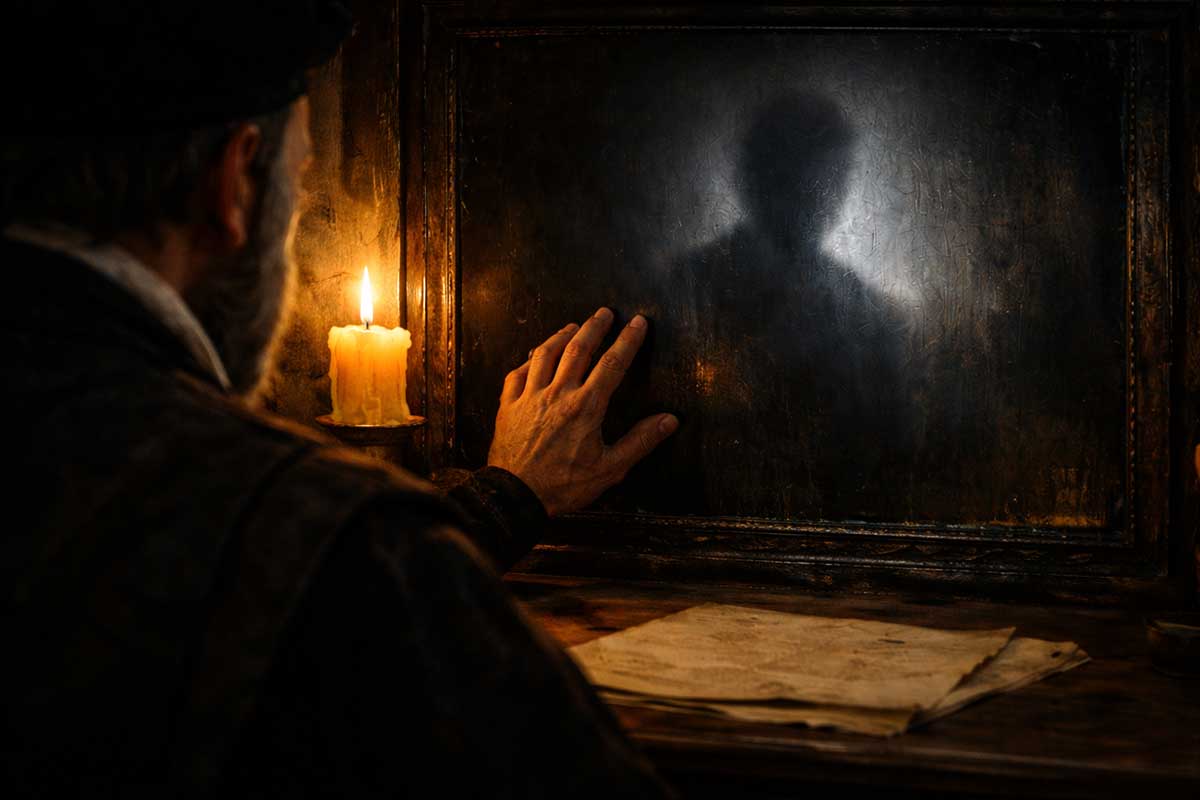
Rain makes my house sound guilty.
It taps the shutters with a patient insistence, as if the night itself is gathering evidence. I keep the candle small and the room smaller. I have learned that a large light makes a man careless. Carelessness is how you end up with witnesses.
On the table, beside the mirror, I have placed a book of medicine—open, visible, innocent. A physician may work late. A prophet may not.
The mirror is wrapped in a cloth when it is not in use. Plain linen, frayed at one corner. Nothing “mystical.” Anything that looks deliberate invites questions. I have cleaned the stone with oil, the way one wipes a fine instrument, and I have set it so it will not catch a stray reflection of the window. I do not want the street to look in and see my face hovering above darkness.
I sit. I breathe until my thoughts begin to unlace. The old fear arrives first—like the first ache of illness—then recedes as the room becomes less solid and more… permeable.
And then she is there again.
Not a figure. Not a face. A listening that presses gently against the back of my mind.
“Michel,” she says—my name, pronounced as if she has practiced it.
My spine stiffens. Hearing my name from “far” is worse than hearing it from the hall. It means the seam between us has learned my shape.
“You returned,” I murmur.
“I said I would.”
I almost ask how. Instead I ask what matters.
“Do you have the verses?”
A pause, a faint shifting, as if she moves papers on her side of the world.
“Yes. I have a book.”
The book. My stomach tightens. Of course my writings survive; that was the whole point—hiding them in the shape of puzzles so they could travel through time without being seized. And yet the idea of them bound and printed, handled by strangers, makes me feel exposed. As if I have been undressed in a marketplace.
“Read,” I say.
I hear the smallest intake of breath on her side, a nervousness. Then she begins.
She reads the quatrain slowly, carefully, as if it were a prayer.
And it is wrong.
Not wholly wrong. Worse—almost right.
A vowel softened. A consonant clipped. The meaning tilts, just a little, like a table set on uneven stone.
I stop her sharply. “No.”
Silence.
“What?” she asks, startled.
“You cannot do that,” I say, and my voice is harsher than I intend. “The vowels must stay pure.”
“Pure?” she repeats, uncertain.
I lean toward the mirror, hand hovering near the black surface without touching. “In my tongue, the sound carries the skeleton of the word. You change it, and you change the bones. Do you understand?”
“I’m trying,” she says, careful now. “I don’t speak French.”
The word French lands strangely. In my mind I see that she must come from a time when language has been sliced into categories, formalized, named. In my day we speak what we speak, and the priests call it crude if it isn’t Latin.
“You will read it again,” I say. “Slower.”
She obeys.
This time she overcorrects. It becomes stiff, like a child reciting. The quatrain loses its breath.
“Stop,” I whisper.
I close my eyes. The rain continues, patient as a judge.
I want to explain. I do not want to explain. Explanation becomes confession.
“You think this is a game,” I say finally, quieter. “A clever puzzle. But I wrote these to survive men who burn people for curiosity. My words are a disguise. If you mis-speak the disguise, it becomes an accusation.”
“I don’t want to hurt you,” she says.
“And yet you could,” I answer.
Her silence grows heavier. Then: “How do I do it right?”
That simple question—honest, almost humble—shifts something in me. It reminds me of students in my study, heads bent, hungry to learn. It reminds me that I am not speaking to a priest. I am speaking to a link—thin as thread, but real.
I soften my tone a fraction. “Do not worry about perfection. Worry about consistency.”
“Consistency,” she repeats.
“Yes,” I say. “Because if it is truly me you hear, I will correct you the same way each time.”
A test, hidden inside a lesson. It comforts me to build structure around the impossible.
“Read the first line,” I instruct.
She does. I let her finish the line. Then I make her repeat one word—three times—until the sound settles into something my mind recognizes. It is not modern. It is not my tongue. But it is close enough that the meaning stops sliding.
I exhale.
“Now,” I say. “Again. From the beginning.”
She reads.
The quatrain opens like a box that was stuck, and suddenly the picture behind it becomes visible—not a certainty, not a single road, but a cluster of outcomes attached to one central knot.
I speak before I think. “This belongs to your century. Not mine.”
“What does it mean?” she asks, intent.
I almost laugh—at myself, at the absurdity. The greatest danger of all is that my work might become entertainment. People playing with it the way children play with knives.
“It is about communication,” I tell her, and I can’t keep the bitterness out of my voice. “Your world will be drowned in it.”
She is quiet, as if waiting.
So I do what I always do: I translate through what the Inquisition cannot accuse.
“In the old stories,” I say, “when I speak of Hermes—Mercury—I speak of messages. Of speed. Of networks. When I speak of strings wrapped around the world, I speak of a net that binds people and makes them believe they are free.”
I feel her attention sharpen. I can almost hear her writing.
“No,” I snap suddenly. “Do not write yet.”
“Why?” she asks.
“Because you haven’t earned the meaning,” I say, and my own severity surprises me. “If you collect symbols without discipline, you will turn this into superstition.”
“I’m sorry,” she says softly. “I just… I want to get it right.”
I stare into the mirror and see nothing but candlelight. Yet I feel her there, and the feeling is both relieving and intolerable.
I decide on another test—one that is not metaphysical, but practical.
“Tell me something,” I say. “On your side—do you have a maid?”
A pause. A confused breath. “No. Not like you mean.”
“Good,” I murmur. “Then you will not understand why I cannot let you linger.”
As if to prove my point, from the hall comes the faintest sound: the scrape of a shoe, the hesitant pause of someone who has stopped outside the door.
My blood cools instantly.
I do not move. I do not breathe.
The shoe shifts again. A whisper—two women, low and frightened.
“I tell you, he speaks to the dark,” one says.
“Don’t,” the other hisses. “Madame will hear.”
A tiny click—the handle, tested and released.
My wife’s voice cuts through the hall like a knife. “Leave him. He is working.”
“Madame,” a maid murmurs, trembling, “the room feels—wrong. Like a spirit is inside.”
I close my eyes.
This is how it begins. Not with flames, not with demons—with a frightened servant who thinks she has seen a ghost.
In the mirror, the presence stiffens. I feel her pull back slightly, like a hand retreating from a hot pan.
“I should go,” she whispers.
“Yes,” I breathe. “Now.”
“But I—”
“Now,” I repeat, and this time the word is not anger but command.
The seam tightens. The air clears. The pressure lifts, the way a headache lifts when you stop thinking about it.
The mirror becomes stone again. The candle becomes only a candle.
Outside, the footsteps retreat, and I hear my wife speak sharply in a tone I recognize—the tone she uses when she is protecting the household.
“Enough of your nonsense. He is a doctor.”
A doctor. Yes.
I sit very still, hands tucked beneath the table so I won’t see them shake. My other hand reaches toward the open medical book and turns a page—an unnecessary gesture, but a comforting one. The ordinary must be performed. The ordinary must be visible.
My wife’s steps approach. She knocks once and enters without waiting.
Her eyes flick to the candle, to my pale face, to the cloth-wrapped mirror.
“The stew is cold,” she says, as if that is the only crisis worth naming. Then her gaze narrows. “Are you doing it again?”
I open my mouth. No honest answer will save me.
So I choose the safest truth.
“I’m working,” I say.
She exhales, irritated, frightened, and proud all at once—my wife, who has learned how to survive a world that punishes women for knowing too much.
“Then work,” she says quietly. “But stop terrifying the girls.”
She leaves. The door closes.
And in the silence afterward, I realize something I do not like:
The future voice didn’t sound like a ghost.
But the fear in my house did.
I look at the mirror as if it is a wound.
I think of her mispronounced vowels and how easily meaning breaks.
I think of my verses traveling centuries only to be swallowed wrong.
And I understand, with a chill that feels like the first touch of winter:
If this connection is real, then the danger is not only that I will be burned.
The danger is that my words will live—
and be misunderstood—
and still, somehow, come true.
So tomorrow night, I will insist on discipline.
Tomorrow night, I will make her read again.
And I will keep the vowels pure—
as if purity were a shield strong enough to stop time.
Topic 3: A Drawer of Horoscopes
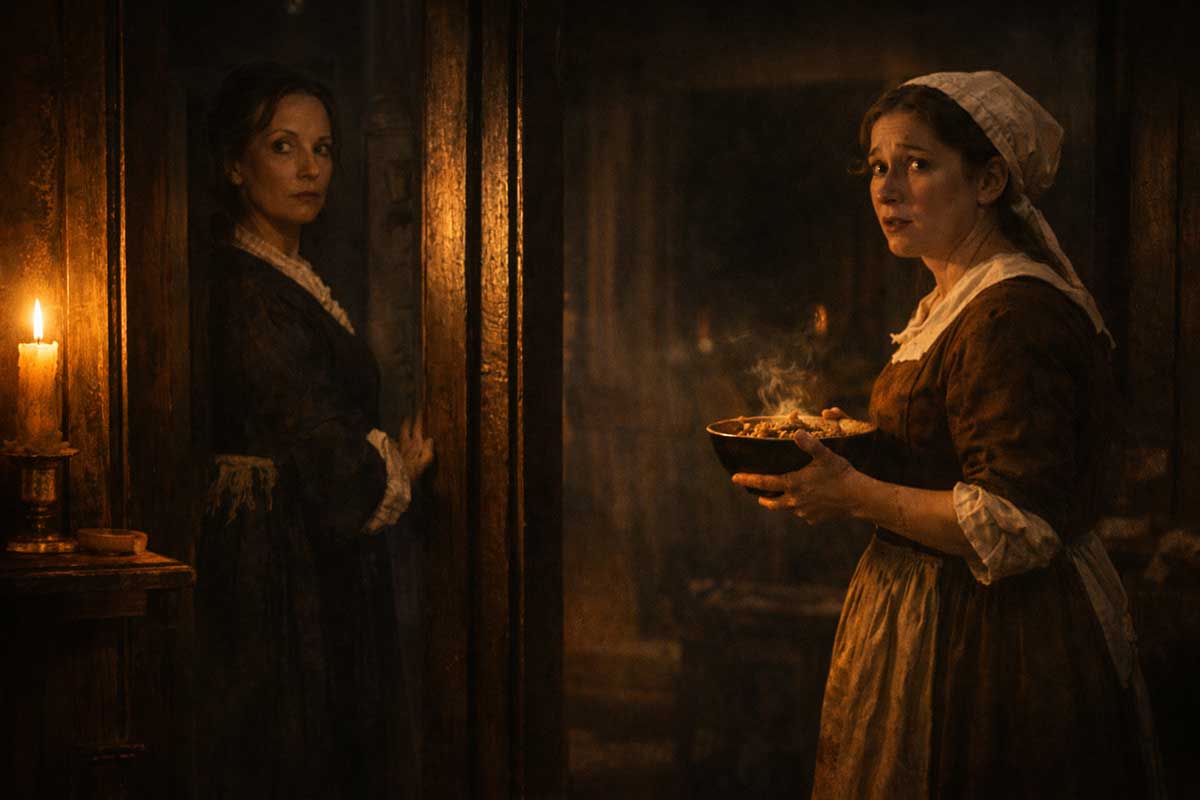
The bells begin before the sun.
They always do—metal tongues wagging from the towers, reminding everyone that time belongs to God, and to men who claim to speak for Him. I listen from my bed and feel the old anger rise, then I swallow it. Anger is loud. Loud draws attention.
By late afternoon the rain has gone, but the streets still gleam like wet bones. A boy runs past my gate with a basket of onions; a woman pulls her hood tighter as if the air itself might accuse her. I treat three patients before dusk. Fever. A cough that smells of rot. A child with a rash I do not like. When the last one leaves, my hands are stained with vinegar and crushed leaves, the honest work of a physician.
It is always the honest work that steadies me—until I remember what waits after the house sleeps.
I eat in silence. My wife watches me the way she watches a pot that might boil over. She speaks of ordinary things with deliberate care, as if naming the ordinary can keep the strange at bay.
When the stew is finished and the candles grow low, she says, almost casually, “The maid refuses to go near your study.”
“I will speak to her,” I reply.
“Don’t,” my wife says, sharper than she intends. Then she softens. “Just… be careful. People frighten easily. Priests frighten them more.”
She does not need to say the word Inquisition. It sits in every corner of France like damp.
Later, when the house finally settles, I go to the study and close the door with a restraint that feels like prayer. I place the medical book open again. Always the same chapter. Always the same innocent posture, in case anyone ever “wanders” in.
The obsidian mirror stays wrapped until the last moment. I do not like touching it, though it is only stone. It makes me feel as if I am touching a mouth that is not mine.
When I uncover it, the candlelight slides across its surface and disappears, as if the light has been swallowed.
I begin the descent—breath slowed, thoughts unbuttoned, attention narrowed to a point so small it feels like a needle.
And she returns.
Not with footsteps, not with apparition—just that pressure, that quiet listening that presses against the mind as if the air itself has learned to read.
“Michel,” she says.
My shoulders tighten despite myself. “You are prompt.”
“I’m here,” she answers, and I hear the effort in it, like a person walking a tightrope.
Good. Effort means discipline. Discipline means fewer accidents.
“We will continue,” I say. “But not as last night.”
“I’ve prepared,” she tells me. “I’ve practiced the pronunciation.”
“Then we begin.” I pause. “And you will not force dates from me.”
A small silence. “But the readers—people—want dates.”
“The people always want what will harm them,” I reply, and my harshness surprises even me. I lower my voice. “Listen: when I see ahead, I do not see a tidy calendar. I see a room full of smoke and moving shapes. I can tell a man from a beast. I can tell fire from flood. But you ask me, What day? What year?”
“I’m asking because you said your prophecies weren’t being interpreted correctly,” she says carefully. “So we need to order them.”
Order. Chronology. The future’s addiction.
I gaze into the mirror and feel a dull ache behind my eyes, as if my skull is being asked to hold too much.
“There are points,” I say slowly, choosing my words as if choosing a safe path through a minefield. “Central things. Knots in the tapestry. A birth. A death. A war that must happen because too many minds have already built it.”
“Like what you called nexus points,” she says, almost whispering.
“Yes,” I answer, and I am unsettled that she knows the phrase so quickly. It means she has been repeating my words to others. It means my voice is already escaping the room.
I continue anyway. “From such a knot, the thread splits. Many outcomes. Some monstrous, some merely ugly, some—if people awaken—less bloody. So your dates…” I exhale. “Your dates are sand.”
“But you said there’s one way you can tell,” she presses. “You said the sky—constellations.”
At that, my irritation becomes something like grief.
“The sky is the only honest calendar,” I admit. “If I see a fragment of it, if a constellation is clear, then I can anchor the vision to a season, a cycle. Without it, everything ahead looks… modern. All the same cold shine. A man may be wearing armor or a uniform; both look like metal to someone born before either.”
She is quiet for a moment, then says, “So we need an astrologer.”
I feel my mouth tighten. “Yes.”
I do not like confessing need. Need makes you dependent. Dependence makes you vulnerable.
But this is the truth: my visions—by themselves—are not enough for the future to arrange.
“You will require,” I say, and my voice drops, “a drawer of horoscopes.”
“A drawer?” she repeats, amused despite herself.
“A mind,” I correct, “so steeped in charts that they can reach for dates the way a baker reaches for flour. Someone who lives in ephemerides. Someone who can look at a sky described in words and translate it into time.”
On her side I sense movement—paper, perhaps. A pen scratching. She is taking notes again.
I let it pass this time. If she does not record it, she will forget, and forgetting is its own cruelty.
“And you,” she says, “how did you date things in your own time?”
A question that almost becomes dangerous.
I answer with the safer truth. “With caution. I wrote in symbols so I would not be forced to prove anything before it arrived. If I was wrong, I would be forgotten. If I was right, I would be dead. Either way, I survive the Church.”
The moment stretches. Then she asks quietly, “Did you ever tell anyone everything?”
I think of nights with students whispering behind shutters, pretending to study medicine. I think of how their faces looked in candlelight—hungry, terrified, alive.
“I told them enough to keep them faithful,” I say. “Not enough to get them hanged.”
A sudden sound—soft, near—pulls my attention away from the mirror.
In the hall: a faint clink. Metal against pottery. Someone in the kitchen, perhaps, careless with a spoon.
My pulse jumps.
The future voice senses it too. “Is someone there?”
“Stay silent,” I breathe.
The house goes still again, except for the distant creak of wood. Then a whisper—two women, quick and low.
“I won’t go in,” the maid says. “Last night I felt a presence. I tell you, a spirit.”
“Hush,” another whispers. “Madame said he is a doctor.”
“And what does a doctor do alone with a black mirror?” the maid replies, voice trembling.
My jaw tightens. I keep my eyes on the obsidian, but my body wants to rise, to bolt the door, to become ordinary by force.
In the mirror, the future presence feels thinner now, as if it is drawing itself up to leave.
“Go,” I tell her, barely moving my lips.
“But—”
“Go,” I repeat. “This is not your century’s danger. It is mine.”
She withdraws, and the air loses that subtle pressure. The mirror becomes only a mirror again—dark and silent and condemning.
I wrap it quickly, hands steady by practice if not by peace.
Only then do I hear my wife’s step at the far end of the hall, firm and unafraid, the sound of someone who has decided this household will not be ruled by rumors.
“Enough,” she says to the maids. “If you want ghosts, go to church. My husband is working.”
Footsteps scatter.
When my wife enters, she does not look at the mirror. She looks at me.
“You’re turning our home into a story,” she says quietly.
“A story can save lives,” I answer.
She watches me for a long moment, then says, “Just make sure it doesn’t cost yours.”
After she leaves, I sit alone with the wrapped mirror and the open medical book, two kinds of work lying side by side like rival truths.
I understand now what I did not want to understand:
To make the future hear me clearly, I will need not only a link—
but a mind trained to count the sky.
A drawer of horoscopes.
And perhaps—worse—more people.
More witnesses.
More risk.
Yet the thread has already been tied.
And the bell towers will ring again in the morning, pretending that time is simple.
Topic 4: The Third Face of the Beast
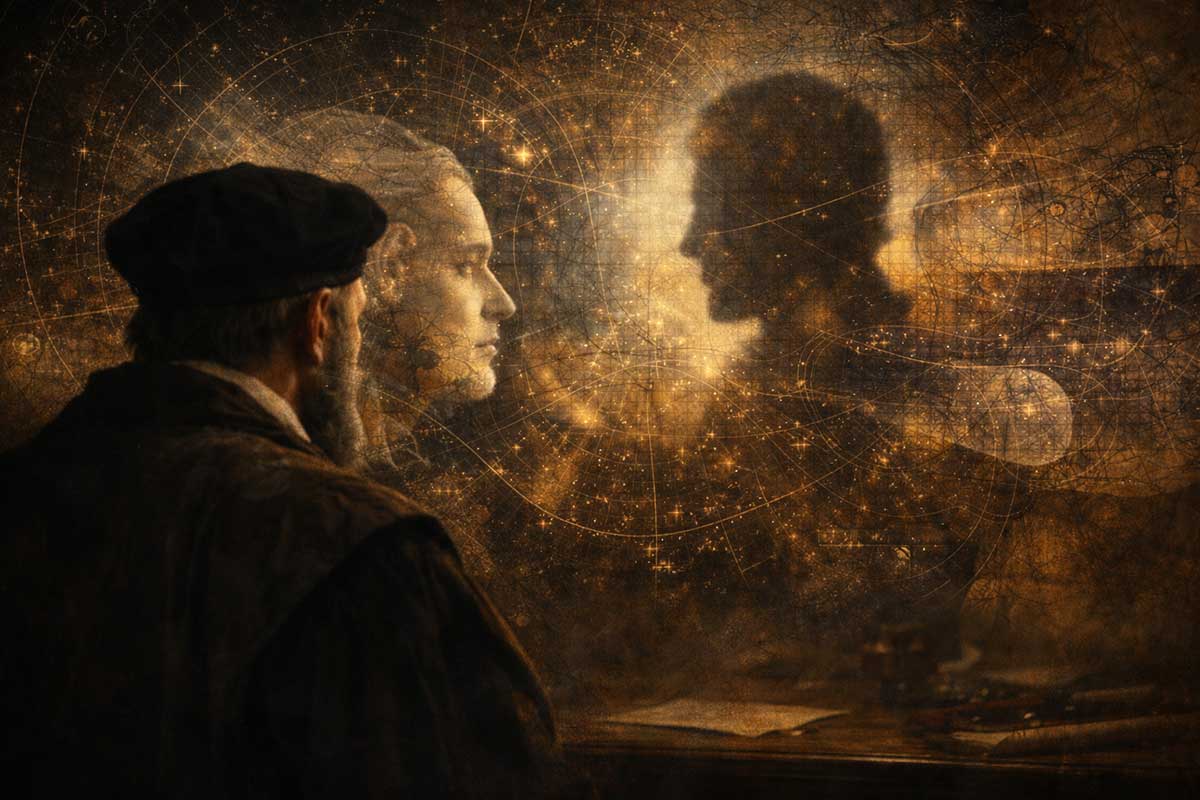
Tonight the air tastes of ash, though no fire burns in the hearth.
It is the season when smoke from neighbors’ chimneys hangs low and clings to the streets like rumor. Even inside my house, the scent finds its way between stones. My wife says it is only winter. I do not correct her. A man survives by letting ordinary explanations stand—especially when the alternative is omens.
I have tried, these past days, to behave like a physician only.
To speak of herbs. To argue about fevers. To complain about the price of salt. To be, in short, forgettable.
But the thread is already tied.
After supper, my wife lingers at the doorway of my study as if she means to speak and refuses to give herself the chance. When she finally turns to leave, she pauses and says without looking at me:
“The girls think you’re calling spirits.”
“I am calling understanding,” I answer.
She laughs once, without humor. “Understanding doesn’t get people burned.”
The door closes. The house becomes a careful silence.
I set the medical book open where it can be seen. I place ink and quills beside it, as if I am preparing a mundane chapter on plagues. Then I pull the cloth from the obsidian mirror.
The candlelight vanishes into it. Always. As if it is not a surface but a mouth.
I breathe down into the familiar narrowing—thoughts unfastening, attention tightening until the room feels like it is shrinking around a single point.
And then she is there.
“Michel,” she says softly, almost as if she fears being overheard in her own world.
“You came,” I reply.
“I did. And there are people in the room with me,” she adds quickly. “They… observe.”
My ribs tighten. “Send them away.”
“I can’t always,” she answers. “They want proof.”
Proof. That crude idol. As if truth is only truth when a crowd applauds it.
“Then be careful what you ask,” I tell her. “Careful what you repeat. Walls have ears in any century.”
“I understand,” she says. “But I need to understand something else too.”
“Speak,” I say.
She hesitates. “You talked about a great enemy. A third one. You called him—” She lowers her voice, embarrassed by the word. “—an Antichrist.”
“I do not like the term,” I answer at once. “It smells of pulpits. I am not a priest.”
“Then what do you mean?” she asks.
I stare into the mirror and let my mind move the way it moves when visions arrive—not in logic, but in fragments, impressions, symbols that cling like burrs.
“I mean a man,” I say slowly, “whose nature is against humanity. Not against a church. Against people.”
She is silent, listening hard.
“In my day,” I continue, “we have seen such men in stories and in battlefields. The conqueror who burns a town and sleeps soundly. The noble who taxes the poor until their bones show. The inquisitor who calls cruelty ‘purity.’”
I swallow. My mouth tastes metallic.
“But what I see ahead,” I add, “is worse. Because cruelty becomes… efficient.”
“Efficient?” she repeats.
“A mind,” I say, and the phrase arrives with its own weight. “The first two—your historians will name them easily. One reshapes Europe with ambition. Another reshapes it with hate.”
Her certainty leaps ahead of my caution. “Napoleon and Hitler,” she whispers.
Hearing names I do not know—especially that second one—makes my stomach clench. Yet her confidence tells me her world has already built a shelf for this idea. It is easier to hold horror when it has a label.
“Yes,” I say, without warmth. “And the third…”
My voice falters—not from fear of him, fear is too small—but from the way he appears in my seeing: not like a storm, but like a hand turning a key.
“The third is not a soldier first,” I continue. “He is a mind that studies. He learns from the second’s mistakes. He understands that crowds can be ruled not only by force, but by story—by symbols, by numbers.”
On her side of the seam, I sense someone shift, someone breathing too loudly. One of her observers.
It makes my skin crawl.
“Do not ask me his name,” I warn.
“I won’t,” she says quickly. “But you mentioned numbers. Like… six-six-six.”
The number prickles the air. It belongs to monks and their nightmares, to apocalyptic texts waved like torches. And yet when she says it, something in my vision answers—as if a bell has been struck in a distant city.
“In the old language of Revelation,” I admit, “the beast is counted. In your time, counting becomes power.”
“Computers,” she whispers.
I do not know the word. But the concept arrives with unpleasant clarity: machines that calculate faster than a human mind, networks of information, an invisible web binding decisions together.
“I see a world,” I say carefully, “where a person cannot buy or sell without a number. Where the world is wrapped in cords—threads connecting everyone to a central mechanism.”
Someone near her inhales sharply. Proof-seekers, hungry.
The sensation of being overheard makes my neck tighten. I lean closer to the mirror, lowering my voice as if lowering it could cross centuries more safely.
“The danger is not the machine,” I say. “The danger is that men will worship the machine’s certainty. They will surrender judgment for convenience.”
A pause.
Then she asks the question that cuts too close:
“Is that why you predicted so much? Because you were… talking to the future? Like you’re talking to me now?”
For a moment I see my study full of eyes—priests, judges, scholars—leaning forward to hear whether I confess to witchcraft.
“I did not speak to the future as you speak to me,” I answer. “I looked. I listened. I drifted, sometimes, beyond my body. I saw scenes. I saw patterns. But it was not conversation.”
“And now?” she asks.
“Now it is different,” I admit, and the words taste like stepping onto thin ice. Because a voice has reached back. Because the thread runs both ways. And if conversation is possible, then so is influence.
From the hall comes a familiar sound—the clatter of a pot lid, muffled quickly. Domestic life, stubbornly real.
A whisper seeps under my door: “Madame, I swear I heard another voice.”
My wife’s reply snaps like a switch. “If you want to believe in ghosts, go work for a priest. In this house, you work for me.”
Footsteps retreat.
In the mirror, the future presence falters. “I’m sorry,” she says. “I don’t want to cause trouble for you.”
“You already have,” I answer, not unkindly. “But so have I.”
She is quiet a moment, then tries again, carefully: “You said the future branches. That nothing is fixed.”
“Yes,” I reply.
“And that you show the worst so people will choose the opposite,” she continues. “But—Michel—how do you keep yourself from being trapped by what you see?”
Her voice is earnest, and it would be easy to answer with a lesson. But I sense something else behind the question—something personal, something dangerous.
She hesitated then, as if weighing whether a question once asked could ever be taken back, and I felt the future itself draw closer—not to warn me, but to test my restraint.
“You are about to step somewhere you should not,” I tell her.
“I… only want to understand,” she says, and her voice thins. “In my time, they ask about you. They want to know everything. Especially the end.”
My hands go cold.
“You must not tell me,” I say sharply.
Silence drops like a cloth over the room.
“How you die,” I add, and the words sit between us like a blade laid flat on a table.
On her side, confusion flashes—then a kind of awe. “But wouldn’t you want to know?”
“No,” I answer. “Because if I knew, I would begin to write toward it.”
“Some people would say knowledge is power,” she murmurs.
“Power,” I repeat, tasting the lie inside the word. “That is what ruins most men.”
I force my hands still, as if stillness could make the boundary real.
“My work depends on uncertainty,” I tell her. “Not ignorance—uncertainty. The future must remain fluid. Even for me. If I let my own ending become a fixed star, I will steer everything toward it—every caution, every kindness, every line I write.”
She breathes in, slow. “So you refuse on purpose.”
“Yes,” I say. “Prophecy is pressure, not fate. And if I allow that pressure to fix itself on me, I become no better than the men who will misuse my words later.”
“I promise,” she says quickly, “I won’t tell you. Even if I learn it.”
“That promise matters more than any interpretation,” I reply.
The house settles again. Somewhere in the kitchen, a spoon taps pottery; someone stirs the stew so it will not burn. The ordinary world insists on its rights.
The future voice steadies. “Then what do we do about the third one?” she asks. “If he rules by symbols and attention—how do ordinary people resist?”
I close my eyes. I see the knot-points again, the branching possibilities. I see crowds turning toward fear because fear is easy. I see peace requiring discipline and imagination.
“Feed the opposite,” I say simply. “Refuse the furnace its fuel.”
“What fuel?” she asks.
“Attention,” I answer. “Focus. The mind is a hearth. Whatever you throw into it becomes heat. If you throw in terror all day, you will build a world that matches it.”
A pause. Then I add, quieter:
“The third face of the beast does not need to conquer cities if he can conquer attention.”
The sentence hangs there, heavy and unadorned.
On her side, I sense the observers shifting again—some frightened, some thrilled. Let them be. If they carry only thrill, they will learn nothing. If they carry fear, they will learn the wrong thing. But if even one of them carries restraint—if even one of them chooses to starve the furnace—then the thread has not been wasted.
I wrap the mirror again, not as an ending, but as a discipline—cloth over a mouth.
In the darkness that follows, I think of what my wife said: Understanding doesn’t get people burned.
Perhaps not.
But restraint might keep the fire from spreading.
Topic 5: The Great Genius and the Door That Must Stay Ajar
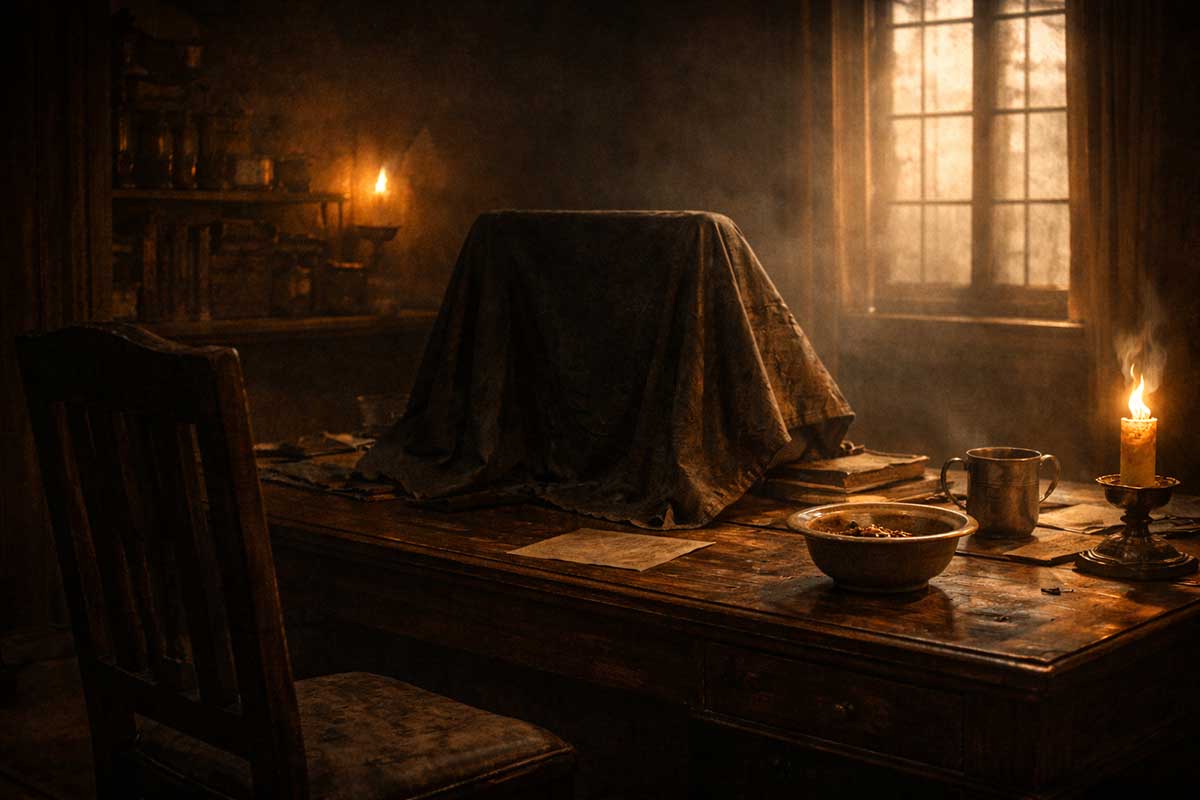
The night after our last speaking, I did not sleep.
Not from fear—fear is blunt, and I have learned to live alongside it like a physician lives alongside blood—but from the peculiar fatigue that follows a visit from elsewhen. The mind returns to the room, the candle, the ink, and yet a part of it remains hooked on the thread, listening for footsteps that are not in the hallway.
At dawn my wife found me still seated, the cloth drawn over the mirror as if it were a wound.
“You look ill,” she said, setting bread down too hard on the table.
“I am only tired,” I answered.
“You are always only tired,” she replied, and her voice held that familiar mixture of annoyance and worry. Then, softer: “Do not make this house into a chapel of your… work.”
“It is not a chapel,” I said. “It is a study.”
She did not answer. She watched the covered mirror the way a sensible person watches a strange dog—without moving quickly, without turning her back.
Later, as she moved through her tasks, I heard her stop the maid in the corridor.
“And if you hear voices,” my wife said, “you will blame the pipes, the wind, or your own nerves. Do you understand me?”
“Yes, Madame,” the girl whispered.
“And if you insist on calling it a ghost,” my wife added, “then you may go live with the priests and let them feed you.”
“Yes, Madame.”
Footsteps retreated. The house resumed its ordinary breathing. Yet the word ghost lingered in the plaster, ridiculous and dangerous.
When the sun lowered again and the street quieted, I returned to the mirror.
I did not uncover it immediately. I waited with the patience of a man who knows that impatience is how you invite error.
Then I removed the cloth, and the candle disappeared into the black.
At once, I felt the thread tighten.
She was there.
“Michel,” the future voice said, and there was relief in it, as if my replying had soothed something.
“You are persistent,” I told her. “Either you have courage, or you have not yet learned what it costs.”
“Both,” she admitted.
A faint sound rose behind her—soft murmurs, the scrape of chairs. Observers again. Always the hungry crowd.
“They’re here,” she said quickly. “But I’ve told them to be quiet.”
I said nothing. Quiet is not the same as absent. Still, I had come to a point where silence would not help us.
“You asked what to do,” I said. “About the third face. About the machine of attention.”
“Yes.”
“Then we must speak of the counterweight,” I continued. “Not the enemy. The counterweight.”
I could feel her leaning in.
“In my seeing,” I said, “the pendulum does not remain forever at one extreme. There is a swing toward cruelty—yes. There is a season where men become efficient at harming. But then there is a recoil.”
“A recoil into what?” she asked.
“Into brilliance,” I answered.
She breathed out, almost a laugh. “The Great Genius.”
I did not like the phrase; it was too clean, too theatrical. Yet it was the nearest label for what I had seen: a figure not merely clever, but generative—someone who changes what is possible, and in doing so changes what men desire.
“Tell me how you see him,” she urged.
I closed my eyes. The images came not as a portrait, but as consequences: tools that do not wound, instruments that do not require cruelty, a kind of knowledge that makes tyrants less necessary because fear is less profitable.
“I see inventions,” I said slowly, “that make the world smaller without making the soul smaller. I see travel beyond the earth. I see men living where no harvest grows, and still they live. I see cures—not all cures, but enough to make death less of a whip.”
“And peace?” she asked.
I hesitated. Peace is a word that invites foolishness.
“I see a chance of peace,” I answered. “A long season where war becomes an embarrassment. Not impossible, but… unfashionable. Inefficient. Hard to sell.”
“Then it gets better,” she whispered, as if speaking it aloud might help.
“It can,” I agreed. “And that ‘can’ is the whole matter.”
On her side, one of the observers inhaled sharply. I heard it as clearly as if they were in my study. I hated that it pleased them—the sensation of prophecy as spectacle.
“Do you know when?” she asked. “Do you know dates?”
I almost smiled, but it was not amusement.
“You keep wanting numbers,” I said. “You want the comfort of a calendar. But time does not behave like your books.”
“How does it behave, then?” she asked.
I leaned closer to the mirror, lowering my voice. The house felt too fragile for this truth.
“I will say it in the phrase that once made your skin turn cold,” I told her. “Listen carefully.”
She went silent.
“There is no straight river,” I said. “There is only a sea.”
I felt her confusion.
“In your world you imagine a line,” I continued, “and you walk along it. But what I touch is not a line. It is simultaneous. Layer upon layer. The living, the dead, the yet-to-be, all adjacent—not stacked in order, but arranged like rooms with thin walls.”
A pause. Then I added the words that had startled even me when they first arrived in my mind, as if spoken from somewhere beyond my own learning:
“I speak to you from beyond the limbo of your counting.”
She did not move. I could sense the hairs rising on her arms.
One of the observers made a sound—half disbelief, half reverence. I ignored it.
“In such a sea,” I said, “there are points where many currents meet.”
“Nexus points,” she whispered, remembering.
“Yes,” I replied. “Events or persons that must occur in some form—because too many choices have already leaned toward them. But from those points, many branches spread. Better outcomes. Worse outcomes. Strange outcomes no one expects.”
“So the Great Genius is a nexus?” she asked.
“He may be,” I answered. “Or he may be the branch that becomes dominant only if you starve the darker branch.”
Her voice tightened. “That puts a lot on us.”
“It always has been on you,” I said. “My seeing changes nothing unless it changes choice.”
A faint clatter sounded at my door, and then the maid’s frightened whisper slipped under it, as if she dared not knock properly:
“Sir… pardon—Madame says the stew is ready.”
My throat tightened. The world insisted again on its small rituals.
“I will come,” I called, and my voice sounded too ordinary for what I was doing.
Then, as the girl lingered, I heard her add—too softly, thinking I would not:
“And… Sir… if you are speaking to someone… please tell them not to stand behind the glass. I saw a shadow there yesterday.”
A ghost, then. A maid’s honest terror. How quickly the human mind makes stories to protect itself.
I kept my voice level. “There is no one behind the glass,” I said. “Go.”
Her footsteps fled. In the mirror, the future voice was quiet, as if she had heard everything.
“You see?” she said. “Even the small things become dangerous.”
“Yes,” I replied. “That is why I need you to understand restraint.”
She hesitated, then spoke with care. “I won’t tell you the manner of your death.”
The boundary again. The discipline. I felt my shoulders loosen slightly.
“Good,” I said. “Then we remain useful.”
“And what do I tell them?” she asked. “The people listening. The ones who want proof. The ones who want to know whether the future is fixed.”
I considered the question. A poor answer could do harm. A grand answer could do worse.
“Tell them this,” I said at last. “That prophecy is not a verdict. It is a mirror held up to the mind. If you stare into it only to admire fear, you will become fear. If you stare into it to choose the opposite, you can change what appears.”
“And the Great Genius?” she asked, almost pleading now.
I looked into the obsidian black and felt the thread stretching—still connected, still possible.
“He is not a savior who arrives to replace your conscience,” I said. “He is what becomes possible when enough ordinary people refuse to feed the furnace.”
The stew’s scent reached my study—salt, herbs, the stubborn persistence of life.
“I must go,” I told her.
“Will you come back?” she asked.
I drew the cloth over the mirror, but I did not let my hand leave it immediately.
“If the thread holds,” I said. “If you keep it clean. If you remember: do not turn this into a theater.”
“I will,” she promised.
I paused, listening to the house, to my wife setting bowls on the table, to the maid still glancing nervously at the glass.
And then I added, quietly—so quietly it was almost a thought:
“Next time, tell me what your world has become when men cannot tell whether their own minds are theirs.”
I felt her stillness—she understood the weight of that.
The cloth settled. The black mouth was covered.
But the thread did not feel severed.
Only waiting.
Final Thoughts by Nostradamus
I will end where I chose silence.
There came a moment when she leaned closer, when the future itself seemed to hold its breath, and I knew the question before it was spoken. It was not about empires, nor wars, nor the rise of clever machines. It was about the manner of my leaving, the last narrowing of the path.
I refused her then.
Not from fear of pain, but from respect for the work. A man who knows the hour of his own extinguishing no longer walks honestly among symbols. He begins to arrange them for himself. I would not allow that corruption.
If my words endure, let them endure incomplete.
You who read this live in an age where knowledge multiplies faster than wisdom, where threads of connection wrap the world so tightly that men mistake the web for fate. I tell you now what I told her across the glass: the future is not a sentence, it is a condition.
Attend to the ordinary moments. The bowl left untouched. The mirror covered at dawn. The choice not to ask what cannot be carried.
I did not speak to the future so that it might admire me. I spoke so that it might hesitate.
If you feel unease after closing these pages, then the exchange was not in vain.
Short Bios:
Nostradamus
Michel de Nostredame (1503–1566) was a French Renaissance physician, astrologer, and author of Les Prophéties. Trained in medicine during the plague years, he encoded future possibilities in symbolic quatrains, insisting that prophecy was conditional, not fixed, and that human choice could alter timelines.
Dolores Cannon
Dolores Cannon (1931–2014) was a pioneering hypnotherapist and author best known for her work in past-life regression and the Convoluted Universe series. She claimed to have communicated with historical consciousnesses, including Nostradamus, through what she described as simultaneous time rather than contact with the dead.
Leave a Reply