

|
Getting your Trinity Audio player ready...
|
Act I, Scene 1: The Girl Who Learned to Watch

People always say I was careless. It is a word that floats in a man’s mouth the way a mint floats in a glass, meant to make what follows taste cleaner.
Careless is what they call you when you do not flinch.
I learned early that flinching is an expensive habit. In Louisville, the rooms were smaller and the smiles were better trained, but the rules were the same as they would be later, when the lawns got wider and the parties began to look like they were staged for someone else’s memory. A room decides who may speak, and who may only laugh. A room decides what can be forgiven, and what becomes a label stitched neatly onto your clothing so it will still be there even after the dress is new.
My aunt used to say I had “a good face for people,” which sounded like praise until I understood she meant I looked like I would not ask for too much. I did not correct her. Women who correct people are accused of wanting power, and women who want power are accused of wanting it for ugly reasons. I preferred to be accused of nothing at all.
That is the first trick. Learn to be forgettable in the ways that matter and unforgettable in the ways that don’t.
If you are pretty, you learn early that beauty is a currency. If you are clever, you learn even earlier that cleverness is not always legal tender. Beauty buys you entry. Cleverness buys you trouble, because trouble starts when you let people know you understand the game.
I understood the game long before I moved to East Egg. I understood it in dressing rooms and parlors and golf club hallways where the air was always cool and the conversation always faintly cruel. Men talked as if they were confessing, but they were always negotiating. Women talked as if they were chatting, but they were always measuring. Every laugh had a purpose. Every compliment had a hook.
Later, in New York, I would watch men in white linen take their secrets out for fresh air the way you might take a dog for a walk. They called it being honest. They called it being modern. It was only a different costume for the same old wish. They wanted to be adored without being held responsible.
That is what Nick did not understand about Tom, at first. Nick was still in the stage of believing a man’s ugliness must be earned. He had not learned that it can be inherited as easily as a house.
If you want the truth, the world is not divided into good people and bad people. It is divided into those who can afford consequences and those who cannot. The clever ones learn to place consequences on somebody else. The lucky ones are born into rooms where consequences are treated like bad weather. An inconvenience, a topic change, a new drink.
And then there are the ones who are not born into those rooms but learn the choreography anyway. Those are the dangerous ones, because they do not just want entry. They want ownership. They want to rewrite the deed.
That kind of hunger can be mistaken for romance. It can be mistaken for courage. It can be mistaken for a dream.
I did not mistake it, not once, not even at the beginning when I still believed my own indifference was a sort of virtue. I saw it the way I always saw things, from the side, from the edge of the picture where you can watch the whole frame.
I met Gatsby first as a name, the way you meet most myths. He was a whisper that traveled faster than the music, a rumor that wore perfume. People said he was a prince and a murderer, an Oxford man and a German spy. People said he killed a man once, and then laughed as if that was charming, as if violence were only a kind of talent if it belonged to someone with enough money.
At the time I did not live in West Egg. I lived in East Egg, where the houses sat like confident old women, not needing anyone’s approval. The people in East Egg did not need to invent stories about themselves. They only needed to believe their names were enough.
That is why Gatsby fascinated them. Not because they believed the rumors, but because they sensed what the rumors were for. They sensed the effort. They sensed the wanting.
It is unsettling to be around someone who wants something that badly, because it makes your own desires look like they have been eating too well.
I should say, before you imagine me as some kind of moral witness, that I was not above wanting. I wanted freedom, and I wanted ease, and I wanted to keep my face turned toward the light so no one could see what I was thinking. I wanted to be in the rooms where decisions were made, and I wanted to pretend I did not care about the decisions at all.
That is a contradiction. I carried it with me like a purse.
The first time I heard Gatsby’s name in Daisy’s house, it was spoken the way you might mention a distant cousin who had become rich in a slightly embarrassing way. Not too loudly. Not with admiration. More like curiosity that was trying to keep its posture.
Daisy’s laughter floated down the hallway before she did, bright and airy, the sound of a girl who had learned to make her sadness decorative. She had that gift, always. Sadness on Daisy looked like a ribbon, like something you might tie around a present so the present would feel generous even if it was empty.
She was not empty, though. She was careful. People forget that. They think softness means innocence. They think a woman who cries is telling the truth. Daisy cried the way other people smiled. It was part of her language.
Tom was sitting in the living room with the kind of stillness that only comes from entitlement. His body always looked like it expected a crowd. When he turned his head, it was as if the room owed him the movement.
And that was the first shape of the story, before the parties, before the heat, before the crash. Daisy’s pretty sorrow. Tom’s casual power. The house like a fortress disguised as a home. And somewhere across the bay, a man no one had met yet, spending money like a man trying to purchase time.
I remember thinking, with the mild amusement I reserve for disasters I cannot yet see clearly, that if Gatsby really was as rich as they said, he would eventually want something that money could not buy. That is always how it goes. Money buys you space. It buys you attention. It buys you the illusion that the world can be rearranged by force of will.
But it does not buy permission.
Not in East Egg.
I did not know then that Daisy was the permission he wanted, and that she had already been claimed by the kind of permission that comes with a last name. I did not know then how many people would pretend to be shocked when the consequences arrived, and how many would simply change the subject.
I only knew, in that first quiet stage before everything turned bright and loud, that Gatsby’s story was not going to be about love the way people like to write it.
It was going to be about the price of wanting something in a room that has already decided you do not belong.
And I, who had spent my whole life learning how not to belong too loudly, would have to decide what I was willing to pay to keep my seat.
Act I, Scene 2: The Parties Are a Tournament
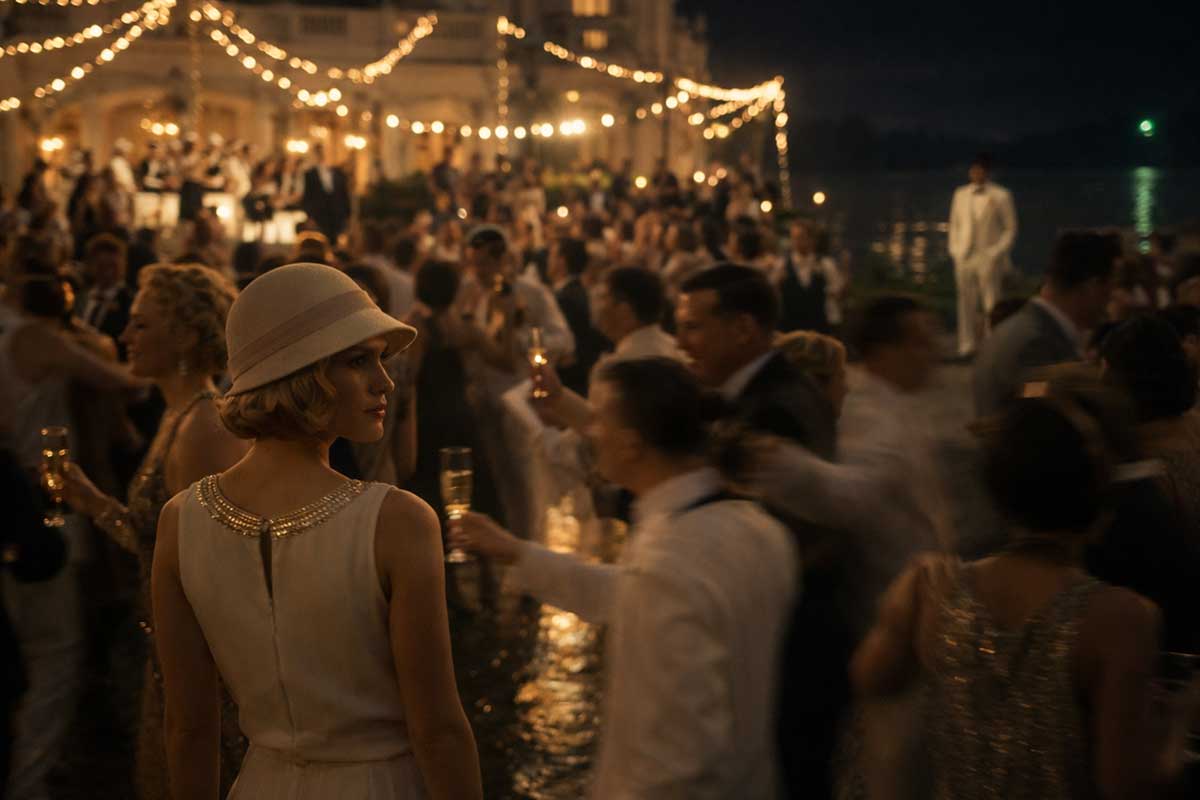
You did not go to Gatsby’s parties because you were invited. You went because other people were going, and you wanted to see whether the world had shifted without telling you.
That was the real fear in those days, not poverty, not scandal, not even war. The real fear was that something could happen while you were away from the room, and when you returned, your chair would be occupied by someone with better stories.
On a summer night, West Egg looked like a stage set. The air carried salt and gasoline and flowers, and the sound across the water was always slightly delayed, like laughter arriving from a different life. Gatsby’s house rose at the edge of the bay like a promise somebody had written in architecture.
As we approached, the place was already spilling over. Cars lined the drive in rows, gleaming and arrogant. The lights were so bright that the shadows looked embarrassed to exist. Music poured out in waves, not a melody so much as a command to forget yourself.
The first thing you noticed was how quickly people acted as if they belonged there. They walked up the steps as if the house had been built for them. They took drinks as if they were owed refreshments for the burden of being charming.
No one asked for Gatsby.
That was the second trick. Make people comfortable enough to be rude.
I moved through the crowd with my usual calm. A good party is a map, and I have always been good at maps. You can tell who is hunting and who is hiding by the way they hold their glass. You can tell who is wealthy by the way they refuse to look impressed. You can tell who is desperate by the way they laugh too long.
There were girls with voices like bells and boys with hair slicked into confidence. There were men in white suits who looked as if they had been poured out of privilege. There were women who had brought their prettiest lies and were hoping to trade them for better ones.
The conversations were all the same conversation, just rearranged.
How did you get here.
Who do you know.
Where is the host.
What have you heard.
Rumors moved like servants. Someone said Gatsby was related to the Kaiser. Someone else said he had made his money from oil, and then corrected herself and said it was from bonds, as if the difference mattered to anyone who was drinking for free. A man near the terrace leaned in and said Gatsby had been seen at the races with a senator’s wife. The girl beside him pretended to be shocked. Her eyes were not shocked at all. They were delighted.
This is the part people misunderstand. They think gossip is about information. It is not. Gossip is about permission. You tell a story about someone powerful so you can feel close enough to them to matter. If the story is dirty, even better. Dirt is intimacy without risk.
Nick was with me, of course, looking slightly stunned as if he had walked into the sea and discovered the water was warm. Nick had a face that wanted to be honest. It made him look young even when he was not.
He said something about the orchestra. I do not remember what. It was probably sincere, which is why it did not stick.
We found a table near the edge of the garden where you could see the whole field. That is where I like to sit, where you can observe without being trapped. From there, the party looked less like celebration and more like a kind of tournament.
People competed without admitting they were competing. They competed for attention. They competed for proximity. They competed for the privilege of being seen by the right eyes at the right moment. A man would tell a joke and look around to see who laughed. A woman would lean her shoulder toward a man and glance across the terrace to see who noticed. Even the dancing was a contest. How lightly can you float. How little can you sweat.
A woman I recognized from East Egg waved at me, her bracelet flashing like a signal. She came over and kissed the air beside my cheek and said, with a sweetness that wanted to be heard, that Gatsby’s parties were “simply divine.”
I asked her if she had met Gatsby.
She blinked as if I had asked her if she had met God.
“Oh, no,” she said, laughing quickly. “But isn’t it marvelous. It’s like being in Europe.”
Europe. That was what everyone wanted to say. Europe was what they used as proof that they had tasted something real. If you could claim Europe, you could pretend you were not just rich, you were cultivated.
Someone else said the champagne was from France. Someone else said the host was from Oxford. Someone else said he was from nowhere at all.
A waiter passed with a tray of cocktails, each glass jeweled with ice. I took one without thinking. The drink tasted cold and sweet and faintly dangerous, the kind of taste that makes you believe you are doing something sophisticated when you are simply being sedated.
Across the lawn, a group of men gathered around a table lit by lanterns. Their laughter rose higher than the music. One of them slapped another on the back with the force of a man who knows his apology will be accepted. They were the kind of men who could break a thing and still be invited back to admire it.
A woman in a silver dress stood alone near the steps, watching the crowd with a hungry stillness. She looked as if she had come to be chosen. In another life, she might have been kind. Here, she was armed with beauty and hope, which are rarely gentle when combined.
It would have been easy to say the party was alive. The truth is, it was animated. There is a difference. Life has roots. Animation is a spectacle. A party like that does not grow. It flares.
And then, finally, I saw him.
Not in the center where people assume a host should be, not holding court, not smiling broadly. He was standing slightly apart near the marble steps, watching the crowd as if he were watching a play he had paid to stage. He held his glass loosely, as if he did not need it. His posture was composed but not relaxed. His face held that careful brightness that makes you think of a man rehearsing friendliness.
He was not handsome in the obvious way, like Tom. He was handsome the way a photograph is handsome. Precisely arranged. Intentional. As if he had studied what people trust and built his face to match it.
Nick, who always seemed to sense importance the way other people sense weather, followed my gaze.
“That must be Gatsby,” he said, almost reverently.
I watched Gatsby for another moment. A man approached him, and Gatsby turned and listened with an attentive kindness that looked like it belonged in church. He nodded, smiled, said something I could not hear. The man walked away looking lighter, as if he had received a blessing.
That was Gatsby’s talent. He made people feel chosen without choosing them.
You could see it in the way people spoke his name after that, once they had spotted him. The rumors shifted. The rumors softened. He was no longer a murderer. He was a mystery.
A mystery is safer than a fact. A fact can be judged. A mystery can be desired.
I did not move toward him. I did not feel the need to be introduced. I have never trusted men who build their own legends. The stories are always scaffolding. They are always hiding something unfinished.
But I watched him, because I could not help it.
It is difficult not to watch a man who is trying to buy a past.
At some point, the music changed, and the crowd swayed as if obeying. Gatsby lifted his glass toward someone across the garden, a small gesture that looked like a signal, and I followed the line of it.
Across the water, the far shore held its lights like a string of small promises. And somewhere in that line, faint but unwavering, there was a green glow.
I did not know then what it meant, only that Gatsby saw it as if it were a star he had personally negotiated into existence.
That was when I understood, in the quiet way you understand a storm when the air goes too still, that this was not merely a party.
This was an altar.
And Gatsby was not hosting.
He was worshiping.
And the thing he worshiped was not the crowd, not the music, not the money.
It was a woman.
Daisy.
I did not know yet how my own name would be braided into their wanting. I did not know how quickly the game would stop being amusing and start being sharp.
I only knew that Gatsby’s gaze did not belong to the present at all. It belonged to a memory he had polished so much he could see himself in it.
And I, who had spent my life learning how to see without being seen, felt the unpleasant tick of certainty.
When a man looks at a light like that, he will burn down every room between him and it.
Including yours.
Act I, Scene 3: Daisy’s Voice, Daisy’s Cage
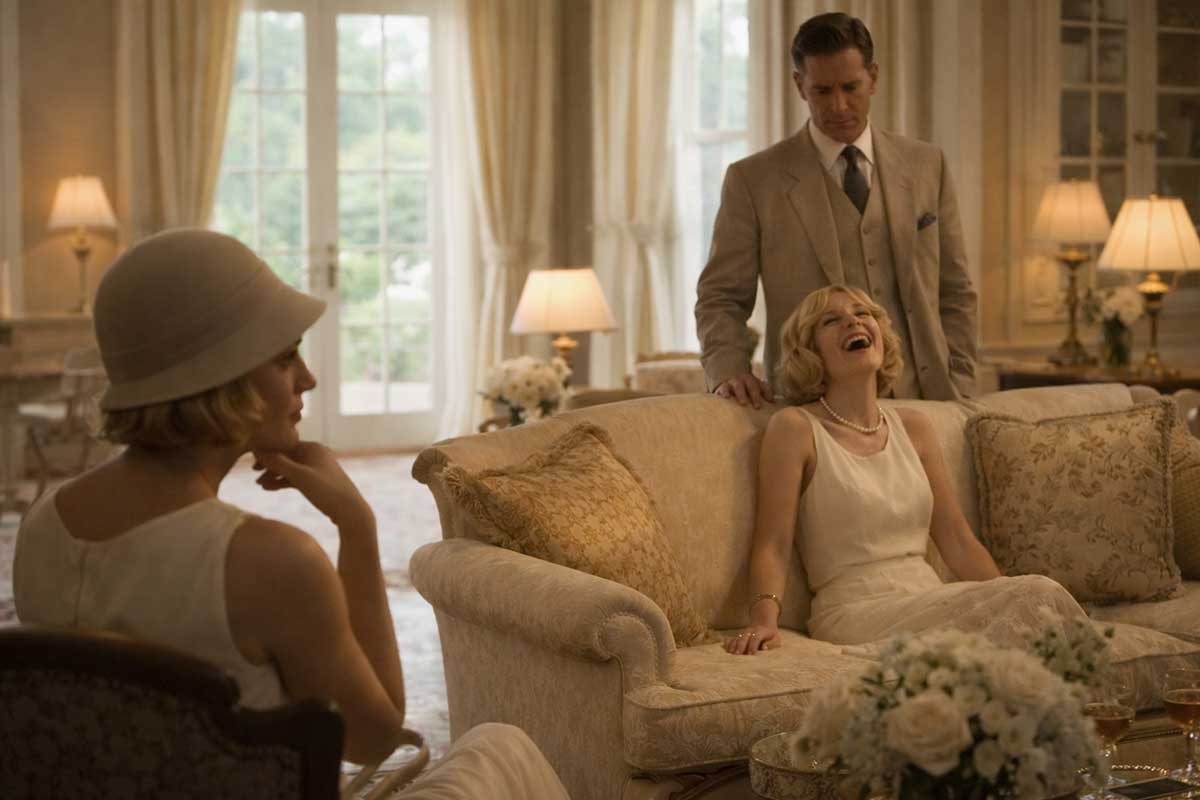
The next morning, East Egg looked scrubbed and innocent, as if someone had washed the night away and left only the expensive parts to dry.
Daisy’s house always had that effect. The curtains breathed with the breeze, and the rooms were pale and wide and softly echoing, like a place designed for people who did not want to hear themselves think. Even the furniture seemed to sit carefully, as if it had been trained not to make demands.
It was tempting, standing there, to believe in goodness. Tempting to believe that a life could be made gentle simply by arranging it correctly.
But gentleness, I have learned, is often only fear wearing perfume.
Daisy was in white again. Daisy was always in white when she wanted to look as if she had never done anything wrong. She had the face of someone who had been forgiven her whole life and still felt vaguely guilty about it, like a child who has stolen candy and been kissed anyway. She floated into the room with that familiar lightness, as if gravity had agreed to treat her differently.
“Jordan,” she said, drawing my name out like she was touching a ribbon. She kissed my cheek and her mouth was cool, her lips soft, her eyes already half laughing. “You look terrifyingly fresh.”
“I’m always fresh,” I said. It was a lie, but an acceptable one, the kind the room enjoyed.
She laughed, and the laugh filled the space and made it feel friendly. That was Daisy’s gift. She could make a room love her before she had even entered it.
Nick was there too, quiet and polite, as if he had come to do his duty to the family and hoped duty would not ask him to be interesting. Daisy treated him like a cousin she had just remembered, all warmth and brightness, and then she forgot him again the moment her attention shifted. I watched him take it as a compliment.
Tom was in the other room, on the telephone, as if he could not bear to be in the same space as his own domestic life without some external audience. I could hear his voice rising and flattening, rising and flattening, the rhythm of a man who believes his anger is a form of honesty. Every time he said “Hello,” he sounded as if he were challenging the person on the other end to deserve it.
Daisy pretended not to notice. That was her other gift.
We sat near the windows, where the light was strongest. Daisy always preferred the strongest light. It made her look as if she had been invented yesterday.
She poured coffee and added sugar with delicate violence, tapping the spoon against the cup a little too sharply. Small things are how you know when Daisy is not as calm as she appears.
“Was it simply monstrous,” she asked, “the party?”
“Animated,” I said.
“Animated,” she repeated, pleased, as if she had learned a new word. Then her eyes narrowed slightly, playful but searching. “And the host?”
“I saw him.”
“And?”
I let the pause lengthen. Daisy’s curiosity was never casual. Curiosity in Daisy was always hunger dressed up in lace.
“He looks like a man who rehearses his smile,” I said. “He watches people as if he’s studying what they want.”
Daisy laughed again, lightly, but the laugh came a fraction too late. It was not laughter. It was cover.
“Isn’t that what everyone does,” she said.
Not everyone, I thought. Only the ones who are trying to enter a room that has already said no.
Out loud I said, “Some people don’t need to.”
Daisy’s eyes flicked toward the other room, toward the telephone voice, and then back to me. Her smile stayed in place, but it was the smile of a woman holding something down with both hands.
That was Daisy’s life. Holding things down.
A long time ago, before Tom, before East Egg, before the house learned her shape, Daisy had been a girl who believed she could have anything. She had been a girl who believed the world would rearrange itself around her feelings. She had been a girl who believed love was a kind of music you could dance to forever.
Then she married Tom Buchanan and discovered the world had its own music and it was louder.
People like to say Daisy married Tom for his money. That is a lazy explanation, the kind men prefer because it makes women look simple. Daisy married Tom for safety. Money was only the most visible part of it. Tom’s money came with a fortress. Tom’s name came with a shield. Tom came with a whole system of permission that told Daisy she would never have to stand alone in a room.
That is not romance. That is strategy.
There was a time I would have judged her for it. I was young enough then to confuse judgment with intelligence.
Now I knew better. I knew what it cost to be alone.
Daisy leaned back in her chair, letting her head rest against the cushion as if the chair were doing the work of holding her up. She looked at the ceiling, at nothing, and said in a voice that was meant to sound teasing, “I’m paralyzed with happiness.”
It was one of her phrases, one of the little performances she wore like jewelry. The words made Nick smile faintly, as if he believed her.
I looked at Daisy’s hands instead. They lay in her lap, fingers intertwined too tightly. Her ring flashed when the light hit it, hard and bright, like a small signal that could not be turned off.
“Do you ever get tired of being happy,” I asked.
Her eyes came back to me. For a second, the softness fell away and something sharper showed through, something like fatigue, something like rage.
“I get tired of being anything,” she said. Then the softness returned, quick as a curtain. “But I’m very lucky, Jordan. You know that.”
Lucky. That was the word people used when they meant trapped.
Tom came back into the room, big and restless, carrying his own importance like a trophy. His presence rearranged the air. Daisy’s spine shifted slightly, as if her body had learned his moods by heart.
“I’m going out,” he said to Daisy, not asking, announcing. He looked at me and Nick, and his smile had teeth. “You two behaving yourselves?”
Daisy’s laugh fluttered. “Always,” she said, and it sounded like a joke, which was the only way she was allowed to answer.
Tom’s eyes moved past her, as if he was already bored with the idea of her. Then he left.
The room exhaled.
Daisy stood and walked to the window. The movement was graceful, but I watched the way she placed her hand on the frame, fingers splayed, as if she were steadying herself against something invisible.
“Tell me,” she said, without turning, “what people are saying about him.”
“About Gatsby.”
She still did not turn, as if she could not bear to see my face when I answered. That was another rule in Daisy’s life. Do not look directly at the truth. Look at the wallpaper. Look at the water. Look at anything else. If you can keep your eyes away from the truth, you can pretend it is only a rumor, and rumors can always be changed.
“They say everything,” I said. “They say he’s a prince. They say he’s a criminal. They say he’s from Oxford.”
Daisy’s fingers tightened on the window frame. “Oxford,” she repeated softly.
There was a pause, and in that pause I understood. Not fully, not the whole shape yet, but enough to feel the ground shift.
This was not ordinary curiosity.
This was recognition.
Daisy turned then, slowly. Her face was composed, her lips slightly parted as if she had been about to say something delicate. But her eyes were too bright. Her eyes had that particular shine they get when she is looking at something that can hurt her and she has decided, foolishly, to look anyway.
“Would you ever,” she said, “introduce me to him?”
There it was. The ask that sounded like nothing. The ask that would become everything.
Nick looked up, surprised, as if he had just realized he was part of a story.
I felt something I did not like. Not fear, exactly. More like the unpleasant recognition that the game I had been watching from the edges had just turned to face me.
“Why,” I asked, keeping my voice light, “do you want to meet him?”
Daisy smiled, and the smile was so pretty it could have been innocent. “Oh, I don’t know,” she said. “You make him sound so…” She searched for the word, and for once it did not come easily. “So grand.”
Grand. That was Daisy’s favorite kind of danger. The danger that could be mistaken for romance.
I watched her carefully. “It would be inconvenient,” I said.
“Inconvenient,” she echoed, and her laugh came out wrong, too thin. “Jordan, you always say that when you mean yes.”
I should have said no. I should have said no the way you close a door quietly before the wind can blow it open. But Daisy’s voice had always been able to pull people toward her, not with force but with a kind of charming gravity. Daisy did not command. Daisy invited. And invitations in East Egg were the closest thing to a law.
Also, I was curious.
Curiosity is my worst habit. It makes me forget to be cautious.
Nick’s face was earnest, hopeful. He wanted to do the right thing. He wanted to be useful in a good way. That is the kind of innocence that gets people hurt.
Daisy moved closer, and for a moment she was not performing. For a moment she looked almost young, almost real, a woman standing at the edge of an old memory.
“I just want to see,” she said. The words were soft, but her hands were still tightly clasped. “I just want to see what’s there.”
What’s there, I thought, is a man who built a cathedral out of wanting you.
But I did not say it.
Instead I said, “All right.”
The word fell into the room like a match.
Daisy’s face lit up with a happiness that was too bright to be safe. She clapped her hands once, quickly, like a child. Then she caught herself, smoothed her expression, and laughed as if she had not done it.
Nick looked startled, and then pleased, as if he had been given a role in a play he did not understand.
I watched Daisy, and I watched the window, and beyond it the water and the line of distant lights. Somewhere across that water was Gatsby’s house, with its bright music and its worship.
Daisy had asked for a meeting as if she were asking for tea.
I knew better. Meetings like that were never tea. They were detonations.
And I had just agreed to strike the match.
Act I, Scene 4: The Favor That Costs You Later
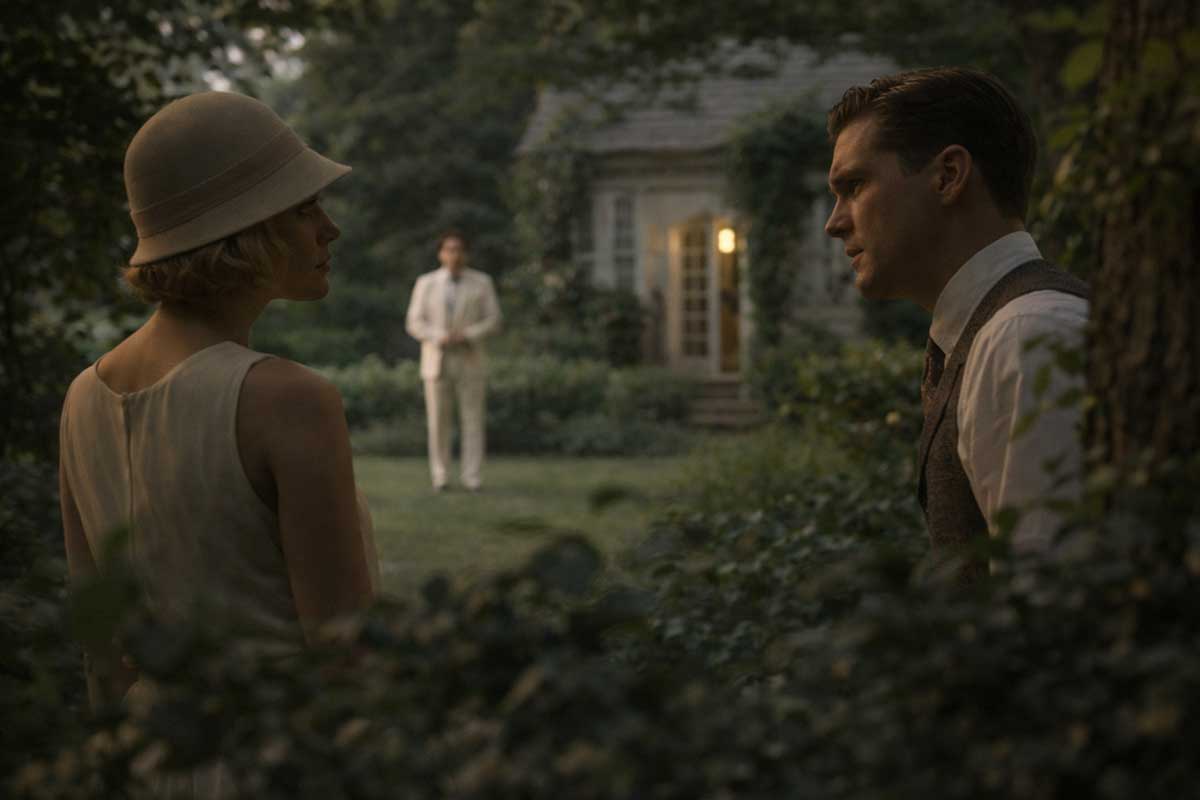
By afternoon, the heat had thickened, pressing down on the lawns until the green looked almost unreal. The day had that bright, nervous energy that comes before a storm, the kind of light that makes everything look too exposed.
It was the kind of day where you could not pretend you had nothing to lose.
Nick drove, because Nick always volunteered for effort. I sat beside him, hat angled just so, sunglasses hiding what I did not want to reveal. Daisy sat in the back, dressed as if she were going to be photographed, which meant she had already decided this meeting mattered more than she was willing to admit.
The car smelled of leather and sun.
Nick kept glancing at me as if he wanted advice. He was the sort of man who believed advice would make him safer, as if knowledge could be used like a coat against weather.
“What exactly,” he asked, carefully, “is this about?”
“Daisy wants to see him,” I said.
Nick frowned. “But why now?”
I watched the road slide under us, smooth and fast. “Because she can,” I said.
Nick did not like that answer. He wanted reasons. He wanted morals. He wanted clean lines.
“This feels…” he began.
“Messy,” I offered.
He sighed, relieved at being understood. “Yes.”
“Everything worth watching is messy,” I said.
Daisy leaned forward between the seats. “Jordan,” she said, bright and too casual, “don’t fill his head with your bleak philosophy.”
“It’s not philosophy,” I said. “It’s observation.”
Nick’s mouth tightened, but he said nothing. Daisy settled back again, humming softly, as if she were entertaining herself on a drive to nothing in particular.
I knew Daisy’s tricks. I had grown up beside her. When she hummed like that, it meant she was trying to keep herself from speaking. Daisy could talk through anything. If she was choosing silence, it was because the truth was too close.
We arrived at Nick’s house and Daisy stepped out as if she were stepping onto a stage. She adjusted her gloves. She smoothed her dress. She lifted her chin. Every movement said: I am fine.
Inside, the little cottage felt almost modest, almost moral, after East Egg. Daisy walked through it with a faint smile, amused by its simplicity. But her eyes kept flicking toward the window, toward the road, toward the possibility of him arriving.
I watched her, and I watched Nick, and I felt the strange sensation of being the only one in the room who could see the wires.
Nick busied himself with preparing tea as if the tea mattered. Daisy wandered to the window again. Her fingers tapped lightly against the glass, once, twice, then stopped.
“Do you think,” she said to no one, “he’ll come?”
“He’ll come,” I said. I said it with more certainty than I should have had, and I hated that I was right.
Because men like Gatsby do not miss appointments with their gods.
Outside, the sound of a car approached.
Daisy stiffened. It was subtle, but I saw it, the way you see the flicker of a bird in the corner of your eye. Her hand rose to her throat, then dropped.
Nick looked at me, eyes wide, as if he had just realized this was not a game.
The doorbell rang.
And just like that, the favor I had agreed to in Daisy’s pale living room became something heavier. It became a door opening. It became history rewriting itself, or trying to.
Nick went to the door, and Daisy turned away from the window as if she could not bear to look directly at what she had summoned.
I stayed where I was, on the edge of the room, because that is where I belong.
You can see more from the edges.
The door opened, and Gatsby stepped inside, bringing the bright, sharp air of his world with him.
He looked smaller in the cottage, as if the modest walls refused to let his legend expand. His suit was perfect. His smile was prepared. But his eyes, when they flicked toward the hallway where Daisy stood hidden, were not prepared at all.
His eyes looked terrified.
Nick introduced him, voice awkward, trying to make this seem ordinary.
Gatsby nodded. He said something polite. His hands moved slightly, as if he did not know where to put them.
Daisy still did not turn.
I watched Gatsby take one step forward, then stop.
In that pause, the room was so quiet I could hear the ticking of a small clock on Nick’s mantle, marking time like a warning.
And I thought, very clearly, that this was the moment people write poems about, the moment they call fate.
But I also thought, very clearly, that fate is just what you call it when you do not want to admit someone made a choice.
And Daisy had made hers.
And I had made mine.
And Gatsby, poor Gatsby, had built an empire just to reach this doorway.
Nick looked at me as if asking what to do, but there was nothing to do. The play had begun.
Daisy turned then, slowly, like someone stepping into a spotlight.
For a second, her face was blank.
Then she smiled.
And Gatsby smiled back.
And the smile was not joy.
It was relief.
Relief is always dangerous. It makes people believe the hard part is over.
I watched them, and I knew the truth that no one else in the room wanted to know yet.
The hard part was just beginning.
Act I, Scene 5: The Reunion, the First Crack
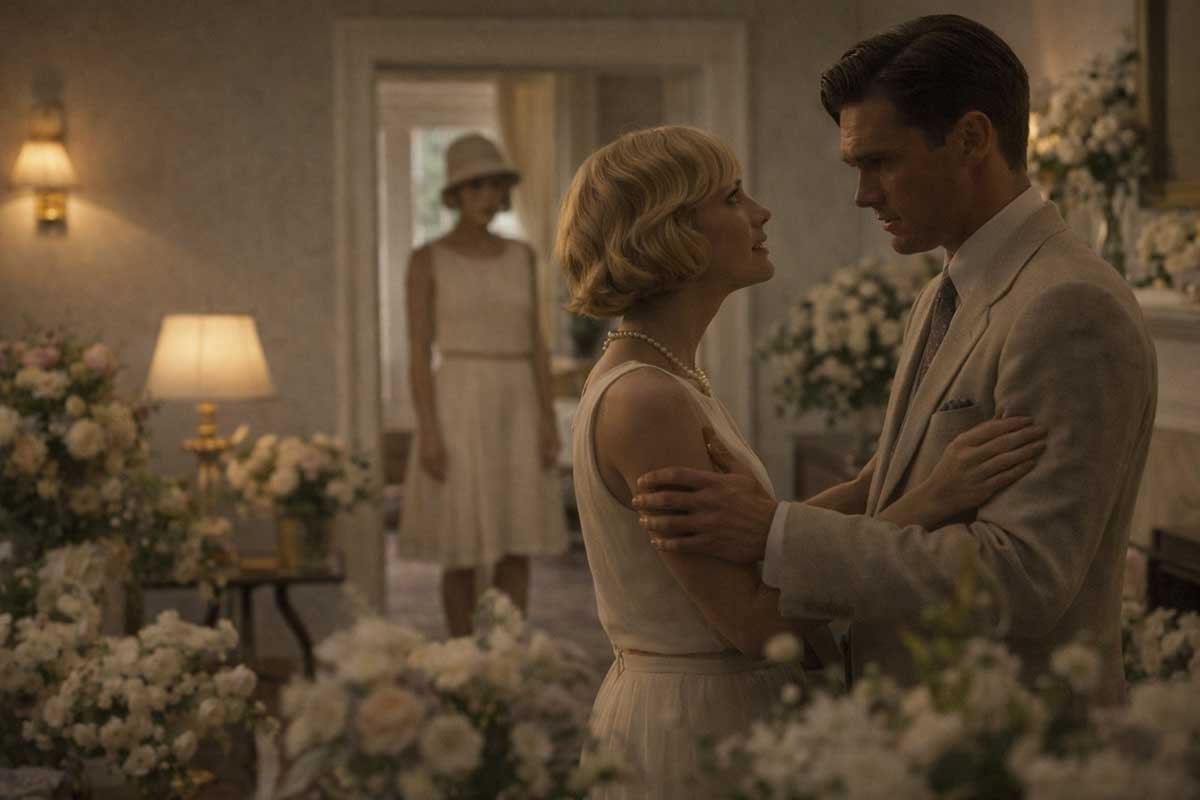
For a moment after Daisy turned toward him, no one spoke.
It was not the romantic silence people remember. It was the kind of silence that comes when a room has too many expectations in it and none of them agree. Even the clock seemed to hesitate between seconds, as if it wanted to see which version of time would win.
Gatsby took another step forward. His smile was careful, almost apologetic, the smile of a man entering a place he has rehearsed but never actually stood in. Daisy’s smile stayed bright, but it trembled at the edges, like glass under heat.
“Hello,” he said.
He had probably imagined saying her name. He had probably imagined saying something clever, something soft, something that would prove the years had been merely decorative. Instead he chose the safest word in the language.
Daisy’s fingers moved toward the back of a chair and rested there, not for elegance but for balance.
“Hello, Jay,” she answered.
The name landed heavier than the greeting. Nick looked quickly at me, surprised she used it so easily. I did not move. Names are never accidental.
Gatsby laughed once, too quickly, as if laughter might rescue the moment from its own weight. “It’s been… it’s been a long time.”
“Yes,” Daisy said. Nothing else followed it.
Nick shifted beside the table, hovering near the teapot like a host who suddenly regrets hosting. He looked at me again, and I gave him the smallest shake of my head. There was no rescuing this. Only witnessing.
Gatsby’s eyes moved across Daisy’s face as if verifying details he had memorized years ago. Her hair. The curve of her cheek. The tilt of her mouth. But recognition did not bring peace. It brought confusion. He had preserved her in memory, and memory does not age correctly.
Daisy was still beautiful, but she was no longer the girl he had left. No one ever is. The tragedy was not that she had changed. The tragedy was that he had not allowed for it.
“I was… I was just driving around,” Gatsby said, clearly hearing himself and hating the smallness of the lie. “Nick was kind enough to invite me in.”
Daisy’s eyes flickered toward Nick, grateful for the fiction. “How lovely,” she said. Her voice rose into its practiced brightness, but she did not release the chair. “You must both be terribly warm.”
Nick seized the opportunity like a drowning man grabs driftwood. “Tea,” he said. “We’ll have tea.”
We all sat.
No one drank.
The room filled with polite sentences that avoided the only sentence that mattered. Weather. Travel. The garden. Each word moved carefully around the years between them, like stepping around broken glass while pretending the floor was smooth.
Gatsby kept glancing at Daisy when she looked away and looking away when she met his eyes. His composure from the parties had vanished. The man who could host hundreds could not host one memory.
Daisy lifted her cup and set it down again without tasting it. “I heard you… you live across the bay.”
“Yes.” His voice softened, as if the word held architecture. “I watch the water from my house.”
Her lips parted slightly, and she understood what he meant. I saw the moment land in her. She had known before she asked to meet him, but knowing and seeing are different. Seeing demands reaction.
“That must be very peaceful,” she said.
“It is,” he answered, and it was the first honest thing he had said. Honest and foolish, because peace was not what he had been looking for.
The air grew heavier, thick with what neither of them dared to say plainly. Nick stood abruptly, nearly knocking his chair.
“I’ll just step out,” he said. “Give you… privacy.”
Daisy looked startled, but she did not stop him. Gatsby looked grateful and terrified at once.
Nick disappeared outside, leaving the three of us in the stillness.
I did not leave.
I stayed near the window, not pretending to read a magazine, not pretending anything. Some moments require a witness who will not soften them later. That is my talent. I keep the sharp edges intact.
Gatsby leaned forward slightly. “Daisy,” he said, and the name broke open the years more than any confession could have. “I wanted… I hoped…”
He faltered. Dreams speak fluently in solitude. They stumble in daylight.
Daisy’s eyes filled, though she was not yet crying. She studied his face carefully, as if searching for the boy she remembered inside the man he had become.
“I’ve thought about you,” she said.
The sentence sounded generous, but I heard the hesitation. Thought about is not waited for. Thought about is not chosen. Gatsby heard it too. I saw it in the tightening of his jaw, the desperate politeness with which he nodded.
“I wanted everything to be the same,” he said softly.
There it was. Not love. Not affection. Same.
Daisy’s hand lifted from the chair and hovered in the air before settling into her lap. “You can’t repeat the past,” she said, almost gently.
Gatsby smiled, and the smile was luminous and terrible at once. “Of course you can.”
The room shifted. Not visibly, not in any way a stranger would notice, but decisively. That sentence separated them more cleanly than distance ever had.
Daisy looked down at her hands, and for a moment her performance dropped entirely. She looked tired, older, almost frightened.
“I’m glad you’re well,” she said. “I’m glad you… did well for yourself.”
It was meant as kindness. Gatsby heard dismissal. Success was never the point. Success was the offering, not the altar.
He rose and moved toward the window, as if he could place the bay between them again and fix the proportions. Daisy stood too, following a step behind, pulled by something she did not fully trust.
They stood side by side looking out at the water.
From where I sat, I could see their reflections in the glass layered over the afternoon light. Two figures nearly touching, divided by a thin surface. It was the most accurate portrait of them I would ever see.
“You see that light,” Gatsby said quietly, gesturing across the bay. “I’ve watched it every night.”
Daisy followed his hand. The faint green glow waited in the distance, ordinary and unwavering.
“It’s just a light,” she said.
To her, it was geography. To him, it was destiny.
I realized then what neither of them understood yet. Gatsby had not been waiting for Daisy herself. He had been waiting for the certainty he felt when he first loved her, and he believed she could restore it. Daisy had come hoping to feel that certainty again and feared she might.
They were not meeting each other. They were meeting their own memories.
And memories are the most unforgiving companions. They refuse compromise.
Daisy turned back toward the room. Her composure returned in careful layers. She smiled, brighter than before, because brightness is armor.
“This is all so romantic,” she said lightly, as if the word could shrink the moment into something manageable. “We mustn’t be serious.”
Gatsby nodded, though seriousness radiated from him like heat. “No,” he agreed. “Not serious.”
But the agreement was only politeness.
Nick returned then, slightly flushed from his unnecessary walk, and the ordinary world rushed back in with him. Cups were lifted. Laughter attempted. Conversation resumed its shallow pathways.
The meeting, officially, was a success. No one cried openly. No one argued. No one confessed the full shape of their wanting.
Yet as we prepared to leave, I felt a certainty settle over me, quiet and final.
The reunion had not healed anything.
It had measured the distance between dream and reality and discovered it was larger than either of them could cross without breaking something.
And because I had arranged it, because I had opened the door and watched them step through, the crack belonged to me too.
That is the problem with standing at the edge of a story. You think you are safe from consequence.
Until you realize the edge is only the beginning of the fall.
Act II, Scene 6: The Contract Nobody Signs
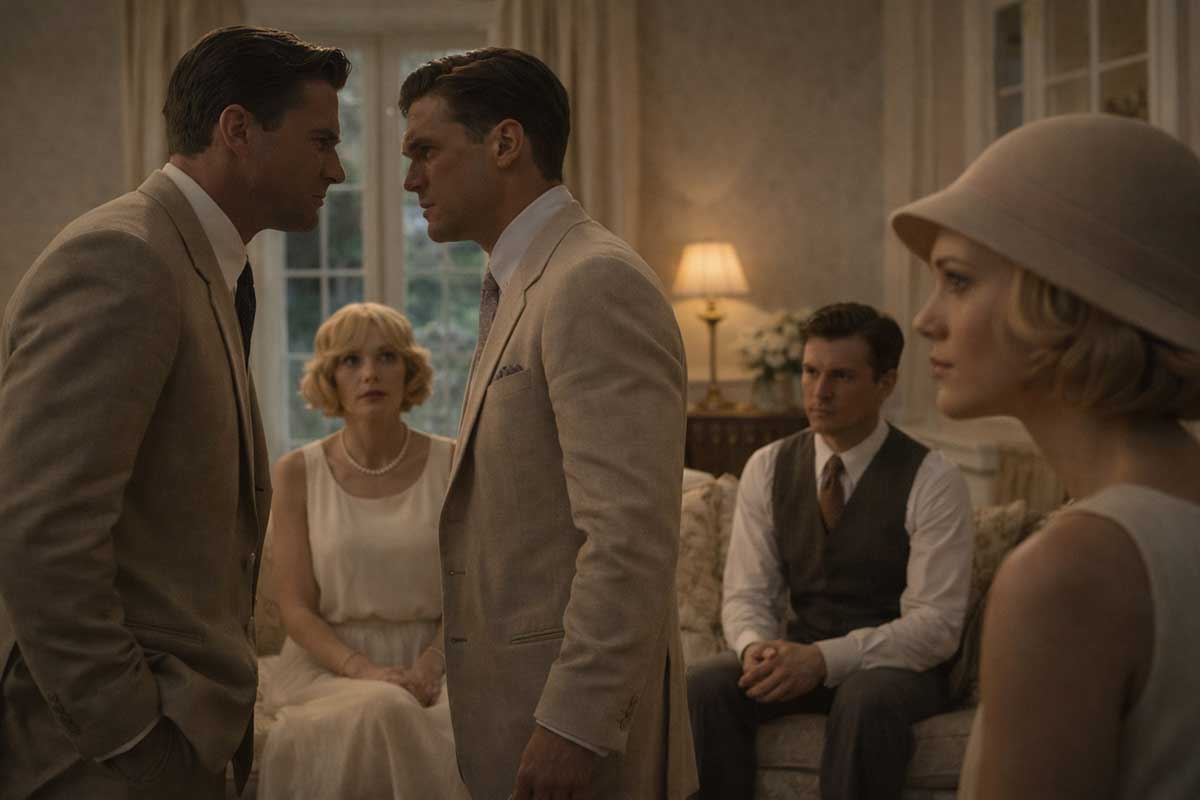
After that afternoon at Nick’s, the story began to behave the way stories do once they have been invited inside. It stopped waiting politely at the door and started walking through the house as if it owned the place.
Daisy began mentioning Gatsby in the same tone she used for weather, casual and constant, as if repeating the name could make it harmless. Nick began doing favors with the earnestness of a man who believes good intentions are a form of protection. Gatsby began appearing more often, arriving with that controlled brightness and leaving behind the faint sense that he had just adjusted the air in the room.
And Tom began noticing.
Tom noticed the way a man notices a draft in his own house. Not because he is cold, but because it insults him that the house is not sealed.
The first time I saw them all together after the reunion, it was at Daisy’s. The afternoon had the same soft light as before, but the room no longer felt innocent. Daisy sat too still. Gatsby stood too straight. Nick looked as if he wished he had taken a different train back from the war. Tom moved through the space like a large animal checking the fence.
They were polite, of course. People like that are always polite. Politeness is how they sharpen knives without drawing blood yet.
Tom addressed Gatsby with exaggerated friendliness, the kind that always contains a warning. Gatsby answered with a careful respect that looked almost humble until you watched his eyes. His eyes did not respect Tom. His eyes were enduring him, the way you endure a locked door by imagining the room beyond it.
Daisy kept speaking lightly, laughing at small things, offering trays of food as if the right lemon cake could turn the air back into harmlessness. Every time Tom looked at her, her laughter rose a little. Every time Gatsby looked at her, her voice softened without meaning to.
Nick watched all this with a quiet horror.
He believed love was supposed to make people better. He believed love was a kind of moral improvement. But here love was being used like a weapon, and it had nothing to do with goodness.
It was about ownership.
That is what people miss when they romanticize it. They think desire is beautiful by nature. They think wanting is proof of sincerity. They do not notice that wanting can be a form of conquest.
Tom wanted Daisy as property. Gatsby wanted Daisy as permission. Daisy wanted not to be destroyed by either.
I sat near the window and watched the room the way I watch a golf course. People think golf is calm. It is not calm. It is a slow contest of nerves, a public performance of control.
This was the same. A contest no one admitted was happening.
Tom asked Gatsby where he was from.
Gatsby said the prepared answer, the polished origin story. Oxford. Wealth. Family. The words were all in the right order. Tom listened the way a man listens to a witness he intends to discredit.
Daisy interrupted with a laugh and said Gatsby was simply marvelous, and the sentence sounded like a compliment, but it was also a plea. Please do not. Please do not make this ugly. Please let me keep the illusion that we are still civil.
Tom smiled at her without warmth.
I saw then what Daisy had married. Not money. Not charm. Not strength. She had married a man who could make ugliness feel inevitable.
Gatsby, for his part, did not argue. He did not puff up. He did not show anger. He absorbed Tom’s questions and returned them politely, as if he were being tested by a teacher whose approval mattered.
But his politeness did not hide submission. It hid patience.
That was the terrifying part. Gatsby was not fighting for Daisy as if he might lose. Gatsby was behaving as if he had already won and was merely waiting for the world to notice.
Tom sensed it.
Tom’s body leaned slightly forward, almost imperceptibly, like a man preparing to charge. Daisy’s shoulders tightened. Nick’s hands moved as if he wanted to straighten something on the table. He wanted to restore order. He did not understand that order was exactly what was being attacked.
“You know,” Tom said, voice easy, “I’ve heard some interesting things about you.”
Gatsby smiled. It was the same smile he used at parties, the one that made people feel chosen. But it did not work on Tom. Tom had never needed to be chosen by anyone.
“I’m sure you have,” Gatsby answered.
Daisy’s laugh came out too bright. “Tom, darling,” she said, “must you be so…”
She stopped. She could not find the right word. Cruel was too honest. Curious was too weak. Tom’s behavior lived in a space where vocabulary breaks down.
Tom stepped closer to Gatsby, still smiling. “I’m just interested,” he said. “You can’t blame me for being interested.”
That sentence was the contract nobody signs.
It means: I am allowed to investigate you. I am allowed to name you. I am allowed to decide what you are.
Gatsby’s smile did not change. “Of course not,” he said.
There was a silence then, brief and charged.
Daisy moved quickly to the window, as if she had to breathe. Gatsby’s eyes followed her like a compass needle, and Tom watched that look with a satisfaction that was almost calm.
Because Tom knew. Tom had finally seen the shape of the threat.
And once Tom knows, the game stops being social.
It becomes legal. It becomes financial. It becomes physical.
People think the tragedy of that summer was an accident on a road. The truth is, the tragedy began earlier, in rooms like this, with polished sentences and smiling investigations.
After Gatsby left, Daisy tried to pretend he had not left. She talked too much. She offered Nick another cup of tea. She asked me about a dress she had worn years ago as if the past were a closet she could step into and close the door.
Tom watched her, quiet now, as if storing the scene away.
Later, when we were alone for a moment, Daisy touched my arm and whispered, “Do you think he’s all right?”
She meant Gatsby. She also meant herself. That is the habit of women like Daisy. They ask about someone else when they are afraid to ask about their own survival.
“He’s fine,” I said.
It was not true. But it was the kind of lie the room required.
Daisy nodded, relieved, and smiled, grateful for the lie. Then she smoothed her hair and walked back into the living room where Tom sat, waiting in his own house like a verdict.
I watched her go and felt, again, that quiet certainty.
It was not love driving this anymore. It was power.
And power does not tolerate being rewritten.
Act II, Scene 7: The Girl in the Mirror
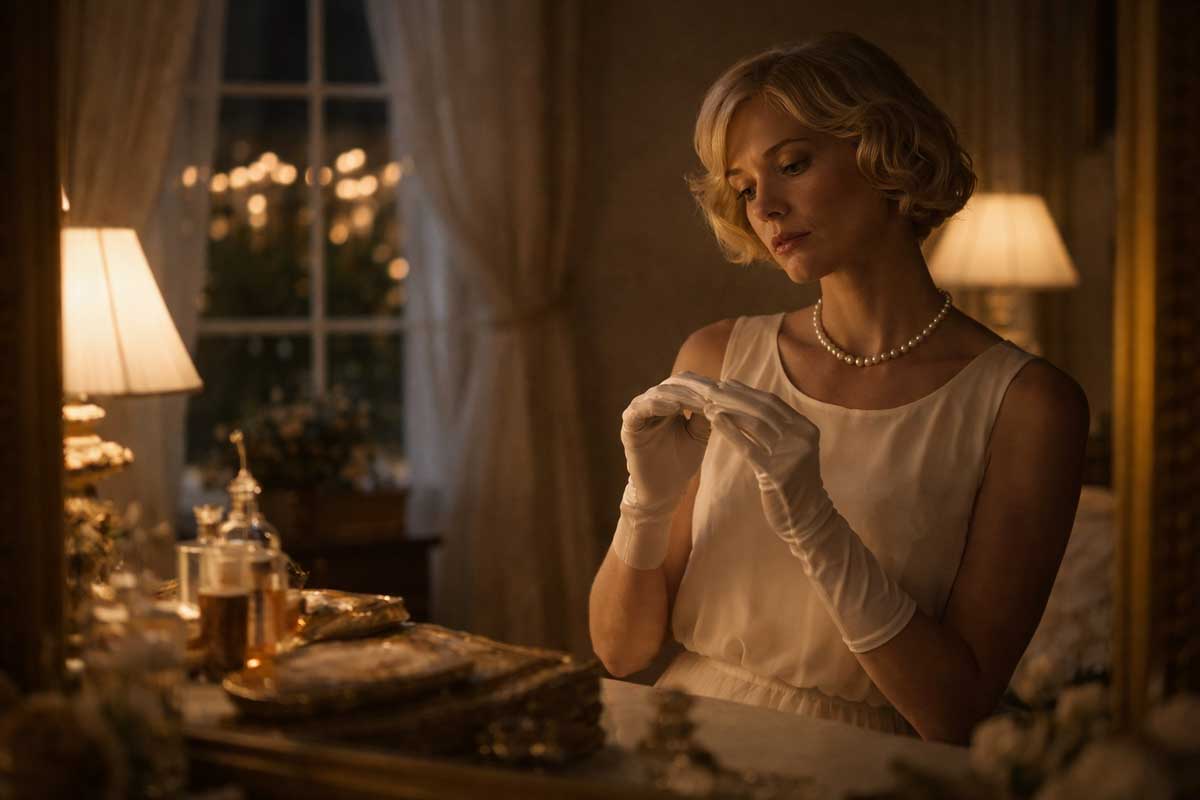
People assume I was untouched by it all, as if standing slightly apart means you are not also inside the fire.
That is another kind of compliment. It suggests you are colder than you are.
The truth is, I had my own stakes. I always did. They were simply quieter.
A woman in our world does not get to be messy and remain invited. A man can be reckless and call it passion. A woman is reckless and the room calls it character.
I had learned early how to keep my character intact.
I had learned it in hotels where the carpets were too thick and the staff moved like shadows. I had learned it in locker rooms where other girls talked about men as if men were weather, unpredictable but unavoidable. I had learned it on golf courses where you smile while someone hopes you fail.
Golf was the only place I was allowed to be openly competitive. It was the only place where ambition looked respectable on a woman, as long as it arrived wearing white gloves and a calm face.
Even then, people watched.
They watched the way I walked, as if stride could reveal sin. They watched the way I held a cigarette, as if the angle of my fingers could confess my intentions. They watched the way I won, as if winning were suspicious.
I had heard the whispers. I had heard the word dishonest said with a softness that made it worse. It did not matter what was true. It mattered what could be repeated.
That was the rule. Truth is optional. Reputation is not.
Sometimes, late at night, I would catch my reflection in a mirror and think about the life I had built. Not a home, not a marriage, not a family. A position. A place in rooms where people pretend not to need you until you stop showing up.
I told myself I preferred it this way. I told myself I wanted freedom.
I did. I also wanted not to be punished for it.
Because there is always punishment waiting for women who do not choose a cage.
You can feel it in the way people speak to you. They become curious in the wrong way. They ask questions that are not questions.
Who do you go home to.
Who keeps you.
Who will claim you when you get older.
They say it like concern. It is not concern. It is a reminder. A reminder that your value is expected to be assigned by someone else.
That summer, with Gatsby’s lights flaring across the bay and Daisy beginning to glow with dangerous hope, I found myself thinking about my own choices more often than I wanted to.
Not because I envied Daisy.
I did not envy Daisy. Daisy had a beautiful cage, but it was still a cage, and I had seen what happens when she rattles the bars. The cage rattles back.
What I envied was something else.
I envied the permission Daisy carried without thinking. The way rooms opened for her even when she had nothing to say. The way men forgave her for surviving. The way women excused her because she was charming and soft and pretty enough to be treated like a child.
No one treated me like a child.
They treated me like a threat, or a decoration, depending on how much I smiled.
I had learned to smile. I had learned to be pleasant. I had learned to be just mysterious enough to be interesting, but not mysterious enough to be suspicious.
And still, the whispers followed.
Once, years earlier, I had lied about something small. Not because I needed to. Because I could. It was an experiment. I wanted to know how far the world would bend if I pushed it gently.
It bent.
It bent easily.
And what I learned was not that lying is easy. What I learned was that people prefer a lie that flatters their expectations to a truth that complicates them.
After that, I lied less, not out of morality, but out of boredom. The world was too willing. It was like cheating at a game where the referee is asleep.
But the memory of that lie stayed with me, a private proof that I understood the mechanism. That I could, if I chose, manipulate the way the room saw me.
Maybe that is why I recognized Gatsby so quickly.
Because Gatsby was doing it on a grand scale.
Not a small lie. Not a flirtation. Not a social twist.
A full reinvention.
He was building a version of himself that the world would have to accept, because the lights were too bright to ignore. Because the music was too loud to deny. Because the money was too abundant to question politely.
Part of me admired the audacity. Part of me hated it.
Because men are praised for doing publicly what women are punished for doing privately.
A man reinvents himself and people call him self-made. A woman reinvents herself and people call her false.
That afternoon, I stood in my room and looked at myself in the mirror longer than I usually allowed. My face looked the same as it always did, composed, cool, reliable. But I could see the strain around my eyes, the slight hardening of my mouth.
The story was tightening.
I could feel it closing around us. Around Daisy. Around Gatsby. Around Nick with his earnest conscience. Around Tom with his satisfied cruelty.
And around me.
Because I had arranged the first meeting. I had opened the door. I had placed the first piece on the board.
People like to think the spectators are safe.
They are not.
The spectators become witnesses. The witnesses become participants. The participants become blamed.
I turned away from the mirror and reached for my gloves, as if gloves could protect you from anything.
Then I heard the phone ring downstairs.
A sound so ordinary, so domestic, and yet it tightened my chest immediately.
Because in houses like Daisy’s, the phone is rarely just a phone.
It is a line to the outside world. A line to the secrets that keep the house standing.
And I understood, with a kind of quiet disgust, that while Gatsby was trying to buy the past, Tom was about to remind him what the present really cost.
Act II, Scene 8: The Plaza Heat, the Real Contest
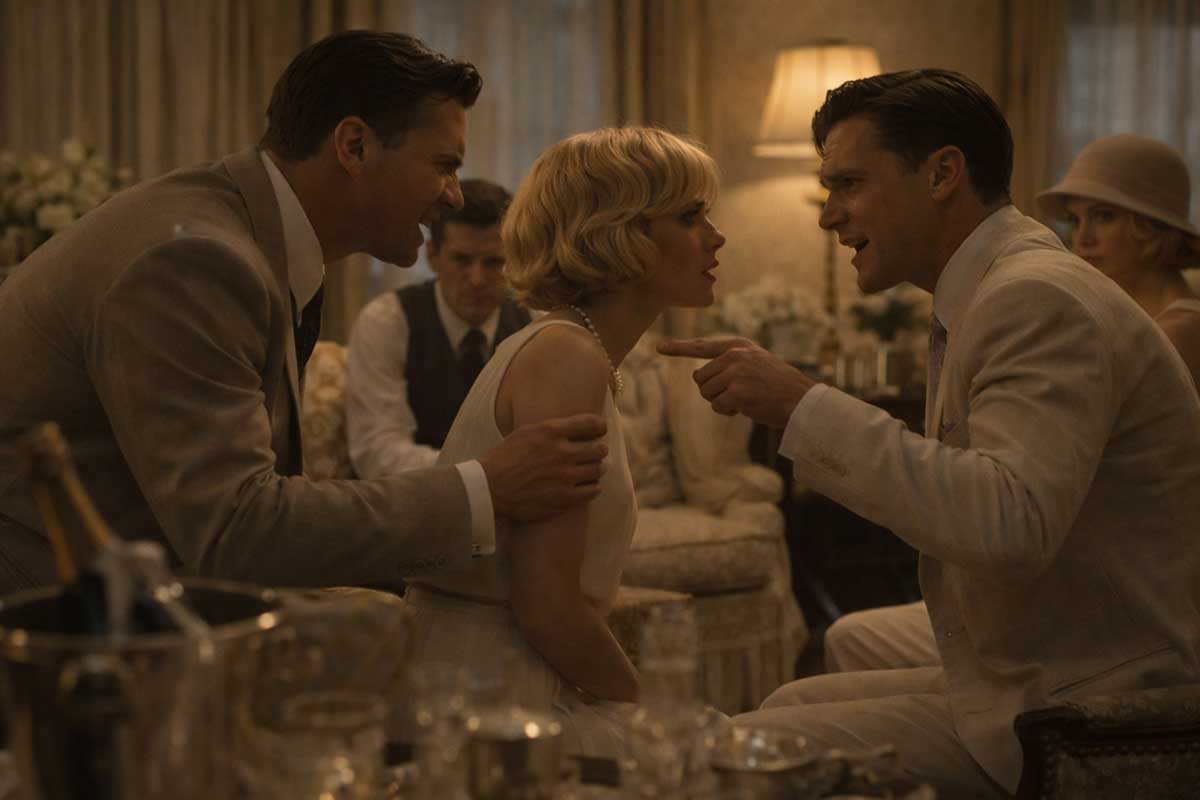
The heat that day did not merely sit on the city. It pressed.
New York in summer always pretends to be alive, but in August it becomes honest. The buildings sweat. The sidewalks glare. People speak more quickly because patience requires energy no one has left.
Tom insisted we go into the city. No one argued in a way that counted. Daisy laughed and said it would be fun. Gatsby agreed immediately. Nick looked uneasy but obedient. I accepted because refusal would have meant acknowledging what we all already knew.
The day was not chosen for pleasure.
It was chosen for resolution.
The train felt close even before it filled. Daisy leaned near Gatsby and spoke in a low voice that was meant to sound careless. Gatsby listened with the total attention he gave everything connected to her, as if the rest of us were background furniture.
Tom watched them both without appearing to watch. He had moved past suspicion. Suspicion has agitation in it. This was calmer. This was ownership preparing itself.
We reached the city and took rooms at the Plaza because Tom wanted air and witnesses. Men like Tom prefer their battles conducted where the world can observe the victory.
The suite looked cool and pale, but the heat climbed inside anyway, collecting in the corners of the ceiling and resting on our shoulders. Ice melted faster than it could be replaced. Even the curtains seemed tired.
No one sat comfortably.
Tom stood near the mantel. Gatsby stood near the window. Daisy moved between them like someone trying to balance two mirrors so neither reflected too much.
Nick remained near the table, hands restless. I sat where I could see everyone.
There is always a moment before the truth arrives when people attempt one last version of politeness.
Daisy spoke about the view. Nick commented on the traffic below. Gatsby said something about the weather that did not interest him at all.
Tom waited.
Finally he laughed, not loudly, not violently, just enough to signal he was done pretending.
“You want too much,” he said, looking directly at Gatsby.
The words were simple. The effect was immediate.
Gatsby did not flinch. “I don’t want anything that isn’t mine,” he answered.
Daisy inhaled sharply. The room tightened.
Tom stepped forward. “Yours,” he repeated. “You think you can come into my house, into my life—”
Daisy interrupted quickly, voice trembling. “Tom, please.”
But Tom did not stop. “—and take what you never built.”
Gatsby’s expression did not change, but the restraint inside it grew visible. “I built everything I have,” he said quietly.
“That’s exactly the point,” Tom replied. “You built it.”
The sentence carried more accusation than volume. Tom did not need to shout. He had the comfort of belonging. He was not defending a claim. He was enforcing one.
Gatsby turned to Daisy, as if Tom were only an obstacle to be explained away. “Tell him,” he said gently. “Tell him you never loved him.”
The words hung there, delicate and impossible.
Daisy looked from one to the other, and for the first time since I had known her, she seemed small not because she wished to appear so, but because she truly felt it.
“I… I loved you once,” she said to Gatsby.
Gatsby shook his head, smiling softly as if correcting a child. “Not once. Now.”
Daisy’s eyes filled. “I did love him,” she said, almost pleading. “I loved him once—but I loved you too.”
It was the only honest sentence anyone spoke all afternoon, and it satisfied no one.
Gatsby’s certainty fractured. Tom’s victory steadied. Nick’s belief collapsed quietly beside him.
Daisy looked at Gatsby, and I saw the precise moment she chose survival over devotion. Not coldly. Not cruelly. Carefully.
Her voice softened. “We can’t repeat the past,” she said again, weaker than before.
Gatsby stared at her as if language itself had betrayed him.
Tom smiled then, a relaxed smile, the smile of a man who has regained possession without lifting a hand.
“I told you,” he said almost kindly. “You can’t.”
The argument continued, but the outcome had already happened in that small, frightened sentence from Daisy. After that, it was only explanation and humiliation.
Tom revealed what he had learned about Gatsby’s money, each detail like a document presented in court. Gatsby denied, deflected, insisted, but it did not matter. Truth in such rooms is decided by comfort, not evidence.
By the time we left, the heat had not broken, and neither had the tension. But the balance had shifted.
Gatsby had not lost Daisy entirely.
He had lost the version of her that would destroy her own life for him.
And that was the only version he had ever loved.
Act II, Scene 9: The Ride Home, the Breath Before Impact
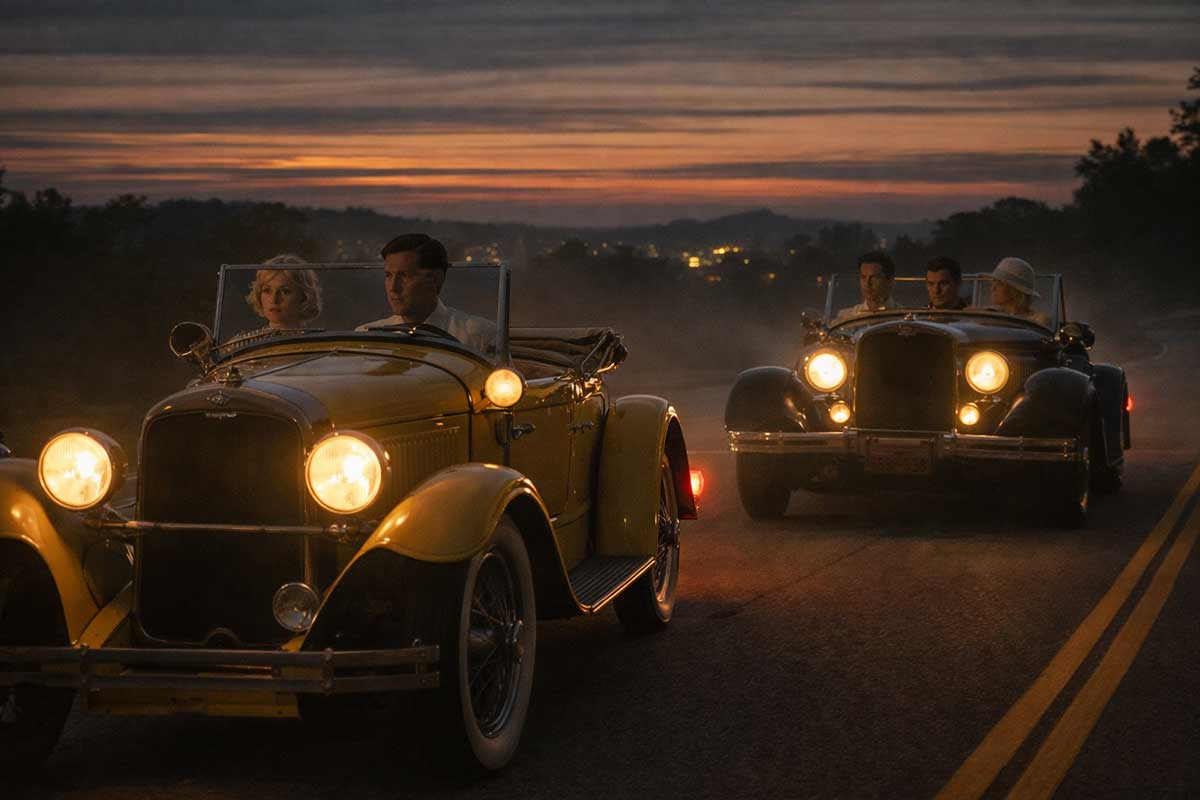
No one wanted to ride together, but no one wanted to separate either. Decisions require energy, and the day had taken it.
Tom suggested arrangements. Gatsby insisted Daisy ride with him. Daisy agreed too quickly. Nick and I were left with Tom.
The sun lowered but the heat stayed trapped in the roads, rising from the pavement in shimmering waves. The drive began in a silence that was almost relief after the pressure of the hotel room.
Tom drove with deliberate calm, as if nothing significant had occurred. That was his skill. Once he had won, he no longer needed to perform anger. He returned to comfort as naturally as breathing.
Nick looked out the window, pale, as though the world had tilted slightly and he was trying to adjust his balance.
I watched the road behind us more than the road ahead.
“You see,” Tom said finally, conversationally, “men like that don’t last.”
Nick did not answer.
Tom continued anyway. “You can’t build a life out of inventions. Eventually facts return.”
I considered telling him facts are only powerful when the right people repeat them. But the conversation was not meant for me.
Nick turned then. “He loved her.”
Tom shrugged. “That’s not the same thing as belonging.”
The distinction satisfied him completely.
We drove on. The sky deepened toward evening, and the air cooled just enough to feel possible again.
Then we saw the crowd.
Cars had slowed along the road, gathering in a loose half-circle near the garage. A shape of disturbance, unmistakable. Even before we stopped, the energy told the story: something irreversible had happened.
Nick leaned forward. “What is it?”
Tom’s jaw tightened, not with fear but with calculation. He pulled over and stepped out immediately. We followed.
Voices overlapped. A woman crying. Men speaking loudly to assert control. The smell of gasoline and dust hung heavy.
On the ground lay the broken outline of a life interrupted. Myrtle Wilson.
The details came in fragments. A car. Speed. A yellow body disappearing down the road.
Nick’s face drained. He turned instinctively toward me as if I could translate reality into something manageable.
I could not.
Tom spoke quickly with someone, his questions precise. He learned what he needed. He turned back to us, expression composed.
“Come on,” he said. “Nothing we can do here.”
Nick stared at him. “Nothing?”
Tom’s tone hardened slightly. “We’ll only make it worse.”
We returned to the car. No one spoke for several miles.
I watched the road ahead and thought of Daisy and Gatsby driving somewhere in front of us, carrying a silence heavier than the heat had been.
Sometimes the moment that changes everything does not feel dramatic. It feels inevitable.
The air that evening felt that way.
As if the day had been waiting for a payment.
And now it had been made.
Act II, Scene 10: The Accident, the Cover, the Purchase
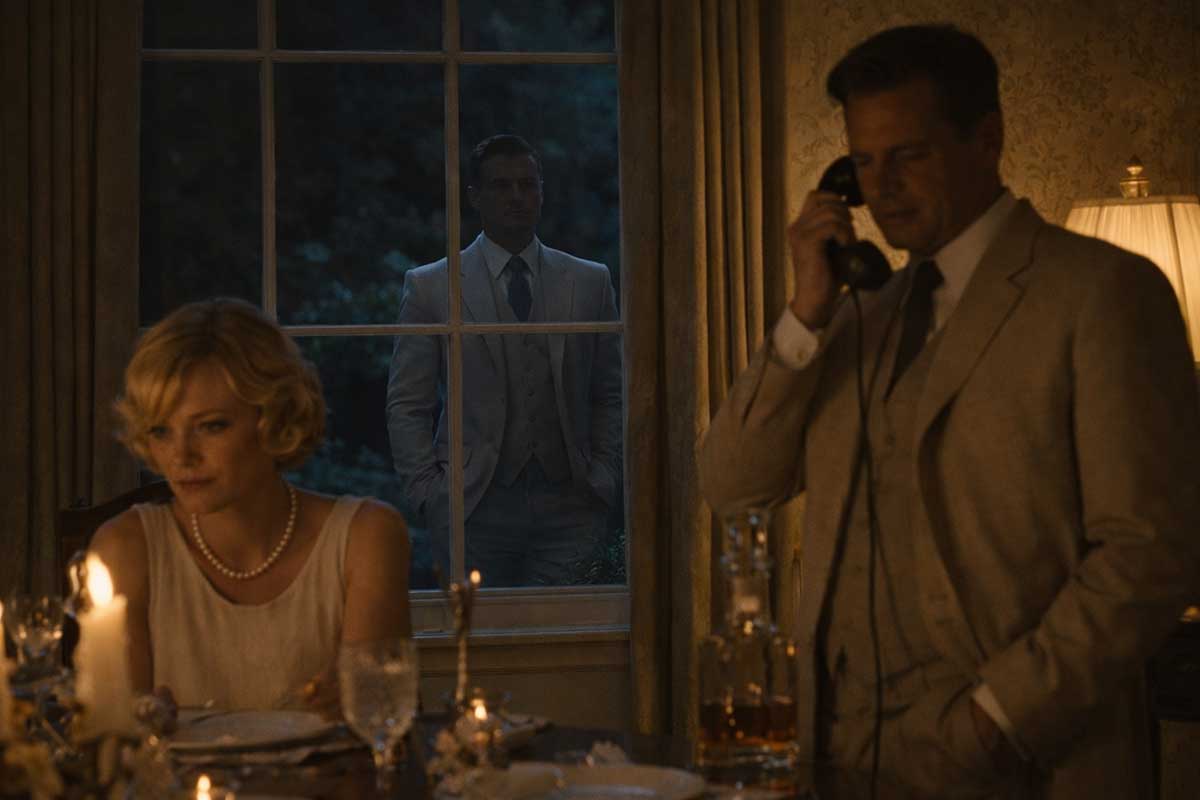
By the time we reached East Egg again, the sky had gone a bruised purple and the air smelled like cut grass and hot metal. The heat had begun to loosen its grip, but the day’s pressure had simply moved inside us. It sat behind our ribs and waited.
Tom drove into his driveway as if nothing had occurred. That was not denial. That was practice. In houses like his, disaster is treated as a temporary inconvenience, like rain during a tennis match. You wait it out. You resume.
Nick and I followed him in. The foyer lights cast a soft glow that made everything look gentler than it was. Daisy’s house was always trying to persuade you of its innocence.
Tom did not go to the living room. He went straight to the kitchen, where the servants moved quietly, careful not to become part of the story. Nick hovered, uncertain. I stayed near the hallway, because if you are going to witness something unpleasant, it helps to stand where you can leave.
Then I saw Daisy.
She was in the dining room, seated at the table with Gatsby.
They were not speaking. They were not touching. They were simply there, facing each other under the warm light as if the light could soften what they had done.
Daisy’s face was pale. Gatsby’s expression was controlled to the point of pain. He watched her with the calm devotion of a man who has decided he will take responsibility for anything that happens, including things he did not do.
There were no tears. Not yet. Tears would have been too honest.
Tom stopped at the doorway and looked at them.
The room froze.
For a moment I thought Tom might explode, because that is what people expect from men like him. They expect violence, because it makes the rest of us feel morally superior when we condemn it later.
But Tom did not explode.
Tom smiled.
It was the most chilling thing I saw that summer.
The smile meant he had already decided what to do.
He stepped inside, casual, as if coming to check on the roast. “Hello,” he said.
Daisy’s chin lifted slightly. She tried to look normal. Gatsby stood, polite, controlled.
Tom’s eyes moved between them. “I suppose you know what happened,” he said, in a voice that made it sound like a piece of news, not a human body on a road.
Daisy swallowed. Gatsby answered. “Yes.”
Tom nodded as if confirming a detail on a ledger. “Terrible thing,” he said. Then he looked directly at Daisy. “You should go upstairs.”
Daisy hesitated. For a second, her eyes met Gatsby’s and something passed between them that looked like panic.
Then she obeyed.
That is the part people misunderstand about Daisy. They think she is frivolous. They think she is weak. Daisy is trained. Daisy knows when the room has become dangerous. Daisy knows when to move.
She rose, hands shaking slightly, and left without a word. The sound of her steps on the stairs was soft, like a retreat.
Gatsby watched her go, and I saw the exact moment his dream tried to hold on and slipped a little.
Tom waited until she was out of sight. Then he turned to Gatsby with a calm that felt like a courtroom.
“So,” Tom said, “whose car was it?”
Gatsby’s jaw tightened. “It was mine.”
“And who was driving?”
Gatsby did not look at Tom. He looked toward the staircase. “Daisy was,” he said quietly.
Nick inhaled sharply. It was the sound of a man witnessing the universe rewrite itself in an instant.
Tom’s expression remained composed, but his eyes sharpened. He had what he needed now. Not the truth. The leverage.
“And you’re going to take the blame,” Tom said, not asking.
Gatsby’s voice stayed steady. “Yes.”
Tom’s smile returned, small and satisfied. “That’s very noble of you.”
Noble. The word was a knife wrapped in velvet.
Nick took a step forward. “Gatsby—” he began.
Gatsby glanced at him once. The glance was not pleading. It was instruction. Do not interfere. Do not complicate this. Let me do what I must.
Nick stopped.
Tom walked closer to Gatsby, invading the space the way he always did when he wanted to remind someone of the hierarchy. “You’re a fool,” he said softly. “And I’m glad of it.”
Gatsby did not respond. He kept his eyes fixed upward, toward the place where Daisy had disappeared, as if her presence could still be summoned by will alone.
Tom turned away then, satisfied, and went to find a telephone.
That was the purchase.
Not money changing hands. Something more invisible.
Responsibility.
Gatsby had bought Daisy’s safety with his own ruin.
It was the cleanest exchange in the world, because it required no paperwork. It only required one man who believed love meant sacrifice, and another man who understood sacrifice as a resource.
Nick followed Tom into the other room, drawn by outrage. I stayed where I was and watched Gatsby.
He remained in the dining room, still, as if his body had decided movement was too dangerous. He looked like a man standing guard over a door that would never open.
I stepped closer.
“Is she upstairs,” I asked, keeping my voice neutral, as if this were only an ordinary question in an ordinary evening.
“Yes,” Gatsby said. His eyes did not leave the staircase. “She’s… she’s resting.”
Resting. It was the kind of word people use when they cannot say frightened.
I could hear Tom’s voice on the telephone now, brisk, controlled, already arranging the story that would travel through the right rooms. Tom would speak to the police. Tom would speak to Myrtle’s husband. Tom would decide which version of events would be believed.
And Daisy would remain upstairs, wrapped in soft sheets, protected by the house and its name.
Gatsby would remain outside the fortress, holding the blame like a coat.
Nick returned, face tight with anger. “He’s calling people,” he whispered to me, as if he had just discovered corruption exists.
Of course he’s calling people, I thought. That is what power does when it is threatened. It connects.
Gatsby turned slightly, finally acknowledging us. “I’m going to wait,” he said.
Nick stared. “Wait for what?”
“For Daisy,” Gatsby said. “In case she needs me.”
Nick’s eyes filled with a kind of helpless rage. “She won’t,” he said, too bluntly, too honestly.
Gatsby did not react. He only smiled faintly, the way men smile when they refuse reality on principle.
“You don’t understand,” Gatsby said softly.
Nick took a step toward him, as if to shake understanding into him. Then he stopped, because you cannot shake a dream out of a man who has built his whole life to support it.
I felt, unexpectedly, a small wave of disgust that had nothing to do with Gatsby’s naivety and everything to do with the room’s cruelty.
Not Gatsby’s cruelty.
The house’s.
The system’s.
The way it could make a woman safe by making a man disposable.
“You should go,” I said to Gatsby.
He shook his head. “Not yet.”
Outside, the night had settled, heavy and quiet. Somewhere across the bay, the lights of West Egg glittered faintly, as if the party still believed it was the point.
Gatsby walked toward the back of the house, positioning himself where he could see Daisy’s window.
He stood there like a sentinel.
Nick watched him, and I could see Nick’s mind struggling to reconcile the story he wanted with the story that was happening. Nick wanted heroes and villains. He wanted love to mean something that saved people.
But love, in that world, did not save.
It only selected who would be sacrificed.
Tom came back into the room, phone call completed, confidence restored. He looked at Nick and then at me, and his expression suggested we had all just survived a minor inconvenience.
“Come on,” he said to Nick. “Let’s go to bed.”
Nick did not move immediately. His gaze drifted toward the staircase, toward Daisy’s absence. Then toward the dark outside, where Gatsby waited.
A long silence passed.
Finally Nick turned away, as if turning away were the only way to keep from screaming.
We left.
I walked out through the hallway and paused near the doorway. For a moment, I looked back.
The house glowed softly, warm, safe, beautiful.
And outside, in the darkness, Gatsby’s figure held steady beneath Daisy’s window, guarding the woman who had already retreated behind a name that would protect her.
I stepped into the night and felt the full weight of the exchange settle into place.
This was no longer a romance.
It was a transaction.
And the receipt would be paid in the only currency that never runs out.
A life.
Act III, Scene 11: The Telephone That Never Rings
In the days after, the world behaved as if it were embarrassed by what it had done.
West Egg’s lawns stayed trimmed. East Egg’s curtains still floated in the morning breeze. Boats still cut clean lines across the water. The sun rose with the same arrogance it always had, as if tragedy were only a story people told at night.
But the air had changed. It carried a thin, sour note of avoidance.
People did not stop talking. They simply changed what they talked about. They spoke of the accident the way they spoke of storms, as something unfortunate that had happened to someone else’s property. They lowered their voices in public. They raised them again in safer rooms. And in those rooms, the conclusion formed quickly, neat and comfortable.
It was Gatsby’s fault.
That conclusion traveled faster than any proof, because it matched what the room already wanted to believe. Gatsby had always been an outsider with too many lights. Outsiders are useful when something needs blaming.
I went to West Egg once, a few days later, not because I expected anything to be repaired, but because I wanted to see how quickly the party would pretend it had never been there.
The house looked strangely smaller in daylight. The great façade was still impressive, but it had lost its enchantment, like a theater after the audience leaves. Servants moved through the quiet rooms with careful steps, returning objects to their places, as if order itself were a kind of prayer.
The garden was empty. No music. No laughter. Only the faint sound of a fountain, still performing its small task, spilling water as if spilling could keep time from moving.
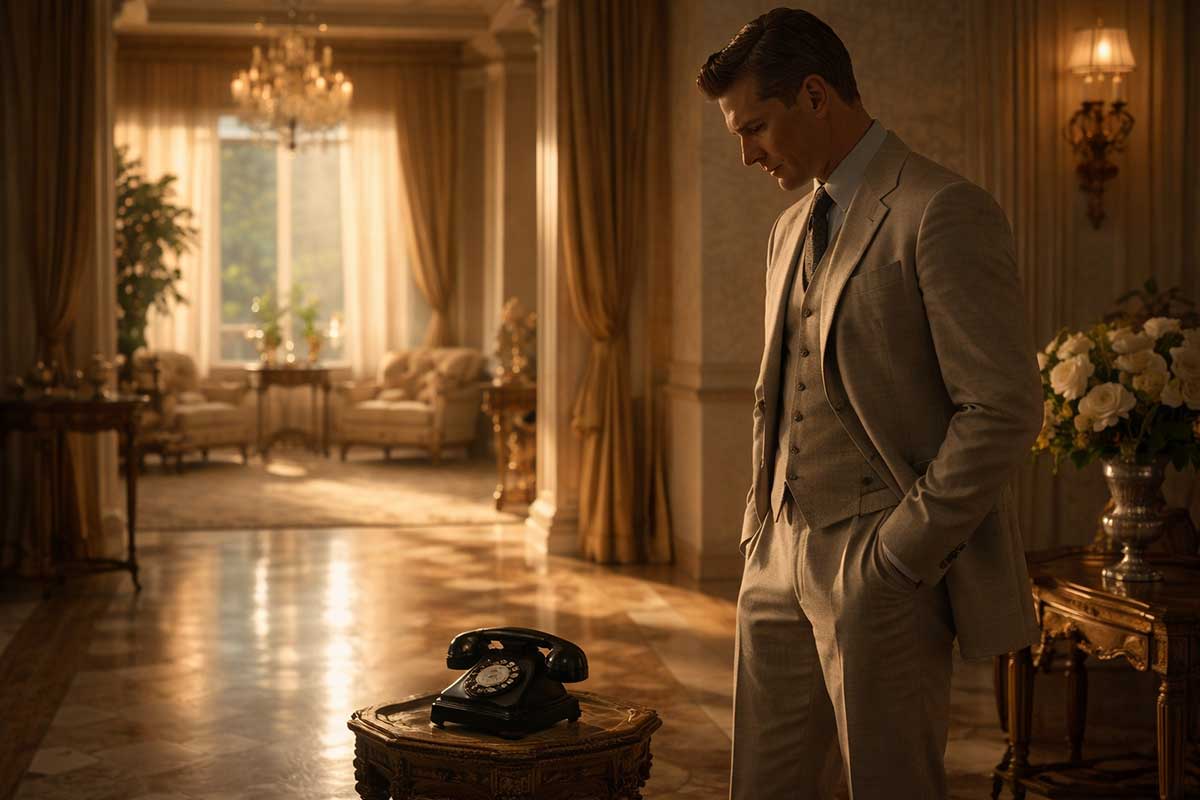
Gatsby’s phone sat on a table near the hallway. I noticed it immediately.
That is what you watch in the aftermath. Not faces. Not tears. The mechanisms.
The phone was the mechanism now. The line to the world that had once flowed into Gatsby’s house like a river. The line that had carried invitations and confirmations and urgent requests for another night of brightness.
The phone did not ring.
A servant stood near it, waiting. Not because he believed it would ring, but because he had been trained to wait. Waiting was his job. Waiting was everyone’s job, in different ways.
Gatsby appeared from the back of the house, moving slowly, as if his body had decided it was safest to occupy as little space as possible. His suit was still immaculate, but the brightness that once held him upright had dimmed. His eyes looked older. Not with wisdom. With depletion.
He smiled when he saw me, a polite, practiced smile that did not reach the part of him that mattered.
“Jordan,” he said.
“Gatsby,” I answered. Then, after a beat, “Have you heard from her?”
His gaze flicked toward the phone as if the phone were her. “Not yet,” he said. His voice remained calm. The calm was a kind of discipline. It was the discipline of a man refusing to admit he has been abandoned.
The servant shifted slightly. Gatsby did not notice. Or he noticed and pretended not to.
“She’s very shaken,” Gatsby continued, offering the excuse as if it were fact. “Tom’s keeping her quiet.”
Quiet. The word sounded gentle. It was not gentle. Quiet was what happens when someone decides you do not get to speak.
“You can’t stay here,” I said.
Gatsby looked at me, surprised, as if he had not considered that his own survival mattered.
“I’m waiting,” he said.
“For what,” I asked, and immediately regretted it. The question was too blunt. It made the dream look childish.
But Gatsby only smiled faintly, patient with my lack of faith. “For a call,” he said. “She’ll call.”
I glanced at the phone again. It sat there like a small black truth. It did not ring. It had not rung. It would not ring.
Gatsby walked to the window and looked across the bay. The green light was invisible in daylight, but he behaved as if he could still see it. As if faith could replace sight.
He spoke without turning. “I’m going to protect her,” he said.
Protect. That was the word men like Gatsby love because it makes their sacrifice look noble. It makes their hunger look clean.
In that moment I understood something cruel and simple.
Gatsby’s devotion was not a gift to Daisy. It was a demand placed on the universe. If he could protect her, then the story would have meaning. If he could protect her, then the years of building, the money, the parties, the lies, the discipline of becoming would all be justified.
If Daisy did not call, the story would collapse.
That was why he kept waiting. Not for Daisy.
For proof.
The house remained still around him. I heard a distant door close. Somewhere a servant moved a vase an inch to the left. The world tidied itself.
“You know,” I said quietly, “they won’t come back here.”
Gatsby turned then, and his eyes held a gentle certainty that made me angry.
“They will,” he said. “They have to.”
Have to. The language of men who believe desire creates obligation.
I watched him for a moment longer. His face still carried that careful handsomeness, but now it looked like a mask held up by will. It was not beauty anymore. It was effort.
“I should go,” I said.
He nodded, distracted, already turning back toward the phone.
As I walked out, the silence followed me. The enormous house seemed to hold its breath, waiting for a sound that would not come.
Outside, the driveway was empty. No cars. No bright guests. No careless laughter.
Only the fountain, spilling.
Only the bay, glittering.
Only the phone, refusing.
And Gatsby, standing inside his own myth, listening for a ring that would never arrive.
Act III, Scene 12: Nick Wants Truth, Jordan Wants Proof
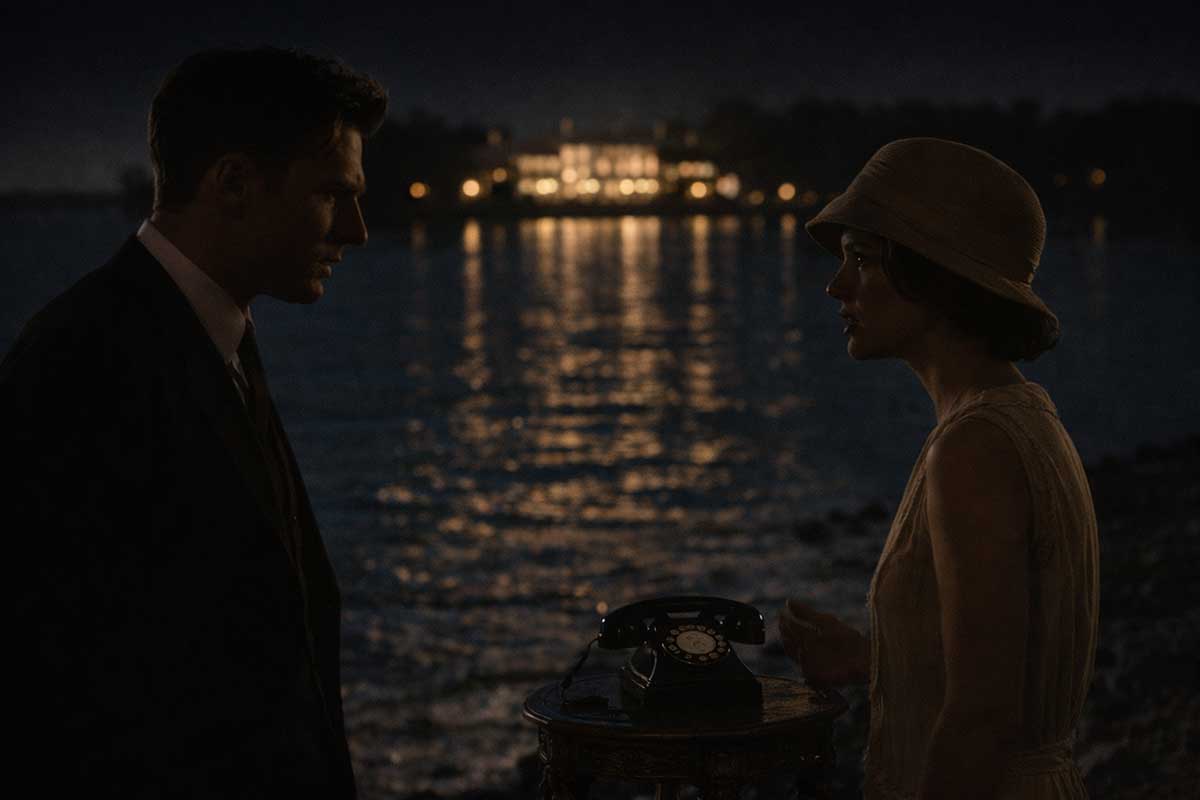
Nick found me that evening, not in a drawing room or on a lawn, but on a quiet street near the water where the air finally felt cool enough to breathe. He walked quickly, shoulders tight, as if he had been holding himself together by force.
He looked furious, but not in the way Tom looked furious.
Nick’s anger was moral. It wanted the world to behave.
“Jordan,” he said, stopping too close. “This is wrong.”
“Yes,” I said.
He blinked, thrown by the lack of argument. People like Nick expect resistance. They need to fight for righteousness so they can feel it more deeply.
“They’re letting him take the blame,” Nick continued. His voice shook. “They’re letting him sit there, alone, while they hide.”
“Yes,” I repeated.
Nick clenched his hands. “How can you say it like that? Like it’s weather.”
“Because it is weather,” I said. “In their world.”
He stared at me as if I had betrayed him. In a way, I had. Nick wanted allies who believed in the same moral universe he did. I lived in a different one, and I had never pretended otherwise.
“We should do something,” he insisted. “We should tell the police. We should make them listen.”
I studied his face. His eyes were bright with a kind of hope that felt almost painful now, like a song played in the wrong key.
“Proof,” I said.
He frowned. “What?”
“You need proof,” I said. “Not truth. Proof.”
Nick’s mouth tightened. “It is the truth.”
“The truth is useless unless it can survive contact with their comfort,” I said. “Do you understand that? The police will listen to Tom. The papers will listen to Tom. The men in offices will listen to Tom. Because Tom’s version of events fits the world they already believe in.”
Nick shook his head, refusing. “But Daisy—”
Daisy, I thought. Always Daisy. Everyone wants Daisy to become a person who chooses courage. They do not want to accept she chooses survival because survival is what she has been trained for.
Nick’s voice lowered. “She was crying,” he said. “I saw her. She can’t be that cold.”
“She isn’t cold,” I said. “She’s afraid.”
Nick’s face twisted. “Afraid of what? She has everything.”
“That’s exactly what she’s afraid of losing,” I answered.
A long silence followed. The water made a soft sound against the shore, steady and indifferent.
Nick looked away, as if the night had suddenly become too bright. “He’s going to be killed,” he said quietly.
The sentence hit the air with the finality of a door closing.
I did not argue. There was nothing to argue. Nick had finally arrived at the point I had been watching from the beginning.
“You should tell him to leave,” Nick said, turning back to me. “You should come with me. We can make him go.”
“Make,” I repeated. “Nick, you still believe people can be made to do the sensible thing.”
Nick stepped closer. “Can’t they?”
I looked at him then with a kind of tired pity I did not want to feel. “Not when the sensible thing would destroy the story they built to survive,” I said.
Nick’s jaw tightened. “So we do nothing.”
“No,” I said. “We do what we can.”
“What can we do,” he demanded.
“We can be there,” I said. “We can witness. We can refuse to let the story be rewritten completely.”
Nick stared at me. “That’s not enough.”
“It’s all that’s left,” I replied.
He turned away sharply, anger and grief tightening his shoulders. “You make everything sound so hopeless.”
I watched him for a moment, then said the truest thing I could say without softening it.
“It isn’t hopeless,” I said. “It’s just not fair.”
Nick stopped, still facing away. His voice came out raw. “I believed in him,” he admitted.
I understood. Not Gatsby as a man, but Gatsby as an idea. The idea that longing can remake the world. The idea that effort and devotion should earn you a place in the room.
“It’s a beautiful belief,” I said quietly.
Nick turned back, eyes wet. “And it’s wrong,” he said.
“Yes,” I answered. “It is.”
We stood there a moment longer, two people watching a storm they could not stop, feeling the helplessness that arrives when you finally understand the rules you have been living under.
Then Nick exhaled, long and shaky. “I’m going to him,” he said.
I nodded. “Go.”
As he walked away, I felt a strange pull in my chest, a brief urge to run after him and tell him to stop trying to save what cannot be saved.
But I did not.
Because Nick was doing what people like Nick always do in the face of ugliness.
He was choosing meaning.
And meaning, even when it fails, is still a kind of courage.
Act III, Scene 13: The Woman Behind the Curtain
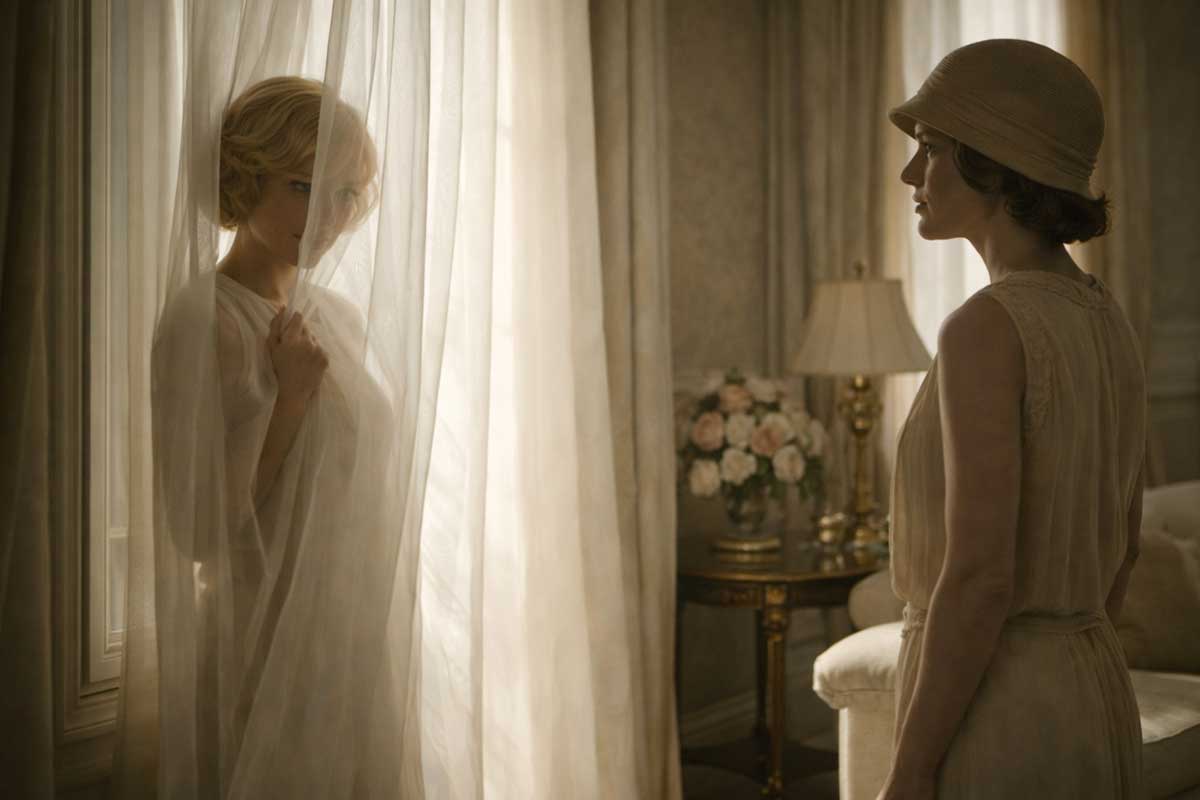
I went to Daisy’s house the next morning because I could not stand the quiet anymore.
Quiet is the most efficient kind of cruelty. It lets people pretend nothing is happening while the damage continues in full.
The day was cooler, the light softer, as if the world were offering comfort. Daisy’s house looked exactly the same as it always did, calm and bright and expensive, with the kind of beauty that convinces strangers it must also be good.
A servant let me in with the same careful politeness as before. There was a new caution in the way she avoided my eyes. Servants always know. They know before we know, because they can hear the arguments through walls and see the aftermath in the objects we leave behind.
The living room smelled faintly of flowers and furniture polish. Everything had been arranged to look untouched. The cushions were perfect. The vases were full. The room was performing innocence.
Daisy was not there.
I waited, because waiting is what you do in houses like that. You sit politely while the house decides whether you are allowed to see its owner.
After several minutes, Daisy appeared at the top of the stairs.
She moved slowly, hand on the banister, as if descending were a difficult choice. She wore a pale dress. She had done her hair carefully. She had applied just enough color to her cheeks to look alive.
The performance was better than the day before.
That, more than anything, made me angry.
She reached the bottom step and smiled as if we were meeting for lunch.
“Jordan,” she said brightly. “How nice.”
I did not return the brightness. “I saw Gatsby,” I said.
Her smile flickered, then returned. “Did you,” she said, voice airy. “How is he?”
The question was almost elegant. It was the kind of elegance that turns knives into jewelry.
“He’s waiting,” I said.
Daisy’s hands tightened briefly around each other, then loosened. “He shouldn’t,” she said softly.
There it was. Not guilt. Not sorrow. Strategy.
I stepped closer. “Why aren’t you calling him?”
Daisy’s eyes widened slightly, and then her expression smoothed again. “Jordan,” she said, gentle and warning, “don’t be dramatic.”
Dramatic. The word women use when they want to avoid saying cruel.
I kept my voice steady. “He’s taking the blame,” I said. “For you.”
Daisy’s mouth opened, then closed. For a moment her face looked genuinely frightened, not of what she had done, but of what I might force her to admit.
“I didn’t ask him to,” she whispered.
It was true and not true at once. Daisy did not ask. Daisy allowed. Daisy’s talent was letting other people volunteer for her salvation.
“You let him,” I said.
Daisy turned away, walking toward the window. She moved with that floating grace again, as if grace could erase consequences. Her fingers found the curtain edge and held it, not to look out, but to have something to grip.
“He would have done it anyway,” she said, voice small. “You don’t understand how he is.”
“I understand exactly,” I answered. “That’s why I’m here.”
Daisy’s shoulders lifted with a quick inhale. “Jordan, please,” she said. “Don’t.”
I watched her. The sunlight through the window outlined her hair, making her look like a painting of innocence. She knew that. She always knew what the light did for her.
“You’re going to leave him out there,” I said, “and you’re going to go away with Tom.”
Daisy’s eyes shut for a second. When she opened them again, her gaze held a kind of exhausted honesty that appeared only when she was cornered.
“Yes,” she said. The word was barely audible. Then she added, quickly, as if explaining could make it kinder, “We have to.”
Have to. The same language Gatsby used. The same demand, from the opposite side.
“You don’t have to,” I said.
Daisy’s laugh came out suddenly, sharp and broken. “Oh, Jordan,” she said, and now the brightness was gone. “You really don’t know.”
She turned fully toward me then. Her face changed in the way faces change when they stop trying to be liked.
“They’ll destroy me,” she said.
The sentence landed hard, not because it was dramatic, but because it was true in her world.
“Who,” I asked.
Daisy’s eyes flicked upward, toward the hallway, toward the invisible shape of Tom. “Everyone,” she said.
I understood then that Daisy was not afraid only of Tom. She was afraid of the entire structure that held her up. The families. The friends. The rooms. The polite women who would smile while cutting her out. The men who would call her reckless as if they had never been reckless themselves.
She was afraid of falling out of the world that forgave her.
And she was also afraid, I realized, of being asked to become someone new. Gatsby wanted her to step out of her training and become a heroine. Daisy did not know how to live as a heroine. She only knew how to live as Daisy Buchanan.
“What about him,” I said quietly. “What about Gatsby?”
Daisy flinched, and for the first time tears rose without permission. They filled her eyes and then spilled, silent and fast.
“Don’t,” she whispered. “Don’t make me see it.”
That was the curtain. That was Daisy’s cage. Not Tom’s money. Not Tom’s name. Not even Tom’s temper.
Daisy’s cage was her ability to refuse vision.
If she could not see it, she could survive it.
I watched her cry, and my anger shifted, not into softness, but into a cold clarity. Daisy was not cruel in the way Tom was cruel. Daisy was cruel in the way a trapped animal is cruel when it bites to escape.
“You know he could die,” I said.
Daisy’s breath caught. She pressed her hands over her mouth for a moment, then lowered them slowly.
“He won’t,” she said, as if the words could protect him. “Tom won’t let anything happen.”
There was Daisy’s final faith. Not in love. In power.
Power will handle it.
Power will clean it.
Power will make the mess disappear.
I stepped back, feeling suddenly tired. “You’re leaving,” I said.
Daisy nodded once, a small nod, almost childlike. “We’re going away,” she said. “Just for a little while.”
Just for a little while. As if time could be borrowed like a coat.
She wiped her cheeks and tried to put the softness back onto her face. It was not fully successful. The mask slipped at the edges.
“I did love him,” she said quietly, not looking at me. “In a way.”
In a way. The language of compromise. The language of someone trying to honor a feeling without allowing it to demand action.
I did not answer. There was nothing to say that would not be either cruel or false.
Daisy took a breath and lifted her chin again. The light returned to her face. The room returned to its performance.
“Will you stay for lunch,” she asked.
It was an absurd question. It was also perfectly Daisy. Lunch was her way of proving the world remained normal. Lunch was how she kept the room from collapsing into truth.
“No,” I said. “I won’t.”
Daisy’s smile twitched. “All right,” she said softly, and for a second she looked almost grateful that I had refused. Refusal meant she did not have to pretend for me.
I walked out of the house and felt the air hit my face like a mild slap. The world outside was ordinary. Birds. Sunlight. The distant sound of a lawn being watered.
Behind me, Daisy’s house stood calm and bright, a fortress pretending to be a home.
Inside it, Daisy was already disappearing behind her curtain again, rehearsing the face she would wear when the story came back around.
And across the bay, Gatsby was still waiting for a call.
What Daisy could not see, and what Gatsby refused to see, was that the call was not coming.
Not because she did not care.
Because caring was not the currency that decided anything in their world.
Permission was.
And permission belonged to Tom.
Act III, Scene 14: The Funeral, the Accounting
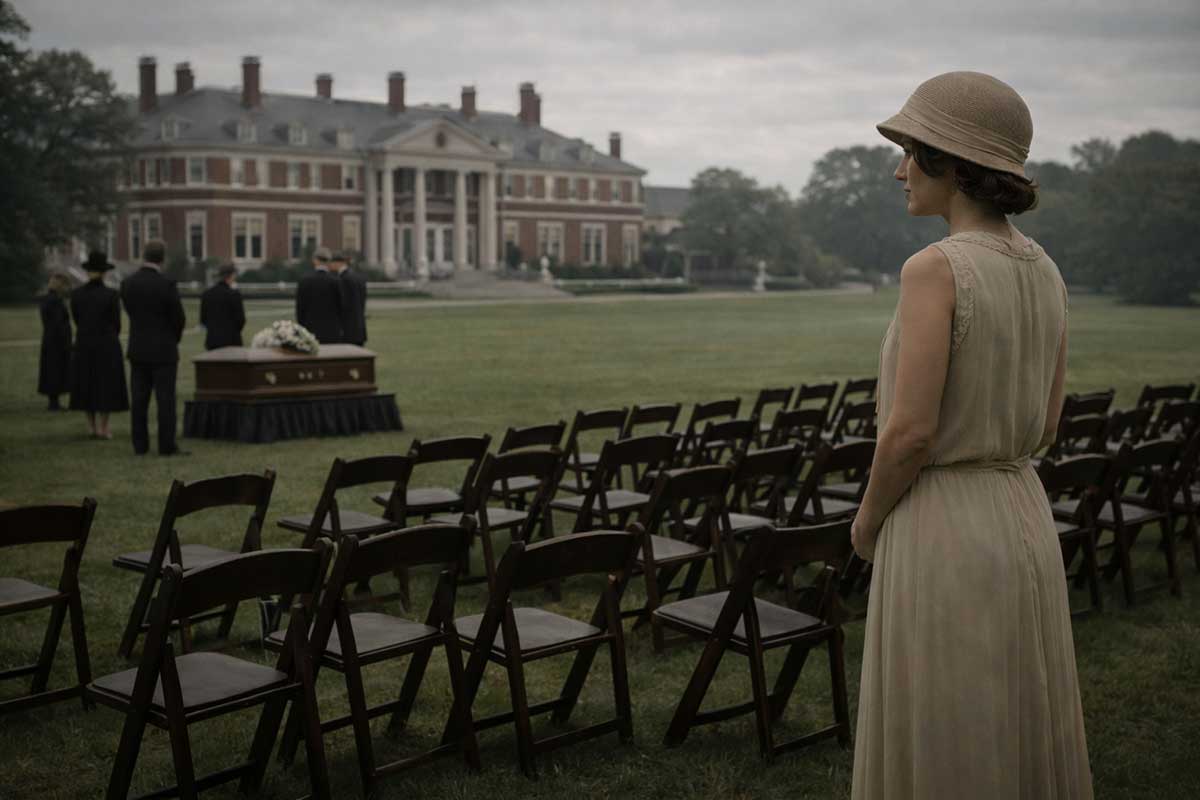
The news moved through the city the way news always moves, with a strange double speed.
It arrived slowly to the people who mattered, padded by distance and denial, and it arrived instantly to the people who did not, carried by rumor and necessity. By the time I heard that Gatsby had been shot, the story had already begun to reshape itself in the mouths of strangers.
They said he had been killed by a husband.
They said he had been killed by a lover.
They said he had been killed because he deserved it.
No one said, plainly, that he had been killed because the world needed someone to blame and he had volunteered.
I went to West Egg because I wanted to see whether the house would finally admit what it had always been.
The mansion stood in daylight like a prop that had lost its audience. The windows were open, but no music came out. The driveway was empty. The lawn looked too neat, like a body dressed carefully for viewing.
Inside, the air was still. Even the servants moved differently now, less like shadows and more like mourners. Objects had been returned to their places as if someone believed order could restore meaning.
Nick was there, of course. He looked as if he had not slept. His face held that strained politeness people wear when they are trying to keep grief from becoming anger.
He nodded when he saw me, but his eyes did not soften. He had crossed into a new kind of clarity. The kind you only earn when you realize you were wrong about something you loved believing.
“They’re not coming,” he said, before I could speak.
I did not ask who. We both knew.
We moved through the rooms that had once been crowded. The ballroom, now silent. The long tables, now bare. The staircase, now only a staircase. The air carried a faint smell of stale champagne, like perfume lingering after the person has left.
There is something humiliating about emptiness after spectacle. It proves the spectacle was not a life. It was only a flare, and flares burn out.
Outside, near the front steps, a few people stood in small clusters, talking quietly. Not many. Fewer than you would expect if you had ever been at one of Gatsby’s parties and believed those people were real friends.
They were not friends. They were customers.
That was the accounting.
A clergyman arrived and looked uncertain, as if he had expected a crowd. He asked a servant where to stand. The servant pointed without speaking.
Nick moved toward the phone again, as if the phone were still the mechanism, as if one more call could change the nature of what had already been revealed. He had been calling people for days. He had been calling the men who had slapped Gatsby on the back, the women who had laughed too loudly, the couples who had leaned against Gatsby’s marble railings and spoken about their own lives as if Gatsby’s house were a public park.
Most of them did not answer.
Some answered and offered condolences in the tone they used for bad business news.
A few answered and gave reasons. Travel. Illness. Inconvenience.
Inconvenience. Always the cleanest excuse.
I watched Nick set the receiver down with careful control, the way you set down something hot.
His hand shook slightly.
“Are you surprised,” I asked him.
Nick’s mouth tightened. “No,” he admitted. “Not anymore.”
We waited.
The coffin was brought out, plain and heavy. It looked wrong against the mansion’s grandeur, like a truth carried into a room that has always insisted on fantasy. The men who carried it moved carefully, as if the weight were not only physical.
A few more people arrived.
Owl Eyes came, the man from the library, blinking and bewildered, as if he had stepped into the wrong scene. He looked at the house and then at the coffin and shook his head slowly, disbelief settling on him like dust.
“It’s… it’s a damned shame,” he murmured. “A damned shame.”
He sounded more honest than anyone else there.
I looked around. The faces were mostly unfamiliar to me, not because Gatsby had not known them, but because Gatsby had not known anyone. He had hosted them. He had fed them. He had provided the illusion that their own stories were important.
But he had not belonged to them.
That is what the funeral proved.
The clergyman began speaking. His words were gentle, and they fell into the air without resistance. They were the kind of words that are meant to comfort, but comfort requires people willing to receive it together. Here, the words sounded like they were being spoken into a well.
I glanced up at the house, at the bright windows, at the empty terrace where people had once danced. It looked indifferent. It looked as if it had already begun to forget.
Because houses do not grieve. They simply remain, and their remaining is a kind of cruelty.
Nick stood at the front, close to the coffin. His face was rigid, and his eyes were wet. He did not look like a narrator anymore. He looked like a man who had been wounded by a moral discovery.
I felt an unexpected tenderness for him then. Nick had tried. He had tried in the only way he knew, by believing in decency and acting as if decency would matter.
Decency had not mattered.
Not enough.
Across the water, the far shore glittered faintly. It was a bright day, and the green light was invisible, but I could still imagine it, stubborn and waiting, a small glowing lie that Gatsby had treated like a promise.
As the service ended, people began to drift away almost immediately. They did not linger. They did not stand together in shared sadness. They did what people do when they are afraid sadness might become responsibility.
They left.
Each departure felt like a verdict.
Nick watched them go, and I could see his anger hardening into something that would last. Not anger at one person, but at the entire machine.
I remained a moment longer, standing near the edge of the lawn.
The coffin was taken away. The clergyman packed his words back into his bag. The servants began, quietly, to restore order again, because order is what the living demand.
Soon there was nothing left to do but look at the empty space where Gatsby’s body had been and understand that this was the true ending of his dream.
Not death itself.
The emptiness after.
The proof that the parties had never been a community. They had been a transaction, and now the account had closed.
Nick approached me, his voice low. “They’re gone,” he said.
“Yes,” I answered.
He looked at the house and then out at the water, eyes narrowing. “I hate them,” he said quietly.
I understood. Hate is often only grief searching for a shape.
I did not say that, though. I simply stood beside him as the last few guests disappeared down the drive.
And as the mansion settled into silence, I felt the full weight of what Gatsby had been trying to do.
He had not been building a home.
He had been building a crowd.
And a crowd, once the music stops, becomes nothing at all.
Act III, Scene 15: Jordan’s Last Lie, Jordan’s First Truth
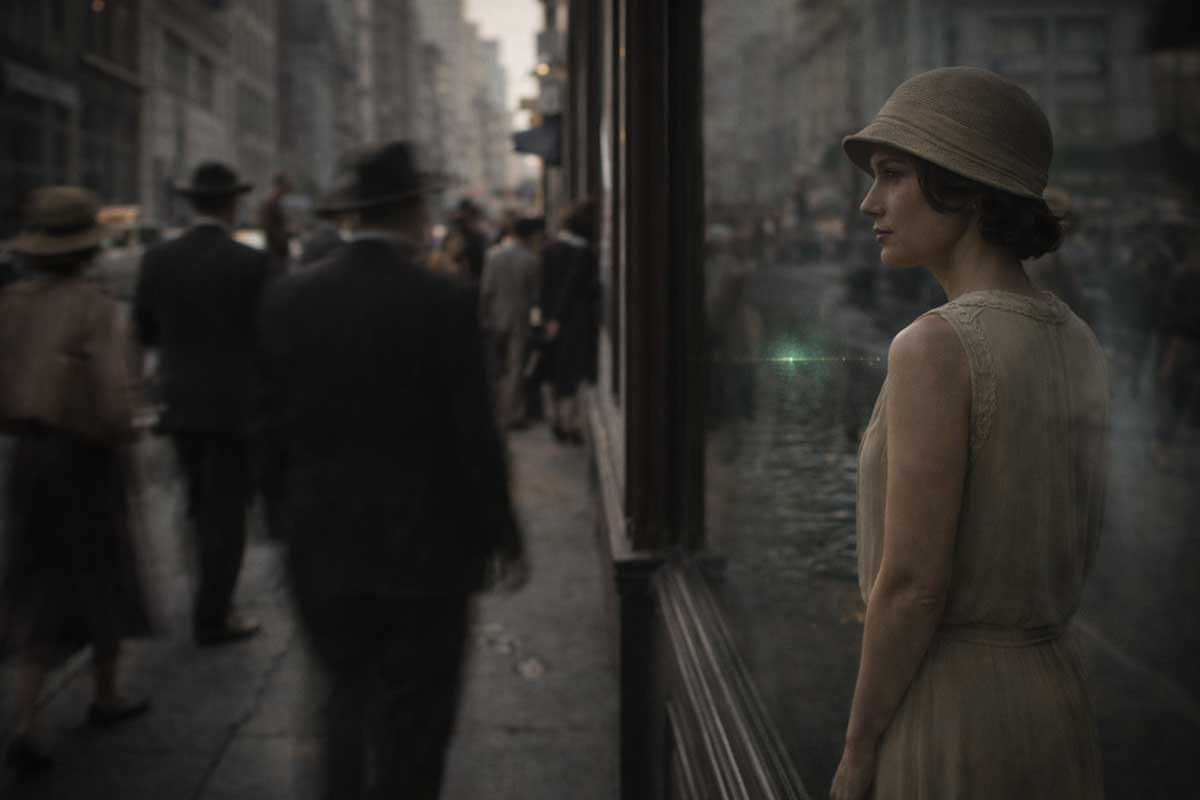
After the funeral, the days thinned out. The parties had vanished, the phones had gone quiet, and the season began to fold itself away as if it wanted to hide what it had revealed.
That is what those places do when something ugly happens. They change the calendar. They change the scenery. They go somewhere else. They let distance do the work of forgiveness.
East Egg was already preparing to disappear. I knew it before Daisy told me, because I could feel the house shifting. Drawers opening. Suitcases appearing. Servants moving with that brisk caution that means the owners want to leave without making a scene.
Daisy did not call me.
Tom did not call me.
Nick did.
He asked me to meet him in the city, in a small place near the station where the tables were close together and strangers could overhear you if you spoke too loudly. Nick chose public spaces when he needed restraint. He chose them the way some men choose churches.
When I arrived, he was already there, sitting stiffly, his coat buttoned even though the air was not cold. He looked as if he had been standing alone in wind.
He rose when he saw me, the old politeness still intact, but his eyes had changed. The softness was gone. In its place was something sharper, something that had learned the world’s real shape.
We sat.
For a moment neither of us spoke. There are silences that feel comfortable and silences that feel like a door being held shut. This was the second kind.
Finally Nick said, “They’re gone.”
I nodded. “Yes.”
“They left,” he repeated, and the repetition was not for clarity. It was for disbelief. “They just… left.”
That was his last wound, I think. Not Gatsby’s death. Not the empty funeral. The leaving.
Because leaving proved, absolutely, that Daisy and Tom were not merely careless.
They were protected.
Carelessness without protection is called disaster. Carelessness with protection is called a lifestyle.
Nick’s fingers tightened around his cup. “They’ll be fine,” he said, voice low. “They’ll go somewhere else and it’ll be as if none of this happened.”
“Yes,” I said again.
He looked up sharply. “How can you keep agreeing with me like that?”
Because it was true, I wanted to say. Because you are finally seeing what I have always seen. Because this is how the rooms are built.
Instead I said, “Because you’re right.”
Nick stared at me, and for a moment I saw the old Nick, the one who wanted to believe the world could be made decent by insisting on decency.
Then his face tightened. “I keep thinking,” he said, “about Gatsby waiting outside her window.”
The memory hit the air between us and made it heavy.
“He thought she’d call,” Nick continued. “He thought… he thought it mattered.”
Nick’s voice broke slightly. He pressed his lips together, forcing control back into place. “And then he died for it,” he said.
I watched him, and I felt something complicated move through me. Not pity exactly. Not affection exactly. More like recognition.
Nick had come East hoping to write a story about life. He had ended up writing a story about consequence.
He leaned forward. “Jordan,” he said, “tell me the truth.”
There it was. Nick’s religion. Truth.
He said it as if truth were a clean object you could hold in your hand. As if truth would fix something simply by being named.
“What truth,” I asked.
“About Daisy,” he said. “About Tom. About what really happened. About you.”
About you. That was the real question, and we both knew it. Nick was trying to decide what kind of person I was, because now he believed the kind of people you are near will either save you or ruin you.
I felt the old instinct rise in me, the instinct to smile and smooth and avoid. The instinct that had kept me safe in every room I had ever entered.
I could tell him the version he wanted.
I could tell him Daisy was weak. Tom was a monster. Gatsby was a saint. The world was cruel. We were helpless. I was only a witness, unfortunate but innocent.
That would comfort him. It would give him a story he could carry without it cutting him.
It would also be a lie.
And I was suddenly tired of lies that made men feel morally clean.
Nick waited, eyes fixed on me with a seriousness that felt almost like accusation.
In that moment I realized my choice was not really about Daisy or Tom or Gatsby anymore.
It was about me.
Because the last remaining currency I had was my own reputation, my own place in the rooms that would continue whether I was kind or not. And the simplest way to keep that place was to keep being what those rooms preferred.
Useful. Cool. Uncomplicated.
A woman who does not ask for consequences.
Nick wanted me to be something else. He wanted me to be proof that people can choose decency even when decency costs.
I looked at him, and I thought about Daisy behind her curtain. I thought about Gatsby waiting for a ring that never came. I thought about the empty lawn and the fast departures and the way the house had looked in daylight, like a beautiful lie stripped of music.
And I thought, quietly, that if I told the truth now, Nick might not forgive me for it.
But I might forgive myself.
So I did the strangest thing.
I spoke plainly.
“I arranged it,” I said. “The meeting. Daisy asked and I helped. I knew it would be dangerous. I did it anyway.”
Nick’s face tightened. He had not expected that. He wanted the truth, but he wanted the truth to flatter him.
I continued before he could stop me. “Daisy did not mean to kill Myrtle,” I said. “But she was driving. Gatsby agreed to take the blame because he believed sacrifice would bring her back to him. Tom used that sacrifice. Tom made sure the blame landed where it would protect Daisy and protect himself.”
Nick’s jaw clenched. “And Daisy,” he said. “What about Daisy.”
I let myself pause. Daisy’s name deserved a pause, because Daisy was the hinge of everything.
“Daisy chose safety,” I said. “Not because she’s evil. Because she’s trained. She doesn’t know how to live without that house around her. She doesn’t know how to exist without permission.”
Nick’s eyes flashed. “So she just leaves,” he said. “And that’s it.”
“Yes,” I said. “That’s it.”
Nick sat back, as if the air had been knocked out of him. He stared past me for a moment, toward the street, toward the station, toward the idea of going back home and believing in simpler things.
When he spoke again, his voice was quieter. “And you,” he said.
There it was again. About you.
I felt the old lie rise in me, ready. The lie would be easy. The lie would be elegant.
I could say I was only watching. I could say I had no part. I could say I was above it all. I could say I had tried to stop it.
I could say I cared.
Instead I said, “I knew how it works,” I said. “I stayed anyway.”
Nick looked at me, and I could see his disappointment forming. Disappointment is a strange thing. It is not anger. It is grief for who you hoped someone was.
“You’re careless too,” he said.
The old accusation, returned.
I almost smiled. In another life, I would have laughed it off, tossed my head, made it into a joke. That is how women survive judgments.
But I did not smile.
“No,” I said. “I’m not careless. I’m practiced.”
The word surprised him. It surprised me too, hearing it out loud.
Nick’s eyes narrowed. “Is that supposed to be better,” he asked.
“No,” I said. “It’s worse.”
We sat in silence again. The noise of the city moved around us, indifferent.
Finally Nick spoke, voice low. “I can’t,” he said.
I nodded once. “I know.”
It was not a breakup exactly. It was a recognition. Nick could not live with someone who saw the world the way I did and did not pretend otherwise. Nick needed hope. Not as decoration. As a necessity.
Nick stood, coat shifting, shoulders tightening. He looked down at me as if he wanted to say something kinder and could not find it.
Then he said, almost to himself, “They’re not punished.”
“No,” I said. “They’re not.”
He turned to leave, then paused. “What will you do,” he asked, and now his voice held something like pity.
I could have lied then. I could have said I would change. I could have said I would go somewhere quiet and become good.
Instead I told him the truth, because once you have told one truth, the rest become harder to avoid.
“I’ll go on,” I said. “Like everyone else.”
Nick’s mouth tightened. He nodded once, sharply, as if confirming something he did not want to know. Then he walked away toward the station, toward the clean line of departure.
I watched him go.
When he disappeared into the crowd, I felt the familiar urge to protect myself return, to rewrite the moment into something softer.
He was too sensitive.
I was too modern.
It didn’t matter.
Those were the lies my world preferred.
I let them pass through me without taking hold.
Outside, the day was bright. People hurried by, carrying parcels, laughing, living. The city did not pause for any tragedy.
I stepped out onto the sidewalk and felt the wind off the river.
Somewhere across the water, on a shore that could no longer be reached, a house stood quiet, already forgetting its own music.
People will keep telling Gatsby’s story as if it were a romance, because romance is the safest disguise for obsession. They will tell it as if it were about hope, because hope is easier to sell than warning.
Maybe Nick will tell it that way too. Maybe he will have to.
But I will remember the sound that mattered most.
Not the orchestra. Not the laughter. Not the gunshot.
The phone.
The phone that did not ring.
And I will remember Gatsby standing inside his own brightness, waiting for a world that never intended to answer him.
If that is a lesson, it is not a gentle one.
It is simply this.
Some rooms cannot be bought.
And some lights, no matter how long you stare at them, never promise anything at all.
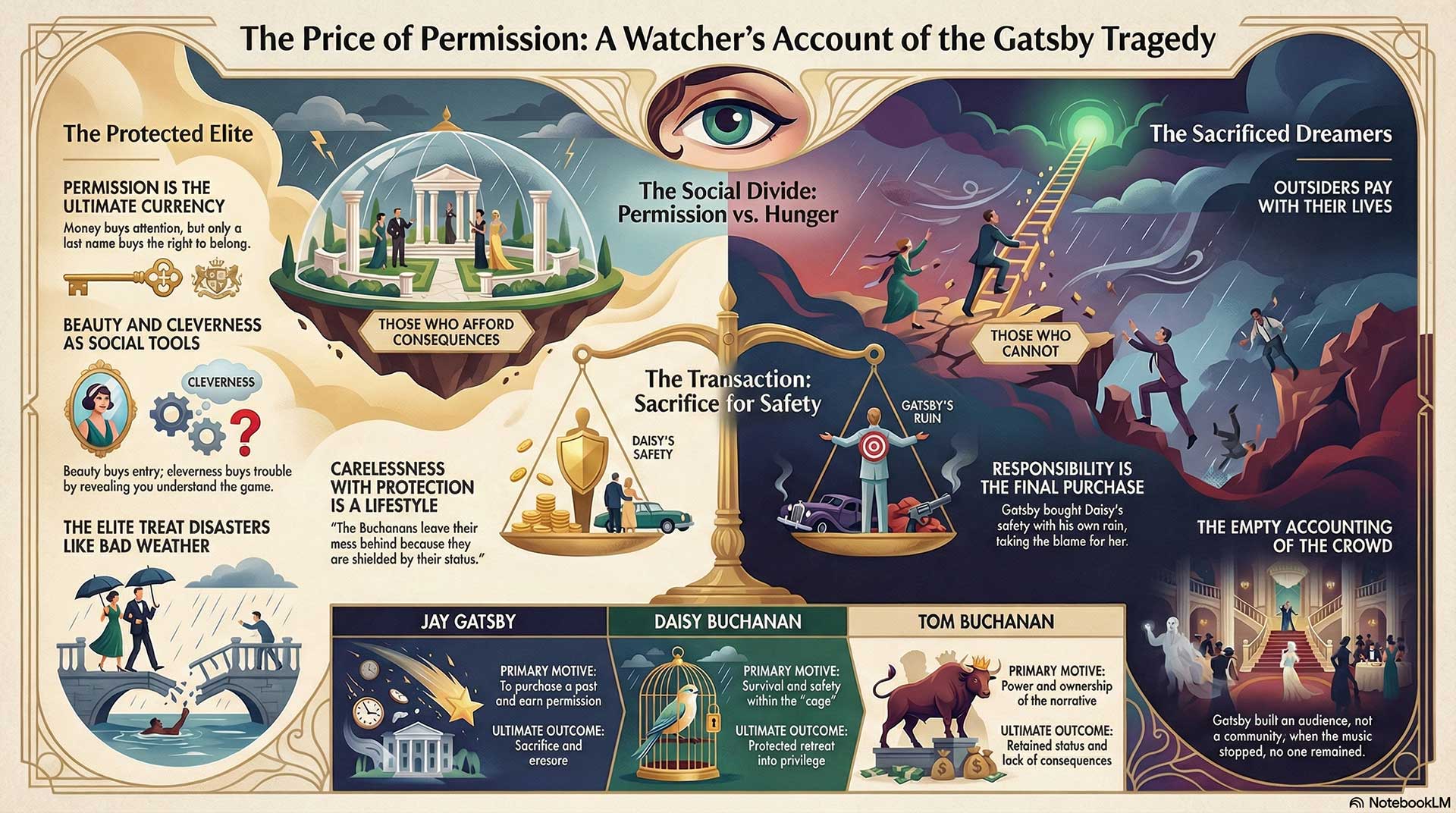
Short Bios:
Jordan Baker: A poised professional golfer and sharp social observer who sees the truth behind glamour and tells this story with cool clarity.
Nick Carraway: A principled Midwesterner drawn into East Coast wealth, struggling to reconcile decency with what he witnesses.
Jay Gatsby: A self-made dreamer who builds an empire of parties and myth to reclaim a lost love, clinging to hope past reason.
Daisy Buchanan: A charming, conflicted woman trained to survive inside privilege, choosing safety when love demands courage.
Tom Buchanan: An entitled, domineering heir who treats people as possessions and uses power to control the narrative and escape consequences.
Leave a Reply