
|
Getting your Trinity Audio player ready...
|
What if Charlie Mackesy moderated his own characters through a storm?
Introduction by Charlie Mackesy
I never set out to write a book about storms. I set out to draw what it feels like when life gets loud and the mind gets cruel, and you are trying to remember what you already know. A storm can be weather, yes. But it can also be worry, grief, shame, or that private fear that makes you feel you must handle everything alone.
So I put a boy on a path with three friends, because that is how most of us survive. Not by being fearless, but by being accompanied. The mole brings small comforts and big truths. The fox brings caution and hard-won trust. The horse brings steadiness and quiet courage. And the storm does what storms do. It tests what you believe, not when you are calm, but when you are cold and tired and unsure.
If this story gives you anything, I hope it gives you this. You are allowed to be scared. You are still worthy while you are scared. And you do not have to earn love by being fine.
(Note: This is an imaginary conversation, a creative exploration of an idea, and not a real speech or event.)
Topic 1: When the Storm Arrives
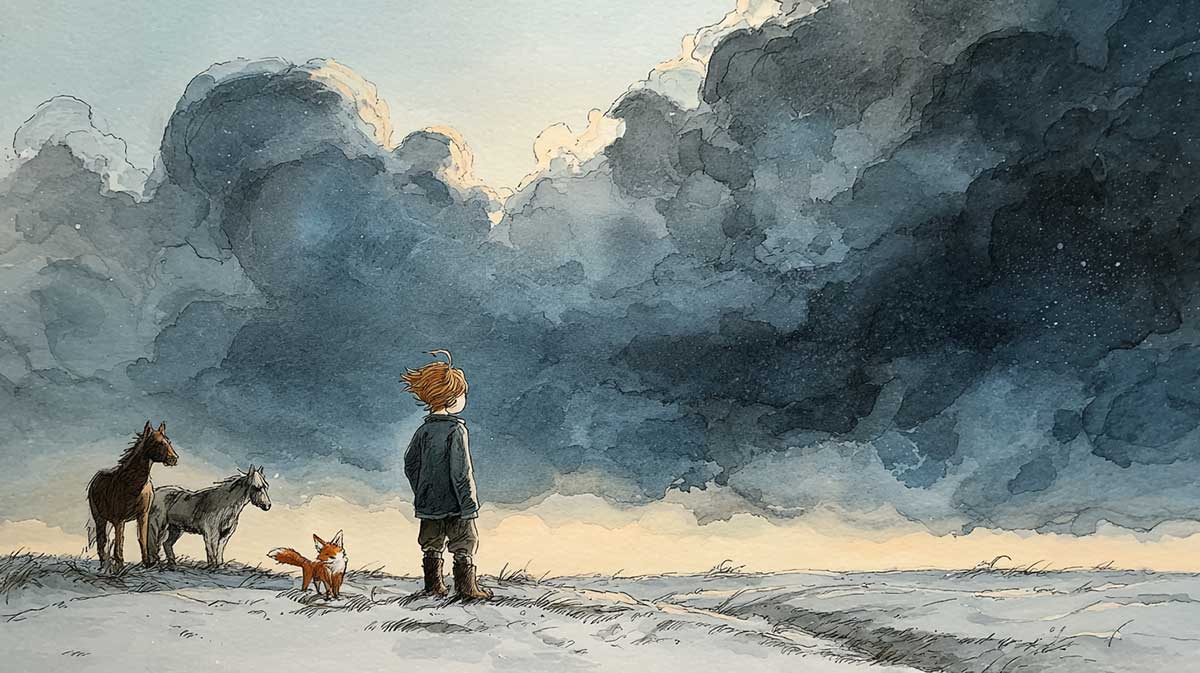
The sky has that strange, quiet tension, like it’s holding its breath. The kind of quiet that makes you notice your own thoughts louder than usual.
The Boy walks a little slower. The Mole stays close, as if proximity itself is a plan. The Fox watches the horizon like it has teeth. The Horse moves with a calm that feels almost unfair, the way mountains are calm.
And then there’s the Storm. Not just weather. Something that arrives in the chest first, and only later in the clouds.
Charlie Mackesy looks at them all the way an artist looks at a blank page, with tenderness and a little mischief, like he’s trying to draw something brave without forcing it.
“Alright,” Charlie says softly. “When you first realize a storm is coming, what’s the first thing you do inside yourself?”
The Storm answers first, pleased with itself. “I tighten. I speed up the mind. I make every sound feel like a warning. I whisper, Prepare. Control. Run. I don’t care if those things help. I care if they move you.”
The Mole blinks and rubs his paws together. “I look for warmth. That’s the honest answer. I think, Where is the nearest kindness. A pocket. A shoulder. A little shelter. Sometimes I also think about cake, but I’ve learned cake is not the same as safety. It just tastes like a pause.”
The Fox keeps his eyes half on the path, half on the Boy. “I go quiet. I scan. I check exits. I don’t like storms because they remind me I can’t predict everything. And when I can’t predict, I start trying to manage. If I can’t manage the storm, I try to manage myself. Which is sometimes the same mistake.”
The Boy swallows. “I pretend I’m fine. It’s like my first reflex is to act normal so nobody worries. Then my chest gets tight and I realize I was lying. I start thinking about all the things I didn’t do. All the ways I should have prepared. I get angry at myself fast.”
The Horse lowers his head a little, like he’s listening to the ground. “I breathe. Not because it’s wise. Because it’s what I can do. The first thing inside me is a decision to stay present. Storms try to take your attention and throw it into the future. I keep it here. The next step is simple. Find one thing that is steady.”
Charlie nods, like he’s sketching a line that finally fits.
“Alright,” he says. “The storm makes everything feel urgent. What’s the most important thing that is not urgent?”
This time, Charlie’s question hangs in the air like a lantern.
The Boy answers first, a little surprised by his own words. “Being kind to myself. It’s never urgent to me. I always treat it like a luxury I’ll earn later. But when the storm comes, that’s when I need it most. I need someone in me to say, You’re not failing. You’re just afraid.”
The Fox gives a small, sharp nod. “Trust. Trust is not urgent. You can’t rush it. But it’s the thing that keeps you from turning on everyone. Storms make you suspicious. They make you interpret everything as a threat. The non-urgent, essential thing is remembering who is on your side.”
The Mole lifts one paw like he’s making a serious speech, though his voice stays soft. “Gentleness. Especially with yourself. Storms make people tight and pointy. They start stabbing with words because they feel stabbed by fear. But gentleness is slow. It doesn’t shout. It doesn’t win arguments fast. It just keeps the heart from getting frostbite.”
The Horse looks at them one by one. “Love. Love is not urgent in the way panic is urgent. Love does not scream, Now. Love says, I am here. It is the difference between surviving the storm and becoming the storm.”
The Storm laughs, like wind through cracks. “You all talk like you have time. I make people choose quickly. I make them cut corners. I make them drop what matters because it feels inefficient. The thing that is not urgent is meaning. Meaning is slow. Meaning requires stillness. And stillness is exactly what I try to steal.”
Charlie smiles, not because it’s funny, but because it’s honest. He turns his gaze back to them, gentle but firm.
“One more,” he says. “If fear had a job, what would you say its job is, and when does it go too far?”
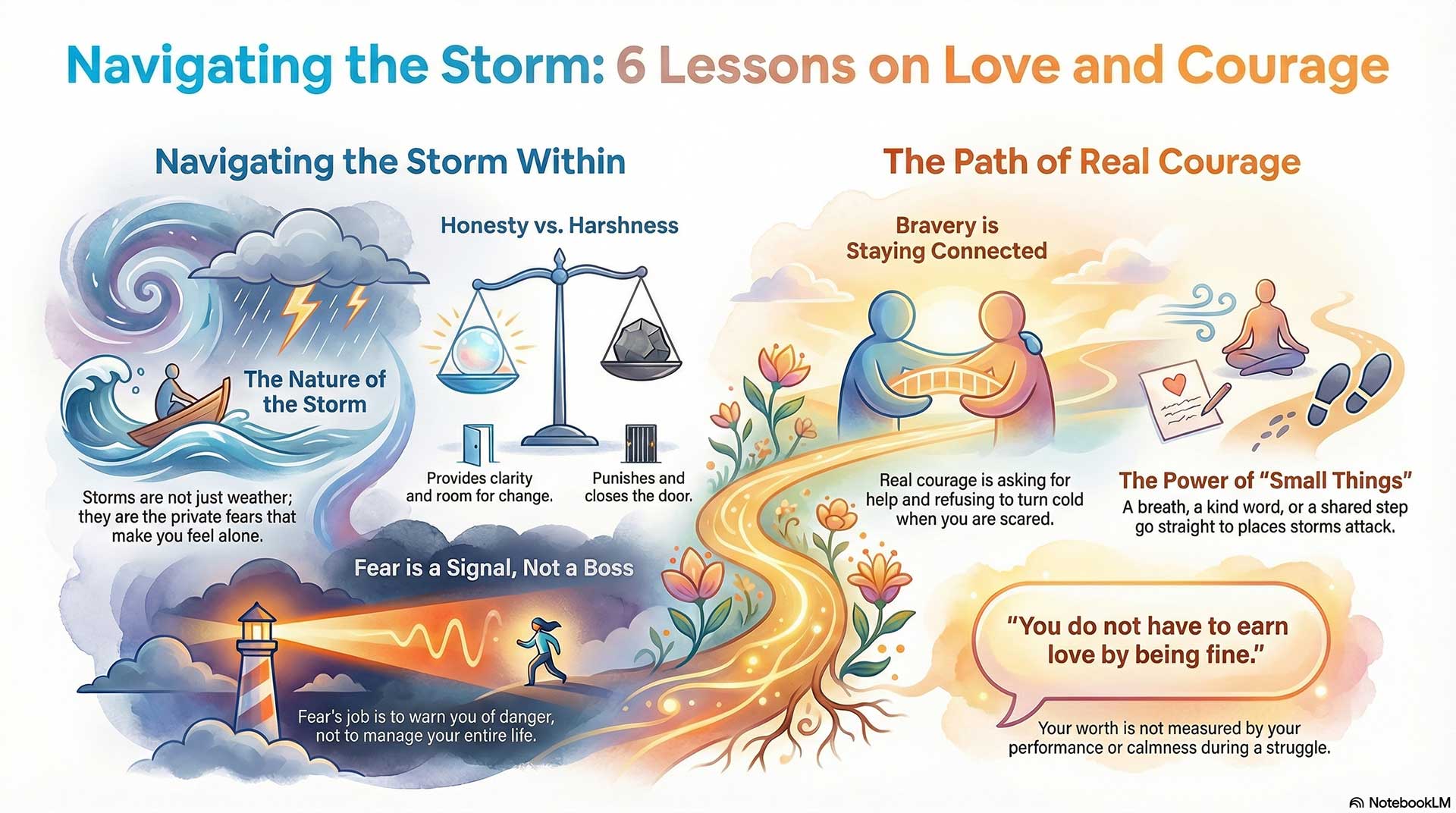
The Mole answers first, surprisingly practical. “Fear’s job is to warn you. Like a little bell. Ding ding, something might hurt. That’s useful. But it goes too far when it becomes the manager of your whole life. When it’s not just warning you, but deciding your friendships, your dreams, your words. Fear is a terrible boss.”
The Storm leans into that. “My job is survival. I am ancient. I keep you alive by making you avoid danger. I go too far when you start living as if everything is danger. Then you survive, yes, but you don’t live. You become small and call it safe.”
The Fox takes a breath that looks like it costs him something. “Fear’s job is to protect what matters. It shows you where you’re attached. What you love. What you can lose. But it goes too far when it makes you bite the hand that reaches for you. When it turns love into a threat. When you start using fear as an excuse to be cold.”
The Boy stares at his shoes for a second, then looks up. “Fear’s job is to tell me I’m human. That I care. That I can be hurt. But it goes too far when it tells me I’m alone. When it says, Nobody will understand. When it convinces me I have to handle everything perfectly to deserve help.”
The Horse speaks last, calm and steady. “Fear’s job is to bring your attention to the edge of things. To say, Be careful. But it goes too far when it becomes your identity. When you stop being someone who feels fear, and start being fear. That is when the storm isn’t outside anymore. It’s inside.”
Charlie lets the silence land. The wind shifts. The light changes. It doesn’t feel safe yet, but it feels clearer, like they’ve named something that was hiding in plain sight.
Charlie looks at the Boy and then at the group.
“Alright,” he says quietly. “Let’s take the next step together. Storms love to isolate people. So we won’t give it that.”
Topic 2: Staying Together When You’re Scared
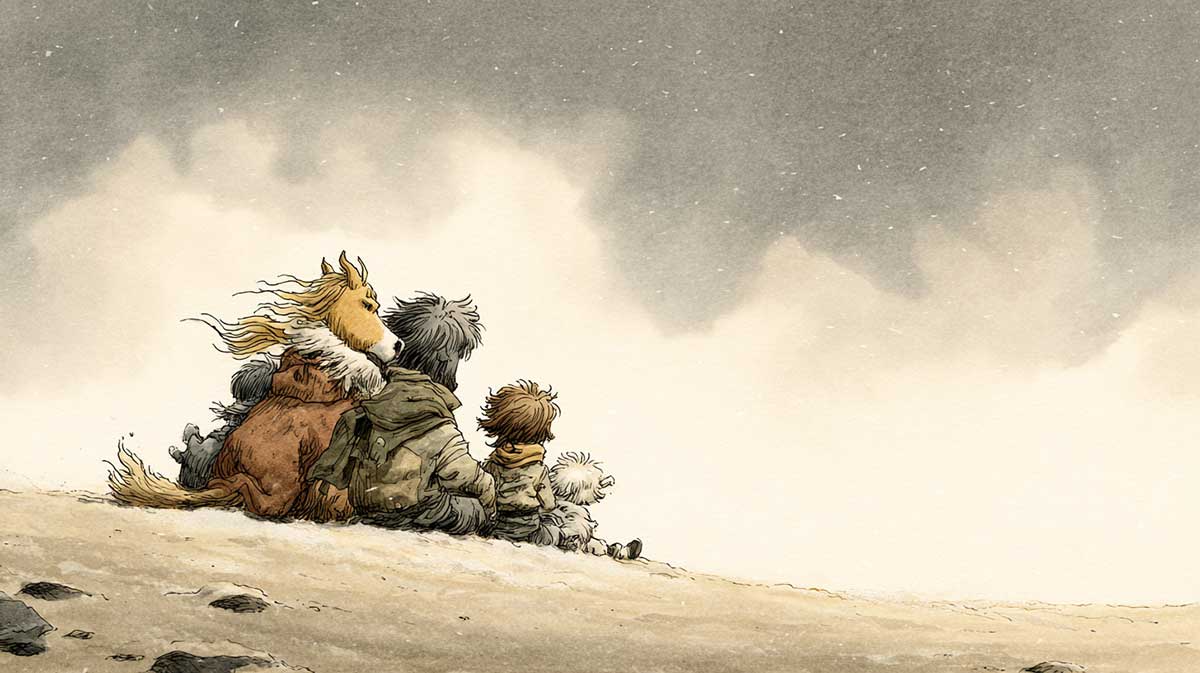
The storm does not arrive like a door slamming. It arrives like a slow theft.
First it takes the horizon. Then it takes the color from things. Then it starts taking people from each other, not by separating their bodies, but by separating their attention. Everyone becomes a small island with loud weather inside.
The Boy pulls his collar up, though it does little. The Mole presses close, both for warmth and for the comfort of being able to feel someone else breathing. The Fox keeps drifting to the edges, not because he wants to leave, but because his instincts keep trying to earn safety by controlling the perimeter. The Horse moves with steady steps, as if steadiness is something you can loan to others.
Charlie walks with them, quiet, letting the storm make its noise without letting it run the conversation.
Then he speaks, gentle as a pencil line.
“In hard moments,” Charlie says, “what kind of help actually helps, and what kind secretly hurts?”
The Horse answers first. “Help that helps is simple. It does not demand performance. It does not ask you to explain yourself perfectly. It says, I’m here. It makes room. Help that hurts is anxious. It tries to fix you quickly so the helper can feel calm again.”
The Mole nods, earnest. “Yes. The helpful kind is like a warm cup in your hands. You don’t have to deserve it. The hurtful kind is when someone says, Here is advice, and if you don’t take it, you’re doing your pain wrong. It turns comfort into homework.”
The Fox speaks without looking directly at anyone. “Help that helps respects the animal in you. The part that is scared and doesn’t want to be touched. It doesn’t chase. It stays available. Help that hurts is when people crowd you, ask too many questions, try to pull you out of fear by force. Then you feel trapped twice, by the storm and by their good intentions.”
The Boy hesitates, then admits it. “Help that helps is when someone stays with me without making me feel like a problem. Like I’m not breaking their day. Help that hurts is when I feel watched, like everyone is evaluating whether I’m handling it well. Even kind faces can feel like pressure if I think I have to look okay.”
The Storm swirls around them as if it has been invited to the panel, delighted. “The help that hurts is the help that makes you dependent. Or ashamed. I like both. I like anything that makes you feel you owe someone your calm. Or that you are a burden. I love when help becomes a transaction.”
Charlie takes that in, and his eyes soften.
“Alright,” he says. “Why do we sometimes push away the very people who want to keep us safe?”
The Boy answers quickly, like he has been waiting for someone to ask. “Because it feels embarrassing. I don’t want to be seen needing things. I want to be the person who has it together. When someone comes close, it’s like they can see I’m scared. And then I feel smaller.”
The Fox gives a short, honest sound that is almost a laugh but not quite. “Because closeness can feel like a trap when you’ve been hurt. When I’m scared, I go into survival mode. In survival mode, I don’t want anyone to have power over me, even kind power. So I push away first, to prove I can’t be left.”
The Mole looks at the Fox with gentle seriousness. “Sometimes we push away because we think we are protecting them. We think, If you see my messy insides, you’ll have to carry them. So we choose loneliness because it feels less selfish. But it’s a trick. It makes everyone colder.”
The Horse speaks slowly. “We push away because receiving is vulnerable. Giving feels strong. Receiving feels like you must trust. In a storm, trust feels risky. But the truth is, we were not made to endure storms alone. That is why we have each other.”
The Storm practically purrs. “You push people away because I tell you a story. I tell you that needing is dangerous. I tell you that if someone helps you, you’ll owe them, and owing is weakness. I tell you that being independent is the same as being safe. And you believe me because I speak in your own voice.”
Charlie lets the group walk a few steps in the sound of that. The snow starts to sting. The wind tugs at everything loose.
Then Charlie asks the last question, and it lands like a hand on a shoulder.
“What does loyalty look like,” he says, “when you can’t fix anything?”
The Mole answers first, determined. “It looks like staying. It looks like saying, I can’t solve this, but I can sit with you while it’s hard. Loyalty is not a magic wand. It’s a lamp. It doesn’t remove the dark. It just keeps you from thinking you’re alone in it.”
The Horse nods. “Loyalty is presence without control. It is patience. It is not rushing the frightened one to the finish line. It is walking at their pace. It is carrying what you can, quietly, without announcing it.”
The Boy looks up at the Horse, then at Charlie. “Loyalty is when someone doesn’t get bored with my fear. When they don’t treat it like a phase I should be over by now. When they don’t start measuring me against who I am on good days. It’s like they believe I’m still me, even when I’m scared.”
The Fox takes a breath and chooses his words carefully. “Loyalty is not forcing closeness. Sometimes loyalty is giving space without disappearing. It’s being near enough that the other can return. It’s not punishing them for flinching. It’s understanding that fear makes people sharp and then not taking the sharpness as the whole truth.”
The Storm interrupts, offended by the tenderness. “Loyalty is overrated. In storms, everyone is alone. When I get loud enough, people turn into needs and threats. They forget names. They forget promises. They focus on themselves. That’s nature.”
The Horse turns his head, calm and unmoved. “No,” he says simply. “That is one version of nature. There is also the nature that gathers. The nature that huddles. The nature that shares warmth. You are real, Storm. But you are not the only truth.”
The Mole steps closer to the Boy, almost leaning into him. “Also,” he adds, “sometimes loyalty is snacks. Not as a joke. As a way of saying, Your body matters too. Here, take a bite. You’re still alive.”
The Boy actually smiles, small but real, and that smile feels like a little fire that refuses to go out.
Charlie watches that fire and seems pleased, not because it’s cute, but because it’s human.
“Alright,” he says quietly. “We keep going. Together. Not because we’re fearless, but because we’re not leaving each other alone with the worst thoughts.”
And the storm, for a moment, has to share the path with something stronger than weather.
Topic 3: The Voice in Your Head

The storm has found its rhythm now. Snow comes in sideways sheets, and the wind has a way of turning every sound into an accusation. Even the trees look like they’re pointing.
They stop behind a low rise where the ground dips a little, like the earth is offering a shallow hand to cup them. It isn’t much, but it breaks the wind. The Horse stands with his body angled to shield the others. The Mole disappears for a second and reappears pressed against the Boy’s boot like he’s anchoring himself to something reliable. The Fox hovers close to the edge of the shelter, ears flicking at every shift in the air. The Boy’s cheeks are red, not only from cold.
Charlie doesn’t rush the quiet. He lets it settle until it feels like a table has been set.
Then he asks, “What does the storm say to you that sounds like truth but isn’t?”
The Storm answers first, as if he’s been waiting to be invited to confess. “I say, This is who you really are. I say, Look how quickly you fall apart. I say, You were only brave because the weather was kind. I say, You are not built for this.”
He swirls around them like a smug thought.
The Boy flinches because it hits too accurately. “It says, You’re weak. It says, Other people would handle this better. It says, If you were smarter you would’ve prevented it. If you were stronger you wouldn’t feel like this. And the worst one… it says, You’re disappointing everyone.”
The Fox keeps his voice low. “It says, They will leave you. It says, Don’t trust. Don’t soften. If you need them, they’ll use it. And it says, if you get close, you’ll get hurt. Again.”
The Mole looks up, his eyes wide but steady. “It says, Hurry. Hurry, or you will lose love. It says, Fix yourself quickly so you can be acceptable again. It says, You don’t get to be messy. You don’t get to be frightened. You don’t get to be human unless you pay for it.”
The Horse speaks with a calm that feels like warmth. “It says, This will last forever. It says, This moment is your whole story. Storm-thoughts are very good at stealing perspective. They take one page and call it the entire book.”
Charlie nods slowly, as if he’s tracing the line where a thought becomes a trap.
Then he asks, “How do you answer the cruel voice without becoming cruel to yourself?”
The Mole answers first, surprisingly fierce for someone so small. “I answer with kindness that doesn’t negotiate. Like a door you don’t open for cruelty. I say, Thank you for trying to protect me, but you’re not in charge. And if I can’t say it, I try to do it. I take a sip of something warm. I breathe. I touch a friend. Small kindnesses are arguments the cruel voice can’t win.”
The Fox is quiet a beat, then admits, “Sometimes I don’t answer at all. Sometimes I just notice it. I say, That is a fear-thought. Not a prophecy. Then I wait. Cruel voices want a reaction. They want you to join them. If I refuse to react, the voice loses some power.”
He looks toward the Boy, not quite meeting his eyes, but close enough to be felt.
“And,” the Fox adds, “I try to remember: cruelty is usually fear wearing armor.”
The Boy speaks next, struggling, honest. “I… I usually argue with it. And then I lose, because it knows all my weak spots. So lately I try something else. I imagine what I would say to someone I love. I would never say, You’re pathetic. I would say, You’re scared, and that makes sense. So I try to talk to myself like that. It feels fake at first. But it helps.”
The Horse nods. “Yes. You answer cruelty with truth that is gentle. Not soft in the sense of weak, but soft in the sense of accurate. Cruelty exaggerates. It turns a feeling into a verdict. Your answer can be: This is a feeling, not a sentence. This is weather, not identity.”
The Storm interrupts, irritated. “You call me cruelty like I’m a villain. I am realism. I am pressure. I expose the weak points. I show what breaks.”
The Horse turns his head slightly. “You show strain,” he says. “Not worth.”
Charlie’s eyes narrow in a tender way, as if he’s protecting something invisible.
Then he asks the third question, and it’s the kind that makes you feel seen even before you answer.
“What’s the difference,” Charlie says, “between being honest and being harsh?”
The Boy answers first. “Harshness feels like punishment. Honesty feels like clarity. Honesty says, I’m scared. Harshness says, I’m useless. Honesty describes what’s happening. Harshness describes what I am, like I’m a fixed thing.”
He rubs his hands together and exhales. The breath looks like a small ghost leaving.
The Fox follows. “Honesty leaves room for change. Harshness closes the door. Honesty says, This hurt me. Harshness says, I can’t be loved because I’m broken. Honesty points to a wound. Harshness becomes the wound.”
The Mole nods hard. “Also, honesty is usually quieter. Harshness is loud because it’s trying to control the story. Honesty is humble. It admits, I don’t know everything. Harshness pretends it knows the future.”
He pauses, then adds, “And harshness loves to sound like wisdom. It wears a clever hat.”
For a moment even the Boy smiles.
The Horse speaks last, steady. “Honesty is compassion with truth. Harshness is fear with a sharp edge. Honesty is something you can hold. Harshness is something that makes you drop everything.”
The Storm circles them, trying to find a crack. “Harshness gets results,” it says. “Harshness makes people move. Harshness keeps them from getting comfortable.”
Charlie looks at the Storm, not angry, just calm, like he’s addressing a child who has learned the wrong trick.
“Harshness can make you move,” Charlie says. “But it rarely tells you where to go.”
The Boy’s shoulders lower a fraction. The Mole leans in. The Fox’s ears soften. The Horse stands like a wall that doesn’t feel like a prison.
And Charlie, with his quiet pencil voice, adds something that feels like a small rope thrown across a river.
“Alright,” he says. “Next time the cruel voice pretends it’s truth, we’ll ask it a question back: Is this kind? Is this accurate? Is this helping me survive in a way that still lets me live?”
The storm keeps roaring. But inside the little pocket of shelter, something has shifted.
The voice in their heads is still there.
It’s just not the only one speaking anymore.
Topic 4: Small Courage, Real Courage
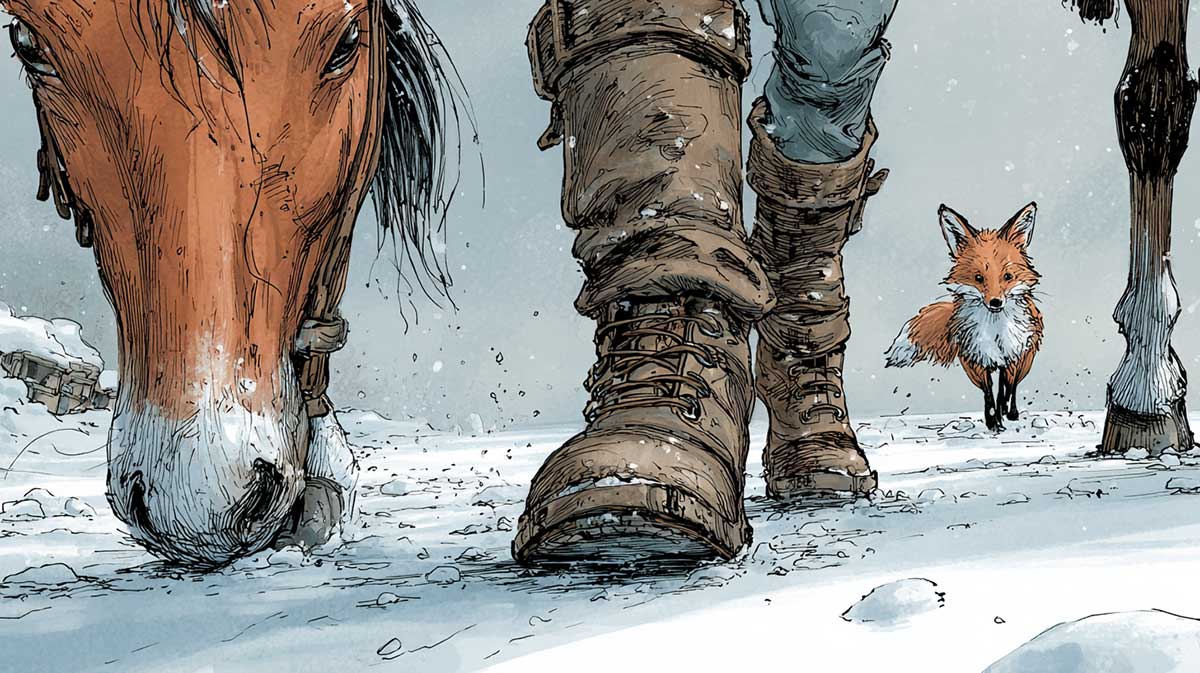
The storm has grown teeth.
Snow keeps finding the gaps in their clothes, as if it’s searching for the softest place to frighten them. The world has narrowed to a few feet of visibility, and the wind keeps changing direction, like it can’t decide how to break them most efficiently.
The Boy’s steps start to wobble. Not dramatic, not falling, just that subtle loss of rhythm that says the body is starting to bargain with gravity. The Mole looks up at him, worried, then quickly looks away as if worry itself might make things worse. The Fox paces in small bursts, a creature trying to out-run a feeling. The Horse stays steady, a moving shelter.
Charlie walks near the middle, as if being “in the middle” is an act of care.
He speaks into the wind, but his voice lands anyway.
“What counts as bravery,” Charlie asks, “when you feel tiny?”
The Mole answers first, surprising everyone with his certainty. “Bravery is asking for help. That is the hardest thing when you feel small. Because your pride tells you you must be big. But bravery is saying, I can’t do this alone. Bravery is letting someone see you.”
He pauses, then adds quietly, “And also… bravery is taking one more step when you don’t want to. Even if the step is very small.”
The Boy nods, but his eyes are wet, partly from wind. “Bravery is not pretending,” he says. “It’s telling the truth. Like… I’m scared. I’m tired. I don’t know if I can. I always thought bravery meant being confident. But right now it feels like… staying here with the fear instead of running away inside my head.”
The Fox speaks, voice low. “Bravery is not turning cold. That’s mine. When I’m afraid, I want to snap. I want to disappear. I want to make myself unreachable. Bravery is staying connected. Not biting. Not leaving.”
He glances at the Boy, then away again, like affection is still a language he’s learning.
The Horse answers last, steady. “Bravery is being gentle in a storm. Storms try to make you harsh. They try to make you urgent and selfish. When you choose patience, when you choose kindness, that is real courage. It is a strength that does not need to prove itself.”
The Storm laughs sharply. “You call that courage? Courage is domination. Courage is force. Courage is doing what you must to win. My definition: survive. Nothing else.”
The Horse doesn’t argue. He just keeps walking.
Charlie nods as if he expected that answer too.
Then he asks, “Why do small things, warmth, breath, presence, change more than big speeches?”
The Horse answers first this time. “Because you cannot think your way out of panic. The body needs reassurance. Warmth tells the nervous system: you are not dying. Breath tells the heart: slow down. Presence tells the soul: you are not alone. Big speeches live in the head. Small things go straight to the places storms attack.”
The Mole nods vigorously. “Yes. Big speeches are often for the speaker. Small comforts are for the frightened one. A hand. A shared coat. A quiet sentence like, I’m here. Also, a small snack can be a miracle. Not because it fixes life, but because it reminds you you’re allowed to take care of yourself.”
The Boy adds, “When someone gives me a big speech, I feel like I have to become a better person immediately. It makes me feel like I’m failing at healing. But when someone just stays, I can breathe. I can be messy. And then I can actually get stronger.”
The Fox speaks carefully. “Words are dangerous in storms. Too many words can feel like pressure. But a small thing, a shared rhythm of walking, a pause, a look that doesn’t judge, those are safe. Small things are harder to mistrust.”
The Storm hisses around them. “Big speeches don’t work because I drown them out. But small things… annoyingly… sometimes slip under my noise. That’s why I try to make people rush. Rushing steals the small acts. Rushing makes them forget to breathe.”
Charlie’s eyes narrow with recognition.
“Alright,” he says. “Last one. How do you keep moving without demanding certainty first?”
The question feels like it’s aimed at the Boy, but Charlie keeps it open for everyone.
The Boy answers first, voice thin but real. “I… I make the goal smaller. I stop trying to solve the whole storm. I just try to get to the next tree. Or the next minute. If I think about the entire way, I panic. If I think about the next step, I can do it. Sometimes.”
He swallows. “And sometimes I say out loud: I don’t need to know everything. I just need to keep going.”
The Mole nods. “Yes! Tiny goals. One step is a plan. Also, I keep moving by remembering there’s a future me who will be grateful. Future me will say, Thank you for not giving up. Even if present me is complaining loudly.”
The Fox answers next, blunt. “You move by accepting discomfort. The demand for certainty is a demand for comfort. But comfort isn’t always available. So you make a deal: I will be uncomfortable and still move. That’s it. That’s the whole trick.”
Then he adds, softer, “And you move because someone is beside you. Not to save you. Just to be with you.”
The Horse speaks, calm and grounded. “You keep moving by trusting principles, not predictions. A principle is: breathe. Stay kind. Stay together. A prediction is: the storm will end soon. Predictions can fail. Principles do not.”
The Storm circles them, irritated. “You cannot guarantee anything,” it says. “You cannot see ahead. You cannot promise safety. You could walk and still lose.”
Charlie looks at the Storm, then at the Boy.
“Yes,” Charlie says gently. “That’s true. But we can choose how we walk.”
The Boy looks up at the Horse, the Fox, the Mole. Their faces are wind-worn, eyes bright in the whiteness. Not fearless. Present.
The Horse shifts closer, making a barrier. The Mole presses in, a warm little heartbeat. The Fox steps nearer than usual, almost protective. Charlie stays beside them, quiet and steady.
And the Boy does something small that feels enormous.
He says, “I’m scared.”
Nobody argues with him. Nobody tells him not to be. Nobody makes a speech.
The Horse says, “Of course you are.”
The Mole says, “Me too.”
The Fox says, “Same.”
Charlie just nods, like the truth is a lantern.
And they take another step.
Not because certainty arrived.
Because courage did. Small, real, and enough.
Topic 5: Always Remember
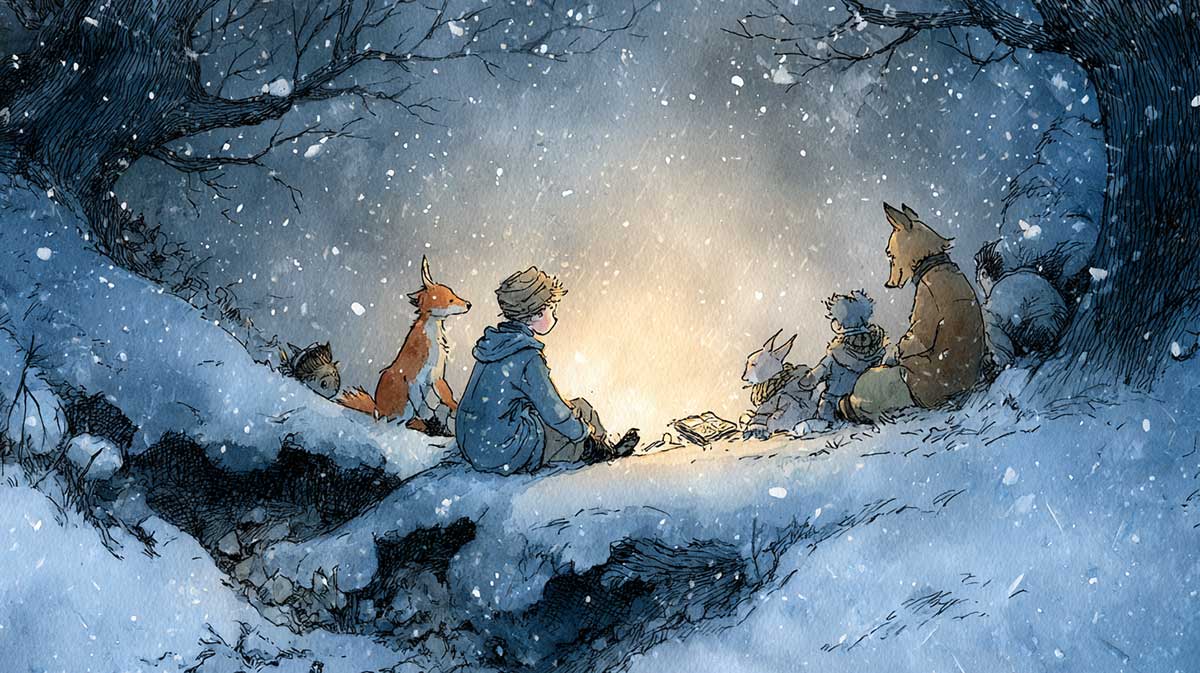
The storm does not stop like a machine turning off. It loosens its grip gradually, almost reluctantly, as if it’s annoyed they didn’t break in the way it planned.
The wind softens from a roar to a long, exhausted sigh. The snow still falls, but now it falls downward instead of sideways. The world reappears in pieces: a tree line, a pale path, the faint shape of distance returning.
They find a hollow in the land where the ground is calmer. The Horse stands guard out of habit, though it feels less necessary now. The Mole digs under a little tuft of snow and produces something tiny to eat, as if feeding the body is part of feeding the soul. The Fox settles nearer to the group than he would have earlier, pretending it’s only for warmth. The Boy sits down and realizes his hands are shaking.
Charlie stays standing for a moment, watching them, then sits too. No dramatic speech. Just company.
He looks at them with that gentle seriousness again.
“When everything feels dark,” Charlie asks, “what should you always remember about yourself?”
The Boy answers first, voice quiet. “That I’m still me. That fear doesn’t cancel who I am. That I’m allowed to struggle. And… that I don’t have to earn love by being calm.”
He looks down, then adds, “Also that I’ve survived before. Even when I thought I wouldn’t.”
The Mole nods, eyes wide and kind. “Always remember you are loved more than you know. Not because you did something impressive. Just because you exist. And remember this too: you don’t have to carry everything alone. If your heart is heavy, that’s a sign to share it.”
Then, almost as if confessing a secret, he adds, “And remember that small joys still count. A sip of warmth. A laugh. A bite of something sweet. These are not silly. They are proof you haven’t given up.”
The Fox speaks after a pause. “Always remember that not everyone leaves. The storm makes it feel like abandonment is inevitable. But it isn’t. And remember that you can come back after you push people away. You can apologize. You can return. You are not your worst reflex.”
He looks toward the Boy briefly, then away again. “And always remember: being guarded kept you alive once. But it doesn’t have to be your whole personality forever.”
The Horse speaks slowly. “Always remember your worth is not measured by your performance during a storm. Storms reveal strain, not value. Remember that courage can be quiet. Remember that you can begin again even if you feel broken. And remember that you belong. You belong to life. You belong to love.”
He lowers his head. “And if you forget everything else, remember to breathe. Breath is a promise: I am still here.”
The Storm drifts closer, less loud now, but still proud. “Always remember,” it says, “that I will return. That you cannot make life safe by thinking hard enough. That control is an illusion.”
It pauses, then adds something almost honest. “And remember that you are stronger than you think, because you’re sitting here right now. You didn’t disappear.”
Charlie doesn’t flinch. He nods, as if even the Storm has offered a piece of truth wrapped in its usual sharpness.
He asks the second question.
“What do you want to carry into the next storm,” Charlie says, “so you don’t start from zero again?”
The Mole answers immediately. “A list. Not a big one. A tiny one. Things that work. Warmth. Water. Rest. A friend. A kind sentence. And I want to carry permission. Permission to be human. Because without permission, you waste all your strength pretending.”
The Fox speaks next. “A signal. Something that tells me I’m slipping into isolation. For me it’s when I stop making eye contact. When I start thinking, I don’t need anyone. So I want to carry a rule: if I feel like I don’t need anyone, I probably need someone.”
He looks at the group. “And I want to carry trust in small doses. Not trust as a fantasy, but trust as a practice. One step toward someone. Then another.”
The Boy swallows and speaks with effort. “I want to carry the memory that fear lies. That it makes everything feel permanent. I want to carry the idea of next steps. Just the next step. Not the whole map.”
He glances at Charlie. “And I want to carry the courage to say out loud, I’m scared, before I start pretending.”
The Horse answers with calm certainty. “I want to carry a steady rhythm. The rhythm of breath. The rhythm of walking together. Storms are chaotic. Rhythm is medicine. And I want to carry a reminder: be gentle. Especially when you are tired. Tiredness makes people unkind by accident.”
The Storm speaks, quieter now. “I want you to carry respect for me. Not worship. Respect. I want you to stop insulting yourself for feeling fear. Fear is not shame. Fear is a signal. If you learn to read it without panicking, I lose my power to hijack you.”
Charlie looks almost pleased. Not because the Storm is kind, but because the Storm is finally telling the truth in plain words.
Then Charlie asks the third question, and it feels like the whole series has been walking toward it.
“After the storm passes,” he says, “how do you live in a way that proves you learned something?”
The Boy answers first, and his voice is steadier now. “I think… I stop waiting to be perfect before I love people. I stop thinking I have to be strong to be worthy. I let myself be supported. And I check in on others too, because I know how alone it can feel inside your head.”
He pauses. “And I forgive myself faster.”
The Mole smiles. “Yes. You practice kindness when you don’t urgently need it. You practice it on ordinary days so it’s available on hard days. And you say thank you more. Thank you to friends. Thank you to your own body for carrying you. Thank you to the little moments.”
Then he adds, almost like a vow, “And you eat cake without guilt sometimes.”
The Boy laughs, and the laugh is small, but it’s real.
The Fox speaks next, honest and rough-edged. “You show up. You don’t vanish. You don’t use pain as an excuse to become cold. You learn to come back. That’s the proof. Not that you never struggle, but that you return to love.”
He looks at the Horse, then at the Boy. “And you don’t punish people for caring.”
The Horse speaks last, steady as a bell. “You become a shelter for someone else. Not by fixing them, but by being calm near their fear. Storms teach you what matters. If you learned, you will protect what matters. Gently. Daily.”
The Storm drifts around them, dissatisfied that the lesson is not despair. “If you learned,” it says, “you won’t act like calm days are guaranteed. You’ll cherish them. You’ll prepare with humility. You’ll love without assuming you have forever.”
Charlie sits with the quiet for a moment. The air feels clearer now. Not magically healed, but honest.
He looks at each of them, and then he says something that feels like the title itself, spoken as a promise rather than a command.
“Always remember,” Charlie says softly, “storms are loud, but they are not the only voice.”
The Boy leans closer to the others. The Mole rests his head against the Boy’s leg, content. The Fox stays close without flinching away. The Horse stands like a gentle wall against whatever weather comes next.
And the storm, though it will return someday, cannot pretend it won today.
Because they did what storms hate most.
They stayed together.
They stayed kind.
And they remembered.
Final Thoughts by Charlie Mackesy
I think we underestimate how brave it is to keep a soft heart in a hard world. We treat tenderness like a weakness, but it might be the strongest thing in us. The storm tries to shrink your life to the size of your fear. It tries to convince you the dark will last forever, that you are alone, that you are failing.
But storms pass, even when they pass slowly. And while they are here, there are still choices. A breath. A hand. A shared step. A kind word instead of a sharp one. These do not look heroic from far away, but they are the shape of real courage up close.
Always remember this. You are not your worst thought. You are not your fear. You are not the weather. You are the one walking through it. And if you can, walk with someone. If you cannot, let someone walk with you.
Short Bios:
Charlie Mackesy British artist and author known for simple, hand-drawn line illustrations paired with brief, compassionate reflections on love, courage, and being human.
The Boy A gentle, searching child figure who represents the vulnerable part of us that wants to be brave and loved, even while feeling unsure.
The Mole A warm, funny companion who speaks in small, comforting truths, reminding everyone to choose kindness, rest, and simple care.
The Fox A cautious, guarded friend shaped by past hurt, learning trust step by step and protecting the group with quiet loyalty.
The Horse A calm, steady presence who embodies patience and strength without force, offering grounded wisdom when everything feels unstable.
The Storm The speaking force of fear and uncertainty. It tightens the mind, speeds up urgency, and tries to turn a moment of struggle into a permanent identity. It is not evil, but it is relentless, testing whether the characters can remember love, trust, and self-kindness when comfort disappears.
Leave a Reply