
|
Getting your Trinity Audio player ready...
|
What if Gad Saad is right about happiness—and most people are chasing the wrong thing?
Introduction by Gad Saad
We live in a time where the word “happiness” is everywhere, yet clarity about what it means is increasingly rare. People speak of it as if it were a mood to be maintained, a lifestyle to be curated, or a right to be guaranteed. Yet when we look closely, many who appear to have achieved this ideal feel restless, anxious, fragmented, or quietly dissatisfied.
This is not a coincidence.
Human beings are not abstract entities. We are biological organisms shaped by evolutionary pressures, embedded in social structures, driven by ancient desires, and capable of meaning far beyond mere pleasure. When a society begins to define happiness without reference to human nature, it risks constructing a vision of life that feels appealing in theory but fails in practice.
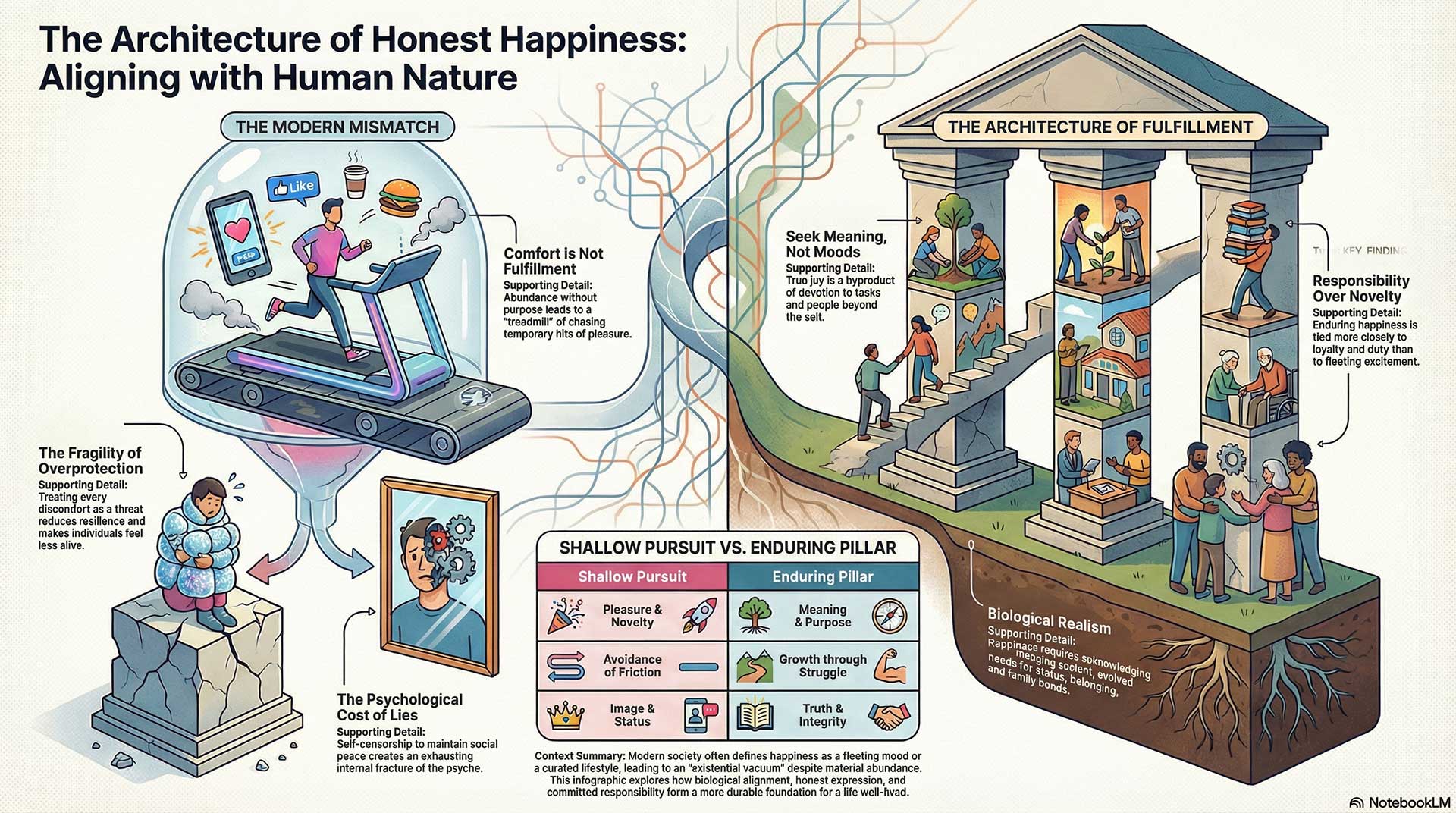
The modern world offers comfort, choice, stimulation, and unprecedented freedom. These are remarkable achievements. Yet comfort without purpose leads to emptiness. Choice without structure leads to paralysis. Stimulation without depth leads to numbness. Freedom without responsibility leads to confusion.
In this series of conversations, I have invited voices from across time and disciplines to explore a simple but urgent question: what actually makes a human life feel whole?
We will examine the paradox of comfort and emptiness, the importance of aligning with human nature, the psychological cost of dishonesty and self-censorship, the fragile state of modern love and family life, and the deeper question of meaning in the face of mortality.
This is not a search for easy answers. It is a search for honest ones.
If there is a single thread running through these discussions, it is this: happiness is not something we invent at will. It is something we discover by living in accordance with truth—about ourselves, about others, and about the world we inhabit.
(Note: This is an imaginary conversation, a creative exploration of an idea, and not a real speech or event.)
Topic 1 — Why So Many People Feel Empty in an Age of Comfort

Moderator: Gad Saad
Participants: Viktor Frankl, Arthur Brooks, Jonathan Haidt, Abraham Maslow, Blaise Pascal
Question 1 — Why do comfort, convenience, and endless options so often fail to produce peace?
Gad Saad:
We were not shaped for a life of permanent ease. Our ancestors had to solve problems, endure uncertainty, form bonds, compete, build, protect, and create. Much of modern life gives us stimulation without purpose, abundance without gratitude, and choice without wisdom. That mismatch matters. When people live in a way that defies their deeper design, emptiness often follows.
Blaise Pascal:
Man cannot remain quietly in his room. He seeks diversion, motion, noise, novelty, distraction. Comfort gives him more tools for escape, yet escape cannot heal the hidden wound. The soul still asks what all this movement is for. A thousand amusements may cover inner poverty for an hour, yet they cannot cure it.
Abraham Maslow:
Meeting lower needs does not finish the human story. Food, shelter, safety, convenience—these matter deeply, yet once secured, new needs appear. A person wants love, esteem, belonging, growth, self-respect, a sense that life is being used well. Comfort can remove pain, yet it cannot by itself create fulfillment. Many people mistake the reduction of discomfort for the presence of wholeness.
Jonathan Haidt:
Modern people are flooded with options, comparisons, and invitations to optimize every part of life. That can sound liberating, yet it often becomes exhausting. Too much choice can weaken commitment. Social media intensifies this by turning life into a public contest of signals. You are no longer just living; you are evaluating your life against thousands of edited lives every day.
Arthur Brooks:
Pleasure is real, yet pleasure fades fast. The brain adapts. What thrilled you last month becomes normal, then expected. If a person builds his emotional life on consumption, novelty, and comfort, he must keep chasing the next hit. Happiness has sturdier roots: enjoyment, satisfaction, meaning, relationships, faith, service, earned success. Without those, comfort becomes a treadmill.
Viktor Frankl:
A human being does not live by ease alone. He longs to give himself to something worthy. When life asks nothing serious of him, he may feel relieved for a moment, then strangely abandoned. Peace is not born from comfort by itself. Peace comes when one knows what one is living for.
Question 2 — Has modern life made people safer but less alive?
Gad Saad:
In many places, yes. We have reduced many old dangers, and that is a real achievement. Yet safety can become an idol. When every discomfort is treated as a threat, people lose tolerance for challenge, friction, uncertainty, and risk. A life emptied of struggle may become emotionally thin. Human vitality is tied to pursuit, resilience, and earned competence.
Arthur Brooks:
A protected life can become a brittle life. Many people now have fewer physical hardships than any prior generation, yet they report rising loneliness, anxiety, and dissatisfaction. Part of the problem is that growth asks for some friction. You need effort, sacrifice, delayed gratification, and goals that cost you something. Without that, you may be secure, yet inwardly stale.
Jonathan Haidt:
I would put it this way: many institutions began treating young people as fragile at the exact moment they needed guided exposure to challenge. Children and young adults develop strength by doing hard things, facing manageable risk, and learning that discomfort is survivable. Remove too much of that, and you get less confidence, less agency, more fear. A person begins to read ordinary life as dangerous.
Viktor Frankl:
A man does not become fully alive through protection from all suffering. He becomes alive when he responds nobly to what confronts him. Suffering is not good in itself. I do not praise it cheaply. Yet when hardship enters life, it can awaken courage, love, sacrifice, responsibility, depth. A sheltered life may spare pain, yet it may spare greatness too.
Blaise Pascal:
Safety can produce a strange poverty. When death, loss, and dependence are hidden from view, man may imagine he is in control. He becomes shallow, satisfied with surfaces, untested in spirit. Then, at the first serious shock, he sees how little he knows of himself. A life too carefully padded may keep a man from meeting his own condition.
Abraham Maslow:
There is a difference between healthy security and overprotection. Healthy security gives a person a base from which to grow. Overprotection shrinks the field of growth itself. People need order and safety, yes, yet they need challenge and aspiration too. The fully alive person is not merely safe. He is engaged, expressive, purposeful, and awake to his own potential.
Question 3 — What kind of emptiness comes from losing purpose, truth, struggle, or transcendence?
Gad Saad:
It is the emptiness of disconnection—from your nature, from reality, from responsibility, from something larger than appetite. People often think their misery means they need more comfort, more validation, more entertainment, more self-focus. Many times the opposite is true. They need mission, honesty, discipline, love, and a way of life that demands something from them.
Viktor Frankl:
I called it the existential vacuum. A person may have freedom, leisure, and material means, yet still feel hollow. Why? He no longer knows what is worth serving. He drifts, then fills the silence with pleasure, conformity, or despair. The cure is not mere self-expression. It is meaning—through work, love, suffering borne with dignity, or duty embraced with seriousness.
Abraham Maslow:
When a person loses purpose, he may still function well on the surface. He can work, buy, socialize, consume, perform. Yet deep inside he feels underused, fragmented, unreal. He senses that he is living below his own height. This creates a quiet sickness. It is not always dramatic. Many times it appears as boredom, cynicism, numbness, or low-grade resentment.
Blaise Pascal:
When truth and transcendence are lost, the human being becomes too small for his own soul. He fills his days, yet cannot answer his heart. He laughs, buys, travels, competes, desires, acquires—yet the inner cry returns in the night. The emptiness is not merely psychological. It is spiritual. Man was not made to live on diversion.
Jonathan Haidt:
A society that weakens shared moral frameworks, shared rituals, and shared sources of meaning often produces isolated selves trying to invent a full life alone. That is a heavy burden. Human beings are communal creatures. We need membership, moral order, purpose, and some sense of sacredness—whether in religion, family, nation, vocation, or service. Strip too much of that away, and people become untethered.
Arthur Brooks:
I see many successful people who are puzzled by their own dissatisfaction. They did what the culture told them to do. They achieved, earned, purchased, optimized. Yet they neglected friendship, faith, service, family, gratitude, and the disciplines that form the heart. Empty success is one of the saddest forms of emptiness, since it leaves a person with no obvious excuse. He has what he wanted, then finds it was too small.
Topic 2 — Human Nature, Evolution, and the Search for Happiness

Moderator: Gad Saad
Participants: Charles Darwin, David Buss, Helen Fisher, Jordan Peterson, E. O. Wilson
Question 1 — What happens when a culture tries to define happiness with little regard for human nature?
Gad Saad:
It produces confusion dressed up as progress. A society can invent slogans, trends, and therapeutic language, yet if those ideas collide with basic human nature, people will still suffer. You cannot build lasting happiness on fantasies about what human beings are. We are embodied creatures with instincts, drives, attachments, status concerns, mating psychology, tribal loyalties, and deep needs for meaning and belonging. Ignore that, and the whole structure becomes unstable.
Charles Darwin:
Any creature must be understood in relation to the conditions under which it developed. Human faculties did not appear in abstraction. Our emotions, social behaviors, sympathies, fears, and ambitions bear marks of long inheritance. If a civilization imagines that man can simply detach himself from these roots by preference or doctrine, it may find itself surprised by the persistence of old tendencies under new names.
David Buss:
When a culture denies human nature, people do not become free of it. They become less aware of it. Mate choice still matters. Jealousy still matters. status still matters. Family bonds still matter. Competition still matters. The same ancient motives remain active, yet people lose the vocabulary to interpret them honestly. Then they mistake predictable human conflict for some mysterious modern crisis.
Helen Fisher:
Romantic love, attachment, and desire are not inventions of recent culture. They are deeply tied to our biology. So are curiosity, ambition, heartbreak, longing, and pair-bonding. A culture that treats human beings like infinitely flexible creatures may sound generous, yet it leaves many people estranged from their own emotional reality. They feel things they have been taught to dismiss, and that gap can create inner division.
Jordan Peterson:
The refusal to reckon with human nature usually ends in chaos. People are told that limits are oppression, that structure is pathology, that hierarchy is only domination, that instinct is a social script. Then life refuses to cooperate. Suffering appears. Conflict appears. Responsibility appears. The truth is that human beings need order, purpose, competence, and truthful confrontation with reality. Remove that, and you weaken both character and joy.
E. O. Wilson:
Human beings are a biological species living inside symbolic systems of their own making. Culture matters greatly, yet culture is not floating free from biology. The deepest social arrangements tend to succeed when they work with our inherited dispositions rather than pretending those dispositions do not exist. Happiness, in that sense, is partly ecological. It depends on whether a way of life fits the organism living inside it.
Question 2 — Which parts of our longing for love, status, belonging, achievement, and family are ancient rather than socially constructed?
Gad Saad:
Quite a lot of them. One of the great errors of modern thought is the urge to treat enduring human patterns as if they were random cultural inventions. Of course culture shapes expression, yet the underlying architecture is old. People want to be chosen. They want to matter. They want admiration from some and love from others. They want to protect kin, build identity, leave a mark, and avoid humiliation. These are not passing fads.
Helen Fisher:
Love itself has ancient roots. Lust pushes us to seek sexual union. Romantic attraction narrows attention onto one special person. Attachment helps sustain long-term bonding. These are distinct systems, yet they often intertwine. That is why love can feel ecstatic, destabilizing, possessive, loyal, irrational, and sacrificial all at once. A modern person may speak in contemporary language, yet the heart still moves through very old circuits.
David Buss:
Status seeking is ancient too. Throughout human history, status affected access to mates, allies, resources, reputation, and protection. The desire for achievement is often tied to this wider social reality. People do not merely want to survive; they want to rank well in the eyes of others. Belonging is equally deep. Exclusion once carried severe costs. That is one reason social rejection can feel devastating at a level far beyond reasoned thought.
Charles Darwin:
The social instincts are among the most powerful features of human life. Sympathy, approval, rivalry, sexual selection, parental investment, and group loyalty all bear evolutionary significance. The family bond, in many forms, has long been central to survival and transmission. We should be cautious of any theory that treats these inclinations as accidental ornaments. They are woven into the history of our species.
E. O. Wilson:
Human beings are intensely group-oriented. We seek identity through membership, common cause, mutual recognition, and the moral rules of a shared world. Achievement is rarely solitary in its meaning. We want our efforts seen and valued by a group that matters to us. The family sits near the center of this because kinship links biology with culture, intimacy with continuity, emotion with inheritance.
Jordan Peterson:
You can see it in ordinary misery. People suffer deeply when they are rejected by a lover, dishonored by peers, alienated from family, stripped of competence, or denied a meaningful role. Why? These things are not superficial decorations placed upon a blank self. They are bound up with our deepest orientation in the world. To be loved, useful, and respected is not vanity alone. It is part of what steadies the soul.
Question 3 — Can a person become happy by denying reality, or does real happiness require alignment with who we are?
Gad Saad:
Real happiness asks for truth. You may soothe yourself with denial for a season. You may flatter yourself, numb yourself, distract yourself, join a chorus that rewards illusion. Yet reality eventually sends the bill. If your life is built on falsehood—about your motives, your habits, your relationships, your nature, your limits—your well-being will be fragile. You do not have to like truth for it to govern you.
Jordan Peterson:
A person who refuses reality does not become free. He becomes enslaved to avoidance. He avoids his weakness, so he cannot strengthen it. He avoids his responsibility, so he cannot build meaning. He avoids his limits, so he cannot orient himself properly. Happiness without truth is performance. It can look polished from the outside and still be rotten at the core.
Charles Darwin:
In the natural world, organisms persist by adapting to reality, not by wishing it away. There is, perhaps, an analogous point in human life. The mind may construct comforting interpretations, yet those interpretations remain subject to the tests imposed by existence itself. A creature out of joint with its conditions cannot flourish for long.
Helen Fisher:
People often lie to themselves most in love. They deny mismatch, loneliness, resentment, fading attachment, or incompatible longings. Yet the body and mind still keep score. Real happiness in relationships asks for honesty about desire, commitment, temperament, expectations, and emotional needs. To align with who we are is not to indulge every impulse. It is to know what we are dealing with before we promise, cling, or walk away.
David Buss:
Self-deception can sometimes offer short-term social advantage, yet it often carries long-term personal cost. A person may deny jealousy, deny sexual conflict, deny competitive motives, deny the importance of mate value, deny the wish for family or admiration. These denials do not erase the underlying mechanisms. They simply make decisions worse. The more accurately you see human nature, including your own, the better chance you have of building a life that actually works.
E. O. Wilson:
Alignment with reality does not reduce the human person. It situates him. We are meaning-making beings, yes, yet we remain animals with a history. The mature life is neither crude submission to instinct nor arrogant rebellion against nature. It is wiser than both. It tries to place aspiration within truth. Happiness of that kind may be less sentimental, yet it is far more durable.
Topic 3 — Freedom, Truth, and the Cost of Self-Censorship

Moderator: Gad Saad
Participants: George Orwell, John Stuart Mill, Aleksandr Solzhenitsyn, Niall Ferguson, Ayaan Hirsi Ali
Question 1 — Can a person be inwardly happy if he is outwardly afraid to say what he believes?
Gad Saad:
Only up to a point. A person may silence himself for convenience, advancement, safety, or social peace, yet repeated self-erasure leaves marks on the psyche. When you constantly monitor your own words, you split yourself in two: the public self that performs and the private self that knows. That fracture is exhausting. Human beings need belonging, yes, yet they also need integrity. When fear rules speech, joy becomes thin and conditional.
George Orwell:
To say what everyone says, when one does not believe it, is a form of corruption. The lie enters the mind by way of the mouth. At first, one merely repeats what is expected. Later, one loses the habit of clear thought. That is one of the worst injuries tyranny can inflict, whether imposed by the state or by social fashion. A man who cannot speak honestly begins to live in a fog, and fog is no home for happiness.
John Stuart Mill:
Freedom of opinion is not a luxury granted to a few difficult people. It is one of the conditions of a vigorous human life. A person silenced by fear is harmed in more than reputation or career. His faculties weaken through disuse. He ceases to test, sharpen, and own his own mind. Happiness worthy of the name asks for the development of individuality, and individuality cannot breathe under constant intimidation.
Ayaan Hirsi Ali:
Fear changes the body before it changes the argument. You begin to anticipate punishment. You edit yourself before anyone speaks. You weigh every sentence against possible outrage. That can make a person look calm from the outside, yet inwardly he is living under pressure. Courage has a cost, but so does submission. Many people underestimate the spiritual fatigue that comes from never saying plainly what one knows to be true.
Aleksandr Solzhenitsyn:
The soul sickens when it cooperates with falsehood. A man need not be thrown into a camp to know this. He need only betray his conscience day after day in small acts. He signs what he does not believe. He applauds what he despises. He condemns what he privately knows is good. Such habits deform the person from within. No lasting happiness can be built on daily acts of inner surrender.
Niall Ferguson:
Civilizations decline when fear governs not merely politics but conversation itself. Free societies depend on habits of candor, argument, dissent, and tolerance for offense. Once people learn that honest speech carries disproportionate penalties, they adapt by becoming evasive, strategic, and cynical. This weakens institutions, trust, and character all at once. The result is not peace. It is a more polished form of fear.
Question 2 — What does habitual dishonesty do to the soul, even when it brings social reward?
Gad Saad:
It hollows out self-respect. People often think the main temptation is material: keep your status, keep your friends, keep your job, keep your place in the tribe. Yet the deeper cost is internal. You begin to doubt your own seriousness. You know you are performing. You know your approval rests on pretense. That creates a strange misery, since you may win the rewards of conformity and still feel ashamed in private.
Aleksandr Solzhenitsyn:
A lie repeated outwardly becomes a wound inwardly. The soul longs for truth as the body longs for air. When one lives by lies, one may still eat, laugh, prosper, and appear successful. Yet beneath that surface, something essential has gone dim. Moral energy weakens. Courage weakens. Clarity weakens. The person becomes less able to stand upright before God, before history, or before his own conscience.
George Orwell:
Dishonesty has a way of spreading. One false phrase calls for another. Then language itself becomes infected. Words no longer describe reality; they conceal it. This does not merely deceive others. It traps the speaker inside a verbal machine of his own making. He loses the power to state plainly what is in front of him. That kind of corruption is not theatrical. It is dull, creeping, intimate, and ruinous.
John Stuart Mill:
When social reward is attached to dishonesty, the danger grows greater, not smaller. Punishment can at least awaken resistance. Reward seduces. It teaches people to mistake applause for virtue. Over time, a person may cease to love truth for its own sake. He begins to love approval, safety, and moral vanity. Such a person may appear socially flourishing, yet his inner liberty is in decline.
Ayaan Hirsi Ali:
There is a loneliness in pretending. People praise the mask, not you. They celebrate your compliance, not your mind. They trust your usefulness, not your honesty. Some endure this for years and then wonder why success feels cold. It feels cold because they were rewarded for disappearing. A human being wants to be seen truthfully, not merely accepted strategically.
Niall Ferguson:
History shows that systems built on managed language become brittle. The same holds for persons. If your rise depends on saying what the moment demands, you become hostage to the next shift in orthodoxy. Your identity becomes unstable, your loyalties transactional, your judgment compromised. You gain position and lose grounding. That is too high a price.
Question 3 — Is freedom merely political, or is it part of psychological health itself?
Gad Saad:
It is deeply psychological. Political freedom matters because human beings are not machines. We need room to think, test, speak, disagree, joke, doubt, and revise. When that room collapses, the mind narrows. Fear enters cognition itself. Curiosity becomes risky. Spontaneity becomes dangerous. This is why censorship wounds more than public discourse. It reaches into the inner life and makes people smaller.
John Stuart Mill:
A free society protects more than legal rights. It protects the cultivation of the person. The ability to form one’s own judgments, to hear contrary views, to express conviction, and to live by chosen principles is part of human maturation. A person denied this space may still survive, yet he does not fully develop. Freedom is tied to flourishing because the soul grows through exercise, not through confinement.
George Orwell:
A man watched too closely soon begins to watch himself. That is the beginning of internal captivity. One need not be physically imprisoned to become mentally cramped. A climate of suspicion, denunciation, and approved phrases creates a citizen who cannot relax into reality. He is always measuring, editing, guarding. That is not merely political damage. It is damage to the texture of consciousness.
Ayaan Hirsi Ali:
Psychological freedom includes the right to stand apart from the group without losing your entire life. It means you can say no, question inherited beliefs, reject coercion, and still remain a person among persons. Many people speak of freedom as if it were abstract, yet its absence is felt in the nerves, in sleep, in speech, in relationships, in the way one enters a room. It shapes the whole self.
Aleksandr Solzhenitsyn:
There is also an inward freedom that no regime can entirely extinguish. A man can refuse consent to falsehood, refuse hatred, refuse self-betrayal. Yet outer freedom still matters, for it protects the visible conditions under which truth may be spoken and shared. The highest life joins both: the inner freedom of conscience and the outer freedom of lawful expression.
Niall Ferguson:
The healthiest societies are those in which institutions protect dissent before heroism is required. When basic honesty demands extraordinary bravery, something has already gone wrong. Political liberty, then, is not separate from psychological health. It is one of the great public frameworks that lets ordinary people remain mentally whole.
Topic 4 — Love, Family, Sex, and the Architecture of a Good Life

Moderator: Gad Saad
Participants: Esther Perel, David Buss, Louise Perry, Helen Fisher, Warren Farrell
Question 1 — Have modern sexual freedoms made people happier, or simply more unstable and detached?
Gad Saad:
Sexual freedom can remove needless shame and coercion, and that is no small thing. Yet freedom without wisdom often becomes drift. When desire is detached from responsibility, courtship from commitment, and pleasure from consequence, many people gain options but lose stability. A society may celebrate liberation and still produce loneliness, mistrust, confusion, jealousy, and emotional exhaustion. The real question is not whether freedom exists, but whether people know what human beings actually need in order to flourish inside it.
Louise Perry:
A great deal of modern sexual culture flatters autonomy, yet often ignores asymmetry, vulnerability, attachment, and regret. Many people enter this world believing they are acting from pure choice, then discover that choice is shaped by pressure, loneliness, competition, and the fear of being unwanted. The result is often a kind of emotional hardening. People call it liberation, yet many are simply learning to expect less tenderness, less loyalty, and less safety.
Esther Perel:
Freedom has expanded the range of possible relationships, and in one sense that can be life-giving. People no longer remain in arrangements simply from duty or social fear. Yet the same freedom can weaken endurance. We now ask relationships to give us security, passion, friendship, healing, validation, and self-discovery all at once. That is a heavy load. The modern heart is freer, yes, but often more restless too.
David Buss:
From an evolutionary view, sexual freedom does not erase the old tensions between short-term desire and long-term bonding. It often intensifies them. Jealousy, mate guarding, status competition, deception, and conflict over commitment remain very much alive. People may tell themselves they have moved past old patterns, yet the same underlying mechanisms still operate. When social norms loosen, those mechanisms do not vanish. They often become harder to manage.
Helen Fisher:
Humans are built for a complicated mix of lust, romantic attraction, and attachment. These systems do not always move in harmony. That is one reason modern sexual life can feel so exhilarating and so destabilizing. A person may desire one partner, fall in love with another, and long for lasting attachment with yet another. Freedom gives more room for movement across these systems, yet it does not remove the emotional cost when they collide.
Warren Farrell:
Many men and women now approach each other with more suspicion and less shared expectation. That creates fragility. People are freer to leave, freer to compare, freer to delay, freer to protect themselves, yet often less able to build trust. The question is not whether freedom is good or bad. The question is what kind of culture helps men and women use freedom in a way that deepens love rather than thinning it out.
Question 2 — What is lost when love becomes centered on novelty, self-expression, or temporary pleasure?
Gad Saad:
What is often lost is depth. Love cannot mature where the self remains sovereign at every moment. If the highest good is constant excitement or endless self-expression, then sacrifice begins to look oppressive, routine begins to look deadening, and loyalty begins to look negotiable. Yet the strongest bonds are forged through continuity, patience, forgiveness, shared burdens, and earned trust. A life built on novelty keeps moving, but it may never arrive.
Esther Perel:
Novelty has genuine erotic energy. Desire often feeds on mystery, distance, surprise, risk, and imagination. Yet relationships cannot live on novelty alone. They also need care, repetition, memory, and ritual. The tragedy is that people often think stability kills love, when in truth stability only kills love if the relationship becomes emotionally lifeless. The challenge is to keep aliveness inside commitment, rather than chasing aliveness by escaping commitment.
Helen Fisher:
Temporary pleasure can be intoxicating, yet it rarely satisfies the attachment system for long. Human beings are not built merely to sample experiences. Many long to be known, chosen, held, and remembered. When love becomes mostly expressive or recreational, people may enjoy moments of intensity yet still feel unmoored. The nervous system itself often wants more than stimulation. It wants emotional anchoring.
Louise Perry:
When love is reduced to self-expression, the other person easily becomes an instrument. He is there to affirm me, excite me, heal me, entertain me, or mirror back my preferred identity. That is a poor foundation for tenderness. Real love asks for a kind of moral seriousness. It asks what I owe, what I must restrain, what I must protect, what I must not casually break.
David Buss:
There is also the issue of strategic confusion. Short-term pleasure and long-term bonding often reward different behaviors. A culture that blurs those paths can leave people chronically misreading each other. One person seeks excitement, another permanence, another validation, another rescue from loneliness. When these motives are hidden or sentimentalized, the emotional damage multiplies. What is lost is clarity, and clarity is one of the great mercies in love.
Warren Farrell:
Children lose something too when adult relationships become too unstable. Family life gives many people their deepest experience of being needed and of living beyond themselves. When novelty becomes the ruling value, roots weaken. Men, women, and children all pay a price. A good life is not measured only by what felt intense. It is also measured by what endured, what sheltered others, and what became trustworthy over time.
Question 3 — Are marriage, family, loyalty, and parental duty still among the deepest sources of happiness?
Gad Saad:
Yes, for many people they remain among the deepest sources of meaning and emotional grounding. That does not mean every marriage is good or every family life is healthy. Yet it does mean human beings are often happiest when bonded to others through enduring responsibility. The modern world prizes autonomy, but autonomy by itself can become sterile. A child, a spouse, a household, a shared future—these draw a person out of private appetite into a larger structure of care.
Warren Farrell:
Family life gives a person a place where he is loved not merely for performance, rank, or charm, but for presence and duty. Parenting in particular can reorder the soul. It teaches sacrifice, patience, protection, humility, and long vision. Many people discover that some of their happiest moments are not glamorous at all. They are moments of ordinary attachment: being awaited, being trusted, being needed at home.
Helen Fisher:
Attachment is one of the great stabilizing gifts in human life. Long-term bonding can reduce anxiety, deepen companionship, and create a secure emotional base. That does not make relationships simple. They remain full of conflict, longing, and misunderstanding. Yet many people find that committed love gives shape to time itself. Life stops feeling like disconnected episodes and begins to feel like a shared story.
David Buss:
From an evolutionary view, pair-bonding and parental investment are central features of human social life. That does not dictate one rigid form for every person, yet it does suggest that love, kinship, and family are not secondary add-ons to happiness. They are near the center of it for many people. The desire to protect offspring, keep a mate, build a household, and sustain a lineage has deep roots.
Esther Perel:
I would say yes, with one caution. Loyalty should not mean emotional stagnation, martyrdom, or silent resentment. Family life gives meaning, yet it must still be lived consciously. Couples need renewal, honesty, play, erotic vitality, and room for inner growth. Duty without aliveness becomes numb. Still, when love and responsibility enrich each other, they create one of the strongest forms of human fulfillment.
Louise Perry:
There is wisdom in older ideals that modern culture is too eager to dismiss. Fidelity, parental duty, restraint, devotion, and the willingness to build something lasting with imperfect people—these are not relics. They are civilizing practices. They protect love from whim and children from adult chaos. Many people spend years chasing freedom, then slowly realize that the deepest happiness was always more closely tied to loyalty than they wanted to admit.
Topic 5 — Meaning, Mortality, and the Courage to Live Truthfully

Moderator: Gad Saad
Participants: Viktor Frankl, Ernest Becker, Seneca, Irvin Yalom, Albert Camus
Question 1 — Can happiness survive suffering, aging, and the certainty of death?
Gad Saad:
It can, but only if happiness is defined more deeply than comfort, pleasure, or youthful momentum. If a person builds his sense of well-being on status, beauty, novelty, physical strength, or endless possibility, time will slowly strip him down. Aging is merciless to shallow definitions of happiness. Yet there is another kind of life in which suffering deepens gratitude, mortality sharpens meaning, and limits force a person to ask what truly matters. That kind of happiness is less glamorous, but far more durable.
Viktor Frankl:
Yes, happiness can survive, though perhaps one should say that meaning can survive first, and happiness follows in altered form. A man may lose health, certainty, ease, and still retain the freedom to answer life with dignity. Suffering does not automatically ennoble. It can embitter, degrade, and break. Yet when a person finds meaning in love, work, sacrifice, or noble endurance, he becomes more than a victim of circumstance. Then even in pain, life does not become empty.
Seneca:
He who has made peace with mortality is less easily enslaved by fear. Much of human misery comes from resisting what cannot be escaped. Old age comes. Death comes. Illness comes. Fortune changes. The wise man does not pretend otherwise. He learns to live so that no outer change can wholly rob him of himself. Happiness grounded in virtue survives what pleasure cannot.
Irvin Yalom:
Many people do not truly begin to live until death becomes real to them. Mortality can be terrifying, yet it can strip away triviality. Petty rivalries lose some force. False ambitions lose their glow. One asks harder questions: Whom do I love? What have I avoided? What remains unsaid? What life is actually mine? In that sense, death anxiety can become a severe but honest teacher. It wounds illusion, yet can awaken authenticity.
Ernest Becker:
Most people try to defeat death symbolically. They attach themselves to projects, reputations, identities, ideologies, nations, achievements—anything that promises they are more permanent than they are. This is deeply human. The danger comes when these defenses become unconscious tyrants. Then a person cannot face his own finitude and must live frantically, defensively, or grandiosely. Happiness requires some confrontation with mortality, or else one spends life hiding from the central fact of being human.
Albert Camus:
Death does not make joy impossible. It makes it fierce. The absurd man knows life has no guaranteed rescue from silence, suffering, or ending. Yet he still loves the sun on stone, the face of a friend, the stubborn act of continuing, the small flame of lucidity. Happiness is not always innocence. Sometimes it is defiance without self-deception.
Question 2 — Does a truthful life demand that we stop chasing pleasure and start facing reality?
Gad Saad:
At some point, yes. Pleasure has its place. I am not arguing for a joyless life of grim discipline. Yet a person cannot mature if he treats pleasure as the final measure of what is good. Truthful living asks harder things: responsibility, sacrifice, honesty about weakness, clarity about trade-offs, acceptance of limits, the courage to confront regret, the willingness to choose meaning over mood. Pleasure may visit such a life, but it no longer rules it.
Seneca:
Pleasure is a poor master because it teaches dependence on what cannot be kept. The person governed by pleasure becomes fragile, anxious, and easily manipulated. He fears loss too much. He avoids hardship too much. He confuses what is sweet with what is good. A truthful life asks for discipline of judgment. One must learn to desire what strengthens the soul, not merely what soothes the appetite.
Albert Camus:
To face reality is not to reject joy. It is to reject illusion. There is dishonesty in pretending life owes us coherence, justice, or permanent satisfaction. Yet there is also dishonesty in pretending despair is profound simply because it is dark. The truthful person does not chase pleasure blindly, but neither does he worship suffering. He stands inside the contradiction and still chooses to live.
Irvin Yalom:
Many pleasures are really anesthetics. They help people avoid loneliness, guilt, death anxiety, emptiness, and the fear of unlived life. There is nothing mysterious here. The human being often flees inward confrontation by staying busy, stimulated, amused, desired, intoxicated, or distracted. Psychologically, the task is not to abolish pleasure but to see when pleasure has become avoidance. A truthful life asks that we stop using delight as camouflage.
Viktor Frankl:
One should not chase happiness directly. The more a man makes it his object, the more it escapes him. Happiness arises as a byproduct of devotion to something beyond the self: a task, a person, a duty, a cause, an act of courage, a stance toward suffering. Pleasure sought for its own sake can become empty. Meaning embraced for its own sake can become radiant.
Ernest Becker:
Reality is costly because it reveals our smallness. That is why so many people chase pleasure, distraction, and self-expansion. They cannot bear the ordinary scale of being human. Yet the person who cannot face reality remains trapped in compensations. He may feel alive in moments, but he is still fleeing. Truth demands a kind of humility that the pleasure-centered life resists.
Question 3 — What remains of happiness when image, status, youth, and distraction begin to fall away?
Gad Saad:
What remains is the real test. When the applause quiets, when vanity weakens, when options narrow, when energy drops, when the mirror tells the truth, what is left? If a person has built a life around love, integrity, purpose, courage, family, honest thought, meaningful work, and gratitude, much remains. If he has built it around display, appetite, and social approval, very little remains. Time exposes the architecture.
Viktor Frankl:
What remains is the possibility of meaning until the final breath. A person may lose many external powers and still keep the freedom to love, to bless, to endure, to reconcile, to bear witness, to suffer with dignity. The deepest happiness may no longer look like excitement. It may look like peace, responsibility fulfilled, and the quiet knowledge that one did not waste one’s life entirely.
Irvin Yalom:
What remains is relationship, presence, and authenticity. Near the end of life, many things that once seemed urgent lose their glamour. People care less about appearance and more about reality. Whom did I truly know? Who truly knew me? Where was I brave? Where did I hide? The stripping away can be painful, yet it can bring a severe tenderness. One becomes less interested in performance and more interested in being real before it is too late.
Seneca:
What remains is character. The externals were always borrowed. Youth is borrowed. Beauty is borrowed. Public esteem is borrowed. Fortune is borrowed. None were ever properly yours. What can be more truly yours is the form of your mind, the discipline of your judgments, the nobility or pettiness of your conduct. If those have been cultivated, much remains indeed.
Ernest Becker:
What remains, for many, is the terrifying question of whether their life had substance apart from the role they played. That is why the collapse of image can feel like annihilation. Yet it can also be a liberation. The false self was exhausting to maintain. When it weakens, the person may finally meet his unadorned humanity. It is a frightening meeting, but perhaps the only honest one.
Albert Camus:
What remains is the bare, stubborn privilege of consciousness itself—the chance to see clearly, to love without disguise, to laugh without illusion, to resist despair without pretending victory is guaranteed. There is a stripped-down happiness that survives the loss of glamour. It is not grand. It is lucid. It says yes to life without demanding that life become innocent.
Final Thoughts by Gad Saad
If there is anything worth carrying forward from these conversations, it is a certain sobriety about what it means to live well.
The modern temptation is to treat happiness as a kind of personal project of optimization—adjust the environment, curate the experience, eliminate discomfort, and maintain a desirable emotional state. Yet this approach often leads to a fragile life, one that depends on conditions remaining favorable and reality remaining negotiable.
A more enduring path asks something different of us.
It asks us to align with who we are rather than deny it. To seek meaning rather than chase pleasure. To speak truth rather than perform agreement. To build relationships that endure rather than ones that merely excite. To accept mortality rather than hide from it. To take responsibility rather than outsource it.
None of this guarantees a life free from pain. In fact, it often invites struggle. Yet it also produces something far more stable than momentary happiness: a sense of coherence, dignity, and grounded purpose.
Human beings are at their best when they are engaged in something beyond themselves—raising a family, building a body of work, defending truth, loving others deeply, or confronting reality with courage. These are not always comfortable pursuits, yet they are deeply human ones.
In the end, happiness may not be the right word for what we are seeking.
What we are seeking is a life that holds together—intellectually, emotionally, morally, and existentially. A life that can withstand scrutiny, time, and hardship. A life that does not collapse when illusions fall away.
Such a life is not easy to construct. It demands honesty, discipline, and courage.
Yet it is the only kind of life that, when examined closely, feels genuinely worth living.
Short Bios:
Gad Saad — Evolutionary behavioral scientist, professor, and author known for applying Darwinian thinking to consumer behavior, culture, identity, free speech, and modern life.
Viktor Frankl — Austrian psychiatrist, Holocaust survivor, and author of Man’s Search for Meaning, best known for his work on meaning, suffering, and human dignity.
Arthur Brooks — Social scientist, writer, and teacher focused on happiness, meaning, work, habits, and the pursuit of a fulfilling life.
Jonathan Haidt — Social psychologist and author known for his work on moral psychology, social media, fragility, and the cultural forces shaping modern anxiety.
Abraham Maslow — American psychologist famous for the hierarchy of needs and for exploring self-actualization, growth, and human potential.
Blaise Pascal — French mathematician, philosopher, and religious thinker known for his penetrating reflections on distraction, emptiness, faith, and the human condition.
Charles Darwin — English naturalist whose theory of evolution by natural selection transformed how we think about life, adaptation, and human origins.
David Buss — Evolutionary psychologist known for research on mating, jealousy, attraction, status, sexual conflict, and the deeper patterns of human behavior.
Helen Fisher — Biological anthropologist known for her work on romantic love, attachment, brain chemistry, and the science of human pair-bonding.
Jordan Peterson — Canadian psychologist, writer, and public intellectual known for speaking on meaning, responsibility, order, suffering, and the structure of human life.
E. O. Wilson — Biologist and naturalist known for work on sociobiology, ants, human social behavior, and the relationship between biology and culture.
George Orwell — English novelist and essayist, author of 1984 and Animal Farm, remembered for his warnings about propaganda, tyranny, and the corruption of truth.
John Stuart Mill — British philosopher and political thinker best known for defending liberty, individuality, free expression, and the value of open debate.
Aleksandr Solzhenitsyn — Russian novelist and dissident whose writings exposed Soviet repression and explored conscience, truth, suffering, and moral courage.
Niall Ferguson — Historian and author known for writing on empires, finance, institutions, civilizational strength, and the forces that shape history.
Ayaan Hirsi Ali — Writer, activist, and public thinker known for her defense of free expression, women’s rights, secularism, and intellectual courage.
Esther Perel — Psychotherapist and author known for work on desire, intimacy, infidelity, erotic life, and the tensions inside modern relationships.
Louise Perry — British writer and cultural critic known for examining sexual politics, modern dating culture, vulnerability, and the social cost of sexual liberation.
Warren Farrell — Author and speaker known for writing on family life, fatherhood, gender issues, and the emotional needs of men, women, and children.
Ernest Becker — Cultural anthropologist and author of The Denial of Death, known for exploring mortality, ego, fear, and the symbolic ways people seek permanence.
Seneca — Roman Stoic philosopher, statesman, and writer known for teachings on virtue, self-command, mortality, and calm in the face of hardship.
Irvin Yalom — Psychiatrist, psychotherapist, and author known for his work on existential psychology, death anxiety, isolation, freedom, and authenticity.
Albert Camus — French-Algerian writer and philosopher known for exploring absurdity, revolt, lucidity, and the search for meaning without illusion.
Leave a Reply