

What if Marci Shimoff could sit with the world’s greatest thinkers and test whether happiness is truly trainable?
Introduction by Marci Shimoff
For most of my life, I believed happiness was something I had to earn.
I thought it came after I worked harder, fixed myself more, achieved the right goals, or finally got life to cooperate. And like many people, I had moments of joy—beautiful ones—but they always felt conditional. Fragile. Temporary.
What changed everything for me was discovering that some people are happy regardless of circumstances. Not because their lives are perfect, but because their inner “happiness thermostat” is set higher. They experience challenges, grief, and uncertainty like everyone else—but they don’t live there.
That realization led me to write Happy for No Reason.
But a book can only point the way. Real understanding happens in conversation—when ideas are tested, questioned, embodied, and sometimes challenged by other perspectives. That’s what this series is.
Together with psychologists, neuroscientists, spiritual teachers, and thinkers, we explore five essential questions:
- Can happiness be trained?
- Are our stories shaping our suffering?
- Does the body hold the key to joy?
- Is love something we feel—or something we practice?
- And what happens when happiness no longer needs a reason at all?
This isn’t about becoming endlessly positive.
It’s about becoming deeply resilient.
It’s about discovering a happiness that doesn’t disappear when life gets hard.
If you’re willing to listen gently—to your mind, your body, and your heart—you may discover something surprising:
You don’t have to wait for life to change in order to be happy.
You can begin now.
(Note: This is an imaginary conversation, a creative exploration of an idea, and not a real speech or event.)
Topic 1 — Is Happiness a Reaction—or a Skill We Can Train?

Setting:
A quiet, modern lecture hall after hours. The lights are low. Five chairs form a gentle arc. No stage theatrics—only attention, clarity, and a shared willingness to be honest.
Moderator: Daniel Kahneman
Opening Context — Daniel Kahneman
Most people assume happiness is a verdict delivered by life: good events produce it, bad events remove it. Yet decades of research suggest something stranger—that happiness behaves less like a reward and more like a habit. Tonight, I want to test a claim that sounds comforting, even dangerous: that happiness can be trained.
Question One (Kahneman)
If happiness can be trained, why do intelligent, self-aware people relapse into unhappiness so easily?
Marci Shimoff
Because insight alone doesn’t reprogram the nervous system. Most people understand happiness intellectually but live from emotional conditioning laid down decades earlier. I’ve worked with people who know every principle in the book—and still suffer—because their internal “happiness thermostat” hasn’t been reset. Awareness opens the door, but repetition rewires the house. Without daily practice, we default to old emotional grooves.
Martin Seligman
I agree, and research supports this. Knowledge doesn’t equal habit. Even trained psychologists relapse into pessimism under stress. What matters is learned behavior under pressure. Optimism, gratitude, and meaning must be practiced until they become automatic responses. Intelligence doesn’t protect against relapse; practice does. Flourishing is not a personality trait—it’s a skill set reinforced over time.
BJ Fogg
Relapse happens because people aim too big. They treat happiness like a personality overhaul instead of a behavior pattern. You don’t become happier by deciding to be happy—you become happier by installing tiny habits that reliably shift emotional state. One breath. One reframe. One moment of success. When behaviors are too hard, the brain rejects them, regardless of how smart you are.
Naval Ravikant
Because self-awareness doesn’t equal detachment. You can understand your mind and still be trapped inside it. Happiness requires stepping out of compulsive thinking, not just observing it. Most people still identify with every emotional fluctuation. Until you stop believing every thought that passes through, intelligence just gives you better explanations for your misery.
Tony Robbins
Relapse happens because emotion beats logic every time. People don’t fail because they don’t know what to do—they fail because their state changes. When physiology shifts, meaning collapses. If you don’t condition your nervous system, stress will hijack your best intentions. Happiness must be trained at the level of breath, posture, movement, and focus—or it won’t stick.
Question Two (Kahneman)
Where is the line between taking responsibility for happiness and blaming ourselves for normal human suffering?
Martin Seligman
The distinction is critical. Responsibility does not mean control over every emotion—it means influence over recovery time. Suffering is inevitable; despair is optional. Healthy responsibility asks, “How quickly can I return to baseline?” not “Why am I feeling this at all?” Self-blame arises when responsibility is misunderstood as emotional perfection.
Marci Shimoff
Exactly. In my work, I emphasize compassion first. Taking responsibility means choosing practices that support happiness—not judging yourself for being human. Pain is part of life. Unhappiness becomes optional when we stop resisting pain and start nurturing inner resources. Responsibility without kindness becomes cruelty.
Tony Robbins
Responsibility empowers when it expands choice. It harms when it shrinks identity. If someone says, “I shouldn’t feel this way,” they’re attacking themselves. But if they say, “I can shift how long I stay here,” that’s power. The goal isn’t to avoid suffering—it’s to shorten the stay and extract meaning.
Naval Ravikant
Blame appears when responsibility is forced prematurely. You cannot reason your way out of grief. Responsibility works best when applied gently and retrospectively. In the moment of pain, presence matters more than control. Later, clarity returns. Wisdom is knowing the timing.
BJ Fogg
From a behavioral perspective, blame is a design failure. If a system makes people feel bad for failing, the system is broken. Happiness habits should be forgiving by design. Miss a day? Resume without penalty. Self-compassion isn’t a moral stance—it’s a practical requirement for habit formation.
Question Three (Kahneman)
If happiness is a skill, should it be treated like physical fitness—requiring daily discipline rather than inspiration?
Naval Ravikant
Yes—with one caveat. Discipline works early, but effort dissolves later. At first, happiness requires structure. Over time, it becomes effortless as identification with thought weakens. The mistake is believing happiness must always feel like work. Eventually, it feels like rest.
Marci Shimoff
I see happiness as both discipline and devotion. Daily practices—gratitude, meditation, emotional clearing—are essential at first. But they’re not meant to feel heavy. They’re invitations to return home. When practiced consistently, happiness stops being something you chase and becomes something you remember.
BJ Fogg
Inspiration is unreliable; systems are reliable. Fitness improves through tiny, repeatable actions. Happiness works the same way. One gratitude note. One conscious breath. One moment of success. Discipline doesn’t need willpower—it needs good design. When happiness behaviors are easy, people stick with them.
Tony Robbins
Discipline is freedom. People resist the word because they associate it with deprivation. But conditioning emotional strength gives you access to joy on demand. Once your body knows the pathway, happiness becomes a reflex. That’s not rigidity—that’s liberation.
Martin Seligman
The data is clear: sustained happiness correlates with consistent practice, not personality. Like fitness, there are plateaus, setbacks, and breakthroughs. What matters is commitment without obsession. Flourishing is a lifestyle, not a mood.
Closing Reflection — Daniel Kahneman
What I hear tonight is not a denial of suffering, nor a fantasy of permanent joy—but a reframing. Happiness, it seems, is less about winning the right conditions and more about training the right responses. Whether we call it skill, habit, or awareness, one thing is evident: happiness does not arrive accidentally.
It is practiced into being.
Topic 2 — What If Our Unhappiness Isn’t About Life—but About the Stories We Believe?

Setting:
A warm, intimate room lined with bookshelves. Late afternoon light filters through tall windows. The atmosphere feels reflective rather than academic—like a conversation meant to be overheard by the soul.
Moderator: Maya Angelou
Opening Context — Maya Angelou
Human beings live twice: once in what happens to us, and once in the story we tell ourselves about it. I’ve seen people survive the unbearable and still sing, and others break beneath far lighter burdens. So tonight, I want us to look closely at the stories we carry—because some of them are keeping us alive, and some of them are quietly killing our joy.
Question One (Angelou)
Which personal story causes the most suffering: “I was hurt,” “I am broken,” or “I deserve better than this”?
Marci Shimoff
“I am broken” causes the deepest suffering. When pain becomes identity, happiness feels unsafe. In my work, people often believe something is fundamentally wrong with them, and that belief quietly governs every thought and choice. Painful events heal; broken identities linger. Happiness rises the moment people realize nothing essential about them was ever damaged.
Byron Katie
“I was hurt” only hurts when we believe the thought. Without the story, there is just sensation, memory, and life moving. The most painful belief is the unquestioned one. When we investigate our thoughts—especially the ones that sound most justified—we often discover that suffering was never in the event, but in the interpretation.
Eckhart Tolle
“I deserve better than this” sustains the ego’s resistance to the present moment. It creates a psychological war with reality. The ego feeds on comparison and grievance. Freedom begins when we stop arguing with what is. Acceptance does not mean passivity; it means clarity without inner conflict.
Brené Brown
“I am broken” thrives in shame. Shame tells us we are flawed at our core, unworthy of love or belonging. When people move from “I am broken” to “something happened to me,” they reclaim agency. Vulnerability allows us to hold pain without letting it define us.
Jordan Peterson
Stories organize meaning. The danger isn’t having a story—it’s having a story that denies responsibility or growth. “I deserve better” can be a call to dignity or an excuse for resentment. The question is whether the story helps you move forward or keeps you frozen in moral superiority.
Question Two (Angelou)
Do some stories protect us emotionally—even when they keep us unhappy?
Brené Brown
Absolutely. Stories can function as armor. Blame, cynicism, and emotional withdrawal often protect us from disappointment. But armor is heavy. It keeps pain out—and joy out too. At some point, protection becomes isolation.
Marci Shimoff
Many people cling to unhappy stories because those stories feel familiar and safe. If you release the story, you risk uncertainty. Happiness can feel dangerous when identity has been built around struggle. Letting go requires trust—trust that joy won’t erase depth or meaning.
Jordan Peterson
Some stories preserve dignity in chaos. A victim narrative can be stabilizing after trauma. The problem arises when the narrative never evolves. A story that once protected you can later imprison you. Growth requires rewriting the narrative, not destroying it.
Byron Katie
Every stressful story is protection from reality. The mind believes it is keeping you safe, but it is actually keeping you blind. When the story is questioned, what remains is often peace. The ego fears that peace because it loses its role as protector.
Eckhart Tolle
Stories protect the ego’s continuity. The ego would rather suffer than disappear. Unhappiness maintains identity. When the story dissolves, the ego feels threatened—but consciousness feels free.
Question Three (Angelou)
If we let go of our most painful story, who are we afraid we might become?
Eckhart Tolle
We fear becoming nobody. The ego equates identity with story. Without the narrative, it believes it will vanish. What actually disappears is false identity; what remains is presence.
Marci Shimoff
People often fear they’ll become complacent or lose their edge. They worry happiness will make them shallow or unmotivated. In reality, when the story drops, creativity and compassion expand. Joy doesn’t diminish ambition—it purifies it.
Byron Katie
We fear becoming free. Without the story, there is no one to defend, no one to blame. That feels terrifying to the ego. Yet what replaces it is kindness—toward self and others.
Jordan Peterson
We fear responsibility. Without a painful story, excuses vanish. We must choose who we are becoming. That’s a heavier burden than resentment, but also a more meaningful one.
Brené Brown
We fear being seen—fully and honestly—without the shield of suffering. Letting go of the story means risking connection without guarantees. But that risk is the birthplace of belonging.
Closing Reflection — Maya Angelou
Stories shape us, but they need not sentence us. You may carry your pain with dignity, but you need not carry it as destiny. When you choose which story to keep—and which one to release—you are not denying your past. You are choosing your future.
And that choice, made gently and truthfully, is an act of courage.
Topic 3 — Can the Body Prevent Happiness Even When the Mind Understands It?

Setting:
A calm, sunlit space overlooking water. The chairs are arranged in a loose circle. No podiums. No screens. The air feels regulated—quiet, safe, unhurried.
Moderator: Dr. Sanjay Gupta
Opening Context — Dr. Sanjay Gupta
As a physician, I’ve watched people understand exactly what they need to feel better—and still be unable to access it. They know the practices. They believe the ideas. Yet their bodies remain tense, vigilant, exhausted. Tonight, I want us to explore an uncomfortable question: whether happiness is sometimes blocked not by belief, but by biology.
Question One (Gupta)
Can a person truly be “happy for no reason” if their nervous system is constantly in survival mode?
Marci Shimoff
Not sustainably. You might touch happiness briefly, but you won’t live there. When the nervous system is stuck in fight-or-flight, the body interprets joy as unsafe. That’s why I emphasize the body as one of the four pillars of happiness. You can’t think your way into peace if your physiology is convinced you’re in danger.
Bessel van der Kolk
Trauma reorganizes the nervous system. When the body learns that the world is unsafe, happiness feels foreign—even threatening. This isn’t a failure of will or insight; it’s a survival adaptation. Until the body learns safety again, happiness remains inaccessible, no matter how compelling the philosophy.
Peter Levine
Survival mode traps energy in the body. That trapped energy shows up as anxiety, numbness, or chronic tension. Happiness requires completion of the body’s defensive responses. Once the nervous system discharges what it’s holding, joy often emerges naturally—without effort.
Andrew Huberman
From a neurobiological standpoint, chronic stress suppresses the brain circuits associated with reward and contentment. Dopamine becomes dysregulated, cortisol stays elevated, and the system loses flexibility. Happiness isn’t blocked by ignorance—it’s blocked by chemistry. Regulation precedes elevation.
Gabor Maté
When people grow up suppressing emotion to maintain attachment, the body carries that suppression forward. Happiness threatens the identity built around endurance and self-neglect. Until the body learns that authenticity won’t cost connection, joy feels unsafe.
Question Two (Gupta)
Is positive thinking sometimes a form of dissociation from unresolved bodily stress or trauma?
Gabor Maté
Yes. Positivity can become another way to abandon the self. If optimism bypasses pain rather than meeting it, the body keeps score. True healing involves turning toward discomfort with compassion, not covering it with affirmations.
Marci Shimoff
This is where happiness work gets misunderstood. Happiness is not denial. When people use positivity to suppress emotion, it backfires. Real happiness integrates feeling. It allows sadness, fear, and anger to move—without letting them dominate identity.
Bessel van der Kolk
Dissociation often looks calm on the surface. People appear functional, even cheerful, while their bodies remain frozen. Positive thinking that avoids sensation reinforces that split. Healing requires embodiment, not emotional performance.
Andrew Huberman
Neuroscience supports this. Suppressing emotional signals increases physiological stress. Regulation isn’t about forcing positive states—it’s about expanding the nervous system’s capacity to experience the full range without collapse.
Peter Levine
When the body is allowed to complete its responses—trembling, breathing, releasing—positive states arise spontaneously. Forced positivity interrupts that process. The body needs permission, not instruction.
Question Three (Gupta)
If happiness depends on the body, should healing come before philosophy or belief work?
Peter Levine
Healing and meaning must work together, but the body often needs to lead. Safety is foundational. Without it, belief work remains abstract. When the body settles, the mind becomes receptive.
Marci Shimoff
I see it as a spiral, not a sequence. Sometimes belief opens the door; sometimes the body does. But ignoring the body slows everything. Happiness becomes sustainable when practices support both insight and regulation.
Andrew Huberman
From a practical standpoint, physiology sets the ceiling. Sleep, movement, breath, and light exposure directly shape emotional capacity. Philosophy without physiological support has limited reach.
Gabor Maté
Healing begins with compassion—for the body’s adaptations. Once people stop fighting their symptoms, integration begins. Meaning then emerges organically, not as a demand.
Bessel van der Kolk
The body must feel safe enough to allow change. Once that happens, beliefs often shift on their own. Healing is not about convincing—it’s about restoring connection.
Closing Reflection — Dr. Sanjay Gupta
What I’m hearing is not a rejection of happiness—but a redefinition of its entry point. Happiness isn’t blocked by ignorance or weakness. It’s blocked by a nervous system that hasn’t yet learned it’s safe to rest.
When the body remembers safety, joy doesn’t need to be forced.
It arrives.
Topic 4 — Is Love a Feeling—or a Practice That Dissolves the Self?

Setting:
A quiet, candlelit hall with high ceilings. The room feels spacious and unhurried, as if time itself has slowed. The participants sit in a wide circle, close enough to hear breath and pauses, not just words.
Moderator: Krista Tippett
Opening Context — Krista Tippett
Love is the word we use most casually and the one we understand least. We speak of it as emotion, instinct, chemistry, virtue, salvation. Yet many people who seek happiness discover that joy does not deepen until love does—and love often demands more of us than comfort. Tonight, I want us to ask whether love is something we feel, or something we practice until it reshapes who we are.
Question One (Tippett)
Is love something we feel—or something we choose when feeling is absent?
Marci Shimoff
In my experience, love begins as a choice long before it becomes a feeling. When people wait to feel loving, they stay trapped in reaction. When they choose loving actions—kindness, patience, generosity—the feeling often follows. Love, like happiness, is trainable. The heart learns by doing.
Thich Nhat Hanh
Love is attention. When you are fully present, love is already there. Feelings come and go, but mindful presence is a practice. To love is to understand, and understanding requires intention, not emotion alone.
bell hooks
We confuse love with desire or attachment. Love is an action, a verb, a commitment to care, honesty, and responsibility. Feelings fluctuate; practice sustains. Without practice, love becomes fantasy.
Pema Chödrön
Choosing love when feeling is absent means staying present with discomfort. It means not closing the heart when pain arises. This is where real practice begins—not when it’s easy, but when it’s most tempting to withdraw.
Dalai Lama
Compassion is a decision grounded in wisdom. Even when emotion is not warm, intention can be. Over time, this intention transforms the heart. Love grows through repetition, like a muscle exercised daily.
Question Two (Tippett)
Does forgiveness heal the heart—or does it sometimes silence rightful pain?
bell hooks
Forgiveness without accountability is not love; it’s erasure. Pain must be named and honored before forgiveness is meaningful. Otherwise, forgiveness becomes another way to avoid truth.
Marci Shimoff
I agree. Forgiveness is not denial. It’s a process of releasing the emotional charge that binds us to suffering. When practiced prematurely, it can suppress pain. When practiced honestly, it liberates the heart.
Pema Chödrön
Forgiveness begins with staying present to pain, not bypassing it. Only when we allow ourselves to feel fully can forgiveness arise naturally. It’s not something we force; it’s something that unfolds.
Thich Nhat Hanh
Understanding precedes forgiveness. When we understand the suffering of ourselves and others, forgiveness is no longer a command—it becomes compassion. Without understanding, forgiveness feels violent to the heart.
Dalai Lama
True forgiveness does not erase justice. It frees the mind from hatred while allowing clarity and appropriate boundaries. Forgiveness is for inner peace, not for excusing harm.
Question Three (Tippett)
What part of the self must dissolve for love to become unconditional?
Pema Chödrön
The part that insists on certainty and control. Unconditional love requires us to remain open even when outcomes are unknown. That openness dissolves the fixed self.
Marci Shimoff
The identity built around protection must soften. When we stop defining ourselves by past wounds, love flows more freely. Happiness deepens as the need to defend disappears.
bell hooks
The ego that equates love with possession must fall away. Love cannot thrive where domination exists. Unconditional love requires releasing the need to control others.
Thich Nhat Hanh
The illusion of separateness dissolves. When we see that we are not isolated beings, love ceases to be conditional. There is no “other” to bargain with.
Dalai Lama
Self-centeredness fades. When concern for others becomes as natural as concern for oneself, love no longer depends on conditions. This transformation is gradual, cultivated through awareness and practice.
Closing Reflection — Krista Tippett
What we’ve heard tonight is that love is not a mood we wait for, but a discipline that remakes us. It asks us to stay present when we want to retreat, to feel when we want to numb, and to loosen our grip on the identities we use to stay safe.
Love, practiced this way, does not just connect us to others.
It frees us from ourselves.
Topic 5 — What Happens When Happiness No Longer Needs a Reason?

Setting:
An open-air terrace at dusk. The horizon dissolves into soft blues and golds. There is no stage—only chairs facing the fading light. The atmosphere feels unhurried, almost playful, as if striving itself has been gently set aside.
Moderator: Alan Watts
Opening Context — Alan Watts
We’ve spent a great deal of time trying to become happy—like a cat chasing its own tail. But suppose happiness was never something to be achieved. Suppose it was what remains when the chase ends. Tonight, let’s see what happens when happiness no longer needs an excuse.
Question One (Watts)
If happiness no longer needs a reason, what happens to ambition, improvement, and purpose?
Marci Shimoff
They don’t disappear—they mature. When happiness isn’t tied to outcomes, ambition becomes joyful rather than desperate. People still grow, create, and contribute, but from fullness instead of lack. Purpose shifts from proving worth to expressing love.
Ramana Maharshi
When the Self is known, action continues naturally. Ambition rooted in incompleteness falls away, but purposeful activity remains. The river flows without striving.
Jiddu Krishnamurti
Ambition born of comparison ends. What remains is clarity. Action without motive is not stagnation—it is intelligence in motion. Purpose imposed from fear dissolves; right action emerges.
Adyashanti
When happiness no longer needs a reason, seeking ends. What remains is engagement without attachment. Life becomes participation, not pursuit.
Anthony de Mello
Ambition drops its mask. You still act, but you are no longer enslaved by results. Freedom is not inactivity—it’s action without anxiety.
Question Two (Watts)
Is “pure being” genuine freedom—or spiritual bypassing disguised as peace?
Jiddu Krishnamurti
Freedom cannot be imitated. If “being” is adopted as a concept, it becomes another prison. True freedom has no method and no authority. It reveals itself when psychological dependence ends.
Marci Shimoff
This is crucial. Happiness beyond reason must include the full human experience. If peace suppresses feeling, it’s bypassing. True happiness is inclusive—it allows grief, anger, and joy without losing center.
Adyashanti
Bypassing avoids pain; awakening embraces it without identity. You can tell the difference by whether compassion deepens. If peace isolates you, it’s false. If it opens you, it’s real.
Ramana Maharshi
In true being, nothing is rejected. Suffering may appear, but it is not owned. Peace is not absence of experience—it is absence of identification.
Anthony de Mello
If your peace makes you dull, it’s counterfeit. Real awareness sharpens perception and humor. Enlightenment without laughter is suspect.
Question Three (Watts)
Can society function if too many people stop seeking happiness through achievement?
Marci Shimoff
Yes—and it would function better. When people act from inner fulfillment, they create more sustainably. Competition softens into collaboration. Success becomes contribution, not conquest.
Anthony de Mello
Society is already dysfunctional because it runs on fear. Happiness without striving doesn’t destroy systems—it exposes unnecessary ones.
Adyashanti
A society rooted in being would still innovate, but without panic. Creativity would flow from curiosity rather than insecurity.
Jiddu Krishnamurti
Society reflects consciousness. When individuals are inwardly free, society reorganizes naturally. Control becomes unnecessary when understanding prevails.
Ramana Maharshi
The world moves as it must. When individuals awaken, harmony increases. Peace is not imposed; it radiates.
Closing Reflection — Alan Watts
You see, the great joke is that happiness has been waiting for us to stop hunting it. When you no longer demand a reason to be happy, life becomes the reason.
Not because it is perfect.
But because you are no longer arguing with it.
Final Thoughts by Marci Shimoff
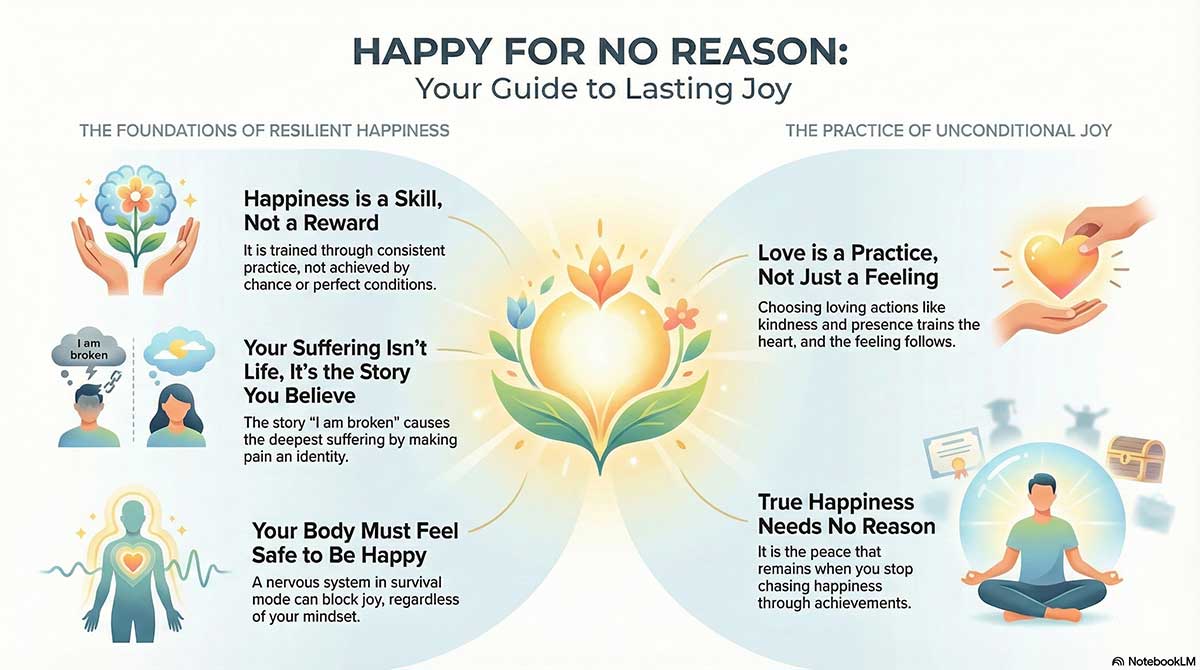
If there’s one thing I hope you take away from these conversations, it’s this:
Happiness isn’t something you achieve—it’s something you allow.
Along this journey, we’ve seen that happiness can be trained, not through force, but through practice.
That our suffering often comes not from life itself, but from the stories we’ve learned to believe.
That the body remembers what the mind forgets—and that safety is a doorway to joy.
That love is not just a feeling, but a courageous, daily practice.
And finally, that beyond all striving, there is a quiet happiness that doesn’t need permission.
Being “happy for no reason” doesn’t mean ignoring pain or pretending everything is fine.
It means meeting life exactly as it is—without abandoning yourself.
When your happiness no longer depends on outcomes, something remarkable happens:
You still grow.
You still care.
You still act.
But you do it from wholeness instead of fear.
My invitation to you is simple:
Choose one small practice.
Question one limiting belief.
Offer one moment of kindness—to yourself.
Happiness doesn’t arrive all at once.
It rises gently, the way the sun does—almost unnoticed at first, until one day you realize you’re standing in the light.
And you always were.
Short Bios:
Marci Shimoff is a bestselling author and happiness expert best known for Happy for No Reason. She blends neuroscience, psychology, and spiritual practice to teach lasting emotional well-being independent of circumstances.
Daniel Kahneman was a Nobel Prize–winning psychologist whose work transformed our understanding of decision-making, cognitive bias, and human judgment, especially the gap between experience and memory.
Martin Seligman is the founder of positive psychology and a former president of the American Psychological Association. His research focuses on learned optimism, well-being, and human flourishing.
BJ Fogg is a behavioral scientist at Stanford University and the creator of the Behavior Model. His work shows how tiny habits can reliably change behavior and emotional states.
Naval Ravikant is an entrepreneur and philosopher known for his insights on happiness, wealth, and mental clarity. He emphasizes internal freedom, rational thought, and detachment from compulsive desire.
Tony Robbins is a performance strategist, author, and speaker who focuses on emotional mastery, physiology, and peak human potential through conditioning and state control.
Maya Angelou was a poet, memoirist, and civil rights activist whose work explored identity, dignity, resilience, and the transformative power of truth and self-expression.
Byron Katie is a spiritual teacher and author known for “The Work,” a method of questioning stressful thoughts to dissolve suffering at its source.
Eckhart Tolle is a spiritual author whose teachings focus on presence, ego transcendence, and freedom from compulsive thinking, especially through living in the now.
Brené Brown is a research professor and author whose work centers on vulnerability, shame, courage, and the emotional narratives that shape human connection.
Jordan Peterson is a psychologist and writer whose work explores meaning, responsibility, mythology, and the psychological role of narrative in individual and cultural life.
Dr. Sanjay Gupta is a physician, neurosurgeon, and medical journalist known for translating complex health science into accessible human understanding.
Bessel van der Kolk is a psychiatrist and trauma researcher best known for The Body Keeps the Score, which explores how trauma is stored in the body and healed through regulation and integration.
Peter Levine is the developer of Somatic Experiencing, a therapeutic approach that focuses on resolving trauma by completing the body’s natural stress responses.
Andrew Huberman is a neuroscientist and professor at Stanford University who studies brain function, stress, and behavior, with a focus on practical neuroscience for everyday life.
Gabor Maté is a physician and author whose work links trauma, stress, and emotional suppression to physical and psychological illness.
Krista Tippett is a journalist and host of On Being, known for facilitating thoughtful conversations about meaning, spirituality, ethics, and the human condition.
Thich Nhat Hanh was a Zen Buddhist monk, teacher, and peace activist whose teachings emphasized mindfulness, compassion, and love as daily practice.
Pema Chödrön is a Buddhist nun and author who teaches compassion, resilience, and openness in the face of uncertainty and emotional pain.
bell hooks was a cultural critic and author whose work explored love as an ethical practice rooted in justice, care, and mutual responsibility.
Dalai Lama is the spiritual leader of Tibetan Buddhism and a global advocate for compassion, inner peace, and ethical responsibility.
Alan Watts was a philosopher and writer who introduced Eastern philosophy to Western audiences, known for dissolving spiritual striving through humor and insight.
Ramana Maharshi was an Indian sage whose teachings emphasized self-inquiry and the realization of pure being beyond ego and identity.
Jiddu Krishnamurti was a philosopher and speaker who rejected spiritual authority and taught freedom through direct perception and self-understanding.
Adyashanti is a spiritual teacher whose work focuses on awakening, non-duality, and integrating realization into everyday life.
Anthony de Mello was a Jesuit priest and spiritual teacher known for combining psychology, humor, and awareness-based teachings to challenge unconscious belief systems.
Leave a Reply