

What if Bashar and Dolores Cannon mapped the Life Review step by step?
Introduction Dolores Cannon
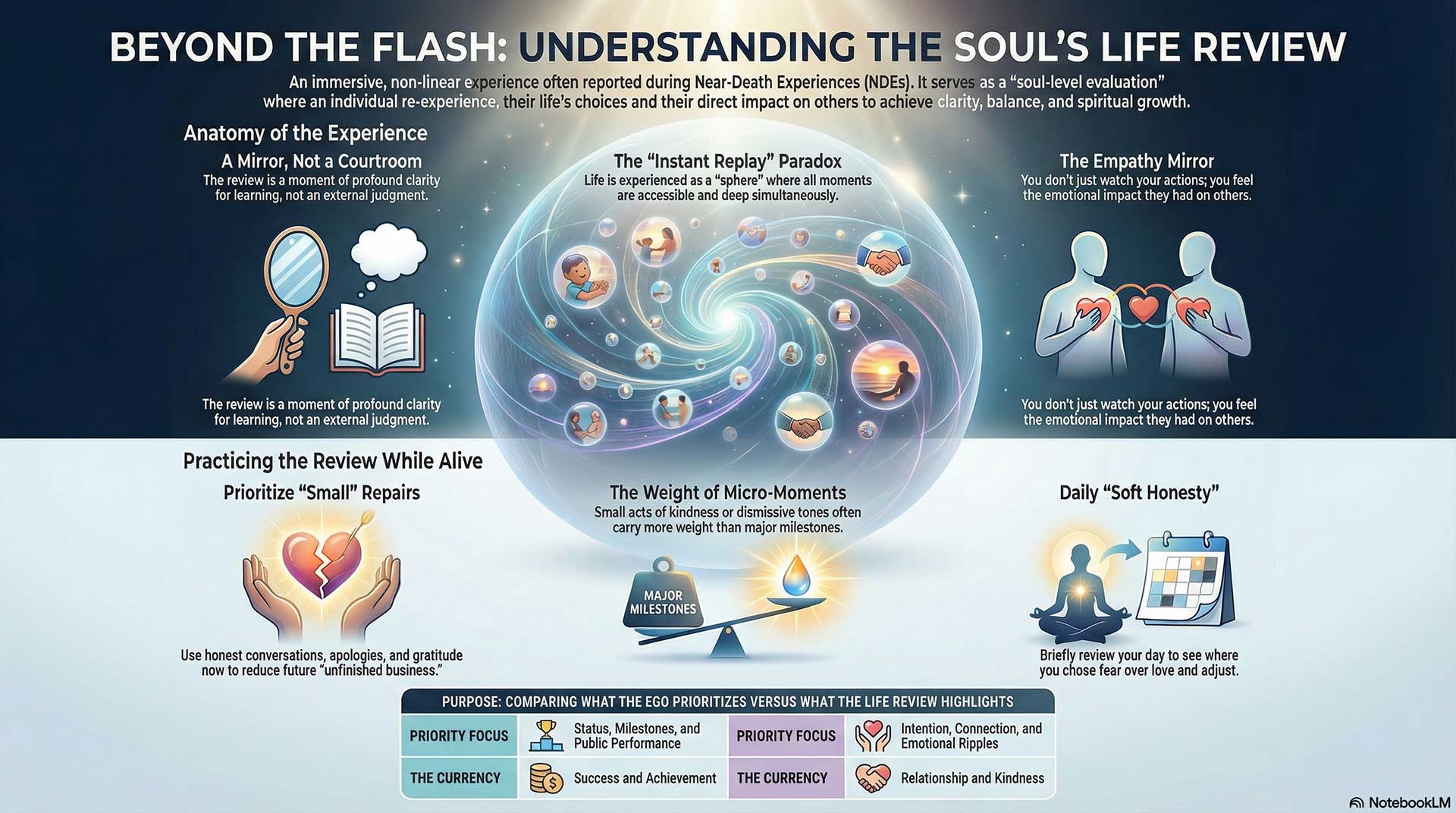
I want to begin by saying something very clearly: the Life Review is not a punishment. It is not a courtroom, and it is not a place where someone outside of you decides what you deserve. In the many sessions I conducted over the years, again and again people described the Life Review as a moment of profound clarity, a kind of soul-level evaluation where nothing is hidden, but nothing is attacked either.
What makes it unforgettable is this: you don’t just remember what you did, you understand it. You feel what you caused. You see the ripples. You recognize the moments you dismissed as “small” were often the moments that mattered most. A tone of voice, a glance, a decision to help, a decision to turn away, a moment of kindness you forgot, a moment of cruelty you explained away. In that state, you cannot lie to yourself. But you also cannot hate yourself, because the perspective is larger than blame. The purpose is learning.
So in this deep dive, we are not asking whether the Life Review is real. We’re exploring what it teaches. We’re exploring why time behaves differently, why empathy becomes unavoidable, why the next steps are about choice, and why many people discover something that surprises them: you can begin your Life Review while you’re still alive, by choosing truth, repair, and love now, instead of waiting.
If you can hold that attitude, then the Life Review becomes one of the most hopeful ideas you’ll ever encounter. Because it means your life is not being “judged” by a distant force. It is being understood by you, and you are being offered the chance to grow from it.
(Note: This is an imaginary conversation, a creative exploration of an idea, and not a real speech or event.)
Topic 1: The anatomy of the Life Review
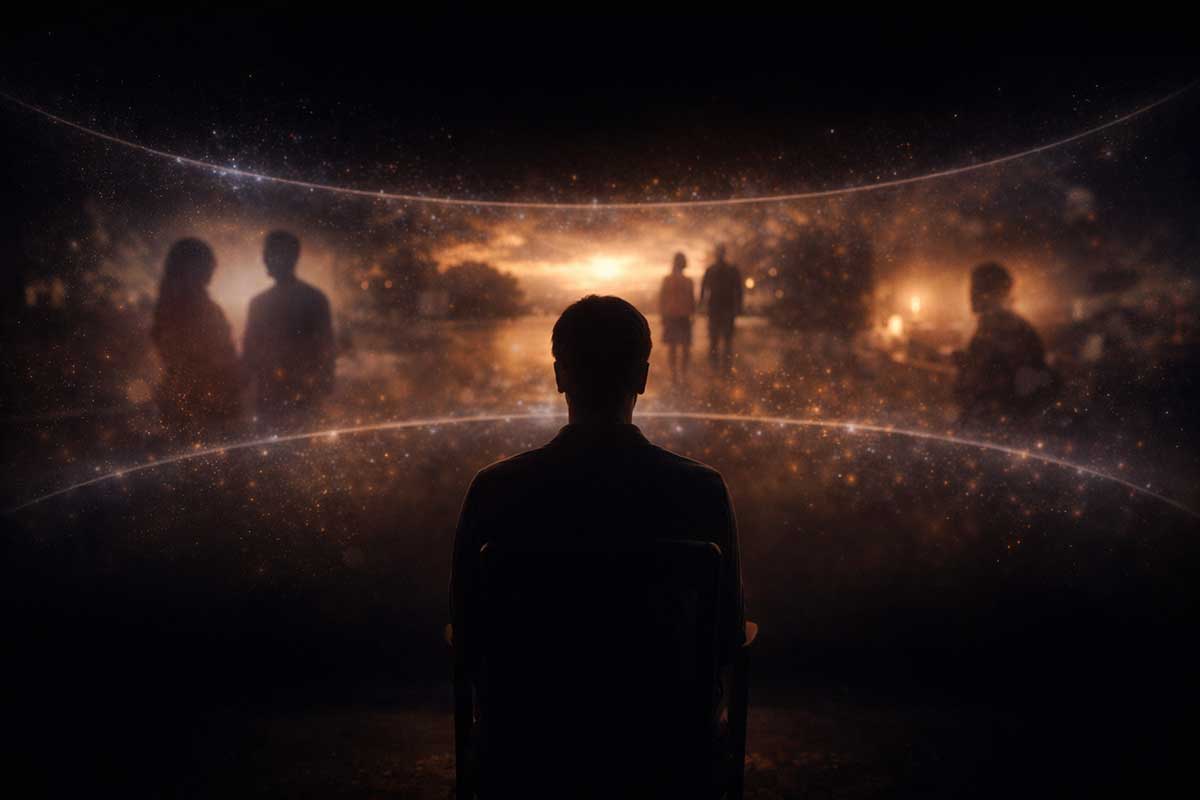
The setting is a quiet library after hours. Rain taps the windows in a steady, patient rhythm. A lamp pools warm light over a circle of notebooks, a glass of water, and five chairs that feel a little too prepared, as if the room has hosted this conversation many times before.
Krista Tippett
Tonight we’re not doing “is it real” or “prove it.” We’re going inside the Life Review as it is reported and described. The inner mechanics. The texture. The logic. When people say, “my whole life flashed before me,” what do they mean, exactly?
Raymond Moody
People reach for “flash” because language needs a quick word, but the experience is often described as immersive. Not a recap. Not a summary. More like being surrounded by the material of your life, and somehow understanding it in a way that feels complete. I’ve heard metaphors like a panoramic screen, a hologram, a record that opens all at once.
Bruce Greyson
And many people emphasize that the review is not merely visual. It includes emotion, meaning, and often a kind of direct knowing. That’s why it can feel more real than ordinary memory. It’s not just recollection. It’s comprehension.
Kenneth Ring
I would add that the Life Review often behaves as if it has an organizing intelligence. Not in the sense of an external narrator telling you what to think, but in the sense that the experience reveals what matters. Many people expect big milestones. Instead they’re shown quiet turning points. Small moments of kindness. Small moments of harm. Moments that changed a trajectory.
P. M. H. Atwater
Yes. People come back stunned by the “micro-moments.” A tone of voice. A look. A sentence you forgot the moment you said it. Yet it lands in the review like a bell. That suggests it isn’t edited for drama. It’s edited for impact, for learning.
Bashar
You may understand it as a calibration. The physical mind is designed to focus. It must filter. It must forget. It must simplify, or it could not function in your dense reality. The Life Review is what occurs when those filters are removed and you perceive the full energetic result of what you have generated. Not for punishment. For clarity. For balance.
Krista Tippett
Let’s push into the first paradox. Many accounts say it’s instantaneous, yet it contains endless detail. How does that work? Is it sequential like a timeline, or simultaneous like a sphere you can enter anywhere?
Kenneth Ring
Many descriptions suggest the “sphere” is closer. The person feels access to the whole. Then attention moves. Later, when they speak about it, they naturally describe attention moving as if time is passing, because that’s how we talk. But the experience itself may not be linear.
Raymond Moody
I’ve heard both kinds of reports. Some describe it as fast-forward from childhood to adulthood. Others insist it was all at once. I think they’re describing the same core event from different angles. The mind translates it into a story afterward.
Bruce Greyson
The most consistent piece is that the review feels structured and coherent. Even when it’s described as “everything,” it doesn’t feel chaotic. People feel they can focus, linger, understand. That’s part of what makes it feel like an experience designed for integration.
P. M. H. Atwater
And I’ve also seen variation that seems tied to the person’s capacity. Some are given the whole vault. Some are moved through themes. If the review is serving learning, it would make sense that it meets people where they are.
Bashar
In non-physical states, what you call time is a tool, not a container. You may perceive the totality, and also choose a path through the totality. Both can be true. The sequence is not imposed. It is selected. You are not dragged through your life. You are shown your life, and you explore what is relevant to your chosen integration.
Krista Tippett
Now the heart of it. People often describe that they don’t just see what happened, they feel what others felt. Is that part of the Life Review essential? What is its function?
Bruce Greyson
It’s one of the most transformative elements people report. The empathy aspect bypasses rationalization. You can’t hide behind “I meant well” if you also feel the effect. But many people also report it isn’t condemning. It’s revealing.
P. M. H. Atwater
And it’s not only pain. Many people also feel the love they gave, the relief they brought, the courage they awakened in someone. The review shows the full spectrum. That’s why people come back with both remorse and gratitude.
Kenneth Ring
It reframes morality. Not as rules, but as relationship. The review tends to suggest that what matters is the quality of connection, the truth of how you treated life.
Raymond Moody
People sometimes assume it’s a courtroom. Many accounts don’t feel like that. The person may judge themselves, but the atmosphere is often described as compassionate. That distinction matters. Compassion allows truth to be faced.
Bashar
Empathy is simply expanded perception. In your physical state, you perceive yourself as separate. In the review, you perceive the actual structure: you are connected. Therefore, the effects you generate are part of your own experience. When you feel what another felt, you are not being punished. You are remembering what you are.
Krista Tippett
So who is evaluating? Is there a judge? Or is it self-recognition?
Raymond Moody
A lot of people describe it as self-recognition. They meet a truth they can’t talk their way around.
Bruce Greyson
Yes. If there is any “judgment,” it’s often internal, coming from a more expanded state of self. And it seems to be oriented toward learning and reconciliation, not humiliation.
P. M. H. Atwater
There’s also this feeling of being supported while you look. That support keeps the honesty from turning into despair.
Kenneth Ring
The person is often surprised by what is highlighted. That suggests the review is showing what the ego overlooked. It’s a reordering of values.
Bashar
You may call it an alignment. In physical reality you create stories. In the review you perceive resonance. Where you were aligned, you feel coherence. Where you were not, you feel dissonance. This is not condemnation. It is feedback.
Krista Tippett
Let’s end Topic 1 with something very specific. If the Life Review is edited for impact, what kinds of moments rise to the surface? What does it seem to make unavoidable?
P. M. H. Atwater
Moments where you had a choice, especially relational choices. Whether you were present. Whether you were kind. Whether you were honest. The tiny crossroads.
Kenneth Ring
And the moments you thought didn’t matter often matter most. That’s the shock. The review seems to treat life like a web, not a ladder.
Bruce Greyson
Repair also matters. Many people come back wanting to apologize, reconcile, express gratitude. That suggests the review makes relationship the true currency.
Raymond Moody
I would say it makes self-deception difficult. Not because you’re attacked, but because you’re awake.
Bashar
It makes love practical. Not a concept. Not a slogan. A lived frequency expressed through choices. The review reveals the signature of what you have generated, and that signature is built from the moments you believed were too small to count.
The rain softens. Nobody reaches for a closing statement too quickly. The room feels like it has been gently re-tuned, as if the Life Review is not only something that happens after, but something that quietly watches every day from the inside.
Topic 2: The empathy mirror
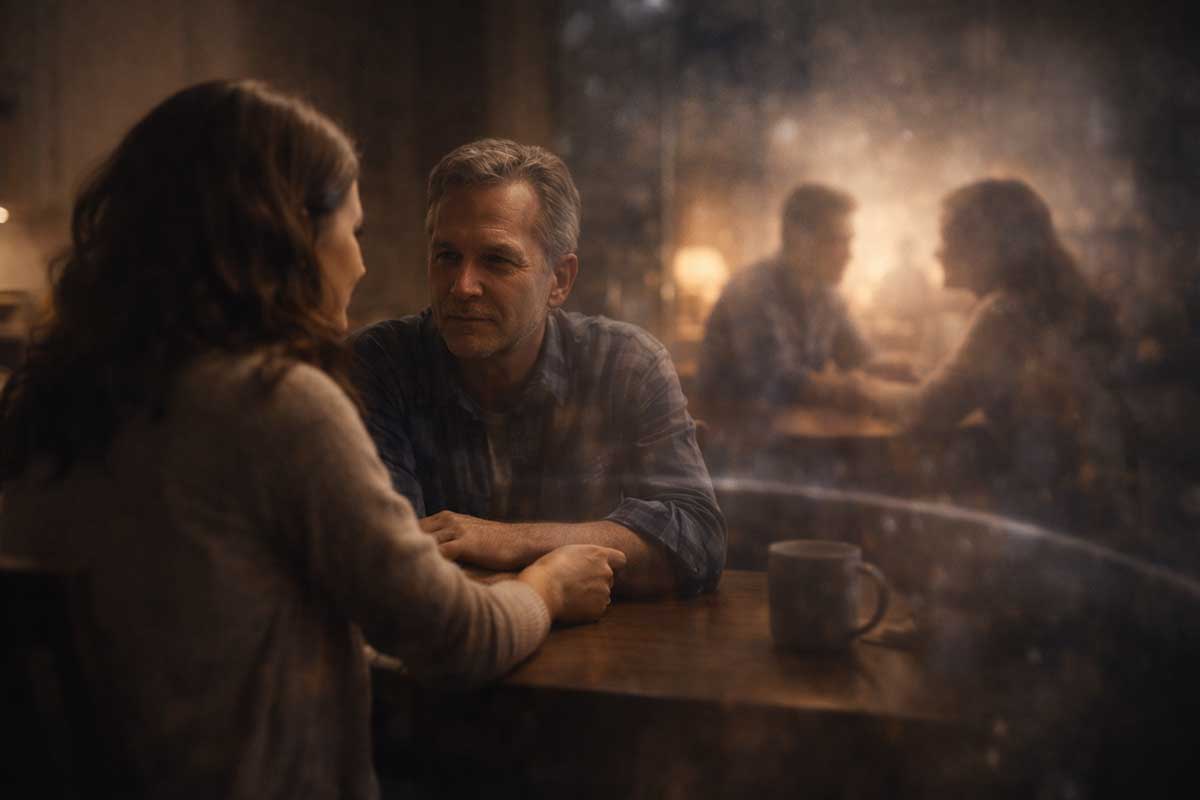
The library has changed shape for Topic 2. The same rain taps the windows, but the chairs are closer, like the room itself wants the conversation to stay personal. A small bowl of folded paper sits in the center of the circle, as if each slip holds a moment someone still thinks about.
Krista Tippett (moderator)
We’re going deeper into the Life Review’s most unsettling and most healing feature: the empathy mirror. So many people describe not only seeing what they did, but feeling what others felt, almost as if relationship becomes a kind of physics. I want to start with a simple question that isn’t simple at all. When the empathy arrives in the Life Review, how does it arrive?
Howard Storm
It’s immediate. There’s no warm-up. No negotiation. In ordinary life, we live inside our stories about ourselves. In the review, the story falls away. You encounter the raw fact of your effect on other beings. Not as an accusation. As an experience. It’s like the veil between “me” and “you” dissolves for a moment, and you feel what your choices actually generated.
Betty Eadie
For me, it felt like being held in a love that was steady enough to allow truth. The empathy wasn’t presented like a punishment. It was presented like a clarity I didn’t know I could survive. And the shock was that I could survive it. Because the love was bigger than the shame I would have put on it.
Dannion Brinkley
People call it a review, but it’s more like you’re plugged into the consequences. You feel the ripple of a moment you forgot. You feel how a careless word lodged in someone. You feel how a kindness lifted someone for years. And the feeling is so undeniable you stop arguing with it. The ego doesn’t get to edit.
George Ritchie
I remember being astonished by precision. It wasn’t just big moral scenes. It was tone. It was attention. It was presence. A glance that dismissed, a glance that reassured. We think we live mostly in “events,” but the empathy mirror says we live mostly in “moments.” Those moments have weight.
Bashar
Empathy is expanded perception. In your physical state, you experience the illusion of separation. In the Life Review, you experience the truth of connection. Therefore, the effects you generated are not outside you. They are within the same field. Feeling what another felt is not a reward or a punishment. It is the natural result of perceiving wholeness.
Krista Tippett
Let’s name the fear that people quietly carry. They hear this and think: “So I’m going to be judged.” But you’re describing something else. What is the tone of the empathy mirror? Does it feel like judgment, like education, like healing, like calibration?
George Ritchie
It felt like light. Not light as a spotlight trying to humiliate you. Light as truth. The judgment, if you want to call it that, was internal. It came from seeing clearly. But the environment itself didn’t feel condemning. It felt like reality without cruelty.
Betty Eadie
Exactly. The tone matters. If it had been harsh, I would have shut down. Instead it felt like, “Look. This is your life. This is what love did. This is what fear did.” And because love was present, it didn’t turn into self-hatred. It turned into understanding.
Dannion Brinkley
And let’s be honest, people punish themselves plenty without the universe helping. The review didn’t feel like an external prosecutor. It felt like you finally saw your own life in high definition. And once you see, you can’t unsee. That’s the education.
Howard Storm
The empathy mirror is a kind of maturity. It moves you from intention to impact. A lot of us hide behind “I meant well.” The review shows what happened anyway. But it’s not to crush you. It’s to wake you up. When you’re awake, you can change.
Bashar
Judgment is a belief. Learning is a process. The Life Review is a learning environment. You may judge yourself if you hold beliefs that demand judgment. But the review itself is simply feedback. It shows you what you generated so you may integrate it.
Krista Tippett
Now for the sharpest distinction. In the empathy mirror, what matters more: your intention, or your impact?
Dannion Brinkley
Impact is unavoidable. Intention can be a story. Impact is a footprint. You can argue your intention all day. You can’t argue what someone felt.
George Ritchie
But intention is not irrelevant. Intention explains what you were trying to do, and that can generate compassion. Yet the empathy mirror insists that intention doesn’t erase effect. It refines the lesson, but it doesn’t rewrite reality.
Betty Eadie
I would say the empathy mirror holds both. It shows you why you did what you did, and it shows you what it caused. That’s what makes it healing. You can forgive yourself without denying the harm. That is rare in ordinary life.
Howard Storm
Yes. It’s the first time many people meet a truth that includes responsibility and mercy at the same time. In physical life we split them. We either excuse ourselves or condemn ourselves. The review can hold both, and that’s transformative.
Bashar
Impact is the manifestation of intention expressed through action. You may say an intention is pure, but if the action is fear-based, the frequency transmitted is fear. The review shows the frequency. It shows what actually arrived in the other.
Krista’s eyes soften, but her voice stays steady.
Krista Tippett
People usually imagine the empathy mirror will focus only on harm. But many accounts say it also reveals the good you did, sometimes the good you didn’t even know you did. Is that true in your experience? And what surprised you?
Betty Eadie
Yes. The surprise was how much small love mattered. A smile. A moment of listening. A time you paused and chose patience. We don’t record those moments as “important.” But the review did. It made me realize that love is rarely dramatic. It’s often quiet.
Dannion Brinkley
Same. People think they’re going to get dragged for their worst day. And sure, you see the hard stuff. But you also see how you lifted someone without knowing. And that can be overwhelming in a different way. You realize your life had power. You weren’t invisible.
George Ritchie
I was surprised by missed opportunities. Not with condemnation, but with clarity. I could see moments where I could have been present and wasn’t. Moments where I could have helped and stayed comfortable. And it made me understand that life is made of chances to love.
Howard Storm
I was surprised by the simplicity of the lesson. Not complex theology. Not elaborate metaphysics. Love is what matters. And love is measurable by effect. That’s what the empathy mirror teaches.
Bashar
The review reveals what you are actually practicing. You may say you practice love, but what you practice is what you repeat. Repetition creates signature. The review reveals your signature.
Krista Tippett
Let’s make this personal in a practical way, but still keep it inside the Life Review lens. If someone wants to “prepare” for the empathy mirror, not out of fear, but out of wisdom, what would you say they should do while alive?
George Ritchie
Treat people as real. That sounds obvious, but we often don’t. We talk at people. We move past people. We reduce them. The empathy mirror undoes reduction. So practice undoing it now.
Betty Eadie
Choose repair quickly. If you hurt someone, don’t build a cathedral of excuses. Apologize. Make amends. And if you love someone, tell them now. The review made me feel how much we postpone what matters.
Dannion Brinkley
Every day, do one thing that reduces suffering. Just one. Make it real. Not an idea. It trains your nervous system to live in the currency the review is going to show you anyway.
Howard Storm
Watch your tone. People obsess over their decisions, but tone is a decision too. Your tone can heal or harm. The empathy mirror is full of tone.
Bashar
Choose the highest excitement you can act on with integrity, because excitement is alignment. When you are aligned, your impact becomes coherent. When you are not aligned, your impact becomes distorted. The Life Review reveals coherence and distortion clearly. Therefore, practice alignment.
Krista lets the room go quiet for a breath. Rain ticks the glass like a patient metronome.
Krista Tippett
So the empathy mirror is not a cosmic scolding. It’s a revelation of connection. A living demonstration that there is no such thing as a private life. Only a shared life, experienced from different angles, until one day it’s experienced from all angles.
No one rushes to end it. The room feels tuned to a deeper frequency: not fear, not performance, but the tender seriousness of realizing that love is not just what we feel. It’s what we leave behind in other people.
Topic 3: Time, memory, and the “instant replay” paradox

The setting for Topic 3 is a quiet hospital conference room after visiting hours. The bright overhead lights are off. Only two warm lamps are on, making the space feel less clinical and more like a late-night study group for mysteries no one can fully solve with daylight language. Outside the glass wall, the hallway is empty. Somewhere far away, a monitor keeps a steady rhythm, like time practicing being ordinary.
Krista Tippett (moderator)
Topic 3 is the part of the Life Review that bends the mind. People say, “It all happened in an instant,” and then they describe it with enough detail to fill a whole book. Some say they could pause a moment, zoom in, feel the whole scene from multiple angles, and then move again. How can a lifetime be both immediate and endlessly deep? I want each of you to answer from inside the Life Review itself, not as a debate, but as an anatomy of how it behaves.
Bashar
You are attempting to translate a non-linear experience into linear words. The paradox dissolves when you understand that time is a tool of your physical perception. In the Life Review, you are not inside time in the way you believe you are now. You are viewing the pattern of your life. A pattern can be seen all at once, and also explored point by point.
Pim van Lommel
Many people report exactly that shift. They describe it like moving from a timeline to a landscape. In physical life, time feels like a corridor. In these accounts, time feels open. And if time feels open, then “instant” does not mean shallow. It means the whole is available. Depth comes from attention.
Janice Miner Holden
And the language people use is very consistent on one point. They say they are not merely remembering. They are re-entering. The detail is not only visual. It’s emotional and relational and contextual. So even if it lasts a perceived moment, it contains layers. The moment is dense.
Jeffrey Long
I often hear the word “download.” That metaphor is surprisingly useful. It arrives as a whole, but you can open it and explore it. People will say, “I understood my entire life,” and then they’ll describe a specific moment with astonishing clarity. The comprehension comes first, then the exploration.
Sam Parnia
What stands out to me is how coherent people say it feels. Not random fragments. They describe structure and meaning. Whether it is panoramic or sequential, the organizing principle seems to be significance. That is why “instant” still feels complete, not chaotic.
Krista nods, as if she’s gathering five different flashlights and aiming them at the same dark corner.
Krista Tippett
Let me sharpen it. When people describe the Life Review, they often say two things that seem incompatible. First, “it was everything at once.” Second, “I could focus on any part and it expanded.” What is the best way to describe that without reducing it to a metaphor that breaks?
Bashar
It is both. The totality is present as a field. Your focus is a movement within the field. In physical reality, you believe focus creates sequence. In the review, focus creates exploration. You are not moving through time. You are moving through meaning.
Pim van Lommel
Yes. The metaphor I like is the difference between a line and a sphere. A line forces you to start at one end and move step by step. A sphere allows you to stand in the middle and see everything around you, then walk toward what calls you. The Life Review is reported more like the sphere.
Janice Miner Holden
And people often struggle because the memory of the review gets translated later by the waking mind. The waking mind likes sequence. It turns exploration into a story. So someone may have had a panoramic experience, then later describe it as “first this, then that,” because that is the only format that fits into normal conversation.
Jeffrey Long
That translation issue matters. Many experiencers insist the review was clearer than ordinary memory. They say it felt more real than real. If the state is that lucid, then the ordinary brain-based “processing speed” might not apply the same way. You can have immense content in a short perceived interval.
Sam Parnia
And the ability to “zoom” suggests something else. The Life Review might not be a replay like a film. It might be an access point to a form of knowing where the scene includes information that was always there but not consciously integrated. In the review, integration happens fast. That can feel like expansion.
Krista lets the silence sit for half a second. It’s the kind of pause that respects the listener’s brain trying to catch up.
Krista Tippett
Here’s the next piece. People say they didn’t only see what they did. They felt what others felt. They saw consequences they never knew existed. They understood a moment’s ripple across years. So what is the Life Review made of? Is it personal memory, or something wider?
Bashar
It is the record of what you generated. Your physical mind calls it memory, but it is more accurate to call it resonance. You are perceiving the energetic results of your choices. When you feel what another felt, you are perceiving connection. That information was always part of the system. You were simply filtered from it.
Janice Miner Holden
The empathy component changes the category entirely. If you include what others felt, then the Life Review becomes relational information, not only personal recollection. Experiencers often describe it as if they briefly occupied the other person’s inner world. Whether one interprets that spiritually or psychologically, the report is that the review contains more than “my point of view.”
Jeffrey Long
Yes, many reports suggest the review is an encounter with consequence. Not just, “what happened to me,” but “what my life did in the world.” That’s why small moments matter. A small moment can have a large consequence.
Pim van Lommel
And that points toward meaning. The Life Review is not presented as a random archive. People often describe it as insight, with a sense of understanding that is immediate. That suggests synthesis. In our daily lives, we collect experiences but we do not always integrate them. The review appears to integrate.
Sam Parnia
From the accounts, the lucid quality is critical. People say they are more awake than awake. In that condition, it may be possible for consciousness to link information more comprehensively than in ordinary waking life. The review might be a state where the mind becomes highly integrative, where fragmentation drops away.
Krista leans forward, elbows on knees, voice gentle but exact.
Krista Tippett
Now I want to ask the question that changes how people live. In the Life Review, what determines what gets highlighted? People expect their biggest milestones. They come back talking about tone, attention, small kindnesses, small harms. Why would the review prioritize that?
Jeffrey Long
Because the organizing principle seems to be impact. A promotion might change your résumé, but a moment of kindness might change a person’s will to live. Many people report being stunned by the significance of small choices. It suggests the review is less interested in status and more interested in effect.
Janice Miner Holden
And the highlight system often appears to be about learning. Learning requires relevance. So the review surfaces moments that reveal a pattern. Not the moments that look impressive. The moments that tell the truth about who you were being.
Pim van Lommel
Also, the ego values the loud events. The review, as reported, values the quiet turning points. The things that altered relationship. The things that altered conscience. The things that altered the direction of someone’s inner life. Those are often invisible on the outside.
Sam Parnia
This is where coherence shows up again. If the review has a learning function, it will prioritize the moments that carry high emotional and relational information. Those moments compress a lot of meaning into a small scene. A sentence can hold a decade of consequence.
Bashar
You may say the Life Review reveals your signature. Your signature is not formed by your public performances. It is formed by your repeated frequencies. What you practiced consistently. Your tone, your honesty, your presence. These are the threads. The review shows the weave.
The monitor down the hall beeps again, softly insistent, as if reminding them that time still exists in this building, even if the topic is what happens when it stops behaving.
Krista Tippett
Let’s go one layer deeper into the time paradox. Many experiencers say the review felt outside time, and yet they could choose to stay with a moment. How does choice work inside a state that feels timeless?
Bashar
Choice is the movement of consciousness. Timeless does not mean motionless. It means the frame is not a linear sequence. You can explore because exploration is focus. Focus is choice. You can place your attention anywhere. That placement creates the experience of duration without requiring time as you define it.
Pim van Lommel
That matches what people describe. They say they could focus on a part of the review and it expanded. That suggests agency. The experience is not simply happening to them. They are participating in it. It’s like a field of information that responds to attention.
Janice Miner Holden
And many people describe the review as gentle in that way. It is truthful, but not coercive. They can look. They can understand. They can feel. Sometimes they even describe a sense of guidance, but the agency remains.
Jeffrey Long
The ability to “pause” is fascinating. It implies the review is not constrained by external time pressure. In physical life, we run out of minutes. In the review, the person often feels they have enough space to truly comprehend. That space is part of why it changes people.
Sam Parnia
And when people return, the aftereffects are telling. Many are less afraid of death, more compassionate, less interested in status, more interested in love and repair. That suggests the review doesn’t just show information. It integrates it. It reorganizes priorities.
Krista holds a longer pause now. The kind that invites the listener to quietly place their own life on the table without being told to.
Krista Tippett
I want to end this topic with a clean takeaway that stays inside the Life Review itself. If the Life Review is dense, integrative, and non-linear, what does that imply about what we are carrying right now while alive? Are we already holding the full record, but living with filters?
Pim van Lommel
I would say many reports suggest that the record is not created at death. It is revealed. Which implies it exists as part of consciousness, perhaps as part of connection. Daily life requires filters. The review feels like the removal of filters.
Janice Miner Holden
Yes. It suggests we may already have access to deeper truth, but we usually don’t sustain it. We get glimpses in remorse, in gratitude, in sudden clarity. The review is like a full opening of that capacity.
Jeffrey Long
And the fact that it changes people suggests that integration matters. Whether one interprets it spiritually or not, people come back living differently because they experienced meaning directly. That is the signature of a truly integrative event.
Sam Parnia
It implies that our everyday model of mind may be incomplete. The reports consistently describe clarity, structure, and expanded context. Even if we keep the conversation inside the description, the description itself suggests there are states of awareness that organize experience very differently.
Bashar
You are always generating your life review now. Not as a threat. As a truth. Every choice creates resonance. The review is simply the moment you perceive the resonance without filters. Therefore, your life is already a living record. You may align with it now, or you may discover it later. Either way, the record is you.
The lamps keep glowing. The hallway stays empty. The steady monitor tone continues its simple rhythm, while the room holds a larger rhythm underneath it, one that suggests a life is not only lived in time. It is also understood beyond time.
Topic 4: After the review, then what
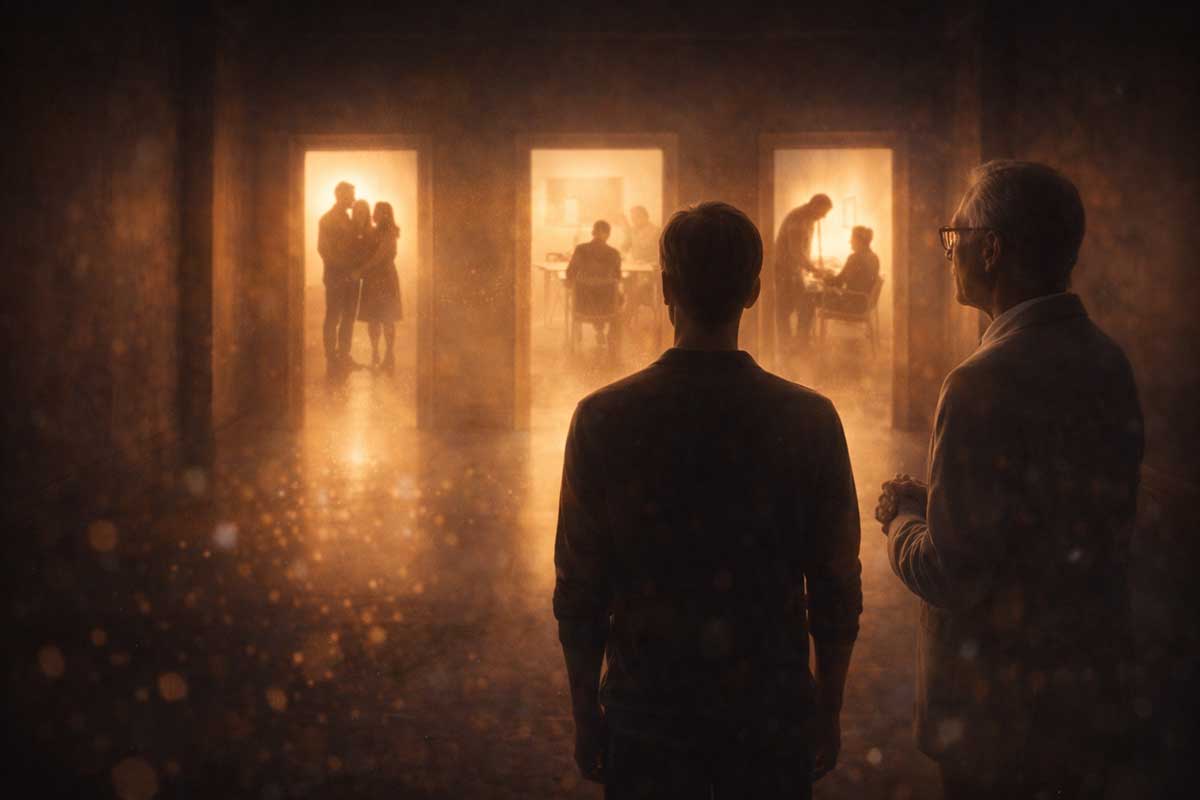
The room for Topic 4 feels like a small chapel without a religion. Candlelight, not for drama, but for gentleness. A circle of chairs. A notebook on each lap. The rain has stopped. Everything outside the windows looks rinsed clean, like the world is holding its breath between chapters.
Krista Tippett (moderator)
We’ve talked about the Life Review as revelation and as empathy. Now we step into what comes after the review in many accounts and frameworks: the choice points. The sense that you are not simply processed, you are invited. So I want to ask it plainly. After the Life Review finishes, what happens next?
Dolores Cannon
In the way it appears through my work, the review is like a debrief, but it is not the end of the meeting. It’s the part where you see the lifetime clearly, then you shift into understanding why you chose it and what you want to do with what you learned. People describe councils, guides, a feeling of being in a place where truth is normal. Then the conversation becomes: what was the mission, what was accomplished, what remains.
Michael Newton
Yes. In my framework, the review often leads into orientation. The soul regains a broader identity, and the next phase includes assessment and recalibration, not in a punitive tone, but in a developmental one. The question becomes: what did you learn, what did you avoid, what are you ready for next. There is usually a sense of belonging, like you are returning to a community that knows you well.
Brian Weiss
What I’ve seen, again and again, is that the review is part of healing. People carry fear about death because they imagine annihilation or judgment. But in the accounts that come through regression and other experiences, it’s more like continuity. The review leads into understanding, forgiveness, and then choices. The choices are often compassionate. They are about growth, not punishment.
Andy Tomlinson
And what strikes me is how personalized it is. The “after” is not one-size-fits-all. Some people describe moving quickly into planning. Some describe spending time integrating. Some describe meeting beings they recognize as teachers. But the theme is consistent: the review gives clarity, then the next stage offers direction.
Bashar
You are never trapped. The Life Review is feedback. After feedback comes choice. You may choose to re-enter a parallel version of the life, you may choose reincarnation, you may choose other dimensions, other civilizations, other explorations. The idea is simple: once you understand what you have generated, you decide what you prefer to generate next.
Krista lets that land, then leans forward as if she’s trying to keep the conversation honest and not float away into abstraction.
Krista Tippett
When you say “choice,” I want to know what that feels like. Is it like picking from a menu. Is it like being pulled by longing. Is it like a calling. How conscious is it?
Michael Newton
It’s conscious, but it’s also natural. In the expanded state, the self is not confused in the way the physical personality can be. People often describe recognition. They understand what they need. They are aware of themes that still have energy. They gravitate toward what will balance them and deepen them.
Dolores Cannon
And many describe it as remembering agreements. Not in a contractual way, but in a soul way. They’ll say, “Oh, that’s why I chose that person.” Or “That was the lesson I came for.” Then the choice feels less like a menu and more like a path that suddenly makes sense.
Brian Weiss
Also, the choice is often wrapped in love. People fear a cold cosmic bureaucracy. But the feel is frequently the opposite. There’s support. Guidance. A sense of safety. So the choices emerge from trust rather than panic.
Andy Tomlinson
And for some, it’s almost like a deep inner knowing that has always been there. Like the personality was a small actor on a stage, and after the curtain falls, the larger self steps forward and says, “All right, here’s what we learned. Here’s what’s next.”
Bashar
Your physical mind imagines choice as effort. In a more expanded state, choice is resonance. You are drawn to what matches your intention. You feel the frequency of each option. You choose by alignment.
Krista Tippett
Let’s talk about the “guides” and “councils” language that shows up a lot. Are these beings running the review and the next steps, or are they more like mirrors while you decide?
Dolores Cannon
In my material, they don’t run you. They assist you. They show you what you may not be seeing. They help you remember what you asked for before you came in. But the soul is not a puppet. It’s the one steering, even if it forgets while incarnated.
Michael Newton
In the reports I’ve worked with, guides are educators, not wardens. They reflect. They ask questions. They help the soul interpret its own journey. The council, when it appears, is often described as deeply wise and calm, but again, not punitive. The soul is accountable to truth, but truth is not cruelty.
Brian Weiss
And I’d emphasize something. People who come in terrified often come out relieved. That tells you the atmosphere is not primarily about fear. If it were, people would come out traumatized. Instead, many come out with more compassion, more patience, less panic about death.
Andy Tomlinson
In practice, it’s helpful to treat guides as part of a supportive intelligence. Whether you interpret them as literal beings or an expression of higher mind, the function is similar: to help integration, to keep the process clear, to prevent the personality’s old defenses from hijacking learning.
Bashar
Guidance is permission-based. You may always receive it, but it will not override your path. The most useful guidance helps you remember that you are capable of choosing.
Krista’s next question is softer, but you can feel it aiming for the place people usually avoid.
Krista Tippett
Okay. Here’s the big hinge. If the Life Review is so illuminating, why not just come back and “fix it” right away. Why do so many frameworks emphasize waiting, integrating, planning, maybe even choosing another life. What is the purpose of that pause after the review?
Michael Newton
Because integration changes you. If you rush back without integrating, you may repeat the same patterns with different costumes. The pause is where the lessons become wisdom rather than information.
Dolores Cannon
Also, there’s often a larger perspective that returns. People see the lifetime in context. They realize, “I did not fail, I learned.” Or they realize, “I avoided what I came to face.” Either way, the pause allows the soul to regain its full range and decide from clarity rather than from the personality’s fear.
Brian Weiss
And healing is real. Many people carry trauma, guilt, grief. The period after the review is often described as being bathed in healing, in unconditional love. From that healed state, choices are different. They aren’t reactions.
Andy Tomlinson
From a practical lens, that pause is where future planning becomes precise. It’s where the soul understands what kinds of relationships, challenges, talents, and environments will best support the next growth edge. Without the pause, the design is blurry.
Bashar
The pause is simply the state in which you are no longer pretending you are small. When you remember what you are, you choose differently. You do not need to rush. You are not running out of time. Time is part of the game, not the player.
Krista nods slowly, then asks the question that ties the whole topic together.
Krista Tippett
So after the review and after the pause, what are the actual next-step choices that matter most. What kinds of choices show up again and again?
Dolores Cannon
Returning to learn something you didn’t finish is common. Exploring a different kind of service is common. Choosing a different relationship pattern is common. Many people describe choosing roles that will teach compassion in a deeper way. The detail varies, but the direction is consistent. Growth, service, healing.
Michael Newton
I’d add: choosing the right learning environment. Some souls choose more intensity. Some choose a quieter integration life. Some choose to work more as guides for others rather than incarnating immediately. The common thread is intentionality.
Brian Weiss
And choice is often tied to love. Love for those still living. Love for the learning. Love for making amends. People don’t come out of the review wanting trophies. They come out wanting to be truer, kinder, more awake.
Andy Tomlinson
Yes. And there’s often a sense that relationships are planned with purpose. Not to trap people, but to give the soul the exact mirror it needs. The review shows the pattern. The next plan addresses the pattern.
Bashar
You may choose to continue, to repeat, to refine, to expand. But understand this: there is no punishment in choice. There is only preference and learning. You choose experiences the way an artist chooses mediums. Not because one is morally superior, but because each teaches something specific.
Krista lets the silence settle. It feels like the room is letting each person listening imagine their own life review, and then imagine the moment after it, when they are not afraid, and can finally choose from truth.
Krista Tippett
So Topic 4 is this: the Life Review is not an ending. It’s a clearing. A moment of perfect feedback. And then, a quiet question that follows you into whatever comes next. What do you want to explore now, now that you know what your life actually did.
If you want, I’ll move into Topic 5 next, where we do the “Life Review while alive” discussion with Bashar as the through-line, and keep it practical but still rooted in the Life Review lens.
Topic 5: Doing a Life Review before you die

The room for Topic 5 is not a library and not a hospital. It’s a quiet living room at dusk. A soft lamp. A cup of tea gone slightly cool. A window that looks out on bare winter trees. The mood is gentle, not heavy. Like the conversation knows it’s about death, but it wants to teach you how to live.
Krista Tippett (moderator)
We’ve stayed inside the Life Review as it’s described: the clarity, the empathy, the choices after. Now Topic 5 is the question people ask when they want to be brave without being dramatic. Can you do the Life Review while you’re still alive. Not as a performance, not as self-punishment, but as preparation and healing. If the Life Review is about truth and consequence and love, how do we bring that into Monday morning.
Elisabeth Kübler-Ross
People fear the Life Review because they imagine judgment. But in my work, what actually torments people near death is unfinished emotional business. Unspoken love. Unforgiven hurt. Unexpressed truth. If you want to live in a way that makes the final chapter gentler, you begin by speaking what is real, kindly, while you still have time.
Ira Byock
Yes. I’ve sat with many people at the end, and what comes up again and again are simple phrases. Please forgive me. I forgive you. Thank you. I love you. If you wait until the end, you compress an entire lifetime of repair into a narrow window. Doing a Life Review while alive means practicing repair now, in real time, in small honest conversations.
Bronnie Ware
And it means telling the truth about what you’re postponing. People near the end often realize they spent too many years living someone else’s expectations. They regret not being true to themselves, not allowing themselves happiness, not staying connected. A living Life Review asks you to look at your life before life forces you to.
Stephen Levine
A living Life Review is a practice of soft honesty. You don’t use it to beat yourself. You use it to open your heart. When you look back at your day, you ask: where did I close, where did I open. Where did I choose fear, where did I choose love. Then you forgive yourself and try again. You become intimate with imperfection, without surrendering to it.
Bashar
You are creating your Life Review now. Not as a looming verdict. As a living feedback system. Every choice generates resonance. When you choose alignment, you generate coherence. When you choose misalignment, you generate distortion. Doing your Life Review while alive means listening to the feedback immediately and adjusting without drama.
Krista’s voice becomes quieter, the way it does when she wants the listener to feel included rather than instructed.
Krista Tippett
So if we make this practical, what does a “Life Review practice” look like. Not a grand project. Something you could actually do daily.
Ira Byock
Start with one relationship. The one that has a knot in it. Don’t try to fix your entire life in a weekend. Make one honest phone call. Write one letter. Speak one sentence that reduces suffering. A good life is built by small repairs.
Elisabeth Kübler-Ross
And allow feeling. People avoid their pain, and then their pain rules them. The Life Review seems to reveal truth with clarity. You can practice that by letting yourself feel what you have been avoiding, and offering it compassion. When you face pain with love, it loses its grip.
Bronnie Ware
I would add: take responsibility for your time. The dying often realize that life was shorter than they expected. Not in a panicked way, but in a clarifying way. A daily Life Review practice could be one question at night: did I live today in a way I will respect later. Not in perfection. In truth.
Stephen Levine
Yes. And do it gently. The mind is harsh. The heart can be firm without being cruel. Imagine reviewing your day as if you were holding a small child who is learning. You don’t scream at the child for stumbling. You teach the child how to walk.
Bashar
Also, follow your highest excitement with integrity. Excitement is the compass of alignment. When you are aligned, your impact becomes coherent. When you betray your own excitement, you tend to substitute fear-based choices, and those choices create the kinds of regrets you do not prefer.
Krista Tippett
Let’s go into the empathy mirror, because that’s what people fear most. How can someone practice the empathy mirror while alive in a way that’s real and not sentimental.
Stephen Levine
You practice by listening. Real listening is an empathy mirror. When you listen without rehearsing your defense, you begin to feel the other person. And then you notice your own habitual ways of protecting yourself. That noticing is the start of transformation.
Ira Byock
And ask people directly. If you want the Life Review’s clarity, you can invite it. Ask someone you trust: what is it like to be on the receiving end of me. Where do I help, where do I harm. That question takes courage. But it’s a living Life Review.
Bronnie Ware
And do not wait for “later.” Later is the word that disappears at the end. People regret the conversations they didn’t have. A living empathy mirror practice is sending the message today, making the visit today, saying the thing today.
Elisabeth Kübler-Ross
You can also practice forgiveness as a daily hygiene. Forgiveness is not approval. It is release. When you don’t release, you carry the emotional weight into every room you enter. The Life Review seems to reveal emotional truth. Forgiveness clears the lens.
Bashar
Empathy is the recognition that what you do to another, you are doing within the same field. Therefore, choose as if you will feel the result. Not as a threat. As a natural fact of connection.
Krista breathes in slowly, like she’s about to ask the question people avoid because it forces action.
Krista Tippett
What is the smallest daily habit that would change someone’s Life Review the most.
Ira Byock
Repair one thing. Every day. A message. An apology. A thanks. A truth spoken kindly. A boundary set respectfully. Repair turns life into something you can live with.
Bronnie Ware
Tell the truth about what matters to you. Then live it in at least one visible way each day. Otherwise you wake up at the end realizing you lived a life designed by other people.
Elisabeth Kübler-Ross
Say “I love you” more. People underestimate how much it matters to have love spoken while you are still here to receive it.
Stephen Levine
Bring tenderness to your own heart. Because if you cannot be kind to yourself, you will struggle to be truly kind to others. The Life Review reveals not only what you did, but the quality of consciousness you lived inside.
Bashar
Act on alignment immediately. When you receive feedback that something is not your preference, change the definition, change the action, change the choice. The quicker you respond, the less distortion accumulates.
Krista nods, and the room feels like it’s getting lighter, not heavier, as if the topic is secretly about freedom.
Krista Tippett
I want to end the whole series with a simple image. The Life Review is often described as a moment where you cannot hide from the truth, but you are also not crushed by it. So maybe the practice while alive is this: tell the truth earlier, repair sooner, love more plainly, and live in a way that makes your future self feel like they can breathe.
Outside, the winter trees stand still. Inside, the lamp holds its small circle of light. And the conversation leaves you with something that feels like a blessing disguised as a task: to live today in a way you won’t have to explain away later.
Final Thoughts by Dolores Cannon
If there is one thing I would want people to carry with them after hearing a conversation like this, it is this: you are not here by accident, and you are not living a meaningless story. Your life has themes. Your life has lessons. Your life has turning points that your personality may not recognize, but your soul certainly does.
The Life Review is often described like a mirror, but it is more than a mirror. It is a realization. You realize what you did to others was never separate from you. You realize that love is not an idea, it’s an effect. You realize that excuses dissolve in the presence of truth, but truth itself is not cruel. It’s simply complete.
And when people ask me, “What is the most important thing I should do now?” my answer is usually much simpler than they expect. Make peace where you can. Tell the truth kindly. Forgive what you don’t need to carry. Stop postponing love. Because the Life Review doesn’t care about your résumé. It cares about what you practiced in your heart and how you treated the people who crossed your path.
If the Life Review teaches anything, it’s that the smallest moments are never small. They echo. And the beautiful part is this: you can change the echo starting today. You can choose differently. You can repair. You can soften. You can become the person you would be proud to meet in that review.
That’s not fear. That’s freedom.
Short Bios:
Krista Tippett Peabody Award winning journalist and creator of On Being, known for thoughtful, humane conversations on spirituality, ethics, and what makes a life meaningful.
Bashar A channeled consciousness presented through Darryl Anka, known for teachings on parallel realities, belief systems, and consciousness-based frameworks that often include “life review” themes.
Raymond Moody Psychiatrist and philosopher who popularized modern near-death experience research, introducing key language and patterns reported by experiencers.
Bruce Greyson Psychiatrist and leading NDE researcher, known for rigorous clinical work and for developing tools to study NDE reports systematically.
Kenneth Ring Psychologist whose research helped map common NDE elements, including aftereffects and the transformative impact on values and behavior.
P. M. H. Atwater Researcher and author who has documented thousands of NDE accounts, focusing on patterns, life changes, and long-term integration.
Howard Storm Former atheist and college professor whose widely discussed NDE account emphasizes moral clarity, compassion, and spiritual transformation.
Betty Eadie Near-death experiencer and author known for describing an expansive life review, strong emphasis on love, and the lasting shift in priorities afterward.
Dannion Brinkley NDE experiencer and author whose accounts highlight the “panoramic life review” and a practical focus on service and personal responsibility.
George Ritchie Physician whose early NDE narrative influenced later research, including detailed descriptions of review-like insight and moral learning.
Pim van Lommel Dutch cardiologist and author who advanced medical discussion of NDEs, emphasizing non-ordinary states of consciousness and consistent report features.
Janice Miner Holden Researcher who has studied NDE content and aftereffects, including how experiencers interpret and integrate life review themes.
Jeffrey Long Founder of a major NDE case collection project, known for synthesizing common elements across large numbers of firsthand accounts.
Sam Parnia Critical care physician and researcher focused on consciousness and reported experiences around cardiac arrest and resuscitation contexts.
Dolores Cannon Hypnotic regression author known for “between-life” material, soul planning themes, and accounts that often include life review frameworks.
Michael Newton Hypnotherapist whose “life between lives” work shaped popular ideas about soul groups, life review, and post-life planning narratives.
Brian Weiss Psychiatrist who brought past-life regression into mainstream discussion, emphasizing healing, continuity of consciousness, and life lessons.
Andy Tomlinson Past-life regression practitioner and trainer known for structured approaches to regression work and integration-oriented practice.
Elisabeth Kübler-Ross Pioneer in end-of-life care conversations, famous for reframing death with dignity and for shaping modern hospice and grief understanding.
Ira Byock Palliative care physician who emphasizes practical emotional completion, forgiveness, and relationship repair as core end-of-life work.
Bronnie Ware Author known for documenting common end-of-life regrets, especially around authenticity, relationships, and postponed living.
Stephen Levine Spiritual teacher and writer who focused on conscious dying, forgiveness, and cultivating compassion through honest self-inquiry.
Leave a Reply