
|
Getting your Trinity Audio player ready...
|
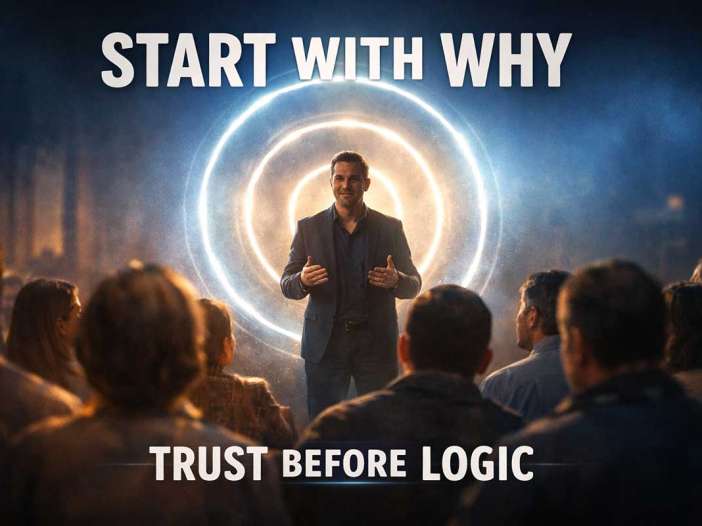
What if Simon Sinek challenged today’s leadership experts to prove “Start With Why” still works in 2026?
Introduction — Simon Sinek
Leadership is often misunderstood as authority, intelligence, or strategy. But none of those explain why some leaders can move people beyond contracts, beyond incentives, and even beyond comfort. The real question is not how leaders convince people. The real question is why people choose to follow at all.
This conversation explores a simple idea: people respond to belief before instruction. When a leader communicates purpose clearly, others recognize themselves inside that purpose. Trust forms not because the leader has all the answers, but because the leader reveals a direction worth traveling together.
We will move from biology to culture, from inspiration to manipulation, and finally to leadership during hardship. The goal is not to learn how to control behavior. The goal is to understand how belief spreads naturally when it is genuine.
Because leadership does not begin with action.
It begins with meaning.
(Note: This is an imaginary conversation, a creative exploration of an idea, and not a real speech or event.)
Topic 1: The Golden Circle in Real Life

Simon Sinek:
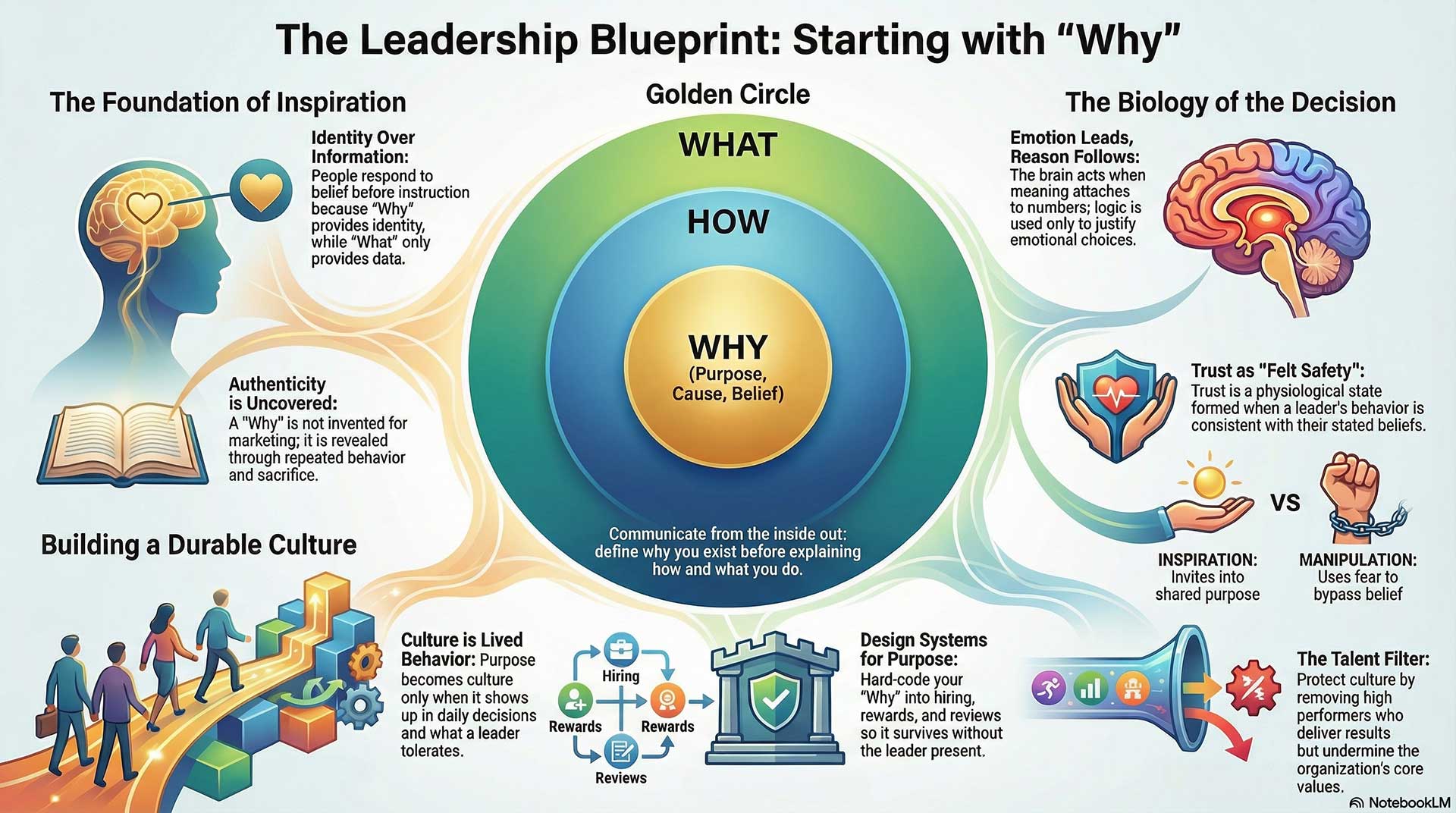
Welcome, everyone. My work often begins with a simple observation. Some leaders and organizations inspire loyalty far beyond logic. People don’t follow them because of specifications or price. They follow them because of belief. The Golden Circle suggests we communicate from the inside out, starting with why we exist, then how we act, then what we do.
Let’s begin here.
Why does “why” move people when “what” often fails, even with great data?
Seth Godin:
Because humans are tribal before they are rational. A “what” gives information. A “why” gives identity. When people hear a purpose that resonates, they don’t just evaluate the product, they recognize themselves inside it. The decision becomes personal, not transactional.
Nancy Duarte:
Data informs, but story transforms. “Why” creates narrative tension. It tells people what future you are inviting them into. Without that invitation, facts remain static. With purpose, facts become momentum.
Tony Robbins:
Emotion drives motion. The brain doesn’t act on numbers alone. It acts when meaning attaches to those numbers. “Why” activates energy. “What” organizes it. Leaders who start with what are asking people to think. Leaders who start with why give them a reason to move.
Angela Duckworth:
Purpose sustains effort. People work harder and longer when the activity connects to something beyond immediate reward. Data can persuade temporarily, but meaning creates perseverance.
Jim Collins:
Great organizations endure because they preserve a core ideology. Their actions are consistent because they originate from belief. When people sense that consistency, trust forms naturally. “Why” signals stability in a changing world.
Simon Sinek:
Good. So “why” is not decoration. It’s alignment.
Now the second question.
What is the difference between a real “why” and a slogan pretending to be one?
Seth Godin:
A slogan tries to attract everyone. A real why attracts the right people and repels others. If no one disagrees with you, you haven’t said anything meaningful yet.
Nancy Duarte:
A slogan sounds polished. A real why sounds human. It can be explained simply and shown through behavior, not just written on a wall.
Tony Robbins:
A fake why is marketing. A real why costs you something. You will refuse certain opportunities because they violate it. Sacrifice proves authenticity.
Angela Duckworth:
You can test it through persistence. If people only repeat it when convenient, it’s branding. If they uphold it during difficulty, it’s purpose.
Jim Collins:
Time exposes truth. Core purpose remains stable across decades, while strategies evolve. If it changes every quarter, it was never a why.
Simon Sinek:
So authenticity reveals itself under pressure.
Now the third question.
How can a leader discover their “why” if they feel they don’t have one?
Seth Godin:
Look backward, not forward. Notice the moments you felt proud of your work. Patterns emerge. Your why already exists in your behavior.
Nancy Duarte:
Listen to the stories others tell about you. Your audience often understands your contribution before you articulate it yourself.
Tony Robbins:
Identify what makes you angry in a constructive way. The problems you feel compelled to solve usually point to purpose.
Angela Duckworth:
Purpose develops through engagement. Try things consistently. Reflection plus effort clarifies meaning over time.
Jim Collins:
Ask what you would keep doing even if it stopped being profitable. That question separates passion from convenience.
Simon Sinek:
Let me close this topic with a simple reminder. A why is not invented. It is uncovered. It exists in repeated behavior, sacrifice, and consistency. When leaders communicate it clearly, they don’t force loyalty. They invite belonging.
In the next topic, we will move deeper into biology itself, how trust forms in the brain and why inspiration cannot be commanded, only earned.
Topic 2: Trust, Belonging, and the Biology of Decision-Making

Daniel Kahneman:
In this topic, we move from leadership language to the machinery underneath human choice. People like to believe they decide logically and then feel confident. In reality, it often works the other way. Feelings and intuitions lead. Reasoning follows to justify.
So let’s begin with this.
If people decide emotionally and justify logically, what should leaders do differently tomorrow?
Simon Sinek:
They should start by communicating belief before details. If you open with features, you’re asking people to analyze. If you open with why, you’re giving them a reason to trust. Leaders should speak to meaning first, then use data to support, not to substitute for, that meaning.
Lisa Feldman Barrett:
I would say leaders must understand that emotions are constructed in context. People don’t simply receive information and then feel something predictable. They interpret information based on prior experience, culture, and expectations. So “tomorrow” means leaders should shape context, clarify intent, and reduce ambiguity. Emotion is not noise. It is the brain making meaning.
Antonio Damasio:
Leaders should stop pretending decisions are purely cognitive. Feeling is part of the decision process. The body and brain constantly evaluate what is safe, what is risky, what is valuable. Tomorrow, leaders should ask: what emotional signals does our organization send? Do we create calm and clarity, or anxiety and confusion? That will shape choices more than arguments.
Brené Brown:
Tomorrow, leaders should replace image management with trust building. People decide emotionally based on whether they feel safe, respected, and included. If leaders want real action, they must practice clarity, boundaries, and honesty. People can handle hard truths. They can’t handle being managed through spin.
Robert Cialdini:
Leaders should ethically apply persuasion principles with a focus on authenticity. People are influenced by social proof, authority, consistency, and liking. Tomorrow, instead of pushing messages, leaders should demonstrate consistency between words and actions. That generates credibility, and credibility makes influence easier.
Daniel Kahneman:
So leaders should treat emotion as part of the system, not a flaw in the system.
Now the second question.
How does trust actually form, and what destroys it fastest?
Simon Sinek:
Trust forms when behavior is consistent with stated beliefs over time. It is not built in slogans. It is built in small moments. It’s destroyed fastest by hypocrisy, when leaders say why but act like what.
Lisa Feldman Barrett:
Trust forms when people can predict the emotional meaning of interactions. When leaders are unpredictable, the brain increases vigilance. When leaders are consistent, the brain reduces uncertainty. Trust is partly a prediction system. What destroys it fastest is ambiguity and mismatch, when what you say does not match what people experience.
Antonio Damasio:
Trust involves bodily states. When someone feels safe with you, their physiology reflects it. When someone feels threatened, their body prepares defensively. So trust is not only belief. It is felt safety. It’s destroyed quickly by humiliation, intimidation, or betrayal, because those create strong bodily markers of danger.
Brené Brown:
Trust forms in small deposits. Saying what you mean, doing what you say, admitting mistakes, respecting confidentiality, asking for help. Trust is destroyed by secrecy, blame, and betrayal. And one of the fastest trust killers is leaders who demand vulnerability from others but refuse it themselves.
Robert Cialdini:
Trust is strengthened by commitment and consistency. When people see consistent follow-through, they believe you are reliable. Trust is destroyed quickly by sudden reversals without explanation, or by exploiting influence tactics to manipulate. The moment people feel used, trust collapses.
Daniel Kahneman:
So trust is not a single event. It is a pattern, and it is fragile.
Now the third question.
How do you inspire action without slipping into manipulation?
Simon Sinek:
Manipulation is when you try to move people using short-term tactics like fear, pressure, or incentives that bypass belief. Inspiration is when you invite people into a purpose they can choose freely. The test is simple. If someone would feel betrayed after they learn the full truth, it was manipulation.
Lisa Feldman Barrett:
I would say inspiration respects the person’s ability to make meaning. Manipulation tries to control meaning. Leaders should create clarity and context, but not distort reality. When you hide information or manufacture emotion, you are manipulating. When you explain intent honestly and allow autonomy, you are inspiring.
Antonio Damasio:
Manipulation often triggers strong feelings that narrow thinking. Inspiration allows feeling while preserving dignity and agency. If people feel coerced, their body knows. They may comply, but they will not commit. Inspiration creates willingness, not submission.
Brené Brown:
Inspiration requires integrity. It also requires boundaries. Leaders should not use purpose language to demand sacrifice while ignoring human needs. If “why” becomes a weapon, it is no longer a why. It is a tool of control. Real inspiration includes consent, respect, and accountability.
Robert Cialdini:
Ethical influence is transparent and aligned with the audience’s interests. Manipulation hides motives and serves only the persuader. Leaders can use persuasive communication, but they must be honest about intent and fair about outcomes. The moment influence becomes extraction rather than mutual benefit, it becomes manipulation.
Daniel Kahneman:
Let me close this topic with a caution. The mind seeks coherence. People want to belong to something that feels meaningful and safe. Leaders who understand this can build trust, or they can exploit it. The difference is integrity.
In the next topic, we will move from individuals to organizations and answer a hard question. How do you turn why into culture so it survives beyond one charismatic leader?
Topic 3: From Words to Culture, Turning “Why” into Daily Behavior

Jim Collins:
A compelling why can inspire people for a moment. But enduring organizations turn that why into discipline, systems, and culture. The goal is not a motivational speech. The goal is a durable way of operating that outlasts any one leader.
Let’s begin with the core.
What turns a purpose statement into a lived culture instead of wall art?
Simon Sinek:
Purpose becomes culture when it shows up in decisions, especially hard ones. If you claim a why, but you hire, promote, and reward the opposite, your why becomes decoration. Culture is not what you say. It’s what you do repeatedly, and what you tolerate.
Edgar Schein:
Culture is learned through what leaders pay attention to, measure, and reward. People watch where time, resources, and recognition go. If the purpose is not reflected in daily priorities and rituals, it will not become shared assumptions. Wall art is language. Culture is behavior repeated until it becomes normal.
Patrick Lencioni:
Purpose becomes culture when it is translated into clear values and behaviors that can be observed. People need to know what “living the why” looks like on Monday morning. If the why stays abstract, teams argue about what it means. If behaviors are defined, teams can hold each other accountable.
Amy Edmondson:
A lived culture requires psychological safety. If employees fear speaking up, they will perform the purpose rather than live it. The why becomes a script. When people feel safe, they can align their real work with the purpose, raise problems early, and learn without hiding.
Reed Hastings:
Culture becomes real through freedom plus responsibility. You don’t create purpose by enforcing slogans. You create it by hiring people who resonate with the mission, then giving them autonomy and expecting high judgment. The why becomes a filter for decision-making at scale.
Jim Collins:
So purpose is not branding. It is operational consistency.
Now the second question.
How do leaders design systems that reinforce “why” when they are not in the room?
Simon Sinek:
You design processes that force purpose-based choices. Hiring questions that test belief alignment. Onboarding that teaches story, not just procedures. Performance reviews that reward behaviors tied to why, not just results. If the system does not reinforce it, the leader’s presence becomes the only fuel, and that does not scale.
Edgar Schein:
Leaders embed culture through formal mechanisms and informal cues. Formal mechanisms include selection, promotion, rewards, and the way meetings run. Informal cues include what leaders react to emotionally, what they ignore, and how they respond under stress. If leaders want reinforcement without being present, they must hard-code priorities into routines.
Patrick Lencioni:
It also requires clarity around values and consequences. If someone violates the culture and there is no consequence, the culture is weakened immediately. You reinforce why by making it safe and normal for peers to challenge behavior. That only happens when leaders model accountability.
Amy Edmondson:
One powerful system is structured learning. After-action reviews, incident reviews, and routine reflection. These practices turn values into habits. They also signal that truth matters more than image. Purpose survives when the organization rewards learning and transparency.
Reed Hastings:
At scale, context matters more than control. Leaders should write down the why and the decision principles, then empower people to act. The system is reinforced through talent density, clear context, and direct feedback. If employees understand the mission deeply, the leader doesn’t have to be in the room.
Jim Collins:
So the leader becomes a builder of systems, not the center of gravity.
Now the third question.
What do you do when high performers undermine the culture but deliver results?
Simon Sinek:
This is the decisive moment. If you keep the person, you teach everyone that the why is negotiable. People stop trusting leadership. It is better to lose a high performer than to lose the belief system. Culture is the long game.
Edgar Schein:
You have to treat it as a cultural crisis. The behavior signals what is truly valued. If results excuse toxicity, then toxicity is part of the culture. Leaders must intervene quickly and visibly. Otherwise the shared assumptions shift toward fear and cynicism.
Patrick Lencioni:
You confront it directly and tie it to values. If the person refuses to change, you remove them. Great teams are built on trust, healthy conflict, commitment, accountability, and results. A toxic high performer damages trust, which destroys the team’s ability to sustain results anyway.
Amy Edmondson:
Toxic high performers destroy psychological safety. People stop sharing ideas and risks. Innovation drops. Errors get hidden. In the short term you get output. In the long term you get fragility. So leaders should act early and communicate clearly that behavior matters.
Reed Hastings:
You let them go. This is one of the hardest lessons, but it’s essential. A single brilliant jerk can create a company of careful, afraid people. Long-term performance comes from a healthy culture. If you want to scale excellence, you remove the person who makes others smaller.
Jim Collins:
Let me close this topic with a principle. Great organizations preserve their core while stimulating progress. The why is core. The systems make it durable. The courage to protect culture is what keeps purpose real.
In the next topic, we will explore the shadow side. When belief becomes dangerous. When charisma becomes control. How do we distinguish inspiration from manipulation at scale?
Topic 4: The Dark Side of “Why”, Charisma, Cults, and False Purpose

Yuval Noah Harari:
Stories bind humans together. That is our greatest strength and our greatest vulnerability. A “why” can inspire compassion and courage. It can also justify cruelty and blind loyalty. So we must examine the boundary between meaning and manipulation.
Let’s begin with this.
How can we tell inspiring leadership from dangerous emotional manipulation?
Simon Sinek:
Inspiration is an invitation. Manipulation is a trap. If the leader’s why requires you to surrender your ability to question, it’s not inspiration. Healthy leadership encourages dissent because it values truth over ego. Dangerous leadership demands obedience because it values control over truth.
Hannah Arendt:
Danger begins when people stop thinking. The most frightening systems are those that make ordinary people feel relieved to obey. A leader becomes dangerous when they replace moral judgment with belonging. When loyalty becomes more important than conscience, manipulation is already operating.
Rick Alan Ross:
You can look for behavioral red flags. Isolation, information control, fear of outsiders, shaming doubt, and claiming exclusive truth. Cultic leadership often begins with warmth and certainty, then introduces dependency. The “why” is used to bind identity to the group so leaving feels like losing the self.
Robert Cialdini:
Manipulation often hides intent. Ethical influence is transparent and aligned with mutual benefit. Dangerous leaders use scarcity, fear, and social proof to create urgency and conformity. If the leader discourages independent verification and relies heavily on emotional pressure, that’s a sign the influence is not ethical.
Jon Ronson:
A key tell is how the group treats questions. Healthy movements can laugh at themselves and tolerate disagreement. Dangerous ones treat doubt as betrayal. The atmosphere becomes brittle. People walk on eggshells. Humor dies. And when humor dies, something has usually gone very wrong.
Yuval Noah Harari:
So the line is not passion. The line is whether truth and conscience remain allowed.
Now the second question.
Why are people vulnerable to belief-based leaders, even intelligent people?
Simon Sinek:
Because meaning is a human need. People want to belong to something larger than themselves. In uncertain times, a strong why feels like a handrail. If leaders offer identity and certainty, people can confuse that with truth.
Hannah Arendt:
Loneliness is a political condition. When people are isolated, they are more likely to accept totalizing stories that promise belonging. Intelligence does not protect against the desire to be part of a coherent world. The hunger for certainty can override the discipline of thinking.
Rick Alan Ross:
High intelligence can actually increase vulnerability because smart people can rationalize their commitment. They become skilled at explaining away contradictions. Also, vulnerable moments matter. People join extreme groups during transitions, grief, trauma, or confusion. The leader offers clarity and community when the person most needs it.
Robert Cialdini:
We are social learners. We take cues from the group to reduce uncertainty. When we see many others believing something, we assume it must be valid. Social proof is powerful. Add authority cues, commitment escalation, and reciprocity, and you can create deep loyalty even among skeptical minds.
Jon Ronson:
And people want a clean moral story. Good guys, bad guys, a mission, a tribe. It’s emotionally satisfying. Intelligent people aren’t immune to that. They’re just better at building intellectual scaffolding around emotional desire.
Yuval Noah Harari:
So vulnerability is not stupidity. It is humanity.
Now the third question.
What safeguards keep “why” from turning into blind loyalty?
Simon Sinek:
Build mechanisms that outlast charisma. Encourage dissent. Reward whistleblowing. Create transparency. A healthy why can survive scrutiny. A false why cannot. So the safeguard is a culture where questions are normal, not punished.
Hannah Arendt:
The safeguard is the practice of thinking and moral judgment. People must be trained to ask, “Is this right?” not only “Is this ours?” When conscience is cultivated, ideology cannot easily replace it.
Rick Alan Ross:
Practical safeguards include maintaining independent relationships outside the group, access to outside information, and clear boundaries around leader power. Also, avoid systems where one person becomes the unquestionable source of truth. Shared leadership and accountability reduce cultic drift.
Robert Cialdini:
Increase transparency and reduce pressure. Ethical leaders disclose motives, welcome independent evaluation, and avoid urgency tactics that force quick commitments. Slow decisions are a safeguard because manipulation thrives in speed and emotion.
Jon Ronson:
Keep humility alive. A movement that can admit mistakes stays human. A movement that must always be right becomes dangerous. So encourage humor, self-critique, and the ability to say, “We got that wrong.”
Yuval Noah Harari:
Let’s close this topic with a sober point. The same human capacity that enables compassion through shared meaning can enable cruelty through shared fantasy. The goal is not to abandon why. The goal is to protect it with truth, humility, and safeguards.
In the final topic, we turn toward hope again. How do leaders communicate why in an age of burnout and cynicism, and keep belief alive during pressure, change, and disappointment?
Topic 5: Scaling Inspiration, Leading Through Change and Cynicism

Maya Angelou:
People are tired. Many are skeptical. They’ve heard beautiful words used as costumes. So if we are going to talk about inspiration, we must speak about truth, endurance, and the quiet work of earning trust again.
Let’s begin.
How do you communicate “why” when people are burned out and skeptical?
Simon Sinek:
You lead with empathy and proof, not performance. Burned out people don’t need slogans. They need to feel seen. So you acknowledge reality first. Then you connect purpose to practical care. Purpose without care feels like exploitation. Purpose with care feels like belonging.
Satya Nadella:
In cynicism, the first step is listening. People need to believe leadership understands the truth on the ground. You can’t persuade people to care if they feel ignored. So you communicate why through curiosity, humility, and consistent action, not through speeches.
Adam Grant:
I would add that skepticism is often a sign of intelligence and experience. People have been disappointed. So leaders should treat skepticism as feedback. Show what is changing. Invite participation. Give people agency. Nothing reduces cynicism faster than having a real role in shaping the future.
Angela Duckworth:
Burnout is not only emotional. It’s biological. People are depleted. Purpose messages fail when people are exhausted because they don’t have energy to translate meaning into effort. So communicate why alongside a plan for recovery, sustainable pace, and realistic expectations.
Nelson Mandela:
When people are tired, they look for integrity. They want to see whether a leader will suffer with them, not above them. The why must be carried by example. A leader’s willingness to endure hardship with dignity can reawaken belief more than any words.
Maya Angelou:
So you do not speak down to the weary. You speak with them.
Now the second question.
What keeps purpose alive during layoffs, pressure, and rapid change?
Simon Sinek:
Consistency. If purpose disappears during hardship, people conclude it was never real. In hard times, leaders must over-communicate values and make decisions that reflect them. Even painful decisions can preserve trust if they are made transparently and with humanity.
Satya Nadella:
Purpose remains alive when it becomes a decision framework. In pressure, you simplify. You clarify what matters most and what you will not compromise. When leaders align tradeoffs with purpose, people may disagree, but they understand. Confusion kills belief faster than difficulty.
Adam Grant:
Purpose also requires fairness. If the burden of hardship is unevenly distributed, cynicism spreads. People don’t lose belief only from layoffs. They lose belief when leaders protect themselves and ask others to sacrifice. Fairness is the oxygen of meaning.
Angela Duckworth:
Purpose stays alive when people can see progress. During chaos, people need small wins, clear milestones, and rhythms. Otherwise purpose becomes abstract again. So you create structures that let people feel momentum even during instability.
Nelson Mandela:
In struggle, purpose becomes most visible. If you want it alive, you protect dignity. You treat even those who disagree with you as human beings. You do not allow hardship to make you cruel. Cruelty is the quickest way to kill a mission from within.
Maya Angelou:
Purpose that cannot survive pressure is only poetry. Purpose that survives pressure becomes history.
Now the third question.
How does a leader rebuild belief after betrayal or failure?
Simon Sinek:
By owning it fully and changing behavior, not messaging. Apologies without change are manipulation. Rebuilding belief requires transparency, accountability, and time. You don’t demand trust back. You earn it back through consistent actions that cost you something.
Satya Nadella:
You rebuild through learning. Admit what happened, what you learned, and what will be done differently. Then invite others to contribute to that change. People regain belief when they see leaders treat failure as a moment of truth, not a public relations issue.
Adam Grant:
I’d add that leaders should allow anger to be expressed safely. If people can’t voice their disappointment, it turns into sabotage or withdrawal. Create channels for honest feedback. Make it safe to tell the truth. That is how organizations heal.
Angela Duckworth:
Rebuilding belief is also about stamina. It is not one grand moment. It is many small moments of follow-through. Every time a leader keeps a promise, it becomes a brick. Over time, a foundation returns.
Nelson Mandela:
A leader rebuilds belief by returning to principle. Not by defending reputation, but by serving the people. When you show that you care more about the mission than about your image, people begin to believe again. And when you treat even your critics with dignity, you create a path forward.
Maya Angelou:
Let me close this conversation with something simple. People will forget cleverness. They will forget charisma. But they remember how you made them feel. They remember whether you were true.
A real why does not shout. It endures.
If you want to inspire action, you must first inspire trust. And trust is made from the quiet materials of integrity, humility, and consistent care.
That is how belief survives the weather of the world.
Final Thoughts by Simon Sinek
In the end, leadership is not proven when everything works. It is proven when things go wrong.
People do not remember perfect plans. They remember whether you stood by your values when it was costly. A real why is quiet but resilient. It survives disagreement, pressure, and time because it lives in behavior, not in presentation.
You cannot demand loyalty. You can only deserve it. And deserving it requires consistency, honesty, and the courage to put people before short-term results.
When leaders start with why, they do more than motivate performance. They create belonging. And belonging is what allows ordinary people to do extraordinary things together.
That is how action becomes inspiration.
Short Bios:
Simon Sinek — Author and speaker known for Start With Why and the Golden Circle concept explaining how belief and purpose drive leadership influence.
Maya Angelou — Poet and memoirist whose work explored dignity, courage, and the emotional impact leaders leave on people.
Yuval Noah Harari — Historian and thinker focused on shared human narratives, collective belief systems, and how ideas shape societies.
Jim Collins — Business researcher and author of Good to Great, studying why some organizations sustain excellence over time.
Daniel Kahneman — Nobel Prize–winning psychologist known for decision science and how intuition and reasoning interact.
Seth Godin — Marketing thinker emphasizing tribes, identity, and the power of meaningful storytelling in leadership and business.
Nancy Duarte — Communication expert specializing in persuasive presentations and how narrative structure moves audiences.
Tony Robbins — Performance strategist focused on motivation, emotional state, and behavior change.
Angela Duckworth — Psychologist known for research on grit, perseverance, and sustained effort toward meaningful goals.
Lisa Feldman Barrett — Neuroscientist studying how emotions are constructed and how meaning shapes perception.
Antonio Damasio — Neuroscientist researching the relationship between emotion, decision-making, and consciousness.
Brené Brown — Researcher on vulnerability, trust, and courageous leadership.
Robert Cialdini — Psychologist known for principles of ethical influence and persuasion.
Edgar Schein — Organizational psychologist who pioneered the modern understanding of corporate culture.
Patrick Lencioni — Leadership consultant focusing on teamwork, trust, and organizational health.
Amy Edmondson — Harvard professor researching psychological safety and learning cultures in organizations.
Reed Hastings — Co-founder of Netflix, known for culture-driven management and freedom-with-responsibility leadership.
Hannah Arendt — Political philosopher who examined authority, responsibility, and the dangers of blind obedience.
Rick Alan Ross — Researcher and educator studying coercive persuasion and cult dynamics.
Jon Ronson — Journalist exploring group psychology, public shaming, and social conformity.
Satya Nadella — CEO of Microsoft known for empathy-centered leadership and cultural transformation.
Adam Grant — Organizational psychologist studying motivation, creativity, and workplace meaning.
Nelson Mandela — South African leader who embodied reconciliation, moral courage, and principled leadership.
Leave a Reply