

|
Getting your Trinity Audio player ready...
|
What if Yurong “Luanna” Jiang explored Spinning Ghost Mode with Carl Rogers on deep listening?
Introduction by Yurong “Luanna” Jiang
Last summer, I got a phone call that felt like a joke and a prophecy at the same time. Two classmates in Tanzania were staring at a washing machine with Chinese labels. Google Translate kept insisting one huge button meant “spinning ghost mode.” So there we were, an Indian and a Thai calling me, a Chinese student in Mongolia, to decode a washer in Tanzania. All of us linked by friendship, distance, and a small moment of confusion.
I used to believe this is what the future would feel like. A small village. A world where the borders still existed on maps, but not in our hearts. At Harvard, that belief stopped being a childhood dream and became a lived experience. The people I once knew only as colorful shapes became real faces. Real laughter. Real worries. Real courage. And once you truly meet people, the world’s problems stop being “global issues.” They become personal.
But lately, connection is not automatically producing understanding. We are more wired than ever, yet we keep mistranslating each other. Tone becomes threat. Disagreement becomes contempt. A person becomes a label. And too often, we reach for the easiest story our fear can tell: that those who think differently are not just wrong, but somehow less human.
This series is a refusal of that story. It is a practice of staying with discomfort long enough to hear what is actually being said. It is an invitation to keep our hearts open without drowning, to name harm without erasing humanity, to stay soft without losing our backbone, and to hold on to one another without denying what is true. If the world feels stuck in spinning ghost mode, we can still choose what button we press next.
(Note: This is an imaginary conversation, a creative exploration of an idea, and not a real speech or event.)
Topic 1: “Spinning ghost mode” and why we misread each other

Yurong “Luanna” Jiang: Last summer I learned a phrase I never expected to carry with me into graduation week: “spinning ghost mode.” A washing machine button. A mistranslation. A joke that somehow became a mirror.
Because that night wasn’t just funny. It was an Indian and a Thai calling me, a Chinese student in Mongolia, to help them decode a washer in Tanzania. All of us stitched together by friendship, distance, and one confused interface. The world really can feel like a small village.
And yet, lately, it also feels like we’re connected… but not understanding. Like we’re all pressing buttons and watching something spin, unsure what it’s doing, unsure how to stop it without breaking something.
So let’s begin there.
Question 1
Yurong “Luanna” Jiang: When our lives are more connected than ever, why do we still “translate” each other so badly, and what are we usually getting wrong first: tone, intent, or fear?
Deborah Tannen: It’s tone first, almost always. We think we’re debating ideas, but we’re actually reacting to signals. The same sentence can mean “I’m with you” or “I’m above you,” depending on rhythm, speed, and context. One person thinks they’re being efficient, the other hears dismissal. One thinks they’re being careful, the other hears avoidance. We don’t just speak different languages, we speak different relationship styles. And the tragedy is that we assume our own style is neutral.
Carl Rogers: I’d say fear is underneath tone. Tone is the trigger, fear is the fuel. The human nervous system is scanning for danger in every conversation: Will I be shamed. Will I be controlled. Will I lose my place. Once that fear lights up, we stop listening and start defending. Then we “translate” the other person through our alarm system. We don’t hear what they said, we hear what it might cost us.
Marshall Rosenberg: Intent gets lost because we focus on blame. We translate pain into accusation. Instead of “I’m lonely,” we say, “You don’t care.” Instead of “I’m scared,” we say, “You’re reckless.” When we do that, the other person stops hearing our need and starts hearing a verdict. A need is an invitation. A verdict is a door slam.
Emily Dickinson: We get the soul wrong first. We believe the sentence is the person. But language is only the envelope. The letter inside is often trembling. People seal their tenderness with wax that looks like certainty. And when we answer the wax, we miss the trembling. If we listened for the trembling, we would translate more gently.
Hayao Miyazaki: Modern life trains us to move quickly, and quickness is not friendly to understanding. We skim. We assume. We reduce. A person becomes a label. A moment becomes a conclusion. In my films, I try to show that even a “villain” has weather inside them. If you slow down enough to see the weather, you stop translating them into a flat shape.
Yurong “Luanna” Jiang: That image, “weather inside them,” feels exactly right. Sometimes we’re not arguing with a person at all. We’re arguing with our rushed translation of their weather.
Question 2
Yurong “Luanna” Jiang: In a moment of confusion, what’s the simplest way to switch from “proving” to “understanding” without pretending we agree?
Marshall Rosenberg: Ask one question that reveals the need. Not the argument. The need. Something like, “What are you hoping for here?” or “What are you afraid will happen?” If you can hear the need, you don’t have to surrender your position. You simply meet the human underneath it.
Carl Rogers: Reflect before you rebut. Not as a tactic, but as a discipline. “Let me see if I understand what matters to you.” When someone feels accurately heard, the temperature drops. And when the temperature drops, truth can enter the room without a fight.
Deborah Tannen: Name the frame. People fight because they think they’re in the same conversation when they’re not. One is having a “solution conversation,” the other is having a “care conversation.” If you say, “Do you want advice or do you want me to stay with you,” you stop the invisible collision.
Hayao Miyazaki: Change the scene. Literally. Walk. Make tea. Look out a window together. When bodies soften, minds soften. Understanding is not only a mental act. It is also an environmental act.
Emily Dickinson: Replace the sharp “Therefore” with a softer “Perhaps.” “Perhaps I’m missing something.” That one word creates space. It makes a room in which two truths can sit without wrestling.
Yurong “Luanna” Jiang: I love how practical that is. Advice or care. Reflect before rebut. Change the scene. One word: perhaps. These are small switches that keep the human in the room.
Question 3
Yurong “Luanna” Jiang: If the world feels stuck in “spinning ghost mode,” what is one small habit we can practice today that turns miscommunication into connection within one conversation?
Emily Dickinson: Pause long enough to feel what you are about to say. If you speak while flooded, your words will wear armor. If you wait even three breaths, you may choose a truer garment.
Deborah Tannen: Do a “translation check.” Say, “Here’s what I heard you mean, is that right?” It’s amazing how many fights dissolve when you discover you were arguing with the wrong meaning.
Carl Rogers: Offer one sentence of unconditional regard, especially when you disagree. “I respect you, and I want to understand.” People can survive disagreement. They struggle to survive contempt.
Marshall Rosenberg: Speak from observation and need, not evaluation and blame. “When I hear X, I feel Y, because I need Z.” That structure is simple, and it protects dignity on both sides.
Hayao Miyazaki: Treat the other person like a full character, not a function. Not “the cashier,” “the parent,” “the stranger,” “the difficult one.” A full character has a childhood, a burden, a dream. When you remember that, your tone changes without effort.
Yurong “Luanna” Jiang: Maybe that’s the real antidote to “spinning ghost mode.” Not perfect translation. Just the refusal to flatten each other. Three breaths. One check. One respect sentence. One need. One reminder: full character.
And if we can do that in one conversation, maybe we can do it again. And again. Until connection stops being a slogan and becomes a habit.
Topic 2: Global problems feel personal

Yurong “Luanna” Jiang: Topic 2 is where the speech stops being a story and starts being a mirror. Because once you’ve really met people across borders, you can’t un-feel it. A girl skipping school out of fear is not a statistic anymore. A woman who can’t afford basic dignity is not “over there.” It’s like the thread runs through all of us.
But there’s a real problem here too. If you open your heart to everything, you can drown. If you close it to survive, you can harden.
So let’s go carefully.
Question 1
Yurong “Luanna” Jiang: How do we keep our hearts open to suffering we’ll never fully touch, without becoming numb or overwhelmed?
Viktor Frankl: By choosing meaning over magnitude. You cannot carry the whole world, but you can carry one responsibility with dignity. Overwhelm comes when we confuse awareness with obligation. The heart can stay open if the will is anchored: “This is what I will do with the life I have.” Meaning is a container. Without it, empathy spills everywhere.
Jane Goodall: Stay connected to hope through action, even small action. When people become numb, it’s often because they feel powerless. I have watched teenagers transform despair into energy the moment they join something practical: cleaning a river, helping an animal shelter, mentoring a child. The heart can tolerate a lot if it feels it’s moving toward healing.
Thich Nhat Hanh: We breathe. We return. We do not force the heart open with violence. When you are overwhelmed, it means you are trying to hold suffering alone. But suffering is not yours alone. You practice interbeing: “This pain is in the world, and I am in the world, and I will not abandon myself while I care.” Compassion must include yourself, or it becomes another form of harm.
Bryan Stevenson: Get close. Not to everything, but to something real. Numbness is what happens when suffering stays abstract. Overwhelm is what happens when it stays infinite. Proximity turns infinite into human. You learn the name, the face, the specific barrier. Then the work becomes possible, and your heart stops swinging between shutdown and panic.
Toni Morrison: Beware of spectacle. Suffering can be turned into consumption. If you are constantly fed other people’s pain without intimacy, you will either become numb or addicted to feeling righteous. The heart stays open when attention becomes reverent: slow, specific, and unwilling to use another’s wound as your identity.
Yurong “Luanna” Jiang: That lands for me: meaning as a container, proximity as an antidote to abstraction, breath as a way to not abandon yourself, and attention that refuses spectacle.
Question 2
Yurong “Luanna” Jiang: What does real solidarity look like in everyday life, beyond performing care or trying to “look right”?
Jane Goodall: It looks like consistency. Showing up when nobody is watching. Caring for the person in front of you with the same sincerity you’d want for yourself. And it looks like learning. Real solidarity is curious. It asks, “What actually helps?” not “What makes me feel helpful?”
Bryan Stevenson: Solidarity is staying in relationship when it’s inconvenient. It’s not a moment. It’s a practice. It means listening long enough to be changed, and then using your position, whatever it is, to reduce unnecessary suffering. Sometimes it’s a call you make. Sometimes it’s a door you hold open that others didn’t even know existed.
Toni Morrison: Real solidarity is not an aesthetic. It’s an ethic. It refuses simplification. It refuses the cheap version of care that needs villains and saints. It says: I will not abandon complexity. I will not abandon people. I will not abandon my own moral imagination.
Viktor Frankl: In everyday life, solidarity often looks like restraint. Refusing cruelty. Refusing gossip. Refusing to reduce a person to a story. Each refusal is a moral act. People think solidarity must be grand. Often it is simply the decision not to participate in the small degradations that make larger degradations possible.
Thich Nhat Hanh: Solidarity is a way of walking. When you walk, you walk for yourself and for all beings. When you speak, you speak so that understanding can be possible. You do not “perform” compassion. You become it, quietly, like a candle that does not announce itself.
Yurong “Luanna” Jiang: I love that: solidarity as consistency, inconvenience, complexity, restraint, and a way of walking.
Question 3
Yurong “Luanna” Jiang: How do we turn empathy into wise action without turning it into guilt?
Bryan Stevenson: Guilt makes you the center. Responsibility keeps the other person at the center. Replace “I feel bad” with “I will stay present.” Then choose an action you can sustain. Sustainable action beats dramatic action every time. It’s the long obedience that changes things.
Viktor Frankl: Ask: What is life asking of me now? Not what would make me feel clean. Not what would make me feel admired. What is my responsibility in this moment, given who I am and where I stand? When you live as an answer to life, guilt loses its grip because your attention moves from self-judgment to service.
Jane Goodall: Keep it practical and keep it humble. You don’t need to solve everything. Pick one lane. Learn it well. Help in a way that respects the people you’re trying to support. Guilt is often a sign you want to fix the feeling more than the problem.
Toni Morrison: Guilt is impatient. It wants immediate relief. Wise action is patient. It accepts that repair takes time, and it refuses the fantasy that you can purchase innocence. Do your work without demanding applause or absolution.
Thich Nhat Hanh: Begin with a vow that is gentle: “I will not turn away.” If you do not turn away, you will naturally find the next right step. Guilt is heavy because it is self-punishment. Compassion is light because it is love in motion.
Yurong “Luanna” Jiang: That’s a clean distinction I want to keep: guilt makes me the center, responsibility keeps the other person at the center. And the vow is simple: don’t turn away.
Topic 3: The danger of the “enemy label”

Yurong “Luanna” Jiang: Topic 3 is the moment the human heart gets tested. Because it’s easy to talk about connection when we’re comfortable. It’s harder when we feel threatened, insulted, or hurt. That’s when the mind reaches for the shortest story it can find: “Enemy.”
But the word “enemy” does something to us. It changes how we see. It changes what we permit ourselves to do. So I want to ask this carefully, with no grandstanding. Just honesty.
Question 1
Yurong “Luanna” Jiang: What changes inside us the moment we start thinking of someone as an enemy instead of a person?
Hannah Arendt: The most important change is permission. Once someone becomes “an enemy,” we feel licensed to stop thinking. We trade curiosity for certainty. And that is dangerous, because thoughtlessness is not neutral. It becomes a kind of moral sleep. In that sleep, ordinary people can do extraordinary harm and still feel righteous.
Carl Rogers: Empathy collapses. When you call someone an enemy, you protect yourself from the vulnerability of understanding them. Because understanding feels like it might soften you, and softness feels unsafe. So you shut the door. But the door you shut on them is also the door you shut on your own deeper humanity.
James Baldwin: You also stop telling the truth. Not truth about them, truth about yourself. “Enemy” becomes a mask that covers fear, envy, shame, or grief. You don’t have to face your own pain if you can place all pain outside yourself and blame a single figure. The enemy is a convenient mirror you refuse to look into.
Primo Levi: The enemy label simplifies reality until it becomes survivable for the mind. But simplification comes with a moral cost. Once you reduce a person, you reduce your own capacity for nuance. And in extreme circumstances, that reduction can become a system. It begins as a word. It ends as a world.
Dalai Lama: Compassion gets replaced by a story of separation. You begin to think, “Their suffering does not count.” That is the first injury. Later injuries follow naturally. When we remember that every person wishes to be happy and avoid suffering, the enemy label becomes harder to maintain.
Yurong “Luanna” Jiang: “Permission” and “moral sleep” stayed with me. It’s not just that we dislike someone. It’s that we give ourselves a license to stop seeing.
Question 2
Yurong “Luanna” Jiang: How do we name harm clearly while still refusing to erase someone’s humanity?
James Baldwin: You tell the truth without hatred. Hatred is lazy. It collapses complexity so you don’t have to endure it. But truth requires stamina. You can say, “This is wrong. This hurt me. This must stop,” and still refuse to believe the person is nothing but their worst act. Condemn the harm. Do not worship it by making it the whole identity.
Hannah Arendt: Accountability must be specific. Generalized condemnation becomes ideology, and ideology is one of the fastest ways to lose the human face. Speak in particulars. What happened. What was done. Who was impacted. What must change. The more precise you are, the less likely you are to drift into dehumanization.
Carl Rogers: Separate the person’s worth from their behavior. This does not excuse the behavior. It creates the conditions where change is possible. If someone feels only shame and exile, they will defend the behavior more fiercely. If they feel seen as a human who still has dignity, they can face what they did without collapsing.
Primo Levi: We must also be humble about ourselves. Anyone who believes they are incapable of harm has already taken the first step toward it. The refusal to erase humanity includes the humility to admit: under certain conditions, I too could become unrecognizable. This humility does not weaken justice. It strengthens it.
Dalai Lama: Compassion and boundaries can live together. You can protect others and protect yourself while holding the person in your mind as a suffering human being. Compassion does not mean closeness. It means refusing hatred. Sometimes the most compassionate act is to stop harm firmly.
Yurong “Luanna” Jiang: “Compassion does not mean closeness” is such an important line. We can have boundaries and still be human.
Question 3
Yurong “Luanna” Jiang: What’s one inner warning sign that we’re slipping from “I disagree” into “I despise”?
Carl Rogers: When you stop being curious. The moment you no longer wonder, “How did they come to be this way,” and instead only want to win or punish, you’ve crossed the line.
Hannah Arendt: When slogans replace thoughts. If you feel your mind reaching for rehearsed phrases instead of real observation, you are outsourcing your conscience.
James Baldwin: When you enjoy contempt. When mockery becomes pleasurable. That pleasure is a symptom. It means you’re feeding on someone else’s humiliation to stabilize your own identity.
Primo Levi: When you feel relief at their suffering. Even small relief. That is the moment your moral compass is being recalibrated toward cruelty.
Dalai Lama: When you forget that they too want happiness. The forgetting may seem small, but it is the root of the enemy story.
Yurong “Luanna” Jiang: Curiosity dying. Slogans replacing thought. Enjoying contempt. Feeling relief at suffering. Forgetting their basic wish to be happy. Those are quiet signs, but they’re frightening because they can happen in anyone.
Topic 4: Discomfort as the tuition of belonging

Yurong “Luanna” Jiang: Topic 4 is the lesson I didn’t expect to learn here. Not calculus or regression analysis, though those matter. The deeper lesson was learning to stay present when I wanted to shrink. To sit with discomfort. To listen deeply. To stay soft in hard times.
But discomfort isn’t always virtuous. Sometimes it’s growth. Sometimes it’s harm. So we need discernment, not bravado.
Question 1
Yurong “Luanna” Jiang: What kinds of discomfort are a doorway to growth, and what kinds are a signal to protect yourself?
Brené Brown: Growth discomfort has one key feature: it comes with choice and dignity. You feel stretched, not erased. Harm discomfort comes with fear, manipulation, or chronic disrespect. If you’re repeatedly walking away from yourself to keep the peace, that’s not growth, that’s self-abandonment. Courage is not enduring everything. Courage is knowing what you can face and what you should refuse.
Pema Chödrön: Growth discomfort often feels like groundlessness. The story you used to rely on doesn’t work, and the mind panics. That can be good. It means you’re meeting reality instead of your habit. But if the discomfort is telling you, “I am not safe,” listen. The practice is not to override wisdom. The practice is to notice whether you are afraid of uncertainty, or whether there is a true boundary being crossed.
Mister Rogers: One simple test is this: after the discomfort, do you feel more like yourself or less like yourself? Healthy discomfort can be tiring, but it leaves you with more honesty, more tenderness, more clarity. Harmful discomfort leaves you smaller, confused, and afraid to be real.
Rumi: Some discomfort is the fire that melts the cage. It burns, yes, but it makes the heart more free. Other discomfort is smoke that suffocates you. The difference is love. If the path leads you toward a wider love, it is likely a true fire. If it leads you toward numbness, it is likely not your path.
Mary Oliver: Pay attention to what the body knows. The mind can justify almost anything. The body is more honest. Are you tense for hours. Are you losing sleep. Are you losing your appetite for beauty. Sometimes protection is not dramatic. Sometimes it’s simply turning toward what is life-giving.
Yurong “Luanna” Jiang: Choice and dignity. Groundlessness versus danger. More like yourself or less like yourself. The body’s honesty. That already feels like a compass.
Question 2
Yurong “Luanna” Jiang: How do we stay soft in hard times without losing our backbone?
Mister Rogers: Softness is not weakness. Softness is the ability to keep seeing a person as a person. Backbone is the ability to say what is true and what is not acceptable. You can do both by speaking plainly and kindly. Clear is kind. And kind can be clear.
Brené Brown: Boundaries are the secret. People think boundaries make you hard. They actually keep you soft. Without boundaries, you get resentful and armored. With boundaries, you can remain generous without being depleted. Softness without boundaries turns into exhaustion. Backbone without softness turns into cruelty.
Pema Chödrön: Practice staying. Not staying in harm, staying with the first wave of reactivity. The moment you feel attacked, there is a rush to defend. If you can pause and feel that rush, you create space. In that space, you can respond with both compassion and firmness.
Mary Oliver: Softness comes from attention. When you’re attentive, you notice the small mercies: a tree, a friend’s face, a warm cup, a child’s laugh. Those things keep the heart from turning to stone. Backbone comes from commitment: knowing what you serve and returning to it.
Rumi: The backbone is love that refuses to shrink. The softness is love that refuses to harden. The same love, two directions.
Yurong “Luanna” Jiang: Boundaries keep you soft. Attention keeps you human. Commitment keeps you steady. I want that written on a wall somewhere.
Question 3
Yurong “Luanna” Jiang: What helps you stay present when you feel misunderstood, judged, or tempted to shut down?
Pema Chödrön: Label the feeling without becoming it. “Ah, shutting down is here.” When you can name it, you can meet it. Then return to the breath. Returning is the practice. Not perfection.
Brené Brown: Get curious instead of defensive. Curiosity is the bridge. Ask yourself, “What story am I making up right now?” and “What else could be true?” That simple move often prevents a spiral.
Mister Rogers: Remember that the person in front of you is often carrying something you cannot see. That doesn’t excuse harm, but it reduces your urge to retaliate. And then speak your truth in a way that your future self will respect.
Mary Oliver: Step outside, even mentally. A window. A sky. A single moment of widening. It interrupts the tunnel vision of shame and anger. The soul needs spaciousness to stay present.
Rumi: When you feel judged, the ego wants a fight. The heart wants a door. Choose the door. Ask, “What are we really longing for here?” That question turns walls into thresholds.
Yurong “Luanna” Jiang: Naming the shutdown. Returning to breath. Asking what story I’m making up. Widening the space. Choosing the door instead of the fight. This feels like a toolkit for staying human.
Topic 5: We rise by refusing abandonment

Yurong “Luanna” Jiang: Topic 5 is the one that scares me the most, because it asks for the thing we all want and rarely know how to do. To hold on. Not to an argument. Not to a version of someone we wish they were. But to the human being, even when something has frayed.
“Refusing to let one another go” sounds beautiful until you’re hurt. Until trust is strained. Until you don’t know if staying connected is brave or foolish. So let’s be honest and practical.
Question 1
Yurong “Luanna” Jiang: What does “holding on” look like when trust has been strained and emotions are high?
Desmond Tutu: It begins with truth. Not punishment disguised as truth, but truth spoken so healing can begin. Holding on does not mean pretending nothing happened. It means saying, “This happened, and I will not let it turn us into strangers if repair is possible.” Sometimes holding on is a conversation. Sometimes it is simply the decision to keep the door unlocked in your heart, even if you must keep distance for safety.
John Gottman: In practical terms, holding on looks like making repair attempts and accepting them. Small moves matter: a gentle tone, a soft start-up, a sincere apology, a willingness to pause before words become weapons. Trust is rebuilt in tiny moments, not grand speeches. You don’t leap back to closeness. You rebuild predictability.
Edith Eger: Holding on also means holding on to yourself. If you abandon yourself to keep the relationship, you will resent it. So “holding on” has two hands: one that reaches for the other person, and one that keeps you anchored in your dignity. When emotions are high, the goal is not to win. The goal is to stay free inside your own mind.
Henri Nouwen: Holding on can look like patience with the unfinished. We often demand that people be fully healed, fully mature, fully safe, now. But human beings are in process. Holding on means staying present to the process without denying reality. It is a quiet faith that the broken parts are not the whole story.
Fredrik Backman: Holding on is usually unglamorous. It’s showing up again. It’s choosing the kind sentence. It’s making soup. It’s asking, “Do you want company?” even when you’re tired. People imagine love as a feeling. Most of the time it’s a decision made in small, ordinary moments.
Yurong “Luanna” Jiang: Two hands. One reaching, one anchored. Tiny repair attempts. Truth without punishment. Patience with the unfinished. And the unglamorous choice to show up again.
Question 2
Yurong “Luanna” Jiang: What’s the difference between forgiving, repairing, and reconnecting, and how do we know what’s possible?
John Gottman: Repair is the process of reducing harm and creating safety in the relationship again. It involves specific behavior change, not just words. Reconnecting is the return of warmth and intimacy over time. Forgiveness is internal. It’s the decision not to keep rehearsing resentment. They don’t always happen together. You can repair without full reconnection yet. You can forgive internally even if you don’t reconnect.
Desmond Tutu: Forgiveness is not forgetting. It is not saying the harm was acceptable. It is the decision to release the poison, so it does not kill you. Reconciliation, which is a form of reconnection, is conditional. It requires truth, accountability, and some evidence of change. Wisdom does not rush. The heart can forgive while the feet keep appropriate distance.
Edith Eger: Exactly. Forgiveness is often for your freedom. It means you are no longer chained to what happened. But repair requires a partner. If the other person refuses responsibility, you may still forgive, but you may not be able to repair. That is not failure. That is reality.
Henri Nouwen: Reconnection also requires gentleness. Many people try to reconnect by demanding certainty: “Promise you’ll never do it again.” But life is fragile. Reconnection grows through humility: “I will try. I will return. I will learn.” Trust is a garden, not a contract.
Fredrik Backman: And sometimes what’s possible is not the old relationship, but a new shape of it. That can still be love. People get stuck because they think the only options are “back to normal” or “gone forever.” Sometimes the most honest form of holding on is creating a smaller, truer connection that doesn’t keep reopening the wound.
Yurong “Luanna” Jiang: I really like that. A new shape. Forgiveness for freedom. Repair needs two people. Reconnection is a garden.
Question 3
Yurong “Luanna” Jiang: What daily practice helps people choose relationship over being right, especially after conflict?
Henri Nouwen: A daily practice of humility. Each day, ask: “Where did I make the other person feel alone?” Not to self-attack, but to return to love. Humility softens the insistence on being right.
John Gottman: Make a habit of small positive bids and turning toward them. A smile. A touch on the shoulder. A sincere question. Relationships thrive when positive interactions outnumber negative ones. After conflict, you rebuild by returning to friendship behaviors, one small bid at a time.
Desmond Tutu: Pray, or if you do not pray, practice blessing. Each day, speak one sentence of goodwill toward the person you are tempted to condemn. It does not excuse harm. It keeps your heart from becoming a courtroom.
Edith Eger: Choose your thoughts the way you choose your food. Notice the thought that says, “I must win,” and replace it with, “I want to be free.” Freedom often requires releasing the need to dominate.
Fredrik Backman: Do the next kind thing. Not the dramatic thing. The next kind thing. After conflict, kindness feels like swallowing pride. But pride is expensive. It costs you time you’ll never get back.
Yurong “Luanna” Jiang: The next kind thing. Turning toward small bids. Blessing instead of prosecuting. Humility as a daily return. Choosing freedom over winning.
That’s the thread through all five topics, isn’t it? We don’t rise by proving each other wrong. We rise by refusing to let one another go.
Final Thoughts by Yurong “Luanna” Jiang

If there is one thing I hope you carry from these conversations, it is this: understanding is not the same as agreeing, and compassion is not the same as surrendering. We can be clear and still be kind. We can set boundaries and still refuse hatred. We can tell the truth without turning people into monsters. We can listen without losing ourselves.
We do not rise by collecting points. We rise by protecting the human in each other, especially when it would be easier to protect only our pride. The smallest acts matter more than we think: asking one honest question instead of making one sharp assumption; taking three breaths before replying; saying, “Tell me what you mean” instead of “I know what you are.” These are not soft skills. They are survival skills for a shared future.
So when you feel the room getting loud, when misunderstanding starts to spin, when your mind reaches for a label that would make the other person easier to dismiss, pause. Remember the faces you’ve met across difference. Remember that every person is more complex than the worst sentence they’ve said. Remember that you, too, want to be seen clearly.
In the end, we do not rise by proving each other wrong. We rise by refusing to let one another go. Not because we all think the same, but because we are bound by something deeper than belief. Our shared humanity.
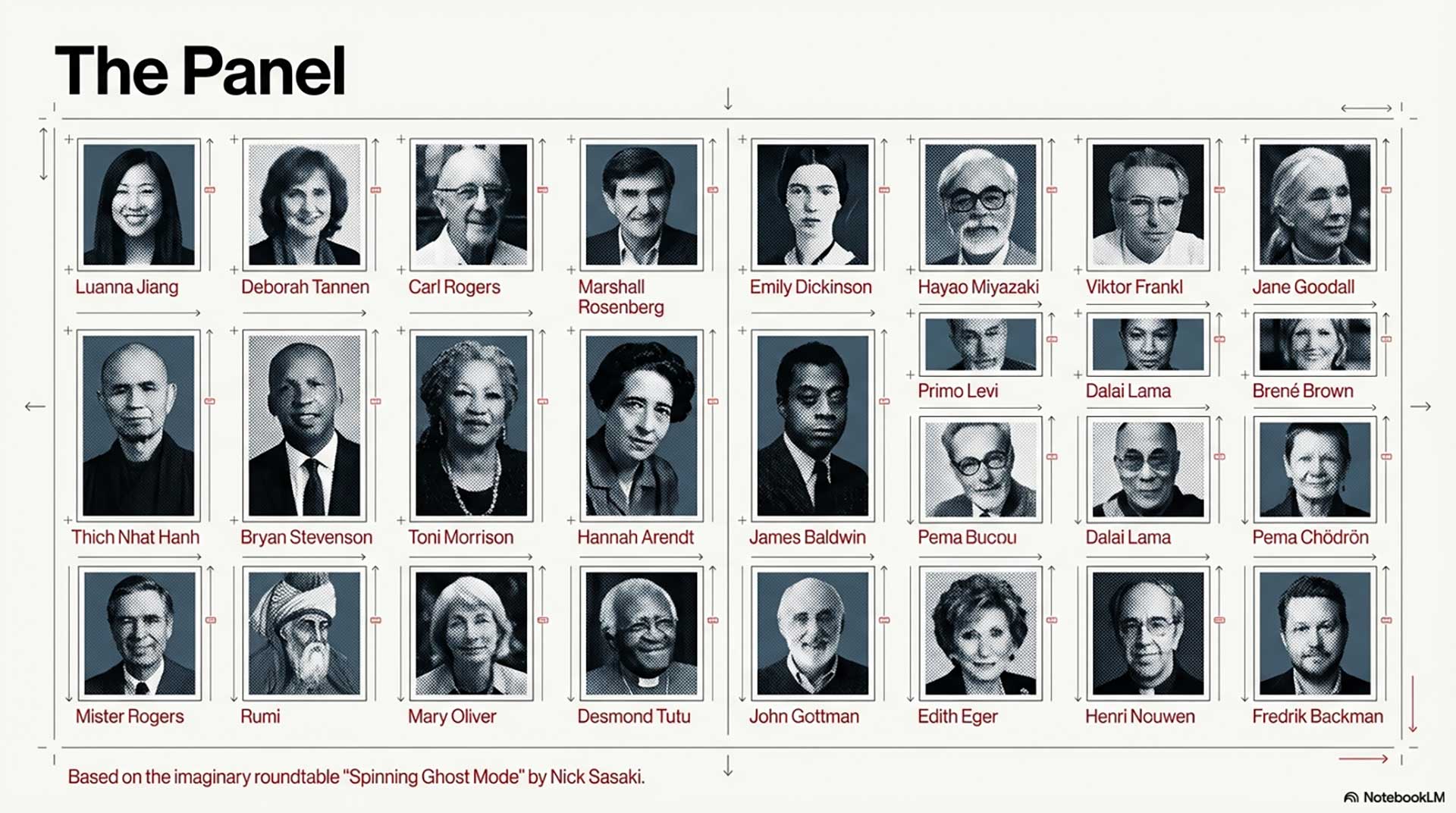
Short Bios:
Yurong “Luanna” Jiang is a Harvard graduate and international development thinker known for her “spinning ghost mode” story, using humor and lived global friendship to argue for shared humanity, deep listening, and staying soft in hard times.
Deborah Tannen is a linguist and bestselling author who studies how everyday conversational styles create hidden misunderstandings, showing how tone, context, and relationship signals shape what people hear.
Carl Rogers was a pioneering psychologist who founded person-centered therapy, emphasizing empathy, reflective listening, and unconditional positive regard as the fastest path to healing and real dialogue.
Marshall Rosenberg was the creator of Nonviolent Communication, a practical method for turning conflict into connection by translating blame into feelings, needs, and clear requests.
Emily Dickinson was an American poet whose compressed, fiercely honest language explores inner life, longing, fear, and wonder, making her a natural voice for the “trembling beneath the words.”
Hayao Miyazaki is a legendary animator and storyteller whose films portray complex humanity with tenderness and nuance, insisting that even “opponents” have inner weather, history, and dignity.
Viktor Frankl was a psychiatrist and Holocaust survivor who founded logotherapy and taught that meaning, responsibility, and inner freedom can hold the human spirit steady under suffering.
Jane Goodall is a primatologist and environmental leader who expanded our understanding of animal life and inspires hopeful, practical compassion through lifelong advocacy and youth action.
Thich Nhat Hanh was a Vietnamese Zen teacher and poet who popularized mindfulness and “interbeing,” teaching that compassion includes oneself and that peace is built through present-moment practice.
Bryan Stevenson is a lawyer and justice advocate who founded the Equal Justice Initiative, known for urging “proximity” to suffering as the antidote to abstraction, despair, and dehumanization.
Toni Morrison was a Nobel Prize winning novelist whose work examines dignity, memory, harm, and moral imagination, often warning against spectacle and simplistic stories that erase complexity.
Hannah Arendt was a political philosopher who analyzed how thoughtlessness and ideology can enable cruelty, insisting that moral life depends on careful thinking and refusing dehumanizing categories.
James Baldwin was an essayist and novelist who spoke with fierce clarity about fear, identity, and love, arguing that truth without hatred is the only path that doesn’t destroy the truth-teller.
Primo Levi was a chemist and writer whose testimony about the Holocaust explored moral gray zones, warning how the first act of reduction often begins with language and ends with systems.
Dalai Lama is the Tibetan Buddhist leader and teacher of compassion whose message centers on human dignity, inner discipline, and refusing hatred while still holding boundaries and responsibility.
Brené Brown is a researcher and author known for her work on vulnerability, courage, shame resilience, and boundaries, teaching that softness and strength are not opposites but partners.
Pema Chödrön is a Buddhist teacher and author who guides people to stay present with uncertainty, soften reactivity, and find steadiness in groundlessness without bypassing real safety needs.
Mister Rogers was a beloved children’s television host and moral educator who modeled gentle clarity, emotional literacy, and the belief that kindness with backbone can change a life.
Rumi was a 13th-century poet and mystic whose writing explores love, transformation, and the heart’s capacity to expand through difficulty, often framing pain as a doorway to awakening.
Mary Oliver was a Pulitzer Prize winning poet celebrated for attentive, simple language that returns readers to nature, presence, and the quiet courage of choosing what is life-giving.
Desmond Tutu was an Anglican archbishop and reconciliation leader who championed truth-telling, forgiveness, and moral courage, showing that compassion can coexist with accountability.
John Gottman is a psychologist and relationship researcher known for predicting relationship outcomes and teaching practical tools like repair attempts, soft start-ups, and turning toward bids for connection.
Edith Eger is a psychologist and Holocaust survivor whose work focuses on trauma recovery and choosing inner freedom, teaching that forgiveness is often a path to reclaiming one’s life.
Henri Nouwen was a priest and writer who explored belonging, the “wounded healer,” and the spiritual depth of community, emphasizing patience with the unfinished in ourselves and others.
Fredrik Backman is a novelist known for portraying ordinary people with warmth and humor, highlighting how small acts of care, humility, and showing up again can hold relationships together.
Leave a Reply