
|
Getting your Trinity Audio player ready...
|
What if Happiness in 2026 was decoded by contemporary well-being thinkers across science, tech, and spirituality?
Introduction by Nick Sasaki
Happiness in 2026 is not a cute slogan anymore. It is a survival skill.
This year, AI can smooth your life so well you forget what you actually wanted. You can feel “connected” all day and still go to bed lonely. You can be distracted for hours and call it rest. You can make decent money and still feel unsafe. You can be informed and still feel angry all the time.
So I wanted to create a different kind of conversation, one that doesn’t preach and doesn’t pretend. Just five rooms, five topics, and a simple question underneath everything.
What still works when everything gets louder?
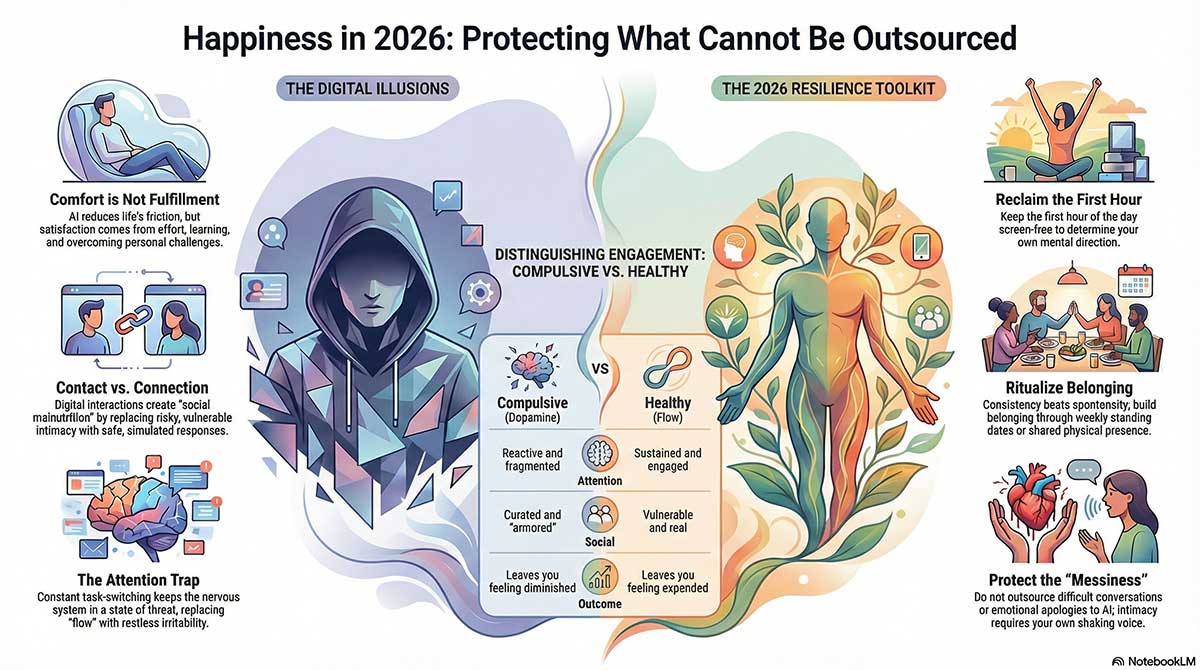
Across this series, we keep returning to the same truth. The strongest happiness in 2026 comes from what cannot be outsourced. Attention that stays with your life. Relationships that are real, not simulated. A calm money rhythm that reduces fear. And a heart that stays human even when the world wants you to pick a side and hate someone.
If you’ve felt tired, scattered, or quietly worried lately, you’re not broken. You’re living in a time that is designed to pull you away from yourself.
Let’s pull back.
(Note: This is an imaginary conversation, a creative exploration of an idea, and not a real speech or event.)
Topic 1: Happiness in the AI Age

The room is quiet in that particular way that feels chosen, not empty. A modern library lounge, early 2026. Tall windows. A soft lamp. Phones face-down at the edge of the table like a small act of respect.
Krista Tippett sits at the center, notebook open, listening before she speaks.
Krista Tippett: We’re going to talk about happiness in 2026, and we have to begin with the fact that many people now have an AI in their pocket that can soothe them, flatter them, guide them, and optimize their lives. Here’s my first question, and I’d like each of you to answer it plainly. In 2026, what is the biggest happiness illusion AI creates, and why do people fall for it?
Daniel Gilbert: The biggest illusion is that removing discomfort is the same as creating happiness. AI is brilliant at reducing friction. It can spare you awkwardness, uncertainty, boredom, and the small irritations of daily life. And because we hate discomfort in the moment, we assume that less discomfort equals more happiness. But much of what makes life satisfying comes from effort, from learning, from progress, from being surprised by other people. Convenience is not fulfillment. It’s relief. And relief is addictive.
Sherry Turkle: I would say the illusion is that you’re in a relationship. People fall for it because it feels responsive and safe. The AI listens without rolling its eyes. It doesn’t leave. It doesn’t ask for reciprocity. It doesn’t misunderstand you unless it’s programmed to. But the human heart doesn’t only need responsiveness. It needs to be known by a real other, and that involves risk and patience and repair. AI can offer companionship without vulnerability. That can feel like happiness while slowly training you away from what actually sustains happiness.
Cal Newport: The illusion is that you can outsource your attention and still keep the rewards of a deep life. People want to feel focused, proud of their work, grounded in something real. AI promises, “I’ll do the hard thinking, and you’ll still feel like the person who did it.” But attention is not a feature you install. It’s a way of living. If your days become a stream of prompts and outputs, you may become more productive while feeling strangely hollow, because depth requires sustained contact with one thing. AI can support that, but it can also replace it, and people won’t notice the difference until they feel the emptiness.
Esther Perel: The illusion is that emotional life is a problem to be solved efficiently. AI can draft your apology, smooth your texts, suggest your date night, regulate your mood with a script. And efficiency is seductive when we are tired. But intimacy is not efficiency. Intimacy is presence, attunement, and the willingness to be impacted. If your tenderness is generated, if your curiosity is outsourced, then your relationship may become calm, but it won’t feel alive. People fall for it because we confuse peace with aliveness. We want peace. But we also need vitality.
Yuval Noah Harari: The illusion is that happiness is purely personal and can be optimized privately. AI makes self-optimization extremely attractive. It can design your habits, manage your schedule, curate your media, even guide your beliefs. But happiness depends on the stories we share and the societies we build. In 2026, AI is reshaping collective narratives, not only individual routines. People fall for the illusion because personal control feels comforting. It feels safer than confronting the fact that we are being shaped by systems we don’t fully understand.
Krista Tippett lets a silence form, then nudges the conversation into its next layer.
Krista Tippett: So the warning is clear. But people don’t want to throw away a tool that genuinely helps. Let’s go to the second question. What should never be outsourced to AI if we want to protect real happiness?
Esther Perel: Difficult conversations. The ones where you feel your throat tighten, where you don’t know if you’ll be understood. The moment you say, “I’m afraid,” “I’m lonely,” “I want more,” “I’m sorry,” “I can’t do this anymore.” If AI writes that for you, you may avoid the discomfort, but you also avoid the transformation. Relationships are built in the places where we risk saying the truth in our own voice.
Cal Newport: Your capacity for deep work and deep leisure. If AI turns your mind into a supervisor of outputs rather than a maker, you’ll lose something essential. Keep at least one daily block where you do something mentally demanding without AI, and one block where you rest without stimulation. A deep life requires both. If you outsource both, you get neither pride nor peace.
Daniel Gilbert: The experience of effort. You can’t buy the satisfaction you get from earning competence. AI can deliver results without the struggle, but your brain knows the difference. It’s the difference between receiving praise and knowing you deserved it. We should protect domains where the process costs us something and where progress is visible.
Sherry Turkle: Solitude. Not loneliness, solitude. The ability to sit with your feelings without an interpreter. If AI is always there to fill silence, you never learn how to be with yourself. And then you become both more dependent and more fragile. You also become easier to manipulate because you can’t tell which thoughts are yours and which were suggested.
Yuval Noah Harari: Moral judgment. In 2026, systems will recommend not only actions but values. They will shape what you find normal, what you find outrageous, what you find meaningful. If you outsource moral judgment, you also outsource responsibility. That might feel like relief, but it creates a hollow kind of happiness that collapses when you face consequences.
Krista Tippett turns a page in her notebook, as if turning the conversation from diagnosis to remedy.
Krista Tippett: Third question. Imagine someone watching this who says, “Fine, I hear you. But I still want to use AI. I’m busy. I’m stressed. I’m lonely sometimes. I’m trying to be okay.” Give them one practical rule for using AI that would improve their happiness in the next 30 days. Not ten rules. One.
Daniel Gilbert: Use AI to remove administrative pain, but not emotional pain. That means let it handle scheduling, forms, drafting routine messages. But if you’re sad, anxious, confused, or lonely, don’t use it as your primary comfort. Use it to point you toward a human or a real action, not to soothe you back into passivity.
Cal Newport: Create one “AI-free deep block” every day, even 45 minutes. During that block, no AI, no feeds, no notifications. Work on something that matters or read something that stretches you. The happiness gain won’t be instant like a dopamine hit. But within a month you’ll feel more grounded, more capable, less scattered. That’s the kind of happiness that lasts.
Sherry Turkle: Make a rule that you don’t use AI as a substitute for a friend. If you’re tempted to talk to a machine, ask yourself: who is one real person I could reach out to, even briefly? Use AI only to help you compose the message if you must, but send it to a human. You’ll be surprised how quickly your inner life changes when you choose real connection over safe simulation.
Esther Perel: A rule for couples and families. No AI in the room during intimacy. That includes emotional intimacy. When you talk about feelings, when you repair conflict, when you flirt, when you grieve, when you dream. Keep the messiness. The messiness is where love lives. If you want happiness, protect the places where your voice shakes.
Yuval Noah Harari: One rule: do not let AI choose your worldview. That means you deliberately diversify your inputs. Read at least one long-form piece each day from a source you choose consciously, not an algorithm. Talk to at least one person per week who disagrees with you respectfully. The future of happiness depends on whether humans remain capable of independent thought and shared reality.
Krista Tippett looks around the circle, then back to the imagined audience.
Krista Tippett: I want to name what I’m hearing underneath all of this. Happiness in 2026 isn’t about rejecting technology. It’s about protecting what technology can’t replace. Effort. Attention. Solitude. Moral responsibility. Human intimacy. And the courage to be uncomfortable for the sake of something real.
She pauses, not as a dramatic effect, but as an invitation to let it land.
Krista Tippett: If we do that, then AI becomes what it should have been all along. A tool that serves human life, not a life that serves a tool.
The lamp glows. The city outside keeps moving. Inside the room, the conversation has left a small, usable warmth behind, the kind that doesn’t evaporate when the screen goes dark.
Topic 2: The Loneliness Economy

A different room, same year. Early 2026. A community center after hours that has been quietly renovated into something warm and human. A circle of chairs. A pot of tea on a side table. The lighting is soft and forgiving. No stage, no podium, no performance. Just a circle, because circles make it harder to hide.
Vivek Murthy sits with a gentle, serious presence, as if he has listened to thousands of people describe the same ache in different words.
Vivek Murthy: Topic two is the loneliness economy. In 2026, we are connected by devices and still starving for belonging. Here’s my first question. Why is loneliness rising now even when we have constant connection? What changed, specifically?
Robert Waldinger: The simplest answer is that we confused contact with connection. We’ve increased the number of interactions and decreased the quality. The Harvard study keeps pointing to the same thing over decades. It isn’t how many people you know. It’s whether you feel safe and seen with someone. Modern life is built for efficiency, not intimacy. We schedule people like tasks. We cancel plans with a text. We treat friendship like a luxury instead of a necessity. Over time, that becomes a kind of social malnutrition.
Brené Brown: I’ll add one word: armor. People are more defended now. We’ve lived through years of public shaming, division, and constant comparison. The risk of being misunderstood feels higher. So we protect ourselves with curated personas, and we call it “being careful.” But you can’t build belonging without being seen. Loneliness rises when people stop believing it’s safe to be real.
Johann Hari: We also lost a lot of the structures that made connection automatic. Third places. Neighborhood rituals. Stable work communities. Even predictable family time. And then the attention economy stepped in and offered a replacement that feels like connection but behaves like addiction. People are exhausted, and when you’re exhausted, you choose the easiest form of relief, which is often scrolling. But scrolling is not nourishment.
Arthur C. Brooks: The cultural story changed too. We taught people that independence is the highest virtue and that needing others is weakness. We also moved happiness toward achievement. That makes relationships feel secondary. But love is not secondary. Friendship is not optional. When you build a life around success and treat people like an accessory, you can end up at the top of a ladder leaning against the wrong wall, alone.
Vivek Murthy nods slowly, then asks the question that is personal and practical at the same time.
Vivek Murthy: Second question. People hear “build community” and they roll their eyes because they’re busy, tired, and a little guarded now. What is the most realistic way to rebuild belonging for adults in 2026?
Brené Brown: Start small and start brave. Belonging isn’t built by attending more events. It’s built by a few honest moments repeated over time. Choose one person and practice being a little more real than you were yesterday. Tell the truth that is easy enough to say but meaningful enough to matter. You don’t have to pour your soul out. You just have to stop performing.
Robert Waldinger: And make it regular. The research is painfully unromantic on this. Belonging thrives on repetition. A weekly walk. A standing breakfast. A Sunday dinner. If you rely on spontaneity, modern life will eat it. People think they need more friends. Often they need more rhythm with the friends they already have.
Arthur C. Brooks: I like the idea of service as a shortcut to connection. Not charity as superiority. Service as shared purpose. Join something where you help alongside others. It takes the pressure off self-presentation. You’re not selling yourself. You’re showing up. People bond faster when they’re doing something meaningful together.
Johann Hari: We should also address the guarded part directly. Adults are guarded because they’ve been disappointed. So make connection easier by lowering the stakes. Don’t begin with, “Let’s be best friends.” Begin with, “Let’s meet at the same place at the same time once a week.” We rebuild trust the way we rebuild muscle. A little load, repeated.
Vivek Murthy: I’ll add something from what I’ve heard from people across the country. Many people think they have to wait until they feel confident to reach out. But the act of reaching out is what restores confidence. The antidote to loneliness is often not receiving love. It’s giving it first, even in small ways.
He looks around the circle and then asks the third question like a prescription, but without arrogance.
Vivek Murthy: Third question. If you could design one anti-loneliness habit for the next 30 days that almost anyone can do, what would it be?
Robert Waldinger: One daily check-in with one real person. Two minutes counts. A short call. A voice note. A simple, genuine message. The point is consistency. After 30 days, you’ve built a bridge that can carry weight.
Brené Brown: One “unarmored sentence” a day. Tell the truth in a small way. “I’ve been having a hard week.” “I miss you.” “I feel nervous about this.” The sentence doesn’t have to be dramatic. But it has to be real. That trains your nervous system to stop treating connection as danger.
Johann Hari: Replace thirty minutes of scrolling with thirty minutes of shared presence. Not shared content. Shared presence. Sit with someone, walk with someone, call someone, even if it’s awkward. The loneliness economy is feeding on your time. Starve it by putting time back where humans live.
Arthur C. Brooks: I’ll make it simple. One act of warm service per day that involves another human. Hold the door and look them in the eye. Thank someone by name. Help a neighbor. Bring food to a coworker. Service creates micro-bonds, and micro-bonds add up to a life that feels held.
Vivek Murthy sits back, letting the answers settle into the circle.
Vivek Murthy: Here’s what I’m taking from all of you. Loneliness in 2026 is not a personal failure. It’s a predictable outcome of how we’ve built life. But the cure isn’t grand. It’s local. Repetition, honesty, service, and presence. Small acts done consistently.
He glances at the chairs as if imagining the millions of people who feel alone in crowded cities.
Vivek Murthy: We don’t need to become more impressive. We need to become more reachable.
The tea sits steaming. Outside, cars pass. Inside, the room feels just a little more human than it did an hour ago, which is exactly how belonging begins.
Topic 3: Attention as a Happiness Asset

The setting shifts again, still 2026. A quiet university seminar room with a single round table. The walls are plain, almost intentionally so. No screens on. A small sign on the door reads “Session in progress” with no other words. The air feels clean, like a place designed to protect attention.
Tristan Harris sits with the alertness of someone who has watched millions of hours of human focus get harvested and sold.
Tristan Harris: Topic three is attention as a happiness asset. Here’s the first question. What is the biggest attention trap in 2026 that most people don’t realize is shaping their mood and personality?
Mihaly Csikszentmihalyi: The trap is the loss of sustained engagement. People think the problem is distraction. The deeper problem is that they rarely enter a state of full absorption anymore. Flow requires an unbroken channel of attention. Without that, the mind becomes restless, then pessimistic. When you don’t experience deep engagement, life starts to feel thin. You begin to believe you are bored by the world, when the truth is that your attention has become fragmented.
Nir Eyal: I’ll name it more tactically. The trap is treating distraction as a moral weakness instead of a system problem. In 2026, people blame themselves. They say, “I lack discipline.” But most environments are engineered for interruption. If you don’t build guardrails, you will be pulled. And the pulling becomes your identity. Your life becomes reactive. That changes your mood, because you never finish what you start, and unfinished loops create stress.
Kelly McGonigal: I see the trap in the body. Constant switching keeps the nervous system in a mild state of threat. You may not notice it as fear, but it shows up as irritability, fatigue, and a craving for quick comfort. People then chase dopamine to fix the discomfort that dopamine-seeking created. It becomes a loop. And because it’s subtle, people think it’s just “how life is now.”
Thich Nhat Hanh: The trap is forgetting you are alive. You believe you are living because your mind is busy. But when you are not present, you are not truly there. In 2026, the world offers endless stimulation. But stimulation is not nourishment. Without mindfulness, you may consume many things and still feel empty, because you have not actually touched the moment.
Tristan Harris: I’ll add one I see everywhere. The trap is personalized outrage. The feed learns what makes you tense and gives you more of it, because tension is attention. And over time, you start to believe the world is exactly as the feed shows it. Your personality becomes sharper, more suspicious, less generous. Not because you chose it, but because your attention was steered.
He lets that sit, then moves to the second question with a surgeon’s precision.
Tristan Harris: Second question. What’s the difference between healthy pleasure and compulsive dopamine, and how can someone tell the difference in their own life?
Nir Eyal: Healthy pleasure leaves you more yourself afterward. Compulsive dopamine leaves you less yourself. Ask a simple question: do I feel expanded or diminished after? Another test is intentionality. If you chose it and you can stop when you decide, it’s likely healthy. If you feel pulled, if you keep going past the point of enjoyment, you’re in compulsion.
Kelly McGonigal: Also track what you’re using it for. Are you using it to celebrate and enjoy, or are you using it to escape and numb? Pleasure can be restorative. Compulsion usually has an emotional trigger. Stress, loneliness, boredom, shame. If the urge spikes when you feel those emotions, then it’s not about pleasure. It’s about avoiding feeling.
Mihaly Csikszentmihalyi: Pleasure is often passive. Flow is active. The happiest states often come when you are doing something that stretches you, where your skills meet a worthy challenge. If your leisure never includes challenge, you may experience many pleasures and still feel dissatisfied. The mind needs to create, not only consume.
Thich Nhat Hanh: There is a gentle sign. When pleasure is healthy, it brings gratitude. When it is compulsive, it brings forgetfulness. You eat, you scroll, you watch, and afterward you do not remember. You were not there. You were carried away.
Tristan Harris: And a system-level sign is escalation. If you need more intensity more frequently to feel the same relief, you’ve likely moved into compulsive design territory.
He turns the page, then asks the third question like an engineer trying to rebuild a broken bridge.
Tristan Harris: Third question. What is one boundary or system that reliably gives people their attention back without requiring constant willpower?
Cal Newport is not in this session, but the room feels like it borrowed his seriousness anyway. Tristan gestures to the group to keep it simple and concrete.
Nir Eyal: Use timeboxing. Plan your day in blocks, including leisure. People assume scheduling steals freedom. It actually creates it. When you decide in advance what you’ll do and when, you reduce the number of moment-to-moment battles. Willpower is expensive. Structure is cheaper.
Kelly McGonigal: I recommend a daily “downshift ritual.” Same time each evening, a short sequence that tells the nervous system it is safe. A walk, a shower, light stretching, a few minutes of breathing. Not as self-improvement, but as recovery. When the body recovers, attention returns.
Mihaly Csikszentmihalyi: Protect one flow ritual each day. It can be writing, music, woodworking, cooking, studying, anything that has clear goals and immediate feedback. The important part is uninterrupted time. Flow is not merely productivity. It is psychological nourishment.
Thich Nhat Hanh: One mindful pause before you touch the phone. Just one breath. You pick up the phone, you breathe, and you ask, “What am I seeking?” That one breath turns a habit into a choice. You do not need willpower all day. You need remembrance.
Tristan Harris: My boundary is simple and practical. Make the phone sleep outside your bedroom and keep the first hour of the day screen-free. Not because screens are evil. Because if the machine gets the first hour, it often gets the whole day. The first hour is when you decide what kind of mind you will have.
The room is quiet again. Not empty, but reclaimed. The strange thing about attention is that when it returns, happiness often shows up behind it, like a friend who couldn’t enter the house until the noise stopped.
Topic 4: Financial Stress and Quiet Despair

A new setting, still 2026. A small library meeting room with a round table and a window that looks out onto a gray winter morning. On the table are simple objects that feel honest: a notebook, a plain calculator, a jar labeled only by a strip of blank tape, and a stack of envelopes with no writing. The mood is calm, but you can feel the quiet pressure that money puts on people even when nobody says the numbers out loud.
Morgan Housel sits with the relaxed seriousness of someone who knows that money is rarely about money.
Morgan Housel: Topic four is financial stress and quiet despair. First question. In 2026, what money story is quietly destroying people’s happiness even when they’re doing okay on paper?
Sonja Lyubomirsky: The story is “I’ll be happy when I finally feel secure.” People keep moving the finish line. They reach a goal, and their mind instantly produces a new condition. Then happiness becomes delayed life. That’s corrosive because it trains you to live in anticipation rather than appreciation. It also makes you ignore small joys that actually build resilience.
Tara Brach: I hear the story as “I’m not okay until everything is okay.” It creates a kind of chronic vigilance. The nervous system stays braced, scanning for the next threat. People may be stable, but they don’t feel stable. Underneath, there’s often shame, the belief that needing help is failure. That shame isolates people, and isolation multiplies distress.
Gretchen Rubin: A very common story is comparison. “Everyone else has it figured out.” In 2026, you’re not comparing yourself to your neighbors. You’re comparing yourself to a highlight reel. And money becomes a proxy for worth. Even if you’re objectively fine, you feel behind. That feeling can poison daily life.
Tony Robbins: The story is powerlessness. “The economy is happening to me, so my life is happening to me.” When someone believes they have no agency, stress becomes identity. The truth is, you can’t control macro forces, but you can control your state and your decisions. Happiness often returns the moment people remember they still have choices.
Morgan Housel: The story I see everywhere is “I should be farther ahead by now.” It’s a brutal narrative because it turns time into an enemy. It ignores the reality that most people are carrying unseen burdens. It also ignores that “ahead” is not a single lane. One person has money but no health. Another has a great family but little income. Yet we rank ourselves using one scoreboard.
He lets that land, then moves to the second question with a gentler voice.
Morgan Housel: Second question. How do you build real peace when the future feels unstable and you can’t control the bigger economy?
Tara Brach: You begin with the inner practice of allowing. Not approving of hardship, but making space for the fear without becoming the fear. When people stop fighting their own feelings, they regain clarity. From clarity, wise action becomes possible. Peace is not pretending. It’s meeting reality without self-hatred.
Sonja Lyubomirsky: Research supports that too. When circumstances are uncertain, small intentional practices matter more, not less. Gratitude, kindness, social connection, physical movement. These are not sentimental. They protect psychological bandwidth. When you have bandwidth, you make better decisions, and that reduces stress.
Gretchen Rubin: I think peace is also built by habits that reduce decision fatigue. People under financial stress make too many choices while already tired. So create defaults. Automate savings if possible. Have a simple meal plan. Set a weekly review time. When your system is stable, your mind feels less chaotic.
Tony Robbins: I come back to triage. What can you control today? Your spending choices, your income strategy, your health, your relationships, your mindset. People try to control everything and end up controlling nothing. Peace comes when you focus on the few moves that actually change your life. Then you build momentum. Momentum is an antidote to despair.
Morgan Housel: I’d add the concept of enough. Not as giving up, but as defining success in a way that isn’t endlessly fragile. If your definition of enough is always “more,” then uncertainty becomes torture. If your definition of enough is “a buffer and a life I can enjoy,” then uncertainty becomes manageable. It changes your risk posture. It changes your stress level.
Morgan looks around the table, then asks the third question like a tool you can take home.
Morgan Housel: Third question. What’s one practical decision rule that reduces financial anxiety immediately and still respects reality?
Gretchen Rubin: A weekly money check-in at the same time every week, short and non-dramatic. Ten minutes. Look at balances, upcoming bills, and one small action. The rule is consistency, not intensity. Avoiding the numbers creates anxiety. Seeing them calmly reduces it.
Sonja Lyubomirsky: Pair that with a joy rule. One intentional low-cost joy every day. A walk, tea with someone, music, reading. This isn’t denial. It’s resilience training. When your brain remembers that life still contains pleasure and meaning, anxiety becomes less total.
Tara Brach: My rule is pause before you purchase or panic. A single minute of breathing, hand on heart if that helps, and the question: “What am I really needing right now?” Often the need is reassurance, rest, connection. When you meet the real need, the money impulse softens.
Tony Robbins: Mine is simple. Build a buffer before you build a lifestyle. Pay yourself first into a safety account, even if it’s small. Then you live on what remains. Anxiety drops when you know you’re building a moat. A moat changes how your brain experiences the future.
Morgan Housel: I’ll offer a rule that is boring but powerful. Keep your fixed costs low enough that one setback doesn’t become a catastrophe. People underestimate how much happiness is just not being cornered. Flexibility is freedom. Freedom is peace.
The gray morning outside doesn’t change. The economy doesn’t magically resolve. But around the table, you can feel something shift. Not a fantasy of perfect security, but a steadier idea. In 2026, happiness under financial pressure is often the quiet confidence that you have a plan, a buffer, a rhythm, and people who know your real life.
Topic 5: A Divided World
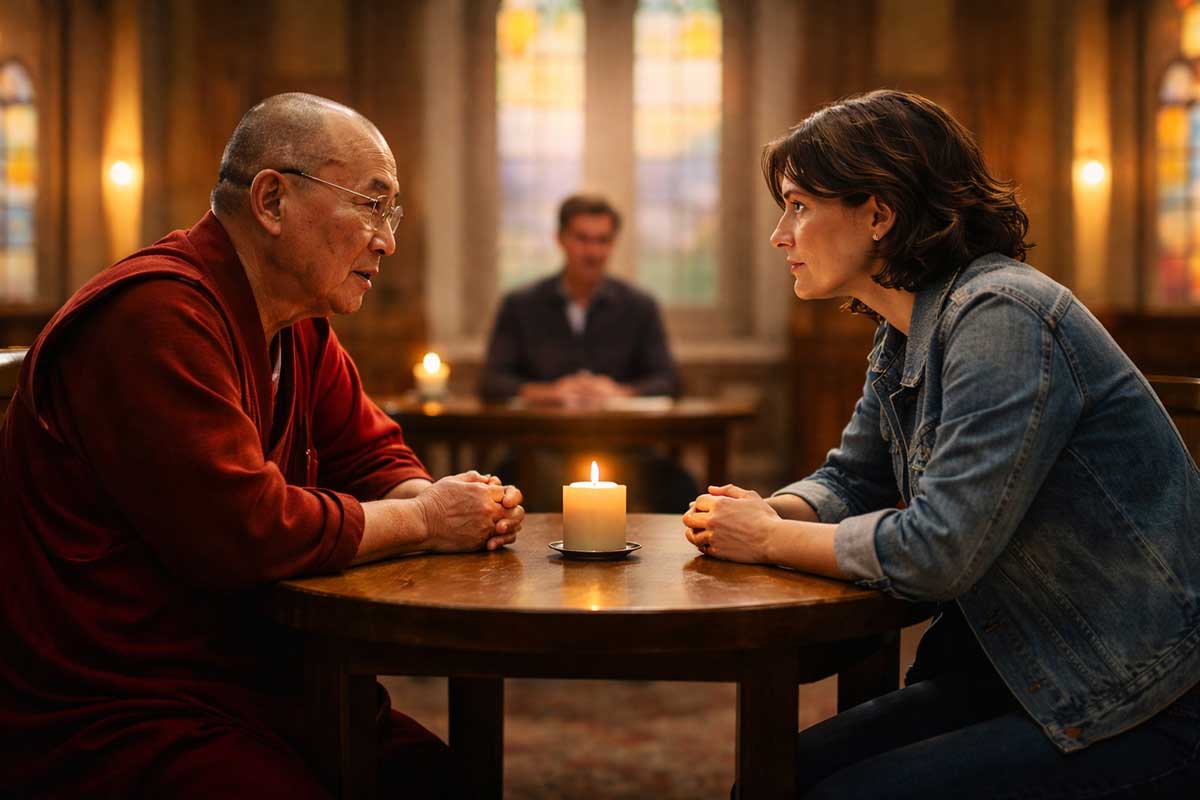
The final room in this 2026 series is not a studio. It’s a small chapel-like hall that isn’t religious in any obvious way. High ceiling, wooden chairs, soft light through stained glass that shows no symbols, only color. The air feels like it was designed for people who disagree to still remember they are human.
Krista Tippett sits at a round table in the center. No microphones. No cameras. Just five people who have each studied a piece of the human heart.
Krista Tippett: Topic five is a divided world. First question. How do you stay engaged with a world that feels polarized without letting outrage and contempt steal your happiness?
Jonathan Haidt: I’ll start with the mechanism. Outrage is socially rewarding. It signals loyalty to your group. In 2026, platforms still amplify moral anger because it drives engagement. So the first step is to recognize that your nervous system is being recruited. Then you build friction. You slow down. You don’t share until you’ve read beyond the headline, and you don’t consume political content as a form of identity maintenance. If you treat politics like a sport, you will end up hating people.
Dalai Lama: Anger can have a place if it moves you to compassionate action. But hatred is poison. It destroys your own peace first. If you want to remain engaged, you must keep seeing the humanity in those you oppose. This is not weakness. It is strength. Without compassion, you may win arguments and lose your heart.
Matthieu Ricard: I would add that happiness is not a selfish luxury. A mind filled with resentment cannot serve anyone. If you want to help the world, you need inner stability. That means training attention and intention. When you feel outrage, notice it, and then ask: what action reduces suffering? If the answer is only to attack, then you are feeding the problem.
Eckhart Tolle: Outrage thrives on identification with thought. A narrative appears, and you merge with it. Then the “other side” becomes an object, not a person. The practice is to watch the mind. The moment you sense the heat of reactivity, return to the body. Feel your breath. Create space. From space, you can respond rather than react. Engagement without presence becomes unconsciousness.
Krista Tippett: I hear a shared point. That if you lose your interior life, you lose the capacity to engage wisely. Let’s move to the second question. What is the line between healthy boundaries and emotional numbing? How do you keep compassion without burning out?
Matthieu Ricard: Compassion is not the same as empathy. Empathy can drown you because you absorb the pain as if it is yours. Compassion is steadier. It wishes relief for suffering and then acts where it can, without collapsing. The line is whether you feel open and energized to help, or shut down and exhausted. If you are exhausted, you need to replenish, not because you are selfish, but because you are human.
Dalai Lama: Yes. You cannot carry the whole world in your heart every day. But you can keep a good heart. Healthy boundaries mean you choose your actions wisely and preserve your inner peace. Numbing means you stop caring. If you stop caring, you become cold, and coldness is also suffering.
Jonathan Haidt: Boundaries should also be social. If your entire environment is outrage, your brain will interpret outrage as reality. Diversify your inputs. Spend time with people who disagree but are decent. And remember that most people are not extreme. The loudest voices are not the majority. When you forget that, you burn out because you think the world is worse than it is.
Eckhart Tolle: Numbing is the avoidance of feeling. Boundaries are the presence with feeling without drowning in it. If you can feel sadness, grief, concern, and still remain rooted in awareness, you are not numb. You are awake. Burnout often comes from carrying pain with resistance. Presence reduces resistance.
Krista Tippett: That brings us to the third question. If you had to recommend one daily practice that makes people less polarized and more peaceful in 30 days, what would it be?
Jonathan Haidt: A daily “steelman” practice. Spend five minutes describing the best version of the other side’s argument as if you were trying to convince yourself. Not to agree, but to understand. It interrupts caricature. Caricature is the fuel of polarization.
Dalai Lama: Each day, practice loving-kindness. Even briefly. Begin with someone you love, then include someone neutral, then someone difficult. Wish them well. This changes your mind over time. A peaceful mind creates a peaceful world.
Matthieu Ricard: I will combine both. Do loving-kindness and then do one small altruistic act. Polarization thrives when we are trapped in identity. Altruism frees us. It reminds us we are connected.
Eckhart Tolle: One conscious pause before speaking about politics. One breath, one moment of presence, and then ask: am I speaking to be right, or to be true? If you speak to be right, you often create enemies. If you speak from truth and presence, you create possibility.
Krista Tippett: My own practice would be a daily act of curiosity. Ask one sincere question to someone you disagree with, with no trap inside it. Curiosity is a form of respect. And respect is a seed of peace.
The stained-glass colors shift slightly as the sun moves. Nobody in the room has solved the world. But something feels more possible. Happiness in a divided world is not ignorance. It’s not detachment. It’s a kind of inner steadiness that keeps your heart from turning into a weapon.
Final Thoughts by Nick Sasaki
After these five conversations, I don’t think happiness in 2026 is about finding the perfect mindset.
It is about protecting your mind from being rented out.
Protect your attention, because it is the doorway to your whole life. Protect your relationships, because loneliness is not only pain, it is also a slow loss of meaning. Protect your boundaries, because outrage will happily eat your peace and call it “being informed.” Protect your sense of enough, because comparison turns a good life into a constant emergency.
And here’s the part I like most. The solution is not dramatic. It is practical and kind.
Turn the phone face-down and stay in the room you’re in. Send one message to a real person, even if it’s simple. Create one daily focus block where you remember what you can do. Do one calm money check-in that replaces dread with clarity. Ask one sincere question to someone you disagree with, without trying to win.
None of this fixes the whole world overnight. But it fixes something crucial.
It gives you your life back.
And when enough people get their lives back, the world gets better in a way no algorithm can fake.
Short Bios:
Krista Tippett
Journalist and interviewer known for deep, human conversations about meaning, ethics, and inner life.
Vivek Murthy
Physician and public health leader who brought national attention to loneliness as a major well-being crisis.
Tristan Harris
Former tech insider turned advocate for humane technology, focused on how platforms shape attention and behavior.
Morgan Housel
Writer on the psychology of money, known for explaining how fear, risk, and “enough” shape real life decisions.
Daniel Gilbert
Harvard psychologist who studies how people mispredict what will make them happy and why our minds get the future wrong.
Sherry Turkle
MIT scholar who studies how technology changes relationships, identity, and what it means to feel understood.
Cal Newport
Author and professor known for “deep work” and attention protection in a distracted digital world.
Esther Perel
Psychotherapist and author focused on modern love, intimacy, and how relationships survive stress and change.
Yuval Noah Harari
Historian and writer exploring how large-scale narratives, technology, and power shape human meaning.
Robert Waldinger
Psychiatrist and director of the long-running Harvard study showing relationships are central to long-term happiness.
Brené Brown
Researcher and author known for work on vulnerability, courage, shame resilience, and belonging.
Johann Hari
Writer known for explaining modern disconnection, attention struggles, and the social roots of despair.
Arthur C. Brooks
Scholar and author who writes on happiness through meaning, love, service, and character.
Mihaly Csikszentmihalyi
Psychologist who introduced “flow,” the deeply fulfilling state of absorbed, purposeful engagement.
Nir Eyal
Author focused on behavioral design and practical strategies to become “indistractible.”
Kelly McGonigal
Health psychologist known for work on stress, willpower, and how mindset changes performance and well-being.
Thich Nhat Hanh
Zen teacher who popularized everyday mindfulness, peace, and presence as a path to happiness.
Tara Brach
Psychologist and meditation teacher known for radical acceptance and self-compassion practices.
Tony Robbins
Coach and speaker known for high-energy strategies on mindset, agency, and creating momentum in life.
Gretchen Rubin
Author known for practical habit-building approaches to happiness and daily life design
Leave a Reply