
|
Getting your Trinity Audio player ready...
|

Introduction by William Faulkner
This story is not written in judgment, nor in condemnation, but in remembrance. In every small town there are figures who linger on the edge of the present, too bound to the past to move forward, too proud to surrender, too alone to ask for help. Miss Emily Grierson was such a figure.
She stood, a relic of a vanished South, in her house that decayed around her as stubbornly as she herself resisted time. The town whispered, judged, pitied, but it did not understand. And so I wrote this story to set her down as she was: not merely as gossip or grotesque, but as human.
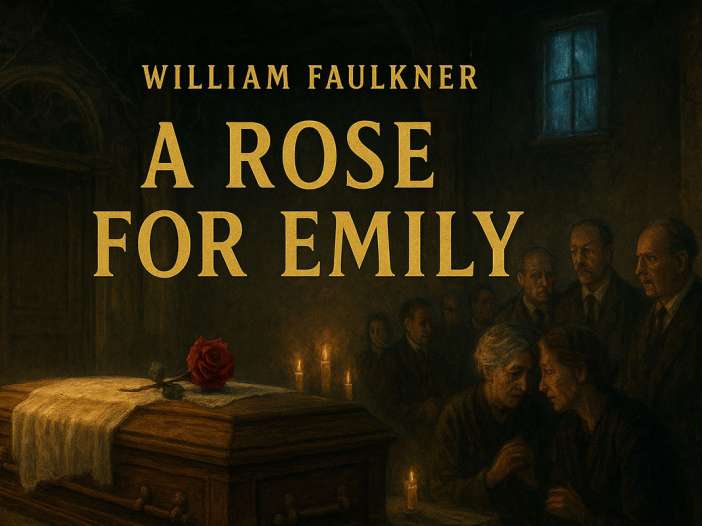
The title was a gesture, as simple and as complex as memory itself. A rose is given in silence, without words. It is a tribute, an offering of compassion to a woman who lived and died surrounded not by love, but by curiosity and pity. The rose is not approval, nor forgiveness, but acknowledgment — that she, too, was part of us.
(This performance begins with a familiar tale and unfolds into newly imagined acts, offering an original continuation inspired by its themes.)

Scene 1 — The Rose and the Coffin

Setting:
The Grierson mansion, once stately, now sagging into its lot. A wide porch, high windows, shutters like closed eyelids. Inside, a parlor draped in black. Beyond, a staircase that climbs into shadow. Throughout the scene, the house itself hums with quiet: the tick of a stalled clock, air that smells of dust and old roses.
Characters:
Chorus (Townspeople: Old Women, Young Men, Children, Shopkeepers, Officials), speaking sometimes in unison, sometimes in braided fragments.
The Servant (gray-haired, unspeaking; moves like a shadow).
Reverend (murmuring prayers).
Undertaker (formal, efficient).
Alderman (proud, practical).
Two Women (neighbors, sharp-eyed).
Two Young Men (respectful, uneasy).
[Lights rise on the porch. Mourners cluster in small knots, whispering. Inside the parlor, a coffin rests on trestles. The SERVANT opens the door, steps aside, never meeting a gaze.]
Chorus (soft, layered):
We came to look upon her house.
We came to look upon our history.
We came to say we loved her—
—or to see what was true at last.
Reverend (intoning):
Ashes to ashes—
Chorus (overlapping him, barely above breath):
A daughter of high rooms
and locked windows.
A name that outlived money.
A spine that outlasted time.
Two Women (aside to each other):
Her father stood in that doorway and sent them all away.
Suitors turned on their heels like boys chased from a garden.
Two Young Men (low):
We were told our elders excused her debts.
We were told the town owed her—
—or feared her.
Alderman (brisk, to the Undertaker):
Let’s not linger. There’ll be… talk enough.
Undertaker (nods):
There always is.
[Inside, mourners file past the coffin. The SERVANT hovers at the threshold of a hallway that leads to the stairs. He listens, then vanishes deeper into the house.]
Chorus (as a single breath):
She stood at the window for years.
Her hair went the color of moonlight.
She stopped the clock without touching it.
Two Women (to the audience):
Do you remember the summer the town smelled bad?
We scattered lime in the garden by lantern light, pretending not to look at the house.
Young Man 1 (to Young Man 2):
She bought poison once. No explanation.
The law asked for a reason.
She gave none—only a look that was reason enough.
Young Man 2 (glancing upstairs):
There’s a room no one has entered in decades.
Chorus (quiet, leaning toward the stair):
A key turned and then forgot us.
A door learned to be a wall.
[The prayer concludes. A final hymn hums and falls away. The crowd thins. Only a tight circle remains: the ALDERMAN, the REVEREND, two WOMEN, two YOUNG MEN. The SERVANT reappears at the back, sets his hand to the knob of a side door, and slips out of the house without a word.]
Two Women (startled):
He’s leaving—just like that—
Where is he going?
Where does anyone go when a house is finished with them?
Alderman (watching the door close):
He served her all his life. He owes us nothing.
Reverend (wary, to Alderman):
There’s a matter the town has whispered about.
Best settle it while we hold the keys.
Alderman (eyes on the stair):
Upstairs?
[A tense silence. Dust hangs in a slant of light. The ALDERMAN withdraws a small ring of keys from his pocket.]
Chorus (in a hush):
Curiosity is a lantern we carry into the dark.
It makes us brave.
It makes us cruel.
Alderman (to the small group):
We go. Quietly. No spectacle.
Two Young Men (together, swallowing):
Yes, sir.
Two Women (nodding, then crossing themselves):
Yes.
[They move toward the staircase. Each step creaks. The house seems to listen. As they climb, the CHORUS gathers below, faces tilted upward, their murmurs rising and falling like wind.]
Chorus (building, half-whispered inventory):
Portraits that watch.
Paper that peels like shed skin.
A clock with its hands removed.
A mirror clouded by breath long gone.
A door that learned to be a wall—
[At the landing: a narrow hall. Dust blooms underfoot. The ALDERMAN stops before a door with a tarnished knob and a rust-laced keyhole.]
Alderman (quiet):
This is the one.
Reverend (soft):
May the Lord be with us.
[The ALDERMAN tries a key. It resists. He tries another. A rasping turn, a stubborn latch, a sound like old bone. The door yields an inch, then more. A breath of stale air spills out—sweet, metallic, and old.]
Two Women (hands to their mouths):
Oh.
Young Man 1 (hoarse):
There’s lace on the windows—
Look—
No one’s sat here in… how long?
[Lights reveal the room: rose-tinged curtains faded to ash, a dressing table with silver blackened by time, a suit of men’s clothing folded carefully on a chair, a pair of shoes beneath it. On the center bed: an outline beneath a crumbling coverlet.]
Young Man 2 (whisper):
Is someone—?
Reverend (gentle but steady):
Stand back.
[They approach in increments, each step a trespass. The ALDERMAN adjusts the coverlet. A shape: the collapsed architecture of a human form, the grin of bone glimpsed from the pillow’s edge, a vestige of collar and tie. Silence contracts.]
Two Women (barely able to speak):
The foreman.
The man from the road crews.
The one who laughed.
Chorus (below, a tide of voices):
He vanished.
He did not leave.
He never left.
[A long beat. Then: a small, precise gesture. One WOMAN leans in. Her eyes fix on the pillow beside the skull.]
Woman 1 (trembling):
There—
Do you see it?
Woman 2 (leaning, whispering):
A thread of hair.
Not black. Not gold.
Winter-gray.
Young Man 1 (backing away):
She lay here.
She lay—here.
Reverend (closing his eyes):
God have mercy.
Alderman (voice roughened):
Close the curtains. No more light on this.
[The YOUNG MEN move to the windows. One tugs a curtain; the fabric surrenders in his hands, crumbling like dry leaves. Dust erupts. They cough, eyes watering. The room dims to a twilight of memory.]
Chorus (from below, rhythmic, inexorable):
We brought casseroles and condolences.
We brought our hungry eyes.
We brought the town to see its own reflection.
Woman 2 (to the Alderman, fierce and small at once):
What do we do now?
Alderman (after a long pause):
We do what towns do.
We make a record no one will read
and a secret everyone knows.
Reverend (quietly):
Say it plain: we failed her as much as she failed herself.
Young Man 2 (staring at the bed):
There’s more than failing here.
Young Man 1 (touching the doorframe like a ward):
There’s wanting. And keeping.
There’s the kind of love that can’t bear daylight.
[A muffled sound from somewhere deeper in the house—perhaps a door settling, perhaps the distant echo of a footstep that isn’t there. All of them freeze, listening.]
Chorus (a breath):
Hush.
[Nothing follows. The house returns to its pulse of quiet.]
Alderman (finding his voice):
We go down now.
We tell no stories tonight.
Reverend (nodding):
Tomorrow’s sun will not change what we’ve found.
[They step backward from the bed, as if stepping away from a grave they have no right to stand over. The ALDERMAN pulls the door gently toward the jamb but does not lock it. He holds the ring of keys in his palm and looks at them as if they are heavy.]
Chorus (as the group descends, spreading through the lower rooms, the words falling like slow rain):
A flower pressed too long between pages.
A house that learned to keep breath.
A town that learned to look away.
[At the bottom of the stairs, the SERVANT is gone. The front door stands ajar. Outside, night gathers. Someone on the porch drops a whisper that becomes a rumor that becomes a myth.]
Chorus (final cadence, together):
We buried a woman.
We opened a room.
We found the shape of love when it forgets to let go.
[Blackout.]
Scene 2 — Whispers in the Dust

Setting:
The town square of Jefferson, morning light gray and unsettled. Shops stand half-open, townsfolk gathered in knots. The Grierson house looms at stage right, shuttered and silent, though its windows seem to watch. A nervous stillness hangs in the air.
Characters:
Chorus (Townspeople: Old Men, Old Women, Young Men, Young Women, Shopkeepers, Children).
Alderman (stern, anxious).
Reverend (somber).
Druggist (uneasy, guilty).
Two Young Women (neighbors).
A Young Man (curious, reckless).
Sheriff (practical, unsettled).
[Lights rise. TOWNSPEOPLE cluster in the square. The CHORUS murmurs, voices weaving.]
Chorus (whispering fragments):
The house—
The upstairs room—
The body in the bed—
Her hair on the pillow—
A love that rotted into silence.
Old Woman (to another):
I couldn’t sleep. Every time I closed my eyes I saw it. That grin of bone.
Young Man (to the crowd):
It’s a scandal! A horror! The newspapers will come. They’ll drag our name through every headline in the state.
Alderman (raising his hand):
Quiet yourselves. Nothing leaves this town. Not a word. Do you hear me?
Chorus (unison, low):
We hear. We hear.
Reverend (stern):
It is sin enough that she lived in that sin. Must we spread it further?
Two Young Women (huddled, whispering):
But the room—did you see the curtains? Faded like old roses.
And the clothes. A man’s clothes. Folded neat.
She kept him dressed, like he’d just stepped out.
Druggist (entering, voice trembling):
I—I sold her the arsenic. I thought she’d use it on rats. She gave me that look, and I asked no more.
Sheriff (curtly):
Your guilt serves nothing now. What matters is the house.
Chorus (leaning forward, tense):
The house.
Sheriff (to Alderman):
What shall we do with it? Board it up? Burn it down?
Alderman (stiffly):
It is her legacy. We will preserve it. But the room—seal it. Nail it shut. Let no one enter again.
Young Man (defiant):
And pretend it never happened? Is that what Jefferson does? Pretend?
[A hush. The YOUNG MAN breaks away, strides toward the Grierson house. The CHORUS gasps.]
Old Woman (hissing):
Fool boy, don’t go near it!
Young Man (calling back):
What are you all so afraid of? The dead can’t touch us!
[He steps onto the porch. The shutters creak faintly. A crow cries overhead. The YOUNG MAN puts his hand on the door handle. It gives slightly, though no one touched it since the funeral. He shoves it open. Dust swirls. The CHORUS recoils as if a breath of air from the grave has escaped.]
Young Man (peering inside, quieter now):
It’s dark. Smells like—like her.
[He steps over the threshold. The door swings shut behind him with a heavy thud. Silence.]
Chorus (whispering, overlapping, urgent):
Don’t go in—
He’ll never come out—
The house takes who it wants—
It’s not empty—
Never empty—
[A beat of silence. Then a muffled cry from within. The CHORUS gasps. The SHERIFF and ALDERMAN rush forward, force the door back open. The YOUNG MAN stumbles out, pale, shaking. His hands are smeared with dust, but his eyes are wide with terror.]
Sheriff (grabbing his shoulders):
What happened? Speak, boy!
Young Man (hoarse, barely breathing):
Someone was walking upstairs.
[The CHORUS murmurs in a rising tide, fear mixing with fascination.]
Chorus (fragments):
The servant…
He never left…
Or something worse…
Alderman (snapping):
Enough! You heard nothing but the house settling. That place is rot and creak. It plays tricks on the ears.
Young Man (shaking his head violently):
No. I know footsteps when I hear them.
Reverend (grim, lifting his Bible):
Then may God keep Jefferson, for something foul lingers in that house.
[The CHORUS falls into silence. The GRIERSON house looms, unchanged, windows like watching eyes. A faint sound—like a slow tread of feet above—echoes through the stillness. The YOUNG MAN cries out and collapses. The SHERIFF and ALDERMAN drag him away. The CHORUS, frozen in fear, watches the house.]
Chorus (low, murmuring in rhythm):
The past does not rest.
The dead do not sleep.
The house does not empty.
[Lights dim to black, leaving only the silhouette of the house, its upstairs window faintly glowing.]
Scene 3 — Children at the Gate
Setting:
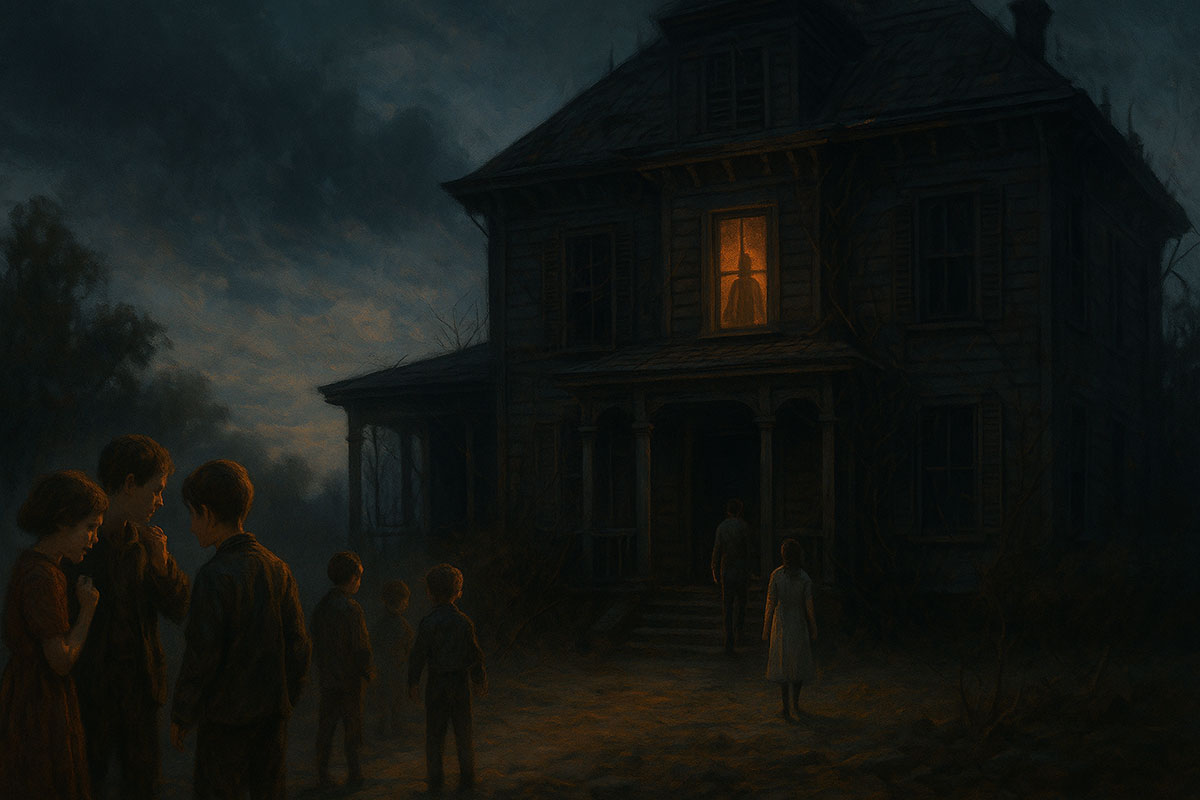
The Grierson house, boarded windows and overgrown yard. Stage left: Jefferson’s town square, now bustling with children, shopkeepers, and gossip. Stage right: the shadow of the Grierson parlor, empty but ominous. At times, light flickers from the upstairs window though no one is seen there.
Characters:
Chorus (Townspeople: Old Women, Old Men, Children, Shopkeepers, Young Women, Young Men).
Sheriff (uneasy, trying to maintain order).
Two Children (daring each other, bold but afraid).
Schoolteacher (rational, but unnerved).
Historian (scholarly, fascinated with Emily).
Two Young Women (neighbors, curious).
[Lights rise on the town square. The CHORUS mills about, their voices overlapping like wind.]
Chorus (fragments):
A year gone—
The house still stands—
Boarded, but not silent—
Her presence clings—
Dust does not forget—
Two Women (to each other):
They should have torn it down after the funeral. It poisons the air.
Old Man (shaking his head):
No one dares. They say her spirit walks the halls.
Shopkeeper (low, to the crowd):
And what of the boy? The one who went inside last year?
Chorus (whispering, rising):
He was never the same—
His hair turned gray at the temples—
He wakes screaming in the night—
[Two CHILDREN run forward, daring each other, pointing at the house.]
Child 1 (mocking):
Go on then, touch the door!
Child 2 (nervous, stepping closer):
I will—if you come with me.
[They creep to the porch, put hands on the door. A sudden creak from within makes them shriek and bolt. The CHORUS laughs uneasily, then falls quiet.]
Schoolteacher (scolding):
Enough of this nonsense! It is an old house, nothing more. Fear comes from your own stories, not from its walls.
Historian (stepping forward, thoughtful):
Yet stories are part of history. And this house—this woman—will not be erased. I’ve begun a study of her family.
Chorus (eager, circling him):
What did you find?
What truth?
What curse?
Historian (gravely):
Her father kept records. The Griersons believed in binding the dead. Keeping them near, so memory would not decay. Perhaps she was not mad after all. Perhaps she practiced a ritual old as the hills.
Two Women (horrified):
A ritual?
Historian (nodding):
She was the last of her line. But such traditions do not die easily.
[The CHORUS murmurs in unease. Lights shift to stage right: the shadow of Emily’s parlor. Dust motes shimmer. A faint creak of floorboards is heard above. The CHILDREN gasp and cling to each other.]
Child 1 (whispering):
Someone’s up there.
Child 2 (wide-eyed):
No one lives there.
[Suddenly, a YOUNG COUPLE enters from stage left, laughing, daring each other.]
Young Woman (boldly):
Let’s go in. We’ll be the ones who prove the town wrong.
Young Man (grinning):
A story to tell forever.
[They stride toward the house. The CHORUS surges forward, trying to stop them.]
Chorus (urgent, overlapping):
Don’t—
Fools!—
The house keeps what it takes—
It will not let you go—
Young Woman (mocking):
Superstitions of old bones. Watch us!
[They push the door. It opens with a groan. They disappear inside. Silence. The CHORUS waits, tense, listening. Minutes drag.]
Shopkeeper (hissing):
Call them out!
Sheriff (stern):
Enough. We go in together.
[The SHERIFF steps toward the porch, but before he can enter, the door slams shut with a violent crack. Dust explodes outward. The CHORUS screams and stumbles back.]
Chorus (in unison, terrified):
It lives!
[Silence again. The SHERIFF pounds the door. No answer. The CHORUS gathers, trembling.]
Schoolteacher (to Sheriff, shaken):
Well? Break it down!
Sheriff (hesitant, pale):
We tried before. You know what we found.
Historian (softly, almost reverent):
Perhaps they chose to stay.
Two Women (crying out):
Chose? Or were taken?
[The upstairs window glows faintly. A shadow moves across it—slow, deliberate, impossible to mistake. The CHORUS gasps.]
Child 2 (pointing, shrieking):
There! Someone’s there!
Chorus (in overlapping whispers):
Her…
Him…
Them…
The house does not empty—
[At the porch: the SHERIFF yanks the door open. The inside is black. He calls into the void.]
Sheriff (shouting):
Come out! Come out, both of you!
[No response. He steps one foot across the threshold, then halts as a low groan rolls through the house, like wood bending under unseen weight. He stumbles back, slamming the door shut. His face is white.]
Sheriff (grim):
They’re gone.
Schoolteacher (incredulous):
Gone? In an instant?
Sheriff (staring at the house):
No. Swallowed.
[The CHORUS falls silent. A shoe tumbles out of the doorway, scuffed and worn, clearly belonging to the YOUNG MAN. The crowd recoils in horror.]
Chorus (in fragments, rising in dread):
The house takes what it wants.
The house keeps what it claims.
The house is not empty.
Historian (softly, closing his book):
And perhaps… it never was.
[The lights fade as the house silhouette looms larger, upstairs window faintly glowing with shadows. The CHORUS whispers one last time.]
Chorus (unison, hushed):
Another year gone.
Another name forgotten.
Another secret kept.
[Blackout.]
Scene 4 — The House That Wouldn’t Fall

Setting:
The stage is divided. Stage left: Jefferson has changed — neon signs, gas stations, a supermarket, cars honking in the distance. Stage right: the Grierson house remains, rotting and overgrown, untouched. Its windows are dark except for the faintest flicker upstairs.
Characters:
Chorus (Generations of townspeople: Old Residents, Newcomers, Workers, Children, Officials).
Sheriff’s Son (now grown, pragmatic, but haunted by family stories).
Historian (Older) — still alive, frail but determined.
Foreman (construction worker, impatient).
Two Old Women (keepers of memory).
Young Couple (newcomers, skeptical).
[Lights up. Stage left bustles with modern Jefferson: cars, bright lights, shop signs. The CHORUS of NEWCOMERS speaks briskly.]
Newcomers (in unison, confident):
It is time to sweep away the old.
Time to clear the eyesore.
Time to build fresh.
Foreman (to his crew):
We’ll tear it down by week’s end. A supermarket expansion. Easy work.
[On stage right, the HOUSE looms, sagging but strangely defiant. The OLD RESIDENTS gather, murmuring uneasily.]
Two Old Women (to each other):
They don’t know. They don’t remember.
What the house has kept.
Chorus of Old Residents (whispering):
A woman who slept beside death.
A boy who heard footsteps.
A couple who vanished.
Sheriff’s Son (stepping forward, to the crowd):
My father warned me of this place. Said it swallows what enters. But time has a way of blunting fear. Even I begin to doubt.
Historian (hobbling forward, older now, voice shaking):
Doubt is a luxury, young man. This house is a record of what we choose not to believe. And it always answers doubters with silence—or worse.
Young Couple (laughing lightly):
Ghost stories! Old Southern fancies. The house is timber and plaster, nothing more.
[They stroll toward the porch. The OLD WOMEN clutch their shawls tighter.]
Two Old Women (pleading):
Don’t! Don’t mock it. It listens.
Young Man (mocking):
Let it listen. We’re not afraid.
[They step onto the porch. The boards groan loudly, though the couple laughs. Then silence. They glance at each other uneasily. A faint light flickers in the upstairs window. The CHORUS gasps.]
Young Woman (nervous now):
Did you see—?
Young Man (forcing bravado):
Reflections. Only reflections.
[Suddenly, a long groan shudders through the house, as if timbers shift under invisible weight. The couple stumbles back off the porch, pale. The CHORUS murmurs darkly.]
Chorus (fragmented):
The house resists.
The house remembers.
The house will not go.
Foreman (snapping):
Enough! Tomorrow, we tear it down. Men, bring the tools.
[Workers gather with hammers and crowbars. They approach. As one strikes a board, a loud crack echoes, followed by a low moan like wind through a hollow grave. The Worker staggers, clutching his chest, collapses dead. The CHORUS screams.]
Newcomers (shocked, whispering):
A heart attack—
Bad luck—
Coincidence—
Old Residents (grimly):
It was the house.
Sheriff’s Son (kneeling by the Worker):
He’s gone. Just like that.
Historian (to the crowd, voice shaking):
Do you see now? This house was never just wood. It is will. It is memory. It is hunger.
Foreman (furious, shaken):
Superstition! We finish the job tomorrow.
[He storms off with his crew. The OLD RESIDENTS shake their heads. The SHERIFF’S SON lingers, staring at the house.]
Sheriff’s Son (softly, almost to himself):
Why do you stay, old house? Why do you not crumble and be done?
Chorus (low, in rhythm):
Because the past does not die.
Because the past is not even past.
Because some doors never close.
[The upstairs window glows faintly brighter. A shadow appears across it—indistinct, but unmistakably human. The CHORUS cries out. The SHERIFF’S SON stares upward, transfixed.]
Sheriff’s Son (whispering):
Miss Emily.
[The light vanishes. Silence falls heavy. The CHORUS gathers close.]
Two Old Women (in unison):
When the house falls, so will we.
It is stitched into Jefferson like a scar.
Historian (closing his book, trembling):
The Grierson line is gone, but the house endures. And so long as it endures, we are bound to it.
[Lights dim. On stage left, Jefferson bustles on in neon and noise. On stage right, the house looms untouched, unyielding, its window glowing faintly like a watching eye.]
Chorus (final cadence, mournful):
The future builds.
The present forgets.
But the house waits.
[Blackout.]
Scene 5 — The Last Rose, The Last Shadow
Setting:
Fifty years after Emily’s funeral. Jefferson has changed beyond recognition: bright lights, paved streets, the murmur of radios and cars. Only stage right remains unchanged—the Grierson house, collapsing inward, roof sagging, windows hollow. Its silhouette dominates the dark like a wound that refuses to heal.
Characters:
Chorus (Townspeople: Old Residents, Newcomers, Children, Officials, Workers).
Sheriff’s Granddaughter (curious, strong, carrying family memory).
Historian’s Successor (younger, eager, determined).
Mayor (pragmatic, impatient).
Demolition Crew (resigned but wary).
[Lights rise. Stage left bustles with Jefferson’s present: neon signs, car horns, children playing. Stage right: the decayed Grierson house, its porch broken, windows dark except for a faint glow upstairs. The CHORUS gathers uneasily.]
Chorus (whispering, fragmented):
Half a century—
Still it stands—
Empty, yet not empty—
Waiting, always waiting—
Mayor (stern, to the crowd):
Enough of this. We cannot let one ruin hold our town hostage. Tomorrow, this house falls. Jefferson moves forward.
Chorus (overlapping, murmuring):
It will not fall—
It will take who touches it—
It is not just wood—
It is will—
Historian’s Successor (stepping forward, voice charged):
I’ve studied every record. The family practiced binding. The girl who lay with her dead lover did not simply lose her mind. She followed rites. She fed the house. That is why it resists.
Mayor (angrily):
Enough ghost stories. Men, prepare.
[The DEMOLITION CREW steps forward, tools in hand. They hesitate on the porch. Boards creak beneath their weight. A long groan rolls through the structure, like breath through a tomb.]
Chorus (softly, fearful):
It knows.
[The SHERIFF’S GRANDDAUGHTER pushes forward, determined.]
Sheriff’s Granddaughter:
My father’s father said the same—don’t go in. But time has made us cowards. I’ll see for myself.
[She climbs the porch steps. The CHORUS gasps. She touches the door—it swings open without resistance, as if waiting. Dust explodes outward. She vanishes inside. The CHORUS leans forward, hushed.]
Chorus (in fragments):
She is brave—
She is doomed—
The house chooses who enters—
[Moments later, her voice echoes from within, steady but strained.]
Sheriff’s Granddaughter (offstage):
Come. Come see. The house is hollow.
[The SUCCESSOR HISTORIAN, the MAYOR, and a few others steel themselves and step inside. The CHORUS follows hesitantly. Stage right lights up: the upstairs bedroom, faded and ruined. The bed still stands, its mattress collapsed, its linens black with time. The faint impression of two bodies remains in the bedding.]
Historian’s Successor (awed):
The shape endures. Though decades have passed, the bed remembers.
Sheriff’s Granddaughter (pointing at the wall):
There—look.
[On the wall, faint scratches in the plaster are revealed. Words carved in a hand unsteady but deliberate.]
Carved Words (lit with eerie glow):
“You watched me. You judged me. Now you lie beside me.”
[The CHORUS gasps in horror. The MAYOR stumbles back, pale.]
Mayor (hoarse):
Seal it. Burn it. Whatever it takes. This ends tonight!
[Suddenly, the house shudders violently, timbers groaning. Plaster cracks. A low moan rises like many voices layered together. The CHORUS panics.]
Chorus (overlapping, terrified):
It breathes—
It collapses—
It takes us all—
[The upstairs window glows brightly. A shadow appears—tall, thin, unmistakably Emily’s silhouette. She raises her hand slowly, palm outward, as if in benediction or warning. Then the light extinguishes.]
Sheriff’s Granddaughter (shouting over the noise):
Out! Everyone out!
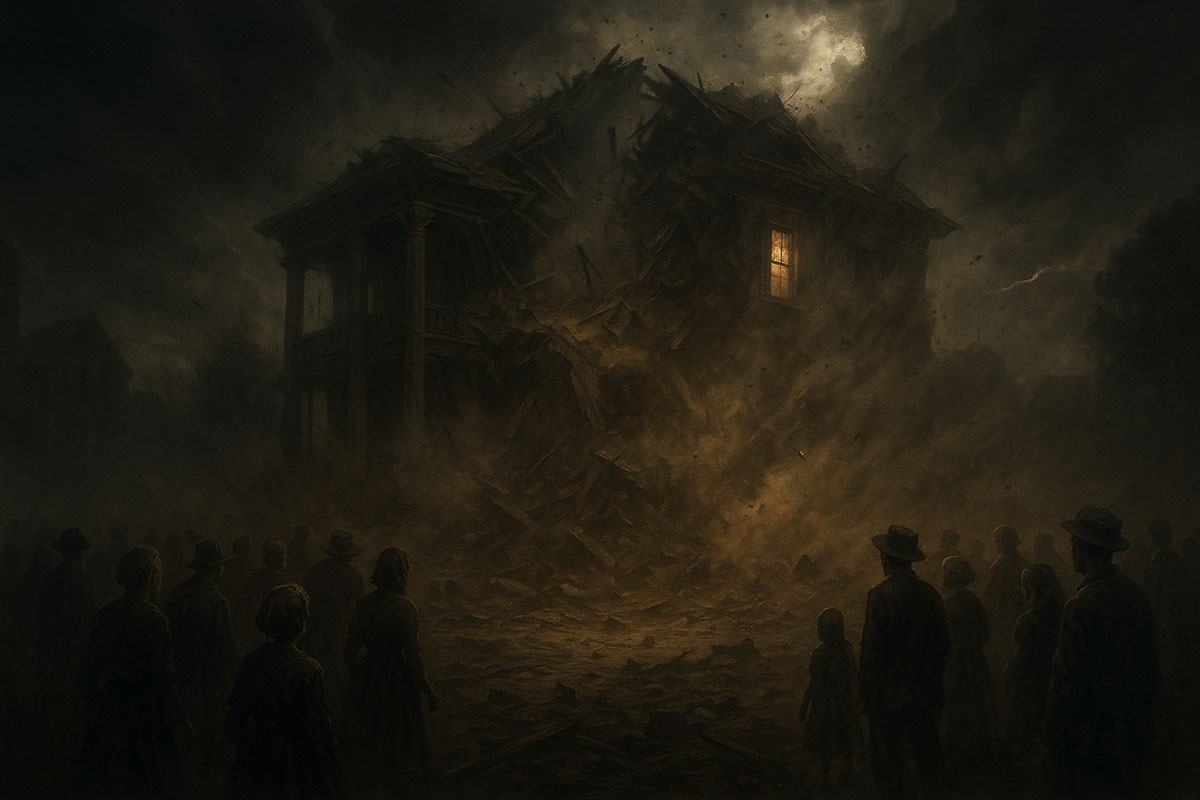
[The crowd rushes. The SUCCESSOR HISTORIAN lingers, staring transfixed at the bed. The MAYOR drags him out as the house begins to cave inward. With a thunderous crash, the mansion collapses, sending dust and debris across the stage.]
[Silence. Only the wreckage remains. The upstairs window—its frame intact—rests among the ruins, glowing faintly one last time before fading.]
Chorus (gathering slowly, shaken, in hushed tones):
The house is gone.
But the past is not gone.
The scar remains.
Sheriff’s Granddaughter (softly, standing before the rubble):
She is gone. Yet she is not. She lingers with us, in every whisper, in every shadow. And we—
We are the ones who fed her silence.
[The CHORUS murmurs in agreement, voices rising like a dirge.]
Chorus (final unison):
The past does not die.
It is not even past.
And Jefferson will never be free.
[Blackout.]
Final Thoughts By William Faulkner
When I said “a rose for Emily,” I meant it as one places a flower upon a grave — not to glorify, but to remember. A rose carries no judgment. It does not question the choices of the living or the dead. It only affirms that there was life here, and it was endured.
Emily Grierson’s tragedy was not hers alone. It was the tragedy of a town that looked at her from a distance but never crossed her threshold until it was too late. It was the tragedy of time itself, which erodes gentility into dust and turns love into possession.
The rose, then, is for Emily, but it is also for us: for our complicity, for our silence, for the fascination we call pity. It is a reminder that behind every closed door lies a story we do not see, and that every life, no matter how strange, deserves at least this — a single flower of remembrance.
Short Bios:
Emily Grierson
The last of a once-proud Southern family, Emily lived her life cloistered in the decaying Grierson mansion. Raised under her father’s iron control, she was denied love in youth and resisted change in age. Her loneliness hardened into denial, culminating in the secret she kept upstairs — a grotesque testament to her refusal to let go.
Mr. Grierson
Emily’s domineering father, remembered more as a shadow than a man. His pride shut out suitors and his authority defined Emily’s life. Even after death, his presence clung to her, shaping her choices and haunting her solitude.
Homer Barron
A Northern foreman with a booming laugh and easy charm. He brought color into Emily’s life briefly, but his reluctance to marry clashed with her desperate need for permanence. His fate was sealed not by his laughter, but by Emily’s silence and determination to keep him forever.
The Townspeople (Chorus)
Neighbors, gossips, and witnesses. They are the true chorus of Jefferson — judging, pitying, and watching Emily’s decline from a safe distance. Complicit in their silence, they become both narrators and participants in her tragedy.
The House
Though never speaking, the Grierson mansion is a character in its own right: a decaying monument that resists time, holds secrets, and mirrors Emily’s own stubborn refusal to change.
Leave a Reply