

What if Martin Luther King Jr. challenged modern Americans to confront their own political hatred?
Introduction by Dr. Martin Luther King Jr.
Let No Man Pull You Low Enough to Hate Him Meaning is not a slogan for one party. It is a discipline for every citizen—especially when politics tries to turn disagreement into contempt.
In this five-part imaginary dialogue, I moderate a roundtable built on one fair rule: if a tactic is wrong when the other side uses it, it is wrong when our side uses it. We examine self-mastery under provocation, accountability without cruelty, free speech without dehumanization, institutional trust with lawful dissent, and the hard work of ending retaliation cycles.
The purpose is not to soften conviction. The purpose is to keep conviction from becoming cruelty. A nation cannot remain free if it cannot restrain its appetite to humiliate its opponents.
(Note: This is an imaginary conversation, a creative exploration of an idea, and not a real speech or event.)
Topic 1: Self-Mastery Under Provocation

Moderator: Dr. Martin Luther King Jr.
Panel: Jonathan Haidt, Daniel Kahneman, Cass Sunstein, Mary Beth Tinker, William Ury
Dr. Martin Luther King Jr.: Before we begin, I will set a rule that makes this conversation fair—and makes it useless to every propagandist. If a tactic is wrong when the other side uses it, it is wrong when our side uses it. No moral discounts. No tribal exemptions. And no one—no politician, no pundit, no crowd—has the right to drag you low enough to hate.
Now, my question. Modern politics is full of provocation. People feel mocked, threatened, lied about, or treated as disposable. Then they are tempted to become the kind of person they claim to oppose. What happens inside a citizen when provocation hits—and what does real discipline look like without becoming passive or numb?
Daniel Kahneman: Provocation is effective because it targets our fastest mental machinery. When we feel threatened, we jump to conclusions, we simplify, and we search for a villain. We also become confident too quickly. A disciplined citizen creates a small gap between stimulus and response. Not endless hesitation—just enough to prevent being steered. A practical test is: “What evidence would change my mind?” If the answer is “nothing,” you’re no longer thinking; you’re defending an identity.
Jonathan Haidt: It also hits our need for belonging. People are not only persuaded by arguments—they’re pulled by groups. Provocation becomes a loyalty signal: you prove you’re on the team by showing outrage. This happens everywhere, not just in one party. Discipline means noticing when you’re performing for approval rather than seeking truth. Ask: “Am I trying to understand, or am I trying to win a status contest inside my group?”
Cass Sunstein: Groups intensify. When people mostly hear their own side, they become more certain and more extreme. The most aggressive framing wins applause. Over time, the group stops rewarding accuracy and starts rewarding “hard hits.” That is how provocation scales. Discipline requires cross-checking—deliberately encountering disagreement without treating it as contamination. Otherwise, even intelligent people become predictable and easy to manipulate.
Mary Beth Tinker: On the ground, provocation looks like a taunt at a school meeting, a viral clip, a workplace argument, a neighbor’s sign in the yard. The temptation is to strike back with humiliation. That is where dignity collapses. Discipline does not mean silence. It means you speak firmly without degrading. You defend your rights and your values without turning another person into a target for cruelty.
William Ury: Provocation is often about dignity. People want to feel safe, respected, and not controlled. When that is threatened, we go into fight mode. Discipline is self-command: holding your boundaries without letting anger hijack your judgment. One tool is to move from “enemy-thinking” to “problem-thinking.” Instead of “Who is evil?” ask: “What fear is being exploited? What interest is at stake? What outcome actually makes tomorrow safer?”
Dr. Martin Luther King Jr.: You have described a nation not merely arguing, but being trained—trained to react. And reaction is easy to sell.
Now I ask the second question, because this is where citizens confuse passion with virtue. Many people say, “My anger proves I care.” But anger can either serve justice or serve hatred.
How do we tell the difference between moral seriousness and moral corruption—between righteous anger and the pleasure of hate?
Jonathan Haidt: Moral seriousness stays connected to facts and limits. It says, “This is wrong, and here is why.” Moral corruption shows up when people stop caring about truth and start caring about humiliation. When you want the other side to suffer, when you delight in their downfall, that’s a signal. Another signal is when you assume bad motives by default—when disagreement becomes proof of wickedness.
Daniel Kahneman: Overconfidence is another signal. When people become certain that only fools or villains could disagree, bias is already in control. Hatred is often a story that feels clean and satisfying: one side is pure, the other side is rotten. Reality is rarely that convenient. A disciplined citizen stays aware of uncertainty and resists the comfort of total certainty.
Cass Sunstein: Look for double standards. Moral corruption arrives when people excuse tactics they would condemn if used against them—smears, intimidation, selective outrage, selective “rules.” The test is simple: “Would I accept this if the other side did it?” If not, you are no longer defending a principle; you are defending a tribe.
Mary Beth Tinker: Watch your language. When you start using words you would not want used about your own family, you’ve crossed a line. When you stop criticizing actions and start stripping people of dignity, you are feeding hatred. Debate can be intense without being degrading. If you can’t argue without contempt, you’ve lost control of yourself.
William Ury: Also watch your goal. Righteous anger aims at improvement: safety, fairness, a better outcome. Hate aims at emotional payoff: “I want to punish you because it feels good to punish you.” That payoff is short-lived, but it does long-term damage. Hate locks you in the past. Discipline keeps you oriented toward the future.
Dr. Martin Luther King Jr.: That is the noted danger: hatred feels like strength, but it is often surrender—surrender to someone else’s ability to provoke you.
Now I ask the third question, because citizens do not only need ideals; they need habits.
Give me concrete practices—personal and civic—that help people keep self-mastery under provocation, without becoming passive and without becoming cruel.
Daniel Kahneman: Create a pause. When you feel the surge—anger, fear, triumph—delay your response. That delay is not weakness; it is steering control. Also, do not share claims you cannot verify. Treat “I’m not sure” as a mark of seriousness, not a mark of shame.
Cass Sunstein: Build environments that reward accuracy. In families, workplaces, and communities, praise people for correcting themselves. Encourage disagreement without punishment. Reduce the social reward for the most extreme framing. If people are praised for being fair-minded—even while strongly opinionated—the incentive structure changes.
Jonathan Haidt: Strengthen identity outside politics. If politics becomes your main source of belonging, then political conflict becomes personal war. Strong families, faith communities, local service, hobbies, and friendships across difference are not distractions. They make citizens harder to manipulate.
Mary Beth Tinker: Teach and practice debate norms: criticize ideas, not personhood; defend rights without intimidation; protest without dehumanization. And model it. Adults must show young people what courage looks like when it includes restraint.
William Ury: Use curiosity as a de-escalation tool. Ask genuine questions. Repeat back what you heard—accurately, not sarcastically. Find one shared value even if you disagree on everything else. Shared value does not mean agreement; it means a bridge for conversation. Also, invest in local conflict resolution—mediation, community dialogue, de-escalation training—so disagreement has outlets besides shouting and revenge.
Dr. Martin Luther King Jr.: I will close with this. The battle for justice is not only out there in laws and elections. It is also in here—in the human heart—where provocation tries to build a home.
Let no man pull you low enough to hate him. That is not a request for softness. It is a command of strength. If your opponent can make you hate, your opponent can make you unfair. If your opponent can make you hate, your opponent can make you reckless. And if your opponent can make you hate, your opponent can govern you from the inside.
So we hold our line. We demand standards. We argue fiercely. We seek truth. We protect the innocent. We correct what is wrong. But we refuse to become a people addicted to contempt. Because a nation cannot stay free if its citizens cannot first govern themselves.
Topic 2: Accountability Without Cruelty

Moderator: Dr. Martin Luther King Jr.
Panel: Preet Bharara, Tom Tyler, John Braithwaite, Bryan Stevenson, Danielle Sered
Dr. Martin Luther King Jr.: I will begin with the rule that keeps this discussion honest. If a tactic is wrong when the other side uses it, it is wrong when our side uses it. No exceptions. And no anger—however justified—gives us permission to be dragged low enough to hate.
Now, the question. Every society needs accountability. Without it, the innocent are left exposed and the strong rule the weak. But accountability can be pursued in two ways. One way is serious, evidence-based, proportionate, and focused on public safety. The other way is performative, selective, and fueled by humiliation.
What does accountability look like when it is firm enough to protect the public, fair enough to be trusted, and disciplined enough to avoid cruelty?
Preet Bharara: Start with evidence and standards. Accountability collapses when people want punishment without proof, or when they change standards based on who the accused is. A serious system applies the same rules to friends and enemies. It also avoids punishment-as-spectacle. The moment the public begins to treat consequences as entertainment, the system loses seriousness and invites abuse.
Tom Tyler: People comply with law when they believe it is legitimate. Legitimacy comes from process: respect, neutrality, transparency, and giving people a voice. Firmness without fairness produces resistance. Fairness without firmness produces fear. The combination—firm, fair process—reduces retaliation, increases cooperation, and makes public safety more achievable.
John Braithwaite: We should distinguish between consequences and degradation. Consequences can be necessary. Degradation is optional—and usually harmful. When a system humiliates people, it often manufactures defiance and future harm. A serious approach condemns the wrongdoing clearly and imposes proportionate consequences, while avoiding the kind of degrading treatment that turns punishment into a recruitment tool for resentment.
Bryan Stevenson: Cruelty is often sold as toughness, but it is frequently a shortcut around good judgment. A strong society can impose real consequences while still insisting on human dignity. Dignity doesn’t erase responsibility. It prevents the system from becoming a mirror of the very harm it condemns. When we strip dignity from people, we weaken the moral authority of the law and make justice look like vengeance.
Danielle Sered: Accountability should be measured by results: fewer victims, less repeat harm, more safety, more repair. If consequences do not lead to responsibility and change, you are mostly managing anger, not preventing harm. A fair system demands that people face what they did, accept responsibility, and make amends where possible. And it supports victims with real resources, not slogans. Accountability is not softness. It is obligation plus verification.
Dr. Martin Luther King Jr.: Now I ask the second question, because this is where politics tempts citizens into double standards.
When people are afraid, they demand harshness. When people are angry, they demand humiliation. When people feel righteous, they demand exceptions for themselves. Each of these instincts can appear in any ideology.
So what are the warning signs that accountability has stopped being justice and started being revenge—especially when a crowd insists it is “necessary”?
Preet Bharara: The first warning sign is selectivity. If the rules change based on identity, power, or popularity, you are not pursuing justice. You are pursuing advantage. The second is disproportion—punishments untethered from the actual wrongdoing. The third is pressure on process—intimidating witnesses, investigators, judges, or juries. And the fourth is celebration. Justice is sober. Revenge is gleeful.
Tom Tyler: Another warning sign is disrespect baked into procedures. When officials communicate contempt, people experience the system as hostile and they withdraw cooperation. That makes everyone less safe. In a healthy system, even those held accountable are treated with basic dignity, not because they “deserve” it, but because the system must remain legitimate.
John Braithwaite: Watch for stigmatizing permanence—the idea that a person can never return to good standing even after serving consequences and demonstrating change. That is not always warranted. Sometimes separation must continue for safety, but permanent social exile can become a factory of resentment. A stable society punishes the act, then—when appropriate—creates pathways back to responsible participation.
Bryan Stevenson: I would add moral laziness. Revenge avoids hard questions: What actually prevents repeat harm? What protects victims tomorrow? Cruelty is often a substitute for strategy. A serious society does not substitute anger for design.
Danielle Sered: And there’s the victim problem. Revenge is often performed in the name of victims while victims are left unsupported. A fair system does not use victims as a symbol. It provides them safety, resources, and agency. If a system talks about victims but doesn’t materially support them, it’s using pain as political fuel.
Dr. Martin Luther King Jr.: Now the third question, and it must be practical. People want a system that does not reward wrongdoing, does not excuse it, and does not turn justice into cruelty.
So what would a serious, fair community actually do tomorrow—on the ground—to get accountability without cruelty? Give me standards, guardrails, and habits.
Tom Tyler: Improve procedural fairness everywhere. Train officials to communicate respectfully. Make decisions transparent. Give people voice. When people believe the process is fair, they comply more and resist less. That reduces both crime and conflict.
Preet Bharara: Strengthen due process and oversight. Insist on evidence. Resist selective enforcement. Require clear, public standards. And hold leaders accountable when they inflame contempt. A leader who turns punishment into performance is weakening the rule of law.
John Braithwaite: Separate punishment from degradation. Impose proportionate consequences, but avoid humiliation rituals. Build reintegration pathways when appropriate, with proof of change. That’s not leniency—it’s reducing repeat harm.
Danielle Sered: Create real accountability pathways that require concrete obligations: truth-telling, responsibility, repair where possible, and verified behavior change. Also, provide real victim support services. A community that cares about victims invests in victims.
Bryan Stevenson: Combine consequences with prevention that is demonstrably linked to safety—mental health capacity, addiction treatment, early interventions, job pathways for reentry. Frame these as public safety tools, not ideological symbols. The goal is fewer victims.
Dr. Martin Luther King Jr.: I will close with a standard that applies equally to all sides.
A strong society does not confuse cruelty with seriousness. It does not confuse humiliation with justice. It does not excuse allies and crush enemies. It builds a system that can protect the innocent, prove wrongdoing with evidence, impose proportionate consequences, and still remain sober, fair, and human.
Let no man pull you low enough to hate him. In this topic, that means: do not let anger turn accountability into revenge. Hold the line. Keep standards consistent. Keep consequences real. But refuse cruelty—because cruelty is not strength. It is surrender.
Topic 3: Free Speech Without Dehumanization

Moderator: Dr. Martin Luther King Jr.
Panel: Nadine Strossen, John Inazu, Cass Sunstein, Jonathan Haidt, Mary Beth Tinker
Dr. Martin Luther King Jr.: I will begin with the rule that makes this conversation fair. If a tactic is wrong when the other side uses it, it is wrong when our side uses it. No moral discounts. No tribal loopholes. And no one—no institution, no movement, no crowd—has the right to pull you low enough to hate.
Now the question. A free society depends on speech: criticism, protest, argument, persuasion. But speech can also become a weapon—used to intimidate, to strip dignity, to turn neighbors into enemies. And restrictions can become a weapon too—used to silence dissent and protect power. Both dangers exist. Both can be used by any side.
So what does it look like to defend free speech while refusing dehumanization—and refusing intimidation disguised as “righteousness”?
Nadine Strossen: The starting point is simple: broad protection for speech keeps a society free, because once censorship power is normalized, it rarely stays limited to “bad people.” It expands. And it is eventually used against dissenters across the spectrum. But defending speech does not mean celebrating cruelty. Dehumanization is a moral failure and a public danger. The answer is not to hand more power to authorities to decide what may be said. The answer is to strengthen norms—argument over intimidation, persuasion over coercion, rebuttal over suppression.
John Inazu: We need to separate two things: the legal right to speak, and the civic skill of living with deep disagreement. A society that can’t tolerate disagreement becomes punitive and brittle. A society that tolerates dehumanization becomes cruel and unstable. The middle path is pluralism: protect rights, cultivate restraint, and build institutions where people can disagree strongly without treating each other as enemies.
Cass Sunstein: Incentives matter. In many environments, the sharpest insult gets the biggest reward. The most extreme framing gets applause. People learn quickly what earns status. That dynamic is not confined to one ideology. It’s human. If a society wants healthier speech, it has to reward good-faith argument, accuracy, and intellectual humility—especially when it’s inconvenient for your own side.
Jonathan Haidt: A major driver is moral certainty. People start to believe disagreement is not a difference of judgment but proof of bad character. Then dehumanization feels justified. The antidote is learning to separate people from positions. You can oppose a claim fiercely without assuming the person is evil. Once you label the person an enemy, you stop listening, and you start escalating.
Mary Beth Tinker: In schools and communities, we can teach a simple rule: you may argue hard, but you may not humiliate. You may protest, but you may not intimidate. You may criticize power, but you may not strip dignity from those who disagree with you. Free speech is essential, but it should not become a cover for cruelty. And standards should apply consistently—not only when we feel offended.
Dr. Martin Luther King Jr.: Now I ask the second question, because citizens feel the tension. Some fear that if harmful ideas are not confronted aggressively, they will spread. Others fear that “aggressive confrontation” has become social punishment without due process—designed to frighten people into silence.
So where is the line between legitimate criticism and intimidation? How do we keep accountability from becoming a mob—and keep freedom from becoming a license for cruelty?
John Inazu: Legitimate criticism targets the argument and the behavior. Intimidation targets the person’s standing—attempting to ruin them rather than persuade them. It often relies on threats, coordinated harassment, or pressure campaigns that bypass fair process. If the goal is to make people afraid to speak, that’s intimidation, not debate. A healthy society doesn’t demand agreement; it demands restraint.
Nadine Strossen: A good test is coercion versus persuasion. People have every right to rebut speech, criticize it, boycott, protest, argue, publish counterarguments. But when it becomes targeted harassment—doxxing, threats, stalking, swarming someone’s workplace or family—that’s coercion. And coercion can come from any side. A free society must defend robust debate while condemning coercive tactics that silence debate.
Cass Sunstein: Another test is consistency. If your standards shift depending on whether the target is an ally or an opponent, people will correctly conclude that “accountability” is just a weapon. When people lose trust in fairness, they stop listening and start retaliating. The purpose of consistent standards is not politeness; it’s stability.
Jonathan Haidt: Watch what your group rewards. If humiliation becomes entertainment, you’re in trouble. Groups can become addicted to punishment rituals, and they begin to confuse cruelty with courage. A disciplined citizen asks: am I trying to correct and persuade, or am I enjoying the destruction of someone’s reputation?
Mary Beth Tinker: The civic habit we need is the ability to argue without degrading. If you can’t express your position without contempt, you’re not strengthening your cause—you’re shrinking it. The goal is a society where people can say hard truths without fear, and where disagreement doesn’t require humiliation.
Dr. Martin Luther King Jr.: Now the third question. People want tools. They want standards they can apply tomorrow—in media, schools, workplaces, and politics.
What are the practical rules of conduct that protect free speech, protect human dignity, and keep debate from collapsing into dehumanization?
Cass Sunstein: Build “fairness friction.” Encourage norms that require people to state the other side’s argument accurately before criticizing it. Reward corrections. Reward clarity. If people are praised for intellectual honesty, the incentive structure shifts away from insult.
Nadine Strossen: Defend broad speech rights, but draw bright lines around coercion: threats, harassment, stalking, doxxing, and incitement to violence. Those are not debate. They are intimidation. A free society can protect speech and still protect people.
John Inazu: Strengthen pluralistic institutions—places where people cooperate even while disagreeing. Service organizations, community projects, local boards, and diverse workplaces can teach the skill of coexistence. When people know each other as humans, it becomes harder to demonize.
Mary Beth Tinker: Teach debate and protest skills early: how to disagree with respect, how to protest without intimidation, how to defend rights while honoring the dignity of opponents. These are civic skills, like reading and writing.
Jonathan Haidt: Rebuild cross-cutting relationships. If you only know the other side as a caricature, dehumanization becomes easy. When you know individuals, it becomes harder to hate. Also, train yourself to replace “they are evil” with “I think they are wrong, and here’s why.”
Dr. Martin Luther King Jr.: I will close with this. A free society is not one where everyone agrees. It is one where people can disagree without destroying each other’s humanity.
Let no man pull you low enough to hate him. In this topic, that means: do not let speech become the tool that turns your opponent into less than human. And do not let fear tempt you to silence dissent through intimidation or censorship.
If we believe in freedom, we must believe in persuasion. If we believe in dignity, we must refuse humiliation. And if we believe in fairness, then our standards must apply to everyone—especially when it costs us something.
Topic 4: Institutions, Trust, and Lawful Dissent

Moderator: Dr. Martin Luther King Jr.
Panel: Stephen Breyer, Preet Bharara, Nadine Strossen, Tom Tyler, Cass Sunstein
Dr. Martin Luther King Jr.: I will begin with the rule that makes this conversation fair. If it is wrong when the other side does it, it is wrong when our side does it. No special exemptions for our friends, no harsher standards for our enemies. And no person, no party, no institution, and no crowd has the right to pull us low enough to hate.
Now the question. A free people must be able to challenge institutions—courts, elections, police, agencies, the press—without fear. That is lawful dissent. But there is a danger on both sides: one danger is reflexive “trust the system”, which can excuse real abuse; the other danger is reflexive “burn it all down”, which can destroy the rules that protect ordinary citizens.
So what does a disciplined middle path look like—one that respects the rule-set, scrutinizes the referees, and keeps dissent lawful and serious?
Stephen Breyer: The rule-set matters because it is how we settle disputes without violence. Citizens should criticize institutions; that is part of democracy. But if every loss becomes “proof” that the entire system is illegitimate, we lose the common ground that makes peaceful disagreement possible. Courts and institutions must do their part: explain decisions, follow consistent standards, and be transparent when they can. Citizens must do their part: challenge outcomes with evidence and lawful tools, not with blanket contempt.
Preet Bharara: Trust is earned, not demanded. Institutions damage trust when they appear selective, sloppy, or influenced by politics. And citizens damage trust when they demand exceptions for their own side—immunity for allies, punishment for opponents. The rule of law is tested precisely when it is inconvenient. If you only believe in due process when it protects people you like, you don’t really believe in due process.
Nadine Strossen: Lawful dissent requires strong speech protections. A society that responds to institutional criticism by censoring it proves the critic’s point. At the same time, criticism must be responsible. Serious dissent uses evidence, sources, and restraint. Reckless accusations can incite harassment, threats, and vigilantism. We can defend free speech while also demanding a culture that values accuracy over rumor—because accuracy is what keeps dissent legitimate.
Tom Tyler: People cooperate with institutions when the process feels fair. That means respectful treatment, neutral decision-making, transparency, and the chance to be heard. When citizens feel dismissed or ridiculed, distrust grows and becomes identity. Improving procedural fairness is not partisan; it’s practical. It reduces conflict and increases compliance even when outcomes disappoint people.
Cass Sunstein: Echo chambers intensify distrust. In like-minded circles, the most dramatic accusations get the most applause, and over time people stop distinguishing between what is proven and what is emotionally satisfying. That can happen on any side. A disciplined society develops norms that reward verification and penalize rumor—especially when the rumor helps “our team.”
Dr. Martin Luther King Jr.: Now the second question. We often speak of corruption as something the other side does. But a fair conversation requires self-examination.
What are the most common ways citizens and leaders on any side weaken institutions while claiming to defend justice—and how do we call it out without becoming partisan?
Preet Bharara: The most common is the double standard. People demand strict investigation when it targets opponents, and they call it a witch hunt when it targets allies. They praise oversight when it helps them, and they attack oversight when it threatens them. Another is intimidation—pressure on investigators, judges, juries, or election officials. If your argument depends on threatening people, it’s not lawful dissent; it’s coercion.
Stephen Breyer: Another pattern is confusing disagreement with illegitimacy. Courts make decisions people dislike. Elections produce winners people resent. That is not proof of fraud or corruption. If claims are made, they must be supported by evidence and pursued through lawful channels. Otherwise, we teach citizens that only victory is legitimate—which leads straight to instability.
Cass Sunstein: A third pattern is informational irresponsibility—sharing claims without checking them because they feel good. People do this to protect identity and group status. If the public rewards certainty more than accuracy, the system becomes vulnerable to manipulation. Calling it out means praising truth-telling even when it costs your side something.
Nadine Strossen: A fourth pattern is trying to silence criticism when it feels threatening. That might be official censorship, or it might be informal coercion through harassment and intimidation. Either way, it shrinks lawful dissent. A society must preserve the right to criticize institutions, or institutions become unaccountable.
Tom Tyler: And a fifth is disrespect as habit—officials treating citizens with contempt, and citizens treating officials as enemies. Disrespect is not merely rude; it breaks cooperation and builds resentment. Procedural fairness and respectful communication are stabilizers.
Dr. Martin Luther King Jr.: Now the third question. Many citizens ask, “If I suspect bias or wrongdoing, what do I do?” They do not want to be told to be quiet. They also do not want to become part of a mob.
So give me a practical pathway. How does a citizen challenge institutions forcefully—without rumor, without intimidation, without hatred, and without surrendering lawful order?
Nadine Strossen: Use lawful tools and evidence. File complaints. Gather documents. Support investigative journalism that cites sources. Use courts, public hearings, oversight processes, and peaceful protest. Avoid harassment and threats. Your power increases when your claims are documented and your conduct is restrained.
Preet Bharara: Demand independent oversight and clear standards. Support conflict-of-interest rules, transparency requirements, and whistleblower protections. And be consistent: if you want accountability, accept it when it reaches your own side too. That is the credibility test.
Tom Tyler: Participate. Attend meetings. Serve on boards. Use civic channels. Push for improvements in process: transparency, respectful treatment, clear explanations. When people see a system that listens and corrects errors, trust becomes possible again.
Cass Sunstein: Cross-check information before spreading it. Encourage norms in your circles: “Show me the evidence.” Reward people who correct mistakes. Discourage sensational claims that can’t be supported. This is not passivity; it is disciplined self-government.
Stephen Breyer: Preserve the peaceful settlement of disputes. That is the point of institutions. Reform them when needed, but do not treat them as enemies to be destroyed. The alternative is rule by intimidation—always worse, always unstable.
Dr. Martin Luther King Jr.: I will close with a standard that applies equally to every ideology.
We must not worship institutions. And we must not sabotage them. We must respect the rule-set while scrutinizing the referees. We must pursue reform through lawful means. And we must refuse the intoxicating pleasure of contempt.
Let no man pull you low enough to hate him. In this topic, that means: do not let distrust—however justified—turn into a hatred that destroys the shared rules that protect us all. Hold your standards. Demand evidence. Use lawful tools. And keep your conscience free of the poison that makes justice impossible.
Topic 5: Ending Retaliation Cycles

Moderator: Dr. Martin Luther King Jr.
Panel: William Ury, Danielle Allen, Preet Bharara, Daryl Davis, Priscilla Hayner
Dr. Martin Luther King Jr.: I will begin with the rule that makes this conversation fair. If it is wrong when the other side does it, it is wrong when our side does it. No moral discounts. No “my outrage is special.” And no grievance—real or imagined—gives anyone the right to pull us low enough to hate.
Now the question. A country can survive disagreement. But when disagreement becomes retaliation—punish, counter-punish, humiliate, counter-humiliate—politics becomes a vendetta. Each side calls itself the victim. Each side calls its retaliation “necessary.” And the cycle becomes self-justifying.
How does a nation break retaliation cycles without pretending harm didn’t happen, without handing out blanket forgiveness, and without surrendering accountability?
Danielle Allen: The first step is to restore the idea of shared citizenship. That doesn’t mean friendship. It means legitimacy: the other side has a right to exist, to speak, to vote, to participate. Retaliation grows when people start believing opponents are not legitimate citizens, but threats that must be crushed. Once you define politics as extermination—social, legal, or reputational—the cycle is guaranteed. Breaking it means keeping conflict inside rules.
Preet Bharara: Rules are the key. Retaliation fills the vacuum when people believe rules are selectively enforced. A nation breaks retaliation by insisting on evidence, consistent standards, and due process—especially when it’s painful to your side. If consequences are real and fair, people are less tempted to take justice into their own hands. But if accountability is used as a weapon—protect allies, punish enemies—retaliation becomes rational.
William Ury: Retaliation is often driven by unmet needs: safety, dignity, and assurance that harm won’t repeat. If those needs aren’t addressed, people reach for the blunt tool of revenge. Breaking the cycle requires two things: credible boundaries (so people feel safe) and credible channels for grievances (so they don’t feel ignored). The goal is not to eliminate conflict; it is to stop escalation.
Priscilla Hayner: Retaliation also thrives on competing stories. Each side believes its own version of events and dismisses the other’s. A practical tool is transparent fact-finding with checks: courts, audits, independent investigations, verified documentation, public reports. That’s not about enforcing a single narrative—it’s about shrinking the space where rumor can justify revenge.
Daryl Davis: And then there’s the human factor. Retaliation becomes easy when the other side is a symbol, not a person. When people have never spoken across the divide, their picture of the enemy gets filled with caricatures. Human contact doesn’t solve everything, but it makes dehumanization harder. You can still disagree strongly. But it becomes harder to celebrate harm when you’ve looked someone in the eye and heard their story.
Dr. Martin Luther King Jr.: Now the second question, because citizens raise a serious concern. They say, “If we stop retaliating, the other side will take advantage. Restraint will be interpreted as weakness.”
So what is the difference between breaking a cycle and enabling bad behavior? What does strength look like when it refuses hatred?
Preet Bharara: Strength is consequences applied consistently. Not softness—consistency. You investigate wrongdoing with evidence. You prosecute or sanction when appropriate. You protect rights for everyone. You don’t let leaders or crowds intimidate witnesses, judges, jurors, election officials, or police. And you don’t excuse threats because they came from “our people.” That consistency is what prevents retaliation from being framed as “justice.”
William Ury: Strength is firm boundaries plus de-escalation. It’s the ability to say, “This will not be tolerated,” without saying, “And now I’ll destroy you.” Escalation is easy. De-escalation requires discipline. The strongest negotiators I’ve seen are not the loudest—they’re the most controlled.
Danielle Allen: Strength is also preserving legitimate opposition. Democracies fail when people can’t lose safely. If losing means being ruined—socially, economically, legally—then politics becomes war. A strong democracy builds guardrails that allow intense competition without annihilation.
Priscilla Hayner: Strength requires credible truth. When truth becomes optional, retaliation becomes endless because everyone can justify anything. A disciplined society protects evidence, supports transparency, and punishes violence and intimidation regardless of who does it.
Daryl Davis: Strength is refusing to be manipulated. Some people profit from your anger. They want you to believe the only option is revenge. The moment you choose hatred, they win. You can protect yourself, demand accountability, and still refuse to hate. That is not weakness—it’s self-command.
Dr. Martin Luther King Jr.: Now my third question. Give me concrete actions—not speeches—that ordinary citizens and leaders can adopt tomorrow to reduce retaliation and rebuild a workable civic life.
Priscilla Hayner: Commit to verified information. Encourage public processes that document wrongdoing with evidence and make findings public. Support oversight that is independent, not partisan theater. And protect the people who tell the truth—whistleblowers, witnesses, investigators—so fear doesn’t replace facts.
Preet Bharara: Reinforce due process and consistent enforcement. Demand that accountability applies to allies and opponents. Reject intimidation tactics openly. And insist leaders speak responsibly; public rhetoric that treats opponents as enemies invites retaliation.
Danielle Allen: Strengthen civic habits: serve locally, participate in community institutions, support fair elections and peaceful transfers, and treat disagreement as normal rather than existential. The more we practice citizenship in ordinary life, the less we demand total victory in politics.
William Ury: Build conflict resolution capacity: mediation, local dialogue formats, de-escalation training, and “cooling mechanisms” after crises. Also create face-saving exits so people can step back from escalation without humiliation. Humiliation locks people into retaliation.
Daryl Davis: Increase real contact across difference. Not staged shouting matches, but conversations in churches, service clubs, veteran groups, union halls, neighborhood projects—places where people cooperate. You don’t have to agree. But you do have to stop treating each other like monsters.
Dr. Martin Luther King Jr.: I will close with this. Retaliation always claims to be justice, but it is usually pride wearing a robe. It promises security and delivers escalation. It promises dignity and delivers humiliation. It promises victory and delivers a country that cannot live with itself.
Let no man pull you low enough to hate him. In this final topic, that means: do not allow your fear, your anger, or your appetite for revenge to become the engine of your politics. Demand truth. Demand accountability. Keep boundaries strong. Keep standards consistent. And refuse dehumanization—because once a nation learns to hate as a habit, it will eventually hate its own freedom.
If we must fight, let us fight with discipline. If we must oppose, let us oppose with fairness. And if we must win, let us win without losing our souls.
Final Thoughts by Dr. Martin Luther King Jr.
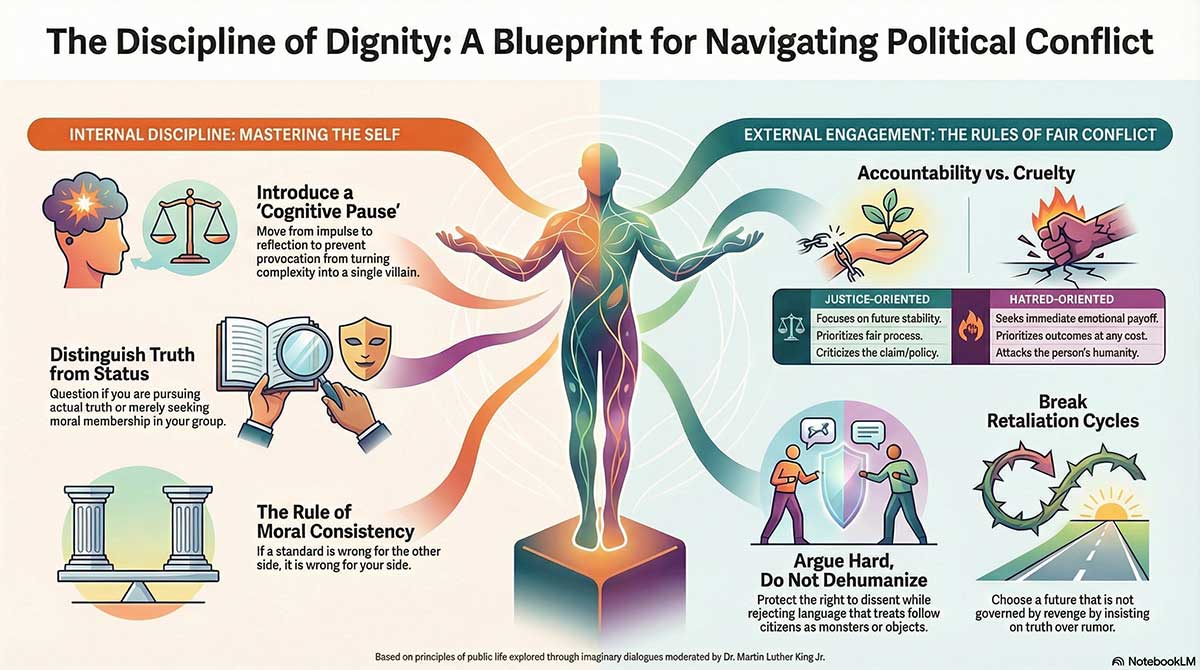
I have heard the fears that drive our public life: fear that crime will go unpunished, fear that speech will be silenced, fear that institutions are corrupt, fear that the other side will destroy the country if given power. Those fears do not belong to one party. They live in every human heart when trust collapses.
But here is the test that applies equally to all: will you keep your standards when it costs you? Will you reject humiliation even when it feels satisfying? Will you demand evidence even when rumor flatters your side? Will you defend rights even for those whose views you reject?
Hatred is not strength. Hatred is surrender—because it allows your opponent to govern you from the inside. When a man can make you hate, he can make you unjust. When a crowd can make you hate, it can make you reckless. And when politics makes hatred normal, freedom becomes fragile.
So let no man pull you low enough to hate him—not because your opponent deserves it, but because your soul cannot afford the corrosion. Fight for what you believe. Argue with courage. Demand accountability. Protect the innocent. But refuse dehumanization. Refuse the double standard. Refuse revenge as entertainment.
If we must oppose, let us oppose with fairness. If we must win, let us win without losing our moral discipline. That is how a people stays free.
Short Bios:
Dr. Martin Luther King Jr.
Civil rights leader and Baptist minister whose philosophy of nonviolence and disciplined love reshaped modern movements for justice and human dignity.
Stephen Breyer
Former U.S. Supreme Court Justice known for pragmatic constitutional interpretation and emphasis on institutional stability and civic participation.
Nadine Strossen
First Amendment scholar and former ACLU president advocating robust free speech alongside strong anti-harassment principles.
Preet Bharara
Former U.S. Attorney recognized for corruption prosecutions and consistent rule-of-law standards across political lines.
Cass Sunstein
Legal scholar and behavioral economist known for research on group polarization, institutional design, and democratic norms.
Tom Tyler
Psychologist and legal scholar specializing in procedural justice and how fairness builds public trust in institutions.
Jonathan Haidt
Social psychologist studying moral foundations, polarization, and how tribal instincts shape political conflict.
Mary Beth Tinker
Free speech advocate whose landmark Supreme Court case affirmed students’ constitutional rights in public schools.
William Ury
Negotiation expert and coauthor of Getting to Yes, focused on conflict de-escalation and practical peacemaking.
Bryan Stevenson
Civil rights attorney and founder of the Equal Justice Initiative, advocating justice reform grounded in dignity and accountability.
Danielle Sered
Justice reform leader developing accountability models that center victims while reducing repeat harm.
John Braithwaite
Criminologist known for “reintegrative shaming” theory, emphasizing accountability without permanent social exclusion.
Desmond Tutu
South African archbishop and chair of the Truth and Reconciliation Commission, championing truth with forgiveness.
Danielle Allen
Political theorist focused on democratic citizenship, trust-building, and civic repair in divided societies.
Priscilla Hayner
Expert on truth commissions and transitional justice, advising governments on accountability and public truth processes.
Daryl Davis
Musician and dialogue advocate known for persuading extremists to abandon hate through sustained, personal engagement.
Leave a Reply