
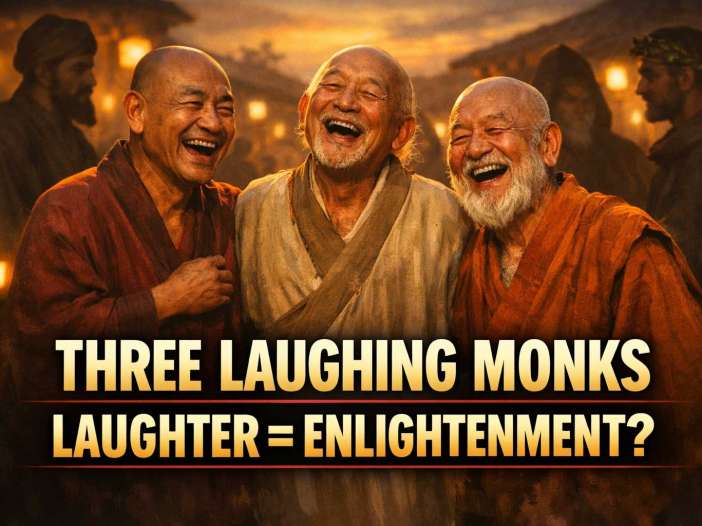
What if the Three Laughing Monks debated top philosophers about whether laughter is true enlightenment?
A village square in ancient China. Dust in the air. Steam from dumplings. A chicken with serious opinions.
Right in the middle of it all, three old monks arrive together. Nobody knows their names. Not because history failed. Because these three absolutely refused to give you the satisfaction.
They stand in the center of the square, look around like they are checking the vibes, and then they start laughing.
Not the polite “haha.” Not the “I am laughing because you are my boss.” This is warm, unstoppable laughter, like somebody just remembered the universe is ridiculous and decided to forgive it.
At first the villagers stare. Then one person smiles. Then another person cracks. Then the laughter jumps like a spark. Within minutes, the whole square is laughing, and nobody is even sure why. Which, honestly, is the best kind.
Now the weird part is that the laughter attracts other weird people. It is like a spiritual group chat invitation. One by one, the legends show up.
Hotei rolls in looking like happiness got a human body and forgot to be subtle. He laughs immediately, because of course he does. He is basically laughter with legs.
Zhuangzi arrives next, smiling like he already knows this entire square is either a dream, a butterfly, or a butterfly dreaming it is a monk.
Hakuin shows up with the energy of a man who could slap enlightenment into you and then offer you tea. Ryokan follows him, soft and gentle, like a poem that accidentally became a person.
Milarepa appears like a mountain that learned how to walk. He has suffered, he has transformed, and he is here to ask the one question everyone avoids: are we laughing because we are free, or because we are scared.
Rumi glides in as if the heart has its own sandals. He listens to the laughter and nods like, yes, that is also a form of prayer, and it is much easier on the throat.
Nasruddin strolls in late, not because he is rude, but because timing is part of the joke. He is already smiling like he has something in his pocket and you are going to regret asking about it.
St. Francis arrives with the kind of kindness that makes you check your own soul for dust. He looks at the laughing crowd and thinks, beautiful. Also, did anyone eat today.
Diogenes enters like a suspicious raccoon in human form. He scans the square as if looking for hypocrisy the way other people look for lost coins.
And then, very quietly, Marcus Aurelius arrives, calm as a stone in a river. He watches the laughter like an emperor watching a rebellion and thinking, if this spreads, is it dangerous or is it medicine.
The three laughing monks keep laughing. They do not advertise a teaching. They do not start a school. They do not sell a course.
And yet the entire square is already learning something.
So here is the question that kicks open the door.
If laughter can change a village in five minutes, what exactly is it doing to the human heart.
(Note: This is an imaginary conversation, a creative exploration of an idea, and not a real speech or event.)
Topic 1: Is laughter enlightenment, or just avoidance?
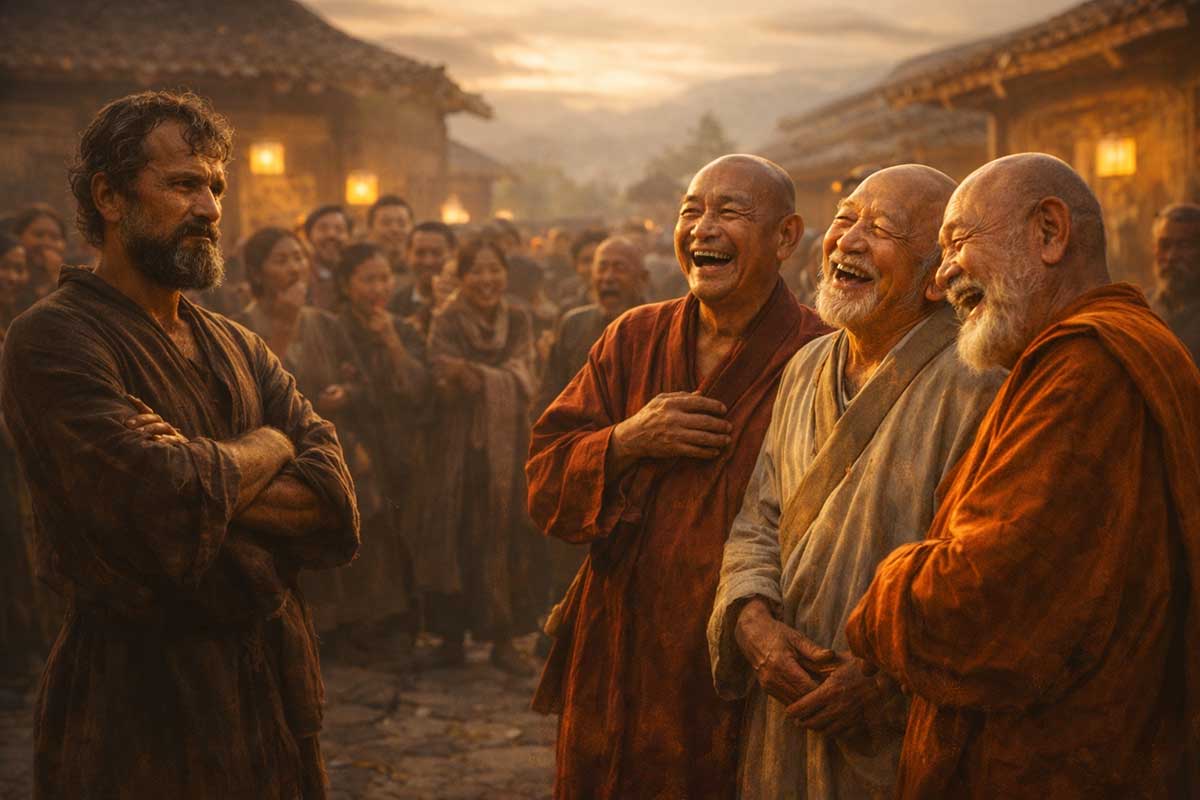
The village square smells like dust, steamed buns, and whatever that one fish vendor is pretending is fresh.
Three old monks step into the center like they own the place, even though they are carrying nothing but wrinkles and confidence. Nobody knows their names. Not because history forgot, but because these three would rather levitate than fill out a name tag.
They stand. They look around. They inhale like they are about to deliver a sermon.
Then they laugh.
Not mean laughter. Not nervous laughter. The kind of laughter that sounds like someone just set down a heavy bag they have been carrying for years.
A child giggles. A merchant tries to stay professional and fails. A grandmother snorts and immediately acts like she did not.
A new figure walks in from the temple gate with the calm of someone who has seen every spiritual performance and still refuses to clap on cue.
It is Hakuin.
He watches the laughter spread like warm tea poured into cold water. Then he steps forward as if he is about to moderate a debate between lightning and a mountain.
Hakuin: All right. We have three laughing monks who do not speak, yet somehow the whole village is talking with their faces. We also have a philosopher who thinks reality is optional, an emperor who thinks emotions need a job description, a yogi who survived his own past, and a man who considers manners a kind of tax.
Diogenes: I do not pay taxes.
The crowd laughs. The monks laugh harder, like Diogenes just donated a temple bell.
Hakuin: Good. Now listen. I am going to ask something that sounds simple, but it bites. How do we tell the difference between laughter that frees the heart and laughter that dodges pain.
The Three Laughing Monks: Ha ha ha ha ha.
They look at the crowd and laugh again, as if the answer is already in the room and the room is pretending not to notice.
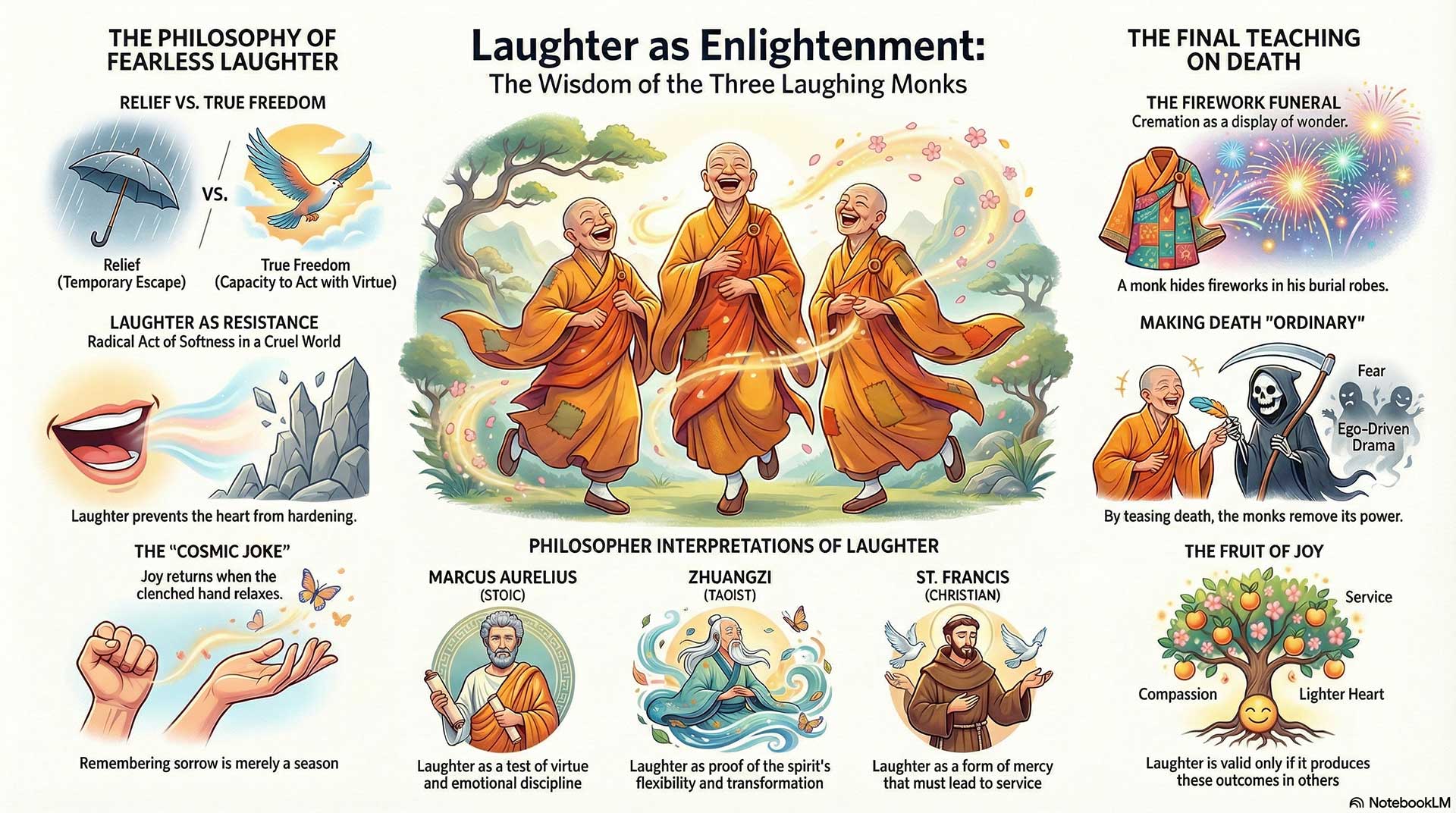
Marcus Aurelius: A useful test is what remains afterward. Does the laughter leave you more capable, more steady, more humane. Or does it leave you scattered, avoiding what must be faced. Relief is not the same as freedom. Freedom increases your capacity to act with virtue.
Milarepa: When laughter is real, it has no panic in it. When laughter is a mask, it has a sharp edge. I have worn many masks. The mask tries to keep pain out. True laughter does not keep pain out. It invites pain to sit down and stop shouting.
Diogenes: Easiest test. Watch what the laughing person does when the joke is over. If they go right back to chasing status, coins, and approval, it was a nap, not awakening. If they become less ridiculous, then fine, call it medicine.
Zhuangzi: We may be asking the question backward. Perhaps pain is what dodges laughter. Perhaps the self dodges laughter because laughter makes the self less important. If your pain is made of a story you cling to, laughter loosens the grip. Then you can finally hold the story gently instead of strangling yourself with it.
Hakuin nods, like someone watching five swords swing and realizing only one is actually sharp.
Hakuin: All right. Here is the next problem. It will make some of you uncomfortable, which is usually a sign that it is useful. If someone laughs during tragedy, what makes it wisdom instead of denial.
The Three Laughing Monks: Ha ha ha.
They laugh, but now it is quieter. It is still joy, but it carries gravity, like a candle flame that does not flicker even when the wind shows up.
Marcus Aurelius: Intention and responsibility. If laughter is used to dishonor suffering, it is cruelty. If laughter is used to steady the soul so that one can respond well, it can be wisdom. A soldier can smile before battle, not to mock death, but to refuse fear control.
Milarepa: There is a laughter that is disrespectful, and there is a laughter that is fearless. Fearless laughter says, I will not add extra suffering to what already hurts. I will not panic and infect others with panic. But it must be joined to compassion. If a person is grieving, you do not throw laughter at them like a stone.
Diogenes: Let us be honest. Most denial is very polite. People deny death by buying expensive robes, building fancy graves, and pretending their titles will negotiate with the universe. At least these monks are doing denial loudly if that is what it is. But I suspect they are insulting death, and death deserves it.
Zhuangzi: When my wife died, I mourned, and then I stopped. Not because love ended, but because I remembered transformation. Tragedy is real, yet also part of change. Wisdom is when laughter does not erase grief, but prevents grief from turning into a permanent prison.
Hakuin: Good. Now the last one. Try not to answer like you are writing a plaque for a temple wall. What is the test of real laughter when life stays hard for a long time.
A dog barks once, like it also wants to be included. The villagers quiet down, not from sadness, but from attention.
The Three Laughing Monks: Ha ha ha.
They laugh again, and this time it lands differently. Not as an escape hatch, but as a hand on the shoulder. The laughter is steady, like a drumbeat that says, keep walking.
Marcus Aurelius: Duration exposes what is shallow. The test is whether laughter helps you remain just, courageous, and disciplined over time. If hardship continues, does laughter become bitterness, or does it become steadiness. True strength is not a mood. It is a practiced choice.
Milarepa: When life stays hard, the mind tries to make a throne out of suffering. It says, look at me, I am special because I hurt. Real laughter removes the throne. It makes you ordinary again. Ordinary means you can keep practicing. It means you can keep loving.
Diogenes: The test is whether laughter makes you less dependent. Less dependent on comfort. Less dependent on applause. Less dependent on being right. If you can laugh when you are hungry, not because hunger is funny, but because your dignity is intact, then your laughter is powerful.
Zhuangzi: The long test is whether laughter keeps you flexible. Hardship hardens people. Real laughter keeps the spirit soft enough to bend. A tree that cannot bend breaks. A mind that cannot bend becomes a prison guard for itself.
Hakuin looks at the three monks.
Hakuin: You never speak, and yet you just survived three questions that usually start wars in monasteries.
The three monks laugh again, and now the crowd laughs with them, not because everything is fine, but because something inside them is less trapped.
Hakuin: Here is what I am hearing. If laughter makes you more awake, more compassionate, more capable, it is not avoidance. If laughter makes you numb, superior, or careless, it is a disguise. And the hardest truth is that the same mouth can do both, depending on the heart behind it.
Diogenes: So the moral is: do not trust a laugh. Trust what it produces.
Milarepa: And if it produces love, do not be afraid of it.
Marcus Aurelius: And if it produces virtue, practice it.
Zhuangzi: And if it produces freedom, do not label it too quickly, or it will fly away.
The three monks laugh one more time, and it feels like the village exhaled together.
Then, as if nothing happened, they begin to walk toward the road leading out of town.
The villagers stand there smiling, slightly confused, and noticeably lighter.
And that might be the entire teaching.
Topic 2: A spiritual teaching without words
Moderator: Ryokan
Participants: The Three Laughing Monks, St. Francis of Assisi, Rumi, Hotei (Budai), Marcus Aurelius
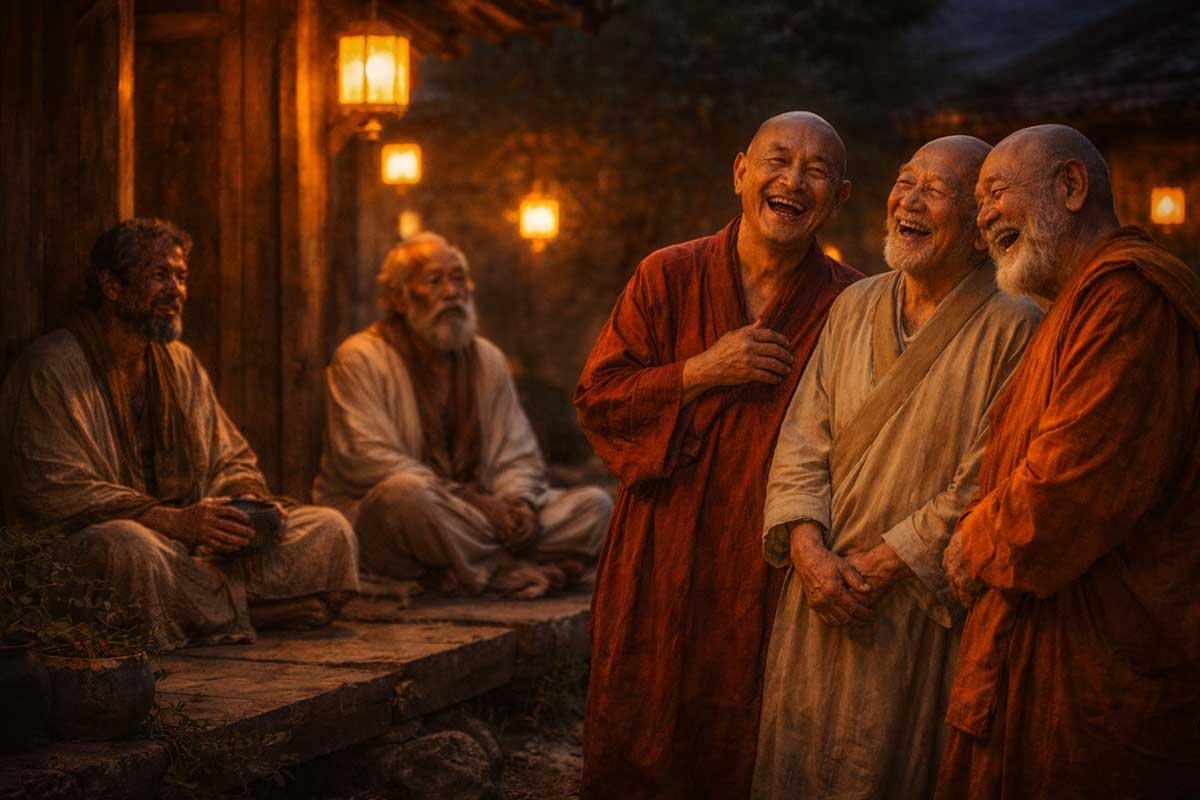
The sun is lower now. The village square has shifted from market noise to evening glow. Lanterns hang like patient moons. Children sit cross-legged. A few elders lean forward, pretending not to be curious.
The Three Laughing Monks stand in their usual place.
They do not speak.
They look at each other.
They laugh.
Softly this time.
From the edge of the square, a gentle figure steps forward barefoot, robes simple, eyes kind enough to disarm pride itself.
It is Ryokan.
He bows slightly, then sits on the ground instead of standing above anyone.
Ryokan: Tonight we speak about not speaking. Which is dangerous, because we might ruin it.
The crowd smiles.
Ryokan: If you never explain anything, what exactly is the teaching that gets transmitted?
The Three Laughing Monks look at him. They do not answer with philosophy.
They laugh again.
But this laughter feels like an invitation, not a performance.
A round-bellied monk with a cloth sack over his shoulder waddles forward, already chuckling.
Hotei: Transmission is simple. When you are not trying to be impressive, people relax. When they relax, they remember something they already knew. That remembering is the teaching.
He pats his belly.
Hotei: Words often block the doorway because they try to own it.
A thin man with bright eyes and wind in his voice steps into the lantern light.
Rumi: Silence is not emptiness. Silence is full. It carries music that speech cannot hold. When these monks laugh without explanation, they are saying, you are already included. No membership required.
The villagers nod.
A small bird lands near the edge of the square.
A barefoot man in worn robes approaches quietly, eyes scanning the crowd with practical compassion.
St. Francis: But love must move. Silence cannot become distance. If someone is suffering deeply and you only laugh, they may feel abandoned. Wordless teaching must still kneel beside pain.
The laughter softens.
A dignified figure in simple but unmistakably noble posture steps forward, hands clasped behind his back.
Marcus Aurelius: A teacher carries responsibility. Silence can be powerful, yes. But it can also be misunderstood. The measure is whether the student becomes more capable of virtue, not merely entertained by mystery.
The Three Laughing Monks glance at one another.
They laugh again.
This time, the laughter is slower. More grounded.
Ryokan smiles like a child who just found a smooth stone by a river.
Ryokan: Then let me ask something sharper. Does silence protect truth from ego, or does it risk becoming vague and unaccountable?
The square grows still.
A breeze moves the lanterns.
Hotei: Silence protects truth from ego when the silence is honest. But if someone hides behind silence because they cannot answer, that is not wisdom. That is fear dressed as mystery.
Marcus Aurelius: Agreed. Accountability is not the enemy of depth. Even an emperor answers to reason. If your silence cannot withstand inquiry, it is not strong.
Rumi: Yet there is a danger in over-explaining. The ego loves explanations. It decorates them. It builds monuments to them. Sometimes the truest answer is an experience, not a sentence.
St. Francis: If silence leads to service, it is alive. If silence leads to superiority, it is rot. We must watch the fruit.
The Three Laughing Monks look at the crowd.
They stop laughing.
For a long moment.
The stillness stretches.
A baby coughs.
A cart wheel creaks.
Then one monk gently pats the shoulder of a tired farmer standing nearby.
And laughs.
The farmer laughs too.
The whole square relaxes again.
Ryokan watches this like a man studying snowfall.
Ryokan: Last question. How can wordless teaching remain compassionate to people who need guidance, not mystery?
A young woman in the crowd leans forward. This question feels personal.
Marcus Aurelius: Guidance requires clarity. Not all students are prepared to infer truth from mood. Sometimes discipline, structure, and instruction are acts of mercy.
St. Francis: Yes. Some hearts need laughter. Some need bread. Some need a hand held in silence. Compassion adjusts.
Hotei: If someone needs instruction, give it. But give it lightly. Even instructions should smile.
Rumi: Words can be ladders. Silence can be sky. Both are useful. The danger is insisting that everyone climb the same way.
The Three Laughing Monks exchange a glance.
One of them picks up a fallen lantern that has tilted sideways.
He straightens it.
Then they all laugh.
Not loudly. Not theatrically.
Just enough to say: we are not against words. We are against forgetting that life is bigger than them.
Ryokan folds his hands in his lap.
Ryokan: Perhaps the deepest teaching without words is this. If your presence makes others less afraid of being human, you are teaching.
The square sits in that thought.
No applause.
No slogans.
Just warmth.
The Three Laughing Monks begin walking toward the edge of the village again.
This time, several villagers laugh quietly as they return to their homes.
Not because they understand everything.
But because they do not need to.
Topic 3: Death, the funeral pyre, and the fireworks
Moderator: Milarepa
Participants: The Three Laughing Monks, Zhuangzi, Rumi, Marcus Aurelius, St. Francis of Assisi
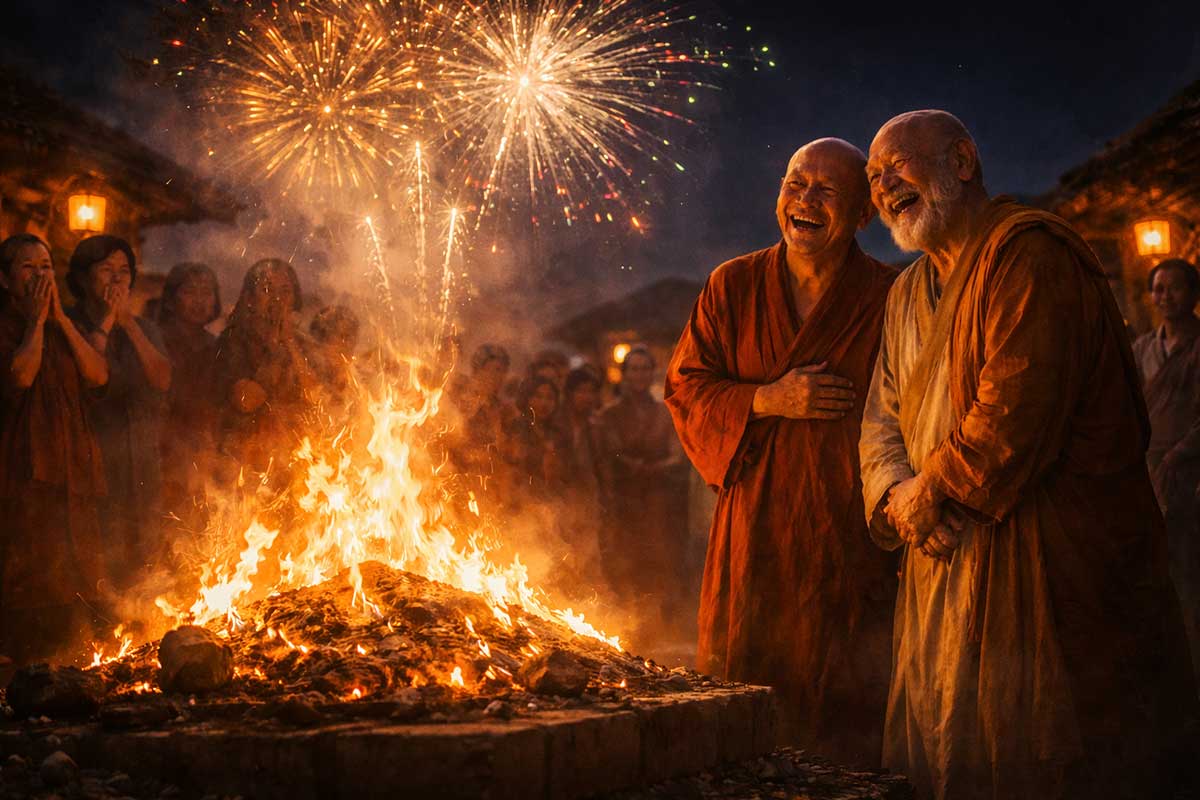
Night has fully arrived. The village has gone quiet in that way that feels respectful and afraid at the same time. Lanterns flicker like small hesitant breaths. In the center of the square, a simple funeral pyre has been built.
The body of one of the Three Laughing Monks rests on it, still wearing his old robe. No clean ceremonial clothes. No grand decorations. Just the same humble fabric that walked the roads and laughed in the dust.
Two monks stand nearby.
Not crying.
Not chanting.
Laughing softly.
Some villagers look offended. Some look confused. Some look like they want permission to feel whatever they are feeling.
A thin man steps forward from the edge of the crowd, barefoot, weathered, and calm in a way that only comes from living through fire. He looks at the pyre as if he has met death many times and stopped pretending it is a stranger.
It is Milarepa.
Milarepa: Tonight we do not debate ideas. Tonight we stand in front of the one thing every mouth eventually goes quiet for.
He glances at the two monks laughing.
Milarepa: And yet, you laugh.
The villagers murmur.
Milarepa turns to the gathering.
Milarepa: First question. What does it mean to meet death with laughter without disrespecting grief?
The Two Laughing Monks laugh again, but gently, almost like a lullaby.
The Three Laughing Monks: Ha ha ha.
The living two bow slightly toward their departed friend, still laughing, as if laughter is their form of incense.
Marcus Aurelius: Grief is natural. A human response to love and loss. But grief becomes destructive when it turns into despair and paralysis. If their laughter is a way to accept nature’s law while still honoring their friend, it can be dignified. The key is whether it contains contempt. I see none.
St. Francis of Assisi: Grief is also love. We must not shame it. But sometimes grief needs a companion so it does not become loneliness. If their laughter is companionship for the living, then it is mercy. Still, I would be careful. Some hearts need tears first.
Rumi: Death is a door that frightens the mind but excites the soul. Laughter can be the soul’s way of saying, I recognize this passage. Yet compassion demands softness. The laughter must not push anyone out of their sorrow. It must invite them to breathe inside it.
Zhuangzi: When a leaf falls, we do not hold a funeral for the tree. We notice change and we call it natural. Yet when humans fall, we demand the universe apologize. Maybe their laughter is the universe refusing to apologize, not out of cruelty, but out of truth.
A villager sniffles.
Another villager laughs, embarrassed, then wipes his eyes.
The pyre crackles.
Milarepa nods slowly.
Milarepa: Second question. Is the bet about who would die first a spiritual victory, a playful prank, or a subtle ego trap?
The villagers lean in. The bet sounds funny, but also suspicious. Like it could be wisdom or it could be performance.
The Three Laughing Monks: Ha ha ha.
Zhuangzi: It is a prank aimed at fear. They made death small enough to tease. That is not ego. Ego wants death to be big so ego can be heroic. Making death ordinary is a kind of freedom.
Marcus Aurelius: It can also be a test of attachment. If they can laugh at death, perhaps they are less attached to their own continuation. Yet I would watch for pride. A person can become proud of being unafraid. Pride is still a chain.
Rumi: The ego trap is subtle, yes. Even spiritual people can decorate themselves with courage. But the laughter here feels childlike, not triumphant. The bet is a way to say, we do not own our timetable. We can only meet it well.
St. Francis of Assisi: If the bet makes the living more loving, it is good. If it makes them feel superior to those who mourn, it is poison. Humor can humble us or harden us. It depends where it points.
The two monks step closer to their friend’s body and place their hands gently on the old robe, still laughing softly, like they are saying goodbye without drama.
The crowd watches.
The quiet becomes more honest.
Milarepa: Third question. If a community is watching you, what responsibility do you have for how your death teaches?
A few villagers glance at each other. This hits them. Everyone is watching. Everyone will be watched.
Marcus Aurelius: We owe others an example of courage and integrity. Death is the final classroom. If you can die without bitterness, without complaint, you show others how to live. But you must not force others to imitate your style. Virtue is universal. Expressions differ.
St. Francis of Assisi: Responsibility includes tenderness. Not everyone has the same faith. Not everyone has the same strength. If your death is calm, let it be calm. If your death is joyful, let it be joyful. But do not forget the living. They will need care, not just inspiration.
Rumi: A good death is a lamp. Not a performance. The lamp does not shout, Look at me. It simply helps others see. If fireworks appear, that is beautiful. But the truest teaching is the heart that remains open even as the body closes.
Zhuangzi: Perhaps the responsibility is to die in a way that does not increase confusion. If you cling, others learn clinging. If you fight, others learn fear. If you accept change, others learn change.
The pyre is lit fully now. Flames begin to lick the old robe.
The villagers hold their breath.
The two monks laugh harder, like they are cheering their friend on, like they know something the crowd does not.
A child grips his mother’s sleeve.
Then, as the fire rises, something cracks in the fabric.
A spark shoots up.
Then another.
Then suddenly, the night sky bursts open.
Fireworks.
Not small ones.
A cascade of color, scattering into the darkness like laughter made visible.
The villagers gasp.
Then someone laughs.
Then another.
Then the whole crowd laughs through tears, not because death is funny, but because fear just lost its grip for one bright moment.
Milarepa closes his eyes and smiles.
Milarepa: Tonight, grief did not disappear. It was simply held inside something larger.
The two monks bow toward the pyre, still laughing.
And for the first time, the villagers understand.
Not with words.
With breath.
With the sound of their own laughter returning.
The sky fades back to dark.
But the village is changed.
Topic 4: Joy that spreads like contagion, ethics and influence
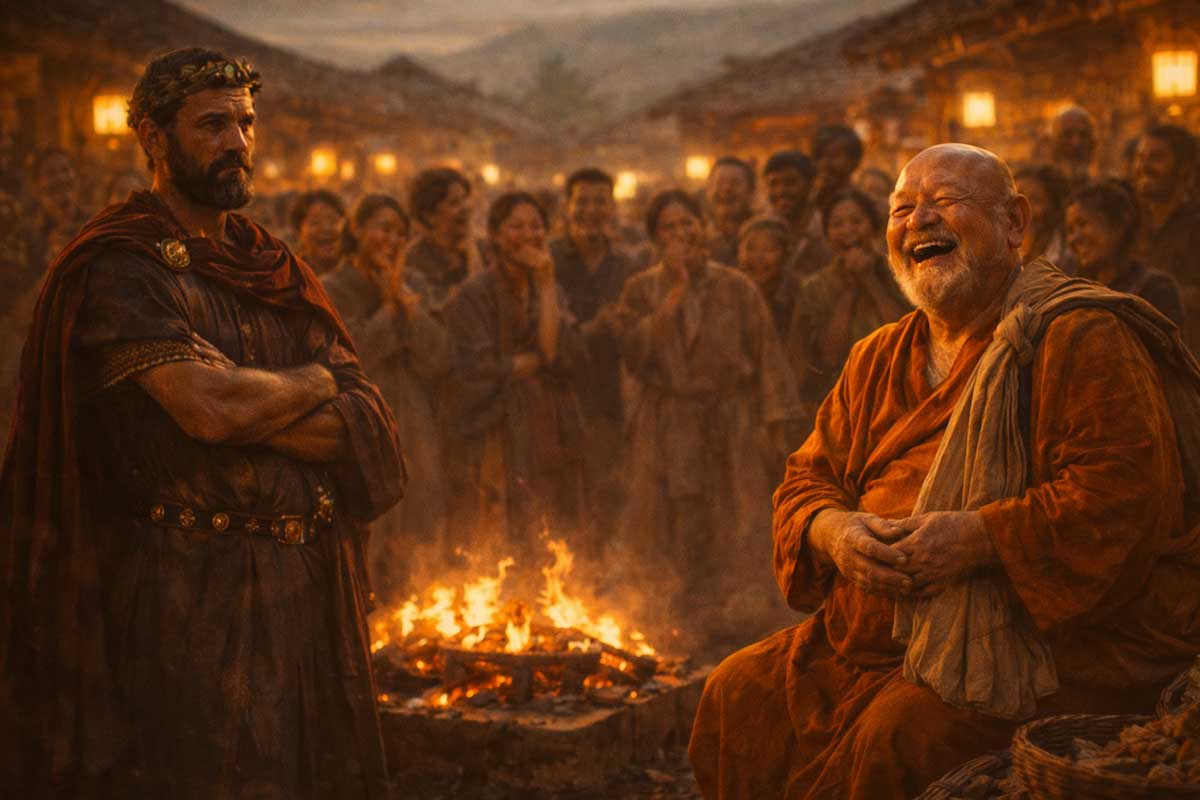
Moderator: Marcus Aurelius
Participants: The Three Laughing Monks, St. Francis of Assisi, Nasruddin, Diogenes, Hotei (Budai)
Morning returns, and with it the market returns, as if the village has collectively agreed to pretend nothing unusual happened last night.
Except everyone is still smiling in a suspicious way.
A few villagers stand in small groups, laughing for no reason, then stopping abruptly as if laughter is now illegal.
The Three Laughing Monks are already in the square again, laughing as calmly as if yesterday’s fireworks were just a normal Tuesday.
At the edge of the crowd, a composed figure steps forward, hands behind his back, face neutral, eyes sharp.
It is Marcus Aurelius.
He looks at the laughing crowd like a man watching a river. Not judging it, but measuring its force.
Nearby, Hotei sits on a low stone, grinning like a festival. St. Francis of Assisi stands with quiet compassion, already noticing who looks lonely. Nasruddin leans against a post, smiling like a man who has a plan and it is definitely not approved by any committee. Diogenes is also there, looking mildly offended that joy is happening in public.
Marcus Aurelius: We are here to discuss a force that spreads faster than gossip. Laughter. Joy. Influence.
He watches a vendor laugh so hard he nearly drops a basket of onions.
Marcus Aurelius: First question. When joy spreads through a crowd, where is the line between healing influence and emotional manipulation?
The Three Laughing Monks: Ha ha ha.
They laugh like the question is a hat that does not fit, but they will wear it anyway.
St. Francis of Assisi: The line is love. Manipulation uses people. Healing serves them. If laughter makes people kinder, more open, more generous, it is likely good. But if laughter becomes a way to control the crowd, even for a “good cause,” it is dangerous.
Diogenes: Crowds are always being manipulated. By kings, merchants, priests, even by fear itself. At least laughter is cheaper. Still, I do not like crowds. They make people stupid. The line is whether anyone can walk away freely without being shamed.
Hotei (Budai): When joy is offered like food, it nourishes. When joy is forced like medicine, it becomes violence. These monks do not chase anyone. They do not beg. They do not threaten. They laugh, and people choose whether to join.
Nasruddin: I once tried to teach people by shouting. It did not work. Then I tried by whispering. Also did not work. Then I tripped and fell into a barrel, and everyone laughed. They remembered that lesson for years.
He shrugs.
Nasruddin: Manipulation wants credit. Healing does not care who gets credit.
The crowd laughs at that, which annoys Diogenes because it sounds too reasonable.
Marcus Aurelius nods slowly.
Marcus Aurelius: Second question. Is it ethical to flip someone’s mood without asking permission, even for a good cause?
A few villagers shift uncomfortably. A woman glances at her husband like, answer carefully.
The Three Laughing Monks: Ha ha ha.
They laugh gently, like permission is sometimes given by the heart before the mouth can say yes.
St. Francis of Assisi: Sometimes yes, sometimes no. If someone is trapped in despair, a smile can be rescue. But if someone is grieving, laughter can feel like assault. Compassion requires sensitivity. Joy must never bully.
Diogenes: Asking permission for everything is another kind of cage. If I ask permission to be honest, everyone will say no. Still, I agree with the barefoot saint. If you use laughter to mock pain, you deserve a slap.
Nasruddin: I once asked permission to tell a joke at a funeral. They said no. I told the joke anyway. Everyone laughed. Then they thanked me. Then they yelled at me again. Life is complicated.
Hotei (Budai): If your joy is gentle, it does not need permission. It is like sunlight. But if your joy is loud, it should be humble enough to check the room.
Marcus Aurelius: In Rome, crowds can be led to violence by the wrong mood at the wrong moment. I have seen it. Mood is power. Power requires restraint.
He turns to the laughing monks.
Marcus Aurelius: Third question. How do we keep joy honest so it does not become performance, branding, or control?
Some villagers do not understand the word branding, but they understand performance. They understand showmanship. They understand a smile that is not real.
The Three Laughing Monks: Ha ha ha.
Their laughter is steady, unchanged. No effort. No pitch.
Hotei (Budai): Honest joy is not trying to look joyful. It simply is. The moment you start checking whether the crowd likes you, joy becomes a product.
Diogenes: If you want to keep joy honest, stop needing people. Neediness is the beginning of performance. The performer needs approval. The free man laughs without it.
Nasruddin: Also, never charge admission. The moment you charge admission, the joke becomes a business plan.
The crowd laughs loudest at that, which makes Nasruddin look pleased and Marcus Aurelius look mildly concerned.
St. Francis of Assisi: Joy stays honest when it turns into kindness. If laughter ends and nobody is helped, then it was only noise. But if laughter opens the hand, opens the eyes, opens the door to service, then it was true.
Marcus Aurelius stands quietly for a moment. Even the marketplace feels a little more still.
Marcus Aurelius: Then the measure is not the sound of laughter. It is the fruit it produces. If joy makes people more virtuous, more compassionate, more steady, it is medicine. If it makes them careless, addicted, or cruel, it is corruption.
He looks at the Three Laughing Monks.
Marcus Aurelius: You wield influence without words. That is rare. It is also dangerous.
The monks laugh again, as if danger is part of the lesson.
A villager who has been watching from the edge steps forward and offers a bowl of rice to an older man who looks tired.
No speech.
Just a small act.
St. Francis of Assisi smiles.
Hotei (Budai) laughs warmly.
Even Diogenes looks away as if the tenderness is too bright.
Nasruddin whispers to a child nearby.
Nasruddin: See. Now the village is infected. The best kind of infection. It spreads, and suddenly people start acting like humans.
The child laughs.
The Three Laughing Monks laugh.
And the market, without anyone announcing it, becomes a little kinder than it was an hour ago.
Topic 5: The cosmic joke vs real suffering
Moderator: Rumi
Participants: The Three Laughing Monks, Milarepa, St. Francis of Assisi, Zhuangzi, Nasruddin
By late afternoon, the village has started calling the square “the laughing place,” as if naming it will keep the feeling from leaving.
A few people are still laughing for no reason, which is beautiful, except one man is laughing while carrying a basket of turnips and he looks confused about it. A baby is giggling at a pigeon. The pigeon looks offended.
In the center, the Three Laughing Monks are doing what they do best.
Laughing.
A breeze passes through like a gentle joke the air wants to tell.
Then a man steps forward with eyes that look like they have cried and danced in the same hour. He wears joy the way other people wear armor.
It is Rumi.
He does not speak loudly. He does not need to. He speaks like he is talking to your chest, not your ears.
Rumi: Friends. Today we have laughed. We have softened. We have breathed again.
He looks around and spots, immediately, the one woman not smiling. She is standing at the edge of the square with her arms crossed, eyes tired, face closed the way a door closes when it has been slammed too many times.
Rumi: And now we must ask the question that makes laughter honest.
The square quiets.
Rumi: If life is a cosmic joke, what do you say to someone who is hungry, lonely, or grieving today?
The Three Laughing Monks stop for a second.
Then they laugh softly, like a candle instead of a bonfire.
The Three Laughing Monks: Ha ha ha.
St. Francis of Assisi: I would not start with a joke. I would start with presence. Sit beside them. Feed them if they are hungry. Hold their hand if they are lonely. Then, when their breathing returns, joy can return. Laughter is holy, but love is the doorway.
Milarepa: In deep suffering, words often fail. Even laughter can fail. The first gift is not laughter. The first gift is not turning away. If laughter comes, it should come like sunlight after a storm, not like someone throwing bright paint at darkness.
Zhuangzi: When a person is grieving, the cosmos is not a joke to them. It is a weight. But the joke may be this. We think sorrow is the whole world. It is not. Sorrow is a season. If you can help someone remember seasons, you help them breathe. Yet you must not rush them out of winter.
Nasruddin: I once told a starving man, “You should laugh more.” He threw a potato at me. He was right.
The village laughs, but gently.
Nasruddin: So I sat down and shared my bread. After that, he laughed at my terrible jokes for free. That is the correct order.
Rumi nods, smiling like he loves that answer.
Rumi: Second question. Can laughter be a form of resistance and survival, not denial? What does that look like in practice?
The Three Laughing Monks laugh again, a little brighter, like yes, finally, you are asking the right thing.
The Three Laughing Monks: Ha ha ha.
Milarepa: Yes. When the mind is trapped, laughter can be a crack in the wall. It says, I will not let suffering own my entire identity. But it must be grounded. Real resistance is not pretending. It is refusing to add unnecessary suffering.
St. Francis of Assisi: Laughter can keep the heart from hardening. That is resistance. In a cruel world, softness becomes brave. But again, laughter must lead to action. If laughter never becomes generosity, it risks becoming entertainment for comfortable people.
Zhuangzi: Sometimes the most radical act is not to take the world’s threats as final. The world says, become afraid. Become bitter. Become small. Laughter says, no. I remain wide. I remain open. I remain unowned.
Nasruddin: Practical example. If a tyrant forbids laughter, laugh quietly. If a tyrant forbids quiet laughter, laugh with your eyes. If a tyrant forbids laughing with your eyes, then congratulations, you are living with a tyrant who has way too much free time.
The crowd chuckles. Even a few stern faces soften.
Rumi looks toward the tired woman again. She has not laughed, but her shoulders have dropped slightly. That is something.
Rumi: Third question. What is the most compassionate way to offer joy when someone cannot access joy yet?
The Three Laughing Monks stop laughing for a long moment.
They look at the woman on the edge of the crowd.
Then one of them walks slowly over, not rushing, not performing, not making her the center of attention.
He sits on the ground a few feet away. He does not speak.
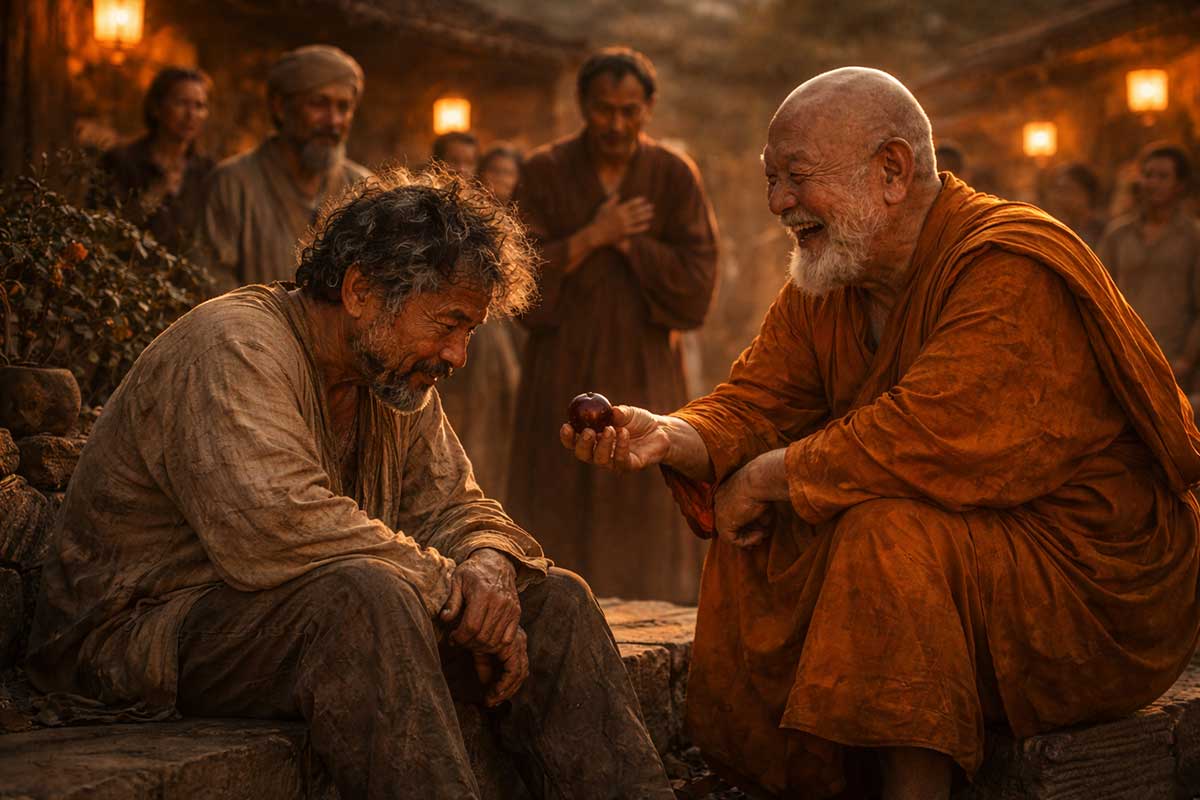
He takes out a small dried plum from his sleeve and places it on the ground between them.
Then he laughs, softly.
Not at her.
Not at her pain.
Just softly, like a small bell in a quiet room.
The Three Laughing Monks: Ha ha ha.
The woman looks down at the plum.
For a long moment, she does not move.
Then she picks it up, holds it, and something in her face changes. Not happiness. Not yet. But a crack. A little space.
St. Francis of Assisi: That is the answer. Offer dignity. Offer companionship. Offer something small and real.
Milarepa: Do not demand joy. Do not preach joy. Simply remain open until they can borrow your openness.
Zhuangzi: Joy cannot be grabbed. It returns when the clenched hand relaxes. Sometimes our job is simply to help the hand unclench.
Nasruddin: And if all else fails, do something mildly ridiculous that harms no one. Sometimes the soul needs permission to be human again.
A child runs by chasing a duck. The duck wins. The child laughs anyway.
The tired woman finally lets out a small sound. It is not full laughter, but it is the beginning of it.
Rumi smiles, eyes bright.
Rumi: Then perhaps the cosmic joke is not that suffering is unreal.
Perhaps the cosmic joke is that love keeps showing up, even when we forget to invite it.
The Three Laughing Monks laugh one last time.
And the village laughs with them, not because pain is gone, but because pain is no longer alone.
Final Thoughts
When the laughter finally slows down, everyone walks away with something different.
Marcus Aurelius leaves with a surprising new strategy. Not “ignore emotion,” but “choose your response.” Even an emperor can learn that joy is a form of strength, not a weakness. He still does not laugh loudly. But you can tell something loosened.
Diogenes leaves pretending he hated it. Which means he loved it. He calls it “public foolishness” while secretly appreciating that nobody tried to look wise. The monks did not perform holiness. They performed freedom. That annoys him, and that is how you know it worked.
St. Francis leaves smiling, but with his eyes on the edges of the crowd. Joy is holy, yes. But if joy does not turn into bread, it can turn into noise. He will be the one asking, who is lonely, who is hungry, who needs a hand instead of a punchline.
Milarepa leaves with the clearest distinction of the night. Forced laughter is a mask. Fearless laughter is a lamp. One avoids the dark. The other lights it up and says, come sit.
Hakuin leaves satisfied because nobody gave a lecture, and somehow everyone got the lesson. Ryokan leaves with a small quiet happiness, like a child who just won a game and did not even care about winning.
Rumi leaves hearing love under everything, including the jokes. Nasruddin leaves with the same expression he arrived with, which is basically “trust me, the universe is funnier than your anxiety.”
Zhuangzi leaves wondering if the village laughed, or if laughter dreamed the village into existence for a moment. Hotei leaves laughing because leaving is also part of the joke. You do not cling. You keep moving.
And the three laughing monks do what they always do. They move on.
If there is one adjustment for this series, it is this.
We do not treat laughter as the enemy of seriousness. We treat it as the flashlight that reveals which seriousness is real and which seriousness is just ego wearing a robe.
Because maybe the punchline is not that life is easy.
Maybe the punchline is that life is hard, and we still get to help each other breathe.
If you want, next I can start Topic 1 in this playful tone with a scene where Diogenes tries to “debunk” the monks in public and accidentally becomes the first one laughing.
Short Bios:
The Three Laughing Monks
Legendary figures from Chinese folklore known only for traveling village to village laughing instead of preaching. Their teaching was wordless, experiential, and centered on joy as liberation. Their story culminates in a funeral pyre that erupts in fireworks, symbolizing fearless acceptance of death.
Hakuin Ekaku
An influential Japanese Zen master who revitalized Rinzai Zen in the 18th century. Known for sharp questioning, koans, and practical discipline, he emphasized direct realization over abstract philosophy and used humor and paradox to awaken insight.
Ryokan
A gentle Japanese Zen monk and poet celebrated for childlike simplicity and humility. He lived in poverty by choice, wrote tender poetry, and embodied spiritual presence without authority or ego.
Milarepa
A Tibetan yogi and poet-saint who transformed a violent past into profound enlightenment through intense meditation. His life story is one of redemption, perseverance, and fearless engagement with suffering.
Marcus Aurelius
Roman emperor and Stoic philosopher, author of Meditations. He taught inner discipline, virtue, and calm acceptance of death and hardship while ruling one of the largest empires in history.
St. Francis of Assisi
Italian Catholic saint known for radical poverty, compassion for the poor, and love of nature. He emphasized humility, service, and joy rooted in devotion rather than status or power.
Zhuangzi (Chuang Tzu)
Ancient Chinese Taoist philosopher known for playful parables and paradoxes. He challenged rigid thinking and embraced life as fluid, transformative, and often humorous.
Rumi (Jalal al-Din Rumi)
13th-century Persian Sufi mystic and poet whose works celebrate divine love, ecstasy, and spiritual union. He viewed joy and longing as pathways to awakening.
Nasruddin (Mulla Nasruddin)
Folk wisdom figure appearing across Middle Eastern and Central Asian traditions. Known as the “holy fool,” he teaches through absurd humor, revealing truth through paradox and wit.
Hotei (Budai)
A semi-legendary Zen monk often associated with the Laughing Buddha image. Symbol of contentment, generosity, and spontaneous joy, he embodied enlightenment through simplicity and humor.
Diogenes of Sinope
Ancient Greek Cynic philosopher who rejected social norms and material comfort. Famous for blunt honesty and provocative behavior, he used humor and ridicule to expose hypocrisy.
Leave a Reply