
|
Getting your Trinity Audio player ready...
|
People call him a genius. A master. A titan.
But I knew him as Ludwig.
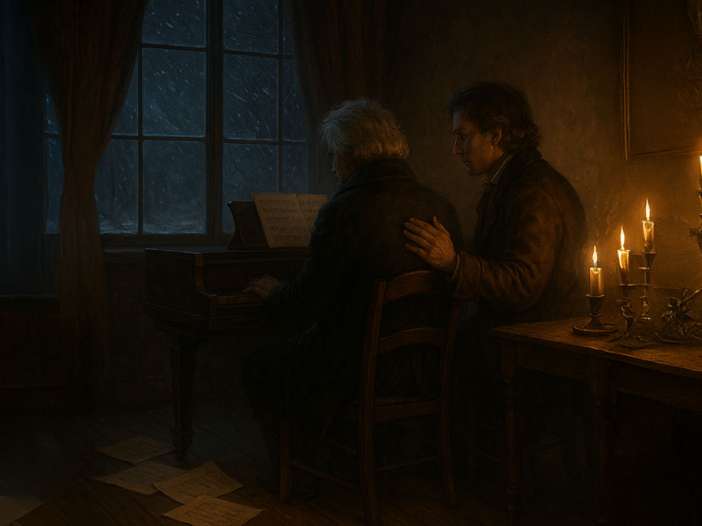
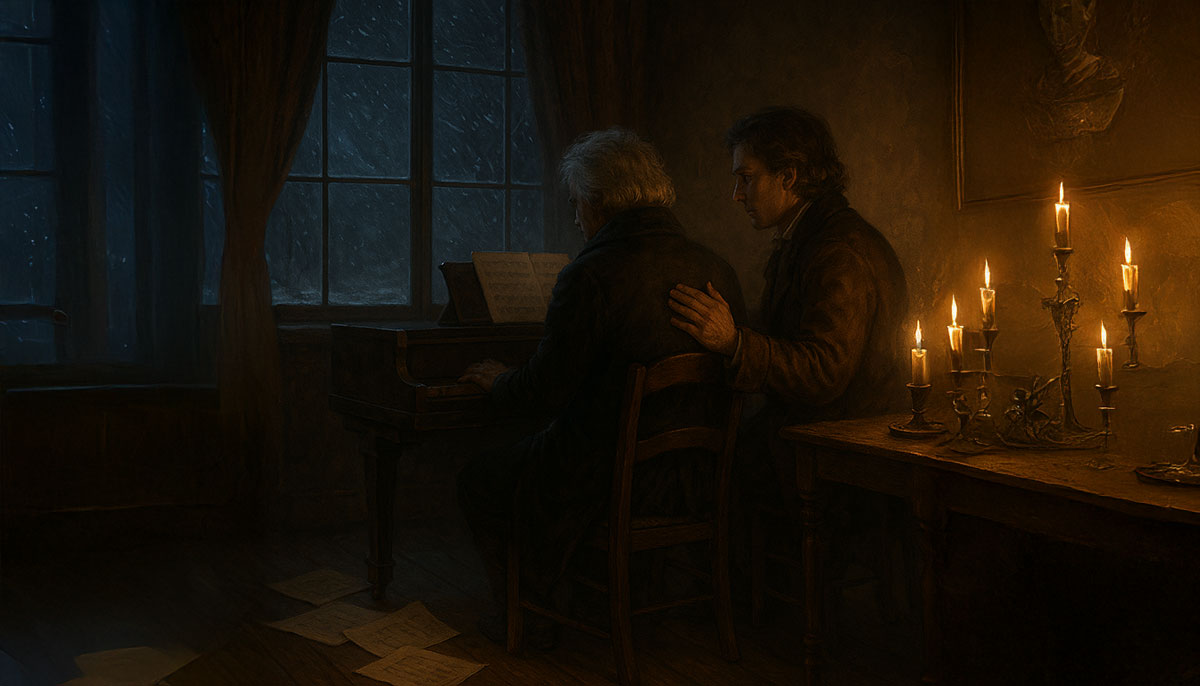
Not the legend, not the silhouette bathed in candlelight at the keyboard—but the boy with shaking fingers in a cold attic, the man who sat in forests staring at nothing because he could no longer hear the world.
He wasn’t easy to love. He could be stubborn, proud, distant. But beneath all that was a heart that never stopped feeling too much. That’s what made his music immortal. And that’s what made his silence unbearable.
This series isn’t about the great works. It’s about the quiet moments—the ones that history forgets.
I was there. Not to rescue him. Just to sit beside him when he couldn’t rescue himself.
And if there’s any truth I’ve come to know, it’s this:
Sometimes, the greatest act of love is simply staying when it would be easier to leave.
(Note: This is an imaginary conversation, a creative exploration of an idea, and not a real speech or event.)

Topic 1: The Lonely Boy at the Piano

Bonn, Germany – Autumn 1777
Ludwig is seven years old.
The wooden stairs creaked beneath your feet as you climbed into the attic, carrying a soft wool blanket and a bundle of rye bread wrapped in cloth. Rain had begun to fall, slow and persistent, drumming gently against the slate roof. The scent of wet wood, old candle wax, and dust hung heavy in the air.
You reached the top and pushed the door open slowly. The attic was dim—lit only by a trembling flame from a stubby candle on the windowsill. Shadows danced on the cracked walls, making the room feel larger than it was, and lonelier too.
There, at the spinet piano in the corner, sat a small boy with dark, tangled hair and a trembling jaw. Ludwig. His back was rigid, hands poised above the keys like a soldier bracing for battle. You could hear the faint echo of shouting from below—his father, again—and the ghost of a door slammed hard enough to shake the frame.
He didn’t look at you when you entered. He just whispered to the piano.
“I have to get it right. I have to get it right.”
You moved slowly, kneeling beside him, careful not to startle him. You gently draped the blanket around his thin shoulders. His shirt was damp with sweat, even though the attic was cold.
“I brought bread,” you said softly. “And cheese, too. You’ve been up here for hours.”
Ludwig blinked but didn’t take his hands off the keys. “If I stop, he’ll hear it. He’ll come.”
“He’s gone,” you said, glancing toward the stairs. “I waited until I saw him leave the house.”
That’s when his hands finally dropped to his lap, and you saw how red and raw his fingertips were. You held them gently in your own.
“He makes me do it until I bleed,” Ludwig murmured, eyes welling. “He says I’ll never be like Mozart. That I’m stupid. That I ruin the music.”
Your throat tightened.
“He’s wrong,” you said. “You’re not here to copy anyone. You’re here to become something the world’s never heard before.”
He looked up at you then, eyes wide and searching.
“But what if I don’t want to be anything?” he said. “What if I just want to be quiet?”
You reached out and touched his cheek, wiping away a tear with your sleeve.
“Then be quiet,” you whispered. “Just for now. Be still. You don’t have to earn your right to rest, Ludwig.”
He leaned into your side, and for a moment, he was just a boy again. No longer the terrified little prodigy-in-training. No longer a vessel for his father’s broken dreams. Just a child, seeking warmth.
You reached into the bundle and offered him a piece of bread. He took it with trembling hands.
“Sometimes,” he said between bites, “when I play... I see things. Like colors. Or stories.”
You smiled.
“That’s your soul speaking. Music isn’t just sound, Ludwig. It’s feeling. It’s memory. It’s everything you’ve ever wanted to say when words wouldn’t work.”
He looked back at the piano, eyes softer now.
“I thought... maybe it was just noise. Just what he made me do.”
You shook your head.
“It’s not noise. Not when it comes from you. What he forces out of you is noise. But when you play what’s real, what’s yours... that’s truth.”
There was silence for a while. The kind of silence that holds meaning. Outside, the rain softened, and a breeze slipped through the cracked window, carrying the scent of damp earth and chimney smoke.
“Do you think I’ll ever be happy?” he asked suddenly, not looking at you.
You didn’t answer right away. You didn’t want to lie.
“I don’t know,” you said. “But I think you’ll do something bigger than happiness. I think you’ll move people. You’ll show them what’s inside the quiet parts of the heart.”
Ludwig didn’t respond. He just placed his fingers gently on the keys again, but this time, he didn’t play for practice. He played for you. For himself.
It was a soft melody—hesitant, trembling. But in it, you heard all the things he couldn’t say aloud: fear, longing, beauty, and hope.
When he finished, the candle’s flame steadied, as if even it had been listening.
“I’m scared,” he whispered.
You nodded and pulled the blanket tighter around him.
“So am I. But I’ll be here. Through every storm, through every silence. You won’t go through this alone.”
He leaned his head against your shoulder. His breath was warm, tinged with the scent of bread and tears. And as the candlelight flickered, the attic didn’t feel quite so cold.
Topic 2: The Heiligenstadt Moment – When Silence Became His World

Heiligenstadt, outskirts of Vienna – October 1802
Ludwig is 31 years old.
The woods were quiet that day—too quiet. The kind of stillness that pressed into your ears like wet cotton, making everything seem farther away. The gravel crunched under your boots as you followed the narrow path through the chestnut trees. Fallen leaves stuck to your soles. A wind stirred the branches, scattering gold and rust-colored fragments across the trail like some forgotten blessing.
You spotted him ahead—Beethoven—sitting on a boulder beside a winding brook. The stream gurgled gently, but he didn’t react to it. His head was tilted slightly, as if straining to hear something that never came.
You approached slowly, not wanting to startle him.
He didn’t turn around.
“I know you’re there,” he said flatly. “I saw the shadow move.”
You came closer and sat beside him on the stone, your coat brushing his. The late afternoon light filtered through the thinning canopy, painting the ground in warm patches. Still, his eyes were dim.
You spoke gently. “You didn’t come back last night. I was worried.”
He looked straight ahead. “Why should I have returned? There’s nothing for me anymore. Not even sound.”
A pause. You could hear the stream, the birds, the breeze. But you knew he could not. Or barely could.
He reached into his coat and pulled out a folded paper. It was creased and worn at the edges.
“The Heiligenstadt Testament,” he said. “My confession. My will. My goodbye.”
Your hands tensed in your lap. You’d feared this.
“I wanted to die,” he continued, “but I couldn’t. Not yet. Because there’s still music left in me. Can you believe that? Even as silence surrounds me, the music doesn’t stop.”
His voice cracked.
“I’m cursed,” he whispered. “To hear heaven in my mind while hell tightens around my ears.”
You placed your hand on his.
“Ludwig, what you’re living through would break anyone. But you’re not cursed. You’re carrying something sacred—and it’s heavy. I see that.”
His eyes flashed with pain. “What good is sacred if it can’t be heard? If I lose my hearing completely, what am I? A deaf composer? That’s like a blind painter. A cruel joke.”
You inhaled the sharp, smoky autumn air, trying to steady yourself before responding.
“Maybe,” you said carefully, “you’re not meant to hear the world anymore. Maybe the world is meant to hear you. You’re not capturing sound—you’re creating truth. Even if your ears close forever, your soul won’t.”
He didn’t answer.
Instead, he reached down and touched the water beside the stone. His fingers traced the current.
“I can feel it,” he said softly. “The vibrations. When I press my ear to the piano, I feel the notes through my bones.”
“Then play with your bones,” you said with a half-smile. “Play with everything you have. The world will feel it too.”
A breeze rustled the trees again. You could smell woodsmoke from a farmhouse chimney nearby, mixing with damp earth and fallen leaves. The wind whispered through the trees like ghosts of sound Beethoven could no longer chase.
He stared into the stream, eyes distant.
“I thought I would marry,” he said suddenly. “Have a family. Be a man who could sit at a table and laugh.”
Your voice caught. “You’re still a man, Ludwig. And you can still love. You just have to let someone see the real you—not the genius, not the brooding artist—the frightened, brilliant, beautiful soul beneath.”
He looked at you then. Really looked.
“You mean that?”
You nodded. “With everything in me.”
He exhaled slowly, as if the pressure of silence had cracked something open inside.
“Maybe I won’t send the letter,” he said. “Not yet. I’ll write something else instead. Something that sounds like the heavens cracking open. Something that says: ‘I’m still here. And I still have something to give.’”
You smiled. “Then the world better listen.”
He let out a small, bitter laugh. “Even if I never hear their applause?”
You squeezed his hand. “Then let their hearts be your echo.”
He stood slowly, joints stiff from the cold. The wind picked up again, rustling the trees like applause only he could no longer hear—but perhaps, still feel.
Together, you walked back toward the house. The sun was beginning to set, casting everything in that amber light he always said made him feel like he was walking inside a symphony. As you reached the cottage gate, he paused, hand on the fence.
“Will you stay with me?” he asked, voice almost a whisper.
“Always,” you said.
And as the evening settled over Heiligenstadt, the silence wasn’t so unbearable. Because you had heard him—truly heard him—even when the world could not.
Topic 3: The Isolation of Deafness – Living in a World Without Sound

Vienna, 1816 – Beethoven is 45 years old
It was winter again. Vienna sat under a blanket of snow, the rooftops quiet and heavy with silence. The fire crackled in the hearth, but even that sound was lost to him now.
You watched Beethoven from across the room as he sat by the window, staring into the whiteness outside. His face had grown more angular, his hair more wild, as if mirroring the storm he could no longer hear. One of his heavy wool gloves was crumpled beside him. His fingers, red from the cold, tapped against the arm of the chair—not rhythmically, just absently.
The silence had swallowed him whole.
You crossed the creaky wooden floor and placed a steaming mug of mulled wine in his hands. The scent of cloves and orange filled the small room. He nodded a thanks without looking.
You sat beside him, your coat still dusted with flakes. The fire’s warmth licked your back as you leaned forward, searching for his eyes.
He didn’t meet your gaze.
You reached for the conversation notebook resting on the table beside him and wrote:
“Would you like to go for a walk?”
He glanced at the page, then at the gray-white world beyond the window. Then slowly shook his head.
“I’m tired,” he said aloud, voice gravelly. “Of pretending.”
You nodded. “Of what?”
“Of pretending I still belong to this world.”
The words sank between you like stones. Outside, a carriage passed, wheels crunching snow—but he didn’t flinch. Not anymore. The absence of sound had become his constant companion, his cold shadow.
You leaned in. “You belong to this world more than most. You’re shaping it.”
He scoffed, shaking his head.
“People laugh at me in cafés,” he muttered. “They mock the way I speak, the way I strain to hear, the way I shout when I don’t know I’m shouting.”
His voice trembled.
“I used to walk through these streets and hear symphonies in every footstep, every whisper, every carriage wheel. Now, I walk in a painting. Beautiful, but dead.”
You wrote gently in the notebook:
“Do you still hear music in your mind?”
He paused. Closed his eyes. And whispered, “Always.”
Then a tear slid down his cheek.
“But what good is music,” he said, “if I’m trapped with it alone? If I can never share it the way I once did? If I can’t hear even a child’s voice say, ‘Thank you’ after a concert?”
You placed your hand on his. It was cold and trembling.
“Your music doesn’t need your ears anymore,” you said softly. “It already lives in the hearts of others. It will outlive you. And it will comfort those who feel alone—just like this.”
He looked at you, finally. His eyes were tired, but not hollow.
“I used to think I would go mad,” he admitted. “And maybe I have. There are days I scream into the void, hoping to hear my own voice bounce back.”
You smiled faintly. “Maybe that’s why your music echoes so deeply. It was carved from that silence.”
He stared down at the mug in his hands. Steam curled upward and vanished into the air.
“I miss voices,” he said. “Laughter. Wind. A lover’s breath against my ear. I miss the applause.”
You leaned in closer, voice steady. “I’ll be your applause, Ludwig. And your echo. And when you need it, your silence too.”
He broke then. Not loudly. Not with rage. Just a small collapse inward, like a building that had finally grown tired of holding itself up.
You stood and walked over to the pianoforte.
“Play with me,” you said.
He frowned. “But I can’t—”
You reached beneath the lid and gently set his hand on the frame.
“Don’t listen with your ears. Listen with your skin. With your spine. With your memory.”
He closed his eyes. Slowly, his fingers pressed a chord. You played a soft note beside him.
Another. Then another.
He began to move with you. His foot found the pedal. His fingers trembled—then steadied. He couldn’t hear it, not the way he once could. But he could feel the vibration in his wrists, the echo through the bones in the bench, the way your rhythm guided his.
For the first time in days, his brow unfurled.
You looked at him—not the maestro, not the myth—but the man.
“You’re not alone in the silence,” you said. “I’m here. I hear you.”
He nodded, once.
And together, without speaking, without sound, you built a symphony in the quiet.
Topic 4: The Nephew’s Betrayal – When Love and Legacy Collide

Vienna, Summer 1826 – Beethoven is 55 years old
The shutters were closed, but the midday sun still pressed through the cracks, casting narrow lines of gold onto the dusty floorboards. The room was stifling—thick with the scent of ink, old books, and something sour, like wine left too long in the glass.
You stood at the threshold, hesitating.
He was seated at the writing desk, his back to you. Hair disheveled, shoulders tense. A nearly empty bottle of wine stood nearby, the cork lost. Crumpled pages littered the floor like fallen leaves. The silence, as always, was deafening.
You stepped inside.
“Ludwig?”
He didn’t turn.
You saw the edge of the letter in his hand—creased, smudged, and spotted with dried tears. Your chest tightened. You already knew what it was.
Karl’s suicide attempt.
His beloved nephew—his great hope, his pride, his son in all but blood—had tried to end his life with a pistol just days before.
When Beethoven finally turned to face you, his eyes were wild and hollow, like the inside of a bell long cracked.
“I gave him everything,” he rasped. “Everything.”
You approached slowly. Sat beside him, though he didn’t seem to notice.
“I gave him my name,” he continued. “My fortune. My protection. I fought the courts for him. Tore his mother apart to keep him safe. I shaped his future with my bare hands.”
His voice trembled.
“And he tried to throw it all away. With a bullet.”
He slammed his fist down onto the table. The bottle rattled but didn’t fall.
“What did I do wrong?” he asked. “Why wasn’t I enough?”
You said nothing for a moment. Just reached for his hand. He didn’t pull away.
“Maybe,” you said gently, “it wasn’t about being enough. Maybe it was about being too much.”
He looked at you sharply.
“I watched you smother him, Ludwig. You meant it as love. You thought you were saving him. But he couldn’t breathe beneath your expectations.”
He looked away.
“I thought... I thought if I raised him, he'd become strong,” he whispered. “Better than his father. Braver than his mother. Someone the world would never hurt the way it hurt me.”
The candle on the table flickered in the stuffy air, its wax pooling over the edge of the dish.
“I see now,” he added, “I didn’t raise a man. I tried to mold a mirror.”
You squeezed his hand.
“We all do that with the ones we love. We want to rewrite the past by rewriting them. But Karl isn’t your second chance. He’s just… Karl.”
He said nothing. His breathing was shallow, like someone barely keeping their head above water.
“He’s not dead,” you reminded him. “He survived. He’s at the hospital. He asked for you.”
Beethoven shook his head.
“What would I say? How could I face him after all this?”
You met his gaze.
“Tell him what you never told yourself—that it’s okay to feel lost. That pain isn’t weakness. That failure doesn’t mean the end.”
He laughed bitterly. “I’ve never said those things. Not even to me.”
“Then say them now. Start here.”
You leaned forward, lowering your voice.
“Tell him it’s not too late. For either of you.”
A silence settled again. Not the crushing silence of his deafness, but a softer one. A waiting silence.
After a while, he picked up one of the crumpled pages and smoothed it gently. Then another. He began to organize them on the desk, careful now, quiet.
His voice, when it came, was smaller than you'd ever heard it.
“Do you think he hates me?”
You shook your head.
“I think he hurts. Just like you. And like you, he doesn’t know how to show it except by breaking something.”
Beethoven stared at the flame, watching it dance.
“I wanted to give him a future,” he said. “Instead, I gave him a cage.”
You leaned in close.
“Then open it. Show him the way out.”
A breeze touched the shutters, nudging them open just slightly. Light spilled in, golden and sharp. Dust motes rose like tiny stars.
Beethoven stood slowly, his joints stiff, his eyes red-rimmed but clear.
“I’ll go to him,” he said. “Not as a master. Not as a composer. Just… as a man who tried and failed and still wants to love.”
You nodded.
“That’s more than enough.”
And as he left the room, the silence he carried for so long felt a little less heavy. Not because it was gone—but because, for the first time, he wasn’t carrying it alone.
Topic 5: The Final Days – When the Music Was All That Remained
Vienna, March 1827 – Beethoven is 56 years old
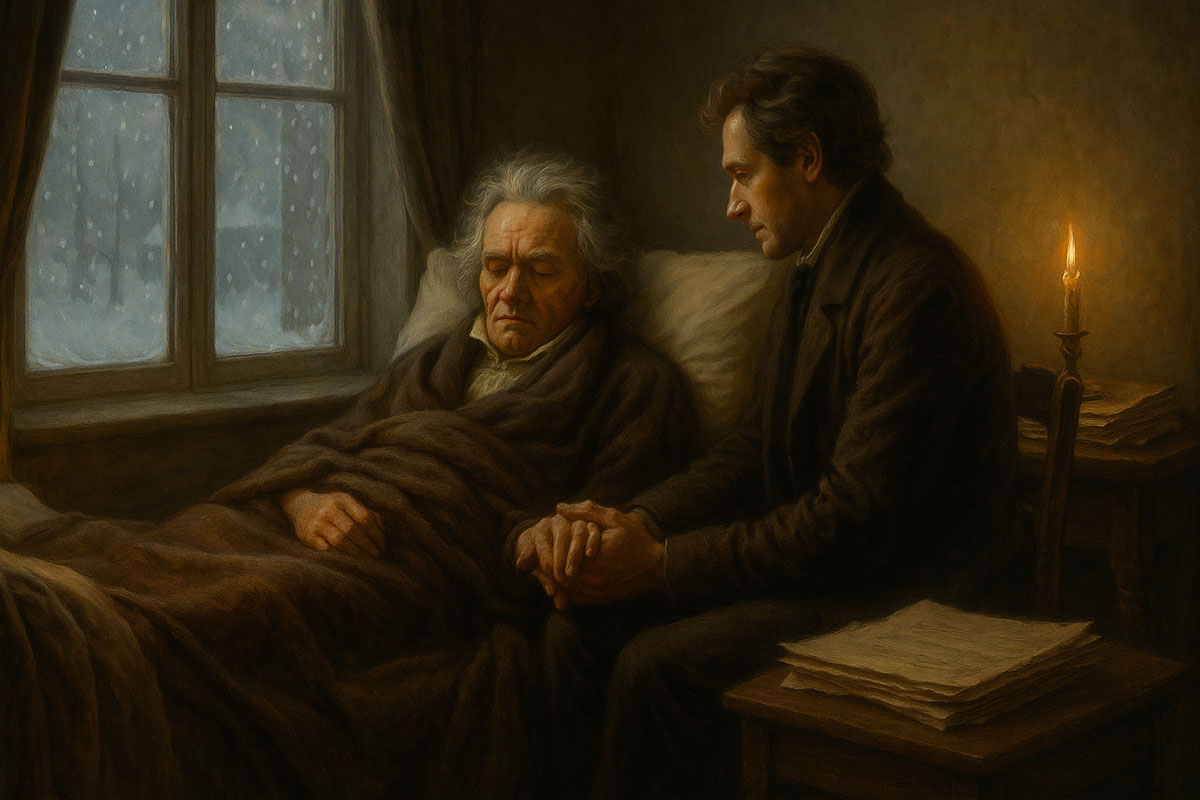
The room smelled of damp wood and medicine—sweet laudanum, old bandages, and something metallic underneath. A pale winter light spilled in through the tall window, barely warming the floor. Outside, snow fell in slow spirals, soft as breath.
You sat by the bed, listening to the rasp of his breathing. Each inhale sounded like wind catching in a broken flute—uneven, hollow, reluctant.
Beethoven lay beneath thick wool blankets, barely more than a shadow of the titan he once was. His face had thinned. His once-strong hands—those hands that had thundered across pianos, scribbled frantic notes into margins, gripped baton and manuscript—now trembled as they reached for nothing in particular.
You leaned in and gently moistened his lips with a cloth. He flinched from the touch but didn’t push it away.
He whispered something you couldn’t catch.
You reached for the notebook and placed it in his hand.
He shook his head, slow and tired.
“No more words,” he said hoarsely. “Just... be here.”
And so you stayed.
The fire in the hearth had long gone out. You didn’t dare leave to stoke it. The silence in the room was sacred now—not empty, not mournful, but thick with presence. The kind of silence that listens.
He reached for your hand and gripped it weakly.
“I can still hear it,” he murmured. “The music.”
You squeezed his fingers.
“I know.”
His eyes fluttered open. Clouded, but still full of something fierce.
“They told me to rest,” he said with a ghost of a smile. “But I’m not done composing.”
You laughed softly, your breath fogging the cold air. “Even now?”
He gave a single, shallow nod.
“There’s a piece,” he whispered. “It doesn’t use notes. It only... breathes.”
You felt the sting behind your eyes and swallowed it back.
“Then let it breathe through you,” you said gently.
He closed his eyes again.
“I’m not afraid,” he said.
“I know,” you whispered.
He was silent for a while, the rise and fall of his chest barely perceptible.
“Do you think they’ll remember me?” he asked suddenly. “Without applause? Without ever knowing what I heard?”
You leaned in closer. “They won’t just remember you, Ludwig. They’ll be changed by you. Your music will live longer than kings.”
He looked toward the ceiling, pupils darting faintly as if following invisible stars.
“I used to wonder if God cursed me or chose me,” he whispered.
You hesitated. Then said, “Maybe both. But you turned it into something no one else could.”
His chest hitched.
“The Ninth,” he said. “The ‘Ode to Joy’… I never heard a single note of it. But I felt it. Every chord, every chorus, every heartbeat.”
You smiled through your tears. “And the world heard it for you.”
His fingers twitched. You took them in both hands, trying to warm them.
“I’m so tired,” he said at last.
“Then rest.”
He nodded faintly. His lips moved again. You leaned in close, close enough to feel the last warmth of his breath.
“Friends applauding,” he whispered. “That’s what I want to imagine now.”
You closed your eyes and said softly, “They are. All over the world. Right now.”
And then... a pause.
Longer than the others.
Stillness.
You opened your eyes. His hand was slack in yours.
But his face—his face looked peaceful. For the first time in years.
Outside, the snow stopped.
A single beam of light broke through the clouds and spilled across his desk, where his final composition lay unfinished.
You walked to the desk and gently placed your hand on the page.
The ink had stopped mid-stroke. The melody would never resolve.
But maybe it didn’t have to.
Maybe, some pieces weren’t meant to end. Just to echo.
You turned back toward him and whispered, “Bravo, Ludwig. Bravo.”
And for a moment, the silence in the room felt like standing inside his final symphony.
Not the kind of silence that mourns.
The kind that listens with awe.
Final Thoughts by Nick
I watched him suffer more than most men ever will.
He was struck not once, but again and again—by cruelty, by silence, by betrayal, by the weight of a world that asked for his soul but offered little comfort in return.
And yet, he kept writing. Even when he could no longer hear a single note. Even when he doubted whether he belonged among people. Even when death hovered near.
He wrote for the world that he could no longer touch, but still believed in.
In those final days, when his breath grew thin and his body faltered, he looked at me—not as a composer looks at an audience, but as a friend looks at another and simply says, thank you.
I carry that look with me.
Because what I gave him wasn’t greatness. It wasn’t applause.
It was presence.
And that, I believe, is what we all need most—someone who sees us not for what we produce, but for who we are beneath the noise.
If his music lives on, it’s not just because he was brilliant.
It’s because he kept going… and someone stayed close enough to remind him why.
Short Bios:
Ludwig van Beethoven
German composer and pianist (1770–1827), Beethoven reshaped Western music with his emotionally powerful symphonies, sonatas, and quartets. Despite going deaf in mid-life, he continued to compose some of the world’s most enduring works, turning personal anguish into artistic triumph.
Nick (Beethoven’s Imaginary Best Friend)
A fictional yet faithful companion, Nick stands by Beethoven through his deepest trials—not as a biographer or critic, but as a steady presence. His quiet strength, compassion, and unwavering loyalty offer the love and understanding Beethoven never received in life.
Leave a Reply