

|
Getting your Trinity Audio player ready...
|

Introduction by Jack Thorne
Charles Dickens once said that of all his children, David Copperfield was the one he liked best. I think that’s because David was closest to himself — a boy pushed into the world too early, broken and rebuilt by the kindness of strangers, the cruelties of society, and the strange, fumbling miracle of love.
When I began thinking about this adaptation, I didn’t want to present David as a dusty hero from a Victorian mantelpiece. I wanted him alive — messy, uncertain, dazzled by wrong loves, loyal to the wrong people, and yet somehow carrying forward a belief that life could be better. Because that’s Dickens at his best: not grand statues, but flawed human beings making sense of storms and finding light.
This play is a memory play. It is David telling us his story while also living it. We see him as a boy, as a man, and as the voice that remembers — sometimes with warmth, sometimes with shame, sometimes with laughter. Memory is our stage machinery, and imagination is our set.
And at the heart of it all is a simple question: how do we write the story of our own lives, when so much of it is written by others? Dickens asked it. David asked it. Tonight, maybe, you’ll ask it too.
(Note: This is an imaginary conversation, a creative exploration of an idea, and not a real speech or event)
Scene 1: Blunderstone Rookery (Birth & Murdstone’s Shadow)

The stage opens in near-darkness. A single lantern glows on a wooden table. Adult David steps forward, speaking directly to the audience.
Adult David:
“I was born on a Friday, at midnight. They said it meant fortune. They said it meant disaster. I don’t remember. I was busy being born.”
As he speaks, the back wall flickers with projections of storm clouds. In soft golden light, Clara Copperfield, barely more than a girl herself, cradles her newborn. Peggotty, sturdy and warm, hovers near, fussing, protective, already suspicious of the world.
A sense of fragile warmth fills the space. Clara hums a lullaby, the lantern glow softening. Suddenly, the shadows lengthen. At the edge of the stage, a tall, severe figure emerges: Mr. Murdstone. He doesn’t enter fully, only stands half in darkness, watching. His presence alone chills the room.
Adult David circles his younger self, whispering:
“This is where my story began. Where love tried to bloom, but fear crept in behind it. Where the house was small, and my mother’s laugh was large, but the shadow at the door was larger still.”
The walls of the cottage are suggested by hanging wooden frames. As Murdstone steps closer, those frames descend lower, enclosing Clara and baby David in a cage-like shape. The warmth dims. Clara laughs nervously, clutching her child, while Murdstone’s hand rests heavily on her shoulder.
The scene ends with Young David reaching out for light, while Murdstone’s shadow eclipses him. Blackout.
Scene 2: Peggottys’ Boat House (Chosen Family)
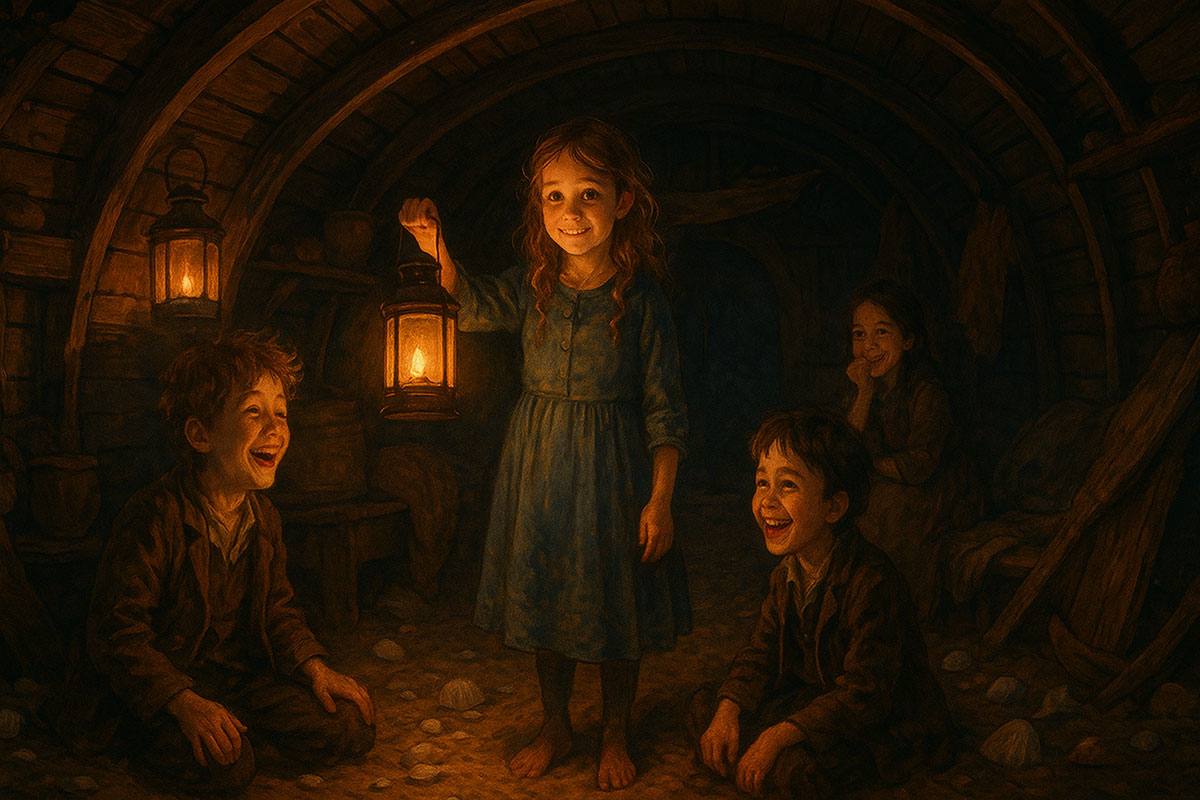
The stage bursts into brightness. Sand trickles across the floor. A half-boat sits upturned, its ribs forming beams overhead, lanterns swinging gently. The air hums with fiddle music. Mr. Peggotty, broad-shouldered and kind, sets out bread. Ham, good-natured and clumsy, laughs as he helps. Little Emily runs in with flowers, her laughter ringing.
Young David enters, wide-eyed. He has never seen anything like it: a home carved out of a wreck. He touches the wood, amazed, then is swept up in the warmth of the family. Emily takes his hand, showing him shells, whispering dreams of the sea.
Adult David, watching from the side:
“This was family not made of blood, but of love. A boat turned upside down. A hearth lit in the wreckage. And I belonged here more than anywhere else.”
The Peggotty household sings a sea shanty, playful and warm. The audience feels their togetherness, their resilience against poverty.
But shadows creep even into this joy. As the song fades, Steerforth’s voice echoes faintly from the future: “She’s a prize worth taking, Davy.” The lights flicker. For a moment, Emily’s lantern glows alone, foreshadowing her fate.
David and Emily sit side by side, hands linked, gazing at the horizon. The innocence is golden, almost painful. The scene ends with the lanterns dimming, leaving Emily’s light as the last to fade.
Scene 3: Salem House School (Cruelty & Steerforth’s Friendship)
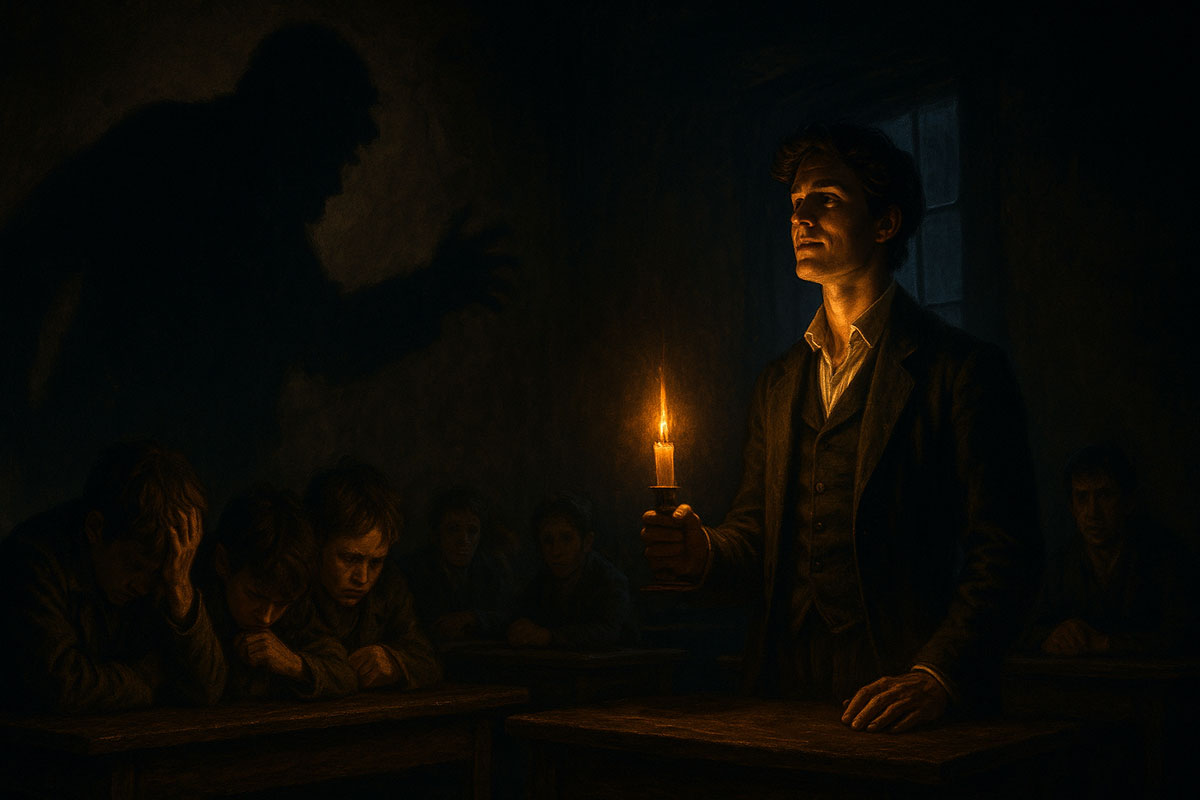
The stage is stripped bare: wooden benches, harsh white light. A great shadow of Mr. Creakle looms, his cane raised. The crack of wood on flesh echoes. Boys flinch. Fear dominates.
Young David sits isolated, head bowed. Then, from the crowd, James Steerforth emerges: tall, charming, confident. He places a protective hand on David’s shoulder. With a smile, he turns punishment into bravado. David looks at him with awe — salvation in human form.
Traddles, awkward and kind, fumbles into trouble, drawing laughter. The cruelty softens for a moment, as the boys’ camaraderie glimmers under oppression.
Adult David (to audience):
“We were children. But even then, the rules of the world were written on us. Some command fear. Some absorb it. I adored Steerforth. How could I not? He was the sun, and I revolved around him.”
Night falls. The boys huddle around a dim candle. Steerforth brags of ships, of conquest, of his destined greatness. David hangs on every word, unaware he’s sowing the seeds of heartbreak.
The candlelight flickers across their faces, making heroes of children. The scene ends with David whispering Steerforth’s name, as if invoking a star.
Scene 4: Mother’s Death (End of Innocence)

Soft domestic light: Clara cradles her new baby. David sits at her feet, happiness fragile but real. Peggotty hovers, protective, but the air feels tense.
Suddenly, Clara coughs, falters. She collapses. The baby wails. Jane Murdstone sweeps in, cold as steel, gathering the child. Mr. Murdstone stands, unyielding.
Adult David steps forward, voice breaking:
“She was gone before I knew she could leave. My mother — too young, too gentle, too easily broken.”
The stage strips bare. The cottage walls vanish, leaving only David small and lost in a pool of light. Peggotty kneels, arms around him, but the warmth cannot banish the shadow of the Murdstones.
David clutches a book tightly, whispering:
“I’ll remember. I’ll write it down. I won’t let her vanish.”
The lantern light fades until only David’s face glows, child and narrator fused by grief. Blackout.
Scene 5: London Warehouse & the Micawbers (Exploitation & Humor)

Industrial darkness. Steam coils. A piston thumps like a tired heart. Projections crawl up the back wall: tally marks, ledgers, bottle silhouettes, the arithmetic of childhood spent. Young David is a small figure in a too-large apron, scrubbing glass until his fingers gleam red beneath the grime. Above him, clerks on a mezzanine shuffle papers with theatrical indifference—“Murdstone & Grinby: Efficiency & Morality” lettered like a smug sermon.
Adult David steps into a side light:
Adult David
They called me industrious. They called me lucky to have a place. I was a boy polishing bottles for men who never learned to see their faces in them.
A bell clangs. Manager (all briskness, no mercy) barks orders.
Manager
Copperfield—hurry. Your tears won’t fill a bottle.
Young David (softly)
No, sir. They never do.
The mechanical rhythm swells into a grim lullaby, then—like a curtain rips—the stage pivots. We enter the Micawber lodgings: cramped, shabby, joyous. Pots chatter on a single-ring stove; a laundry line sags with unmatched socks; a baby wails while Mrs. Micawber soothes in heroic counterpoint.
Mr. Micawber bursts in with grandiosity and a cracked teacup.
Micawber
List, friends, to a man acquainted—intimately acquainted—with adversity! Yet prosperity is merely detained, not deceased; delayed, not denied.
Mrs. Micawber (without looking up)
Dinner is delayed, not denied, if Mr. Micawber’s fortunes produce a carrot.
They adore David immediately, folding him into absurd rituals: budgeting with buttons, toasts with air, symphonies played on cutlery. Young David smiles for the first time in weeks.
Adult David
Under their collapsing ceiling, hope survived on puff pastry speeches.
Micawber counsels David as if knighting him.
Micawber
Copperfield, you must cultivate a resolute philosophy. When misery knocks, answer with tea. Should tea be unavailable, answer with rhetoric.
Young David
Yes, sir.
A letter arrives. Silence. Mrs. Micawber holds her breath; Micawber opens it with Shakespearean dread.
Micawber (sigh of theatrical doom)
A debtor’s greeting. We are to remove ourselves from prosperity’s queue and try again tomorrow.
They weep, then laugh, then plan, then fail, then sing. David learns the choreography of resilience.
Return to the warehouse. Bottles clink like chains. The Manager scolds; David nods, older than his years. The industrial projection tightens, numbers crowding the walls, closing in.
Adult David (to audience)
I mistook survival for purpose. I mistook work for worth. But the Micawbers—ridiculous, magnificent—taught me that tenderness is wealth, and laughter, bread.
In the final beat, Mrs. Micawber presses a crust into David’s hand; Micawber presses a vow into his heart.
Mrs. Micawber
We shall never desert you.
Micawber
And when something turns up, Copperfield, we shall not desert that, either.
Blackout on their defiant smiles.
Scene 6: Betsey Trotwood’s Garden (Rebirth Under Aunt Betsey)

The stage rotates: soot gives way to sunlight. Projections of ivy and sky unroll across the back wall. A tiny lawn springs up—a green island of eccentric order. Enter Aunt Betsey Trotwood, armed with a broom and unassailable opinions, patrolling for donkeys like a general surveying a beachhead.
Betsey
I will not have donkeys trespassing on my property. Or grief, for that matter—both nibble and leave nothing worth keeping.
Young David stumbles in, filthy, footsore. He stands at the border of brightness, as if entry requires permission he has never owned. Mr. Dick drifts past with kite-silk, murmuring about “King Charles’s head,” a problem too stubborn for logic and therefore perfect for compassion.
Betsey (clocking David’s ruin in one glance)
Name?
Young David
David… Copperfield. Please—
Betsey (to the sky)
And precisely when did the world decide to become an instrument of cruelty?
Adult David steps near the hedge line.
Adult David
I had run out of places to run. I brought only the remains of a boy and the idea of a name.
Betsey interrogates him briskly, then, startled by her own tenderness, wraps him in a shawl so forcefully it reads as policy.
Betsey
You will stay. We will tidy you into usefulness.
Mr. Dick offers the kite-string.
Mr. Dick
When thoughts are noisy, let the wind argue with them.
A compact transformation sequence: Peggotty arrives, relieved but grieving; Murdstone and Jane appear to reclaim the boy; Betsey eviscerates them with velvet steel.
Betsey
You have mistaken compliance for guardianship. You won’t make that error here.
The Murdstones retreat, scorched. The garden brightens two degrees. A desk appears: Dr. Strong’s lessons hinted in books and clean paper. Young David sits, breath held as if education were air he must learn to trust.
Adult David
I did not know yet that love can be law. In my aunt’s court, justice wore gardening gloves.
Montage: David learning; Mr. Dick experimenting with kites and empathy; Betsey reassigning fate with administrative efficiency. On the wind, the warehouse’s clatter recedes like a nightmare late to its own ending.
Betsey (softly, almost to herself)
We don’t always choose our family. But we may, on alert days, rescue it.
The scene closes on a tableau: Betsey upright in her chair, Mr. Dick with his kite aloft, David at his books—three souls in a small republic of care.
Scene 7: Law Office & Dora’s Drawing Room (Ambition & Romance)
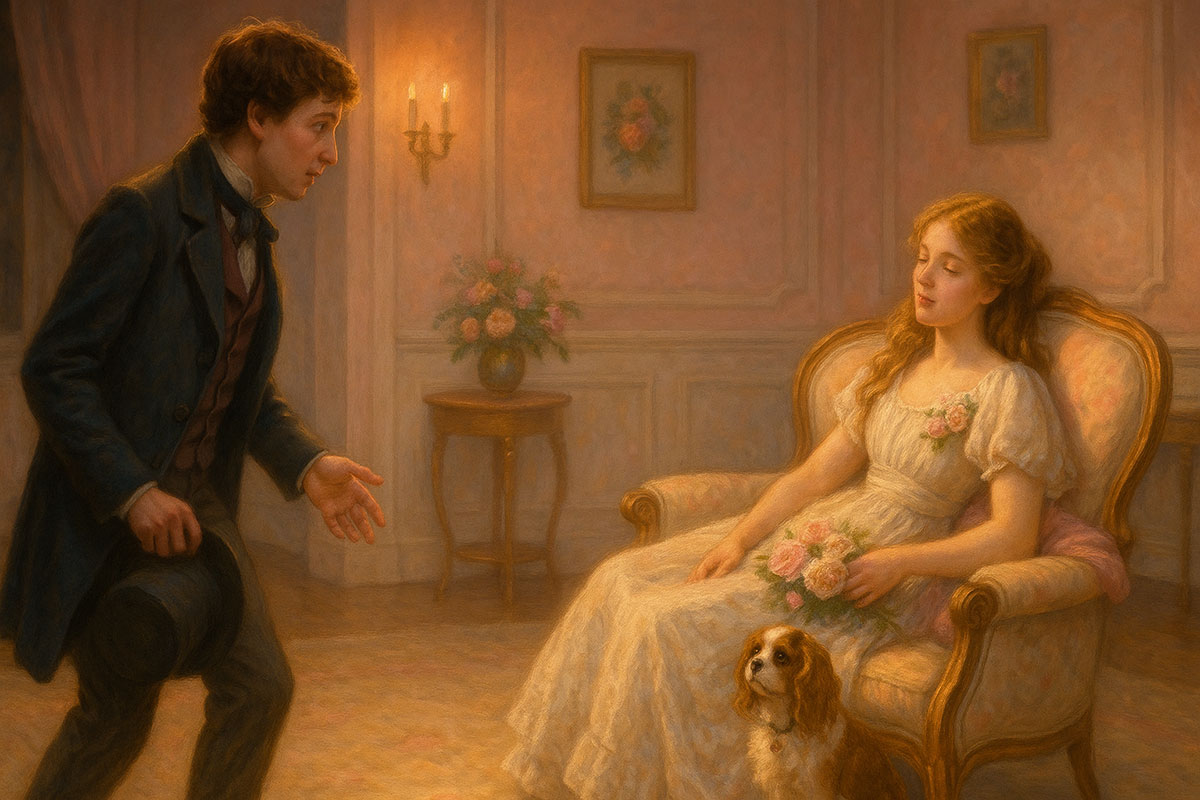
A brisk London interior snaps into place: ledger tables, ink stands, a door that whistles drafts of ambition. David, now adolescent-lean, copies documents with dutiful fire. The city hums through the walls—carriages, gossip, possibility. Spine of the scene: the double beat of professional awakening and romantic bewilderment.
Adult David
I believed success was a staircase and I, a polite pair of legs destined to rise it.
Enter Mr. Spenlow: elegant, important, orbiting himself.
Spenlow
Law is a matter of forms, Copperfield. Observe the forms; the substance, if any, will present itself later.
Forms—deeds, affidavits—shuffle into dance. Then, a shift: petals, lace, a small dog with aristocratic contempt. Dora Spenlow arrives like a change in weather. The lighting blushes—literally—into rose and cream.
David (breathless, to audience)
Dora.
Their meeting is a gentle catastrophe. He drops a quill; she laughs like a bell; the dog—Jip—claims David’s ankle with imperial rights. Dialogue overlaps, shy, fizzy.
Dora
I am simply dreadful with numbers.
David
I am simply dreadful without breath.
They promenade the drawing room, all lace and lemonade; the stagecraft turns buoyant, chairs gliding like gondolas, a waltz of misreadings. Adult David watches, smiling and wincing.
Adult David
I mistook radiance for refuge. Beauty, for ballast. Love, for its rehearsals.
Cutaways interleave: David working late, head on folios; Dora plucking at embroidery, already tiring; Agnes Wickfield appearing briefly in cool light, a stillness that reads as truth. She and David exchange a glance so honest it unsettles the pink veneer.
Agnes (quiet)
Work well. Rest kindly. Judge gently.
David
Always, Agnes.
Back to Dora: an engagement sealed in sweetness. Jip barks as if to notarize. Spenlow smiles in the way men do when business and sentiment occupy the same ledger.
Adult David
I thought I had acquired permanence. In fact, I had acquired a beautiful breakable.
The scene closes on a split image: David bent over legal pages in a cool blue pool, Dora drifting in rosy haze. Between them: a small, insistent dog, the herald of comedic foreshadowing and tragic fragility.
Scene 8: Steerforth with the Peggottys (Foreshadowed Betrayal)

Return to the boat house. Lanterns swing. Sea-light stitches silver into the timber ribs. Mr. Peggotty lays a simple feast; Ham beams; Emily, in a dress the color of tidal dawn, moves with an unlearned grace. She’s older now, a promise she doesn’t know she’s making.
David brings Steerforth in with proud, boyish triumph.
David
Here—my family.
Steerforth (radiant)
Then I am home.
He is irresistible: praise placed exactly, laughter poured generously. He lifts Mrs. Gummidge from gloom with a joke; he calls Ham “a tower of a man” and makes it poetry; he listens to Mr. Peggotty as if wisdom were a coastline. The room expands to fit his charm.
Adult David (aside, a hair too late)
Charisma warms what it intends to burn.
Emily and Steerforth share a glance like a chord played too loudly. It vibrates the props. Ham sees it; he swallows the sea.
Song begins—a low shanty about safe harbors. Steerforth harmonizes, turns it bright, makes adventure sound holy. Emily’s lantern glows brighter than the rest.
Steerforth and Emily drift a step aside.
Steerforth (light, dangerous)
You’re meant for more than boats turned upside down.
Emily (breath caught)
More?
Steerforth
Sky to match your eyes.
David watches, dazzled by the star he has brought into his night. He thinks generosity; he has delivered gravity. Adult David steps into the near-dark.
Adult David
I thought I was offering him goodness. I was offering him innocence. These are not the same gift.
Ham approaches Emily with a shy, open hand—the home she already had. She smiles, grateful, then looks back at Steerforth, the horizon suddenly taller than the shore.
The lighting tilts seaward—projected waves begin to move across the floorboards. The lanterns swing a fraction more violently. Mr. Peggotty tells a story about storms that visit without knocking. No one hears the moral.
Steerforth clasps David’s shoulder.
Steerforth
You are my truest friend.
David
Always.
He means it. Both men do. Both are wrong. The family sings the last verse; Emily’s lantern flares and gutters, flares and gutters, as if it were practicing how to say goodbye.
Blackout, the sea still whispering of ships that will not return.
Scene 9: Steerforth’s Elopement (Emily Lost)
The boat house returns, a sanctuary remade in candlelight. Lanterns sway as if breathing. The table is set with the humblest feast: bread, a salted fish, a jug that hopes to be wine. Mr. Peggotty raises a toast—his words are weathered wood, solid and warm. Ham glances at Emily with shy pride; she lowers her eyes, cheeks lit like dawn. David, glowing with vicarious happiness, pours, passes, blesses this evening in a hundred small ways. A family is a circle; tonight, it appears unbroken.
Then Steerforth enters, a gust that forgets doors. Everything brightens as if obeying him. He has gifts—ribbons, a trinket, laughter wrapped in velvet. He praises Mr. Peggotty with the exactness of an actor who has studied kindness, and the kindness believes him. Mrs. Gummidge is coaxed from gloom with one compliment; Ham is made a hero with a squeeze of the shoulder that feels like knighthood. David watches, proud to have brought his star to meet his sea.
A sea shanty rises—low, patient, knowing. Steerforth harmonizes, spins the melody into mischief; Emily laughs, a bell across water. Their eyes find each other and stay. Time lengthens, thins, becomes thread. Adult David steps into a side light.
Adult David
Some glances are not seen until they are remembered. I did not see this one. I was busy loving my friend.
Ham offers Emily a carved shell, a small future in his open palm. She thanks him, sincere, and then—barely—looks back at Steerforth. The shell is a shore; Steerforth is a horizon. She trembles.
The lanterns dim to two: Emily’s and Steerforth’s. The others become silhouettes, a chorus of ordinary blessings. Steerforth draws Emily aside, his voice pitched to the space between trust and danger.
Steerforth
You’re wasted on smallness, Emily. The world has rooms with your name pinned to the doors.
Emily
Rooms?
Steerforth
Light, silk, admiring eyes.
Silence. The sea in the walls begins to speak—projected waves crawling along the boat ribs. Mr. Peggotty tells a story about storms that arrive when the moon is wrong. Nobody notices the moon.
David presses Steerforth’s hand, oblivious to the bargain his pride has sold.
David
There’s no place truer than this one.
Steerforth smiles—two futures balanced on a tooth.
Later—lanterns lower, song spent—the family drifts to sleep. Emily lingers, small bag hidden in shadow. Ham appears with a blanket, awkward, adoring. She kisses his cheek—gratitude that feels like goodbye. He doesn’t know the grammar of that kiss. He believes the blanket is a promise.
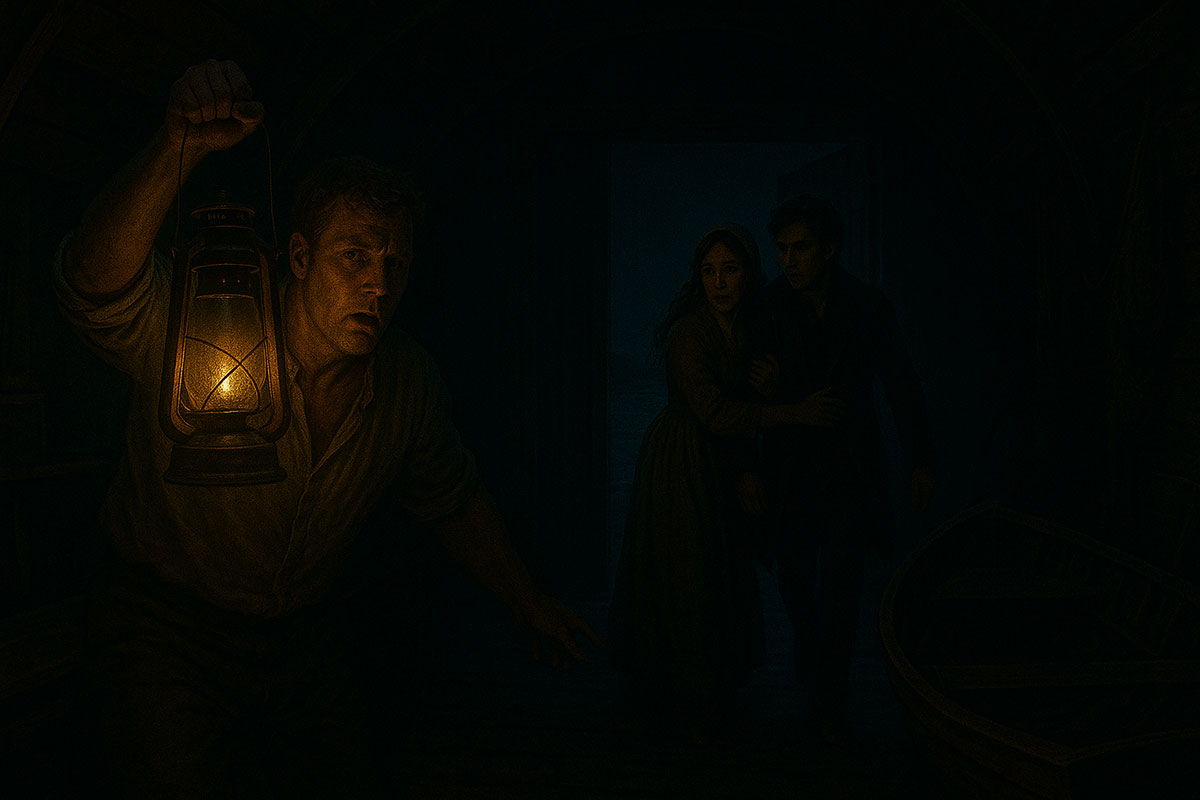
Steerforth’s figure darkens the threshold. Two silhouettes meet. A soft gasp; a soft “yes.” They slip out, swallowed by wind.
A moment beats. Then Ham returns with a flower he found at the door. He calls for Emily. Once. Twice. His voice keeps calling after he stops. Mr. Peggotty wakes, understands without understanding, and drops to his knees, palms on wood as if the boat could answer.
Adult David
I had escorted betrayal to my own hearth and asked it to sing.
The lanterns fade to one—Ham’s shaking in his hand. Blackout.
Scene 10: Micawber vs. Uriah Heep (Exposing Corruption)

A law office rises like a cage: shelves laddered to a ceiling that never arrives, ledgers stacked like walls, a green-shaded lamp casting righteous gloom. Uriah Heep glides between desks with rubbery humility, fingers constantly knitting and unknitting apologies.
Uriah
I am so umble, Miss Agnes. Humbleness is my only fault.
Agnes Wickfield stands still as a plumb line. Her father, Mr. Wickfield, slumps, papers spilling from his authority. Heep oozes caretaking—sign here, sir, for your own good—and the signatures steal the house, the business, the dignity.
Adult David enters in the periphery, narrating like a conscience with receipts.
Adult David
Evil seldom shouts. It curtsies, it tidies, it witnesses your signature.
Door burst: Mr. Micawber, wearing debt like a frock coat and courage like a sword. He announces himself with a flourish that almost covers his fear.
Micawber
Gentlemen! And—more importantly—ladies. I, Wilkins Micawber, do not propose to be silent when villainy puts on the boots of humility and tramples decency with a velvet heel!
Heep smiles, a damp blade.
Uriah
Mr. Micawber is, I humbly submit, often mistaken. About sums. About facts. About employment.
Micawber produces a ledger of his own—pages of copied letters, dates, sums: embezzlements annotated like an aria. As he reads, projections flash each incriminating figure across the back wall; the office becomes a courtroom whose judge is arithmetic.
Micawber (rising music in his voice)
Here, a loan transformed into a theft by the alchemy of false witness. Here, a trust converted to a trap. Here—ah, the flourish—an inventory balanced on the back of a man’s ruin!
Uriah twitches, humility fraying.
Uriah
I am umble.
Agnes (first razor of the scene)
You are hungry. That is different.
Mr. Wickfield, newly oxygenated, stands.
Wickfield
I have been unwell. I have been weak. I have not been blind—only persuaded to close my eyes.
Micawber goes in for triumph with reckless generosity.
Micawber
In consequence of a long, and I may add, intimate acquaintance with penury, I recognize the scent of fraud at twenty paces.
He slams the ledger. The green lamp flares. Heep lunges for the papers; David and Traddles block him—not with force, but with posture that remembers school and refuses fear.
Uriah (venom uncloaked)
I’ll ruin you all.
Agnes
You already tried.
The walls—those ledgers—split, light seaming down like acquittal. Heep collapses into the only darkness left: his own.
Adult David
It was not a hero in shining armor who saved us. It was a man who had learned to survive disappointment and could therefore recognize it wearing someone else’s face.
Micawber, suddenly shy, bows to Agnes as if to the idea of virtue. The office breathes again—papers re-stack, a desk becomes a desk. Outside the window, daylight arrives early.
Scene 11: Dora’s Decline (Fragile Love Dies)
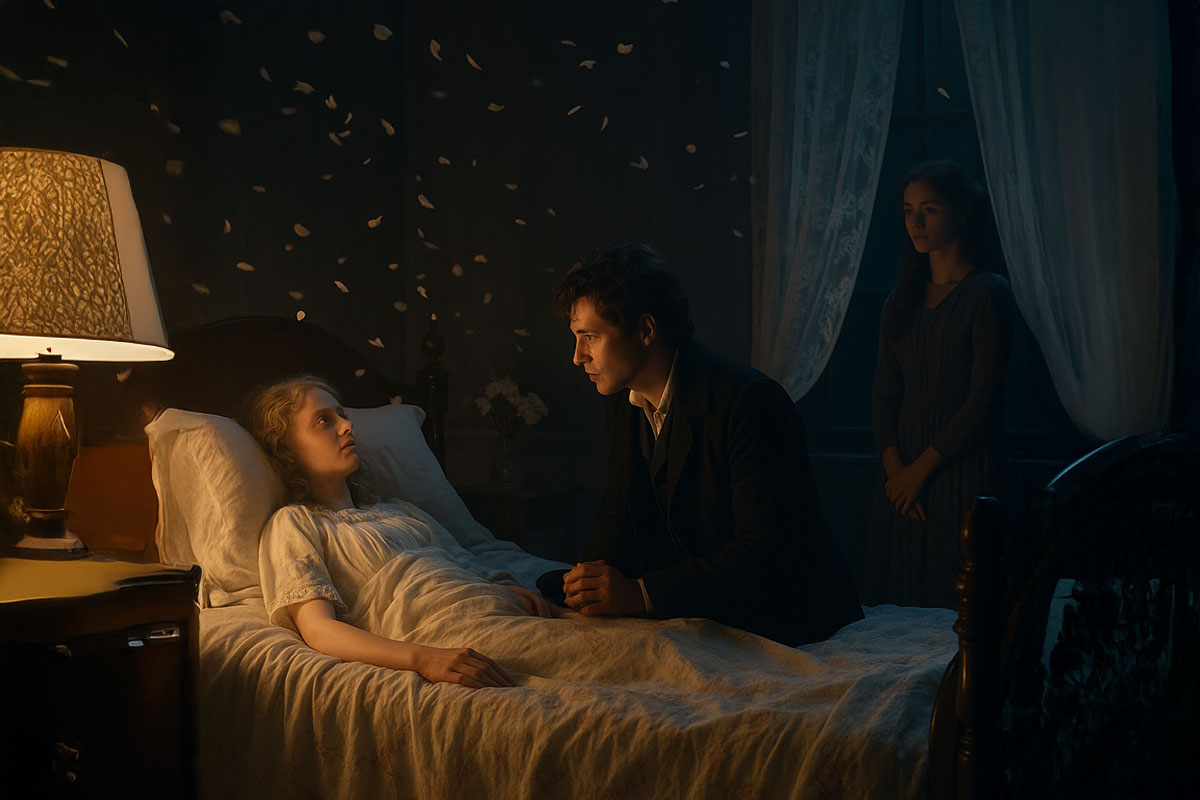
The palette shifts to pastels bleached by time—rose to pearl, gold to straw. Dora’s drawing room is a soft echo: lace curtains, a vase that remembers its flowers, Jip the dog curled like a comma at the end of a fading sentence. Dora reclines, frail and bright, a flame with less wick.
David reads to her—nonsense, fairytales, the law’s kinder clauses. He stumbles on the word “forever.” She smiles, correcting him with a fingertip.
Dora
Don’t promise time to me, Doady. Promise me gentleness.
Adult David stands in a light that refuses to be rosy.
Adult David
There are loves that teach us what we want. Dora taught me what I could not have.
Visitors arrive like weather—Betsey with practical violets, Agnes with the exact quiet that steadies a room. The women share a look beyond words. Agnes takes up mending a torn ribbon; Betsey tells Jip that grief is no excuse for bad manners. Jip obeys; grief does not.
Dora (to Agnes, a confession in lace)
You will help him, won’t you? When I am… when the light is… (she gestures, a candle pantomiming its own end)
Agnes
Always.
Dora nods, relieved. David doesn’t hear. He’s bargaining with the universe in his head, using every clause his profession has taught him. He misses the contract being signed in front of him: Dora giving him permission to let her go.
A brief bright spell—Dora wants to plan a picnic she knows will not happen. David plays along; they lay out napkins on the coverlet, pour invisible lemonade. Jip guards crumbs that aren’t there. Laughter arrives, fragile and perfect.
Then the light thins. Dora grows still. Her hand searches for David’s; his finds it as if relearning.
Dora (whisper)
You were always so brave when you were making mistakes.
He begins to cry—not the loud kind, the true kind that sits behind the eyes like a full well.
Dora
Hush. Let me go, Doady. I am not a sorrow. I am a story.
The room listens as if to a small, important sound. Dora’s breath becomes a thread, then a stitch, then—nothing. The lace curtain lifts as if a soft hand passed by.
Adult David
There are doors we do not know we are standing in until they close behind us.
Jip whimpers; Betsey takes him up with uncharacteristic gentleness. Agnes closes Dora’s eyes the way one closes a book one intends to keep forever. David kneels, not theatrical, simply smaller.
The pastels remain, but they remember color. The room is a shrine to tenderness that was tried, and found too delicate for the world.
Scene 12: The Storm & Steerforth’s Death (Chaos & Punishment)
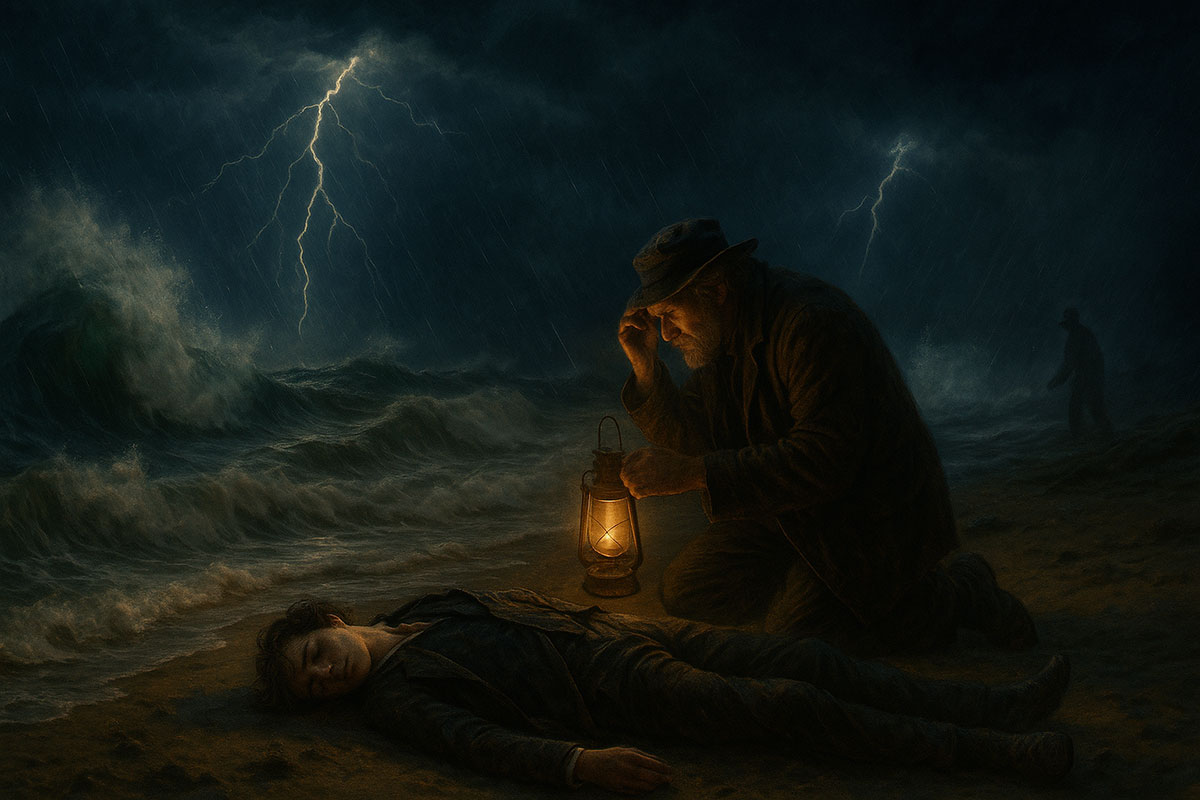
Sound crashes in before light: ropes groan, timbers scream, a drumbeat mimics the heart when it is afraid. Projections tear the set into sea—a deck tilts out of the floor, a mast angles down from the flies; rain appears as threads of light. Figures lash themselves to hope.
Onshore, the Yarmouth pier forms from planks and men’s prayers. Ham stands in silhouette, a man built of lighthouse and loyalty. Mr. Peggotty clutches a rope as if it were a verse from a book that saves.
Adult David threads between sea and shore, narrator and witness.
Adult David
There are nights when law is merely wind, and the only statute is whether a man will swim toward another.
A ship founders in the projection, breaks like an oath. Shouts cut the rain. A body on a spar—then a hand—then nothing.
Ham moves before anyone can dissuade him.
Mr. Peggotty
Ham—
But heroism has never obeyed its elders. Ham dives. The water swallows him like a thought.
A terrible interval—lightning, blackout, lightning—where the stage forgets it’s a stage and remembers only risk. Then the sea returns what it takes when it has been kinder than expected: a body. Carried up as if he were always weight and never charm—Steerforth, hair plastered, face too beautiful to be gone.
David steps forward, drenched in imagined rain. Memory overlays the corpse: Steerforth laughing, Steerforth singing, Steerforth promising rooms with Emily’s name on them. The overlay dissolves. He is only a boy who drowned in the shape of a man.
Adult David
My friend. My betrayer. The sea does not distinguish.
Mr. Peggotty lifts his eyes to a God he argues with, then gathers the rope again because argument does not close a wound. The surf coughs up Ham—or part of him—one arm, one absence. The stage does not dwell; it honors.
Mrs. Gummidge keens, a sound like gulls and grief. Emily is not present—only her lantern, snuffed as if the storm remembered her first.
David kneels by Steerforth, touches the brow. No anger survives; only cost.
David (to him, to himself)
You taught me that brilliance can be a storm and a shelter in the same hour. And that neither lasts.
The storm noise recedes to rain, the rain to a hush, the hush to a long inhale the audience forgets to exhale. The pier empties but for Mr. Peggotty and his rope. He stays onstage as the lights dim, a figure carved from endurance.
Adult David
We think justice looks like balance. Sometimes, it is only a shore with names written on it and another tide already coming.
Blackout.
Scene 13: David Abroad (Wandering in Grief)

A bare stage, remade by light. Maps ripple across the back wall like skin over a pulse: Paris in sepia, the Alps in blinding white, Rome in gold and dust. A small desk rolls with David wherever he goes—as portable as sorrow. A suitcase, scuffed and stubborn, becomes a stool, a pulpit, a barricade against memory.
Adult David steps into a cool wash.
Adult David
It is possible to move so quickly you mistake flight for healing. I tried every language for the word “stay” and pretended I’d learned “begin.”
Young Porters cross behind him with choreographed indifference—crates stamped with cities, cathedral spires sliding by like thoughts. David writes, tears the page, writes again. In Paris, a violinist plays a waltz that sounds like Dora’s laugh rewritten for minor key. In Switzerland, wind roars; the projection tilts to whiteout; David leans into it, a figure learning the angle of resilience. In Rome, statues stare—patients of eternity—while David counts his breaths like coins.
He meets fellow émigrés of grief: a widow tracing her ring on a table; a painter who only paints morning because afternoons are too honest; a boy selling postcards of ruins with a sincerity that breaks David’s practiced politeness.
Adult David
I hoarded other people’s stories. It is a way of not drowning—clinging to the flotsam of strangers.
He takes out a letter he cannot send—addressed to Dora, then to Steerforth, then to himself, finally to Agnes with no words written. He pockets it each time, as if hope were contraband.
A café sequence: cups appear and vanish; waiters move like metronomes. A Journalist recognizes his talent, tosses him a commission—travel sketches, thin pay, heavier purpose. David writes by candle and train-window, turning landscapes into sentences, sentences into survival. The desk collects stamps of use—ink bruises, coffee rings, a burn that looks like an eclipse.
At the edge of sleep, voices: Betsey’s brisk affection; Peggotty’s tea-spoon courage; Mr. Dick’s kite-string counsel; Dora’s last request—promise me gentleness. Each voice is a rope thrown from shore. One voice is quietest and nearest.
Agnes (off)
Come home, David. Not to a place—to yourself.
He freezes. The map projection pauses, then begins to rewind: Rome to Alps to Paris to Channel blue. David rises, closes the suitcase with an unconditional click. He leaves the desk where it is, then returns for it, smiling at the joke he’s finally in on: wherever you go, you will bring yourself. So bring paper.
Adult David
I thought I had traveled far. The longest distance was the one between sorrow and meaning.
Lights shift to a dawn palette. The desk rolls forward as if on a tide. David steps into the softening dark.
Blackout.
Scene 14: Return to Agnes (Recognition of True Love)

A room remade by order. Wickfield’s study restored: shelves upright, a decanter that pours restraint, sunlight clearing its throat at the curtains. On the desk, a ledger that now behaves like a book and not a trap. Agnes stands in the light, not waiting—working. Calm isn’t stillness; it’s precision.
Adult David
I meant to knock. What a relief that the door remembered me.
He enters. For a beat, they look—full, unperforming. A hundred letters-unsent arrive in a second and do not need reading.
David
Agnes.
Agnes
Welcome home.
They speak gently, as if hearing requires consent. He tells her fragments: Paris’s violin, Alpine brightness, Roman stone that perfected the art of not flinching. She listens like someone adding what she hears to an invisible account of care.
Agnes
You have been writing.
David (chagrined, amused)
Survival notes at first. Then—sentences that stopped apologizing.
Agnes
Good. (a beat) You always were most yourself when you were almost yourself on paper.
They smile the kind of smile that remembers how they used to smile and forgives the gap. He apologizes for not seeing what was beside him. She refuses the apology with a look that says: sight has seasons.
Agnes
We aren’t in competition with our younger selves. We are employed in correcting them.
A soft interlude: Mr. Wickfield enters, steadier, contrite, grateful. He thanks David awkwardly; he thanks Agnes without words by polishing his spectacles with new reverence. Traddles pops in with legal good news—the last of Heep’s entanglements dissolved—and exits tripping over his own reliability.
David and Agnes stand at the window. Outside, the projected garden from Betsey’s lawn scene returns—greener now, tended. Mr. Dick’s kite crosses once, then twice, like a signature on sky. Betsey’s voice floats from the other room, ordering tea to celebrate something she refuses to name.
David
I thought love was fireworks. Perhaps it is a lamp that refuses to go out.
Agnes
Fireworks will burn the paper. Lamps let you read.
He laughs—a sound he hasn’t trusted in months; she joins, surprised at how easily it returns.
There is no declaration, only an alignment. He reaches for her hand the way one turns a page: not to finish, to continue. The room, discreetly, exhales.
Adult David
I had sought absolution. What I found was accuracy.
Lights rest in a sober gold. The ledger on the desk is closed—balanced—not by arithmetic, by mercy.
Blackout.
Scene 15: Agnes & David’s Union (Maturity & Redemption)
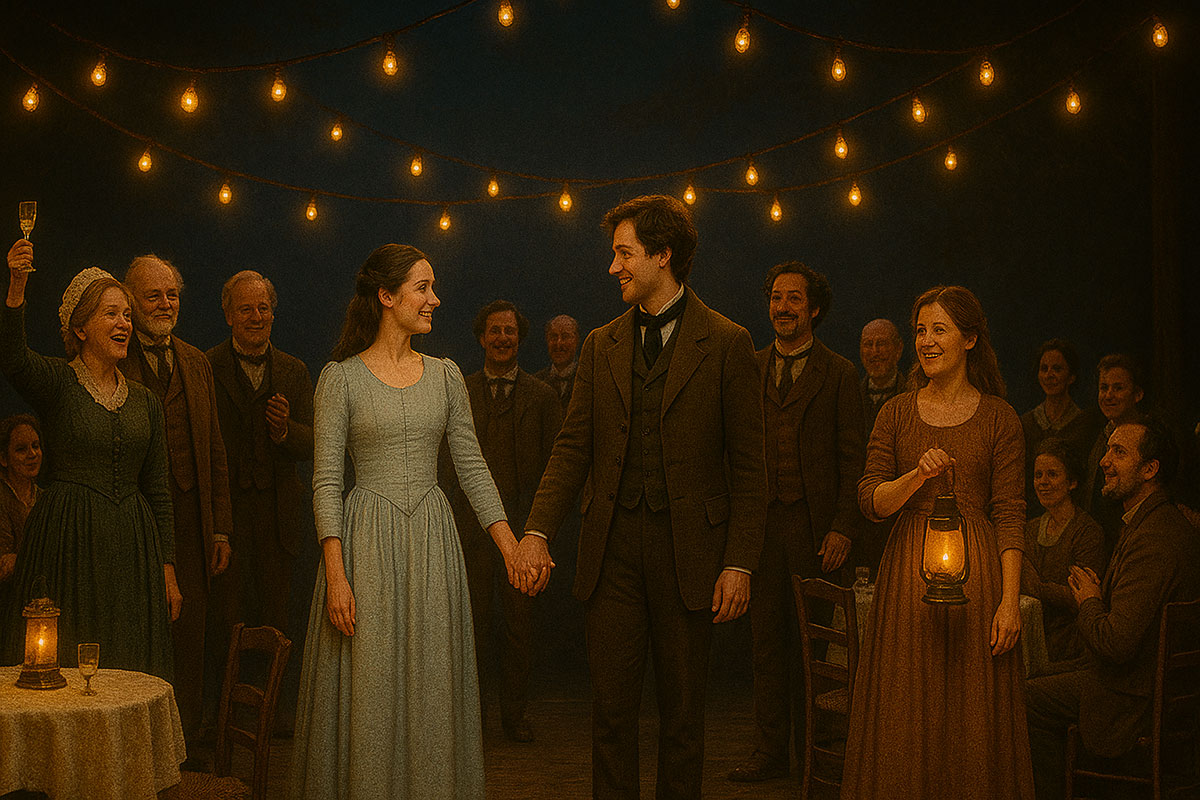
A celebration stitched from honest materials. Lanterns—warm, not ostentatious. Bunting that has paid off its debt. The ensemble sets the space as if building a village from goodwill: a table with too many chairs, a cake disguised as humility, a vase of small flowers that refuse hierarchy.
Betsey presides, general of happiness, adjusting everything that doesn’t need adjusting.
Betsey
Order is the courtesy we pay to joy.
Mr. Dick floats through with his kite, trailing ribbon wishes: Clarity. Kindness. Pudding. He is stopped and thanked as if he had invented weather.
Micawber practices a toast behind a pillar; Mrs. Micawber edits it with surgical affection. Traddles wrangles napkins into legality; Peggotty carries a pie as if it were news from a hospital ward—urgent, nourishing, good.
David and Agnes enter without trumpets. The light finds them the way morning finds rooms—on purpose but unannounced. The gathering hushes not into reverence, into recognition: yes, this.
Micawber launches.
Micawber
Friends, Romans, country—no, wrong text. My text is debt, ruin, resurrection, and roast potatoes. In observing the felicity of our estimable pair, I am reminded that when something turns up, it is frequently because two someones turned toward.
Laughter. Mrs. Micawber dabs her eyes, which is to say her heart.
Betsey raises her glass, small and decisive.
Betsey
To David and Agnes: may your mistakes be brief and your corrections speedy.
Mr. Wickfield adds softly:
Wickfield
And may your house be governed by mercy’s laws.
They sign nothing. They sign everything. Hands joined, they look more like collaborators than statues. The music is live and near: a fiddle, a penny whistle, a drum that sounds like footsteps in the right direction.
In a corner, Ham’s memory stands with Emily’s lantern—now relit—a quiet memorial inside the joy. David notices, inclines his head; Agnes follows, and together they let remembrance sit at the table instead of haunting the door. This union does not erase cost; it learns to count differently.
Adult David
Fairy tales end at the kiss. Ours begins at the ledger—debits confessed, credits shared, balance pursued, profit measured in peace.
Dancing breaks out awkwardly then earnestly: Betsey leading a line she pretends not to be leading; Mr. Dick conducting breezes; Micawber waltzing debts into dividends. The room glows the way truth glows when no one is merchandising it.
As the music softens, Agnes and David step to the edge of the light. Their foreheads touch—prayer without ceremony. The company circles them, not to enclose, to accompany.
Fade on a chord that feels like home found after being mis-shelved.
Scene 16: Epilogue / Final Tableau (Life as Story)

Night again, but the charitable kind. The stage returns to the desk from Scene 1, papers scattered like constellations that finally reveal a pattern. Adult David sits, writing with the calm velocity of someone who has forgiven his pages for being true.
Behind him, tableaux rise in warm silhouette: Clara rocking an infant; Peggotty mending a world with a needle; the boat house lanterns; Salem’s hard bench; Betsey’s garden and its anti-donkey ordinance; Micawber’s posture of splendid defiance; Dora’s room washed in pearl; the pier in storm; Agnes in a square of morning.
Adult David (without looking up)
Whether I turned out to be the hero of my own life—or only the chronicler of braver hearts—has ceased to trouble me. Stories don’t ask for heroes. They ask for honesty.
He pauses, smiles at a sentence like you smile at an old friend you didn’t recognize right away. He reads a line under his breath—something about lamps and fireworks—and underlines it, not to shout, to remember.
The ensemble enters, each bearing a small emblem: Peggotty with a thimble that might as well be a shield; Betsey with a chair for sitting down to clarity; Mr. Dick with the kite that steadied the sky; Micawber with a ledger closed on a grin; Traddles with a brief he has ironed into hope; Mr. Peggotty with rope, uncut, for future rescues; Emily’s relit lantern resting in his hands, not as guilt as promise.
Adult David turns to us at last.
Adult David
If you find yourself at midnight between luck and doom, take notes. If someone hands you a smaller version of yourself, be kinder to it than I sometimes was. If you must run, run toward the person who makes you accurate.
He sets down the pen. The desk lamp warms to a gentle sun. Agnes steps from the shadows to his side; he doesn’t start—he has been writing her there all along. They look out together.
The company gathers in a final living portrait—not symmetry, companionship. No one centered, but everyone placed. The projections withdraw, leaving only faces and the hum of a room that refuses to end in silence. A soft chord holds. The lanterns rise and hold with it.
Adult David (quiet, the first line finding its echo)
I was born on a Friday at midnight. It took me years to learn that Friday belongs to the week, and midnight belongs to the morning that follows.
Blackout. A breath. Then applause, as if the audience were returning something they borrowed: attention, compassion, time.
Final Thoughts by Jack Thorne

I wanted this story to close not on triumph, but on truth. David doesn’t end with riches or with vengeance; he ends with a desk, a pen, and the people who survived with him. That’s where meaning is.
In David’s world, cruelty was everywhere: in schools, in marriages, in factories, in the law itself. But kindness was everywhere too — in Peggotty’s hand, in Aunt Betsey’s fury, in Agnes’s patience, in Micawber’s absurd resilience. Dickens insists, and I believe, that kindness is the stronger force.
So if you walk out tonight holding anything, let it be this: that your mistakes don’t disqualify you from love; that your losses don’t erase your worth; and that the small acts of mercy we offer each other — a shawl, a kite, a word spoken gently — are what make a life heroic.
Thank you for sharing David’s story with us. It is Dickens’s. It is mine. And, perhaps, it is also yours.
Short Bios:
Charles Dickens
One of the greatest novelists of the Victorian era (1812–1870), Dickens authored classics such as Great Expectations, A Tale of Two Cities, and Oliver Twist. His works blended humor, social critique, and unforgettable characters, often drawing from his own experiences of hardship. David Copperfield was his most personal novel, reflecting his own childhood struggles.
Jack Thorne
A celebrated contemporary playwright and screenwriter, Jack Thorne is known for adapting complex, beloved works for the stage, including Harry Potter and the Cursed Child and Philip Pullman’s His Dark Materials. His writing combines emotional intimacy with bold theatrical innovation.
David Copperfield (character)
The protagonist of Dickens’s novel, David grows from an abused, lonely child into a thoughtful, resilient man. His story reflects the pain of loss, the power of kindness, and the triumph of perseverance.
Agnes Wickfield
David’s lifelong friend and eventual wife, Agnes embodies loyalty, patience, and moral clarity. She is the emotional anchor of David’s journey and represents quiet, steadfast love.
Dora Spenlow
David’s first wife, Dora is charming and beautiful but frail and childlike. Her decline and death mark one of the novel’s most poignant explorations of love, loss, and maturity.
Betsey Trotwood
David’s eccentric and formidable aunt, Betsey rescues him from cruelty and provides him with stability, guidance, and fierce love. She represents justice, independence, and unconventional wisdom.
James Steerforth
Charismatic, privileged, and dangerously magnetic, Steerforth becomes both David’s idol and his betrayer. His seduction of Emily and his tragic death in the storm make him one of Dickens’s most complex figures.
Wilkins Micawber
Comic, eloquent, and perpetually in debt, Micawber is one of Dickens’s most beloved creations. His optimism and eventual triumph over Uriah Heep highlight the resilience of the human spirit.
Uriah Heep
The novel’s sly villain, Heep cloaks his ambition in false humility. His attempt to control the Wickfields and exploit others makes him a symbol of hypocrisy and greed.
Mr. Peggotty
A fisherman of great heart, Mr. Peggotty embodies generosity, loyalty, and love. His devotion to his adopted daughter Emily, even after her betrayal, gives the story some of its deepest compassion.
Leave a Reply