
|
Getting your Trinity Audio player ready...
|
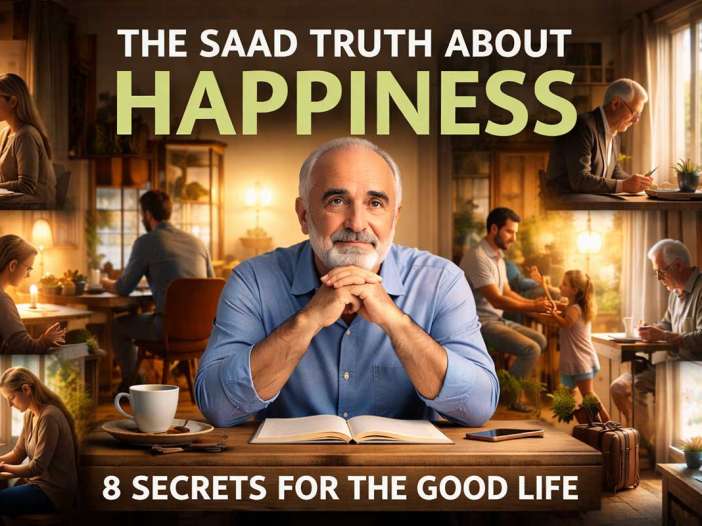
What if Gad Saad sat down with the world’s sharpest minds on happiness and exposed what really makes life good?
What does it really mean to live a good life? That question sounds simple at first, yet it keeps opening into deeper ones. Is happiness something we feel, or something we build? Is it found in pleasure, or in truth? Does it come from peace, from love, from meaningful work, from self-command, from resilience, or from learning how to carry pain without letting pain define us?
In this imaginary conversation, Gad Saad’s The Saad Truth About Happiness becomes more than a book summary. It becomes a living exploration of human life from many angles. Each chapter opens a different door. One asks us to think about wisdom itself and whether ancient voices still know something modern people have forgotten. Another asks us to look at two of the biggest choices any person can make: whom to love and how to spend the working years of life. Another turns to moderation, asking why human beings so often ruin good things by wanting too much. Then the conversation shifts into play, variety, failure, regret, and worry — not as side issues, but as central parts of the search for lasting happiness.
What makes this journey compelling is that it does not treat happiness as a vague mood or a soft motivational slogan. It treats happiness as something that must stand up under pressure. A good life cannot depend only on comfort, applause, novelty, or temporary excitement. It has to survive disappointment. It has to survive boredom. It has to survive mistakes, aging, loss, and the ordinary weight of daily life. That is why these conversations matter. They are not asking how to feel good for a moment. They are asking how to build a life that is still worth living when life becomes difficult, confusing, or painfully honest.
Across these eight topics, we hear voices from philosophy, psychology, relationships, creativity, suffering, mortality, and practical daily living. Some speak with ancient clarity. Some speak with modern research. Some speak from hardship. Some speak from close observation of ordinary human weakness. Put together, they show that happiness is rarely a single thing. It is a pattern. It is a structure. It is a way of ordering the self and the life around it.
This series begins, then, with a simple hope: that by listening closely to these different voices, we may see our own lives more clearly. Not in a flattering way, not in a sentimental way, but in a way that helps us become more truthful. If happiness has secrets, perhaps they are not hidden because they are mysterious. Perhaps they are hidden because people often do not want to hear them. To live well may ask more of us than modern culture likes to admit. It may ask for courage, restraint, humility, meaningful effort, loving honesty, and the willingness to change before regret becomes too heavy.
That is the road we are about to walk. Not the road of fantasy, but the road of formed living. Not the road of easy pleasure, but the road of tested happiness. And if these conversations do their work well, they may leave us with something better than inspiration. They may leave us with a clearer sense of what kind of life is actually worth building.
(Note: This is an imaginary conversation, a creative exploration of an idea, and not a real speech or event.)
Topic 1 — Ancient and Modern Wisdom Regarding the Good Life

Participants
- Gad Saad
- Aristotle
- Epictetus
- Viktor Frankl
- Arthur Brooks
Question 1
What is the strongest foundation for a good life: virtue, meaning, pleasure, love, or inner peace?
Aristotle: A good life begins with virtue, since a person cannot build lasting happiness on appetite alone. Pleasure comes and goes, but character shapes what a man does day after day. Without virtue, even success can become corruption.
Viktor Frankl: I would place meaning at the center. A person can survive pain, deprivation, and loss if he knows why he lives. Pleasure is too fragile to carry the full weight of existence.
Arthur Brooks: I see happiness as a mix of enjoyment, satisfaction, and meaning, but the deepest stability comes from ordered love and purpose. When people chase pleasure by itself, they often become miserable. The strongest base is a life aimed at something worthy.
Epictetus: Inner peace matters, but not as softness or escape. It comes from learning what is within our control and what is not. A man who governs his responses is harder to enslave by fortune, fear, or praise.
Gad Saad: From my view, a good life must be reality-tested. You need meaning, love, self-respect, competence, and some joy in being alive. Any philosophy that ignores human nature ends up sounding noble but failing in practice.
Question 2
What can ancient wisdom still teach modern people about happiness that modern culture keeps missing?
Epictetus: Modern people often suffer twice: once from pain itself, and once from their frantic resistance to it. Ancient wisdom teaches restraint, perspective, and self-command. Not every emotion deserves obedience.
Arthur Brooks: Modern culture keeps telling people to optimize everything, yet many become more anxious as they gain more choices. Ancient wisdom reminds us that happiness is not endless expansion. It often comes from limits, duties, friendship, and gratitude.
Aristotle: The mistake of many ages is to confuse freedom with appetite. A person becomes free by being formed well, not by indulging every urge. Happiness grows when desire is educated rather than worshiped.
Gad Saad: I think ancient thinkers were often better at speaking clearly about human weakness. They did not assume that comfort alone would make us flourish. They understood that discipline, courage, loyalty, and moderation are not old-fashioned burdens but survival tools for a good life.
Viktor Frankl: Ancient wisdom also knew that suffering belongs to life. Modern people are often shocked by pain, as if something abnormal has happened. Yet once suffering is accepted as part of existence, the question changes from “Why is this happening?” to “What is life asking of me now?”
Question 3
Is happiness mainly a feeling, a discipline, or a way of living?
Arthur Brooks: Happiness includes feelings, of course, but feelings are the weather, not the architecture. A good life is built from habits, loves, beliefs, and commitments that hold even when the mood dips. So I would say it is a way of living supported by discipline.
Gad Saad: I agree. If happiness were just a feeling, then anyone with enough stimulation should be fulfilled, and that clearly is not true. A good life is something you construct through wise choices, honest relationships, meaningful effort, and the refusal to live in self-deception.
Viktor Frankl: Happiness cannot be pursued directly for long. It tends to arrive as the result of devotion to something beyond the self. In that sense, it is less a feeling to be grabbed and more a byproduct of right living.
Aristotle: Yes, happiness is an activity of the soul in accordance with excellence. It is not a passing mood. It is the lived expression of a well-formed life.
Epictetus: A disciplined mind is not the whole of happiness, but without it, happiness is unstable. The undisciplined man becomes a servant to every fear and desire. True peace belongs to the person whose life is governed from within.
Nick Sasaki:
What strikes me here is that none of these men treats happiness as mere excitement or comfort. They keep returning to form, meaning, discipline, and truthful living. This first topic gives us a strong base for the rest of the series: the good life is not stumbled into. It is shaped.
Topic 2 — The Right Life Partner and the Ideal Job

Participants
- Gad Saad
- Esther Perel
- John Gottman
- Cal Newport
- Viktor Frankl
Question 1
Which shapes a person’s happiness more deeply over a lifetime: the partner they choose or the work they do?
Gad Saad: If I had to choose one, I would say the life partner. A bad partner can poison your home, your confidence, your focus, your health, and even your ability to succeed at work. People often underestimate how much daily emotional friction can destroy the quality of a life.
Viktor Frankl: I would not separate the two too quickly. Love and work are two great anchors of human meaning. Yet love reaches into the deepest part of the person. Work can give purpose, but love can give the soul a reason to endure.
Esther Perel: The partner shapes the emotional climate of life. The right person does not remove pain, but they create a living space where truth, repair, laughter, and growth remain possible. The wrong person can make even success feel cold.
Cal Newport: Work matters hugely, since most people give it so many hours of their lives. Work that is misaligned with one’s strengths or values can create chronic emptiness. Yet I agree that a destructive home life spills into everything else much faster than many people admit.
John Gottman: I would lean toward partner choice for one simple reason: close relationships affect physiology, stress, trust, and long-term stability in direct ways. A strong marriage or partnership can buffer the blows of the outside world. A hostile one can make every other burden heavier.
Question 2
What separates a life-giving relationship from one that slowly drains the soul?
John Gottman: In my view, the key markers are respect, trust, repair, and the ability to handle conflict without contempt. Contempt is one of the most dangerous poisons in a relationship. Once one person begins to treat the other as beneath them, the bond starts collapsing from the inside.
Esther Perel: A life-giving relationship lets both people remain alive as persons. It is not just safety. It is also vitality. The relationship must have honesty, emotional generosity, room to breathe, and a willingness to see the other person again and again rather than freeze them into a role.
Gad Saad: I would add that compatibility matters more than fantasy. Shared values, mutual admiration, sexual fit, loyalty, and emotional steadiness are not secondary issues. People often choose from infatuation, status, loneliness, or illusion, then wonder why the relationship becomes a prison.
Viktor Frankl: Love sees the deepest possibility in another person. A draining relationship does the reverse. It shrinks the other, uses the other, or refuses to meet the other in truth. Where love is real, it calls the person upward.
Cal Newport: There is a parallel with deep work here. What nourishes life usually has structure, intention, and care. A draining relationship is often full of reaction, noise, constant interruption, and unresolved disorder. People cannot thrive in emotional chaos forever.
Question 3
How can a person choose work that fits both their nature and their sense of meaning?
Cal Newport: I think people should be careful with the idea of instantly finding their passion. A better path is often to build rare and valuable skills, gain control over your working life, and move toward work that feels useful and deeply engaging. Meaning often grows after mastery, not before it.
Viktor Frankl: A person should ask not only, “What do I want from work?” but also, “What is life asking of me through this work?” Meaning is often found where responsibility meets giftedness. Work becomes noble when it serves something real beyond the ego.
Gad Saad: Many people make terrible choices here by chasing prestige, social approval, or abstract status. The right job should fit your temperament, your abilities, your willingness to struggle, and your actual human needs. If your work constantly violates your nature, you will pay for it.
Esther Perel: Work needs to support identity, not just income. People suffer when they live one life on paper and another inside. The right work lets a person feel that who they are and what they do are not at war with each other.
John Gottman: I would add one practical point: the ideal job is not chosen in isolation from the rest of life. Work that destroys marriage, sleep, health, or presence with loved ones carries hidden costs. A wise choice asks not just, “Can I succeed there?” but, “What kind of life will this job force me to live?”
Nick Sasaki:
This topic lands close to home for almost everyone. Love and work are not side issues. They shape the texture of ordinary days, and ordinary days become a life. What I hear here is a warning and an invitation: choose with more honesty, more patience, and more realism than culture usually teaches.
Topic 3 — The Sweet Spot: All Good Things in Moderation

Participants
- Gad Saad
- Aristotle
- Seneca
- Maimonides
- Jonathan Haidt
Question 1
Why do human beings so often ruin good things through excess?
Gad Saad: Human beings are drawn to immediate rewards, often with little regard for long-term consequences. Food, sex, status, pleasure, comfort, praise — all of these can become traps when appetite outruns wisdom. A good thing stops being good when it begins to own you.
Aristotle: Excess comes when desire is left unformed. The soul must be trained, or it will chase pleasure beyond its proper measure. Men do not usually ruin life by enjoying good things, but by failing to govern their enjoyment.
Jonathan Haidt: Part of the problem is that our minds are not built for perfect self-regulation. We are emotional creatures first and rational creatures second. The ancient environment rewarded grabbing what was available. Modern abundance turns that impulse into overeating, addiction, distraction, and compulsion.
Seneca: The man who cannot stop does not possess pleasure. He is possessed by it. Many think excess is freedom, yet it is often slavery with a smiling face.
Maimonides: Balance requires disciplined correction. If a person leans too far in one direction, he must sometimes train himself back through the opposite. Excess becomes habit, and habit becomes character, unless wisdom intervenes.
Question 2
Is moderation a sign of wisdom, self-mastery, or fear of living fully?
Aristotle: Moderation is not fear. It is proportion. A person who has mastered himself can enjoy what is fitting, at the right time, in the right way, for the right reason. That is richer than reckless indulgence.
Seneca: The unwise often mock restraint as weakness. Yet what is weaker than a man who cannot refuse himself anything? Self-command is one of the clearest signs of strength.
Gad Saad: Many modern people confuse intensity with depth. They think living fully means constant stimulation, constant consumption, constant emotional drama. That is often just immaturity dressed up as freedom. A mature person knows how to enjoy without collapsing into excess.
Jonathan Haidt: There is a psychological truth here: many pleasures fade when overused. The person who cannot moderate often destroys the very delight he is trying to maximize. So moderation is not anti-life. It often protects life from becoming numb.
Maimonides: Wisdom lies in ordering the self. A disordered life may look exciting for a season, but it usually becomes unstable. The balanced person is not empty of passion. He is properly guided by reason and moral purpose.
Question 3
How can discipline make life richer instead of smaller?
Jonathan Haidt: Discipline creates the conditions for freedom that lasts. Without discipline, people fall into cycles that shrink their attention, health, and trustworthiness. With discipline, they gain steadier satisfaction and deeper forms of joy.
Gad Saad: Discipline lets you protect what matters from your weaker impulses. It helps you build a body, a marriage, a career, a mind, and a conscience that do not fall apart under pressure. Far from shrinking life, it expands what you are capable of sustaining.
Seneca: A disciplined man is harder to terrify and harder to tempt. He wastes less energy on regret, chaos, and self-inflicted pain. Simplicity and order can give the soul room to breathe.
Maimonides: Discipline is medicinal when rightly used. It restores proportion. It brings the person back into alignment with health, judgment, and moral clarity. What seems restrictive at first often becomes liberating once the soul regains balance.
Aristotle: Discipline forms virtue through repeated action. In time, what first feels difficult can become noble and even pleasant. The good life is not made poorer by excellent habits. It is made possible by them.
Nick Sasaki:
This conversation makes one thing plain: moderation is not a timid life. It is a governed life. The goal is not to remove pleasure, but to keep pleasure from becoming a master. What looks like restraint from the outside may, in truth, be the very thing that keeps a person free, strong, and fully alive.
Topic 4 — Life as a Playground

Participants
- Gad Saad
- Stuart Brown
- Mihaly Csikszentmihalyi
- Esther Perel
- Robin Williams
Question 1
Why do so many adults lose their sense of play as they grow older?
Stuart Brown: Many adults stop playing when life becomes identified only with duty, performance, and survival. Play gets pushed aside as if it were a luxury, yet it is one of the deepest sources of renewal. When people lose it, they often become more rigid, joyless, and emotionally brittle.
Gad Saad: Adulthood often becomes a prison of seriousness. People think maturity means becoming permanently heavy, efficient, and guarded. That is a mistake. A person can be responsible and still keep delight, curiosity, mischief, and spontaneity alive.
Esther Perel: Many adults lose play when they become overmanaged by fear. Fear of failure, fear of judgment, fear of looking foolish, fear of wasting time. Play asks for looseness, and looseness feels dangerous to people who believe their worth depends on control.
Mihaly Csikszentmihalyi: Modern life fragments attention. A person pulled in ten directions struggles to enter the kind of absorbed engagement from which play often grows. Without presence, play fades into distraction or disappears entirely.
Robin Williams: Some people stop playing because they got hurt. Life can slap the silliness out of you if you let it. Then one day you wake up and realize you became efficient but not alive.
Question 2
Is play just pleasure, or is it one of the hidden pillars of a happy life?
Gad Saad: Play is far more than amusement. It is tied to vitality, bonding, creativity, risk-taking, learning, and joy in existence itself. A person who cannot play often loses access to an important layer of being human.
Mihaly Csikszentmihalyi: In its best form, play creates flow — that state where attention becomes fully engaged and the self stops feeling divided. Such moments are deeply rewarding. They are not trivial escapes but glimpses of ordered joy.
Stuart Brown: Play is a biological and social need. It helps human beings adapt, connect, imagine, recover, and grow. When play is absent, people can become more depressed, more hostile, and less flexible in mind and spirit.
Esther Perel: Play keeps intimacy alive. In love, friendship, and family life, play opens space for surprise, laughter, teasing, tenderness, and erotic energy. Without it, relationships can become all management and no aliveness.
Robin Williams: Pleasure can vanish in minutes. Play leaves a mark. It gives breath to the soul. It lets people remember they are more than their pain, more than their paycheck, more than the role they perform.
Question 3
Can humor, creativity, and lightness protect a person from despair?
Esther Perel: They do not erase pain, yet they can interrupt its tyranny. Humor and creativity make room in the psyche. They remind us that sorrow is real, but it does not own every inch of inner life.
Robin Williams: Humor is not denial when it is honest. Sometimes it is the last lantern in a dark room. A joke can keep a person from sinking all the way down. A little absurdity can keep a person breathing.
Stuart Brown: Creativity and play are forms of resilience. They help the nervous system recover. They let people experiment with reality instead of becoming crushed by it. In that sense, lightness can be a survival tool.
Mihaly Csikszentmihalyi: Creative engagement helps people transform suffering into form, motion, and meaning. A person absorbed in making, building, writing, painting, performing, or solving can recover a sense of agency that despair tries to steal.
Gad Saad: Despair feeds on helplessness and repetition. Humor and play can crack that pattern. They restore movement. They remind you that you are still capable of response, imagination, and life. That is no small thing.
Nick Sasaki:
This may be one of the most surprising chapters in the whole series. Play sounds light, yet the people here treat it with great seriousness. What they suggest is that a happy life is not built only from duty, meaning, and discipline. It needs joy, movement, laughter, and the freedom to be more than a machine.
Topic 5 — Variety as the Spice of Life (Sometimes)

Participants
- Gad Saad
- Esther Perel
- Daniel Kahneman
- Barry Schwartz
- Mihaly Csikszentmihalyi
Question 1
When does variety make life richer, and when does it quietly destroy depth, loyalty, and peace?
Esther Perel: Variety enriches life when it brings freshness, curiosity, and renewed attention. It becomes destructive when novelty turns into avoidance. Some people do not seek variety to become more alive. They seek it to escape boredom with themselves, and that can slowly erode loyalty and depth.
Gad Saad: Human beings are drawn to novelty for many evolutionary reasons. New experiences, new possibilities, new partners, new status signals — all of these can feel exciting. Yet the same instinct that helped survival can become destabilizing in a modern world full of endless options. Variety is good until it becomes a refusal to commit.
Barry Schwartz: Too many options often produce less satisfaction, not more. People imagine that wider choice will bring freedom, but it can bring anxiety, second-guessing, and chronic dissatisfaction. Variety works best when it serves a meaningful life rather than replacing one.
Mihaly Csikszentmihalyi: Depth usually requires sustained attention. A person who is always shifting may collect stimulation without ever reaching fulfillment. Variety can refresh the mind, but peace often comes from learning how to enter deeply into worthwhile things.
Daniel Kahneman: The mind is not always a good judge of what will make it happy. We overvalue what is new, vivid, and immediately rewarding. This can lead us to mistake excitement for improvement, when in fact we may be trading stable well-being for temporary spikes of interest.
Question 2
Why do human beings crave novelty so strongly, even when stability is what they truly need?
Daniel Kahneman: The brain pays special attention to what is new, surprising, and emotionally charged. Novelty catches attention fast. Stability is often less dramatic, so it gets undervalued, even when it is better for long-term well-being.
Gad Saad: Novelty once had obvious survival value. New territory, new resources, new alliances, new reproductive opportunities — these mattered. The problem is that old instincts now operate inside modern systems built to exploit them. Social media, advertising, pornography, shopping culture — all of these can hijack the novelty drive.
Esther Perel: Novelty gives people a feeling of expansion. It can make them feel awake, desired, powerful, or free. Stability, by contrast, can start to feel invisible unless people know how to stay present inside it. The challenge is not just to seek the new, but to learn how to see the familiar with fresh eyes.
Barry Schwartz: People often imagine that one more option will solve the unease they already carry. So they keep searching. Yet endless searching can become its own prison. A person can become addicted to possibility and unable to inhabit reality.
Mihaly Csikszentmihalyi: Stability can nourish deep satisfaction, but it asks something harder of us. It asks us to develop attention, discipline, and the ability to engage fully. Novelty gives easy stimulation. Depth asks for inward formation.
Question 3
How can a person keep life fresh without becoming restless, distracted, or unable to commit?
Mihaly Csikszentmihalyi: The answer is not endless change, but renewed engagement. A person can go deeper into the same craft, the same relationship, the same practice, and still find freshness there. Flow does not depend on constant novelty. It depends on meaningful challenge and absorbed attention.
Esther Perel: In relationships, freshness often comes from mystery, imagination, play, and the willingness to meet the other person as someone still unfolding. Commitment does not require emotional deadness. It requires that we stop confusing predictability with intimacy.
Barry Schwartz: One practical answer is to limit unnecessary choice. Build a life where the important things are chosen clearly, so the mind is not forever comparing and doubting. Peace grows when commitment is protected from constant temptation.
Daniel Kahneman: It helps to distrust the immediate glamour of the new. People should ask whether what attracts them is truly better, or merely more stimulating right now. Good judgment often begins with slowing down the mind’s reflexive attraction to novelty.
Gad Saad: A strong life has both roots and sparks. Keep your commitments, but do not let yourself become spiritually numb. Learn, travel, laugh, experiment, create, explore. Freshness is healthy when it enriches the structure of life rather than blowing it apart.
Nick Sasaki:
This conversation draws a fine line that many people miss. Variety can awaken life, but it can just as easily become a form of instability. The deeper lesson here is that freshness is not the enemy of commitment, but restlessness is. A good life needs both renewal and rootedness.
Topic 6 — On Persistence and the Anti-Fragility of Failure

Participants
- Gad Saad
- Viktor Frankl
- Angela Duckworth
- Nassim Nicholas Taleb
- Thomas Edison
Question 1
What kind of failure makes a person stronger instead of bitter or broken?
Angela Duckworth: The kind of failure that strengthens a person is failure that stays connected to effort, learning, and purpose. People grow when they can say, “This hurt, but it taught me something I can use.” Failure becomes dangerous when it turns into identity, when someone stops saying “I failed” and starts saying “I am a failure.”
Thomas Edison: A failed attempt is useful when it gives you information. If you try honestly, observe closely, and keep improving, then the failure is doing work for you. Most useful failure is not empty defeat. It is correction.
Nassim Nicholas Taleb: Some failures are too large and crush a person. Others are small enough to create adaptation. The key is whether the stressor is survivable and whether it reveals weakness before catastrophe does. A system, or a person, grows stronger when tested by manageable strain.
Viktor Frankl: Failure can deepen a person when it does not empty life of meaning. A human being can bear disappointment, humiliation, and setback if he can still answer the question, “What is being asked of me now?” When suffering is joined to responsibility, it need not destroy.
Gad Saad: Failure helps when it breaks illusion without breaking the self. Many people need reality to slap them awake. The problem is not failure itself. The problem is narcissism, fragility, and the fantasy that life should unfold without resistance.
Question 2
How should a person respond when life humiliates them, defeats them, or refuses to reward their effort?
Viktor Frankl: First, they must refuse the lie that pain makes life meaningless. There is dignity in the way one bears adversity. When life refuses reward, the person still keeps freedom in one place: the freedom to choose a worthy response.
Gad Saad: A person should stop whining, tell the truth about what happened, and adapt. Sometimes life is unfair. Sometimes you were foolish. Sometimes you were simply weak in a place that needed strength. Self-pity delays recovery. Honest recalibration begins it.
Angela Duckworth: I would say: grieve, but do not freeze. Let disappointment be real, then return to effort with better information. Persistence is not blind repetition. It is committed adjustment.
Thomas Edison: When the result is bad, change the method, not the mission too quickly. People often abandon a worthwhile aim when what they really needed was a better process. Defeat can teach precision.
Nassim Nicholas Taleb: One should reduce dependence on fragile approval systems. If all your motivation depends on applause, reward, promotion, or smooth outcomes, you are easily shattered. Build a life where setbacks can teach you, not end you.
Question 3
Can repeated struggle become one of the building blocks of happiness?
Nassim Nicholas Taleb: Yes, if the struggle is meaningful and not purely destructive. Ease alone often weakens people. Repeated challenge, within limits, builds confidence, toughness, and respect for reality. A life without friction may feel pleasant for a while, but it often produces a brittle soul.
Angela Duckworth: Happiness is not just comfort. Many people feel most alive when they are growing toward something difficult. Struggle can produce pride, skill, and earned hope. There is a deep satisfaction in knowing you stayed with something worthy.
Thomas Edison: Success without struggle is often shallow. You do not know what something means until it has cost you time, error, patience, and persistence. The joy of arrival is sharper when the road had resistance.
Gad Saad: I would put it this way: some of the happiest people are not those who avoided hardship, but those who proved to themselves that hardship could not take them down. Struggle can turn into self-respect. And self-respect is a powerful ingredient in the good life.
Viktor Frankl: Yes, but only when struggle is joined to meaning. Empty struggle deforms. Meaningful struggle ennobles. When a person suffers in service of love, truth, duty, or conscience, pain can become part of a life that is still deeply worth living.
Nick Sasaki:
This topic has real steel in it. These voices are not praising pain for its own sake. They are saying that failure, rightly faced, can strip illusion, sharpen judgment, and build a person from the inside. Happiness here is not softness. It is the quiet strength that comes from having been tested and still standing.
Topic 7 — It’s (Almost) Never Too Late — Eradicate Regret

Participants
- Gad Saad
- Bronnie Ware
- Viktor Frankl
- Irvin Yalom
- Maya Angelou
Question 1
What kinds of regret wound people most deeply near the end of life?
Bronnie Ware: The deepest regrets are usually not about failed ambition. They are about unlived truth. People regret the life they did not permit themselves to live, the love they did not express, the courage they postponed, and the time they surrendered to fear, duty, or pleasing others.
Viktor Frankl: I think the deepest regret comes when a person senses that he turned away from meaning. Not every loss is avoidable, yet there is a special sorrow in knowing one refused a calling, betrayed conscience, or wasted suffering that might have been transformed into something noble.
Irvin Yalom: Many people reach later life with grief over the self they abandoned. They regret living mechanically, delaying honesty, and acting as if they had endless time. Regret cuts deepest when one sees that life was not stolen by fate alone, but quietly given away through avoidance.
Maya Angelou: I believe one of the fiercest regrets is failing to love fully and speak truth cleanly. People ache over withheld tenderness, swallowed words, tolerated indignities, and years spent shrinking for the comfort of others. The heart remembers every time it was told to be smaller than it was meant to be.
Gad Saad: I would say regret bites hardest where self-deception lasted too long. Wrong partner, wrong career, cowardly silence, wasted talent, fake living, fear-based choices. Many people know much earlier than they admit that they are on the wrong path, but they keep lying to themselves until decades disappear.
Question 2
Can regret still become a force for healing, truth, and action, or does it usually arrive too late?
Irvin Yalom: Regret can become healing if it awakens presence instead of paralysis. It is painful, yes, but pain can clarify. The moment a person sees life more truthfully, some freedom returns. They may not recover the past, but they can still stop betraying the present.
Gad Saad: Regret is useful only when it moves you toward action. Endless rumination is vanity in tragic clothing. If regret helps you apologize, change course, repair damage, leave illusion, or begin at last, then it has served a purpose. If it becomes self-punishment without motion, it is just decay.
Bronnie Ware: I have seen that even late honesty can soften a life. People may not be able to rewrite whole decades, yet they can still tell the truth, express love, forgive, ask forgiveness, and release some of the weight. Regret turns healing when it opens the heart instead of sealing it shut.
Maya Angelou: I do not think truth is wasted when it comes late. Late truth can still bless. A person can still stand up, speak clearly, write the letter, make the call, leave the false room, and honor what remains. There is pain in lateness, yes, but there is grace in refusal to stay asleep.
Viktor Frankl: As long as a person lives, he remains responsible to the next hour. That is enough to keep hope alive. Regret is not redemptive by itself. It becomes redemptive when one answers it with responsibility. The past is fixed, yet the moral meaning of the present is still open.
Question 3
What should a person do now so they do not wake up one day feeling they betrayed their own life?
Maya Angelou: Tell the truth sooner. Love sooner. Refuse the habit of self-abandonment. A person must stop making a home inside what diminishes the soul. Speak with dignity, act with courage, and stop waiting for permission to live honestly.
Viktor Frankl: Ask each day what life is asking of you, not merely what you want from it. A betrayed life often grows from living unconsciously, selfishly, or passively. Responsibility is the antidote. One must answer the call of conscience in the concrete tasks, loves, and duties before him.
Bronnie Ware: Stay close to what matters before busyness swallows it. Make room for friendship, family, rest, laughter, honesty, and the small choices that build a real life. Many regrets are born from drift, not disaster.
Gad Saad: Stop making major decisions from fear, vanity, or social pressure. Pick the partner you can respect. Do work that fits your nature. Protect your health. Say what you mean. Leave fake worlds early. Most regret is predictable if you are honest enough to look ahead.
Irvin Yalom: Keep death in view, not morbidly but lucidly. A finite life can become more vivid when one remembers it is finite. People betray themselves less when they stop pretending they have forever.
Nick Sasaki:
This topic cuts deep. Regret is not just pain about the past. It is a mirror held up to the life we are shaping right now. What these voices keep saying is simple and severe: do not wait too long to become truthful. A life is often betrayed quietly, choice by choice, silence by silence, delay by delay. Yet as long as breath remains, some part of the story can still be reclaimed.
Topic 8 — Don’t Worry: Be Happy

Participants
- Gad Saad
- Dale Carnegie
- Marcus Aurelius
- Pema Chödrön
- Arthur Brooks
Question 1
What is the difference between useful concern and the kind of worry that slowly poisons life?
Dale Carnegie: Useful concern leads to action. Poisonous worry keeps circling without resolution. One helps a person solve a problem. The other drains strength by making the mind rehearse trouble again and again without doing anything clear.
Marcus Aurelius: Concern faces what is before it with reason. Worry multiplies shadows. A disciplined mind asks, “What is mine to do now?” An undisciplined mind suffers from events that have not yet happened, and may never happen.
Arthur Brooks: Useful concern is concrete, limited, and tied to a next step. Toxic worry is vague, repetitive, and identity-forming. It starts to feel like a permanent climate inside the self rather than a signal that something needs attention.
Pema Chödrön: Worry often comes from our refusal to sit inside uncertainty. We want guarantees, and when life does not give them, the mind starts spinning stories. Concern can be kind and awake. Worry becomes a desperate attempt to make uncertainty disappear.
Gad Saad: Exactly. Worry tricks people into thinking they are being responsible when they are often just feeding fear. If the problem is real, then act. If it is fantasy spiraling out of control, then stop treating your own nervous system like a truth machine.
Question 2
Why do so many people hold onto anxiety as if it were protecting them?
Pema Chödrön: Anxiety can feel like preparation. People imagine that if they worry enough, they will be less shocked by pain. Yet anxiety rarely gives true protection. It mostly keeps the heart from relaxing into the life that is actually here.
Arthur Brooks: Many people confuse vigilance with virtue. They feel that calmness means carelessness, so they stay mentally overactivated. Yet peace is not irresponsibility. In many cases it makes wiser action possible.
Gad Saad: There is also an evolutionary angle. Minds built to detect threat were often more likely to survive than minds floating in blissful ignorance. The trouble is that modern people can carry this machinery far beyond what reality demands. A threat-detection system can become a self-torture device.
Marcus Aurelius: Men cling to worry because they believe inner agitation gives them mastery over outer events. It does not. The storm in the soul does not calm the storm outside. One must learn to meet life with steadiness rather than panic.
Dale Carnegie: I found that many people worry out of habit. They have practiced fearful thinking so long that it begins to feel normal. They do not notice that worry is not solving their problems. It is becoming one of their problems.
Question 3
What daily habits help a person loosen worry and grow into real peace?
Arthur Brooks: Good habits begin with structure. Sleep better, move your body, limit the endless flood of stimulation, spend time with people who love you, and give your mind something meaningful to serve. Peace is helped by a sane daily rhythm.
Dale Carnegie: I would say: live in day-tight compartments. Deal with today. Face the actual duty in front of you. Write down the problem, ask what the worst likely outcome is, accept that possibility if you must, then begin improving from there. Action reduces worry.
Marcus Aurelius: Begin each day by ordering the mind. Examine your judgments. Remind yourself what is within your control and what is not. Do your duty without demanding that the world obey your preference. Peace grows where expectation becomes disciplined.
Pema Chödrön: Learn to remain present with discomfort without instantly fleeing into mental noise. Breathe. Sit still. Notice fear without becoming fear. When people stop fighting every uneasy feeling, they often find that the feeling moves through more gently than expected.
Gad Saad: Cut down the nonsense that feeds anxiety. Too much doom-scrolling, too much comparison, too much digital overstimulation, too much dependence on public approval. Build competence. Build truth. Build strong relationships. Worry weakens when life becomes more grounded.
Nick Sasaki:
This final topic brings the whole conversation down to daily life. The point is not to become unrealistically carefree. The point is to stop worshiping anxiety as if it were wisdom. Peace does not come from controlling everything. It comes from meeting reality with steadiness, action, perspective, and trust. That may be one of the hardest secrets of happiness, and one of the most needed.
Final Thoughts by Nick Sasaki

After moving through all eight topics, what remains is not one neat formula, but a hard-earned portrait of the good life. No single chapter can carry the whole truth. Love is not enough by itself. Work is not enough by itself. Discipline alone is not enough. Play alone is not enough. Reflection, resilience, peace, novelty, and regret each reveal something essential, yet none can stand alone. Happiness, as this series has shown, comes more from the way these forces are shaped into a life than from any one of them taken in isolation.
One of the strongest lessons here is that happiness cannot be built on self-deception. A person may spend years pretending that the wrong partner is fine, that empty work is meaningful, that excess is freedom, that distraction is joy, that constant novelty is aliveness, that failure has no lesson, that regret can wait, or that worry is a form of wisdom. Yet time keeps exposing the truth. The false life may look manageable for a season, but it slowly extracts its price. This series keeps returning to that point: reality matters. Human nature matters. What nourishes the soul is not infinitely flexible. Some choices deepen life. Some choices thin it out from within.
Another lesson is that happiness is much more moral than many people want to admit. Not moralistic in a narrow or scolding sense, but moral in the sense that a good life depends on character, truthfulness, proportion, responsibility, and courage. The person who cannot govern appetite will suffer for it. The person who cannot choose honestly will suffer for it. The person who refuses responsibility will suffer for it. The person who lives in fear of discomfort, fear of truth, or fear of change will likely suffer for it too. Again and again, these conversations suggest that happiness is not merely something we receive. It is something shaped by the quality of our loves, our habits, our judgments, and our willingness to face life as it is.
Yet this series is not grim. It has warmth in it too. It reminds us that happiness is not only discipline, but delight. Not only structure, but play. Not only endurance, but laughter. Not only staying rooted, but letting life stay fresh. Not only avoiding regret, but learning to speak, love, repair, and begin again before it is too late. In that sense, the good life is not a dry achievement. It is alive. It breathes. It has room for tenderness, for humor, for relationship, for curiosity, and for those small human moments that make a life feel inhabited instead of merely managed.
What I find most moving is that this path remains open even for imperfect people. No one needs to have lived flawlessly to learn from these truths. In fact, many of them become visible only after failure, heartbreak, excess, confusion, wasted time, or anxiety has already left its mark. That may be one of the deepest consolations in the whole project. A person can wake up late and still wake up. A person can carry regret and still turn it into honesty. A person can be wounded and still become wise. A person can realize, even after many wrong turns, that there is still time to live more truthfully than before.
So where does this leave us? It leaves us with a vision of happiness that is fuller, sterner, and more hopeful than the shallow versions people are often sold. Happiness is not the absence of pain. It is not endless pleasure. It is not social approval. It is not the performance of success. It is the slow formation of a life that can hold joy without collapsing into excess, hold sorrow without collapsing into despair, hold love without losing honesty, hold freedom without losing discipline, and hold uncertainty without surrendering to fear.
That is a demanding vision. Yet it is also a humane one. It respects the weight of real life. It respects the weakness of human beings. It respects the possibility of growth. And perhaps that is why these eight conversations matter. They do not flatter us, but they do not abandon us either. They call us upward. They ask us to live in such a way that, when we look back one day, we can say not that life was perfect, but that it was real, worthy, and deeply lived.
If that is the measure, then happiness is not a passing feeling at all. It is a formed soul inside a well-chosen life.
Short Bios:
Gad Saad
A marketing professor, evolutionary behavioral scientist, and public thinker known for sharp cultural critique and direct arguments about human nature, truth, and the conditions for a flourishing life.
Aristotle
Ancient Greek philosopher whose writings on virtue, character, and flourishing remain central to discussions of happiness and the good life.
Epictetus
Stoic philosopher who taught inner freedom, self-command, and the importance of focusing on what is within one’s control.
Viktor Frankl
Psychiatrist, Holocaust survivor, and author of Man’s Search for Meaning, remembered for his profound insights into suffering, responsibility, and meaning.
Arthur Brooks
Writer and social scientist focused on happiness, purpose, habits, love, and the practical structure of a meaningful life.
Esther Perel
Psychotherapist and relationship thinker known for her work on love, desire, intimacy, and the tensions between safety and aliveness in modern relationships.
John Gottman
Psychologist and relationship researcher famous for his long-term studies on marriage, conflict, trust, and the habits that sustain lasting love.
Cal Newport
Author and professor known for ideas on deep work, craftsmanship, meaningful career building, and a more focused way of living.
Seneca
Roman Stoic philosopher whose letters and essays explored self-mastery, mortality, emotional discipline, and wise living.
Maimonides
Jewish philosopher and physician whose thought joined reason, ethics, discipline, and balanced living into a unified moral vision.
Jonathan Haidt
Social psychologist whose work explores moral intuition, human flourishing, self-control, and the tensions inside modern life.
Stuart Brown
Psychiatrist and researcher best known for his work on the importance of play in creativity, resilience, and healthy human development.
Mihaly Csikszentmihalyi
Psychologist famous for the concept of flow, the deeply engaged state in which challenge, attention, and meaning come together.
Robin Williams
Beloved actor and comedian remembered for extraordinary humor, emotional range, and the ability to bring both laughter and pain into the same human space.
Daniel Kahneman
Psychologist and Nobel laureate whose work on judgment, bias, memory, and decision-making reshaped how people think about the mind.
Barry Schwartz
Psychologist and author known for exploring choice overload, decision fatigue, and the hidden burden of too many options.
Angela Duckworth
Psychologist and author known for her research on grit, perseverance, effort, and long-term achievement.
Nassim Nicholas Taleb
Essayist and thinker known for ideas about uncertainty, fragility, risk, and how adversity can strengthen people and systems.
Thomas Edison
Inventor and businessman remembered for persistence, experimentation, and a practical attitude toward failure and discovery.
Bronnie Ware
Writer and palliative care worker known for her reflections on the most common regrets people express near the end of life.
Irvin Yalom
Psychiatrist and existential thinker whose work explores mortality, freedom, regret, and the search for a life lived honestly.
Maya Angelou
Poet, memoirist, and moral voice whose writings speak with dignity, courage, truth, and deep human compassion.
Dale Carnegie
Writer and teacher best known for practical wisdom on worry, relationships, communication, and calm daily living.
Marcus Aurelius
Roman emperor and Stoic philosopher whose reflections on duty, mortality, and inner steadiness continue to guide readers across centuries.
Pema Chödrön
Buddhist teacher and author known for gentle but piercing wisdom on fear, uncertainty, compassion, and remaining present in difficulty.
Leave a Reply