

|
Getting your Trinity Audio player ready...
|
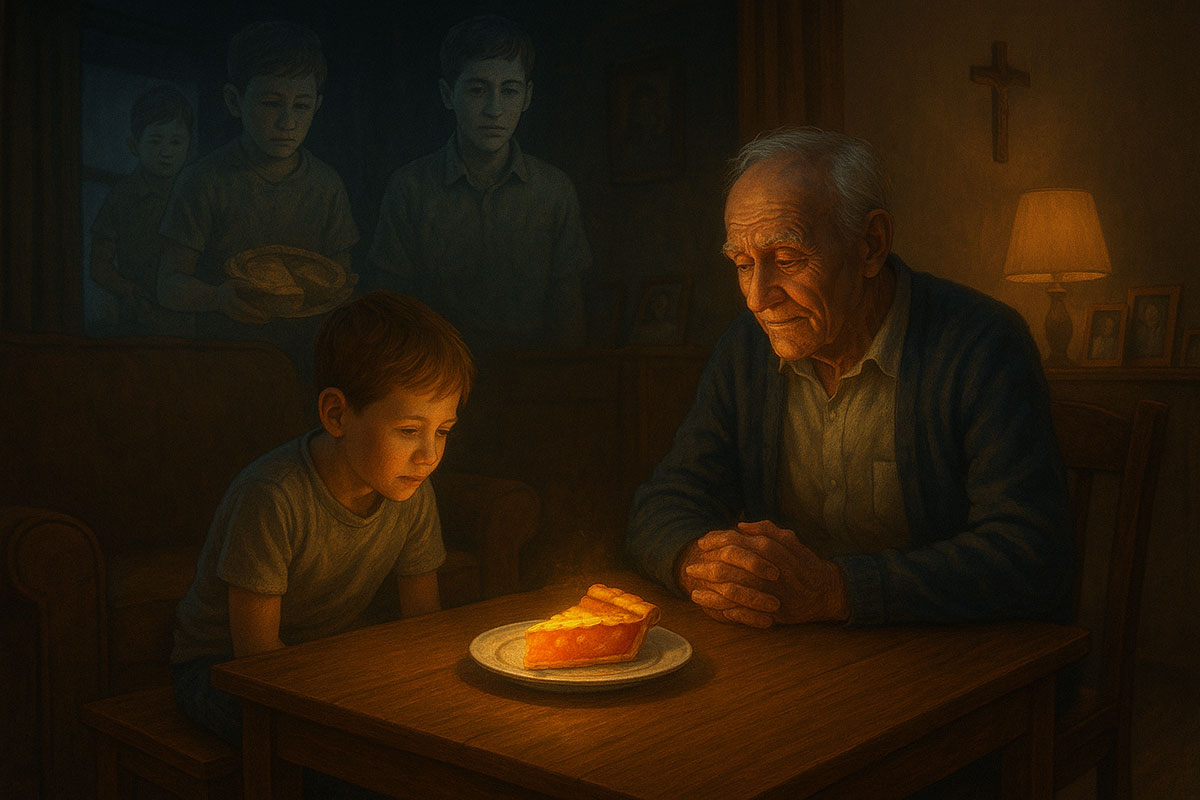
Introduction By Gary Soto
When I was a boy, I thought sin came in the shape of sweetness—golden crust, sugar crackling in the sun, the smell of apples too much for a six-year-old to resist. I wanted, so I took. And when I ate, I learned. The lesson wasn’t in the taste—it was in the pit of my stomach, in the heaviness that came after, in the way the pigeon stared like a priest, in how the preacher’s words sounded louder though he never spoke my name.
I have carried that pie all my life. Not the crust, not the filling—it was gone in minutes. What stayed was the shame, the way it curled around me, whispering whenever temptation brushed against me. That small act of theft became my teacher, harsher than any belt, more faithful than any sermon.
So this play begins where my life of conscience began—in an alley with ants swarming the last crumbs. And from there, we walk through the years, through guilt, through silence, through memory, until finally, at the far end, we see that even shame can be turned into story.
(This performance begins with a familiar tale and unfolds into newly imagined acts, offering an original continuation inspired by its themes.)

Scene 1 — The Theft
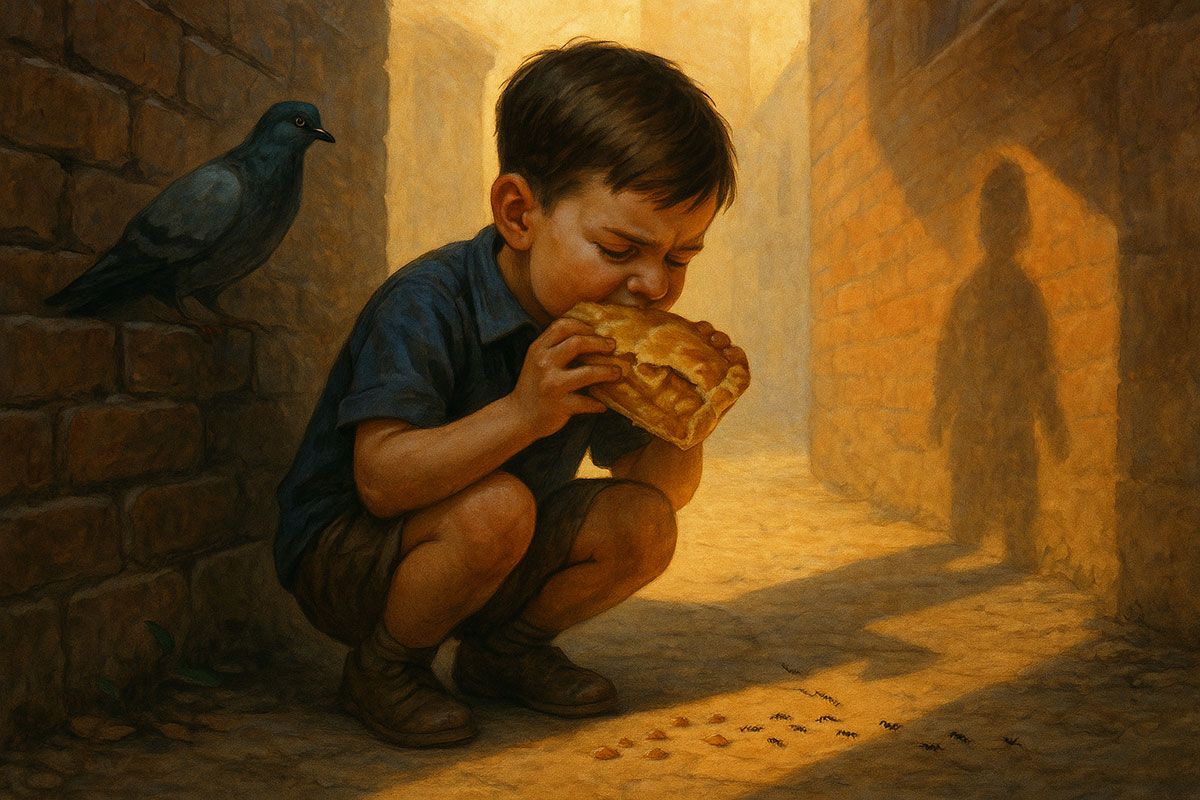
Setting: A small neighborhood market on a hot summer afternoon in California, late 1940s/early 1950s. The aisles are narrow, the air thick with the smell of ripe fruit and sugar. Outside, children’s laughter drifts faintly from the street.
Lights: A golden afternoon glow filters through the dusty store windows.
Sound: The whirr of an old ceiling fan, the shuffle of the grocer sweeping, faint church bells in the distance.
On stage: Young Gary, six years old, hovers outside the market door. His clothes are worn but neat, his eyes darting between the glass case and the shadows. In the display, a row of pies gleams—apple, cherry, peach—their crusts glistening with sugar like promises. He presses his nose to the glass.
Gary
(whispering)
Apple. The round belly of it. Gold and brown. Like it’s smiling at me.
(He swallows hard, clutching a nickel that is not enough. His hand trembles. The church bells toll once, slow and heavy.)
Gary (cont.)
God sees. He sees everything. Mama says He watches even when you breathe wrong.
(He closes his eyes, then opens them wide, staring at the pie as though it calls him.)
The Grocer shuffles past, broom in hand, humming off-key. He does not notice Gary at first. Gary ducks behind a barrel of onions, peeking out, waiting for the moment. His breath comes fast. He touches the wooden crucifix around his neck, then lets it fall against his chest.
Gary
(voice low, urgent)
Forgive me. Just one time. Forgive me.
(He slips inside. The bell above the door jingles faintly. He tiptoes past the counter, heart pounding like a drum. His small hand reaches up to the display. He lifts the warm pie, its weight both terrifying and glorious. For a second, he freezes, pie in hand, listening. The Grocer hums in the back. No one sees. He bolts out the door.)
Outside: sunlight blazes. Gary runs to the alley behind the store, pie clutched to his chest. He crouches behind a stack of crates. His breath comes in ragged gasps. He looks at the pie as though it is treasure and sin combined.
Gary
It’s mine. Oh God, it’s mine.
(He tears into it with both hands, the crust flaking, the filling oozing. He devours it greedily, apple and cinnamon staining his chin, his fingers. For a few moments, he is lost in joy. He laughs once, a small, wild laugh. Then—silence. The sweetness clings to his tongue, but already the weight of it presses on his chest.)
Lights dim slightly. The church bells toll again, louder this time. Gary freezes mid-bite. He looks around as if every sound hides an accuser. A PIGEON lands on the roof above him, cocking its head. Gary glares at it, then trembles.
Gary
Don’t look at me.
(He hurls a piece of crust at the bird; it flaps away. The act gives him no relief. He wipes his sticky fingers on his shirt, then stares at them, horrified.)
Gary (cont.)
I can’t wash this off. It’s inside me now.
From the far end of the alley, a NEIGHBOR passes by, glancing once in his direction. Gary hides the pie plate behind him, cheeks burning. The NEIGHBOR doesn’t stop, but Gary imagines the worst.
Gary (to himself)
He knows. They all know.
(The sky seems darker. He imagines the voice of a PREACHER, deep and solemn, filling the alley with invisible thunder.)
Preacher’s Voice (offstage, echoing)
Thou shalt not steal. Every sin is written on the heart. Every sin is seen.
(Gary shudders, clutching his chest as if words have struck him like stones. He stumbles to his feet, leaving the half-eaten pie on the ground. Ants crawl toward it. He backs away, eyes wide, unable to look.)
At home: The stage shifts. A small kitchen table, worn and scarred. Gary sits at it, restless. Mother hums as she washes dishes, unaware. Gary fidgets, picking at the crust under his fingernails. The crucifix glints at his throat.
Mother
You’re quiet today.
Gary
Just tired.
(A pause. She turns, smiling gently, drying her hands.)
Mother
Sunday’s coming. We’ll sit in church, and you’ll feel better. God takes the weight off when you pray.
(Gary swallows hard, forcing a nod. He cannot meet her eyes. Lights shift, isolating Gary in a spotlight as he whispers to himself.)
Gary
But will He take this? Will He ever take this?
Night: Gary lies in bed, restless. Moonlight spills through the window. He tosses, dreams stirring. Voices whisper around him—imagined or remembered—grocer, preacher, pigeons, even the hiss of ants swarming the abandoned pie. His blanket twists around him like chains.
Gary
(half-asleep, crying softly)
I’m sorry. I’m sorry.
(The crucifix slips from his chest and dangles over the edge of the bed. The moonlight catches it. For a moment, silence. Then, faintly, a whisper in the dark—Gary’s own conscience, or something beyond.)
Whisper (offstage, echoing)
The sweetness fades. The shame stays.
Blackout.
Scene 2 — The Burden of Guilt
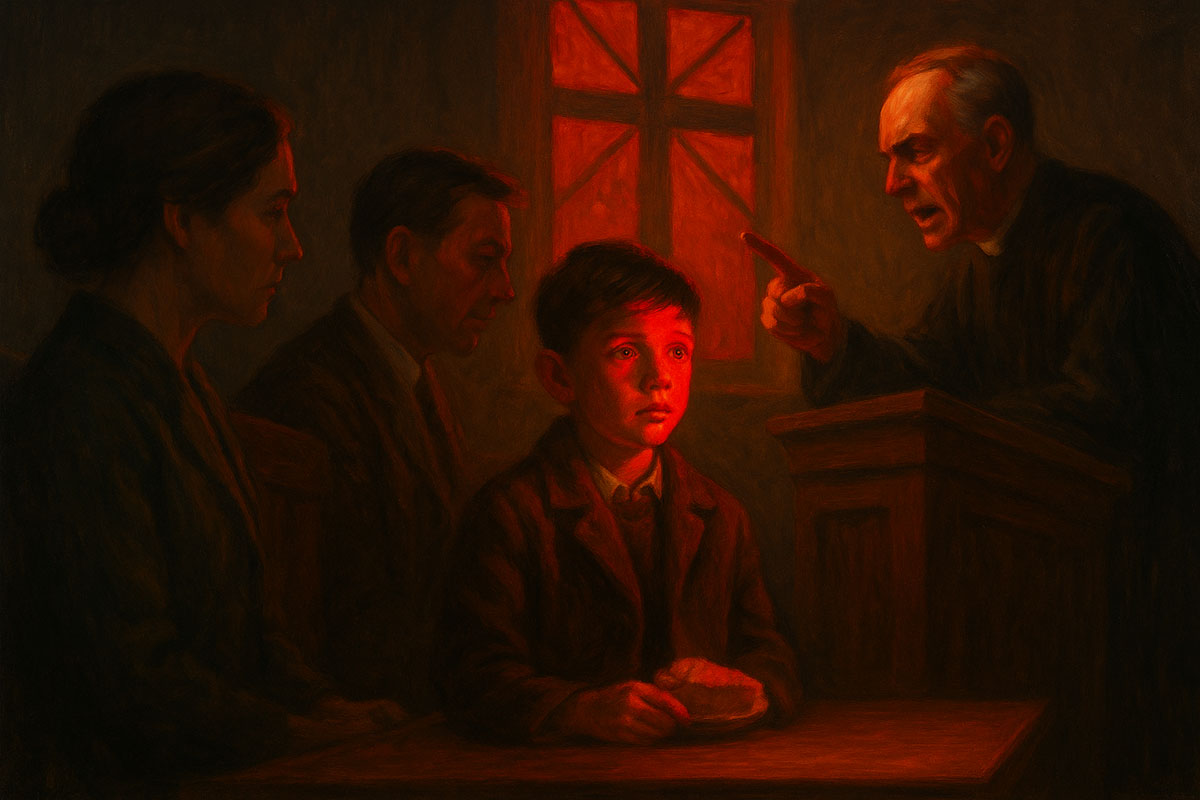
Setting: Sunday morning. The stage is divided: Stage Left is the kitchen of Gary’s home; Stage Right is the small neighborhood church. The two spaces overlap in light and sound, symbolizing how Gary’s guilt follows him everywhere.
Lights: Morning sunlight filters through the kitchen window, soft but unforgiving. In the church space, stained glass light flickers faintly, painting the pews with shifting colors.
Sound: The clink of breakfast dishes; the faint hymn of “Amazing Grace” bleeding in from the church side.
On stage: Gary, pale from a sleepless night, sits at the table. Mother places a plate before him, humming a hymn. He pushes food around with his fork. Father, silent and stern, reads the newspaper. The crucifix hangs from Gary’s neck, heavy as iron.
Mother
Eat, mijo. You’ll need strength for the Lord’s day.
Gary
(quietly)
I’m not hungry.
Father
Everyone eats on Sunday.
(Gary forces a bite of eggs. His stomach twists. His eyes dart to the window, where a PIGEON perches on the sill, pecking at nothing. He stiffens, remembering yesterday. He drops his fork with a clatter.)
Mother
What is it?
Gary
Nothing. Just… nothing.
Stage shifts. The kitchen dims, the church brightens. Gary now sits in a pew, pressed between Mother and Father. A PREACHER stands at the pulpit, hands raised. The hymn fades into silence.
Preacher
Children, the Lord sees what we do in secret. Every sin weighs upon us until we lay it at His feet. Even the smallest trespass—
(Gary flinches, hearing the word “trespass” like a blow. His heart races. He glances at the stained glass, where sunlight glows blood-red across Christ’s outstretched arms.)
Preacher (cont.)
—yes, even the hunger that leads us astray, the desire that tempts us—He knows it. And He knows you.
(Gary grips the pew so tightly his knuckles whiten. He imagines the entire congregation turning to stare at him. In reality, no one looks. But in his mind, every eye pierces him. He whispers.)
Gary
They know. They all know.
Stage Left: the market appears in shadow projection. The GROCER sweeps his sidewalk, looking up briefly as though into Gary’s thoughts. Gary squeezes his eyes shut, trembling. The half-eaten pie flashes faintly in memory, ants swarming it like judgment.
Gary (to himself)
I can’t wash it away. It’s written on me.
(The PREACHER’s voice booms, overlapping Gary’s whisper.)
Preacher
Sin is a stain no water can clean. Only confession. Only truth.
(Gary bolts upright. Mother grips his sleeve, confused. He sits back down, sweat dripping. His breathing is ragged. The congregation bows their heads in prayer, but Gary cannot. His eyes dart everywhere, desperate.)
Stage Right dims. Stage Left: later that day, outside the market. Gary lingers at the corner, staring at the storefront. The GROCER, broom in hand, hums while sweeping. Gary freezes, heart pounding. He imagines the grocer’s gaze burning into him, though the man never looks up.
Gary (to himself)
He’s waiting. He knows it was me. He’ll call me thief.
(He presses his hands over his ears as if to block the thought. The crucifix bounces on his chest like a weight.)
Stage shifts to twilight. The alley where Gary ate the pie is shown in ghostly light. The pie tin still lies there, crawling with ants. Gary enters slowly, drawn back like a moth to flame. He kneels, stares at the ruin of sweetness, and covers his face.
Gary
Why did I do it? It wasn’t even worth it. Not even good anymore.
(He weeps silently, clutching the crucifix. A CHORUS OF VOICES begins softly, almost a whisper, growing louder—imagined echoes of preacher, mother, grocer, neighbors.)
Chorus
Thief. Sin. Trespass. Shame. Shame. Shame.
(Gary staggers back, pressing his hands to his ears. He looks at the sky, wide-eyed, desperate for relief.)
Gary
God, take it. Please, take it away.
(Silence falls suddenly. The CHORUS vanishes. Only the faint sound of the pigeon’s coo remains. Gary collapses onto the ground, exhausted, the crucifix dangling from his hand.)
Lights fade to black, leaving the image of the ruined pie tin glowing faintly at center stage.
Scene 3 — The Growing Shadow
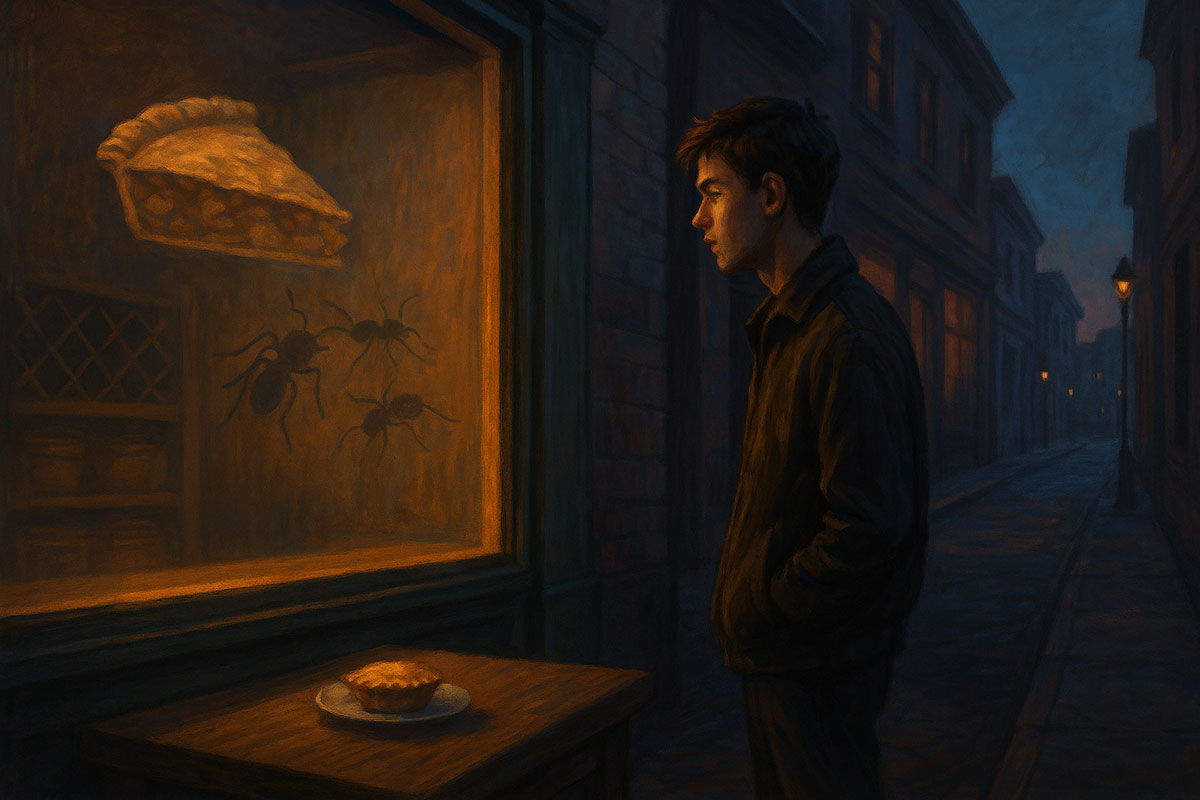
Setting: The street outside the old neighborhood market, now older and slightly run-down. Across the stage, faint projections of a school hallway and Gary’s bedroom appear as transitional spaces.
Lights: Early evening, a mix of natural twilight and the cold glow of streetlamps. Shadows stretch long, echoing Gary’s unresolved burden.
Sound: The distant chatter of teenagers, the squeak of school shoes, the echo of church bells faintly carried on the wind.
On stage: Gary, now a teenager, stands outside the market with his schoolbooks tucked under his arm. His posture is taller, but his eyes carry the same haunted weight. He stares at the storefront as though it hides a ghost. A FRIEND approaches, laughing.
Friend
Come on, Gary. Let’s hit the park. Maybe shoot some hoops.
Gary
I’ll catch up.
(The FRIEND shrugs and exits. Gary lingers, staring at the glass where pies once sat. His reflection looks back at him.)
Gary (to himself)
It’s still here. That pie. Not the same one, but the taste… the weight. Like it never left.
Stage Right: a SCHOOL HALLWAY flickers into view. Gary stands at a desk, a TEST in front of him. He glances at his neighbor’s answers. His pencil hovers, trembling. A VOICE—his own conscience, or perhaps the echo of the preacher—fills the space.
Voice (offstage, echoing)
Every sin is remembered. Every theft stays.
(Gary drops his pencil, refusing to copy. He buries his face in his hands. A TEACHER passes by, oblivious. The lights dim, shifting back to the street.)
Gary’s BEDROOM appears in dim light Stage Left. He sits at his desk, writing in a notebook. The crucifix still hangs on the wall. He scribbles furiously, then reads aloud.
Gary (reading)
“I stole a pie when I was six. Apple. Sweet at first, then ashes. I thought it would go away, but it follows me. Every lie, every temptation… I taste it again. Every time I almost take the easy path, I see the ants on the crust. I hear the pigeon’s wings.”
(He slams the notebook shut, frustrated. His MOTHER’s voice drifts in from offstage.)
Mother (offstage)
Gary, lights out soon. School tomorrow.
Gary
Yes, Mama.
(He blows out his lamp, but the glow of the crucifix lingers. He lies awake, whispering to himself.)
Gary
Will it ever end?
Stage shifts back to the MARKET. The GROCER, older now, sweeps the sidewalk as before. Gary hesitates, then approaches timidly.
Gary
Evening, sir.
Grocer
Evening.
(A pause. Gary swallows, his throat tight.)
Gary
You ever… remember a boy, years ago? Took something that wasn’t his?
(The GROCER pauses, thinking, then chuckles.)
Grocer
Son, I’ve seen a hundred boys sneak candy, a hundred more pocket fruit. Kids are kids.
(Gary’s face falls, relief and despair mixed. The grocer pats his shoulder lightly and goes back to sweeping. Gary stands frozen, voice cracking.)
Gary (to himself)
Just kids. But it wasn’t just. It was me. And it never left.
Stage darkens. A CHORUS OF TEENAGERS fills the background, laughing, whispering, their voices overlapping: “Cheat,” “Lie,” “Steal.” Gary stands at center, clutching his books, drowning in the noise. Suddenly he shouts.
Gary
Stop!
(The voices cut off. Silence falls. Only the faint toll of church bells remains. Gary sinks to his knees, whispering.)
Gary
It was only a pie. Only a pie. So why do I still feel its teeth?
Lights fade slowly to black, leaving the crucifix glowing faintly above his bed, and the empty pie tin from childhood projected ghostlike across the stage floor.
Scene 4 — The Reckoning
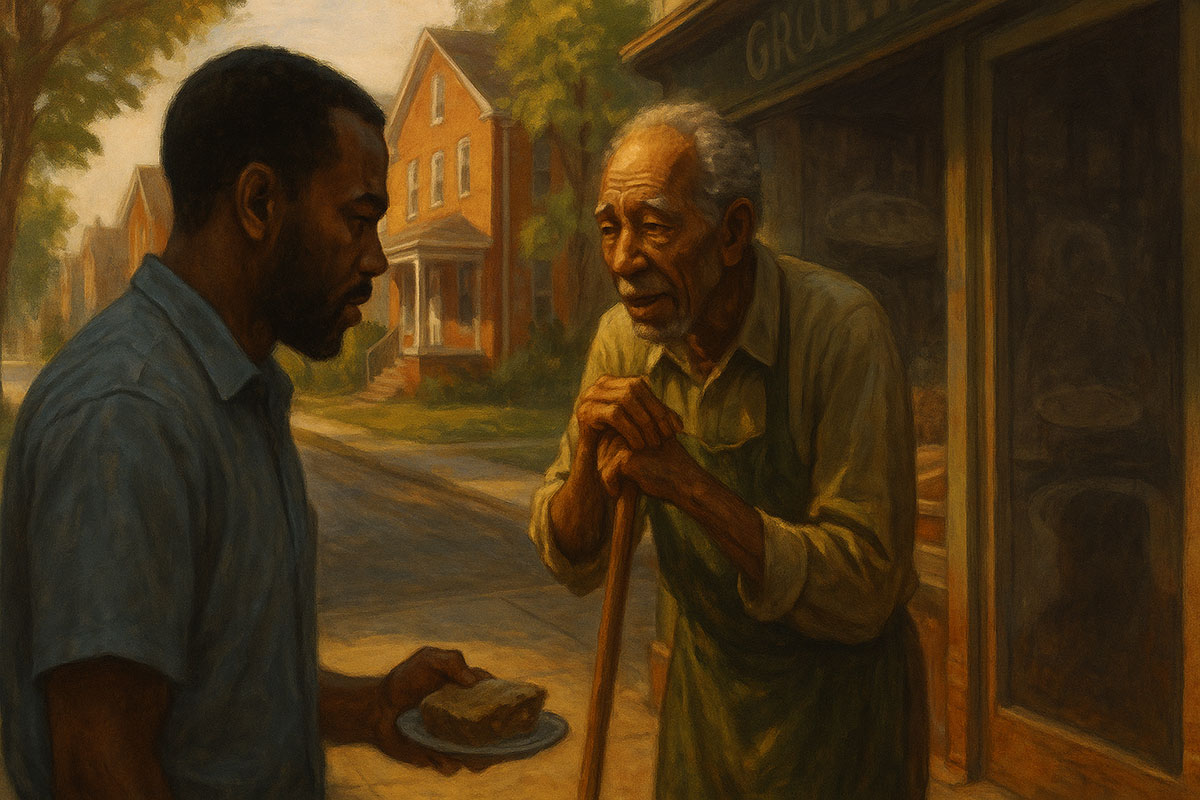
Setting: The old neighborhood, many years later. The market still stands, but it has changed—its once-bright windows dulled, its shelves half-empty. A small wooden sign creaks in the wind. Across the stage, a park bench and an old church steeple are suggested in dim light.
Lights: Late afternoon, golden but fading. Shadows stretch longer with each passing moment.
Sound: A faint wind, the squeak of the grocer’s broom, distant church bells tolling five. The city beyond hums faintly, indifferent.
On stage: Gary, now in his twenties, stands at the edge of the market. His clothes are clean but plain, his face more lined, his shoulders heavier. He holds himself with a young man’s restraint, but his eyes carry years of unspoken guilt. He stares at the building as if it were a grave.
Gary (to himself)
There it is. Same door. Same windows. Same place I carried it out, running like a thief. (beat) I was a thief. Still am.
(He hesitates, then steps forward. The Grocer, now old, bent with years, sweeps the sidewalk slowly. He looks up, squinting.)
Grocer
Help you, son?
Gary
I… I used to live here.
Grocer
Lots of folks did. Streets change, people move.
Gary
Not all people. Some of us stay. Even when we leave, we stay.
(The Grocer frowns, puzzled. Gary swallows hard, his voice trembling as he tries to begin.)
Gary
Years ago… I was a boy. Small, six maybe. I came into your store.
Grocer
Plenty of kids did.
Gary
But I—I stole something.
(The Grocer pauses, leans on his broom. His eyes narrow, then soften with tired amusement.)
Grocer
What was it? Candy? An apple? Boys are quick with their hands.
Gary
A pie.
(A silence. Gary’s words hang like a confession in the fading air. The Grocer chuckles, shaking his head.)
Grocer
A pie, eh? Son, I don’t remember that.
Gary
But I do. Every day. I can still taste it. Sweet, then bitter. I’ve carried it like a stone.
Grocer
(studying him)
All this time?
Gary
I thought you knew. I thought everyone knew.
Grocer
(softly)
I didn’t. And I don’t care now. It was just a pie.
Gary steps back, stunned. His chest rises and falls as if he’s been struck. He shakes his head, almost angry.
Gary
Just a pie? Do you know what it did to me? How it ate at me? How every prayer, every church bell, every whisper felt like it was screaming my sin?
(The Grocer shrugs, weary.)
Grocer
Then maybe the lesson worked. Cost me a pie, but bought you a conscience. Fair trade, I’d say.
(Gary trembles, torn between gratitude and fury. He stares at the ground, then lifts his gaze, voice breaking.)
Gary
So all these years… I was alone in it.
Grocer
That’s how guilt works, son. The world forgets. But you don’t.
Lights dim slightly. The park bench glows Stage Left. Gary sits, head in hands. A CHORUS OF VOICES begins to murmur softly—the echoes of Mother, Preacher, Childhood Gary, and Neighbor from past scenes.
Chorus
Thief. Trespass. Shame. Sweetness fades. Shame stays.
(Gary lifts his head, staring upward at the fading light. He grips the crucifix at his chest, now tarnished with years.)
Gary
Maybe it wasn’t the pie I stole. Maybe it was my own innocence.
(Silence. The CHORUS fades. Only the distant toll of the church bell remains. The Grocer sweeps in the background, humming faintly, unaware of the storm inside Gary. The stage lingers on Gary, torn between relief and sorrow.)
Blackout.
Scene 5 — The Final Bite
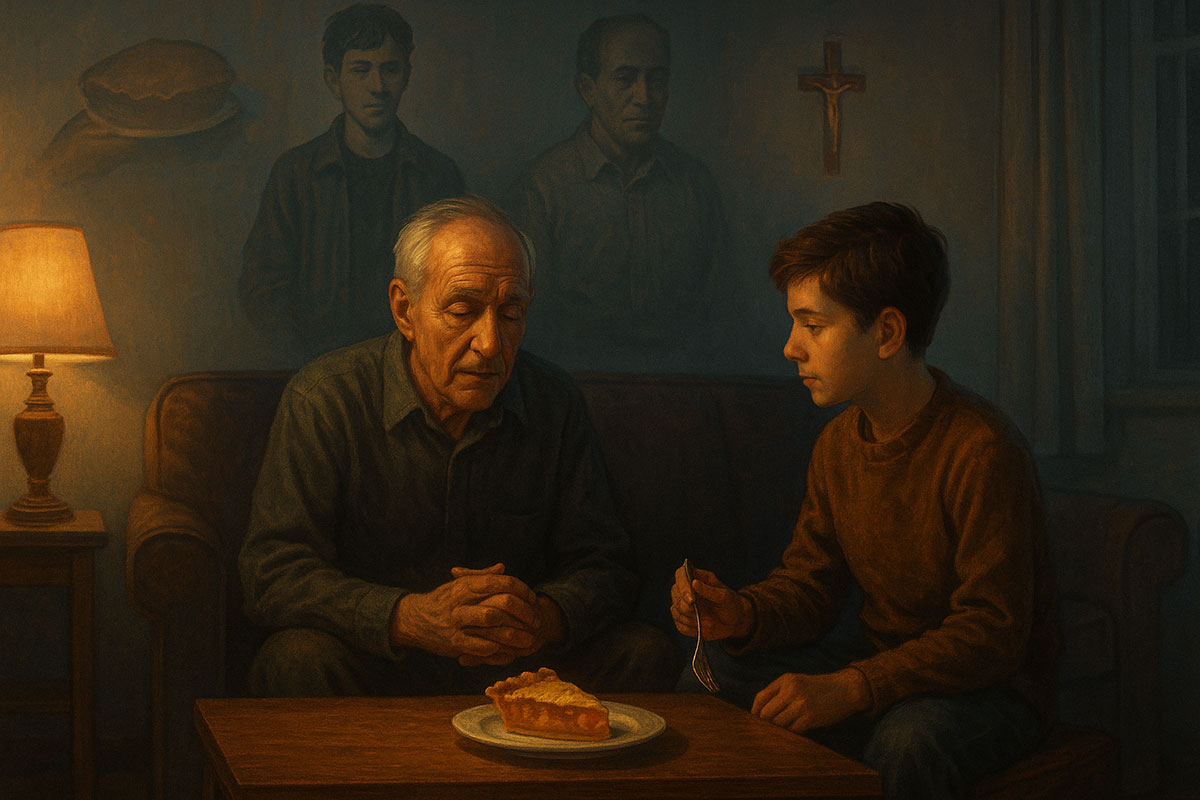
Setting: A modest living room in Gary’s later years. The furniture is simple but warm. Family photographs line the walls. A wooden crucifix hangs above the doorway, casting a faint shadow.
Lights: Evening glow, a lamp by the armchair. Outside the window, the last light of sunset fades into night.
Sound: A clock ticking steadily, the occasional bark of a neighbor’s dog.
On stage: Gary, now older, sits in an armchair. His hair is gray, his posture slightly stooped, but his eyes are alert. Across from him, Eli, his grandson, about ten, sits cross-legged on the rug, holding a slice of apple pie on a plate. He eats it slowly, savoring each bite. The smell of cinnamon lingers in the air.
Eli
Grandpa, why don’t you have some? Grandma said there’s plenty.
Gary
(smiling faintly)
No, no. I’ve had enough pie for one lifetime.
Eli
(tilts his head)
How can you have enough pie?
(Gary chuckles, but the sound is tinged with memory. He leans forward, resting his elbows on his knees.)
Gary
Let me tell you a story. When I was about your age—maybe younger—I wanted pie more than anything. Apple, just like that one. Only problem was, I didn’t have the money.
Eli
So what did you do?
(A pause. Gary’s face tightens, as though confessing again after all these years.)
Gary
I stole it.
(Eli’s eyes widen. He sets the fork down slowly.)
Eli
You? But… you’re Grandpa.
Gary
Exactly. Even grandpas make mistakes. Big ones.
The stage shifts subtly: projections of the old MARKET and the PIE from Scene 1 appear faintly behind Gary as he speaks, ghostlike memories on the wall.
Gary (cont.)
I ran out with that pie like it was treasure. Ate it in an alley, hands sticky, face covered. For a moment, I thought I’d found heaven. Then I tasted something worse than any hunger—guilt.
Eli
What happened?
Gary
Nothing. That was the worst of it. Nobody caught me. The grocer never came after me. My mama never found out. But I couldn’t stop thinking about it. Every church bell, every prayer, every pigeon looking down at me—I thought they were there to remind me.
Lights dim on the memory projection. Only the warm lamplight remains. Gary looks at Eli intently.
Gary
You see, Eli, sometimes the punishment isn’t what other people do to you. It’s what you carry inside. I carried that pie for years. Every time I was tempted to lie, or cheat, or take the easy way out, I remembered the pie. And I remembered how sick my heart felt.
(Eli frowns, processing. He picks up the fork again but doesn’t eat.)
Eli
So… if you could go back, would you steal it again?
(Gary leans back, sighing. He looks toward the crucifix on the wall, then back at Eli. His voice is steady now.)
Gary
No. Because the sweetness fades, but the shame lasts forever.
(A silence falls. The ticking clock grows louder. Eli looks down at his slice of pie, then pushes it toward Gary.)
Eli
Then… have this one. I want you to eat it the right way.
(Gary’s eyes glisten. Slowly, he takes the plate. He lifts a forkful, small, deliberate, tasting it as though for the first time in his life. He smiles faintly through tears.)
Gary
Better this way. Much better.
Lights shift. Gary and Eli remain in warm focus while, in the background, ghostly images of Young Gary, Teen Gary, and Adult Gary appear briefly, each holding the memory of the pie. They fade, leaving only the old man and the child. The chain is broken. The guilt has transformed into lesson.
Gary sets the empty plate aside, placing his hand gently on Eli’s shoulder.
Gary (softly)
Promise me something, Eli. When life tempts you, when you think nobody’s watching… remember the pie.
Eli
I will, Grandpa.
The clock chimes the hour. The lamplight glows warmly as the two sit together, the room filled with the quiet peace of truth finally spoken.
Blackout.
Final Thoughts By Gary Soto
The pie is gone, but the guilt stayed. For years I thought that was punishment. But now, older, I see it was a gift. That pie, stolen in hunger, made me taste the weight of choice. It taught me that sweetness fades fast, but the echo of wrongdoing lingers like a bell in the chest.
I once believed everyone could see it on me—that the grocer knew, that God knew, that every bird, every neighbor, every church hymn pointed me out. But I’ve lived long enough to understand: they forgot. They moved on. Only I carried it.
And that’s what conscience is. It doesn’t need policemen or preachers. It speaks in your own voice, even when you want silence. It follows you until you decide what to do with it—bury it, or tell it.
I chose to tell it. To put the pie on paper, to let others taste what I once did. And maybe, just maybe, some young reader will think twice before reaching through the glass. Not out of fear, but because he knows that the crust may be sweet, but the aftertaste lasts a lifetime.
Short Bios:
Gary Soto (1952– )
An award-winning Mexican-American poet, essayist, and memoirist. His works often draw from childhood memories in California’s Central Valley, exploring themes of poverty, family, and moral awakening. The Pie is a reflection on his own boyhood temptation and the guilt that followed.
Young Gary (Fictionalized Character)
A six-year-old boy who steals an apple pie from the market. Innocent yet reckless, he learns the sharp taste of guilt almost as soon as the sweetness fades.
Teenage Gary (Fictionalized Character)
Years later, still haunted by memory. The stolen pie becomes a symbol for temptation, reminding him of conscience whenever he faces choices between honesty and deceit.
Adult Gary (Fictionalized Character)
Now grown, he confronts the grocer from whom he once stole. He discovers that the world has forgotten, but his own memory has carried the burden for decades.
Elder Gary (Fictionalized Character)
An older man who finally tells the story to his grandson. By sharing the truth, he transforms guilt into wisdom, showing that conscience shapes character as much as experience.
The Grocer
An ordinary man, unknowingly central to Gary’s lifelong guilt. He represents the world’s indifference: while Gary carried the weight for years, the grocer never remembered the theft.
Eli (Grandson)
The listener and inheritor of Gary’s story. Innocent and curious, he becomes the vessel of redemption, ensuring the lesson of the pie continues into the next generation.
Leave a Reply