

|
Getting your Trinity Audio player ready...
|
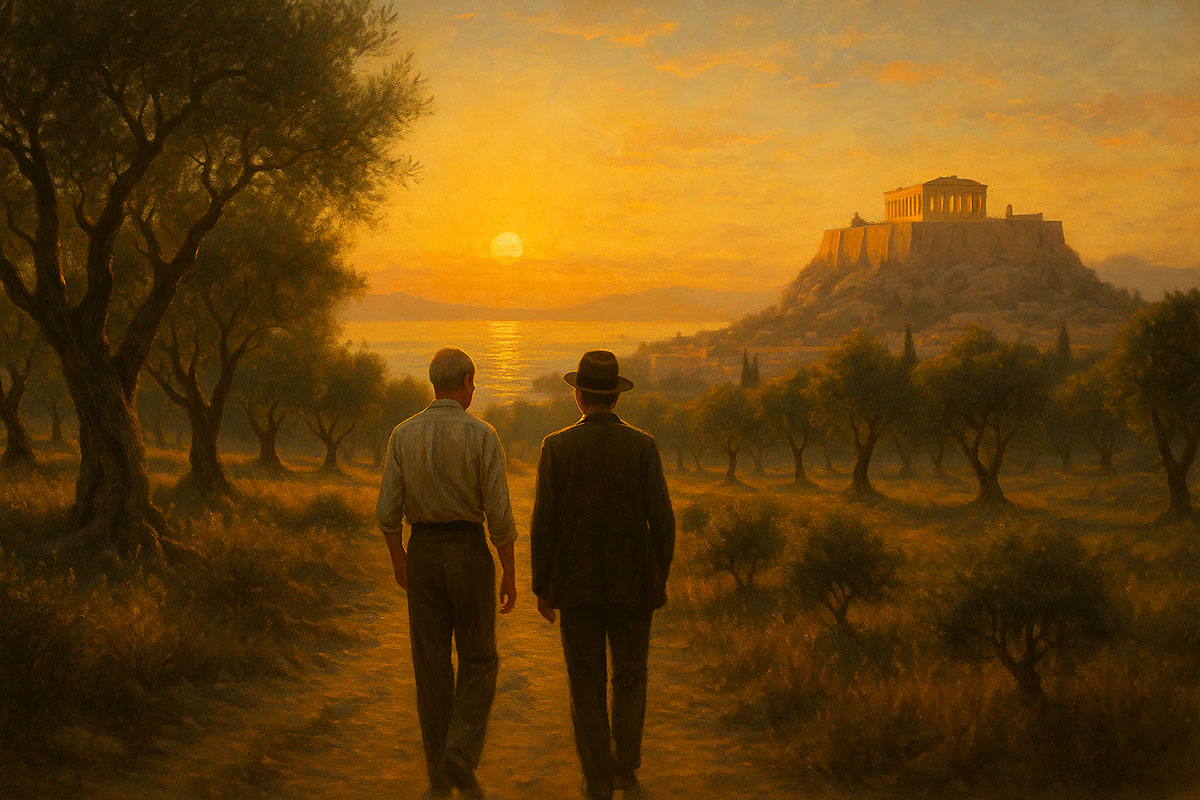
Introduction by Henry Miller
When I first set foot on Greek soil in 1939, I felt something stir in me that had long been dormant. Greece was not just another country—it was a revelation. The air itself seemed older than time, yet fresher than any I had breathed before. To walk through Athens, Delphi, Crete, or Corfu was to peel away the layers of modern fatigue and rediscover the raw marrow of life. This is no ordinary travelogue—it is a testament to joy, freedom, and the unshakable truth that man, stripped of pretense, is capable of immeasurable happiness. And in this retelling, I am not alone. I walk these paths with a friend, a witness, a companion who reminds me that the greatest journeys are not of one man but of souls joined in discovery.
(Note: This is an imaginary conversation, a creative exploration of an idea, and not a real speech or event)
Day 1 — Athens: Gateway to the Eternal
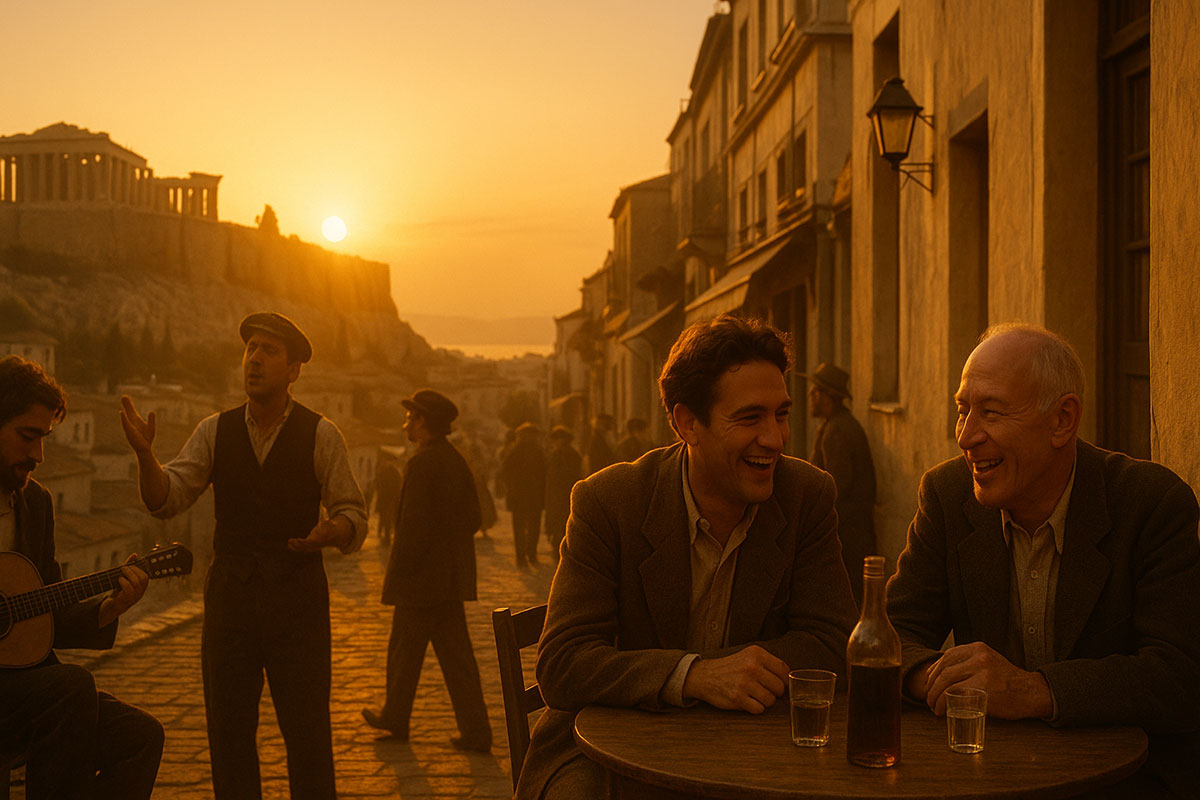
Scene 1: Piraeus, the First Breath
The ferry noses into Piraeus at first light, a low horn rolling across the water. Ropes thud, gulls veer, and a hundred voices volley Greek across the quay. Henry leans on the rail, coat unbuttoned, wind pressing his shirt flat. He looks younger in this light—eyes bright, mischief close to the surface.
“Smell that?” he says. “Tar, sea, oranges. It’s medicine.”
We step onto the dock and the world rushes in—crates, fish scales, the scrape of oars, a boy sprinting with a tray of sesame koulouri. A man with a newspaper under his arm is waving: broad shoulders, laughing eyes, a neck like a pillar.
“Nick! Miller! Welcome!” booms George Katsimbalis, the Colossus himself, swallowing us in a bear hug. He smells of tobacco and resin. “Athens is hungry for you.”
Henry grins. “I’m hungry for Athens.”
“Good,” George says, grabbing our bags with the casual strength of a quarryman. “She likes men who arrive with appetites.”
We pile into a rattling taxi—doors that require pleading more than force—and sail toward the city. White buildings climb the hills in rough steps; laundry flaps like flags of surrender. Between glimpses of rooftops and pines, a pale crown rises.
Henry sees it and goes still. “There she is,” he says softly. “The old one.”
“The Acropolis,” George nods. “We’ll climb her before the day turns careless.”
From the back seat, a calm voice: “Henry, you look like you’ve been let out of a cage.”
We spin around—how did he slip in?—and there he is: Lawrence Durrell, feline smile, a notebook already open on his knee.
“Lawrence!” Henry laughs. “I thought you were still keeping Corfu civilized.”
“For you,” Durrell says, “I allow it to go feral for a day.”
George slaps his knee. “Enough poetry in the car. We go to the rock.”
Scene 2: The Ascent to the Acropolis
We climb a path that smells of thyme and dust. The city falls away; the air thins, sharp as new linen. Marble blocks lie where giants forgot them. Henry’s stride becomes a kind of prayer—slow, deliberate, each step an argument against every sterile hallway he’s ever paced.
Durrell points to dented stones along the way, the museum-scatter of civilizations. George tells a story about a stonemason who swore that the Parthenon hums at dawn if you press your ear to the columns. “Stone remembers,” he says.
We reach the top as sunlight rinses the pediments. The Parthenon stands there like a disciplined exhalation, and Henry goes quiet in the way he does when words would only bruise the moment. He touches a column with his palm—gentle, courtly—then looks at me.
“Nick,” he whispers, “there are places where a man stops being merely a man and becomes a tuning fork. The air here—do you feel it? It’s the world’s old pitch.”
Durrell shifts his weight, smiling. “Athena’s city has a way of insisting on first principles.”
“And second helpings,” George adds. “Speaking of which, we breakfast.”
But we linger, because lingering is the only honest ritual up here. A girl in a blue dress ties a ribbon to the fence. A priest walks by with a rolled newspaper and a loaf of bread under his arm. Pigeons step like scribes. Clouds shred into silk. The city glows, and for a long minute, Henry looks like a man who has stumbled into his own beginning.
Scene 3: Plaka, Bread and Voices
We descend into Plaka, where alleys narrow to the width of an embrace. Vines drape over balconies; shutters lift and blink awake. George knows everyone. He is a passport and a parade. He steers us to a bakery where sesame rolls come out in sun-hot spirals and olives sit glossy in a bowl like dark eyes.
We tear bread as if it’s a new philosophy. Henry chews with the solemnity of a monk, then breaks into a grin. “Olives and bread,” he says. “The secret constitution of the happy man.”
An old poet with a cane recognizes George, and soon a small crowd forms—smokers, vendors, a boy selling postcards of Apollo. A woman pours us tiny coffees that could power a cathedral. Introductions braid the morning—Seferis is mentioned, Katsimbalis deflects praise with a joke, Durrell sketches phrases under his breath.
“You write?” the poet asks me.
“Some days,” I say.
“Write every day,” Henry cuts in. “Write even the days you don’t, if you must.”
George roars. “Listen to him! Miller has come to legislate joy!”
The poet taps his cane. “Joy doesn’t need laws, only witnesses.”
Durrell lifts his tiny cup. “Then let us be faithful witnesses.”
We drink. The coffee leaves a dark comet tail in the cup. A cat decides the table is hers and is not challenged.
On the way out, a boy tries to sell Henry a chipped figurine of Athena. “How much?” Henry asks.
“Whatever she’s worth to you,” the boy says.
Henry puts a drachma in his hand and refuses the statue. “Keep her,” he says. “Guard the goddess.” The boy salutes as if sworn into a myth.
Scene 4: Afternoon Heat, a Taverna of Arguments
By afternoon the heat is a living animal. We retreat to a taverna shaded by vines, where the bottles sweat before the men do. A bouzouki troubles the air with a tender, stubborn melody. Plates arrive like small declarations—grilled sardines, lemon wedges, tomatoes that taste like memory.
Writers drift in, pulled by George’s gravity. Introductions ping. Names gather on the table like coins: Elytis, Tsirkas, a sculptor who swears he can weigh silence. The talk begins easy and slides toward fervor in the Greek manner—art, politics, the riot of Europe’s pulse.
Durrell, courteous even at his most pointed, argues that the island teaches proportion—“It pares one down to the usable self.” George counters that Athens is the school of abundance, where a man’s voice learns to stand on its hind legs. Henry listens, eyes bright, then drops his own plumb line.
“I fled a world of invoices and correct opinions,” he says. “I want life raw and singing. Greece—she strips you to the truth and pours you a glass.”
A young poet challenges him: “Isn’t that romanticism?”
“It’s hunger,” Henry says. “Call it what you like.”
The sculptor laughs. “In Greece we call hunger breakfast.”
We eat until the table looks like a battlefield of crumbs and lemon rinds. The bouzouki player nods at Henry and slides into a minor key that sounds like the history of wanting. For a while, no one speaks. Even George is quiet, as if the song has taken the words hostage. When it ends, we clap like men who have remembered something that was never theirs to forget.
Outside, two boys play football with a bundled shirt. A woman leans from a balcony and scolds them with love. The afternoon slouches toward evening, and the light becomes the color of honey.
Scene 5: Midnight Walk, A City of Lamps
Night in Athens is a different animal—sleek, conspiratorial, generous. We walk without aim, which is to say with perfect aim. Syntagma hums; side streets whisper. A man sells roasted chestnuts at a corner where lovers negotiate the physics of leaning.
Durrell peels off, promising to send a letter ahead to Corfu. “Let the island tidy its hair,” he says. “We’ll be ready when you are.”
George takes us up a skinny stairwell to a rooftop where chairs are mismatched and bottles seem to condense from the air. The Acropolis glows like a coal banked for winter. George tells a joke so improper it could rip the hem off a saint, and Henry laughs until he has to wipe his eyes.
Then the laughter ebbs, and the night widens. A breeze passes like a hand through a harp. Dogs begin their committee work two streets over. We sit on the roof’s edge, legs swinging above a small universe of courtyards and kitchens and radio static.
Henry nudges me. “Nick,” he says, “promise me something.”
“What?”
“When you feel the weight come back—the lists, the famine of purpose—remember this light. Remember how the stones speak here. You don’t argue with what’s alive. You join it.”
Below us, a woman sings while washing plates, a ribbon of voice through the dark. George falls silent, which is his highest compliment. In the distance the train sighs, resigned to both departure and return.
We walk home late, as if returning from a country inside the city. Henry carries the small notebook he keeps for phrases that would flee if he didn’t pen them. At a quiet corner, he stops, looks back at the lit crown of the Acropolis, and says, not to any of us in particular:
“I’ve been exiled in my own rooms for years. Here—tonight—I’ve stepped back into the weather.”
George claps his shoulder. “Good,” he says. “Tomorrow we take you to the mountain that tells the future. Delphi will want to hear your accent.”
Henry smiles at me, that reckless, grateful smile of his. “Well then, best friend,” he says, “let’s go ask the world what it wants from us.”
We part at a doorway that smells faintly of jasmine. The city keeps breathing without effort. Somewhere a radio croons a song about leaving and not leaving. I fall asleep to Athens brushing past the shutters, and for the first time in a long while, the inside of my head is wide open.
Day 2 — Delphi: The Voice of the Gods
Scene 1: The Road to the Mountains
The day begins with the clatter of an old bus winding out of Athens. Dust lifts behind us like a veil. Miller leans out the window, inhaling the fields. “Nick,” he says, “this is no ordinary road. This is a staircase into myth.”
George Katsimbalis is with us, reciting snatches of history as the bus jerks past cypresses and shepherds with flocks. Lawrence Durrell, half-asleep, scribbles lines in his notebook. You can tell even he feels the tug of Delphi before we arrive.
The mountains rise like folded wings. Villages cling to slopes, their whitewashed walls blinking in sunlight. Miller grips my shoulder. “The gods chose well where to whisper. You can feel the approach like an overture.”
Scene 2: First Steps Among the Ruins
By noon, we are walking among stones that blaze with heat. The Temple of Apollo stands fractured but unbowed, columns reaching like unfinished sentences into the sky. Miller removes his hat and runs his fingers over the marble as if trying to catch its pulse.
“This isn’t ruin,” he says to me, “it’s resonance. The oracle never left, Nick. She’s only waiting for ears willing to listen.”
Durrell adds softly, “In Greece, silence speaks in more tongues than words.”
George laughs. “Careful, poets. She’ll hear you and demand a tribute.” He tosses a coin onto a broken altar, winks at us, and says, “Insurance.”
Scene 3: Meeting the Village Elder
Later, in the lower village, we meet an old man with skin like parchment and eyes like live coals. He insists we sit in his courtyard shaded by vines. He pours us glasses of retsina and offers olives that taste of salt and sun.
Through George’s translation, he tells us his grandfather claimed to hear the oracle’s voice in dreams. “She speaks not of kings or wars,” the elder says, “but of small things—a broken roof, a barren goat, a lost child. The gods are practical.”
Miller raises his glass. “And merciful, to speak in bread and goats instead of abstractions.”
The elder chuckles. “A man cannot eat an abstraction, foreign friend.”
Scene 4: Dusk Among the Stones
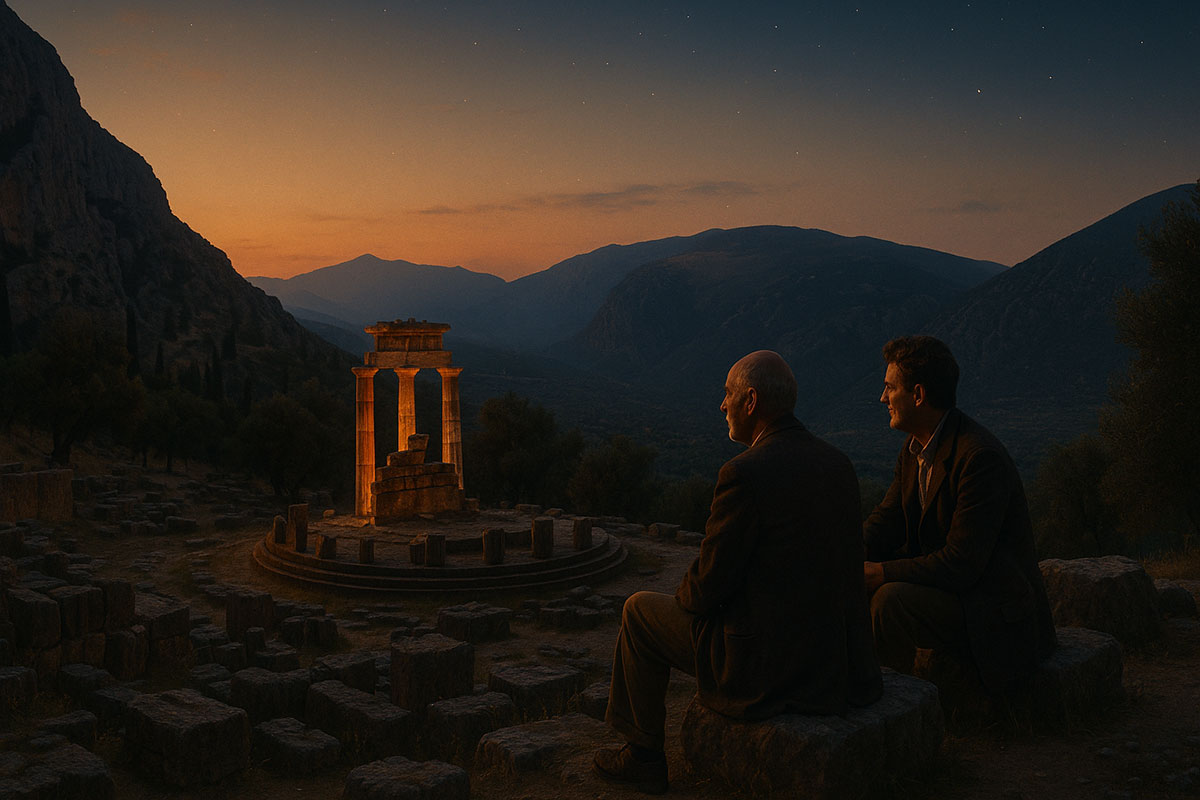
As the sun lowers, the ruins blush. Shadows stretch long fingers across the ground. We sit together on fallen blocks of marble overlooking the valley. Below us, olive trees ripple like a green sea.
Henry grows pensive. “Nick, do you feel it? It’s as if every fear I carried here is being siphoned off into the earth. Greece is no country—it’s an organ of the cosmos.”
Durrell, quiet for once, nods. “It pares you down to your truest size.”
George lights a cigarette. “And what size is that, my friends?”
“Human,” Miller says simply. “Just human. And that is enough.”
Scene 5: Campfire Beneath the Stars
Night falls cold and sudden. We huddle around a small fire just beyond the ruins, the valley below lost in darkness. Stars crowd the sky, urgent and innumerable. Someone begins a low song—was it George?—and soon the night vibrates with its simple, unbroken tune.
Miller leans toward me, voice low: “I feel as if the stars are the real script, and men are only actors improvising beneath their lines. Delphi teaches that we are echoes, Nick. Echoes—but also answers.”
The fire pops, sparks rising like prayers. We sit until the chill drives us to our blankets, the temple’s broken columns silhouetted against the sky, like doorways into forever.
Day 3 — Peloponnese: Land of Heroes and Villages
Scene 1: Toward Sparta
The morning air smells of pine and dust as our rattling car follows a ribbon of road south. George, at the wheel, drives like a man arguing with the horizon. “Sparta first,” he declares. “No ruins worth speaking of, but the spirit remains.”
Durrell lounges in the back, notebook open, eyes half-closed as if the words arrive from the mountains themselves. Henry leans forward, eager. “Sparta,” he mutters, “the name itself is a discipline. You can hear the clang of shields in it.”
When we arrive, there’s little to see but fields, scattered stones, and the Taygetus mountains crouching behind like sentinels. George spreads his arms: “Here lived men who feared no one, not even death. And now, chickens run where warriors marched. What lesson is that, eh?”
Henry squints at the horizon. “That strength doesn’t last—but the idea of strength does. That’s the more dangerous army.”
Scene 2: The Lion Gate of Mycenae
By midday we reach Mycenae. The heat is fierce, and the stones blaze as if lit from within. We pass through the Lion Gate, its carved beasts standing guard above us. Miller stops beneath the lintel, touches the rock.
“Nick,” he says, “these lions aren’t decoration—they’re a warning. You enter here with your life in your throat. Think of Agamemnon. Think of Clytemnestra. The air tastes of blood still.”
Durrell scribbles quickly. “History here is less remembered than it is rehearsed.”
George chuckles darkly. “And always ends in a quarrel over dinner.”
We wander the citadel, the stones silent, but heavy with the stories men keep trying to forget. Henry lingers at a broken wall, staring out over the valley. “Every ruin is a mirror,” he says. “It reflects what we would rather not see.”
Scene 3: Bread and Wine in the Village
By afternoon, we pull into a small Peloponnesian village—whitewashed houses, chickens darting, the smell of wood smoke in the air. A farmer waves us into his courtyard, as though expecting us. His wife lays out a table: coarse bread, feta, olives, and a jug of deep red wine.
We sit in the shade, cicadas singing. The farmer toasts us with a grin missing two teeth. George translates his words: “Eat, drink—there is no shame in being strangers here. All men are neighbors in Greece.”
Henry tears a hunk of bread, dips it in oil, and sighs. “Nick, this is the banquet of kings. Bread that tastes of the field, wine that tastes of the sun. What more is civilization than this?”
The farmer laughs. “Civilization is too complicated. Village life is enough.”
Scene 4: Songs at Dusk
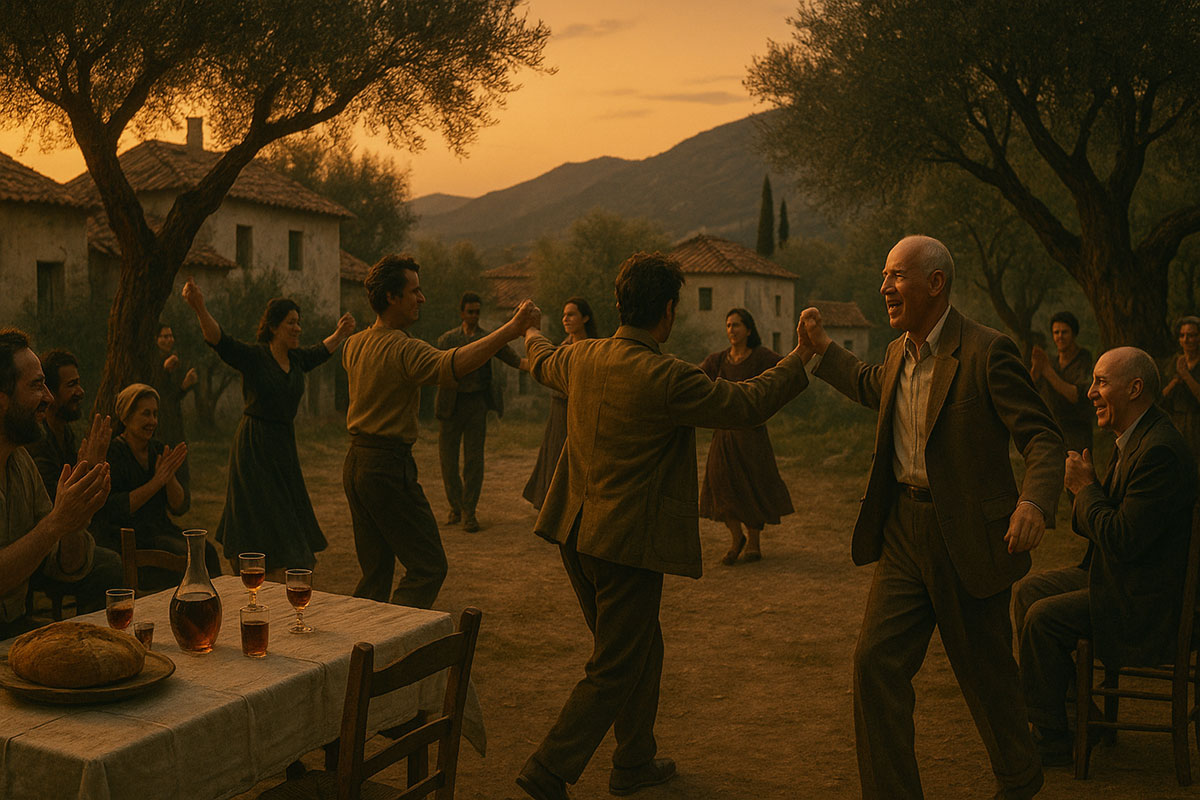
Evening falls, and villagers gather. Someone pulls out a lyra, another claps a rhythm, and soon a circle forms. Children stamp their feet, women sing verses that rise and fall like waves. George is pulled into the dance first, his booming laugh shaking the stars loose.
Durrell, shy but willing, joins next. Henry, never shy, leaps in with both feet, his movements wild, half-ritual, half-anarchy. The villagers roar approval. He grabs my arm. “Nick, dance! Don’t analyze—just let the ground have you.”
So we do, until sweat runs, and laughter carries farther than words. When the song ends, Henry throws his arms wide. “Here it is—life, pure and uncorrected!”
Scene 5: Under the Olive Trees
Later, the village quiets. We walk back along a dirt path under olive trees, their silver leaves whispering in the night. The air smells of earth and fruit. A donkey brays once in the distance, then silence again.
Henry slows his step. “Nick, the cities of the world will choke you with ambition. But here—look—the people have nothing but time, and they spend it like gold. That’s the secret Greece is teaching me. Poverty is not failure—it’s permission.”
George, walking ahead, calls back: “Remember it well, my American friends. Tomorrow we go to Crete, where the earth itself teaches survival.”
Henry squeezes my shoulder. “Tomorrow, then. But tonight—listen. Even the trees are giving counsel.”
And indeed, in the rustle of olives, the night sounds less like silence than an old, unfinished hymn.
Day 4 — Crete: Rugged Heart of the Aegean
Scene 1: Crossing the Wine-Dark Sea
We leave the mainland at dawn. The ferry rolls on waves that slap like open palms against its hull. Salt spray coats our lips, and gulls wheel like careless prophets. George plants himself at the prow, shouting verses of Homer to the wind.
Henry grips the rail, laughing into the gale. “Nick, this is it—the threshold of another world. Crete! Even the name tastes like stone and honey.”
Durrell leans near, voice half-dream: “Crete is not an island, Henry—it’s a continent of the spirit.” He writes it down before the words escape.
By the time the jagged outline of Crete rises from the horizon, we’re all soaked, exhilarated, and a little drunk on the Aegean itself.
Scene 2: Into the Mountains
The island greets us with heat and silence, broken only by goat bells echoing in ravines. A donkey cart takes us upward along dirt paths cut into the hills. Villages cling to cliffs, their houses painted the color of bone.
Children run beside us, barefoot and grinning. A shepherd waves his crook, calls out blessings. Henry leans down, pats a boy’s head, and murmurs: “This is the kingdom of the essential, Nick. No false walls, no clocks that command.”
The road twists higher, into air sharp with thyme and oregano. By the time we reach a village square shaded by plane trees, we’re coated in dust and thirst.
Scene 3: The Feast
A table is spread before we even ask. Goat stew simmered with wild herbs, bread baked this morning, sharp cheese, and jugs of raki that glow like bottled fire.
George toasts loudly: “To Crete! To the earth that refuses to bow!”
The villagers sing as they serve us. One man slaps Henry’s back and insists he try the lyra. Henry bows awkwardly over the instrument, scratching out notes that make the crowd erupt in laughter and applause. He laughs with them, unashamed.
Durrell whispers to me, “Look at him—this is what he came for. To dissolve.”
Scene 4: Lessons from an Elder
As the feast slows, an elder joins us, skin weathered as driftwood, eyes sharp as hawks. Through George’s translation, he tells us stories of Ottoman invasions, of men hiding in caves, of families surviving on roots and rainwater.
“We have little,” he says, “but little is enough when it is ours.”
Henry leans forward, intent. “Nick, do you hear him? This man carries centuries in his chest and speaks with no fear. This is freedom—not in possessions, but in refusal to be broken.”
The elder lifts his cup. “Freedom is bread baked by your own hands.”
Scene 5: Under the Cretan Sky
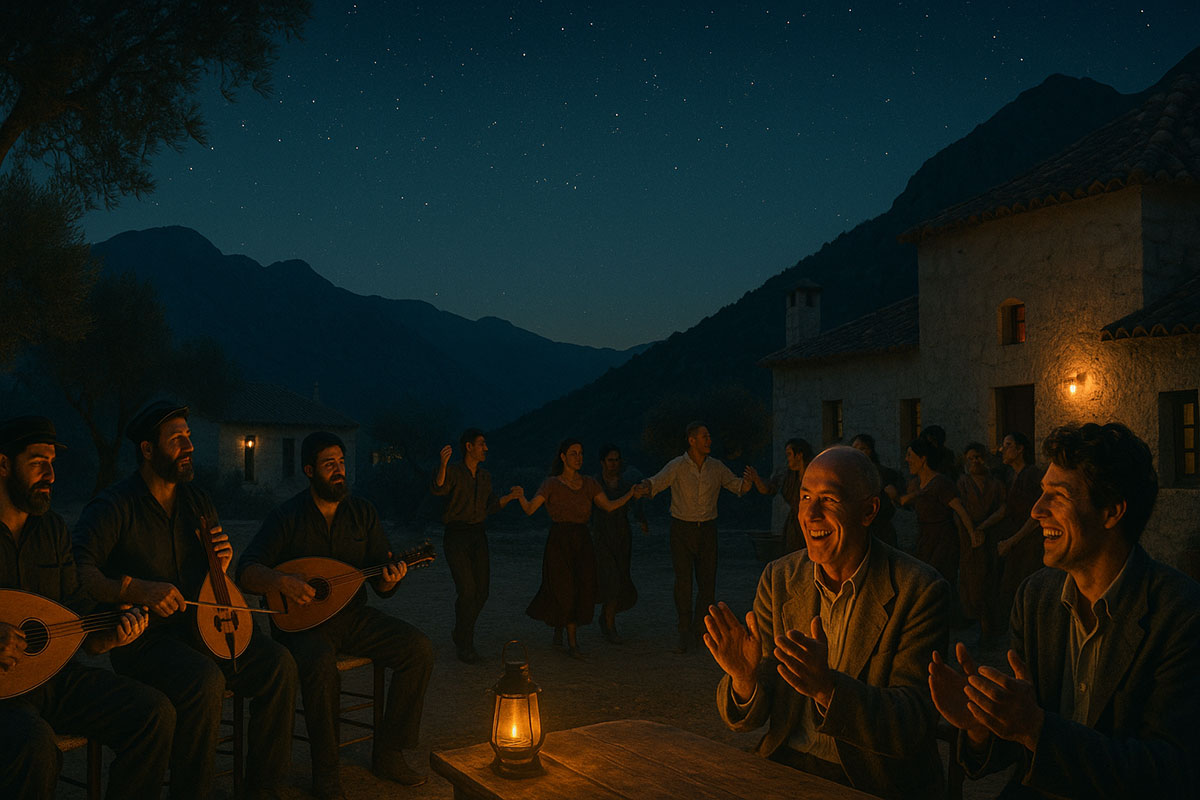
Night arrives swift and deep. The village gathers in the square. Someone plays a lyra; others clap and stamp until the earth itself seems to dance. George dives into the circle first, booming and wild, followed by Durrell with careful steps.
Henry grabs my arm. “Nick, come. Crete doesn’t want spectators.”
We dance until sweat blinds us, until the stars themselves seem to stamp along. Later, when the music softens and most have gone, Henry and I sit on a low wall. The mountains loom black, the sky dense with stars.
He speaks low, as though to himself: “Here, Nick, I feel the universe stripped bare. No excuses, no decorations. Just the earth, the sky, and us in between. If I could live anywhere forever—it would be here, on the edge of the raw world.”
The lyra hums one last mournful note. The night holds us steady, like an elder’s hand on the shoulder.
Day 5 — Hydra & Poros: Islands of Stillness
Scene 1: The Ferry Across the Aegean
Morning sun scatters diamonds across the sea as our ferry churns toward the islands. Hydra first, then Poros. Salt air stings sweetly, and the boat rocks with the lazy certainty of a cradle.
Henry leans against the rail, eyes closed, arms wide as if embracing the wind itself. “Nick,” he says, “the sea is the only proper road to truth. Every wave is a sentence, every horizon a paragraph.”
Durrell, scribbling as usual, murmurs: “Hydra has no cars, only donkeys. A perfect island for poets—it forbids hurry.”
George bellows from the deck below: “And it demands thirst! We’ll drink the island dry before we leave!”
The gulls cry above, escorting us like careless saints. The islands rise—bare, sunburnt, luminous.
Scene 2: Swimming in Hydra’s Coves
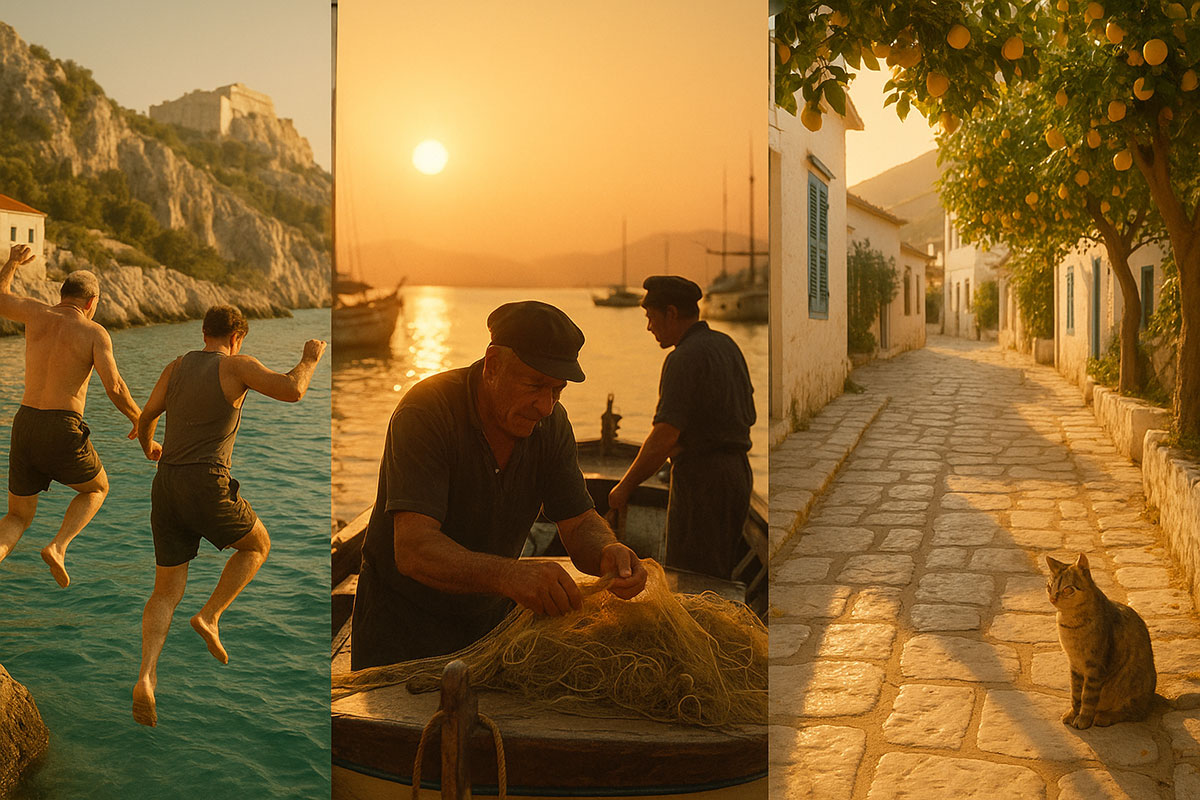
By midday we’re on Hydra, its stone houses tumbling down to the harbor. No roads, only narrow alleys and the stubborn bray of donkeys. We follow a rocky path until the sea opens into a small cove, turquoise water cradled by cliffs.
Henry strips down without hesitation and dives, a splash that echoes like applause. “Come on, Nick!” he calls, his voice ringing over the waves.
The water is cold, clear, a shock that empties the mind. We float together, looking back at the bare island cliffs. “This,” Henry says between strokes, “is baptism—without priests, without books, only the body knowing it’s alive.”
Durrell wades in slowly, smiling with feline content. George, laughing too hard to dive, sits on a rock and throws us chunks of bread as if feeding seabirds.
Scene 3: The Quiet of Poros
By afternoon we’ve ferried across to Poros, a smaller, gentler island. Its streets are narrow threads of white stone, lined with lemon trees whose fragrance rides the warm air. Children chase each other barefoot, and old men play backgammon in the shade, their laughter as slow as the tide.
We sit at a café overlooking the harbor. The coffee arrives strong, thick, leaving dark patterns in the cup. Henry studies the grounds as though they might reveal a destiny. “Look,” he says, pointing, “a swirl like a spiral. That’s my life—always circling back, never straight.”
Durrell shakes his head. “Nonsense. You’re more like this sea—expansive, unpredictable, and incapable of standing still.”
George slams down his backgammon piece, startling the table beside us. “And I say he’s like raki—burns on the way down, but makes you sing!”
We laugh until even the old men nod approval.
Scene 4: A Fishermen’s Meal
Evening comes with a hush, and we follow George to a fisherman’s home. His wife serves us grilled fish so fresh it still tastes of the sea, figs bursting with sweetness, and simple wine poured into mismatched glasses.
The fisherman tells stories of storms that overturned boats, of nights at sea when stars were the only compass. Through George’s translation, he says: “The sea gives, the sea takes, but it never lies. A man who listens to the sea does not need prophets.”
Henry raises his glass. “Then tonight we listen.”
The fisherman’s children giggle at George’s booming laugh. Durrell recites a poem about tides. I look around the table, lit only by an oil lamp, and feel as though time itself has paused to join us.
Scene 5: Sunset Reflections
After dinner we walk to the shore. The sky burns orange, then fades to violet as the sun slips into the sea. Fishermen mend their nets, women call children home, and the waves keep their steady hymn.
Henry stands at the water’s edge, his feet wet, his face haloed in the last light. “Nick,” he says softly, “here life strips itself to the bone. Bread, sea, sky, laughter—what else does a man need? Here, I feel no ambition, no torment. Only the fact of being alive, and the gratitude of it.”
George slaps his back, nearly knocking him into the water. “Then you are Greek now!”
Durrell smiles thinly. “No—he is Henry, which is rarer.”
We linger until the stars reappear. The islands sleep without hurry, the sea a dark mirror of infinity. And in that silence, we feel whole, as if the islands themselves have claimed us.
Day 6 — Corfu: Durrell’s Sanctuary

Scene 1: Arrival at the Island
The ferry from Piraeus glides into Corfu’s harbor, where the sea is calmer, gentler than the open Aegean. The island spreads before us like a tapestry of olive groves and Venetian rooftops. Durrell stands taller, proud and boyish, gesturing to the land.
“My island,” he says, eyes gleaming. “Or perhaps I belong more to it than it to me.”
Henry inhales deeply, squinting at the soft hills. “Nick, this is not an arrival. It’s a return to something I didn’t know I’d lost.”
George rolls his shoulders. “Enough poetry, boys. Let’s eat.”
Scene 2: Morning Swim in the Ionian Sea
We find a secluded cove, water crystalline, pebbles shining beneath the surface. The sea is warmer here, a slow caress instead of a shock. Miller dives first, limbs loose, shouting as he surfaces: “Nick! It’s like swimming in liquid glass!”
Durrell floats on his back, hands folded, face utterly serene. “The Ionian doesn’t merely cool the skin,” he says, “it rearranges the soul.”
George sits half-immersed near the shore, splashing us with mock ferocity. “You poets,” he growls. “Even your swimming has metaphors.”
I float beside Henry, the sun on our faces. He turns to me, voice softer now: “Nick, water like this—this is how eternity must feel. Weightless, endless, forgiving.”
Scene 3: Olive Groves and Quiet Roads
By afternoon, we wander inland through miles of olive groves. Sunlight filters through silver leaves, dappling the ground like coins. Donkeys graze, bells clinking. The air smells of resin and earth.
Durrell pauses by an ancient tree, running his hand over its gnarled bark. “This tree,” he whispers, “has seen empires rise and vanish. It has no interest in our vanities.”
Henry stops too, listening to the cicadas. “Nick, I swear the earth here hums. Do you hear it? It’s not silence—it’s music too large for us to catch whole.”
George plucks an olive straight from a branch, spits it out immediately, and roars. “Bitter as truth!” he declares. We laugh until the grove echoes back.
Scene 4: Dinner at the Durrell House
That evening we sit at a long table in Durrell’s home. Candles flicker against walls stacked with books. His wife serves roasted lamb, olives, tomatoes bursting with flavor, and sweet wine from the island’s slopes.
Durrell raises his glass. “To friendship, to Greece, to words that fail but keep trying.”
Henry clinks with him, eyes shining. “To the banquet of life—simple, honest, indestructible.”
George, already red-cheeked from wine, begins a story about a soldier who mistook a goat for a ghost. The laughter rolls until tears run. The children peep from the stairs, giggling.
Later, Henry leans toward me across the table. “Nick, this—this is better than all the salons of Paris. Here, no one pretends. We eat, we laugh, we live. Literature should be exactly this: food shared.”
Scene 5: Midnight Conversation
The house has gone quiet. Durrell is still awake, perched near an open window with a notebook on his knee, fireflies drifting outside. George snores faintly in the next room. Henry and I sit on the terrace, the Ionian a dark mirror under the stars.
He turns to me suddenly. “Nick, do you think we deserve this? After the noise, the failures, the chaos of our other lives—do you think we’ve earned such clarity?”
I pause. “Maybe it isn’t about deserving. Maybe it’s about being open enough to receive it.”
He exhales, a smile forming. “Yes. Greece is a giver, not a judge.”
From inside, Durrell’s voice floats out, quoting softly: “Other countries may offer you discoveries in manners or lore. Greece offers you something harder—the chance to discover yourself.”
Henry looks at me, his eyes fierce even in the dark. “And with you here, Nick, I’m discovering not just myself—but the joy of being human again.”
The cicadas quiet, the sea hushes, and for a long moment the night holds us in a silence that feels like truth itself.
Day 7 — Athens Return: The Colossus and Farewell
Scene 1: Return to the City
The ferry from Corfu brings us back to Piraeus. Athens rises ahead, noisier than ever, streets alive with hawkers, trams rattling, children weaving through stalls. Henry inhales the chaos like perfume.
“Nick,” he says, gripping my arm, “this city doesn’t welcome—it engulfs. You don’t visit Athens, you surrender to it.”
Waiting at the docks is George Katsimbalis, larger than life, waving both arms like semaphore. “My poets! My vagabonds! Welcome home to the belly of the world!”
Durrell smirks. “Home? George, you’ve claimed every port in Greece as your kitchen.”
“And why not?” George roars. “A Greek’s duty is to feed the hungry and confuse the gods.”
Scene 2: Stroll Through the Markets
We follow George into the Athens markets, narrow lanes thick with spices, fish, leather, and shouting vendors. The air smells of cinnamon and sweat, lamb skewers sizzling on open grills.
Henry stops to watch a boy juggle oranges. “Do you see him, Nick? He is Greece—the art of balance in a storm.”
We taste figs that drip honey onto our hands, sip strong coffee from cracked cups, and buy nothing but the memory of abundance. George haggles over olives he doesn’t even want, just to keep his tongue sharp.
Durrell leans to me. “Athens is a city always on the edge of collapse, yet it thrives like a weed in sunlight.”
Henry laughs. “And what better place for a writer, Lawrence? Collapse and survival—that’s all our material anyway.”
Scene 3: The Café Debates
By afternoon we’re seated at a smoky Athens café, glasses of retsina sweating on the table. The room fills with poets, journalists, and dreamers. Names bounce like coins—Seferis, Elytis, young men scribbling verses on napkins.
The debate begins with literature, slides into politics, erupts into philosophy. George thunders about Greek dignity, Durrell counters with island restraint, and Henry throws fuel on the fire.
“I’ll tell you what Greece has,” Henry declares, standing so everyone can hear. “It has the courage to be poor and proud. To make bread and wine out of dust and sun. In Paris they argue about aesthetics—in Athens, they argue because their blood insists on it!”
The room applauds, some jeer, and George hugs him so hard the table nearly collapses. “Miller!” he shouts. “You are already half Greek. The rest will come with age.”
Scene 4: The Farewell Banquet
That night, George arranges a farewell banquet in a courtyard strung with lanterns. Tables groan under roasted lamb, olives, bread, feta, and jugs of wine that refill themselves by miracle or by George’s cunning.
Stories rise and clash like waves. George tells of battles, Durrell reads a new poem, and Henry, flushed with drink, sings half a French ballad before collapsing into laughter.
Children run between tables, dogs sniff scraps, women clap in rhythm as a fiddler plays. The air feels thick with eternity, as if Greece itself has gathered to send us off.
Henry raises his glass to me. “Nick—friend, witness, brother—if I write one true book, it will be because of these days, and because you shared them with me.”
Scene 5: The Rooftop Goodbye
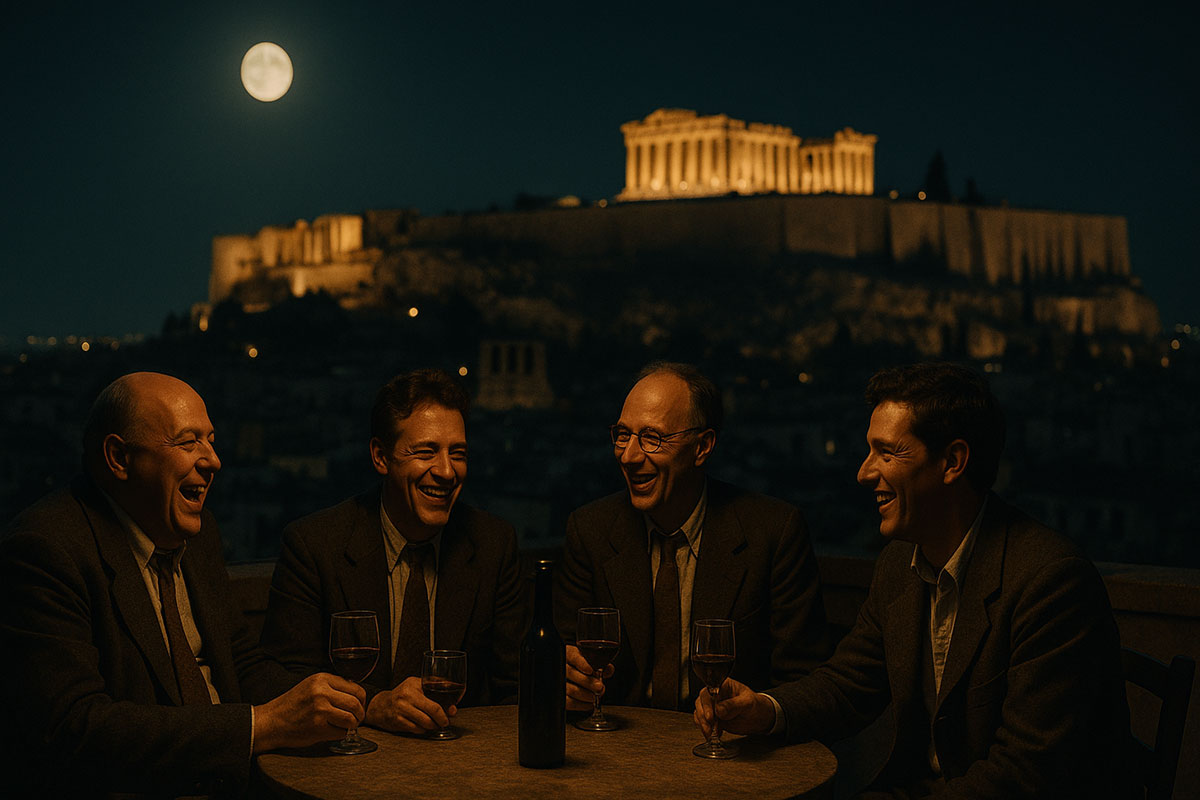
Past midnight, George leads us to a rooftop overlooking Athens. The Acropolis glows, serene, defiant. We sit in silence awhile, the city’s hum below, the gods’ silence above.
Henry turns to me, his face lit by moonlight. “Nick, do you know what I’ve realized? Happiness is not something you chase—it’s something that seizes you when you’re finally naked of ambition. Greece stripped me bare. And I’ve never been richer.”
Durrell closes his notebook. “Then it has done its work.”
George, uncharacteristically quiet, lights a final cigarette. “You’ll leave soon, but Greece will not leave you. That is her trick.”
Henry grips my hand, strong, urgent. “These, Nick—these have been the happiest days of my life. If the war swallows the world tomorrow, still I’ll have this: sun, sea, bread, and friendship.”
We sit there until dawn brushes the Parthenon in pale fire. The city stirs awake. Somewhere below, a rooster crows, and the spell breaks.
Miller looks at me one last time, eyes bright but heavy. “Promise me, Nick—carry this light back with you. Don’t let the world’s noise drown it.”
And as the first tram rattles to life in the streets below, I promise.
Final Thoughts by Henry Miller
As the last night in Athens fell and the Acropolis glowed like an ember in the dark, I knew I was leaving more than a land behind. Greece had burned itself into me—not as a memory, but as a state of being. Here, I discovered that happiness is not an invention, but a condition, waiting for us when we are ready to receive it. Bread shared with peasants, wine drunk under olive trees, laughter echoing in village squares—these were the treasures, more enduring than gold. If tomorrow brings war or ruin, still I will have Greece, and the knowledge that once, for a time, I was free. And to my friend who walked beside me—Nick—these were not just my happiest days. They were ours.
Short Bios:
Henry Miller (1891–1980)
An American writer known for his bold, autobiographical novels like Tropic of Cancer and Tropic of Capricorn. His 1939 journey through Greece, later captured in The Colossus of Maroussi, became one of his most joyful and spiritually transformative experiences.
Lawrence Durrell (1912–1990)
A British novelist, poet, and travel writer, best known for The Alexandria Quartet. Living in Corfu during the late 1930s, Durrell hosted Miller and inspired his reflections on Greece. His lyrical style shaped modern travel literature.
George Katsimbalis (1899–1978)
A Greek writer and raconteur, celebrated in Miller’s The Colossus of Maroussi as “The Colossus.” Known for his booming voice, larger-than-life personality, and endless storytelling, he became the living symbol of Greek vitality for Miller.
Nick Sasaki (b. 1961)
Imagined here as Henry Miller’s closest friend and companion through Greece. Walking beside Miller, Nick shares in the conversations, landscapes, and revelations of 1939, serving as a witness to Miller’s happiest days and anchoring the travel diary in friendship.
Leave a Reply