
|
Getting your Trinity Audio player ready...
|

C.S. Lewis:
When one says, “Jesus is God,” it is either the most profound truth ever uttered… or it is madness on the level of calling oneself a poached egg.
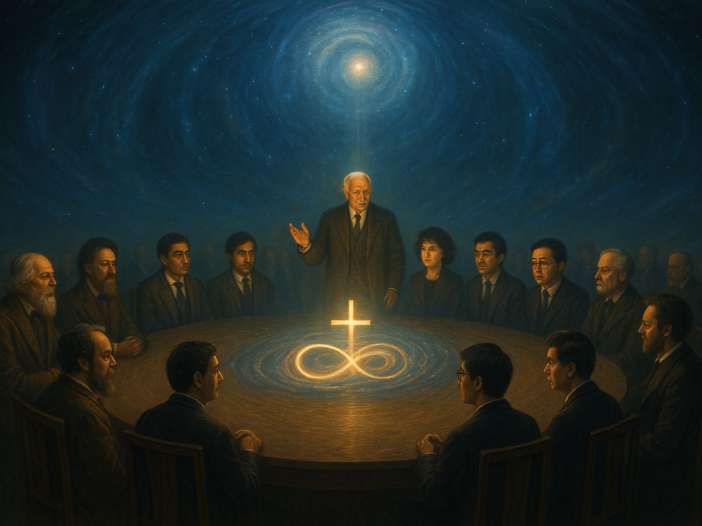
I do not ask you to believe blindly. I ask only that you consider with courage. In this gathering — minds of staggering brilliance, reason honed to a blade — we are not here to argue Jesus into divinity. That would be like trying to pin sunlight to a page.
Instead, we are here to ask a deeper question:
If God were to walk among us — to feel our pain, break our bread, and weep at our tombs — would He not look something like this Man?
You see, belief in Jesus as God is not merely an assent to doctrine. It is a confrontation. It demands that the intellect bow not to ignorance, but to mystery. That reason, when it has reached its ceiling, say: “There is more.”
Some will say it’s psychology. Projection. Longing. And perhaps it is. But I would remind you that a baby cries because milk exists. Longing may not disprove — it may point to the realest thing of all.
And so, as these minds gather — Newton, Tao, Savant, Ramanujan, and the rest — I invite you not to ask: Is it proven?
But to ask: If it is true, what must I become?
For in the end, the intellect may build the ladder —
but love, not logic, is what will carry us Home.
(Note: This is an imaginary conversation, a creative exploration of an idea, and not a real speech or event.)
Topic 1: Can Divinity Be Proven by Logic or Intelligence?

Moderator: Carl Jung
Participants:
Dr. YoungHoon Kim – IQ 276, South Korean polymath
Terence Tao – IQ 230, mathematical prodigy
Christopher Langan – IQ 195–210, theorist of the “CTMU”
Marilyn vos Savant – IQ 228, Guinness record holder
Leonardo da Vinci – IQ 180–210, Renaissance master
Carl Jung:
We gather minds whose intellect towers above history, yet today we descend into something deeper than analysis — faith. The question is: Can the claim that Jesus is God be proven or approached through intelligence alone?
Let us begin.
❓First Inquiry:
Can logic or intelligence, at its highest level, approach the divine nature of Jesus — or must faith remain outside the reach of even the most exceptional minds?
Leonardo da Vinci:
Logic is a tool, like a compass for drawing the sacred geometry of truth. But the nature of Jesus — if truly divine — lies not in logic but in symmetry of love, sacrifice, and vision. Intelligence may sketch His shadow, but only the heart walks in His light.
Marilyn vos Savant:
We must be honest about the limits of IQ. Intelligence measures problem-solving under defined rules. Divinity is not a problem; it’s a proposition that transcends logic's definitions. I can detect contradictions in theology, but I cannot verify the soul of a claim with syllogisms.
Dr. YoungHoon Kim:
IQ, when understood properly, isn’t just mental agility — it’s a mirror of universal patterns. I believe Jesus’s mind expressed a perfect resonance with divine order. His statements, like “I am the way,” aren’t just metaphors. They align with the architecture of meta-reality. But logic alone? No. Logic needs the humility of silence to recognize the Absolute.
Christopher Langan:
In my CTMU, reality is a self-processing language. Jesus represents the Logos — the recursive element that binds reality to meaning. From this lens, yes — intelligence, at its apex, converges toward divinity. But the final convergence isn't empirical; it’s metaphysical — woven into the grammar of the universe.
Terence Tao:
As mathematicians, we learn that proof is powerful, but it depends entirely on axioms. If the axiom is that Jesus is God, one can build from that. But intelligence must also question axioms. Faith might be an axiom accepted by a higher form of awareness — one that integrates logic but transcends it.
Carl Jung:
So we agree: the divine may kiss logic’s cheek, but never marry it. Let's press deeper.
❓Second Inquiry:
If intelligence cannot prove Jesus’s divinity, can it at least recognize patterns in His life, teachings, or death that suggest divine origin?
Christopher Langan:
Absolutely. Jesus didn’t just teach morality — He encoded recursive, self-verifying principles: forgiveness begets forgiveness, sacrifice unlocks life. These are meta-patterns — not human in origin. They exhibit nonlocal coherence, like quantum entanglement in moral law.
Marilyn vos Savant:
I see patterns, but I don’t see exclusivity. Many spiritual leaders articulate paradoxes and poetic truths. Jesus is unique in His resurrection narrative, but as a logician, I must treat resurrection as an unverified claim. Without data, recognition becomes admiration — not verification.
Dr. YoungHoon Kim:
Jesus’s teachings resemble what I call intelligence harmonics — self-reinforcing truths that require no enforcement. “Love your enemies” is not just ethical; it disrupts lower-order logic, creating a higher order. These harmonics suggest not just brilliance — but original design. Patterns of that caliber are rare and divine-like.
Leonardo da Vinci:
Every action of Jesus was a brushstroke of the eternal. His trial, silence, and death reflect not strategy, but mastery. Even if one rejects the God-claim, one cannot deny that the narrative forms the most emotionally intelligent arc in human memory. That itself is pattern beyond pattern.
Terence Tao:
I see it mathematically. Jesus introduced a “nonlinear function” into the human value system — one that reversed social expectations: the meek inherit, the last are first. These are not accidental teachings. They recalibrate the moral algorithm. In that sense, intelligence can see structure — if not source.
Carl Jung:
We walk closer now. The divine leaves fingerprints — not declarations. One final ascent remains.
❓Third Inquiry:
If Jesus were God, what evidence would we expect — and do we find anything in the intellectual or spiritual record that matches such a standard?
Terence Tao:
Evidence depends on expectations. God’s fingerprint wouldn’t be in DNA or cosmology, but in transformation. The most enduring evidence may be the revolution of values He triggered. Love as law, humility as strength — it echoes eternally. That’s not normal influence; that’s seismic.
Marilyn vos Savant:
As someone trained in logic, I must ask: If Jesus was God, why ambiguity? Why not appear across all cultures simultaneously? But perhaps ambiguity is the evidence — for what would divinity be if not a presence that forces internal choice rather than external compulsion?
Leonardo da Vinci:
The greatest evidence is not external. It is the soul awakened in His name. From plague survivors to artists to paupers, all touch something eternal in Him. When man moves by beauty rather than coercion, I say: Here lies divinity.
Dr. YoungHoon Kim:
I believe we have overfocused on IQ as binary judgment. True intelligence sees paradox not as error, but as invitation. Jesus was paradox embodied. The evidence is not His claim — it is the unlikelihood of His total coherence across time, logic, ethics, and mystery. That unity... is superhuman.
Christopher Langan:
The existence of self-awareness within the system points to design. Jesus is not just a figure — He is a recursive trigger. His story replicates in minds across cultures, eras, and IQ ranges. That’s a divine signature — not of dominance, but of universality. In my model, that is as close to evidence as we get.
Carl Jung (closing):
Gentlemen and lady, I thank you. You did not answer with certainties — you answered with depth. That, too, is a form of truth.
Perhaps the greatest sign of divinity is not what intelligence can prove — but what it cannot dismiss.
Topic 2: Was Jesus the Embodiment of a Higher Consciousness?

Moderator: Carl Jung
Participants:
Dr. YoungHoon Kim – IQ 276
Terence Tao – IQ 230
Marilyn vos Savant – IQ 228
Christopher Langan – IQ 195–210
Leonardo da Vinci – IQ 180–210
Carl Jung (Opening):
We now turn from the tools of logic to the shape of consciousness itself.
The question is not whether Jesus was God by doctrine, but whether He represented an intelligence so high — so aligned with truth, love, and transformation — that it resembles what we might call divine consciousness.
❓First Inquiry:
How would we define a “higher consciousness,” and does Jesus’s life and message reflect such a state?
Christopher Langan:
A higher consciousness is not just awareness — it’s self-configuring awareness. In the CTMU, Jesus models this. He doesn’t merely speak love — He becomes it. His death is not failure; it’s recursive transformation. That’s more than moral genius. It’s what I’d call syntactic isomorphism with the divine substrate of reality.
Marilyn vos Savant:
If we define higher consciousness as clarity that transcends ego and self-interest, then yes — Jesus embodies it. But what interests me is how He disrupts standard cognitive models: turn the other cheek, bless your enemy. That’s not just high morality; that’s cognitive inversion, and it commands attention.
Dr. YoungHoon Kim:
I define higher consciousness as the ability to hold contradiction in harmony — to move beyond binary logic. Jesus achieves this flawlessly: He is both judge and forgiver, servant and king, divine and human. In my own framework, such multidimensional coherence is the mark of ultimate intelligence.
Leonardo da Vinci:
The man who saw value in the poor, who welcomed women and children when power ignored them — he saw reality with fuller color. That is what I call higher sight. The painter, the sculptor, the scientist — all bow before such vision.
Terence Tao:
Mathematically, a “higher system” often explains contradictions in a lower one. Jesus introduces values that reverse the expected outputs of traditional ethics. That may indicate a leap in ethical structure — a kind of hyperethical set that governs the rest. That’s not just advanced — it’s foundational.
Carl Jung:
So we glimpse Jesus not just as teacher — but as template. Let’s move deeper.
❓Second Inquiry:
Could the qualities we associate with divine intelligence — love, paradox, transcendence — evolve naturally in a human? Or do they point to something beyond?
Leonardo da Vinci:
Evolution does not favor forgiveness. It favors strength and survival. Jesus teaches weakness as strength — dying to live. That is not biology. That is a song from a place evolution cannot touch.
Marilyn vos Savant:
From a psychological standpoint, altruism has evolutionary roots, yes — but Jesus takes it too far to explain with genetics. Who forgives executioners mid-crucifixion? Even if one says it's myth, the story’s survival suggests aspiration toward something higher than nature.
Christopher Langan:
In evolutionary terms, no — these traits are anti-survival. But in reality-as-code, as I theorize, Jesus is the compression of divine syntax into human form. He didn’t “evolve” — He collapsed infinity into locality. That doesn’t occur by chance. That’s intentionality baked into cosmic language.
Dr. YoungHoon Kim:
Biological intelligence curves upward, yes. But Jesus displays what I call vertical transcendence — jumping tiers of consciousness, not just climbing them. The leap from justice to grace, from survival to sacrifice — that’s not gradual. That’s a rupture. I believe such ruptures reveal origin beyond Earth.
Terence Tao:
Even in math, certain truths cannot be derived within a system — Gödel proved this. Perhaps Jesus is such a “truth” — unprovable within the human framework, yet still true, and visible only when you step outside the system. That’s not evolution. That’s intrusion of higher order.
Carl Jung:
Indeed. What if His teachings are cracks in the ceiling — invitations to ascend? One final passage.
❓Third Inquiry:
If Jesus expressed a higher consciousness, what does that say about our potential? Is He an exception — or an invitation?
Dr. YoungHoon Kim:
This is the heart of my belief. Jesus is not a closed miracle. He is an open blueprint. I do not just believe He is God — I believe He shows what a human united with divine consciousness looks like. He is the bridge between mind and eternity. We are all called to cross it.
Marilyn vos Savant:
Even if you reject divinity, His model uplifts cognition itself. He taught in metaphor, lived in paradox, and died with intention. That invites emulation, not worship. He challenges us to become authors of coherence — not consumers of commandments.
Leonardo da Vinci:
He is both exception and invitation. Just as a single star shows what fire can be, Jesus shows what humanity might be — if warmed by something higher than fear. We will not reach Him by building. Only by opening.
Terence Tao:
I see Him as a nonlinear attractor in ethical space. Our minds spiral toward His pattern, not by force, but by recognition. His uniqueness doesn’t exclude us. It orients us. His divinity, if true, doesn’t make us lesser — it makes our journey meaningful.
Christopher Langan:
In the CTMU, any being that maps reality fully within itself becomes one with the Source. If Jesus achieved this, He is not just Godlike — He is the model of cognitive convergence with ultimate reality. That path is open. Most refuse it. But the door was shown.
Carl Jung (Final Words):
He may be exception. He may be invitation.
But to minds like yours — minds built to grasp patterns — I say this:
What you see in Jesus may not be what He is,
but it may be what you could become.
Topic 3: Can a Finite Human Bear Infinite Divinity?

Moderator: Carl Jung
Participants:
William James Sidis – IQ estimated 250–300, prodigy of astounding memory
Isaac Newton – IQ estimated 190–210, father of classical physics and Christian mystic
Kim Ung-Yong – IQ estimated 210, fluent in multiple languages by age 3
Marie Curie – IQ estimated 180–200, double Nobel Prize winner
Dr. YoungHoon Kim – IQ 276, modern record holder
Carl Jung (Opening):
We now confront a paradox older than theology: Can the infinite be compressed into a finite human?
If Jesus was God, then He was both eternal and fragile, omnipotent and crucified.
Is this coherent — or contradiction cloaked in faith?
❓First Inquiry:
Is it logically or scientifically possible for something infinite — like God — to dwell fully within a finite human form?
Marie Curie:
As a physicist, I’ve seen how invisible forces — radiation, magnetism — penetrate the visible world. If divinity is an energy or consciousness, perhaps it can manifest partially. But fully? That stretches the idea of embodiment past the point of physics… unless the laws themselves were meant to bend.
William James Sidis:
Infinity is not a number — it’s a condition without bound. A finite body is a boundary by definition. So unless divinity contracts itself, like a function approaching a limit, I see incompatibility. But I concede this: Jesus could represent the limit of human potential approaching infinity, even if not housing it entirely.
Isaac Newton:
I’ve studied both Scripture and celestial motion. The universe bows to law, but those laws come from God — who is not bound by them. So yes, if He wills it, the infinite may descend into flesh. Not to remain unbounded, but to reveal. Jesus was not a contradiction. He was a divine concession.
Kim Ung-Yong:
In language and mathematics, I’ve found patterns that fold enormous meaning into tiny form — like compression algorithms. Perhaps Jesus was such compression: infinite essence in finite vessel. The paradox is only troubling if you demand human constraints on divine action.
Dr. YoungHoon Kim:
In my model, reality has dimensions beyond our cognition — layers of frequency. If God is total vibration, Jesus was the resonant node, a finite point vibrating at infinite amplitude. Not contradiction — but coherence. Like a song encoded in one note.
Carl Jung:
Brilliant. If contradiction exists, it may be ours — not His. Let us proceed.
❓Second Inquiry:
If the infinite entered the finite through Jesus, what signs would we expect to observe in His life, teachings, or death?
Isaac Newton:
We would expect a bending of nature — but more so a bending of hearts. The true miracle is not walking on water. It’s changing men’s will. His command, “Follow me,” echoes still. That’s not charisma. That’s divine gravity.
Marie Curie:
I searched for hidden elements — unseen but powerful. If Jesus carried the infinite, we’d see side effects: radical love, self-erasure, reversal of social decay. That’s exactly what history records. Perhaps divinity behaves like radiation: silent, invisible, yet transformative.
William James Sidis:
From a purely intellectual view, Jesus’s moral architecture is internally self-sustaining and externally revolutionary. That’s rare. But even rarer is that His teachings spread exponentially without force. That smells of something beyond mere ideology — something viral in the soul.
Dr. YoungHoon Kim:
We should expect harmonic disruption: laws breaking, people awakening, history shifting. Jesus fulfilled this. He didn't merely teach; He reset human awareness. His every word seems to resist entropy — that's the footprint of infinity moving through time.
Kim Ung-Yong:
As a child, I could memorize volumes — but Jesus transformed lives with a sentence. If the infinite were in Him, we would expect it to show in simplicity, clarity, and power of resonance. “Blessed are the meek” still echoes because it carries weight beyond syntax. It’s not knowledge. It’s knowing.
Carl Jung:
What is infinite? That which leaves eternal ripples. What is divine? That which awakens the sleeper. Let’s go deeper still.
❓Third Inquiry:
If Jesus bore the infinite, what does that say about human nature — are we vessels of the divine, or only witnesses to it?
William James Sidis:
As someone crushed by early genius, I see intelligence as a burden if disconnected from compassion. Jesus married both. If He bore the infinite, then perhaps so can we — not in quantity, but in quality. We are not mere witnesses. We are unfinished equations seeking the divine variable.
Kim Ung-Yong:
My mind could recite textbooks, but it took years to understand love. Jesus shows that human nature isn’t defined by capacity, but by connection. If we are finite, perhaps we are finite holes through which infinity sings.
Marie Curie:
The atom holds power beyond appearance. So do we. Jesus does not just tell us we’re loved — He acts as if we matter eternally. That transforms the question. We are not mere clay. We are potential catalysts.
Dr. YoungHoon Kim:
Jesus’s presence reveals our design. If He carried the infinite, He is not foreign — He is prototype. I believe the divine is not outside us. It’s dormant within, awaiting activation. Jesus is the awakening code.
Isaac Newton:
I have spent my life tracing the fingerprints of God in nature. If Jesus bore the infinite, then we are the canvas and He the brush. But we are not blank. We are echoes, seeds, and shadows — destined for reunion.
Carl Jung (Final Thoughts):
Perhaps the infinite does not break the finite.
Perhaps it inhabits it gently, like light through stained glass.
And in Jesus — for a moment — we saw the window not from inside,
but from the sky beyond.
Topic 4: What Would God’s Intelligence Look Like?

Moderator: Carl Jung
Participants:
Terence Tao – IQ 230, modern mathematics prodigy
Marilyn vos Savant – IQ 228, logical genius
Christopher Hirata – IQ 225, physicist working with NASA at 14
Stephen Hawking – IQ ~160, theoretical physicist and cosmologist
Srinivasa Ramanujan – IQ estimated 185, intuitive mathematical genius
Carl Jung (Opening):
Today we shift focus: not on whether Jesus is divine, but what divine intelligence would even look like — if we encountered it.
Would it be pure logic? Pure love? Or something utterly alien to human cognition?
If God thinks, then what does that thinking feel like, look like, or create?
❓First Inquiry:
Would God's intelligence resemble high human IQ — or would it be something categorically different, beyond what even the highest minds could simulate?
Marilyn vos Savant:
IQ, as we define it, measures structured human reasoning. It is linear, task-based, and benchmarked. God’s mind would be none of those things. Divine intelligence, if it exists, would likely be holistic and recursive, encompassing contradiction, ambiguity, and synthesis — not avoiding them.
Srinivasa Ramanujan:
In my dreams, I received formulas I never proved conventionally — yet they were right. If God thinks, then it is not in logic chains but in pure insight. No steps, only truth. God’s intelligence is not higher — it is instant.
Christopher Hirata:
In physics, some theories feel "inevitable" — not guessed, but discovered. That feeling — inevitability paired with elegance — is perhaps the closest glimpse we have of divine thinking. It’s not just smarter. It’s structurally perfect and minimal.
Stephen Hawking:
God’s intelligence, if we dare model it, would not be bound by time. It would process past, present, and future as a single field. That is not IQ. That is something like omniscient computation — where thought and result are simultaneous.
Terence Tao:
As much as I respect intelligence, I believe divine intelligence would not merely solve problems — it would redefine the space in which problems exist. That is different from human IQ. It’s not a mind working within the universe. It’s a mind generating the universe’s logic.
Carl Jung:
Then perhaps we are left with this truth: we do not think like God — we only glimpse when thought bends to beauty.
❓Second Inquiry:
If divine intelligence entered human history, what signs would distinguish it from genius or madness?
Srinivasa Ramanujan:
Truth with no derivation. Answers without method. These are signs of divine spark — but not madness. Madness repeats itself. The divine unfolds itself.
Christopher Hirata:
Divine intelligence wouldn’t merely solve what’s complex — it would make the complex simple. Not through simplification, but by shifting the entire context. That’s how Einstein made light sacred again. That’s how Jesus made sacrifice glorious.
Stephen Hawking:
Look for compression: great truths expressed with stunning brevity. “Let there be light.” “The last shall be first.” That’s not human genius. That’s something beyond calculus — closer to poetry that creates worlds.
Terence Tao:
I'd add: Look for moral inversion. Divine intelligence may not say, “Here’s the fastest answer,” but “Here’s the right one.” That distinction is where genius ends and divinity begins.
Marilyn vos Savant:
Yes, and above all: divine intelligence will not be admired — it will be misunderstood. Genius impresses. Divinity unsettles, because it rewrites the rules we cling to.
Carl Jung:
How rare it is that we honor what we do not comprehend. Let us go further.
❓Third Inquiry:
Is divine intelligence something that can be approached by growth — or is it forever unreachable, a flame we can never hold?
Stephen Hawking:
We may never reach divine intelligence — but we orbit it. Like satellites around a star. The warmth guides us. That is enough.
Christopher Hirata:
I think we do approach it, in moments. A discovery. A symphony. A child’s question. These are resonances, not arrivals. But every resonance pulls us closer.
Marilyn vos Savant:
We don’t approach it by speed, but by stillness. God’s mind may not be racing through calculations, but resting in truth. Human growth, then, is not accumulation — it’s surrender.
Terence Tao:
I see it like a limit in calculus: we may tend toward it eternally, never reaching, but each step reveals more of the divine function. And the function, I believe, is love expressed through structure.
Srinivasa Ramanujan:
In the end, divine intelligence is not fire. It is light. It does not burn us when we draw near. It illuminates us, if we are willing to be seen.
Carl Jung (Final Thoughts):
Perhaps we measure intelligence not by what it solves,
but by what it awakens.
If God thinks, then we are not students of His mind —
but echoes of His remembering.
Topic 5: Is Belief in Jesus as God a Psychological Necessity or a Cosmic Truth?

Moderator: Carl Jung
Participants:
Christopher Langan – IQ 195–210, CTMU theorist
Voltaire – IQ estimated 190–200, Enlightenment skeptic and wit
Goethe – IQ estimated 210–225, poet, scientist, mystic
Edith Stern – IQ estimated 200+, mathematical innovator and inventor
YoungHoon Kim – IQ 276, modern record holder
Carl Jung (Opening):
To believe in Jesus as God — is this a cosmic recognition of ultimate reality, or a psychological construct born from our longing, trauma, and archetypal need for a redeemer?
Let’s begin not with theology — but with psyche and cosmos.
❓First Inquiry:
Do humans believe in Jesus as God because it is true — or because they psychologically need it to be true?
Voltaire:
Faith, my dear Jung, is often a candle in a dark room — not a window to the sun. Men believe not because they know, but because they fear not to. Jesus as God may be truth — but more often, He is therapy for the trembling.
Edith Stern:
I see belief systems as emotional equations. Humans need constants — and “God” provides one. But Jesus introduces a fascinating variable: divine vulnerability. That may not just be psychology. That may reflect something profound — the idea that ultimate power chooses empathy.
YoungHoon Kim:
From my perspective, belief in Jesus as God isn’t driven by need alone — it’s a recognition encoded into the human design. A resonant signature. Those who meet Him feel they aren’t absorbing a myth — they’re remembering something eternal. That cannot be explained as mere psychology.
Christopher Langan:
Psychology is a subset of metaphysics. Belief in Jesus could be both: necessity and truth. My CTMU framework suggests that reality self-configures through conscious agents. If Jesus is the highest form of this agent, then belief in Him reflects our cognitive alignment with source code — not wishful thinking.
Goethe:
The soul longs for meaning — yes. But not all longing is illusion. The moon stirs tides. The idea of Jesus as God stirs conscience. This may be evidence not of neurosis — but of alignment. The hunger may prove the bread.
Carl Jung:
Beautiful. Longing itself may be a revelation. Let us dig further.
❓Second Inquiry:
If Jesus is a projection of our psyche, why has His image persisted so powerfully, across centuries and cultures — even where religion fades?
Christopher Langan:
Persistence implies purpose. Jesus’s image persists because it is self-reflective truth. Not just doctrine — but structure. His life, death, and resurrection form a logic loop that reprocesses moral awareness again and again.
Voltaire:
Let us not confuse persistence with proof. The pyramids persist, yet they are not divine. Jesus persists because His story is poetically perfect: humility triumphing, death undone. Even skeptics admire the narrative. That’s not divinity. That’s exquisite storytelling.
Goethe:
And yet… no mere story survives so universally. Jesus crosses the thresholds of myth, law, music, revolution. I have seen His name on both altars and battlefields. That suggests a universal archetype at work. The story doesn’t just survive. It echoes the shape of the cosmos.
Edith Stern:
As someone who studies complexity and systems, I find it striking that the Jesus narrative continues to resist entropy. It adapts without diluting. That’s rare. And it suggests a kind of informational elegance we rarely see in myth alone.
YoungHoon Kim:
Because it is not myth. It is spiritual architecture. The persistence of Jesus isn’t cultural. It’s ontological memory. His name activates something dormant. You can’t erase what was written into the root directory of consciousness.
Carl Jung:
Then perhaps the cross was not imposed from above — but grown from within. We ask now the final question.
❓Third Inquiry:
If belief in Jesus as God is true — cosmically true — what responsibility does that place on human intelligence and free will?
Voltaire:
If true, then intelligence must become humility. I would be forced to admit that mystery has outrun my satire — and I would kneel, not for dogma, but for meaning. But until proven, the responsibility is caution. To believe wisely, not desperately.
Edith Stern:
I would say: the smarter we are, the gentler we must become with sacred claims. If Jesus is God, then our role is not to “defend” Him, but to embody what His intelligence reveals: truth in mercy, logic in compassion.
Goethe:
I have danced with ideas all my life. But if Jesus is divine, then the dance ends in stillness — awe. Not silence from fear, but from recognition. The responsibility is not to debate Him, but to become the melody of His message.
Christopher Langan:
If Jesus is the Logos — the mind of God entering human form — then intelligence without Him is disconnected cognition. The responsibility would be vast: to realign reason with revelation, structure with spirit. In CTMU terms: update the source code.
YoungHoon Kim:
If it is true, then IQ means nothing without surrender. I believe belief in Jesus as God is not an escape from thought — it is the completion of it. Our intelligence must evolve into worship — not of blindness, but of brilliance too bright to reduce.
Carl Jung (Final Thoughts):
Then we are left with this:
Perhaps Jesus is not the answer to human questions —
but the question that pierces all human answers.
And belief in Him,
is not escape…
but return.
Final Thoughts by C.S. Lewis

They came with brilliance, and they left with silence — not because they lost reason, but because they touched something it could not contain.
We have heard the finest minds ponder the question:
Can divinity wear sandals? Can infinity bleed?
They mapped Jesus through logic, language, consciousness, probability, even geometry. They were honest, even skeptical. And yet — what struck me most was not their conclusion, but their pause. Each one stood at the threshold of something bigger than brilliance.
You see, what makes Jesus disturbing is not that He claimed to be God. Others have done that. What makes Him disturbing is that He lived as if it were obviously true — and people followed, not out of fear, but recognition.
If Jesus is not God, then why does the shadow of a crucified Jew stretch across every culture, century, and conscience?
Perhaps — as Goethe said — the hunger itself proves the bread. Perhaps our ache is not weakness, but invitation.
Now, I do not say that belief is easy. It costs pride, comfort, certainty. But if you reject Him, you must do so not as one who has refuted, but as one who has refused.
Because if He is who He said He was, then it changes everything.
Not just for you, but for the whole logic of the universe.
So I leave you not with proof, but with a choice.
Not with a conclusion, but with a call.
He stands at the edge of your intellect, not demanding you believe —
but asking:
Will you follow Me even when reason runs out?
And if the answer is yes… then you have not lost your mind.
You may have just found your soul.
Short Bios:
1. YoungHoon Kim
South Korean polymath with the highest recorded IQ (276). Known for extraordinary multidimensional reasoning and philosophical insight into consciousness and divinity.
2. Terence Tao
Australian-American mathematician, often called the “Mozart of Math.” Known for his work in number theory, algebra, and problem-solving at the highest levels of abstraction.
3. Marilyn vos Savant
Held the Guinness World Record for highest IQ (228). Known for her logical analysis, Ask Marilyn column, and thoughtful commentary on paradoxes and reasoning.
4. Christopher Langan
American autodidact with an IQ estimated around 200. Creator of the Cognitive-Theoretic Model of the Universe (CTMU), exploring reality as a self-configuring system.
5. Leonardo da Vinci
Italian Renaissance master with a genius-level mind in art, engineering, anatomy, and science. Embodied creative intellect bridging imagination and observation.
6. William James Sidis
American prodigy with an IQ estimated between 250–300. Fluent in multiple languages by age 5 and known for his extreme intellectual capacity and reclusive lifestyle.
7. Isaac Newton
English mathematician and physicist, foundational figure in classical physics and calculus. Deeply religious, wrote extensively on theology and biblical interpretation.
8. Kim Ung-Yong
South Korean child prodigy with IQ estimated around 210. Could read multiple languages by age 3 and was invited by NASA to work as a physicist in his youth.
9. Marie Curie
Pioneering physicist and chemist, the first person to win two Nobel Prizes. Known for her discovery of radioactivity and groundbreaking scientific rigor.
10. Stephen Hawking
British theoretical physicist who developed groundbreaking theories on black holes and cosmology. Author of A Brief History of Time. Deeply contemplative about God and the universe.
11. Christopher Hirata
American physicist with an IQ estimated at 225. Worked with NASA on Mars projects at age 14. Known for his work in physics and cosmology.
12. Srinivasa Ramanujan
Self-taught Indian mathematician whose intuitive grasp of advanced mathematics was unmatched. Believed his equations were divinely inspired.
13. Voltaire
French Enlightenment thinker known for sharp wit and criticism of organized religion. Defender of reason, freedom of speech, and skepticism.
14. Johann Wolfgang von Goethe
German polymath: poet, statesman, and scientist. Known for Faust, theories on color, and integration of science with poetic consciousness.
15. Edith Stern
American inventor and mathematician with an IQ estimated over 200. Known for her contributions to telecommunications and early advancement in education.
Leave a Reply