

|
Getting your Trinity Audio player ready...
|
When we think of Madame Bovary, the first word that usually comes to mind is tragedy. Gustave Flaubert gave us Emma Bovary as a warning—a woman consumed by her hunger for romance, crushed beneath the weight of her own illusions and debts. Her story is often remembered not for its beauty, but for its despair: a cautionary tale of what happens when desire outruns reality.
But what if despair isn’t the only possible ending? What if we invite laughter into the story—not to mock Emma’s restlessness, but to heal it?
This is where Saito Hitori steps in. Known for his wisdom clothed in humor, Hitori has a way of turning pain into punchlines, and loneliness into opportunities for joy. He reminds us that life doesn’t need to be grand or extravagant to be worth loving. Sometimes the truest luxury is a fig, a ribbon, or a teacup shared in laughter.
So imagine Emma Bovary not as a doomed dreamer, but as a woman learning to transform her longings into joy. Imagine Charles not as a dull husband, but as a partner who discovers playfulness. Imagine Yonville not as a gray country town, but as a stage where even the simplest acts—sharing soup, exchanging compliments, or dancing with a ribbon—become extraordinary wonders.
This retelling is not about rewriting Flaubert’s brilliance. It is about offering a new lens, one that asks: What happens when, instead of drinking poison, Emma drinks lemon tea? What happens when she learns that Paris can live in her kitchen, and that everyday love can dazzle more brightly than chandeliers?
Here begins Saito Hitori Madame Bovary: The Comedy of Everyday Love—a story where illusions give way not to despair, but to laughter, forgiveness, and a joy simple enough to last.
(Note: This is an imaginary conversation, a creative exploration of an idea, and not a real speech or event.)

Act I — A Teacup, a Fig, and a Restless Heart

Yonville was tidy in the way small towns often are—clean curtains, swept stoops, gossip folded into baskets like fresh bread. Emma Bovary stood at her window and pressed her forehead to the cool glass as if the world were a mirror she might step through. Charles, kind and clumsy, hummed to himself while arranging his medical bag the way a child stacks blocks—careful, hopeful, a little crooked.
“Charles,” Emma said, not looking away from the window, “do you ever feel… elsewhere?”
Charles paused, gauze in hand. “Elsewhere than here? But here is where you are.”
She almost smiled. Almost. “That’s not an answer.”
Before he could find one, a traveler in a cream-colored coat came down the lane with a walking stick, a little basket of figs, and a smile that seemed to arrive before he did. He stopped at their gate as if guided by invisible applause.
“Good morning,” he said, bowing. “Two gifts are free today: fresh air and a kind word. I brought figs to make it three.”
Charles brightened. “I’m Charles Bovary. Doctor. This is my wife, Emma.”
Emma glanced at the stranger—his quiet cheer felt like sunlight finding a crack in a shutter. “And you are?”
“A neighbor while I’m in Yonville,” he said. “People call me Saito. I bring small joys where large troubles live.”
“Small joys?” Emma repeated, a leaf of skepticism in her tone. “The world is large and difficult.”
“Precisely why small joys are portable,” Saito said. He held out a fig. “Try one. It’s impossible to be angry while eating a fig. The fruit forgives you as you chew.”
Emma accepted, more to prove him wrong than right. Sweetness surprised her tongue. She laughed despite herself, and for a moment the room remembered how to breathe.
Charles watched, captivated. “You’re a philosopher?”
“A shopkeeper of moods,” Saito answered. “May I sit?”
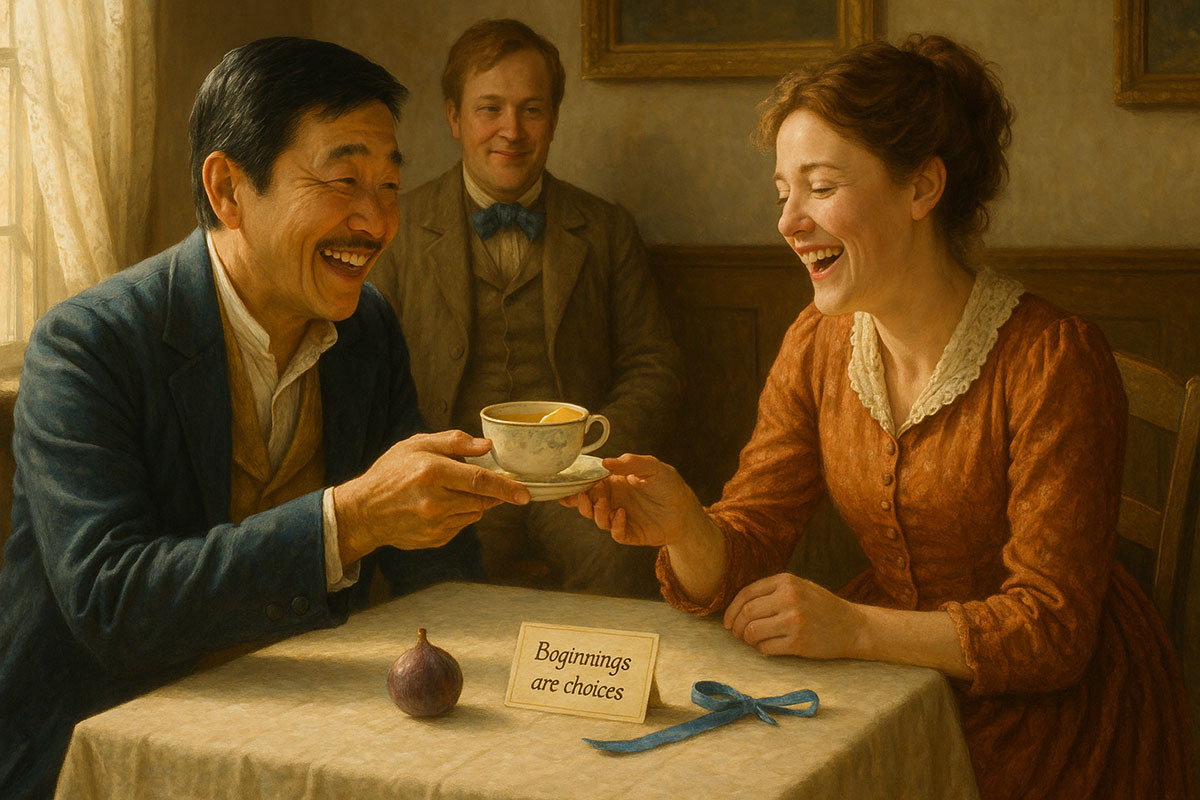
They settled around the kitchen table. Saito set a tiny teacup in front of Emma—porcelain thin as a promise—and poured hot water over a slice of lemon. “For restlessness,” he said. “Sip slowly and think of nothing grander than this moment.”
Emma lifted the cup, uncertain. “I’ve tried thinking small,” she said. “It doesn’t suit me.”
“Thinking small is not the same as feeling small,” Saito replied. “We start with a teacup because all oceans are made of sips.”
Charles nodded vigorously, delighted by words that made sense without diagrams. “I often tell patients to rest in little ways.”
Saito smiled. “Then we are colleagues.”
Emma set the cup down. “I married kindness,” she said, and she meant Charles, “but my heart keeps writing letters to Paris.”
“Write them,” Saito said. “Then mail them to the fire.” He grinned at her surprise. “Some letters are meant to be written, not sent.”
A knock rattled the door. Madame Homais swept in, the chemist’s wife—festooned with opinions, wrapped in lace. “News!” she announced. “A summer fête is proposed. Dancing, pastries, speeches… Yonville will, for once, act like a place where interesting things occur.”
Emma’s eyes brightened. Charles clapped politely. Saito bowed. “Perfect,” he said. “A stage for practicing happiness. I volunteer to direct a very short play. Three minutes. No tragedy allowed.”
“On what theme?” Madame Homais demanded.
“Bread,” Saito said. “And gratitude.”
Emma laughed—an unguarded note. “You can’t make drama from bread.”
“Watch me,” Saito said. “A woman buys a loaf. She frowns. The bread frowns back. She says, ‘You are plain.’ The bread says, ‘So are you when you forget who you are.’ They forgive each other. Curtain.”
Charles burst out laughing. Madame Homais frowned exactly like a loaf. Emma covered her mouth to hide a smile that didn’t want hiding.
After the neighbor left, the house felt fuller. Charles touched Emma’s sleeve. “Would you like to be in the play?”
“I want to be somewhere that feels like a beginning,” she said.
“Beginnings are not places,” Saito’s voice floated back from the doorway he had not quite left. “They’re choices repeated every morning.”
The fête bloomed as promised—tables under bunting, music that stumbled into rhythm, a stage made of borrowed planks. Saito set up a little sign: SMALL JOYS CLUB — JOIN NOW, PAY WITH A LAUGH. People lined up, skeptical, curious, enthralled by the notion that membership had only one rule: share something that made your day gentle.
Emma watched from the side, simultaneously charmed and bored by her own boredom. Rodolphe—tall, practiced, smelling faintly of horses and intent—drifted near.
“You deserve more,” he murmured, eyes like invitations.
“More what?” Emma asked.
He smiled as if the question proved his point. “More everything.”
“Ah,” Saito said, stepping neatly between them, as if he’d been standing there all along. He offered Rodolphe a fig. “A good test for ‘more’ is whether it makes you kinder.”
Rodolphe’s smile thinned. “We were speaking of art, not ethics.”
“Art that ruins lives is bad art,” Saito said cheerfully. “Come, both of you—help me rehearse the bread scene.”
“Not now,” Rodolphe said, retreating with dignity. “Another time.”
Saito watched him go, then turned to Emma. “You felt a wind,” he said softly. “It tried to push you. Winds are useful. They teach us where our feet are.”
Emma studied him. “How do you make everything both simpler and larger?”
“Practice,” he said. “And lemon water.”
They performed the silly bread play. It lasted ninety seconds and ended with applause that felt like rain after a dry season. Emma bowed, flushed. Charles cheered so enthusiastically his hat fell off. For a moment the space between Emma’s dreams and Emma’s days narrowed to a line she could step over without bruising.
That night, in bed, Charles whispered, “You were wonderful.”
Emma stared into the dark. “For a breath,” she said, “I believed this life could be enough.”
Saito’s parting words returned to her: Beginnings are choices repeated every morning.
“Perhaps,” she said to the ceiling, “tomorrow I will choose again.”
The ceiling, wiser than it looked, held the promise in place until dawn.
Act II — Hearts on Credit, Joy in Cash
The next months arranged themselves like a row of jars labeled by mood. Some were filled with quiet contentment—Emma and Charles discovering the comedy of cooking together. Others contained blue afternoons—the old longing tapping at the window like a persistent guest.
Into this domestic alchemy crept Monsieur Lheureux, merchant of everything and patience of nothing. He appeared with catalogues that smelled like Paris and promises that shimmered like heat. “Just sign,” he purred. “Happiness comes on installments.”
Emma touched the silk ribbon. It felt like a story she wanted to star in.
Saito arrived with a loaf of bread and a grin. “Good morning. I’ve brought a budget.”
“A what?” Emma asked, defensive.
“A gentle map for money,” Saito said. “Not to shrink your life—only to give it a rhythm. Like a waltz instead of a stampede.”
Lheureux tsked. “Maps are for people who don’t trust their feet.”
“Feet love maps,” Saito said. “They get lost less.”
Emma bristled. “Must joy always be frugal?”
“Joy is extravagant,” Saito said. “But it purchases differently. It buys picnics instead of pearls, friendships instead of furniture. You can have silk—own it with laughter, not with fear.”
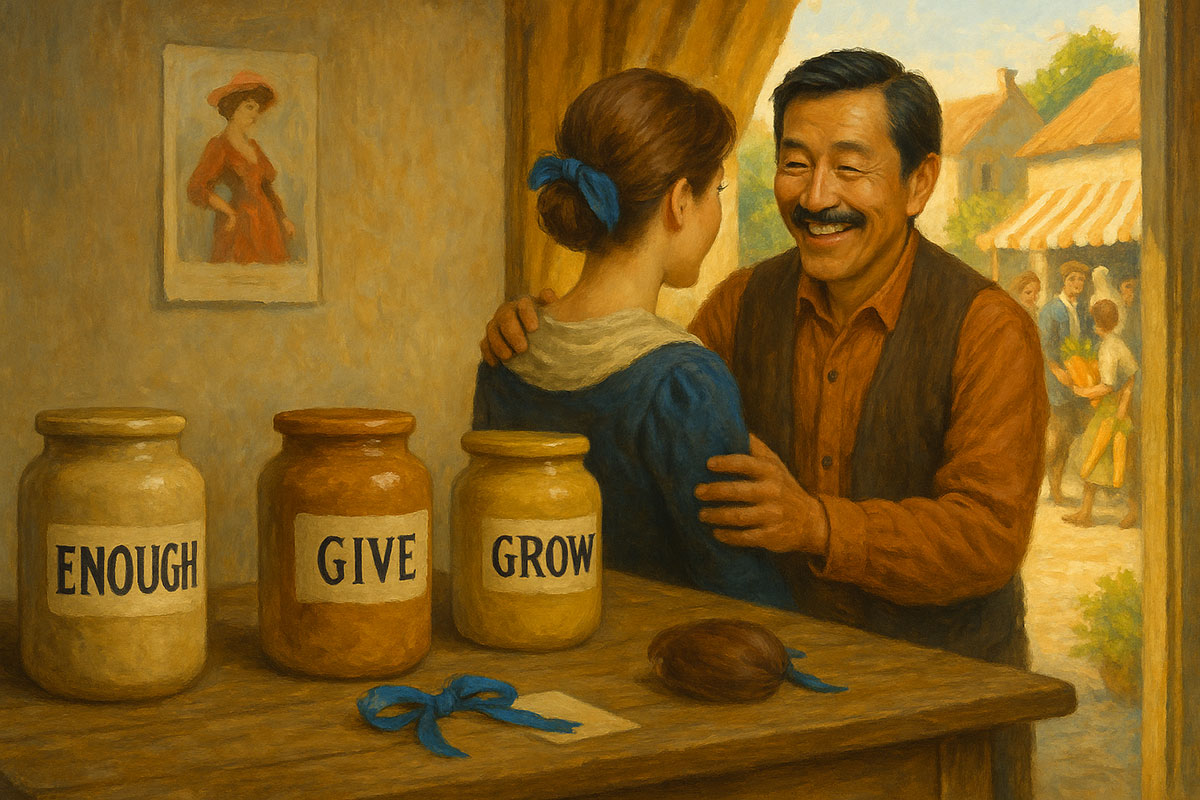
He set three jars on the table, labeled with a child’s neat hand: ENOUGH, GIVE, GROW.
“Into ENOUGH,” he explained, “goes rent, bread, wood, candles. Into GIVE, coins for others, so you never tighten into a knot. Into GROW, money that plants trees—skills, tools, a hen that lays eggs. The fourth jar is invisible: JOY. It is filled by how you live, not what you buy.”
Lheureux’s smile curdled. “Charming,” he said. “But Madame longs to adorn her natural grace. You would deny a rose its dew?”
“I would teach the rose to laugh at salesmen,” Saito said, still smiling. “Madame, buy one ribbon. Wear it when you host the Swap & Share.”
“The what?” Emma arched a brow.
“Saturday,” Saito said. “Bring three things you no longer need. Leave with something you want that costs no money. Yonville will learn fashion from generosity.”
Lheureux collected his catalogues with a sigh that tried to sound like pity and only managed impatience. “You will come to me,” he told Emma softly. “Dreams need credit.”
“Dreams need waking,” Saito replied. “And a good breakfast.”
When the merchant left, Emma deflated. “I’m tired of being a beginner at contentment,” she said.
“Excellent,” Saito said. “Beginners learn fastest.”
He showed her the smallest magic: making a list titled THINGS I ALREADY HAVE BUT HAVEN’T NOTICED. It included: a husband who tries, a daughter who laughs when you look surprised, two hands that know how to cut flowers, eyes that love light, a window with four seasons backstage.
She smirked, embarrassed by gratitude’s intimacy. “You forgot my beautiful selfishness.”
“Keep a little,” Saito said. “It will make your compassion stylish.”
Rodolphe, unaccustomed to rivals like contentment, returned with a new strategy: admiration woven into melancholy. “Yonville cannot keep you,” he murmured on the lane, voice low enough to imply escape.
Emma’s heart did its old, foolish leap; her feet remembered their map. “I have a play to rehearse,” she said briskly. “Tonight we practice ‘The Extraordinary Soup.’”
Rodolphe blinked. “Soup?”
“Soup,” Saito said, appearing with theatrical timing and an onion. “Ingredients: water, potato, joy. Season with jokes.”
In the makeshift theater, Emma ladled lines with conviction. Charles forgot his stage directions and everyone loved him for it. Children brought carrots they’d grown in the new community garden Saito had bullied into existence with charm and shovels.
After rehearsal, Emma sat on the church steps, breath white in the evening. Rodolphe sank beside her, the sign of surrender disguised as a casual sprawl.
“You are wasted here,” he said. Then, before she could answer: “But perhaps you are wasting Yonville, too.”
She laughed, surprised by the compliment hiding in the insult. “Today I taught Madame Homais to waltz with a soup ladle. That cannot be a waste.”
“You have changed,” Rodolphe said, irritation threaded with fascination.
“No,” she answered. “I’ve finally arrived.”
“Arrivals are just departures with better lighting,” he muttered, standing. “If ever you want Paris, I know the road.”
“I’m paving a square,” she replied. “We’re hosting a Market of Free Things.”
He walked away, baffled by someone who had chosen a town over a legend and was happier for it.
Lheureux returned with a sharper smile and papers that rustled like whispered threats. “Just sign,” he urged, tapping where figures multiplied. “To be generous, one must first possess.”
Saito stepped between pen and paper. “True,” he said, “which is why we’re building a Possessions of the Heart list. It appreciates faster.”
“Poetry,” Lheureux sneered. “Poetry cannot buy lace.”
“No,” Saito agreed. “But it makes a plain collar look like a crown.”
Emma exhaled, eyes on the ink. She was not immune. The idea of a larger life tugged like the tide. She felt her old self rising—a woman composed of longing more than laughter.
“Tell me,” Saito said, very gently, “what would you actually do in Paris tomorrow?”
She blinked. “Walk. Look. Buy. Pretend to be someone.”
“Excellent,” he said. “Let’s do all four in Yonville this afternoon.”
And they did. They walked the lane as if it were a boulevard. They looked at clouds dressed as palaces. Emma bought a ribbon—a single, scandalously blue ribbon—from Lheureux with coins from the ENOUGH jar, not credit. Then, wearing it, she pretended to be someone: Emma Bovary, the woman who could host joy.
The pretending fit like truth.
That evening, Saito found Charles in the barn practicing compliments as if they were stitches. “You look like an orchestra when you smile,” Charles told a confused goat.
“Close,” Saito said. “Try that on your wife instead.”
When Charles told Emma, she laughed so hard she cried, and then cried so softly she laughed again. They kissed in the kitchen like two people who had just discovered the word “beginning.”
The house, pleased to be useful, held their happiness without creaking.
Act III — The Festival of Ordinary Wonders
Trouble, even in comedies, remembers its lines. A bad harvest poked Yonville’s ribs; bills arrived with the politeness of executioners. Lheureux, sensing opportunity, returned with contracts dressed as condolences.
“Madame,” he said, voice satin, “your generosity has been noticed. Yonville admires you. Imagine what you could do with a little more… liquidity.”
Emma looked at the paper. Old reflexes stretched like cats. Saito was away that morning, visiting a widow who had forgotten how to laugh. Charles, at the surgery, rearranged bandages into hopeful armies. Emma stood alone with the temptation that had once been her religion.
She dipped the pen. The nib touched the page.
“Wait,” she told herself, surprising herself into obedience. She set the pen down and walked to the door. “I will be back,” she said to Lheureux. “If I am not, then I will not.”
She found Saito in the widow’s kitchen, teaching the teapot to sing. “It whistles already,” the widow said.
“Then it needs lyrics,” Saito answered, without turning, as if he knew Emma stood at the threshold like a question mark.
Emma blurted, “I almost signed.”
“Congratulations,” Saito said lightly. “Almost is progress.”
She sagged into a chair. “I’m tired of choosing joy as if it were a chore.”
“That’s because you treat it like virtue,” he said. “Try treating it like mischief.”
“Mischief?”
“Yes. Outwit your worst habit and then giggle.” He poured her tea. “What did you want in that signature?”
“Permission to be dazzling,” she admitted, ashamed and relieved.
“Good,” he said. “Then let’s dazzle Yonville.”
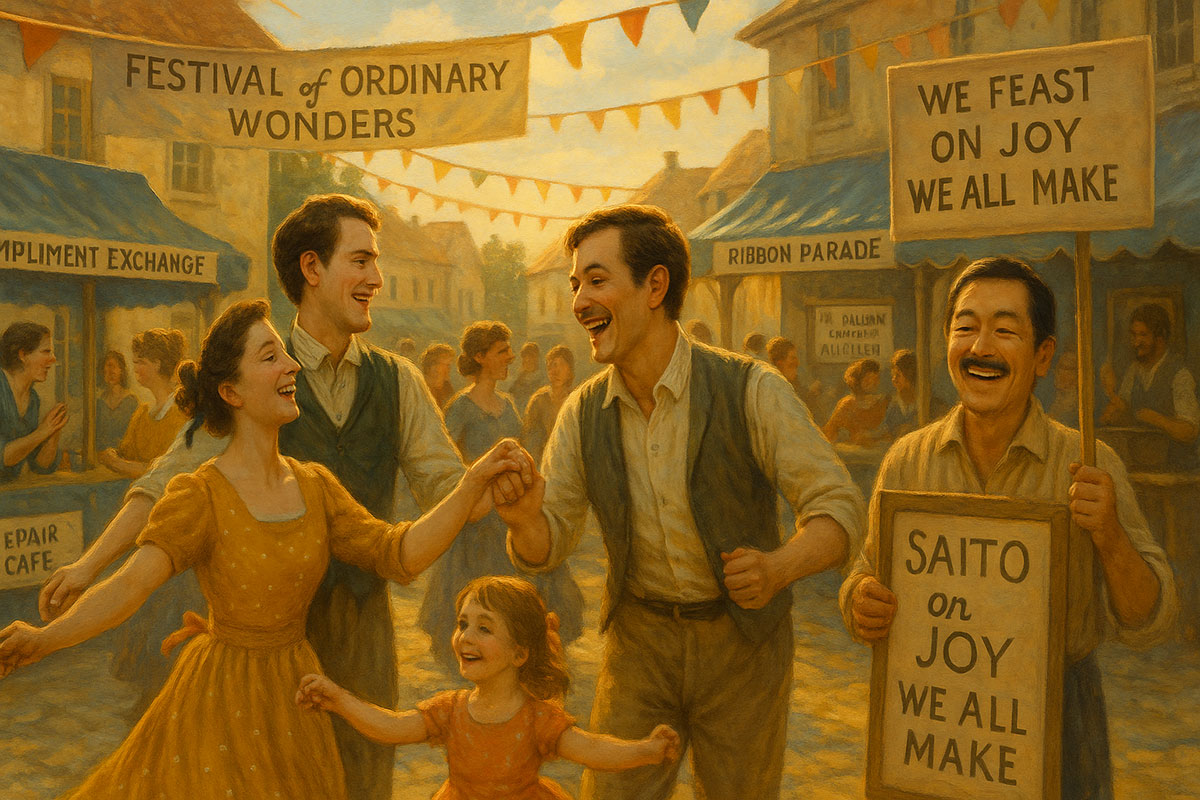
The Festival of Ordinary Wonders took one week to assemble and one afternoon to change the town. Saito drew posters with a child’s certainty: SEE A SPOON BECOME A MIRROR! WATCH A BARN TURN INTO A BALLROOM! TASTE CAKE THAT COSTS 11 CENTS BUT SEEMS LIKE PARIS!
Booths appeared: The Compliment Exchange (bring one, leave with one better), The Ribbon Parade (one ribbon, many uses—belt, bookmark, bouquet-tie), The Repair Café (mended kettles, mended quarrels), and, in the center, The Stage of Enough.
Emma opened the festival, ribbon bright in her hair. “Welcome,” she said, surprising herself with the steadiness of her voice. “Today Yonville practices being rich in the right things.”
Lheureux stalked the perimeter like a cat denied cream. He set up a rival stall: FUTURE LUXURY, PAY LATER. A few souls drifted over, then drifted back, pulled by laughter like a tide.
Charles, eyes wide, carried a tray of his newest invention: Happiness Pills—small sugar tablets that tasted like childhood and cost one smile. “Side effects include kindness,” he told customers solemnly. “Report improvements to your neighbors.”
Rodolphe appeared at noon, drawn by curiosity he mistook for boredom. He watched Emma lead the children in a dance called “Spilled Milk,” where everyone pretended to slip and then bowed to the floor. He shook his head, defeated by a woman who had taught the town to invent joy.
“Leave?” he murmured at her elbow, a last, small test.
“I have,” she replied, eyes on the children. “I left my old story.”
He saluted, strangely respectful, and walked toward whatever legend needed a sadder heroine.
At dusk, Saito called everyone to the Stage of Enough. “Confessions for courage,” he said. “No punishments—only repairs.”
The widow confessed to hoarding jam; she distributed jars and slept better that night. The chemist confessed to lecturing too much; he agreed to listen twice before prescribing. A farmer confessed to breaking a promise; he repaired it onstage with a handshake that looked like a bridge.
Emma stepped forward last, heart pounding like applause with nowhere to go. “I confused love with spectacle,” she said. “I wanted a balcony and forgot the kitchen is where the light lives. I forgive the woman I was. I choose to dazzle the ordinary.”
Yonville cheered—not wildly, but deeply.
Lheureux, sensing a lost market, attempted one final flourish. He mounted a crate and shouted, “You will regret this peasant carnival when winter comes and you own nothing!”
Saito climbed onto the crate beside him. “We own each other,” he said simply, gesturing to the crowd. “It’s harder for winter to take that.”
A pause. Then someone began to sing the Small Joys anthem, cobbled from rehearsals and recipes:
We clean with truth, we bless with names,
We laugh at fate’s untidy games.
A ribbon bright, a loaf well-baked—
We feast on joy that we all make.
Voices joined until the evening itself hummed.
Later, at home, Emma and Charles stood at their window. Lamps winked across Yonville like friendly stars. Berthe, their little daughter, snored softly, the sound kittens make when they dream of being lions.
“I was brave today,” Emma said, astonished by hearing it aloud.
“You’re brave every time you stay,” Charles replied, meaning: stay with us, with yourself, with a life that asks for presence instead of drama.
She touched his face. “You made happiness pills.”
He blushed. “Sugar and courage,” he admitted.
She laughed. “Mischief.”
“Mischief,” he agreed.
They kissed the way people kiss when they’ve learned a new language without leaving home.
Saito, on the road just beyond their hedge, paused to listen the way a gardener listens to a healthy tree. He tipped his hat to the Bovarys’ roof, to the chemist’s loud conscience, to Lheureux’s cooling ambition, to Rodolphe’s receding silhouette, to Yonville’s stitched-up heart.
A neighbor stepped out. “Leaving so soon?” she asked.
“I stay wherever people practice lightness,” he said. “That means I’m always arriving.”
“Will we manage without you?”
“You already are,” Saito answered. “Besides, I’m easy to imitate. Start the kettle. Invite fear for tea. Serve it honey. Laugh while it cools.”
He walked on. Behind him, the town exhaled like a funding prayer that had just been answered by pie.
Months later, the ledger in Emma’s drawer showed three columns that told a truer story than any romance: ENOUGH held steady; GIVE kept emptying and refilling like a happy well; GROW bought a second hen, then a loom for a neighbor, then time for Charles to learn the waltz properly.
On market day, Lheureux tried once more with a velvet box cradling a necklace that pretended to be more than glass. Emma lifted it, admired its audacity, and returned it gently.
“I already sparkle,” she said, and meant it.
He blinked, then bowed—defeated, perhaps, but also instructed by a lesson he would sell badly.
At the next festival, Emma took the stage with Charles and Berthe. Their new play, “The Balcony That Learned to Love the Kitchen,” made Yonville laugh until the sky turned the color of apricot jam.
If tragedy is a door that slams, comedy is a window that opens. Through that window, on an ordinary evening, a breeze carried the scent of bread, figs, and the sound of a town that had remembered how to be light.
The curtain does not fall. It stands open like a good neighbor’s gate, and everyone walks through, carrying something small that glows.
Final Thoughts By Nick Sasaki
In Flaubert’s original vision, Emma Bovary’s fate was sealed by her own illusions. She longed for passion and grandeur, but could not find them in the ordinary. Her tragedy was not just her affairs or her debts, but her blindness to the quiet beauty of the everyday.
Saito Hitori’s reimagining flips the mirror. It tells us that the ordinary is not a prison but a treasure. That the kitchen can be a palace if you laugh there, that debts lose their poison when generosity replaces vanity, and that love, when watered with humor, can grow stronger than any fantasy.
Emma no longer dies. She chooses life—and not just life, but joy. She discovers that Paris exists in a loaf of bread shared with neighbors, in a blue ribbon that costs a coin but feels like a crown, in a festival where compliments and soup are more precious than jewels. And Charles, once a symbol of mediocrity, becomes her partner in play, reminding us that even a clumsy man can dance if laughter is the music.
The deeper lesson is simple yet profound: We all have a little of Emma Bovary in us. We chase illusions, compare ourselves to stories, feel restless with the everyday. But we also have the power to rewrite our endings. We can choose laughter over bitterness, forgiveness over shame, and small joys over grand illusions.
Flaubert taught us the danger of longing without gratitude. Saito Hitori shows us the gift of gratitude without losing longing. Both are true. Both have their place. But in this retelling, Emma Bovary becomes not a warning, but an invitation.
So let us accept that invitation. Let us practice dazzling the ordinary—whether by pouring tea with a smile, planting figs instead of debts, or telling jokes to keep love alive. For in the end, tragedy may close the curtain, but comedy leaves it open, like a window that lets the light in.
And that, perhaps, is the truest happily-ever-after: not perfection, but laughter shared in the kitchen of everyday love.
Short Bios:
Saito Hitori — A wandering sage of laughter and light, he teaches Yonville that figs, ribbons, and lemon tea can heal even the heaviest hearts. With humor as medicine, he helps Emma and Charles discover joy in the ordinary.
Emma Bovary — Once the tragic dreamer of Flaubert’s tale, here she learns that true splendor is not in Paris ballrooms but in kitchens filled with laughter. From restless longing, she grows into a woman dazzling the ordinary with playfulness and forgiveness.
Charles Bovary — The country doctor once mocked as dull, now revealed as a man of quiet devotion who finds his voice in humor. With Emma, he becomes a partner in joy, proving that clumsiness and love make a charming duet.
Rodolphe — The suave seducer reimagined not as a destroyer but as a man bewildered by Emma’s choice of joy over passion. He exits stage left, defeated not by rejection but by her laughter.
Monsieur Lheureux — The sly merchant who once dragged Emma into debt, here becomes the town’s reluctant clown—outsmarted by jars labeled “Enough, Give, Grow.” His velvet boxes can’t compete with joy freely shared.
Yonville — The village chorus, transformed from a backdrop of provincial boredom into a stage of communal wonders: soup rehearsals, ribbon parades, and festivals where everyone confesses and repairs with laughter.
Nick Sasaki — Founder of Imaginary Talks and narrator of this reimagined tale, Nick guides us through Emma Bovary’s transformation with warmth and reflection. He frames the shift from tragedy to comedy, showing how Saito Hitori’s wisdom turns longing into laughter and everyday love into a lasting joy.
Leave a Reply