

|
Getting your Trinity Audio player ready...
|

Sei Shōnagon:
They say that in the palace, every season has its own sound. The clink of a tea cup against porcelain in spring, the rustle of silken sleeves in summer, the distant tapping of rain on lacquered eaves in autumn, and the muffled hush of snow in winter. But for me, there was always another sound—softer, yet sharper than any—Murasaki’s brush against paper.
She was a quiet storm, though you might not have noticed unless you leaned close. In the stillness of her presence, entire worlds took root, blooming in ink before anyone could guess at their shape. I used to tease her that she carried the whole court in her sleeve—every secret, every longing, every unspoken sorrow—and yet she would only smile, the corner of her mouth curving like a crescent moon at dusk.
We were different, she and I. I loved to scatter my thoughts like cherry petals, delighted if they startled someone’s heart awake. She, however, gathered hers as one gathers rare blossoms—choosing each with care, arranging them so that, once set upon the page, they would never fade. And so, as I tell you of these moments—her beginnings, her whispered corridors, her solitude, her imperial summons, and her final farewell—I ask that you listen not only to the words, but to the spaces between them. For there is where her truest voice hides.
(Note: This is an imaginary conversation, a creative exploration of an idea, and not a real speech or event.)

Chapter 1: The Quiet Girl in the Fujiwara Household
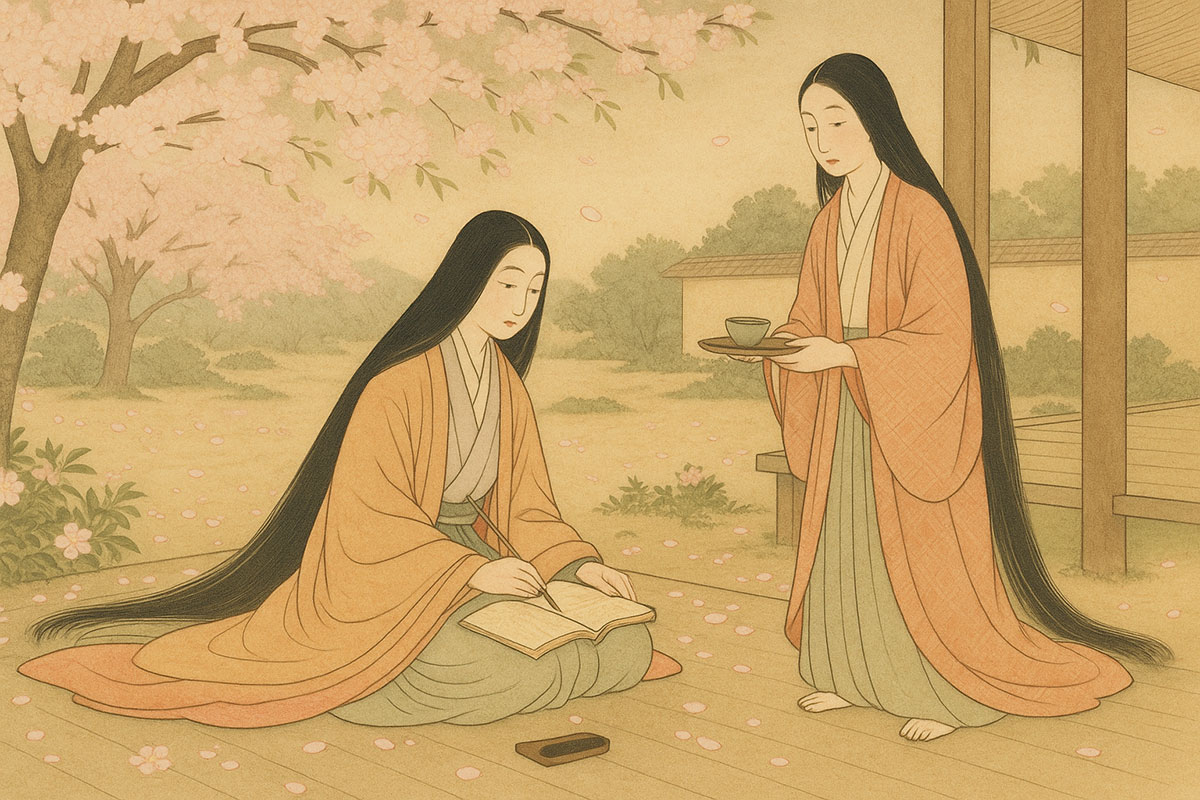
In the dim, polished corridors of the Fujiwara estate, the air smelled faintly of cedar and ink. Lantern light painted soft gold over the sliding screens, and somewhere beyond them, the faint rustle of silk could be heard as women moved quietly about their work.
Murasaki sat near the edge of a lacquered desk, her brush poised, yet unmoving. She was not supposed to be here—at least, not for this purpose. From across the room, her father’s voice drifted through the half-open screen, deep and deliberate, as he read aloud lines from the Analects to her older brother.
I knelt beside her, pretending to arrange the paper scrolls we had been told to sort. “You’ll get caught,” I whispered.
Her lips curved—not quite a smile, more like a secret slipping into the air. “Only if I forget to breathe.”
We sat together in silence, listening. She didn’t copy every word, only the ones that seemed to bloom in her mind before the sound of them faded. Her brush moved with practiced quiet, as though the strokes themselves were part of the act of hiding.
“They’ll say it’s unseemly,” I said softly. “A girl reading the classics?”
“They’ll say many things,” she replied, eyes fixed on the ink as it dried. “But these words… they feel like they’re waiting for me. If I don’t learn them, they’ll vanish, as though they were never here.”
The evening deepened, and the moonlight spilled like silver across the polished floors. When the lesson ended, her father passed by without noticing the small, folded slip she held under her sleeve—today’s harvest of stolen knowledge.
She turned to me before we parted for the night. “Promise me,” she said, “that if the world ever tries to take these words from me, you’ll help me remember them.”
I promised. And in that moment, I knew—this quiet girl, hidden in the shadows of her family’s corridors, was already carrying a story far greater than any of us could imagine.
Chapter 2: The Early Loss of Her Husband

The first autumn after her wedding was quiet—too quiet for a woman whose laughter, when she allowed it, had once slipped into rooms like sunlight through paper screens.
The air in the capital had begun to cool, the scent of chrysanthemum petals clinging to the breeze. Servants in muted robes passed softly along the corridors, their eyes lowered, their steps careful, as though the house itself might shatter if they moved too quickly.
I found her in the garden pavilion, kneeling beside the low railing. Her hands rested in her lap, still as a folded poem. From here, the pond reflected the late afternoon sky—a pale, fragile blue, like silk worn thin by years of touch.
She didn’t look at me right away.
“It’s strange,” she murmured, voice low, “how silence can make the world heavier. When he was here, I never noticed the sound of my own breathing. Now, it feels too loud.”
Her husband’s death had been sudden—an illness swift and merciless. One day he had been leaning toward her, his sleeve brushing hers at the banquet, whispering something about the next poem he would write. Days later, he was gone, the ink on his last verse still damp when they sealed it away.
I sat beside her, our sleeves touching in the cool air. “You don’t have to fill the silence,” I said. “You can let it be.”
She shook her head slightly, as if the thought were both comforting and unbearable. “If I let it be, I’ll forget his voice. The way it lingered after he spoke—as though the words wanted to stay with me a little longer.”
The sun began to dip, casting ripples of gold across the pond. Somewhere, a heron lifted into the air, its wings slow and deliberate, cutting through the stillness.
“Everyone tells me to move forward,” she continued. “As if life were a straight path one could simply walk along. But I think… perhaps life is a circle. And right now, I am somewhere in its shadow.”
I wanted to tell her that circles can turn toward light again, that grief’s shadow does not last forever. But she didn’t need promises. She needed presence. So I stayed, listening to the water lap against the stones, to the faint rustle of her sleeve as she finally reached for the brush lying beside her.
With deliberate care, she began to write—not about death, but about the shape of the evening light, the way it stretched long over the garden, touching everything as if for the last time.
When she finished, she set the brush down and exhaled. “Perhaps,” she said quietly, “writing is the only way I can still speak to him.”
And in that moment, I realized—her grief was not an end, but the beginning of a language only she could write.
Chapter 3: The Long Nights of Court

The palace was a place of splendor and shadows.
At night, the corridors glowed with the faint orange of lanterns, their light brushing over silk tapestries and polished floors. The air was thick with the scent of incense, and beyond the carved screens came the murmured laughter of courtiers, the rustle of layered robes, the metallic chime of bracelets and hair ornaments shifting as women leaned in to whisper.
Murasaki sat near the edge of the great hall, her brush poised over a sheet of fresh paper. It was not her turn to speak. Around her, the evening poetry contest was unfolding—men and women trading verses like polished jewels, each one weighed and admired.
She looked at me with that half-smile she reserved for moments of quiet irony. “They think these gatherings are about art,” she murmured. “But they’re just another battlefield—only the weapons are words.”
And she was right. A misplaced metaphor could be as damaging as a political slight. A perfectly timed poem could elevate a house’s fortunes. Every syllable carried weight, and every gesture was remembered.
I asked her if she felt tired of the game. She didn’t answer immediately. Instead, she brushed a lock of hair behind her ear, dipped her brush in ink, and began to write—not for the contest, but for herself.
Her hand moved with an ease that belied the sharpness of her thoughts. The poem was about the moonlight spilling over the veranda, illuminating the lacquered floor as if trying to read the palace’s secrets. She wrote quickly, then set it aside before anyone could ask to see it.
“It’s easier,” she said softly, “to give them what they expect and keep the rest for my own pages.”
Hours passed like this—the distant music of koto strings, the faint clink of sake cups, the constant hum of subtle rivalry wrapped in elegance. Murasaki played her part flawlessly, offering verses that were graceful but never too revealing. She knew how to win without drawing too much attention, how to survive in a court where a rumor could end more than a career.
Yet I saw the weariness in her shoulders when the laughter swelled and she had to lean forward, pretending delight. I saw how her gaze drifted to the paper in her lap, to the inkstone waiting like an old friend.
When the gathering finally dispersed, we walked together through the palace gardens. The moon hung low, heavy and gold. The sound of our steps on the gravel was the only music left.
“They will all forget tonight’s poems by morning,” she said. “But the ones I write in secret… those will remain.”
In that moment, I understood—her true work was not in the court’s bright, competitive displays, but in the quiet hours that followed, when the world’s demands fell silent and her voice was entirely her own.
Chapter 4: The Creation of Genji
The nights were no longer enough for her.
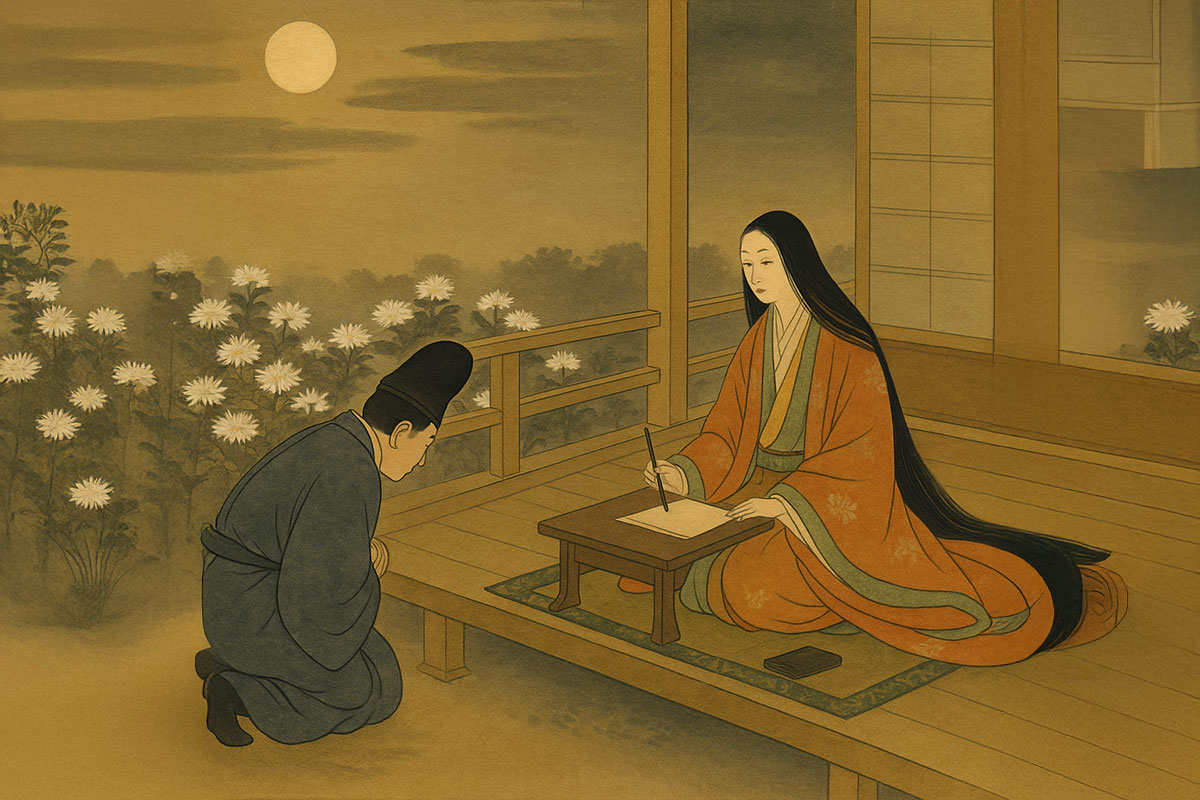
After the court’s performances and rituals were done, she would retreat to her private chamber, sliding the screen shut with the quiet finality of someone closing the world out. The air smelled faintly of camellia oil and the smoke of the last extinguished lantern. Her writing table waited like a confidant, low and unassuming, yet ready to receive everything the court would never hear her say aloud.
I remember the first night I saw the beginnings of him—Genji. At the time, he was only a handful of sentences, a prince caught between beauty and sorrow. She wrote them as if she were pulling threads from the air, each one shining under the lamp.
“They think the court has no shadows,” she told me, “but I’ve seen them. I’ve walked in them.” She dipped her brush again. “Genji will walk there too.”
Her pace was unhurried but relentless. On some nights she paused to gaze out at the moonlit garden, as if waiting for a word to drift toward her from the wind. Other nights, the ink on her brush barely had time to dry before she dipped it again, driven by something larger than the hour.
We would sit together in the hush, the only sounds the whisper of her brush against paper and the occasional sigh when the image in her mind resisted taking form. She spoke to me in fragments—questions, reflections, half-confessions.
“Will they understand,” she once asked, “that beauty and loneliness are not opposites?”
Her characters grew in depth, their joys carrying the echo of loss, their sorrows threaded with fleeting moments of light. The palace intrigue she witnessed by day seeped into her pages, transformed into something sharper, more lasting. Love affairs became poems in motion. Political whispers turned into currents that shaped fates.
I began to see her eyes change when she wrote—no longer the guarded gaze of a court lady, but the open, searching look of someone in conversation with eternity. The boundaries of her room dissolved; she was walking in gardens that never wilted, sitting in chambers that would never crumble, speaking with voices that would never fade.
Sometimes she read passages aloud to me, her voice low so the words seemed to float in the lamplight. “Listen,” she would say, “do you hear how he hesitates before stepping into her chamber? That pause tells you everything.”
The more she wrote, the more I understood—Genji was not just a prince. He was a mirror she was holding up to her own world, showing it the truths it would never dare name.
By the time the first chapters were complete, the court still slept in its silks and ambitions, unaware that in the quiet hours, Murasaki had begun weaving a work that would outlive them all.
She set down her brush one night and whispered, almost to herself, “Now he lives.”
Chapter 5: The Autumn Farewell
The garden had changed.
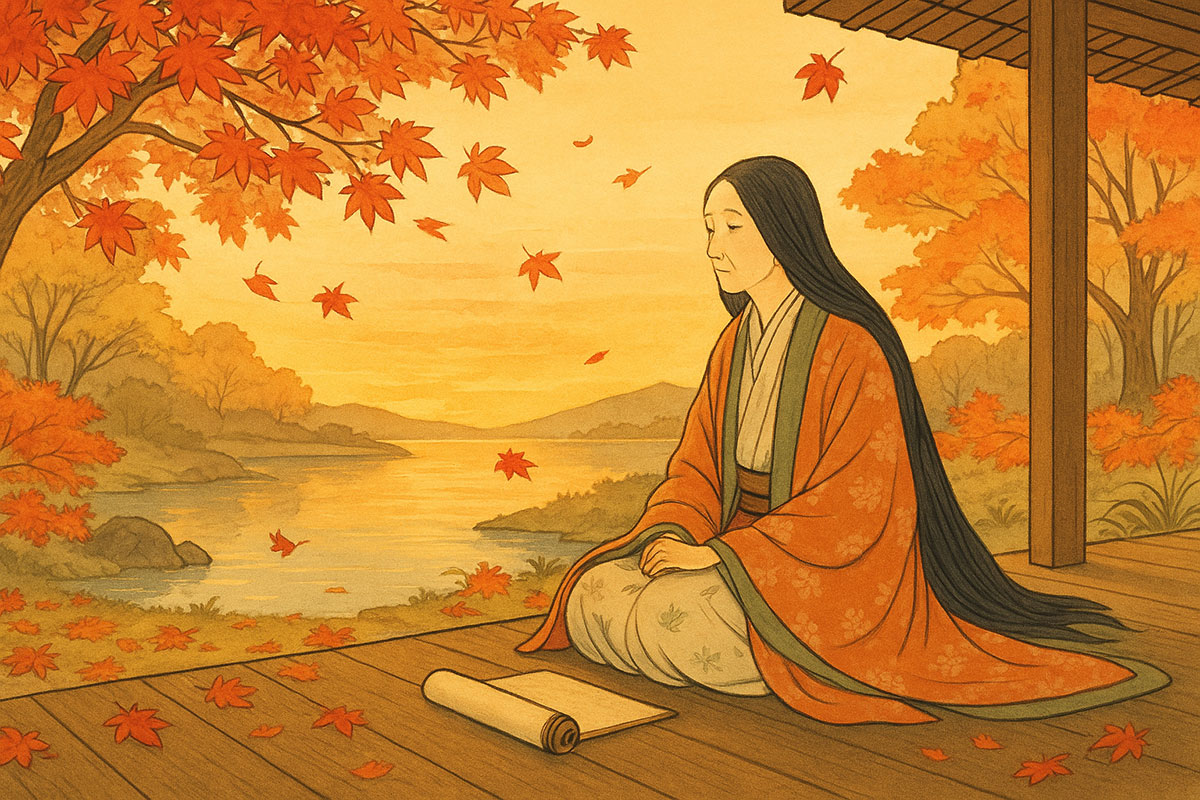
Summer’s green had thinned into gold, the maple leaves curling at the edges, trembling before they fell. The air carried that unmistakable scent of autumn—cool, a little sharp, as if it wanted to keep people awake to what was ending.
Murasaki sat beneath the eaves, her brush set aside, her gaze fixed on the koi pond where the water mirrored the fading season. She was quieter than usual, her silences no longer pauses between thoughts but whole landscapes in themselves.
“I’ve written so many beginnings,” she said at last, “but endings… endings always weigh more.”
I knew what she meant. Genji’s world had grown in her pages until it seemed to breathe on its own. But even worlds born of ink must bow to the truth of time. Her characters, so vivid and beloved, would meet fates she could neither soften nor rewrite without breaking their truth.
The court still bustled with its ceremonies and whispered rivalries, but she had withdrawn from its restless tide. I often found her by the window, watching the play of light on the paper walls, as if memorizing it for a journey she knew she must take alone.
One afternoon, she handed me a sealed packet. “If something should happen,” she murmured, “make sure these chapters find their way to someone who will keep them safe.”
Her fingers lingered on the packet a moment longer, as though parting with a child.
That autumn, the days shortened quickly. She wrote less, but when she did, the lines felt distilled—pure, unclouded, as though she had learned to speak in the language of what cannot be wasted. The Genji she now shaped was different too: more reflective, more aware of the shadow that follows beauty.
On her final evening before leaving the capital for a retreat in the provinces, we walked through the garden together. Lanterns swayed gently, casting circles of light on the path. She stopped by the maple tree and pressed a fallen leaf into my hand.
“Stories,” she said softly, “are like these leaves. They grow, they flourish, they fall. But if they are carried far enough, they become part of other soil, other roots.”
When we parted, she did not look back. Her steps were slow but steady, her figure fading into the autumn dusk like the last line of a poem you carry in your mind long after the page is closed.
I kept the packet safe, just as she asked. And in the years to come, whenever the wind brought the scent of autumn into my rooms, I would open those pages, and it was as if she were there again—brush in hand, eyes alight, ready to breathe life into a world that would never truly say farewell.
Final Thoughts by Sei Shōnagon
I have often wondered if the world will ever see another like her. Not because she was perfect—no, she would scoff at such foolishness—but because she lived so entirely in the weave of her own fabric, unafraid to let its threads run long or knot themselves in unexpected places.
In her gardens, both real and imagined, she sowed not just beauty, but the patience to wait for beauty. She did not simply tell the court’s tales; she preserved the rhythm of our days, the perfume of an evening wind, the sigh of a woman alone with her thoughts.
If you walk by a pond in autumn and see the sky trembling in its surface, perhaps you will think of her. And if a leaf, drifting down, happens to land upon the water just as you look, then you will know—Murasaki has turned another page.
Short Bios:
Murasaki Shikibu — A Japanese novelist, poet, and lady-in-waiting at the Heian court (c. 973–c. 1014), best known as the author of The Tale of Genji, considered the world’s first novel. Her refined observations of court life and human emotion remain timeless in Japanese literature.
Sei Shōnagon — A contemporary of Murasaki Shikibu, court lady to Empress Teishi, and author of The Pillow Book, a witty and perceptive collection of essays, lists, and anecdotes that reveal her sharp intelligence and love of elegance. She is remembered for her keen eye for beauty and her quick, sometimes biting humor.
Leave a Reply