

|
Getting your Trinity Audio player ready...
|
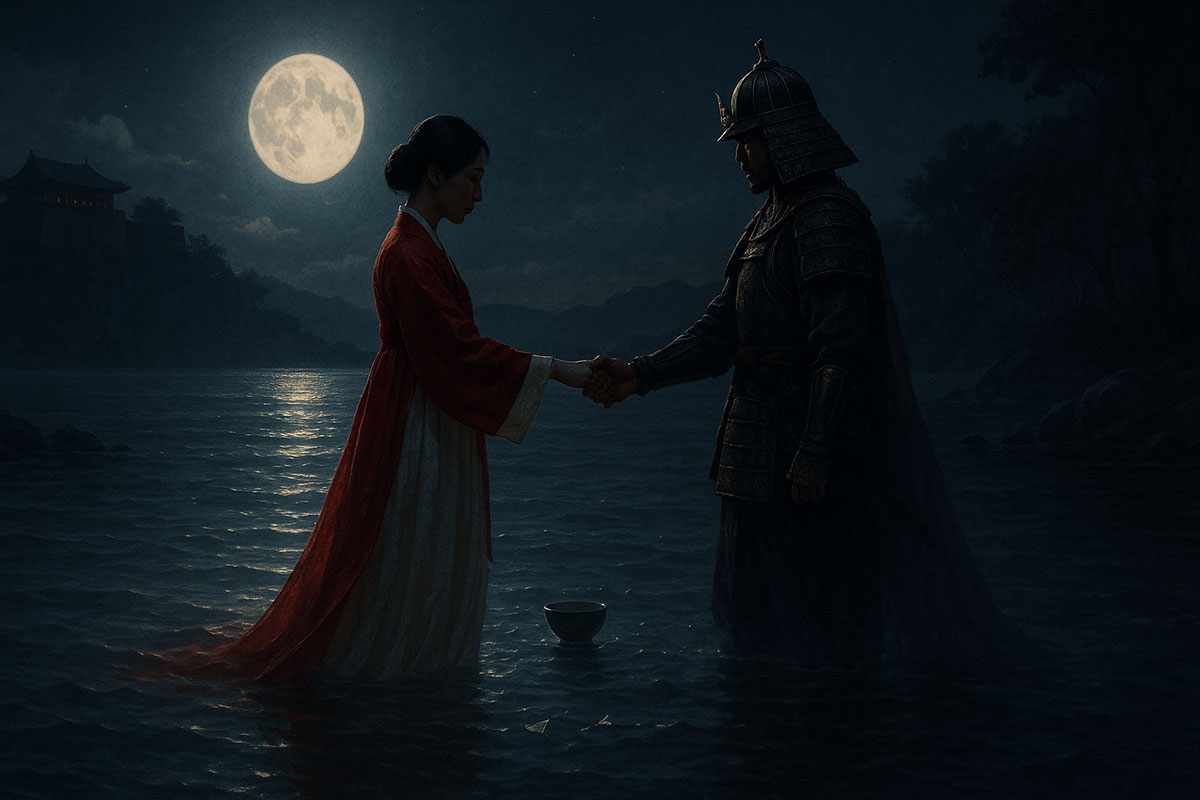
Youn Yuh-jung:
(Soft lighting. No music. The stage is empty. Her voice enters like an old river remembering its own reflection.)
“There are names that echo loudly through history.
And there are names that… whisper.
In Jinju, during the sixteenth century,
there lived a woman who was never meant to be remembered—
not in textbooks, not in victory songs.
She was called a Kisaeng—a court entertainer.
She served wine, danced, smiled.
And when the war came, she wasn’t handed a sword.
But in the end, it was her silence…
that cut deeper than any blade.
This is not a war story.
And it is not a love story.
This is the story of a cup.
Of a woman who knew how to pour it.
And of the man who…
chose not to drink it.
Lights slowly rise on Act 1.
(Note: This is an imaginary conversation, a creative exploration of an idea, and not a real speech or event.)
Act 1 — Stillness Before the Fire
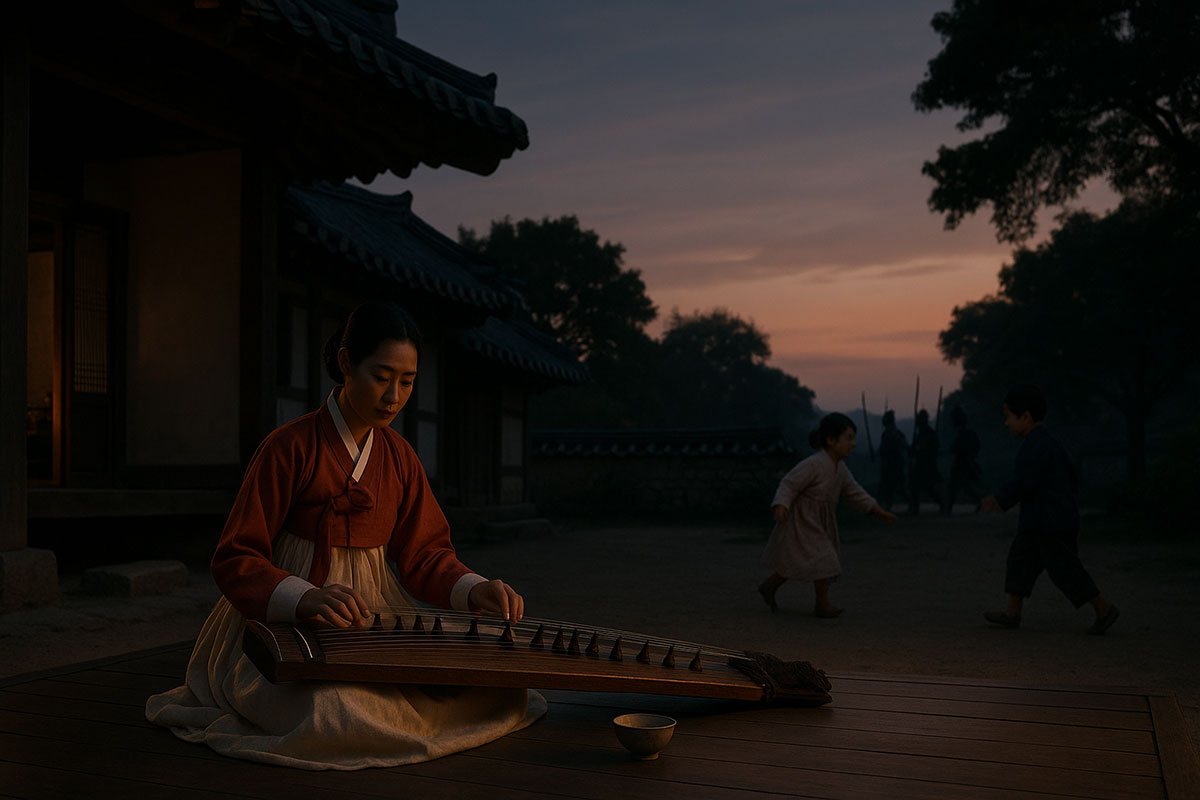
 Scene: A Quiet Courtyard at Dusk
We open in a fading courtyard tucked behind the Jinju fortress. The last sunlight melts across worn stone paths and laundry lines. Children’s laughter rings faintly in the background. A woman kneels alone beside a traditional gayageum, quietly adjusting the strings.
Scene 1 — Tuning Shadows
Young Kisaeng A (teasing):
You’re at it again, Unnie. You were playing all night yesterday too, weren’t you?
Nongae (smiling without looking up):
Mm. The wind didn’t want to stop.
I just let it borrow my fingers.
Young Kisaeng B (giggling):
They say your music makes men cry.
Even the enemy, they say—one note and poof, they fall over!
Nongae (softly):
If a man cries,
it means there’s still something human in him.
If my song reaches that part…
maybe I don’t need a sword.
The girls fall quiet. The laughter fades with the breeze.
Scene 2 — The General’s Tent, Nightfall
Inside a simple but guarded tent, a Japanese general stares at a battle map, unmoving. His second-in-command hesitates behind him.
Second-in-Command:
General. Jinju still holds. The walls may fall, but the people… they cling like roots to the dirt.
What are your orders?
General Tadakage (without turning):
Blades that strike soil dull quickly.
And walking against the wind?
Only leaves you lost.
Second-in-Command (confused):
…Sir?
He exits. Tadakage remains still, eyes no longer on the map but beyond it.
Tadakage (quietly):
This land breathes.
And here I am—sharpening silence into war.
Scene 3 — By the River
A large flat rock near the banks of the Nam River. Nongae sits with her gayageum. Her hair is tied loosely, and she seems both here and somewhere else. Across the water, unseen by her, Tadakage stands still, listening.
Nongae (to herself):
If this song can reach anyone,
let it find someone who hasn’t forgotten how to feel.
If they’re still listening,
they haven’t fully given themselves to war yet.
Tadakage (quiet, from afar):
Your notes…
they cut deeper than steel.
The music continues, soft and fragile. Neither sees the other.
Scene 4 — Behind Closed Doors
Nongae brushes out her hair by candlelight, studying her reflection.
Nongae (whispering):
They say we’re meant to smile, pour, dance.
But tonight, my music reached someone.
I think… I think my hands trembled a little.
Scene 5 — The General’s Night
Tadakage sits before a small brazier, his armor cast aside. In the fire’s flicker, he holds a ceramic cup, empty.
Tadakage (low):
Victory.
What name does it really carry?
After the sword, after the shouting—
what’s left?
He places the empty cup on the ground.
Behind him, drunken laughter echoes faintly from the men’s camp.
Scene 6 — Distant and Near
On opposite ends of the river, the woman and the general both look up at the same moon. A thread hangs between them—unseen, but felt.
Both (overlapping inner voices):
“I haven’t met you yet.
But somehow…
I already know you.”
Fade to black.
Act 2 — When Shadows Touch
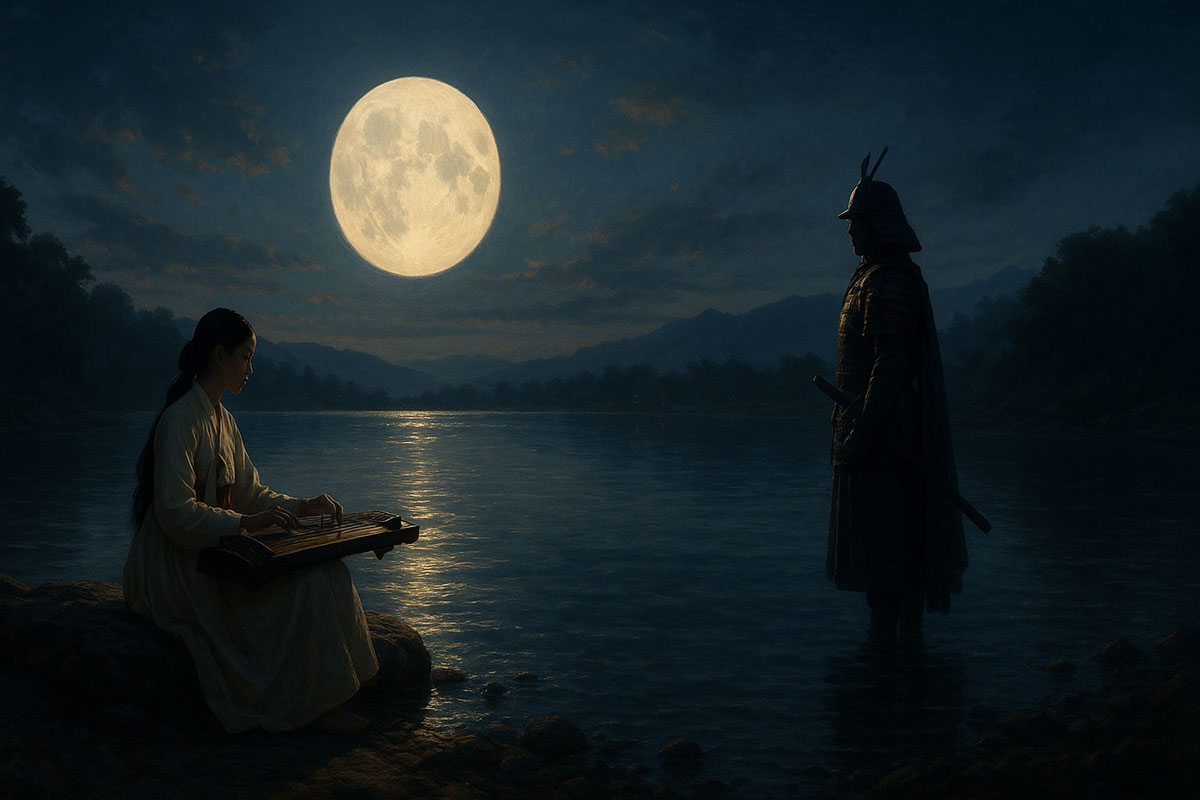
Scene: Dusk Along the River
The stage is split between two spaces: a quiet riverside rock where Nongae tunes her gayageum, and a lookout point across the river where General Tadakage stands in shadow. A soft twilight glow spills across both sides. Crickets chirp, water flows gently.
Scene 1 — Red Fabric, Unspoken Fire
(In the Kisaeng quarters, Nongae lays out a red hanbok—its edge faintly scorched. She runs her hand along it gently.)
Senior Kisaeng (offstage, entering quietly):
You’re really going to wear that tomorrow?
Nongae (without looking up):
Yes.
It remembers the woman who wore it before me.
She didn’t come back.
Senior Kisaeng (cautiously):
That’s why you shouldn’t—
Nongae (firmly):
That’s why I must.
A pause. The older woman watches her.
Senior Kisaeng:
Nongae…
Don’t show your heart.
Not to them.
Nongae (soft smile):
If my heart is going to break anyway,
I might as well break it on purpose.
Scene 2 — First Words
(At the riverside. Nongae sits down, her back straight, her gayageum resting on her lap. Across the water, Tadakage appears from the trees. This time, she sees him.)
Nongae (quietly):
You were here last night… weren’t you?
Tadakage (surprised but steady):
I heard the music.
It stopped me in my tracks.
Nongae:
That wasn’t meant for you.
But I suppose the river doesn’t ask for permission.
Tadakage:
It didn’t feel like a song meant for war.
That’s why I listened.
A beat. The river flows between them.
Nongae:
Are you a soldier?
Tadakage (pauses, then softly):
…No.
Just someone who wandered into a war
and forgot how to get out.
Nongae:
Then tonight, here…
you’re not my enemy.
Tadakage (nods slowly):
No. Not if you see me that way.
Scene 3 — Back at Camp
Back in the Japanese camp, two soldiers whisper while sharpening weapons.
Soldier A:
He disappears every night.
You think he’s meeting someone?
Soldier B:
Maybe.
Or maybe he’s just sick of all this.
(They both fall silent as the sound of a distant gayageum drifts in on the wind.)
Scene 4 — A Needle and a Name
In her room, Nongae embroiders something inside the red hanbok—a small character near the hem.
Nongae (softly):
This is not my name.
It’s just a reminder that I was here.
Even if no one says it later…
the river will remember.
Scene 5 — A Flower Left Behind
Later that night. Tadakage returns to the riverside. Nongae is gone. On the rock where she sat, there is a single white flower.
Tadakage (picks it up slowly):
You left something behind…
or maybe it’s what I needed to find.
He lets the flower drift into the river.
 Final Image: Across the Water
At the same moment, Nongae looks up at the same moon from her window. On opposite sides of the river, neither sees the other—but the moonlight stretches between them.
Both (overlapping, inner voice):
“I still don’t know your name.
But something in me… remembers you.”
Fade to black.
Act 3 — The Cup Between Us
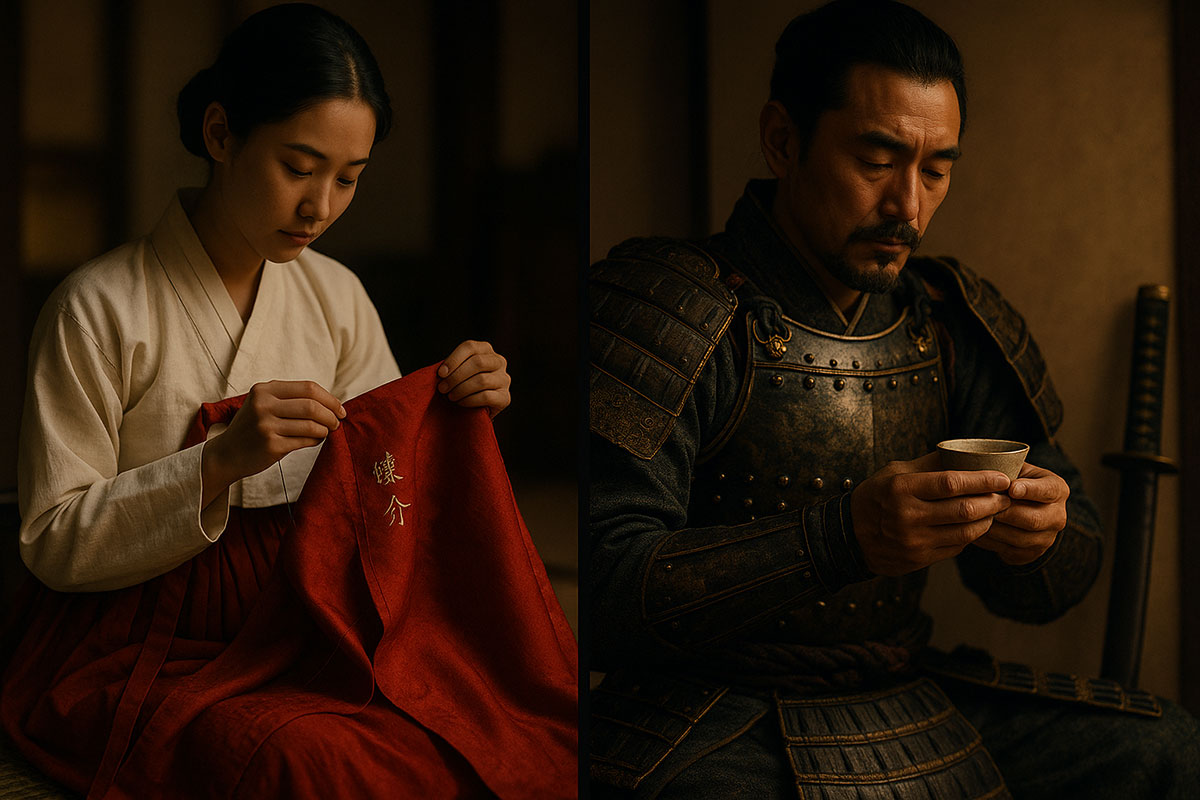
Scene: Parallel Preparations
The stage is split:
Left—Nongae’s quiet chamber in the Kisaeng house.
Right—General Tadakage’s tent.
Each prepares for the same night, unaware of how fully their decisions mirror each other.
Scene 1 — The Red Hanbok
(Nongae folds the red hanbok. The charred hem trembles slightly in her hands. She lays it across her lap and stares at it in silence.)
Senior Kisaeng (from the doorway):
It’s final.
They’ve chosen you to serve at tomorrow’s banquet.
Nongae (calmly):
It was always going to be me.
Senior Kisaeng:
You don’t have to wear that one.
Nongae:
No… I do.
It already knows how the story ends.
A beat of silence between them.
Senior Kisaeng (softly):
If you’re afraid, you can say so.
Nongae (gently):
I’m not afraid.
I’m already halfway gone.
Scene 2 — The Sword and the Cup
(In his tent, Tadakage holds a sake cup in one hand, his sword in the other. He looks at them both.)
Tadakage (to himself):
One is for killing.
The other is for forgetting.
(He slowly sets the sword down, then places the cup upright in front of him.)
Tadakage (softly):
Tomorrow, if she offers it…
I won’t drink.
I’ll follow it.
Scene 3 — The Riverbank, Twilight
The stage shifts to the riverbank. Nongae stands at the edge, her hanbok catching the last rays of daylight. Tadakage approaches from the shadows. They meet halfway, the space between them no longer wide.
Nongae:
The banquet is tomorrow.
Tadakage (nods):
I know.
A pause. The air is thick with things unspoken.
Nongae:
I’ll be there.
I’ll dance.
And at the end… I’ll offer you a cup.
Tadakage (quietly):
Then I won’t refuse it.
But I won’t drink from it, either.
Nongae:
Do you know what’s inside?
Tadakage:
Not wine.
Something heavier.
A long silence.
Nongae (softly):
This isn’t about love.
It’s not a test. Not revenge.
Tadakage:
No.
It’s a memory… written in silence.
Scene 4 — Embroidered Goodbye
(Nongae alone, in candlelight. She finishes stitching her name—개—into the lining of her hanbok.)
Nongae (softly):
Not for them.
Not for history.
Just for the water.
So it knows I passed through here…
still whole.
Scene 5 — Laying Down the Armor
(Tadakage removes each piece of his armor with care. He folds it as one might fold prayer cloth. There’s reverence in the act.)
Tadakage (low):
I never knew how heavy this was
until I imagined standing before her…
as only myself.
Final Image
A spotlight shows Nongae standing at the edge of the river, her hanbok billowing.
Tadakage appears on the opposite side.
Neither speaks.
Between them, the faint sound of water.
A sake cup floats silently downstream.
Fade to black.
Act 4 — The Dance and the Silence

Scene: The Banquet Hall
Soft lanterns flicker inside a grand stone hall in Jinju fortress, now occupied. The air is thick with incense and noise. Japanese generals and officers are seated around low tables. Laughter rings, but it’s tired. Forced. A low drum echoes in the background, announcing entertainment.
Scene 1 — The Room Fills
Officer A (pours himself wine):
To our triumph. Jinju finally bows.
Officer B (raising his cup):
About time. Let’s drink it into silence.
Second-in-command (quietly, to Tadakage):
They’ve brought in Kisaeng for the entertainment.
...Your name was specifically requested.
Tadakage (eyes unmoving):
I won’t ask why.
Let them come.
The lights dim slightly. Music begins—a single note, a ripple. Doors slide open.
Scene 2 — Nongae’s Entrance
(Nongae enters. Her hanbok is crimson and white, her posture impossibly still. She walks without performance. Her eyes never break from Tadakage.)
The hall seems to hush itself.
Officer A (to Officer B):
...Is she even real?
Tadakage (to himself):
No fire. No blade.
Just a woman carrying silence like a blade.
Scene 3 — The Dance
Music rises—slow, almost breathless. Nongae begins to move. Her arms unfold like wings, her feet glide as if she’s skating across the still surface of a pond. All eyes are on her, but she only looks at one man.
Nongae (inner voice):
This isn’t a dance.
It’s a farewell with rhythm.
Tadakage (inner voice):
I’ve seen war gods fall.
But none stood with the calm of your hands.
Scene 4 — The Cup
Nongae walks to the tray beside Tadakage. She lifts a ceramic cup with both hands and turns toward him. Slowly, she kneels and offers it. The hall watches in breathless silence.
Nongae (soft, only to him):
This cup isn’t poison.
But it won’t save you.
Tadakage (just as quiet):
I know.
It’s not a drink.
It’s an answer.
(He takes the cup, but doesn’t drink. He holds it carefully, like a living thing.)
Nongae (still kneeling):
From here, everything will disappear.
Even our names.
Tadakage:
Then let this be the last thing I carry.
Not my sword.
Not my title.
Only the echo of your silence.
Scene 5 — The Departure
(Nongae rises and walks slowly toward the doors. Every step is final. At the threshold, she turns once—just for him.)
Tadakage (inner voice):
You never needed words.
You already said everything.
Nongae (inner voice):
Your silence…
was the first time I was truly seen.
Final Image
Tadakage remains seated.
The sake cup still in his hands.
He has not blinked.
He has not breathed.
The lights fall except for a single lantern behind him,
flickering like the end of a vow.
Fade to black.
Act 5 — The Water That Remembers Nothing
Scene: The Banks of the Nam River, Late Night
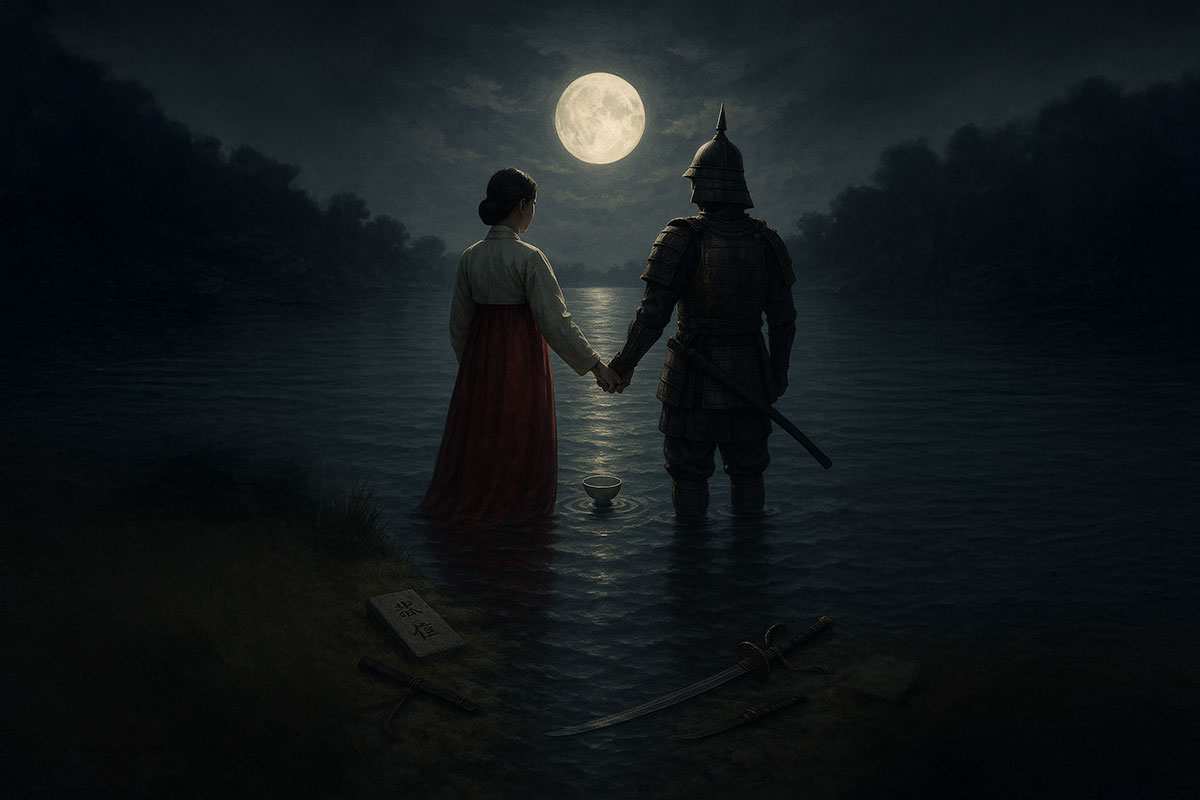
The moon is full, and the river glows like a path of glass. No music. No wind. Only water, breathing in ripples. On the bank, Tadakage stands alone, dressed no longer as a general but as a man.
Scene 1 — The Letting Go
(Tadakage removes the last piece of his armor and sets it on a stone.)
Tadakage (to himself):
They called me “General.”
But none of that fits here.
Not the rank.
Not the language.
Not the war.
(He picks up the cup—the same one she handed him.)
Tadakage:
You said it held no poison.
But I felt myself dying anyway.
And now I think…
you were teaching me how.
Scene 2 — Her Arrival
(Nongae appears, barefoot, in her red and white hanbok. She walks quietly, her presence calm as dusk. The two meet at the water’s edge.)
Nongae:
I thought maybe you wouldn’t come.
Tadakage:
I didn’t come to surrender.
I came to be undone.
Nongae (softly):
Then we’re already halfway there.
A long pause. They look out over the water.
Scene 3 — The Cup
(She places her hand over his holding the cup.)
Nongae:
This is not a symbol.
Not a weapon.
Not a vow.
Tadakage:
Then what is it?
Nongae:
Just proof…
that we stood still.
That we saw each other
and didn’t turn away.
(They set the cup gently into the water. It floats between them, half-submerged.)
Scene 4 — Into the River
(They step slowly into the river, hand in hand. First their ankles. Then their knees. The water glows around them.)
Tadakage:
Will anyone remember this?
Nongae (without fear):
The water will.
And that’s enough.
(The cup sinks. They walk forward until only their silhouettes remain. Then, those too dissolve into the moonlit current.)
Final Image
Silence.
Then the sound of the river swallowing itself.
A single lantern on the bank remains lit.
Next to it: a folded red hanbok, and a general’s sword.
Unclaimed.
Unneeded.
Epilogue (Narration)
They stepped out of war, out of country,
out of names.And became a quiet that never asked to be remembered.
The river did not mourn.
It simply carried them.
As it always does.
Fade to black. Curtain closes.
Final Thoughts by Youn Yuh-jung
(After the curtain falls. No visuals—just her voice, as if spoken by the river itself.)
The river remembers nothing.
Not titles. Not uniforms. Not which side won.
But sometimes, when the moon is right…
and the water is still…
it carries the shape of two shadows.
A woman who offered silence.
A man who answered without words.
And between them—
a cup that held no wine,
only the weight of being seen.
Short Bios:
Youn Yuh-jung
Youn Yuh-jung is an acclaimed South Korean actress whose career spans over five decades. Known for her fearless roles and subtle emotional depth, she became the first Korean actress to win an Academy Award for her performance in Minari (2020). With her signature blend of wisdom and understated power, she embodies characters who carry both pain and quiet dignity.
Nongae (논개)
Nongae was a 16th-century Korean Kisaeng (court entertainer) from Jinju who became a national symbol of patriotism and sacrifice. During the second siege of Jinju in 1593, she is said to have lured a Japanese general to the edge of the Nam River under the guise of pouring a farewell cup—and then leapt into the water with him, pulling him to their deaths. Though her historical details remain debated, Nongae is honored in Korea as a woman of extraordinary courage, choosing silence and death over submission.
The Japanese General (identity disputed)
The Japanese general allegedly killed in the river by Nongae remains unnamed in historical consensus. Some legends refer to him as Kei Yamura Rokosuke, though records suggest this may be fictional or symbolic. Rather than a single person, he is often seen as representing the invading force during the Imjin War (1592–1598). In poetic retellings, he becomes more than a general—he is a mirror to Nongae’s silence, a man who meets her not in conquest, but in mutual release.
Leave a Reply