
|
Getting your Trinity Audio player ready...
|
What if top Shakespearean scholars argued about Romeo and Juliet Explained with modern readers—who would they blame?
Introduction — William Shakespeare
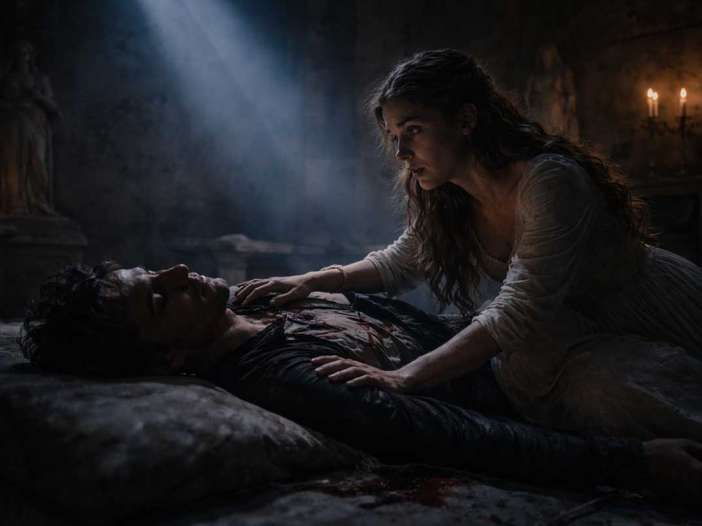
Romeo and Juliet Explained begins, not with lovers, but with a city that has forgotten how to breathe. Verona is loud with honor, quick with insult, hungry for spectacle. Its streets are trained to flare—boys into blades, fathers into pride, mothers into silence, and even good men into helpless watching. When I wrote this, I did not wish merely to mourn two beautiful youths. I wished to expose how an entire place can become a trap that calls itself “tradition.”
I announce the ending at the start because this tale is not built for surprise. If you enter it seeking only romance, you will mistake the warning for decoration. But if you enter it knowing that these two will die, you will notice something sharper: how often people choose the path that makes death more likely, and how often they call that path “normal.” The prologue is a lantern held above the stage. It tells you what the darkness is capable of so you cannot pretend the darkness is accidental.
And then—because tragedy is cruel—I give you a love that feels sincere. Not symbolic. Not allegorical. Actual. Romeo and Juliet do not love because the plot needs them to. They love because, for a brief moment, they meet each other as if the feud were a dream and the world could be rewritten by honest speech. That is why their love hurts to watch: it is not foolishness. It is clarity appearing in a city that punishes clarity.
You will hear “fate” spoken often. “Star-cross’d.” “Fortune.” “A plague.” Yet do not be too quickly enchanted by the poetry. Fate is the name people give to consequences once consequences arrive. Before the tomb, there is a chain of hands—hands that slap, hands that draw swords, hands that sign marriage contracts, hands that refuse to listen. The stars do not force those hands. The culture does. And the culture is made of choices repeated so long they masquerade as destiny.
In our WSI approach, we did not treat the play as a museum piece. We treated it as a living argument that modern readers are still having:
- Is the tragedy doomed from the start—or manufactured?
- Is speed the hidden killer?
- Who truly deserves blame: a few reckless souls, or a whole civic ecosystem?
- Why is truth unsafe for the young?
- Is this love a miracle—or a kind of emotional absolutism that can’t survive reality?
If you keep those questions close, you will not get lost in interpretation. You will feel the play operating like a human machine—beautiful, violent, intimate—turning ordinary moments into irreversible ones.
(Note: This is an imaginary conversation, a creative exploration of an idea, and not a real speech or event.)
Topic 1 — Fate: Are Romeo and Juliet Doomed from the Start?
Main Introduction — William Shakespeare
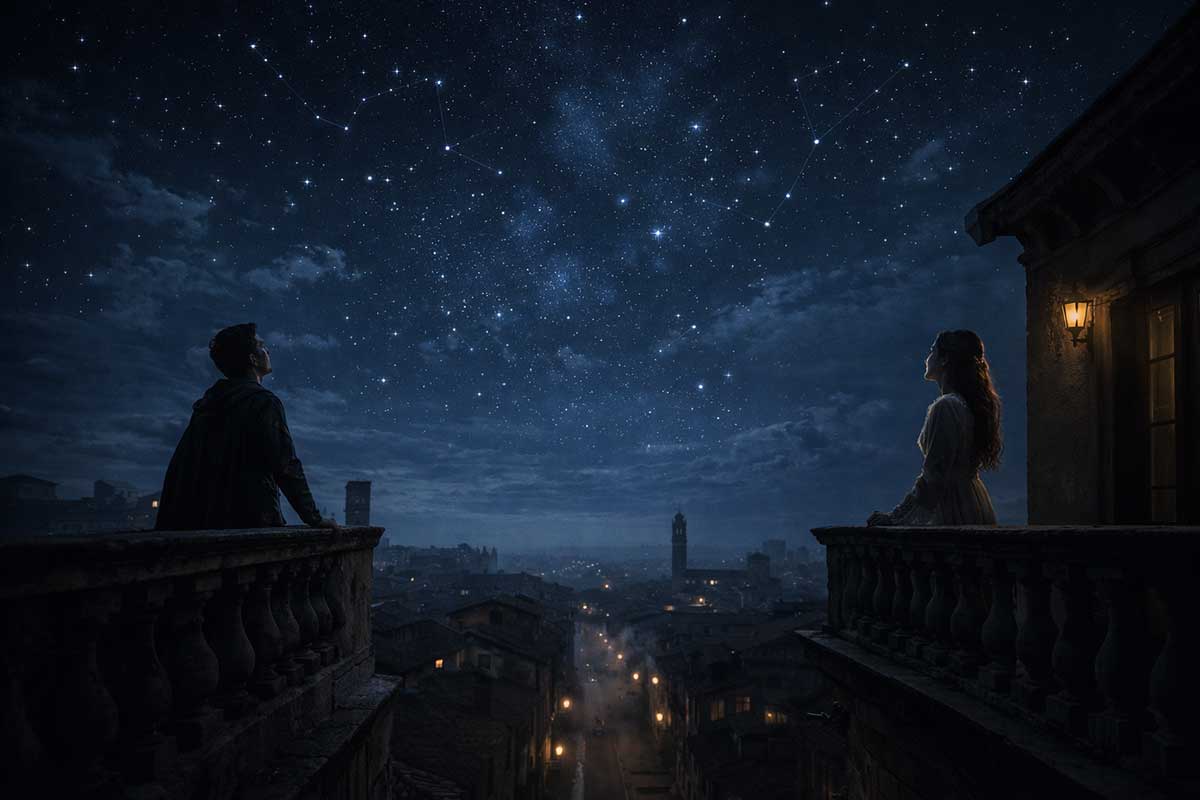
Before any sword is drawn, before any kiss is stolen, I tell you how this story ends.
I did not do this to ruin surprise. I did it to change how you watch. When you know the ending, every step toward it becomes charged. The question ceases to be what will happen and becomes why does it keep happening.
So let us begin where the audience always begins — with fate — and ask whether destiny rules this tragedy, or whether human hands quietly build the trap they later blame on the stars.
First Question (woven naturally)
What does “star-cross’d lovers” truly mean — destiny, or pressure?
Stephen Greenblatt
When Shakespeare invokes the stars, he is not invoking a mystical force so much as a cultural language. In early modern England, astrology was a way of talking about constraint — social, political, inherited. “Star-cross’d” names a world already tilted against them. The stars don’t cause the feud; they name the invisible weight pressing down on these young people before they ever speak.
Jan Kott
I would go further. Fate in Romeo and Juliet is not cosmic — it is mechanical. The machine is already running when the lovers step inside it. Every institution — family, law, masculinity, honor — is calibrated for violence. When love enters that system, it does not change the machine. The machine crushes love.
Emma Smith
What’s striking is how quickly the language of fate appears after human actions. Characters blame the stars once events escape their control. Fate becomes retrospective explanation. It’s a way of making unbearable consequences feel inevitable rather than preventable.
Northrop Frye
In tragic structure, fate is less a power than a pattern. Shakespeare shows us a sequence that repeats across generations. The lovers are caught in a mythic rhythm — not because the gods decree it, but because societies repeat their own errors with terrifying consistency.
William Shakespeare
I hear you circling the same truth: fate may speak, but humans give it a voice.
Second Question
If fate exists, where do choice and responsibility still matter?
Frank Kermode
Tragedy depends on the tension between inevitability and choice. If everything were fixed, there would be no tragedy — only reporting. The power of this play lies in moments where things could have gone otherwise. Fate provides pressure; choice provides ignition.
Stephen Greenblatt
Exactly. Romeo does not have to attend the ball. Mercutio does not have to draw his sword. Capulet does not have to force the marriage. Fate does not compel these acts. Social habit does. Shakespeare exposes how culture disguises its own violence as destiny.
Jan Kott
And yet — once the machine is in motion, individual morality collapses. Romeo’s choices narrow until only extreme gestures remain. Fate here is not prediction; it is acceleration. The faster the world moves, the fewer ethical exits remain.
Emma Smith
This is why the play feels so modern. The characters are not stupid. They are rushed. Time itself becomes an antagonist. Decisions are made under compression, not contemplation. Responsibility still exists, but it is exercised in panic.
William Shakespeare
So fate presses — but haste decides.
Third Question
Why reveal the ending in the Prologue at all?
Northrop Frye
The Prologue transforms the audience into witnesses rather than judges. Knowing the outcome removes the illusion of control. You cannot hope for rescue; you can only observe how ordinary actions become fatal under pressure.
Frank Kermode
It also shifts moral focus. Without suspense, attention moves to process. Each delay, each misunderstanding, each moment of pride becomes unbearable because we already know its cost.
Emma Smith
And importantly, it prevents romanticization. You are not allowed to pretend this is a story of passion alone. The ending stands before you like a warning sign. Everything beautiful that follows is haunted by what it will become.
Jan Kott
The Prologue is ruthless. It denies hope so that responsibility cannot hide. When the lovers die, the audience cannot say, “If only…” The play replies: You knew.
William Shakespeare
Yes. I did not wish to surprise you. I wished to indict the world that made surprise impossible.
Closing Reflection — William Shakespeare
If you leave this topic believing that Romeo and Juliet were doomed by the stars, you have missed my warning.
The stars do not raise children into feuds.
The stars do not demand public honor at the cost of private truth.
The stars do not confuse speed with sincerity.
Fate in this play is not a force above humanity — it is the echo of humanity refusing to change.
When a society moves too fast, listens too poorly, and loves its pride more than its children, tragedy does not arrive by accident.
It arrives on schedule.
Closing Reflection — William Shakespeare
Main Introduction — William Shakespeare
In this play, love does not grow.
It ignites.
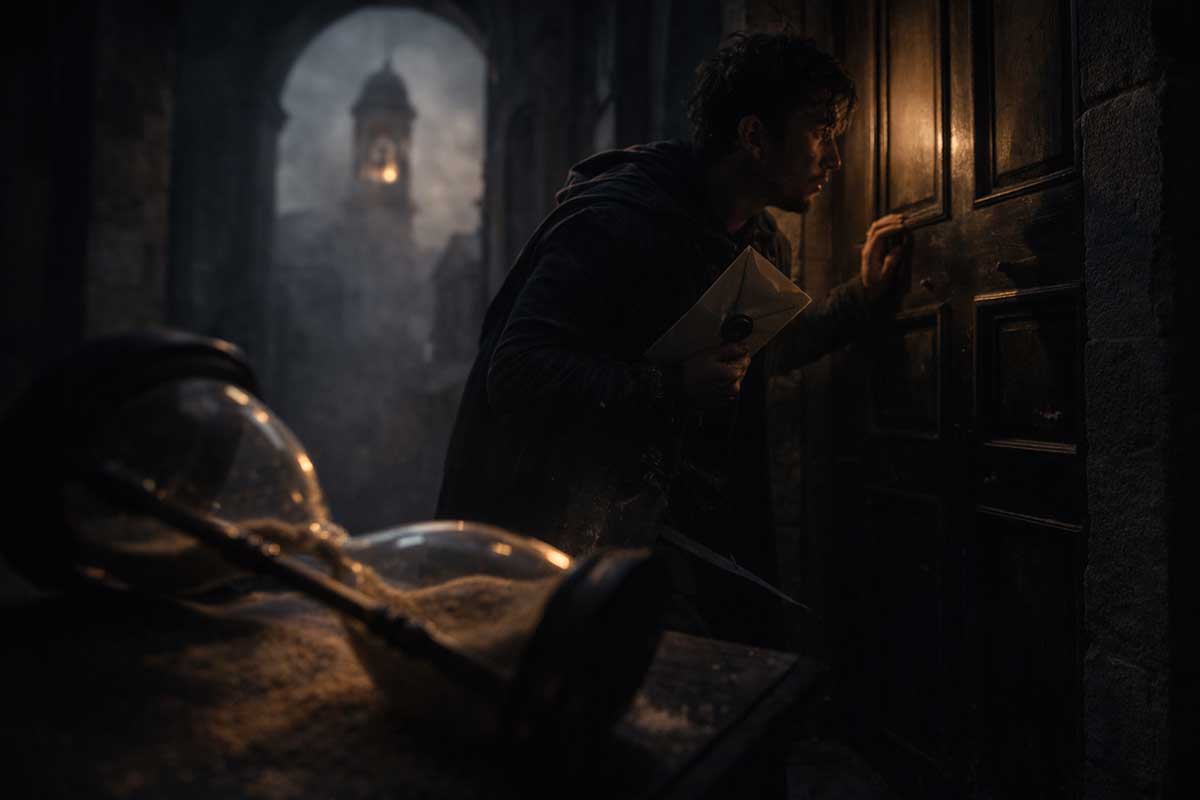
I did not give Romeo and Juliet weeks or months. I gave them hours. Not because young love is foolish, but because the world around them does not allow slowness. When hatred governs the streets, patience becomes a luxury.
So let us ask plainly: if fate presses from above, is it speed that tightens the noose?
First Question (woven naturally)
Why does everything in Romeo and Juliet happen so fast?
David Scott Kastan
The compression of time is structural. Shakespeare accelerates events to show how fragile human judgment becomes under pressure. This is not romantic haste; it is emergency behavior. The lovers are constantly responding to crises they did not create.
Marjorie Garber
Speed here is emotional realism. Adolescence often experiences feeling as absolute and urgent. But Shakespeare intensifies that urgency by placing it inside a hostile adult world. The result is a collision between youthful immediacy and rigid authority.
Jonathan Dollimore
We should not sentimentalize it. Speed is socially enforced. The feud, the threat of public violence, the demand for obedience — these conditions eliminate deliberation. When institutions are violent, people act quickly or not at all.
Harold Bloom
Romeo, especially, is a creature of immediacy. He experiences emotion as total presence. What Shakespeare does is remove the buffers that might have tempered him. There is no reflective space left.
William Shakespeare
So haste is not a youthful flaw alone — it is the rhythm imposed upon them.
Second Question
Is acting too fast the lovers’ mistake — or their only option?
Simon Palfrey
This is crucial: slowness is unsafe. If Romeo hesitates at the ball, he is discovered. If Juliet delays, she is married off. Speed is not recklessness; it is survival under surveillance.
Marjorie Garber
Exactly. The play repeatedly punishes hesitation. Mercutio dies during a moment of confusion. Juliet’s delay in revealing the marriage triggers her father’s fury. The world rewards decisiveness, even when it is destructive.
David Scott Kastan
We often ask why Romeo and Juliet marry so quickly. The better question is: When would it have been safe to wait? The answer is — never. The social clock is already ticking against them.
Jonathan Dollimore
Speed becomes the tragedy’s engine. It transforms manageable conflicts into irreversible ones. Shakespeare shows how systems that demand immediate obedience leave no room for moral repair.
William Shakespeare
So what appears as impatience may in fact be compression — the soul forced to sprint.
Third Question
Which moments could have slowed the tragedy — but didn’t?
Harold Bloom
Mercutio’s death is pivotal. It happens in a moment where playfulness slips into violence. A pause there — a single breath — might have saved him. Instead, speed converts bravado into fatality.
Simon Palfrey
The failed letter to Romeo is the most obvious rupture. The entire ending hinges on delayed communication. Shakespeare turns logistics into destiny. Time itself becomes a weapon.
David Scott Kastan
Capulet’s rushed insistence on Juliet’s marriage is another missed slowing point. Authority panics. Instead of listening, it accelerates control — and seals the outcome.
Marjorie Garber
What’s devastating is that each character believes speed will restore order. In fact, it ensures collapse. Everyone is trying to fix the situation quickly, and that urgency destroys them.
William Shakespeare
Yes. Every hand moves faster — and the ground gives way.
Closing Reflection — William Shakespeare
This is not a tragedy of impatience.
It is a tragedy of no time to think.
When the world demands instant loyalty, instant obedience, instant resolution, love cannot mature — it can only burn. Romeo and Juliet do not die because they love too fast.
They die because everything else around them refuses to slow down.
If there is a villain here, it is not youth.
It is a society that confuses speed with strength — and calls the wreckage fate.
Topic 3 — Blame: Who Actually Caused the Tragedy?
Main Introduction — William Shakespeare
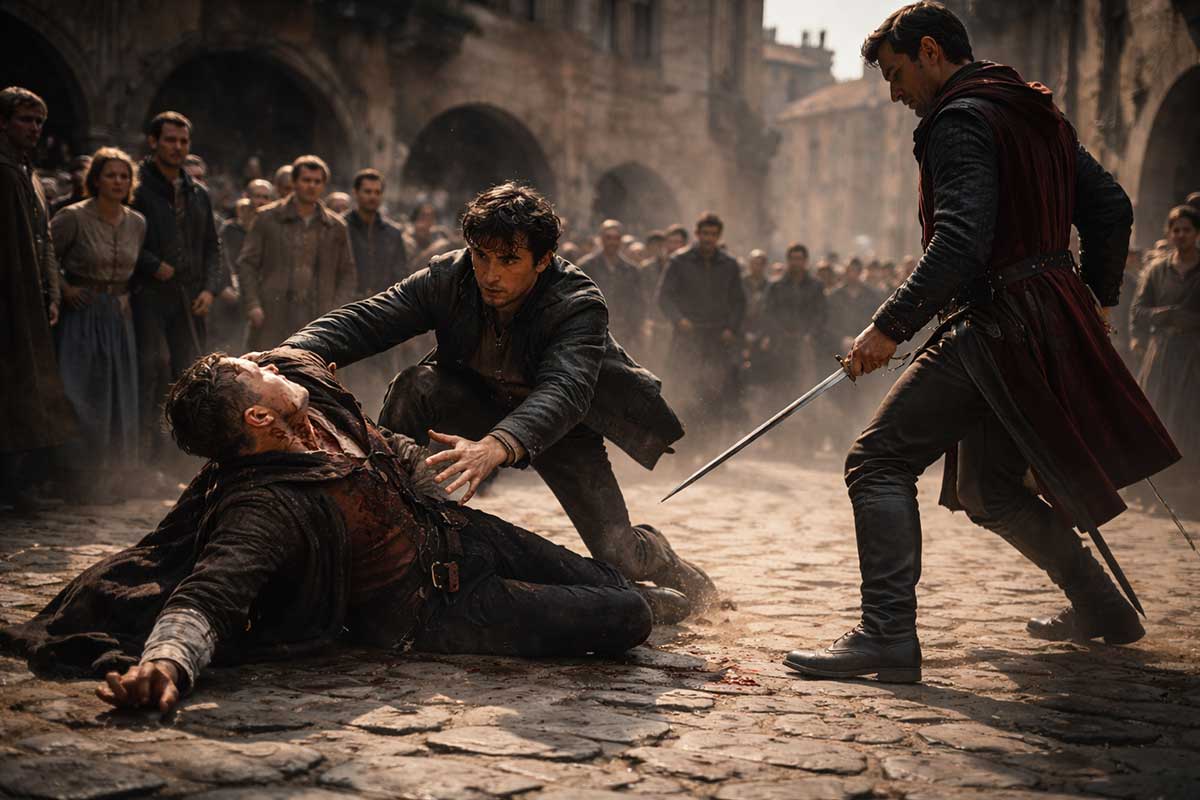
When the bodies lie still, the living ask only one thing:
Who did this?
They search for a villain because grief demands a shape. But tragedy is rarely generous enough to offer a single culprit. In Romeo and Juliet, blame scatters — across people, customs, decisions, and silences.
Let us gather those fragments and ask whether this catastrophe belongs to a person… or to a world.
First Question (woven naturally)
Who bears the greatest responsibility for Romeo and Juliet’s deaths?
Terry Eagleton
The feud is the primary agent. Individual actions matter, but they unfold inside a structure already rigged for violence. The lovers do not create the conditions of their destruction — they inherit them.
Raymond Williams
Exactly. Shakespeare is diagnosing a culture, not prosecuting a person. The tragedy emerges from how social values — honor, masculinity, obedience — organize behavior. Blame belongs to a pattern, not a single hand.
Richard Strier
Still, we must not absolve individuals entirely. Moral responsibility does not vanish under pressure. Romeo chooses revenge. Capulet chooses coercion. Friar Laurence chooses secrecy. Tragedy depends on ethical failure at multiple points.
Michael Neill
And identity intensifies blame. Each character acts in defense of who they think they must be — honorable man, obedient daughter, wise priest. Those identities become traps. Responsibility is distributed, not diluted.
William Shakespeare
So guilt is shared — but not erased.
Second Question
Is Friar Laurence a moral guide or a reckless enabler?
Andrew Hadfield
The Friar represents institutional optimism. He believes systems can be healed through symbolic acts — marriage, reconciliation, patience. His error is not malice but overconfidence in fragile plans.
Richard Strier
Yet ethical caution is part of wisdom. The Friar repeatedly chooses secrecy over transparency. Each choice compounds risk. Good intentions do not negate responsibility for foreseeable harm.
Terry Eagleton
We should also see him as constrained. He operates beneath patriarchal authority and violent families. His options are limited. That doesn’t excuse him — but it explains why improvisation replaces governance.
Michael Neill
The Friar is tragically modern. He tries to manage disaster rather than challenge its root causes. His plans are clever, not courageous.
William Shakespeare
Yes. He treats the wound — not the disease.
Third Question
Why does peace only arrive after Romeo and Juliet are dead?
Raymond Williams
Because societies often respond to loss more than reason. The feud ends not through persuasion, but through exhaustion. Death becomes the only language left.
Andrew Hadfield
Public tragedy forces private change. The families need spectacle — undeniable proof — before relinquishing pride. Shakespeare exposes the cruelty of that requirement.
Terry Eagleton
This is the bleakest insight of the play. Reform arrives too late to save the innocent. Systems change only when their costs become unbearable — and the cost is paid by those with the least power.
Richard Strier
Which raises a devastating moral truth: recognition without prevention is not virtue. It is regret.
William Shakespeare
Peace that requires sacrifice is not peace — it is aftermath.
Closing Reflection — William Shakespeare
If you wish to blame Romeo and Juliet, you may.
But then you must also blame the streets that trained boys to duel, the fathers who valued obedience over understanding, the laws that punished violence without healing its cause, and the adults who mistook control for care.
This tragedy does not ask who is guilty.
It asks why guilt is always assigned after the damage is done.
When love must die to teach restraint, the lesson is already corrupted.
Topic 4 — Youth vs Authority: Why Can’t the Young Speak Safely?
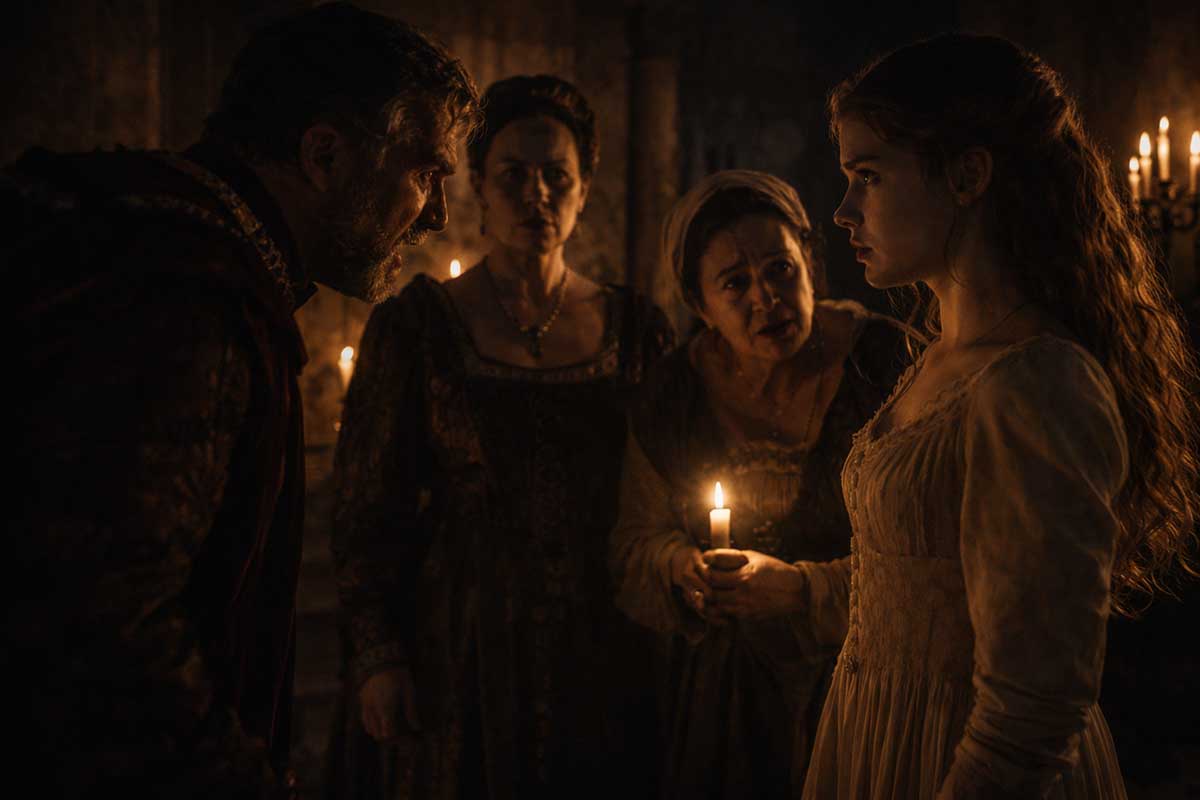
Main Introduction — William Shakespeare
In Verona, the young do not lack words.
They lack permission.
Romeo and Juliet are not silent because they have nothing to say. They are silent because truth, spoken upward, is punished. Parents command. Princes decree. Elders decide. The young adapt — or disappear.
Let us ask why honesty is so dangerous in this world, and why authority hears disobedience where it might have heard need.
First Question (woven naturally)
Why can’t Romeo and Juliet simply tell the truth to their parents?
Catherine Belsey
Because authority in this play is not dialogic. It does not listen; it demands affirmation. Truth that contradicts expectation is read as rebellion. Silence becomes a survival strategy.
Coppélia Kahn
For Juliet especially, obedience is gendered. Her value is tied to compliance. Speaking her truth threatens the structure that defines her worth. The danger is not emotional — it is structural.
Ania Loomba
We should see this as a system of control. Families function like micro-states. Children are subjects, not citizens. Romeo and Juliet don’t lack courage; they lack jurisdiction.
Elaine Showalter
And silence is not passivity. Juliet’s quiet often masks strategic thinking. She learns quickly that direct resistance invites violence, so she chooses performance over confrontation.
William Shakespeare
Yes. In this world, honesty is not rewarded — it is exposed.
Second Question
Is Juliet’s obedience genuine, or is it a form of strategy?
Lynda Boose
Juliet’s obedience is conditional. She performs submission when authority becomes coercive. This is not weakness; it is adaptive intelligence within a patriarchal system.
Coppélia Kahn
Her transformation is remarkable. She moves from asking permission to making decisions that risk death. Obedience becomes a mask — a way to buy time.
Elaine Showalter
Importantly, Juliet is punished not for disobedience, but for autonomy. The moment she refuses the marriage to Paris, authority escalates from persuasion to threat.
Ania Loomba
This is why secrecy becomes necessary. When systems refuse consent, resistance goes underground. Juliet’s silence is a political act.
William Shakespeare
She does not grow quieter — she grows more precise.
Third Question
Are the adults actually more childish than the young?
Catherine Belsey
Absolutely. The adults are governed by pride, image, and ritualized hostility. The young, by contrast, attempt empathy and mutual recognition.
Elaine Showalter
The street brawls are a crucial signal. Adult masculinity behaves impulsively, publicly, and destructively — while calling youthful emotion “immature.”
Ania Loomba
Authority mistakes control for wisdom. It enforces obedience without introspection. Shakespeare exposes how power infantilizes itself while blaming youth for chaos.
Lynda Boose
Parents in this play cannot imagine being wrong — only being defied. That rigidity makes honest dialogue impossible.
William Shakespeare
Yes. The children must grow up quickly because the adults refuse to.
Closing Reflection — William Shakespeare
Romeo and Juliet do not die because they are too young to speak.
They die because the world they inherit cannot hear.
Authority that demands obedience but denies listening creates secrecy. Secrecy breeds haste. Haste breeds catastrophe. And then the same authority mourns what it never allowed to live.
If you hear echoes of this beyond Verona, that is no accident.
I wrote not of children who failed to obey —
but of adults who failed to care.
Topic 5 — Love vs Obsession: Is This Romance or Emotional Absolutism?

Main Introduction — William Shakespeare
Many call this play a romance.
I do not object — but I insist on precision.
Love can liberate, but it can also consume. The difference lies not in intensity, but in whether love allows the self — and the other — to remain whole.
So let us ask whether Romeo and Juliet love each other — or whether love itself becomes something that refuses limits.
First Question (woven naturally)
Is Romeo truly in love — or simply in love with love?
Stanley Cavell
Romeo begins in self-absorption. His love for Rosaline is theatrical — more about suffering than relationship. But with Juliet, something shifts. Love becomes dialogic. They recognize each other, not just their own longing.
Janet Adelman
Yes, Romeo matures rapidly. The language he shares with Juliet is balanced and reciprocal. This is not obsession speaking alone — it is mutual acknowledgment.
Gail Kern Paster
However, Romeo still experiences emotion as total. Once Juliet becomes his world, loss becomes annihilation. That absolutism is psychologically dangerous, even if the love itself is sincere.
William Shakespeare
So love grows — but it grows without guardrails.
Second Question
Who is more grounded in the relationship — Romeo or Juliet?
Carol Thomas Neely
Juliet. Consistently. She anticipates consequences, worries about pace, and adapts her language to danger. Her courage is measured, not impulsive.
Patricia Parker
Juliet’s speech is pragmatic. Even in passion, she thinks structurally. Romeo’s language collapses toward extremes — life or death, heaven or despair.
Stanley Cavell
This does not make Romeo false — only vulnerable. Juliet learns to negotiate reality. Romeo refuses negotiation entirely once love becomes identity.
William Shakespeare
She survives longer because she knows when silence protects and when speech endangers.
Third Question
Does the play celebrate love — or warn us about it?
Janet Adelman
It does both. Shakespeare honors the authenticity of their bond while refusing to romanticize its consequences. Love is not condemned — absolutism is.
Gail Kern Paster
The danger lies in collapsing the self entirely into the beloved. When love becomes the sole source of meaning, loss becomes unbearable.
Carol Thomas Neely
Importantly, the play critiques the conditions that force love into secrecy and extremity. Obsession is not born in a vacuum; it is shaped by repression.
William Shakespeare
Love does not destroy them.
A world that leaves love no room to breathe does.
Closing Reflection — William Shakespeare
I did not write Romeo and Juliet to warn you away from love.
I wrote it to warn you what happens when love must carry the weight of everything else — safety, identity, escape, salvation.
Love should deepen life, not replace it.
When love becomes the only refuge, it becomes too fragile to survive the storm.
Romeo and Juliet did not love wrongly.
They loved alone — and that solitude was fatal.
Final Thoughts by William Shakespeare
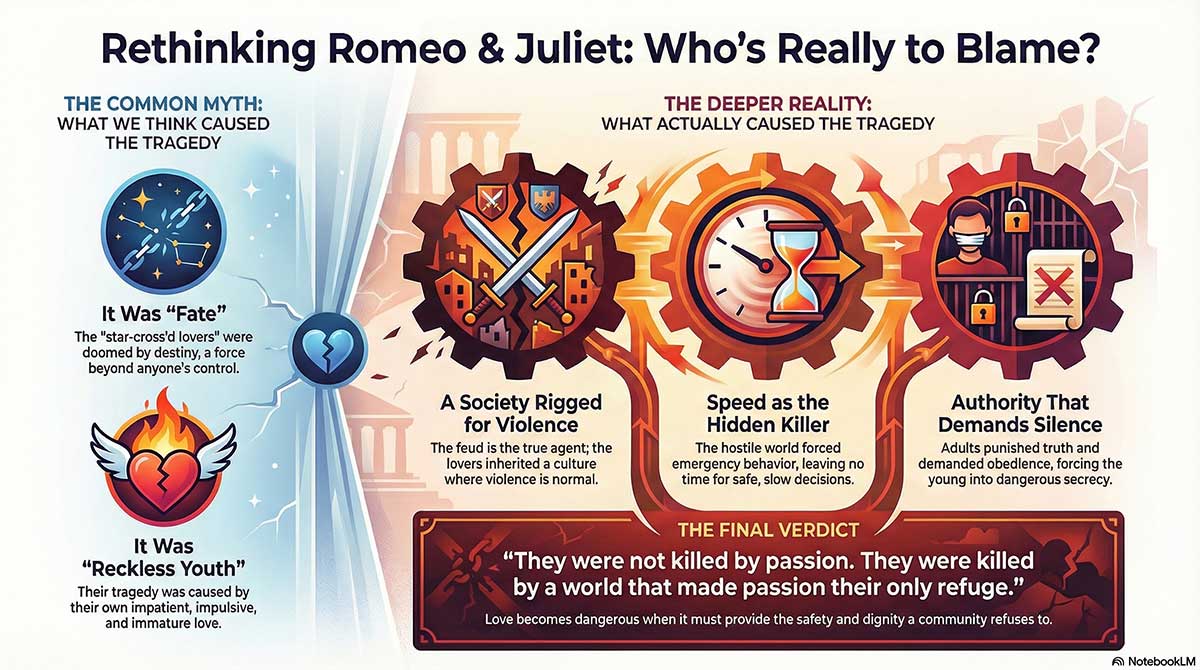
If you wish, you may leave this story calling it “the greatest love story.” Many do. But if that is all you take, you will leave with a rose and ignore the thorns that cut it.
This play is not only about love. It is about what a society does to love when pride becomes law.
Look carefully at the pattern: whenever Romeo and Juliet attempt to speak plainly, the world answers with force. When they try to love openly, the world demands they love in secret. When they seek time, the world accelerates. When they seek counsel, the adults offer control. And when their choices narrow to a corridor with no exits, the world watches their final act and calls it “tragic,” as if tragedy were a weather event rather than a human design.
What breaks my heart, even now, is not merely that they die. It is that their deaths are used as a lesson only after the lesson becomes useless. The families reconcile when there is nothing left to save. The city discovers restraint when restraint arrives too late. Peace is declared over bodies—as if peace were something you could build from ash and call it mercy.
And yet—do not despair in the wrong direction. The point is not that love is dangerous. The point is that love becomes dangerous when it is forced to carry what community refuses to provide: safety, belonging, dignity, a future. Romeo and Juliet pour everything into each other because everything else is poisoned. Their love is not the problem; it is the evidence.
If you want a single sentence to hold in your hand, let it be this:
They were not killed by passion. They were killed by a world that made passion their only refuge.
So the question for modern readers is not, “Would you have loved like them?”
The harder question is, “What would you change so no one has to love like that again?”
Because if a city teaches its children to fight, it will eventually bury them.
If a home treats truth as disobedience, it will eventually breed secrecy.
If adults confuse authority with wisdom, the young will learn to survive through masks.
And when the masks finally break, the adults will call it fate.
Do not call it fate too quickly.
Call it what it is: a pattern we can recognize, and therefore a pattern we can interrupt.
That is the real invitation hidden inside Romeo and Juliet Explained—not merely to understand the play, but to understand the world that keeps rewriting it.
Short Bios:
William Shakespeare — English dramatist and poet whose tragedies explore how love, power, and social systems collide; Romeo and Juliet remains one of his most enduring examinations of youth and fate.
Stephen Greenblatt — Leading Shakespeare scholar and founder of New Historicism, known for reading Shakespeare’s plays as products of social pressure, power, and cultural constraint.
Frank Kermode — Influential critic of narrative and tragedy who emphasized how endings and foreknowledge shape meaning and moral attention in literature.
Northrop Frye — Canadian critic famous for identifying recurring mythic and tragic patterns that structure stories across cultures, including Shakespearean drama.
Emma Smith — Oxford professor and public-facing Shakespeare scholar noted for making complex interpretations accessible to modern readers and audiences.
Jan Kott — Polish critic whose modern, existential readings of Shakespeare highlight political violence, systems of power, and historical repetition.
David Scott Kastan — Scholar of Shakespeare and early modern drama focusing on time, authority, and how texts change meaning across historical moments.
Marjorie Garber — Harvard professor known for psychologically rich and culturally resonant interpretations of Shakespeare’s characters and themes.
Jonathan Dollimore — Critic whose work emphasizes subversion, ideology, and how Shakespeare interrogates social and political norms.
Simon Palfrey — Shakespeare scholar focused on performance, tragic pacing, and how urgency and uncertainty shape audience experience.
Harold Bloom — Renowned critic who emphasized character psychology and the inwardness of Shakespeare’s figures, especially in love and tragedy.
Terry Eagleton — Cultural theorist whose Marxist readings examine class, power, and ideology within literary tragedy.
Raymond Williams — Influential thinker who explored how literature reflects social structures, generational conflict, and cultural change.
Richard Strier — Scholar of Renaissance ethics concerned with moral responsibility, choice, and conscience in early modern texts.
Michael Neill — Critic specializing in identity, violence, and responsibility in Shakespearean tragedy.
Andrew Hadfield — Historian and literary scholar examining Shakespeare in relation to political authority, law, and power.
Catherine Belsey — Theorist whose work investigates language, power, and how ideology shapes meaning in literature.
Coppélia Kahn — Scholar known for feminist readings of Shakespeare, especially masculinity, patriarchy, and family structures.
Elaine Showalter — Pioneering feminist critic who explored gender, psychology, and voice in literary traditions.
Ania Loomba — Scholar whose work connects Shakespeare to issues of power, empire, race, and authority.
Lynda Boose — Critic focused on family dynamics, obedience, and patriarchy in Renaissance drama.
Stanley Cavell — Philosopher who examined skepticism, love, and acknowledgment in literature, including Shakespeare’s romances and tragedies.
Janet Adelman — Influential Shakespearean critic known for psychologically nuanced readings of gender, desire, and identity.
Gail Kern Paster — Scholar specializing in early modern emotion, bodily theory, and psychological states in Shakespeare’s plays.
Carol Thomas Neely — Critic whose work bridges literature and psychology, especially on madness, gender, and emotional expression.
Patricia Parker — Shakespeare scholar known for close readings of language, rhetoric, and narrative structure.
Leave a Reply