

|
Getting your Trinity Audio player ready...
|
Coleman Barks:
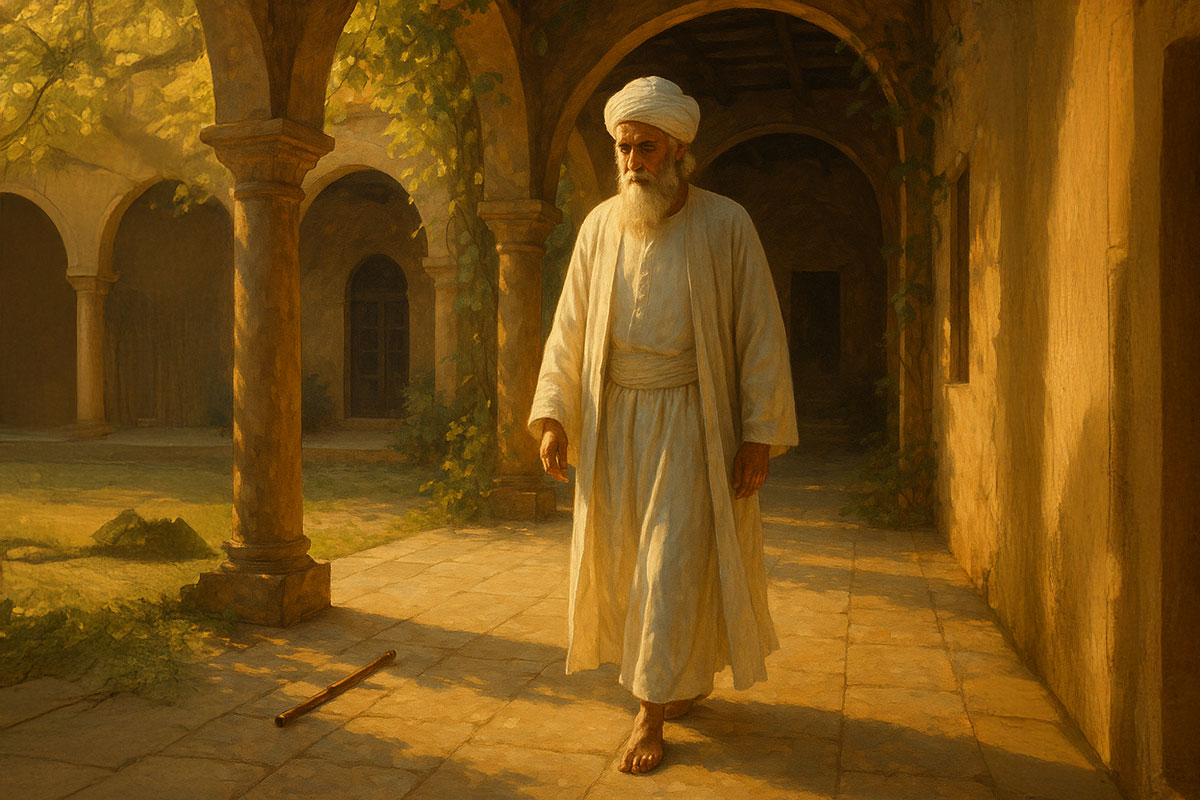
When you walk with Rumi, you do not walk in a straight line. The path curves through gardens, dips into marketplaces, turns unexpectedly into silence, and opens suddenly into light. These are not mere detours — they are the way.
This series is a set of windows into moments I imagine we might have shared if I could have been his friend. Not the public Rumi of anthologies, but the Rumi whose robe hem caught in the dust of Konya streets, whose reed flute lay silent when the heart ached, whose whirling began in solitude before anyone else knew it was a prayer.
In these chapters, you will meet him in his marketplaces and courtyards, beside fountains that run dry, in gardens fragrant with jasmine, and in the dance of dawn itself. Each scene is an invitation — not to observe from a distance, but to stand beside him, breathing the same air, feeling the same turning toward the Beloved.
Rumi’s words are not meant to be read once and put away. They are seeds. Sometimes they bloom in the moment; sometimes they wait for years before breaking through the soil of your life. My hope is that walking through these stories, you’ll find one or two that lodge quietly in your pocket, ready to open when the wind is right.
(Note: This is an imaginary conversation, a creative exploration of an idea, and not a real speech or event.)

Chapter 1: The Market of Konya
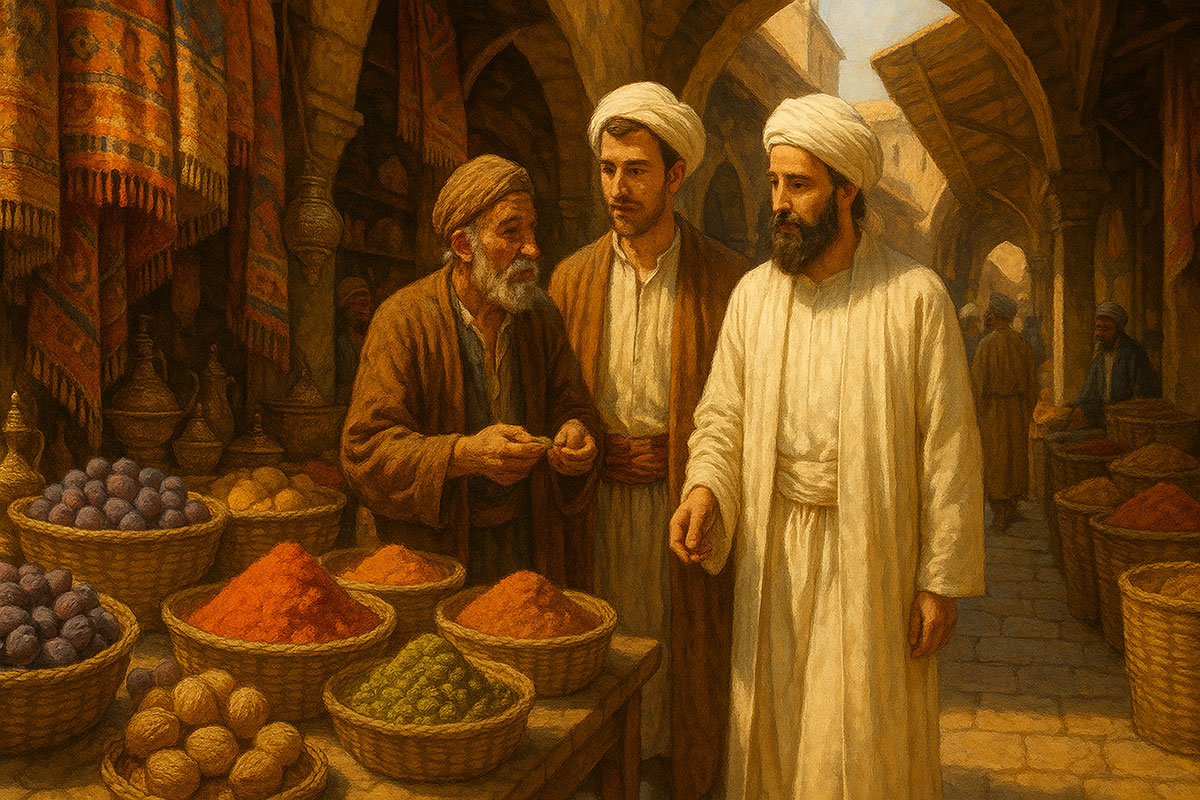
The market was alive that morning, a tide of voices and color swelling through Konya’s narrow streets. Carpets hung like captured sunsets from wooden beams; baskets of figs and pomegranates spilled sweetness into the air. Brass lamps caught the sun, each one holding a fragment of the day’s light.
Rumi walked beside me, his scholar’s robe brushing against my arm. He had spent the early hours teaching at the madrasa, the questions of students still echoing faintly in his mind. His eyes, though, wandered to the merchants, to the children weaving between stalls, to the way sunlight pooled on the stones.
“Books tell me of God,” he said softly, “but here, I feel Him moving in the folds of a carpet, in the calloused hands that weigh out almonds.”
We stopped by a spice-seller’s stall, where saffron glowed like captured dawn and cinnamon bark curled like ancient script. The old merchant, his beard as white as almond blossom, pressed a pinch of cardamom into Rumi’s palm.
“For warmth,” the man said.
Rumi inhaled deeply, his eyes closing for a breath. “It is like the prayer after prayer,” he murmured.
As we walked on, he paused to watch a boy shaping dough into flat rounds, his small hands moving with the surety of someone who has learned by doing, not by studying. “How is it,” Rumi asked me, “that the heart grows restless when it is confined to ink and parchment? I love my books, yet there are mornings when the smell of bread teaches me more than any page.”
I smiled. “Perhaps because the page is only the echo, and life is the voice.”
A gust of wind lifted the edge of his robe, carrying with it the faint strains of a reed flute from somewhere deeper in the market. He turned toward the sound as if it were calling him by name. For a moment, he stood still, listening, the noise of the market blurring into a single hum around us.
“There is a song beneath all this,” he said at last. “A single thread tying bread to prayer, coin to kindness, market to mosque. One day, I must follow it.”
We left the market as the noon call to prayer rose over the rooftops. In his hand, Rumi still held the cardamom pod, turning it between his fingers as though it were a key to some hidden door.
Later that night, I saw him writing. The scent of cardamom lingered in the room, and I knew the market had found its way into his verses.
Chapter 2: When the Stranger Came
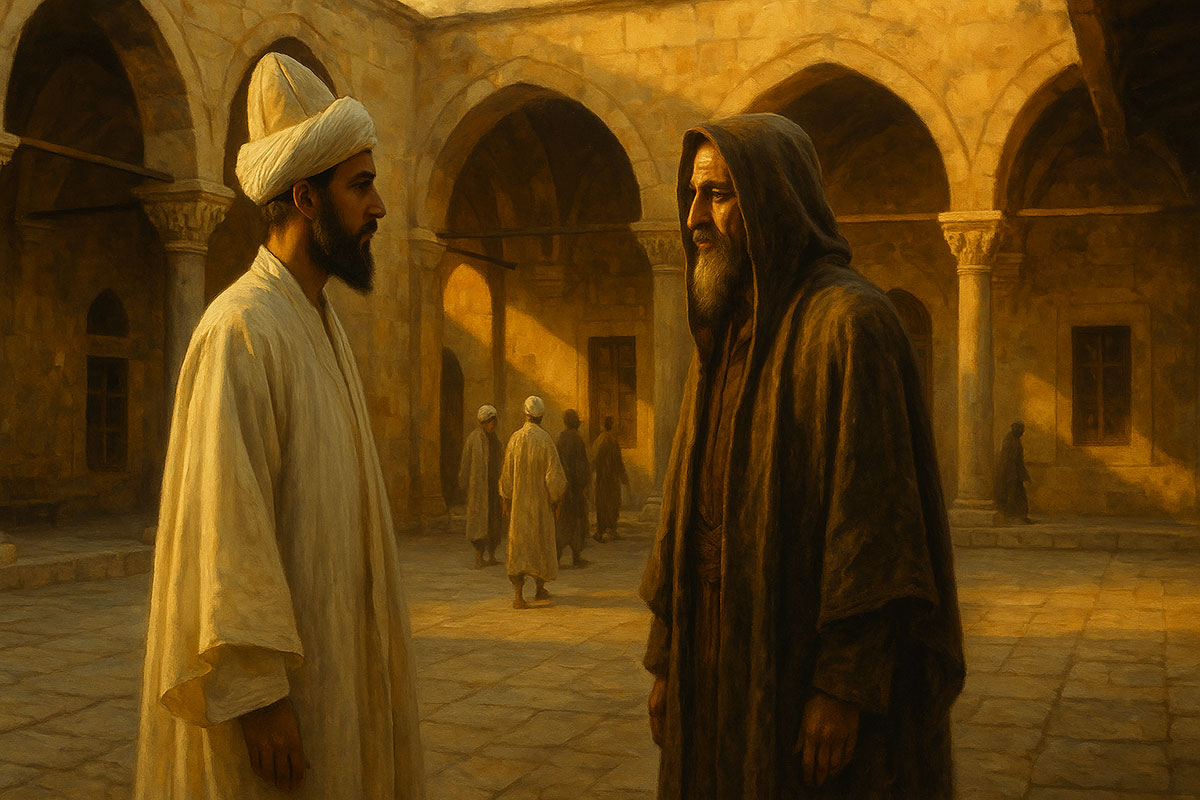
It was late afternoon when the stranger arrived. The streets of Konya glowed with the last embers of sunlight, dust rising like incense in the stillness. I was in the madrasa courtyard, speaking with Rumi’s students, when I saw him — a tall man in a worn traveler’s cloak, his eyes carrying something that seemed to cut through the ordinary world like a blade through silk.
He walked as one who belonged everywhere and nowhere. His name, I would learn later, was Shams of Tabriz.
Rumi emerged from the study hall, his hands still dusted with chalk from the morning’s lessons. I had never seen him hesitate before meeting a stranger, but that day, something in him paused. It was as if two currents of the same river had unexpectedly converged.
Shams looked directly into Rumi’s eyes. He did not bow, nor offer the usual courtesies. Instead, he asked, “Who is greater — Muhammad or Bayazid?”
The question was a spark in dry grass. Around them, the students murmured in confusion, some frowning, others intrigued. But Rumi’s gaze held fast.
“What do you mean?” he asked.
Shams stepped closer. “One said, ‘I do not know You as You deserve to be known.’ The other said, ‘Glory be to me.’ Which is greater humility?”
I saw the answer arrive in Rumi’s mind before he spoke it. “The one who knew his limits.”
Shams smiled then, not in triumph, but in recognition — as if he had found a long-lost companion on a road neither knew they were traveling together.
They spoke for hours in the courtyard, the students drifting away until only I remained. The conversation ranged from scripture to silence, from the shape of the stars to the scent of bread baking in the street below. At times it felt less like dialogue and more like music, each voice an instrument in some hidden composition.
As twilight deepened, Rumi’s son came to call him home. He barely noticed. The air between him and Shams was charged with something rare — not the admiration of a student for a teacher, nor the camaraderie of equals, but the beginning of a transformation neither could yet name.
When we finally walked back through the city streets, I asked Rumi what he thought of the stranger.
“He is not a stranger,” Rumi said quietly. “He is the question I have been asking all my life.”
That night, he did not touch his books. Instead, he sat by the lamp, his gaze fixed not on the flame, but on something only he could see.
I did not know then how this meeting would alter the shape of his days — or how much it would cost him. But I knew, with the certainty one feels at the turning of a season, that a new chapter in his soul had begun.
Chapter 3: The Silence After Shams
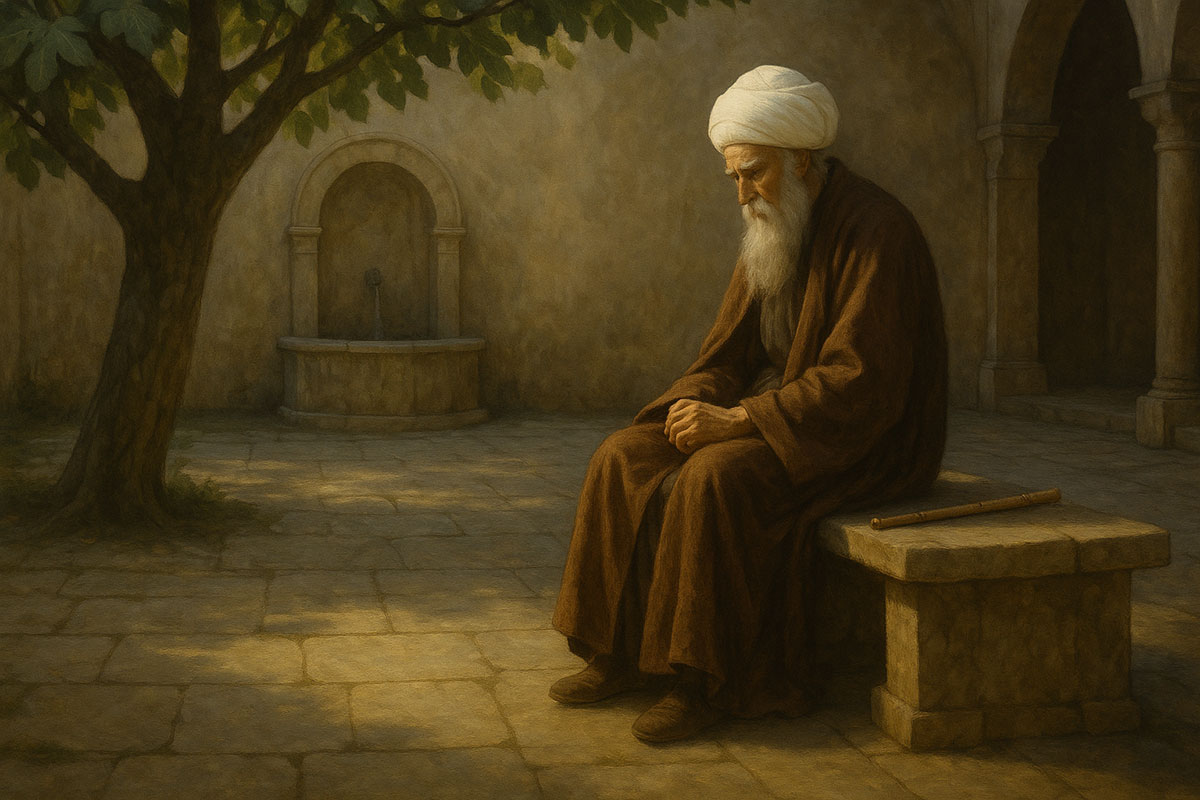
The fountain in the courtyard had run dry that morning. Without the water’s murmur, the air felt strangely hollow, as though the world itself had forgotten how to speak.
Rumi sat beneath the fig tree, his robe drawn close around him despite the spring warmth. Days had passed since Shams was last seen in Konya. Some said he had left quietly; others whispered darker possibilities. I knew better than to press him for truth — the absence in his eyes told me all I needed to know.
He did not write, did not teach, did not visit the market. The reed flute, which once sang in the evenings, lay untouched beside his desk. He ate little, and when he did, it was without noticing the taste.
I sat beside him on the stone bench, the courtyard shadows shifting slowly with the sun. “It’s not the end,” I said gently.
His voice was barely more than breath. “Then why does the world sound like it has stopped turning?”
I searched for the right answer but found none. The silence between us was not empty; it was heavy, like the air before a storm.
One afternoon, I found him in his study, staring at a blank page. His pen rested in his hand, unmoving. “The words will not come,” he whispered when he noticed me. “Without him, the river is dry.”
I picked up the reed flute and set it on the desk before him. “The river may be dry, but the bed still remembers the water,” I said.
He looked at the flute for a long time. Then, slowly, he lifted it. The first note was fragile, uncertain. The second carried more breath. By the third, the sound deepened, gathering a tremor that was neither entirely sorrow nor entirely longing.
The melody that emerged was unlike anything I had heard from him before. It was the sound of someone calling into the dark, not expecting an answer, yet unable to stop. As he played, tears slid down his cheeks, silent as the notes themselves.
When he set the flute down, he reached for the pen. The first line he wrote was jagged, the ink blotting at the edge of each word. But as the page filled, the script steadied. What began as grief on the paper turned into a kind of prayer, each line a thread tying him, however tenuously, to something beyond his loss.
That night, he did not speak of Shams, but I felt him in every word Rumi wrote. The absence was no less, but it had begun to take shape — not as a void, but as a doorway.
And though the fountain in the courtyard remained dry for weeks, its echo had returned in another form.
Chapter 4: The Whirl of the Heart
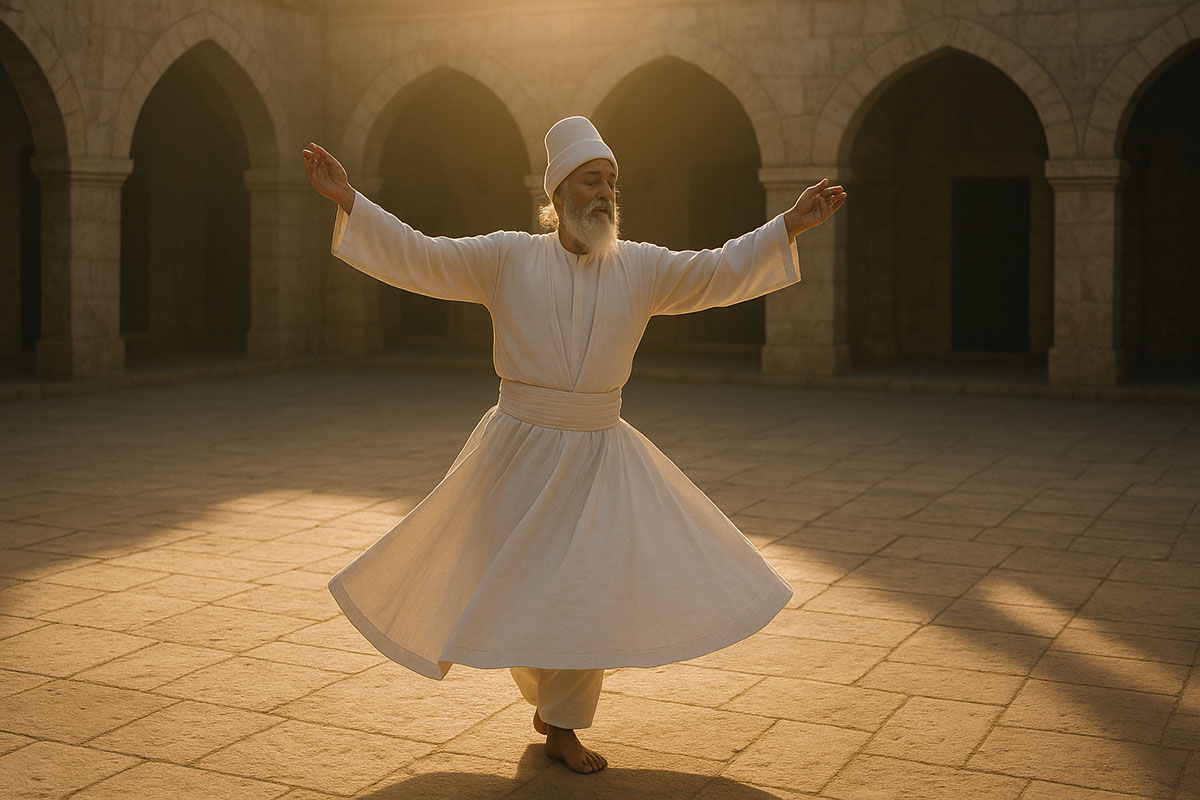
It began in the quiet hours before dawn, when the sky still held the last embers of night. I found Rumi in the courtyard, barefoot, his robe brushing the flagstones. At first, I thought he was pacing in prayer, but then I saw the movement — slow, deliberate, and circular.
He turned, his right foot grounding him, his left carrying him around in an unbroken arc. His arms opened slightly, palms lifted to the air. His eyes were closed, but his face was alight, as if following music only he could hear.
I had heard of the sema — the whirling dance of the dervishes — but never seen Rumi enter it. This was not performance. This was prayer taking shape in the body.
As the light in the courtyard shifted from silver to pale gold, the pace of his spinning grew. Not hurried, never frantic — just steady, each turn drawing him deeper inward. His robe flared slightly at the hem, the fabric whispering against the stone. The air seemed to hum with a rhythm beyond sight or sound.
I stepped closer, careful not to break the thread that held him. In his presence, I began to sense the pull of the circle, as though the earth itself turned more clearly in this small space.
After a time, the turning slowed. He stopped, arms folding over his chest, his breathing deep and even. Opening his eyes, he smiled in that quiet way he did when joy came without reason.
“You’ve never done this before,” I said.
He nodded. “I have been writing for years, trying to make the words dance. But today I understood — the body must turn with the soul, or the song is incomplete.”
We walked to the shade of the fig tree, where a jug of water waited. As he drank, I asked, “And what did you see while you turned?”
“Nothing that the eye can draw,” he said. “But I felt the center. The place where Shams stands, and where I stand, and where all things stand, without being apart from one another.”
Later that day, the students gathered, curious about the whispers they’d heard. Rumi spoke to them not of steps or technique, but of surrender — how to let the heart’s own orbit pull you without resistance.
That evening, I saw him write in a new way. The verses came like the turning: steady, unforced, each line a rotation around an invisible sun.
It was then I understood — Shams had opened the door, but Rumi was learning to walk its inner corridors himself. And in the whirl of his heart, he had found a path back to joy without losing the shape of his longing.
Chapter 5: The Garden at the End

The autumn light was softer now, as if the sun itself had grown older and learned to speak more gently. Rumi walked with me into the garden behind his home, the roses still in bloom though the season’s breath had begun to cool the air. Their petals, deep crimson and pale gold, bent under the weight of dew that had yet to vanish.
He moved slowly, not from frailty but from savoring. Each step was deliberate, as though the gravel path were an unrolled manuscript he meant to read word by word.
“Do you hear it?” he asked, pausing beside the fountain.
I tilted my head, catching only the faint trickle of water. “Hear what?”
“The reunion,” he said with a small smile. “It’s in everything now — the wind in the trees, the hum in my chest. I think the Beloved is preparing to call me home.”
We sat on a stone bench beneath an arch of climbing jasmine. The scent was heavy in the air, a fragrance that seemed to slow time itself. His hands rested loosely on his knees, and for a long moment, we simply breathed together.
“I used to think,” he began, “that my poems were the message I came here to deliver. But they were only the trail of my footprints. The message is the walk itself — the loving, the losing, the returning.”
A few petals drifted down from above, one landing on the page of the notebook he had brought with him. He opened it and began to write, his hand steady, the ink flowing as if it had been waiting for this moment.
“What are you writing?” I asked.
“The ending,” he said, without looking up. “Not of the Masnavi — endings are for books. This is the ending of my listening.”
When he read it aloud, the words were like sunlight passing through leaves:
When the soul leaves the cage,
do not say it is gone.
Say instead: the bird has remembered the sky.
We stayed in the garden until the horizon drank the last of the day’s light. The sky shifted from rose to violet, the first stars trembling awake. Rumi closed his notebook and handed it to me.
“Keep it,” he said. “You have been the keeper of my silences as much as my words.”
I took it, unable to speak. In the stillness, I realized this was not a farewell soaked in sorrow. It was a meeting at the edge of two worlds, and he was already leaning toward the other with joy.
As we walked back through the garden gate, the night air carried the faintest strains of a reed flute. I could not tell if it came from the street beyond or from somewhere far deeper, but Rumi heard it too. He smiled without turning his head.
“The Beloved is near,” he whispered.
And for the first time, I understood he had always been near.
Final Thoughts By Coleman Barks
When I imagine Rumi’s last days, I do not see an ending — I see a door. He once said, “Don’t grieve. Anything you lose comes round in another form.” Death, for him, was not loss but a homecoming.
These chapters began in the marketplace, where the scent of cardamom first stirred a hunger deeper than bread. They passed through the lightning-strike meeting with Shams, the long nights of silence, the spinning prayer of the sema, and the garden where the air trembled with reunion. In each, Rumi’s friendship — with Shams, with the world, with the Beloved — was not a possession to be held, but a current to be entered.
If there is one thing I hope stays with you after closing this final page, it is the sense that Rumi’s voice is not trapped in the past. It is here. In the hum beneath your daily noise, in the small, unplanned moments when your heart leans forward to listen.
Walk with him as far as you can. And when you feel you’ve reached the end, keep going — that is where the real conversation begins.
Short Bios:
Rumi (Jalāl ad-Dīn Muhammad Rūmī) – 13th-century Persian poet, Islamic scholar, and Sufi mystic whose works, including the Masnavi and Divan-e Shams, explore divine love, spiritual transformation, and the unity of all existence. His poetry has influenced cultures worldwide and remains one of the most widely read today.
Shams of Tabriz – Wandering dervish and spiritual teacher whose deep, transformative friendship with Rumi ignited the poet’s most prolific period of mystical writing. Known for his fearless questions and unorthodox methods, Shams remains a figure of mystery and inspiration.
Coleman Barks – American poet and translator who introduced Rumi’s poetry to a wide English-speaking audience through free verse interpretations. His work has helped make Rumi one of the best-selling poets in the United States and beyond.
Leave a Reply