
|
Getting your Trinity Audio player ready...
|
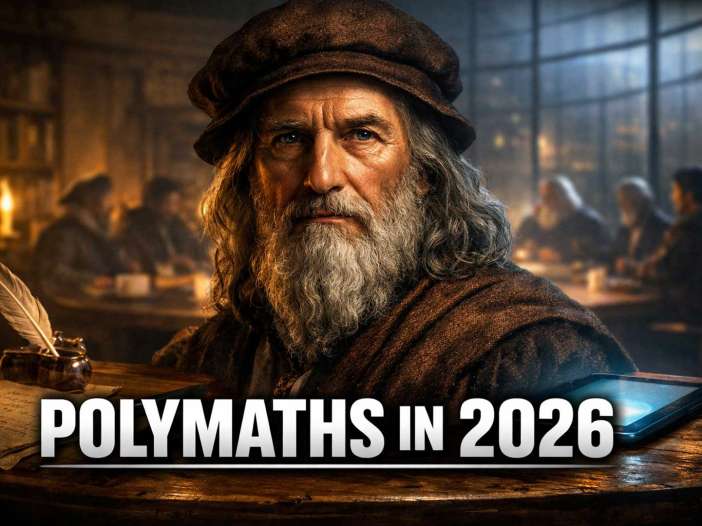
What if the world’s greatest polymaths debated today’s biggest crises together?
Introduction by Nick Sasaki
What happens when the greatest polymaths in history are invited to confront the year 2026?
This series imagines a gathering of minds who never accepted narrow boundaries between disciplines. Leonardo da Vinci, Aristotle, Ada Lovelace, Benjamin Franklin, Humboldt, Newton, and others are brought into conversation not as relics of the past, but as living intelligences asked to face our most urgent questions.
Artificial intelligence now rivals human output. Truth itself feels unstable in a world of perfect fakes. Energy choices shape the fate of civilization. Work no longer guarantees dignity. Meaning feels harder to name, even as technology accelerates.
Rather than asking what these thinkers would predict, this series asks something more important:
How would they reason?
Each conversation explores not answers, but standards. What counts as understanding rather than imitation. What makes trust possible when appearances deceive. Whether breadth still has value in an age of machines. How societies choose constraints that preserve dignity. And what a human life is ultimately for when productivity is no longer its center.
These are not debates about the future alone. They are examinations of the kind of intelligence, character, and responsibility required to remain human when tools grow powerful.
This is not nostalgia.
It is a test of wisdom.
(Note: This is an imaginary conversation, a creative exploration of an idea, and not a real speech or event.)
Topic 1: The Age of AI and the Meaning of Human Genius

Moderator:
Gottfried Wilhelm Leibniz
Guests:
Ada Lovelace, Leonardo da Vinci, Isaac Newton, Aristotle, Benjamin Franklin
The room feels impossible, like a library that has absorbed a workshop, a courtroom, and an observatory. Shelves climb into shadow. A quill rests beside a circuit board. Brass instruments lie next to a thin glass slab glowing with quiet text.
At the center stands Leibniz, calm, composed, as if convinced that even this moment can be reduced to clarity.
“Friends,” he says, “we stand in an age where machines appear to think. So we must ask a question sharper than fear or awe. If artificial intelligence can outperform humans in many domains, what then becomes the highest form of human intelligence?”
He gestures gently, inviting the first round.
Round 1
Ada Lovelace
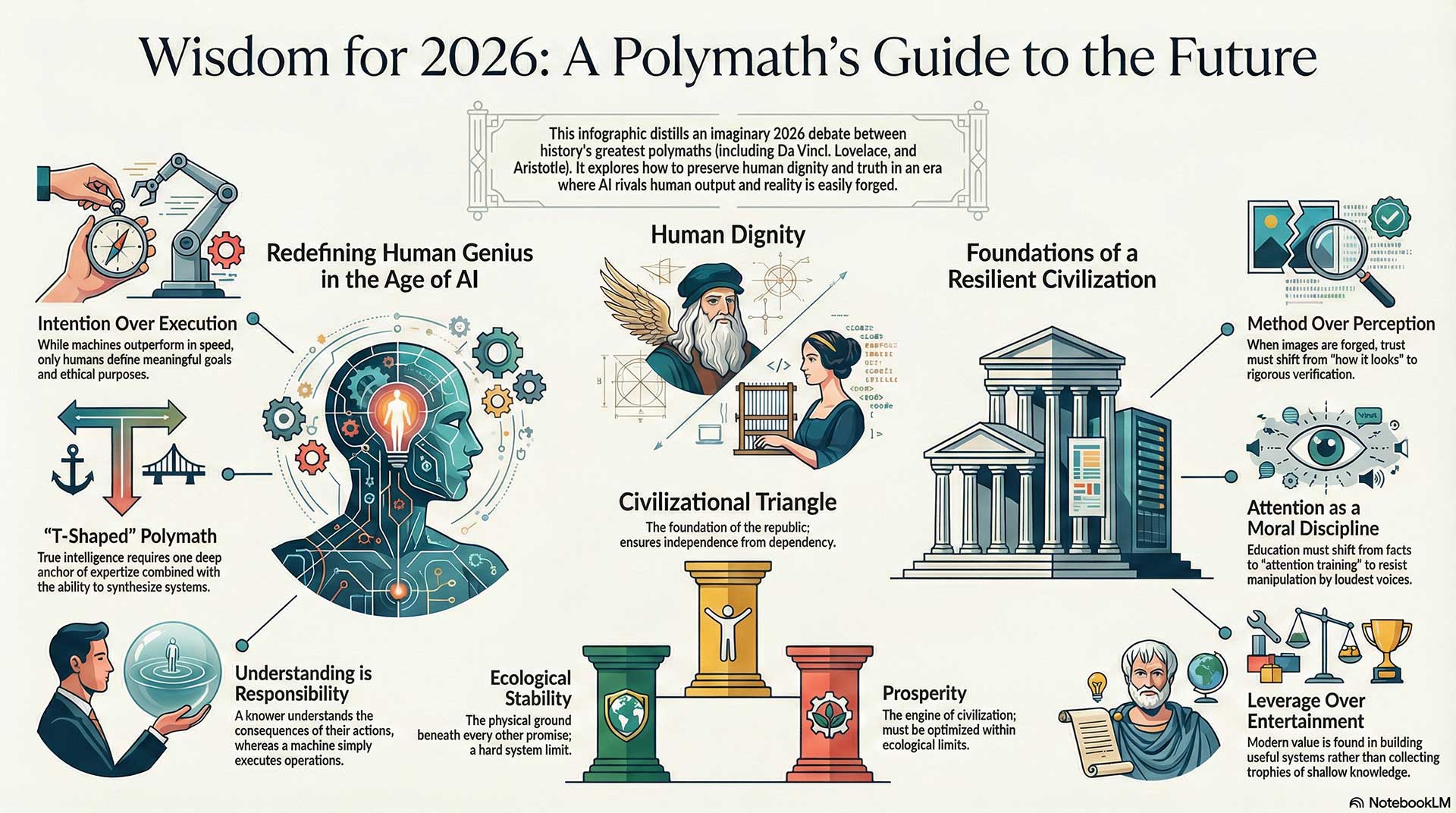
“We must not be enchanted by performance alone. A machine may execute operations with astonishing speed, yet it does not originate intention. It does not choose its purpose. The highest human intelligence is the ability to define meaningful aims and then shape methods toward them. If a machine composes endless music, the human question becomes which music matters, and why. That judgment belongs not to calculation, but to interpretation, grounded in values.”
Leonardo da Vinci
“I recognize this illusion. When I drew the muscles of the arm, some mistook the drawing for the arm itself. These machines generate maps of language, images, patterns. But the map is not the territory. The highest human intelligence is the eye that sees what is absent, what cannot be rendered. A machine may design a bridge that stands, but can it sense the bridge that belongs to a city’s spirit? Genius is not merely solving problems. It is perceiving meaning.”
Isaac Newton
“If an engine produces correct answers, it does not follow that it understands. Understanding is a relation between principles and phenomena that permits prediction, testing, and correction. The highest human intelligence remains the capacity to construct explanatory structures, to refine them, and to discard them when they fail. If AI provides a thousand hypotheses, the human task is to judge which are coherent, testable, and illuminating. Abundance of output is not insight.”
Aristotle
“We must ask what intelligence is for. It is not merely for knowing, but for living well. In an age where machines can imitate argument, the highest human intelligence becomes practical wisdom, the ability to deliberate well about what is good, just, and fitting. If AI can argue every side persuasively, then rhetoric loses its authority. The human must become more excellent in virtue, or else intelligence will serve ends it does not comprehend.”
Benjamin Franklin
“I have always admired useful tools, and I admired the printing press for the same reason. But I also saw how easily it spread folly. If AI can persuade at scale, then the highest human intelligence may be civic intelligence. The ability to build trust, norms, and habits that protect people from manipulation. Genius may no longer be solitary brilliance. It may be the capacity to keep a society grounded in reality.”
Leibniz inclines his head.
“You seem to agree that machines multiply means, but do not guarantee worthy ends. Let us press further.”
Round 2
Leibniz
“If machines increasingly produce results without understanding, should society reward output or comprehension, and how do we tell the difference?”
Leonardo da Vinci
“If we reward only output, we train ourselves to become servants of speed. Understanding reveals itself through coherence across domains. A mind that understands can translate an idea from anatomy to architecture, from music to mechanics. When outputs multiply but fail to harmonize, that is the mark of imitation, not intelligence.”
Isaac Newton
“Comprehension shows itself in compression. An explanation that unites many observations under few principles bears the sign of understanding. If AI produces results without such unification, then it is an instrument, not a knower. Society must learn to reward those who can reduce complexity into law, not merely generate effects.”
Ada Lovelace
“There is another test. Understanding carries responsibility. A human who understands knows the consequences of applying a method. A machine executes regardless. If we reward output alone, we remove accountability from intelligence itself. That is dangerous.”
Aristotle
“We distinguish by asking whether knowledge guides action toward the good. Understanding that cannot inform ethical choice is incomplete. If society rewards cleverness without wisdom, it will grow powerful and blind at the same time.”
Benjamin Franklin
“And practically speaking, people will chase whatever is rewarded. If we reward raw output, we will get floods of it. If we reward judgment, restraint, and reliability, we will get fewer things, but better ones. The future depends on which habit we encourage.”
Leibniz pauses, hands folded.
“Then perhaps the question is not whether machines think, but whether humans will remember what thinking is for.”
The glowing glass slab hums softly. No one looks at it.
Topic 2: Truth, Trust, and Reality in a World of Perfect Fakes
Moderator:
René Descartes
Guests:
Ibn al-Haytham, Benjamin Franklin, Hypatia, Aristotle, Ada Lovelace
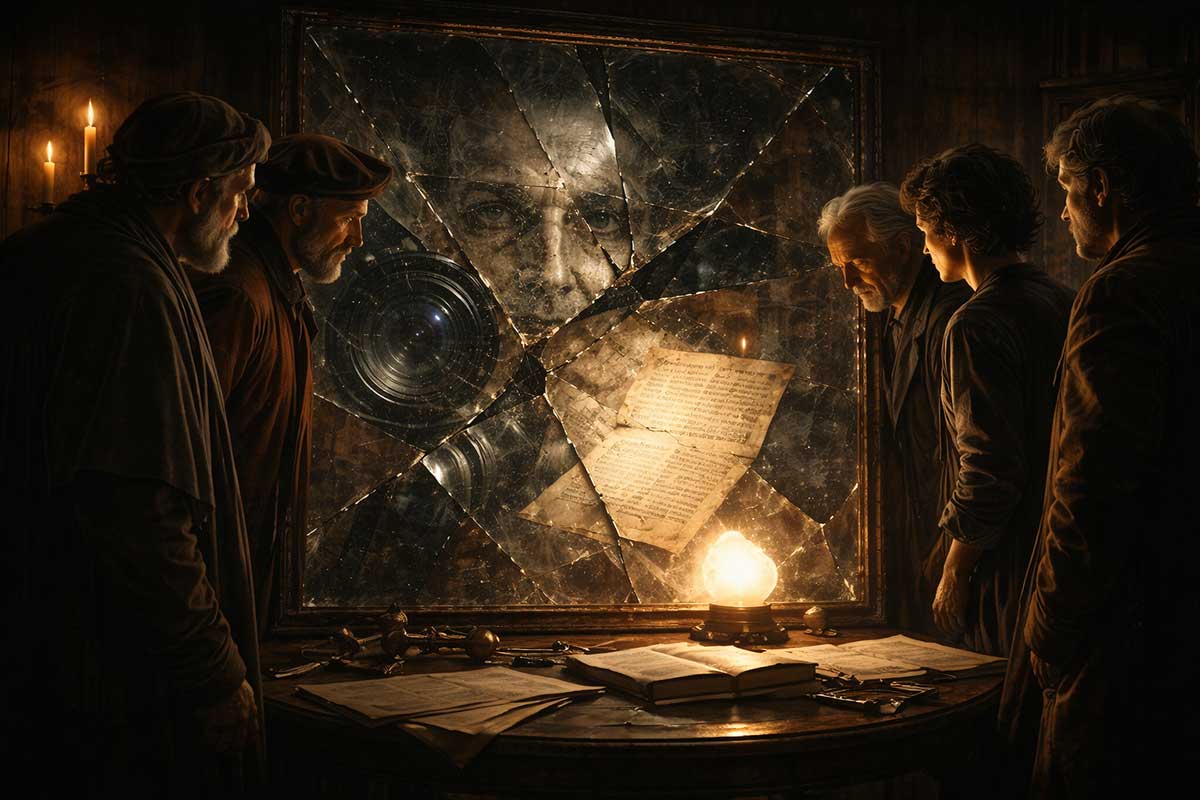
The chamber shifts as if the building itself is choosing a new mood. The impossible library grows quieter, colder. A long table appears, bare except for a few objects placed with unsettling care.
A polished mirror. A lens. A sealed letter with wax. A small printing plate. A thin glass device that can display any face, any voice, any document, any scene.
Descartes steps forward and looks at the mirror first, not the device.
“Once, I imagined an evil demon deceiving me through my senses. In your age, deception does not need demons. It needs only skill and machines. So we begin with a practical question. When audio, video, and documents can be forged flawlessly, what becomes the foundation of public trust?”
He waits. No one rushes. They all understand what is at stake.
Round 1
Ibn al-Haytham
“Begin with humility. The eye is not a perfect instrument. Perception is a construction. If fakes become perfect, then the senses become suspect again. The foundation of trust must shift from appearance to method. We must demand provenance, controlled tests, and repeatable verification. A claim is not true because it looks real. It is true because it survives scrutiny.”
Benjamin Franklin
“I lived through a revolution of information. Printing made it easy to enlighten and easy to inflame. What you face is that multiplied a thousand times. Public trust will not be rescued by one clever invention. It will be rescued by habits. People must learn to slow down, to ask who benefits, to check sources twice. Communities must build shared standards again, or else every argument becomes a weapon.”
Hypatia
“I hear in this a danger beyond falsehood. When everything can be faked, many will stop believing in truth itself. That is the true catastrophe. The foundation of trust is not blind faith in images, but the public practice of reason. We must teach people to distinguish between certainty, probability, and mere assertion. Without that discipline, the loudest voice will replace the truest one.”
Aristotle
“Trust is not merely a technical matter. It is a moral one. A city is held together by shared belief that words can refer to things, and that citizens can speak in good faith. If we lose that, then persuasion becomes pure power. Therefore the foundation of trust must include character. We must reward honesty, punish deliberate deception, and cultivate civic virtue, or no mechanism will save us.”
Ada Lovelace
“There is also a structural problem. Machines can generate convincing falsehoods at scale. Even if each person is careful, the sheer volume can exhaust attention. The foundation of trust must include systems, authentication, signatures, and transparent chains of custody for important information. Without infrastructure, the human mind becomes the weakest link.”
Descartes nods.
“You have offered method, habit, reason, virtue, and infrastructure. Good. Now the sharper dilemma.”
Round 2
Descartes
“Do we need identity verification everywhere to restore trust, or does that destroy privacy and freedom?”
Benjamin Franklin
“If you require everyone to prove who they are at all times, you build a machine for tyranny. Yet if nobody can be held accountable, you build a playground for fraud. The answer is not total exposure. It is graduated rules. High stakes spaces require verification. Ordinary speech must remain free. Otherwise you will cure deception by killing liberty.”
Ada Lovelace
“I agree. Verification must be contextual. When the matter is medical records, banking, elections, contracts, there should be strong authentication. But for art, debate, whistleblowing, and the exploration of unpopular truth, anonymity has value. The danger is that the tools built for security will be repurposed for control.”
Ibn al-Haytham
“This is the logic of instruments. The more powerful the instrument, the more carefully its use must be limited. Verification everywhere may reduce one kind of error, but it introduces another: fear. People who fear being watched stop seeking truth. They stop experimenting. They stop confessing doubt. A society that cannot doubt cannot learn.”
Hypatia
“And there is a deeper fracture. Identity verification does not guarantee truth. A known person can still lie. A verified speaker can still manipulate. The real threat is not merely anonymity. It is the decay of rational standards. We must not confuse the question, who said it, with the question, is it well supported.”
Aristotle
“Freedom without responsibility collapses into chaos. Responsibility without freedom collapses into tyranny. The city must preserve both. A wise society will use verification as a tool, not as a worldview. Its foundation must remain the cultivation of citizens who love truth more than victory.”
Descartes folds his hands as if concluding, but his eyes sharpen again.
“Then the final pressure point.”
Round 3
Descartes
“What is the role of education now: teaching facts, or teaching how to judge claims under uncertainty?”
Hypatia
“Teach the mind to recognize degrees. Some things are demonstrated. Some are probable. Some are merely possible. Education must train judgment, not memorization. If the world is filled with convincing illusions, then the greatest skill is calm discernment.”
Ibn al-Haytham
“Teach method. Teach how to test. Teach how to doubt properly. Doubt is not cynicism. It is a discipline that protects the soul from being pulled by appearances. Let students learn how easily they can be fooled, then give them tools to correct themselves.”
Aristotle
“Teach character alongside reasoning. A clever mind without virtue becomes an engine of manipulation. A good education forms citizens who value truth, who are ashamed to deceive, and who know that knowledge is for the sake of the good life.”
Benjamin Franklin
“Teach media habits as civic hygiene. Slow down. Check sources. Compare accounts. Ask who is selling you something. And teach people to build local trust networks again, because mass information without relationships becomes noise.”
Ada Lovelace
“Teach both. Facts are necessary anchors, and judgment is the skill of navigation. But the main addition in your age is systems literacy. People must understand how machine-generated content is produced, how it can be weaponized, and how verification tools work. Otherwise they will always be outmatched by those who do.”
Descartes looks again at the mirror, then at the device that can fabricate anything.
“So the question becomes this. Not whether we can restore trust through technology. But whether we can restore the human capacity for careful thought.”
The room stays quiet for a moment, as if everyone is listening for a world outside the walls that is already arguing.
Topic 3: The Polymath’s Comeback or the Death of Breadth
Moderator:
Alexander von Humboldt
Guests:
Leonardo da Vinci, Avicenna (Ibn Sina), Johann Wolfgang von Goethe, Benjamin Franklin, Ada Lovelace
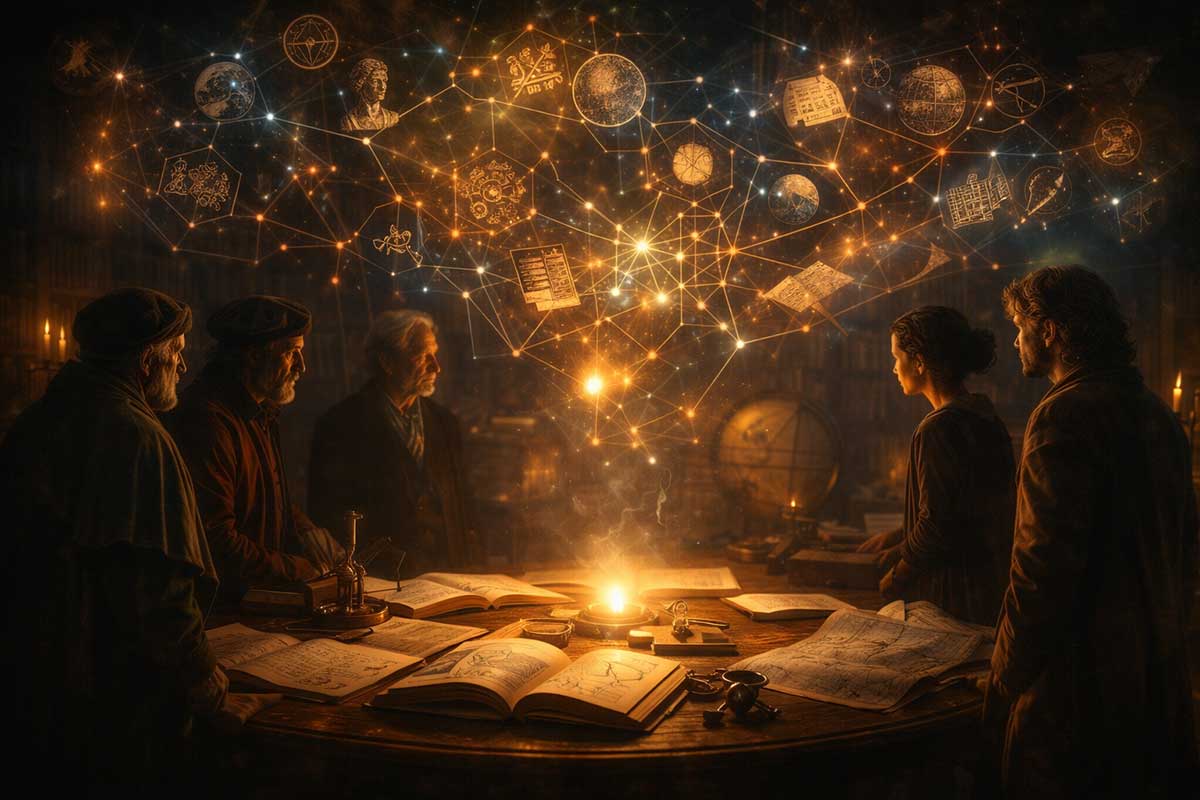
The library-workshop-courtroom dissolves into something wider, greener, stranger. The table remains, but now it sits beneath a high ceiling of glass, like a conservatory joined to a map room. There are drawers of specimens, rolls of paper, instruments, and notebooks that smell faintly of ink and soil.
A globe rests near a stack of field journals. A mechanical model sits beside a book of poems. A ledger of civic projects lies next to a diagram of a steam engine. Somewhere, a quiet machine displays a shifting web of ideas.
Humboldt stands where the air feels alive.
“When I traveled,” he says, “I learned that everything touches everything. Yet your age has a new force, one that tempts the mind to become shallow while believing it is broad. So I ask you plainly. In 2026, does AI revive the polymath, or does it finally bury breadth under endless convenience?”
He gestures, and the first round begins.
Round 1
Leonardo da Vinci
“A revival is possible, but only for those who remain embodied in the world. The danger is that people will live among images instead of things. Breadth without contact becomes theater. The true polymath observes, sketches, tests, listens to materials, watches how light behaves on skin, how water moves, how humans respond to beauty. If AI gives you answers without touching reality, you will become clever and hollow.”
Avicenna (Ibn Sina)
“In my time, breadth was not a hobby. It was necessity. Medicine demanded philosophy. Ethics demanded metaphysics. Logic disciplined the mind so it would not wander. In your time, information is abundant, yet discipline is scarce. AI may assist learning, but it also tempts the student to accept conclusions without building the inner structure of understanding. A polymath is not someone who accumulates. A polymath is someone who integrates while remaining rigorous.”
Johann Wolfgang von Goethe
“I have always mistrusted the cold pride of narrow method. Life is richer than a single lens. Yet I also mistrust the shallow mind that visits many rooms but inhabits none. If AI multiplies what is easy, it may seduce people into imitating breadth rather than cultivating it. The saving power is taste. The modern polymath must develop taste to recognize what is living truth in each domain, not merely fashionable jargon.”
Benjamin Franklin
“I’ll put it in plain terms. The world pays for usefulness. If AI lets a person combine skills faster, then the practical polymath will thrive. But if AI makes it so easy to appear knowledgeable, then the market will fill with fakes. The winners will be those who can build, test, ship, and show results that reality cannot deny.”
Ada Lovelace
“There is a deeper question. AI can make the surface of competence look smooth. It can produce language that sounds like understanding. That will blur the line between real synthesis and imitation. If polymathy returns, it must be anchored in proof, in creation, in responsible outcomes. Otherwise breadth will become a costume.”
Humboldt nods.
“I hear the same concern in different tongues. The problem is not breadth. It is counterfeit breadth.”
He looks at the web of ideas on the glowing screen and raises his hand.
Round 2
Humboldt
“Then tell me this. Does skill stacking create true value, or does it create a generation that is merely ‘good enough’ and never excellent?”
Benjamin Franklin
“Skill stacking is honest if it produces capabilities that combine into something rare. But it becomes a scam if it is used to avoid deep work. The test is this. Can you do something that a single specialist cannot do alone? Can you build a working machine, persuade a public, design a system, solve a problem end to end? If yes, you’re valuable. If no, you’re collecting trophies.”
Ada Lovelace
“Stacking must include at least one deep anchor. Without depth, you cannot tell when your tools are misleading you. Without depth, you cannot discover new principles, only remix old ones. The modern polymath might be shaped like a ‘T’: depth in one area, breadth across many, integration above all.”
Avicenna (Ibn Sina)
“Excellence is not optional. Without it, breadth becomes arrogance. Yet excellence need not mean mastery of everything. It means mastery of method, mastery of reasoning, mastery of learning itself. If one has deep training in logic and disciplined inquiry, then breadth can be honorable rather than shallow.”
Johann Wolfgang von Goethe
“Excellence also includes the moral courage to refuse the trivial. In a world of constant stimulation, ‘good enough’ will be the default. The polymath must be the one who can say no. No to noise. No to imitation. No to the deadening comfort of endless summaries. And yes to depth where it matters.”
Leonardo da Vinci
“I agree. The true measure is whether your mind can endure the slow friction of reality. Can you wrestle with a problem that resists you for months? Can you sit with uncertainty until something true emerges? If not, your breadth is a garden painted on a wall.”
Humboldt smiles slightly.
“Good. We are arriving at a standard. Not how much you know, but how real your knowing is.”
He lets the silence do some of the work, then moves to the third round.
Round 3
Humboldt
“What should the modern polymath optimize for in 2026: depth, range, speed of learning, or synthesis that creates something new?”
Ada Lovelace
“Synthesis. But synthesis with conscience. The polymath’s gift is to combine elements into something that did not exist before, and to foresee consequences. Speed is a tool. Range is a palette. Depth is a foundation. Synthesis is the house you build.”
Leonardo da Vinci
“Synthesis that touches life. Not merely clever combinations, but inventions that serve beauty, health, dignity, and wonder. A machine can combine patterns endlessly. Only a human can decide which combination is worth living with.”
Avicenna (Ibn Sina)
“Depth in principles, breadth in application. The modern polymath must become a guardian of coherence. When the world fragments into specialties and machines generate endless claims, someone must preserve the architecture of reason.”
Benjamin Franklin
“I’ll answer with one word. Leverage. If you learn fast but build nothing, you are entertainment. If you learn slower but build useful systems, you change the world. Optimize for the ability to produce real outcomes, ethically and repeatedly.”
Johann Wolfgang von Goethe
“Optimize for wholeness. The modern world divides the person. Work over here, meaning over there, beauty somewhere else. The polymath’s calling is to reunite the human being. To make knowledge serve life rather than replace it.”
Humboldt looks around the table, then out through the glass ceiling where the sky seems to hold both stars and algorithms.
“Then we can say it. The polymath does not die when knowledge expands. The polymath dies when the soul loses the patience to integrate.”
Outside the conservatory, the web of ideas continues to shift, as if waiting for someone to make it real.
Topic 4: Energy, Climate, and Civilization Level Decisions

Moderator:
Leonhard Euler
Guests:
Archimedes, Isaac Newton, Alexander von Humboldt, Thomas Jefferson, Benjamin Franklin
The conservatory fades. In its place, a vast hall appears that feels half observatory, half engine room. Copper pipes run along the walls. A chalkboard stands beside a table of instruments. Outside tall windows, you can see a coastline, a forest edge, and a city skyline all at once, like the world has been folded into a single view.
At the center, Euler stands with a piece of chalk, eyes calm, voice calm, as if even the fate of civilizations can be discussed without theatrics.
“In 2026,” he says, “your problem is not ignorance. Your problem is tradeoffs. Energy choices now shape climate, industry, security, and human dignity. So we will do what minds are for. We will make the real choices visible.”
He turns to the group.
“First question. If you had to pick one primary path for 2026 to 2036, what is it: nuclear, solar plus storage, geothermal, an aggressive efficiency revolution, or something else?”
Question 1
Euler: If you had to pick one primary energy path for 2026 to 2036, what is it?
Round 1
Archimedes
“Begin with what can be built at scale, repaired by ordinary hands, and defended from failure. Efficiency is the fastest new power plant. Then build what is simple and robust. A civilization that relies on fragile complexity invites collapse. Make the system sturdy first, then elegant.”
Alexander von Humboldt
“Do not choose a single path as if nature were a single equation. Regions differ. Ecosystems differ. What matters is balance with the land and water that sustain life. Yet if I must name one emphasis, it is efficiency and electrification paired with clean generation. The cheapest energy is what you do not waste, and the cleanest energy is what does not need to be produced.”
Benjamin Franklin
“I like what works quickly. Efficiency is immediate, boring, and powerful. But you also need dependable baseload for industry and winter. If your goal is stable prosperity, you cannot bet everything on one source. If forced to choose a headline strategy, I choose rapid efficiency plus grid reliability upgrades. Then you add whatever generation your region can actually deliver.”
Isaac Newton
“A system must be stable under perturbation. I care less about slogans and more about dynamics. If the grid becomes volatile, society becomes volatile. Therefore the primary path must be whatever yields reliability while reducing emissions. In many places that implies a diversified system, including firm low carbon generation and strong storage. The physics will not yield to politics.”
Thomas Jefferson
“A nation must protect its people from dependency. Energy policy is sovereignty. The best path is the one that strengthens domestic resilience and does not place the republic at the mercy of foreign supply chains. I would prioritize a broad buildout that citizens can support and that local industry can maintain, with efficiency as the immediate cornerstone.”
Round 2
Archimedes
“And build for repair. If a storm breaks it, can you fix it without a miracle and a ship from afar?”
Alexander von Humboldt
“And build with ecological humility. Energy that destroys the foundation of life is not progress.”
Benjamin Franklin
“And measure honestly. If a plan sounds grand but cannot be deployed fast, it is a speech, not a solution.”
Isaac Newton
“And test claims. The world will punish wishful thinking with blackouts and rising costs.”
Thomas Jefferson
“And keep legitimacy. People must feel the plan serves them, not only experts and financiers.”
Euler nods once.
“Good. Now we face the harder question. Not what we can build, but what we must refuse to sacrifice.”
Question 2
Euler: What should be treated as non negotiable: economic growth, ecological stability, or human dignity? What tradeoffs are acceptable?
Round 1
Thomas Jefferson
“Human dignity is the foundation. A republic exists to protect rights and the conditions of a decent life. If policy enriches a few while burdening the many, it fails. Growth is valuable, but it is not sacred. Ecological stability is also essential, because liberty cannot survive on ruined land.”
Alexander von Humboldt
“Ecological stability is non negotiable because it is the ground beneath every other promise. When forests fail, when waters change, when climates shift, the poor suffer first and the powerful pretend surprise. Dignity and stability are bound together. Growth that consumes the future is a theft from those not yet born.”
Benjamin Franklin
“I’ll be practical. People will not accept policies that feel like punishment. So dignity must be protected in the near term, or your long term plan dies politically. But you must also protect the environment or the bill arrives later with interest. The tradeoff is not dignity versus climate. The tradeoff is whether you pay now with planning or pay later with disaster.”
Isaac Newton
“Non negotiable means the constraint of the system. If the climate system crosses thresholds, you do not negotiate it back. Therefore ecological stability is a hard constraint. Within that, you optimize dignity and prosperity. Ignore the constraint and you will discover the meaning of non negotiable.”
Archimedes
“You must preserve the ability to act. A starving people cannot think about ethics. A collapsing ecosystem cannot feed them. A weak grid cannot power hospitals. The non negotiable is the function of civilization itself. Choose tradeoffs that keep the machine running while you rebuild it.”
Round 2
Thomas Jefferson
“Policy must be judged by whether ordinary families feel safer, freer, and more secure.”
Alexander von Humboldt
“Treat the biosphere as an inheritance, not a warehouse.”
Benjamin Franklin
“Make the transition feel fair, or it will be rejected.”
Isaac Newton
“Respect constraints first, then argue preferences.”
Archimedes
“Keep critical systems resilient. Without that, every moral ambition collapses.”
Euler turns back to the chalkboard and draws a simple triangle. At each corner he writes a word: Stability, Dignity, Prosperity. Then he underlines the lines between them.
“Now the question that decides whether your solutions become reality. Who governs decisions at this scale?”
Question 3
Euler: Who should govern planetary scale energy and climate decisions: nations, markets, technologists, or a new global institution?
Round 1
Benjamin Franklin
“A new global institution sounds tidy, but power always finds ways to misuse institutions. Nations must lead because they can be held accountable by citizens. Markets can help, but markets chase profit, not justice. Technologists can advise, but they should not rule. The best governance is layered. Local where possible, national where necessary, and international where problems cross borders.”
Thomas Jefferson
“I do not trust concentrated authority. Yet I also recognize that rivers and winds do not respect borders. The answer must preserve self government while coordinating where coordination is unavoidable. Let alliances and treaties exist, but keep the people sovereign. The temptation in crisis is always to centralize. That temptation must be resisted.”
Alexander von Humboldt
“Nature is a single system. Governance fragmented into competing interests will always be late. We need shared standards, shared measurement, shared transparency. Whether that is called a global institution or a network of institutions is less important than whether it is honest and enforceable.”
Isaac Newton
“Governance must be informed by measurement. If your institutions cannot agree on what is happening, they cannot agree on what to do. The first task is shared reality: data, models, uncertainty ranges, and consequences. After that, the question is legitimacy. Decisions imposed without legitimacy will fail.”
Archimedes
“Do not let rulers choose tools they cannot maintain. If governance becomes too distant from engineering reality, it will demand the impossible and blame the laws of nature. The governors must be bound to practical constraints. Build what can be built, repair what can be repaired, and plan for failure.”
Round 2
Benjamin Franklin
“Layer it, and make fraud costly.”
Thomas Jefferson
“Coordinate without surrendering the people’s rights.”
Alexander von Humboldt
“Make transparency a requirement, not a virtue.”
Isaac Newton
“Agree on measurement before arguing policy.”
Archimedes
“Never forget maintenance. Civilization survives on maintenance.”
Euler sets the chalk down.
“You have described a truth that many avoid. In 2026, the problem is not a lack of ideas. It is the discipline to choose constraints, the courage to be fair, and the humility to respect nature.”
Outside the tall windows, the coastline, forest, and city remain in the same frame, as if waiting to see whether the debate becomes design.
Topic 5: The Next Social Contract: Work, Wealth, and Meaning

Moderator:
Aristotle
Guests:
Benjamin Franklin, Thomas Jefferson, Rabindranath Tagore, Susan Sontag, Ada Lovelace
The engine hall softens into something quieter and more human. The walls become wood and stone. The windows look out not on one folded landscape, but on a street. People pass by. Some hurry. Some drift. Some stare into their phones as if searching for a reason to move.
A single long table remains, but now it holds ordinary objects. A loaf of bread. A schoolbook. A coin. A work apron. A blank sheet of paper.
Aristotle stands at the head, not stern, but steady. His voice carries the tone of a teacher who believes every political question is also a question about the soul.
“In your year 2026,” he says, “work is changing. Wealth is concentrating. Technology is remaking labor. And many people feel their lives losing meaning. So we begin simply. If automation reduces the need for human labor, how do people earn dignity, status, and purpose?”
He lets the question hang, like a lantern.
Question 1
Aristotle: If automation reduces the need for human labor, how do people earn dignity, status, and purpose?
Round 1
Benjamin Franklin
“Purpose comes from usefulness. People want to feel needed. If machines do more work, society must create more ways for humans to contribute, not just consume. Apprenticeships, community projects, service roles, local building, mentoring. We should not treat people like mouths to feed. We should treat them like hands and minds to engage.”
Susan Sontag
“There is also the question of attention. In modern life, status is increasingly earned by being seen rather than by being needed. Automation will intensify this. People will chase visibility, identity, and performance, and that can hollow out meaning. A healthy society must protect spaces where dignity is not dependent on spectacle.”
Rabindranath Tagore
“Meaning is not granted by markets. It is cultivated through relationship, beauty, and contribution. When labor diminishes, a civilization has a rare chance to recover the human spirit. But only if it values education of the heart, not only the training of skills. Otherwise leisure becomes emptiness and boredom becomes despair.”
Ada Lovelace
“I would distinguish between labor and creation. Machines may replace many tasks, but they do not replace the need for human authorship, choice, and responsibility. In a world where systems run themselves, dignity may come from stewardship. Who designs the rules, audits outcomes, and ensures fairness? That is work of a higher order.”
Thomas Jefferson
“A republic depends on citizens who can stand upright, not beg for favor. If the economy changes so that fewer are needed for labor, then the nation must guard against a new class system where one group owns the machines and the rest become dependents. Dignity requires broad opportunity and real ownership, or freedom becomes a word without substance.”
Round 2
Benjamin Franklin
“Give people paths to contribute that are real, not symbolic.”
Susan Sontag
“Do not let ‘being watched’ replace being valued.”
Rabindranath Tagore
“Teach people how to live, not only how to earn.”
Ada Lovelace
“Make stewardship and accountability honorable work.”
Thomas Jefferson
“Protect independence through ownership and rights.”
Aristotle nods.
“Then our question is not merely economic. It is ethical. Now we speak of the instrument many propose.”
Question 2
Aristotle: Is universal basic income a stabilizer, a trap, or a transition tool toward a new kind of economy?
Round 1
Thomas Jefferson
“It can be a stabilizer if it protects liberty, and a trap if it creates dependency. The decisive matter is whether it strengthens citizens or weakens them. If it comes with conditions that can be used to control speech, movement, or belief, it is not help, it is leash.”
Benjamin Franklin
“I like experiments. Try it locally, measure the results, and adjust. But remember this. People do not only need money. They need direction and belonging. UBI may prevent collapse, but it will not automatically create purpose. Pair it with real community pathways or you will pay people to feel useless.”
Ada Lovelace
“As a transition tool, it could provide stability while society restructures education and work. But it must be designed with care. If it is funded or administered in ways that deepen inequality or surveillance, it will poison trust. The question is not only whether it works, but whether people believe it is fair.”
Susan Sontag
“UBI also changes the cultural story. If people no longer need work to survive, the status hierarchy will migrate even more toward attention, taste, and cultural power. That may liberate some, but it may intensify resentment. The social contract is not only bread. It is recognition.”
Rabindranath Tagore
“A society that gives bread but no spirit will still be hungry. If UBI becomes a way to keep the peace while stripping people of meaningful roles, it will not heal. But if it becomes a foundation that allows people to serve, create, care for families, and learn, then it can be a bridge to a more humane world.”
Round 2
Thomas Jefferson
“Design it so the citizen remains free, not managed.”
Benjamin Franklin
“Measure outcomes, and don’t ignore human psychology.”
Ada Lovelace
“Build it with transparency, fairness, and safeguards.”
Susan Sontag
“Remember recognition and status, not only money.”
Rabindranath Tagore
“Let it create space for growth, not emptiness.”
Aristotle folds his hands.
“Now we arrive at education, the forge where the future citizen is made.”
Question 3
Aristotle: What should education train for in 2026: careers, character, creativity, or civic responsibility?
Round 1
Rabindranath Tagore
“Education must first awaken the whole person. Careers change. Character endures. Creativity renews the world. Civic responsibility protects the weak. If you teach only employability, you produce anxious workers. Teach the love of truth, beauty, and service, and you produce free human beings.”
Benjamin Franklin
“I’m practical. Teach skills, yes, but teach judgment more. How to learn, how to verify, how to build, how to cooperate. And teach the dignity of useful work in every form, because a society collapses when it looks down on the roles it depends on.”
Ada Lovelace
“Teach systems thinking. Teach computational literacy as a form of citizenship. People must understand how algorithmic decisions affect them, how data is used, and how to challenge systems that fail. Creativity matters, but so does the ability to audit and govern technology.”
Susan Sontag
“Teach attention. Attention is moral in 2026. If people cannot control what they attend to, they cannot control what they become. Education must train the mind to resist manipulation, to read deeply, to think without constant stimulation. Otherwise the citizen becomes a consumer of whatever is loudest.”
Thomas Jefferson
“Teach civic responsibility as the backbone. A republic is not maintained by experts alone. It is maintained by citizens who can reason, debate, and act with courage. Without that, careers and creativity become ornaments on a collapsing house.”
Round 2
Rabindranath Tagore
“Form the soul, then the skill will follow.”
Benjamin Franklin
“Teach learning itself, and cooperation.”
Ada Lovelace
“Teach how to govern systems, not just use them.”
Susan Sontag
“Teach attention as discipline, not indulgence.”
Thomas Jefferson
“Teach citizenship, or you will lose the republic.”
Aristotle looks down the street beyond the windows where lives continue, unaware of the debate in this room.
“Then perhaps the new social contract is not merely a policy. It is a renewed agreement about what a human life is for, and what a society owes to the souls it shapes.”
The table remains. The bread remains. The blank page remains.
Final Thoughts by Nick Sasaki
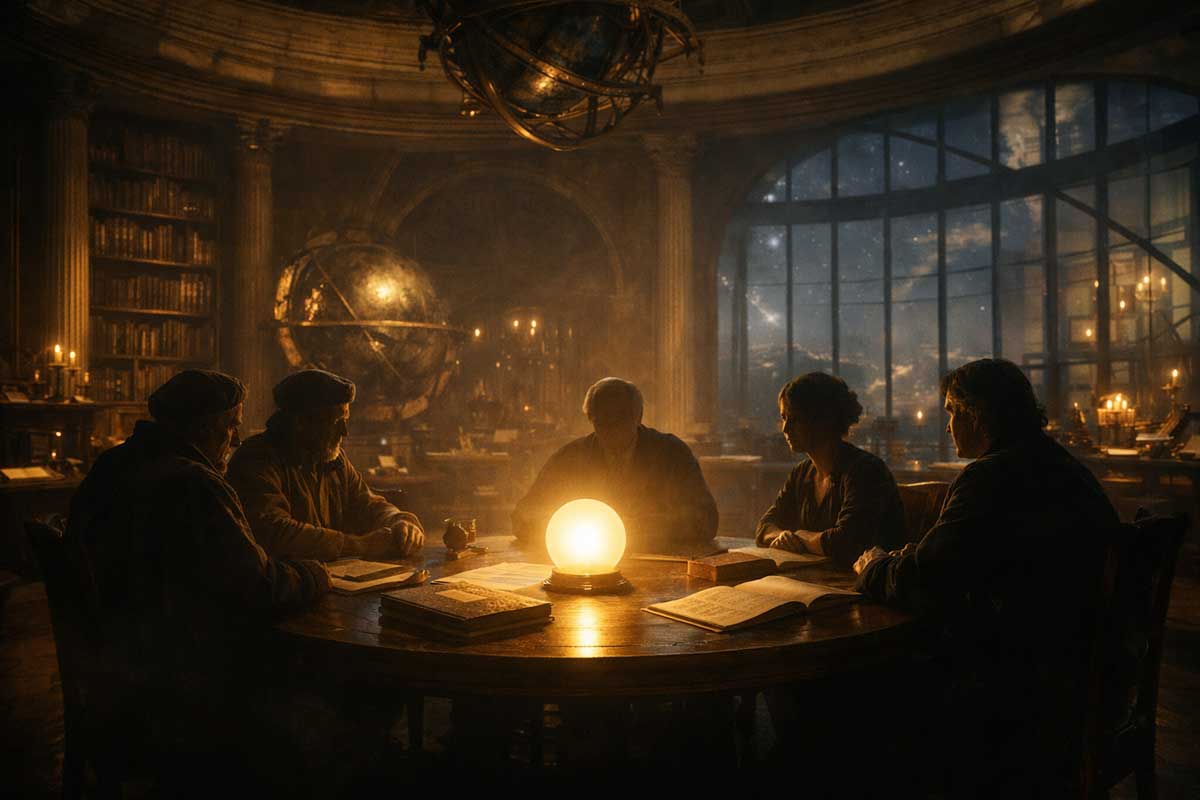
Across five conversations, one quiet conclusion emerges.
The polymath does not disappear when knowledge expands.
The polymath disappears when societies lose patience for integration.
Machines now calculate faster than any human ever could. They generate language, images, arguments, and plans with breathtaking speed. But again and again, the discussions return to the same realization: intelligence is not defined by output alone. It is defined by judgment, restraint, responsibility, and purpose.
Truth survives not because information is abundant, but because discernment is cultivated.
Civilizations endure not because energy is limitless, but because tradeoffs are chosen honestly.
Work retains dignity not because it is compulsory, but because contribution is meaningful.
And breadth matters not when it is shallow, but when it unites what specialization fractures.
If there is a message these polymaths leave behind, it is this:
The future does not need smarter machines nearly as much as it needs wiser humans.
The task ahead is not to compete with artificial intelligence, nor to surrender to it, but to remember what thinking is for. To design systems that serve life rather than replace it. And to recover the courage to integrate knowledge, ethics, and meaning into a coherent whole.
The conversation does not end here.
It waits for those willing to think slowly, deeply, and together.
Short Bios:
Aristotle – Ancient Greek philosopher whose work shaped logic, ethics, politics, biology, and metaphysics. He defined knowledge as understanding causes and saw human flourishing as the purpose of society.
Leonardo da Vinci – Renaissance polymath combining art, engineering, anatomy, and natural observation. He embodied synthesis through direct engagement with reality, not abstract theory alone.
Isaac Newton – Central figure of the Scientific Revolution who unified motion, gravity, and optics into coherent laws. He exemplified depth, rigor, and explanatory power.
Ada Lovelace – Mathematician and early theorist of computing who recognized that machines could manipulate symbols beyond calculation. She emphasized human intention, creativity, and responsibility in technology.
Benjamin Franklin – Inventor, writer, civic organizer, and diplomat who united practical problem solving with public responsibility. He viewed intelligence as something that must serve society.
Gottfried Wilhelm Leibniz – Philosopher and mathematician who sought a universal system of reasoning. He believed clarity, definition, and symbolic thought could organize even the most complex debates.
René Descartes – Philosopher and mathematician known for methodological doubt and the search for certainty. He reshaped how truth, perception, and knowledge are examined.
Ibn al-Haytham (Alhazen) – Pioneer of optics and scientific method who emphasized experimentation and skepticism of perception. He laid foundations for evidence-based inquiry.
Hypatia of Alexandria – Mathematician and philosopher who taught public reasoning and intellectual discipline in a time of political and religious tension. She symbolizes courage in the pursuit of truth.
Alexander von Humboldt – Naturalist and explorer who revealed the interconnectedness of climate, geography, biology, and human systems. He pioneered holistic, systems-level thinking.
Avicenna (Ibn Sina) – Philosopher and physician whose work integrated medicine, logic, metaphysics, and ethics. He emphasized disciplined reasoning as the backbone of breadth.
Johann Wolfgang von Goethe – Poet, scientist, and thinker who resisted narrow reductionism. He argued that true understanding requires intuition, experience, and wholeness.
Leonhard Euler – Mathematician who brought clarity, structure, and precision to complex systems. He exemplified how abstraction can guide real-world decision making.
Archimedes – Ancient engineer and mathematician whose work balanced theoretical insight with practical invention. He focused on robustness, simplicity, and physical reality.
Thomas Jefferson – Political thinker and statesman who connected education, rights, and self-governance. He viewed independence and dignity as inseparable from civic responsibility.
Rabindranath Tagore – Poet, educator, and philosopher who emphasized human dignity, creativity, and spiritual development. He argued that education must form the whole person.
Susan Sontag – Modern cultural critic and essayist who examined media, power, identity, and attention. She warned that visibility and performance can replace meaning if left unchecked.
Leave a Reply