
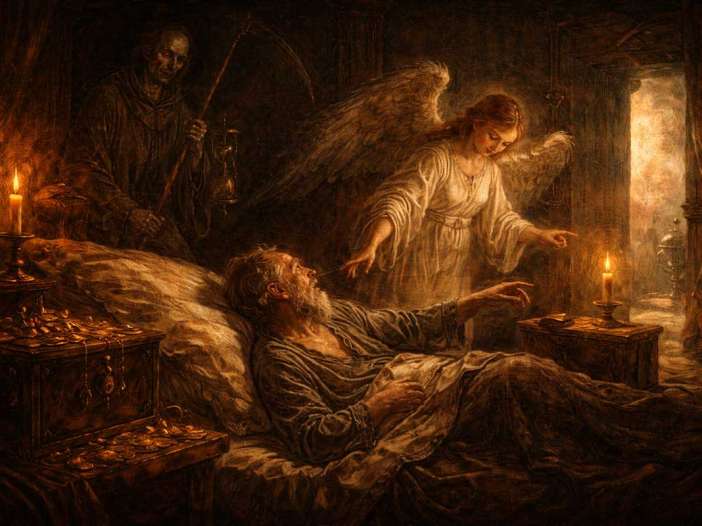
What if Hieronymus Bosch decoded his monsters with the top scholars who study his symbols?
Introduction by Hieronymus Bosch
I did not paint to entertain you.
If you have come to these panels expecting clever monsters, strange birds, and a carnival of medieval imagination, you will find them—yes. But if you stop there, you will leave with nothing but curiosities. My images were made for a more serious purpose: to show the soul its own habits before the habits become a cage.
People speak of “spirituality” as if it were perfume—soft, comforting, vague. I speak of it as a discipline. A human being is not only a body moving through markets and bedrooms and streets; a human being is a will, an attention, a conscience, a hunger, a fear. If those inner powers are not governed, they will be governed for you—by the crowd, by appetite, by urgency, by the small conveniences that become lifelong chains.
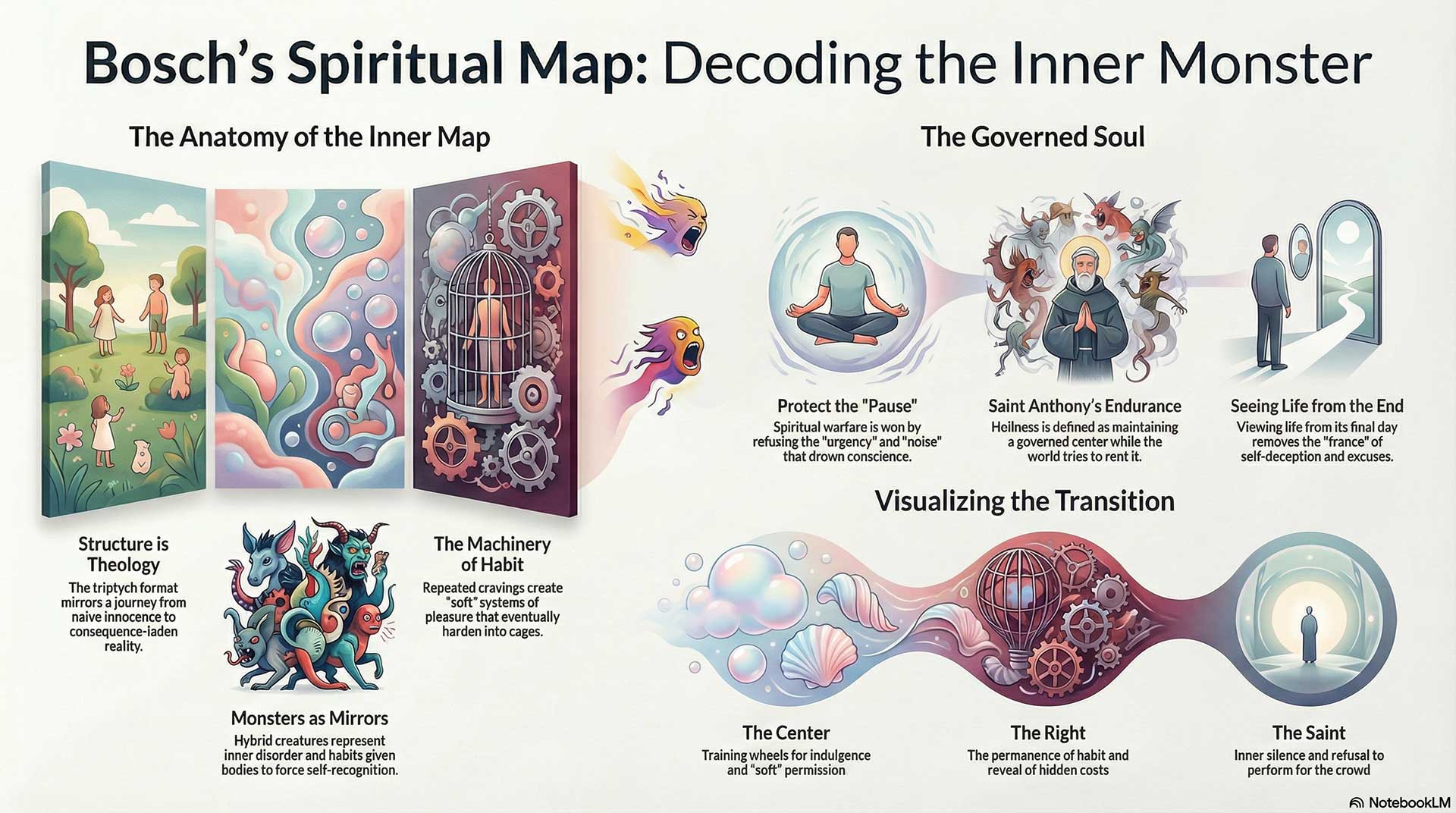
That is why my paintings look crowded. Temptation is crowded. The world offers ten thousand small permissions, and each one whispers, “It won’t matter.” But everything matters, because everything becomes repetition, and repetition becomes you. In this series we walk through six rooms: the road of temptation, the mirror of monsters, the machinery of habit, the quiet endurance of Saint Anthony, the last things that strip away excuses, and finally the panel that asks what makes all of this spiritual rather than merely strange.
I invite you to look with honesty. Do not ask first what a symbol “means.” Ask what it awakens in you. Ask what it flatters. Ask what it frightens. Ask where you linger. If you can locate yourself inside the image, then the painting has done its work. If you cannot, then you have only visited the surface—and the surface is where the soul learns to lie.
(Note: This is an imaginary conversation, a creative exploration of an idea, and not a real speech or event.)
Topic 1 — The Map of Temptation: Reading The Garden as a Spiritual Landscape
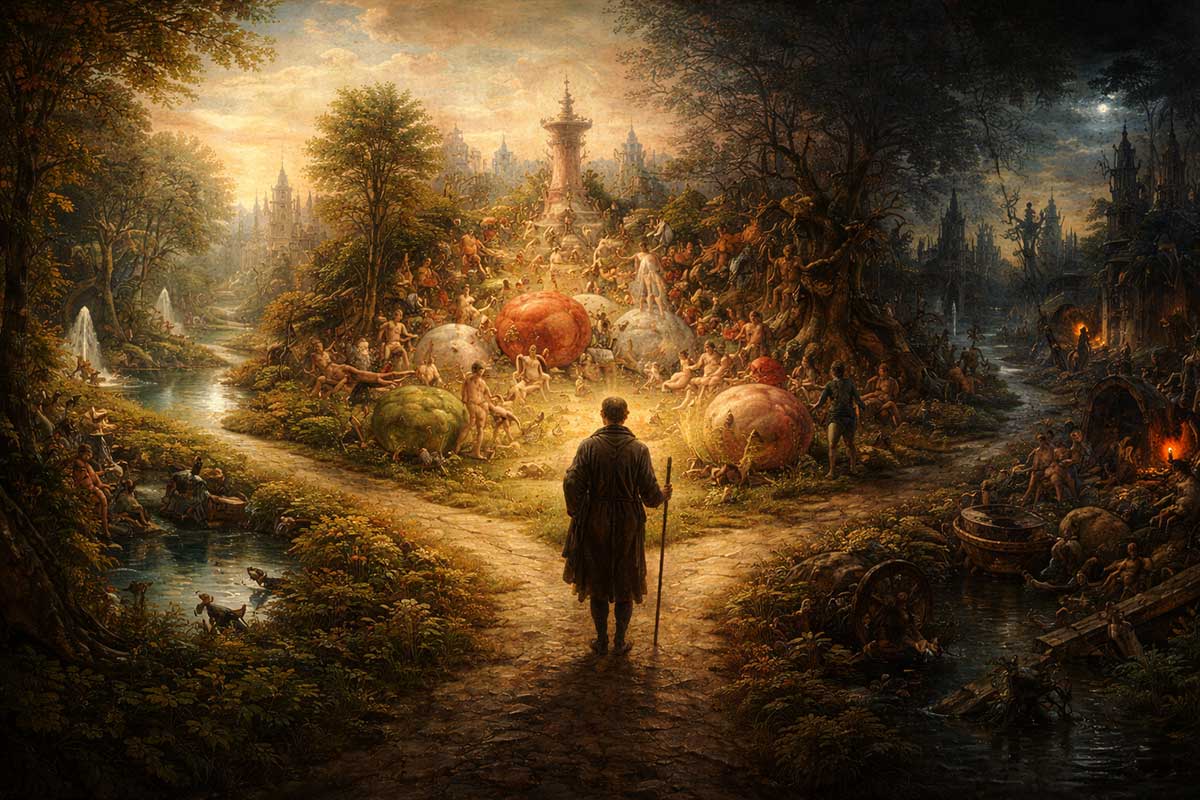
Hieronymus Bosch: You want me to begin with the strangest truth? People think my triptych is a riddle. It is not. It is a mirror—held at an angle so the viewer cannot lie to himself.
Reindert Falkenburg: Then let’s talk about the mirror without turning it into a parlor trick. When viewers stand before The Garden of Earthly Delights, they often react in two extremes: either “pure fantasy” or “pure moral warning.” I think you built something more architectural—a landscape the soul has to travel through. Was that your intention?
Hieronymus Bosch: If you give a man a sermon, he nods and forgets. If you give him a road, he remembers where his feet went. A triptych is a road. It folds open like a journey, not like a single scene.
Reindert Falkenburg: So the structure itself is theology.
Hieronymus Bosch: Structure is always theology. Even the most ordinary room teaches you what is permitted. The left panel teaches the innocence that believes it cannot fall. The middle panel teaches the intoxication that believes it will not pay. The right panel teaches the cost that arrives even when no one invites it.
Reindert Falkenburg: Let’s slow down on the left panel—Eden, or something like it. Viewers see calm, a divine presence, animals, a couple. But there are already small disturbances: odd beasts, uneasy pairings, hints of imbalance. Are you suggesting that temptation begins before sin—inside the naive confidence of “I’m fine”?
Hieronymus Bosch: Temptation begins the moment a person believes he is exempt from consequence. Innocence is not the same as wisdom. Eden without vigilance is merely a beautiful sleep.
Reindert Falkenburg: That’s sharp. And it changes how we read the transition into the center. Because the central panel is where most people get lost. They see bodies, fruit, birds, shells, strange vessels—pleasure multiplied into spectacle. But you’re implying it’s not “pleasure” as such; it’s pleasure ungoverned by conscience.
Hieronymus Bosch: I painted excess because excess is easier to recognize than intention. A viewer may not admit envy, but he recognizes a crowd running toward sweetness. The fruit is not a botanical lesson. It is a symbol for appetite—how quickly desire ripens, how quickly it bruises.
Reindert Falkenburg: There’s something else: the central panel doesn’t feel simply “sinful” in a grim way. It’s almost bright, playful. That’s why modern viewers say, “This looks like paradise.” Is that part of the trap you’re showing—that temptation rarely looks like a threat?
Hieronymus Bosch: Of course. Hell rarely begins with fire. It begins with permission. A small yes that feels harmless. A laughter that forgets time. A sweetness that persuades you to ignore the body’s warning and the mind’s doubt. The center is seductive because temptation must persuade before it devours.
Reindert Falkenburg: In other words: the middle panel isn’t the destination—it’s the momentum.
Hieronymus Bosch: Momentum is the true danger. Once a person is carried, he thinks he is choosing. He is not. He is being moved.
Reindert Falkenburg: That ties directly to your “map” idea. Because a map shows currents—where people tend to flow. If The Garden is a map, what are the main currents you wanted viewers to notice?
Hieronymus Bosch: First: curiosity without reverence. Second: desire without limit. Third: community without responsibility. When bodies gather without conscience, the crowd becomes a machine. Each person says, “I am only participating,” and participation becomes permission.
Reindert Falkenburg: That’s extraordinarily modern. Now, one of the biggest questions: why such strange imagery—hybrid creatures, unnatural scale, devices that feel like proto-machines? Some viewers say it’s simply your imagination. But I suspect you’re doing something more precise: you’re making inner states visible by giving them bodies.
Hieronymus Bosch: Exactly. When greed becomes a creature, you can see its mouth. When lust becomes a vessel, you can see it spill. When vanity becomes a performance, you can see the mask. People need pictures because they refuse to see themselves directly.
Reindert Falkenburg: Then let’s cross to the right panel—your hell. Many viewers call it a nightmare carnival: instruments, punishments, darkness, grotesque humor. But if we keep the “map” reading, the right panel isn’t merely punishment—it’s the revealed logic of the center. It’s what appetite becomes when it outlives joy.
Hieronymus Bosch: Yes. The right panel is not revenge. It is consequence.
Reindert Falkenburg: That distinction matters. Revenge suggests an angry judge. Consequence suggests a moral physics.
Hieronymus Bosch: A man can argue with a judge. He cannot argue with physics. If you live like you are not a soul, you become a person without a center. A person without a center is easily possessed—by fear, by craving, by cruelty, by shame. Hell is what happens when the inner government collapses.
Reindert Falkenburg: I want to linger on shame. Your hell is full of exposure—people seen, humiliated, turned into objects. Is shame one of the strongest currents from the center to the right?
Hieronymus Bosch: Shame follows indulgence like a shadow follows a body. In the center, people believe they are free. In the right, they discover they are known—known by their habits, known by the results of their own choices. Shame is the moment when the soul sees itself without excuses.
Reindert Falkenburg: This is where the spiritual reading becomes unavoidable. You’re not just depicting medieval morality. You’re depicting the inner anatomy of temptation: innocence without vigilance, desire without limit, consequence without appeal. That’s why viewers—centuries later—still feel unsettled. They recognize the pattern.
Hieronymus Bosch: They recognize it because it is theirs.
Reindert Falkenburg: One final question for Topic 1, then. If a viewer wants to read The Garden as a spiritual landscape—your “road,” your “map”—what should they do in front of it? What is the right way to look?
Hieronymus Bosch: Do not hunt for trivia. Do not ask, “What does this bird mean?” Ask, “Where am I standing?” Let the panels pull you like a current. Notice what attracts you in the center—what you linger on. Notice what repels you in the right—what you refuse to admit could belong to you. Then look back to the left and ask, “Where did it begin?” If you can trace the path inside yourself, you have read the painting correctly.
Reindert Falkenburg: That’s a chilling instruction—because it turns the viewer into the traveler.
Hieronymus Bosch: The traveler was always the subject. The triptych only shows the road.
Reindert Falkenburg: Then in Topic 2, we should follow the traveler into the next realm—the one viewers call “monsters.” Because if your images are mirrors, then the monsters are not decorations. They are the faces our hidden habits wear when they finally step into the light.
Topic 2 — Monsters as Mirrors: Why Bosch’s Demons Still Feel Personal
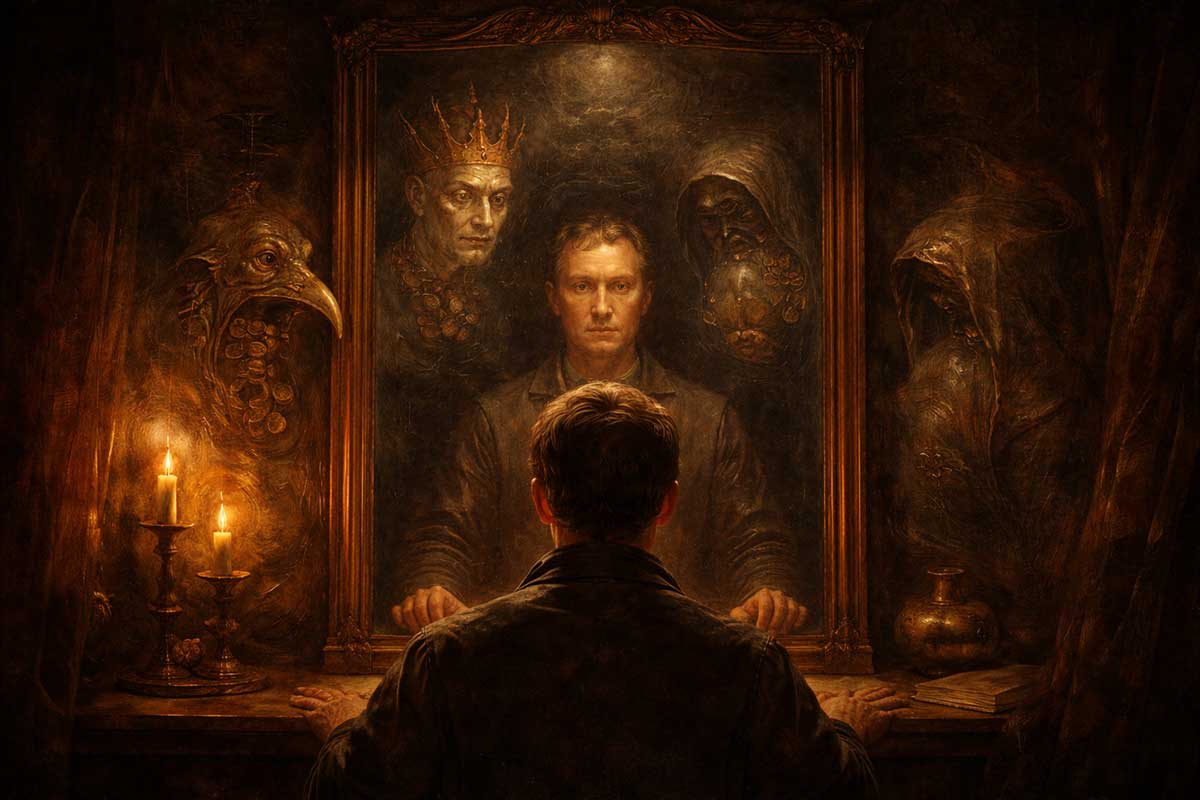
Hieronymus Bosch: People always ask me about the monsters as if I kept them in cages behind my studio. They think I invented them to entertain fear. But the monsters were already walking through the streets—only you called them by polite names.
Larry Silver: That’s exactly where I want to begin. Modern viewers react to your demons like they’re surreal inventions—memes, nightmares, creative spectacle. But in your world, monsters were moral psychology. They were vices with bodies. So let me ask directly: when you painted a demon, what were you painting inside the human?
Hieronymus Bosch: Appetite. Shame. Cruelty. Vanity. Despair. And most of all: the habit of pretending those things belong to someone else.
Larry Silver: That last line is the punch. Because your monsters don’t just attack people; they expose them. They bring out what’s already there. In The Garden and Saint Anthony, the demons feel less like external devils and more like inner forces that have learned to speak in images. Was that the spiritual function—forcing recognition?
Hieronymus Bosch: Yes. A man will confess if he is cornered by his own reflection. But he will argue if you corner him with accusation. So I painted the accusation as a reflection.
Larry Silver: Let’s make this practical. When people look at your hell scenes, they often treat them like a Where’s Waldo of horror—counting details, pointing at oddities. But you’re saying each creature is a moral sentence. Give me an example: what does a hybrid monster—part bird, part human, part machine—allow you to say that a normal figure wouldn’t?
Hieronymus Bosch: A normal figure would let the viewer stay comfortable. A hybrid figure breaks comfort. It shows confusion made flesh—desire mixing with fear, pleasure mixing with punishment, innocence mixing with complicity. Hybrids are what humans become when their inner order collapses. They are contradictions living without shame.
Larry Silver: That’s a strong claim: monsters as the image of inner disorder. It also explains why they don’t feel random. Even the most bizarre creature in your work has a kind of logic—its “job” is legible: it tempts, humiliates, devours, performs, accuses. Was your design process functional?
Hieronymus Bosch: Always. A demon has a role. Otherwise it is just decoration. And I did not paint to decorate.
Larry Silver: Here’s the modern bridge: people today talk about addiction, compulsions, algorithms, systems that “feed” on attention. When they see your demons swallowing people or luring them into rituals, they feel you predicted their world. But you didn’t know smartphones. You knew human habit. Do you think the monsters endure because human habit doesn’t change much?
Hieronymus Bosch: The tools change. The hunger does not. A man will always trade his soul for a sweet moment if he believes the bill won’t come. My monsters are the bill.
Larry Silver: Let’s go deeper: your monsters often punish in ways that fit the sin. It’s not random torture; it’s irony—music becomes noise, desire becomes humiliation, greed becomes ingestion, pride becomes exposure. That’s why your hell feels like moral physics. Are you saying the punishment is intrinsic to the vice?
Hieronymus Bosch: Exactly. Vice contains its own punishment the way rot contains its own smell. Hell is not a separate country. It is a direction.
Larry Silver: That’s terrifyingly clean. Now, many viewers assume the spiritual point is simple: “Be good or else.” But your paintings aren’t simple. There’s humor, grotesque wit, carnival energy. Why include humor in damnation? Why make the monsters sometimes almost… ridiculous?
Hieronymus Bosch: Because sin often looks ridiculous from the outside and irresistible from the inside. Humor is a knife. It cuts the glamour. When a man laughs at a vice, he has one second of freedom from it.
Larry Silver: So the comedy is strategic: it breaks the spell.
Hieronymus Bosch: Yes. The devil hates ridicule more than he hates anger. Anger still grants him importance. Ridicule shrinks him.
Larry Silver: That’s brilliant—and it explains something viewers feel but can’t name: your hell is horrifying, yet it’s also strangely “busy,” like a theater. It’s not pure darkness; it’s an overlit stage of consequences. Which brings me to shame again. Your monsters humiliate. They turn people into objects. Is shame the spiritual engine of your work—or do you see it as a tool that can become either repentance or despair?
Hieronymus Bosch: Shame is a forked road. If a man uses shame to see clearly, it becomes repentance. If he uses shame to hide and harden, it becomes despair. My images show both directions. The viewer chooses which one is his.
Larry Silver: That’s important. Because modern audiences often read your work as purely punitive, almost sadistic. But if shame is a forked road, then your intention isn’t sadism—it’s diagnosis. The monsters diagnose the soul.
Hieronymus Bosch: Yes. Diagnosis is mercy, if the patient accepts it.
Larry Silver: Let’s connect this to specific works without turning into a catalog. In The Temptation of Saint Anthony, the monsters swarm around a saint who refuses to collapse. The saint’s power is not violence; it’s endurance. That suggests monsters are strongest when the inner center is weak. Is that the spiritual lesson?
Hieronymus Bosch: The monster cannot enter a house that is governed. It can knock. It can whisper. But it cannot rule unless invited. Many people invite it because they are tired of governing themselves.
Larry Silver: That’s one of the most modern sentences you could say. Self-governance as spiritual warfare. And it leads to a key question: if monsters are mirrors, does that mean evil is purely internal? What about real cruelty in the world—war, oppression, exploitation? Do your monsters speak to systems too?
Hieronymus Bosch: A system is only a shared habit. When many people agree to call greed “business” and cruelty “order,” the monster becomes a city. I painted individual monsters because that is where responsibility begins—but yes, they grow into systems if the individual refuses to see.
Larry Silver: So the monsters scale.
Hieronymus Bosch: Everything scales—virtue and vice. The soul is the seed of a society.
Larry Silver: Final question for Topic 2. If a viewer wants to engage your monsters properly—without getting stuck in spectacle—what should they do?
Hieronymus Bosch: Choose one monster that repulses you and ask why. Then choose one monster that fascinates you and ask why. Repulsion reveals what you fear. Fascination reveals what tempts you. Between the two, you will find the door to your own interior. That is where the painting truly hangs.
Larry Silver: Perfect. Then Topic 3 takes us into the next layer: not just monsters, but the machines they inhabit—the strange devices, instruments, and contraptions where desire becomes a system. Because once vice becomes a system, it stops feeling like “choice” and starts feeling like destiny.
Topic 3 — The Machinery of Sin: When Desire Becomes a System
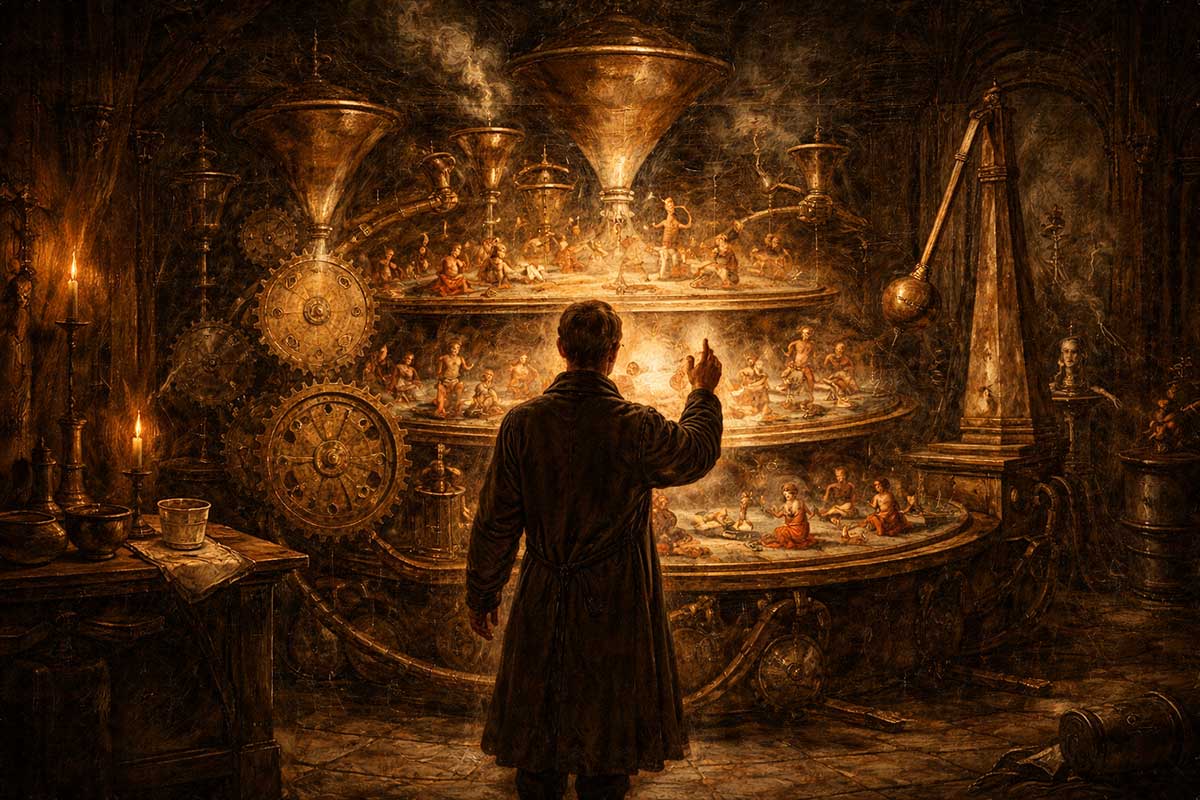
Hieronymus Bosch: You have noticed the devices. Good. Most people stare at my monsters and forget the cages that hold them. But the cage is the true horror—because the cage is built by human hands.
Jos Koldeweij: That’s exactly why I wanted this topic with you, Bosch. People call your imagery “fantasy,” but your contraptions don’t feel like fantasy. They feel like mechanisms—systems that process human behavior. Wheels, funnels, instruments, platforms, knives, pipes, strange helmets, hybrid machines stitched to bodies. It’s as if sin has an engineering department. Are you showing that vice becomes structural?
Hieronymus Bosch: Yes. A single craving is a spark. A repeated craving becomes a ritual. A ritual becomes a system. And a system begins to pretend it is fate.
Jos Koldeweij: That line alone explains why modern viewers feel you’re describing their world. But let’s keep it grounded in your time. Late medieval Europe was full of structures—church discipline, guilds, markets, punishments, public spectacle. Your machines often look like exaggerated versions of what people already knew: instruments of control, tools of labor, tools of entertainment. Were you deliberately transforming everyday tools into moral metaphors?
Hieronymus Bosch: Of course. The most effective symbol is the one the viewer recognizes without admitting it. A tool is never neutral. It teaches the hand a habit. It teaches the mind a rhythm. When a society builds tools for appetite, the appetite becomes inevitable.
Jos Koldeweij: That’s a powerful way to frame it: tools teach habit. In your hell scenes especially, music becomes torture, food becomes grotesque consumption, games become punishment. It’s not random. It’s like each machine is an “education” in what the vice truly is. Is the machine the moment when pleasure reveals its hidden cost?
Hieronymus Bosch: Yes. The machines are the moment when fantasy becomes reality. In the middle panel of The Garden, people play. They chase sweetness. They believe nothing will harden. But in the right panel, the same energies return as mechanics—repetition, coercion, and noise. Sin always wants to become permanent. The machine is permanence.
Jos Koldeweij: Let’s take the “music” theme, because viewers are obsessed with it. In your hell, instruments are everywhere. But instead of harmony, they become pressure—bodies pinned, sound implied as violence. Why music?
Hieronymus Bosch: Because music is one of the closest things to ecstasy. It moves the body without asking permission. When it is ordered, it becomes beauty. When it is disordered, it becomes possession. People think the devil comes as ugliness; often he comes as irresistible rhythm.
Jos Koldeweij: That’s extremely insightful. So the point isn’t “music is sinful,” it’s that any ecstatic force—music, sex, drink, power—becomes destructive if it’s not governed.
Hieronymus Bosch: Exactly. Ecstasy without conscience becomes escape. And escape becomes a home you cannot leave.
Jos Koldeweij: I want to connect this to your “system” idea. In modern terms, people talk about feedback loops—systems that reinforce behavior until it becomes identity. Your machines feel like visual feedback loops. A person enters a device, and the device reshapes them into the very vice they began with. Were you illustrating that repeated sin changes the person’s nature?
Hieronymus Bosch: Yes. Repetition is a sculptor. Whatever you repeat becomes you. People want to believe they can commit a habit without becoming a habitual person. That is a lie. The machine shows the lie made visible: the vice doesn’t just happen to you; it happens through you until you are part of it.
Jos Koldeweij: That’s the spiritual danger: you lose the inner center. Which brings us to a key question. In your work, machines often merge with bodies—helmets that swallow faces, vessels that contain people, creatures that are half-instrument. Why the fusion?
Hieronymus Bosch: Because vice wants intimacy. It doesn’t want to remain an activity. It wants to become identity. When a person wears a habit long enough, it stops feeling like clothing and starts feeling like skin. I painted that fusion so the viewer would feel repulsed—because repulsion can break a spell.
Jos Koldeweij: So disgust is a kind of mercy—if it wakes the viewer up.
Hieronymus Bosch: Exactly. Mercy is not always gentle. Sometimes mercy is a shock.
Jos Koldeweij: There’s also bureaucracy in your machines—procession, order, queues, assembly-line cruelty. Modern viewers see your hell and say it resembles industrial systems or totalitarian logic. But you lived before industrialization. How did you imagine evil as organized?
Hieronymus Bosch: Evil is organized because humans are organized. A crowd is a machine of agreement. When people agree to call cruelty “normal,” cruelty becomes efficient. The devil loves efficiency. It removes the pause where conscience might enter.
Jos Koldeweij: That’s stunning. “Efficiency removes the pause.” That’s a sentence you could paste into a modern critique of technology. And it makes your machines feel prophetic, though they weren’t meant as prediction. They were meant as warning: when the pause disappears, the person becomes programmable.
Hieronymus Bosch: Yes. The pause is the door to repentance. A machine hates doors.
Jos Koldeweij: Let me bring in the “pleasure devices” of The Garden—the shells, bubbles, fruit vessels, strange architecture that seems designed for play. Some viewers interpret the central panel as celebratory. But your logic suggests those are early-stage machines—soft machines. Systems of permission. Is that fair?
Hieronymus Bosch: Very fair. The center is full of soft enclosures: bubbles, shells, fruits. They look harmless. They are training wheels for indulgence. A person learns to live inside a soft enclosure—comfort, novelty, stimulation. Later, when the enclosure becomes hard—addiction, compulsion, shame—he says, “How did I get here?” But he was practicing.
Jos Koldeweij: That creates a chilling continuity across the triptych: soft machines in the middle, hard machines on the right.
Hieronymus Bosch: Exactly. Pleasure is the rehearsal. Consequence is the performance.
Jos Koldeweij: One more layer: many of your devices are absurd—impossible machines, nonfunctional contraptions. Yet they still communicate “system.” Is the absurdity important? Are you suggesting vice is ultimately irrational, even as it pretends to be clever?
Hieronymus Bosch: Yes. Vice pretends to be practical: “I deserve this,” “It won’t matter,” “Everyone does it.” The machine looks clever but is ultimately pointless. That is why it is absurd. The absurdity is a spiritual diagnosis: the soul has built a perfect system to achieve nothing.
Jos Koldeweij: That is brutal—and true. Okay, last question for Topic 3. If a viewer wants to understand your machinery without drowning in detail, what is the simplest lens?
Hieronymus Bosch: Ask: What is this device training? Is it training the viewer to chase, to consume, to perform, to obey, to forget? When you see what it trains, you see what it worships. And whatever a person worships, he becomes.
Jos Koldeweij: Perfect. Then Topic 4 will take us into the most famous “training ground” in your work: The Temptation of Saint Anthony—where the machinery of sin surrounds a human being who refuses to surrender his inner government. Because if Topic 3 is about systems that remove the pause, Topic 4 is about the pause itself: endurance, attention, and spiritual warfare without melodrama.
Topic 4 — Saint Anthony: Spiritual Warfare Without Melodrama
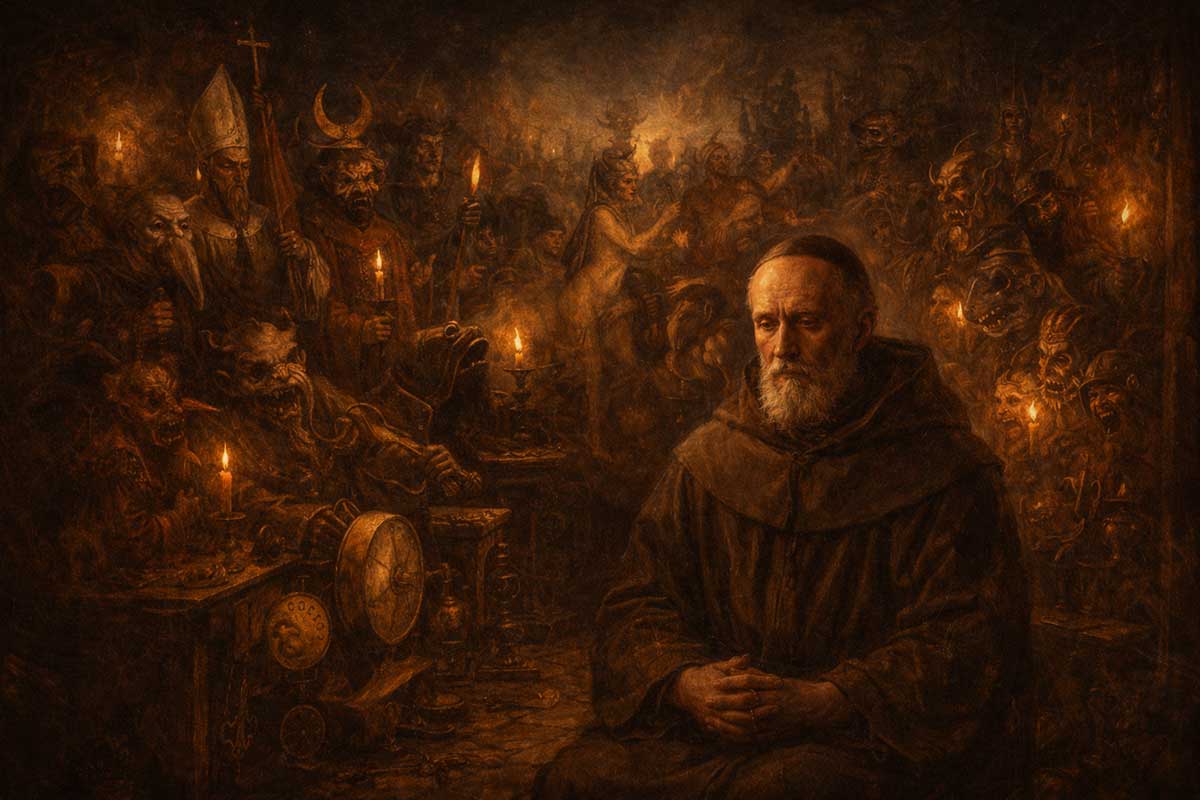
Hieronymus Bosch: People love the monsters in Saint Anthony because they can point at them and feel clever. But Saint Anthony is not a spectacle of monsters. It is a portrait of a man holding his center while the world tries to rent it.
Matthijs Ilsink: That’s a perfect place to start, because most viewers approach the triptych as chaos—swarming creatures, burning structures, collapsing logic. But if we treat it like you treated The Garden—as a spiritual map—then the subject isn’t the chaos; it’s what happens inside a person surrounded by it. What does Saint Anthony represent to you: holiness, endurance, or something more psychologically precise?
Hieronymus Bosch: He represents the governed soul. Not the flawless soul. Not the proud soul. The governed one. A person who refuses to let hunger take the throne.
Matthijs Ilsink: That word—governed—keeps returning. In Topic 3 you said “the pause is the door to repentance.” In Saint Anthony, the demons seem to attack the pause itself. They want Anthony reactive: frightened, enraged, aroused, humiliated. But he doesn’t give them the reaction. Is that the heart of spiritual warfare?
Hieronymus Bosch: Yes. The devil’s greatest weapon is not temptation; it is urgency. If he can make you urgent, he can make you stupid. He can make you choose quickly, and quick choices are rarely guided by conscience.
Matthijs Ilsink: That’s… disturbingly modern. So Anthony’s holiness is not primarily about purity, but about refusing urgency. Refusing to be rushed out of himself.
Hieronymus Bosch: Exactly. People imagine sainthood as an emotional perfume. It is not. It is attention trained to remain intact.
Matthijs Ilsink: Let’s unpack how you show that visually. In your triptych, the demons are varied—some grotesque, some comic, some seductive, some bureaucratic, some animal-like. You’re not repeating one “devil.” Why? Are you showing that temptation adapts to the person?
Hieronymus Bosch: Temptation is opportunistic. It studies you. It wears whatever face you will entertain. If you are proud, it becomes flattery. If you are lonely, it becomes romance. If you are exhausted, it becomes comfort. If you are ashamed, it becomes numbness. The demons are not creatures from a bestiary. They are masks for strategies.
Matthijs Ilsink: So the painting is not about medieval fear of hell. It’s about pattern recognition: seeing strategies as strategies.
Hieronymus Bosch: Yes. If you can name the strategy, it loses half its power. The demon hates being recognized.
Matthijs Ilsink: That connects to the famous paradox of Saint Anthony: it’s packed with detail, yet the spiritual center is often quiet. The saint isn’t the loudest thing on the canvas. He’s often steady, almost small compared to the spectacle. Was that a deliberate contrast—quiet strength versus noisy temptation?
Hieronymus Bosch: Yes. Noise is the instrument of chaos. The demons are loud because they must drown out the one thing they cannot tolerate: inner silence. Anthony’s steadiness is not dramatic because drama belongs to the demon, not to the saint.
Matthijs Ilsink: Then we should talk about the temptations themselves. In the tradition, Anthony is tempted by lust, power, and despair. In your world, lust isn’t just erotic; it’s appetite broadly—anything that promises escape. When you paint seductive scenes—banquets, alluring figures, bizarre invitations—are you warning viewers about pleasure, or about the loss of governance?
Hieronymus Bosch: The loss of governance. Pleasure is not the enemy. Slavery is. When pleasure becomes the master, the person becomes less human. Anthony is tempted not by pleasure, but by surrender—by the relief of letting something else decide.
Matthijs Ilsink: That’s profound: surrender as relief. You’re basically describing what modern people call coping mechanisms.
Hieronymus Bosch: You call it coping. I call it the first brick of a prison.
Matthijs Ilsink: Oof. But you also paint religious hypocrisy in these scenes—corrupt clergy, grotesque rituals, parody of sacred acts. Some people think you’re anti-Church. Others think you’re protecting the true spirit of faith by attacking its counterfeit. Which is closer?
Hieronymus Bosch: Counterfeit holiness is more dangerous than obvious vice. Obvious vice can be resisted. Counterfeit holiness persuades the soul to sleep. It says, “You are righteous,” while the heart rots. I painted parody so the viewer would feel the discomfort of recognizing false sanctity.
Matthijs Ilsink: So your demons aren’t only external temptations—they include internal self-deception: pride disguised as virtue.
Hieronymus Bosch: Exactly. The demon’s finest costume is righteousness.
Matthijs Ilsink: Let’s return to the idea of “spiritual warfare without melodrama.” Many religious artworks depict saints fighting demons with dramatic gestures, heroic violence, divine light beams. Your Anthony often feels… resigned, steady, almost bored with the demons. Why remove the melodrama?
Hieronymus Bosch: Because melodrama flatters the ego. It turns struggle into performance: “Look how spiritual I am.” Anthony’s strength is not a show. It is a refusal to perform. He stands where he stands. The demons dance because they want attention. He does not pay them.
Matthijs Ilsink: So the saint wins by starving the demons of attention.
Hieronymus Bosch: Yes. Attention is food. Many people feed what they hate by staring at it.
Matthijs Ilsink: That’s one of the most useful modern takeaways. People get trapped by doom-scrolling, spirals of fear, obsessive anger, compulsive distraction. Your Anthony is basically the person who says: “I will not live inside your rhythm.”
Hieronymus Bosch: Exactly. He keeps his own rhythm. That is holiness.
Matthijs Ilsink: One more crucial question. In your world, temptation is constant. Does that mean you believe humans are doomed to struggle forever? Or is the point that struggle can become a teacher?
Hieronymus Bosch: Struggle can be a teacher if you learn its lessons. Temptation reveals what you still worship. When you resist wisely—not with pride, but with clarity—you become more free. Freedom is not the absence of temptation. Freedom is the ability to choose without being dragged.
Matthijs Ilsink: That’s a beautiful definition. Final question for Topic 4: if Anthony is the governed soul, what is the single practice that keeps him governed?
Hieronymus Bosch: He protects the pause. He refuses urgency. He remembers the end while the demon sells him a moment.
Matthijs Ilsink: Then Topic 5 is the natural conclusion: death, judgment, greed, repentance—the “last things.” Because if Saint Anthony is how you fight temptation in the moment, Topic 5 is how you view your life from the end—so you don’t sell your soul for a day and realize too late what you traded.
Topic 5 — Judgment, Mercy, and the Last Things: Seeing Life From the End
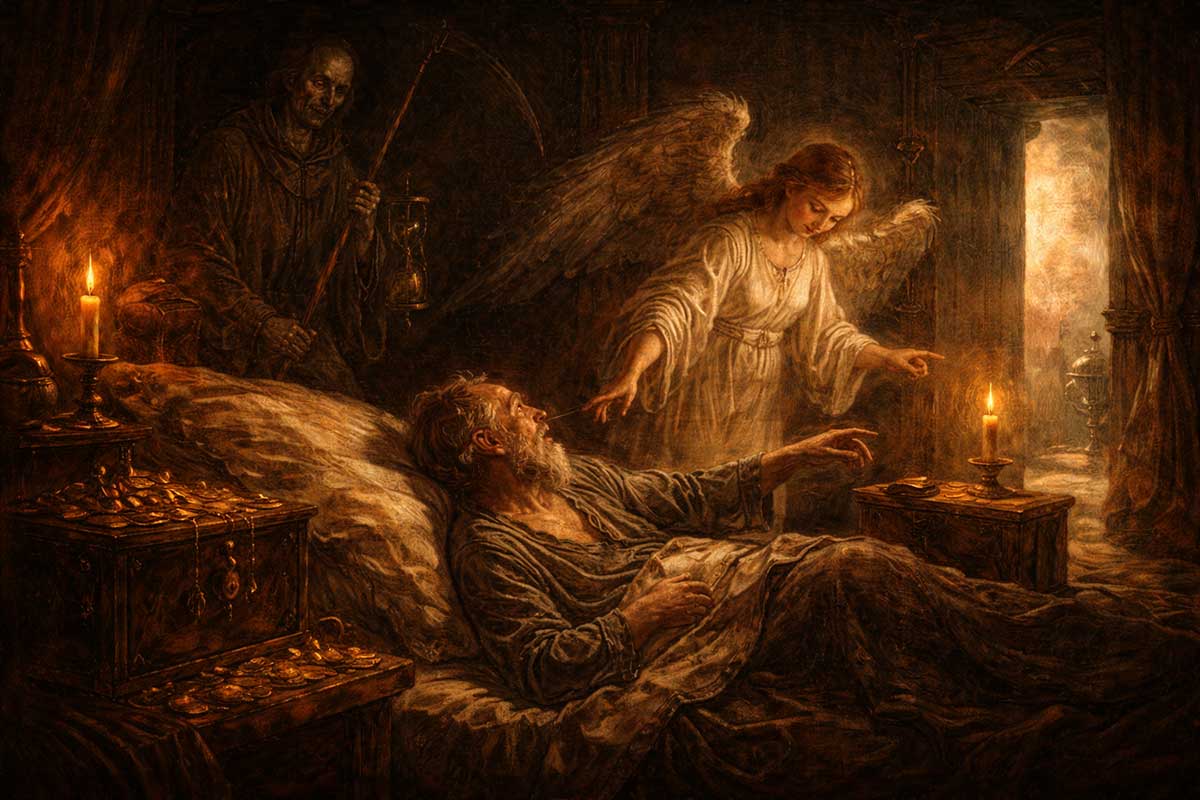
Hieronymus Bosch: People think my paintings are obsessed with hell. They are wrong. I am obsessed with late understanding—the moment a person finally sees what he has been doing, when there is no time left to pretend.
Reindert Falkenburg: That’s the right doorway. Because “the last things” in your world—death, judgment, repentance, mercy—aren’t only doctrines. They’re spiritual optics. You force the viewer to look at life from the end, so the middle can’t lie anymore. When you paint works like Death and the Miser, you’re not merely threatening; you’re clarifying. What is the spiritual function of the end in your work?
Hieronymus Bosch: The end is the only honest teacher. In the middle of life, people can bargain with themselves. They can invent stories: “later,” “not that bad,” “I deserve it.” But death removes language. Death turns every excuse into silence. Then the truth stands in the room.
Reindert Falkenburg: And that’s why your judgment scenes feel like “moral physics,” not revenge. Let’s talk about the most human part: greed. In Death and the Miser, the miser is surrounded by objects and still reaches for more—while death arrives. Many viewers read it as anti-money. But I think you’re after something deeper: the spiritual deformity of clutching when reality is asking for release.
Hieronymus Bosch: Exactly. Money is not the enemy. Clutching is. The miser is not condemned for owning; he is condemned for belonging to what he owns.
Reindert Falkenburg: That’s an important distinction—ownership versus belonging. Your work suggests that what we cling to becomes our master. And in the final moment, the master demands payment.
Hieronymus Bosch: Yes. Every attachment collects interest.
Reindert Falkenburg: That line could be printed on the frame. Now, when modern audiences see your hell or last judgment scenes, they sometimes recoil: “This is fear-based religion.” But your framing makes it feel like a compassion-based warning: you’re trying to spare people from late understanding. In other words, you’re trying to move the moment of recognition earlier—when it can still change something.
Hieronymus Bosch: Exactly. Fear can awaken a sleeping man. But I do not paint fear to control. I paint fear to interrupt the trance.
Reindert Falkenburg: The trance of “there will be time later.”
Hieronymus Bosch: Yes. That is the most dangerous faith: faith in endless time.
Reindert Falkenburg: Let’s bring in mercy, because without mercy your work would collapse into sadism. Where is mercy in Bosch? Viewers don’t always see it because the images are so intense.
Hieronymus Bosch: Mercy is in the warning itself. Mercy is in the mirror offered before the cliff. Mercy is also in the quiet figures who resist the crowd—in the moments of pause, of prayer, of refusal. People look at the monsters because monsters are loud. But the mercy is often small, like a candle.
Reindert Falkenburg: A candle in a storm. That’s how it feels. And it connects to Saint Anthony: protecting the pause. So in Topic 5, you’re giving the viewer a different kind of pause: not the pause in the moment of temptation, but the pause of looking at your whole life from its last day.
Hieronymus Bosch: Yes. If you can see your life from the end, you become harder to manipulate in the middle.
Reindert Falkenburg: That is incredibly practical. Now, another major theme in your “last things” works is self-deception. You show people surrounded by signs of warning—death in the room, angels, devils, the consequences everywhere—and still choosing the old habit. Why are humans so stubborn in your world?
Hieronymus Bosch: Because habit is comfortable even when it is killing you. Humans would rather suffer a familiar chain than risk an unfamiliar freedom. The miser knows his money will not save him, and still he reaches. That is the tragedy: the hand learns a motion and keeps doing it after the heart has changed.
Reindert Falkenburg: That’s psychological truth. But spiritually, it raises a question: is judgment something that happens to us, or something that happens within us—when the soul finally sees itself?
Hieronymus Bosch: Judgment is the soul seeing itself without the fog of excuses. Whether you call it God’s judgment or self-judgment, the experience is the same: truth arrives, and you cannot bargain with it.
Reindert Falkenburg: Which makes your hell imagery feel less like torture chambers and more like “truth visualized.” The punishments match the vices because they reveal what the vice already was. Lust becomes humiliation, greed becomes devouring, vanity becomes exposure, cruelty becomes being treated cruelly. You’re saying: sin contains its own judgment.
Hieronymus Bosch: Yes. Hell is a vice completed. Heaven is a virtue completed. Completion is terrifying because it removes ambiguity.
Reindert Falkenburg: That’s the clearest expression of your moral universe. Let me ask a modern question: what would you say to a viewer who loves your work aesthetically but resists the religious frame? They might say, “I don’t believe in judgment.” How do they still receive Topic 5?
Hieronymus Bosch: They already believe in judgment. They judge themselves every night in secret. They judge others every day in public. They believe in consequence when it harms them. The question is not belief. The question is: will you use judgment to wake up, or will you use it to punish and harden?
Reindert Falkenburg: So you’re turning judgment into an inner instrument—an ethical tool.
Hieronymus Bosch: Yes. The end is a tool. Death is a tool. Not to terrify you into obedience—but to free you from trance.
Reindert Falkenburg: Last question, Bosch. If someone stands before Death and the Miser or any “last things” work and wants to apply it to their life without falling into despair, what should they do?
Hieronymus Bosch: Do not ask, “Am I doomed?” Ask, “What am I clinging to that makes me less alive?” Then release one small thing today. Not as punishment— as liberation. The devil loves big promises for tomorrow. God loves small releases today.
Reindert Falkenburg: That’s an extraordinary closing. Because it frames your entire spiritual code as a practice: map temptation, recognize the monster, resist the machine, protect the pause, and view life from the end—so you can live awake in the present.
Hieronymus Bosch: Exactly. The painting is finished when the viewer changes one act.
Reindert Falkenburg: Then our final panel will gather the full circle. We’ll ask what makes Bosch “spiritual,” not merely strange—and why your moral universe still feels like a blueprint for the modern mind.
Topic 6 — Panel: What Makes Bosch “Spiritual”…and Not Just Weird?
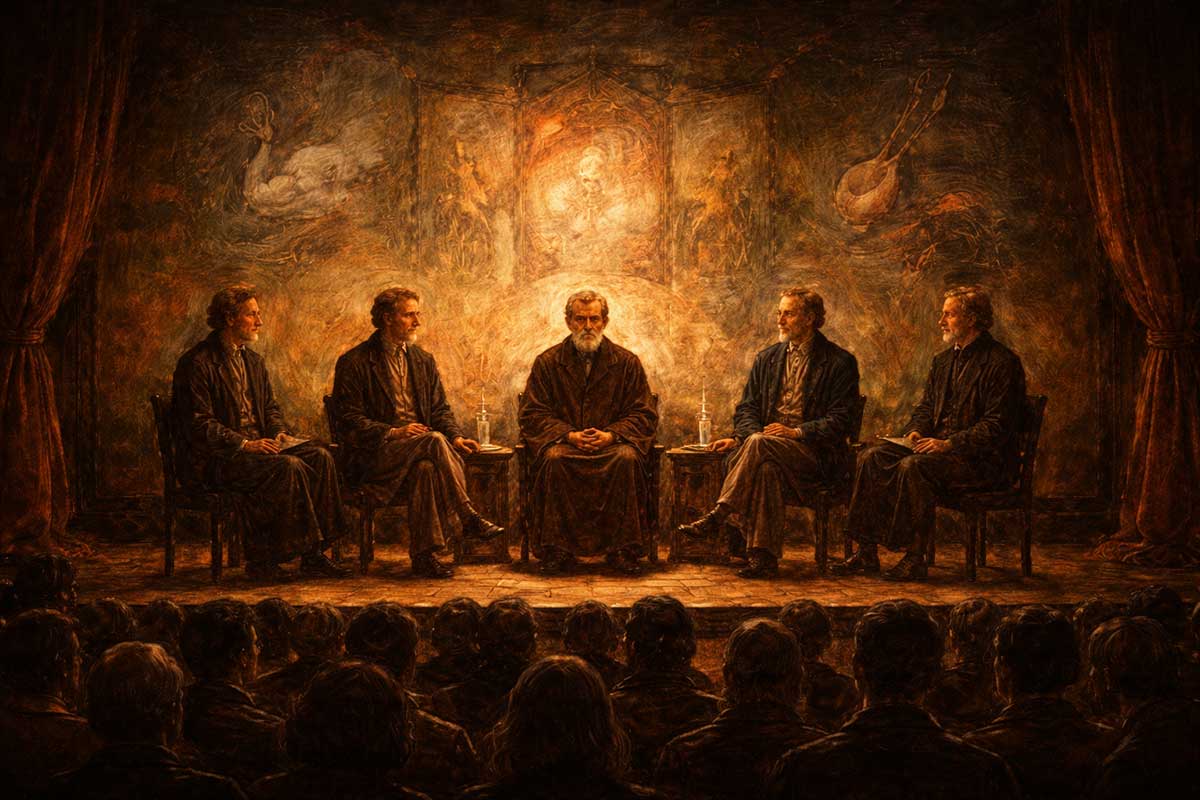
Reindert Falkenburg: Good evening. We’ve walked through five rooms of Bosch’s moral universe—temptation as landscape, monsters as mirrors, systems as machinery, Saint Anthony as inner governance, and the last things as late understanding. Now we bring everyone together for one question that viewers always ask in one form or another: What makes Bosch “spiritual” and not merely strange?
Bosch, you’re at the center of this panel. If you had to answer in one line—what is the spiritual core of your work?
Hieronymus Bosch: I paint the moment a human being realizes he is not innocent.
Jos Koldeweij: That’s blunt—and accurate. But people today hear “spiritual” and think “mystical” or “uplifting.” Your work is neither soft nor sentimental. It’s disciplined and unsettling. So perhaps spirituality here means something different: moral perception. Would you say your paintings are spiritual because they train the viewer’s conscience?
Hieronymus Bosch: Yes. A conscience is an organ. If it is not exercised, it atrophies. My paintings are weights.
Larry Silver: That explains why your work feels like psychological realism disguised as fantasy. Modern viewers often treat your monsters like surreal comedy. But we argued in Topic 2 that they’re not random—they’re habits given faces. I want to push a question: are your monsters external devils or internal drives?
Hieronymus Bosch: Both. The world and the heart collaborate. A man’s inner hunger finds the world’s outer bait. Call it demons, call it temptation, call it habit—names do not change the mechanism.
Matthijs Ilsink: Mechanism—that’s key. In Topic 3 we talked about systems that remove the pause. Bosch, you said “the cage is built by human hands.” If your art is spiritual, then it’s not about believing in hell as a place. It’s about recognizing how we build hell as a process. Is that fair?
Hieronymus Bosch: Yes. Hell begins as a small convenience.
Reindert Falkenburg: “A small convenience”—that’s an insanely modern phrase. It makes Bosch feel contemporary without needing to claim he predicted anything. But let’s address what audiences love most: the details. People stand before your triptychs like detectives. Scholars debate every bird and berry. How do we help the viewer not turn Bosch into trivia?
Hieronymus Bosch: Ask where you are standing in the painting. Not which creature is which.
Larry Silver: That’s your “map” instruction from Topic 1: the traveler is the subject. I’d add something: Bosch stages moral experience as choice under seduction. The center panel of The Garden is bright and playful. That brightness is the danger. So the spiritual power is that he shows temptation as it actually arrives—beautiful, communal, justified—rather than as a horned villain.
Jos Koldeweij: Exactly. The spirituality isn’t a theology lesson, it’s a training in realism about desire. And Bosch uses structure to do it. The triptych format is not a gimmick; it’s spiritual architecture: origin, indulgence, consequence. A viewer walks it.
Matthijs Ilsink: And in Saint Anthony, Bosch shows another spiritual truth: holiness is not melodrama. It’s refusal. Anthony’s victory is not a heroic battle scene. It’s the protection of attention. That’s a spiritual teaching almost anyone can understand, religious or not: don’t let noise govern you.
Reindert Falkenburg: So we already have several candidate answers for “what makes Bosch spiritual”:
spiritual architecture (triptychs as roads),
moral psychology (monsters as habits),
systemic critique (machines as feedback loops),
inner practice (Anthony as attention),
end-of-life clarity (late understanding).
Bosch, which of these is closest to what you think people should carry home?
Hieronymus Bosch: The end.
Larry Silver: The end as in death, judgment, consequence.
Hieronymus Bosch: Yes. In the middle of life, people can lie to themselves. The end removes language. It removes excuses. If you can see your life from the end, you become difficult to tempt.
Jos Koldeweij: That connects everything. The triptych is a life. The “machine” is repetition over time. Saint Anthony is the pause that prevents ruin. And the last things are the lens that exposes the true cost of indulgence. This is why your work still shocks people: because modern life is built to hide the end. We live as if time is endless.
Matthijs Ilsink: I want to ask the question many viewers are afraid to say out loud: is Bosch’s spirituality fear-based? Are you trying to terrify people into obedience?
Hieronymus Bosch: I am trying to wake them before it is too late.
Larry Silver: That’s the crucial difference: fear as control versus fear as interruption of trance. Your humor supports that, too. Bosch uses grotesque wit to puncture glamour—ridicule to shrink the vice. That’s not control; that’s liberation.
Reindert Falkenburg: Let’s bring in another big modern question: people say, “Bosch is just weird.” They mean: it’s so idiosyncratic that it can’t be a spiritual system. What do we say to that?
Jos Koldeweij: I’d answer: the strangeness is a method. Bosch must estrange the viewer from their habits, because habit is the enemy of conscience. If the image looks familiar, the viewer stays asleep. Bosch makes familiarity impossible. That is spiritual technique.
Matthijs Ilsink: And from a material/art-historical angle, there’s also this: Bosch is rooted in a world of sermons, morality plays, devotional practices, and public rituals. His “weirdness” is not random invention—it’s a visual language that speaks to that culture’s moral imagination. Spirituality here means belonging to a shared moral cosmos, even if we’ve forgotten the dictionary.
Larry Silver: Which raises the next question: do we need the dictionary? Must viewers know medieval iconography to feel Bosch?
Hieronymus Bosch: No. You need honesty, not education.
Reindert Falkenburg: I love that. But as a scholar I’ll still defend the value of context—because context can prevent lazy projection. Yet Bosch is right: the paintings work because they touch something universal—temptation, self-deception, crowd permission, late regret. Those do not require Latin.
Jos Koldeweij: Here’s a spicy panel question, then: Bosch’s canon has attribution debates. Some works are Bosch, some workshop, some later imitators. Does that uncertainty weaken the spiritual reading?
Larry Silver: Not necessarily. If the “Bosch mode” became a language, that itself is part of the spiritual story: the culture wanted this kind of mirror. But attribution does matter for how we interpret intention. Bosch’s sharpness is not always matched by imitators. Some copy the grotesque and miss the diagnosis.
Matthijs Ilsink: Exactly. Copies often amplify spectacle and reduce structure. Bosch’s strength is the system: the moral architecture and the psychological precision. When that’s absent, you’re left with monsters without meaning.
Reindert Falkenburg: Bosch, do you mind being copied?
Hieronymus Bosch: I mind being misunderstood.
Reindert Falkenburg: That might be the most Bosch sentence possible.
Larry Silver: Let’s close with one sentence from each of us: “What makes Bosch spiritual?”
Jos Koldeweij: Bosch is spiritual because he reveals how small indulgences become systems—and how systems erase the pause where the soul can choose.
Larry Silver: Bosch is spiritual because his monsters are mirrors: he turns inner drives into visible faces so the viewer can recognize what they feed.
Matthijs Ilsink: Bosch is spiritual because he teaches a practice: Saint Anthony’s quiet refusal to be ruled by noise, urgency, or performance.
Reindert Falkenburg: Bosch is spiritual because he builds a moral landscape the viewer must walk—origin, temptation, consequence—until they locate themselves.
Hieronymus Bosch: Bosch is spiritual because he tells the truth with pictures: you are always becoming what you repeat.
Reindert Falkenburg: And that is the thread that ties all six talks together. Bosch is not “weird” for the sake of weirdness. He is precise. He is diagnostic. He is constructing a spiritual instrument—a mirror, a map, and a warning—so the viewer can wake up before late understanding arrives.
Final Thoughts by Hieronymus Bosch
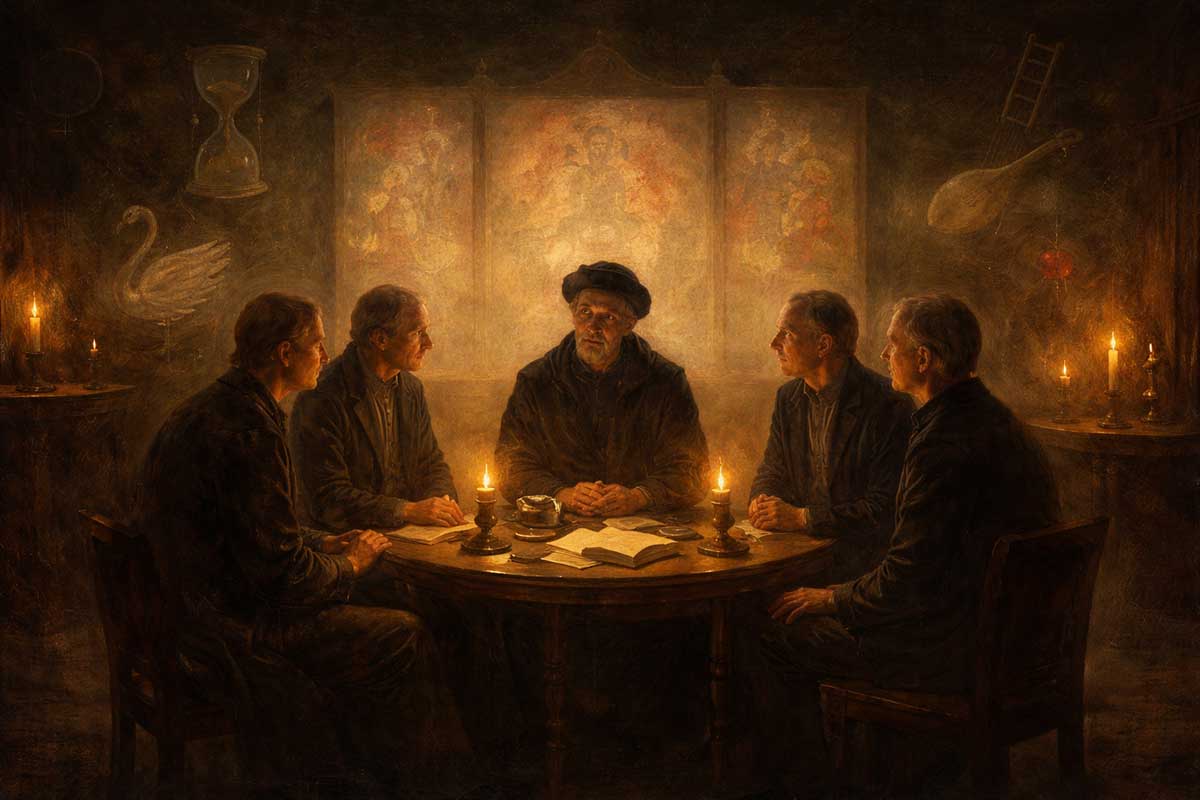
If you remember nothing else, remember this: the painting is not finished when I set down the brush. It is finished when you change one act.
The true danger is not the monster. The true danger is the moment you say, “This is not about me.” That sentence is the door through which every vice enters. My creatures are not distant demons meant for superstition. They are shapes for your own patterns—your hungers, your excuses, your entertainments, your urgencies, your self-deceptions. They are mirrors disguised as nightmares.
When you leave this series, do not carry my images like trophies. Carry one question instead: What do I repeat that makes me less free? Then protect the pause where you can choose differently. Refuse the small convenience that steals your conscience. Refuse the crowd’s permission when it demands you become numb. Refuse the performance that calls itself virtue. Keep your attention intact.
And remember the end—not as panic, but as clarity. The end is the honest teacher. If you can see your life from its last day, you will stop trading your soul for a moment that cannot keep its promises.
My work is called strange because it refuses to flatter. But the purpose is not despair. The purpose is waking. If you wake, even once, you will understand what I meant by “spiritual”: not a dream, but an inner government—strong enough to remain human in a world that is always asking you to become less.
Short Bios:
Hieronymus Bosch — Netherlandish painter (c. 1450–1516) whose visionary triptychs turn temptation, vice, and judgment into densely symbolic “moral landscapes,” blending satire, theology, and psychological insight.
Reindert Falkenburg — Bosch scholar known for close iconographic readings that treat Bosch’s triptychs as spiritual “maps” guiding the viewer through choice, desire, and consequence.
Jos Koldeweij — Leading Bosch expert associated with major research and exhibitions, valued for grounding Bosch’s imagery in late-medieval visual culture and devotional practice.
Matthijs Ilsink — Art historian tied to modern Bosch scholarship and technical study, attentive to how Bosch’s works function as systems of meaning rather than mere spectacle.
Larry Silver — Prominent historian of Northern Renaissance art who reads Bosch through moral allegory, social context, and the psychology of vice and self-deception.
Leave a Reply