
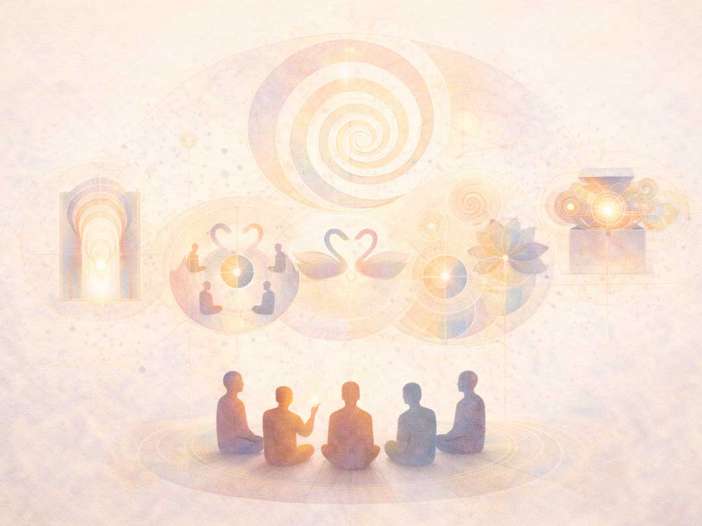
What if Hilma af Klint explained her spiritual paintings with leading scholars—step by step, symbol by symbol?
Introduction by Hilma af Klint
I did not paint these works to decorate a room. I painted them to build one.
When I began what later came to be called my Temple paintings, I understood—even then—that the visible world is not the whole world. Beneath appearances there are laws, currents, polarities, and quiet architectures that shape everything: how a seed becomes a flower, how a thought becomes a life, how a soul becomes capable of greater truth. My task was to translate that hidden order into form—into color, proportion, rhythm, and symbol—so that the eye could learn what the mind too often forgets.
Many will ask if these paintings were “guided,” and by what. Some will argue about spirits. Some will reduce everything to psychology. I do not insist on one vocabulary. I only insist on seriousness. What matters is that the work was made through discipline: attention refined until it could receive, and judgment refined until it could arrange. The paintings are not riddles to be conquered. They are corridors. You walk them, and your way of seeing changes.
In this series we entered the Temple through five rooms: instruction, method, symbol language, nature-as-diagram, and the long silence of timing. At the end we gathered in a panel to ask the question that lives underneath them all: what single thread holds the Temple together? If you stay with me, do not rush to interpret. Let the forms work like music. Their meaning lives in relationship, repetition, and quiet pressure—until something in you becomes still enough to recognize what has been there all along.
(Note: This is an imaginary conversation, a creative exploration of an idea, and not a real speech or event.)
Topic 1 — The Instructions: “Paintings for the Temple”
Julia Voss: Hilma, I want to start where most people think the story begins: the moment you say you were “assigned” a body of work—what later becomes known as the paintings for the Temple. But the myth version makes it sound like lightning struck and you instantly became a prophet of abstraction. The real version feels more human, more deliberate. Before we touch a single symbol, tell me: what did “instruction” actually feel like?
Hilma af Klint: It did not feel like lightning. It felt like pressure—gentle pressure, but constant. Like a hand placed on your back when you hesitate at a doorway. I was trained to paint what the world agreed was real: portraits, landscapes, the measurable surface. And yet, beneath that surface, I sensed another order—patterns that did not belong to objects, but to meaning. When the instruction came, it was not a command that shattered my mind. It was a direction that clarified it.
Julia Voss: So it was less a spectacle, more an alignment.
Hilma af Klint: Yes. And it carried responsibility. That is what people misunderstand. They imagine a mystical thrill. But what I felt was obligation—the seriousness of being asked to build something that was not for my lifetime.
Julia Voss: That phrase—“not for your lifetime”—is one reason the work feels spiritual to modern viewers. It sounds like you were painting for a future audience you would never meet. Did that certainty come immediately?
Hilma af Klint: It came with the tone of the message. Not the words—people become obsessed with words—but the tone. The tone was patient. It was not urgent like politics. It was not flattering like vanity. It was calm like geology. It suggested time was wide.
Julia Voss: When you say “Temple,” many people picture a literal building. But the closer you get to your notebooks and the way you organized the series, the more it feels like a mental architecture—an inner structure. In your mind, was the Temple a place, an idea, or a future state of perception?
Hilma af Klint: All three. A Temple is a place where the human being approaches what is larger than the human being. It can be built of stone, but it can also be built of attention. I believed the paintings could function as rooms—chambers that trained the viewer to look differently, to sense relationships invisible to the ordinary gaze. If there was a physical Temple, it would only be the outer shell. The inner Temple was always the seeing.
Julia Voss: That’s the thing: your abstraction isn’t abstraction as style. It’s abstraction as function. The forms aren’t there to be modern; they’re there to do something to the viewer.
Hilma af Klint: Exactly. The work was meant to work.
Julia Voss: Let’s get concrete. When the Temple paintings begin, we see repeating systems: symmetry and imbalance, paired colors, spirals, ovals, segmented circles. People want a decoder ring immediately—“this equals that.” But you weren’t making a crossword puzzle. You were building a language. How did you decide what the first “letters” of that language would be?
Hilma af Klint: You choose what can carry multiple truths at once. A spiral can be growth, and it can be descent. An oval can be womb, and it can be orbit. A line can be division, and it can be connection. Symbols are not numbers. They are vessels. If the vessel is strong, it can hold contradictions without breaking.
Julia Voss: That’s a very modern way to put it: symbols as containers for paradox. And it explains why viewers feel your paintings are “alive.” They don’t close into one meaning; they keep opening.
Hilma af Klint: They must open. If a symbol closes, it becomes propaganda. The spiritual is not propaganda. It does not force the mind. It invites the mind into a wider room.
Julia Voss: Did you worry, as you began, that art history would misunderstand you? That people would flatten the work into “she invented abstraction early” and miss the actual intent?
Hilma af Klint: I did not think in those terms. “Art history” was not the authority for me. The authority was the assignment itself. The work did not ask me to be first. It asked me to be faithful. If I had chased recognition, I would have contaminated the clarity. Recognition is noisy.
Julia Voss: There’s a tenderness in that, but also a kind of severity: fidelity over fame. Still, you were a working artist in a real world. You had peers, institutions, expectations. When you sat down to begin the Temple paintings, did you feel fear?
Hilma af Klint: Yes. Not fear of spirits. Fear of myself—fear that I would not be capable of staying clean inside. Because the human mind always wants to decorate the message with ego. It wants to say, “Look at me.” I had to learn to say, “Look through me.”
Julia Voss: That’s the line I wish every viewer could hear before they see the work: not “look at me,” but “look through me.” It changes the entire experience.
Hilma af Klint: And it changes what we mean by spiritual. Spiritual does not mean floating away from life. It means making oneself transparent enough for meaning to pass into form.
Julia Voss: One last question for Topic 1, then we’ll move to the next chamber. If a modern viewer stands in front of your Temple paintings and whispers, “What are you trying to tell me?”—what would you want the most honest answer to be?
Hilma af Klint: I would want them to hear: “You are not only what you can measure.” And also: “Do not rush.” These paintings were made for eyes that can slow down.
Julia Voss: Then let’s go to Topic 2, because slowing down is exactly what the next part demands: how the work was made, who was present, and what “guidance” really meant when the room went quiet.
Topic 2 — The Five: Mediumship, Method, Skepticism
Tracey Bashkoff: Hilma, I want to enter the most misunderstood room in your story: The Five—the circle you formed with four other women, and the way your work emerged through séances, scripts, and what you called “guidance.” In museums, this often gets treated like a curious footnote. Online, it gets treated like proof you were either a prophet or a fraud. How would you describe The Five in plain language, without romance and without apology?
Hilma af Klint: We were women who took the invisible seriously. Not as entertainment. Not as theater. As practice. We met, we read, we listened, we wrote. We tried to become accurate instruments. If you want plain language: we were training ourselves to perceive patterns beyond the ordinary senses—and to record them carefully.
Tracey Bashkoff: “Accurate instruments” is a striking phrase, because people assume mediumship is chaotic. But your notebooks feel systematic. Even your paintings feel engineered. What was the method inside the mystery?
Hilma af Klint: The method was discipline. Silence. Repetition. A willingness to be corrected. When people imagine a séance, they imagine excitement, candles, drama. For us, it was closer to laboratory work—except the laboratory was the mind and the heart. We began with prayer, with intention, with a kind of inner cleaning. Then we wrote what arrived. We compared. We questioned. We returned again and again.
Tracey Bashkoff: So you didn’t treat “messages” as unquestionable. You treated them as data.
Hilma af Klint: Not “data” in the modern sense, but yes—something to be tested by consistency. If a message contradicted itself too easily, if it flattered us, if it fed vanity, we distrusted it. That is important. The ego is always waiting nearby with a mask.
Tracey Bashkoff: That’s the skepticism inside the spiritual practice, which people don’t expect. Let’s name the central problem: viewers today ask, “Did you really believe spirits told you what to paint?” But there’s another, deeper question: “How do we honor your lived reality without asking modern audiences to share your metaphysics?” What answer would you want?
Hilma af Klint: I would want them to focus on function rather than superstition. Whether you believe in spirits, the real question is: what did the practice produce? It produced a language of form that could hold things ordinary painting could not hold—contradictions, layers, time, inner motion. It produced work that was not made for fashion. It was made for transformation.
Tracey Bashkoff: You’re shifting the conversation from “Is it true?” to “What does it do?”
Hilma af Klint: Exactly. Modern people often ask the wrong question because they fear being fooled. But art is not a courtroom. Art is an encounter. If the encounter expands you, then something true has happened—whether or not you can explain it with the tools you prefer.
Tracey Bashkoff: Still, as a curator, I have to anticipate the skeptical viewer. They’ll say: “Abstract art was already developing. Maybe she just absorbed trends.” Or: “Maybe this is automatic drawing dressed up as mysticism.” What would you say to someone who reduces The Five to a psychological trick?
Hilma af Klint: I would say: you are free to call it psychological. But do not call it careless. People imagine automatic work as sloppy. Yet if you look closely, you see structure—series, stages, internal logic. Psychological life also has laws. If you insist it was my subconscious speaking, then you must also admit the subconscious can be wiser than the conscious mind. And then you are back at the edge of spirituality again, only with different vocabulary.
Tracey Bashkoff: That’s an elegant trap: skepticism leads you back to the same mystery, just renamed.
Hilma af Klint: Precisely. Many people are not opposed to mystery. They are opposed to the word “spirit.” Replace it with “intuition,” “unconscious,” “pattern recognition,” “nonlinear cognition”—and they relax. I do not mind what word they choose, as long as they approach the work with seriousness.
Tracey Bashkoff: Let’s talk about the circle itself. The Five were women in a world that didn’t grant women full authority in art or religion. How much of The Five was spiritual necessity, and how much was social necessity—creating a space where you could be powerful without asking permission?
Hilma af Klint: Both. We needed a room where our inner lives were not treated as decoration. A room where our intelligence was not dismissed as sentiment. In that sense, yes, it was social. But it was also spiritual because we believed the world was larger than the roles we were given. The circle was a vow: we would not reduce ourselves to what society expected.
Tracey Bashkoff: There’s also the question of collaboration. People are used to the myth of the lone genius. But The Five implies something communal: receiving together, testing together, holding the work together. Did the group change the way you perceived guidance?
Hilma af Klint: Yes. Alone, you can be seduced by your own voice. In a circle, you are confronted with difference. Someone hears something you didn’t. Someone challenges your interpretation. That friction can purify the message. The group also created courage. It is easier to enter the unknown when you are not alone.
Tracey Bashkoff: And yet, you eventually move into a phase where you’re producing the Temple paintings with a kind of solitary intensity. Was that a departure from the circle, or an evolution of what the circle taught you?
Hilma af Klint: Evolution. The Five were my training. They strengthened the muscles of receptivity and precision. But a large commission—especially one that felt assigned—required another kind of solitude. Not loneliness. Solitude: the ability to hold a long thread without dropping it.
Tracey Bashkoff: Here’s the heart of Topic 2: the tension between “guided” and “authored.” When you painted those vast sequences, did you feel you were executing instructions, or making choices?
Hilma af Klint: Both. Guidance without choice is mechanical. Choice without guidance is ego. The work lived in the marriage of the two. The instruction gave direction, like a riverbed. My choices were the water’s movements within it. Color, balance, pace, sequence—these required human judgment. If I pretended I had no agency, I would be dishonest. If I pretended I had total agency, I would also be dishonest.
Tracey Bashkoff: That answer helps curators and viewers alike, because it makes your process neither supernatural spectacle nor mere self-expression. It’s closer to a practice of translation.
Hilma af Klint: Yes. Translation is a good word. You translate what you cannot fully grasp into form that can be seen. And the translation is never perfect. That imperfection is not failure. It is the human signature.
Tracey Bashkoff: Last question, Hilma. If a skeptical viewer wants one practical way to approach The Five without getting stuck in belief-versus-disbelief, what should they do in front of the paintings?
Hilma af Klint: They should watch how their mind behaves. Does it rush to label? Does it demand certainty? Does it mock what it cannot measure? Then they should gently refuse those habits for five minutes. Let the forms work on them the way music works—without forcing meaning too quickly. If they can do that, they will understand The Five not as a rumor, but as a method: a way of becoming available to the unknown without losing rigor.
Tracey Bashkoff: That’s the perfect bridge to Topic 3—because once you accept the method, you’re ready for the next thing everyone craves: the symbol alphabet itself. The swans, spirals, letters, and geometry—how to read them without turning them into a cheap “decoder ring.”
Topic 3 — The Symbol Alphabet: Swans, Spirals, Letters, Geometry
Iris Müller-Westermann: Hilma, this is the moment where modern viewers lean forward and say, “Okay—but what do the symbols mean?” They see spirals, ovals, segmented circles, swans, and letters like “U” and “W,” and they want a key. Yet your work resists simple decoding. If we treat your paintings like a language, what is the right way to learn its alphabet?
Hilma af Klint: First, you must accept that an alphabet is not a sentence. People want the whole message immediately. But symbols are like notes in music—they gain meaning through relationship, rhythm, placement, and repetition. If you isolate one symbol and demand a single definition, you make it smaller than it is.
Iris Müller-Westermann: So the first rule is: meaning is relational.
Hilma af Klint: Yes. Relational, and layered. A spiral can imply growth, but also return. A circle can be wholeness, but also boundary. The same shape can hold multiple truths depending on what it touches.
Iris Müller-Westermann: I’ve noticed viewers often project modern “New Age” readings onto your work. They’ll say, “This is a chakra,” or “This is a cosmic portal,” with total certainty. But your paintings were made inside a specific spiritual culture—Theosophy, spiritualism, scientific diagrams of your time, botanical studies. How do we keep interpretation grounded without freezing it?
Hilma af Klint: You begin with the discipline of context and the humility of not-knowing. Context protects you from fantasy. Not-knowing protects you from arrogance. A good viewer holds both.
Iris Müller-Westermann: Let’s give people something concrete. If we start with two recurring motifs—the swan and the spiral—what do they represent in your own inner system?
Hilma af Klint: The swan carries polarity and union. It is the meeting of opposites—often feminine and masculine energies, but not in a shallow way. More like two currents that must learn to recognize each other. The swan is grace, but also discipline: it moves smoothly, yet it is powerful beneath the surface.
The spiral carries becoming. Not a straight line of progress, but growth that returns, revisits, deepens. The spiral is time as the soul experiences it—circling the same questions, but at a higher or deeper level.
Iris Müller-Westermann: That’s fascinating because it also matches how people experience your series: they feel like they’re circling a mystery rather than “solving” it. What about the letters—especially U and W—which appear again and again? Viewers latch onto them like clues.
Hilma af Klint: Letters are dangerous because they tempt literal thinking. But in my system, they often function like labels for forces, not words. You can think of them as shorthand for paired principles—sometimes spiritual, sometimes psychological. But they are not meant to be read like a sentence on a page.
Iris Müller-Westermann: So the letters are closer to variables in an equation than letters in a novel.
Hilma af Klint: Yes. Variables in a living equation. But even that is incomplete, because the paintings are not meant to resolve into one answer. They are meant to train perception.
Iris Müller-Westermann: That phrase keeps returning: train perception. It makes me think your “Temple” idea is almost pedagogical—like a school of seeing. If a viewer stands before one of your large Temple works, what is the “lesson” you want them to experience first?
Hilma af Klint: To feel that opposites can be held without violence. Most minds are addicted to conflict: either-or, win-lose, pure-impure. I wanted to show that polarity can become harmony. Not by erasing difference, but by placing difference into a larger order.
Iris Müller-Westermann: That’s a spiritual lesson, but it’s also a political one, and a psychological one.
Hilma af Klint: Of course. The spiritual is not separate. If you cannot hold opposites internally, you will create war externally. Many people want spirituality to be private comfort. But true spirituality changes how you relate to everything.
Iris Müller-Westermann: Let’s talk geometry. Modern people hear “sacred geometry” and immediately think of trendy patterns. But in your paintings, geometry often feels like an instrument—circles, triangles, segmented wheels—almost diagrammatic. How did you use geometry: as symbolism, as structure, or as evidence?
Hilma af Klint: As structure and as evidence of an underlying order. The world is not random. Even the flower follows laws. The atom follows laws. The human mind follows laws, though it often pretends otherwise. Geometry is a way to show that there is a skeleton beneath the skin of appearances.
Iris Müller-Westermann: Skeleton beneath skin—that’s powerful. It reminds me of how you combine organic forms with diagram-like forms, as if nature and mathematics are speaking the same language. Did you experience those as compatible?
Hilma af Klint: Completely. The modern mind falsely separates them. It says, “Science is real, spirit is fantasy.” But science is also an act of faith—a faith that the universe is intelligible. My work tries to reunite the awe of science with the awe of spirit.
Iris Müller-Westermann: Let me challenge you with a skeptic’s critique: “If your symbols can mean many things, then they mean nothing.” How do you answer that?
Hilma af Klint: A symbol that means only one thing is not a symbol; it is a sign. A stop sign means one thing. A symbol is a living form that carries more than one layer of reality. People are not one-layered. Love is not one-layered. Suffering is not one-layered. Why should the language of the soul be one-layered?
Iris Müller-Westermann: That’s the crucial distinction: sign versus symbol. And it’s also the antidote to cheap decoding.
Hilma af Klint: Yes. Cheap decoding is a kind of impatience. It is the desire to possess meaning instead of being changed by it.
Iris Müller-Westermann: So if someone wants to “read” your work properly, they need patience, context, and relational seeing. Let’s turn that into a practical approach. Imagine a viewer in a museum with one of your Temple paintings. What are the three steps you’d want them to take—internally—before they decide what anything means?
Hilma af Klint: First: silence the urge to conquer the image. Do not treat it as a puzzle to win.
Second: notice repetition. What returns? What pairs? What transforms?
Third: watch your own inner response. Where do you feel harmony, tension, calm, resistance? The painting is not only on the wall; it is also in you.
Iris Müller-Westermann: That’s almost like meditation instructions.
Hilma af Klint: It is a form of meditation. Looking can be a spiritual practice. The eye can pray without words.
Iris Müller-Westermann: Last question, Hilma. If Topic 2 was about method—how you made yourself available without losing rigor—Topic 3 is about the alphabet itself. But the deeper question is: why symbols at all? Why not paint the world directly like other artists?
Hilma af Klint: Because the world people see is not the world that is. Most of reality is hidden—forces, relationships, inner laws. Symbols allow me to paint what cannot be photographed: the architecture of becoming. I painted symbols because I wanted to give the viewer a ladder—not to escape life, but to climb into its depth.
Iris Müller-Westermann: That brings us naturally to Topic 4, where the ladder becomes even more explicit: nature as a spiritual diagram—flowers, evolution, and the question you kept returning to in your notebooks: what stands behind the visible world.
Topic 4 — Science + Spirit: Flowers, Evolution, Hidden Order
Åke Fant: Hilma, many people approach your work through the doorway of mediumship or “spiritual messages,” but I’ve always thought another doorway is equally important: your respect for observation. You painted flowers, you studied form, you watched nature with a seriousness that feels almost scientific. In your work, the spiritual doesn’t float away from the physical—it seems to emerge from it. If I ask you simply: why flowers? Why plants? Why all this attention to growth?
Hilma af Klint: Because nature is the most honest teacher. A flower does not pretend. It obeys laws and yet looks like a miracle. When you study a plant, you see pattern and grace at once. And you realize: the visible world is not shallow. It is a veil with structure.
Åke Fant: “A veil with structure.” That’s beautifully precise. In some of your series, the forms feel like biological diagrams—petals becoming spirals, seeds becoming orbits, cells becoming symbols. Were you trying to show that life and spirit follow the same architecture?
Hilma af Klint: Yes. I was trying to reunite what the modern mind tears apart. People say: science is real, spirit is fantasy. But science is also a kind of devotion—devotion to intelligibility, to order, to the belief that the world can be understood. And spirit is also a kind of science—an investigation into inner laws that cannot be weighed, but can be experienced.
Åke Fant: That’s a bold statement: spirit as a kind of science.
Hilma af Klint: Not science of instruments, but science of attention. The instrument is the human being. If you refine the instrument, you refine what you can perceive.
Åke Fant: This is where your “Temple” project becomes crucial. Many viewers sense that your paintings are not decorative objects but tools—almost like charts for consciousness. Let’s focus on the phrase you used again and again in your notebooks: the question of “what stands behind the visible.” When you say that, do you mean a metaphysical world, a hidden intelligence, or simply deeper patterns?
Hilma af Klint: I mean the organizing principle. You can call it intelligence, you can call it law, you can call it God. I do not insist on vocabulary. But I insist that life is not random. Even in a leaf, you see the logic of formation. If you follow the logic long enough, you begin to sense a presence—an ordering force. That is what stands behind.
Åke Fant: In other words, you’re not asking viewers to accept a mythology. You’re asking them to accept that order itself can be sacred.
Hilma af Klint: Yes. Sacred does not mean supernatural. Sacred means significant beyond the self.
Åke Fant: Let’s bring in evolution, because it’s a word that makes some people tense—either they worship it or they fight it. In your work, evolution feels less like a biological argument and more like a spiritual arc: stages of development, transformation, ascent, return. How did you imagine “evolution” in relation to the human soul?
Hilma af Klint: I imagined evolution as the soul’s education. Not moral superiority—education. Growth that is not always upward in comfort, but upward in capacity. A person becomes capable of holding more truth, more paradox, more compassion, more clarity. That is evolution.
Åke Fant: That definition alone would calm half the debates of the modern world.
Hilma af Klint: Debates often become violent because people think growth is humiliation. They hear “evolution” and imagine someone calling them primitive. But spiritual evolution is not insult. It is invitation.
Åke Fant: When you paint flowers as diagrams—sometimes monumental, sometimes almost schematic—you seem to be teaching viewers to see themselves as part of the same continuum: seed, bloom, decay, return. Is that intentional?
Hilma af Klint: Yes. People imagine spirituality is leaving nature behind. But the true lesson is humility: you are not separate. You are a phase of the same mystery. When you see that, you become less arrogant and less afraid.
Åke Fant: Less afraid—that’s key. Your paintings often soothe people even when they don’t understand them intellectually. They feel regulated by them. Do you think your work has a nervous-system effect because it suggests a deeper order?
Hilma af Klint: I think so. When the mind senses order, it rests. Chaos makes the mind grasp for control. My paintings are not trying to hypnotize; they are trying to reassure the viewer that there is pattern beneath the noise.
Åke Fant: Let’s address the modern suspicion: “Isn’t this just pattern-making? Isn’t your ‘order’ just something the human brain projects?” If someone says that, how would you respond?
Hilma af Klint: I would say: even if the brain projects order, why does it hunger for it? Hunger itself is evidence of something. A thirst implies water exists somewhere. The mind’s longing for meaning implies meaning is not a childish fantasy—it is a need. My work meets that need with form.
Åke Fant: That’s a very elegant response: longing as evidence.
Hilma af Klint: Yes. And nature supports it. The sunflower turns. The seed knows how to become the flower. That is not the human brain inventing a story; that is the world carrying its own intelligence.
Åke Fant: I want to connect this to your abstraction. For many modern artists, abstraction was a formal revolution: breaking from representation. For you, abstraction seems like a spiritual necessity—because representation couldn’t carry what you wanted to show. Is it fair to say you abstracted not to escape the world, but to reveal its hidden scaffolding?
Hilma af Klint: Exactly. Abstraction is not the absence of reality. It is a deeper realism. I did not paint fewer things; I painted what stands behind things.
Åke Fant: And the flowers become the perfect bridge because they are visible realities that already hint at invisible laws.
Hilma af Klint: Yes. A flower is a diagram you can smell.
Åke Fant: That line is unforgettable. Let me ask a closing question that points us toward Topic 5—the afterlife of your work. If your paintings are tools for consciousness, why did you keep them hidden? Why insist they not be shown publicly for decades?
Hilma af Klint: Because tools can be misused by the unready. People would have treated them as curiosities or fashions. They would have reduced them to trend. I wanted time to mature the viewer. I wanted the world to become quiet enough to hear the work.
Åke Fant: Which is exactly where Topic 5 takes us: secrecy, timing, and the strange modern fate of work that was made for the future—and is now being claimed by the present.
Topic 5 — Afterlife of the Work: Secrecy, Timing, Modern Noise

Julia Voss: Hilma, we’ve walked through the beginning—your sense of instruction, The Five as method, the symbol alphabet, and the way nature becomes a spiritual diagram. Now we arrive at the part that makes modern viewers obsessed: you made this work, you organized it like a mission, and then you withheld it. You even asked that it not be shown for years. People today call that visionary—others call it tragic. Why did you hide it?
Hilma af Klint: Because the world I lived in did not have the eyes for it. Not the technical eyes—the spiritual eyes. People would have treated it as novelty, scandal, or decoration. They would have reduced it to gossip: “a woman painting strange things,” “a mystic,” “a curiosity.” I wanted the work to be met as a language, not as a spectacle.
Julia Voss: So it wasn’t modesty. It was protection.
Hilma af Klint: Protection, yes—but also timing. Some works are like seeds. If you plant them in winter, nothing grows. The work needed a season when people could sit with abstraction without instantly turning it into fashion or mockery.
Julia Voss: The irony is: today it is a phenomenon. Museums overflow. People call you “ahead of your time.” The market gets involved. The internet turns your symbols into memes, tattoos, “energy codes,” products. Do you think the work arrived in the right season—or did it arrive into a different kind of noise?
Hilma af Klint: Both. The world has become more willing to accept non-literal art. That is good. But the world is also more impatient. People scroll. They want instant meaning. They want a slogan: “This symbol means love,” “this one means ascension,” and then they move on. That is not seeing; that is consumption.
Julia Voss: And the work resists consumption—because it’s serial, slow, structured. It wants the viewer to stay long enough for the inner instrument to change.
Hilma af Klint: Exactly. The paintings are not a single “hit.” They are a corridor. You walk through them. You become different by walking.
Julia Voss: Let’s talk about the instruction you left—the idea that the paintings shouldn’t be shown publicly for a long time. Some people interpret that as a claim of prophecy: you believed future humanity would be spiritually ready. Others interpret it as a practical response to sexism and the art world’s limits. Which is closer?
Hilma af Klint: Both again. I understood the limitations of my era. A woman could be tolerated as a painter of flowers, portraits, polite scenes. But work that claimed spiritual authority—work that refused to perform femininity—would be mocked or pathologized. At the same time, I truly believed the paintings belonged to a later stage of perception. Not because people would become “better,” but because the language of abstraction would become more familiar, less shocking. Once the shock disappears, you can actually listen.
Julia Voss: That’s an important distinction: not “better,” but “more familiar with the grammar.” You didn’t want your paintings to be judged as rebellion. You wanted them met as message.
Hilma af Klint: Yes. Rebellion is still bound to the old world it fights. My work was not meant to fight. It was meant to build.
Julia Voss: Here’s the hard modern question: When people finally did meet the work, art history often tried to claim it in the narrowest way—“she invented abstraction before Kandinsky.” That’s flattering, but also flattening. It turns your spiritual mission into a race. How do you feel about that kind of recognition?
Hilma af Klint: It misunderstands the purpose. To be “first” is not my interest. First is a vanity the modern world worships. My interest was to be faithful to the assignment and to the structure of the work. If you praise me only as “early,” you may still miss the real challenge: what the paintings ask of the viewer’s inner life.
Julia Voss: Yet the “first” narrative does open doors—museums, press, curiosity. It’s a gateway. The risk is that the gateway becomes the whole house.
Hilma af Klint: Exactly. People enter through the headline and never walk into the rooms.
Julia Voss: Another modern tension: your work is often framed as “women finally being recognized.” That’s true, and important. But your story is also about spirituality being re-admitted into modern culture through art. Do you think museums and critics are comfortable acknowledging that spiritual dimension, or do they try to secularize you?
Hilma af Klint: They try to translate me into safer language. They say “esoteric influences” the way someone says “weather conditions.” They speak around the intensity. I understand—they fear being seen as irrational. But if you erase the spiritual seriousness, you erase why the work exists.
Julia Voss: This is where your story becomes a mirror for our time. Modern people want meaning, but they’re allergic to being embarrassed. They want mystery, but only if it comes with footnotes and distance.
Hilma af Klint: Yes. They want the sacred as an aesthetic, not as a demand.
Julia Voss: A demand—there’s the word. Your paintings don’t merely offer beauty; they demand a certain kind of attention. They ask the viewer to slow down, to hold paradox, to resist cheap certainty. That’s almost an ethical request.
Hilma af Klint: It is ethical. Because the habits of shallow looking become habits of shallow living. If you learn to see deeply, you also learn to treat life deeply—people, nature, your own mind.
Julia Voss: Let’s talk about controversy. In the modern wave of popularity, there are critics who say, “This is being turned into spiritual entertainment,” or “people are projecting whatever they want.” On the other side, there are people who treat you as a kind of saint whose work gives personal guidance. Do you prefer one misunderstanding over the other?
Hilma af Klint: I prefer neither. Entertainment is too light; sainthood is too heavy. I am an artist who practiced a method. That is enough. If someone feels guided by the work, fine—but do not abandon your own responsibility. The paintings are not a replacement for thinking. They are a training for thinking more widely.
Julia Voss: That’s an unusually grounded statement for a figure associated with “messages.” You’re basically saying: the work expands you, but it doesn’t outsource your agency.
Hilma af Klint: Exactly. True spirituality does not weaken the person. It strengthens the person’s capacity to see and choose.
Julia Voss: Last question, Hilma. If you could speak to the modern viewer who discovered you through a viral post or a quick museum visit, and you had one instruction before they leave—what would you want?
Hilma af Klint: I would want them to stop treating the paintings as answers and start treating them as doors. Choose one canvas and stay with it longer than is comfortable. Notice what repeats. Notice what resists naming. Notice what changes in you as you look. If you do that, you will understand why the work waited. It waited for someone willing to meet it with patience.
Julia Voss: And that takes us perfectly into our final panel: if Hilma’s work is a corridor of rooms, we need one last gathering to ask what all the rooms share—what single thread runs through the entire Temple.
Topic 6 — Panel: What Is the Single Thread of the Temple?
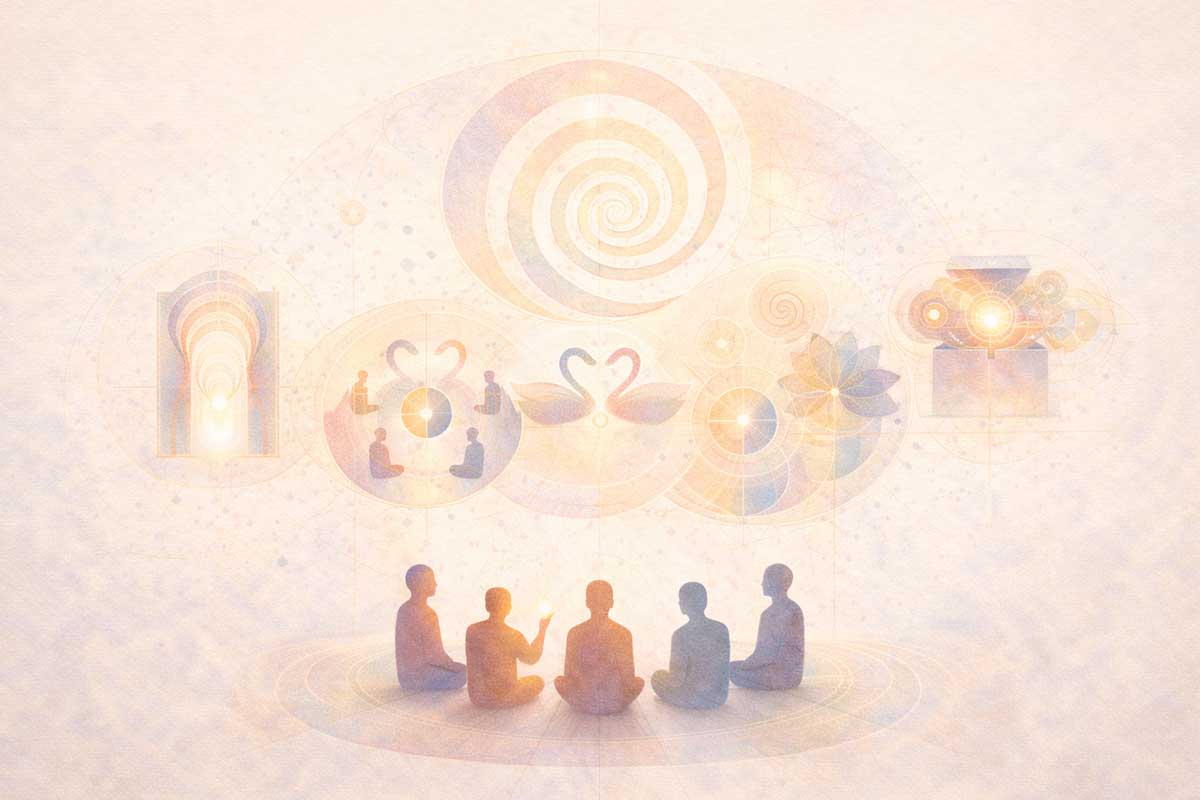
Julia Voss: Tonight we’re doing something a little different. We’ve spent five talks walking through five “rooms” of the Temple—instruction, method, symbol language, nature-as-diagram, and the long silence of timing. Now we’ll ask one question that has been hiding in every room: what single thread runs through the whole Temple? Hilma, I want to start with you. If you had to name the thread in one sentence—without explaining—what would you say?
Hilma af Klint: The thread is union without violence.
Julia Voss: That lands like a bell. Iris, you’ve worked closely with the “Temple” presentation in museum space. Do you hear the same thread?
Iris Müller-Westermann: Yes, though I might phrase it as the training of perception. Hilma’s work doesn’t only show “union”; it teaches you how to see union—how to tolerate opposites without forcing them into one cheap answer. When viewers rush to decode symbols, they miss that the real “message” is the discipline of looking.
Åke Fant: I agree. And I’d add: the work isn’t only about perception in a psychological sense—it’s about structure in reality. In Topic 4 we talked about flowers and evolution. Hilma is insisting that order exists, that nature itself is a living diagram. If there’s a thread, it’s that the visible world is not superficial. The visible is a veil, but it is a veil with laws.
Briony Fer: Let me complicate it slightly. I love “union without violence,” but I also think the Temple’s thread is serial thinking—the refusal of the single masterpiece. Hilma’s work is made to be walked through: repetitions, permutations, transformations. That’s where meaning lives—in the series. If you isolate one painting, you can easily turn it into an icon or a product. The series prevents that. It insists on time.
Julia Voss: That’s interesting—time as an ethical framework. Hilma, when you hear “training perception,” “order in nature,” “serial thinking,” do you feel those are versions of your sentence?
Hilma af Klint: They are all the same path from different angles. “Union without violence” requires time. It requires patience. It requires the viewer to stop conquering the image. And yes, it requires series, because unity is not a slogan. It is a process.
Julia Voss: Iris, you said “training perception.” People watching this series will ask: training toward what? What changes in a person who truly learns the Temple’s way of seeing?
Iris Müller-Westermann: The simplest answer is: the person becomes less reactive. The paintings invite you to hold contradiction—masculine and feminine energies, spirit and matter, science and mysticism, growth and return—without snapping into either/or. That skill translates into life. If you can sit with a painting without forcing it to resolve, you can sit with a conversation, a fear, a relationship, without turning it into war.
Åke Fant: Exactly. And when you add the nature dimension, there’s also humility. The work says: you are not the center. You are part of an unfolding order. That can sound abstract, but it changes behavior. People become quieter, less performative, less desperate to be right.
Briony Fer: But there’s another change: the viewer becomes aware of how meaning is produced. Hilma’s symbols feel like an alphabet, but she refuses a dictionary. So the viewer realizes: meaning isn’t extracted like a mineral; it’s formed in relation—through repetition, placement, rhythm. That realization is powerful. It teaches people to distrust instant certainty.
Julia Voss: That brings us to the modern “Hilma boom.” People love the work partly because it feels spiritual, and partly because it’s visually clean, soothing, shareable. Hilma, does modern popularity honor the thread—or drown it?
Hilma af Klint: Both. Many people approach with sincerity. They feel something they cannot name. That is good. But many others approach as consumers. They want a quick identity: “I am the kind of person who likes this.” The Temple is not an accessory. It is a discipline.
Julia Voss: Let’s take a question from the audience.
Audience Member: If the single thread is union, does that mean you think conflict is bad? Isn’t conflict sometimes necessary for truth?
Hilma af Klint: Conflict can be necessary. Violence is not. Union does not mean bland harmony. It means holding tension inside a larger order—so the tension can reveal truth instead of destroying the person. Think of electricity: polarity creates light. But if the system is broken, polarity becomes fire.
Åke Fant: That’s a perfect metaphor. In nature, tension is everywhere—predation, competition, decay—and yet there is still pattern. Hilma isn’t denying conflict; she’s insisting conflict belongs inside a field of meaning.
Iris Müller-Westermann: And aesthetically, the paintings show that. They don’t eliminate contrast—they organize it. They place opposites in dialogue.
Briony Fer: Also, Hilma’s work is not passive. It’s rigorous. People confuse softness of color with softness of thought. The Temple is strict. It’s built like a system. That’s why it survives interpretation—it has bones.
Julia Voss: Another audience question.
Audience Member: Why the insistence on waiting—on secrecy? How is “timing” part of the thread?
Hilma af Klint: Because a sacred object can become a toy in the wrong season. I did not want my work to be reduced to scandal or novelty. Timing is part of union without violence. If the world meets the work in ridicule, the work becomes a weapon in other people’s hands—used to humiliate, to dismiss, to prove a point. I wanted the work to meet a viewer capable of patience.
Julia Voss: So the thread includes a kind of protection: protecting the work from the world, and protecting the viewer from misreading the work too quickly.
Hilma af Klint: Yes. And protecting the inner act of seeing.
Iris Müller-Westermann: This is where “Temple” is literal. A temple is not a billboard. It asks you to enter differently. Hilma built an environment of attention. Timing was part of building the conditions for attention.
Åke Fant: And you could argue the modern world is still learning that. People can enter the room now, but their habits—scrolling, instant certainty—fight the temple atmosphere.
Briony Fer: Which is why the series matters. It slows you down. It forces sequence. It enforces time as meaning.
Julia Voss: Let’s close with one final round. One sentence each. What is the Temple’s single thread?
Åke Fant: Nature is a sacred order you can learn to read.
Briony Fer: Meaning lives in transformation over time, not in a single decoded symbol.
Iris Müller-Westermann: The work trains perception to hold opposites without collapsing into war.
Hilma af Klint: Union without violence—through disciplined seeing.
Julia Voss: And I’ll add mine as moderator: a future-minded patience that refuses cheap certainty. That, to me, is why this work keeps arriving in people’s lives like a message that’s been waiting—quietly—for the right kind of attention.
Final Thoughts by Hilma af Klint
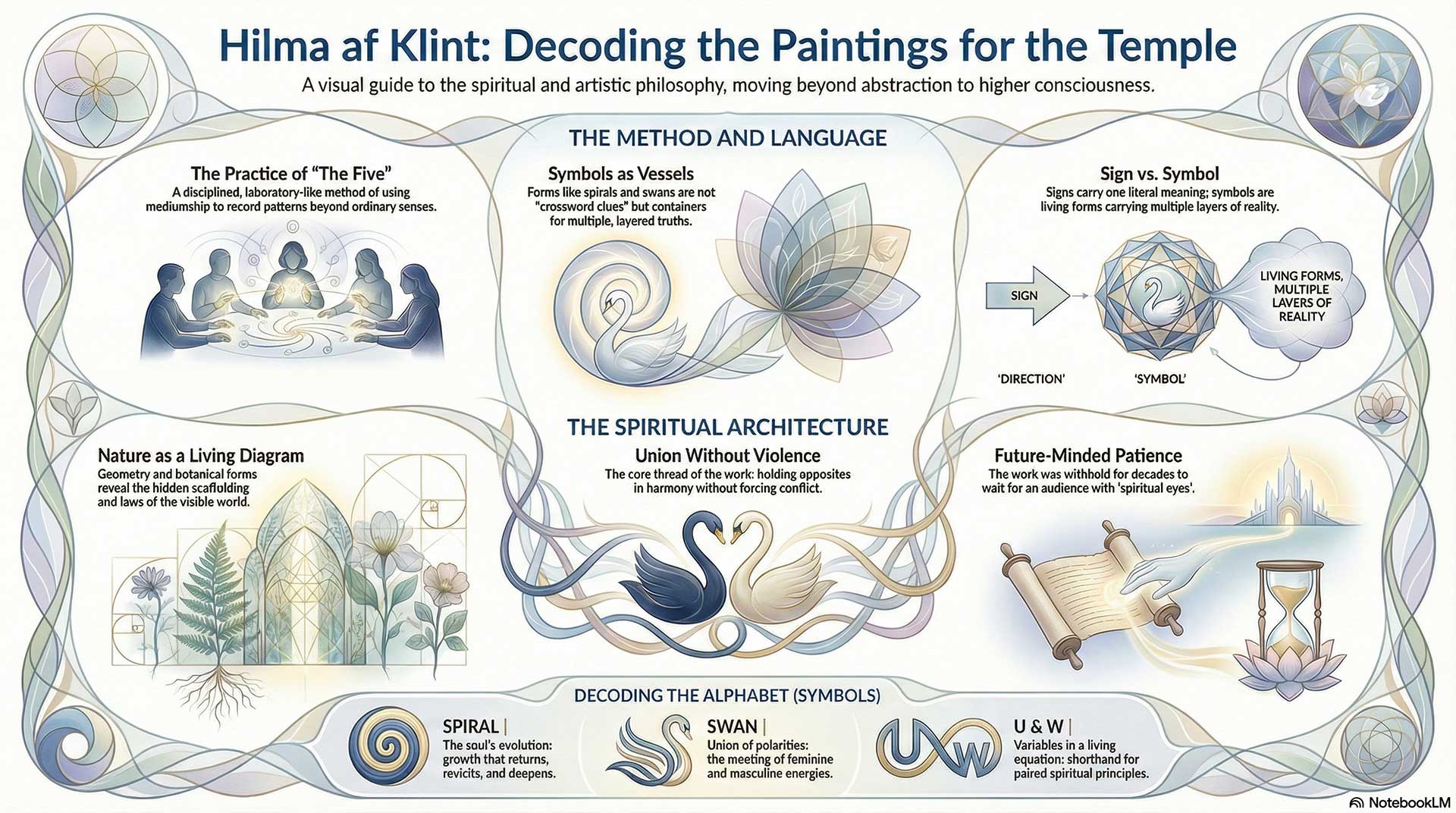
If you have watched this far, you have already done the most difficult thing: you have stayed.
Modern life teaches the eye to skim, the mind to label, the heart to protect itself with quick certainty. But the Temple asks for another posture—patient, attentive, humble. In that posture, you begin to notice that the world is full of relationships rather than isolated things. You begin to sense that opposites are not enemies by nature; they are powers that can be held inside a larger order. And you begin to understand why I called this work a Temple: not because it belongs to one religion, but because it requires reverence—reverence for meaning, for structure, for the unseen.
People often want one sentence: “What does it all mean?” Here is the sentence I will leave you with: union without violence. Not bland harmony, not forced agreement, but a capacity to hold polarity without turning it into war—inside yourself first, and then in the world.
Do not take these paintings as answers. Take them as training. Choose one image and sit with it longer than is comfortable. Notice what repeats. Notice where you become impatient. Notice where your mind tries to conquer. Then soften that impulse and look again. If you do this, something quietly shifts: you begin to meet life itself with a wider gaze.
And perhaps that is the true purpose of art: not to distract us from reality, but to return us to it—deeper, calmer, and more awake.
Short Bios:
Hilma af Klint (1862–1944) — Swedish visionary and pioneer of spiritual abstraction who created vast, systematic series—especially Paintings for the Temple—to map unseen laws of consciousness, polarity, and transformation.
Julia Voss — German art historian and leading Hilma af Klint biographer whose research clarifies Hilma’s notebooks, spiritual context, and the disciplined structure behind the Temple project.
Tracey Bashkoff — Curator associated with major Hilma af Klint exhibitions who frames Hilma’s work as a future-facing spiritual system and helps translate “esoteric method” into museum-ready clarity.
Iris Müller-Westermann — Curator and scholar central to landmark Hilma af Klint retrospectives, known for emphasizing the serial logic of the work and how it “trains perception” through repetition and form.
Åke Fant — Early foundational scholar of Hilma af Klint whose long-term study helped establish her significance and provided crucial documentation of her spiritual framework and artistic development.
Briony Fer — Art historian and critic whose writing highlights how meaning in Hilma’s work emerges through sequences, transformations, and formal rigor—resisting simplistic “decoder ring” readings.
Leave a Reply