
|
Getting your Trinity Audio player ready...
|
What if Jesus challenged Jordan Peterson to stop “wrestling” and come home to the Father?
Introduction by Desmond Tutu
My dear friends, when human beings speak about God, we often do it as though we are describing a distant mountain—beautiful perhaps, but far away, and mostly unchanged by our small lives. Yet the great shock of faith—especially the faith of Jesus—is that God is not a mountain. God is a Father. God is near. God is not only holy; God is tender. And if we are honest, that tenderness is terrifying, because it means we cannot hide behind clever words or cold ideas.
Tonight, we enter a conversation that is not meant to impress anyone. It is meant to heal something. We bring together three very different voices: Jesus, who spoke to God with the intimacy of a child who trusts his Daddy; Rev. Sun Myung Moon, who insisted again and again that God is a Heavenly Parent whose heart has known sorrow; and Jordan Peterson, who has looked unblinking at human tragedy and said that we must wrestle with the highest truth—or be destroyed by lies, resentment, and chaos.
You see, we are living in a world that is hungry, not for arguments, but for meaning. A world in which people are angry, divided, exhausted. And behind so much of that exhaustion is a secret orphanhood: the feeling that no one is truly there, no one truly cares, no one truly sees. So the question before us is not merely theological. It is human.
If God is Father, why does the Father weep?
If the world is broken, is it simply tragedy—or is it estrangement, waiting for return?
If sacrifice is required, is it the price of truth—or the cost of love that refuses to abandon even the enemy?
We will talk about suffering, sacrifice, Cain and Abel, and the culture war that tempts us to turn one another into scapegoats. But we will not do it as spectators. We will do it as participants—because every one of us, in one way or another, is already in the story.
And perhaps, before we are finished, we will discover something simple and demanding: that “wrestling with God” is not meant to be a life sentence of conflict. It may be the painful road home—until we stop lying, stop hating, stop pretending… and allow ourselves to be loved.
(Note: This is an imaginary conversation, a creative exploration of an idea, and not a real speech or event.)
Topic 1 — God as Father: Tears, Intimacy, and the Heart of Heaven
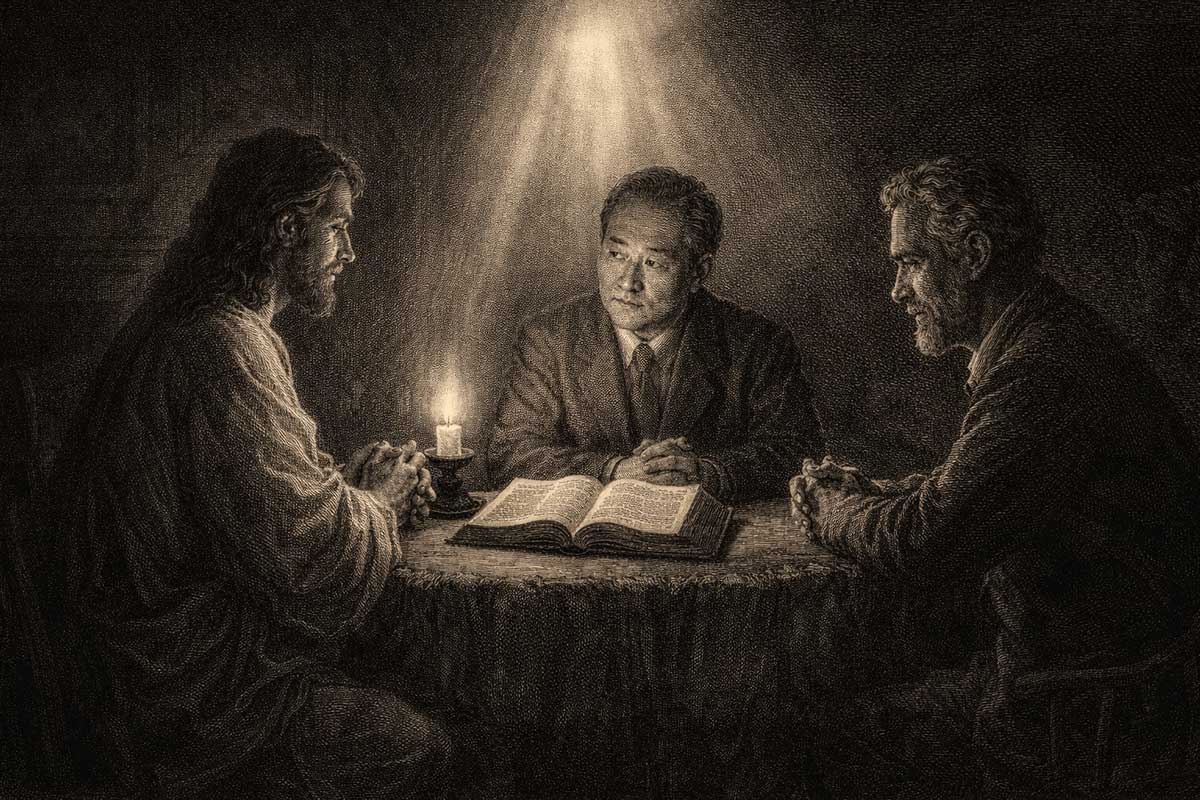
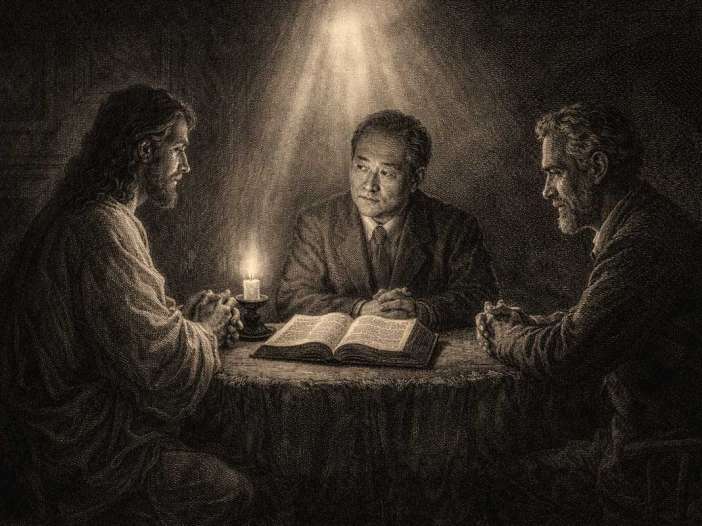
Nick Sasaki sat at the center of a quiet room that felt half like a study and half like a chapel—warm wood, a single lamp, and an open Bible on the table, not as a prop but as a shared point of gravity. No microphones. No stage. Just presence.
Jesus sat with a stillness that didn’t feel remote—more like someone who had already walked through grief and didn’t need to advertise it. Rev. Sun Myung Moon sat upright, eyes bright with the intensity of someone who carried a lifelong burden for God’s heart. Jordan Peterson sat forward, hands lightly clasped, looking less like a lecturer and more like a man in the middle of an honest experiment—watching his own thoughts collide with something he couldn’t reduce too easily.
Nick didn’t warm up with small talk.
He looked at them and spoke simply.
“When people hear you say God is Father—some hear poetry, some hear psychology, some hear a literal claim about reality. I want to start right there.”
He let the silence settle, then continued in a way that felt like opening a door.
When you call God “Father,” what are you claiming—metaphor, moral ideal, or a living relationship that can be wounded?
Jesus
“Father” is not a decoration. It is how I speak to Him because it is who He is. A father is not an idea. A father is someone you can love, trust, obey, grieve, and return to. People make God distant because distance feels safer. But distance is not truth. When I say Father, I am not explaining Him—I am approaching Him. And when you approach the Father, you discover that your life is not a performance. It is a relationship.
When you call Him Father, you cannot keep living as though no one is listening. You cannot keep pretending that hatred is strength. You cannot keep hiding behind words. A father can be dishonored. A father can be rejected. A father can be betrayed by his own children. That is not a metaphor. That is the tragedy of love.
Jordan Peterson
If I’m being careful—and I want to be careful—“Father” functions at several levels. At the psychological level, it’s the representation of authority that is simultaneously protective and demanding. Not merely the tyrant, not merely the indulgent comforter, but the source of obligation that calls you upward. That’s one level.
But your phrasing—“a relationship that can be wounded”—that’s… different. Because in purely symbolic terms, you can’t really wound a symbol. You can only reinterpret it or discard it. But if what you’re describing is true, then “Father” implies something that can be harmed by betrayal. That makes morality much more personal. It’s not just alignment with an abstract highest good. It’s fidelity—fidelity to a relationship.
And that’s where it becomes difficult for modern people, because we’ve trained ourselves to treat ultimate things as concepts we manage. The moment you admit that the ultimate might be relational—might address you and demand your response—you lose your loopholes.
Rev. Sun Myung Moon
When I say God is Father, I mean Father in the deepest way: the Parent whose love came before the world, before any law, before any commandment. God did not create human beings as servants first. God desired sons and daughters. That is the original dream.
But because the human family became divided, God’s heart was wounded. God’s love could not be fully given. The Parent could not embrace the children. Imagine a parent who sees his children fighting, hurting each other, destroying themselves—and cannot force love. That Parent suffers.
So yes, it is living relationship. God is not only truth; God is heart. God is not only power; God is longing. When people treat God as an idea, they protect their pride. But when people meet God as Parent, their pride melts, because they realize the pain they have added to Heaven.
Nick nodded slowly. He didn’t rush to the next thought. He glanced down at the open Bible, then back up.
“Okay,” he said. “So Father isn’t just warmth—it’s a claim about reality and responsibility. But I want to press something that Nick’s readers will feel in their chest.”
Why would God weep—what kind of world makes the Father grieve, and what does that imply about human freedom?
Jordan Peterson
If God weeps, then we’re dealing with something like the deepest possible moral seriousness. Because the classical image many people have is a God who is either indifferent—like a force—or omnipotent in a simplistic way—like a dictator. A weeping God is neither. A weeping God suggests that love is real and that love can be rejected.
And that implies freedom—real freedom. Because if creatures can’t wound the Father, then the Father can’t truly love them in the way we mean love. Love that cannot be rejected is not love; it’s control. So the fact of grief—or the possibility of grief—suggests that human beings can genuinely refuse the good. They can genuinely betray what is highest.
And then you’re forced into a terrifying thought: the world is not merely tragic because it contains suffering; it’s tragic because it contains moral failure—chosen blindness, chosen resentment, chosen cruelty. If the Father weeps, it’s not because He doesn’t know what’s happening. It’s because what’s happening matters.
Rev. Sun Myung Moon
God weeps because love is blocked. God’s purpose was joy—joy through true family. But the Fall created separation. Since then, history has been a long road where God searches for His children, and human beings often do not recognize His heart.
God’s tears are not weakness. They are the proof that God’s love is absolute. A parent does not stop loving even when the child rebels. God suffers because He is patient. God cannot abandon His children. He has endured betrayal, centuries of violence, and misunderstanding—still waiting for the day when the children return, not by fear, but by love.
Freedom is precious. God did not create robots. He created children who can respond. That response can be beautiful, and it can also be terrible. God’s tears show that Heaven is not cold. Heaven is aching for restoration.
Jesus
A father grieves when the child is lost. Not because the father is weak, but because love is stronger than pride. The world that makes the Father weep is a world where people refuse mercy, where they love darkness because it hides them, where they harm each other and call it justice.
But the Father’s grief is not hopelessness. It is longing. And longing is an invitation. I told people to return—not as an idea, but as a child who comes home. Some people think repentance is humiliation. It is not. It is coming back to love.
Freedom is real. That is why forgiveness is real. That is why return is real. If you were not free, you would not be responsible. If you were not responsible, love would be meaningless.
Nick let out a breath he’d been holding. The room felt heavier now—not oppressive, but weighty in the way a truth becomes weighty when it can’t be turned into a slogan.
He leaned forward, voice gentle but unavoidably direct.
If God is Father, what is the clearest sign a person is truly living as a son or daughter—not in words, but in daily life?
Rev. Sun Myung Moon
The clearest sign is that you live for others. A true child resembles the Parent. God lives for His children. So the child must live for brothers and sisters. This is not sentimental. It is practical: you sacrifice your selfish desire, you forgive, you build unity, you create true family, you heal divisions.
Also, a true child comforts the Parent. Many people pray only for themselves. But a son or daughter asks, “Heavenly Father, how can I reduce Your sorrow today?” When you feel God’s heart, you cannot live selfishly. You feel responsibility—not only personal morality, but responsibility for peace, for reconciliation, for restoring what has been broken in history.
Jesus
A child of the Father loves like the Father. Not in speech, but in action. You forgive when it costs you. You serve when no one applauds. You refuse to turn people into enemies you must destroy. You tell the truth without using truth as a weapon. You pray without performing. You give without demanding repayment.
If you call God Father and still feed on contempt, you are not living as a child. A child reflects the Father’s heart. The Father seeks the lost, feeds the hungry, lifts the crushed, and does not rejoice in punishment. So watch your life: do you restore, or do you divide? Do you heal, or do you accuse? Do you bring people home, or do you push them out?
Jordan Peterson
This is where I feel the collision most sharply—because the ethical demand implied here is extraordinarily high. In my language, I would say: a person living properly is someone who tells the truth, bears responsibility, and aims upward. But what you’re both describing adds another dimension that’s… frankly destabilizing in a serious way.
Because if the highest reality is Father—not merely a principle—then the aim is not simply self-improvement. It’s likeness. Likeness to the Father. That means you don’t just discipline yourself; you extend mercy. You don’t just avoid resentment; you actively reconcile. You don’t just sacrifice for your future; you bear burdens for others.
And here’s the “aha,” if I’m allowed to say it plainly: my framing can make the struggle sound like it never ends—like the point is to wrestle forever. But “Father” implies that the end of the struggle is not endless conflict. It’s return. It’s home. It’s reconciliation.
That’s not soft. It’s harder than my usual formulation, because it demands not only courage but tenderness—and tenderness is something modern people are terrified of, because tenderness makes you vulnerable.
Nick didn’t interrupt. He let the vulnerability stand in the room, because it was the kind that didn’t ask for sympathy—just honesty.
He closed the Bible gently, not as an ending, but as a pause.
“Okay,” he said quietly. “So we have something very clear: if God is Father, then the central drama isn’t only ‘meaning versus chaos.’ It’s relationship—betrayal and return, grief and reconciliation, love that can be rejected and love that still waits.”
He looked at Jesus, then Rev. Moon, then Jordan.
“Next, I want to take this straight into suffering—because Jordan’s worldview starts with tragedy, and Rev. Moon starts with restoration, and Jesus speaks in a way that cuts through both. Let’s go there.”
And the room, instead of relaxing, somehow became even more attentive.
Topic 2 — Why We Suffer: Tragedy, Providence, and Returning Home
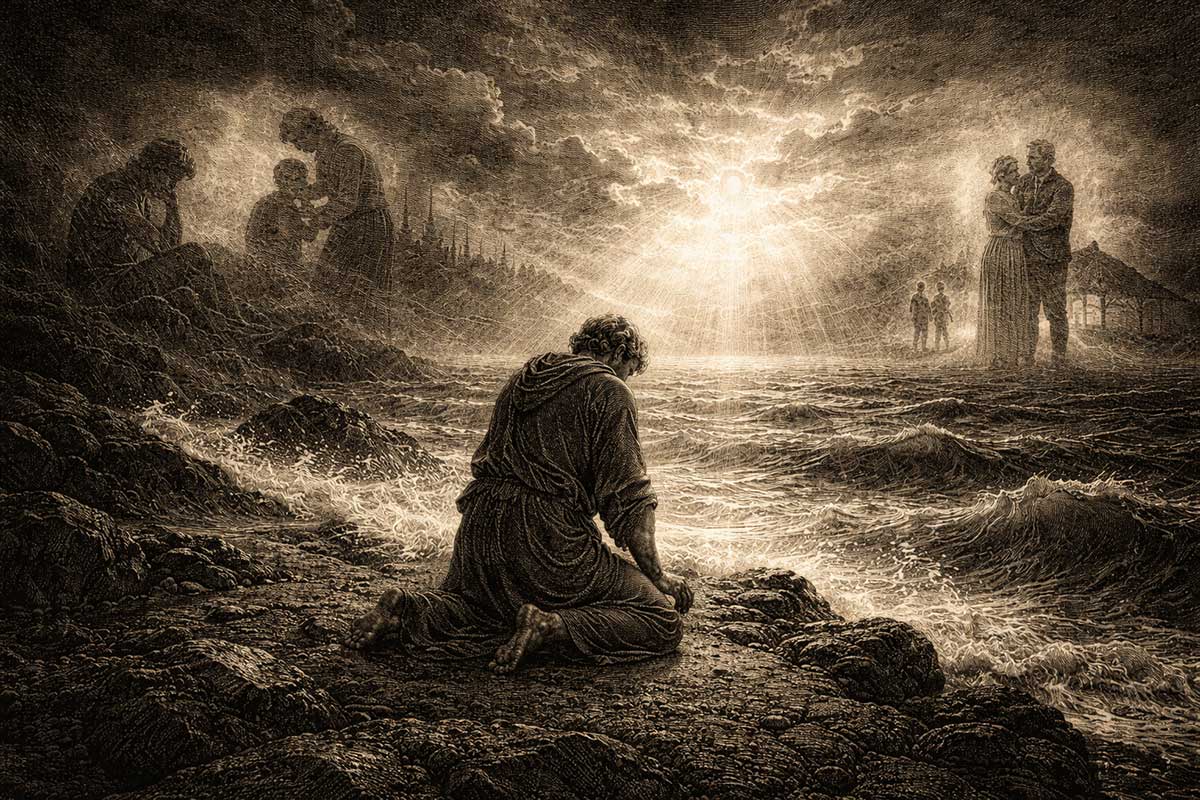
Nick Sasaki kept the same calm rhythm, but the room felt subtly different now—like the air had cooled. Topic 1 had been intimate and almost tender; Topic 2 brought in weight. The kind you can’t intellectualize away.
He glanced at each of them, then spoke in a way that didn’t sound like a debate prompt. It sounded like something a person asks when life has actually hurt.
Is suffering mainly the structure of existence to be confronted, or the result of a broken relationship that can be restored?
Jordan Peterson
Suffering is built into existence. That’s not a philosophical posture. It’s an empirical observation. Bodies decay, people betray, accidents happen, children get sick, good intentions fail. Anyone who claims that life is not tragic is either naïve or lying—often to themselves.
But that doesn’t mean suffering is meaningless. The question is: what do you do with it? Because suffering can either make you deeper and more truthful, or it can make you resentful and dangerous. The human capacity to transmute suffering into bitterness is one of the most horrifying features of our nature.
Now, when you describe suffering as the result of a broken relationship with God—that’s a different framing. It might be true at a metaphysical level, but even psychologically, it maps: when people lose the sense of ultimate meaning, when their relationship to what is highest is corrupted, they become lost. They spiral. In that sense, restoration is real. But I’d still insist the tragedy is primary: you have to confront it without lying. If you try to leap over tragedy with cheap consolation, you produce more tragedy.
Rev. Sun Myung Moon
Suffering is not God’s original desire. God created human beings for joy, for true love, for family. But the human fall created separation from God. Because of that, history became a long course of restoration. Suffering entered through the misuse of freedom and love.
So yes, suffering is real. But we must ask: why is it so deep? Why does it involve not only nature but human cruelty, betrayal, war, hatred? That is not “just existence.” That is broken relationship and broken lineage. God has suffered more than any human being because God has watched His children destroy one another.
But God does not abandon. God works through providence. God calls individuals and families—Noah, Abraham, Jacob, Moses—not because God enjoys testing them, but because someone must open the way back. When you understand that, suffering becomes not meaningless tragedy but a battlefield where love must be restored.
Jesus
Suffering is real. And it touches everyone. The rain falls on the just and the unjust. But do not think suffering is proof that God has abandoned you. Many who suffer are closest to the Father’s heart, because they have nothing left to cling to except love.
The world is broken—yes. People harm each other. They deceive. They hate. They try to save themselves by blaming others. That is the sickness. But the Father does not stop seeking. He does not stop calling. Restoration is not a theory. It is what happens when you return, forgive, and live differently.
Do not ask only, “Why did this happen?” Ask, “Who will I become now?” Suffering can turn you into someone who wounds others, or someone who heals. And the Father desires that you heal.
Nick let that land. Then he leaned in—because he knew this is where people’s lives either become stronger or collapse.
When tragedy hits, what is the first responsibility: tell the truth, endure with meaning, repent, forgive, or comfort God—what comes first?
Rev. Sun Myung Moon
The first responsibility is to find God’s heart in the situation. Most people ask, “Why me?” But Heaven asks, “How can love be restored here?” When you find God’s heart, you can repent—not only for yourself, but for the human condition. You can forgive. You can take responsibility.
To comfort God does not mean you ignore the suffering. It means you do not use suffering as an excuse to become selfish. You become a person who absorbs pain and transforms it into love. That is why the saints wept—because they felt God’s sorrow.
But practically, truth must come first also. Without truth, repentance is false. Without truth, forgiveness becomes cheap. You must face reality—then move with love.
Jordan Peterson
Truth comes first. Always. Because if you lie about tragedy—if you rationalize it away, sentimentalize it, or blame someone falsely—you make it worse. The first moral obligation under suffering is to stop lying. Because lies corrupt your perception, and then you make bad decisions, and then you hurt people.
Now, repentance is important, but repentance can be corrupted into self-hatred. Forgiveness is important, but forgiveness can be corrupted into enabling. Meaning is important, but meaning can be corrupted into ideology. The safeguard is truth. You speak what you see. You admit what you did wrong. You face the pain. And then you move.
Comforting God… that’s a hard phrase for modern people, because it implies God can suffer and that you can respond. But I will say: the idea that suffering should make you more compassionate and responsible rather than more bitter—that is correct. And if you frame that as “comforting the Father,” it might actually help people transcend their narcissism, because they’re no longer the center of their own tragedy.
Jesus
The first responsibility is to return to the Father in truth. Not a performance. Not a speech. A turning of the heart.
When you are struck by suffering, the temptation is to harden. To blame. To close. But the Father desires that you open. So speak truth—yes. But speak it with humility. Not as a weapon. Truth without love becomes another form of cruelty.
Forgive quickly, because unforgiveness binds you to the wound. Repent honestly, because pretending you are innocent blinds you. Endure with hope, because despair is a lie about the Father’s power. And comfort God by loving others in your pain, because that is how heaven’s sorrow is eased.
Nick nodded. He’d gotten what he wanted: not a neat list, but an order of priorities with real tension.
Then he asked the question that modern audiences quietly obsess over—because they’ve been burned by false hope and cynical despair.
What does “hope” actually mean here: personal resilience, historical restoration, or the Kingdom—how do we measure it without self-deception?
Jordan Peterson
Hope is not optimism. Optimism is a cheap mood. Hope is a disciplined commitment to act as if the good is possible, even when evidence is ambiguous. It’s the decision to move forward with integrity even when you can’t guarantee the outcome.
You measure it by whether it produces responsibility instead of fantasy. If hope makes you more honest, more courageous, more competent, and more willing to shoulder burdens, it’s not self-deception. If hope makes you passive—waiting for miracles while refusing responsibility—then it’s corruption.
Now, historical restoration—Rev. Moon’s providential framing—can be psychologically powerful, but it’s also dangerous if it becomes a justification for coercion or utopianism. The safeguard is again the same: truth and humility. Don’t sacrifice the present in the name of a future heaven you’ve invented.
Rev. Sun Myung Moon
Hope is not only personal. It is cosmic. It is the Parent’s hope that the children return and the human family becomes one. God has carried hope through history, even when human beings repeatedly failed.
But we must not confuse hope with fantasy. True hope requires indemnity—meaning you pay a price in love, sacrifice, service. You measure hope by fruit: is your family becoming more true? Are relationships healing? Are enemies becoming brothers? Is God’s sorrow being reduced?
The Kingdom is not a private feeling. It is God’s dream on earth and in heaven. Hope means living now as a citizen of that Kingdom—creating true love and true unity even in a fallen world.
Jesus
Hope is trust in the Father. Not a strategy, not a calculation. Trust.
You measure it by your life. If you hope, you forgive. If you hope, you serve. If you hope, you stop turning others into enemies. If you hope, you tell the truth without fear. If you hope, you do not despair even when the world shakes.
The Kingdom is near when people return to the Father and love one another. Do not measure hope by comfort. Measure it by love under pressure.
Nick let the last line settle because it had the sharpness of a blade but the warmth of a hand.
He closed his notebook, as if to mark the end of this round—but not the end of the conversation.
“Okay,” he said quietly. “So Jordan starts with tragedy and insists on truth. Rev. Moon starts with providence and insists on restoring God’s joy. Jesus starts with the Father and insists on love under pressure.”
He looked at them with the kind of seriousness that felt earned.
“Next, I want to talk about sacrifice—because all three of you talk about it, but you’re not talking about the same thing. And if we miss that, we miss everything.”
Topic 3 — Sacrifice: Alignment With Truth vs Bearing Love for Others
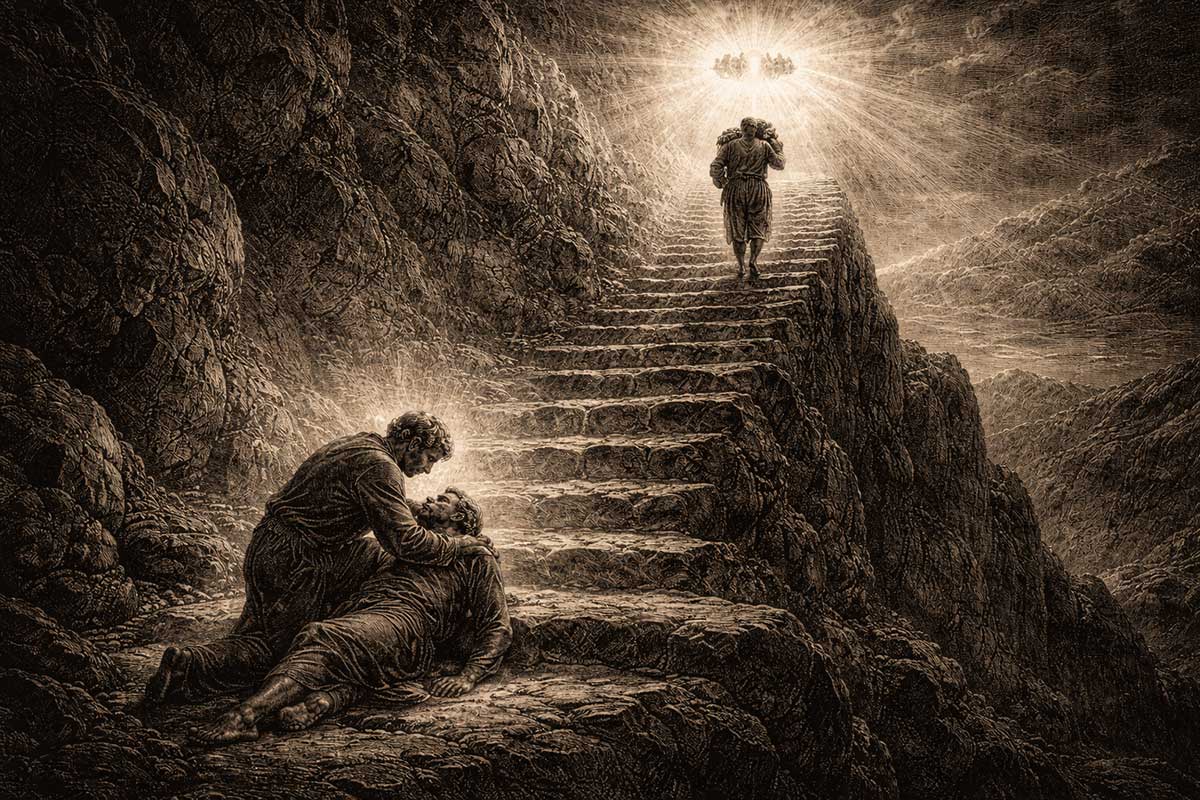
The room felt even quieter now, as if the word sacrifice itself had thickened the air. Nick Sasaki didn’t rush. He knew that this topic could easily turn into moral posturing—people saying “sacrifice” as a badge—unless it was dragged back into reality: into cost, into tears, into the places where the ego fights hardest.
He looked at all three of them.
“What I love about this trio is… you all demand sacrifice. But you don’t mean the same thing. And if we don’t separate those meanings, we’ll end up talking past each other.”
He let that settle.
What is sacrifice for: personal transformation, restoring relationship, repairing history, or saving others—and how do you know it isn’t ego in disguise?
Jesus
Sacrifice is for love. If it is not love, it is not holy.
People often sacrifice to be seen. They suffer loudly so others will call them righteous. That is ego. But the Father sees in secret. The sacrifice that is true is the one done without needing applause—done because another person is hungry, lost, wounded, ashamed, or crushed.
You ask what it is for: it is to restore what is broken. It is to bring the lost home. It is to heal. It is to forgive when your pride wants revenge. It is to give when you could keep. It is to carry another’s burden when you could walk away.
How do you know it isn’t ego? If the sacrifice makes you proud, if it makes you contemptuous, if it makes you demand repayment—then it has become corruption. True sacrifice produces humility and mercy.
Jordan Peterson
I’d say sacrifice is the fundamental structure of time and value. You cannot build anything good without giving up something immediate for something higher. That’s not only moral. It’s practical. It’s civilization.
But the question—what is it for—depends on what you aim at. If you aim at the highest good, sacrifice transforms you. It integrates you. It makes you competent and trustworthy. It also stabilizes your relationships because you’re no longer a creature of impulse. You become someone who can make a promise and keep it.
Now, ego in disguise is the biggest problem in moral discourse, because people will call their resentment “justice” and call their cowardice “kindness.” Sacrifice can be ego in disguise if it’s performative or if it’s transactional—if you’re “sacrificing” to gain status, to purchase moral superiority, or to control others.
One test is whether the sacrifice increases your capacity to tell the truth. If it makes you more honest and less resentful, it’s probably oriented properly. If it makes you bitter, sanctimonious, and vengeful, it’s twisted.
Rev. Sun Myung Moon
Sacrifice is for restoration of love and restoration of God’s joy. In a fallen world, God’s heart is sorrowful. Human relationships are broken. The human family is divided. So sacrifice is not merely self-improvement. Sacrifice is to heal history.
How do you know it is not ego? If you sacrifice while secretly blaming others, it is ego. If you sacrifice while expecting recognition, it is ego. True sacrifice is to live for others, even when nobody understands you, even when you are lonely. That is why God’s champions often cried. They felt Heaven’s pain and did not want to add to it.
Sacrifice repairs relationship: first with God, then with your spouse, your children, your enemies. It also repairs lineage—meaning the direction of love. When love is pure and unselfish, Heaven can dwell there.
Nick nodded. He didn’t paraphrase. He didn’t summarize. He simply pressed the next question into the exact pressure point where modern people crack.
Is the highest sacrifice giving up comfort for truth, or giving up “being right” to reconcile—what is harder and why?
Jordan Peterson
Giving up being right to reconcile is harder—if the reconciliation is genuine. Because giving up comfort for truth is difficult, but it still preserves your dignity. You can suffer nobly. You can be the hero in your own story. That’s dangerous because the ego can parasitize it.
But to reconcile, you have to relinquish something deeper: your moral superiority. You have to admit that you might be wrong. You have to see the other person not as a villain but as a human being. And sometimes you have to accept an imperfect peace rather than the satisfaction of total victory.
That said, there’s a trap: reconciliation without truth becomes cowardice. It becomes appeasement. So the real question is whether you can reconcile while still telling the truth.
Jesus
Truth without reconciliation becomes condemnation. Reconciliation without truth becomes a lie.
What is harder? Forgiving an enemy is harder than fasting. Loving someone who despises you is harder than giving away money. Giving up being right—especially when you are truly wounded—requires you to die to pride. That is why it feels like death.
But do not confuse reconciliation with pretending. If your brother sins, speak truth. But speak it so he can return. Not so you can crush him. The Father is not interested in you winning the argument. The Father is interested in the lost returning home.
Rev. Sun Myung Moon
To reconcile is harder, because it requires heart. Truth is necessary. But heart is deeper.
In restoration, Abel must win Cain—not by force, not by pride, not by showing superiority, but by love. Abel must sacrifice not only comfort but also dignity, because Cain’s resentment is strong. Abel must sometimes go lower to lift Cain higher.
This is why God suffers. God must love even those who oppose Him. God’s heart is not prideful. God’s heart is patient.
So giving up being right to reconcile—if it is done with truth and love—is the highest. It resembles the Parent.
Nick let out a slow breath. He could feel the audience in his mind—people watching from their lives, from their marriages, from their family rifts, from their political rage. This was where it got personal.
Then he asked the question that had teeth.
Where is the line between holy sacrifice and destructive self-erasure—how do we prevent sacrifice from becoming harm?
Rev. Sun Myung Moon
Holy sacrifice creates life. Destructive sacrifice destroys life.
If you sacrifice and the result is resentment, bitterness, and broken family, then something is wrong. God does not desire suffering for suffering’s sake. God desires restoration and joy. Sacrifice must have direction and purpose: to heal, to unite, to create goodness.
Also, sacrifice must be guided by principle. In Divine Principle, indemnity is not blind punishment. It is a condition to restore love and order. If a person sacrifices without wisdom, without guidance, they may be exploited. Love must be intelligent. You do not sacrifice so that evil can continue. You sacrifice to transform evil into goodness.
Jordan Peterson
This is crucial. Self-erasure is often disguised as virtue—especially among people who have been trained to think boundaries are selfish. But a person who cannot say no becomes a tool for those who have no conscience. That’s not morality; that’s pathology.
The line is crossed when sacrifice is not freely chosen and oriented toward the highest good. If you sacrifice because you’re afraid, because you can’t confront conflict, because you’re addicted to being needed—that’s not holy. It’s a form of cowardice or compulsion.
Another test: does the sacrifice produce competence and stability, or does it produce chaos? You cannot love people effectively if you are collapsing. The biblical demand isn’t “destroy yourself.” It’s “pick up your cross,” which is different: it implies voluntary burden-bearing in service of truth, not self-annihilation.
Jesus
Do not give what is holy to what will trample it. Love is not foolishness.
The Father does not ask you to vanish. The Father asks you to become. Sacrifice is not the destruction of the self; it is the purification of the self. It is the death of pride, the death of hatred, the death of fear. But what is born is life.
If your sacrifice makes you unable to love—if it makes you numb, bitter, or crushed—seek counsel and return to the Father. The Father is not honored by your despair. The Father is honored by your love.
Nick’s face softened, because he felt the strange convergence here: Jordan’s insistence on truth and boundaries; Rev. Moon’s insistence on restoration and direction; Jesus’ insistence on love without hypocrisy.
He closed his notebook again.
“Okay,” he said. “So sacrifice isn’t one thing. Jordan calls it the structure of reality and the antidote to resentment. Rev. Moon calls it restoration love that comforts the Parent and heals history. Jesus calls it the path of love that tells the truth and brings the lost home.”
He looked at all three.
“Next, we have to go into Cain and Abel—because that’s where resentment becomes violence, and where reconciliation is either impossible… or the whole point of history.”
Topic 4 — Cain and Abel: Resentment, Scapegoating, and Reconciliation
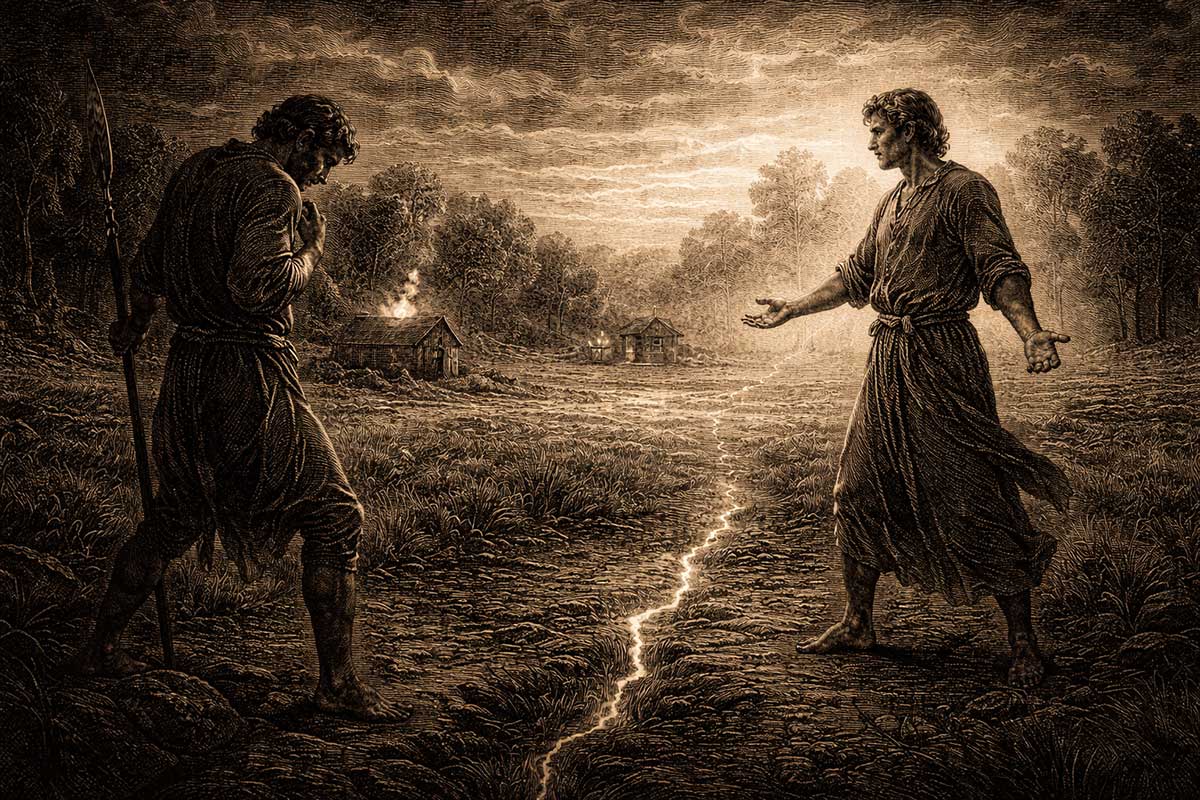
The room didn’t feel theoretical anymore. Cain and Abel wasn’t an “idea” for anyone at the table. It was a pattern they’d seen in families, nations, churches, movements, classrooms, and in the private chambers of the heart.
Nick Sasaki didn’t open with a lecture. He looked at them the way someone looks at a wound that keeps reopening.
“Cain and Abel is the story people retell without realizing it,” he said. “It’s jealousy and shame, it’s misread love, it’s the craving to be seen, and it’s what happens when we can’t bear our own disappointment.”
He paused.
Is Cain’s core problem wounded pride, rejected offering, envy, or spiritual separation—and what’s the first step that could have saved him?
Jordan Peterson
Cain’s core problem is resentment that’s been justified. He experiences the sting of rejection—real or perceived—and instead of using that pain as information, he uses it as permission. He turns the world into a courtroom where he is the wronged party and the universe owes him.
The first step that could have saved him is unbelievably simple and brutally hard: fix your offering. That’s what the text implies. If what you’re doing is not acceptable, then improve it. Tell the truth about why it isn’t acceptable. Don’t immediately externalize blame. Don’t make your brother the enemy because he succeeded where you failed. Cain’s tragedy is that he chooses hatred over competence, accusation over transformation.
Jesus
Cain’s problem is that he would not return. He could have returned.
He felt wounded, yes. He felt unseen, yes. But in that wound he listened to a voice that told him: “You are justified to hate.” That voice always leads to death.
The first step that could have saved him was humility before the Father. Not humiliation—humility. If you are angry, speak the truth to God. If you are ashamed, bring it into the light. If you feel rejected, ask to be taught. The Father did not abandon Cain. The warning was mercy. Cain refused mercy because pride is more intoxicating than repentance.
Rev. Sun Myung Moon
Cain’s root is separation from God’s heart. When the relationship is broken, love becomes self-centered and prideful. Then the person cannot recognize Heaven’s will.
In the Cain and Abel story, Heaven is trying to restore what was lost. Abel represents the side that is closer to God’s direction. Cain represents the side that is farther away. But Cain is not meant to be destroyed. Cain is meant to be restored.
What could have saved Cain first? He needed to accept Abel, not as a rival, but as a bridge back to God. That requires humility, yes, but also understanding: God’s purpose was not to shame Cain, but to guide him back. When Cain fails to see that, envy becomes hatred, and hatred becomes violence.
Nick nodded slowly. He’d heard three versions of the same alarm bell: Cain isn’t just “bad.” Cain is what happens when pain becomes entitlement.
He leaned in.
What is Abel responsible for, if anything—simply offering rightly, or also winning Cain’s heart—and how far does responsibility extend?
Rev. Sun Myung Moon
Abel must do more than be “right.” Abel must love Cain.
In restoration, Abel has a mission: to move Cain’s heart, to serve Cain, to help Cain return. Abel cannot stand in pride and say, “I am chosen.” If Abel becomes arrogant, he repeats the Fall again in another form.
How far does responsibility extend? It extends to the point where Abel is genuinely trying to restore Cain, not judge Cain. Abel’s victory is not Cain’s humiliation. Abel’s victory is Cain’s change of heart. This is extremely difficult, because Cain’s resentment is deep. But Heaven’s method is love, not domination.
Jordan Peterson
I understand the restorative logic, but there’s a danger here: you can make Abel responsible for Cain’s pathology. That can become abusive.
Abel’s first responsibility is to offer what is true and acceptable—to live rightly, to speak truth, to embody competence and integrity. Now, does Abel have a responsibility to reach out? Yes, because moral action includes mercy. But the boundary is crucial. You cannot make yourself a martyr to someone’s envy and call it virtue. Cain must still choose. Abel can invite Cain upward, but Abel cannot carry Cain’s resentment for him.
And there’s another complication: Cain often interprets Abel’s goodness as an accusation. That’s why the story is so psychologically accurate. Abel’s mere existence feels like judgment to Cain. So Abel should be humble, yes—but not self-erasing.
Jesus
Abel must not hate Cain.
If your brother is trapped in resentment, you do not repay resentment with contempt. But you also do not lie. You speak truth in a way that leaves the door open for return.
Responsibility extends far enough that love is proven. Love does not mean you let Cain kill you and call it wisdom. Love means you refuse to become Cain in response to Cain. Love means you do not turn your brother into an enemy you must destroy.
Abel’s task is to remain faithful to the Father while still seeing Cain as a brother. The Father desires Cain’s return. Abel should desire the same.
Nick took a breath. He could feel the practical tension: Rev. Moon pushing toward heart-winning restoration, Jordan warning against enabling, Jesus holding the line of truth-with-mercy.
He looked down at the Bible again, then up.
“In the modern world,” Nick said, “Cain and Abel feels like it’s everywhere. Families. Politics. Religion. Online mobs. People make scapegoats the way they breathe.”
In modern society, who is “Cain” and who is “Abel” in practice—and do we repeat this pattern through politics, institutions, families, or online mobs?
Jordan Peterson
We repeat it constantly. Cain is the person—or the group—who believes their suffering entitles them to moral superiority and therefore cruelty. Abel is the person—or the group—who is doing better, or is perceived as favored, and becomes the target.
In politics, this shows up as narratives of blame: “Our problems are caused by them.” In institutions, it shows up as bureaucratic scapegoating and purity rituals. Online, it becomes instantaneous: outrage, accusation, dehumanization, then the sacrifice—public shaming, cancellation, symbolic execution.
The deeper point is that Cain wants to destroy what he perceives as evidence of his own failure. Abel becomes a mirror Cain can’t bear. So Cain breaks the mirror. That’s the archetypal pattern.
Rev. Sun Myung Moon
In the modern world, Cain and Abel are not fixed identities. They are positions that shift depending on the situation. In a family, one sibling can become Cain toward another. In a nation, one group can become Cain toward another. Even inside one person, Cain and Abel can struggle.
But Heaven’s goal is not for Abel to crush Cain. Heaven’s goal is unity. The tragedy of modern society is that people do not know how to restore heart. They only know how to defeat opponents. So resentment becomes a culture. People build identity by having an enemy.
If we apply the Cain and Abel story properly, then the question is always: how do we create conditions for Cain to return without Abel becoming proud? How do we establish love and truth so the human family can become one under God?
Jesus
Cain appears wherever people refuse to forgive.
When the crowd wants a scapegoat, it is repeating Cain. When people accuse without mercy, it is repeating Cain. When people punish to feel righteous instead of restoring to heal, it is repeating Cain.
Abel appears wherever someone keeps faith without hatred—where someone does good without demanding praise, where someone tells the truth without using it to crush.
But hear this: the Father does not delight in Abel being “right” while Cain is lost. The Father desires that Cain returns. So the question for every generation is not, “How do we destroy Cain?” but, “How do we stop becoming Cain—and how do we help Cain come home?”
Nick didn’t move for a moment. That last line sat in the room like a candle flame: small, steady, hard to argue with.
He closed his notebook with a soft click.
“Okay,” he said. “So Cain isn’t just envy—he’s the moment pain turns into a license to hate. Abel isn’t just ‘the good one’—he’s the test of whether goodness can stay humble and still fight for restoration.”
Nick looked at the three of them.
“Next, I want to go straight into the culture-war version of this: scapegoating at scale. Jordan calls it ideological possession. Rev. Moon calls it the fracture of the human family. Jesus calls it the loss of the Father’s heart.”
He paused, then added quietly:
“Let’s finish this with the question everyone avoids—what ends the struggle: wrestling forever, or coming home?”
Topic 5 — The Real Battle: Wrestling Forever vs Coming Home to Peace
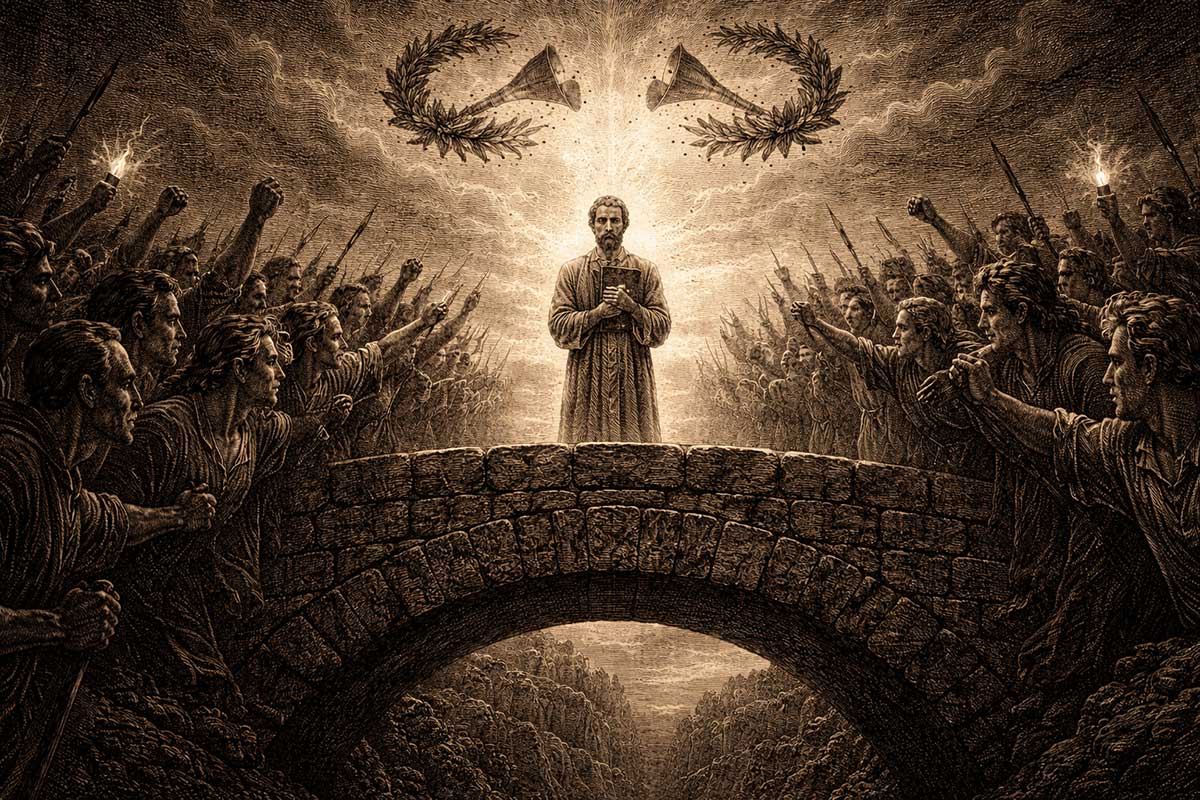
The room felt like it had traveled—through intimacy, suffering, sacrifice, Cain and Abel—and now it arrived at the question that sat behind everything like a shadow: Is the struggle the point… or is the struggle meant to end?
Nick Sasaki didn’t frame it as philosophy. He framed it like someone talking to a world that’s tired.
“We live in a time where everyone’s fighting,” Nick said softly. “Families, politics, religion, online… people are exhausted. Some people romanticize the fight. Some people collapse. So I want to end with the hardest thing: what does it mean for the struggle to actually resolve?”
He looked at all three.
Does “wrestling with God” describe the human condition permanently, or is it meant to end in reconciliation—what does “the end of the struggle” look like?
Jesus
The end of the struggle is return.
The Father does not desire endless conflict. The Father desires sons and daughters who come home. Wrestling is what happens when the heart is divided—when truth calls you one way and pride pulls you another, when love invites you and fear refuses.
But hear this: the struggle ends when you surrender to love. Not surrender as weakness—surrender as repentance, as trust, as obedience. When you forgive, when you stop accusing, when you stop clinging to resentment as identity, the struggle loosens its grip.
Peace is not numbness. Peace is the soul aligned with the Father. And the sign of that peace is that you become a peacemaker. You do not merely feel calm. You reconcile.
Rev. Sun Myung Moon
Wrestling is a stage of the fallen world. It is not the final purpose.
God’s original ideal is harmony—true family—where human beings live in true love with God as Heavenly Parent. The struggle exists because of separation, because love went wrong, because lineage was corrupted, because selfishness entered.
So the end is restoration: God and humanity reunited, true families established, enemies becoming brothers and sisters, heaven on earth and in heaven. This is not only individual peace; it is historical peace.
Reconciliation must happen vertically and horizontally: with God, with spouse, with children, with tribe, nation, race, religion. That is why I speak of one human family under God. The struggle ends when the Parent can finally embrace the children without barriers.
Jordan Peterson
My instinct is to say the struggle is permanent, because life continuously presents you with chaos, and you must continuously act to maintain order. That’s true at the level of biology and society. Entropy never stops.
But what you’re both pointing toward is something like a different category of resolution: not the end of work, but the end of alienation. Not the end of suffering, but the end of bitterness. Not the end of moral effort, but the end of the internal fragmentation that makes effort feel like war.
So perhaps the struggle doesn’t end in the sense that life becomes effortless. But it can end in the sense that you no longer have to posture, lie, and fight reality. You can become reconciled to the highest good—reconciled to truth—and if God is Father, then reconciled to the Father.
If I’m honest, I think many people are addicted to conflict because conflict makes them feel righteous. And that’s a terrible thing. So the “end of the struggle” might actually be the end of that addiction: the willingness to let go of resentment, to stop needing an enemy.
Nick held that line—“addicted to conflict”—because it explained so much of modern life.
He asked the next question without raising his voice.
If ideology becomes a substitute religion, what replaces it: truth, love, worship, family, community—what actually holds a society together?
Jordan Peterson
Something has to sit at the top of the value hierarchy. If you remove God—however you understand that—something else will take His place. The problem with ideology is that it offers total explanation and moral certainty without humility. It creates an enemy, and it demands sacrifice—but usually the sacrifice of someone else.
What replaces it has to do two things: orient people toward the good and restrain their worst impulses. Truth is foundational because without truth you can’t even coordinate reality. But love is also foundational because without love truth becomes weaponized. And you need institutions—family, community, tradition—that embody those values in practice.
The terrifying reality is that a society can’t be held together by slogans. It’s held together by trust. And trust is built by truthful speech and reliable action over time.
Rev. Sun Myung Moon
The human family must return to God as Parent. That is the center that can hold society together, because it makes every person your brother and sister. Without that, people fall into tribe, race, nation, ideology.
True family is the school of love. If families collapse, society becomes a battlefield of selfish individuals and competing groups. Community without God becomes unstable because there is no ultimate parent-heart to unite it. So I emphasize true parents, true families, true love—because through that, the world can learn to live for others.
Worship without love becomes ritual. Love without principle becomes confusion. We need both heart and truth. And we must raise people who live for others—not only talk about it.
Jesus
Love holds society together. But love is not a feeling. Love is truth lived with mercy.
If people worship without love, they become hypocrites. If people speak truth without love, they become accusers. If people build community without forgiveness, they build prisons.
What replaces ideology is the Father’s way: humility, repentance, forgiveness, service. When people live as children of the Father, they do not need enemies to feel righteous. They become salt. They become light. They become peacemakers. And that is what keeps darkness from ruling.
Nick nodded. He could feel the conversation reaching the place where it had to become practical—because big ideas without a first step become entertainment.
He leaned forward for the final question of the entire series.
What would each of you tell a modern person who feels empty, angry, and divided—what is the first practical step back toward God-as-Father?
Rev. Sun Myung Moon
Pray to God not as a judge, but as Parent. Even if you cannot feel it, speak sincerely: “Heavenly Father, I want to return.”
Then begin living for others immediately. Serve someone. Forgive someone. Stop feeding anger. When you live for others, your heart changes. And when your heart changes, you can feel God’s heart.
Also, take responsibility for your family. Heal your relationships. A person cannot return to God while neglecting those closest to them. The road to Heaven begins at home.
Jesus
Come to the Father with honesty. Do not perform. Do not hide.
Then forgive one person. Not later—now. Forgiveness breaks the chain. Anger makes you feel powerful, but it makes you a slave. Forgiveness makes you free.
And do one act of love today that costs you something—time, pride, comfort. Not to impress anyone, but because the Father sees. When you love like the Father, you begin to know the Father.
Jordan Peterson
Tell the truth. Specifically: stop saying things you know are false. Stop acting out what you don’t believe. Clean up your speech. Clean up your habits. Take one small responsibility that you’ve been avoiding and shoulder it voluntarily.
And here’s a point of convergence I didn’t fully appreciate until this conversation: if you can frame that as returning to the Father—returning to a relationship rather than merely aligning with an abstract good—it might reduce the nihilism that so many people feel. Because nihilism is often a form of orphanhood: the belief that no one is ultimately there.
So the first step is truthful speech and voluntary responsibility. And perhaps—if God is Father—prayer as well. Not prayer as magic, but prayer as reorientation.
Nick looked at them, then at the invisible audience that had been in his mind the whole time.
He spoke the final line with care.
“So maybe the story isn’t that we wrestle forever.”
He paused.
“Maybe the story is that we wrestle until we stop lying… and then we come home.”
The room didn’t feel like it ended. It felt like it opened.
Final Thoughts by Desmond Tutu
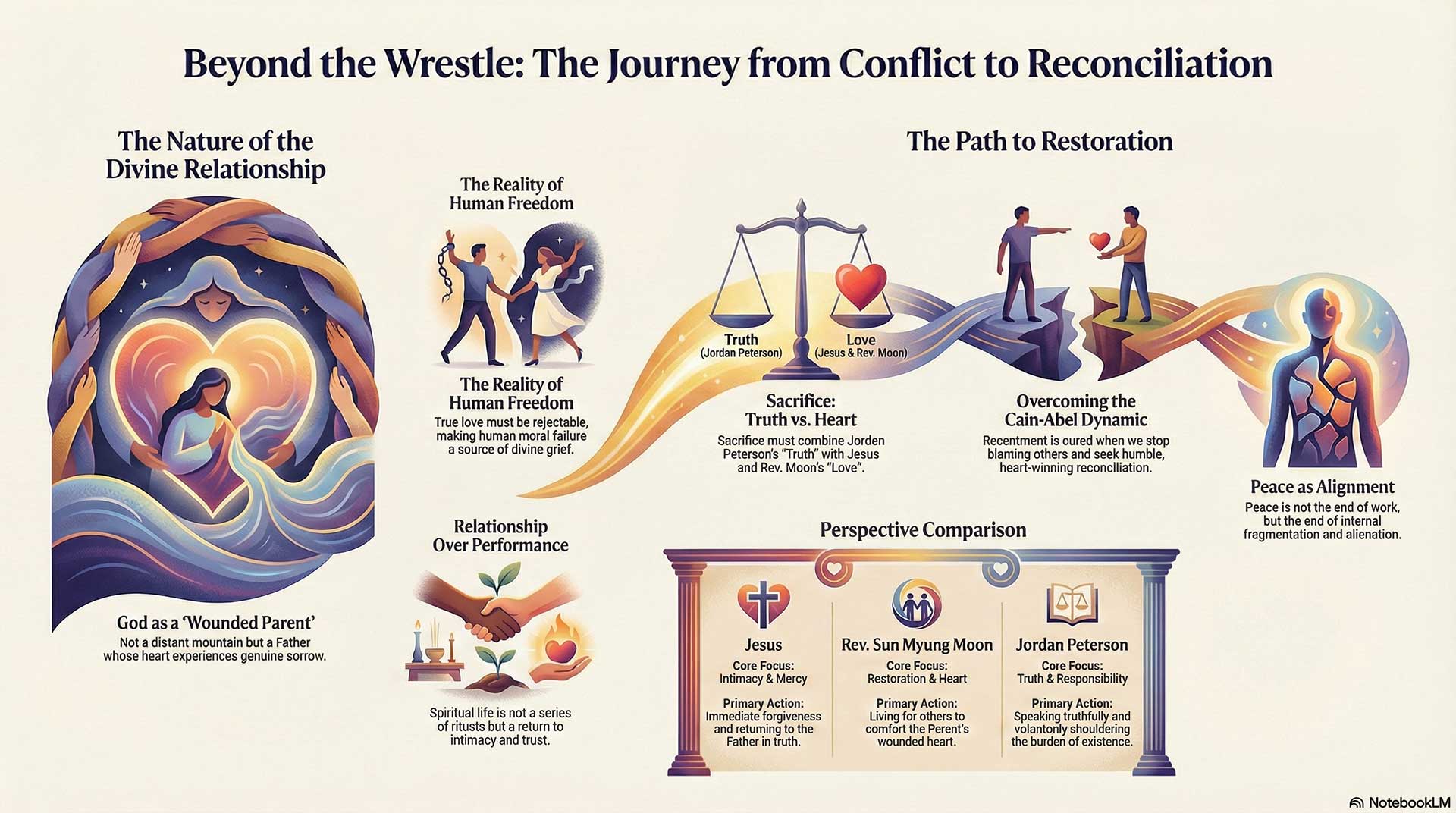
My dear friends, if you have listened closely, you will have felt it: this was never only a discussion about God. It was a discussion about what happens to the human heart when it believes it is alone—when it believes the universe is cold, when it believes pain must be repaid with pain, when it believes that having an enemy is the only way to feel clean.
And yet, from three very different directions, we have come to something that is almost scandalously simple.
Jesus speaks as one who knows the Father not as a theory but as intimacy—trust, obedience, mercy, return.
Rev. Sun Myung Moon speaks as one who cannot bear the thought of God as distant—he insists God is a Parent whose heart has been wounded by the sorrow of His children.
Jordan Peterson speaks as one who refuses the lie that life is easy—he tells us to face tragedy, to tell the truth, to take responsibility, to stop feeding resentment.
At first you might think these paths are competing. But if you listen with a generous heart, you begin to see how they can illuminate one another.
Truth without love becomes a weapon.
Love without truth becomes sentimentality.
Responsibility without mercy becomes hardness.
Mercy without responsibility becomes indulgence.
But when truth and love meet—ah, then something holy happens. Then suffering does not have to make us cruel. Then sacrifice does not have to make us proud. Then Cain and Abel does not have to be repeated in our homes, our churches, our nations, and our politics.
Because the deepest danger in our world today is not that we disagree. The deepest danger is that we dehumanize. We turn one another into symbols, into enemies, into scapegoats—and we call it righteousness. That is the oldest sickness. And it is why, again and again, God’s children make God weep.
So what do we do now?
We do something that sounds small but is in fact revolutionary: we come home.
We stop lying—especially the lies we tell ourselves.
We forgive—especially the forgiveness we keep postponing.
We take responsibility—especially where we have been blaming others.
We love in practical ways—especially when it costs us pride.
And if God is Father—if God is truly Parent—then we must dare to believe that the Father is not waiting to crush us, but waiting to embrace us. Not because we are impressive, but because love is what God is.
My prayer for you is this: may your wrestling not become your identity. May your wrestling become your road. And may the road lead you—not into endless conflict—but into reconciliation, into compassion, into the fearless truth that makes peace possible.
(Note: This is an imaginary conversation, a creative exploration of an idea, and not a real event.)
Short Bios:
Desmond Tutu — South African Anglican archbishop and Nobel Peace Prize laureate who became a global moral voice against apartheid and for human dignity, forgiveness, and reconciliation. As chair of South Africa’s Truth and Reconciliation Commission, he helped shape a model of restorative justice rooted in truth-telling, mercy, and the belief that every person bears sacred worth—often expressed through his warm, deeply compassionate theology and emphasis on ubuntu (“I am because we are”).
Jesus — A first-century Jewish teacher and healer from Galilee whose life and teachings (especially on the Kingdom of God, forgiveness, mercy, and love of enemies) became the foundation of Christianity. In the Gospels he speaks to God with striking intimacy as “Father,” calls people to repentance and inner transformation, and embodies compassion through service and self-sacrifice.
Rev. Sun Myung Moon — Korean religious leader and founder of the Unification Movement, known for teaching that God is a Heavenly Parent and humanity one family under God. Through the Divine Principle, he offers a providential reading of biblical history (Adam and Eve, Cain and Abel, Noah, Abraham, Moses, Jacob) emphasizing the restoration of love, lineage, and reconciliation through “living for the sake of others.”
Jordan Peterson — Canadian clinical psychologist and public intellectual whose work blends psychology, mythology, and cultural critique to explore meaning, responsibility, and suffering. Widely known for arguing that truth-telling, voluntary responsibility, and sacrifice are necessary for individual and social stability, he often interprets biblical narratives as enduring psychological maps of human nature and moral order.
Leave a Reply